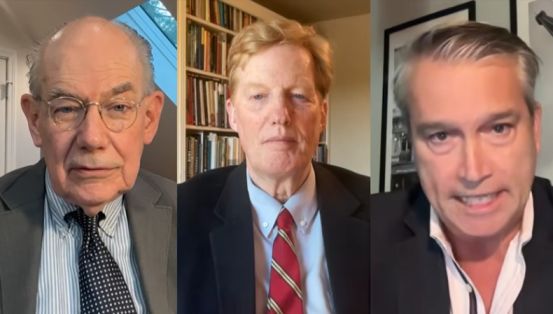
Editor’s Notes: In this episode, Tom Switzer hosts renowned political scientists John Mearsheimer and Joshua Landis to analyze the potential impact of President Trump’s naval blockade of the Strait of Hormuz following failed peace talks in Islamabad. Mearsheimer argues that the blockade is a “colossal blunder” that threatens to drive the global economy off a cliff while failing to break Iranian nationalism. Landis provides historical context on the U.S.-Israel strategy toward Iran and highlights how the resulting domestic inflation and high interest rates are damaging Trump’s standing with his own base. The panel also explores the shifting power dynamics in the Middle East, including the unexpected resilience of Hezbollah and the looming threat of a broader conflict involving Turkey and China. (April 13, 2026)
TRANSCRIPT:
Introduction
TOM SWITZER: Hello and welcome. I’m Tom Switzer. Always great to have your company. Now, today’s guests: Joshua Landis from the University of Oklahoma. Hi there, Josh.
JOSHUA LANDIS: Pleasure being here back again.
TOM SWITZER: Indeed. And John Mearsheimer, professor of political science from the University of Chicago. Hi there, John.
JOHN MEARSHEIMER: Hello, Tom. Hello, Josh.
TOM SWITZER: Now, Iran has failed to meet the US demands for a peace settlement. This was in Islamabad. And in response, President Trump has announced a naval blockade of the Strait of Hormuz. Now, these are for the ships using Iranian ports. Now, so we’re all on the one page, let’s remember that since the war— this was February 28th— Tehran has denied passage to most oil and gas tankers, and now the regime will get the same treatment. This is the argument, John. Will the US blockade work?
Will the Naval Blockade Work?
JOHN MEARSHEIMER: No, it not only won’t work, it’s counterproductive. And let me tell you why.
First of all, you have to understand that the United States and Israel represent an existential threat to Iran. And Iran is a highly nationalistic and tough-minded country. And when a highly nationalistic and tough-minded country faces an existential threat, it can absorb an enormous amount of punishment. So the idea that we’re going to get the Iranians to throw up their hands and surrender is not a serious argument.
Now, there’s another whole dimension to this. Why have we allowed Iranian oil out into the global oil market? Why have we removed economic sanctions from Iranian oil? It’s because we need that Iranian oil in the global oil market to stop the global economy from going off a cliff. Well, if we prevent that Iranian oil from reaching global oil markets, this is just going to threaten to do serious damage to the global economy.
And then there’s one final point. I’d be willing to bet that shortly the Houthis and the Iranians are going to shut down the Red Sea, and you’re not only not going to get oil and gas coming out of the Persian Gulf and fertilizers as well, but you’re also not going to get those products coming out of the Red Sea, and that’s really going to throttle the world economy, and that’ll force the Trump administration to finally concede defeat to the Iranians.
The Wall Street Journal’s Case for the Blockade
TOM SWITZER: Well, John, the Wall Street Journal editorial page, which you and I read almost every day, even if we disagree with it, President Trump also reads the Wall Street Journal because he attacks their editorials on social media. Now, the Journal over the weekend urged the president to do precisely this, that the US would quarantine all the ships transiting with Iranian oil.
Now, your second point there, I think, needs elaboration because we’ve discussed this before, that even as the US attacked Tehran during the war since February 28th, it was undercutting itself by encouraging the Iranian oil exports, which you just made. The question the Wall Street Journal might put to you is why should Iran alone be exempt from the costs of its illegal actions in Hormuz, raking in revenue while it starves the rest of the world? John.
JOHN MEARSHEIMER: It’s very simple. To keep the global economy afloat. I mean, we weren’t doing this because we were being benevolent or we were privileging the Iranians over the Saudis or anything like that. We did it because it was in our national interest. We did it because we understand that this whole war, once we didn’t win a quick and decisive victory as the Wall Street Journal and President Trump thought we would do, is in a world of hurt. And this could get really serious. We could create a global depression. And to avoid that, we’re allowing the Iranians to sell oil.
And by the way, Tom, as you well know, this is why we’re allowing the Russians to sell oil in global markets. This is why we took sanctions off the Russians as well.
TOM SWITZER: But the Journal would say to you, for the naval blockade to work, they’d actually concede that Trump must be willing to accept energy market pain.
JOHN MEARSHEIMER: Well, we’ll see how much energy market pain he’s willing to accept because he’s not the only player in this game. Every other country on the planet is about to absorb even more pain than they’ve already absorbed. And the telephone is going to be ringing nonstop at the White House from leaders all over the world telling President Trump with no uncertain terms that he has to shut this foolish escapade down before he drives the international economy off a cliff.
TOM SWITZER: Again, the Journal would say Iran has an incentive to restore traffic in the Strait, as does China, by the way. Their tankers have been given priority. So why should China get leeway and not the rest of East Asia and Europe? That’s what the Journal would respond to you.
JOHN MEARSHEIMER: Well, the Journal can say that till they’re blue in the face, but the fact of the matter is, the Iranians are in the driver’s seat here, and the Iranians have no intention of surrendering.
They’re going to play hardball.
You want to remember that it was President Trump who wanted this set of negotiations in Islamabad. It wasn’t the Iranians. And in fact, the hardliners in Iran said, don’t go to Islamabad. And if anything, their position is going to be reinforced by these failed negotiations. So President Trump has not improved his situation. And the idea that the Iranians are now going to surrender because we finally found this clever strategy is not a serious argument. This possible strategy was sitting out there for a long time. We never turned to it because almost everybody understood it wasn’t going to work, and it’s not going to work.
Joshua Landis on the Blockade and Domestic Pressures
TOM SWITZER: Let’s bring in Joshua Landis here about the naval blockade and John’s thoughts about the naval blockade. Josh.
JOSHUA LANDIS: Well, I think he’s absolutely right. This isn’t going to be able to— President Trump isn’t going to be able to endure this for long. Already we’ve seen how sensitive he is to inflation and higher oil prices here in the United States.
I’m a teacher at the University of Oklahoma, a red state, but my students are all complaining and they’re complaining in part because their parents are complaining because the cost of living has shot up. Interest rates have shot up and everybody is worried about how they’re going to pay their bills. And that’s right across the United States. And that’s going to be very painful. And I think politicians, especially Republican politicians, are going to be demanding that he do something to bring down those oil prices. And blockading Iran is going to have exactly the opposite effect.
How Did We Get Here? The History of the Iran Nuclear Deal
TOM SWITZER: Now, many Americans, indeed many people around the world, are probably thinking to themselves, how on earth do we get to this point where Iran would have a stranglehold over, or has capacity to have a stranglehold over an important energy gateway. Josh, let’s put this in a kind of historical context. I mean, why did Donald Trump in his first term scuttle the Obama nuclear accords with Tehran? That was in 2015. President Trump scuttled them in 2017. Why?
JOSHUA LANDIS: In the run-up to Obama, when it became clear that he was moving towards a deal, Israel began to panic. A number of top generals in Israel said, we do not want— we would prefer to have Iran moving towards enriching and moving towards a bomb than having sanctions lifted.
TOM SWITZER: Why?
JOSHUA LANDIS: They explained, because we can bomb Iran in the same way we bombed Iraq’s nuclear facilities, Syria’s nuclear facilities. We can bomb Iran’s nuclear facilities. But once sanctions are taken off, Iran will move towards 5 million barrels a day, 6 million barrels. They’ll become rich and they’ll become powerful in the region. We want them poor. We want to beggar them, and we’re willing to take the risk of their enrichment.
And I think President Trump fulfilled that wish and he took the deal off that we have to remember kept enrichment at 3.5% and offshored the vast majority of the uranium. It was a good deal. But the Israelis thought that they could get a better deal by bombing. And that’s exactly what’s led us to the bombing today, is that they set out this strategy over 10 years ago of let’s bomb rather than sanction. And now President Trump is trying to fulfill that obligation and Israel is pushing him to fulfill that obligation. And for many reasons, that’s where we are today.
The Nuclear Enrichment Question and the Islamabad Talks
TOM SWITZER: Plausible? John Mearsheimer.
JOHN MEARSHEIMER: Yeah, I agree with what Josh said. Just to piggyback on his comments, if you look at what Vance focused on in Islamabad, it was the nuclear enrichment capability. Very important to emphasize that Iran does not have a bomb and it’s not pursuing a bomb. And lots of people in authoritative positions fully understand that.
But what Iran does have is the ability to enrich uranium. And of course, if you can enrich uranium, it’s not that difficult to make a bomb. And what the Israelis want is they want to eliminate that enrichment capability completely. And that’s why they hated the JCPOA, because it allowed Iran to maintain a low level of enrichment capability, as Josh was describing.
Well, Vance at Islamabad focused laser-like on the nuclear issue, and he made it clear to the Iranians that they can’t have any nuclear enrichment capability. They have to eliminate it completely, and they have to give us the enriched uranium that they have. They have to give that up and give it to the United States. But the fact is the Iranians are not giving up their capability to enrich uranium. We’ve been down this road God knows how many times, and the Iranians simply won’t move off dead center. So JD Vance was wasting his time and that’s why the negotiations led nowhere.
The Strait of Hormuz vs. Nuclear Deterrence
TOM SWITZER: You know, many commentators have made the point that the Strait of Hormuz has more power than a nuclear weapon in many respects because it can hold the global economy to ransom. And the Iranians might be wise just to let go of their enrichment so that they can just have control over the Strait of Hormuz. John?
JOHN MEARSHEIMER: You can make that argument, but I think there’s no substitute for having a nuclear weapon. This is not to say for one second that the Iranians are pursuing a nuclear weapon because as I said, they’re not. But I’ve said on many occasions in the past, Tom, that if I were an Iranian, they would’ve had a nuclear weapon a long time ago. I think they were remarkably foolish not to develop one. And I think it is the ultimate deterrent. And as good as the Strait is as a deterrent, it doesn’t have quite the impact or the power that a nuclear deterrent would have.
The Broader Regional Implications
TOM SWITZER: Okay, Joshua, John has made the point several times on this program since February 28th and elsewhere that the goals of the war have hardly been met. The regime is surviving. The nuclear program or the enrichment of uranium will continue. So too are the ballistic missile programs. And of course, Tehran’s support for their militia proxies, Hamas, Hezbollah, and the Houthi rebels in Yemen. What does all this mean for the Arab states going forward, Josh?
The Arab World’s Fear of Instability
JOSHUA LANDIS: Well, the Arab states are terrified of the instability in the region. They’re terrified of two things. One is Israeli hegemony, and two is that the United States seems to be addicted to destabilizing the Middle East.
And if we look at during the Cold War, the many years, 45 years of the Cold War, America on average was attacking foreign countries about 2.5 times per year. Once the Soviet Union collapsed in 1990, that went up to almost 3.5, 3.7 times a year. And that’s about a 50% increase in the countries that America bombed or attacked or overturned.
And you have to ask yourself why, without a peer competitor, without any challenge to America, why would the United States go out and attack countries so frequently? And I think there’s only one answer to that, and that’s because we could. And we began to use our military and teaming up with Israel, of course, in the Middle East to attack one country after the next.
And after the end of the Syrian civil war, the overturning of Assad, the Gulf countries and other Middle Eastern countries were desperately hoping that stability could be returned to the Middle East. Here, President Trump has completely upended that, and Israel has upended that, not only in attacking Qatar, but then in attacking Iran, and attacking Syria and now Lebanon, taking a big hunk of Lebanese territory.
The Arab countries are trying to figure out how are we going to stop this? And there are two things I think you could say. One is the Arabs and the Middle Eastern countries have been so severely divided for centuries, for hundreds, for decades, excuse me, now. And that’s always left them weak and really at the mercy of foreign powers. They need to get organized.
And we saw that beginning to happen before the invasion of Iran. Between Turkey and Saudi Arabia, because the Shiite Crescent, or the Axis of Resistance, as it was called, led by Iran had collapsed, Syria had been overturned, Hezbollah had largely been destroyed. Turkey and Saudi Arabia were beginning to build their own sort of Sunni axis to try to contain Israel, because Israel had been partially contained by Iran because they were frightened of Hezbollah’s missiles and they didn’t bomb Iran. Because Iran had a deterrent in Hezbollah and in missiles. But once that collapsed, it was free for all. Israel could attack and take more Syrian territory, take Lebanese, take Iranian territory, and it’s begun to expand.
This, of course, is terrifying most Middle Eastern countries, and they’re going to have to figure out how do you balance, how do you create a deterrent and restore some balance in the region. And every time I go on Chinese TV, the Chinese of course ask this question perhaps pointedly, but in many ways I think the region is going to have to wait for China to be able to extend its power to the region in order to counterbalance the United States.
Because, coming back to the first point, we could attack Iran in 2003, in part because the Soviet Union was dead and we didn’t have to fear the Soviet Union countering us in places like Iraq. And until there is some fear of this kind of adventurism, of a counter to this sort of adventurism, the United States and Israel are going to continue to do what they want in the region. And that comes at a great cost, as we are seeing, to Saudi Arabia, UAE, and all the Middle Eastern powers who are paying a very high price for this instability.
Trump, Netanyahu, and the US-Israel Relationship
TOM SWITZER: But given that New York Times story by Maggie Haberman and Jonathan Swan, this was about a week ago, John, Trump might be entitled to be upset with Bibi Netanyahu for leading him down this path. Do you see America maintaining that close relationship with Israel, or do you see cracks already emerging in that relationship, especially given everything that Josh has just said? John?
JOHN MEARSHEIMER: Well, you would expect to see cracks emerging given what Josh said, which makes eminently good sense. But as best I can tell, there are hardly any cracks at all. It looks like Netanyahu and Trump remain joined at the hip. If you look at the negotiations that took place this past weekend, it’s quite clear that both the Israelis and President Trump were on the same page and they were giving directions to JD Vance about what he can do and can’t do. So I don’t see any fracture at this point in time between Bibi and Trump.
The Sunni-Shia Power Battle
TOM SWITZER: Josh, when we spoke in February with Vali Nasr on this program, this was just before the US-Israel attack on Iran. The consensus, and I think you reflected this consensus, was that the Islamic Republic was facing its gravest crisis. And that Shia Crescent that you just mentioned, so this is that stretch of land from Tehran in Iran through Iraq and Syria to Lebanon, that was severely diminished. I mean, but of course the Sunni Gulf states are severely diminished now too. So what does all this mean for the power battle between the Sunnis and the Shia in the region? Josh?
JOSHUA LANDIS: Well, it has shrunk in many ways. It’s shrunk because Israel is so powerful. It’s so overwhelmingly powerful. And we’ve seen that in its taking 600 square miles more of Syrian territory. Telling the Syrians that they cannot move their military south of Damascus, which is just a much greater territory, but then rolling up Lebanon, destroying all the villages in the south and bombing the bridges and really driving the government in Lebanon to the point of almost civil war. And that’s where we are today in Lebanon.
But Israel can do this. It can push these countries until they pop. In part because there is no counterbalance. And the United States is giving them complete wherewithal to do this. In Lebanon, they’ve got a complete pass. In Syria, they have not a complete pass, but they’re pushing the envelope all the time.
And we heard just — what’s the name of the fellow who resigned recently from counterterrorism?
TOM SWITZER: Kent.
JOSHUA LANDIS: Kent. Yes. He came out and said something that sort of shocked me the other day. He said the reason that Trump is leaving NATO is because then America can side with Israel when it goes to war against Turkey over Syria.
JOHN MEARSHEIMER: Wow.
TOM SWITZER: Now, with Turkey being a NATO member. Yeah.
JOSHUA LANDIS: Turkey’s a NATO member. Now, this perplexed me and I thought, can that be true? I’m sure there are many other reasons that are perhaps more important why Trump would want to leave NATO, but it makes you think, were there people in his office who were saying this? Was he hearing this at the upper echelons? Go ahead, John.
TOM SWITZER: John, yeah.
Israel’s Sights on Turkey — and Hezbollah’s Resilience
JOHN MEARSHEIMER: Yeah, just one quick point, then I’d like to ask Josh a question. Naftali Bennett has said this, the former Israeli prime minister, about Turkey on at least two occasions. The Israelis have their gun sights on Turkey, but they do. They have to first deal with Iran.
But here’s the question I have for you, Josh. If you look at Hezbollah between 2023 and 2024, it looked like the Israelis had pretty much finished Hezbollah off. But since this war between Iran and the United States and Israel has started, Hezbollah has weighed in in a big way and has performed in a remarkably impressive way. They’re beating up on the IDF south of the Litani River. And this was not expected. And they’re firing rockets and missiles in large numbers into Israel on a regular basis.
I thought that wouldn’t happen because of what happened in Syria. Syria was the conduit between Iran and Hezbollah. And I figured once Syria went under, that meant that Hezbollah would be badly weakened, and it had already been weakened by the 2023-2024 conflict with Israel. But apparently I was wrong. Can you tell me what’s happening here that’s allowing —
TOM SWITZER: Joshua Landis.
JOSHUA LANDIS: I think this is the sticks and stems of the Hezbollah rocket. I don’t think that they’re getting a resupply, a big resupply of rockets through Syria or anywhere else for that matter, because through air or over the sea, Israel can stop smuggling into Lebanon. I think these are rockets that remain there that have been pieced together, as well as anti-tank missiles.
But it underlines the ability of a country as weak as Lebanon is and a faction like Hezbollah that’s well-trained but doesn’t have a lot of money. One-third of the population of Lebanon is Shia and it’s living in the south, and their towns are being blown up one after the other. They can’t allow for themselves to be just steamrolled like this and destroyed. So they’re fighting with everything they have. And how long they can sustain it, it’s not clear.
But just yesterday, they laid down the Riot Act to the Lebanese government. And Israel and America have been telling the Lebanese government, the Lebanese army, you have to take care of Hezbollah or Israel is going to continue to bomb you and it’s going to bomb downtown Beirut. And Hezbollah just told the Lebanese government, we’ll overthrow you if you try to do anything like that. I mean, Lebanon’s disintegrating before our eyes.
And Israel can occupy it, but they’re going to have the same problem they had in 1982 when they occupied it. At the time, the Shiites welcomed them, because they thought they were getting rid of the Palestinians. But then Israeli troops had to start kicking in the doors of Shiite houses and searching everybody, and their resistance grew up and Iran funded them. But other Middle Eastern countries are going to do the same thing again because they don’t want to have their territory conquered.
And Lebanon has gone through it. Interestingly enough, the Lebanese have gone through a little bit what the Iranians have gone through, which is that when the country is being bombed so severely, it pulls the country together. And there is an element of Lebanese nationalism, which is extremely weak. And the incriminations against Hezbollah for shooting those rockets and dragging Lebanon into a war it cannot afford are severe. But still, the Lebanese see this gratuitous destruction and killing that’s going on in Lebanon and in Beirut, with entire apartment buildings that are 10, 12 stories high being brought to the ground and family after family being killed. It’s horrifying, people.
Can Israel Actually Win?
TOM SWITZER: John, Josh has said that Israel is so powerful, but you’ve taken a different view, especially since October 7th. I think you say that Israel is overstretched. It’s suffering, it’s on the cusp of suffering serious manpower problems. How do you square those circles?
JOHN MEARSHEIMER: Well, you want to remember Clausewitz’s famous dictum that war is an extension of politics by other means. And you can win lots of battles and you can win lots of military victories in the narrow sense of that phrase, but you could lose the war. And this is what happened to us in Vietnam. We never lost a single battle in the Vietnam War, but we lost the war.
And the same was true when we were fighting the Taliban. It was Bambi versus Godzilla, and Godzilla won every battle. And after 20 years, Godzilla left. Bambi won.
So the Israelis, without a doubt, have this incredibly formidable military, which, as you Tom pointed out, and Josh pointed out, is supported by the United States at almost every turn. We protect them diplomatically and we give them huge amounts of material. So they win lots of battles. They wreak destruction on countries all over the Middle East. There’s no question about that, but they don’t win.
And I would just point to Iran. They have lost in Iran. They do not have a winning strategy in Iran. And despite executing a genocide against the Palestinians in Gaza, Hamas is alive and it is in reasonably good shape. And Hezbollah, as we were talking about a few minutes ago, is in reasonably good shape as well. And as Josh pointed out, they’re talking about possibly overthrowing the government in Beirut.
This is not to deny that Israel has caused huge amounts of destruction in Gaza, in Lebanon, and in Iran. But they have not won any of those wars in any meaningful sense. And at the same time, this is all tearing apart the fabric of Israeli society.
TOM SWITZER: So much for Israel being so powerful, Joshua Landis.
The Turkey Question and Israel’s Next Target
JOSHUA LANDIS: Well, it does bring us to the Turkey question because once this situation calms down — and it’s not going to go away for a long time. This is clearly a struggle that is going to lock America into a very destructive and distracting foreign adventure for a long time. This is going to go on. It’s not a forever war because we don’t have troops on the ground, but it is a forever war because we’re going to be tangling with Iran now for years.
But Turkey — Israeli generals and defense officials have said Turkey is our next big enemy and they’re worse than Iran. And there have been many people saying they’re worse than Iran because they’ve harbored Hamas people. They have this rhetoric of anti — and Erdogan uses an anti-Israeli rhetoric in order to stir up nationalism and try to gain his position in the Middle East.
And so they have their eye on Turkey and on Syria, and that’s one of the reasons that they’ve been pushing into Syria and trying to divide and conquer in Syria, because they want to keep Turkey out and from consolidating its position. And they want to keep the United States from siding with Turkey against Israel in this tug of war for Syria.
China’s Role and the Blockade’s Implications
TOM SWITZER: What complicates things further is the role of China here, John. Where does China fit in here with the Strait of Hormuz? Because there was a recent report, a CNN report, that shows that US intelligence indicating that Beijing is preparing weapons shipments to Iran. What’s going on here?
JOHN MEARSHEIMER: Well, I think both the Russians and the Chinese have a deep-seated interest in doing everything they can to prop up Iran and make sure Iran hangs in the fight. Against the United States and Israel. So the word on the street is that the Chinese are sending air defense systems to help the Iranians deal with attacks from the IAF and from the US Air Force. And this is hardly surprising.
It’s also very important to understand that China imports a great deal of oil from the Persian Gulf. And if President Trump does put on the blockade, yes, how’s he going to deal with Chinese ships that go into the Gulf to get oil from Iran and bring it out? Is he going to board those ships and take them? Is he going to sink them? It’d be very interesting to see what he does.
TOM SWITZER: Also, General Jack Kane is suggesting, I think—
JOSHUA LANDIS: Sorry, Josh, if I can jump in for a second. You know, in 1953, the last time that we put a blockade on Iran — it was 1953 when the British led the charge in order to bring down Mohammad Mosaddegh, the nationalist democratically elected leader, in order to install the Shah. And America ended up with 40% of British Petroleum, which was the Anglo-American, the Anglo-Iranian Oil Company, which became BP. And America got 40% of the shares in BP because of that adventure.
But they put their shoulder to the wheel and we embargoed. And for $3 million, the CIA was able to overthrow the Iranian regime and install their man, the Shah. You look at that, fast forward to today and how much money, the billions of dollars, and we are not getting there. We haven’t overthrown the regime and we’re getting locked into this struggle. We’re going to place this embargo just like in ’53. But it shows you how the world has changed in just a short period of time and that America can no longer just overthrow these Middle Eastern regimes and come up with the kind of answers it wants.
Iran’s Control of the Strait and the Cost of War
TOM SWITZER: Yeah, but John, we had on this program last week your old PhD student, Rosemary Kalanick, and we were just discussing about if Iran does ultimately control the Strait of Hormuz and Tehran starts imposing a $2 million levy or toll on each tanker, the oil exporters and their customers in Asia and Europe could probably accept that price. Sure, it’s more than what it was before February 28th, but as long as the oil flows again, the cost may not be so high, right? So ultimately, having Iran controlling the Strait of Hormuz, that might be something the rest of the world could live with. John?
JOHN MEARSHEIMER: Well, I think that the rest of the world just may not have a choice.
JOSHUA LANDIS: The question is, how are you going to wrest control of the strait from Iran?
JOHN MEARSHEIMER: Because as we know, I mean, it’s common sense, the Iranians would be fools to give up the strait. You before, Tom, said maybe control of the strait is the equivalent of having a nuclear weapon. Making that comment tells you that the Iranians would be nuts to give up control.
I mean, what you need to do here is just work out some sort of modus vivendi between the United States, the Gulf states, and Iran so that the spigot is open, then oil can continue to flow out. If it’s a bit more expensive because of these extra dollars or yuan people have to pay, so be it. But people can live with that.
One other point here, Tom, is you want to understand that the Iranian demands are multifaceted. And for example, they want sanctions relief, but they also want reparations for all the damage that’s been done. I would not be surprised in some agreement down the road if they don’t get reparations, but people are willing to let them control the strait and treat it as a toll booth and then use that money to rebuild all the damaged infrastructure. So there may be an incentive, if you don’t want to pay reparations, to let them control the strait and treat it as a toll booth.
TOM SWITZER: Yes, but of course, if this plays out as you suggest, and that’s perfectly plausible, John, most people around the world, including a lot of MAGA Republicans, will then ask, what was the war worth doing in the first place?
JOHN MEARSHEIMER: Well, there’s a simple answer to that, Tom. It wasn’t worth doing. This was a colossal blunder. Trump made probably the biggest foreign policy error that any president has ever made.
TOM SWITZER: You know, even more than George W. Bush with the Iraq invasion in 2003, John?
JOHN MEARSHEIMER: Yes. I was just going to say the Council on Foreign Relations did this study a few months ago where they asked diplomatic historians what was the biggest foreign policy mistake that any president of the United States has ever made. And there was a clear victor. It was George W. Bush and the 2003 Iraq War that was considered the greatest foreign policy blunder the United States had ever made according to these diplomatic historians. Well, I think the Iran decision will leave the Iraq decision in the dust.
Political Fallout and Trump’s America First Base
TOM SWITZER: And you remember in 2016, I think it was at the South Carolina presidential primary, which is a home to a lot of US munitions and armaments and whatnot, President Donald Trump, then the Republican candidate, said that the Iraq War was a big fat mistake, and he distinguished himself from virtually every other candidate on the podium. And he won South Carolina. So how does this war and Trump’s handling of it play with Trump’s America First base?
JOHN MEARSHEIMER: Well, it plays terribly, but the fact is that President Trump is not running for reelection. And the question is—
TOM SWITZER: Through our congressional elections in November, John?
JOHN MEARSHEIMER: Oh, it’s going to hurt in the midterm election. There’s no question about that. And by the way, it’s going to do enormous damage to J.D. Vance and to Marco Rubio, who are considered by many to be the two sort of front runners for the 2028 election. But I was reading today where according to polls, J.D. Vance is the most unpopular vice president in the history of the United States.
TOM SWITZER: That’s very interesting.
JOHN MEARSHEIMER: Wow.
Trump’s Off-Ramp and the Path Forward
TOM SWITZER: Josh, bearing that in mind, but also knowing that only 1 in 3 Americans support the war and about as many support President Trump, very low poll numbers for the president. Trump obviously needs to end this war as soon as possible, but you said earlier this is going to drag on for a while. What do you think Trump’s likely to do? I know he’s talking about the naval blockade. There’s also talk about relaunching military strikes against Iran. Surely it’s in Trump’s best interests to do everything he can to shut it down.
JOSHUA LANDIS: It is. You’re absolutely right. And it’s clear that he’s looking for an off-ramp, but he’s embarrassed. He’s embarrassed because the off-ramp looks like a loss for the United States. And he’s trying to bluster his way through and get a better deal by this blockade. But the blockade, as John said, is likely to create more pain for the United States and the international community in the short term than it’s going to create for Iran.
And that because Iran sees this as an existential question. And it realizes that it has to just stick in its fingers and hang in there. And it’s willing to play this game of chicken with Trump. And I think that leaves Trump in a very bad position. And we’ve already seen him getting more and more upset, escalating, at least rhetorically escalating. And how does he stop doing that and switch to the other topics he needs to do? He needs to go to China. He needs to receive the King of England. He’s got a thick schedule coming up as we move into midterms. And this is just going to stick with him like a bad penny, and it’s not going to go away.
Final Thoughts: Long War, American Bases, and Mowing the Lawn
TOM SWITZER: And Donald Trump soon turns 80 years of age. John Mearsheimer’s final thoughts.
JOHN MEARSHEIMER: Yeah, he’s turning 80 years of age, and this must be taking a heavy toll on him. But I just wanted to make a quick point in response to what Josh said. I sometimes say, like you do, Josh, that this is going to be a long war, and then I correct myself and say it can’t be a long war for the reason that you said. And to just make a couple points here, I think that there’s going to have to be some sort of settlement so that we don’t tank the international economy. But I do think we will continue to be at loggerheads in some very important ways with the Iranians. This is a way of saying it can’t be a long war, but it can be a long war.
And my final point on this is I really wonder what’s going to happen to American bases in the region. As you both know as well as I do that we have 13 bases in the region and they all have been either destroyed or badly damaged. And the Iranians are insisting that we leave those bases and leave the Middle East with our military forces. And the question is, what are we going to do? Are we going to rebuild those bases? Or are we going to move to a different location in the Middle East? Or are we going to go home? And I think the answer to that question has a lot of bearing, Josh, on the question of just how ugly the long war that we were talking about will be.
JOSHUA LANDIS: But if we look at the other wars, you know, we look at Israel’s war in Lebanon, which has been going on for decades now, Gaza, Syria, we get back to this mowing the lawn concept, right? If you can’t beat them entirely, you just beat them down every so often. And Israel is likely to pursue that same strategy with Iran, and it’s been pursuing it, you know, with Stuxnet, with small attacks. And then they got the Samarkand bombing. And now we have this. America’s in it deeper.
And if we look at the policies that have been pursued in the region by the United States and Israel, it comes down to mowing the lawn. And that’s why it strikes me that it’s going to be very hard to get out of this because in a sense, Israel is going to feel compelled to constantly stick its long iron into the Iranian tiger there and cause this to continue boiling because the United States wants to make friends with Saudi Arabia, wants to move ahead with other relationships that can be damaging to Israel. And Israel’s not going to want that, whether it’s with Turkey, whether it’s with Saudi Arabia, and so forth. So this keeps the region fragmented, Israel strong, and the region weak.
TOM SWITZER: To be continued. Joshua, John, always great to be with you. Thanks so much.
JOSHUA LANDIS: It’s a pleasure.
JOHN MEARSHEIMER: You’re welcome.
Related Posts