Share & Care!
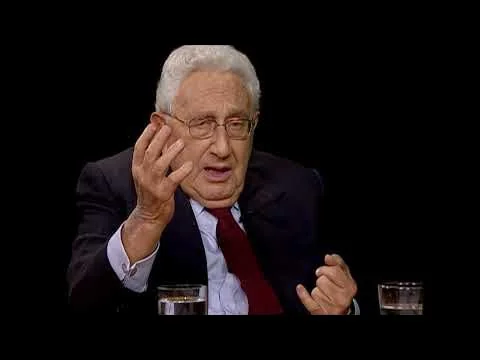
Read the full transcript of award winning journalist Charlie Rose interviews former Secretary of State Henry Kissinger on China, aired on May 30th, 2011.
TRANSCRIPT:
Introduction
CHARLIE ROSE: Henry Kissinger is here. The former National Security Adviser and Secretary of State has just written a new book. It is called On China. He writes both as a student of China’s history and the figure within it. He played a key role in bringing about the historic rapprochement between America and China that culminated in President Nixon’s visit to Beijing in 1972. Until then, the two countries had not had high level diplomatic contact for more than two decades. He will be 88 on Friday. He remains a presence on the global stage. His foreign policy views continue to be sought by leaders across the country. I am very pleased to have him back at this table. Welcome.
HENRY KISSINGER: Good to be here.
Chinese Historical Perspective
CHARLIE ROSE: Dedicated to Annette and Oscar de la Renta, your friends. There is much about history here and I want to come back to the German history. But do the Chinese have a larger sense of history than we do? Or is it simply their history is longer than ours?
HENRY KISSINGER: Their history is longer than ours, but they have a different sense of history. I mention in the book, for example, that when Mao notified his associates that he was going to go to war with India in 1962, he did so by invoking a war that had been fought between China and India in the Tang Dynasty, which was a thousand years earlier, and then another war that had been fought 600 years earlier. And he told his assembled generals, from the first war, you can learn these lessons. From the second war you can learn the following lessons. Not even Europeans who have a more developed sense of history than we do, would you find a leader who says, let’s learn the following lessons from Charlemagne and an American president who would say, we can learn the following lessons from President Polk. Yes, it wouldn’t be conceivable.
CHARLIE ROSE: Was it Zhou Enlai who said to you or to someone else that it’s too early to tell what the ramifications of the French Revolution are?
HENRY KISSINGER: That’s what is alleged. I don’t quite remember that. But people, it’s a good story, but what did happen to me was that, I think almost my first meeting with Mao, he said, let me tell you a story. He told the story of a Romanian emissary who came to Beijing and tried to compose the differences China had with Russia, saying they’re both Communists should work together. And Mao said, there’s no point talking about it because I will fight them for 10,000 years. So when the Romanians continue to protest, he said, okay, with consideration of your long journey, I will take a thousand years off. It will be 9,000 years. This went on until he was down at 7,000 years. At which point he alleged to have said, I’ve made my last concession. So then he turned to me and said, you see how easy it will be to deal with me. He said, every time I make a concession, it’s for a thousand years. But what he was really telling me is, watch out. If you quote me, you’ll be in a fight that will never end.
CHARLIE ROSE: Why did you start with this conversation with him and his top military leaders?
HENRY KISSINGER: To make this, that point, to make exactly this point.
CHARLIE ROSE: So to understand China, you got to understand.
HENRY KISSINGER: You’ve got to understand that here you have a people who have a historic place they come from, for whom what happened, in this case in the Tang Dynasty, is a living reality from which they can learn. So for one thing, they don’t forget many grievances. It’s a different perspective. We look at the future. Our golden age is ahead of us. In Chinese mythology, when they talk about their first emperor, the Yellow Emperor, he is reconstructing an already existing reality. Confucius, their basic philosopher, is trying to reconstruct a golden age that was in the past. It’s a different perspective.
Economic Success and Political Impact
CHARLIE ROSE: The question has often been phrased in terms of what will their economic success impact on their political life.
HENRY KISSINGER: Inevitably, the economic success started in a society that was largely agricultural. Every year, up to a hundred million people are moving from the countryside into cities. That means they are deprived of some of their roots and have to define a new relationship to the system and to where they live. In every other society, this has led to political adjustment. And it’s inevitable that in China, how to bring the new economy into relationship with a political system will be the big challenge of the next 10 years. And I say 10 years because a new administration is coming in next year whose term is 10 years.
Another fundamental factor that is occurring in China is the cultural impact of the one child family. Chinese culture has been based on large families in which many of the younger generation take care of the older generation. Now you have four grandparents competing for the attention of one child. So you have a much more assertive generation growing up and a huge social problem of how to take care of the older generation, which is growing. And the aging of China in about 10 years will be more significant than the aging in most Western countries.
Mao’s Legacy in Modern China
CHARLIE ROSE: What is their sense of Mao?
HENRY KISSINGER: That seems to change periodically. There was a period Mao was never totally discredited, but the memory of the Cultural Revolution was so alive.
Now there’s beginning to be a new appreciation of Mao, partly on the part of the younger generation, which didn’t experience the Cultural Revolution as their parents did. They see him as a symbol of somebody who unified China after many centuries, and in a way, an answer to the selfishness of the Yuppie generation that is emerging in China. This is not yet a dominant view, but my understanding is that taxi drivers have medals of Mao in their car. And he will probably be remembered like that because there was an emperor who unified China 2,000 years ago, who has always been greatly respected for the unification, but never been given full credit because of his brutality and something like that.
CHARLIE ROSE: So the question is, will they look at the brutality of Mao Zedong and say it dwarfs his achievements, or will they say the achievements have to be only understood in the context of the means he used to make them?
HENRY KISSINGER: I think the latter. What you are having now in, for example, in Chongqing, there is an ambitious party secretary who is one of the eminent leaders of the Communist Party, who has started a reform movement in Chongqing, directed against corruption, which is a general experience, but also trying to develop a legitimacy for the political system in which some of the Maoist patterns are resurrected. Patriotic songs, songs extolling the Communist Party and youth organizations that do that. And that is also partly, I think, a reaction to the phenomena of which we call the Arab Spring, to create an alternative legitimacy to the pluralistic democratic system.
US-China Relations
CHARLIE ROSE: You believe that it’s incumbent on the United States, in a sense, to make sure that the Chinese understand us and that we understand them, so that there is not a response of a kind of fear. And that and the absence of building a pacific community.
HENRY KISSINGER: No, it’s incumbent on both sides. I think both sides have a missionary origin. But the missionary quality of America is that we think anybody in the world can become American or can follow our principles so that we believe in universal conversion. The Chinese also believe they have universal values. But you cannot become a Chinese if you are not inside the cultural orbit of the Chinese.
So what the Chinese are looking for is majestic conduct, great achievement, which will then bring other countries into a relationship of respect towards China that was the origin of the tributary system historically. So if the American missionary concept and the Chinese perception of what they’re entitled to by their performance clash without the two sides having understood what they are facing, it would be very unfortunate for both societies and I think for the world.
CHARLIE ROSE: What’s clear in this book is that two points you make. Number one is whether Jiang Zemin or whoever has told you we will not be pressured to do what we don’t want to do. So one thing is they’re saying, looking forward, we have to understand that the Chinese, number one, will refuse to be pressured.
HENRY KISSINGER: Right. And also that the Chinese are realists, they understand reality.
CHARLIE ROSE: But that brings into question this idea of encirclement. How does the United States create a Pacific community without the Chinese believing that we’re trying to encircle them?
Avoiding Confrontation
HENRY KISSINGER: Both sides have the following fear. The Chinese have the fear that you described – encirclement and kind of military containment policy. We have the subconscious fear anyway of being pushed out of Asia and having an Asian bloc develop that we will then have to confront, which would lead to a sort of tension that would be very hard to keep under control.
The limits to China are not primarily a military problem. I think it is important for the United States to have good relationships with countries like India, Indonesia. But many of these relationships could be within a pattern that China too could participate in, of economic growth, of global economy, of education and cultural relationships. So that the military aspect of this confrontation is reduced and a context in which we and China find some things we can do together in order to avoid the danger that we think of each other as permanent enemies, in which case every action will be interpreted in strategic terms.
My appeal is as much to Chinese leaders as to American leaders to make sure that we both conduct policies that take into account the nightmares of the other.
CHARLIE ROSE: Is that happening today? We have these security and economic dialogues. We have a president.
HENRY KISSINGER: What is happening? First of all, I think the best thing that the Nixon administration did was not the opening as such, because that was going to happen sooner or later. We may have accelerated it somewhat. The best thing that was done in the Nixon administration is that we were prepared to put aside some of the technical issues and spent two thirds of our time when we met with Chinese leaders on genuinely explaining to them how we thought about international affairs and let them explain their view to us so that when a concrete issue arose down the road, we could put it into some framework.
That does not seem to me to be happening. What is happening is good communique drafting. I support the communiques that have been drafted. But then not much happens until another communique. So what should happen, what ought to be done, is to establish a permanent dialogue at a high level of making sure that we interpret events as they occur in a parallel way. And if we don’t, how we manage our disagreements, that we don’t wait for things to bubble up and then wind up in a confrontation.
It hasn’t yet really wound up in a confrontation. And I think it’s possible to achieve what I’m describing. But in each country there are trends that see the other as enemies. As I do not really doing a tour, but as I answer questions about this book, over half of them treat China already as an established enemy.
CHARLIE ROSE: Questions from American interviewers, from American interviewers.
HENRY KISSINGER: And from Americans groups and within China. I’m mentioning some of the books that are written in China that say this is going to be a final showdown between America.
CHARLIE ROSE: You cite the books and the authors that so clearly what you’re saying is there are people within both communities, the United States and in China, who look at this with a rather negative attitude and assume there will be a confrontation.
HENRY KISSINGER: Because there is competition and that’s unavoidable and the military strength of China will grow. But then the issue is how do they project it? Is it largely defensive, or will it do what the Soviet Union attempted to do of challenging the United States on a global basis? It’s issues like that that need attention.
CHARLIE ROSE: They have this twice a year, the security and economic dialogue with the top ranks of Chinese and US Officials, including the Secretary of State and the Secretary of the Treasury.
HENRY KISSINGER: I have supported that dialogue. And as you know, I have extremely high respect for both Hillary Clinton and for Geithner. But those are two day meetings. And what happens in practice, whoever does it, is that their staff papers being prepared. And almost invariably the issue will come down to what is the current problem that most needs attention rather than the.
CHARLIE ROSE: Long historical perspective as well as the risk that we are taking.
The Korean Peninsula and Northeast Asia
HENRY KISSINGER: The issue of Korea, which I mentioned a few times in here, you can look at this as an issue of nuclear proliferation, or you can look at it as an evolution of Northeast Asia. And until you get the second one understood, at least in some basis, the proliferation issue can’t be settled because right now the pressure required to get North Korea to give up nuclear weapons, it’s the same that will be required to overthrow them. It’s the one great achievement they’ve had. So it therefore opens up the issue of what is the future of North Korea that led to a war in 1950 when, totally unexpectedly, from an American point of view, the Chinese intervened because they considered North Korea so essentially. So how you can have a dialogue on a problem like this, that’s the unsettled issue. And I’m not saying that in opposition to the administration. I’m saying that in opposition to the way bureaucracies generally operate. And it’s not a philosophical difference.
CHARLIE ROSE: What is the most frequent question the Chinese leadership ask of you about America when you go?
HENRY KISSINGER: What I find in China is there’ll be three or four American individual events. You and I would know that these individual events happened at individual events. For example, I think in the fall of 2009, we sold arms to Taiwan. The President saw the Dalai Lama in the White House after his visit. And the Treasury Department raised the issue of currency exchange. You and I know these were individual actions. I say you and I because Americans would understand them as such. The Chinese put them all together and developed a theory of how this was designed not only to contain China, but to reduce its role in the world. So then they develop a counteraction to a perceived American effort that isn’t really a coherent American effort. Now, by the same token, we will look at some Chinese weapons program and say, well, this proves they’re getting more aggressive militarily, that they’re going to go after Hawaii next.
Human Rights and China-US Relations
CHARLIE ROSE: All right, so where do you put human rights in this context of China, US and the future?
HENRY KISSINGER: The fundamental Chinese attitude towards foreign pressures on human rights is at least twofold. First, they followed the principles that the west followed after the Treaty of Westphalia in 1648. For 300 years, when Europe was devastated as a result of a war in which countries intervened in the domestic structures of each other by trying to convert populations. So it was put, the principle was put forward that sovereignty means that foreign policy concerns only actions of states beyond their borders. This is a principle that all countries followed until the last generation. Really, we never followed it completely because of the special American circumstances.
The second Chinese view is that for 150 years after the opening up of China in the 19th century, the west intervened in Chinese domestic affairs. And that the essence of what China is trying to do is what Mao said on the first day of independence. China has stood up so that China will not let itself be lectured by foreigners. And I traced here when President Clinton, he tried for four years a very active sanction backed foreign policy and the Chinese on human rights.
On the other hand, the Chinese have to understand that America cannot be America without expressing its views on the importance of democracy and on individual transgressions of human dignity as we understand it. So we cannot stop having that attitude. But we can perhaps limit the pressures we generate as a result of this. The Chinese have to understand that this will be an American attitude and see whether we can find some area in between.
CHARLIE ROSE: So what do they say privately? Do they say we realize that we have. We take actions, including the imprisonment of a Nobel recipient.
HENRY KISSINGER: We realize that what they will say, I do discuss individual cases with them in private. And so I don’t want to go into that now. But as a general proposition, they will say we are trying to develop a more democratic base. We may have a different conception of democracy and they believe that they are moving in a direction which is compatible with at least some of our views. But on individual cases they will. Our views do not match.
CHARLIE ROSE: Why do you think they do it?
HENRY KISSINGER: They do it because the latent fear in China, if you look at Chinese history, it has alternated between periods of great cohesion and periods of disintegration. And when people speak of regime change, which our neoconservative wing, that’s really what they’re after. But for China historically, regime change has meant 50, sometimes 100 years of chaos. There hasn’t been a period of a smooth transition from one dynasty to some other government. So it’s always in China, the latent fear of chaos. In the 19th century there was a figure who claimed to be, I think it was the brother of Jesus who conquered central China, the so called Taiping rebellion. And 30 million people were killed before this thing had run its course. So that fear of chaos is always beneath the surface.
CHARLIE ROSE: There was. But you have said, as I understand.
HENRY KISSINGER: But I’m not saying we have to accommodate all of this. I’m saying we have to understand it.
CHARLIE ROSE: And you were on record now saying that they ought to release the Nobel recipient, are you not?
HENRY KISSINGER: Yes. I think it’s an unwise move of them.
CHARLIE ROSE: It’s more than unwise.
HENRY KISSINGER: I deplore it.
The History of US-China Relations
CHARLIE ROSE: Deplore it, isn’t it? Let me go to the history. What was the first conversations about China.
HENRY KISSINGER: That Nixon and I had? Yes, you know, it was a strange situation. I didn’t know Nixon when he appointed me.
CHARLIE ROSE: You’d work for Nelson Rockefeller?
HENRY KISSINGER: Yeah. I had worked for his principal opponent within the Republican Party, something I don’t believe could happen in the way politics is structured. Now, as it happened, both of us had come to the conclusion, although they.
CHARLIE ROSE: Would say the appointment of Hillary Clinton was some of that, you know, she was a principal opponent of Barack Obama.
HENRY KISSINGER: That’s true.
CHARLIE ROSE: Right, but go ahead.
HENRY KISSINGER: That’s absolutely correct. We both had come to similar conclusions. The conclusion was that when the world was in a kind of a turmoil as a result of the Vietnam War, the Soviet Union had just occupied Czechoslovakia. We both came to the view that the United States needed an alternative vision of world order than simply the Cold War. And we did not see how the Cold War could be conducted with the Soviet Union unless China was a part of it. But we had no idea, having come to that conclusion, what to do about it. So we were sort of fitfully talking about it and one occasion we found some Dutch diplomat who was traveling to China and we sort of gave him a half baked message. We never heard from him again. I don’t even know what happened.
CHARLIE ROSE: And then what happened in Warsaw?
HENRY KISSINGER: We, the Chinese, because of the Cultural Revolution, had recalled all their diplomats from around the world. So the only place where there was a diplomat, where there was also an American diplomat was in Warsaw, because in Warsaw we held formal talks at periodic intervals. So I instructed the American ambassador there, at the next social event where the Chinese was present, to walk up to the Chinese and tell him that we wanted to talk. The American diplomat, outstanding man, Walter Stoessel, thought this was a Kissinger invention and he didn’t get it through the channels, so he ignored it. So I made him come back and walked him into the Oval Office. And the President repeated the instruction, you.
CHARLIE ROSE: Are to tell the Chinese.
HENRY KISSINGER: And so he did it. So at the next party there is a report now that the Chinese had written, have written about the interesting thing.
CHARLIE ROSE: About this book, you now have access to Chinese thinking you did not have.
HENRY KISSINGER: At an early time, a lot of Chinese.
CHARLIE ROSE: We’ll talk more about that in a.
HENRY KISSINGER: Minute, including some on the Korean War. Really fascinating. So the Chinese reported their story that they saw the Americans looking over to them and they started. So they were afraid we’d come over and they ran away. And the American plus an interpreter ran after them and said, we want to talk to you.
CHARLIE ROSE: Our government wants to talk to you.
HENRY KISSINGER: That’s right, our government wants to talk to you.
CHARLIE ROSE: So here were you and Richard Nixon, the President, looking at Russia and saying, you know, that we can use China perhaps as an opening and sort of give us more leverage against Russia. All right, what you now know is that the Chinese and the person of Mao Zedong was having the very same idea.
HENRY KISSINGER: Exactly right. They came to the same conclusion, but.
CHARLIE ROSE: You didn’t know each other were coming to that conclusion.
HENRY KISSINGER: Not only didn’t we know we had come to the same conclusion, we didn’t know how to communicate it to the other. And we both made mistakes in doing that. We went to the most liberal Communists we knew, I mean, the most independent of Moscow, which was Romania, and tried to use them to arrange an opening to Beijing. But Mao didn’t trust any Communists, so that didn’t work very well. Mao thought he could use a journalist who we considered a fellow traveler as a sort of a messenger to us. But we thought he was just a propagandist. So it was like two ships passing in the night.
But when we go into how Mao got this view, how did Mao come to this view, which is sort of interesting? There were four marshals of the Chinese Liberation army, the People’s Liberation army that we had purged and that were working in factories, doing manual labor. He pulled them out of the factories, brought them to Beijing and said, write me an essay about the international situation. At first they thought this was might be a trick to get them to incriminate themselves. But Zhou Enlai convinced them that they ought to do it. So they wrote a paper, in effect saying you ought to open to the United States.
Then the question was, how do we convey this to Mao in a plausible way? One of the marshals said, tell him it’s like the Hitler Stalin Pact. Another marshal said, I have a better idea, and this is all from Chinese documents. He said, tell him this is like the chapter in the Romance of the Three Kingdoms in which state A moves against state B by using state C. And that novel was 600 years old, was banned in China. But they could be sure that Mao had read it many times. And so that’s what they did.
Understanding Chinese Perspective
CHARLIE ROSE: Help us understand what you have discovered about the Chinese. There is this sense we don’t want to be an imperialistic power, but we want to be an influential power that demands respect.
HENRY KISSINGER: Right? The practical effect of that is they want to be influential corresponding to what they consider their achievement. So that has to the traumatic experience in the history of the 19th century when for 2000 years they had been the greatest power that they knew in the world. And then suddenly foreigners come invading their country, carving pieces out so that a lot of not a lot, but some of our actions are interpreted of 19th century. Fourth, that their approach to strategy is different from ours, we segment the problem into constituent parts, and then we deal with experts on these constituent parts to solve it. They put all the things together so that economics.
CHARLIE ROSE: There’s a grand strategy of which all the elements flow into. It’s like all the tributaries flowing into one river of a strategy.
HENRY KISSINGER: Right. And now they are undergoing, as we are, in a less formal way. They have to define now that the first period that I experienced Chinese leaders, their primary concern had to be how to restore their domestic structure and their economy so that they could play a significant role.
CHARLIE ROSE: But what are the intentions? Fifteen years from now, when they have.
HENRY KISSINGER: The largest economy, they will have in statistics, the largest economy, but they will also have tremendous problems of urbanization, of aging, of the relationship between the cities and the countryside. So they cannot just translate their power into global adventures. And I don’t think that that’s the way they look at it.
CHARLIE ROSE: But have they lost any respect to us because of what they saw happen with the economic crisis?
HENRY KISSINGER: I think the biggest blow to our relationship has been the Chinese interpretation of our financial crisis. That we did not look at political matters in an identical way. That was apparent after the first years of the relationship. And they sort of understood that this was the case, but they did think that we had sort of a magic formula for economic progress from which they could learn and when.
CHARLIE ROSE: And they had in fact, from Deng Xiaoping formed.
China’s Economic Transformation and Global Perspective
HENRY KISSINGER: That’s right. And when, basically, when Deng Xiaoping said opening up and reform, which were his basic slogan, he really meant learn from the Americans. And he sent tens of thousands of students abroad. But then comes 2007, and it suddenly turns out that the American financial model that they had actually tried to copy in some respects started disintegrating in some of its assumptions. And that has not only made them lose confidence that we knew what we were doing, but those people inside the Chinese system who lean towards the United States had a lot of explaining to do, and we still suffer from it. I saw some commentary on the Chinese Five Year Plan, and I don’t pretend to be an economist, but that commentary said, don’t let the American seeming recovery fool you, because the west is trying to solve the current economic crisis by exactly the same message that got them into the crisis. And I’m not saying they’re right, but I’m saying that although they have, there is some merit in it.
Mao and Zhou Enlai’s Relationship
CHARLIE ROSE: Back to Mao Zedong and Zhou Enlai. How are they different? Why did they get along?
HENRY KISSINGER: How did they work together? Mao destroyed Zhou Enlai.
CHARLIE ROSE: I know at the end, Mao destroyed almost everybody, didn’t he?
HENRY KISSINGER: Right. No number two men to Mao survived. I knew a leader in another country once who was number two, and he said the trick was to be close enough to the number one so that no one else could come in between, but not so close that the number one felt threatened. Now, this man didn’t succeed either.
CHARLIE ROSE: So he lost out too.
HENRY KISSINGER: He lost out too. But Mao was a prophetic type. He had his own visions of a unique Chinese ethical mission. And he was assailed by his mortality so that he didn’t feel he could start this and let somebody else complete it. He had to try to complete it in his lifetime. Most revolutionaries that you can study in history have a specific goal, and when they reach it, they then institutionalize that goal. Mao didn’t want to institutionalize anything. He wanted permanent revolution. He wanted people to go through this process.
CHARLIE ROSE: But he wanted permanent revolution in China. It wasn’t that he wanted permanent revolution in the same way that Fidel Castro wanted to export revolution or…
HENRY KISSINGER: No, he didn’t want to export it, but he thought China would, very Chinese again, would be sort of an admired and therefore inspiration. For example, again in this Chinese document, some of which I quote here, in 1969, when he began playing, considering the idea of opening to the United States, he wanted to get an answer to the following question. He called in the head of the Australian Communist Party. He wanted somebody from the west, but he wanted to be a Communist. And he asked him the following: “I’m watching the student riots all over the world.”
CHARLIE ROSE: This was in 68, what he saw in France and everywhere. 68.
HENRY KISSINGER: 68. But I think the conversation was early 69. But around at that time, he called in that Australian leader and he said, “What we are watching here is this the beginning of a world revolution or the beginning of a world war? Does it mean that these student demonstrations will spread all over the world or is it the beginning of another world war?” If it’s… What he meant was this. If it’s the former, then we have to join the revolutionary movement. If it’s the latter, we have to protect ourselves against invasion. And he finally decided on the latter, but he spent hours with that Australian.
CHARLIE ROSE: Where do you put him as a man who was prepared to do anything for his vision of what his country ought to be, including killing millions of people?
Mao’s Legacy
HENRY KISSINGER: Yes. And secondly, did unspeakable suffering on his people. He killed or his policies killed tens of millions of people. The Cultural Revolution tore apart families because he had the idea that everybody should have years of working in the countryside to know how the ordinary people lived. But he also unified the country. He made China a major international player. He’s the only significant Communist country that survived the upheavals. And he switched in the middle of the Cold War to the winning side.
CHARLIE ROSE: The US, the west versus the Soviet Union.
HENRY KISSINGER: Yeah, but nobody else managed. So these were significant achievements. Westerners would say the suffering does not justify the achievement. The Chinese may make a different… May come to a different conclusion.
CHARLIE ROSE: And you suggested there’s increasing appreciation of Mao today.
HENRY KISSINGER: That seems to be the case. Seems to be.
Global Conflict Concerns
CHARLIE ROSE: Let me just speak to one… There’s so many things to talk about, but you mentioned this notion of worrying about uprisings leading to war. Where do you think today the most troubling possibility of war starting is in the world?
HENRY KISSINGER: The most troubling one that I see is Korea, which we talked about here before. That might occur if we wake up one morning and find that the Korean structure has… North Korea has disintegrated because it’s after all held together by one family that is going through succession crises. And that then would… And if that has not been considered before, that would trigger the concerns of all surroundings.
CHARLIE ROSE: Okay, but let me just ask you that. We know that they’re going to have a transition there and their leader is going to die because he’s widely known to be very, very sick. Right. Do the Chinese and the United States have conversations about, look, what happens if he dies? What are the possible scenarios and what do we do to avoid the worst?
HENRY KISSINGER: You have to consider South Korea. What will they do and what will they think? And how easy is it for the Chinese to talk about the disintegration of an ally for which they went to war 50 years ago? So it’s not a subject about which I can talk very, very freely. But I’m sure this is on people’s mind in both capitals. How they can manage to talk about that, that’s a tricky question.
The second area which I think has a danger of war… I consider dangers of war occurring when there is a situation that countries consider affects them fundamentally. But there is no understanding of what other countries planning to do, no framework for interpreting these actions. So Afghanistan after a withdrawal, after the withdrawal of Americans, which is almost certainly going to happen, and the interplay of Pakistan, India, and then eventually other countries there, like Russia, like Iran, like China, which is affected in them. So that’s an area where everybody has a common concern, but the situation is fluid. And for a variety of reasons, they have not been willing to come to a common understanding.
CHARLIE ROSE: Who hasn’t? You mean the Indians and the Pakistanis, which have not…
Afghanistan Challenges
HENRY KISSINGER: No, I… This is a view that I’ve advanced now for months. I think the solution… There’s no solution to the Afghan problem, but the way the transition from what we are doing to what will have to happen is not by way of negotiation with the Taliban, because the Taliban are a party to that conflict. And once we are out, they have no restraint on them.
I have experience with an agreement you make which you think you can enforce, and then it turns out you can’t in Vietnam. Now in Afghanistan, we won’t think we can enforce it by ourselves. So therefore, there has to be some understanding of how to keep Afghanistan from becoming again a terrorist base. And for that, the countries that are potential targets have to be involved.
The reason it doesn’t happen yet is that for the other countries, as long as we are there, they have no great incentive to commit themselves to anything. And on the outside, those who want to get out just are looking for any method that gets them out, like negotiation with Taliban.
CHARLIE ROSE: Then I’m confused. If you need for everybody to be involved in some coming together and understanding the risk, and you need those people to be engaged by this, but they don’t want to be engaged as long as we’re occupied, as long…
HENRY KISSINGER: As we are there, we have to convince them, A, that we’re going to get out, and B, that there is an interval in which we are prepared to adjust our withdrawal to an international status agreement for the region, which then everybody in some way manages to implement. Now, is that possible? I don’t know that at the beginning of a diplomatic process, you can’t tell exactly, but you can state you can think through your objectives.
Historical Analogies
CHARLIE ROSE: Okay, one last historical analogy. You point out the fact that the Germans developing economic power and the conflict with Britain took place, and you believe…
HENRY KISSINGER: We’re talking about Pre-World War I.
CHARLIE ROSE: Exactly right. And therefore you ended up with World War I. I mean, so what’s the analogy of that to the present relationship between China and the United States? China obviously is the developing economic power.
HENRY KISSINGER: Well, there’s, of course, there’s one difference. The Germans had not been, as a nation, a significant power. China thinks that it always was a significant power and it is restoring its historic position.
I think the analogy is that if the leaders of Britain and Germany in 1910, let’s say, had known what the world would look like after the war in 1919, would they not have tried to find some way of a parallel evolution? Because if the objective was to keep Germany from becoming its strongest European nation, that’s happened anyway.
But prior to World War I, the country that was most responsible, in my opinion, was Germany, because it pursued a military policy that directly challenged British command of the seas and it conducted a diplomatic policy which was based on humiliating other parties in negotiations in order to teach them that Germany was all powerful.
But in this case, we are starting with a cleaner slate. So we’re not in 1910, we’re at 1890. In that sense, I mean, we can still design a mutual approach. But I’m not saying, I’m not offering here a recipe of specific politics. I’m urging a way of thinking out of which we should then develop specific policies.
CHARLIE ROSE: And what’s the title of the last chapter? Does History Repeat Itself?
HENRY KISSINGER: Does History Repeat Itself?
CHARLIE ROSE: Here is the last paragraph. “In pursuit of understanding the nature of peace, I’ve studied the construction operation of international orders ever since I was a graduate student well over half a century ago. On the basis of these studies, I’m aware that the cultural, historic and strategic gaps in perception that I have described will pose formidable challenges for even the best intentioned and most far-sighted leadership on both sides. On the other hand, were history confined to the mechanical repetition of the past, no transformation would ever have occurred. Every great achievement was a vision before it became a reality. In that sense, it arose from commitment, not resignation to the inevitable. In his essay Perpetual Peace, the philosopher Immanuel Kant argued that perpetual peace would eventually come to the world in one of two ways, by human insight or by conflicts and catastrophes of a magnitude that left humanity no other choice. We are at such a juncture. When Premier Zhou Enlai and I agreed on the communique that announced the secret visit, he said, this will shake the world. What a culmination if 40 years later the United States and China could merge their efforts not to shake the world, but to build it.”
Thank you. Thank you very much, Henry Kissinger for the hour. The book is called “On China.” It is history, it is memoir, it is strategy, and it is insight into the people who made up China and the people who came from the United States to try to engage. And what the fears were and what the hopes were and what the events were that propelled history forward. Thank you for joining us. See you next time.
Related Posts
- Maggie Haberman: Trump’s ‘Unreality Bubble’ Meets the Midterms (Transcript)
- Transcript: President Trump Remarks on Healthcare, Sep. 18, 2026
- Transcript: Jonathan Swan’s Dive into Trump’s Reality: The Weekly Show
- Transcript: President Trump Remarks in Dublin, Ireland – Sep 12, 2026
- Transcript: President Trump Remarks at the Republican Midterm Convention – Sept 9, 2026