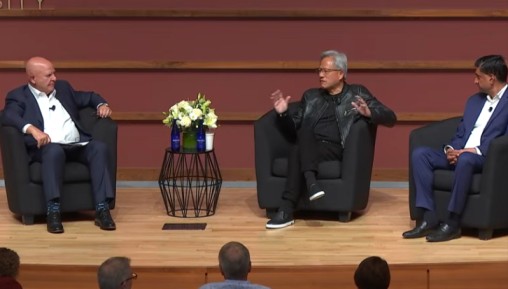
Editor’s Notes: In this event from the Stanford Graduate School of Business, NVIDIA founder Jensen Huang and Congressman Ro Khanna join General HR McMaster to discuss the critical intersection of AI, national security, and economic leadership. The conversation explores how the United States can maintain its competitive advantage by fostering global talent and funding research universities while also addressing the risks of “overregulation” that could stifle innovation. Throughout the discussion, the guests emphasize a “democratized” vision for AI that aims to bring industrial prosperity back to the American workforce and ensure the “American Dream” remains accessible in the age of intelligent computing. (April 17, 2026)
TRANSCRIPT:
Welcome and Introduction
INTRODUCING SPEAKER: Well, good afternoon, everyone. I’m delighted to see such a full house and delighted to have the opportunity to kick off what I hope will be an absolutely fabulous discussion. So we are gathering right now at a moment of extraordinary transformation in artificial intelligence. AI, of course, is not just reshaping business education, but it’s raising important questions about US leadership, economic and national security, and the future of work itself.
At the GSB, it is our responsibility to not only help our students to understand this technology, but to understand the broader context in which AI leaders, policymakers, and practitioners are making decisions. This is exactly why we are launching the Stanford Leadership Institute now. The institute brings together academics, policymakers, practitioners, and our students to help develop an understanding of the very context in which leadership takes place.
My hope is that today’s discussion will surface practical insights, raise important questions, and deepen all of our understanding of how we can responsibly harness the potential of AI while thoughtfully addressing its risks. We are thrilled to be joined today by our speakers. We have Jensen Huang, the founder and CEO of NVIDIA, Congressman Ro Khanna, who represents California’s 17th District, and General H.R. McMaster, former National Security Advisor and a senior fellow at the Hoover Institution and Freeman Spogli Institute for International Studies, who’s going to moderate the discussion. Please join me in welcoming these wonderful speakers.
Opening Remarks
JENSEN HUANG: Sorry, I’d shake your hand except Congressman—
RO KHANNA: You can be in the center. OK. They came here to see you.
JENSEN HUANG: I think this might be the hot seat.
RO KHANNA: I think I’ll sit over here.
JENSEN HUANG: I would shake your hand except I put some honey in my tea. And now everything’s sticky. And my first thought was, what, are you a child?
H. R. MCMASTER: Hey, well, it’s a great honor to be with both of you gentlemen and to be with all of you. Thanks for coming out for this panel discussion. It seems to me this is kind of like a setup for a joke. A washed-up general, tech innovator and CEO, and congressman from Silicon Valley walk into a bar. You know, what happens next?
So hey, why don’t we just jump right into it? There’s so much to talk about, obviously. And I really want to hear what’s on your minds in each of these general areas. But first of all, I think we can all agree that artificial intelligence-related capabilities are extremely powerful. They have huge impact across society. They hold great promise. They’re affecting the way that we wage warfare. And they determine, I think, whether or not we have a competitive advantage economically or militarily and from a national security perspective. Could I hear just both of your thoughts on how do we, if you agree, which I know you both do, that we should maintain our competitive advantage, how do we do it?
RO KHANNA: Jensen, why don’t you start?
Jensen Huang on AI and the Five-Layer Stack
JENSEN HUANG: First of all, I think it’s helpful to take a step back and ask ourselves, what is it that we did? We have reinvented computing as we know it. How software is developed, how software is written, what software can do, and how software is processed. At its most fundamental level, in a lot of ways, that’s all we’ve done.
Now, of course, the nature of computing also changed in the sense that the way we did computing in the past is what was called retrieval-based computing. All of the content was prerecorded. You wrote a story, you designed something, or you recorded a video, you recorded a speech, and you stored it on cloud databases and data centers. And based on how you clicked something or whatever the recommendation systems are and whatever the algorithms are, it would present that prerecorded content to you.
The way that computing is done today is called generative. It takes all the context, the prompt, your intentions, and it understands — because it now understands it. It can perceive, it understands, it reasons, and it could write your story, summarize, write software. And so the new type of computing is generative. It is therefore seemingly intelligent. But when you look under the hood and you open the data center and you open up your computer, what you see is software running on top of computers. And so this is a new type of software. It is incredible in that sense, but it’s no more incredible in that sense. It’s not an alien. It didn’t come from outer space.
And so I think that, number one, because of the nature of this new computer, everything about the computer industry has changed because it’s so capable and it could do such amazing things. Everything from the nature of companies, the position of companies, and the nature of data centers went from storage of files to now generation of tokens. And I call them factories. You turn electricity into tokens. It’s manufacturing something. The classical data centers used to be a file server. Now you have basically token generators. Well, that takes a lot of computers.
And so now the question is, what can it do?
Now, the implications to all the different industries we can go into a little bit later. So the first thing is to understand, number one, what is the technology? From an industrial perspective, what is it? Well, from an industrial perspective, because of the way I described computing, AI is essentially a 5-layer stack of an infrastructure. It’s energy on the bottom, chips next, infrastructure like a cloud AI factory, AI models, and then most importantly, AI applications. And those applications could be enterprise software or consumer software or drug discovery or robotics or manufacturing, so on and so forth.
These 5 layers, each one of them have industries and markets and lots of different companies. And I think the most important thing to take away is that if the United States wants to — and of course we do want to — stay in the lead, it is vital that we win in every single one of the 5 layers. And each one of the layers has its own issues. Each one of its layers has its own dynamics. Each one of its layers has different companies in it. But it’s completely vital that we enable every one of those layers to succeed.
And then finally, the single most important layer to succeed — and if this layer doesn’t succeed, the flywheel will never happen, and if the flywheel doesn’t happen, the technology will never scale, the industry will never scale — the most important thing is that the application layer is diffused into the United States, into society, into our industries, and that AI is actually being used.
If we cause ourselves, because of anything that we decide to do, to be so fearful of AI that we resisted it, that we regulated it out of society, we regulated it out of industry, and we slowed ourselves down — it would be really quite unfortunate that this industrial revolution that we invented, that we started, that we’re in the across-the-board leadership position in, somehow we didn’t take advantage of.
H.R. McMaster on Removing Barriers and Maintaining Competitive Advantage
H. R. MCMASTER: So if I were to sum up what you said, it is to really work on removing barriers to AI adoption, and think about how you can accelerate the development of the technology but then the application of the technology. And Congressman Khanna, what do you think are the keys to maintaining our competitive advantage? What are you most concerned about in terms of how we stay ahead?
Ro Khanna on America’s Comparative Advantages
RO KHANNA: Well, first of all, let me just say it’s an honor to be here, an honor to be here with Jensen. When I first met Jensen, his first question was, “Congressman, how do you understand Maxwell’s law?” And that gave me a pause, and then he proceeded to explain it very simply. And so he is someone who’s an economic patriot, and I respect him — even where we disagree, I’ve found him to be very thoughtful. And General, I’ve appreciated you putting our country first, and thank you to Stanford GSB for hosting us.
The first thing, in my view, that gives America a comparative advantage is that we have people from around the world who want to come here, study here, innovate here, be part of the research universities here. If you look at the AI startups, 60% of them have been founded by immigrants. If you look at the AI researchers, 72% of them did not have an undergrad degree from the United States. They had an undergrad degree from other parts of the world. 38% of them are Chinese nationals who came to the United States.
H. R. MCMASTER: I mean, making me think of Wang An, you know, the founder of Wang Computers.
RO KHANNA: Yeah. And so I believe there’s something not just about getting the world’s talent, but having the world’s talent interact with each other from diverse perspectives. That creates magic and innovation.
The second thing is our research universities, or where we are. We have 14 of the world’s top 20 research universities. You have Tsinghua and Peking University, 2 in China. We have 14. Now Nature magazine says that they have 9 out of the 10 top in quantity, but we still have the top quality in research. That’s not by accident. That’s because we’ve funded research universities. Of course, people remember it was at Stanford that because of NSF funding in 1969, you had the ARPANET internet from UCLA to Stanford. We need to continue to fund our research universities.
Third, I would say it’s our academic freedom. In our country, you could have any job and your view on war and peace or economics matters as much as a PhD, a congressman, or a president. And people are not afraid to say, “You’re wrong.” They’re not afraid to question authority. They’re not afraid to speak out. They’re not afraid to challenge convention. That is our comparative advantage. We need to keep that.
And finally, which is here at Stanford, the tech transfer program — the idea that universities can collaborate with the private sector. We have a magic formula with the government, universities, and private sectors working together. Those, in my view, are the fundamental principles that have allowed and will allow America to continue to lead, whether it’s AI or in other technology.
The Role of Economic Statecraft in Maintaining AI Leadership
H. R. MCMASTER: Well, to maintain competitive advantage, then we’re going to remove barriers to application, which can be emotional, attitudinal, and you’re emphasizing human capital, research funding, and really academic freedom. I think the power of our free market is part of that. Got to say that here at the home of Milton Friedman, here at the Hoover Institution.
But of course, there are certain actions that we have to take beyond even just funding research to maintain our competitive advantage — that involve not only really incredible innovators like Jensen and your team, but government policy. And so how do you view economic statecraft? What is the role of the tools of economic statecraft? I’m thinking in terms of an issue that you’ve had to confront directly: export controls, inbound and outbound investment screening, creating the right incentives for investment by maybe countering elements of economic aggression, dumping of certain materials to maintain a grip on critical supply chains, for example, but also deregulation and removing barriers that are really impeding us maybe from maintaining that competitive advantage at all the levels you described, from energy all the way through to application. But how do you view economic statecraft, really the role of government and government policy in maintaining this competitive advantage?
America’s Competitive Edge: Technology, Manufacturing, and Economic Strategy
JENSEN HUANG: Our situation is a little different than most industries. I would say that the computer industry, the computing technology industry, is one of America’s national treasures. Unlike all of the other industries, this industry leads the world. Between computing technology, of course, I’m at the epicenter of computer technology education. This is one of our nation’s national treasures, no doubt. The other one, of course, is our financial services industry, the backbone of the world’s economy.
Almost every other industry, we need subsidies. Almost every other industry, we need protection. These two, we don’t. These two industries, we thrive. We lead at a level that is hard for most people to understand. There’s no car company in history that has ever had 95% of the market. NVIDIA’s position in China was 95%.
And so in our particular case, it’s not a regulation, is not about helping us succeed. This industry was very successful. And so now the question is, how does regulation affect us? First of all, we want the United States, of course, to continue to be the world leader. We’re an American company. We want America to win. The question is how to do so in the nature of technology. And this is where we have to think about what is the essence of the technology.
When we talk about AI, what are we really talking about? AI is not a model. That’s not what AI is. Computing is not an operating system. And so it’s really important to understand what is the AI industry, how do we continue to nurture this industry so that it enhances our national security, so it enhances our economic security, so that we have a thriving industry.
If that’s where policy goes, to enhance those pillars, it’s really important to then take a step back and understand what is it that we’re regulating, in what way do we want to regulate, in such a way that we retain and maybe even enhance our global competitive advantage.
And so I think the mistakes that people have about thinking about AI is that AI is a thing. It’s an industry that’s 5 layers deep. And we have interdependencies with many of our adversaries. In order for the United States to advance our AI, we need our energy industry to grow. If we want our energy industry to grow, we need China. If we want our infrastructure industry to grow, we need China. And the reason for that is because the supply chain is so deep. We have so much dependency on them, on so much of the core industrial technologies that build up our industries. We just have to be thoughtful about all these different things. Think about the big picture. And ultimately optimize towards the United States, America winning, but not a particular industry winning or losing.
Reducing Dependence on China: Tools of Economic Statecraft
H. R. MCMASTER: Well, I’d like to ask you the same question, but maybe emphasize what you’ve been a big proponent of, which is to reduce our dependence on so much of the world’s manufacturing on the southeastern coast of China. And you mentioned that we need China to really maintain our competitive advantage. Which is kind of by design, I think, by the Chinese Communist Party and their policies to create the dual circulation economy, to get an exclusive grip on such critical supply chains and materials. You mentioned energy, of course, the reliance on batteries and turbines and so forth.
Congressman, what are your thoughts about what tools of economic statecraft could we apply to maybe, in the short term, do what Jensen is saying, which is maintain our competitive edge in any way we can. If it’s importing certain components from China, so be it. If it has to be that. But is there also something we can do longer term to reduce — what I would call the coercive power of the Chinese Communist Party over our economy?
RO KHANNA: Well, I agree with you. We can’t have China be the world’s monopoly when it comes to rare earths, when it comes to key starting materials for drugs, when it comes to active pharmaceutical ingredients. I mean, Jensen is right that the tech industry here and the financial industry here has been extraordinary, and America’s comparative advantage and one of the reasons we’re the world’s greatest economy.
But we made a colossal mistake in this country, hollowing out places where I grew up in Bucks County, Pennsylvania, where I saw steel shut down, where we saw the entire Midwest and so many places lose factory towns, lose industry. This idea that we could just be a financial nation, an innovation nation without having an industrial base was a mistake. It was a mistake for our national security, and it was a mistake for our social cohesion. And I would argue that we are still facing some of the consequences of that with the type of politics and anger we see in our politics, because a lot of people lost their pride. People who had served in the wars, whose grandparents served in the wars, who built America, suddenly we said, okay, go move. And if you can’t be in finance or tech, well, tough. And they said, no, we built this country.
So my view is we need a Marshall Plan, a 21st century Marshall Plan for America, new economic patriotism. Now that means, though, not just strategic tariffs. I’m for strategic tariffs for things not being dumped. But if you put tariffs on, for example, active pharmaceutical ingredients and you don’t have any industry here, what do the tariffs do? It just means the price is higher.
So we also need policies, an industrial development bank. Rafael Reif has this great piece in Foreign Affairs. He was a former MIT professor saying, let’s have investment in emerging critical technology to help it scale, to help build the new industry here, whether it’s rare earths, whether it’s critical minerals, key starting materials, robotics, whether it is in places where advanced steel, where we want to make sure we have some self-reliance.
And then I would enlist people like Jensen and others to say, help us, business leaders, help us reindustrialize Ohio, Pennsylvania, Michigan, parts of this country, but not with the stuff of the past, the things that we’re going to need for the future. And how do we create those jobs and industry? And I believe that can be a mission that brings this country together across party, across geography, and gets labor, business, technology, government all working in the same direction.
Reindustrializing America Through AI Growth
JENSEN HUANG: As the congressman knows, the AI industry’s growth is the engine that’s enabling the United States to reindustrialize chip manufacturing, computer manufacturing, and building all these AI factories. We are reindustrializing the United States. We’re creating so many manufacturing jobs and plumbing and construction, electricians and now, drawing tool outfitters. Their salaries are doubling, tripling. It’s fantastic.
But we need a thriving economic engine, a really, really strong, thriving economic engine so that American companies can afford to invest in the United States. We are going to invest half a trillion dollars in setting up manufacturing of chip plants and computer plants here in the United States. It’s not possible if we don’t have a thriving business.
And so one of the ways is to lean into this and help diversify our reliance of manufacturing and bring it onshore, create a much more balanced economy. We can’t just be all carbs. Our country needs to have a great labor force in the information area, but also in the manufacturing area, in the labor area, in the crafts. And so we have the opportunity now with a thriving industry to do that. And so everything that we can do to keep that industry, keep the industry thriving, is really a good thing to do.
Democratizing AI: Ensuring No American Is Left Behind
H. R. MCMASTER: And maybe what government can do is incentivize the kind of investments you’re talking about and obviously create the thriving economic environment that generates the capital that allows you to make those investments. I think, Congressman, what you’re talking about is a transition in the global economy that occurred really largely after China’s entry into the WTO, in which many Americans benefited from that transition because of cheap goods that were available from China. But many Americans were left behind.
You’ve talked a lot about democratizing AI, Jensen. You’ve talked a lot about encouraging adoption across the whole economy, which I think is a very similar theme to this idea of democratizing AI. In your recent paper, you talk about not having AI concentrated in the hands of a few billionaires, present company excepted, but getting it to everybody. So what I’d like to ask both of you is, what are your ideas about how can everybody come along? But this gets to your point too about the doom scenario, right, of people losing jobs and so forth. How do you, to use your term, democratize AI? How do you ensure that this massive transition you’re talking about, an opportunity, doesn’t leave Americans behind and allows Americans all to benefit from the technology and its impact across so many different sectors?
RO KHANNA: Well, I start with the premise that if America has been good to you, you need to do good for America. America has been very good to the three of us on this stage. We have been able to, in our own ways, live the American dream. One of the things that I respect about Jensen is that he has talked about having a sense of social contract, of an obligation to contribute back to the state, to the country.
And there has to be a recognition of how a lot of folks in East San Jose, or where I grew up in Bucks County, see the country. They see 19 billionaires — I don’t know if Jensen’s one of the 19 — but who have literally $3 trillion, 12.5% of the GDP. It’s triple the wealth concentration of the Gilded Age. And 70% of Americans don’t have a view of the American dream. We’ve got massive economic inequality.
And you know what? They don’t trust us. Even though we invented AI, the highest skepticism of AI is in America. And why is that? Why is it that other countries are more trusting of it? Because they don’t trust the elite. They don’t trust the people in Congress. They don’t trust the president. They don’t trust the business leaders. They don’t trust media. They feel like we have not delivered for them.
So we have an obligation to figure out how we’re actually going to get this AI revolution to work for everyone. And I can go into things in detail, but two places in my view that are so important is to have a jobs program, a commitment to jobs. Now I was at Brown University the other day, and I said, how many people are concerned about jobs? And 80% of the hands went up. When this was an issue that William Julius Wilson was writing about in black inner cities, few people cared in America. When Deaton and Case started writing about it in white working class areas, more people cared, but not enough. Now you’ve got Brown graduates’ kids having this issue. So there is an opportunity.
H. R. MCMASTER: Better them than Stanford, I’d say.
RO KHANNA: I mean, Stanford won’t admit it. But we have an opportunity to have the most patriotic affirmative jobs agenda in this country, where we could say with the federal government that for young people coming out, we’re going to hire you. You can work to rebuild your community. You can rebuild — I was just at a park. You can help do that. Counseling, you can help in the care economy, you can make local government more effective, or you can come to the federal government, do a moonshot, build —
H. R. MCMASTER: You could join the Army.
RO KHANNA: I mean, but that’s, as you know, it’s 1%, right?
JENSEN HUANG: Yeah.
RO KHANNA: But I want to have some sense of giving back, even if you don’t do that. And we work with the business leaders, right? I mean, Jensen has worked — NVIDIA — we’ve been creating these partnerships with HBCUs. You could join something like that where you get these skills. And let’s figure out how we take this moment of anxiety where the reality is no one knows what the disruption will be, where the new jobs will be. Jensen talks about the radiologists having more demand. I would have never guessed that. We need to have humility. We don’t know.
But we can take this moment to say we are going to have an affirmative jobs agenda that’s going to give people a sense of rebuilding their communities in the country, working for America, bringing this country together, and maybe giving some new national purpose to this country. And that to me would be one constructive response to this fear of AI and technology.
The Narrative Around AI and Jobs
JENSEN HUANG: Well, I say to everybody, move to California and don’t leave. It’s the highest taxes in the world, but it’s OK. But the weather is great.
RO KHANNA: And a great member of Congress.
JENSEN HUANG: Great congressman. First of all, I think the narrative of AI destroying jobs is not going to help America. First of all, it’s just false. Of course, with every technology and every single day that goes by, jobs of the past are changed.
H. R. MCMASTER: Would you mind mentioning — Ro mentioned this — would you mention the example you’ve quoted before about radiologists? Do you mind sharing that with the audience? I feel like it’s a great example.
AI, Jobs, and the Future of Work
JENSEN HUANG: At the beginning of the AI revolution, one of the smartest and most influential computer scientists and one of the fathers of AI, modern AI, said that in 10 years’ time, the one job you don’t want is radiology. And the reason for that is in a decade, AI is going to completely revolutionize radiology. It will permeate every aspect of it. It will automate radiology and reading scans. Radiologists will be obsolete. This is the one job you shouldn’t go after.
Well, a decade later, he was completely right. AI has completely permeated through every aspect of radiology. Every single radiology scan is now assisted by AI, and the number of scans that are being studied by AI has gone through the roof. He’s completely right. The part that was exactly opposite is the number of radiologists increased.
And so the question is, why is that? It makes absolutely no sense whatsoever that the task that the radiologist does, radiology, was completely automated and why would they need more radiologists? And the reason for that is obviously very clear. And most mature people, when you think through it, your job— the purpose of your job and the tasks that you do in your job are related but not the same.
And using myself as an example, if they were the same, then somebody would observe that what Jensen does really for a living is typing and talking. And typing and talking have both been automated to a superhuman level by AI. And yet I’m busier than ever. I’m busier than ever. And so I think the first thing is to separate those two ideas.
Now what’s amazing is this. Then you say, why did I say we actually did harm? Well, telling people who want to go into radiology that the future of radiology is dead caused the number of people who are developing a career in that field to decline. And so now look what happened. We need more radiologists than ever and we don’t have enough.
The purpose of radiology is to help diagnose disease, work with patients, work with doctors, diagnose disease. They’re able to admit more patients, study, scan, do more scans, do a better job with healthcare. The hospitals are making more money. They notice that radiology department is doing incredibly well. They hire more radiologists so they can increase their revenues. Take care of more patients. That flywheel is only sustainable if we have radiologists, software engineers.
Somebody said that AI is going to destroy all of the software engineering jobs. Well, as it turns out, we now have agentic AI inside NVIDIA. It’s everywhere. Every single software engineer is using it. And the one thing that you will observe— two things you observe.
Number 1, the software engineers that know how to work with AI are the most popular software engineers. The software engineers that know how to use AI, know how to use agentic systems, working with agentic systems are the most popular and the most successful.
Number 2, the software engineers are busier than ever. And the reason for that is because back then they used to have an idea and they would code it and it would take time to code. Now we have an idea, it takes no time to code. Now all of a sudden the company is waiting for you for the next idea. So you’re in the critical path all the time.
And so what we see is agents are contacting software engineers perpetually in text. What’s the answer for my next thing? What’s the answer? What do you want to do now? I just fixed that, what’s next? Your agents are harassing you, micromanaging you, and you’re busier than ever. And yet our company is able to do more. We’re doing things faster. We’re doing it at a larger scale. We’re thinking about doing things that we never imagined.
And so here’s the fundamental flaw. And it drives me nuts that it’s not obvious. The fundamental flaw is that there are people who think that NVIDIA has to write— we have to code, pick our favorite number, a billion lines of code a year. That if we just finish coding 1 billion lines of code, job done. That’s the definition of a year. And so if we have AI automate that 1 billion lines of code and instead of having 10,000 people do it, it only takes 1,000 people to do it, all of a sudden, 9,000 people are unnecessary.
Well, it turns out a billion lines of code was all we could do with those many people in the time that we had. I have dreams to write a trillion lines of code. And so the fact that we now have AI assistants help us, we could explore more space, do better work, do things at a greater scale, do things more cost effectively. Do things better. And so the jobs didn’t disappear. The task was automated.
Now, of course, there are some jobs where the task is exactly the same. And those jobs where the context doesn’t matter, the world’s always exactly the same, then I think those jobs will be affected. But it is very likely that overall this is not even. With all technology evolutions, it’s not even, but overall, my sense is, my belief is, we’re going to create more jobs in the end. There’ll be more people working at the end of this industrial revolution than at the beginning of it, just like at the end of the last one, the beginning of this one.
Workforce Adaptation and the Risk of Inequality
H. R. MCMASTER: I have a question later on workforce adaptation. I know you’ve done a lot of thinking about this as well. Do you want to just follow up on that, Ro?
RO KHANNA: I mean, I think Jensen’s view of abundance in some ways is correct. John Maynard Keynes had that famous article about how his grandchildren would only be working 15-hour work weeks. And he was right about the productivity increases and the increases in output. But what he was wrong about is that people would not just be content with the life of a British nobleman. We wanted indoor plumbing. We wanted to be able to fly places. We wanted this thing called a smartphone. So it is true that human demand, human desire is proven to be infinite, which creates more jobs.
The problem is when you look at the Industrial Revolution or you look at these technology eras, even if years later we end up with a lot of jobs, there have been massive times of inequality, massive times of job loss for the most vulnerable, massive times of workers not benefiting. And so my view is that what we need to do is think about how in the adoption phase workers have ownership, workers have bargaining rights, workers have an ability to get some of the gains of the productivity, that it’s not just going to the capital class, especially when AI is by definition capital biased.
And that we’re thinking about the entry-level folks and people whose jobs may be automated and thinking smartly about how we adopt it so you don’t have 4 million truck drivers out of work or you don’t have young people 3, 4 years out of work. And that needs to be a concerted effort with government and business leaders, universities to do that. I don’t view that as being an AI doomer, not an AI accelerationist, I’m an AI democratist. I want this technology to work for everyone.
JENSEN HUANG: There’s no question that bringing everybody along is really the single most important thing to do. And the fact of the matter is, it is unlikely most people will lose a job to AI. It is most likely that most people lose their job to somebody who uses AI. And so we have to make sure that everybody uses AI.
It is also the case— you hear many examples of this— where somebody used to be a carpenter, but because of AI, they’re now an architect. You could describe things into AI and it comes out with an incredible design, incredible draft, and they can be interior designers. And so they elevate their craft, they elevate their service and elevate their business to a level to be able to offer more.
And so I think the first thing that we have to do— and you’re exactly right— we have to make sure that people understand that AI is not this incredible technology that nobody knows how to use. AI is an incredible technology that everybody should know how to use. It’s the reason why it’s the fastest adopted technology in history, because it’s so easy to use. And so we have to lower the barrier of it. We have to demystify it. We have to make sure that people aren’t afraid of it so that they take advantage of this tool to enlighten themselves, to enable themselves.
AI Regulation, National Security, and the Dangers of Overregulation
H. R. MCMASTER: Okay, I want us to talk more about the impact of AI on certain sectors, the promise of AI. But before that, let’s talk a little bit about the dangers. We know that this is a competitive space. We know that adversaries, potential enemies are adopting AI and applying it to warfare. And of course, there’s going to be a desire to regulate it or to put guardrails in place. We saw this with the Anthropic Department of War kerfuffle, in recent weeks.
RO KHANNA: Kerfuffle is diplomatic for bullying by the Secretary of War. Right, right, right, right.
H. R. MCMASTER: So, when you sign a contract with the Department of War, what did you think it was for? Anyway, that’s just a side. So, of course, if you want to regulate something, you need all parties to the competition. And this is a competition, this technology, to sign up for it. I don’t think our— what I would call the axis of aggressors, Russia, China, Iran, North Korea— I don’t think they’re going to sign up for whatever program we put into place.
What, from your viewpoint, from a security perspective, an international security, a national security perspective, is sensible in terms of guidelines, protocols, to cope with the misapplication, the dangerous application of artificial intelligence-related technologies?
RO KHANNA: First of all, in my view, we need a combination of protected frontier models, but also open source. I mean, you have China having Qwen, right? And Qwen— they don’t have Qwen’s most sophisticated models being open source, but they have Qwen, which is a cheaper model, being adopted. I don’t want America not to have our models be a standard adopted across the world.
But you could have a standard that says if you use a certain amount of compute power for training, if you have a certain amount of power in terms of the use of a frontier model, then we’re going to make sure it’s regulated in terms of the export control, but we’re not being open source. But we’re still going to compete on certain open source models so that we still have American standards across the world and don’t cede the market to China or to Qwen or other models that they may come up with.
And the second thing I would say is we shouldn’t have a race to the bottom. When I think of American AI, I think American AI should be excellent AI. We should be the AI where when Europe buys it or Asia buys it, they know it’s safe. They know that the agentic AI isn’t going to do crazy things. They know that the agentic AI isn’t going to engage in surveillance or violate privacies, that American AI is going to have American values.
When I was growing up, you used to buy American. And you knew the stuff would work. And people would say, “Yeah, I want to buy American.” That’s what I want for AI. I want America to have the best. And that means having well-crafted regulations. It doesn’t mean no regulations. Every time I get on a plane, I’m really glad we have regulations. I don’t want a world where we don’t have regulations. And so we can have it for the FAA. If we can have it for nuclear energy, we should be able to have it for AI. But not in a way of stifling innovation— encouraging the standards for our AI to be the safest, the best, the least violating of privacy.
H. R. MCMASTER: So, Jensen, I’d like you to comment on this from the perspective of maybe what you see as dangers of overregulation as well. I mean, the European model doesn’t seem to be working in terms of incentivizing the kind of innovation we see in this country. And then we had the Mythos issue the last couple of days, 24 hours, I guess. And is that a concern for you, or do you think that, in terms of regulation, or do you think this is the free market working? This is American ethics working in terms of the release of a tool that could readily and immediately identify zero-day vulnerabilities.
Balancing Regulation, Trade, and the American Dream
JENSEN HUANG: We should regulate applications as rigorously as we regulate applications, industries, and use cases. We just have to be mindful about premature regulation. And so you have to decide — and this is the wisdom and the judgment of different cultures. Some countries tend to regulate after something happens and as they see something happen. Some countries tend to regulate before anything can possibly happen. And so they both have their risks, and you have to decide: what is the consequence you want to endure?
Do you want your society and your culture to have absolutely no harm come to them, and therefore they take no risk at all, and the industry therefore is suffocated? Or do you want to take a little bit too much industry, got things to mop up? And so I just described in fact two different regions — not the United States. The United States is still kind of somewhere in the middle, but two different countries in two different regions that have different cultures that way.
With respect to technology regulation, I think whoever the country is that invented the technology and owns the industry has the right to decide whether they give their industry head start benefits. And the thing that you have to be mindful of with head start benefits versus no access regulations is you have to think through the ramifications of your decision.
You know, it turns out that a lot of countries we depend on — it turns out ASML is not an American company. And it turns out just about every one of our energy sectors rely deeply on technology and minerals and whatnot that comes from China. And so depending on what game we want to play, we just have to realize we’re in an interdependent world. And when you’re in an interdependent world and there are no absolutes — this is like we’re not playing tic-tac-toe. The world is a lot more complicated than that.
And we want to simplify the world into, “I’m going to keep everything to myself. I’m going to take my marbles home. You’re not going to get any of it.” And you just have to be a little careful — they have some marbles too. And so in these interdependent worlds, having a big picture understanding of how the world and the systems work is helpful, number one. Number two, having maturity and balance — helpful. Having nuance — helpful. Having a long-term mindedness — helpful. And so these things ought to be taken into consideration, but the idea that I’m going to shut you off and expect that there’s no repercussions is a bit naive.
H. R. MCMASTER: So you’re saying don’t take the ready, fire, aim approach. You’re saying it’s better to think through the consequences.
JENSEN HUANG: Unintended consequences is hard to extrapolate in technologies that are moving as fast as AI.
The Role of Government, Private Sector, and Academia
H. R. MCMASTER: Well, and this is a big point on regulation, I think. I’ve heard this metaphor before — that trying to regulate AI is like trying to ask the Wright brothers to first develop the maintenance manual for a 707 before they further develop the airplane. But there is a role certainly for government, as you mentioned, Ro — the government working together with the private sector. And I would include academia here, the role of the university, which you mentioned as well.
Can I just get both your top-level thoughts on how you see the roles — you mentioned we have to work together internationally, we have partners we rely on. But how about just within the United States — the role of the public sector, private sector, and academia in maintaining what is the theme here, our competitive advantage?
RO KHANNA: Well, it’s the absolute key. And my view is that we should be working to set up jobs programs across the country where you can have colleges and community colleges working with industry, funded with government, so that people have an understanding of technology and an understanding of the different opportunities — whether it’s trade schools, whether it’s a 4-year degree, whether it’s not a 4-year degree — in terms of having high-paying jobs. We want to be funding, of course, the research. We want to be opening the universities to the talent from around the world, not restricting ourselves.
And more broadly, Jensen mentioned that we can’t decouple, and I agree with that. But I think the challenge has been we had unfettered globalization. We had basically for 30 to 40 years capital saying to the state, “You don’t matter, we’re going to go wherever we want.” And that didn’t work for America. It didn’t work in a lot of places. And people said, “You know what, we can’t have just capital dictating the shots. We’ve got to make sure that we have industry, we have community, we have some self-reliance.”
But in doing that, we don’t have to go to the extreme that we see today, which is a sense that America is just going to turn inward, to reject immigration, to reject cooperation with other nations. One can view China as having a monopoly on rare earths and say that’s not right and we need to rebalance — but also say we don’t want a Cold War with China, and we want to work with China on climate change, or AI, or solving global poverty.
What I want for America is one that is more self-reliant, that recognizes that places have been hollowed out and shafted and builds that back — but then is confident enough to lead the world on our values of pluralism, of solving big issues like climate and global poverty, and the rules for AI. A multiracial, confident America that is not afraid to engage in the world. We were shell-shocked because we didn’t develop correctly. But if we develop correctly and across the nation, then I believe we can be a real global leader and force, and not have the kind of isolationism that has gripped us — which in my view is one of fear, not of bigness. Not of the American leadership model of the world.
Competing Without Hatred: The American Dream
JENSEN HUANG: I agree with the congressman. I think the place that we have to find ourselves navigating to is not the polar extremes. It’s not all, it’s not nothing. And the idea that trade is going to be unfettered without some long-term thinking about the industries we want to protect — not for any other reason — we need to have domestic tranquility. We need to have a balanced ecosystem, a balanced industry, a balanced economy. We recognize that we can’t have unfettered trade. We also recognize we can’t decouple. The concept of decoupling — it’s insane. It’s deeply uninformed.
And so the world is somewhere in between. And when we realize that the world is somewhere in between, then all of a sudden we can be thoughtful about the fact that we are going to coexist with many countries around the world. We’re going to compete with China, but we’re not anti-China. We have to be very careful that there’s a slippery slope between anti-China and being anti-Chinese. And at the moment that you fall into that slippery slope, then the first thing that you mentioned today — the single most important asset of our nation — is that we are the place where everybody wants to come.
We’re the only country in the world where there’s a brand called the American Dream. There’s no other country that says something else dream — the Tahiti Dream. It doesn’t exist. The American Dream. And everyone wants to come here to enjoy it, like you and I did. And the fact of the matter is, in order for that to happen, we can’t be anti-this race, anti-that race, anti-this country, anti-that country, because we want all their people to feel welcome here.
When we have everybody welcome here, we’re going to be able to — with everything that you mentioned in the beginning, the university systems, the freedom of thought — all of those things are going to play out. Everything that I enjoyed in my life, my lifetime — you look up the American Dream in Wikipedia, you might see my picture. And this is the ultimate dream. I am the ultimate demonstration of the American Dream. I’m first generation. And so this is an incredible thing.
And therefore, I am completely with you. We must protect that. We must nurture that. And to nurture that is not at the extremes. It is not at the extremes. We can’t be free for all. On the other hand, we can’t be decoupled. And we can’t be anti-everybody. We are allowed to compete with everyone with great confidence. When we have confidence, we are delighted to compete. I happen to know a lot about competition. I don’t have to hate anybody. I don’t have to be anti anybody. And we can compete and win. And that’s America. That’s our industry. And I think we could do that.
RO KHANNA: I think the country is desperate for that — to ask Americans to be bigger. Both Jensen and I live the American Dream. He has a lot more zeros in his net worth, but we both have. But I would argue that I have something that’s so precious — to be one of 11,000 people to represent the Congress of the greatest nation in the world, to represent this region that is literally where one-third of the wealth originates, and I get to go and represent every day this region to the United States. It’s an incredible honor.
JENSEN HUANG: Yeah.
RO KHANNA: And I grew up — my parents were immigrants from India. My grandfather was part of Gandhi’s independence movement. I grew up middle class. But in the ’70s and ’80s, I believed — even though I went to public school, had to take out too many loans — I believed you could do anything in America. You could be anything. And somehow we have lost that belief in this country. Partly because of people not having healthcare and childcare and the material necessities, partly because of the deindustrialization. But it’s also just been that we have become fearful. We have been taught to hate each other or dislike each other.
And I think that what I would love — if there’s any takeaway from this panel — is for people to say, “You know what, we can believe in this American Dream.” Of a multiracial America that’s done something that no civilization has ever done, where people from around the world can come here and do anything. And that’s what our project is. That’s what the America we want to work towards.
Closing Thoughts: The Promise of AI and Advice for Students
H. R. MCMASTER: Well, I mean, that’s just a heck of a way to end.
JENSEN HUANG: But I’d like to give—
H. R. MCMASTER: I’d love to give both of you just a chance to close out. And maybe you can hit on this if you want to — but we’re talking really about restoration of confidence. Also, the topic is competing and maintaining our competitive advantage in artificial intelligence technologies and the application of them. Could you maybe describe what you think is the promise associated with these technologies? And then maybe also some advice for the Stanford students here too — while they’re here, what should they make sure they study, or what would you recommend they study, or what experiences they should seek out, to maybe take full advantage of those tremendous opportunities associated with this technology?
RO KHANNA: Look, AI can do incredible things. It’s something that can make sure that we start to cure rare diseases because of the technology that we will have. It is going to allow for enormous developments in mRNA. I mean, just like we have the DNA genome now — with AI, you may actually be able to map out mRNA. And that may, as we saw not just with COVID and the vaccine, lead to cures for innumerable diseases. It has the potential to help with the reindustrialization of this country. It has the potential to make education more accessible, not just in the United States, but around the world. So there’s no reason to just be anti the development of a technology.
What I want to see, though, is that we don’t make the mistakes in this country of the Industrial Revolution, where for 60 years Britain led and was the wealthiest country, but the working class did not see gains. The inequality increased. We can’t survive that as a country given the anger and the polarization and the ravages of globalization.
So how do we adopt the goal of adopting AI, but do so thinking first and foremost about the working class, about people who have been left out, about making sure that they will have economic security — and recognizing that at the end of the day, the final project of America is not just technological advancement. The final project of America is becoming this cohesive multiracial democracy with the American Dream for everyone. That should be the North Star. And we work backwards into seeing how technology fits into that.
The point I make all the time is: we need Silicon Valley asking what this region can do for America, not what America can do for Silicon Valley.
JENSEN HUANG: Thank you.
H. R. MCMASTER: Jensen, last word.
A Message to the Next Generation
JENSEN HUANG: This is a better time to be in school and graduating from school than ever. I hear the opposite, but I see personally nothing but extraordinary opportunities ahead. As an example, there are more startup companies today than at any time in history. More startups and more industries and more applications solving problems that we thought were never, never possible until now.
We understand the language— we nearly understand using AI, the language of the biological machine for the first time. The ability for us to understand so many different fields of science and different problems at a scale that we never thought possible is right in front of us.
This is the best of times to be in school. This is the best of times to be graduating from school because the world is reset. An entire industry. The largest industry in the world, the computer industry, is reset. And because every industry in the world is built on top of the computer industry, every industry is reset.
You are at exactly at the same place as everybody else. Nobody has a head start on you. This is the perfect time to engage the most powerful technology the world’s ever known. It is personalized. Everybody has it on their web browser. It is accessible, obviously everybody’s using it. And put it to use in service of your career, in service of your dreams to solve great problems.
I can’t imagine how excited you must be, and yet I hear sometimes you’re concerned about the future. I just need you to know that what I see on the other side is a welcoming industry. Looking for new college grads who are expert at using AI, whether it’s expert at using AI for marketing or finance or engineering or software engineering. We are looking for expert AI users.
A whole new generation is going to come into the industry powered by a new technology that the world’s never seen before. And you are the first generation. It’s an incredible opportunity. And all of us on the other side are waiting for you, looking forward to working with you to build the future together. Thank you.
H. R. MCMASTER: All right. Ro, Jensen, thank you so much. Thank you so much. Two great Americans here. Appreciate you guys.
RO KHANNA: Thank you. That was great. Thank you.
Related Posts
- Andrew O’Donohue’s Graduate English Address – Harvard Commencement 2026 (Transcript)
- Zohran Mamdani’s BMCC 2026 Commencement Address (Transcript)
- ‘I Am The Son Of Immigrants’: Astronaut Jonny Kim At Harvard Alumni Event (Transcript)
- Hamza Masoud’s Speech: Harvard Class Day Ivy Oration 2026 (Transcript)
- Daniel Pink 2026 Commencement Address: Columbus College of Art & Design (Transcript)