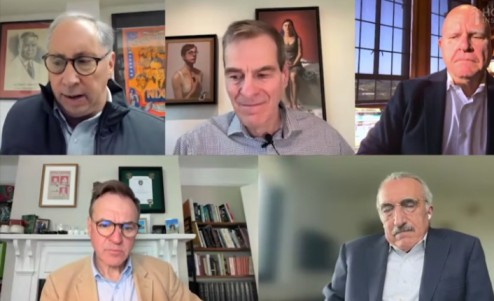
Editor’s Notes: In this episode of GoodFellows, the Hoover Institution’s panel of experts—Niall Ferguson, John Cochrane, and H.R. McMaster—welcomes guest Abbas Milani to examine the shifting and volatile power structures within Iran. The conversation explores the rising dominance of the Islamic Revolutionary Guard Corps (IRGC) and whether the regime has effectively transitioned into a military dictatorship driven by survival. Together, they analyze the regime’s internal fragmentations and the severe economic crises that may ultimately pave the way for fundamental regime change. This deep dive offers a critical perspective on the future of Iranian democracy and its far-reaching impact on global geopolitics. (April 18, 2026)
TRANSCRIPT:
Who’s Actually Running Iran? w/ Abbas Milani @ GoodFellows
BILL WHALEN: It’s Thursday, April 16th, 2026, and welcome back to Goodfellows, a Hoover Institution broadcast examining history, economics, and geopolitics. I’m Bill Whalen. I’m a distinguished policy fellow here at the Hoover Institution, and I will be your moderator today.
But before we get to the show, I’d like to say on behalf of my colleagues that we look forward to seeing you here at the Hoover Institution on Wednesday, April 22nd for our live show and the reception after we’re done filming where you’ll get to meet the Goodfellows. The only bad news I have to report is that the show is now sold out, but we take that as a positive because we are thrilled at the response. And again, we’re looking forward to seeing you here at Hoover on the campus of Stanford University on the 22nd.
Now on with the show and our first order of business, which is meeting the aforementioned Goodfellows. In case you’re watching this show for the first time, our three Goodfellows, as we jokingly refer to them, are the historian Sir Niall Ferguson, the economist John Cochrane, and former presidential national security advisor, Lieutenant General H.R. McMaster. Guys, good to see you on this Thursday.
We’re going to go back to some familiar turf and talk about Iran, but from a different perspective today. We want to talk to a Hoover colleague who actually knows the country very well. That is Abbas Milani. Abbas Milani is a Hoover Institution research fellow and co-director of Iran’s Democracy Project. He’s also the Hamid and Christina Moghadam Director of Iranian Studies at Stanford University. Abbas Milani’s expertise is US-Iranian relations and Iranian cultural, political, and security issues. And we’re going to tap into that knowledge to figure out what this conflict looks like from the Iranian perspective. Abbas, welcome to Goodfellows.
ABBAS MILANI: It’s a pleasure to join you and the Goodfellows.
Who Is Running Iran?
BILL WHALEN: Let me start the conversation, then I’ll turn it over to the fellows with two questions folded into one. Abbas, I look at the government in Iran right now, and I’m somewhat confused. There is a Supreme Leader, who we haven’t seen or heard from since he was given that title. He reportedly was seriously wounded in the same air attack that killed his father, the first Ayatollah Khamenei. It seems the IRGC, the Revolutionary Guard Corps, is deciding when and where to fire missiles. Meanwhile, you have peace talks in Islamabad where the Iranian delegation was led by the nation’s foreign minister and parliamentarian speaker.
So two questions, Abbas. Who is running the country? Secondly, as you look at the current list of players, is there any individual you see who could take over and run the country in a direction that would be to the United States’ suiting? In other words, could the outcome here be regime alteration, as Sir Niall would call it, or is the end outcome going to be regime change?
ABBAS MILANI: I think the group that is running the country, the institution that is running the country, is the IRGC. I think Iran is now, in every sense of the word, a military dictatorship. There are occasional references to Khamenei Jr., but they are so far merely perfunctory. No one knows in what capacity he’s alive, if he’s alive.
So I think it’s the IRGC that is in charge. And there are a few of them that we know are in command, including Vahidi, which is one of the most notorious of these commanders, Zolkadjar, another one of these very notorious commanders, Rezaei, who by all accounts is a PhD in economics. I apologize to all the economists of the world, but he’s a true imbecile and was an imbecile when he was a commander of the IRGC. Almost put him on trial for crimes because he sent thousands of young Iranians to their sure death because of his idiocies. He is one of them. Safavi is another one.
So it’s a very small tight coterie of Islamists. Almost all of them were involved in terrorist activities before the revolution. They were part of a small group of terrorists. So I think they are in charge increasingly, and I wouldn’t be at all surprised if they do what Niall suggests, that they will have regime alteration, that they will change their tune. Because to me, their sole goal is survival.
Fanatics, Politicians, and the Corrupt
NIALL FERGUSON: Abbas, can I ask you a question? A senior US official said to me recently, “We think there are three kinds of people in the leadership. There are the fanatics, there are the politicians, and there are the corrupt.” And I told this to my wife, Ayaan Hirsi Ali. And her response was, “Tell him they’re all fanatics.” What is your view?
ABBAS MILANI: My view is that all are in some parts one of these three characteristics. The person that is now deemed to be the favorite candidate to negotiate with, Qalibaf, is arguably one of the most corrupt. He’s clearly one of the most opportunistic. And he’s clearly a survivor, the rest of them too. So I think that kind of a differentiation doesn’t make sense to me.
What makes sense to me is that this regime, in my view, has been beaten militarily badly.
Fragmentation Within the Regime
H.R. MCMASTER: Abbas, on the kind of fragmentation of the regime, there have been these reports — I don’t know, you would know much better than I do — that the IRGC leadership told the delegation in Pakistan, “Hey, come home.” And they were angry for a number of reasons, including Araghchi and Qalibaf saying, well, maybe they would be willing to stop support for terrorist organizations and militias across the Middle East, including Hezbollah.
And so this fragmentation, does it create an opportunity? That is kind of the first question. What opportunity does it create? The second is, I think we agree — we’ve talked about this — there can be no enduring peace with Iran. There can be no enduring security for the Iranian people until there is a change, a fundamental change in the nature of the regime. How could that happen? Through fragmentation and a portion of the regime turning against the others, these combinations of these three groups? Or can the people — do you think, because the regime is in this weakened state — can you see a path toward forcing that, a change in the regime?
ABBAS MILANI: Well, I think signs of fragmentation are there already and in several different ways. In one sense, when talk of discussions between the US and Qalibaf reached the media, the IRGC issued a very harshly worded, threatening statement. Very little attention was paid to it in the Western media, to my surprise.
The IRGC basically said that there is a Bonapartism — and the concept they use is “Bonapartist,” a concept that comes from the Marxist tradition, primarily from Gramsci’s writings. That’s when a system goes in crisis and some Bonaparte-like character, Napoleon-like character comes and shuts everybody down and rules. They said, “There is a Bonapartism coming, but it’s not an individual, it is us — us and the people of Iran.” So clearly they were worried that Qalibaf might be trying to make a side deal with the US, and they shut him down even before they went to the meeting.
I think there are other elements within the regime, like Rouhani, the ex-president, who has been, even before all of this, essentially offering himself as someone who’s willing to make a deal with the US and change the course of direction. My sense is that he was so open about it, and Zarif, the foreign minister, were so open about it, that Khamenei’s order to absolutely brutally murder anyone who came to the streets — according to them, in 3 days, 3,177, and everybody says it’s a multiple of that — was to make sure that kind of a deal doesn’t happen. In other words, no one from within the regime can make peace with the Iranian people who then can make peace with the US.
So I think that fragmentation has happened, but the IRGC so far is in command. And to me, again, to go back to what Niall was saying and quoting Ayaan Hirsi Ali, who knows this region well, who knows Islamists extremely well, this is a corrupt ideological regime. They’re now more corrupt than they are ideological. They want to keep property rights. The IRGC literally controls at least half of the Iranian economy. Whoever sits in Khamenei’s place, whether it’s IRGC de facto or de jure, gets their hands on at least $100 billion of assets. We are not talking about small change. So this is a mafia-like regime that is going to try to stay in power. But like all mafias, once there is that much money involved, there is infighting.
The Economy as the Regime’s Achilles Heel
JOHN COCHRANE: So you’ve turned to economics, which I like. But it looks like there are two roads that we’re talking about here. One is some form of the regime stays in power, and we find a way to let them make a deal that involves a little bit less annoying their neighbors, to put it politely, but they get to stay in power. And to that end, corruption is good as opposed to fanaticism, because corrupt people can be bought and we have a lot of money to offer. You’ve made a very good comment that of course they need a face-saving way out. And part of making a deal is — as any used car dealer knows — you make them say, “Oh boy, you got a great deal out of this,” while fleecing them. Unfortunately, I’m not sure our administration is very good at letting other sides feel like they won self-confidently, so that’s too bad.
The other direction, of course, what we’re all praying for, is real regime change. The IRGC goes, anything better comes in. It might be for a while the regular military, it might be the Shah, and so forth. So my first half of my question — I am getting to a question, Niall — is, what hope is there for toppling the regime or allowing the Iranians to topple it? You understand the internal mechanisms of Iran far better than we do. You need somewhere to run to. You need some event that makes the internal security services stop shooting their own people. I think we would all love to see that, and we’re all kind of making good with the other one.
And the second part of that question is, our current strategy is not military — we’re blockading the Strait of Hormuz and hoping that economic pressure does it, which seems like a step we should have taken a while ago. But on the other hand, that stops their oil exports. But Venezuela, North Korea, Cuba have gone on for a very long time with absolutely rotten economies. So I wonder whether economic pressure alone will do the trick.
ABBAS MILANI: I think you’re pointing to a very important issue — I think maybe the critical issue. What I think will topple this regime is the economy. It is the economy that is their Achilles heel, because the economy is on the verge of collapse. The financial system is on the verge of collapse. The banking system — the second biggest bank went belly up a few months ago. And amongst themselves in their inner fighting, we learned how rapacious everybody is and was, including Khamenei’s son, who was apparently one of the powers behind the throne of this corrupt conglomerate, Mr. Ansari, who owns €440 million worth of assets and buildings in London, and who was one of the most rapacious of these.
So I think it’s the economy. Right now, you can’t take more than $7 from your own account in a bank in Iran, at an ATM. You can’t make more than maybe about $100 from your account. Even that is impossible to get. Unemployment is on the rise. Inflation is at least above 50%. So there is this remarkable level of incompetence, corruption, and economic challenges, and anger in the people. And the regime knows this.
While it is making constantly these conciliatory gestures toward the West, towards Europeans, towards allies in the region that they had bombarded — they hit the United Arab Emirates, which is one of their most important places for money laundering and for circumventing the sanctions. They hit the United Arab Emirates more than they hit Israel with drones and missiles. In spite of all these gestures, let’s be nice again — every day, virtually every day, the Iranian regime is threatening the people of Iran: “We will kill you if you come out.”
JOHN COCHRANE: Is there a strategy that targets the assets of the IRGC as opposed to just trying to impoverish ordinary people?
The Strait of Hormuz and Iran’s Economic Vulnerabilities
ABBAS MILANI: I have said that this is the way to go all the way, all the time. I never thought that attacking is going to solve this problem. I thought hitting them economically, freezing the assets of the IRGC, freezing Khamenei’s assets, freezing the assets of the oligarchs like Ansari, closing some of their network, remarkable soft power network that they have created through Europe, through the US, through Canada, the number of schools, the number of seminaries, that they have set up where they teach, they promote all of these ideas. That to me was the way to go.
But they need to make concessions to get the economy running. They need hundreds of billions of dollars of investment, and that is what is going to get done. And that’s why they keep threatening the people of Iran. They just announced 400, a list of 400 names of people who live in diaspora, mostly journalists, some athletes, some artists who have said anything against the regime, and they’re confiscating their properties.
They’re now sending, I know directly, they’re sending texts from Iran to people in Canada, in the United States, in Europe that don’t participate in these demonstrations against the regime, “We’ll go after your family in Iran.” That’s a regime that is frightened of its people and knows. And thus, some of the headlines I read in papers that Iran is the new superpower of the region, that Iran is at the height of its power, to me is flabbergasting.
NIALL FERGUSON: But Abbas, there’s one thing that is true, and that is that they were able, by retaliating against their Gulf neighbors and by closing the Strait of Hormuz, to exercise some leverage despite the economic collapse, which I completely agree with you about, and despite the utter military defeat that was inflicted on them.
And I think the worrying thing now must be that in order to get the strait reopened, we might end up relaxing the economic pressure, in fact unfreezing the assets and appealing to their corrupt side. That might mean that the net result of all of this is that the IRGC remains in power, the economic spigot is reopened, and the Iranian people lose out once again.
How should the US government proceed now? Because I think we’re at an absolutely critical juncture. If you think the stock market knows anything, you’d think that the crisis was over. But it isn’t over because the strait’s still closed. And all we’ve done is close it further by stopping Iran from shipping oil to China. What’s the right move next? I find it quite hard to answer that question myself, so I’m eager to hear from you.
The Question of a Strategic US Policy on Iran
ABBAS MILANI: Well, I think it is a very hard question. On the Strait of Hormuz, there is a very interesting interview with Mr. Shamkhani, who was Khamenei’s top military advisor. He was in charge of this national security committee that they have. And they ask him, this is after the shorter war, before this war. They said, “How come you didn’t close the Strait of Hormuz? You kept bluffing.” The journalist, Iranian journalist, he said, “We weren’t bluffing, but we will close the Strait of Hormuz when it is the last thing we do. This is when we are existentially threatened.”
So they knew from the moment that the Harmony et al. were taken out, that they were now in that existential mode. So they went to the endgame from the beginning. And then they realized maybe they can make money out of this. Maybe they can begin charging money. And to cave to that idea, to me, is absolutely counterproductive. I don’t think they will go for it. I don’t think China will go for it. I don’t think United Arab Emirates would go for it. Saudi Arabia will certainly not go for it. And Iran has a claim that has no base in law. Iran is one of the countries that has access to the Strait of Hormuz. Oman has as much access as Iran had. So to me, that is a non-starter.
One of the things that, again, I’m surprised it wasn’t in any of the demands that the Trump administration made about to Iran — and we haven’t seen the documents, we have seen what has leaked about the documents — there isn’t a single mention of defending the people of Iran against this regime. Any deal that is made with this regime, in my view, has to include language from the Trump administration that we promise these people that we’ll come to their help. Now we have their back. You can’t continue killing these people. You can’t continue threatening them. You can’t continue doing the things that they’re doing.
They have shut down the internet for 1,000 hours. People live on that. The regime itself said they have lost $2 billion in companies, many of them led by women. So any policy of the US, of the Trump administration, that excludes defending the rights of the people against this regime — because I have no doubt that Iranian people will take care of this regime because the regime can’t solve the problems that Iran has. And the problems are fundamentally economic. And the economic problems, contrary to what regime apologists say, were not created by the sanctions. They were exacerbated by the sanctions.
The Sentiment of the Iranian People
H.R. MCMASTER: Yeah. Hey, Abbas, you’re making such an important point here, I think. And this has been, I think, an element of our approach that has been most disappointing to me is that some of the language was insensitive to the tremendous opportunity and maybe the moral responsibility to come down on the side of the Iranian people.
This is an impossible question because Iran is not monolithic or homogeneous, but how have you seen the sentiment of the people evolving since the beginning of this war? And if the Iranian people are to be able to kind of muster the courage again, to face the machine guns and everything else they had to face in January. What are some of the signs that an uprising is beginning in terms of strikes or Basij and RGC members just not going to work, or portions of the country — or more portions, certain portions of the country more susceptible to really having the people take control away from the state and its tools of repression. Could you kind of maybe give us an idea of how that sentiment has evolved and then what the prospects are for the people seizing an opportunity?
ABBAS MILANI: Well, one of the consequences of the closure of the internet is that it’s very difficult to get firsthand information. I think that’s one of the reasons they’ve shut it down. Before I had much more access in terms of talking to different people and getting a sense of what is on the ground. I and everybody else is more limited.
But if you look at what the regime has been doing, you get a sense of what’s going on. Within the last 2 weeks, the regime has brought in thousands of Hashd al-Shaabi, Kataeb, Fatah al-Mujahideen, Zainab Youn, and marched them in the streets, had them talk into television and saying, “We are here to help support the regime.” They have talked about opening the border and bringing Shiites from Afghanistan to essentially fill in where the Iranian people are disappointing them.
Bertolt Brecht famously said, “The Central Committee of the East German Communist Party is dissatisfied with the people of Germany. They have elected a new people.” This regime is the last thing you know, people. They literally have this remarkable plan. Those to me indicate that they see signs of a potential explosion. That’s why every night, virtually, in neighborhoods, in cities that people had gone to the street from around 11 o’clock, they send their goons into streets on bicycles, motorcycles, cars shouting, “Hey, that, hey, that, long live LaPang, we’ll kill anyone,” threatening in a Nazi-like, Brownshirt-like, going into Jewish neighborhoods before they were attacked. So to me, that’s the most empirical evidence I have seen that they very much anticipate and fear that uprising.
H.R. MCMASTER: And just quickly for our viewers, I was struck by the reports of US A-10 attack aircraft attacking Hashd al-Shaabi. These are Iranian-created, supported militias in Iraq, inside of Iraq, as they were marshaling to come into Iran.
ABBAS MILANI: So they are drawing on external proxies for additional — and not just Hashd al-Shaabi, literally, as I say, Kata’eb from Iraq, Hashd al-Shaabi from Iraq, Fatemiyoun from Afghanistan, Zainabiyoun, the Iranian Shiites that were sent in Syria to fight on behalf of Assad. They are bringing them all back. If a regime is consolidated and sure of its own oppressive apparatus, it doesn’t need to constantly bring in people from outside and say, “We got these to come after you.” Here’s where I think there’s the real fork in the road.
Regime Change or Negotiation: America’s Strategic Choice
JOHN COCHRANE: You mentioned that we’ll try to negotiate with them to promise to treat their own people well, and I can imagine how long those promises would be kept. But America faces a choice. Is our goal to unseat this regime completely and bring in something new? Or is our goal to lower our own costs, short-run costs, in a small amount, negotiate with them, which means some promises mostly about not lobbing missiles on your neighbors and opening the straits for a while. But that means supporting them. That means giving them money. That means not helping all the people who want to unseat them. That is a very dirty deal.
That looks like where the US is going because of the short-run costs. My own fear is not so much for the effects on Iran, but the long-run effects of keeping them in power and becoming, in essence, helping them stay in power because it’s too expensive to do the others. I think HR would tell us we could take the Straits of Hormuz in about 48 hours if we only gave him a tank and some friends to do it. The overwhelming military and economic ability for us to do it seems there, just the will seems short.
Would you counsel, go for it, do what it takes to get rid of this regime, or would you counsel the direction we’re taking now? Ah, that’s too much of a pain in the ass, like the Venezuelans, we’ll just negotiate, buy them off, let them keep their properties in London so long as they don’t cause us too much trouble. Try to keep the cameras off as they murder their own people?
ABBAS MILANI: I think, again, you have put your finger on the most important, in my view, question that the West needs to — the US needs to decide. They need to have a strategic decision on Iran. They haven’t had that. No administration, in my view, after the revolution, Democrat or Republican, has had strategic thinking — what do we want to do with Iran? Is Iran a possible ally of the United States or the West? Can this regime be cured into becoming a law-abiding state rather than a cause? Or is it as dangerous as someone like me says, and we need to help the Iranian people get rid of these things?
The US had a policy on Soviet Union from 1946. No administration, none that I know of. The last administration that in my view had a strategic vision on Iran was Nixon. The Nixon Doctrine basically said, we need Iran. Iran is our key ally. Iran is ally with Israel. Israel is our key ally. And we need to keep this regime regardless of the tensions we have with them. They fought Iran tooth and nail on oil, Nixon administration. They fought them on the nuclear issue, but they kept their alliance.
JOHN COCHRANE: So let me ask my fellow, the American specialists here, would it not be much better politically in America? I mean, imagine we go into the midterm elections and we have a messy deal with Iran. The Democrats, the economists, and everybody says what a terrible thing this was for Trump to do it. Although we’ve mown the grass very successfully versus an actual victory. One of our great enemies for decades is now gone. I would think that America and those in charge of America right now would be much better off seeing this to conclusion rather than a face-saving negotiation and kick the can down the road a little more.
The Path Forward for Iran
NIALL FERGUSON: John, the problem is that we know from history, if you want to collapse a regime like this, you can’t do it purely with air power or indeed with naval power. The regime has a lot in common with the Nazi regime, the combination of fanaticism and corruption, which Abbas talked about earlier. But how did you decapitate the Third Reich? You needed the Red Army to be in Berlin, and only then did the fanatics begin to commit suicide and the rest hand themselves over to justice. There’s no administration that’s going to commit the ground forces that would be necessary to achieve certain regime change. I think that’s a problem. HR will have thoughts on this.
Part 2, collapsing the economy feels doable, except that, as we discovered with Russia, it’s quite hard to collapse a really large economy, even one that’s in this case teetering on the brink of hyperinflation. Why? Because it has borders we can’t control. There’s goods already coming in from Pakistan, for example, and the Chinese are not going to let these people go down because the Iranians are a critical part of the Chinese axis of authoritarians. The Chinese are selling them weapons. Sending weapons, maybe giving weapons, which they never did to Russia. They did dual use but not weapons to Russia. The Chinese support for the regime is more overt than we have seen.
And so it’s not clear to me that we can, with the means at our disposal, collapse the economy enough to cause the kind of revolution that I think would happen if there were no food at all. I mean, there comes a point when, regardless of the price level, there just is no food. And when you get to that point, then it’s very hard for a tyranny to remain in business. But I don’t think we can get them to that point. I think they can still keep the basic show on the road.
And so that’s the dilemma for policymakers. Nobody wants to commit large-scale ground forces because that would be Forever War 3.0. Nobody can bring the economy tumbling down just by American levers. And therefore you’re left with the following problem. Every day the Strait of Hormuz remains closed creates a bigger headache for the economy that starts to really hurt ordinary Americans. Not right now, but in a couple of weeks and certainly in a couple of months. So you can’t leave it like that for too long or it’s going to be utter carnage in the midterms. The electorate’s already mad enough about affordability. Wait till they see 4% inflation, which is perfectly conceivable under these conditions. That’s the dilemma.
Abbas Milani’s Advice to the U.S. and Israel
BILL WHALEN: Abbas, we have just a couple of minutes left. Let me ask you this question. The Treasury Secretary, Scott Bessant, was at the White House yesterday talking about various things, including taxes. He got asked the obligatory question about when the price of gasoline is coming down. He did something clever. He said it could be days, weeks, months. In other words, I’m not a cleric. I can’t see the future. But as we look at the future of this regime, what is your advice, Abbas, to the United States, to Israel in terms of how it should be couching this conflict in terms of expectations? Should they be saying the regime is going down in a matter of days, weeks, months, or should they say years?
ABBAS MILANI: Well, I don’t think it’s going down in a matter of days or months, but I think they should say this regime can’t — this is my belief — this regime in its current form cannot survive. That’s, I think, the difference between this regime and, for example, the Nazis. Iran does have a very vast reservoir of people who want to change. They don’t want to make a radical revolutionary change necessarily. They want a society, they want an Iran where they can live normal lives and the Iranian culture, the Iranian economy can reach its full potential.
There might be at some stage, some within the regime who realize, like people did in South Africa, like Pinochet did in Chile, that the status quo is untenable, that they will make a deal to give up much of their power or some of their power and keep their property and live to serve, to enjoy the fruits of their corruption. I see that as possible. That requires a wiser opposition than we’ve had. The opposition hasn’t really been willing to follow this path and see whether it is possible to go through this regime through an intermediary stage.
Recommended Sources on Iran
BILL WHALEN: Finally, Abbas, our Good Fellows audience is very information hungry. Could you recommend a few places they should go to follow what is going on in Iran? Keeping in mind these are probably people who don’t speak Farsi.
ABBAS MILANI: Well, my suggestion is that look at multiple sources. It has become — I truly, I’ve never seen the Western media so polarized, both epistemologically, politically, and journalistically. Some of the headlines that I read in some of the most important papers in England and France and here, are so discordant with what I know about the reality in Iran. So my sense, my suggestion is please read as much as you can, multiple sources, and believe that Iran is a pivot. You can’t have Middle East peace without a democratic Iran. I absolutely believe that. And I think the people of Iran want to make that. Wise policy is to help Iranians reach that point. And Iranians — I mean Iranians in diaspora, Iranians — 10% of Iranians now live in diaspora.
BILL WHALEN: Abbas Milani, thanks for joining us today. Hope to have you back on Good Fellows in the future with hopefully good news to report from Iran.
ABBAS MILANI: I hope so.
H.R. MCMASTER: Thanks, Abbas. Thank you.
NIALL FERGUSON: Excellent.
ABBAS MILANI: Thank you.
Hungary’s Political Earthquake: The Fall of Viktor Orbán
BILL WHALEN: All right, on the second portion of our show, gentlemen, a few odds and ends for you. Let’s begin in, of all places, Hungary, which I don’t think we’ve talked much about in our 6 years of doing Good Fellows. Over the weekend, the good people of Hungary went to the polls and they now have turned out their prime minister, Viktor Orbán. He’s out of a job after 16 years as prime minister. Sir Niall, I turn to you. Is this a referendum on Orbán being a little long in the tooth and out of touch with a disgruntled electorate? Or is there a bigger story here about MAGA losing its touch in Europe?
NIALL FERGUSON: Well, there’s a huge story here. This is a tremendously important development because many people thought that it wouldn’t and couldn’t happen, that Viktor Orbán had in effect become a fascist dictator and wouldn’t let go of power. This kind of thesis has been quite often aired. But now we know that he’s not a fascist, he’s a populist, and therefore can be defeated in an election that was pretty free, very high turnout, I think close to 80%, not voting for a candidate of the left, mind you, because the winner is not ideologically very different from Viktor Orbán. That’s important.
The reason that Orbán was thrown out, I think, was principally something we’ve been talking about already on the show: corruption. And the perception that there was a kind of deep hypocrisy to Orbán’s populism. There’s another interesting thing here, and it’s about Orbán’s own future. I think he’s going to, and his cronies too, are going to face some serious legal action in the coming weeks and months. So this show ain’t over, and we’ll be hearing about Orbán again.
But it reminds me of a conversation I had with him quite a few years ago now. I should check, but it was pre-pandemic, so at least 6 years ago. I was in Budapest and I met him and I said to him, “No one is ever going to really believe in what you say you’re achieving in Hungary, where he portrayed himself as pursuing a very distinctive course, until you lose an election. But if you can lose an election and show that you’re willing to bow to the will of the people, your claims will be so much more credible.”
And I remember saying it and thinking to myself, we will find out if he’s just going to be one of these Erdoğan types like the Turkish president who’ll never let go of power until they carry him out feet first. Now it turns out that Orbán wasn’t Erdoğan and actually did bow to the will of the people. I think that is a good thing. And there’s the bonus benefit that there’s no longer a veto exercised by Hungary on the loan that the European Union has wanted for some time to make to Ukraine. And so this makes a meaningful difference to the situation in Eastern Europe as well. So I think it’s great news and I wish his successor the very best of luck. He’s going to need it because he’s inherited quite a mess.
H.R. MCMASTER: And even beyond that, Niall, I mean, to get two-thirds of the votes — and that was the mark for the people of Hungary because they wanted to reverse elements of the state capture that Orbán and his party had organized over many, many years. And so it’s important for that reason. That the people are still sovereign in Hungary, and they expressed that through the results of this election.
The second thing, though, is it’s a compelling counterargument against the catastrophism that democracy’s over and this idea that you have to try to engineer outcomes in elections that cut against the popular will. And I think you saw that in the Netherlands also and the outcome of that election. So I think this is tremendously important in a number of ways.
And then also I would say the guy was a panderer to Putin and Xi Jinping. How did that play out in the country that revolted against the Soviets in 1956? It didn’t float with them. I think it’s also a good shot back at Putin, who I think lately has been encouraged by the tensions between Europe and the United States over the war in Iran. And his hopes for breaking apart NATO, for rending the transatlantic relationship, I think have been significantly diminished by the outcome of the Hungary election.
JOHN COCHRANE: I would add this has lessons for Europe more generally. The cordon sanitaire, the exclusion of anything from the right — “this is something we can’t talk about” — is shown to be, well, one of those many habits of the center-left in Europe that didn’t make much sense. This rightward shift in European voters and electorate is not towards an authoritarianism. They’re not looking for the strongman. They’re looking for some sensible policies in the place of fairly unsensible policies, but they want democracy, freedom, rule of law, all of those things that we all cherish. And that’s kind of what’s exposed here.
Now, Europe’s having trouble digesting it. They’re trying to portray it as a great victory of the left. And as Niall pointed out, Magyar’s policies are one iota to the left of Orbán’s. In fact, had he won against anyone else, it would be decried as the end of democracy and the right-wing shift, and here come the Nazis again. But there is this sensible middle of European politics which has ascended, and I think the standard elites are perhaps starting to wake up and pay attention to that fact.
Pete Hegseth and the Army Chief of Staff
BILL WHALEN: Second item — HR, this one’s for you. War Secretary Pete Hegseth has asked Army Chief of Staff General Randy George to step down and take immediate retirement, with an anonymous source telling reporters, “It was time for a leadership change in the Army.” Question for you, HR: big deal, little deal, no deal at all? And I could historically point you, HR, to all sorts of examples of Lincoln and Truman and other presidents firing generals in the middle of conflicts.
Winners, Losers, or Too Soon to Tell: The Iran War Edition
H.R. MCMASTER: Yeah, I think it’s a big deal for one reason, and that is I think there’s a fundamental misunderstanding about the chain of command. The chain of command comes from civilian leadership to senior military officers who do what their civilian bosses instruct them to do. And I think what’s happened is that Secretary Hexton, with the vast number of these personnel changes, is fighting a rear guard against phantoms. Hey, you won the election. You’ve got military leadership there that is professional, that is committed to support and defend the Constitution, that recognizes, hey, the military should never be a check on executive power. That was what our founders were most concerned about.
So I think that this idea that there’s a loyalty test, as you mentioned, though, it’s not unprecedented, right? I mean, when John F. Kennedy came in, he thought the old guard over there in the Pentagon from under Eisenhower, that they were not going to support his policies. So he brought Maxwell Taylor out of retirement and put him in as senior military advisor in the White House to largely kind of supplant the advisory responsibilities of the Joint Chiefs. Then he installed Taylor as the chairman, again, out of retirement. So it’s not unprecedented that there’s this kind of idea that I need my people there.
Lyndon Johnson said to the JCS, “Hey, I’m like a coach I used to know and you’re my team. You’re all Johnson men.” Well, actually they’re all Constitution men. And I think the politicians need to understand that.
And then finally, with this, I don’t know what the reality is about these promotion lists and removing women and minority officers from the promotion list, but there was a problem under the Obama administration. There was a problem under the Biden administration of pursuing equality of outcome instead of equality of opportunity. And I don’t think that was beneficial to minority officers, to women officers either, because then if somebody gets promoted, you’re like, oh yeah, I know where that person got promoted, which is not true. These are extraordinary officers.
And so now they’re like everything in the Trump administration. There’s an unequal and opposite reaction. And the problem is that both the advocacy for kind of radical social ideas or political agendas under Biden and the Obama administration drug the military, was trying to drag the military into partisanship. We don’t want the Trump administration to do the same thing. Hey, hands off, hands off the military.
So I just think that it’s a big deal for that reason. But as you mentioned, it’s not unprecedented. And I think it ought to be framed under, hey, the military is not partisan. I mean, I don’t know any partisan generals or admirals. I don’t know any woke generals or admirals. I don’t know any extremist generals and admirals. There’s this kind of crazy narrative out there where the military is being used like other institutions to score partisan points. And the danger is that will diminish maybe Americans’ trust or some Americans’ trust in that institution.
BILL WHALEN: All right, gentlemen, our GoodFellows producer slash game master Scott Immigrant has come up with yet another game for us to play. We’re going to call this one Winners, Losers, or Too Soon to Tell. The Iran War edition. I’m going to give you the name of an individual and you’re going to tell me if they are a winner, a loser, or too soon to tell vis-à-vis Iran. Let’s start with US President Donald Trump. Niall?
NIALL FERGUSON: Too soon to tell.
H.R. MCMASTER: And by the way, that will be my answer to all these questions.
NIALL FERGUSON: We do not know as we are having this conversation how this turns out. There’s a ceasefire. The missiles have stopped flying. Drones have stopped flying, but the Strait of Hormuz is still, to all intents and purposes, closed. And so it’s not yet clear how this turns out. And rarely is it clear at this stage in a war, where are we 6 weeks in, how it’s going to turn out. So my answer is the same to all these questions. It is too soon to tell.
BILL WHALEN: Gentlemen, anybody else want to go in a different direction?
JOHN COCHRANE: Well, Jerry, you want to go next?
H.R. MCMASTER: Oh, I agree.
NIALL FERGUSON: Too soon to tell.
JOHN COCHRANE: I’ll add, but according to the depends on, Trump said early in the war, “I want America to win wars again.” If we win this, if by the midterm elections the Iranian regime is gone, yeah, Trump gets a solid win. Anything else, and I think the forces of this is all a mistake, gas prices are high — it’s a loss for Trump.
J.D. Vance and the Islamabad Negotiations
BILL WHALEN: All right, our second individual, U.S. Vice President J.D. Vance. Niall, you’re going to say too soon, but maybe explain what Vance is juggling here in terms of his political interests?
NIALL FERGUSON: Well, I think it’s rare that a vice president gets sent to a meeting like the one that just happened in Islamabad. That would typically be an assignment for a secretary of state or perhaps a national security advisor. Since we have the same guy doing both jobs right now, it’s unusual that it was not Marco Rubio, but it was J.D. Vance.
The risk for Vance is very, very clear. If this all turns out badly, then it’ll be his name and his face that people associate with it. The Machiavellian school thinks that Secretary Rubio has pushed Vance into this position with malice aforethought. But that seems unlikely to me since it could equally well turn out fine for Vance. That’s why I say it’s too soon to tell.
If we look back on the Iran War as a tremendous act of strategic courage that led to regime change in Iran, I wholly agree with John, all concerned will look like geniuses. If, unfortunately, the regime is able to cling on and the economic costs start to really impact voters, then everybody’s going to look like they screwed up. So Vance is in the same situation as President Trump. He stands on a kind of knife edge of history.
I think he has done a good job. I think the Islamabad negotiations are difficult. It was right for it to be the US that broke off the talks when it was clear the Iranians weren’t making sufficient concessions. But that is just the first inning, and I wouldn’t be at all surprised if Vice President Vance were back in Islamabad in a relatively short time to resume these negotiations.
JOHN COCHRANE: I’m going to disagree with that because I think no one’s going to remember that Vance went to Pakistan, but they will remember that Vance was the no forever wars, I don’t think this is a good idea guy. So actually, if it turns into quagmire, I think his stock within the 2028 Republican debate about do we retreat, isolationism versus engagement—
NIALL FERGUSON: Well, that’s possible, John, but remember, although he had his doubts, we know that he said in the critical meetings, you gotta go hard and fast. So I don’t think he’s in a position to say, I was against it until I was for it, because that’s a line that’s never worked terribly well in American politics.
Netanyahu: Winner or Too Soon to Tell?
BILL WHALEN: Mm-hmm. H.R., Israeli Prime Minister Benjamin Netanyahu.
H.R. MCMASTER: Yeah, too soon to tell. Again, the default, but hey, again, it depends on the outcome of the Iran war, but it really depends on the outcome of what’s happening in Lebanon right now with Hezbollah. I think we have to really highlight how very, very significant this is, that there are now direct talks initially brokered by the US between Lebanon and Israel. It is against the law in Lebanon to talk to Israelis. And so this is the beginning of maybe what could be a road to the diminishment of Hezbollah’s influence even further and maybe the ultimate disarmament of Hezbollah. And this might be what gets, finally, Lebanon to arrest its downward spiral and rebuild what should be a beautiful and thriving country. So I think if Netanyahu pulls that off, it would be quite significant.
NIALL FERGUSON: A couple of quick points. I think he’s, of all the people on the list, Bill, the one most likely to be a winner at this point because of the extraordinary damage that’s been inflicted on Iran and because the Iranians have been forced to concede a separate process over Lebanon. That is a big concession that the Iranians have made, although they have talked all along about this axis of resistance. The fact that the Lebanon issue has been separated from the main questions of the Iran-US talks, that’s a concession by the Iranians. So I think Bibi is on track to be the person who is most likely to win. Though it’s too soon to tell.
JOHN COCHRANE: I’ll just, for the sake of fun, I’ll disagree because otherwise this show gets boring. I remember October 8th, 2023, we just discussed Bibi’s future and none of us thought it was very bright. And it’s remarkable how well he’s done since then. But I do remember that democracies are not very grateful to people who win wars. What did the UK do to Winston Churchill for having won World War II? They turned against him immediately. And even if what Israel has achieved is just amazing under Netanyahu, but nonetheless, when things conclude, even with pretty many advances for Israel, never distrust the Israelis’ ability to tear each other to shreds. Things fall apart. So I think converting this into a solid political gain after the war is over will be very difficult. And I forecast it probably won’t happen.
NIALL FERGUSON: And Bibi has to face elections. He has elections to come before October. So that’ll be the moment of truth in terms of Israeli domestic politics.
H.R. MCMASTER: Just a quick point since John brought up Churchill — and Niall, you might want to comment on this — what Churchill said about the Suez Crisis, right? I would not have dared. I think he says something like that, but if I had dared, I would not have dared stop. And I think that’s kind of the situation that Netanyahu and President Trump are in together.
JOHN COCHRANE: Yeah, Niall has this brilliant essay on how this is America’s Suez Crisis, which is what’s pushing me towards the hawkish attitude I have evidenced throughout this show, that if you back up now, then you are as important geopolitically as the UK was after Suez.
The European Trio: Starmer, Macron, and Sanchez
BILL WHALEN: All right, I have two more and we will mercifully end this game after that. Niall, the European trio of Keir Starmer, Emmanuel Macron, and Pedro Sanchez.
NIALL FERGUSON: I think they’re highly likely to come out of this worse off, whatever happens. Because although they have struck all kinds of poses that are popular domestically, given the unpopularity of the war and the unpopularity of President Trump, as I keep trying to remind my European and British friends, when the smoke clears, you are still entirely reliant on the United States for your security. Without the United States, you don’t have deterrence. And your dependence on the US is even greater than it used to be because of your reliance on what people call the US tech stack, and especially, of course, the artificial intelligence part of it. So I think they’re going to end up looking extremely weakened when President Trump is able to vent his full spleen. He is furious about their behavior, and I think they’re underestimating how much that’s going to cost them.
JOHN COCHRANE: Just to pile on to Starmer, this was an anniversary of the Falklands War and comparing Thatcher to Falklands and Starmer in this case, eventually, oh yeah, I guess we’ll send you an aircraft carrier. It turns out we only have one that faintly works and it makes it halfway there before, so much for Britannia rules the waves.
NIALL FERGUSON: Well, Margaret Thatcher had occasional disagreements with Ronald Reagan. I think of the case of Grenada, but she kept them private because she understood how extraordinarily important the relationship with the United States was. And this is something that I’m afraid Keir Starmer has forgotten and he’ll pay a price for it.
BILL WHALEN: Hey, John, do you want to add to the European love fest?
H.R. MCMASTER: Well, I just did an interview with Anders Fogh Rasmussen, if I can plug the Today’s Battleground series. And we agreed that we both have to step back toward each one another. And I think that we could see some concrete steps in that connection, especially if it does get to more of an enduring ceasefire and a sustained effort to patrol and keep open the Persian Gulf and the Straits of Hormuz. That will be done with a multinational task force that will include European nations as part of it.
JOHN COCHRANE: But H.R., so Trump wants the Europeans to take over the Strait of Hormuz and even China, but do the Europeans have any capacity to do anything about the Strait of Hormuz?
H.R. MCMASTER: Yeah, they do. They’ve got a missile frigate for Stendhal. And they have some of their ships that are better configured to do this. The Poles and the French, the UK have pretty significant minesweeper capability. So yeah, they provide — and we do exercise. I mentioned before, like, every year we do an exercise, sometimes up to 30 nations on keeping the Strait of Hormuz open. This was not a problem that was unanticipated.
Xi Jinping: Winner or Loser?
BILL WHALEN: All right. And finally, Xi Jinping.
China’s Strategic Calculus and the Taiwan Question
NIALL FERGUSON: Well, this again is a difficult one to judge right now because Xi Jinping has options. And these options include making a move with respect to Taiwan. Most experts, and we have plenty at Hoover with whom I’ve discussed this, think that he won’t do that, that he’ll wait and watch the United States get embroiled in another Middle Eastern war and look to the elections in Taiwan in January of 2028, hoping that the Kuomintang win. He’s cultivating their leader. Xi was just in Beijing. So that’s the base case.
But there is a tail risk, and I’d love to hear H.R.’s thoughts on this. And the tail risk is that they’re keeping a careful count of the number of Tomahawks that have been fired, the Patriots that have been used up, the depletion of the arsenal of precision weaponry that the Iran War has caused. And there must be some people in Beijing saying, “If we don’t take advantage of this moment, we may never get a better moment again.” Not, I think, for invasion or even blockade, but for some move that pushes the envelope on Taiwan’s autonomy, particularly its commercial autonomy.
So this seems to me the key question. We won’t know if Xi Jinping is a winner or loser until we know whether he’s willing to take risk. My gut feeling is that if he does nothing, if he waits, he’s going to discover two years down the line that time really wasn’t on his side. Because two years from now, I think Indo-Pac Comm is going to be in a much stronger position than it is right now to deter Chinese action. So again, it’s too soon to tell, but he has some agency here and he’s got to make one of the biggest, perhaps the biggest, decision of his whole career.
H.R. MCMASTER: Yeah, I agree with Niall. It’s a pivotal moment. You saw the news just today about new steps to mobilize the industrial base and to increase the production rate for munitions and weapons systems. You saw — there’s a great essay in the journal today about what Steve Feinberg is doing within the Department of Defense, which is really significant. We mentioned it, you heard it first here on GoodFellows, as we were talking about how finally, finally the Pentagon is really reforming in a fundamental way.
And so I do think this creates this idea of a closing window of opportunity, an idea I think that Xi Jinping may have already had and always had in his mind. But I do think it still is valid to say, hey, that decision point for him is coming in 2028 associated with the Taiwanese election. I think that’s probably the most consequential pivot in connection with either a DPP victory, in which case I think he ratchets up coercion in a significant way, or a KMT victory, which he will then try to use to get annexation by invitation.
JOHN COCHRANE: And I would just add, the war in Iran has, I think, really broken through everybody — I don’t talk to the military as much as you do, H.R., but certainly the idea that drones are important and we need to do something about it, especially when we have concentrated high-value ships as our main thing. That, boy, oh boy, is everybody on board with that one. And also disruptions to international trade, I think, are now suddenly a little more salient, which of course an invasion of Taiwan would stop Pacific trade. And all of you who wanted China to stop its exports — well, China would stop its exports, and China would realize it would stop its exports. So if anything, I think this would push them towards less military but more blockadish economic. They need to do something that does not stop global trade, and good luck to them on figuring that one out.
Lightning Round
BILL WHALEN: Okay, gentlemen, onto the lightning round.
ABBAS MILANI: Lightning round.
BILL WHALEN: All right, John, we are starting with you. It is April 16th, which means that you all were up late last night working on your taxes, yes or no? John, I was looking at analysis by a company called Postal. They’re a virtual mailbox and compliance service. They claim that individual tax returns cost American taxpayers $146 billion in time and out-of-pocket expenses. They also claim Americans are spending 2.1 billion hours filling out their Form 1040s. That’s 12 hours per filer. John, is there a way to build a better mousetrap?
JOHN COCHRANE: Oh my God, yes. And most other countries of the world do that. The insane complexity of our tax code, especially as you gain a little bit of wealth, is just a national crisis. But we’re focusing on the wrong question. It’s like people who measure the effects of regulation by the number of pages in the Federal Register. It’s the damage that the tax code does economically, the amount of effort that’s put into avoiding taxes, arranging taxes, and so forth, as opposed to building better mousetraps, building better companies and so forth. That stupendously high marginal rates combined with Swiss cheese of deductions that hurts the economy — that is orders of magnitude bigger than the pain in the ass of filling out the forms.
BILL WHALEN: Niall?
NIALL FERGUSON: Oh, I completely agree with John. If we could get back to the principles of taxation enshrined in Adam Smith’s Wealth of Nations — simplify, simplify, simplify. What a blessing it would be, and economically hugely beneficial. It’s one of the things I talked about in the book, The Great Degeneration, that one of the symptoms of degeneration is excessive complexity of legislation and regulation. So amen to everything John said.
JOHN COCHRANE: I’ll just put a quick — you want taxes? A flat 20% VAT and throw everything else out. That’s one example of what we could do. And the economy would boom and the government would get more money.
Artemis II and the Return to Space
BILL WHALEN: Okay. One final item, gentlemen. Since the last time we did our show, Artemis II went deeper into space with man than ever before. But my question to the three of you — where’s the excitement? Where’s the parade? Where’s the hoopla?
H.R. MCMASTER: I would just say, hey, I think that one of the people who gets a lot of credit for this should be Vice President Pence, Mike Pence, who put together a space council in Trump 1. And I think fundamentally resurrected the space program and modified it significantly by expanding the private and public cooperation in connection with space. And of course emphasizing security in space, recognizing it as a contested domain, but also reinvigorating our ethos of exploration in space. So credit to Mike Pence for really getting the resources behind a solid strategy for space.
JOHN COCHRANE: So I’ll disagree just because that’s my job today. An unbelievably expensive boondoggle that does what we got done in 1967 — a huge disposable rocket that sends a one-time-use capsule up so that four people can have a fantastic tourist experience at a cost rivaling that of the California High-Speed Train and similar benefit. SpaceX is on its way to sending people to the moon for actual reasons, not national prestige projects. The last thing we need is a national prestige project. How about actually build a freeway for something less than hundreds of billions of dollars per mile? That would be a great national —
BILL WHALEN: Okay, the California High-Speed Rail, John, is going to spend at least $126 billion and nobody has been on that train yet. The train hasn’t gone an inch. So let’s give NASA credit. Niall, I’ll give you the last word here. I think you want to push back against my characterization.
NIALL FERGUSON: Well, I’ve been saying for a while that we’re sort of subconsciously reenacting the Nixon presidency, and this just clinches it for me because we kind of got it all going on. We got an energy price shock as big as the 1970s coming down the pike at the speed of an oil tanker. Then we’ve got a scandal that just won’t go away. I still don’t really know what the First Lady was talking about last week, but Epstein seemed to figure, and he’s the Watergate in the drama. And then we go to the moon again. So it’s all kind of perfectly Nixonian. I’m grateful to NASA, but as you say, John, we kind of did this then.
H.R. MCMASTER: So we need to bring back some old school funk. Yeah, we’d be back.
NIALL FERGUSON: All we’re missing is the soundtrack and HRM County Girl News.
Closing Remarks and the George F. Will Award
BILL WHALEN: That’s part of the new tradition. Tang for everybody, gentlemen. All right, we’ve got to bounce here, but before we go, I want to point out one thing. Another year, another honor for our colleague Sir Niall Ferguson. Earlier this week, the Liberty Fund announced that our jolly good fellow is the 2026 honoree of the George F. Will Award for the Advancement of Liberty in a Free Society. Sir Niall receiving this honor for his efforts in deepening our understanding of the free society, individual liberty, and the human condition. Niall, do you want to take us out by just telling us how wonderful this award is and what it’s going to be like to be on the stage with George Will?
NIALL FERGUSON: Well, I’m immensely grateful to the Liberty Fund for the award because it gave me the chance to have a conversation with George F. Will, one of the institutions of American journalism who consistently writes brilliant essays, never afraid to take the contrarian line. So it was just a treat. It was one of those events that you live sort of in dread of. I’m always slightly filled with dread at the prospect of an award because I’m afraid of its being embarrassing. And you know that British people fear embarrassment above death.
But this was in no way embarrassing. It was just a lovely occasion, fantastic people. One of my kids was able to be there, and I’m immensely grateful to Mitch Daniels and everybody at Liberty Fund for giving me an absolutely unforgettable night. And George Will was his usual acerbic and brilliant self. I hope somebody taped the conversation. It was a lot of fun.
BILL WHALEN: Gentlemen, that’s it for our show. Great conversation as always. Look forward to the live show on the 22nd, seeing you then in person. And all our viewers, we look forward to meeting you then. So take care until next time. Look forward to seeing you. Thanks again for watching us.
Related Posts
- PoliticsGirl: w/ Historian Timothy Snyder (Transcript)
- Transcript: Trump Remarks At Medal of Honor Ceremony – June 18, 2026
- Diary Of A CEO: w/ US Vice President JD Vance (Transcript)
- Trump’s Press Conference at G7 Summit In France (Transcript)
- David Remnick Interviews Hillary Clinton at 92NY (Transcript)