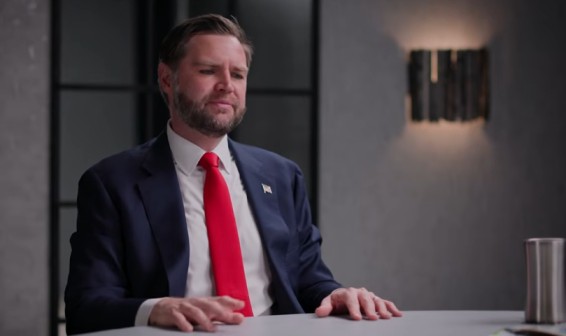
Read the full transcript of Vice President JD Vance’s interview on The Diary Of A CEO Podcast with host Steven Bartlett, June 18, 2026.
Editor’s Note: In this exclusive episode of The Diary Of A CEO, Vice President JD Vance opens up about his complicated childhood and the transformative influence of his grandmother, who served as a vital anchor amidst family chaos. Beyond his political career, he reflects on his personal evolution, addressing past misconceptions about Donald Trump and his own journey back to faith. The conversation offers a candid look at the experiences and values that have shaped his perspective on life and leadership.
Early Life and Family Background
STEVEN BARTLETT: Mr. Vice President, I have your book here.
JD VANCE: Okay.
STEVEN BARTLETT: And it says, “Of all the things that I hated about my childhood, nothing compared to the revolving door of father figures. I hated the disruption, and I hated how often these boyfriends would walk out of my life just as I began to like them.” I always think to understand the people that are sat in front of me, you have to take, get a picture of their early context. And I had no idea about your earliest context. And it has in some respects informed what I’ve then seen from you later as an adult, but can you take me back to your earliest context and explain that quote for me?
JD VANCE: Yeah, so I was raised in a very working-class town, very working-class family. This is a photo of me when I was a little kid here. My family, like a lot of other families in similar circumstances, we struggled. We struggled to adapt to middle-class life. Yeah, this is my sister and my grandfather. It’s interesting, my grandfather had very low formal education. He graduated from high school. My grandmother actually left school when she was 13. Very religious people, particularly my grandmother, but they struggled pretty much economically for most of their lives.
My grandfather died when I was 13. I think my grandmother died when I was 20. This is probably not even a year before she died. And I was about to go to Iraq, and she was very old and frail. And this is one of the last photos of the two of us. And this is really the woman who raised me, because you raised the, the revolving door of father figures. So Mom, amazing person, she’s been clean and sober for now 11 years, but she was in the throes of a pretty bad addiction problem for much of my childhood. And so this was kind of my savior. This was the person who stepped in and made sure I had a stable life, to the extent that I did.
STEVEN BARTLETT: And your grandmother, she got pregnant at 13? And she had a miscarriage at that age?
JD VANCE: Yeah, that’s right. So think about this, Eastern Kentucky, you’re talking about the hills of an extremely impoverished, very rural part of the United States of America. And so she is dating my grandfather, I think at the time was 16. She’s 13. So these are children. She gets pregnant. They moved to Ohio for more opportunity because you just couldn’t build a good life for yourself. There weren’t enough good jobs in that part of the world. And she had a miscarriage. So the thing that brought her out of her home, I think hastened them getting married. I don’t think they would have gotten married at 13 and 16 were it not for this unplanned pregnancy. She was kind of in it then.
So they’re married. They have a very chaotic marriage and abusive marriage in a lot of ways. But they have 3 kids — my mom, my uncle, my aunt. And the story of our families in some ways, some of us were able to kind of break the cycle and some of us weren’t. And part of what motivated me to write that book was trying to understand why is it that life worked out for some of us and didn’t work out for others?
The Revolving Door of Father Figures
STEVEN BARTLETT: So your biological father?
JD VANCE: Yeah.
STEVEN BARTLETT: He put you up for adoption.
JD VANCE: So he did. So I was adopted by a man when I was 5 or 6 years old by the name of Robert Hamill. And he became, and it’s still technically, if you look at my birth certificate, he is still listed as my legal father. Now he was in the picture from, call it, I was 7 until 10 or 11. And then he and mom got divorced. He still stuck around for a little bit after that, but by the time I was 12 years old, he was just gone. Never talked to him again, never saw him again.
STEVEN BARTLETT: And am I right in thinking this is the third man in your life at this point? Because your sister Lindsay comes from a different father?
JD VANCE: That’s right. So her father, very good guy. She’s 5 or 6 years older than me. And so he was the first of my mother’s husbands. And then my dad, my biological father, was number 2. And then my legal father was number 3. And then things sort of got a little quicker from that point forward. So there was a—
STEVEN BARTLETT: There was a—
JD VANCE: There was more turnover, let’s say, in the relationships at that point forward.
STEVEN BARTLETT: There was also a guy called Matt thereafter at 13 years old that your mom had met.
JD VANCE: Yeah, yeah. Good guy. Very close to him. He actually is very political. And so he and I reconnected a little bit over our shared interest in politics, but he was just a good, hardworking guy. He was only around for maybe a few years, probably less than that in my life, but he was a significant and positive force.
Chaos, Instability, and the Search for Stability
STEVEN BARTLETT: In your book, page 124, you say living with Mum and Matt, which is when you were 14 years old, was like a front row seat to the end of the world.
JD VANCE: Yeah.
STEVEN BARTLETT: As an adult, you can almost imagine now that you’ve got so many kids yourself that I can understand the feeling of craziness being normal and you kind of don’t realize until you see into someone else’s world or someone else hears about yours. Because I can relate to that in many ways. But as an adult, you must look back on that and now see the way that that shaped you.
JD VANCE: Yeah. Well, it was very unhealthy. I certainly think, again, it was hard to sort of really feel a sense of stability. It was hard to really attach to people because you always assumed that they were going to be gone.
Years later, I was talking to — I was actually at a conference. I was giving a speech and this guy came up to me and he was a child psychologist. And he said, “One of the things the literature shows is that people who come from traumatic or chaotic environments and end up doing pretty well, they always have one person, whether it was a teacher or a social worker or a grandparent, aunt or an uncle, they always have one person who’s sort of their anchor. And that seems to be the difference for a lot of these kids.”
And again, I was lucky enough to have that. And I think about my life a lot of the time sitting here. I’m the vice president of the United States. What would my life have turned out to be if you’d had all that chaos, which was just a background part of my life, but you take out those stabilizing forces? God knows, man.
STEVEN BARTLETT: Your grandmother.
JD VANCE: God knows. My grandmother.
STEVEN BARTLETT: That’s right. Because through your story, when I was reading about your childhood, she seemed like the safe place that you would retreat to.
JD VANCE: Correct.
STEVEN BARTLETT: Over and over again.
The Anchor: His Grandmother
JD VANCE: I was obviously — I think it’s very important for boys to have male role models, to have father figures that they look up to. She was in an unconventional way, like both a mother figure and a father figure. She was extraordinarily odd, and I mean that in the most loving way possible, but she was just incredibly tough.
I was, I don’t know, 12, 13. I was hanging out with one of the kids in the neighborhood who was kind of going down a bad path. He actually would later spend some time in jail. He was getting into drugs, starting to smoke weed, starting to do a little bit more than that. Again, 12, 13. So we were pretty young kids. My grandmother found out and she told me that if I kept on hanging out with this kid, she was going to run him over with her car. And then I was kind of caught off guard by that. And she said, “JD, I promise you, and no one will ever find out about it.” And I was like, whoa. So for the sake of this kid, I pretty much stopped hanging out with him.
But that toughness, I think, was like a necessary part. It was like through sheer willpower that she kept me on the straight and narrow. And again, I don’t know where I’d be without her.
His Mother’s Addiction
STEVEN BARTLETT: And over the next sort of couple of decades, your mother’s addiction seems to get worse and worse.
JD VANCE: It does.
STEVEN BARTLETT: It does. From prescription drugs to heroin and everything in between. And it really sort of ravages not just her life, but the family’s life. That’s right. Nearly making your grandparents bankrupt. Yes.
JD VANCE: And Mom, by the way, has been clean and sober for 11 years, which is an amazing thing. But when Papaw died, he was what my grandmother was for me. I sort of realized that that’s what Papaw was for Mom. He was her safe place. He was her anchor. And I think she already had some addiction problems, but it just really accelerated from there and things kind of went off the rails.
And my grandparents, before my grandfather died, were trying various ways to help her. And yeah, it got worse and worse, harder and harder drugs, had a few bad overdoses. And by the grace of God, some miracle, it’s amazing how transformed she is. And it sort of drives home how, for some people, drugs are just — they take so much away from a human being. And she was certainly that way. And the same way that they took so much away from her, sobriety has given her a whole lot back.
The Light and Dark Sides of Adversity
STEVEN BARTLETT: If I asked your wife how this season of your life, the most formative season of your life, has changed you, what are all the things you would say? It’s funny because I remember interviewing, I think it was Michael Jordan’s coach. And he said to me that people’s dark sides and their light sides are fundamentally interconnected. Yes. And I can relate. Absolutely. The things people might clap for or applaud about you are also fundamentally linked to the things that you struggle with or that make you sometimes not the most normal person. Yes.
Childhood Trauma, Relationships, and Attachment
JD VANCE: That makes total sense to me. I think on the dark side, what she would say is, I have an extraordinary mistrust, I think, of people that I don’t know particularly well. I sort of assume the worst sometimes about circumstances and things outside of my control, but I maybe assume the best about the people themselves.
So there’s an inherent sense that the world is going to fall apart. I think that’s a very true thing. I mean, even in our marriages, it would be hard to imagine— I’m saying, all marriages are work, but it’d be hard to imagine a marriage that was more successful and more happy than ours. Our kids are doing great, they’re healthy. My wife and I love each other very much, but we’re also just like— she really is my best friend. She’s the person I talk to about everything. She’s my closest confidant.
And yet there are all kinds of times during our 12-year marriage where I’ve just had this thought like, there’s no way this is going to last. Either because she’s taking the kids to the grocery store and I start thinking to myself, oh my God, a drunk driver is going to have a head-on collision. There’s a sense of instability that is very much built in. That’s kind of the dark.
I think the light is because I’ve seen a lot of people at their very best and their very worst. I sort of assume the best about the human beings themselves. So even though the circumstances are crazy and even though s* hits the fan, sometimes completely outside of your control. I think what she would say is that I probably have a higher empathy quotient than any person that she knows, and I really try to understand what makes people tick. So there’s the light and the dark together, but there’s a lot beyond that.
I mean, when I look back at our early relationship and we’d have an argument, like before we were married, I’d be like, “Okay, well fine, let’s just break up.” And her response is like, “Well, that’s crazy. Why would we break up? Let’s just have a rational conversation.” And I’d say, “Honey, I don’t do rational conversations in this context. That is not something we do.” But again, so long as you’re self-aware about that, it’s a problem that you can solve. And certainly, I think she would say now compared to 14 years ago when we first started dating, it’s just night and day. But very early on, it was a chaotic relationship itself.
STEVEN BARTLETT: Clearly an avoidant attachment style, which obviously makes a ton of sense.
JD VANCE: 100%.
STEVEN BARTLETT: Yeah, I can relate.
JD VANCE: Yeah. I didn’t have the vocabulary to describe that, but that’s exactly what that was.
STEVEN BARTLETT: Did you have to go to couples therapy? Because it seems almost inconceivable that you could go through that early context, be so avoidant, be sort of on edge with commitment and see everything as kind of being ephemeral, yet still have a healthy relationship like the one you have with her?
JD VANCE: No, never went to couples therapy. I actually went to therapy a couple of times and I just found it way too uncomfortable to talk to a stranger.
STEVEN BARTLETT: Is this uncomfortable?
JD VANCE: No, no. I mean, this is kind of a weird kind of therapy, but no. The other thing I really didn’t like about it, and again, I don’t mean this to criticize therapy. I’m sure it helps a lot of people. Please don’t take this the wrong way, but there was something about it that felt almost too self-referential and too— it almost encouraged at least me to blame others or to blame my past or to blame my mom or to blame— I just really didn’t like this feeling that I was sort of giving up agency over my own life.
And so we’ve just gotten better at how we relate to each other. That’s primarily me. I mean, she grew up in a very stable situation. Her parents are South Asian immigrants to the United States of America, but she was born and raised in San Diego, California. Just a very normal middle-class Southern California life. And I think because of that, she just had much healthier relationship practices than I did.
Empathy, Politics, and the Other Side
STEVEN BARTLETT: That point about understanding the person on the other end and having empathy for the human being. Politics appears to be almost exact— because I watch the election campaigns, I watch how yourself and the president went against people like Kamala Harris. So you must, with that logic, think that Kamala Harris is actually a really good person. Like, you must understand Kamala.
JD VANCE: I wouldn’t say that I understand her. I would say that I just don’t have this animosity towards people on the other side.
STEVEN BARTLETT: But is that not sort of implicit in the job itself, that you have to point out their faults?
JD VANCE: Yeah, you do. Absolutely. But I think you can be sort of rational about it. You can be cerebral about it. Certainly there are things the other side does that annoy me. But my fundamental bias is that just most people are good people. And to the extent that they do something you disagree with, it’s either because they screwed up on something or because they made a mistake.
I’ve always been like this. I’ve always been more charitable about other human beings. And maybe I do that too much. Maybe I’m too charitable, but I’d rather be too charitable than too cynical about human beings. Because if you’re always cynical about other people’s motivations, man, you’re going to be in a very, very bad spot.
STEVEN BARTLETT: I actually think the same about interviewing, because I meet so many people from so many different—
JD VANCE: Yeah, of course.
STEVEN BARTLETT: And one of the things that I’ve come to learn is just try and meet everybody as I experience them versus, especially when I’m interviewing politicians, I just want to meet them as I experience them versus thinking about how they’ve been framed. And it’s actually made me much more empathetic because again, obviously we all have preconceptions and then you meet someone and you go, “Oh, they are a family person. They care about X, Y, and Z. They care about the same things. They just disagree about pathways.”
JD VANCE: Yeah, yeah, of course.
STEVEN BARTLETT: But politics seems to be like the sort of game of politics to me seems to be like paint the other side to be malicious.
JD VANCE: Well, I think the game of politics, fundamentally, you’re making a pitch to people, right? It’s not about Kamala Harris or Donald Trump or J.D. Vance or Tim Walz. It’s about the American people. And fundamentally, to make that sales pitch, you have to say what’s better about this product, what’s worse about the other product. So that is just inherent.
But I think you can do that. What I always try to do is talk about here are the policies that are really bad. Here are the reasons why I think this is screwed up. Here are the reasons why I think that she made mistakes. It is fundamentally a position where you’re trying to point out the faults in another person, even if it’s just their conduct as opposed to their character.
But even with that, I do think that you see people in politics who fundamentally just really hate the people on the other side. That’s just not me. It’s never going to be me, even when I’m being very pugilistic, even when you really have to drive home a point. Not to get too much into the weeds of partisan politics, but something I think the Biden administration just really screwed up in a profoundly dangerous way was our immigration policy. Now, there are all kinds of reasons why that might have happened, but fundamentally that was a very, very, very bad screw-up. But I don’t hate Kamala Harris because I think she had a bad immigration policy. I just think it’s important to point out the flaws.
Immigration Policy and Political Rhetoric
STEVEN BARTLETT: On the immigration policy, I’ve still got to go through your childhood here, but on this point of immigration, this is another area where you get such division. I remember watching— I think I was probably back in Plymouth in the countryside. One of them was like Trump, the president demonising Mexican people and brown people. I remember this particular quote which I’ve always struggled with a little bit, where he said about the Black community, “What have you got to lose?” And I remember thinking, I’m a Black man. I feel like I’ve got things to lose.
That kind of narrative about those individuals, that broad strokes sort of demonisation of them would make people’s lives harder and feels unnecessary. Even if you agree that immigration is a problem, the sort of skin colour or religion or “Mexicans, rapists and murderers” might galvanise in the near term, but in the long term is probably going to sow division. And that’s probably net negative for society.
JD VANCE: Well, one thing I’d say about anything that I’ve ever heard the president say that’s then refracted through the lens of social media is very often what he is accused of saying, he didn’t say it, or he said it in a totally different way, or there was much greater context. I remember back in 2016 or 2015, whenever he said this, sort of being offended at the “rapists and murderers” line. And then I went and looked at what he said. And what he said, which is actually true, is that some of these countries are actually encouraging prisoners to come into the United States of America. Does that mean that every person who comes into America is a rapist or a murderer or a prisoner? No, it doesn’t. But he didn’t say that.
So again, this goes back to the point about being charitable. I do try to understand fundamentally, why did a person say that? What are they actually thinking? What are they trying to get across? And again, if you disagree, that’s fine.
STEVEN BARTLETT: You wouldn’t have said that.
JD VANCE: The president and I certainly have very different styles. Absolutely, we have different styles. But the way that I think about immigration is fundamentally like this: as a country, you are the people who live in your nation. America’s 330 million souls. Again, most of them, whether they voted for me or not, they’re really good people and they want really good things for their families. They want really good things for themselves. Yeah, there are some bad apples in every crew. 330 million people, there are definitely some bad people, but most people are fundamentally good and decent.
However, you could let people into your country who could be fun, decent, normal human beings who just kind of mess with the equation a little bit. It’s like if I have a bunch of people over to my house for dinner and I invite 10 people and one of them brings a stranger, it’s probably going to be fun, right? But if every single one of them brings 3 strangers, it’s going to totally change the character of the conversation that you’re going to have, of the room that you’re going to have. A country is like that, just on a much more massive scale.
So I maybe come at it or describe it a different way, but fundamentally I think that the president was very right about immigration in a way that was prescient. And even if the blunt way that he described it offended some people, I think it was a very important contribution to not just our country, but to the world.
Immigration, Division, and Community
STEVEN BARTLETT: I think it would be hard to find an American who didn’t think we needed— again, I’m not an American, so I guess I’m talking about where I’m from, but we needed borders and a policy around borders. Sure. Just in the same way that we have it around our house and every festival we enjoy and whatever venues we go to.
I think the thing I’ve always been concerned about when I see this sort of rising narrative across the world, not just in America, but now across the West, the UK as well, is in trying to solve that problem, it seems that division is the most compelling narrative for politicians. And then the downstream consequence of division you see playing out on the streets, you see especially in the UK at the moment, you’re really seeing certain communities be quite demonised and victimised because of this broad political narrative, which is being used to get people into power.
But then the downstream consequences of real people on the streets that are brown or black or Muslims is, I don’t think the people at the top consider that. Well, I mean, is there another way of making the point on immigration, legal immigration, without demonizing people?
JD VANCE: Well, I certainly, when I talk about it, to the extent that I demonize anybody on the immigration conversation, I demonize the leadership that is immune to thinking about the consequences of this.
Just this point about division. Division is a very interesting word to me because I think division is very bad. I like living in a community that’s cohesive where people get along, where we love everybody regardless of what they look like or what thoughts they might have in their head. But let me give you a slightly different perspective on the division thing. What if division is not the result of politicians demonizing certain groups, but what if division is the inevitable consequence of when the population changes too quickly, too fast in a given society?
And what you see as politicians exploiting division, I actually think that what they’re trying to do is articulate a feeling that people have, and sometimes people might express that feeling in ways that we don’t like or maybe they’re offensive. But fundamentally, let’s just say you’re a working-class guy in Britain or you’re a working-class guy in the United States of America. And somebody moves in your neighborhood.
STEVEN BARTLETT: That’s what I did. Yeah. So my family’s obviously Black. My mom’s Nigerian, and I came from Botswana, and I moved into a white neighborhood.
JD VANCE: Okay. And how— I mean, how did people treat you?
STEVEN BARTLETT: We were called the N-word at times.
JD VANCE: Well, that’s terrible. I don’t like that. But I imagine that a lot of people in your community were welcoming.
STEVEN BARTLETT: Yeah, for sure. Okay. But, you know, as a kid, you only remember the ways you stand out.
JD VANCE: No, of course. And I certainly think it’s important to try to fight back against that stuff. We don’t want young kids who come into a community for that to be their memory.
But our next door neighbor was a Black family and my grandmother was not woke. She did not have progressive views about race or gender or pretty much anything else. But she really loved— I’ll never forget this— the Black man who lived next door to us. She said he has a good heart and that was her highest compliment of anybody. He was a preacher. The family was a very, very good family, stable family, mom, dad, few kids. And I was very close to the young son.
I did not experience that. When people talk about division, I just did not see that family as substantially different from us. And I don’t think that family— I’m sure they experienced racism, but I don’t think that was a common fixture of their day living in that neighborhood.
Now, where Mamaw really did resist the changes is when we had a few people— the neighborhood went downhill very quickly, and I talk about that a little bit in the book— and you had a bunch of people move in with different habits. And you had a woman who, you know, she said a bath, but then she got drunk and passed out, and so she ruined her entire house.
And so at some level, was it wrong for my grandmother to feel offended that her neighborhood had changed so quickly, so fast, that she never felt comfortable there anymore, or the people who came in had different values, or she couldn’t hold a conversation with somebody in the same way?
I got attacked on this during the campaign in 2024 when I said, you know, it’s actually okay if you’re an American, an English native speaker, it’s actually okay for you to want the person who moves in next to you to speak English, not because you’re a racist or a xenophobe, but because you want to be able to talk to the person you share a community with.
And so what I often see is that division gets magnified when statesmen don’t do the job of actually ensuring that integration is possible. And for integration to be possible, it has to be, I think, slow moving. You have to be careful. 100 people moving into a community is different from 10 people moving into a community. You have to make sure that everybody has economic opportunities. It’s one thing to welcome a newcomer when everybody has access to a good job, but you welcome a newcomer when a lot of people are feeling economically distressed, they’re going to react to it totally differently.
So again, this is maybe me being charitable to people you think I shouldn’t be charitable to, but fundamentally, my job as an elected leader is to create the kind of environment where division happens less. It’s not to pretend that division doesn’t exist. People naturally, I think, feel reactive when things change too quickly. And that’s okay.
The Role of Algorithms and the Question of Migration
STEVEN BARTLETT: No, I understand the sort of human instinct of, I guess, of kind of xenophobia in a way. And I think we all would want our neighbor to be able to connect with our neighbor. I think it’s the point of nuance is when they can’t speak my language, what do I then do about that?
And I think, you know, maybe if my neighbor didn’t speak my language, we might not get along because we wouldn’t be able to connect and talk. But I wouldn’t be angry at them. And my concern is from a high level when the sort of Western narrative now is that it’s the brown people that are the reason that your life is hard. If I believed that, if I heard that from my political leaders, it’s conceivable that I might be angry at my neighbor, even though they’ve done nothing. Just their presence alone might make me resent them a little bit. And then what happens when I resent them? Because I’m being told that they’re the reason that I’m suffering, that they’re the reason I don’t have a job. And then we get into these culture wars, which is a slippery slope.
JD VANCE: Yeah. But what I would say is I’m not mad. And I said this on the campaign trail all the time. I’m not mad at the illegal alien who broke our laws and came into the country. Probably some of them probably didn’t even know they were breaking our laws, who came into our country and wanted better opportunity for their families.
What I am mad at is the political system that encourages people to break those rules and sows division and then gets mad at the native population for looking around and saying, wait a second, I didn’t sign up for this. I didn’t agree to this.
I would say there’s an instinct in every human being to want to share a community with people where you’ve got something in common with. And it’s like everything, right? A little bit of spice is good. Too much spice changes the dynamic a little bit. And I think most people, they’re okay with change, but change that happens too fast, too quickly, I think in an immigration context is very, very bad for a country. And I think you guys have had that. We’ve had that. A lot of European countries have had that. I don’t even feel particularly angry at any country because it’s a mistake that all of us made. But now that you see that— I mean, you rightly call it division. I just think that we have to say, wait a second. Let’s try to do things a slightly different way.
STEVEN BARTLETT: I think algorithms also play a big role in that because of the design.
JD VANCE: Oh, 100%. Yeah, absolutely.
STEVEN BARTLETT: So that’s probably another conversation. I do think though, if my family were struggling or at all in danger or at risk, and there was an area of land over there that offered them a better chance, I personally think for the sake of my family, if my family was struggling, I would try and move my family into that area. And I assume you would do the same. I assume you would, if your family— I’ve got this wonderful photo of your kids and your wife— where if America went to catastrophe and Mexico was doing great, would you not try and get into Mexico even if you didn’t have a visa?
JD VANCE: No, I don’t think I would. I mean, I can understand why some people have to move. You need to eat, you need to provide for your family. But I think that this is another thing about the immigration thing that is challenging. You want people to feel a certain rootedness and a certain devotion to their country.
One of the things that’s very unique about America compared to Europe is there’s this poll question that went around when I was a teenager, maybe I was in my early 20s, and it asked what percentage of young people in that society would die for their country if they had to. In the United States, it was something like 70%, and in all the other Western countries, it was like 20 to 35%.
And so, you talk about moving to Mexico because there’s economic opportunity in a universe where Mexico’s flourishing and America’s struggling. I get what you’re saying, that you want people to move and migrate to the place where they can have a chance of feeding their family. But I love this place in a way that is totally independent of the economic opportunities it provides to my children. There’s something much deeper and there’s a connection to the places, to the memories, to the folkways.
I mean, I drive through Eastern Kentucky, man, and those beautiful rolling hills and even mountains, but they’re all mountains that are alight with life. You go to West Virginia, you should do this. It’s the most beautiful area, I think, in the world because you get the mountains and you get the rivers and you get that. But it’s also so green and rich with life. I feel an attachment to it that is very, very unique.
STEVEN BARTLETT: But even if your family were at risk, you wouldn’t move them into Mexico?
JD VANCE: Well, I mean, the story of my family, my grandparents, is they came from eastern Kentucky and moved to southern Ohio. Not exactly that far away. These are two very close areas, but they moved away even though they didn’t want to because of economic opportunity to provide for their families. So I certainly empathize with that.
I mean, if somebody showed up— I mean, I’m the vice president. I have a Secret Service detail. It’s hard to put myself in this perspective right now. But if somebody showed up to my home in Cincinnati and pointed a gun at my head and said, you have to leave or we’re going to kill your children, I’d leave, right? But I think most migration decisions are not actually that consequential and extreme.
STEVEN BARTLETT: Makes sense. Yeah.
Joining the Marine Corps
This young man here, you ultimately go into the Marine Corps.
JD VANCE: I go to the Marine Corps. Yeah. So this is me right after boot camp. In 2003, maybe. Yeah, I think 2003. This photo is taken in boot camp and this is, I’m pretty sure, taken in Iraq. Actually, this is either in ’05 or ’06 at a point when, you know, the Iraq war was not going well.
STEVEN BARTLETT: But why did you go to the Marine Corps? What was the decision?
The Patriotic Reservoir and the Iraq War
JD VANCE: You know, there was this sense, and in hindsight, I really resent this. I mean, I’m genuinely still angry at George W. Bush over this, even though, again, I try to be charitable. And I have friends who worked for him, think he’s a great guy. I’m not saying he’s not.
But when I was a senior in high school, I remember I’m at a restaurant. It’s called Skyline Chili in southwestern Ohio. And this guy comes out of Skyline Chili. He’s got a World War II red veterans hat. We call them Red Hatters in the United States. So he was a veteran of World War II. And I remember feeling like, because even at that stage, this is probably 2003, 2002, maybe, I remember thinking to myself, this generation is dying away. Like I had this feeling, right? Because most veterans you met, they were veterans of Vietnam, maybe of the first Iraq War. But I just went up and I shook his hand. I said, “Thank you, sir, for your service.” And he was genuinely touched.
But I remember thinking, this guy answered the call. Now we have to answer the call. September 11th happened when I was a junior in high school. And there was this patriotic sense of this is our World War II, right? And even some of the historical analogies that got used were the exact same. Saddam Hussein was Adolf Hitler. “What if you had had an opportunity to stand up and say no to Adolf Hitler? When he annexed the Sudetenland, wouldn’t you have taken that chance?” And it’s like they were so good at tapping into that patriotic reservoir.
And by the way, I think that reservoir is a very valuable thing. I think it’s important for statesmen to cultivate it, but only to tap into it when it’s really necessary and when it’s really justified. And what was so screwed up about Iraq is, I mean, I remember I went to the Marine Corps recruiter and I wanted to be a Marine because my older cousins were Marines and people said the Marines were the toughest. Whether that’s true or not, that was certainly the impression that Marines had of themselves.
I signed on the dotted line. I went in what’s called open contract. So sometimes you sign up and you have your job assigned, like you already know what you’re going to do. I went open contract. I said, “You can give me whatever job you want to. I just want to be a Marine.” And I did that because I love my country and I wanted to contribute in the same way that that guy who wore a red hat was still wearing his red hat, was still proud of it, knew that he contributed. And that led me, of course, to go to Iraq from ’05 to ’06 and made a lot of friends, gained a ton of appreciation for the Marine Corps as an institution, the people. But became a little jaded about our political leadership.
Betraying the Trust of a Generation
STEVEN BARTLETT: Why are you— you said you were kind of annoyed at Bush.
JD VANCE: Because that patriotic reservoir that exists in any country, I think it’s maybe most powerful in the United States of America because we have this 70-plus percent of young people say they would die for their country. That’s very unique among advanced economies. And I’m sure a lot of people in Europe look at that and say, “Oh, those jingoistic idiots, they’re wrong, or there’s something bad about that.” But I actually think you have to have a real nation. You have to have the willingness that if, God forbid, something happens, you’re willing to put on your uniform and go and do what needs to be done.
But again, in order for that to work, in order for that feeling to be justified, leaders have to not take advantage of it. You can’t say Saddam Hussein is Adolf Hitler. He wasn’t. You have to be careful with it. And I don’t think that George W. Bush was careful with it. I think that he called the nation to do something that ultimately wasn’t actually in our best interest as a nation, but more fundamentally, he drew on that wellspring of patriotism to direct us to do something that we shouldn’t have been doing in the first place.
STEVEN BARTLETT: Because he had bad information or because of negligence or incompetence?
JD VANCE: I mean, I know enough people who know him. I think he had bad information. But fundamentally, post-9/11 was really important. We had to go and deal with the terrorist networks that had existed all across the world that had been allowed to fester over the previous generation of American negligence. But fundamentally, the war on terrorism was not an existential thing to the United States of America. In the same way that World War II was an existential thing for Britain, right?
And I think we just have to be careful about how we describe what we’re asking our young people to do, because if you ask them to do something and they feel like you were being honest with them, I think that sort of pays dividends into that patriotic reservoir. If you ask somebody to do something and it turns out you were lying to them, whether it was intentional or not, I think you draw down that patriotic reservoir. I don’t know what the— by the way, I mentioned that poll and I don’t have the data in front of me, but whatever the number of young Americans who say they would die for their country, I would bet a lot of money that that number in 2026 is much lower than it was in 2003.
STEVEN BARTLETT: So it’s really like a sort of a contract with the nation that’s built on trust.
JD VANCE: Exactly. It’s a social contract built on trust. You violate that trust, it has very, very bad consequences.
The Iran Conflict and the Risk of Another Forever War
STEVEN BARTLETT: The US is, I guess, in a war now.
JD VANCE: Well, not anymore.
STEVEN BARTLETT: Famous last words. Fair.
JD VANCE: We are in a ceasefire that I feel very good about. That we announced. I know this will air later, but we announced the ceasefire. We announced the peace agreement with the Iranians yesterday.
STEVEN BARTLETT: Yes. I’ve learned so much about war because of this war, in part because I’m an interviewer at the time of war. And so I’ve been having lots of conversations with lots of people about the nature of war, and I’ve learned so much. Frankly, I didn’t know anything about Vietnam and really the psychology of war. And how, when you start a war— Robert Pape said this to me. He said, “The thing people underestimate about war is when the bombs start dropping, politics changes both where the bombs are dropping and at home.”
And I, to some degree, think that with the Iran War now, that’s exactly what happened from my assessment of it, which is it looked like it was going to be quite straightforward. Drop the bombs, take out the leader. The people rise up, which is what the president had said. He had encouraged the people to rise up when those bombs dropped and Khomeini was taken out. But then what happened, again, I don’t know what I’m talking about here, so please correct me, is it looked like the country fractured into all of these sort of little pockets of militia and military.
I remember, I think it was Hegseth saying, “It just takes some time for the carrier pigeon to get out to where the soldiers are at the outpost.” And this speaks to how the fracturing had happened. And then I heard the president, and I think yourself multiple times say, “We don’t really know who we’re negotiating with,” or words to that effect, because we’ve taken out the first and second row of leadership.
And then I thought, gosh, we’re in the same situation again where the bombs started dropping, unintended consequences were there’s now not one central leadership to negotiate with, but also politics at home has shifted. I mean, the approval ratings— I got this graph of the approval ratings had started to plummet at home and politics is changing on the ground there as well. Is this another forever war?
JD VANCE: Well, the answer is no. And this is always— when I talked about this conflict, I always said Donald Trump learned the lessons. It’s actually almost unfair to him. He didn’t learn the lessons of the Iraq War because back during the Iraq War, he was saying this was stupid, we should get out of Iraq. He was saying that back then.
And I think that while there were certainly some objectives that we had in this conflict, I just never had any doubt. Now, obviously, I’m an insider. I saw the president’s deliberations and thought on this, but I never had any worry that this would become a multi-year expedition with no end in sight because I knew that we had leadership that was trying to define the objective very narrowly, accomplish the objective, and then see where we are.
And so, if you go back, you talk about this, the street uprising, certainly there was some thought that it would be possible that the Iranian street would rise up in the face of this thing and that you would see a new government that was much more pro-American, much more pro-Western. What happened though is— and what we knew we could do is degrade their military. That was actually the primary objective. Yes, the president talked about the Iranians rising up, but the primary objective was always to degrade their conventional power so that we could be in a better position vis-à-vis Iran so that whoever was calling the shots, they didn’t have a loaded gun to our head anymore.
STEVEN BARTLETT: Okay.
The Iran Nuclear Deal and Strait of Hormuz
JD VANCE: And that’s what we knew we could accomplish. And then there was always the question about, okay, now that we’ve accomplished that, where do we go from here?
One of the things that I feel just quite good about this moment that we’re in is the president basically bought us an option. He said, we can weaken their military, destroy their conventional military, we can change their leadership, and then we can actually present a pathway to the Iranian leadership. Where do we go from here? Like you said something very interesting that was true 2 months ago. That’s not true now. 2 months ago, I would have said I had no idea who we’re negotiating with. Now I feel very confident that we have an understanding of who we’re negotiating with, what it is that they care about.
Yes, there are fractures in their system. So the Iranian system, this is oversimplifying it a lot, but it has kind of 3 poles. There’s the political pole, the people who are most responsive to leadership. That’s the foreign minister, the president, the speaker of the parliament. There’s a clerical pole, meaning the clerics who actually hold ultimate authority in the Iranian system via the Supreme Leader, the clerics, the religious leaders. And then you have the military, particularly the IRGC. All three of these poles interact with each other in weird ways.
Two months ago, we were like, wait a second, who has the upper hand? What does this group want versus this group versus that group? But what I feel pretty confident about now — we’re taping this interview, I guess, June 15th, right? — what I feel quite confident about right now is that we know who we’re dealing with and the fractures really aren’t — the system is kind of coalesced.
And what they’re telling us, which is interesting — now, is it the street rising up? No. But what they’re telling us is, you know what, obviously they’re not endorsing anything that we did. There’s a lot of mistrust, a lot of animosity. But fundamentally, we’ve done one thing vis-à-vis the United States for 47 years, and we shouldn’t do that thing anymore. We want to change. And if you, the Americans, are willing to actually negotiate with us, to have a conversation, yeah, we’re willing to make the long-term commitment never to develop nuclear weapons. But we want a totally different economic arrangement than what we have with the West right now.
So that’s where we’re at right now — actually figuring out the details of what that would look like. But where we stand right now, I actually feel pretty good about it. I feel good that we actually could have a better relationship with that country. I feel good that they’ll never have a nuclear weapon. So that’d be like a real loaded gun they would have to the West. But I also think that there is a general consensus in their system that their relationship would be different than the past.
The other thing — and this is very important, the underappreciated element — like, if I was ever going to write a book about Donald Trump’s foreign policy, and by the way, he hates people who write books, not books like that, but insider books where you take trusted information and put it into a book, he doesn’t like that. But what I would say is he’s so non-conventional in the way that he does everything, but certainly the way that he does foreign policy, that things that were previously unimaginable are actually on the table.
So when Donald Trump says to the Iranians, “We want you to be a successful country. If you give us what we need on nuclear, we’ll take the sanctions off your country and allow you to prosper,” that would have been unthinkable 10 years ago in any Democrat or Republican administration. But it’s thinkable because Donald Trump is just like, “No, the way things worked in the past are dumb. We’re going to do something new.” And that’s what he’s putting on the table. We’ll see if they meet us, but right now I feel pretty good about it.
The Strait of Hormuz
STEVEN BARTLETT: The other term I’d never heard before is Strait of Hormuz. I’ve read so much about the bloody Strait of Hormuz. Did you have any idea that the Iranians would cut off the Strait of Hormuz? You did know that going into it?
JD VANCE: It was a major — yeah, as soon as you see these media reports like the Trump team was caught off guard, what would happen in the Strait of Hormuz was a main fixture of the conversation that we were having. About whether to do this, how to do this. So it was certainly a variable.
Now, you can never predict with 100% certainty what people are going to do, but the basic bias that we had going into it is that they would try to cut off the strait. They would try to jack up energy prices. They thought — and I think this is true — they thought that they could cut off the straits for us, but actually keep the straits open for themselves. That ended up not being true when we imposed the blockade.
But fundamentally, we knew some version of what would happen. But we also went into it saying, if they do this, fundamentally, it’s a short-term thing. So Brent crude is sort of the main crude oil index, right? I think the highest it got was $126 per barrel. Right now, sitting here, it’s around $82 a barrel. It’s fallen off a cliff because there’s a broad recognition that, yeah, it was a short-term shock, but not a short-term shock that’s going to permanently alter the world energy economy.
STEVEN BARTLETT: It’s quite a powerful weapon they have in their arsenal just to shut off the world’s economy and piss off your people at home at the gas pump. It’s quite a —
JD VANCE: Well, geography really matters in warfare, it turns out. And yes, they have great proximity to the Strait of Hormuz. But again, if you just go back 2 weeks ago, one of the things that’s interesting, really underreported, but I think your listeners will obviously be interested in, is if you look at the amount of oil that we were getting out of the Strait of Hormuz — we, I mean, the United States, the Gulf Coast coalition, broadly speaking, the Arabs in the Gulf — you look at what it was, call it April 1st, it was close to zero. You go to May 30th, early June, it was many, many million barrels of oil a day. Now, not enough to eliminate the shock, to be clear, but we were seeing significant increases in oil traffic.
And again, I think that’s one of the reasons why we’re having a good negotiation with the Iranians. They recognized, yes, they have this leverage point, but maybe not forever. And it’s one of those cards you can play, but you can’t necessarily play it week after week after week. It degrades in power. So I take your point. Yeah, they have this geographical thing going on. But I think that geographical leverage point was weakening over time. And it’s why we are where we are, I think, with a very good deal. Because with it — knock on wood — we have to see it to completion.
STEVEN BARTLETT: Because if you’re them, you go, well, all I’ve got to do is wait 2 years because the president is going to be removed from office in 2 years’ time. He’s going to be at the end of his term. So if they could just wait it out for 2 years, they can hope that the new political leader that comes in might be more charitable with them.
JD VANCE: Yeah, but if Donald Trump has 2.5 years left in office, I think the Iranians recognize they did not have 2.5 years to wait things out. One is, as we got more and more oil out of the strait, their leverage point decreased. But in some ways more importantly, look, you look at Persian culture, you look at the history of Iran, this is one of the proudest and oldest civilizations anywhere in the world. They don’t want to be like a Libya-style rump state. They want to have a much brighter future. I think that’s actually true. Now, there’s a question about how to get there. And obviously there’s a lot of animosity between the two sides. But I do think something has fundamentally changed in the way that regime sees the world.
Skepticism About the Deal
STEVEN BARTLETT: The deal that you have on the table. Now, okay, excuse me if I’m skeptical, but I said to you before we started recording, I watch everything. So I’ve watched every — if you do an interview, Hegseth does one, if the president does one, I see it. I see the whole thing. I don’t know why, but I’m very, very interested in US politics because it does impact the whole world.
And as I’ve watched these interviews, there’s been lots of false deals. You flew out there to Pakistan and you flew right back. The deal wasn’t done. I think I saw a report the other day that said the president has said roughly 30 times that there’s a deal done or that there’s a deal on the table, usually on a Sunday. Then it’s not. Then we go back into this negotiation thing. So I’m like, I don’t have any trust anymore for a deal getting done.
JD VANCE: Well, this one’s real.
STEVEN BARTLETT: So, okay, good. Interesting.
JD VANCE: People can always change their minds, but this one is real for sure.
STEVEN BARTLETT: So what does that mean? Does it mean that there’s a contract that has been sent with terms on it and they’ve provisionally — like a term sheet — said we agree?
JD VANCE: That’s exactly what’s happened.
STEVEN BARTLETT: Okay. So they’ve agreed to a term sheet.
JD VANCE: Yes.
STEVEN BARTLETT: And then as is the case in business and investing, that becomes more of a formalized contract. And then that’s signed. So what is in the term sheet?
Terms of the Agreement
JD VANCE: Well, a few things. The first is that the Strait of Hormuz opens effectively immediately and the blockade is lifted effectively immediately. Now, when I say effectively, that’s doing a little bit of work there because part of what’s going on is there’s a different risk tolerance for different shippers in the Gulf. Some, again, like I said earlier, some of these guys are already shipping a lot of oil through the Strait of Hormuz right now, even though the Iranians are threatening to shoot at them.
But what this means is that over time, we’re going to demine the Strait of Hormuz. The Iranians are going to stop shooting. We’re going to lift our naval blockade. And you’re going to see, I think, a pretty quick resumption of full flow of traffic in the Strait of Hormuz. That’s number one.
STEVEN BARTLETT: And there’s mines in there.
JD VANCE: Most important thing.
STEVEN BARTLETT: There’s mines in there.
JD VANCE: Yeah, there are mines in there, but it’s a very big waterway. There’s a lot of traffic moving right now. So we know where the mines are. They’re not everywhere. And again, the ships are able to move. The biggest obstacle and impediment to ships moving right now is actually not the mines themselves. It’s the Iranians who are shooting drones and missiles on the other side. Now, I say that — we have seen a precipitous decline since we signed this agreement. We’ve seen a precipitous decline in even that happening. So you’re already again seeing the fruits of this negotiation that we have.
Number 2 is it contemplates the Iranians giving up their highly enriched stockpile of material, committing to a long-term inspections regime on their nuclear program, and in exchange, having a totally different economic relationship with the United States of America. So there’s a stack of sanctions that the US has on Iran that is like 60 pages long. That is incredibly destructive to the Iranian economy by design, right? The deal is you’re not going to behave like a normal country. We’re not going to engage in normal trade transactions with you.
What this agreement provides is that if the Iranians take significant steps to behave like a normal country, they’re going to get significant reintegration into the world economy. I think that is in some ways the most profound thing. And what the United States gets out of that is the long-term guarantee that they never become a nuclear power.
I think people always sort of — it’s hard to appreciate how temporal this is. The Iranian nuclear program has been completely destroyed. It doesn’t exist right now. But over time, you can try to rebuild it. So what we’re trying to say is we don’t want you to rebuild this program. If you make real commitments and verifiable commitments that you’re not going to, then you’re getting a lot of economic benefits on the side.
STEVEN BARTLETT: You dropped those big bunker buster bombs. I was very fascinated by all that whole series of military operations and the nuclear material is now buried pretty deep underground, from what I understand. With this deal, do you get to go and get it? Do they hand it over to you? What happens?
The Iran Nuclear Deal Framework
JD VANCE: So the way the deal is structured is that the Iranians, the Americans, and the International Atomic Energy Agency will actually work together to go get the material and destroy it. That’s the basic idea is that we’re all going to work together. Again, the agreement contemplates a new era in relations. So the idea is that we’re all going to try to work together, destroy this material. And again, if that happens, the Iranians are going to have a totally different economic relationship with the West. And if it doesn’t happen, then the United States is no worse off.
STEVEN BARTLETT: And you do get to check that they’re not just going to a different mountain and building new nuclear weapons.
JD VANCE: That’s where the verification element comes in. But we have a very good sense, you know, you can probably guess why. We have a very good sense of what’s going on in the country of Iran. We could probably keep that material just permanently buried, but we don’t want to do that. We actually want to solve the problem and we want the Iranians to have a different relationship with us. And that’s what we’re trying to do.
STEVEN BARTLETT: And the specifics of you being able to go and check that they’re not just building new nuclear weapons, it sounds to me like the specifics haven’t been defined yet, like how those checks take place.
JD VANCE: Well, it’s— yeah, it’s like you said, it’s a term sheet where we’ve got broad agreement on principles and how we’re going to approach the negotiation. But there are a lot of details that we got to figure out from here.
STEVEN BARTLETT: So I’ve got Strait of Hormuz opens, nuclear inspections, but also a coalition to remove the nuclear waste. From that, they get the opportunity to participate in the economy and sanctions will be lifted. Yep. Is there anything that’s in that term sheet that’s not included there?
JD VANCE: I mean, there are other, like, little details and things like that. Obviously the permanent cessation of hostilities. We’re trying to bring in a regional era of peace here. But that’s pretty much the main thing.
Trump, Netanyahu, and the US-Israel Relationship
STEVEN BARTLETT: And Israel, there was some interesting words exchanged yesterday. Again, I watch everything. So I saw that the Fox reporter had called Trump, I think yesterday, because Netanyahu had started firing some bombs. And he had some select words, kind of like your grandmother’s words. Yes, indeed. Apparently he said, Trump said he’d phoned Netanyahu and told him he had no fing judgment. “Why did Bibi have to do a fing attack? I’m so pissed off.” An hour before we were supposed to sign the deal, Trump called Netanyahu a very difficult guy. “He should be very thankful for us for doing this, because if Iran had a nuclear weapon, Israel wouldn’t be around for 2 hours.” Lots of cussing at Netanyahu and what he had done. I’ve heard you actually say that you think Israel and the United States have two different objectives as it relates to— I don’t want to mischaracterize your words, but—
JD VANCE: Well, what I’d say is that we’re different countries with different interests. I think in the United States, sometimes people characterize Israel as a good partner to the United States. That is true. But sometimes people mischaracterize it and say that Israel and the United States are fundamentally always aligned. It’s just not true. We’re different countries. We have different needs. We have different geographies.
STEVEN BARTLETT: Do you trust them?
JD VANCE: I don’t trust anybody when it comes to international affairs and diplomacy. Do I think that they’re very capable? Absolutely. Do I think that, again, when we have shared interests, we work together very well? Absolutely. But I don’t trust anyone. And I think that we just have to continually be laser-focused on what our interests are.
And what the president said about Bibi is, sometimes, we are the world’s superpower and obviously we’re Israel’s most important ally anywhere in the world. And sometimes to ensure that we are able to accomplish our objectives, the president has to have a very frank conversation with the prime minister of Israel. So sometimes he does that, sometimes everything works smoothly, sometimes it doesn’t. It’s just the nature, like any relationship, right? Any relationship is going to have moments where you have to be more direct. Sometimes you’re working together and sometimes there’s a little bit more conflict.
STEVEN BARTLETT: The world’s opinion and thoughts about the US-Israel relationship has never been more widely discussed.
JD VANCE: I agree.
STEVEN BARTLETT: And I almost don’t know why, but it seems to be the case that over the last, I’d say, 6 to 12 months, people are really now questioning what is this relationship? And who is the dominant partner in the relationship? What, for someone, and just in super simple terms, because I don’t really know a lot about this particular point. Sure. What is the relationship and why and where did it come from?
JD VANCE: Well, I’m hardly an expert in US-Israeli relations, right? But let me just say, they’re obviously in some ways the only democracy in the Middle East. Very advanced economy, very high-skilled people. Technological ingenuity. I mean, it’s a country of 9 million people. They generate a lot of the world’s inventions just from 9 million people. It’s a very impressive country economically. They’re also probably better at intelligence collection than any country in the world.
And again, because they’re an advanced economy, because their people, generally speaking, want to live in peace and harmony, just want to go to work and raise their kids. There are a lot of shared interests and a lot of shared objectives. And I think that, over time, especially, for example, when one of our biggest problems going back to the early 2000s was the rise of Islamic terrorism, Islamic radical terrorism, I should say. There was a sort of broad recognition that there’s a lot for us to work on.
But again, even if you go back to then, the early 2000s, very large alignment between Israeli interests and American interests. But even in the early 2000s, the Israelis were much more worried about Iran than the United States was, right? We were much more worried about Al Qaeda, like a different branch of Islamic terrorism. So even when we’ve been very aligned, we’re just different countries that have different objectives.
And I will say, having seen the president of the United States operate, I feel quite confident that they are the junior partner, we’re the senior partner, we’re the world’s superpower. That’s the way that it works. But, again, sometimes it’s like with the UK. I would say the UK is our closest ally, our oldest ally. I’m not just saying that because you’re a Brit.
STEVEN BARTLETT: Do you trust the UK?
JD VANCE: Again, I don’t really trust anybody. But do I like a lot of Brits?
STEVEN BARTLETT: Absolutely.
JD VANCE: Do I have incredible fondness for the United Kingdom as a country and a culture? Absolutely. And I really like a lot of the people, even the Labour government, even though they’re politically misaligned with me and the rest of the Trump administration. But we have disagreements from time to time. So we work really well together. And sometimes we have misaligned interests and we have to pursue our interests in the best way we can.
What Does Netanyahu Want?
STEVEN BARTLETT: And please do tell me, what does Netanyahu want? Because I sit here with these experts and they say they want to overtake the whole of the Middle East. They want to run the Middle East. What does he want?
JD VANCE: I don’t know. I don’t know.
STEVEN BARTLETT: You don’t know?
JD VANCE: Well, I mean, I can’t get inside somebody’s head.
STEVEN BARTLETT: Have you asked them what they want?
JD VANCE: What do you think they want? Well, I think that in this particular operation, again, where interests were aligned is we wanted Iranian conventional military power to be much weaker, to be decimated. The Israelis shared that objective. Do I think that there are maybe— I don’t know if Bibi thinks this, but do I think there are people within Israeli society who would like to turn Iran into Libya, basically a failed state with 90 million people? Probably. But I don’t know that Bibi wants that. I’ve actually never had that conversation with him. It’d be an interesting conversation to have.
I’ll tell you right now, is Iran turning into a Persian Libya good for the United States of America? Absolutely not. And that’s one of the reasons why the president has set us on this course of working on our interests, which is the elimination of the nuclear threat and a changed dynamic with the Iranians, which is very much on the table.
From Trump Critic to Vice President
STEVEN BARTLETT: You run for Senate. Yeah. And you’re successful. And this is really, from what I could see from my research, where you and Trump first made friends, I should say. Yeah. Before then you weren’t friends.
JD VANCE: No, that’s right.
STEVEN BARTLETT: You were quite critical of Donald Trump before then. I mean, you’ve been probably asked this a million times, but I actually didn’t know this until literally today. I read the piece you’d written in The Atlantic where you criticized him for taking advantage of the struggling working class.
“What Trump offers is an easy escape from pain. To every complex problem, he promises a simple solution. He can bring jobs back simply by punishing offshore companies into submission, as he told a New Hampshire crowd. Folks are too similar with the opioid Scrooge. He can cure the addiction epidemic by building a Mexican wall and keeping the cartels out. He will spare the United States from humiliation and military defeat with indiscriminate bombing. It doesn’t matter that no credible military leader has endorsed his plan. He never offers detail for those plans to work because Trump is cultural heroin. He makes some people feel better, but he cannot fix all that ails them. And one day they’ll realize it.”
Very tough words against Trump.
JD VANCE: Long time ago.
STEVEN BARTLETT: 2016 and 10 years ago.
JD VANCE: What changed? Well, let me pick up. First of all, I think you always have to be able to acknowledge when you’re right and when you’re wrong. And there’s a lot I was right about in 2016, but just pick up on something. Can you read the line for me again where I talk about— is it no credible military leader has endorsed these plans?
STEVEN BARTLETT: Yeah, it says, “It doesn’t matter that no credible military leader has endorsed his plan.”
JD VANCE: So what I would say is I wrote that. I believed it when I wrote it. And reading it now, I’m almost embarrassed that I wrote it because it was so obviously absurd. In fact, the fact that Donald Trump was misaligned with the military experts and the military leadership of 2016 was a good thing, not a bad thing.
Think about those military leaders. I mean, I have a lot of respect for the troops, the people who serve, the people who put on a uniform. But you can make a very credible argument that from the early ’90s until at least 2016, America hadn’t won a war in 30 years. Like, there’s a reason why Donald Trump mistrusted the military leadership, and he was right. And so much of what I think the president represented at the time was a recognition that American institutions had become sclerotic and broken. And he was a weapon to break down those institutions.
STEVEN BARTLETT: Your assessment of him is similar to the Democratic assessment of him. Your assessment of him back in 2016 is similar to the Democratic assessment of him. There was a private message between you and a roommate where you said he was either a cynical asshole or America’s Hitler. How do you go from that position to vice president of the same person? What is that journey?
JD VANCE: A crazy journey, man. But again, you have to ask yourself, first of all, I thought Donald Trump would be a failed president if he got elected. He was not. I thought that America’s institutions were fundamentally functioning. They were not. I thought that the military leaders who told us this about a war, or the scientific experts who told us this other thing about a pandemic, were fundamentally— maybe not always right, but fundamentally wise people who were mostly right. I was wrong.
STEVEN BARTLETT: What have you observed behind the scenes that that JD didn’t see? So in operation, when you see him making decisions?
The Moment JD Vance Became VP Nominee
JD VANCE: Yeah, so I want to caveat this with saying that I didn’t know him well by the time I voted for him in 2020. Obviously, very, very involved in the 2024 campaign well before I was ever his vice presidential nominee. I had that change based purely on what I saw from the outside. It’s not like I had insider knowledge about Donald Trump and that’s what caused me to change.
Now what I will say is that having the insider knowledge, one thing that really mistakes or gets wrong — that piece in The Atlantic, that’s where that piece was published — is that Donald Trump is much different as a human being than the media makes him out to be. He’s very warm. He’s a very loving person to his kids, to his grandkids. He’s incredibly generous. If you see Donald Trump in the Oval Office, it’s like he has to give you a gift. Whether it’s a water bottle or a MAGA hat or a coin or a pin. He’s one of these people who really likes hospitality. He really likes making other people happy. I had no understanding of that from him from the outside. What I would see is clips of him arguing with a journalist and that was it. And that gives you a very, very one-dimensional view of a person.
So yeah, I definitely from the inside have seen a much, much more multidimensional figure. The thing I say about Donald Trump is I remember this in 2016 and in hindsight it’s just so, so dumb. People would say that he was dumb or that he wasn’t very smart. He’s super smart. He reads a lot. He understands people at an instinctual level better than anybody that I’ve ever known. From a pure IQ perspective, he’s a very smart person. And it’s interesting that if you give Donald Trump an IQ test with the other 45, 46 presidents that the United States has had, I guarantee he’d be either near the top or at the top. And the entire American media in 2016 had convinced me, at least, that he was not a smart person.
STEVEN BARTLETT: And by 2022, he’s endorsed you. And you win your race in the US Senate. And then sometime after then, at some point you’re going to get introduced to him and he’s going to ask you to be the vice president of the United States. Bring me — if I was a fly on the wall, was that a phone call or was it a meeting?
JD VANCE: Well, there have been meetings before that. Just generally at that point, I was involved in his reelection campaign. I was one of the first, maybe the very first senators to endorse him. In 2023, I believe, is actually when I endorsed him very early on, when again I thought he would win. But the conventional wisdom was that he would not win even the Republican nomination, that his political career was over. So I endorsed him very early.
He and I became quite close over that period. We talked a lot about issues. He gave me some advice on various bills that I was working on in the Senate. We just became pretty close. He and I worked very closely together — there was this train derailment in East Palestine, Ohio. And he and I became quite, quite close over that. So we just sort of developed a relationship. We were friendly and then we were closer. And then he was sort of a person that I really looked to in politics.
And then the 2024 campaign really started heating up and there were all these rumors about possibly me being his running mate. He and I didn’t ever have that conversation about being his running mate until a day or two before he picked me. And that was an in-person conversation. It was actually the morning he was shot, in person. He goes to that rally in Pennsylvania, he gets shot, obviously is okay, thank God. And then 2 days later, he asked me to be the nominee.
STEVEN BARTLETT: So where were you when he asked you?
The Phone Call That Changed Everything
JD VANCE: I just landed in Milwaukee for the RNC convention. There’s like a deadline to it because the way the convention works is you have to be formally nominated by the delegates on Monday at 3 or 4 o’clock and it was 11 o’clock. I had just arrived in Milwaukee. I had no idea what was going on and I thought I had a good chance, but I wasn’t sure.
And he called me. I didn’t answer the phone. It was just one of those things where I was getting so many phone calls and the call went straight to voicemail like it never rang. And so I get a text message from a friend of mine who’s now the White House chief of staff, said, “You just missed a very important phone call.” I called him back. I said, “What’s up, Mr. President?” He said, “JD, you just missed a very important phone call. I’m going to have to pick somebody else.” But then he asked me and the rest is history, man.
The Cost of Public Life on Family
STEVEN BARTLETT: Did you know at that time what you were signing up for?
JD VANCE: No, I had no idea. No idea.
STEVEN BARTLETT: So why did you want to do it? And people say I represent my country, but why? It’s a lot. It’s a big cost to your family. When I arrived here today, I saw — I don’t know — it felt like 50 men with guns. Probably. Yeah, they’d scoped out the whole building. Yeah. And they’d been searching this building, I think, for a couple of days. And I thought, wow, how does the vice president live life with his family when you have this going everywhere with you? Did you know what you were signing up for?
JD VANCE: No, no, I didn’t. You sign up because you want to make a difference. And because I was already a senator, so I’m already in the politics business. I might as well try to serve at the highest level possible. You think you could help, right? Part of being the VP is you help on the campaign trail — 6 months, really the part of the campaign that is the most intense is the part where you’re sort of riding sidesaddle with the presidential nominee. So just like all these things for why people get into politics in the first place.
But no, look, I’m not a whiner and I would never complain about this. But if I was a whiner, the one thing I would say is it was very hard on the kids, in particular our oldest son. And I just had no idea what I was getting myself into. The president and I have this brief phone conversation. My kid is talking to me about Pokémon cards at the hotel in Milwaukee. We’re still unpacking our suitcase and it’s like, okay, I’m now the VP nominee. I have to get on my suit. I have to get prepared to be nominated like 3 or 4 hours later. And all these thoughts are swirling through my head.
Knock at the door and it’s the Secret Service and it’s like, all right, you’re under our protection now. We have to move your entire family to the President’s Hotel so that you’re in the same protective bubble. And all of a sudden I just realized my life is totally different now. It’ll never be the same. I was okay with that. You just get used to it. I’m a grown man. But it was very hard on my oldest boy, who’s 9 years old now.
STEVEN BARTLETT: He made a comment, didn’t he?
JD VANCE: Oh, yeah. He hated it. He hated the attention. He hated how people treated him differently. It was like one of these things where he would go to a school and people would treat him like he was special, and he just wanted to be a normal kid. And I felt guilty. I felt really guilty about that. And I felt this sort of sense like, “Oh my God, I’ve conscripted this kid into this life.” I had no idea what I was signing him up for. He didn’t sign up for it. I signed him up for it. And that was pretty tough.
STEVEN BARTLETT: “Sometimes I feel like I ruined his life without even asking him.” You wrote that in your new book, page 198. Yes. In reference to your 7-year-old son. “Sometimes I feel like I’ve ruined his life without even asking him.”
JD VANCE: Yeah. That’s how I felt. I think that I’ve gained certainly some perspective about it. One of the things we’ve been quite good at is just finding communities where he’s more isolated from all the attention and all the pressures of it. We have a very, very good school community for him, a Christian school that he goes to and he loves.
There’s also, by the way, a flip side — kids, as you may know, you realize how much nature matters more than nurture. Our oldest boy is an introvert. Our 6-year-old is a little bit more like me. He’s a bit of an extrovert. He loves it. And so you kind of have to balance the way that it affects the kids. But I don’t feel like I’ve ruined my 9-year-old’s life anymore. But I certainly at that time felt extremely guilty about what I had signed them up for.
STEVEN BARTLETT: And in your new book, Communion, you say — you quote him and say that he said, “Dad, I just want everyone to go back to treating us like they used to.”
JD VANCE: Yes, that’s right.
STEVEN BARTLETT: Are these things hard to hear?
JD VANCE: Of course, man. Of course. Do you have kids?
STEVEN BARTLETT: Not yet.
JD VANCE: Good for you. My prayers for that endeavor.
STEVEN BARTLETT: Thank you.
JD VANCE: I think your kids have an emotional effect on you that is just totally profound and revelatory. And yeah, man, when your son tells you that he wants something that you can no longer provide him, that’s a very, very tough thing.
Now, the flip side of it is — and you can say this is a rationalization, but I think it’s true — there are a lot of blessings that come along with this life. I’ve talked to him a lot about this. I write this in the book, that Charlie Kirk was probably the person who was most influential in helping me think through this conversation — don’t try to pretend that it’s not a sacrifice to him. Don’t pretend that you haven’t signed him up for something that has changed his life. You have. But I try to talk to him about, well, there are benefits too. You’ve gotten to see the world and you’ve gotten to see the country in a way that no kid has ever gotten to see it. And we get to live in this cool house. I live in the Naval Observatory here in Washington, DC. We would not get to do that if I was not the vice president.
So what I’ve learned to do with him is not to minimize the negative, but to try to contextualize it, but also to try to emphasize the positive. And it’s funny, I asked him this probably about a year ago. I said, “Are you still unhappy that I became the vice president?” This is probably 4 or 5 months into it. He said, “Absolutely.” I asked him that question recently and he said, “Actually, it’s pretty good.”
Kids adjust. Lives change. You figure out a routine for the kids. But I also think that guilt motivated certain conduct. Would we have built the life that we have around them were it not for this recognition that we had caused this change and this disruption? No. So you take the good with the bad. You accept that you’ve caused some problems, but you also accept that you can make things better.
STEVEN BARTLETT: Lovely photo here of your wife as well.
Life With Secret Service Protection
JD VANCE: I love this photo. I think she looks beautiful. This is actually the day, or at least the weekend, that I met her mom. We were— this is at the High Line in Brooklyn. Have you ever been to the— not Brooklyn, in South Manhattan. It basically travels a long way up South Manhattan. There’s this little observation deck. We’re sitting there taking a photo, and that first summer we were together, we started dating in March of 2011. And so I was doing a research assistant thing in New Haven, Connecticut, about an hour and a half train ride. She was in New York City.
It was in some ways like a metaphor for our relationship because I found New York just this totally intimidating place. I didn’t know how to ride the subway. I didn’t even know how to buy a subway card to get on the subway. But because I was in love with her, I went down there every chance I could get. We spent every moment— when you’re newly in love with somebody, it’s just like an obsession. And we sort of explored New York City together as this young couple that summer. And that was the day that I met her mom and I passed the test because here I am.
Steven Bartlett: What surprised her most about you becoming the vice president? What didn’t she expect?
JD Vance: She doesn’t get surprised by much. That’s actually a very, very hard question. I do think the Secret Service protection surprised her too, the way that it changes your life. To give you an example, we went to Rome for the Pope’s inaugural mass, the new Pope, the American Pope. And my favorite thing to do in the world— like if you said, I’ll give you 2 hours, you can do whatever you want— what I would do is I would go to someplace, whether in the country or in a big city, and I would just take a walk with Usha. That is my ultimate way to vacation or to relax.
We tried to take a walk in Rome, and it was like SEAL Team Six had descended upon Rome. They were shutting down every traffic intersection. There’s a helicopter flying overhead. And I think that’s surprising to her, how much the security protocols have changed, just the way that we do things like take a walk together.
Steven Bartlett: Can you make that decision still yourself? Could you say to all these Secret Service people— I can’t see any Secret Service at the moment, but I know they’re behind that curtain.
JD Vance: They’re all behind the curtain. Yeah. And I know they’re probably—
Steven Bartlett: Yeah, they’re outside.
JD Vance: They’re everywhere.
Steven Bartlett: They’re probably on the roof. But are you the one that still gets to make the call of what you want to do? So could you say, listen, I want to walk down the street to Walmart?
JD Vance: There are actually statutory prohibitions. They have legal obligations in order to protect me. They are, I will say, great people, amazing people. And we found accommodation. We found a way of taking a walk without disrupting everybody. But it’s taken a little bit of work and a little bit of practice. And the biggest change is just, again, it’s not that you can’t take a walk. It’s that the basic protocol, the thing that they’ve gotten used to, is much different and more misaligned with the way that we want to live our lives. So we figured it out. We’ve gotten things to a good place. But in the first instance, man, it was crazy.
Steven Bartlett: I just couldn’t imagine. I was actually getting here today— you hear about Secret Service, but when you’re someone like me— I was here yesterday, so making my way into this building today, which is like our studio. I couldn’t believe it. I was being tapped down, pocket checked. People were handing me stuff, keep this on. I went downstairs to the toilet in the basement. There was a guy down there with a gun. I was like, there’s a guy outside my door with a gun. Wow.
JD Vance: You’ve never been safer than you are right now.
Finding His Way Back to Faith
Steven Bartlett: I know. Yeah. You’ve written this new book called Communion, which is about— the subtitle is Finding My Way Back to Faith. Back to faith. So for your 30s, you became atheist in your late 20s?
JD Vance: Yeah, I would say my 20s, even. In my early 20s. So I was raised in an evangelical household, very conservative, very evangelical Christianity. My grandmother was one of these people. She read the Bible 5, 6 times a day. She prayed 5, 6 times a day. Mamaw was devoutly religious. But we were what you would call unchurched. So I would go to church with my dad. I would occasionally go to church with my mom, occasionally with my mamaw. But our religion was very much experienced at home. You would watch televangelists on TV, you would watch Billy Graham revival things on TV, but we didn’t go to church that much.
And so I got to a point in my life where I just felt like my faith wasn’t speaking to me anymore. It didn’t seem to have particular relevance to my life. There was a certain new atheist element to it where I assumed that I knew more than these bumpkins that had raised me. Her faith is all superstition. I’m rational and I’m a college-educated kid and I know things that other people don’t. So there’s a certain intellectual arrogance that was built into it. But fundamentally, I think that— with all love and affection to my grandmother— the thing about my faith that just never took root is that I never saw why it actually mattered that much. It was just a thing. It was in the background. It was something we believed. I really did believe this stuff when I was a teenager, but it didn’t really matter. And so when that boy collided with reality, and collided with a lot of things that were going on in the world, I just was not properly prepared to actually integrate my faith into this new world.
Steven Bartlett: When did you realize that it mattered?
JD Vance: So I become an atheist. I’m sort of one of these angry atheists, where I’ll argue with people who say that they’re religious and I pretend that I’m smarter than everybody else. It was very embarrassing in hindsight.
A flaw that I have— all of us have many flaws, many virtues— but a flaw that I have is I just wanted to rise above. Where it came from a good place is I wanted stability. I wanted a decent income. I wanted to provide my kids that stability that I didn’t have. But where it was a very bad thing is I cared way too much about what credentials I had. Where did I go to school? How much money did I make? And so this sort of new atheism actually was like the perfect philosophy for the creed of a kid who just wanted to get ahead. I wanted to make as much money. I wanted to have the most prestigious profession. I was super ambitious for ambition’s sake.
And I had won every competition that life had put before me. I’m at this point in my late 20s. I’ve got a beautiful girlfriend. Things are going pretty well. I’m at Yale Law School, the top law school in the United States of America. Very prestigious. Everybody thought I was very smart because I went to Yale Law School and I cared about that back then. I don’t care about it now. And I sort of realized I’m actually not a happy person. I’m not a good person. I care about where I went to law school way more than whether I’m good to this girl.
I really was madly in love with her. But was I a particularly good boyfriend? No. I had learned from my youth to be chaotic and I’d threaten to break up with her every other month. And if we had an argument, I’d just disappear for a couple of days. I sort of realized, okay, there’s something missing here. There’s something that all of this obsession with achievement and being smarter than everybody else and being rational, it has not actually made me a good person.
And I sort of looked around and said, well, who are the people that I actually want to be like? Who are the people that I most admire in the world? And I slowly realized that the ones who are the most virtuous, the ones who are the best at the things that actually mattered, they were Christians. And their faith motivated not an obsession with getting ahead, but an obsession with treating people well, or an obsession with developing the strength of character that mattered so that you could withstand very tough circumstances.
And I started to think to myself, okay, wait a second. There are these rays of sunshine from Christians that I knew in my life, from Christian ideas that were in the background of my own intellectual curiosity. And if there are all of these rays of sunshine where Christianity seems to be warmer and truer than something else, maybe the rest of it actually has something to be said for it too. And that kind of led me down a pathway of thinking about my faith in a way that I never had when I was a teenager. I never had to when I was a teenager.
And it finally just hit me— there is something deeply profound about this. And at first it was an intellectual thing. But over time it became a more emotional and more practiced thing. And eventually I got baptized. I’d never been baptized as a kid. And even though my wife is not Christian, I force her to take our 3 kids to church every single week, and she’s remarkably patient about it. But it’s one of these things where it really did transform me, but in a slower way.
Steven Bartlett: Atheism is a form of religion in a way, isn’t it? It has the same level of sort of certainty, and that’s why I introduce myself to you as an agnostic, because it feels a little bit arrogant to say that I know.
JD Vance: Yeah, yeah, no, that’s interesting.
The Impact of Artificial Intelligence
Steven Bartlett: I’m going to take a little bit of a hard turn, which is AI. AI is going to cause a lot of job disruption. It’s a big topic of conversation for my audience, but also as an entrepreneur and investor, we’re talking a lot at the moment about the impact of AI. When you look at the words of the big AI CEOs over time, one thing I find fascinating is if you look at Sam Altman’s words about the impact AI is going to have, it’s very dystopian. You look at Elon, very, very dystopian. And right now, I think the only thing that’s up there with being as unpopular as AI is ICE in the US. I saw this graph the other day in terms of how unpopular it is. Eric Schmidt, who I know you know because he was an investor in your company, the other day when he was doing that commencement speech in front of the college students, he was booed every time he said the word.
JD Vance: That’s right.
Steven Bartlett: Are you scared about the potential economic impact and unemployment impact of artificial intelligence at this moment in time?
JD Vance: So I’d say I’m less scared about that than I am about other things. Historical analogies are always fraught. And by the way, I think the AI companies themselves, the CEOs— there’s a certain incentive to be super dystopian because it’s like a form of viral marketing. If people are really scared of your product, that must mean that it really works. And if they’re not scared of your product, maybe it actually doesn’t work that well. So I think there’s something weird, something synergistic about the most pessimistic predictions about AI and some of the people who are making them. But set that to the side because I do have some real concerns.
On the job displacement thing, let me back up for a second because I bring a certain bias to this. When I was— again, this is an almost religious idea that I developed in the early 2010s that I think is just preposterous now. And that religious idea was that there was this inevitable march of economics from agricultural to industrial to service-based. And the reason that all of my friends and family were losing their jobs was because that was just an inevitable economic trend— that advanced economies, they deindustrialized.
Steven Bartlett: Okay.
AI, Inequality, and the Future of Work
JD VANCE: And there was even this argument at the time that the reason why manufacturing employment was going down in the United States was because of automation, because of technology, that it had nothing to do with outsourcing or with immigration, but it was purely because of technology had replaced all these workers with robots. I think that story is totally false.
Now, the robots that exist in manufacturing, did they make people more productive? Absolutely. Did they cause a change in what a manufacturing line worker was doing in, say, 2005 versus 1955? Absolutely. So the change is there. But in reality, there was a ton of manufacturing job growth. It just wasn’t happening in the United States of America.
And I think sometimes we tell ourselves a story that technology always leads inevitably to job loss to make up for the fact that what often leads to job loss among populations is either outsourcing or immigration. You ship the job to another country or you have somebody else take the job of somebody who currently has it.
So what do I think is actually going on with AI? If you go back to the Industrial Revolution, the last significant major disruption in the labor market, you actually had way more people working at the end of the Industrial Revolution than you did beforehand. Again, some of the jobs were different. There was some job disruption, but when I look at AI, I don’t see mass unemployment as the most likely consequence. I think people will become more productive. I think some people’s jobs will change. Some people will lose their jobs, but I just don’t buy this idea and I haven’t seen any evidence in the data that it’s going to lead to mass unemployment.
Let me tell you what does worry me. Again, historical analogies are always fraught. You go back to the Industrial Revolution. Was mass joblessness the main consequence of the shift from an agricultural to an industrial economy? No. But what did happen? Rich people got way richer. And that led to, in Europe, fascism and communism. In fact, your country and my country, pretty much the only two countries that successfully avoided either a fascist or communist revolution in response to the Industrial Revolution.
That’s, by the way, one of the real interesting things about Christianity is the seminal text about how capital and labor could work together, about how you could have social harmony compared to Marx who was sort of saying there was an inevitable social division, was Pope Leo XIII who wrote in his famous encyclical that the way to preserve harmony between the social classes was to ensure that the workers could bargain. This is where sort of the idea of collective bargaining had a Christian underpinning, and to make sure that the capitalists weren’t able to take advantage of the workers. They had to sort of respect them.
And that model of social harmony, I think, is something we’re either going to follow — that Christian concept of social harmony in the age of AI — or we’re going to wake up and we’re going to realize that rich people have gotten way richer. The average American, the average Brit, the average Western society member has stagnated. And people really hate relative poverty. You can give people iPhones and you can give the people the creature comforts of a 21st century economy. But if you make rich people way richer, you are going to have significant problems. And so I think that is one of the consequences that I see from AI.
The one other thing I really worry about with AI is surveillance. A friend of mine once said that AI is fundamentally a communist technology in that it allows governments and corporations to surveil people in very profound and different ways. And that scares me a lot. I don’t want a social credit system that’s powered by AI. I don’t want you to not be able to buy a beer because some tech CEO has given you a score based on an artificial intelligence algorithm that nobody actually understands. That scares me too. But I don’t think we’re going to have mass unemployment. We might have mass inequality. That’s its own problem. It’s a different problem though.
Wealth Concentration and the Rise of AI Giants
STEVEN BARTLETT: According to the current 2026 Federal Reserve and Census Bureau data, financial inequality in the United States has reached its highest level in nearly 4 decades. And obviously we’ve seen this headline this week of the US’s first trillionaire, which again has been talked about everywhere around the world and has sparked this debate. You think about the explosion we’re seeing in robotics and Elon Musk’s pay packet rewarding him for getting a million humanoid robots out there at a certain timeline, and Elon himself saying there’ll be a billion humanoid robots at some point, there’ll be more humanoid robots than humans. It appears to me that there will be some kind of job disruption. We can obviously — there’s new jobs created which are hard to forecast.
JD VANCE: Yeah.
STEVEN BARTLETT: And you’ve got these big frontier model companies like OpenAI and Anthropic that are going to be benefactors of this evolution. Wealth is presumably going to accrue to these large, large corporations, the Metas, the Anthropics, the OpenAIs. How would you think about — we already have crazy, crazy inequality — how do you think about redistributing that wealth? Bernie Sanders is saying people need to own 50% of these AI companies.
Predistribution, Collective Bargaining, and the Role of Faith
JD VANCE: The president, by the way, likes that idea too. He likes it. He likes that idea. I don’t know that he would say 50%, but he does like that idea. So there’s a concept in the social welfare literature of redistribution versus predistribution. The idea of predistribution is that you give workers, you give people, normal people a seat at the bargaining table. And I don’t think it’s just economic. The economic thing, by the way, is very important. You want the worker whose life has been transformed by this technology to have a seat at the table. You want them to be able to actually bargain with the company for better wages. Now that’s impossible if you think about it, like the individual worker to negotiate against Dario from Anthropic. It’s not going to happen. But workers working together — this is where the idea of collective bargaining came from.
But there’s all kinds of interesting things. And again, I think there’s a deeply Christian concept to this. I know you’re sort of fascinated by faith but not a person of faith yourself. There is a very deeply Christian concept that you have to give everybody in the country a seat at the table. So for example, there’s the economic piece of it. What about the cultural piece of it? How will AI transform the culture that we consume, that we distribute, that we make?
Back in the ’50s and ’60s, it was broadly accepted that — now, it wasn’t a censorship regime, there was nothing legal going on here — but it was broadly accepted that Hollywood would consult with the religious leaders at the time in order to ensure that the content they were making was actually consistent with the sensibilities of their membership and consistent with some basic Christian ideas. Again, that wasn’t forced, but there was this mechanism that gave everybody a seat at the table.
And I think that’s one of the bad things about the — there are many bad things about the decline of institutional Christianity in this country — but we do not have a mechanism that gives powerful people, that forces them to actually work with everybody else. Religion was one of the ways that happened in the West. I think probably the most profound and effective way that happened in the West. We just don’t have it anymore. And I really worry about that.
STEVEN BARTLETT: So the president is supportive of the United States owning these big AI companies.
JD VANCE: He likes the idea as sort of a sovereign wealth fund idea of the United States taking some stake in these AI companies. He said so publicly. I’m not breaking news. But the president, he is a very unconventional person. You would say a Republican’s not supposed to think like that. The president doesn’t care. The president just develops the thoughts that he has. He tries to determine, is this a good idea or a bad idea? I would call him sort of a radical pragmatist, though I think most Europeans think that he’s this hyper ideological person. He’s extremely pragmatic about this stuff.
But one very important thought — the idea that we’re going to allow these companies, let’s say 10, 20 years down the road, to accumulate trillions and trillions and trillions of dollars of wealth, and then we’re going to be able to successfully redistribute it to workers? I’m very skeptical of that. Very skeptical of that. I think that’s a very modern — I call it a liberal concept — this idea that you can just tax people and give it to poor people and it works out. Then you turn the poor people into effectively subservience of the rich people. You have to give everybody a stake in the society. I haven’t quite figured out how this is going to work in the age of AI. I think labor unions are a very important model here, but this is the model where you just take from some people and give to other people. That’s never provided a stable society. You’ve got to give the workers a seat at the table.
Remembering Mamaw
STEVEN BARTLETT: Mamaw. She passed away when you were 21 years old. Rushed to hospital with a collapsed lung 2 days after her 72nd birthday. Yep. And she was taken off life support. She was clearly the most important figure in your life from reading your story, for so many reasons. She hasn’t gotten to see the position you rose to today. I read that you didn’t cry when she passed away. You didn’t process those emotions either because you sensed that your entire family was on the verge of collapse and you wanted to give the impression of emotional strength. That’s what you say in your book, Hillbilly, on page 169. What would she think of you today? What would she have said?
JD VANCE: Well, I think she was, again, a deeply patriotic person. I think she’d be amazed by this. I mean, the pageantry, being able to go to the White House, just things like that would have been very, very meaningful to her.
STEVEN BARTLETT: What would you say to her?
JD VANCE: I think that I would say thank you. Maybe the most important lesson that I’ve learned is that the difference between good people and people who struggle is good people have a good sense of gratitude. And I don’t know that I would be alive were it not for this woman. I certainly wouldn’t be here.
And I think the one thing Mamaw would worry about — and I think I’ve done a pretty good job, just to be clear — but Mamaw would worry a lot about the pomp and the circumstance in the same way that she would be amazed by it. She would find it incredible and she would love to participate and see it. She would always say, “Don’t get too big for your britches.” And what that means is don’t let it go to your head. Don’t think that you’re better than somebody just because you have a title or because you have more money than they do.
And I think that I have to constantly remind myself that I get to be vice president for 4 years. I’m going to do as good of a job as I can for that 4 years, but it doesn’t make me better than anybody. And it doesn’t mean that I know more than anybody. I mean, I may know more about CIA reports, but fundamentally, if you start to see yourself as better, you become unable to successfully govern a democratic country.
STEVEN BARTLETT: Have you ever grieved the loss of Mamaw?
JD VANCE: Oh, absolutely. I mean, I think I wrote in the book, I didn’t cry when she died. I cried a lot 2 days later. I’ve grieved her for a long time. My biggest regret with Mamaw is just she never met Usha. And there’s something so similar about them, but so different. They’re both incredibly smart. Even though Mamaw left school in middle school, Usha went to law school. They’re incredibly blunt people. I mean, Usha just doesn’t have a filter. It’s one of the things I was immediately attracted to about her, is that even if she was going to offend you, she was going to say exactly what was on her mind. But they came from such different worlds.
And I think my grandmother would be fascinated by her. When Mom met Usha — and Usha ethnically is Indian, she was born in the United States — my mom said, it just goes to show sometimes how little some of us knew about the world. She said, “What is she like ethnically?” And I said, “Mom, she’s Indian.” And my mom says, “Which tribe?” So they came from very different worlds, both Mom and Usha, but also Mamaw and Usha.
But that is the biggest regret about her death, is that if she was the most important person in my life for the first 20 years, Usha is the most important for the rest of it. And I really wish those two people could have met because they’re amazing people.
STEVEN BARTLETT: The emotion’s still right on the surface for you.
JD VANCE: Very much so.
Closing Tradition
STEVEN BARTLETT: We have a closing tradition on this podcast where the last guest leaves a question for the next guest, not knowing who they’re leaving it for.
JD VANCE: Okay.
Aliens, Mystical Experiences, and Faith
STEVEN BARTLETT: The question that’s left for you is, I think it was slightly biased, but the question is, are aliens real?
JD VANCE: That’s interesting. Answer is I don’t know. It is something that I have sworn to myself. I’m now a year and a half into this job that I would go through all of the highly classified information about everything that we know about UFOs. I just haven’t done it yet. It’s like one of these crazy things where you get to the job and the day-to-day just takes over. So I haven’t done that yet.
But I mean, look, I believe in things and I think that they’re true and I think that they’re rational, but I recognize that there may be even crazier than the idea that there are extraterrestrials. Like, I believe that a Jewish man about 2,000 years ago was the only begotten Son of God, was literally crucified, and then rose from the dead 3 days later. Like, I recognize that sounds a little out there, but I think that it’s true.
And I 100% believe that people have mystical experiences. I mean, I’ve talked to people who have been involved in exorcisms. And again, I think the rational mind says, well, that’s just schizophrenia, that’s some other mental illness. I’ve talked to people who said, yeah, 99.9% of the people that I’ve looked at to do an exorcism on were schizophrenic or had some other mental illness. But there’s something — there are weird things out there that we cannot explain.
There are weird moments. I mean, I remember not long after my grandmother died, my sister lost — she doesn’t really lose her temper, but got kind of angry with her daughter. And her daughter’s, I don’t know, 7 or 8 years old at the time, and the light bulb just exploded. And both of us looked at each other like, that was Mamaw.
I write about this in Communion. I was talking to the New York Times writer about the Pope and sort of different perspectives on the Pope, and he was more critical of the Pope, and I was more — my attitude is like, ah, he’s not a politician, you can’t judge him by politician standards. And we’re having this conversation, and I’m telling you, man, a glass just falls off the bar in a totally crazy way and shatters and stops us dead in our tracks. So we both just looked at each other and said, what the hell was that?
And I’m a believer in mystical experience. I don’t think they happen that often, but I think that people have experiences that are impossible to explain if you have a purely narrow hyper-rational view of the world. In other words, I think the hyper-rational view of the world is actually not totally accurate. There’s some weird s* out there.
Faith, Humility, and the Journey Back to Meaning
STEVEN BARTLETT: So you think aliens could be real?
JD VANCE: I do.
STEVEN BARTLETT: Communion. It’s really interesting because I went on a similar journey to you in terms of New Atheism, very rational, how could any of this be true, arguing with Christians every time that I had the opportunity to, in part to try and figure out my own opinion.
JD VANCE: Yeah, it’s like a sparring match, of course.
STEVEN BARTLETT: And I now find myself as being an agnostic person and being open-minded and curious to new ideas. And it’s almost a humility that I wasn’t humble before in that season of my life. But now I’m like open that I could be completely wrong. And listening intently.
And I think this is why this book is so interesting, because you represent, I think, the journey of a lot of people who have rationally talked themselves out of the possibility of faith, but then have felt something is missing at some level, feel like they’ve been lied to by themselves or society or some kind of culture — and then have had the sort of open-minded exploration back to a place of meaning.
And I would say that that meaning and that sense of purpose is so absent in society at the moment. And also, like you said, the Christians that I’ve interviewed here, it doesn’t feel to me to be a coincidence that they’re the most virtuous, anchored, stable, happy, empathetic, charitable individuals I get to sit with. And that itself appears to be proof of something.
And so your book here, Communion: Finding My Way Back to Faith, is I think a wonderful journey in that direction for anybody who finds themselves at any stage in that journey. And it’s out right now. Mr. Vice President, thank you so much for your time. I realize you’re very busy, so it’s a true honor that you chose to give me some of your time today.
JD VANCE: I really, really appreciate it. I really enjoyed this.
STEVEN BARTLETT: Thank you. Thank you.
Related Posts
- Transcript of Pete Buttigieg Interview: Diary Of A CEO Podcast
- Transcript of RFK Jr. Interview with CNN’s Dana Bash
- Transcript: President Trump Hosts a Cabinet Meeting, Jul. 31, 2026
- Transcript: President Trump’s Remarks at Sen. Lindsey Graham’s Funeral
- Transcript: Trump’s Michigan Rally Speech Ahead of Midterm Elections