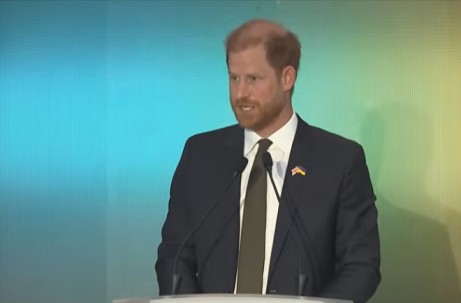
Editor’s Notes: In this forum, Prince Harry makes a high-profile return to Kyiv to deliver a powerful and urgent message on the global stage. Speaking not as a politician, but as a soldier and humanitarian, he addresses the ongoing conflict in Ukraine as a pivotal war for democratic values and sovereignty. The speech features a direct appeal to international leaders, including specific calls for accountability and a challenge to the world to match the resolve of the Ukrainian people. (April 23, 2026)
TRANSCRIPT:
PRINCE HARRY: Ladies and gentlemen, distinguished leaders and friends, it is an honour and a privilege to return to Kyiv, my third visit to your beautiful country, and a privilege to be asked to speak to you today.
Each time I return, I feel something that is difficult to describe, but it is impossible to ignore. It is a sense of clarity. Clarity about what matters, clarity about what is at stake, and clarity about who is carrying that burden.
So let me begin differently today, not by speaking about Ukraine, but by speaking to you. To those defending this country, to those holding families, communities and institutions together, under extraordinary strain, the world sees you, and the world respects you.
I am not here as a politician. I am here as a soldier who understands service, as a humanitarian who has seen the human cost of conflict, and as a friend of Ukraine who believes the world must not grow used to this war or numb to its consequences.
Because what is happening here is not simply a war about territory. It is a war about values, about sovereignty, about whether the principles that underpin our shared democracy shall hold meaning.
Darkness or Dawn? Ukraine’s Answer in Action
The theme of this forum, as we have heard, asks, darkness or dawn? Is light ahead? And standing here, in a country that has endured so much, it would be easy to feel the weight of darkness. But Ukraine has already begun to answer that question, not in speeches, but in action.
For more than a decade since 2014, Ukraine has stood on the front line of a struggle that extends far beyond its borders. And since the full-scale invasion, the Ukrainian people have done something extraordinary. You have adapted, you have endured, and you have held the line. Few believed that would be possible. And yet, here you are, still standing, still fighting, and still leading.
Because this is what leadership looks like in the modern world. Not just strength in arms, but strength in unity. Not just resilience, but innovation under fire. And not just survival, but purpose.
Ukraine is now at the forefront of modern warfare, developing some of the most advanced drone capabilities anywhere in the world, adapting faster than larger forces, and proving that agility and determination can counter brute force. That is not just resilience. That is leadership in real time.
Strength Through Unity, Not Isolation
I have seen what strength looks like in conflict. I saw it during my time serving alongside Allies in Afghanistan. Different nations, different backgrounds, but united by a shared mission and a shared responsibility. And what I see here in Ukraine is that same principle. Strength, not just in bravery and capability, but in unity, in trust, and in the willingness of nations to stand together and carry the burden together.
That is what strength looks like today. Not isolation, not division, but unity. Mutual respect and the resolve to act. The strength is not measured by how loudly we speak, but by how consistently we stand for the values we hold dear.
The Human and Invisible Cost of War
But we must also be honest about the cost. The human toll of this war is truly staggering. And behind every statistic is a life, a family, and a future changed forever.
And beyond the visible losses, there is the invisible cost. The trauma carried by those returning from the front. The psychological strain on families living under constant threat and bombardment. The exhaustion that comes from years of uncertainty and grief. This is not something that ends when the war ends. It is something that must be recognised and supported for years to come.
Because war is not only fought on the battlefield. It is fought in the mind. Through disinformation, through fatigue, and through the slow erosion of hope. Psychological warfare designed to divide. And there are those on the front lines who know exactly what is at stake, and those at home who are exhausted, and understandably so. And that tension is very real.
And yet, Ukraine continues to hold together. And hold together you must. I have seen this nation’s resilience first-hand through members of the Invictus community.
Ukrainian servicemen and women who have faced unimaginable challenges and continue to lead with strength, dignity, and purpose. For those Ukrainians that by day are keeping the economy and the country going, and by night are under bombardment, your service, your courage, and the dedication to your country is recognised and appreciated more than you will ever know.
Now across the world, many are angry, rightly so. Many are scared, understandably so. And many of us disagree on politics. And most of us will agree that there’s a lot to fix to bring us back to the middle. So when some are striving to dismantle democracy, the many should continue to speak up. To be heard. To be counted, and to be the loudest voice, choosing life and freedom. But we know there can be devastating consequences of silence, delay, and lack of accountability.
Ten Years of Ukraine at the Invictus Games
This year marked ten years of Ukraine’s participation in the Invictus Games. A decade that has shown the world what recovery can look like. Not just physical recovery, but the rebuilding of identity, of confidence, and of hope. And during my visit to Lviv, I saw the work of the Superhuman Centre, restoring not only bodies but lives.
And it is proof that even in the darkest moments, humanity has an extraordinary capacity to rebuild.
And that same spirit extends beyond the front lines. Across Ukraine, organisations are working tirelessly to meet the needs of civilians affected by this war. And among them, World Central Kitchen has been providing millions of meals to those displaced. To families living under constant threat, and to communities cut off from normal supply chains. Their work is simple in concept, full of risk and profound in impact. Because in the middle of conflict, a hot meal is not just sustenance. It is survival. It is dignity. It is a reminder that people have not been forgotten. That is what light looks like, even in the darkest places.
The Enduring Threat of Landmines
But even as communities rebuild and support one another, the dangers of war persist. Across fields, towns and villages, landmines and unexploded ordnance remain. A silent, enduring threat to civilians, long after the fighting moves on. Organisations like the HALO Trust are doing extraordinary work to clear these remnants of war, turning danger back into possibility. But the scale of this challenge is immense. Which means our responsibility does not end when the war ends. It continues in the work of recovery, of rebuilding and of ensuring that future generations can live without fear beneath their feet.
Democracy Is Not Inevitable
Now if I may step back for just a moment. There was a time, not so long ago, when many believed that we had reached a kind of historical end point. That liberal democracy had prevailed. And that major ideological conflict was behind us. But history has a way of reminding us otherwise. What we are witnessing today is not the end of struggle, but its evolution. And the lesson is clear. Democracy is not inevitable. It is not self-sustaining and it is not immune to challenge. It must be defended, actively, consistently and collectively.
And that is why Ukraine matters so deeply. Because Ukraine has chosen a path grounded in freedom, in dignity and democratic values even in the midst of war.
The Nature of This War
We must be absolutely clear about the nature of this war. This is not an accident, nor a misunderstanding and nor the inevitable fog of conflict. It is the product of sustained, deliberate policy, planned, executed and defended at the highest levels.
It begins with the violation of the Budapest Memorandum, an agreement under which Ukraine relinquished the world’s third largest nuclear arsenal in exchange for binding assurances of its sovereignty and territorial integrity. Those assurances were not just broken, they were discarded. And when commitments of that magnitude are violated, the damage does not stop at Ukraine’s borders. It strikes at the credibility of every international guarantee, every non-proliferation effort and every promise made between nations.
But the consequences are not only strategic, they are profoundly human. Across occupied territories there is mounting documented evidence of systemic war crimes.
The Forced Deportation of Ukraine’s Children
Deliberate attacks on civilians, mass killings, torture, sexual violence and the forced deportation of entire populations. In places like Bucha and Mariupol, the world has seen what happens when those policies are carried out on the ground. Civilians executed, communities erased and human dignity stripped away.
And nowhere is this more chilling than in the treatment of Ukraine’s children. The International Criminal Court has issued arrest warrants for the unlawful deportation and transfer of children, acts that are not incidental to war but central to a wider strategy. Tens of thousands of Ukrainian children have been forcibly taken from their homes, many separated from parents who were killed, detained or simply lost in the chaos, and transported into Russia or Russian-controlled territories.
There they are subjected to a system designed to erase who they are, given new identities, new citizenship, placed into Russian families and cut off from language, culture and country. Obstacles are deliberately created to prevent their return. Under international law, the forcible transfer of children from one national group to another is not just a war crime, it can constitute an act of genocide, when carried out with intent to destroy a people’s identity.
This is not collateral damage, this is not the chaos of war spilling over. This is organised, systemic, intentional and designed to endure long after the fighting stops.
A Direct Message to President Putin
President Putin, no nation benefits from the continued loss of life we are witnessing. There is still a moment now to stop this war, to prevent further suffering for Ukrainians and Russians alike, and to choose a different course. Years into this war, with immense losses and limited gains, it is increasingly clear that this path offers no victory, only more loss. The cost continues to rise, with no outcome that justifies the human toll.
Ukraine Is Not Standing Alone
But while we recognise these realities, we must also recognise something equally important. Ukraine is not standing alone. Across Europe and beyond, there has been extraordinary support. Countries have stepped forward, often at real cost, and that matters. Because solidarity is not just a principle, it is a capability.
Europe has stood up in profound ways. And that support has mattered, and Ukraine knows it. The task now is to match endurance with speed, solidarity with scale, and commitment with consistency. What has already been done has proven what is possible, and the scale of this moment demands more. Decisive action, delivered quickly, saves lives. And clarity of commitment shortens wars.
A Call for American Leadership
The United States has a singular role in this story, not only because of its power, but because when Ukraine gave up nuclear weapons, America was part of the assurance that Ukraine’s sovereignty and borders would be respected. This is a moment for American leadership, a moment for America to show that it can honour its international treaty obligations, not out of charity, but out of its own enduring role in global security and strategic stability.
Respect and the Path Ukraine Has Chosen
Respect. Ukraine has earned the respect of the world. Through its leadership, Ukraine has very much earned the respect of the world. Through its leadership, through its resilience, and through its conduct. And of course, through its innovation. And respect really matters. Because when leaders act without respect for sovereignty, for international law, for human life, well, respect, once lost, is rarely recovered, and never quickly. And Ukraine has taken the opposite path, and that distinction could not be clearer.
History Will Ask What We Did
As President Zelensky has made clear, “We are defending our right to live.” So the question is no longer whether Ukraine will stand. You have already answered that. The question is, will the rest of the world match your resolve?
Because one day soon, this war will end. And history will not ask what we said, it will ask what we did. Who acted, who stepped forward, and who chose courage over caution? Ukraine has already given its answer. Now is the time for the rest of us to give ours.
Thank you. Slava Ukraine.
Related Posts