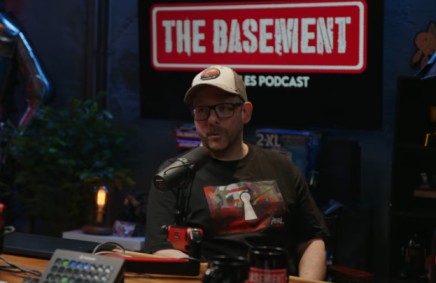
Read the full transcript of filmmaker Luigi Vendittelli’s interview on The Why Files: Operation Podcast, May 12, 2026.
Editor’s Notes: In this episode of “The Basement” from The Why Files, host AJ Gentile sits down with Luigi Vendittelli, a filmmaker and former national director of MUFON Canada, to discuss his documentary S4: The Bob Lazar Story. The conversation centers on Vendittelli’s meticulous five-year project to create a hyper-detailed 3D reconstruction of the secret S4 facility based on direct collaboration with Bob Lazar. They further explore Vendittelli’s extensive background in ufology, including his connection to the Ariel School encounter and the scientific anomalies that continue to spark debate over Lazar’s claims. This episode offers a compelling look at the intersection of digital forensic recreation and historical investigation into the mysteries of Area 51.
Introduction
AJ GENTILE: Today I’m talking with Luigi Vendittelli, former national director of MUFON Canada and the filmmaker behind S4: The Bob Lazar Story, now streaming on Amazon Prime Video. Luigi spent 5 years building the most detailed 3D recreation of Bob Lazar’s S4 facility ever put on film, and it started with a cold call to Lazar himself.
HECKLEFISH: And he answered?
AJ GENTILE: Yep.
HECKLEFISH: Is Bob still taking calls? Because I got a great business idea for him to endorse.
AJ GENTILE: No, you don’t.
HECKLEFISH: It’s a fitness app, CrossFit 51. Every workout is you running from a black helicopter.
HECKLEFISH: Whoa, whoa, whoa, whoa!
AJ GENTILE: It’s not good.
HECKLEFISH: And you can pee inside a replica UFO. Sleek, modern. And in the bathroom, an optional probe.
AJ GENTILE: That’s enough. What Bob found inside the UFO is the part that stays with you. There’s a detail about how light behaves in the craft that Bob couldn’t have known. Not unless he was actually there. Today we also get into his friendship with an aerial school witness, his 2 years training under Dr. David Jacobs, and his grandfather’s 1965 sighting that started all of it. This one goes places you don’t expect. Let’s go down to the basement.
Hey, you can watch The Why Files on Spotify. New video episodes every Monday and Friday, and premium subscribers get fewer ads, which means fewer interruptions when things start getting weird. Luigi Vendittelli, welcome to The Basement.
LUIGI VENDITTELLI: It’s such a pleasure. Thank you for having me.
AJ GENTILE: You’re welcome. I’m going to try not to nerd out too much on the 3D stuff because, you know, we do that here.
LUIGI VENDITTELLI: That’s great, let’s do it.
The Music of S4: The Bob Lazar Story
AJ GENTILE: So I have to watch a lot of documentaries for what I do, and they’re mostly terrible. So when I got your screener, I didn’t know much about you. I certainly knew Bob’s story. I threw it on for a couple of minutes to see, like, what am I in for? And the first thing that grabbed me is the music. The music is unbelievable. It’s so good.
LUIGI VENDITTELLI: A big shout out to James Gray, who’s the composer who did all that.
AJ GENTILE: Really?
LUIGI VENDITTELLI: Yeah.
AJ GENTILE: It has a Blade Runner Vangelis vibe, and I loved it. I thought maybe, is it just going to be the credits? But it goes through the whole thing. It’s so atmospheric. It’s really well done.
LUIGI VENDITTELLI: He reached out to us. He’s from Scotland, and James is a BAFTA Award-winning composer, and said, “I want to work with you guys. I’m going to do all this for free for now, and we’ll figure something out.”
I’m like, because I didn’t have a— when he reached out, we were kind of starting to run low on budgets. I’m like, this is going to cost a lot of money. And he says, “No, I have a passion for this. I want to help you.”
And he said, he sits down with me. I grew up with my father being a big opera and classical music fan, and I wanted the film to have a memorable music to it. And I said, “My father made me grow up with Giuseppe Verdi music.” And he says, “Giuseppe Verdi, perfect.” And he knew everything about it. And I said, “But I also have, it has to have like an ’80s ominous to it.” He says, “Done. Let me send you some stuff when I come up with it.” And he did. And we went, “Okay, we’re working with you.” It’s perfect.
AJ GENTILE: I mean, when you released the soundtrack, I downloaded it immediately. So that’s rolling in my car. That’s great.
LUIGI VENDITTELLI: That’s great.
Luigi’s Grandfather and the 1965 Sighting
AJ GENTILE: Let’s start with your grandfather’s story.
LUIGI VENDITTELLI: Yeah.
AJ GENTILE: He’s out on the balcony. What happened?
LUIGI VENDITTELLI: So in 1965, my mother’s father, my grandfather, who was basically like my second father, I spent a lot of time with him when I was in Italy as a kid and in Montreal when I was a kid. Like, we always were together all the time. He would take me around Rome. I know Rome because of him. He was one of the most important people in my life, and he was such an honest, dedicated grandfather. Like, I was like his son, basically.
AJ GENTILE: Parla italiano a casa?
LUIGI VENDITTELLI: Parla sempre. Abbiamo sempre parlato l’italiano. Perfetto! So, and he was a very big reason why I spoke Italian. He’s very strict, actually, when it came to that. He says you have to learn it perfectly. So I was able to learn Italian and speak it like the people in Rome did. That was important. We stayed in Rome anyway.
And so in 1965, 5 years after he moved to Montreal with my grandmother, my mom, and her sister, he was outside on a balcony with a friend of his who was visiting from Italy. His friend’s name is Corrado Zenga, who was a famous soccer player in Italy, by the way. And they were outside on the balcony smoking a cigarette, as most people did in the 1960s.
And in front of the apartment building, it was a field.
AJ GENTILE: Wow.
LUIGI VENDITTELLI: Flying disc. Okay. It was silver. It was a perfect circle.
AJ GENTILE: It was metallic.
LUIGI VENDITTELLI: Metallic. Silver metallic, perfect circle. And it had flames coming out of it. And he was like, what is that? And he says completely silent and flew very fast over them.
So they ran inside the apartment. My mom remembers this. She was inside the apartment playing with her sister and remembers both my grandfather and Corrado walking in going, “Disco volante, disco,” like screaming. And they run to the other side and they’re getting scared, like what’s going on? And they went to the other window and it was already on the other horizon.
And my grandmother was there and she was like, yeah, you know, he and Corrado ran in freaking out that they saw— we didn’t see anything because it was gone. But I think what happened was she believed it to a certain degree, and so did my mom, because she was there. Not believed the flying saucer, but something flew over the house.
AJ GENTILE: Because your grandfather wasn’t someone to make up stories.
LUIGI VENDITTELLI: Oh God, my grandfather, first, extremely old-school Catholic Italian, like old school, very strict in terms of how he raised me. Always sit properly at the table, always wash your hands, always wear good shoes, always be nice to people, like go to school, study, like very old school, and he was not the type at all to invent some story like that.
And he was also, I should say, back during the Second World War, he was a prisoner in a concentration camp in Hanover, Germany. So he spent 2 years in a concentration camp and almost died.
AJ GENTILE: Why was he in a camp?
LUIGI VENDITTELLI: He was an Italian military, and the SS came into the village, grabbed— actually got caught at the train station. So he and other soldiers were taken at a train station, put in a train, and he said there was no seats. And he says, “I was standing all the way to Germany, and we were not allowed to sit down.” So that was a horrible thing, apparently.
But he stayed in Hanover in a concentration camp, and he eventually got all this paperwork and was also later on, the German government sent a lot of money to my grandfather because of that. He was able to prove that he was a prisoner, and the German government actually had a compensation plan for prisoners that were sent to concentration camps. So he got a bunch of money back in the early 2000s because of that.
Italy and Germany: When Allies Became Enemies
AJ GENTILE: So the historians who are screaming right now, Italy and Germany were allies for a while.
LUIGI VENDITTELLI: Yeah.
AJ GENTILE: Until—
LUIGI VENDITTELLI: Until they weren’t.
AJ GENTILE: Until they weren’t.
LUIGI VENDITTELLI: Absolutely. And when they turned on the Italians, they turned on the Italians viciously.
AJ GENTILE: Mm-hmm.
LUIGI VENDITTELLI: Not a little bit. I mean, my grandmother used to say all the time, she would talk about the horrors of the Holocaust and all that stuff, but she would always say, “We were also victims.” Yes. You know, so it’s something that a lot of people sometimes wonder, “Really? The Italians?” Yeah, yeah. It was a lot of people died, and that was a horrible time.
But anyway, being in the military, he said, “I knew what aircrafts were.” He even remembered when he was saved in Hanover, he remembered saying, “I could see the planes with the black star on them. It was the Americans.” So he always said the planes with the black stars saved us, which is a cool thing because it’s the American military that came to save them. And I get choked up because I remember the stories really, really well.
And anyway, he knew about this stuff. And he’s not a guy who used to lie to me, or lie to anybody for that matter. So I took him very seriously. And I’m like, he saw a flying saucer. And he would say this occasionally in the house, you know, when people come over, my grandmother would be like, you know, say that story. And then he would say the story. And everybody’d be laughing. It was like, “Ahaha, that’s ridiculous,” you know. And he was never laughing. He was always the one guy in the room who wasn’t giggling, wasn’t laughing. And I always used to look at him and go, why is everybody laughing? It didn’t make sense to me.
AJ GENTILE: Did he get annoyed?
LUIGI VENDITTELLI: No, he was sad. I saw him. I think he was sad. It wasn’t— he wasn’t annoyed.
AJ GENTILE: What about Corrado? Did he ever mention the story again?
LUIGI VENDITTELLI: I don’t know. I’m sure he did, but he was living in Italy. Corrado was visiting my grandfather and my grandmother in Montreal, then went back to Italy. So I’m sure he had, but back then, how are people keeping track? Through a letter? You’re not going to start getting, you know, it’s not like today where you could text and talk all the time. So there was big distances in communication back then. So that’s how it was.
But he would always be very, very perplexed. I would see him kind of disappointed. There’s the right word. Disappointed that it was always a joke to him. So I took it very seriously. I remember it sparked something in me, and I said, he doesn’t lie. What did he see? Like, you know, why are we pretending that didn’t happen?
And obviously, you know, as a kid, I read about flying saucers on whatever I would find. So I’m like, is that stuff real? I wasn’t sure, but I was like, he certainly saw something. So it sparked a whole journey in my life, let me tell you, and it changed everything for me. I think that was without a doubt the moment that it got me on a trajectory, and I never stopped, you know.
From Age 9 to MUFON
AJ GENTILE: And how old were you when you made that decision?
LUIGI VENDITTELLI: 9.
AJ GENTILE: 9.
LUIGI VENDITTELLI: Yeah.
AJ GENTILE: So take us from age 9 to MUFON.
LUIGI VENDITTELLI: Well, when I first started looking, I wanted to get information on it. And I was a real geek when I was a kid. I was, I guess, I got to remember this, like the ’80s, right? It’s not popular to be a geek in the ’80s. I don’t know if you remember that.
AJ GENTILE: Tell me, girl.
Growing Up a UFO Believer: MUFON, Gulf Breeze, and Early Investigations
LUIGI VENDITTELLI: Yeah, okay. It was bad. So I was like, I would use my summers to really dive deep on science stuff, because actually there was nothing on flying saucers that I could find, especially in Montreal. So I had to just— I thought if I buy astronomy books, I’m going to learn about flying saucers. That’s my— I’m a kid, I’m very naive.
I still have all my astronomy books from when I was a kid. I used to get a small allowance, put money aside. I would help my grandparents at the market, my father’s parents were at the fruit market, I would help them. I get money, put it aside, and buy astronomy books. And my mom was always like, “You’re spending all your money on books about space?” She was really like, “Why don’t you go out and play?” It was— I was a real geek.
So anyway, I got really educated on astronomy because I’m reading them, but there was never anything about flying saucers. At the end of the books, there was always like a few pages, “Potentiality of Life in the Universe.” And I’m like, okay, but this is not giving me anything.
And eventually we went to Plattsburgh, New York, and that’s just about 45 minutes from Montreal by drive. My mom and my grandmother would go there shopping all the time because the stores in America were much better than the stores in Montreal at that time. Even a small place like Plattsburgh had way better stuff than Montreal.
AJ GENTILE: Really?
LUIGI VENDITTELLI: Oh yeah, yeah, yeah. So much stuff, so much cool stuff. So we would go there almost like every second or third weekend. My sister and I in the backseat, and I remember playing Michael Jackson in my Walkman going to Plattsburgh. And actually, every time I listen to Michael Jackson, I remember those trips going to Plattsburgh.
And basically, in a bookstore, I see something of MUFON. I see a MUFON— I think it was like a pamphlet they had. And I’m like, oh my God, it’s like something about UFOs. And you could become a member. And I couldn’t wait to fill it up and send it out. So I sent that. And they said, “What’s your specialty?” And I was like 12 years old or something. And I said, “I don’t know, astronomy,” because I had read so much. So my original first card ever said specialty astronomy. That was crazy.
But I received a letter from them when I applied. It was Walt Andrus, who was the executive director, a big director of MUFON. And he said, “You are officially the youngest member of MUFON in the world.” And that actually intimidated me. I got scared. I remember going, oh, maybe I— like, now what do I have to do, right?
AJ GENTILE: Am I too young?
LUIGI VENDITTELLI: Am I too young? Like, do I have responsibilities now? I was like, maybe I bit off too much here. I don’t want to— I felt like maybe I should call them and tell them I’m not an astronomer, you know. That’s what I thought.
Anyway, I obviously subscribed to the MUFON Journal. I started reading about all that stuff. That was really interesting to me, because finally I was getting traction on the stories about UFOs and all that. Obviously they were called UFOs back then, not UAP.
AJ GENTILE: And I still call them that. I’m not with that narrative.
LUIGI VENDITTELLI: Yeah, I’m a UFO guy. Exactly. So basically that propelled me into— the more I read about it, the more I wanted to read about it. And I had to do it kind of in hiding. I remember my friends would come over. I had a lot of people that made fun of me because I was into UFOs. I was younger and it’s like the ’80s. It was not cool. It was not something that— people would always make fun of me because I was into UFOs.
AJ GENTILE: What are they saying? What are they saying to you?
LUIGI VENDITTELLI: Oh, it was just like, “Oh, you believe in that stupid stuff?” Basically, “Why do you believe? That’s crazy. Luigi’s a freak.” And it’s like, why? Why am I a freak?
Graduating in 1989: The Year Bob Lazar Went Public
But I think it was like a stigma. It was 100% a public perception of UFOs. I’ll say, even now, and it kind of feels good to say it on a big platform like yours— when I went to my prom, I’ll never forget— there must be a video of this somewhere, somebody from my prom must have videotaped this back then— and I graduated in 1989 when Bob Lazar went public, and the director of the school was up on stage handing out the diplomas at prom.
AJ GENTILE: And you got your diplomas at prom?
LUIGI VENDITTELLI: Yeah, they gave it to us at prom. I remember that.
AJ GENTILE: Okay.
LUIGI VENDITTELLI: And basically he said, “And now Luigi Vendittelli, the guy who believes in aliens.” And everybody was laughing. And I had to go pick up my diploma while everyone’s like, “Ah.” He’s just roasting you.
Yeah. And I’ll never forget it. I mean, I’m talking about it now, right? And I was like, wow. And so that kind of killed my interest to go too fur— because I was getting to the age where I wanted to start dating girls and go out and have friends. It’s like, I don’t want to be a geek all the time. So I was doing it in hiding most of the time.
AJ GENTILE: Were you doing any work for MUFON? Were you investigating?
The Gulf Breeze Case and Ed Walters
LUIGI VENDITTELLI: The only thing I did, actually— yes, one thing I did was there was one case, you probably remember it, the Gulf Breeze, Florida case, right? And I found that to be interesting because there were so many pictures. There was a guy called Ed Walters who had taken those pictures. And I took it upon myself to write him. I just found his address. I don’t remember where. I wrote him and I said, “I’m this guy in Montreal. I’m interested. Is there any more stuff that you could send?”
And I have an original letter from him. I have a videotape he sent me that I still have. And it was made for me. It was Ed Walters talking to me about what had happened and included his home videos of what he saw, the craft, right?
AJ GENTILE: Wow. Was that the acorn shape?
LUIGI VENDITTELLI: Yeah, it kind of—
AJ GENTILE: It was weird.
LUIGI VENDITTELLI: It was not an acorn, but yeah, it was like a— yeah, like a fat— yes, let’s call it a fat flying saucer.
AJ GENTILE: It wasn’t a disc.
LUIGI VENDITTELLI: It wasn’t a disc. And I mean, there’s been a lot of controversies, a lot of things apparently saying, “Oh, it’s not real, it’s not true.” I don’t know. But at the time, it wasn’t determined to be fake yet. And so I was in communication with him.
And the local MUFON chapter found out. I must have sent a letter to some— and by the way, everything was letters back then. There was no email, right? So I had sent a letter to somebody saying I was in communication— I was super excited— I’m in communication with this guy. So they invited me to a MUFON event in Quebec, Montreal. And I tell my dad, “Could you drive me to this place?”
AJ GENTILE: Wait, how old are you now?
LUIGI VENDITTELLI: I was 13. And my dad’s like, “Okay, what’s going on?” And I said, “Oh, I have to do a presentation.” My dad’s like, “What is—” So we go into this place. I’ll never forget. He came there because he was really concerned. And he walks in the room and there’s all these people with white hair. And he says, “What are you doing here?” And I said, “Dad, you’ll see.” And they were kind of very nice to me because I was a kid. Obviously they were super happy that somebody of my age group was there. I was obviously the only young guy there.
And I talked to them. I didn’t present it. It was more like, “Oh, I’ve communicated this, the video.” They played the video. And it was the very first time I participated in something. And I got in the car and my dad said, “Every time you talk to these people, let me know.” Because for him, it was just like, “What are you doing with all these adults?” Right, because you’re a kid.
AJ GENTILE: And you’re taking it seriously, right?
LUIGI VENDITTELLI: Oh, absolutely.
AJ GENTILE: Right.
A Supportive Father and a Bedroom Full of UFO Books
LUIGI VENDITTELLI: One of the things that I’ll never forget is my dad’s no longer with us, but he was always supportive. Always. He was the most supportive dad in the world in what I was doing. He was also conservative Catholic, old school, but 100% supportive in what I was doing. He supported me every time he would hear somebody make fun of me because I was into UFOs. He would back me up 100%.
So that was something that was amazing. My mom too, and she’s still with us, and she’s freaking out that her son made a movie. And for me, it was at least my parents are not against this, because a lot of people also had that happen to them, where their parents or their families were not supportive of looking into this topic.
So that’s the first thing I’d done. And that essentially got me really— I mean, I must have read, I don’t know, 40, 50 books when I was in my teens about it. I found a picture recently. I should send it to you. I sent it to Chris Ramsey, who’s a friend of mine. I said, “Dude, check this out.” And it’s a picture of my bedroom back then with all my books. And you see all my UFO books. And it’s an old picture. And he was like, “Oh my God.” It’s like, yeah, you see, I was a freaking geek. All the books were about UFOs. So all I did was read about it for the longest time.
AJ GENTILE: Definitely send us that picture. We’ll throw it—
LUIGI VENDITTELLI: I will, I will. And there’s my telescope in the picture and stuff. Legit geek.
AJ GENTILE: So it sounds very familiar to me, Luigi, you’re home here.
From Researcher to National Director
LUIGI VENDITTELLI: Good. Well, I mean, now it’s cool, right? Now we’re having a conversation about this. And I find that such a breath of fresh air. And I love all these new people getting involved in it. There’s traction, there’s people listening. And so all that time I investigated— obviously I was doing not investigations, I guess, just researching information like a lot of people do. And eventually got really involved and became national director over the years.
AJ GENTILE: But what were we doing in between? What kind of investigations? What kind of work?
LUIGI VENDITTELLI: Well, the biggest investigations I personally participated in were always in Quebec. That’s the ones I really put a lot of effort on. I used to manage some of the investigations that were happening outside of the Quebec province, but I wasn’t the investigator. I was just basically managing the investigations.
The ones I personally participated in were a lot to do with the black triangular crafts that were out there. I participated in investigating— there’s a big event that happened in 1990 in Montreal downtown, where they saw something in the air, in the clouds, and there were a lot of witnesses. It’s called the Place Bonaventure UFO event, and a very good friend of mine, Marc Saint-Germain, wrote a book about it. And I basically looked into a lot of local stuff that I could be active in because I wasn’t traveling as— and it’s important to note, that was not my full-time job. That’s not what— that didn’t pay the bills, by the way.
So it’s important to make that little caveat on the side: that’s not how you make money. You didn’t make money then and you’re not really making money now in this field. And a lot of people who call us grifters or something like that, it’s like, I would really like to know where that money is, because a lot of times it’s an investment out and no return in. The only return is information. That’s it, right?
So I started a company many years ago. Spent years in China going back and forth in China and—
AJ GENTILE: This is, you were doing merchandise?
The MUFON Investigation Process
LUIGI VENDITTELLI: I’m a merchandiser. I’m a product developer, brand developer, specifically through merchandise. So I basically have been behind the scenes for many, many years, producing merchandise for people who have brands. So it’s like when I see your cups, you know, Basement, anything that’s merch, I would be the guy behind the scenes developing stuff for people.
I also own a license in Montreal. I own the Public Transit Commission license. So we do — it’s like when you go to New York and you see the MTA subway stuff. Well, I have the Montreal license for all of that. And I’ve been producing stuff for the NHL and a whole bunch of museums, some of the biggest museums in the world. I produce stuff for them. So that’s what paid the bills.
So I was doing that at the same time. And as I was, eventually seeing that it was finally gaining traction. And I say this even a long time ago, it was like a real difference even 10, 15 years ago, it was still super, super not good, but not as bad as the ’80s and the early ’90s.
AJ GENTILE: Well, before you bring us up to date, what does an investigation even look like if you’re inside MUFON?
LUIGI VENDITTELLI: So the first thing that happens at MUFON is there’s a CMS database they call it. And this is what — customer management? Yeah, it’s kind of like a customer management, it’s like an internal — you plug in all the data of an investigation. If it comes in, a call comes in, somebody who’s a field investigator — so they could call MUFON. They’ll say, “All right, we’re going to refer you to the local field investigator of your area.” So if it’s Nebraska or something, they’ll reach somebody out there. That person then contacts the witness, goes through an initial call, and then basically assesses — is this even worth plugging in?
AJ GENTILE: Because most aren’t, right?
LUIGI VENDITTELLI: I would say 98% aren’t. And a lot of people get upset when I say that, but that’s the truth. I mean, the reality is a lot of people did think they saw something, but it wasn’t ET. It was a tremendous amount of misidentifications, or very — you know, like the moon is very bright, but if it’s behind a cloud, it could have — somebody who’s not wearing their glasses, they could see something else. There’s so many aspects to it.
So there’s an initial screening process. And a lot of times through the screening process, nothing happens. But then if there is something that happens — and there’s a lot of cases, by the way, I mean, there’s a lot of people that call in — those things then get entered in CMS. So then if the investigator deems it to be worthy, either they go meet with the witness if it’s in proximity to them, or if they could do it, because a lot of them are doing this on their free time. Again, nobody’s getting paid to do this, or they could do it over the phone. And now the beauty of Zoom or video calls — it’s probably, because I’m not in it anymore, but it’s probably gotten even easier because you could do a video call and kind of save yourself a trip.
Let’s say you go see the witness, you meet with them. That also is a big determinator of whether you’re dealing with somebody who is on it. I don’t want to call them dishonest. Are they honestly assessing it properly for themselves? That’s the right way of saying it. They’re not dishonest, but are they just overly excited? Because there’s a lot of that.
AJ GENTILE: Of course, if you go out looking for something, sometimes you’re going to find it.
LUIGI VENDITTELLI: Especially if you want it to be. Like, “I saw it, I saw that.” “What did you see?” “A light.” “Okay, what did it do?” “It was just moving near the trees.” That could have been a plane. “No, I never see planes there.” It doesn’t mean the plane didn’t go there. So sometimes it’s a frustrating thing.
And I became — I was very strict, by the way. I think the years of experience was making me very strict. So I was also not getting along with some of the investigators who wanted it to be that so that they could be an investigator on a case. A lot of hate is going to come at me from saying this, but that’s the reality of it.
AJ GENTILE: Well, people know that MUFON’s kind of infamous for infighting and the politics inside between the believers. And I don’t want to call you a skeptic, but it’s more like a tight funnel.
LUIGI VENDITTELLI: That’s right.
AJ GENTILE: If you have a tight funnel, then what comes out is really important.
LUIGI VENDITTELLI: That was crucial because otherwise we’re wasting resources.
AJ GENTILE: Yes.
Evaluating Evidence and Credible Cases
LUIGI VENDITTELLI: Period. The reality is, in terms of evidence, obviously everybody says you have a picture, you have a video, you have something — you have tracks, you have a landing, if they landed, do you have radiation, do you have a detector that you went there — anything. So those are obviously the ones that are of most interest, because now you have something, you have a tangible piece of something that you can work with, other than “I was outside, I was smoking a cigarette, I saw a light in the sky.”
And I say that thinking — that’s what happened to my granddad. And that’s what made me go — so I’m not disputing that that’s not possible. We have to be careful and not immediately say that’s a flying saucer, UFO, or whatever. But when they have a picture or a video, and it is interesting, then yeah, that information gets put into CMS. There’s a whole list of questions you have to ask the person.
And then as a director, I had access to all investigations. So I had access to seeing if there was a pattern in that area within a certain time. So if somebody said, “I saw this long black object in the sky,” and they’re in Winnipeg — well, do we have anything around Winnipeg that’s saying that? If you hear another one, oh, that’s definitely of interest, versus no, I don’t hear anything. So it could be interesting, but what do we do with it?
I still have people reach out to me almost on a daily basis. Even the fact that I did this film, they think that I’m actively investigating. So they’ll be like, “Check this out, I have a picture,” and it’s like 8,000 feet away and it’s a little dot, and I’m like, okay, what can I do with that? It’s not helping. I appreciate it. I understand the need to share it. But we’re not going to get anywhere with it. Even if I could zoom in and see that it doesn’t have wings — okay, this is not going to make the cut.
So there was a lot of discarding of stuff. And — did you come across anything that passed all your tests? Oh, absolutely.
AJ GENTILE: You did?
LUIGI VENDITTELLI: Oh, absolutely.
AJ GENTILE: 100%.
LUIGI VENDITTELLI: Again, black triangular crafts is the one I really put a lot of effort in. There was —
AJ GENTILE: You saw the object? Or are we talking lights in a shape?
LUIGI VENDITTELLI: Object. Absolutely clearly undeniable black triangular craft.
AJ GENTILE: Not a TR-3B or anything?
The Black Triangular Craft Investigations
LUIGI VENDITTELLI: Well, again, everybody says TR-3B. I don’t think it’s a — from what I heard from witnesses and from the time frames that they come in — I’ll say this, as I was investigating, and we’re talking a good 8, 9 years of very, very active investigating, I would meet people who would be like, “Hold on, my wife will talk to you.” They had something happen and the wife comes out and says, “I saw it in 1996.”
AJ GENTILE: Right.
LUIGI VENDITTELLI: And she never went public because — and her kids saw it. Now the kids are grown up. I had a case, in fact, where the witness saw the black triangular craft. I meet with the witness and then his wife says she had seen it with her kids — they were remarried or something, and the kids weren’t at home. And I said, “Could I speak to them?” They’re adults now. They were outside playing in 1996. And they said there was a black triangular craft right on top of the trees with all these colorful lights. They said, “comme un arbre de Noël” — in French, like a Christmas tree.
And I spoke to these adults and they said, “Yeah, yeah, yeah, it was there.” Now this is something that wasn’t current. This was in 1996. They never reported it. But because now somebody was in contact with me reporting it — “Oh, let me go get her” — and then boom, boom, boom, you’re finding out, “Oh really, a black triangular craft was around here in 1996.”
What it did is it made me start questioning — is this really a government thing? I don’t ever omit the possibility that it’s terrestrial, by the way. That’s a very important thing. You can’t assume ET is driving this thing. If it’s terrestrial, well, that means that something was already in play in ’96, that long time ago. And if that’s the case, why would they be flying at low altitude, or hovering, with no sound, in the Laurentians north of Montreal where there’s nothing? There’s no reason for being out there.
There’s an airport, but it’s a FedEx lens there, UPS lens. It’s a cargo airport. There’s nothing that would be like, “Yeah, the government is testing secret aircraft and they’re flying over people’s cabins.” The Laurentians are known for ski resorts and all that. Why would you fly there?
AJ GENTILE: Yeah, the sound is always interesting because we’re here in Vegas, so we see test flights all the time. They’re so loud, they’ll set off every car alarm in the city. So when you say it made no sound, that is a big deal.
The 2013 Ontario Encounter
LUIGI VENDITTELLI: And there was one incident — the most credible, I would say the one that really, really struck me — happened in 2013. The gentleman reached out to me in 2014, because he found out I existed, because he didn’t know who to call in 2013. And I finally reached out to him. He was in southwestern Ontario.
He was a normal, everyday blue-collar guy driving a pickup truck, wearing a baseball cap, plays baseball, cool dude, but not a UFO guy. He’s coming home at 2 in the morning. He was with his friends driving in the middle of southwestern Ontario, turns and — there’s a small town that you blink and you miss it in Ontario — and he says he sees what looked to him like fire in the sky, and it was coming down. He thought it was a helicopter on fire. So he’s like, “Let me go help these guys.” And it went to the right. So he turned to the right and he’s driving, trying to see where it’s going down.
Eventually he stops his truck because there’s a church, and the triangular craft — it was a black triangular craft, he saw it clearly — had lights on each end, and in the middle of it had a plasma. It looked like plasma, he said it looked like lava moving.
AJ GENTILE: I’ve heard this description before.
LUIGI VENDITTELLI: And it was right above the church tower where the cross is. He stops the truck right on the road, puts it in park, opens the door and puts one foot out and one foot in the truck, and he’s looking up at this thing and he’s like, “What the hell is that?” And he says, in an instant — he says it was so fast — it was at, let’s say, 100 meters away, 100 yards away. It went right in front of him at 20 feet below the streetlight.
AJ GENTILE: Below?
LUIGI VENDITTELLI: Below the streetlight. How big was this thing? He says it was around 20 feet in length. He said it looked like a shiny black diamond — like shiny black diamond little bricks. He drew it for me, these little bricks, and he said the top of it wasn’t flat. It had like a — it was flat and then came up a little bit at a point, but he couldn’t see it very well from his angle. And he’s looking at this and he’s like, “What’s this?” And he said there was not — first of all, he said it didn’t make any sound, but it also took all the sound away. “I couldn’t hear anything.”
AJ GENTILE: That’s interesting.
The Black Triangle Sightings
LUIGI VENDITTELLI: Yeah. He says it was complete— it’s like you’re in a sound room where you don’t hear anything. He said that’s what it felt like. It was complete silence.
AJ GENTILE: That’s going to track with some of the physics with Bob’s story and others.
LUIGI VENDITTELLI: I believe so. And so now what made it really interesting when he’s describing this to me, and he said something that made me kind of believe him really quickly, he says, “I thought that they had a projector somewhere and that they were going to come out with balloons and I was going to be on Candid Camera or something.” ‘Cause he’s like, what am I looking at? You know what I mean? He’s like, it has to be a projection for it to move so quickly. That’s what he’s thinking. He’s not thinking it’s a real thing. He’s like, where’s the cameras?
AJ GENTILE: I think that’s why there’s so few photographs or video of things like that. My brother had a sighting similar. You’re so out of your element. You’re not thinking.
LUIGI VENDITTELLI: You’re not thinking.
AJ GENTILE: You’re just like, what is this?
LUIGI VENDITTELLI: And he said it to me. He said, “Luigi, if I took out my camera, my phone and snapped a picture, I would have had the best picture in the world of one of these things. But it didn’t even occur to me,” he said. “I was going, what am I looking at?” It’s happening live. So you’re just focused.
He says it tilted a little bit. There was a tiny little cemetery right to his right, really small cemetery. And it just went like that and moved so quickly over the cemetery ground. And he’s scared because now it moved again. So he’s just like, what’s it going to do?
And it had a red laser, if you want to call it a laser. He said it was like a sewing machine doing this on the cemetery ground. It was scanning it, but the laser was going really fast, like a sewing machine. Did you ever—
AJ GENTILE: Did you ever hear about the Devil’s Den sighting? No, this is the exact same story. Same craft, same laser beam.
LUIGI VENDITTELLI: Really?
AJ GENTILE: Pentirch in Wales, similar, but Devil’s Den is this exact story. The craft, the thing in the middle, and what really set me off is this laser description. They said they saw the same thing, this repeating laser, and it looked like it was scanning their campsite. Exact same story.
LUIGI VENDITTELLI: Oh wow, I didn’t know that. I didn’t know the story. So this is exactly what he’s seen. When he saw that, he said that’s when I got scared. He’s like, is that a weapon? Because he doesn’t know. He’s just like, what is that thing? Why is it doing that?
So he kind of stepped into the truck a little bit, looking at it through the cab, the cabin window on the other side. And he said it basically just tilted and slowly flew away. He says it flew away behind the trees, and that was it.
Now, when he met with me, he was so worried that I was going to make fun of him. He was super worried. And he kept saying, “Dude, I really saw this.” And I’m like, okay, I believe you. He’s like, “I don’t want you to think I’m crazy, man.” I’m like, no, I don’t think you’re crazy. But he was so concerned. It was so not his thing that he thought, I can’t even believe I’m talking about this because I didn’t think this could ever happen to me.
And I was like, I believe you. So I even investigated him. I said, to make sure, I want a second opinion. There’s a man who I’m very thankful for knowing. His name is Professor Don Donderi from McGill University in Montreal. He’s written books on this. He’s a friend of mine. He’s getting older now, but still doing well.
At the time, I called Don. He’s a PhD in perceptive psychology. He’s done a lot of work for the government and all that. He’s very well respected. I said, “I would like for you to meet this witness, just to assess the person. I want to have a second opinion.”
So Don came out, we went to Ontario together and met with him. When we walked out of there and got in the car, Don said, “He’s completely sane.” He’s saying the truth. Well, he says what felt like he was being 100% honest. And this guy kept saying, “I don’t want this to go public, I don’t need the attention or anything.”
So, why would he do that? Why would this guy not want any attention? Very credible. For Don to kind of validate that for me, because if I get to a point where I really believe this, I need somebody else to validate that I’m not missing something here, right?
AJ GENTILE: Yep.
Mapping the Black Triangle Craft Sightings
LUIGI VENDITTELLI: And so it was interesting. And then for that to be validated, that got me really intrigued in what these cases were happening in with the black triangular crafts. So I started mapping them out. I can share this with you so you can show it on the screen. After we’re done. But I have an image of that map of all the sightings of black triangular crafts at that time all around that area, all the way to around Lake Ontario to Toronto, north of Toronto, and believe it or not, in the Laurentians in Quebec.
AJ GENTILE: What do you think they were doing there?
LUIGI VENDITTELLI: I have no idea.
AJ GENTILE: There’s no pattern to the sightings?
LUIGI VENDITTELLI: I have no idea. No, they just— people seeing it.
AJ GENTILE: Yep.
LUIGI VENDITTELLI: So between 2013 and 2017, there are 200 catalog cases in that area. That’s a lot of people.
AJ GENTILE: Yep.
LUIGI VENDITTELLI: Why would all these people claim to have seen a black triangular craft? Even if we went, which is unlikely, but if we discarded half of them, that’s still a lot of people.
AJ GENTILE: And for every one of those, there’s 10 that didn’t report it.
LUIGI VENDITTELLI: Oh, for sure. That’s actually a really good point that you raised, because by me doing this, I met with people who didn’t want to report it, but they said, “Yeah, I saw something, but I don’t want to talk about it.”
AJ GENTILE: Do you guys check with law enforcement to see?
LUIGI VENDITTELLI: Oh, absolutely. I worked with— because I was director, I had a contact in all the different police. So I also worked with the RCMP, which is federal police. I had a contact with them. I had a contact with MUC police. And of course you have to with the Sûreté du Québec, which is the provincial police there.
There was a Sûreté du Québec police officer who saw it, but his wife talked to us with her name, and he didn’t want to. He didn’t want to.
AJ GENTILE: Yeah.
LUIGI VENDITTELLI: He was like, no, no, no, no, no, I don’t want to. So we have his testimony. He saw it, but he wouldn’t talk about it. And this is frustrating, and it frustrates a lot of people. They say, well, if it’s evidence, why don’t they want to talk about it? Why wouldn’t they put it out?
Well, think about it. They have families. They have friends. Forget us. Forget the audience who wants this. Their lives are affected if they suddenly say, “I saw something anomalous in the air.”
AJ GENTILE: It’s their prom story for you.
LUIGI VENDITTELLI: Exactly.
AJ GENTILE: They don’t want that.
LUIGI VENDITTELLI: They don’t want that in their life. They don’t need it. And I respect that because they have their own personal reasons for that. So it’s an important thing to bring up when you’re talking about investigating this stuff, because there’s a human component to all of it.
AJ GENTILE: Of course.
LUIGI VENDITTELLI: So I consider that to be some of the most compelling stuff that I ever worked on. And I eventually started working alongside one of the Ariel School witnesses.
The Ariel School Incident
AJ GENTILE: I was just going to ask you about your interest in Ariel School. Maybe just a quick sum-up of the— this audience knows the story, but a quick sum-up of Zimbabwe.
LUIGI VENDITTELLI: Zimbabwe is a case in 1994, in the middle of a recess at 10:15 in the morning at a small elementary school in rural Zimbabwe, in Ruwa, Zimbabwe. Kids were playing outside, over 60 kids were playing outside, and the teachers were inside having a teachers’ meeting.
And suddenly they see 3 objects in the sky, 3 craft, 3 flying saucers, if you want to call them, silver discs. One of them landed at about 100 meters, 100 yards from the school. They had a place where they could play, and they had these logs, these wood logs that were all around, and they called them the log barrier. So the kids couldn’t go beyond it. Sometimes they would jump around the log barrier.
And the kids are playing there and this thing landed outside the log barrier. It landed and they’re all obviously going, what is that? They heard a high-pitched sound and it went away. And then they’re seeing these— they didn’t know what it was, but they saw people running from a distance.
And my friend who passed away, Emily Trim, who was one of the witnesses there, was next to Liesel Field, who is interviewed by John Mack in some of these interviews. And these beings came close to the kids and they were not human. The kids initially thought they were animals of some type because— I mean, these are kids between 7 years old and 12 years old.
So they were all looking at this, and there were these two beings that were apparently dressed in black jumpsuits, standing obviously, with big black eyes. And they started communicating to the kids. The kids started seeing images in their minds. And some of those images were very terrible images, very negative, very traumatic images.
AJ GENTILE: Like what?
LUIGI VENDITTELLI: People dying, no air, people suffocating, images of the earth and war and things that— I guess something that had to do with what’s happening or what could happen. And they all saw an explosion at the end. It was like a big giant fiery explosion.
This is not something that kids are used to, especially in rural Zimbabwe in 1994. So it became a big story at that time, obviously. And these beings communicated, and then they disappeared. They just vanished. And the school bell rang, everything disappeared. Kids ran into school screaming about what they saw. Teachers didn’t believe them. Nobody believed them. They thought, you gotta go back to class. Let’s go back, gotta go study. And the kids are freaking out.
So they eventually got to a point where they realized the kids saw something, because they were freaking out. I mean, there’s no way you can calm 60-some kids that saw this. They’re not going to just go back to class and learn about math. We gotta talk about this.
And so they brought in Cynthia Hind, which was a MUFON investigator in South Africa at the time. She came in with a guy called Gunter who brought a Geiger counter to check radiation. And so they went on the school grounds, and I have the pictures from Gunter, and you could see where it landed.
AJ GENTILE: I’ve seen those. You can see it.
LUIGI VENDITTELLI: You could see where it landed. There was no radiation detected on the ground. But something crushed all that, right? And the kids were visibly affected.
And eventually it got to Tim Leach, which was a BBC reporter who ran it as a big story on the BBC. He was covering some of the atrocities that were happening in Botswana and Zaire at the time. There’s a lot of bad things happening in Africa. And he said, “This is a big deal.” He met with the kids. He goes, “They’re not lying. Everybody’s saying the same thing.”
And it got to the ears of Professor John Mack from Harvard. He was in London at that moment and decided to take a plane and fly down and interviewed a lot of the kids and determined that they’re saying something that they saw.
AJ GENTILE: And we can see all those interviews.
LUIGI VENDITTELLI: Those are available. Yeah, and they’re compelling. I mean, you could see in the eyes of those kids that they saw something.
Now, I became very close friends with Emily Trim. She was there and had seen this, and it affected her a lot. Her brother—
AJ GENTILE: You dedicated your movie to her.
LUIGI VENDITTELLI: Yes, I did.
AJ GENTILE: Did you and Emily work together?
David Jacobs, Regression Training, and the Emotional Weight of Contact Research
LUIGI VENDITTELLI: I spent 10 years with Emily. People thought I was dating Emily. I never dated Emily. She became a very close friend of mine, and had a lot of trouble dealing with the trauma of what had happened at Ariel, and something else that had happened to her when she was 21, again related to all this.
By the way, for anybody listening, this was not the end of that with these kids or the people that were there. There were things that happened after, and that’s not been reported. So there have been a lot of people who’ve had things that happen to them after, which were very traumatizing.
AJ GENTILE: Does this connect to your work with David Jacobs?
LUIGI VENDITTELLI: Yes, absolutely.
AJ GENTILE: Can you explain who he is and what—
LUIGI VENDITTELLI: David Jacobs. So this brought me to really look into these contact events, or these encounters if you want to call them. I started reading more about it. I already knew a lot — I had read a lot of the books in the past, Bud Hopkins and all that, but I want to kind of refresh. It’s kind of like a different section of the research. You have to really separate yourself from that and start looking into the encounter stuff.
And I asked — I remember reading a couple of David’s books and I called Don Nondary, who’s a friend, and I said, “I’d really like to talk to him.” And he says, “I can arrange that. I’m close with David.” So he arranged that and we had some exchanges. Eventually he invited me to go out to his house, and I spent lots of time with David.
That relationship became very important to me because he saw how incredibly interested I was in learning this, but learning this on a professional level, not just a superficial booklet. You could read a lot about this stuff, but it’s also written in a way so it’s digestible for people.
AJ GENTILE: Well, who is David and what did he do?
LUIGI VENDITTELLI: David — so yeah, my bad. David Jacobs is — was one of the most respected researchers in abductions in the world. He was one of the reasons why John Mack also got involved in this.
AJ GENTILE: David was a psychologist, right?
LUIGI VENDITTELLI: No, actually, no, no. He’s a PhD in history. He’s a history PhD, but he’s not a psychologist.
AJ GENTILE: But known for regression therapy?
LUIGI VENDITTELLI: Known for regression, absolutely. He started — when I met him, he had already been involved in this for 40 years. So he had a lot of experience in it. And when I went to his house, for anybody who knows the abduction experts back then, it was like Bud Hopkins was one of those. David had all of Bud Hopkins’ work in his basement. All of it.
AJ GENTILE: Wow. And so it’s a lot of work.
LUIGI VENDITTELLI: Oh yeah. And he took me downstairs into his basement. I’ll never forget. It was filled almost to where the windows were — I’m talking stacks of files, filing cabinets, and cassette tapes. Thousands of them. And he said, “This is all of Bud’s work.”
I hope that’s digitized somewhere. Myself and Randall Nickerson knew that that was at David’s house. Randall actually helped move it there because he was close to Bud Hopkins. And David said, “I don’t know what I’m going to be doing with this, but I need this to never be lost.” And I said, “Let me know whatever, how I can help.”
He eventually found a way to get it to — I believe it’s the Philadelphia Museum, or some educational museum that has all this work in their possession. Somebody could go there — I can’t remember the name now, but you could go there and access all of it. It’s all stored in the archives there, so it’s not lost, which is very, very good.
And I spent 2 years being trained by David Jacobs.
Two Years of Training Under David Jacobs
AJ GENTILE: Trained?
LUIGI VENDITTELLI: Yeah. At the time there was no Zoom, there was Skype. So I had — I can’t remember how many — we would do Skype calls because he was in Philadelphia and I’m in Montreal. We would do them at night, 8 PM to 11 PM. So we’d do 3 hours every night or every second night, basically telling me the ins and outs of this phenomenon — what to watch out for, what could be perceived as evidence and it’s not, what could potentially be not a real memory.
So there was a lot of stuff that I learned in that time, including some very — it’s not confidential, it’s kind of like — it’s like when you work in something like this, you have to be careful how you word it to the person that you’re either regressing, interrogating, speaking to, whatever. You have to be very cautious what words you use.
AJ GENTILE: This is a criticism of John Mack’s work. It was kind of leading.
LUIGI VENDITTELLI: Exactly. You have to be very careful about that because you could lead them or build some alternate memory. It’s a very tricky thing. So you have to be very cautious also with regressive hypnosis, because you could have lies in that.
AJ GENTILE: Sure.
LUIGI VENDITTELLI: Or if not intentional, unintentional.
AJ GENTILE: You could create a memory.
LUIGI VENDITTELLI: You could create a memory. Absolutely. So there was a lot of that. I’m absorbing this obviously, because I’m very interested in the topic. And so that was a very rich period of my life because I was learning a lot of this, reading a lot of this.
And while that was happening, I was also very close to Emily. She had not wanted to open up about her experiences but had decided to open up to me, in small steps. And I respected that, because there was so much emotion attached to it.
David’s training was always very important to me because he would always say — he’s unfortunately not that well with his health, so he’s not active anymore — but he would always say, “Whenever you meet somebody who’s had an experience and wants to be regressed, convince them not to do it.”
AJ GENTILE: Very interesting.
LUIGI VENDITTELLI: He always said that. He says, “Always do your best to convince them not to do it, even if they beg you to do it. Pay attention to how they are. Make sure that they’re not already experiencing something traumatic in their life. Are they having marital issues? Are they having health issues? Do they have problems with their job or whatever? Because this will 100% bring up some bad things, whether they like it or not, and it could further damage whatever is already happening in their life. They don’t need this, and we don’t need this. Don’t be selfish in wanting to know what their trauma is.”
AJ GENTILE: This is another tight funnel, guy.
LUIGI VENDITTELLI: Absolutely. You have to be careful about that.
Emily and the Weight of Witness Testimony
AJ GENTILE: What did you learn from Emily? You don’t have to betray confidence. I know she’s passed recently.
LUIGI VENDITTELLI: Yeah, she’s passed. Emily was extremely — I mean, I can’t even begin to tell you how extremely close we had become.
AJ GENTILE: She was so generous with information over the years.
LUIGI VENDITTELLI: She was. She really was. And she was suffering a lot. The amount of people that wanted stuff from Emily was really a lot, and she would always close up and not want to share.
That whole part of my life — I think I’ll say it — I felt like I graduated. All those years with all the investigations and all that, I felt like I had become really top of my game. I was like in the last year of high school, the oldest guy in the school. And now I graduated and I’m going to college and I’m the youngest guy and I’m learning something completely new.
AJ GENTILE: Really?
LUIGI VENDITTELLI: Yeah. That’s how it felt. Because when I went into the communication contact and all that, it’s not nuts and bolts. It becomes emotional, and emotional is a difficult thing. I’m no longer talking to you about something that is logical. I’m talking about an emotional response, and that is not the same.
AJ GENTILE: No, and it’s trauma emotion.
LUIGI VENDITTELLI: It’s trauma emotion, exactly. So I became very conscious of the fact that I don’t want to spark any trauma in somebody because I’m inquisitive, or I’m interested, or I’m curious about this. I have to learn all over again.
Because I can ask you, “Is the flying saucer that had tripods — did it not have tripods? Did it have legs, no legs, whatever?” That’s nuts and bolts. But “When you were crying, were you crying because you were scared or were you crying because you were traumatized?” That’s a completely different interaction.
And again, I always used to say, “I can’t believe I’m the guy doing this because I shouldn’t be.” There should be absolute experts in psychology sitting down with these people — not assessing them or trying to judge what their problem is.
AJ GENTILE: That’s a good distinction.
LUIGI VENDITTELLI: Yeah. It’s like, let’s not look at them as there’s a problem — let’s find out what happened. There’s a huge difference there. And that’s kind of where I used to be like, man, do we really have a lot to learn here as people.
Because here we want to know, what is this? What is all this? What’s it all about? Well, we don’t know. We know that something is happening and these people are experiencing things. And this was where I was at — seeing them reliving trauma, crying, a lot of crying, a lot of emotional stuff. And we have to look at that no longer as investigators, but also as humans, as human beings.
Basically, it became a thing where it’s like, if I do believe this is really happening to you — because I guess you have to have a certain degree of credibility in the story, so yes, I have to kind of assess it to go, “You’re not a nut job,” because there are some, by the way — but once you’ve passed that, I want to be a safe place for you when I’m talking to you. I don’t want you to think that I’m trying to get information from you and I’ll walk away with it. You give it to me, good. You don’t give it to me, even the better. I’m here to help. I’m here to make you know that you’re not alone in this, that clearly something seems like it happened to you. I feel bad that you have to suffer from all this.
Because a lot of what I learned is people would open up to me and say, “My husband doesn’t even know this happened to me.” Really? Yeah. “You can’t talk to my husband about this.” I know one person — I’m not going to name her name — her husband divorced her because she ended up being in a documentary about what happened.
AJ GENTILE: Oh my goodness.
LUIGI VENDITTELLI: And he divorced her. That’s terrible. Because it’s impossible — and I can assure you she was there. There are other witnesses that were there with her. So if she was making it up, they all had to make it up. Everybody was making it up, right? So it’s a really different thing.
And I was very fortunate to have worked with David to get all that information. David would also provide me information that was never to be divulged publicly — about small things that could happen in an event that would indicate that this is a true event. Things that they do.
AJ GENTILE: For example?
LUIGI VENDITTELLI: Well, I can’t get into that because he would say, “If you mention these things to the witnesses or to the people that have gone through the encounters, other people will hear you say that and they’ll say they had that happen to them.”
AJ GENTILE: They will.
LUIGI VENDITTELLI: You see what I mean? So you have to keep a certain few things private. One of the things — the only thing I can tell you — is there is one thing in particular which stuck with me. There’s one thing they do to us, not all of them, but in a large percentage of the cases, that they do to us on our back.
AJ GENTILE: Did that happen to Emily, and the kids at Ariel?
The Ariel School Encounter and Emily’s Legacy
LUIGI VENDITTELLI: No, no, not at all. That was a separate— the kids at Ariel, the event is really a unique event. And I consider it to be possibly one of the most important events because they landed and communicated with so many children. And all those witnesses— I can say this now— some of those kids committed suicide after it happened.
AJ GENTILE: I could believe that.
LUIGI VENDITTELLI: And all those people lived with that for many, many years. And I talk to them now and they’re all sticking to that story. If it didn’t happen, because a lot of people say they just imagined it, it’s mass hallucination or whatever.
AJ GENTILE: Mm-hmm.
LUIGI VENDITTELLI: They’re all in their 30s, in their 40s. They would keep doing this? You’re telling me all these people are all in on it still today? Would you be in on it?
AJ GENTILE: No.
LUIGI VENDITTELLI: Would you? Still keep a lie that you kept with your friends when you were 9? That’s ridiculous. So there’s something that happened. These creatures, whoever they were, they were creatures, they were real. I asked them— a lot of people say, do you think they were AI robots or something? People are talking about— so I asked, I keep referring to them as the kids, but they’re not kids anymore. So kind of, I’ll say kids just because they were kids when it happened, but I asked the kids, I said, do you think they were robots? And they said, no, not at all. They were real living, you know. But do you, don’t you think it’s possible? And all of them were like, no, no, no, no, these were— they were alive because of the communication. They could feel the way they felt, they could feel it, the way they moved, that they said these were 100% living creatures. Now, were they just really, really good robots? I doubt it, but I can’t say. I don’t know. I can’t confirm that. But something happened on that day and something was communicated to these kids and they all saw it.
AJ GENTILE: Do you think it was intentional, that landing? Or, ’cause some of the stories are it was a repair or—
LUIGI VENDITTELLI: I don’t know. And I heard, of course I heard that.
AJ GENTILE: Yeah.
LUIGI VENDITTELLI: Some people saying the craft was not flat on the ground, it was on an angle like that. Look, it’s very possible that it was not intentional. Very, very possible. But we don’t know. Yeah, it’s possible. I’ll say that because even, believe it or not, even they, even the kids go, yeah, I don’t know. They’ll say, we don’t know what it was. We were just playing. And that happened. There was one of them, I won’t say who, she really struck me as very Catholic or Christian, whatever it is. But she says, “I don’t believe in aliens, I don’t believe in flying saucers, but I can’t explain what I saw that day.” I mean, that says a lot.
AJ GENTILE: Some of the videos are, I’m recalling them now, they’re kind of heartbreaking. Before we go to a quick break and get to S4, let’s just finish off with Emily. Let’s give her a send-off. What would you want people to know?
LUIGI VENDITTELLI: Wow. She was an incredibly wonderful person, very sensitive, went through a lot when she was a kid because of it, put it behind— like buried it, like with her brother who buried it. Her brother was there recently. Had a really nice time to get to know him more.
She would always say to me— I’ll say what she said to me at the very end, but I’ll say something she said to me a couple of years before she passed. She says, “We’re all lying to each other. The world is lying to each other, Luigi.” She would say that to me all the time. “Everything is a lie. It’s not that we’re doing this purposely, but we’re constantly lying to each other because the whole goal for all of us is to become something in this society. So we’re lying to each other and we’re all on the wrong path.” She kept repeating that to me. “We’re always lying to each other.”
That struck a big chord with me because she would say it with such— with tears in her eyes, she says, “I don’t know how to explain it, but we’re not being honest with one another.” It’s like humans are not saying the truth to each other. We’re always— there’s always a guard. We’re always keeping certain things, and we’re always saying it in a way where— it’s like we’re always in an interview. You know what I mean? And we’re not saying everything. But it’s true. We do lie to each other. I guess we’re not lying like, “Hey, I have 3 yachts.” That’s not the type of lies I think she’s talking about.
AJ GENTILE: No, there’s a social performance.
LUIGI VENDITTELLI: Exactly.
AJ GENTILE: So she wants us to what? Just—
LUIGI VENDITTELLI: I think she felt that we were losing track of ourselves. She said she had a butterfly— so this is important. After it happened, she had multiple other encounters. She wasn’t the only one, by the way. And those were things that really affected her. For some reason, there was a communication with these beings that communicated something to her about butterflies. She called it the butterfly story, and she called it, “Where Did All the Butterflies Go?” And she says it was something they told her, and she wrote it down. She goes, “I wrote it as I was receiving it.”
And she said it in 2015. We were in Arizona, and she said it on stage. I have a video of it, and it was the most touching thing. Everybody in the crowd was crying. The whole crowd was crying. She called it “Where Did All the Butterflies Go?” And she said the butterflies represented them. Them, and that she was representing us in the conversation with the butterflies. And she said, “Why are you leaving? Why are you all going away?” And they said, “We’re going away because you’re doing things that don’t allow us to be there with you. You’re not taking care of your environment. You’re not taking care of your world, essentially.”
But don’t go away. She kept saying, “Don’t go away.” But they said, “We can come back, but it’s up to you to make that happen.” So she would say this— she said this in a beautiful monologue that she did on stage. It was very nice. And she said it felt like they’re trying to communicate to us to be better. But not technologically better, just better as people.
And when I last saw her, the very last time that I saw her, she was sitting in front of me. She didn’t look like her anymore. She had changed, but her eyes were her eyes. And she said, “They came down from the sky and landed in front of us and talked to us so that we could tell the world, and nobody cared.” And she died a few days later. I’ll never forget that.
AJ GENTILE: I hope you don’t. That’s an important message. Nobody cared.
LUIGI VENDITTELLI: Yeah, because I could see it from her, you know. And I question, why did this happen to her? Because she was such a good person.
AJ GENTILE: She was important.
LUIGI VENDITTELLI: Yeah, such a good person. And I consider that to be one of the most important events, and we should listen. We should just listen to it. I mean, forget judging this. Everybody goes in with this judgmental— we shouldn’t look at it like that. It’s wrong. It happened. Why did it happen? Somebody could say the thing wasn’t operating properly, it landed, they communicated. Well, even if it was that, still the message— it’s still a message.
AJ GENTILE: The message is important.
LUIGI VENDITTELLI: Is important. And let’s not also forget the message that they had in them to convey to us. That’s another thing, because now the message has been conveyed. To these kids.
AJ GENTILE: And they showed us what happens if we don’t listen.
LUIGI VENDITTELLI: Exactly. And then it also shows how judgmental we are if they open up about it.
AJ GENTILE: All right, we’ll come back in a minute. Give me a chance to use a tissue and we’ll talk about S4.
LUIGI VENDITTELLI: Yeah, great.
How It All Started: The Sport Model Flying Saucer
AJ GENTILE: So it all started with a model.
LUIGI VENDITTELLI: Yes, it did. It all started with a potential collector quality diecast model.
AJ GENTILE: You were just trying to make a product.
LUIGI VENDITTELLI: I just wanted to make a product because I’m a merchandiser, right? I thought, let me make a really good flying saucer for everybody to have at home. And I got Bob’s attention, and he was impressed. He basically asked me— I finally got to talk to Bob Lazar, and—
AJ GENTILE: How did you get through to Bob? That’s not easy to do.
LUIGI VENDITTELLI: No, that was actually— it was really a shot in the dark. I thought I could do this without Bob Lazar. I spent months researching the whole story and all the— as much information as I could find online about the Sport Model flying saucer, and there was a lot of information that was really unclear. I couldn’t understand which part was real, which part— some telephone game over the years, people changing stuff. So I said, let me try reaching out to him and at least see if he’s willing to guide me in correcting just a few things and put his stamp of approval, and that would make it so much more interesting.
And I reached out to United Nuclear Scientific, which is this company. I didn’t send an email, I called. I just cold-called them, and Zach answered the phone, and I said, “I’m so-and-so, I’m a guy from Montreal, you guys don’t know who I am, here’s my website, here’s some of the stuff I’ve done. I’m a merchandiser. I promise I’m not some crackpot. I know what I’m doing. I want to make this cool, quality flying saucer. The only guy I know who’s been in one who can give me some details about it, as opposed to somebody who’s been in one and frightened.” So I said, I don’t expect this to go any further than this. But I gave it a shot. So he says, “Look, I don’t know if Bob’s going to talk to you. I’ll ask him.” And so I got a call back 2 days later, and Zach goes, “Yeah, he’ll talk to you.”
AJ GENTILE: Wow.
LUIGI VENDITTELLI: I was like, okay. I mean, for me, it was just like— I remember I was at the office. I saw United Nuclear on my phone. I said, “Oh s*, it’s called, answer the phone.” They got transferred to me.
AJ GENTILE: And during those 2 days, you’re like, there’s no way.
LUIGI VENDITTELLI: I was like, there’s no way he’s going to talk to me. I’m like, who am I? Plus I’m in Montreal, I’m far away. Anyway, he says, “Yeah, he’ll talk to you. He saw some of the stuff you did, he’ll talk to you.” I said, “Oh, okay.” So I said, “When do you want to do that?” He said, “Tomorrow, give me a time.” For me it was 6:00 PM, for him it was 3:00 PM because of the 3-hour difference. And got on the phone with Bob Lazar. For me it was surreal. And I’m like, “Bob, first of all, thank you for being on the call. It’s a pleasure to talk to you.” And he was very nice. And so immediately he says, “So what exactly do you want to do? Explain.” “I want to do a diecast model. I’ve made a lot of stuff in my life, so I know what I’m doing.” And immediately he says, “Okay, well, if you would do it, how would you do it?” That’s what—
AJ GENTILE: What did he mean by that?
Building the Bob Lazar Flying Saucer Model
LUIGI VENDITTELLI: He says, he told me this at a later time. He says, “You have no idea how many people have reached out to me with all these projects. And when I would ask them, ‘How would you do it?’ I could tell they’d never done that before.” Right. So they’re just going to bullshit it. So he said, “How would you do it?” And I said, “Well, how do you want me to explain it to you? What kind of materials would you—” So I started, I gave him a run. I mean, I spent close to 15 years back and forth in China. I learned how to do stuff. So I gave him a real technical answer, and he was like, oh.
And I said, as far as the waveguide is concerned, inside the craft, I knew something about the waveguide. I said, I would make that in two different materials for the model. One of them would be the metal, the other one would be a silicone because we could mimic the movement of it. He goes, “Okay, okay, stop. I could see you know what you’re doing. Come and see me.”
AJ GENTILE: Wow.
LUIGI VENDITTELLI: And I bought the plane ticket. I’ll never forget. He emailed me that night and he says, “These are the dates I’d be available because I’m working. I have other stuff to do.” I said, great. I bought a plane ticket, sent it to him. He says, perfect. I flew out to Oregon, and as I’m at— I think I was in Denver, I was like a stop before getting to Oregon— he wrote me, says, “Tonight, come straight to my house tonight, we’re going to have dinner with my wife and stuff.” And I said, oh my God, wow, it’s great. So first time I met Bob Lazar was at his house, and we had dinner. Zach brought me there.
AJ GENTILE: Did you know that you were dining with a unicorn?
First Meeting with Bob Lazar
LUIGI VENDITTELLI: I was like, I couldn’t believe it. I could not believe this had happened. And I’ll tell you a funny story. I gave him a gift. I brought him a gift. So back in the late ’80s when I would go to Italy all the time, in my father’s village, there was a lot of, if you dug into the ground, you can actually find old World War II shells, like artillery shells that were still, they used ones, but they were underground. You could find them. So I collected many of them over the years, and I keep them in a nice display in my house. But those are rare. Those are really rare. They’re anti-aircraft American shells that were used against the Germans. So I took a shell. I said, let me bring him one of these, because this is something from my family, from where I’m from.
And I get to the airport, and in the security, they stop it. And it’s an empty shell. And I read about it, and you’re allowed to do it. You’re not. You’re allowed to do it on paper, but apparently you’re not allowed to do it at the airport. So they said, “No, you can’t go. You’re going to have to throw it out.” I said, no, no, no, no, no, you’re not throwing that out. So they said, “Well, you’re going to have to go and give it to somebody and come back through security.”
So I went back out. I’m going to get in trouble for saying this, but I bought a cheap backpack that was at a stand. I put it in there. I took some stuff out of my carry-on, put it in the backpack, and I went and checked the backpack. I said, I have another checked bag. I checked it, it passed, got to— it got to work.
AJ GENTILE: Nice.
LUIGI VENDITTELLI: So I gave him the shell. And anyway, we started talking, and he said, “Do you really want to do this? You really think people are going to want to buy a flying saucer?” I said, if it’s done right, absolutely. And he says, “Wow, you didn’t even hesitate.” I said, no, I’m not hesitating. Are you kidding? Nobody’s ever done that.
AJ GENTILE: Where are we going to sell these? Like direct-to-consumer?
The Flying Saucer Model Project
LUIGI VENDITTELLI: I think it was going to go direct-to-consumer. It’s still going to happen, by the way. It hasn’t happened yet, but we’re not talking about like some plastic model here. We’re talking about like some really high-quality stuff where, if you think about it, there’s a lot of diecast collectors out there, or a lot of people collect models. There is not one good quality, commercial grade— not artistic. Artists could do one of one. I’m talking commercial, industrial-made flying saucer. It doesn’t exist.
AJ GENTILE: No, it looks so sexy in here, right?
LUIGI VENDITTELLI: So I’m like, I want a real flying saucer that somebody’s going to want to put in their house, and that’s a cool piece, right? So that’s what I want to do. And so that was the whole beginning of the project. And so it’s going to happen. It’s just— that’s the way it worked out, didn’t happen that way. But that was the beginning of the whole way I approached Bob Lazar.
He’s been absolutely incredible in the initial stages. I sat with him, spent 2 days with him. We went over everything, and he was extremely generous with his time. He corrected all— there’s so many corrections. I would say, “This is what’s on this website,” and he said, “That’s not it. It’s like this.” And I had brought with me a model made in 1994 by the Testors Corporation. It’s a plastic model made in the USA. It’s available on eBay right now for about $200-300. It’s a really cheap model, but it’s slightly accurate. There’s a lot of things that are not, but it’s accurate.
So I had brought one with me. And he goes, “Oh yeah, I remember this. John Andrews came to see me.” But immediately he saw some things in the model. He goes, “Actually, that’s not accurate. And that’s not accurate. And the seat shape is not accurate.” And I said, well, that’s the whole point. Let’s make it right.
AJ GENTILE: Let’s get it right.
LUIGI VENDITTELLI: Let’s get it right. And so that turned out to be the biggest project I’ve ever done in my life.
AJ GENTILE: So what were you doing? Just iterating with Bob with 3D designs?
Building the 3D Model
LUIGI VENDITTELLI: Yeah. So I came back to Montreal. I had a lot of information that I had taken down. I went back to Montreal, I sat down with my team and I said, all right, let’s start doing this. We built a 200-page book out of this, of all the info, because we were going to build it, so I needed to have everything. I said it has to be perfect.
AJ GENTILE: So what’s in the book?
LUIGI VENDITTELLI: Oh, I could show it to you.
AJ GENTILE: Show it. You should— that should be another product.
LUIGI VENDITTELLI: Yeah, I could. Oh, absolutely. It will, because everyone would love to have that. It will be just notes and sketches and a million things, and it addresses the parts, the components, how they looked inside, and how we would have to build it if we had to create— because by the way, because he had been inside, my reasoning at the very beginning was, if I have a 13 to 14-inch diameter craft, and you want to see the inside, we’re going to have to take it apart, right? Well, that was part of it— how do I have consumers take it apart? How is it going to come together easily? So there was a lot that went into that to create something that was beautiful as a product, and what kind of materials we would use, and so on.
And that was happening in a 3D software. So I started building the craft, obviously, and in the software we started building it in real size. We weren’t building it in a 13-inch or 14-inch diameter. It was 52.9 feet in diameter.
AJ GENTILE: Sure.
LUIGI VENDITTELLI: It was real size. And that was the beginning of a complete shift in my life where the way I was seeing it on screen, we started off in Blender with just the craft.
AJ GENTILE: Blender, an open source 3D program.
LUIGI VENDITTELLI: Absolutely. And then we said, why don’t we make the box look like the interior of the hangar? If there’s going to be this flying saucer and we’re going to put it in a collector box, make it look like the hangar.
AJ GENTILE: This is a great product idea.
LUIGI VENDITTELLI: Right? So I’m like, let’s make that happen. And so we had to build a hangar, and then another part of my team started doing that in Unreal Engine 4 at the time.
AJ GENTILE: Ooh, 4.7.
LUIGI VENDITTELLI: Yeah, exactly. And so the Blender file was the craft, the Unreal Engine file was the hangar, and then we started expanding on the hangar. Bob was like, “Okay, well, I’ll tell you how that is so it looks real.” And we started asking a billion questions. And as we got further and further into this, we would constantly, all of us in my team, have questions for Bob. So we had a booklet and we would write, “Oh, that’s a question for Bob,” go write it, handwrite, you gotta ask him, blah, blah, blah, blah, blah. We need to know this.
So I had 178 questions for Bob. I’m like, I don’t know if I’m going to do this on Zoom. I called him. I said, “Bob, why don’t I just come out there? We knock this out of the park in a day. Worst case, 2 days. You can answer everything.” And in person, it’s always better in person because you can have something in your hands and go like, you know.
AJ GENTILE: What were the questions like on that list?
LUIGI VENDITTELLI: Oh, I could send it to you.
AJ GENTILE: No, I mean, for people listening, just as an example.
178 Questions for Bob Lazar
LUIGI VENDITTELLI: Oh, for instance. Okay. So inside the craft, there’s an archway superstructure. There’s inside, looks like archways, right? Well, the thickness of the archway.
AJ GENTILE: Oh, that’s pretty specific.
LUIGI VENDITTELLI: Yeah. So how thick do you think the archway is? And I remember the reason why I bring it up is I said, “That archway superstructure, how thick do you think it was?” I remember him saying it’s about 2 inches. And what’s really important, he said, “It was hollow.” He had not mentioned that.
AJ GENTILE: No, it was hollow.
LUIGI VENDITTELLI: It was hollow. And I found that to be extremely important. Because I thought, oh, I wrote that down. I go, it was hollow. He goes, “Oh yeah, it was hollow. I touched it on the exit.” Because when he walked, when he crawled into the craft, the archway is all around, so you have them right next to you, the surface of them. I mean, like I would have done— of course, we’re going to do that. You’re sending me inside a flying saucer. I might lick the thing, because I want to understand what am I touching here? So basically, he said they were hollow. I found that to be very interesting.
Another one was, where was the flag? Was it the reverse flag? Was that on the right or on the left? Because we had determined there was a sticker on the craft that was a flag.
AJ GENTILE: An American flag on the craft.
LUIGI VENDITTELLI: On the craft. And I remember him saying, right or left? Where are we putting it? So it was on the left. Okay. There was a whole bunch of questions like that. And you’d be surprised. I mean, you could go through all the details and still have a million questions, which by the way, those were only the first 178 questions. There’s a lot more that followed that.
AJ GENTILE: There’s a lot of OCD in your personality.
LUIGI VENDITTELLI: Yes, yes.
AJ GENTILE: You’re a bit of a maniac.
Building the Sport Model: Emitters, Waveguides, and Craft Details
LUIGI VENDITTELLI: Yeah, yeah, yeah. I love it. Absolutely. And that’s actually what Bob said. Bob, literally, I was putting everything away and he goes, “You know, I have never met anybody so detailed like you are.” And I looked at him and I said, “Well, I hope that’s a compliment because I’m trying to make sure I don’t miss anything here.” He goes, “No, no, no. It’s very good. I’m just impressed with how detailed you are.” And I said, “I’m going to build— if this is true,” I said, “this is true. I’m about to build an ET object. I got to make sure I do it right. Otherwise, what am I doing?” So got to do it right. And so that was my— that’s the way I look at things.
And so that got us into really perfecting it, molding the seats into it, or what we thought were the seats, the amplifiers, even the cutout amplifier. He said it had been cut with a plasma cutter. I couldn’t remember the details, I had to ask him. And he says it looked jagged, it looked like they didn’t do a clean job, which also I find amazing because I’m like, who the hell does that? But that’s how it was.
And the interior of the emitters. In fact, the emitters were something that I was very upset with myself for not having understood. He kept explaining them to me and I completely messed up the way I wrote down all my notes. So I built something completely wrong. And when he saw them, he goes, “What are those?” I said, “The emitters.” He goes, “That’s completely wrong.” I said, “Really?” And he goes, “Yeah, what the hell?” So we had to rebuild the emitters because that was my fault. Those are the big tubes, the 3 tubes?
AJ GENTILE: What did you build instead?
LUIGI VENDITTELLI: They’re hollow on the inside. I didn’t think they were hollow. I thought they were full. I thought they were like a solid copper with these plates on them. And he’s like, “What is that?” He goes, “No, they’re just plates on the perimeter, like on the surface, but it’s hollow inside.”
And there’s— you don’t see it in the film, but imagine a 2-foot diameter, 4-foot trash can. There’s a pipe. It’s one of the waveguides that goes into it because it allows it to swivel and all that. But what I found really interesting is— and he had even mentioned it in the past— that waveguide goes into the emitter and protrudes about a foot into the emitter. And I remember thinking, why would it do that? And it makes perfect sense. Why? Because— I don’t have anything that’s cylindrical here, but imagine a cylinder is suspended by a pipe on the ceiling of the bottom level. And the cylinder can swivel at a 90-degree. The top of the craft, the top of the ceiling, is here, and there’s like a pipe holding it. As soon as it swivels, the pipe’s not long enough for it to swivel at 90 degrees. It’s going to hit the top, right? It needs to extend down and swivel. And that piece inside is designed for it to do that.
AJ GENTILE: That’s an important detail.
LUIGI VENDITTELLI: It’s an important detail. But he never said it did that. He said, “That’s what I saw,” right?
AJ GENTILE: You had to work that out.
LUIGI VENDITTELLI: We had to work that out, and that made sense to us. And we went, “Oh my God, look at that, it makes sense because you need that extra to do that movement.” Did he pre-plan that? Some people say he’s still a fraud. Did he pre-plan that? Is that like some Easter egg he put in there for us to figure out? It never felt like that in any of the times I spoke to him. This was really something that caught my attention. I was like, yeah, that’s not him making that up. He saw that, and that’s how I built it.
AJ GENTILE: I think that even supports his story more because you’re doing the structural engineering.
LUIGI VENDITTELLI: Exactly.
AJ GENTILE: Connecting those dots.
LUIGI VENDITTELLI: Exactly.
AJ GENTILE: And then he sees that and goes, “Yeah, that’s how it works.”
LUIGI VENDITTELLI: Yeah, because it would do that. It makes perfect sense.
AJ GENTILE: Of course.
LUIGI VENDITTELLI: So I was like, okay, well, that’s another— that’s something that I thought was really interesting. Anyway, so we got to a point where the craft was built. And now the entrance to the craft, the hatch— you see it in the film, right? You see there’s a— it lips to the bottom.
AJ GENTILE: Yes.
LUIGI VENDITTELLI: It’s like an— oh, right. Okay. That was a feat. Why? Because we didn’t understand it. We weren’t getting it perfectly for a while in the geometry of the craft. And it took a few tries until he said, “That’s it, you got it.”
The Three-Level Craft: Layout and the Upper Level Mystery
AJ GENTILE: So this is a 3-level craft.
LUIGI VENDITTELLI: There’s a bottom level, and that’s the emitters, the main level.
AJ GENTILE: Yeah, 3 emitters underneath, correct.
LUIGI VENDITTELLI: Then the 3 chairs, and then there’s an upper level that he never saw. He never saw it.
AJ GENTILE: Could he speculate what he thinks was up there?
LUIGI VENDITTELLI: He speculates, and it’s in the film, that he says that’s the part where you see these black— what look like— he says they look like portholes. But they’re not. They’re clearly not.
AJ GENTILE: Something for navigation.
LUIGI VENDITTELLI: He says they were Vantablack. He called them Vantablack. I don’t know if you’re familiar with Vantablack. Vantablack is the blackest of blacks.
AJ GENTILE: Oh yes, I’ve heard of that. It’s so black it’s actually weird to look at.
LUIGI VENDITTELLI: Exactly. He says they looked like Vantablack. They didn’t look like they were a surface. They looked like they were an infinity hole.
So we had to make that in Blender. You can, because you just remove all specular, you remove all that, and you could do that, but it looks fake. If you do that in Blender, it looks fake, which is one of the things that I’m kind of not happy with in my craft in Blender. It’s not reflecting anything, but I’m not appreciating it as much as I should. I’m crazy when it comes to detail. I’m like, I don’t think the real thing looks like that. But that’s as far as we could do it. And he said he thinks it’s perfect. And I’m like, it could be better.
But anyway, in regards to that, he says they believed it had something to do with the navigation, or some type of sensor that lets the craft— or whoever is in the craft— know where it is. So it’s basically reading, and there are 6 of them, and it’s reading where it’s at. That’s what he thought it was. They talked about it with Barry, his lab partner, but he says, “I don’t know, I never accessed it, I don’t know what was up there.” So he’s very, very cautious to not speculate too much.
AJ GENTILE: That’s what I love about Bob and his story. And I’m asked all the time who I think the most credible whistleblower is, and it’s always Bob Lazar, because he’s not afraid to say, “I don’t know, I didn’t work on that. I don’t know.”
LUIGI VENDITTELLI: Absolutely.
AJ GENTILE: He just doesn’t know.
LUIGI VENDITTELLI: And a lot of times he would say, “I don’t know.” There were so many questions we had, and he goes, “I don’t know.”
AJ GENTILE: Even the metal— he’s like, “That’s material science. It absolutely felt or looked like this, but I don’t know.”
LUIGI VENDITTELLI: We spoke about the metal a lot, and it had a lot of properties that were clearly giving us the impression that it’s metal.
AJ GENTILE: Mm-hmm.
LUIGI VENDITTELLI: But he said, “Again, Luigi, it could have been ceramic. I don’t know, but it felt metallic to me.” Now, the part where the archway superstructure is hollow— yeah, that’s a tough one to do in ceramic because ceramic is a very strong material. You don’t feel hollow on ceramic.
AJ GENTILE: That’s right.
LUIGI VENDITTELLI: So that to me gives more credibility— more belief that it’s metal or a metal type of material. But it’s also intelligent, in my opinion.
AJ GENTILE: The craft?
LUIGI VENDITTELLI: The material.
The Reactor, Waveguide, and the Upcoming Mini-Documentary
AJ GENTILE: The material is intelligent because we didn’t—
LUIGI VENDITTELLI: We’re going to be doing— so in our film, we had to abbreviate things quite a bit to make it digestible for the audience. There’s a lot of information that never made it in the film. And we are going to be releasing probably an hour and 20 or an hour and 30 minute documentary— a mini-doc— only on the craft.
AJ GENTILE: That’s going to be successful as well. Because there are a lot of us that want to know about— was it layered? Were there waveguides?
LUIGI VENDITTELLI: We have a lot of data that didn’t make it in the film on the sport model. And one of my things I want to do is make that doc. We’re going to call it a mini-doc, if you will, but it’s just about the craft.
AJ GENTILE: Yes.
LUIGI VENDITTELLI: And it allows us also creatively to show it however we want, and not from the perspective of the story of Bob Lazar. So if I have to talk to you about the material of the craft, I’m now creative. I have the liberty to show it to you however I want— outside, indoors, outdoors. So that gives me the opportunity to really explain what it is that we worked on for that long.
But in the center of the floor— first of all, the reactor sits in the middle of the floor of the craft. There’s an indentation, it fits perfectly there. There’s this waveguide pipe that is 3 inches in diameter. It’s not very thick. And it tapers— kind of opens up like that— because it applies perfectly on top of the reactor.
AJ GENTILE: It’s so low-tech looking. It really is.
LUIGI VENDITTELLI: But it—
AJ GENTILE: It looks like a trumpet.
LUIGI VENDITTELLI: Exactly, exactly. It looks like a trumpet and you pull it down. Now what’s really interesting— and this is part of the stuff that we talked about with Bob— is when they— because it goes up and down, okay? You can remove it off the reactor and you can apply it on the reactor. And the reactor is the power source, so this thing is basically channeling whatever the power source is throughout the craft, which I believe the craft being a gigantic cavity, hollow superstructure, propagates this power, gravity field, or whatever other field that is within the craft and creates this bubble, if you want to call it.
AJ GENTILE: It tracks with a lot of witnesses.
The Archway Superstructure and Bob’s Directives at S-4
LUIGI VENDITTELLI: In fact, Bob is in agreement with me. I was talking to him the other day while we were driving. I said, “I am convinced at 100% that the archway superstructure was also down in the lower level.” It’s not something he saw, but he says, “I don’t remember it because it was so dark. I didn’t see it. I wasn’t paying attention to it because I was trying to figure out what those emitters were.” He goes, “But I must agree, it makes no sense that the craft superstructure is only on one side and not connected like this to the other side on the bottom.” That’s my personal opinion. I built the thing, so it always feels to me like it had to have had it on the bottom.
AJ GENTILE: You’re probably right.
LUIGI VENDITTELLI: It’s just logical sense to me. But he says, “I agree, I just don’t remember seeing it.”
AJ GENTILE: And his job was to what— try to replicate the propulsion technology of those emitters?
LUIGI VENDITTELLI: Replicate it with Earth materials. The first directive was to replicate the propulsion system with Earth materials. And the second directive was to disable it— how to disable it from a distance, right?
AJ GENTILE: That’s important too.
Building S4: The Full Reconstruction
LUIGI VENDITTELLI: It’s important. Okay, so they had to— those are primary directives. And essentially, when you think about this, also this material, as he pulls up the waveguide — it’s not telescopic like a normal antenna that we do. We go like this and it goes in. The base part is thicker and it goes inside itself. It’s not like that at all. He goes, you pull it up and it doesn’t make any sound. It’s not like you hear “shh.” It’s completely silent. You pull it up and it just becomes shorter. It blends into the ceiling.
AJ GENTILE: It doesn’t go through the roof or anything?
LUIGI VENDITTELLI: No, no, no. There’s no hole where you see it go in. It’s just blended into the ceiling of the main floor. The bottom is tapered so it goes on top of the reactor. I remember asking him, “Do I leave a hole?” He goes, “No, no, no, it was blended. It was all one piece.”
AJ GENTILE: No seam or anything?
LUIGI VENDITTELLI: No seam. So he goes, “We would pull it up and we didn’t know where it was going.”
AJ GENTILE: That can’t work.
LUIGI VENDITTELLI: That’s exactly why that’s an important feature.
AJ GENTILE: Yeah.
LUIGI VENDITTELLI: I wanted to put it in the film, but I thought, if I do that, I’m going to need a very long segment here to explain this. And it’s a kind of a — for the layman, for people watching this to digest — that’s a lot of technical stuff that I would have to get into. I’ll cover that in the sport model version of the doc because I want to cover it.
But clearly, what is that? What’s happening there? He says, even when you pull it down, where’s the material coming from? Because it is getting longer, but I can’t tell where it’s coming from. So I asked him, “If you were to bring it down and not apply it on the reactor and push, you know, torque it—” He said, “Oh, it wouldn’t move. It wouldn’t move.” Now think about that. If we have something that is only 3 inches in diameter and hollow—
AJ GENTILE: And hollow.
LUIGI VENDITTELLI: And I pull that down, I don’t know, 4 feet, and I can’t get it to move, that’s something really strong.
AJ GENTILE: Even if it’s titanium, you’re going to get a little bit of—
LUIGI VENDITTELLI: You’re going to get something.
AJ GENTILE: Yes.
LUIGI VENDITTELLI: Then move. I found that really interesting.
AJ GENTILE: Yes.
LUIGI VENDITTELLI: Those are little technical aspects of things that I found to be very interesting. I had to build them. You’re not feeling the physics of that, but it’s something that I took into consideration as I was building this thing. The only thing I don’t have is the upper level. I mean, the outside I have, but I don’t have the interior. I don’t know how that works.
From 187 Questions to Building the Whole S4
AJ GENTILE: So you’re at Bob’s, going through all your 187 questions. And then what happens from there? Oh, you’re designing the box, the hangar.
LUIGI VENDITTELLI: So we finally get the box, the hangar. I actually — just for fun — it was just an idea I had on a weekend. I said, “Okay, here’s the box.” I go, “People are going to want to have more.” What I could include in the box is a cardboard fold-out that is the hallway of the base. I could just do that for people who are a little bit more fanatical. So let me make the hallway.
AJ GENTILE: Talk about scope creep.
LUIGI VENDITTELLI: Oh my goodness. Right? So I essentially said, “All right, Bob, how about we build the whole thing?”
AJ GENTILE: The whole S4.
LUIGI VENDITTELLI: The whole S4. Because one day I just said, “Okay, that’s it. Why don’t we do it?” — it was going to start in Unreal Engine. And he says, “Are you sure you want to do that? What are you going to do with it?” I said, “I don’t know yet. I don’t know yet. But I know I want to do it.” And he goes, “That’s going to cost—” I know, I know. I said, I knew, but I had to do it because, historically — or let’s say in this timeline of our lives — Bob Lazar is getting older. And he’s already in the process of helping us design the interior of the hangar. And if I don’t do this now, when is this even going to happen?
AJ GENTILE: It would never happen.
LUIGI VENDITTELLI: It would never have happened. No. So I said, and Bob said, “Well, are you sure you want to do it?” I said, “Yeah, if I invest — because it’s my money — I’ll do it, but on one condition: you stamp it, give it a stamp of approval. You have to help.” He says, “Oh, I’ll do it. You guys are doing a great job. I’ll do it.” And I said, “Great, we’re doing it.”
So I called everybody, had a meeting. I said, “Okay guys, we’re building the whole thing.” And they were like, “What?” And I said, “Yeah, yeah.” So we went back to see Bob, got a lot more information. I went with my co-director, Christopher Matteau, and got so much information.
AJ GENTILE: He’s really talented.
LUIGI VENDITTELLI: He’s very talented. He’s not just talented. I think he’s like a Michael Jordan of this. This guy is very good.
AJ GENTILE: Did he help you with the shot selection, the photography?
AJ GENTILE: Your film is gorgeous.
LUIGI VENDITTELLI: Thank you, I appreciate that. And a lot of that is also due to Christopher Matteau. He and I were almost attached at the hip for about a year in front of a computer. We both gained weight at the same time staring at screens, because that’s exactly what it was. Running to computers, building computers to render and all that stuff. That was insane. Sleeping at the studio, making sure it wouldn’t crash. If it crashed, getting it back — where did it crash? What frame? What messed up? Why did it do that?
AJ GENTILE: I feel this pain.
LUIGI VENDITTELLI: Yeah, you understand.
AJ GENTILE: I do.
Unreal Engine vs. Blender: The Technical Battle
LUIGI VENDITTELLI: So anyway, long story is we started, we got to the Unreal part, but then we immediately dropped Unreal Engine because Unreal — for folks — is a 3D game engine. It’s great for video games.
AJ GENTILE: Mm-hmm.
LUIGI VENDITTELLI: It’s not made for what we were doing. Not yet. It just cannot do what it’s being advertised to do.
AJ GENTILE: Certainly not at 4.7.
LUIGI VENDITTELLI: No, even at 5.
AJ GENTILE: Even at 5 and with Nanite, couldn’t do it.
LUIGI VENDITTELLI: Even at 5 — even with Nanite — was giving us so many errors.
AJ GENTILE: I know.
LUIGI VENDITTELLI: So many errors that we were going bananas going, “Okay, this is just a waste.” I lost a lot of money because of Unreal Engine. Look, they’re great, they do great video games, good for them. But Blender was definitely the way to go. And when we transferred everything over to Blender, things first of all started looking better much faster. Quality went through the roof. And Blender was evolving — it always is.
So there’s a lot of stuff — our version of Blender at our studio is — it’s like when you meet a guy who has a Toyota Supra, but he has a one-of-one, he modified it his way. Our Blender is fully modified to do what we want it to do.
AJ GENTILE: As a 3D artist myself, there are some shots where I went, “How did he build a set for—” Oh, this is VFX. This looks very real.
LUIGI VENDITTELLI: Oh yeah, absolutely. And because you understand this, it’s not just what it looks like, it’s what you can render.
AJ GENTILE: That’s right.
LUIGI VENDITTELLI: Yeah, because you can make anything look beautiful, but now render it.
AJ GENTILE: Make that happen — all the different lights you needed.
LUIGI VENDITTELLI: Yeah, there’s a lot of computing power, and so there’s a lot of under-the-hood technical stuff that has to happen in order for the render, first of all, to happen and not crash. And secondly, in a timely manner where you can actually get your render out, because you have 100 other renders to do and you have X amount of computers. You can’t just go, “Oh yeah, it’ll take 4 days.” Well, hold on — for how many seconds? So the technical aspect of what was accomplished internally for us to make it happen — that I’ll never forget, ever. We were not sleeping to make that happen.
Replicating the Light Inside the Craft
AJ GENTILE: I believe it — while we’re talking technical, there was something that came up about light that wouldn’t bounce. So you spent a year trying to replicate the way light behaved on the craft, inside the craft. But when you are designing the asset, you create the material.
LUIGI VENDITTELLI: Absolutely. Specularity, normal map, everything. Absolutely.
AJ GENTILE: So why was the light not working if you can control it?
LUIGI VENDITTELLI: It was working. The light is working. It wasn’t a defect. Nothing was defective. It was the way the interior of the craft is made. So now you’re in the main floor — and always remember it’s very low. It’s a disc, right? So it’s got this — you can only stand kind of in a small section in the middle. And then after that you’ve got to start crouching down and walking or crawling, whatever. If you’re in the actual space — which we went with VR eventually, which is very cool, and I can’t wait for the world to see that.
But the way the material is made — we used this unpolished — to make it fast to explain — unpolished stainless steel. There’s a little bit of grit to it, a little bit of dust to it, because it gives it that real look and all that. You put any light in there — because in Blender you get a billion versions of lights — it’s beautiful, it’s great, it’s lit. Okay. But that’s not how it was, because you’re inside the craft. That’s not how they were lighting it. I can make it super beautifully lit. But that’s not how he saw it.
AJ GENTILE: And Bob’s saying that — because there were what?
LUIGI VENDITTELLI: He said there were a couple of industrial lights in there. He said the only thing they had in there was big industrial tripod lights — two of them. One behind the amplifier that’s behind the middle seat, and one on the left of the amplifier, to the left of the middle seat. Both of them are there. Their rod is low because it’s not a high ceiling.
AJ GENTILE: Right.
LUIGI VENDITTELLI: So they’re lower. They’re not pushed up. There’s a telescoping thing, and the light heads are pointed up, and there are 4 halogen lights.
AJ GENTILE: And you can replicate that right down to the bulb?
LUIGI VENDITTELLI: 100%.
AJ GENTILE: But the light wasn’t matching.
LUIGI VENDITTELLI: So you get that down to the bulb, to the luminosity, to all that stuff. Turn them on and it gives you — you match them, you go online, you look at these halogen lights, you match the setting in Blender — you could do that.
AJ GENTILE: Sure.
LUIGI VENDITTELLI: So you put them on, turn them on, they’re on, they’re 100%, both of them are on. So you have 8 lights.
AJ GENTILE: Yep.
LUIGI VENDITTELLI: Can’t see anything. It’s like you could see it reflecting brightly where it’s at, but it’s not transmitting light. It’s not lighting the room. And you have to consider 52.5 feet — it’s kind of big anyway.
AJ GENTILE: But you would think it should be throwing light everywhere.
LUIGI VENDITTELLI: It doesn’t.
The Darkness Inside the Craft
AJ GENTILE: And Bob says, no, it was dark, darker than this.
LUIGI VENDITTELLI: He kept saying it was very dark in there. And I kept saying, okay, but what could you see? Well, he always repeated, it’s very dark in there. It’s hard to see. And I’m like, but there’s two f*ing industrial lights. Like, how is this not bright?
So when they’re on, I’ll never forget, we had our camera in there. We used Blackmagic 6K cameras to film most of the time. So we brought the camera in. Put the settings on how we would put our settings. And I would tell Chris, are we in the camera? Yeah. Turn on lights. They’re on. I can’t see shit. And he’s like, I know. The lights are on. I’m like, okay, well, there’s no way.
So the amount of times that we were like, there’s gotta be a toggle that we didn’t — like, we’re missing something. Something’s not happening here. So we would turn off those lights, bring in other lights. Okay. We could see everything. Okay, well, that’s weird.
What we did — and this actually, we did this for a while. I never explained this. I can explain it because you can appreciate it. We took out the halogen. And we put other lights in there, like box lights. So we took 4 little box lights, placed them there, pointed them up, blasted them. Even those weren’t powerful enough. And I’m like, what the hell is up with this thing?
But if you take the lights, go in a different angle and blast them, well, it’ll light the scene. So there are shots in our film where we did obviously create cinematic lighting shots. You don’t know it, we know it, but it wasn’t the natural light. But you cannot see properly in that craft if you only have the 8 halogen lights pointed up.
Which is exactly what Bob Lazar said. It was very dark in there. And if we think of that — here’s a man who’s going to try to — let’s say he’s lying. Okay, he’s making it up. Fine. He’s telling us that there are two industrial tripods with 4 bright halogen lights in there. Why would his brain, as a liar, think that’s not enough? Think about that logically.
AJ GENTILE: It’s a weird detail.
LUIGI VENDITTELLI: It’s too strange that he knew that it would be dark in there, because you have to build the thing to know.
AJ GENTILE: Right.
LUIGI VENDITTELLI: That’s it. You have to just have it.
AJ GENTILE: Is that material just drinking in the light?
LUIGI VENDITTELLI: It really absorbs — I will gladly send you the craft. Okay. If you want it, of course, just don’t share it, but I’ll send you the file. Play around with it.
AJ GENTILE: Because when you said that, I’m like, nah, man, that’s not how materials work.
LUIGI VENDITTELLI: Yeah, but play around with it yourself.
AJ GENTILE: I believe you.
LUIGI VENDITTELLI: Go in there, turn them on, and you’ll be like, oh shit, it’s dark in there. And you’re going to go like, bring a camera in there, try to film something. We’re going to do it, you know what I mean?
Building S4 — From Product to Documentary
AJ GENTILE: So now in the story, you’re starting to build all of S4. Is it still a product at this point?
LUIGI VENDITTELLI: Oh yeah. So we’re at a certain point, we were like, it would be so cool if Bob narrated this, or Bob narrated that. What if Bob narrated, you know — and we’re like, narrate a product? Again, I didn’t know where this was going. I literally thought, I am spending a fortune here building this thing. I don’t really know what I’m going to do with it.
AJ GENTILE: What about your team?
LUIGI VENDITTELLI: They were just excited. They were just excited that I was giving them a green light. Let’s do it. They were just like, this is cool. Because I was just giving them full go with the best we could do. And they’re like, okay, right?
And eventually Bob Lazar started seeing some stuff. He would always want to see final scenes. I never showed him anything that was really — but I would give him snippets and he was like, “Oh my God, why did you withhold that?”
AJ GENTILE: That’s an important detail.
LUIGI VENDITTELLI: Because I wanted it to be finished. In some cases, I wanted certain things to be complete for him to see them. There was a lot of times that they weren’t complete. Like, for instance, the ceiling of the hallway was not complete. And it would not look good. I was like, ah, I would show him things that I needed him to correct me on, but I knew that the ceiling was not complete properly. And I’m like, I don’t want to show him with this crappy ceiling. I gotta finish that. I had to put pipes in there.
So there were certain things where he was like, show me. I’m like, not yet. I want to show it to you when it’s done. When things were getting, let’s say 85% done, that’s when I started showing him.
AJ GENTILE: Did you go back to your David Jacobs training at all and think — were you worried about implanting details?
LUIGI VENDITTELLI: Absolutely.
AJ GENTILE: Because this is a great way to do it.
LUIGI VENDITTELLI: Absolutely. What was really important though is that he corrected himself in a couple of things when we brought him in initially in the hangar and in the lab. The only places where he said, “Oh yeah, there was that,” was in the hangar and the lab. He was there a lot.
In the lab, he had forgotten to mention that there was a door that led right into the hangar.
AJ GENTILE: Ah, okay.
LUIGI VENDITTELLI: It was never mentioned, so I put a cabinet there. And he goes, “There was no cabinet there.” And I said, “Well, okay, I’ll just move the cabinet.” And he goes, “No, there was a door there.” And I said, “What do you mean there was a door there?” He goes, “Isn’t that going right into the hangar?” And I said, “Yeah.” He goes, “Yeah, there was a door there.”
That’s really interesting because when you’re setting up the 3D environment, it starts to fall into place. So even the desks — at a certain point, he and Barry have two desks pointed at each other. I put them in the wrong place. First thing he did is, “The desks are — no, the desks are over there.” He immediately pointed — the desks were not there, they were over there. Like, he pointed at it right away. And I’m like, oh, okay.
AJ GENTILE: Sure.
LUIGI VENDITTELLI: He goes, “Yeah, and the electrical panel was on the left there.” Immediately, boom. At a certain point I had a sink in there. He looked at it, he goes, “Okay, you could leave that one.” I said, “Why?” He goes, “It wasn’t exactly like that, but it’s fine.” And I’m like, but what did it look like, right? He’s like, some stuff he didn’t even want to tell me because he knew I’m insane. So he’s like, “You’re going to waste another 3 weeks on just a sink, it’s not important.”
So we basically got him to correct us on that door. And in the hangar, the large adjacent doors that separate the hangars have normal-sized doors in them, because when the big adjacent doors are closed, you can go in the adjacent hangar just through a normal door in the big door.
And there was a time I mentioned this recently. Bob Lazar was on stage with George Knapp in Arizona, and Bob had drawn on a whiteboard these little doors, and people were saying, “He’s full of shit, there’s no way he could have seen in the other hangars without those doors.” And I remember going like, they’re kind of right. There’s no way to have seen all the way down just through these little doors.
AJ GENTILE: True.
LUIGI VENDITTELLI: They were right. That was a good point. I didn’t have an answer for it, so I’m like, I wonder what that’s all about. Anyway, as soon as he saw the door, he goes, “No, there’s little doors in those doors.” We built the door, he goes, “But there’s a door there.” Oh, there’s a door in the door.
And we validated it. We actually also had consultants that helped us that actually worked at Area 51 in hangars.
AJ GENTILE: Really?
LUIGI VENDITTELLI: Oh yeah. Oh yeah. So there were people that consulted with us and said, “Oh, you got it. That’s how it was.” They even showed us how the X-beams were in the hangars, and they said, “That’s exactly it.”
AJ GENTILE: Were these Special Projects guys, or —
LUIGI VENDITTELLI: Only one. One was — not UFO stuff, but aerospace engineers.
AJ GENTILE: Sure.
LUIGI VENDITTELLI: That worked out there because they did make planes there too. So yeah, they confirmed — they helped us with the floor grill where the water goes in. We have a lot of experts that — because Bob — oh, by the way, when it came to Bob, where was the grill on the ground? He goes, “I don’t know. I wasn’t looking for that.” And that makes sense too. So I needed a consultant to help me, because I asked him, “Do you think the beams were like that?” He goes, “Probably. I wasn’t paying attention to the beams.” Absolutely.
Building the Full Landscape of S4
AJ GENTILE: Now S4 is built inside of a hill. Are you building the landscape as well?
LUIGI VENDITTELLI: Oh, we built the whole landscape. Absolutely.
AJ GENTILE: Windmill.
LUIGI VENDITTELLI: We have — we have —
AJ GENTILE: What a project.
LUIGI VENDITTELLI: Oh my God. It’s huge. It’s a huge project.
AJ GENTILE: Is this a film yet? Or you’re still just building stuff?
LUIGI VENDITTELLI: Oh no, we were a film. We were half a film — not even half a film. We are a quarter of a film. When we completed the Papoose Lake geometry, but we hadn’t done the Papoose Mountain Range. So —
AJ GENTILE: But you decided we’re going to make a movie?
LUIGI VENDITTELLI: Yeah, yeah, yeah. I had decided at that point — well, that’s when I spoke to Bob Lazar and I said, “Bob, how about we turn this into a documentary about what happened to you at S4?”
AJ GENTILE: What would make you think of that?
LUIGI VENDITTELLI: Because when we would bring the cameras inside the scene, it was just too perfect.
AJ GENTILE: It looked too good.
LUIGI VENDITTELLI: And I thought, my God, I think I could bring people back here. It started to really dawn on me, like, this is really good. And I’m like, but it wouldn’t be of any use to people if I explain it. That’s what I kept saying. Who’s going to want to listen to me? Oh, you know, I made it like this. Nobody cares about me.
I said, if Bob explains his story, I think that’s going to go a long way. In fact, I said, this is no longer, in my opinion, created for entertainment. This is almost created as a historical document. Because if I have the guy who saw it, and he’s correcting me, and we have a visual historical document, that’s actually interesting. Because it’s a place we can’t go to.
AJ GENTILE: What happens if one day Bob Lazar gets debunked? What does that mean for your historical document?
LUIGI VENDITTELLI: I find that to be — many times we said that to each other, you know, what if all this turns out not to be true? And we’re looking at each other and we go, “It’ll be one hell of a sci-fi thing though.” Because we basically laugh and say, I don’t think it’s going to get debunked, but if ever it does — which I doubt — it’s still a cool project that was built from somebody’s memory or story and made sense.
AJ GENTILE: 100%, right?
LUIGI VENDITTELLI: I don’t think it is. I really don’t. But Bob says it all the time, he goes, “You know what? Whether people believe my story or not, your film is so beautiful.” He says that to me. He says, “It’s so beautiful to watch that it’s a fun thing to look at.”
AJ GENTILE: It really is.
Legal Threats and Banking Troubles
LUIGI VENDITTELLI: So I said, at least I’ve accomplished that part of the task. I clearly don’t want it to just be that. I want people to get a— I wanted, part of my hope was, if there are so many people out there who really don’t believe this story and have a lot of arguments, which I understand. I read all of them. I read all of them. In fact, after my film came out, boy, did I read a lot of them.
AJ GENTILE: Oh, I bet. Okay.
LUIGI VENDITTELLI: But I will say a lot of them— forget the accusations of Bob Lazar having married a woman before he even went to Los Alamos. They’re talking about stuff that happened to him a decade before he even worked at Los Alamos. Like, okay, whatever. You should look into my life. I was a real nut job when I was younger. So it’s like, same, okay?
So, but if we’re going to look at this story, we need to have it— it’s like a historical piece of what happened to him, okay? This is an opportunity to look at the data and say, instead of attacking points that are wrong, that your starting point is wrong. You’re actually— your starting point is wrong. Start— this is at least accurate. You don’t believe it, fine, but let’s start from here. Start here.
AJ GENTILE: Totally agree.
A Shoutout to the Team
LUIGI VENDITTELLI: A big shout out to Veronica, who’s my sister, who has been a godsend because she handled everything while we were making this film. So she was— she’s like the invisible force behind us, handling everything, making sure everybody’s paid and things are happening okay. And when Jean sent us the map and we found all that, she just quietly said, no, this is— there’s got to be more to this. There’s no way they hit a road and that there’s no other evidence to it. So she found that map, and that is, in my opinion, the 1941 map is undeniably evidence that there’s something there.
AJ GENTILE: Yes.
LUIGI VENDITTELLI: It’s from the government. It’s not from a picture. It’s from the government. So it’s there.
AJ GENTILE: It’s there. She also found the Ed Teller video as well.
The Ed Teller Tape Discovery
LUIGI VENDITTELLI: Vanessa did. Oh, Vanessa did. Yeah, Vanessa did. So Vanessa on my team, she was handling the vetting of the archival footage that we use. Is it, are we allowed? Is it copyrighted? There’s a lot of stuff that we never even put in the film that we spent months vetting and all that stuff.
And then suddenly she contacted the University of California, and I can’t remember which one it is, anyway, and they had the Ed Teller tape from 1982 when he was at Los Alamos. And she contacted them saying, is that the actual tape? And they sent a picture of the tape and a picture of a file folder that was on the same shelf on this metal shelf in the archives. And they said, it’s a U-matic tape and it has not played since that day. It’s been sitting there since 1982, June 28th, July 28th, I think, or June 20th, I can’t remember now, 1982. We’re like, you’re kidding. And we said, are we allowed to? They said, we could digitize it for you. There’s a cost to doing that. It’s a couple hundred dollars. I immediately said, send them the money. Like, go.
AJ GENTILE: Yes.
LUIGI VENDITTELLI: And so she says, okay. And she goes, if you pay an extra $100, they’ll do it faster. Pay an extra $100. Just go. And they— and I said, ask them if we could use it. And they came back and they said, good news. It’s public domain. You’re allowed to use it. Just credit us. And I said, absolutely.
I couldn’t wait to see it. So they digitized it, sent it to us, and they digitized pictures of the file folder. And it’s Edward Teller’s personal notes and personal agenda of those days. And I have all that. And it’s like him going to Los Alamos National Labs. Then he was flying to somewhere else to have another conference. And it’s Ed Teller. I watched the whole thing. I mean, it’s a lot about the weapons and bombs and all that, but it’s extremely interesting.
I bet it’s available. It’s going to be available on our We Are Not Alone channel, WeAreNotAlone.com channel. “And the whole thing is going to be put out there because it’s cool.” And in that crowd, they never had a camera pointed at the crowd. The camera was from behind, so you’re only seeing a portion of the crowd and Ed Teller on the— there’s actually two cameras. There wasn’t a third camera pointed the other way, because if it would have been, we would have seen Bob Lazar.
AJ GENTILE: Yeah, which is a really cool thing. For sure he was there. You mentioned something almost in passing. I don’t think anyone followed up on it. You received legal threats during this process. What? From who?
LUIGI VENDITTELLI: From my bank.
AJ GENTILE: From your bank?
Bank Troubles and Legal Threats
LUIGI VENDITTELLI: Oh yeah, we had a lot of problems over time. Things that were very weird. I’m not going to get into all of them because they’re— I’m still— we put a lot of our money into it. I put a lot of money in, 7 figures, to make this thing happen.
AJ GENTILE: It’s why anyone banks in Canada is beyond me.
LUIGI VENDITTELLI: I can tell you that it’s a very toxic and very— I would almost say abusive system in Canada. And the way that we were attacked by our bank was extremely aggressive and unwarranted.
AJ GENTILE: How did they—
LUIGI VENDITTELLI: They made it look like they had no idea we were making a film on Bob Lazar. And when they were absolutely aware that we were making a film on Bob Lazar, because in Quebec, in the province of Quebec where I live and where our studio is, if you produce a VR experience, which we did simultaneously produce, because the environment is to explore with a VR— anyway, and you’re making that publicly, it’s going to be available later this year. Absolutely. It’s going to be a different product and you’re going to be able to go and visit S4.
If you do that, you are eligible to receive tax credits for the work that you’re— the people that you have and all that, which is a great perk in Quebec, by the way. And that’s why a lot of video game companies are based in Quebec.
AJ GENTILE: Ah, right.
LUIGI VENDITTELLI: Because of the fiscal perks. So I didn’t even know that. And I thought, this is great, but I had to get accredited first by the government. And in order for me to get accredited, I need to get audited. So I got audited and I passed. And I was like, this is great. I had nothing to hide. And they said, you’ve got it. You have your attestation, as they say, which is like a document that says you are now accredited by the government to receive. If you’re eligible for credits, then you have— you’re eligible, you can get them.
The bank helped. So the bank got involved. They were so impressed with what we were doing that they brought a committee to the office. The VP of the bank was there. I got goosebumps. A company in Montreal doing this, Area 51, this is incredible, whatever, we’re going to help you out. So they helped us through and got us a consulting firm to help us facilitate the credits, which was great. I said, I don’t have time to do it anyway. And the bank was going to fund the credits, because when you get approved and the government says, okay, we’ll send you $250,000, $300,000, whatever it is, they don’t send you right away. It’s 18 months.
AJ GENTILE: Sure.
LUIGI VENDITTELLI: Right. So it’s not like, oh great, I’m going to get the money right away. The bank knows this and it’s an opportunity for them because the banks say, we’ll front you the money and we’ll charge you interest. And when you get it, it’s guaranteed money to us. You pay us the money. So I thought, all right, I’ll go ahead. Why not? I mean, it’s a lot of money. I was eligible for a couple hundred thousand dollars. I’m like, go ahead, send it to me.
The last day that we had, it was constant communication. I mean, the correspondence with these guys was constant. All of a sudden they send me an email. “You gotta send this last document.” I did, sent it. Done. Beautiful. And they kept saying, “Come on, Luigi, hurry up. We want to release the funds.” I said, great, send them the thing. Radio silence. Now, nothing— I’ve never had a problem in my life with banks. This all of a sudden happens. They call and they say— I’m not getting any answers, so all of a sudden I go, let me call, put them on, put the girl on speaker. So everybody— by the way, our studio is all open, we don’t have separate rooms, so everybody hears everything. So I decided— it’s been years. I’m like, our business is completely transparent.
AJ GENTILE: Yep.
LUIGI VENDITTELLI: This is how it works. You’ll know what’s going on here. And I make more money than you. I tell everybody, like, that’s just the way it is. Anyway, so the call, she answers the call and she’s stuttering. “I can’t help you anymore. I’m sorry. Bye.”
AJ GENTILE: This is someone you had a relationship with?
LUIGI VENDITTELLI: Oh, we were on the phone almost every day. So anyway, long story short, I get a call that they were going to allocate 2 new people to our account. They allocate 2 new people to our account. “We’re going to ask you and your mom to come on a Zoom call.” My mother’s owner of the company with me. It’s a family business. So she has absolutely no idea what we do. She’s just mom, okay? She’s been with me and my sister— she’s helped out all the time. But if my sister and I ask her to come in the office and help out, she’s going to go like, “What do you want me to do, file? I could file stuff for you, but other than that—”
AJ GENTILE: I know a lot of Italian businesses with a silent partner. I get it, I get it.
LUIGI VENDITTELLI: So it’s mom. So I said, okay, my mom, all right, fine. We get on this call and it’s two attorneys for the bank.
AJ GENTILE: Oh no.
LUIGI VENDITTELLI: And they say, “Tell us about your project with these flying— with these UFOs.” And I said, “Well, you guys know about it. What do you want me to tell you?” “Well, tell us about that.” And I said, “You guys know about it. Like, what do you want me to tell? It’s a long story.”
AJ GENTILE: We’ve been right—
LUIGI VENDITTELLI: We’ve been talking to you guys for over a year. What part do you want me to tell you? Like, that’s a pretty broad question. I thought we were getting into specifics. So we had utilized a portion of our line of credit, which was not even that much, to keep operating because we’re about to launch the film.
AJ GENTILE: ‘Cause you’re using all your own money and it’s—
LUIGI VENDITTELLI: All our own money.
AJ GENTILE: And it’s depleting.
LUIGI VENDITTELLI: Of course.
AJ GENTILE: Right.
LUIGI VENDITTELLI: Yeah, exactly. So yeah, by the way, to those who call me a grifter, ha, that’s a really bad way of grifting.
AJ GENTILE: Right, it’s going broke.
LUIGI VENDITTELLI: Yeah, it’s going broke. That’s a bad grifting move, okay? So I was in a position, I said, you guys know we’re using— I said, we’ve been using the line of credit because of this. But they knew, they kept telling us, “We want to give you more.” That’s why with these credits from the government, we can give you more. I thought, great. She says, well, I’m not going to name the bank, but they were a royal pain in the ass.
AJ GENTILE: Ah, okay. I got it.
LUIGI VENDITTELLI: That bank said, “We are no longer supporting you. And unless you pay us back what you owe us, we’re going to shut you down.”
AJ GENTILE: So line of credit done.
LUIGI VENDITTELLI: Oh yeah, payback. So, and then I got a paper, a court order from them. We had to get deposed in court, a whole thing about what is this UFO project. Kept calling it “Le Projet OVNI,” UFO project, which I found to be very suspicious because I’m like, I have other clients. It was very specific to this. I have a— I deal with the Montreal Transit Commission. I have other clients.
AJ GENTILE: Government clients.
LUIGI VENDITTELLI: Well, one of them is a government client. Absolutely. It’s government.
AJ GENTILE: Absolutely. And your business is 30 years old?
LUIGI VENDITTELLI: No, we’re close to 15.
AJ GENTILE: Okay.
Financial Attacks and the Fight to Finish the Film
LUIGI VENDITTELLI: So I’ve been 25 years, but this company is close to 15. So it’s like, right.
AJ GENTILE: I’ve been here.
LUIGI VENDITTELLI: Okay. And I mean, I’m completely clean. I got audited. Right. So, side note, by the way, when this happened, just a little side note, I’m going to get back to what happened on the court document. I called my lawyer and I’m like, dude, I’m in trouble here. I don’t know what the f* is going on. And he, I kid you not, he said, “What did you do?” And I said, “What do you mean what did I do? I didn’t do anything. What are you talking about?” He says, “Luigi, you know you’re Italian.”
AJ GENTILE: Oh, come on.
LUIGI VENDITTELLI: I swear to you. I swear to you. He says, “You know, did you send money to somebody?” I said, “Dude, if you say that again, we don’t have a relationship.”
AJ GENTILE: No.
LUIGI VENDITTELLI: I said, that is such a— I said, that really sucks that you said that, because why? Because I’m Italian? I’m what, I’m part of some criminal activity or something?
AJ GENTILE: I mean, my family has a history, but I don’t know.
LUIGI VENDITTELLI: But that’s not a— that’s not— no, we’re not— we’re not criminals. No, it’s like, what are you talking about? So I actually had to— he says, because they usually would never do that unless you did something really bad. And I said, I didn’t.
So that was a big deal. Yes. Finally, he says, “All right, fine, send me whatever.” They sent me a quarter— in the court request, it’s in French, I’ll show it to you later, one of the main things they wanted from us is all communications between Motivo, my company, and Bob Lazar.
AJ GENTILE: No, no. Yeah.
LUIGI VENDITTELLI: And that’s when he said, “All right, now I’m starting to suspect.” Now he goes, “I find this suspicious.” He says, because they did not request anything related to your other clients, your other projects that are going on with Motivo. You guys have other big— we make money with a lot of other people. Why only Bob Lazar?
Now, to all the naysayers out there, this actually happened, okay? Why would this happen? And the reality is, I didn’t want to bring it up. I’m bringing it up lightly, but the reality is they were part of it for the longest time, really getting all my information because they want to help me.
AJ GENTILE: Oh, do you think that maybe that was just—
LUIGI VENDITTELLI: I don’t know, but they certainly made a good show out of it because they sent a committee to my office. My team freaked out, by the way. Everybody was like, what the f* is going on?
AJ GENTILE: There’s nothing controversial about your film. Bob has been telling his story for 34 years.
LUIGI VENDITTELLI: Absolutely, so why is this an attack. Now, you know, this caused problems even internally with my team at a certain point because of like, what did you do? Obviously, I’m like looking at them, guys, I swear I didn’t do anything wrong. Because they’re like, why are we getting attacked like this? I said, I do not know.
It was until everybody saw, they all went like, yeah, this is really weird. Because obviously, they’re worried about their jobs or whatever. Because I have to pay everybody. I mean, I have a responsibility. A lot of the reasons why, you know, this was a stress thing for me is I care about the people that work with me. Of course I really do. And it hurts me that I hurt them.
I put my sister— my sister works with me. She was like, what’s going on? You know, like, she’s got a little girl, she’s my little niece, and everybody’s relying on us being successful. So that was a huge thing that I was feeling, because I’m like, why is this happening? I never had that happen to me in my life.
AJ GENTILE: Did you give them the correspondence?
LUIGI VENDITTELLI: Let’s just say that I made sure to tell them that yes, the walls in the lab were off-white and not white. The tiles were probably purchased in a commercial store and not made in some foreign land, that the equipment looked new and not old, things that were completely useless. Because what the hell, what are you talking about? That’s all Bob and I talked about is building S4, right? So what the f*, what do you want? What is that going to change in the whole—
So I told them, yeah, here’s what we talked about. I sent them our email correspondence together because 99% of my correspondence with Bob Lazar was, “Hey Bob, look at this. Was it on the right or on the left? Do we put these on the right or on the left?”
AJ GENTILE: Right.
LUIGI VENDITTELLI: Is that— is it big enough? Is it too small? What colors are the doors? Wood? Are they metal? What else do you want me to talk about?
AJ GENTILE: Did they give you a line of credit back?
LUIGI VENDITTELLI: Did they lay off?
AJ GENTILE: They did not.
LUIGI VENDITTELLI: We lost our line of credit.
AJ GENTILE: You cooperated.
LUIGI VENDITTELLI: They blocked it. So I’ve sent a lot of money to my lawyer. So we owe them some money. I sent a lot of money to my lawyer. He has it in trust. They know that our film was going to be launching soon. This was a huge risk for me financially because if I didn’t make it, I really wouldn’t have made it.
The fact that the film began to sell really well was such a relief for everybody on my team and me. The first thing one of my best friends, Julie, said to me, she says, “You saved your house.”
AJ GENTILE: Did you?
LUIGI VENDITTELLI: I did.
AJ GENTILE: I mean, day one, 4.9 out of 5 on Amazon. It’s a hit. It’s going to be huge.
Number One on Amazon
LUIGI VENDITTELLI: We were—
AJ GENTILE: Did this save your business?
LUIGI VENDITTELLI: Yes, we were number one most sold film in America on Amazon for 4 days. We ended up being number 2 for 2 days, number 3 for 2 days, and are still now number 4 in America. That’s a big thing to say.
AJ GENTILE: When did you find out it was a hit? Who was your first—
LUIGI VENDITTELLI: It was Amazon who contacted my distributor, and they contacted me. They said, “You guys are killing it. You beat Avatar and The Housemaid’s numbers.”
AJ GENTILE: It’s a better film than those. Yeah. Who’s the first one you called?
LUIGI VENDITTELLI: To tell?
AJ GENTILE: Yeah, to— this is a triumph.
LUIGI VENDITTELLI: Oh, who I called first? Yes. I was with Bob when I found out. I was with him, and he was just like so relieved. He’s been stressed for me for a long time. He’s like, “Oh my God, I hope you make your money back. I hope you make your money back.” That’s all he cared about, by the way. He kept, “I don’t want anything.” Him and Joy were like, “We just want you to be okay.”
And I called my sister and she made me cry because she said, “You f*ing did it.” You know, like she goes, “I’m so glad.” She goes, “I’m so glad I stayed there with you throughout the whole thing.”
When you said you were concerned that you put your sister at risk, what did you mean by that? Financially. It’s her job. You know what I mean? I didn’t want to be responsible for that. I remember I was like, why is this happening to us? Like, this is not supposed to happen.
And remember that we had money, but we had to operate. We had to get to the finish line. Right. So I could have paid the bank back, but I wouldn’t have been able to finish what we were doing. And that was a big stress because I’m like, we’re already in deep, 7 figures and a lot. So I’m like, we’ve got to finish this.
So for a lot of people who were also wondering why we were delayed, there was some financial times that, there were some times that the finances were delaying us because we were getting attacked and I had to protect ourselves, I had to protect the company. I have to say, Christopher Matteau and Veronica are fing warriors. Christopher looked at me and he says, “F them. We’re going to finish this.” And he would sleep at the studio to make sure this would happen. Veronica said, “I got it. Don’t worry about me. Don’t worry about the company. Don’t worry about anything. Don’t even look at your emails. Finish the film.” And that’s what we did.
AJ GENTILE: How do you keep them motivated and comfortable for years and years with all this going on?
Personal Struggles During Production
LUIGI VENDITTELLI: Well, it was only the last year. So it was only a year the problems became big, they became real. And it’s still a big risk. Huge, gigantic risk. It’s probably the biggest risk I’ve ever taken. And it’s affected me. I went through a lot during making the film. I had personal problems with a past relationship of mine. I had to treat a precancerous thing on my face that apparently I was getting face skin cancer. I lost my friend Emily. And then this thing with the bank happened. So there were a lot of things that happened. And Bob Lazar had 5 heart attacks in the process of us making this film.
AJ GENTILE: Yeah, I saw that on Jesse’s show.
LUIGI VENDITTELLI: And he said, “I am worried about all this because of all these things happening to you.” It was worrying him that this had something to do with me because he didn’t want this to happen. So I was like, “I don’t want you to get sick over this.”
You know, but it was possibly the most incredibly stressful time of my life because I wanted to make sure— I remember saying this. I said to Bob, I went to see him one time. We were still in trouble. And I looked at him and he says, “What are you going to do?” I said, “Imagine a thruster in the cockpit of an airplane. I swear to God, I will break the fing plane, but I’m not going to stop. I’m going to bend this fing thing until it breaks, but I’m not stopping.” And he goes, “That’s dangerous.” I said, “Well, I’m too much into this right now, so I’m not going to stop.”
AJ GENTILE: So you were surprised when the attacks came?
LUIGI VENDITTELLI: I was very surprised with the bank. That was the one that surprised me the most because it was impossible for us to have predicted that could happen. It was like constant communication with them, like everything was fine. It’s not like I was doing something behind the bank’s back. They were part of our daily process to get the tax credits. It was like, how is this even possible? So there’s no way that was normal.
AJ GENTILE: No, I don’t think tax credits are worth giving up privacy like this.
LUIGI VENDITTELLI: You understand? So I was like, what the f* is this? I remember even getting upset at the lawyer going like, but there’s, I have a year’s correspondence with you guys. She says, “That doesn’t even matter anymore. What matters is right now.” That’s what she said to me.
AJ GENTILE: Do you think they want to shut you down or just get information?
LUIGI VENDITTELLI: No, they told me they wanted to shut us down. They sent a bailiff with a 10-day order that if we didn’t pay it back, they were taking over the company. I had to get lawyers. I had to lawyer up and the amount of f*ing problems that caused because we didn’t know what was going on.
So the reality is we did everything we were supposed to do. We’re 100%— we got audited. Okay. And I’m not the Italian guy running some, I don’t know what. I’m not. Anybody could check that.
AJ GENTILE: You’re not a cash business up there?
LUIGI VENDITTELLI: I’m not a cash— we can’t even accept cash anymore. It’s like in Canada, cash is useless now. But it’s like everything is clear. It’s transparent. I mean, we are 100%. We had to be so transparent to the, not only the auditors, but to the consulting firm getting us the credits from the government. They had to know what we were up to. So we’re like, we’re completely transparent here.
AJ GENTILE: You’re not doing the next film in Canada, are you?
LUIGI VENDITTELLI: I am not doing it this way. I am never using a bank’s money again.
AJ GENTILE: Hear, hear. Good for you.
LUIGI VENDITTELLI: Anybody listening working for a bank, f* you. I’m not taking your money. Sorry, I had to say that.
Bob Lazar Skips Congress to Film in Montreal
AJ GENTILE: No, no, no, I don’t mind.
LUIGI VENDITTELLI: I apologize. Yeah.
AJ GENTILE: So, going through your history, you’ve got this drone imaging company, merchandise, all this other stuff.
LUIGI VENDITTELLI: Oh yeah, yeah. You found a lot of stuff about me.
AJ GENTILE: I did. What’s the unifying theory with how you build things? You’re a builder. You make stuff.
LUIGI VENDITTELLI: I went from— I still love to make tangible things. Now that I’m in the intangible world, because making a film— making this— for a guy who spent my whole career making tangible products, and my biggest feat, my biggest project in my life is an intangible product at 51 years old, that was a challenge. And to learn as I went, hire the right people. But regardless of hiring the right people, I need to know what’s going on. I need to understand what we’re doing. So even Christopher Matteo goes, “Dude, you learned Blender f*ing really fast.”
AJ GENTILE: It’s not easy.
LUIGI VENDITTELLI: No. And here I am working on making intangible environments and tangible assets, filming, which is an intangible thing because it’s film, right? It taught— I learned so much in the last 4 and a half years doing this that I’m very grateful that I’ve gotten to where I’ve gotten with all this. I’m so grateful to the people that I’ve worked with. I can’t thank them enough. Amazing people who all stood by me and my team. I’m super grateful to Bob Lazar for letting me do this. And everybody along— George Knapp, Gene Huff, Mario Santa Cruz, Joy Lazar— all amazing people. I will continue making tangible things, but I will certainly make more intangible things.
Bob Lazar Skips the Congressional Hearing
AJ GENTILE: I hope you do. I want to shift gears for just a couple of minutes before we close it out. Did I read correctly that you were with Bob during one of the congressional hearings?
LUIGI VENDITTELLI: Yeah, I was with him on the first congressional hearing.
AJ GENTILE: David Grusch?
LUIGI VENDITTELLI: David Grusch.
AJ GENTILE: What did he think?
LUIGI VENDITTELLI: Was it Dave Grusch? Yeah, it was Dave Grusch. Yes, absolutely. Bob was actually invited. So this is crazy. We had him planned to come to Montreal because we had the green screen set up— a lot of green screen to do. He knew that I said, “We have to interview you. I absolutely need you on the green screen. I can’t do it without you being in Montreal.” And this was in 2023. And he said, “I will, okay, fine, I’m going to come.” He left his wife at home to take care of all the animals and all that, came to Montreal, and we were set up.
He gets to my house. I have a big place downstairs— it’s almost like a private apartment. So whenever I have guests, they stay in my house and they have their own kitchen, everything. And I said, “Thank you so much for coming.” I said, “You know, that’s going to be the congressional hearing.” And he goes, “I know, I was invited to go, I was supposed to go.” And I said, “What do you mean?” He goes, “I already planned to come here with you to see you.”
AJ GENTILE: So he skipped it?
LUIGI VENDITTELLI: I said, “You didn’t do the congressional hearing so you can come and film with us?” He goes, “I already booked that with you. I wasn’t going to change that.” I’m like, oh my God.
AJ GENTILE: I’m kind of glad he did because I don’t think he belongs with those guys.
LUIGI VENDITTELLI: He doesn’t want to. He doesn’t belong.
AJ GENTILE: And so I don’t trust that narrative.
LUIGI VENDITTELLI: Me neither. Me neither, by the way. So I’m standing there with him in my— I have this counter at the kitchen and we’re talking, having coffee or something. And I said, “I can’t believe you did that.” He goes, “Luigi, I want to be part of this. This is my story. This is what you’re bringing— my story to life.” I thought, oh my God, Bob, this is so cool.
So we went to the office the next day and everybody’s talking. And that was the day of— because the day before was the day before. The day of, we’re filming on a green screen and we take a break and everybody’s got makeup on, because trying to make us look better. We got those things under our— those patches that you stick under your eyes to not have eye bags.
AJ GENTILE: I know them very well.
LUIGI VENDITTELLI: Yeah, yeah. Bob and I were both wearing them, took a picture with that. It was funny. And I said to him, “Did you hear what they just said? Congressional hearing?” And he goes, “No.” So we start going on the phone and Bob goes, “I told you so.” And I was like, “It’s crazy that they’re saying these things.” He goes, “I find that crazy too.” I said, “What do you think?” He goes, “I don’t want to— I don’t want—” He literally said, “I don’t want to be part of that.” He goes, “I don’t— I have nothing to do with that.” He goes, “If they want to keep looking for this, they can.” He says, “But I don’t believe we’re going to get disclosure.” I don’t believe any of this stuff is going to come out.
Will Disclosure Ever Really Come?
AJ GENTILE: I totally agree. When I’m asked about it, I say I don’t believe anyone from the intelligence community, from Navy intelligence, any of that. I’m waiting for a technician to show up— low level, absolutely— with a piece of metal, something. And as I’m saying that, I realize I’m describing what Bob did. Yeah, in 1989. Absolutely. So disclosure is not coming?
LUIGI VENDITTELLI: I do not think disclosure like we would want it is coming. I think we have to be very ready. We have to prepare ourselves for something that will appease a lot of people, but it will not tell us the real truth. I say it all the time. I use a very grotesque analogy, if you let me.
AJ GENTILE: Please.
LUIGI VENDITTELLI: I always say, if a guy is cheating on his wife and he has 2 mistresses, and she starts to suspect that he’s cheating on her. And he calls his best friend and says, “Look, man, I’m going to tell her that you and I were at the strip club yesterday, and you’ve got to stick by the story with me.” And then she goes, “Where were you last night?” And he says, “All right, fine, I smelled of that because there was a stripper dancing, and I admit it, and my friend’s going to vouch for me.” And she might not divorce him because it’s just a strip club, but she doesn’t know the real truth. It’s a pretty good analogy.
AJ GENTILE: That’s a limited hangout. Exactly. Just enough.
LUIGI VENDITTELLI: So I don’t believe we’re going to get the whole truth. I think we’re going to get something just to appease, and I think it might not even be that good.
AJ GENTILE: Yeah, I forget, maybe it was Jesse’s show where he was saying just send a helicopter over there and kick the dirt. That’s what I say. I’m saying, Luigi, they’re not going to do that.
LUIGI VENDITTELLI: They’re not going to do that.
AJ GENTILE: They’re not going to go kick the dirt.
LUIGI VENDITTELLI: I was even talking to Jeremy Corbell, and he’s saying Congressman Burleson is apparently going to be going to all these sites. I said, “Look, okay, I want to see it. What are they going to show him?”
AJ GENTILE: They’re going to show him empty hangars. They’re not going to go out to Papoose.
LUIGI VENDITTELLI: They’re not going to go out there. All you’ve got to do is go there. I don’t even think it’s a 5-minute helicopter ride to Papoose Lake from Groom.
AJ GENTILE: I think it’s like 12 miles or something. It’s right there.
LUIGI VENDITTELLI: You just have to look down and go. If there’s something there— which I believe there is something there because we could see it in the picture and we have a map that shows there’s something there.
AJ GENTILE: I kind of believed it until you showed me that map and blew my mind.
LUIGI VENDITTELLI: There is obviously something there. It’s undeniable. It’s 100%.
AJ GENTILE: Show me the mine then. Thank you.
The Hangar Doors in the Hill
LUIGI VENDITTELLI: If it’s just a mine, let’s go in the mine. And if you put hangar doors in the side of the hill— how would a guy who apparently everybody’s saying he’s not a physicist, he’s not a scientist— which by the way George Knapp keeps saying he was the perfect guy for the job because he’s easily discreditable, they could have discredited him so easy— how would he know that? We didn’t know that. The media didn’t know that. The military, a lot of people in DOD didn’t know that, because you have to have access to go there.
In 1989, there was no Google, there was no Yahoo, there was no Netscape. Let’s go back to old stuff, right? There was none of that stuff. We had to analog our way into life and learn things with analog stuff. How could this dude know that at the most secret location in the world, at a specific hill— there’s so many hills out there— that there would be hangar doors hidden in that hill, and it’s all made up?
AJ GENTILE: There’s no way. There’s no way. Come on. On Joe’s show, he said, “After 35 years, maybe I’m the one who made the mistake.” What was the context of that and what would that mean? Excuse me.
The Implications of Real Disclosure
LUIGI VENDITTELLI: He makes a good point. And I’ll say this— I’ve had a lot of conversations about this, not only with Bob, but obviously Bob and I have talked about this a lot. And I will say this, we have to be realistic about what we’re talking about here and not overly excited about the topic as a whole.
If in fact the United States, or any government, whatever government, whatever military branch, intelligence branch, or contractor— whoever’s in charge— if we are talking about objects that are technologically superior than our objects, made by another civilization, and that these objects are functional, they work. We don’t know how, but we know they’re working. And these objects allow for energy to almost— I don’t want to call it free energy, I don’t like that word because it’s possibly really wrong— but harness something from space and time that could be utilized as power. And that they could turn out to be vehicles to travel with, transportation— that would completely obliterate the entire economic structure of human society in an instant.
Because if it comes out, the first thing is, who’s going to tell us? Let’s assume it’s going to be a person in an authoritative position— a president, a prime minister, whoever. That person who’s going to say it is going to be talking about a topic that is so fundamentally attached to our origins, because now you are talking about another civilization. It should almost in tandem be released with a religious connotation. Because if you don’t have the church or the mosque or whatever associated to this type of disclosure, you’re going to have a lot of people very confused in the world, because a lot of human civilization has a connection to some religion.
Tim Burchett said, “If we release this, a lot of people are going to be upset.” So if that happens with a religious connection, now you have to have— who’s going to say it to us, and which of the religious groups are going to be allowed to say it? Because if they do, that means they validated it. It has to be validated. It’s not just a politician who comes up there and says this.
AJ GENTILE: No, if the Pope says it, that’s different.
LUIGI VENDITTELLI: That’s different. So now there has to be validation. Validation implicates more people. More people implicates security parameters that could be breached. We have adversarial countries that are not always in line with the way we function. Clearly, something like this is happening— their spy networks are on alert. We could say whatever we want about how beautiful and strong America is, but we should never underestimate adversarial countries. They have a lot of money, a lot of resources. If suddenly we trip just for a second and they could take advantage of that, they will. So now you have all these people moving around just to tell us, by the way. All this—
AJ GENTILE: This is just to tell us.
The Disclosure Dilemma: Validation, Technology, and the Trap
LUIGI VENDITTELLI: Just to tell us. There’s nothing happening. It’s just to let us know. I agree with everything you’re saying. Now, once the process has been vetted and you have the Pope, let’s say the Pope is involved. It could be another, it could be the Pope and a rabbi or whatever, all together. Let’s all sing kumbaya and say it together. There’s too many people involved.
When they announce it to us, we as people have been so jaded with wrong information from the government and religious groups that we’re not going to immediately accept it. Nope. We’re going to need validation. How is that going to happen? Who will do that? How are we going to see validation be accepted by the people? And without some uprising of some sort.
So you are now going to have to implicate other steps with other people to validate this so that people go, “Okay, this is real.” Regardless of the fact that you say, “We deserve to know that we are not alone in the universe,” but you could keep the technology secret. Well, how do you do that? You can’t do that. You can’t do that. It’s a catch-22. You have to show me for me to believe you, and you also have to show me that I believe that it can be contained because I don’t want China to have it.
AJ GENTILE: No, and they’d love to have it.
LUIGI VENDITTELLI: You see where I’m going? Sure. Now, again, look at, look at, this is a mess. It’s already a mess. In addition to that, there are people probably within the programs. I do believe they’re still operating somehow. Those people, they’re not cloned. These are people that were born. They have families. They probably still have parents. They have kids, wives, houses, mortgages, friendships, and cousins, and things to lose, and things to lose.
Now, they signed up, and they’re good at keeping their mouth shut, but they never signed up for somebody going, “All right, it’s over here. It’s over here. Here. Hey, George, come here.” Like, let me show George. What have you been doing for the past— because you have to do something like that for the world to believe it, right? Because that’s a tall order for the people to just swallow. “Oh, we’re not alone in the universe and we have extraterrestrial or some type of non-human technology?” You better show me. Because it’s the only way.
AJ GENTILE: They have been creating this disinformation, muddy the waters campaign for a long time. Since 1947, at least. Absolutely. So now we’re finally here, and we’re not going to believe it unless you show us all of it. Exactly. And they can’t do that.
LUIGI VENDITTELLI: They can’t do that. It’s a trap. It’s a trap. And so, as a result—
AJ GENTILE: And I think the military-industrial complex is just kind of cracking their knuckles and saying, “We know that.”
LUIGI VENDITTELLI: It’s a trap.
AJ GENTILE: They’re like, “Do you get it now?” Yeah, exactly.
Bob Lazar’s Doubts and a Fan’s Dying Wish
LUIGI VENDITTELLI: And so that’s where Bob said, “Maybe I am the asshole. Maybe this was supposed to be kept secret. Maybe I shouldn’t have come forward, and I didn’t realize what I was doing.” That’s where that came from when he said that. He says, “Maybe this should be kept secret because it could cause havoc. Who knows?”
He also said in an interview— there’s one of our fans, his name is Marcello Romano. He’s probably listening, and I love that kid. He’s got a very, very bad thing that happened to him, a medical malpractice thing that gave him a horrible lifelong problem that is probably not going to make his life— he’s a young kid, and he reached out to us, says, “I don’t think I’m going to be here for a long time. I’d love to see the movie ahead of time,” whatever. We got to meet him.
Bob was so nice. This guy lives not 2 hours away from Bob. Bob said, “Tell that kid that it’s my birthday on Friday, and I’d rather be with him than with anybody else on my birthday.” That kid, it was his dream to meet Bob Lazar. Goes out there and we have a conversation with him. And Bob opened up. It’ll be on our channel. We’ll eventually put that conversation out.
And Bob said, there is no way to get this technology out to the world without immediately causing a major problem. He says, if they can replicate it, which is possibly not the case, by the way, right? They could use it. They don’t know how to replicate it. So that’s another problem.
AJ GENTILE: That’s a chimpanzee with a machine gun.
The Consequences of Unlimited Travel Technology
LUIGI VENDITTELLI: Exactly. So what you’re doing here is you’re essentially removing all borders. If we could go anywhere, anytime, however we want, instantly, well, what do we care about Border Patrol and the borders, the countries and cultures? And all of a sudden that doesn’t matter.
What about pandemics? If I go to Africa right now and I go hang out, if I decide to go to Zimbabwe and go with some of the tribes out there and hang out with them for a month. And when I come back and the border guy in Canada goes, “Have you been in certain areas?” Yes. Well, I’m going to get sealed off. They’re going to make sure I don’t have Ebola. They’re going to make sure I don’t have— why? Well, it’s because we don’t have that in Canada. Right. Right.
Well, all of a sudden that just goes away. I could go to Zimbabwe, hang out, get dengue, go back home, give dengue to a mosquito, flies into this thing, we go out and everybody starts getting sick. What the hell tells us that can’t happen?
AJ GENTILE: Or just show up at the Kremlin or Langley, and you could—
LUIGI VENDITTELLI: Bob said, “You want to get all the gold in the world, go to Fort Knox, just take it and go away.” Like, what stops us from using this? And my friend Chris Ramsey said to me, it’s the best thing about the government. He says, “If the government of the United States invented a drop of water, the first thing they do is figure out how to drown you in it. They’ll turn it into a weapon.” Absolutely. That’s the reality of it. So if we don’t accept that and we want to pretend that’s not reality and we want to live in the world where everybody says, “Well, I’m ready for it.” No. You—
AJ GENTILE: No, you’re not.
LUIGI VENDITTELLI: You don’t even know what you’re talking about.
AJ GENTILE: We’re not ready for it. We’re not ready for it.
LUIGI VENDITTELLI: I don’t personally think I am. Because I’ve been so exposed to the topic for so long. Of course I would love to know, but that’s a selfish thing that I’m saying, because what the hell am I really talking about? Because I don’t even know what it is.
What Does Luigi Really Think Is Out There?
AJ GENTILE: Well, that’s my last question, is forget what Bob says. You’ve been doing the work for 35 years. What is really happening in the skies, in the water? What do you think is going on?
LUIGI VENDITTELLI: The right answer is I don’t know. If I gave you an answer, that means I haven’t been doing this for 35 years.
AJ GENTILE: Do you have a favorite theory? Time travel, ultra dimension, interdimensional?
LUIGI VENDITTELLI: I don’t think that time traveling and extraterrestrials are a separate thing. Interesting. I think that there is no way to travel in a linear fashion in the universe. I don’t believe that. I think that’s just the reality of space and time. There’s nothing that travels faster than light in a linear direction. Based on that, we cannot reach Alpha Centauri for 30 years, something like that. Or is it 4 years at the speed of light? I can’t remember. Yeah, it’s 3.8, 3.9 light years.
So the thing is, that’s not how we’re going to travel. Whatever these objects can do— I call them objects because they’re technological marvels, call them that— they apparently have— and this is again not just based on what Bob Lazar says, but also some of the people that are coming out talking about these gravity generators, these having a controlling gravity, controlling some type of time warp. Gravity and time and space are interlocked. It’s the same thing. It’s exactly the same thing as you are. We’re essentially bending space and time.
We’re not time traveling like Marty was time traveling in the DeLorean time machine, right? But we are. It is time travel. Because if you’re manipulating gravity, you are essentially manipulating time. You’re not doing it to go like, “Let me go back and see if I can give myself the lottery numbers.” That’s not what’s happening, right?
So to me, it has to be extraterrestrial. It’s not just one species. I don’t believe it’s only one type that has been here. I do believe they have been here. I’m very high conviction they have. I can’t prove it, like everyone can’t prove it, but I can’t prove it as much as the Pope can prove that Jesus walked on Earth.
That’s fair enough. There’s a lot of people in the world that believe that Jesus walked on water, multiplied bread, raised the dead, turned water into wine, and they believe it. There is absolutely nothing that supports it, but they believe it, and they’ll die believing it. But yet there’s an enormous amount of evidence that there are objects in the sky that are doing things that are absolutely impossible with conventional aircraft that we have. Caught them on radar, caught them on multi-systems, yet we don’t want to believe that that’s possible, that they came from another planet.
Because, and I also spoke to some of the most well-known scientists out there, because there’s no way for them to come here. It’s too far away. Yeah, with our type of technology, of course, right? We couldn’t have gone to the moon on a horse and carriage. That’s true. So it’s like, of course I get it, but there’s more and we’ll keep finding more. We only know 5% of physics.
AJ GENTILE: Exactly. So it’s in there somewhere.
Becoming a Better Species First
LUIGI VENDITTELLI: Well, eventually I hope we get a little bit of clarity, but my hope before we get clarity on the ETs and the UFOs, going back to what my friend used to say, Emily, I hope we start paying attention more to us as a species. And start becoming a better species to ourselves first. Then we’ll worry about ET. That’s a long—
AJ GENTILE: Going to be a long time coming. Luigi Vendittelli, I hope you become a full-time filmmaker. It’s amazing. S4 is amazing. Really excellent. Anything you want to send them anywhere?
LUIGI VENDITTELLI: Well, look, it’s available obviously on Amazon Prime Video under S4: The Bob Lazar Story, and it’s also available on wearenotalone.com.
Closing Thoughts
AJ GENTILE: All right, going to be looking for the UFO in the book and all that stuff. Oh yeah, absolutely. Bye everybody.
So that was Luigi Vendittelli, former national director of MUFON Canada and the filmmaker behind S4: The Bob Lazar Story. Bob Lazar’s timeline holds up on specific checkable points. He went public through journalist George Knapp on Las Vegas TV in May 1989, describing a fuel, a new source, element 115, that didn’t exist yet. It was first synthesized in 2003. Naming a then-non-existent element in 1989 is a strange thing to get right if you didn’t know about it.
The 1941 map Luigi’s team found is also real. It shows a road leading into the mountain at Papoose Lake, exactly where Lazar placed S-4. Maps from 1950 and 1952 don’t show that road at all. And the Papoose Lake map was edited 8 days after Lazar went public.
Luigi’s discovery that the craft’s interior appeared to absorb rather than reflect halogen lighting— ultralight-absorbing materials are a real field of research. Now, whether this particular material behaves that way, I don’t know, but it is scientifically possible.
And here’s what I keep coming back to: Emily Trim’s last words to Luigi— “They came down from the sky and landed in front of us and talked to us so that we could tell the world, and nobody cared.” Whatever happened at the Ariel School in Zimbabwe in 1994, this is a woman who spent her life trying to communicate something shown to her as a child. She died believing no one listened. And those images the beings transmitted— war, suffering, the Earth on fire— that seems to be happening all around us. Right now. I hope we do something about it.
As for the Bob Lazar story, it’s on Amazon Prime Video. I promise it’s really good. Luigi’s company is wearenotalone.com. For background on the foundational crash that started all of this, I covered Roswell front to back. The Truth About Roswell, link down below. Until next time, be safe, be kind, and know that you are appreciated.
Related Posts
- Diary Of A CEO: UFO Roundtable w/ Dr. Hal Puthoff & Dan Farah (Transcript)
- TRIGGERnometry: w/ Ex-Climate Activist Lucy Biggers (Transcript)
- Tucker Carlson Show: w/ Kevin O’Leary on Dystopian AI Future (Transcript)
- PBD Podcast #795: w/ Robert Pape – ‘NATO Is DEAD’ (Transcript)
- Interesting Times: Ray Dalio’s Theory of American Decline (Transcript)