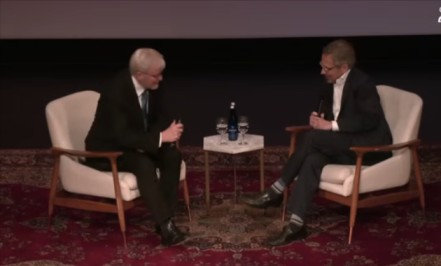
Editor’s Notes: In this presentation from the Asia Society, join former Australian Prime Minister Kevin Rudd and Eurasia Group President Ian Bremmer for an insightful fireside chat on the current state of U.S.-China relations. The discussion provides an expert analysis of the strategic motivations behind an upcoming Trump-Xi summit, as well as the economic pressures and energy dependencies currently shaping Beijing’s foreign policy. Beyond China, the conversation explores critical global flashpoints, including the volatility in the Middle East and the long-term geopolitical implications of the ongoing Russia-Ukraine conflict. This episode offers a comprehensive look at the shifting global order and the future of international diplomacy in an era of rapid technological and political change. (May 12, 2026)
Opening Remarks and Welcome
IAN BREMMER: I’m so happy to be a part of this. Kevin in New York again, where I think he dearly belongs. Kevin, thank you so much for coming back here.
KEVIN RUDD: It’s great to be back in the city, and it’s good to be back from Washington too. And thank you for wearing a tie.
IAN BREMMER: Yeah, yeah, of course. And I look, I didn’t know I was still a distinguished fellow here, but during your absence, but I’m happy that that has retained itself.
KEVIN RUDD: Well, absent a tie, we’ll make you just a semi-distinguished fellow.
IAN BREMMER: Semi-distinguished fellow, that’s probably right. Look, we have stayed in very close touch. This event tonight, Rudsky and Budsky, as we’re calling it informally. While he was in Washington, we just were in Napa together for the weekend. We had a day to dry out. This is actually true information.
KEVIN RUDD: I’ve discovered in Napa you produce wine, a lot of it. There’s now less of it since we were there last weekend.
IAN BREMMER: And no, truly, I mean, it was— New York did not feel the same to me without Kevin here for the last few years. He’s done incredible work, not just for his government and his people, but for the US-China relationship, and we really appreciate the sacrifice that that has represented. So, but having said that, that’s enough of that. Back here. And not only am I delighted to be able to have this conversation, his first back on New York stage, but also I think I would’ve been upset if you hadn’t asked me, Kevin.
KEVIN RUDD: I knew that, and it would not be worth my living had we not. But seriously, it’s good to be back with the Asia Society family. This is a great institution, gone from strength to strength over the last 70 years, and the mission statement for those 70 years, which we encapsulate today, is navigating shared futures when so many folks around the world want to divide on a continuing basis. Asia from the United States, or divisions elsewhere in the world, we’re in the business of how do you navigate a way forward. As one of my predecessors once said, and in doing that, trying to do as much as we can to shed light rather than heat. There’s enough heat already.
The Trump-Xi Summit: Key Priorities and Advice
IAN BREMMER: So this is meant to be a friendly and convivial but also a serious conversation. We’re going to do our best at all of those things, and I’m going to start. Kevin is, I think right now, on Fox with Bret Baier. Obviously he pre-taped because this is more important, but you were talking in the pre-tape with him.
KEVIN RUDD: My avatar is on Fox as we speak.
IAN BREMMER: Yeah, but in the pre-tape, and I don’t know how much they’re going to edit it down, but in the pre-tape, they’re asking you about the upcoming Trump-Xi summit. Let me ask you to start. What’s the most, the single most important piece of advice that you would give President Trump heading into this summit?
KEVIN RUDD: Any successful former ambassador, former foreign minister, and former prime minister does not give the President of the United States public advice. I would think of it in these terms, which is, right now, with Iran unresolved and the Straits of Hormuz still closed, it’s important for the United States to understand that China, for its own domestic economic reasons, wants to see the Straits reopened.
And that is not just a theory on my part. If you look carefully at what the Chinese leadership was saying in their Politburo meeting a week or so ago, as reported in the Chinese official media just after, it’s plain that they see the impact of this ongoing crisis in the Strait as depressing global economic growth, thereby depressing the market for China’s own exports, which means having a fundamental effect on China’s economic growth rate. And that’s bad for China.
And secondly, at a narrower level, China’s dependency on Gulf exports for LNG, which China does not have long-term strategic reserves for. And whereas Australia supplies most of China’s LNG, a large slab of it comes from Qatar. So therefore, as the president arrives, he needs to have in the back of his mind, as I’m sure he does, the fact that whatever is said publicly, that the core of it is, for its own reasons, China wants to see this over. And I think that’s maybe useful framing for the way in which the US approaches this.
China’s Economic Vulnerabilities and the Iran Factor
IAN BREMMER: So in other words, Trump should not be going into this meeting thinking about Iran as an ask from the chairman of the Chinese Communist Party.
KEVIN RUDD: Exactly. And if you track the internal discourse within China, as we seek to do here with the centre which Jing Lei leads, the bottom line is that narrative in Beijing has changed. Only a week or so ago, they did the numbers, and you step back from it all in terms of China’s economic growth formula at present, China’s private domestic consumption is still flat. The property sector is still flat. Private fixed capital investment is still growing just a bit, in which case the only two highly performing sectors in the Chinese growth model are A, tech, and B, net exports.
And so if you hit one of those sectors, which is net exports, you’re going to drill right back into China’s current somewhat challenged economic growth.
IAN BREMMER: Stick with the Middle East for a second in China’s perspective. In a lot of other areas of the Chinese economy—oil reserves, a lot of other commodities, fertilizer precursors, all of these things—the Chinese are far more resilient and in much better shape than almost any other economy in the world. Does that reality leaven some of what you just said?
KEVIN RUDD: It did until about a week or so ago. And then they did the maths on where this would take China’s ability to export its surplus capacity to the rest of the world. And this represents a huge slab of China’s growth numbers. I think you’re right to say oil reserves, strategic oil reserves, better than anyone else, frankly, in the world combined. Not so for LNG and not so for fertilizer precursors, all of them at least.
And so whereas China’s national economic strategy, really since the 19th Party Congress back in 2017, just after China launched Made in China 2025, has been along these lines, achieving national economic self-sufficiency and on the way through, national economic resilience from core supply chains in terms of raw materials and energy to the extent that they could, which is why you’ve seen a renewable energy revolution in China to make them less dependent on hydrocarbon imports in aggregate, through to every other manufacturer and now frontier technologies. This has been the growth strategy, the economic strategy, I should say, under Xi really since about a decade ago.
The Business Delegation and AI Governance
IAN BREMMER: Now, a lot of CEOs announced just a few hours ago that are going along on this trip, some of whom have very functional relations with China, some of whom are in a more challenging position. I’m thinking Meta, given the Manus conversation that just happened, Illumina, for example, others. What’s the messaging that you think the Chinese are likely to take away from that? Is it constructive that there’s such a large group? Is it potentially problematic?
KEVIN RUDD: I think overall it is, from the Chinese lens, it is entirely normal for the President of the United States or the leader of a significant G7 country to arrive with a large business delegation. That’s tick. I think if you look at some of the missing elements from the corporate delegation, there’s no one senior there, on my reading, from pharma, and there is probably no one senior there from auto. So if you look at that, then these are not looming therefore as areas of significant agreement.
But across the rest of the spectrum, this is intended to be a summit which produces certain economic outcomes. I think at the policy level, one thing to look out for is this. You mentioned Manus before. Let me go to the other M, Mythos, and the Anthropic LLM that has been released. The Anthropic LLM, not released, but which is— how do I put this delicately— terrified governments around the world because of its potential to fall into the hands of rogue actors and/or other attack agents.
What I think we need to also keep our eye on is whether in fact President Trump and Xi Jinping are able to open up a serious dialogue on AI governance as it relates to these potentially highly destabilizing models. Don’t know the answer to that, but I think it’s in play. And that’ll be part of the dynamic of the meeting.
IAN BREMMER: I mean, so far what I’ve seen from China is the fact that they are behind somewhat in LLM development implies that they are more interested in governance writ large than the Americans. I don’t have a view of whether or not that means they’re more interested in governance with the Americans in a bilateral format.
KEVIN RUDD: What’s your perspective on that? I think their interest in global governance is as you describe. And that’s why you have so many global AI governance proposals running through the United Nations system, for example, and often promoted by China, which is, let’s agree on some rules so long as we, the Chinese, can fundamentally shape those rules.
And at a bilateral level, you’re right to say that China always wants bilateral governance mechanisms in the past when China is behind rather than ahead for a whole range of reasons. A, you get to observe the actual capacity of the United States, and B, you can, through the governance mechanism, seek to constrain. But there is often a view that with highly potentially disruptive AI models, like this particular innovation from Anthropic, that it would uniquely be a problem for the Western democratic world. That is not how China sees it through its own lens as a resilient authoritarian state. It actually works in both directions.
So as I said, I leave this as an open question. I do not have a conclusion on it, which is for real reasons, namely that the AI world is looming to be rapid, disruptive, and at scale, and soon, that this may just be a small opening for there to be a genuine dialogue between people who know what they’re doing on both sides of this equation. Maybe not, but I’m not normally optimistic about these sort of things because I’ve been around the racecourse too many times over the years and have seen things fall over at the last minute, and this could be one of them as well.
Taiwan: Would Trump Give Away the Store?
IAN BREMMER: So on the Taiwan issue, a lot of talk about how President Trump would react if Xi Jinping directly makes the kind of ask that he’s made of presidents in the past. His own advisors recognize they don’t know what he would say in a one-on-one environment or with the wives and the translators and the rest. The first point is, do you believe it likely that Xi Jinping on this visit would bring up such an offer, such a request? If so, how would he frame it, in your view, as someone who knows more about, has thought more about what is driving Xi Jinping than pretty much anyone in the West? And are you worried, as some of those in the administration and the media have been, that Trump might actually say, “thousands of miles away, not really our issue, Xi, that’s something I’d deal with, I might do something unprecedented.” I’d love to hear what you think about that.
KEVIN RUDD: I think if we’ve read some of the memoirs that have been produced on Trump 1.0, including that by, say, former National Security Adviser John Bolton, and his reflection that President Trump was not fundamentally committed to the defense of Taiwan for the sort of reasons that you just referred to, I am of the view that it is highly unlikely that the president would be tempted to change the language on U.S. strategy towards Taiwan in any significant or fundamental way, despite what John Bolton has said in his memoirs in multiple places. And there’s a reason—
IAN BREMMER: No, no love between those two men at this point.
KEVIN RUDD: I think if there was, you know, several points of freezing below zero, somewhere in the deep cryogenic storage, you would find John Bolton.
IAN BREMMER: Look, the mustache originally put Trump off, and it’s only gone down from there. I think that’s right. That’s why the FBI investigation was a tell, right? I think that’s how—
KEVIN RUDD: That’s why I grew a beard to match my mustache, because I thought the mustache would—
IAN BREMMER: I liked the mustache, by the way. I thought it was very cinematic.
KEVIN RUDD: I appreciate that a lot. And no one else has. I’m waiting for my career in Hollywood, but it’s a long way away. It’s a long way, yes. And anyway, where were we?
IAN BREMMER: We were talking about John Bolton and the fact that Trump would not actually, say, give away the store to the Chinese.
KEVIN RUDD: I think so, because I remember being at the Republican National Convention in Milwaukee in 2024. And I took Therese there for her birthday.
IAN BREMMER: And something she is still not forgiving.
The Milwaukee Encounter and Trump’s Strongman Image
KEVIN RUDD: There’s something that she brings it up. She thought was curious and challenging. But there you go, we got to see Milwaukee. And I was there with a whole bunch of other diplomats. I was ambassador at the time. And I was sitting not far from the Chinese ambassador, and this was just after Hulk Hogan had introduced President Trump. Hulk Hogan at the time— yes, I know he’s gone on to his eternal reward— and he leads a school of international relations policy here in the United States.
Anyway, after Hulk Hogan introduced the President of the United States by ripping his shirt off, that’s Hulk’s own shirt, not the President’s shirt. Would have been more awkward if he’d done it that way, yeah. A little strange. Yeah. Even in America. Even in America, yeah. Quite common in Australia. I know that from public office down under. I’ll tell you about that later.
IAN BREMMER: They call it Thunder Down Under, by the way, in Vegas. Yes, it’s one of the few things that Kevin and I have done together.
KEVIN RUDD: Yes. Back to the subject at hand, which is Hulk Hogan. And so the Chinese ambassador says to me in Chinese, “Lao lu, jishi zemu wei hei shi.” Which is, “Kevin, what the hell was that?” We got a lot of Chinese folks here. I know, I know, it’s great. It’s all I ever shot. Yeah, thank you. You can speak some Russian later.
And so I said we should have a chat tomorrow. So we went and had tea at the Milwaukee Club, and my point was simply this, and it brings us back to Taiwan and why I don’t think the president is likely to be tempted in that direction.
IAN BREMMER: I knew we’d get there eventually.
Taiwan and the Logic of Trump’s Strength
KEVIN RUDD: Yeah, thank you. And that is that, as I explained to the ambassador at the time, the whole Hulk Hogan phenomenon is seeking to underline, underscore what President Trump has seen as his essential strength for office, and that is, I am a strongman. And if you have anything in your mind which is likely to render me to look weak, then frankly, I’m going to double down, retaliate in order to reassert my strength.
So I then said to our Chinese interlocutors, therefore, if our friends in Beijing think that it is wise, based on a Bolton memoir, to think about using military means to change the status quo of the Taiwan Straits, the immediate consequence would be to make President Trump look weak in the world, but also here in the United States. And therefore, President Trump, under those circumstances, could and would do anything in order to reassert his strength. And therefore, we’re in the business of escalation, crisis, conflict, and potentially war.
So to my Chinese friends, I said, do not do this. President Trump, I think, understands this intuitively, which is why I’d be very surprised if the language was to change in any way. And finally, I’ll just say, of course, Xi Jinping as General Secretary of the Chinese Communist Party— he’s been in office now for 13 years— he, being who he is, will open up the question of Taiwan and may well go on a fishing expedition in terms of what language can be produced. But I think this caution will be in the back of President Trump’s mind.
Xi Jinping’s Approach to the Summit
IAN BREMMER: I completely understand the Trump doesn’t want to look weak, doesn’t want to be made to look weak. I’m wondering if Xi Jinping would formulate this as kind of as Bibi Netanyahu did when he said, “Sir, you should really get the Nobel Peace Prize. These people don’t understand you. You’ve resolved 8 major conflicts. Look at this.”
If this is like, this is the biggest piece of all. And people don’t understand this. And this Taiwanese president who’s a troublemaker. But you and I, sir, we understand after showing off like the extraordinary importance of the relationship and the big parades and how respected and how serious and how solid you are and all the things we could do, the billions we could invest in a trade board and in Boeings and soybeans. And I mean, in Ivanka’s licenses to help enrich the family, as they did a bit in the first administration. But nowhere close to what they could do. Is that the kind of thing you think Xi Jinping is likely to try?
KEVIN RUDD: I think, by the way, the Chinese leadership are not fans of the Nobel Peace Prize.
IAN BREMMER: True enough. An earlier recipient—
KEVIN RUDD: They have alternatives, yes. Liu Xiaobo got the Nobel Peace Prize, was presented it in absentia, and the Chinese have been down on the prize ever since then.
IAN BREMMER: Oh, I know. I’m talking about as the great peacemaker, I wasn’t suggesting that—
KEVIN RUDD: Okay, thank you, thank you. I just thought I’d call you out on a technical foul.
IAN BREMMER: No, no, it’s right, it’s right. Technical foul, fair enough, one shot, Kevin, there you go.
KEVIN RUDD: Thank you, 15-love to me. Yeah, yeah, different sport, but yes, we’re with you. Thank you, we got that. Yes, yes, yes, it’s okay. That’s an expression in tennis. It’s a rugby thing, yeah, I know.
IAN BREMMER: Good. Exactly.
KEVIN RUDD: That’s not rugby at all. Australian rules, yeah, yeah, yeah.
IAN BREMMER: I pay attention when you explain this stuff to me, I do. Thank you.
KEVIN RUDD: I think the way in which to look at Xi Jinping’s overall take on the upcoming summit is as follows. I think Xi Jinping, for his own reasons, domestic economic reasons, not only wants to see an end to the closure of the Straits of Hormuz for his own domestic economic reasons, he also has as his undergirding objective for this summit with the United States a period of stabilisation in the US-China relationship for the rest of this year and going into next year and through to the end of next year at least.
And there’s a reason for that. It’s not just I’m feeling like a peacemaker. It’s because a stable relationship with the United States and a mechanism to manage that stability is better for China’s economic interests in the sense: one, net exports — America is still a phenomenally important market for Chinese goods. Two, if we’ve got a stable relationship and a mechanism to manage it, we’re less likely to see additional unilateral tariff measures against Chinese products. And three, you may militate against further export controls being imposed on the export of American technologies, particularly chip-based technologies, into the PRC.
And so for those reasons, as well as the global economic impact of a more stable US-China relationship, the underlying imperative in the Chinese leadership’s mind, in Xi Jinping’s mind approaching this summit is, “Let’s have a stable framework at least through the next year or so because it’s bad for business, bad for our economy, and I, Xi Jinping, know that my real economic growth rate is not much more than about 2 or 3% at present.” I think that’s the frame. Not the 5 that they’re assessing.
IAN BREMMER: In actuality, 2 or 3 this year.
KEVIN RUDD: Well, I accept the advice from analytical outfits like Rhodium and others who look at the economic data clearly, robustly, and don’t just accept the official stats, but look at the unofficial measures of growth in terms of electricity supply and consumption, all those sort of things. I think we’re looking at 2 or 3, which means— and if that is itself chronically dependent on net exports, your underlying interest, given high levels of existing unemployment in China, particularly youth unemployment, where the numbers are huge, is, “How do I stabilize this relationship to maximize my economic growth going forward?” And I think on the flip side of the agenda, President Trump has a parallel interest in stability in the relationship.
IAN BREMMER: So this is pretty good news coming into Thursday and Friday. And the great thing is we’re going to find out really shortly, but I mean, it’s compelling. Yeah, I could screw up completely.
KEVIN RUDD: It’s possible. It’s very unlikely.
China’s Long-Term Strategic Confidence
IAN BREMMER: But this is, I think, the issue people here most want to talk about. To open the aperture for a moment, if we think longer term, I look at the Americans and the Iranians, and part of the reason this war is still going on and the blockade is still going on is because the Iranians believe that they are in a stronger, materially stronger position than Trump believes they are. Do you think long term that the Chinese believe they are in a materially stronger position than the Americans believe they are?
KEVIN RUDD: I think, because I’m going to flip the tables here and then interrogate you about Iran, but we got to answer this first. Yeah, Iran and the Straits of Hormuz, because this is a conversation between the two of us. I know a bit about China, and I always am cautious about making any judgments about the Middle East, because I’m acutely conscious of what I don’t know.
But the overall point is that if you read the Chinese internal literature, the ideological literature and the political literature, the Chinese leadership for some years now, and it’s accelerating, believe strategically they’re winning the competitive race against the United States against most measures of power. They see the rise of the Chinese military. They see China now having the largest surface fleet in the world. Certainly there are deficiencies in terms of Chinese capabilities under the water. They look at their competitiveness now in cyber and space. They look at where they are in technology, having come from virtually nowhere 10 years ago when Made in China 2025 was launched in 2015 across 10 key technology sectors, and they see themselves as succeeding in 8 or 10 of those. And now AI, chips, quantum are these core elements together with nuclear fusion of the 15th Five-Year Plan.
They see themselves in foreign policy stakes as having achieved enormous successes in the Global South. So their overall internal take is that they are prevailing and that they are winning. I think this is a premature judgment, but that is where the internal Chinese view sits.
Now, vis-à-vis the current challenge for US power, and where US power is now being challenged by events over Iran, how do you see the United States bringing conclusion to the Straits of Hormuz closure? Is there a pathway forward with or without the Chinese? And will it be by next Thursday? Over to you.
Trump’s Iran Dilemma and the Search for an Off-Ramp
IAN BREMMER: Yeah, well, I mean, Wednesday as well. This, in my view, is by far the biggest foreign policy mistake that Trump has made in either of his two administrations. And you can tell by just the extraordinary incoherence of his responses day to day, which are well beyond the way he has approached any other issue or conflict. Russia, Ukraine, he’s been much more consistent. Gaza, Israel, he’s been much more consistent. Liberation Day, he was much more consistent. US-China has been much more consistent. Not this.
And it’s because he’s got war goals, then he has different war goals. “They’ve got to open the strait or I’m going to blow them up. No, I’m not. We’re engaging. We’re not engaging. I’m not accepting a deal. No, it’s about the nukes. No, it’s about regime change. It’s about whatever it is,” right? And it’s because this has gone radically worse than he believed it was going to go. And now he has to find an off-ramp.
And he has an off-ramp, but even for him, it’s not a very plausible off-ramp, which is you’re going to have to accept something that looks a lot like the JCPOA, the old Iranian nuclear deal that he believes was a failure and that he unilaterally withdrew from, from Obama when he first became president. How do you deal with that? And so he’s trying to manufacture a win. And so far, the Iranians believe that they are in a stronger position if they wait them out.
I think there’s a good argument that they’re right. Not because the Iranian military is stronger — it’s not. Certainly not because the Iranian economy is stronger — it’s not. But rather because politically, the ability of the Iranians to eat grass, as they say, is much, much greater than Trump, who has the proclivity for the McDonald’s, right?
KEVIN RUDD: So you don’t see the reporting about splits in the Iranian Revolutionary Guard, the IRGC, as having any fundamental foundation in fact? No. That in fact it’s a relatively unitary political operation still, despite the decapitation of the leadership? In the earlier stages of the war, in which case your argument is the IRGC is hardened to just hang on and to wait out.
The Gulf States: Diverging Paths
IAN BREMMER: That’s— I think it’s hardened. I also think when Trump says you need to do X, Y, and Z or else no more Mr. Nice Guy, I think when you’ve just decapitated their leadership, you’ve already lost the no more Mr. Nice Guy card. That’s my general view. I don’t believe that this leadership is as competent. They’re certainly not as experienced. But I think they’re fairly cohesive.
The thing I worry about is how centralized military command is. There have been a couple of instances in the last week where we’ve seen decentralized strikes that look like they weren’t necessarily anticipated by or ordered by Tehran. What worries me there is even if there were an agreement in Islamabad or wherever, supported by Kholibaf, who is kind of the principal decider in this environment. The Supreme Leader is sort of like a chairman at this point. He’s not making day-to-day decisions. It’s not clear to me that implementation of that is trivial. Even if the government, the central government, would want to, the potential of a local commander to veto is not negligible in that environment.
So I think we’re still quite far — not necessarily from Trump accepting a one-page memorandum or something that opens the strait or gets towards opening the strait and then is a 30-day move towards now we’ll talk about the nuclear file. I think it is plausible that Trump on any given day could make such an announcement. Hard to imagine it would be done before the summit with Xi Jinping. But getting from there to actually opening the strait I think is quite far off. And the economic implications of that are massive. The midterm implications of that are massive. The knock-on geopolitical implications in the Middle East for the transatlantic relationship and maybe long-term for US-China relations also are quite significant.
KEVIN RUDD: You touched on that. Let’s go to the Gulf monarchies, the Gulf states. The Gulfies, as we say. Their attitude to the war in the first place and their attitude now to its cessation. So not Israel, just the Gulf monarchies. And how they see their own economic and geopolitical futures for the rest of this year. Your thoughts on that?
IAN BREMMER: Well, first, when we talk about the Gulfies, the two principal drivers of that group are the Saudis and the Emiratis. Both led by strong, locally popular, especially among the young people, generational and revolutionary leaders who in many ways have done extraordinary jobs in their own countries, MBS and MBZ, who did not like each other before this war and have very different economic models. This war has accelerated that rift. Hardened it, and probably broken that relationship in a semi-permanent way.
KEVIN RUDD: Of which the UAE withdrawal from OPEC is totemic.
IAN BREMMER: Totemic. That was not the word I was going to use, but it’s a good word.
KEVIN RUDD: So in Australia, we spell it T-O-T-E-M-I-C.
IAN BREMMER: We spell it the same way in the US. That’s right.
KEVIN RUDD: Okay. The—
IAN BREMMER: So why is it totemic? Totemic, yes. So I think it’s totemic because the UAE is now at a time that they can’t export oil at all, but understands that their future is not about being a regional power. It’s about being a global node. It’s about being a city-state that requires globalization and connections with the world, and getting oil. They don’t want stranded resources. They want to produce as much oil as fast as possible and move on to being a diversified economy.
They’re best friends. And they will tell you, their leadership will tell you that in this war, they realize who their best friends are. Best friend number one, Israel. That’s what they say. And that is a technological point. It is an intelligence point. It is a defense point. And it is also—
KEVIN RUDD: So much of the intel about incomings which need to be taken out for the UAE has come out of the Israeli intelligence network.
IAN BREMMER: Clearly, and this alignment, I think, also defines the way that they both see Iran going forward, which is that the war needs to continue, and if it doesn’t, they should be mowing the lawn together. In ensuring that the Iranians no longer have the capacity to be an existential threat to Israel, as they believe it.
KEVIN RUDD: Renewing the strikes on the nuclear capability.
IAN BREMMER: Correct.
KEVIN RUDD: Not a more general mowing of the lawn against the Iranian state.
IAN BREMMER: Correct. And meanwhile, the Saudis, whose principal ally in the region, extended region, Pakistan, with 13,000 troops on the ground in Saudi Arabia right now, a nuclear program that the Saudis helped fund in terms of the plutonium, is increasingly an Islamic bloc together with Egypt, with Turkey. Saudi Arabia sees themselves as the regional anchor controlling OPEC, the biggest producer of the last oil barrels that are really cheap at scale. Their principal competitor globally on that, the United States. And that is a radically different future. And I also think much more hedged towards China.
KEVIN RUDD: So the divisions you point to—
IAN BREMMER: That will do a deal with the Iranians, by the way, over time. That’s the other big point. Saudis.
KEVIN RUDD: So the divisions you point to geopolitically for, let’s call it, the wider Gulf region or the wider Middle East, couple of years’ time, looks like what? How does it divide?
IAN BREMMER: Could look like the Gulf Cooperation Council is over. Could just look like we’re done with that. And that in the same way that a year ago investors would say, “We’ve got a Gulf strategy and we’ve got a Gulf headquarters,” you increasingly don’t have that. You’ve got a Saudi Islamic strategy and you’ve got a UAE strategy and they’re different. And the Saudis are investing internally overwhelmingly. And the Emiratis are investing globally.
And the US is going to remain very close allies with the UAE and Israel, even if the US is doing, has a lighter footprint in the Middle East with a new president going forward, post-Trump, Democrat or Republican. And the Saudis will be increasingly economically, maybe technologically aligned with the Chinese. Larger population, they’re going to want the tech at scale. Their missile program is already Chinese. The Americans didn’t sell them Tomahawks. And this Islamic bloc, I think, is going to look very, very different.
So yeah, for me, this is not just an acceleration. This is a real shift in the way we think about the Gulf and the Middle East more broadly.
Ukraine: The Forgotten War
KEVIN RUDD: And mindful that the clock is ticking by, what about the forgotten war, which is Ukraine? Because if you look at our global media landscape at the moment, you’d be forgiven for concluding that somehow the hostilities in Ukraine had come to a stop, and they haven’t. Give us your sense. You’re a Russia expert, you’re a Ukraine expert. This is the stuff that you’ve done for a living as a political scientist. How is it now, and what’s your trajectory for Russia-Ukraine for the rest of this year?
IAN BREMMER: Well, the broader geopolitical points that the transatlantic relationship is increasingly broken — it’s Russia-Ukraine, it’s Greenland, it’s the trade war, and now it’s Iran. And you’ve seen that with the German chancellor saying the Americans are being humiliated in Iran. You’ve seen it with the French.
KEVIN RUDD: He tried to walk that back, did he not? Which bit? Chancellor Merz.
IAN BREMMER: He’s tried to walk it back. Yes, absolutely. He put a post out immediately that tried to walk it back. The French president saying that the US, China, Russia are all basically aligned in being opposed to Europe. He didn’t try to walk that back. Meloni going to the Gulf and being— she was the only European leader that went to the second inauguration of Trump and is looking very, very much less like a Trump whisperer in this environment.
The Ukraine piece of this — of course, Ukraine much more relevant to the Gulf states in terms of their technologies, their capabilities. But the big thing that shifted — I mean, the early stages of the war, everyone was — the Iran War, everyone was talking about how the Russians are now more important because they’re making more money with higher energy prices, higher commodity prices, suspended sanctions by the Americans.
But today, the Ukrainians suddenly look like they’re actually turning the corner. They got through winter, which is hard for them with all the hits on their energy infrastructure. But this is the first month in over 2 years that the Ukrainians have taken territory from Russia because they have far more advanced drone and unmanned capabilities, partially because they’ve been building them, partially because Elon Musk shut off Starlink for the Russians. And so now you see the Ukrainians starting to overwhelm the local front lines of the Russian soldiers, badly trained, poor morale, and not fighting for their own territory.
I think that it is a mistake for President Trump not to be leaning into support for Ukraine in the way that you believe he will continue to support Taiwan. I certainly feel like Ukraine is becoming a huge advantage long term for Europe in technology, in fighting capacity, in defense spend and leadership. And I’m not saying that the Russians are going to actually accept a ceasefire tomorrow or the next day. I don’t believe that, despite Putin with a short statement saying the war may be coming to a conclusion.
But I do think that this looks like a bigger win for Ukraine and the Europeans, and they will be doing it without the US. And I think that that is a sad statement on the nature of the transatlantic relationship and NATO right now.
I am — you aren’t very worried about the Xi Jinping-Trump summit, and I think that is great news. I am considerably more worried about the July NATO summit in Istanbul where Trump will come face to face with so many of these leaders that he really doesn’t like and that frankly, privately can’t stand him. And I’m worried about what happens when that occurs. Certainly Xi Jinping and Trump will show a lot of mutual respect with each other. I have a harder time seeing that with the Europeans and the Americans at this point.
KEVIN RUDD: You’ve got to give Zelensky full marks for just sheer guts and persistence. And the Ukrainian people and military for dogged determination, as they’ve been through so many cycles over the last 4 years — since February — which is Russian advance, Ukrainian counterattack, Russia wearing Ukraine down, and now Ukraine fighting back in a big way and firing deep into Russian territory. And so the repressed nature of the military parade recently in Moscow, you think reflects that?
IAN BREMMER: Absolutely. And I don’t think there is a threat to Putin internally. And I’m frankly glad for that. Long term, one of the things I most worry about — I don’t like the fact that Trump doesn’t seem to accept great information from his advisors. I think he lives in a bit of a bubble of people that are constantly telling him how brilliant he is and how things are going great. It leads to bad decision-making.
I worry a lot more about Putin in that situation, a lot more. That was how we got the Russian invasion in Ukraine in 2022. As he gets older, as he feels more threatened by Ukraine, as he is doing less public appearances with fewer international leaders, becomes more in a bunker, I worry a lot about what an individual deeply angry, deeply aggrieved about the United States and about Ukraine and about so many other things, becoming a junior partner to the Chinese — about how the kind of decisions that he might make, taking out his top advisors and putting in instead a former bodyguard. I mean, these are not good indications. I worry a lot about what that will mean for the global stage.
KEVIN RUDD: Yeah, putting in a bodyguard, personal bodyguard, as your National Security Advisor was, as we say, curious as a decision.
IAN BREMMER: Yeah, I mean, this is well beyond Hegseth as Secretary of quote-unquote war. This is worse, and that was pretty bad, right?
Geopolitics and the Global Economy
KEVIN RUDD: We’ve got about 5 minutes to go. A lot of people here from corporate America and the financial sector here in New York. Let’s just stand back from these 3 giant geopolitical phenomena — US-China, the Gulf, the wider Middle East, and Russia-Ukraine. And let’s call it multiple tensions in terms of transatlantic relations. Project this into the economy, that is the global economy. Where does geopolitics take global economic growth for the rest of this year and into next year? And what’s the turbocharging and/or destabilizing impact of the AI revolution in the midst of all that?
As you know, despite all of what we’ve just said, the folks down the road here in the NASDAQ and markets in general are stratospherically high. There’s no apparent impact in terms of the factors you and I have been discussing. So wrapping these together in terms of where growth goes and therefore the fundamentals of the real economy for the period going forward, give us your sense of all of that.
Looking Ahead: Resilience, Renewal, and the Road to 2028
IAN BREMMER: Look, a stable US-China relationship makes me feel better. US and China economic resilience, even if the growth is lower than both countries would like, makes you feel better. But the knock-on implications for the rest of the world are pretty disastrous, right?
I mean, you think about what the inflation, the lack of fertilizer in the growing season, the challenges with fuel oil means for Southeast Asia, means for Sub-Saharan Africa. I mean, the likelihood of financial crisis, of greater famine, all of these things which is not driving the US market at all, but is obviously a concern.
The other piece of that is the K-shaped economy in the United States. The markets are killing it. Average Americans don’t feel that way. You see that in how they feel Trump is doing on the economy. He’s way, way underwater.
And I worry, looking forward to 2028, we’ve got Mayor Mamdani here, we’ve got President Trump. These are both grievance candidates. They’re people that come in. They’re not causing, they’re symptoms. They’re symptoms of something deep that hasn’t been addressed.
And people are — they were unhappy about forever wars. They were unhappy about illegal immigration. They were unhappy about free trade. They’re unhappy about big tech. They’re unhappy about corruption. They’re unhappy about data centers in their backyards. This is going to lead to policymaking that does not reflect the long-term strategic interests of the United States and the world.
I mean, I’m not a market watcher. I’m worried about that. Having just spent a few years in Washington, D.C., as you think through what all of these policymakers you’ve been spending your time with have been thinking about, do you start to see senators, members of the House getting it? Does it make you feel more optimistic about where the Americans are heading?
America’s Capacity for Self-Renewal
KEVIN RUDD: America is a great country. And the history of the United States is a country of permanent self-regeneration and renewal. What you guys do in the midterms, I have no idea, because it’s a wild old world out there, particularly given what’s happened in the superior courts in the Commonwealth of Virginia most recently. That’s for the House and for the Senate. And as for the presidential, that’s an eternity away. I’ve got no idea how this is all going to shake down.
But having been in D.C. for the last 3 years, there are a bunch of greybeards in the Senate, both sides of the aisle, who in my experience are deeply seized of all of the above. These are folks who haven’t gone into elected life on a basis of a folly. It’s because they’re deeply interested in public policy.
So on the long-term strategic competition between China and the United States, those women and men are deeply engaged. On the question of the massive disruptions that are about to erupt from AI, both in terms of that competitive relationship between China and the United States across the AI stack — from compute, through to models and innovation, through to application — those committees and the structures underneath them are deeply engaged.
So I have some optimism that there is a body of wisdom and expertise there, which is not out to lunch, which is deeply seized of what’s going on. The challenge and the opportunity for them is how they engage the administration over the next 2.5 years, and I’m not sure where that’s going to land. Washington’s a wild old place at the moment, if you live there and if you work there. But anyone who gives up on America at this stage, I think, underestimates the future of this republic.
Closing Remarks and Asia Society
KEVIN RUDD: Ladies and gentlemen, please thank Ian Bremmer. Kevin Rudd back in New York. And thank you, folks. One last pitch for this institution called Asia Society. 70 years, not a bad track record. It’s 70 years young.
But if you’re interested in America’s future in Asia and Asia’s future in America, and not just China-US, but also China-India, China-Japan, China-Korea, China-Southeast Asia, this is the place for you. We have the Asia Society Policy Institute, now 10 years old, Chen Jing with the Center for China Analysis, now 4 years old. This is probably the biggest Asia-focused, China-focused policy shop in the US these days for a think tank.
And arts and culture, if that’s what gets you excited, we on this screen here will show contemporary Asian cinema any given week with queues out around the block. So this is a fun place to be. It’s also an intellectually challenging place to be. Become part of it by joining up and becoming a member if you’re not already. Become a corporate member, and most importantly, make sure that Asia Society is top of the pops in your mind, and think about the guys from Eurasia Group as well, who seem to know what they’re talking about.
IAN BREMMER: And if you want to see Kevin rip his shirt off, Thursday nights, 9 o’clock, after the movie, shots, we’re here for you.
KEVIN RUDD: That’s right, and that will be censored for all concerned. Yes. Ladies and gentlemen, thanks for coming to Asia Society.
Related Posts
- Transcript: VP JD Vance’s Press Conference on Anti-Fraud Initiatives
- Tucker Carlson Show: w/ Iuliia Mendel, Zelensky’s Former Press Secretary (Transcript)
- Transcript: President Trump Remarks at Maternal Healthcare Event
- Diary Of A CEO: w/ Pulitzer Prize Historian Anne Applebaum (Transcript)
- Mollie Hemingway: The Untold Story of How One Man Reshaped the Supreme Court (Transcript)