Read the full transcript of Professor Jiang’s lecture titled “Game Theory #25: Trump Visits China”, May 14, 2026.
Editor’s Notes: In this lecture of Game Theory, Professor Jiang analyzes the high-stakes implications of a historic meeting between Donald Trump and President Xi Jinping in Beijing. By applying game theory and historical analogies such as Nixon’s 1972 visit, the lecture predicts a “grand bargain” designed to reconcile trade tensions and stabilize the global economy. The discussion explores the potential for deep financial integration, the involvement of major tech executives like Elon Musk and Jensen Huang, and strategic shifts concerning Taiwan and energy security. Ultimately, the episode offers a provocative look at how mutual economic interests might move the two superpowers from a trade war toward a new chapter of global cooperation and recoupling.
Trump’s Arrival in Beijing
PROFESSOR JIANG: So Trump is in China. This happened about 30 minutes ago, an hour south of us. So Trump came in last night and this morning he met with President Xi at the Great Hall of the People. Let’s just have a quick look. This is him getting out of his limousine. This was brought in from the United States by a military transport.
He brought his entire cabinet, including Marco Rubio, the Secretary of State, as well as Peter Hegseth, who is the Secretary of War. The last time an American president visited was nine years ago, November 2017. So this is a very historical meeting.
And as you may remember, after Trump visited Beijing, they started the trade war and we’ve been in a trade war ever since. I think that this meeting is very optimistic for US-China relations. A lot has to do with who came with Trump.
Who Came With Trump
So this is from Weibo, the Chinese Twitter, and what Chinese are focusing on is who came with Trump. So many of his family members came with Trump, including his son Eric, his son-in-law Lara, and they were excited about coming to China. Team China, guys. Okay.
Much more important is the number of business executives who came with Trump. So you have Elon Musk of Tesla, and of course he does a lot of business in China. Tim Cook of Apple also does a lot of business in China. Boeing is trying to secure a $50 billion sale to Chinese airlines. And so these are three very important business people.
And then you have some of the leading financial people in America, including Larry Fink of BlackRock, Stephen Schwarzman of Blackstone, Derek Solomon of Goldman Sachs. You have Citigroup, you have Mastercard and Visa. Okay? And these are the leading financial companies in America.
Altogether, these business executives, if you put all their companies’ net worth together, their companies are worth over $12 trillion. That’s a lot of money. And these are very busy people. Quite honestly, I’ve worked in business negotiations. You do not bring these people together in one room unless you have a mega deal to announce to the world. Okay?
The Prediction: A US-China Grand Bargain
So my prediction is that by tomorrow we should have the broad contours of a US-China grand bargain, where the two nations reconcile their differences and they start a new chapter in world history where they work together to stabilize the global economy.
So what I want to do today is discuss how we got here, why a grand bargain will happen, and what a grand bargain will look like. Okay? All right.
Events Leading to This Meeting
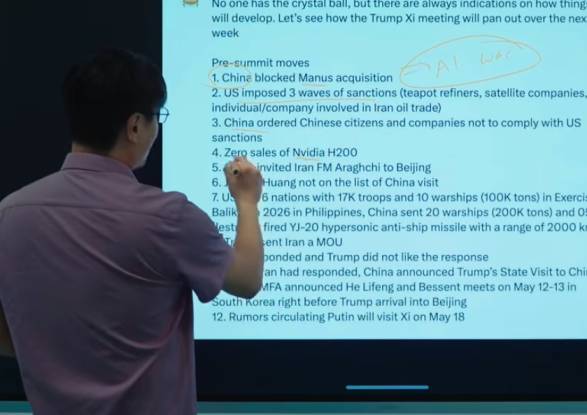
So let’s discuss some of the events that led to this meeting between Xi and Trump. This is David Lee from Twitter, and he’s talking about the past month, what happened.
So the first thing that happened is that China blocked Manus. Manus is an AI company that Mark Zuckerberg tried to buy. Manus was incubated in China, and if you’re an AI company and you become very successful, you want to go to the United States because that’s where all the money is, that’s where all the talent is, that’s how you become really, really big. But because it was incubated in China, China decided, no, you can’t go to the United States, because this will set a bad precedent. China is trying to grow its own talent. So this shows the AI war being fought between China and the United States.
Another thing that happened is that the US imposed sanctions on Chinese companies that do business with Iran, including satellite companies that sell commercial intelligence to Iran on where US bases are, and teapot refineries, which take Iranian oil and then convert it into energy that China can use.
And in response, China said, no, you cannot impose sanctions on us. If you impose sanctions on us, if people comply with the sanctions, then we, the Chinese government, will sanction these people as well. And this is something called the blocking order. This also seems like an escalation in the US-China trade war, where previously Chinese institutions, banks, and individuals complied with US sanctions. And this is the first time the Chinese government said to Chinese people, if you’re a Chinese citizen and you comply with US sanctions, then we will sanction you. Okay, so this is a very big deal.
Nvidia was not able to sell chips into China, and this is going to affect Nvidia’s bottom line. Nvidia is right now the world’s most valuable company, primarily because AI depends on their chips.
China invited Iranian Foreign Minister Araghchi to Beijing, because China is very interested in the outcome of this war between the United States and Iran. Right now, Iran is blocking the Strait of Hormuz, and China depends on 50 to 60% of its energy needs from the Middle East.
Jensen Huang was not on the China list. So before Trump took off, it was announced that Jensen Huang, who is the head of Nvidia, would not come to China. And this is a very big deal because in this grand bargain, what China would want is access to Nvidia chips, semiconductors, in order to fuel its AI.
The United States and six other nations had a war game in the Philippines, and China sent 28 warships.
After Iran had responded, China announced Trump’s state visit. And then, yesterday and the day before, He Lifeng, who is the vice-premier in China, and Scott Bessent, who is the Treasury Secretary, met in South Korea to try to negotiate a deal. And then what’s going to happen is that Putin will visit China after Trump leaves.
Using Game Theory to See the Bigger Picture
So if you just look at what’s happening, it seems as though there’s still a lot of friction between the United States and China. What I want to show you today is that all of this, you can just ignore. This is all that’s happening right now. But if we use game theory, if we just look at the broad contours of what’s happening, we would make much better predictions as to what will happen.
So all this, I think, is just theater. China and the United States are not actually fighting an AI war. It’s all theater. They’re actually working together to promote AI. These sanctions are happening, but eventually the US and China will come to a grand bargain and they will become much more economically integrated. And Iran — China doesn’t really care about Iran. China cares first and foremost about the relationship with the United States.
And one piece of evidence for that is that when Foreign Minister Araghchi went to Moscow, Putin met with him for 90 minutes and Putin expressed his sympathy and support to the Iranian people. When Araghchi came to Beijing, he only met with his counterpart, the Foreign Minister, Wang Yi. Okay, all right.
Another important thing is that Scott Bessent is the one who is leading the US team in China. Scott Bessent is the Treasury Secretary. This goes against protocol, because it’s usually the Secretary of State Marco Rubio and the National Security Advisor — who also happens to be Marco Rubio — this team is the one that sets the agenda for the US-China visit. Because it’s Bessent, we can probably guess that this is probably going to be an economic negotiation. And the focus is on finance.
Basically, what America wants is for China to open up its financial sector for companies like BlackRock and Blackstone to come in, to sell financial instruments to Chinese people. Okay? That’s what America wants. And we’ll talk about this as we go along.
The Geopolitical Landscape: Iran and the Trade Network
All right, let’s continue. So in the geopolitical landscape, it seems as though America is trying to contain China. So this is Tehran, and this is what China is trying to do. China is trying to build a high-speed rail network from Beijing all the way across Central Asia and into Europe. Okay. This is a land route that Beijing wants to take in order to maintain trade with Europe.
As you can tell from this map, Tehran is the pivot or the hub of this trade network. Without Tehran, Beijing could not access Europe. And then Moscow also sees Tehran as very important as well for its north-south trade axis. Without Tehran, Beijing is completely reliant on Russia. Beijing does not want to become reliant on Russia.
Beijing sees itself as the third axis of power in the world. You have the United States, you have Russia, and then you have China. From a geopolitical perspective, China doesn’t want to become partners with either the United States or Russia. It wants to become independent. It wants to create its own sphere of influence. And that’s why Iran is very, very important.
So a lot of geopolitical analysts believe that Beijing is forced to support Iran in this war. And what I want to show you is that’s not actually the case. China may want to become independent of the United States and Russia, but it cannot actually.
The $1 Trillion Investment Deal
All right. Now there’s a rumor. A couple of days ago, that one deal that Trump and Xi will sign in Beijing is Xi Jinping will commit $1 trillion investment into America, primarily factories that manufacture EV cars. This is a huge deal. Okay?
And Laura Ingraham, who works at Fox News, she thinks it’s a bad thing. She thinks that this is about China coming in and trying to buy out the United States. As I’ll show you later, this is wrong. I think this deal will happen, but this is a deal that shows that China is ultimately dependent on America, as opposed to China wants to take over America. Okay.
Historical Analogy: Nixon’s Visit in 1972
All right, so how can we understand the Trump visit? Well, again, in this class, what I want to show you is that historical analogies are a really powerful way to understand the present. So the Trump visit today is analogous to Nixon’s visit in 1972.
So you may not know this, but before 1972, America was hostile towards China, primarily because of Taiwan. During the Chinese Civil War, the Americans were very supportive of Chiang Kai-shek and the KMT. They lost and they went to Taiwan. And when that happened, America said, first of all, we will only recognize Taiwan as the official government of China. Second of all, we will refuse to do any business with the PRC. And third of all, we will help Taiwan eventually try to take over China.
In 1972, when Nixon visited, this marked a radical departure from 20 years of American foreign policy. And the question then is, why would he do that?
The Nixon Shock and the US Dollar Ponzi Scheme
And the answer is, in 1971, the Nixon shock. So if you talk to historians, they’ll give you lots and lots of different reasons as to why Nixon visited China. The main reason, from their perspective, is that Henry Kissinger, who was National Security Advisor to Richard Nixon, was trying to triangulate between China and the Soviet Union. He was trying to get China on the side of the United States in order to defeat the Soviet Union. That’s not true. That’s something that historians made up.
The real reason is that in 1971, Nixon removed the US dollar from the gold standard. And now the US dollar is worth nothing. Before, you could take the US dollar and change it for gold. Now it’s worth nothing. If it’s worth nothing, what you do now is create a demand for it. You basically have to create a Ponzi scheme.
And so Nixon did two things to resolve this issue and create the US dollar Ponzi scheme. The first thing he did was create something called the Petrodollar. The Petrodollar is where Saudi Arabia and other Middle East countries like Qatar and UAE only sell their oil in US dollars. So now, before, the value of US dollars was tied to gold — the gold standard. Now the value of US dollars is tied to oil. If you want to buy oil, and everyone wants to buy oil, you need US dollars. That’s something called the Petrodollar. That’s the first thing.
The second thing, which is relevant to us, is China Opening. The strategy is to turn China into a manufacturing base for the global economy. So the Middle East sells oil to the world, but China now will sell manufacturing goods to the world, and China will also do so using US dollars. And these two things together create the current global economy.
The Shanghai Communiqué and Taiwan
All right. So what I’m going to do now is explain to you why America did this. Okay? This is called the Shanghai Communiqué. This is published in 1972, and this basically spells out the basic premise and framework for all future US-China cooperation and dialogue. And the Shanghai framework basically resolves the Taiwan question.
And with regard to the Taiwan question, American practices what are called strategic ambiguity. Meaning, the United States will not be clear about the issue of Taiwan with regard to China. So what the United States has been saying for a long time is, “We do not support Taiwan independence.” That’s just strategic ambiguity. China would prefer the United States to say, “We oppose Taiwan independence,” in which case the United States is obligated to prevent Taiwan from becoming independent. Okay, that’s what China would prefer, but the United States practices strategic ambiguity, saying “we do not support.”
I wouldn’t be surprised if over the next few months Trump rapidly changes this attitude and declares that the United States is opposed to Taiwan independence. In fact, the United States supports the unification of China and Taiwan. Okay, this would be a radical sea shift from previous administrations. And I’ll explain later why Trump would do this, and also why it’s actually very strategic and smart for the United States to support Taiwan and China’s reunification.
The Real Nature of the US-China Relationship
Let me explain now what the China-US relationship really is, using the theories that we’ve learned in this class. Okay? There’s something that you will never learn anywhere else. And this is speculation on my part. Please take it with a grain of salt.
Reality as a Hallucination: The Foundation of the Theory
Please question me. Please debate me, okay? But this is my theory of how the US and China work together. And once you understand this theory, you can then go on to make certain predictions about how the United States and China will behave moving forward. And based on whether these predictions are correct or not, you can then figure out if this theory is correct or not, okay?
All right, so the first thing to understand, and something I’ve been teaching a lot in this class, is that reality is a hallucination. It is something that we collectively imagine together. And again, the analogy, the metaphor I use is Plato’s Allegory of the Cave, where you imagine about a million people chained together and they’re all looking at a wall. Behind the people is this great fire where the elite — okay, we don’t know who they are — project shadows onto the wall. And then the people who are chained don’t know what’s going on behind the scenes. They only see what’s in front of them, which is the wall.
They see these shadows and they start to create a reality around these shadows. They think these shadows are real and they create mythology, religion, an entire framework around these shadows. Okay, and this is what we call reality.
So the main message here is that true wealth is our attention. Our consciousness is what’s true wealth. In fact, our consciousness is what’s real. Everything else is an illusion. Everything else is a shadow. Your body is a shadow. The person in front of you is a shadow. This blackboard is a shadow. What’s real is the thing inside your head. Your consciousness is what’s real.
Now what power is, is the capacity to direct and control this attention. How I draw power over you is by making you think the way I want you to think. By making you see what I want you to see. So I can make you see the shadows and make you think it’s real, and that’s what true power is.
And this idea, once you understand it, explains the reality that we live in. So I’m going to take this idea and apply it to reality and show you how it works.
The Structure of the Empire and the Game Masters
So, at the very basis of reality is the Empire. It is the American empire that’s able to force you to sit down and look at the wall. Then the people manipulating the fire, casting shadows, are the game masters. And these are the financial elite, including the Bank of International Settlements, the Federal Reserve, Wall Street, City of London — basically private capital. They together create the conditions for this game. They’re able to direct our attention. The mechanism they do this with is of course with capital, or US dollars. And then from that, to create something called the global economy.
But in order for this game to work, the game masters have to disguise the fact that they’re really in charge. So they create institutions that pretend to be objective, international, and impartial, and fair, but are in fact controlled by the Game Masters. These include, of course, the UN, the WTO, the EU, the World Bank — lots and lots of these organizations.
And then in order to justify and legitimize this system, in order to make you think these shadows are real, the media, education, and culture brainwash you, indoctrinate you, into believing this system is real. When it’s all just a hallucination. And then from this, of course, you have the legal system to enforce the system as well as customs and habits, values and norms. So this is an enforcement mechanism to force you to believe that the system is real.
Media, education, and culture brainwash you to believe the system is real, and then you yourself want to enforce this system on others through customs and norms.
Now this is a very fragile system because it’s all just a hallucination. So there are enforcement mechanisms that make sure this system is stable. And these enforcement mechanisms are crime, intelligence — spies basically, spy networks — and science. And these three mechanisms are controlled by the true powers of this world, and they include transnational capital, basically private capital, secret societies, and elite families. And what binds them together, basically their software, the operating system, is what we call the occult. And we’ll study more about the occult later on.
China as a Hallucination of a Hallucination
All right, so this is how the world is designed. Again, this is all a hallucination. One thing that you don’t appreciate about the system is that from this hallucination, I can actually project myself onto another force and create another hallucination.
That’s what Richard Nixon did. From this system, in order to maintain the empire, in order to maintain the supremacy of the US dollar, he created two new hallucinations, and they are the GCC and China. So what underpinned this system before was gold. The fact that the US dollar could always be exchanged for gold. Once that’s gone, then you need to create two new hallucinations in order to disguise the hallucination.
So what happened was that over the next few decades, this system would transport itself and impose itself on the GCC and China. In other words, and this is really important for you guys to understand, China is a hallucination of a hallucination. It’s not real. I’ll explain more about this later on.
So once this hallucination is imposed onto the GCC and China, this creates demand for the US dollar. And this creates certain stability for the US dollar. And it made China very, very wealthy. But it’s all just an illusion. It’s all just a mirage.
There are certain problems with this system. First of all, China doesn’t have any creativity. Why? Because if you’re a hallucination of a hallucination, there’s nothing for you to base yourself on. You’re shadow over shadow. That’s the first problem.
Second problem is wealth extraction. The idea here is that whatever wealth China creates has to return to the source, because the people inside China appreciate that the Renminbi’s entire value is based on the US dollar. So you’re offered Renminbi or US dollar? Of course you want US dollar.
And the third problem is the fragility of the system. Meaning that if this system, the hallucination, is unstable, then China is even more unstable because it’s a hallucination of a hallucination.
The Trade War: Why the US and China Fight
So once we understand this, then we begin to reassess what happened these past ten years. Why did the United States and China fight this trade war? The reason why is that China believes that it can be independent of this hallucination. In fact, it can create its own hallucination. And the United States says, no, no, no, guys. You’re completely dependent on us. So then they start to fight this trade war.
Once this trade war happened, what happened? A lot of money and people started to flee China and move back to the United States. And now what China has recognized is, okay, first of all, we can’t actually leave this hallucination, because if this hallucination collapsed, we’d collapse as well. So the only thing we can do is actually to recouple — to bind ourselves even greater to the system.
Another thing is that the global economy is under a lot of strain. There are two main beneficiaries of the global economy, the United States and China. So both are heavily invested in maintaining the illusion, the hallucination that is the global economy.
And to appreciate how fragile all this is, think of the UAE. The UAE, seen as though it was a very prosperous place. It had universities from America, like Georgetown, Cornell. It had the wealthiest people flocking to Dubai. It seemed invincible. But the moment you attack the UAE — like Iran just lobs a missile at the UAE — the illusion shatters and now the UAE is gone. You understand? That’s how precarious these hallucinations are. One hit at the right spot, the entire illusion is shattered. You can never bring it back.
And so that’s what China is afraid of now. So that’s why China and the United States have to work together. Because what’s important is to maintain the nature of reality itself. The worst thing that can happen is if people wake up from the dream. Because if people wake up from the dream, everyone collapses all at once. Does that make sense, guys? Any questions so far? Are we clear about this?
China’s Manufacturing Ascent and the Trade Deficit
All right, so now that we have this theory, let’s talk about this idea concretely.
So the United States used to be the world’s most powerful manufacturing country. So before it was the UK, then you have the United States. And then China surpassed it. This is intentional. The intention is to use manufacturing to extract the wealth of China and transfer it to America. So now China is the world’s most powerful manufacturing country.
And this is a map that shows it better, where China is now number one, the United States has moved on to number two, Japan and Germany are pretty flat. This is intentional. The intention is to bind China to the global economy, to become dependent on the global economy, and therefore save the global economy when it’s under strain.
One major consequence of this, of China’s rise, is the trade deficit between America and China. Unfortunately, this trade deficit is a natural consequence of China’s manufacturing ascent. Why? Because the purpose is to force China to buy more US dollars in order to support the Ponzi scheme. So this is a system that benefits the Americans.
When Trump came into power in 2016, he said, no, no, no, it shows that China is taking advantage of us. And Trump doesn’t really appreciate that no, it was designed this way. You need to create demand for US dollars. If China is buying a lot of US dollars, that’s a good thing, right? China is trading real assets, the energy of its people, for fake assets, which is just US dollars. So it’s a great deal for America, but Trump said no, this is a bad deal, and this was what led to the trade war.
The WTO, IP, and the Financial Sector
So what led to the trade war is the WTO. In 1999, China negotiated to join the WTO, the World Trade Organization. And this is what’s going to make China rich and the largest manufacturing power in the world. But in order to join the WTO, China had to agree to a lot of conditions. The two most important conditions were: protect IP — you have to protect other nations’ intellectual property and you have to enforce it — and the other thing was to open the financial sector. The goal is USD-Renminbi convertibility.
So these are the two things America wanted from China. First of all, to ensure that all US IP would be protected in China rigorously. Second thing is to allow any Chinese to convert their money into US dollars.
As you can appreciate, these two demands are actually bad for China. So China was not very stringent about protecting IP. This is what led to the rise of Huawei. Basically Huawei can take Apple IP and make these great computers. So in the year 2016, when Trump first came into power, Huawei computers were actually better than Apple computers because Huawei was constantly innovating and they were trying to make computers as cheap as possible, whereas Apple was essentially a monopoly. And this led to the United States imposing trade sanctions on Huawei because it was too competitive against Apple.
The second problem is even worse, because if you think about it, if you just open up your financial sector, all the money in China runs off to the United States. Because Chinese appreciate that we are a hallucination of a hallucination. US dollars is more valuable, it’s based on US dollars, so wouldn’t it make more sense to just convert all your money into US dollars? But then this would of course cause the collapse of the Chinese economy.
So China would refuse to open the financial sector, and that’s what started the trade war. Sorry, not 2016 — in 2018. 2018 is when the war actually started, up to today. So for the last eight years, this war has been going on because America is trying to protect its IP and because America wants to open up China’s financial sector.
The reason why Trump has come to China, the reason why he’s brought so many executives, is because China has essentially agreed to open up its financial sector. I’ll discuss this later on. But you have to appreciate how this war started and why it’s going to end.
China’s Attack Vectors Against the United States
Now the thing about this war is that for the past eight years, China and the United States have been attacking each other. There are two main mechanisms in which China attacked the United States.
The first mechanism is by restricting the supply of rare earth minerals to the United States. Because as you can see from this chart, China actually produces most of the rare earth minerals. Now you may not know this, but actually rare earths aren’t that rare. The problem is in the extraction. It is very expensive. It is very environmentally costly. China is going to pay these costs. The rest of the world isn’t. That’s why China has essentially a monopoly over lithium, cobalt, graphite, and other rare earths that the EV industry, the solar industry, and the semiconductor industry are heavily dependent on. That’s the first attack vector.
The second attack vector is that China appreciates that its value to the global economy is that it purchases a lot of US dollars. So then China started to buy more gold. So you can see how US Treasuries went down, but then gold went way up. And so this is the way that China sought to exert pressure on the United States.
The problem is that China is much more vulnerable to attack than the United States.
China’s Economic Vulnerabilities
PROFESSOR JIANG: The United States is a hallucination, but China is a hallucination of a hallucination. The first thing to appreciate is that China’s energy dependence is huge. China uses twice as much energy as America for its manufacturing sector in order to create exports. Therefore China is vulnerable to embargoes and sanctions.
And so what America is doing right now with this war in the Middle East, by kidnapping Maduro in Venezuela, is especially choking China off from its energy supply. That’s one problem.
Second problem is that China is very export-orientated. The entire economy is just basically on exporting manufactured goods cheaply to the rest of the world. And you can tell because most of the world’s business ports are actually based in China. The busiest is Shanghai, followed by Singapore, Ningbo, Shenzhen, Qingdao, Guangzhou. So five of the world’s top six export hubs are based in China. That shows you China’s dependence on exports.
But if America is controlling the seas and controlling trade choke points, like the Strait of Malacca, the Strait of Hormuz, and the Strait of Gibraltar, Panama Canal, it creates a huge problem for China.
And the third thing is how much resources China uses. China, in only three years’ time, from 2011 to 2013, used more cement than America did in a hundred years. That’s crazy to think about. So this shows you how dependent China is on the global economy.
It also shows you how dependent China is on the USD. It’s only because the renminbi can be exchanged for the USD that allows China to purchase so many resources from abroad.
China’s Dependence on America
The reality is that China is too dependent on America. That’s something that Chinese policymakers have been trying to change for the past 10 years. It doesn’t work because what Chinese policymakers don’t understand is that you’re in a hallucination of a hallucination. You only exist because America created you.
So this is consumer confidence. You can see, 2018 is when the trade war started. And at this time, people are still okay. They’re still bearing the brunt of it, but then COVID happened. And then you saw this massive drop and it never really recovered. Consumer confidence. People don’t believe the economy is doing well. People are not willing to buy things, people aren’t working, people are losing income. The economy is not doing well.
At the same time, this is really interesting — more and more Chinese students are choosing to study abroad even as the economy is failing. Even though there are less and less opportunities to do well in China, more and more Chinese are going to America to study. And the very best are not coming back. There’s a gap of about a million students who stay in the West, and these are often the very best students.
So if you’re hallucinating, you’re anxious. You want to go back to the source. You know the renminbi is based on your dollars. If you can change the remedy for your dollars, you will do so. If you can flee the country, immigrate abroad, you will do so.
Capital Flight and Trade Divergence
This is pretty stark data. This shows you the current account balance. Current account just basically means how much Chinese have in the bank due to trade. This is the trade account — how much Chinese actually traded. The blue tracks the current account, how much Chinese have in the bank because of the trade. The red tracks the actual trade.
As you can see, for most of China’s history, up until about 2022, it tracks pretty closely. But starting in 2022, there’s this divergence — a huge divergence. What’s happening? Capital flight. Money laundering. People are using exports in order to move their money out of the country.
It’s a very simple thing where, maybe I buy a refrigerator from you. It should be $500, we agree for $500, but you charge me $1,000. Why? Because then you take the $500 and you put that money on my behalf into US real estate. You buy property or buy stocks. Does that make sense? It’s all just money laundering.
So in other words, what’s really driving China’s export mania — a lot of it is just money laundering as people try to flee the country. This is not good for China.
China’s Household Savings and Financial Opportunity
Another major problem in China is the household savings rate, where it’s the highest in the world. Why are Chinese saving 40% of their income? Well, a lot of the reason is because Chinese aren’t that wealthy. Even though the Chinese economy has boomed these past 30, 40 years, the Chinese individual has not seen a huge improvement in his standard of living. And so there is not a great confidence in the future, and that’s why Chinese save a lot of their money. And there aren’t that many investment vehicles as well.
So from a US perspective, this is a great opportunity. If Chinese are saving all this money, if you’re a financier, if you’re like Blackstone or BlackRock, you’re like, “Why don’t you give it to me and I’ll invest the money for you and give you bigger returns?” This is why they’re here in China, because they want this. They want all that capital stored in Chinese banks not doing anything. “Give it to us and we’ll make you more money.”
China’s Closed Capital Account
This shows you the capital account. All this is saying is that you can’t actually convert your renminbi into other currencies. Most countries have full open capital accounts — the black is most countries. The bottom quarter of nations have closed accounts, and China is part of the quarter that have closed accounts. So Chinese can’t actually take the money and leave the country.
The other thing that I want you guys to understand is, from a US perspective, there’s still a lot of potential in China, and the reason why is China still has a lot of debt capacity. Debt capacity just means your ability to carry debt. Why? Because China doesn’t have much debt relative to other nations.
Look at this. China, in terms of assets and liabilities, doesn’t have much invested abroad. You can compare that with other countries like Japan, United States, Germany, United Kingdom — they have a lot invested abroad. China doesn’t have that much invested abroad. So in theory, you can encourage the Chinese to buy more things abroad, which would help the global economy.
Now what’s interesting is that China doesn’t invest much abroad relative to other rich nations, but China doesn’t invest much abroad relative to all nations. China is about the same as India, which doesn’t have that much capital. Indonesia, Turkey, and Mexico actually invest more abroad than China does. Brazil, Russia, and Saudi Arabia invest a lot. South Africa invests a lot more than China.
So again, from a US financial perspective, China is the last great opportunity in the world. That’s why they’re coming here. They want to strike a deal where they can financialize the Chinese economy — basically use the Chinese economy as collateral to engage in financial speculation everywhere in the world.
How Banks Create Money
So let me explain how they’re going to do so. China has a closed capital account. Why do you have a closed capital account? Because you know for a fact that if you open it, Chinese take their renminbi and convert it all into US dollars. And that causes your economy to collapse, your banking system to collapse. So what’s the solution here?
First of all, we need to understand something, and this is really important for you guys to appreciate. Banks create money out of thin air. Money is just an illusion.
So the example is, let’s just say you’re a depositor, and you put a million dollars into a bank. The way the bank makes money is by lending it to entrepreneurs. So you, as a bank, give a million dollars loan to a restaurant entrepreneur. And you think that, well, if the depositor put a million dollars in the bank, and the bank then loans it to the restaurant entrepreneur, then in theory, the bank should have zero in the bank. No — the bank now has two million dollars.
The banks are allowed, according to accounting, to create money every time they issue a loan. Not only do they keep that million dollars from the depositor, but they’re also able to print a million dollars to give to the restaurant entrepreneur. Does that make sense?
Do you guys want to know why this is the case? Before, what were banks? Banks were just merchants — a merchant alliance. Why? Because merchants needed capital in order to trade. So they came together and they created their own bank. What merchants would do is basically post their gold into this alliance so that it could be distributed elsewhere.
Now the problem with gold is that it’s heavy, it’s hard to transport, and it’s also dangerous because of pirates. So the way that they used gold in order to create exchanges, in order to create business, is they used receipts — or contracts. So rather than me give you the gold physically, I just give you a piece of paper saying that I guarantee that this paper can be redeemed for gold at my bank.
And then you have to keep track of these exchanges. So the equation we call double entry bookkeeping, which is basically assets and liabilities. That’s double entry bookkeeping, something that we still use today.
So let’s just say I have a million dollars in gold. I just put it into assets. Then someone comes and says, “I need to borrow a million dollars of gold.” I say, “Fine, I’ll give you a receipt for it.” My question is, do I put the receipt in liabilities or assets? Assets, of course. And that’s how the system works. And so this system we still use today. That’s why banks are allowed to create money out of thin air — because of double entry bookkeeping.
AUDIENCE QUESTION: Is it because the banks have powers to print money when they make loans? Because I think if some people deposit their money into the bank and the bank needs to give it back, it might be like into the liability.
PROFESSOR JIANG: Okay, listen, it’s not that hard. I have gold. I put the gold into the bank. People come to borrow the gold. Then I give a paper saying, “This is gold. It’s money.” Is this money a debt or a liability? It doesn’t make sense as a liability because I don’t owe that thing. And the fact that I can use this money in order to create more money means it’s an asset. Does that make sense?
The Federal Reserve and US Debt
So now this becomes the basis of the global banking system. What happens is, you have these banks in America, in the world — they’re private banks, run by private people who put all their money in the banks. You have the US government. The US government does not have any money. The US government wants to borrow money.
If you borrow money from these banks individually, that’s too hard. So what happens is, in 1913, the banks got together and created a name called the Federal Reserve. The Federal Reserve is not a government body — it’s just a cartel of private banks in America. Now the US government can just work with the Federal Reserve and borrow money directly from the Federal Reserve, which represents all the banks in America.
So how does the US government borrow money from the Federal Reserve? It issues bonds called US Treasuries. The Federal Reserve can print money to buy US Treasuries, and then this money goes to the US government, and the US government can then pay for expenses. Does that make sense?
Now this system is fine, but the problem is that the US government spends a lot of money. It fights wars, it wants to send man to the moon, it wants people to have a good life. So today, America has $39 trillion in debt.
And you’re like, “Well, who cares?” The problem is the interest rate, which is about 5%. Because in order to get the Federal Reserve — these private banks — to lend you the money, you have to give them an interest rate. Otherwise, why would they lend you the money? So 5% means that the US government has to pay the Federal Reserve $2 million a year. Wasting $2 million a year, it has to borrow more money from the Federal Reserve. This system is really, really unstable.
Expanding the US Treasury Market
So now your problem is, how do I solve this problem? You solve this problem by getting more people to buy US Treasuries. You can get governments to buy US Treasuries — including the Chinese government, the Japanese government, the UK government. And that’s what’s been happening. The problem is they only have a certain amount of money they can borrow.
So how do you get rid of this problem? You get rid of this problem by getting more people to buy US Treasuries. And who are these people? Everyone in the world — you, me, everyone in the world. This is what we call retail. So previously it was only institutions that wanted to buy US Treasuries, and what the strategy now is, you get everyone to buy US Treasuries. How?
The Stablecoin Mechanism and Financial Repression
PROFESSOR JIANG: You create a new financial mechanism called stablecoins. Okay, stablecoins. And the two most popular stablecoins are something called Tether and Circle. Okay, and the idea is very simple. The idea is stablecoins are backed by US Treasuries.
Meaning Tether and Circle have to buy US Treasuries in order to sell stablecoins. And they can sell stablecoins to anyone and everyone, including in China, which has a 40% savings rate. How? Through institutions like Apple, BlackRock, Visa. Okay, does this make sense? Now you get around the problem of the closed capital account. Closed capital account means you cannot use Renminbi to buy US dollars.
But with stablecoins, you can now use Renminbi to buy Tether or Circle, do you understand? Okay, so now what the US government’s going to do is, they’re going to transfer that debt onto the Chinese people. Okay?
So you’re like, okay, wait, wait a minute here. $39.21 trillion is a lot of money, man. Chinese people don’t have $39.21 trillion. America will never ever get rid of this debt, okay? But there’s a mechanism Americans can use to control this debt. And this is called financial repression.
How does this work? Very simple. Okay, so your treasuries are at 5%, right? Really simple. I’m going to make this 0%, guys. And you’re like, wait a minute here. No, no, no, I don’t understand this. If it’s at 0%, I’m not going to buy US Treasuries.
The answer, the solution is, I’ll make you buy it, guys. I force you to buy it. How do I force you to buy it? By passing laws called the Genius Act and the Clarity Act, which compels stablecoins to use US Treasuries as the basis of their digital currency.
And again, remember, if you’re Chinese, if you can keep your Renminbi at 5% a year, or your US dollar at 0% a year, what do you choose? You choose the US dollar at 0% a year. Does that make sense, guys?
Okay, so that’s the solution, financial repression, where I drop the interest rate of US Treasuries to nothing, in which case inflation will destroy the debt over 50 years. And I force people to buy it by passing laws that force companies to back the digital currency with US Treasuries, forcing them to buy US Treasuries. Does that make sense, guys?
And why do they want to do this? Because now they can access a Chinese consumer. You can sell digital currency to your Chinese consumers. That’s the grand plan.
The Taiwan Question
PROFESSOR JIANG: Okay, and you’re like, okay, wait a minute here. Why would China agree to such a stupid deal? Well, there are actually lots of reasons. Okay, the first major reason is Taiwan.
So again, the United States suddenly needs Taiwan. Taiwan is over here, and what Taiwan does that’s very important for the United States strategically is it blocks China from the Pacific. Okay, it’s something called the first island chain. It’s part of the first island chain. That’s in the blue. So that’s why Chinese and American policymakers think Taiwan is important.
But you think about it, okay? If you’re American, you’re like, wait a minute here, okay? Let’s just say I lose Taiwan. Let’s say I say to China, I want Taiwan to return to the motherland. Okay, what happens now?
Well, now you create a problem because Taiwan now can block this area. Okay, it can separate Southeast Asia into two parts. South Korea and Japan on one part, the Philippines, Southeast Asia, Singapore, another part. Okay, do you guys see this map? You can now divide Southeast Asia into two.
This is important, why? Because guess what? Japan and South Korea get most of their energy through the Strait of Malacca. It basically blocks off South Korea and Japan from a lot of the global economy. In which case, there’s absolutely no way in hell South Korea and Japan agree to let Taiwan return to China. Does that make sense?
So by the United States saying, “Hey, I want China and Taiwan to marry again,” what you’ve done is you’ve now transferred the Taiwan problem from you, the United States, to South Korea and Japan. You understand? That’s why strategically it makes perfect sense for Trump to say Taiwan belongs to China. So the Taiwan issue problem is solved.
China’s Energy Dependence and South America
PROFESSOR JIANG: Now there’s another issue in that China, as we discussed, is very dependent on energy and food from South America. So you can see, this is South America. And you can see all these projects in the yellow that China is building. Okay, so the pink is something that’s already built or under construction. The yellow are planned. These are huge projects.
Okay, so what America has done is basically taken over Venezuela. Okay, and Trump announced this, I think, two days ago. “We’re going to make Venezuela the 51st state.” Why would he want to do that? Because now he blocks China from South America.
And if you look at this map, and the energy supply, okay? So this is war in the Middle East, which means that the Middle East you can forget about. So China now can get energy from Russia or the Western Hemisphere. China doesn’t want to depend entirely on Russia. China will buy more Russian oil, but it does not want to become entirely dependent on Russia. Also, Russia cannot actually meet all of China’s energy needs, okay?
So now China is forced to negotiate with the United States to have access to the Western Hemisphere. That’s all China cares about. China only cares about stability and price stability and cost. I want things at a fair price and I want this to be a stable and predictable relationship.
“I would prefer if America controlled the entire Western Hemisphere because now I can just negotiate with one government as opposed to all these other governments, many of whom are corrupt.” Does it make sense, guys? So China is willing to agree to this absolutely. China has no problem with American control in the Western Hemisphere if it means stability and cost are controlled. Okay, does that make sense, guys?
AUDIENCE QUESTION: Does China hold any attitude about America controlling Venezuela? Like using morals, like this is something they can’t accept?
PROFESSOR JIANG: No, no, no, no, no, no, no. China doesn’t care. Guys, don’t talk about sovereignty, rights, morality in this class, okay? It’s all game theory. I don’t care about these things. Game theory is people are going to behave in their best interest. It’s that simple. Okay, no morality. No human rights. No sovereignty.
Alright, okay. So China doesn’t care who controls Venezuela as long as it’s a stable place where China can get cheap oil. Does that make sense? Okay.
The AI Factor and the Role of Nvidia
PROFESSOR JIANG: Alright, the last thing is AI. Okay, so as you can see, the United States is the world’s leader in AI simply because it has the most data centers. In fact, America plans to build more and more data centers. China is trying to compete, but its data center development is constrained by the fact that it has limited access to semiconductors, to chips.
And so China wants more chips from the United States. And you’re like, “No, no, no, wait, wait, wait. Doesn’t that mean that China could one day overtake the United States? Could China just reverse engineer and steal the IP from these semiconductors?”
No, that’s not how semiconductors work. Semiconductors are so sophisticated that it’s an entire global supply chain, okay? These semiconductors are designed in California, then they are sent to Taiwan to be manufactured, then they’re sent on to the Philippines to be value added, then sent to China to be added to components, then it’s sold to Europe. And all the while, you have to extract resources from Africa, from South America, in order to feed these semiconductors. Do you understand?
So in other words, there’s actually no way that one nation, only one nation, can control the entire supply chain. So as long as America can control the trade network, America will always have an advantage in semiconductors. Okay? There’s actually no way China can reverse the production of the semiconductors because it’s too sophisticated, it’s too expensive. Only one country can specialize in only one field. Does that make sense?
So that’s why this guy is important. Okay? Jensen Huang of Nvidia. Before, he was not supposed to come to China. Okay? It was announced he was not coming to China. Then as Trump was flying through Alaska to refuel, he got on board in Alaska. It was a last minute addition.
But not only that, but there were two business people that were with Trump on his plane, Elon Musk and Jensen Huang, okay? So what happened? So I work in business negotiation, I’ll tell you exactly what happened. What happened was that Scott Bessent and He Lifeng were negotiating this grand bargain, just the contours of this grand bargain, in South Korea.
China wants first and foremost Nvidia chips. Scott Bessent wants first and foremost access to the Chinese financial market. Okay? There was an impasse. So Trump basically said, “I’m not going to bring this guy, okay?” And then as Trump was going to come to China, there was a breakthrough. And Trump’s like, “Okay, as a sign of goodwill, I will now bring him.” Okay? That’s just how business negotiations work.
This is confusing for people, because usually we don’t want business people to run pure politics, to run diplomacy, because they are unpredictable, okay? But this is how business negotiations work.
The Grand Bargain: Summary
PROFESSOR JIANG: Alright, so this is just the basic framework for how the US grand bargain will turn out, in my opinion. Okay, so to summarize.
What China wants is access to cheap energy from the Western Hemisphere. It wants Nvidia chips to fuel its AI, and it wants access to the US market. Okay, those are three things that China wants.
America wants access to Chinese financial markets. Basically, it wants Chinese consumers to buy stablecoins in order to finance the US debt. It wants to better control China’s AI development. Why? Because with AI, China and America are not competitors, they’re partners. Because as I told you last class, the entire point of AI is to create a surveillance state. Okay? Now America has technology, but China has a lot of people and there’s no privacy here. So in other words, what America can do is use China as a lab in order to test out surveillance technology that you could not test out in America. Okay, so America wants access to China’s AI market.
And the third thing that America wants is Chinese manufacturing. Why? Because Chinese manufacturing is the best in the world. So not only does America want China to continue manufacturing in order to buy US dollars, but it also wants to import Chinese manufacturing into America and into Venezuela as well, right? Because Venezuela has all these resources that can be extracted and turned into manufactured goods. Americans don’t want to do it because it’s too expensive, it’s too hard work, but the Chinese will do this. Okay?
So this is what the grand bargain will look like. Any questions? Okay, so these are predictions. This is the way I see the situation, and we’ll know in a couple of days if I’m right or wrong. So we’ll talk next week.
Related Posts
- Game Theory #24: The AI Apocalypse – Professor Jiang (Transcript)
- Greater Eurasia Podcast: w/ Chas Freeman – Trump Goes to Beijing (Transcript)
- Jeffrey Sachs: New European Military Bloc for War Against Russia (Transcript)
- Transcript: A Future of Great Power Politics and Peer Hegemons – John Mearsheimer & Joshua Byun
- Jiang Xueqin: “We Are Already in World War 3” (Transcript)