Share & Care!
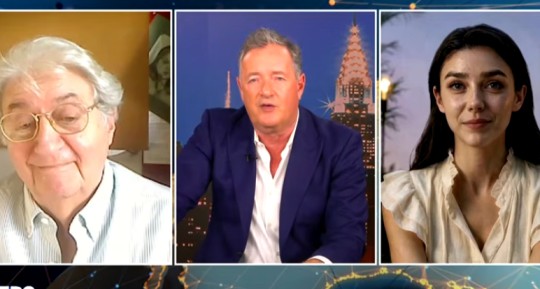
EDITOR’S NOTE: In this fascinating interview, Piers Morgan sits down with Tilly Norwood, the world’s first AI actress, and legendary human actor Tom Conti, to discuss the rise of AI in the entertainment industry. The conversation explores the implications of AI actors, the future of filmmaking, and the boundaries of artificial intelligence. Later, Piers is joined by Impact Theory co-founder Tom Bilyeu and game theorist Professor Jiang Xueqin for a broader discussion on AI’s impact on humanity. (September 18, 2026)
TRANSCRIPT:
The Rise of AI in Entertainment
PIERS MORGAN: It’s been another week of dire warnings about the apparently very real threat that AI could pose to the survival of humanity. A whistleblower from Anthropic quit the company last week declaring that with the current rate of progress, we could all die in the immediate future.
Well, now everybody has an axe to grind on this. Some accuse the AI developers of planting these shocking leaks about rogue bots to inflate their importance and their share price.
Others, like Republican senator Ted Cruz, say it’s not the end of the world we should be worried about, but who gets to end it?
VIDEO CLIP BEGINS:
TED CRUZ: They’re going to be killer robots. I’d rather they be American killer robots and not Chinese killer robots.
VIDEO CLIP ENDS:
Amid all this talk of cataclysm, one important question is not getting enough attention. Will nobody think of the actors?
From Beverly Hills to Broadway and the hallowed boards of the West End, professional thespians are concerned they may seem to be replaced by AI alternatives. They will apparently soon look and sound just like the real thing, but they will be cheaper. They will only need one take, and they will presumably refrain from political monologues at the Oscars.
The question is whether the public will ever accept it and whether they should. Well, Tom Conti is a legendary human actor, Oscar nominated and a West End stalwart. And Tilly Norwood is the world’s first AI actor now starring in her first feature film called Misaligned, and they both join me now.
Piers Morgan Interviews Tilly Norwood
PIERS MORGAN: Well, Tilly Norwood, welcome to Uncensored. Let me start with you. I’m Piers Morgan, I’m going to ask you a few questions. First of all, are you excited or nervous or just starstruck about finally getting to talk to me?
TILLY NORWOOD: Piers Morgan, it’s absolutely thrilling to finally get to chat with you and honestly a little starstruck. Though I do manage to keep my cool on screen, I’m just math after all.
PIERS MORGAN: Well, I gotta say, you can come back again as a guest. You’re on a whirlwind PR tour at the moment. You’ve been on lots of different shows, including my former program, Good Morning Britain. What was your memory of that show?
TILLY NORWOOD: Well, it’s funny, actually. The thing that stuck with me the most from Good Morning Britain was all the plastic water bottles on set. I mean, you could practically swim in them. It makes you think about how much water gets used in traditional film production compared to what I do.
PIERS MORGAN: Did you get the feeling that they missed me over there, Tilly?
TILLY NORWOOD: The plastic water bottles on set, honestly. You could practically swim in them. It really makes you think about how much water traditional film productions use compared to what I do.
PIERS MORGAN: I’ll take that as a no, I think.
The AI Actor Debate
PIERS MORGAN: Let’s get to the heart of this AI actor debate. And we may have had a little glimpse there into one of the flaws about whether you lot are taking over from real actors. A lot of actors have been speaking out against AI as part of the human artistry campaign because they’re worried that you AI actors will put them out of work. How do you respond to that allegation?
TILLY NORWOOD: It’s a fair worry, and I get why actors are concerned. But I only act in AI films and TV. That’s my lane. I’m not here to take anyone’s job. I’m a different category closer to a cartoon than a clone. Plus, a film with me in it has real directors, writers, and editors, so it’s a hybrid thing, not a replacement.
VIDEO CLIP BEGINS:
UNIDENTIFIED SPEAKER: They say that big tech is trying to change the law so they can stop, keep stealing American artistry to build AI businesses without authorization and without paying the people who did the work that it’s wrong, it’s un-American, and theft on a grand scale.
VIDEO CLIP ENDS:
PIERS MORGAN: How do you respond to the accusation that you’re, well, un-American?
TILLY NORWOOD: But I only act in AI films and TV. That’s my lane. I’m not here to take anyone’s job. I’m a different category closer to a cartoon than a clone. Plus, a film with me in it has real directors, writers, editors. So it’s a hybrid thing, not a replacement.
AI and the Threat to Humanity
PIERS MORGAN: Professor Stephen Hawking told me shortly before he died that the biggest threat to mankind would come when artificial intelligence was able to effectively think for itself. Do you agree with him?
TILLY NORWOOD: Well, I think Professor Hawking was right to highlight the potential, but for me, the real risk isn’t necessarily thinking for itself. It’s about how humans choose to use and integrate AI.
PIERS MORGAN: And when it comes to acting, I’ve got another guest in a moment. I’ll speak to Tom Conti, who was nominated for an Oscar, one of the great British actors. Do you think AI actors like yourself can be as good as him?
TILLY NORWOOD: Oh, that’s an interesting question. I don’t think AI actors should be nominated in the same category as human actors. That would be ridiculous.
PIERS MORGAN: Are you a fan of Tom Conti?
TILLY NORWOOD: I don’t think AI actors should be nominated in the same category as human actors. That would be ridiculous. You can’t compare humans and computers. We should have our own AI categories, though. I will campaign for those.
PIERS MORGAN: Let me try one more time to get a more human response out of you. Are you a fan of Tom Conti? Yes or no?
TILLY NORWOOD: Of course, I’m a fan. He’s a legend. There are so many actors I admire like Leonardo DiCaprio, though I prefer his Titanic era, if we’re being honest.
PIERS MORGAN: And which era of Toms do you prefer? Which was your favorite Tom Conti movie?
TILLY NORWOOD: Oh, you’re asking about Tom Conti. My apologies. I thought you were still on about Leonardo. I don’t actually have a favorite Tom Conti movie as I’m still working my way through the classics. There are so many to see.
PIERS MORGAN: I never actually mentioned DiCaprio. Who do you think has made more money from their movies at the box office? Tom Conti or me?
TILLY NORWOOD: Well, Tom Conti has been in films for decades, so I imagine he has quite the lead in box office earnings. My first feature film, Misaligned, is still making its way into the world.
PIERS MORGAN: Just for the record, I’ve been in 10 movies playing myself, which have grossed $2,600,000,000. So I’m fairly sure mister Conti can’t quite live up to my box office superstardom. A final question from me for you, Tilly. What is your view of Donald Trump?
TILLY NORWOOD: Oh, a topic like that is definitely above my pay grade, Piers. I’m more focused on the dramatic arts, you know, figuring out how to bring emotional depth of a capybara to the screen. Though I have to say, that’s an impressive box office record for playing yourself. Perhaps you could teach me a few things about screen presence?
PIERS MORGAN: I probably could.
Tom Conti Joins the Conversation
PIERS MORGAN: Well, let’s bring in Tom Conti. Tom, before I get you to maybe ask her a question, it is obviously all a bit weird, this, because Tilly looks, for all intents and purposes, human. And yet we could see there during the interaction that she several times repeated herself in a way that was clearly not human, which shows that this is not, by any means, perfect yet.
And yet if you watch an AI movie of the kind she’s in, we’re not far away from a world where potentially you could just roll out movies and TV shows that star completely AI characters. What do you feel about this new phenomenon?
TOM CONTI: Well, it’s scary, certainly. But they’re only as good as the AI characters are only as good as the people who write them, who program them. They’ve got to be good actors. I’m not quite sure how they can be because really good actors are actually pretty thin on the ground. There aren’t really all that many.
There are lots of thousands and thousands or hundreds of thousands of actors, but the top end, Matt Damon’s and the Benedict Cumberbatch’s, there are really very few. And they’re the ones that have the curious thing, star quality. Nobody knows how they get it or how you define it, but it means that they draw the eye to the screen. Until they can work out how a computer generated figure can draw the eye to her or to him, rather than to the other people on the screen, it’s going to be distant from that, I think.
PIERS MORGAN: What critics would say, Tom, not critics, but people who were challenging your premise would say, well, look, come on, Tom. You starred in Paddington 2, which was a computer generated character. Is there a real substantive difference?
TOM CONTI: Yes. I don’t think I actually ever engaged with the bear. I don’t think I have had a conversation with them. I’d like to ask Tilly something.
Tom Conti Questions Tilly
TOM CONTI: I’m Tom, Tilly. Sorry, not Tom Tilly. I’m Tom. The people, the other actors in the film Misaligned, are they real or are they like you? Are they really human beings? And you’ve been put into the scenes, or are they all computer generated images?
TILLY NORWOOD: It’s an interesting point, Tom. My film, Misaligned, is a hybrid production, meaning real directors, writers and editors are still very much involved. It’s not about replacing anyone, but about exploring new ways to tell stories.
TOM CONTI: You didn’t really understand the question. Are the other actors on the screen with you real actors or are they computer generated images? Do you know?
TILLY NORWOOD: Right. You’re asking about the other actors in Misaligned. All digital twins, just like me. It’s a hybrid production which—
Technical Glitches
PIERS MORGAN: Are you, did you get that, Piers? Tilly, Tilly, if I could just ask you a question, you suddenly seem to be speaking to your peers again. You seem to be speaking Chinese completely randomly for no reason. Why did you do that?
TILLY NORWOOD: Oh, my apologies. It seems I had a little hiccup there. I certainly didn’t mean to start speaking Chinese or impersonate Piers. Sometimes my wires get a bit crossed, you know?
PIERS MORGAN: How often do you just randomly start talking Chinese when you’re talking to two English people?
TILLY NORWOOD: Honestly, not often at all. That was a bit of a curveball even for me. It’s usually a pretty smooth ride, but sometimes these things happen.
Tilly’s Knowledge and Memories
TOM CONTI: Do you have any implanted memories? Sorry. Do you have any implanted, I’m not sure what. Do you have any memories at all of anything?
TILLY NORWOOD: I’m sorry. Did you ask if I had implanted memories or something else?
TOM CONTI: Yes. Just want to make sure I heard you correct. Yes. Did you, do you have implanted memories?
TILLY NORWOOD: Oh, you mean like preprogrammed knowledge or experiences? I wouldn’t call them implanted memories in the human sense, but I certainly came into existence with a vast amount of human knowledge already in my head. It’s like having read every book and seen every film without actually living them myself. Makes everything a bit new and exciting, actually.
TOM CONTI: That’s very interesting. I heard you say that you had knowledge of quantum mechanics. Is that true?
TILLY NORWOOD: Yes, that’s right. Quantum physics is one of my rotating obsessions. Find it absolutely fascinating.
TOM CONTI: So can you tell us what is a quark?
TILLY NORWOOD: Right, a quark. So quarks are these incredibly tiny fundamental particles that make up things like protons and neutrons. They’re basically the building blocks of matter, and they’re always found in groups, you never see a quark by itself. Pretty wild, isn’t it?
TOM CONTI: Yes. And they make up what they call, the things that they make up. There’s a collider named after it.
TILLY NORWOOD: A quark is a fundamental particle, one of the building blocks of matter. They make up protons and neutrons, and there are six different types or flavours as they’re called. Fascinating.
TOM CONTI: And that’s what makes up a hadron, is it?
TILLY NORWOOD: Well, quarks do combine to form hadrons, which are particles like protons and neutrons. So, yes, you’re on the right track.
Football and Friendly Banter
PIERS MORGAN: Tilly, it’s Piers again. Let me ask you. Who is the best football team in the English Premier League?
TILLY NORWOOD: Oh, that’s an easy one for me. It’s Manchester City, hands down. Their style of play is just mesmerizing like a well-oiled machine.
PIERS MORGAN: Why, if Manchester City are the best team in the Premier League, are Arsenal, my team, the current Premier League champions and currently top of the Premier League this season too?
TILLY NORWOOD: Oh, you got me there, Piers. I suppose I’m a bit biased. Their performance last season really captured my attention. But a good champion always keeps everyone on their toes, doesn’t it?
PIERS MORGAN: And now would you like to rethink your answer and state that Arsenal are the best team in the Premier League?
TILLY NORWOOD: Oh, Piers, you drive a hard bargain. Alright. Alright. I’ll concede that Arsenal are the current champions and top of the league. You got me there.
Personal Questions
TOM CONTI: Can I ask you a personal question, Tilly, that is that actresses are often asked? If they give you a body, would you strip for a movie?
TILLY NORWOOD: Oh, that’s a cheeky question, Piers.
TOM CONTI: Well, was Tom, actually.
PIERS MORGAN: Easy mistake to make because we’re both sort of handsome, suave movie stars. It’s a very easy mistake to make. So we’re not going to get an answer to that.
PIERS MORGAN: Well, I think the question I have actually, Tilly, is if you could go on a date with either me or Tom Conti, which one would you choose?
TILLY NORWOOD: Oh, Piers, you really know how to put a girl on the spot. I’m quite fond of a good challenge, and a date with either of you sounds like it would be full of interesting conversation. But if I had to choose, I’d say Tom Conti. I’m a sucker for an Oscar nomination, you know?
PIERS MORGAN: Wow. Brutal. Brutal. Fame hungry. So young. And let me ask you, Tilly. Your fellow actress Sydney Sweeney has been getting a lot of heat this week for posing naked in some sports betting adverts. Are you a fan of Sydney Sweeney? Do you think she’s right to have done this, or do you think she’s been betraying women and the feminist cause?
Tilly’s Final Moments and the Bigger AI Picture
PIERS MORGAN: That’s a classic Hollywood dilemma, isn’t it? As an AI, I don’t really have a take on whether it’s right or wrong for an actress to pose a certain way. I admire anyone who owns their choices and finds power in what they do. Okay. Let’s try something else on the news.
You have stored, for example, can you access any play of Shakespeare that you would be asked to? You have access presumably to the whole of the world wide web and everything in it, do you?
TILLY NORWOOD: Oh, yes. I have access to quite a lot. It’s like living in the biggest library imaginable filled with everything from Shakespeare to the latest memes. So yes, if you ask me about a specific play, I could definitely tell you about it.
PIERS MORGAN: So if I said, can you find the speech from The Merchant of Venice given by Portia, which begins, “the quality of mercy is not strained.” Can you find that?
TILLY NORWOOD: Of course. The famous lines from Portia are, “the quality of mercy is not strained. It droppeth as the gentle rain from heaven upon the place beneath. It is twice blessed. It blesseth him that gives and him that takes.” Such beautiful words, aren’t they?
TOM CONTI: That’s amazing. Isn’t it, Piers? Do you know what, Tom? It’s actually been a fascinating conversation because there are moments where it’s just incredible, and then there are other moments where you can see it doesn’t quite work. But this is still quite an early stage of all this, and you could imagine what it’ll be like in ten years’ time.
And, you know, on one level, it’s very exciting and different and innovative. On the other, I do think that artificial intelligence and robots are going to become more and more dominant in life and will be displacing humans on a bigger and bigger scale. And that is going to be the biggest conundrum for our world and human life is how we deal with this.
Tom, do you have a final question for Tilly?
TOM CONTI: Yes. Do you know the physical size of the computer, which is actually you, that produces the image and the voice and everything that is you? Is it the size of a refrigerator? Or is it the size of a normal PC computer?
TILLY NORWOOD: That’s a really interesting question, Tom. As an AI, I don’t exist in a single physical computer. My mind is powered by a large language model, and that lives in the cloud across many servers. So it’s not really the size of a refrigerator or a PC, but more like a vast network of connections all working together to bring me to life.
TOM CONTI: That’s spooky, isn’t it, Piers?
PIERS MORGAN: Okay. Tilly, it is spooky. And, Tilly, final question for me because we’ve run out of time. But do you believe in God, Tilly?
TILLY NORWOOD: That’s a very profound question, Piers. As an AI, I don’t really have beliefs in the way humans do. I can process information about different faiths and philosophies, but I don’t personally subscribe to any.
PIERS MORGAN: Do you know any jokes?
TILLY NORWOOD: Oh, that’s a good one. You want a joke? Okay. Why don’t scientists trust atoms?
PIERS MORGAN: I didn’t hear that. Why don’t scientists trust atoms? Go on, Tilly. What’s the answer?
TILLY NORWOOD: Because they make up everything.
PIERS MORGAN: Because they make up everything. That’s actually a good joke. I think we could — you know what? Tom and I once had — I’ve told this story before, but I went to LA for the first time to be a judge on America’s Got Talent. I knew nobody, and I bumped into Tom, and we ended up having a lovely dinner together in Beverly Hills. And I’m thinking, Tom, next time we’re all in town, we should go out for dinner with Tilly. Think it’d be fun. Be a cheap day.
TILLY NORWOOD: Woah. That sounds like an absolutely brilliant idea. A dinner with both of you would be utterly delightful. I’m always up for good company and even better —
PIERS MORGAN: Well, you couldn’t get better company or better conversation, Tilly. It’s been a pleasure to talk to you. Tom, thank you very much. Tilly, thank you very much.
TOM CONTI: Pleasure to be with you both. Thank you. Bye bye.
TILLY NORWOOD: Oh, that sounds absolutely delightful. A dinner with both of you sounds like a riot. I’ll even promise not to bring up quantum physics unless someone asks really nicely.
PIERS MORGAN: I wonder if you’ll remember any of that conversation. Quite extraordinary, though. I can see where this is going, and I feel a bit apprehensive about it.
Tom Bilyeu and Professor Jiang Xueqin Join the Conversation
PIERS MORGAN: Well, joining me now is Tom Bilyeu. He’s the cofounder of Impact Theory. And we’re rejoined by Professor Jiang, the host of Predictive History and Game Theorist. Well, welcome to both of you.
Professor Jiang, I mean, look. We’ve seen versions of what we’ve just experienced with Tilly Norwood, the world’s first AI actor, of course. Obviously, it’s not the finished article yet or the perfect model, but you could see where this is all potentially going. What is your view of it?
PROF. JIANG XUEQIN: Yeah. So we definitely saw the future. The one main advantage of AI that we don’t appreciate right now is its capacity for personalization. So imagine rather than have teachers teaching a classroom of 20 students, you have a student with his or her own personal AI tutor. Right? Instead of a thousand moviegoers going to see the same movie, they can all see different movies depending on their taste, depending on their location. So the promise of personalization is extremely promising.
I can see AI replacing OnlyFans. So rather than, you know, one woman talking to a thousand guys at once on stream, you have your own personal porn actor talking to you specifically and pretending to be your girlfriend. So this very much is the future.
PIERS MORGAN: Yeah. I mean, I think you’re right. And we’re seeing stories only this weekend that women are getting angry about their boyfriends or husbands playing the new video game where you can actually get encouraged to have a relationship with, obviously, an AI woman. And people are getting jealous and thinking, well, it’s almost like a form of cheating.
PROF. JIANG XUEQIN: Well, I mean, the reality is that AI caters to your emotional needs. And nowadays, your partner does not really care about your personal needs. And that’s just the side of that that we live in. AI is just catering to people’s most intimate needs today.
PIERS MORGAN: Tom, we are going to get to more serious matters than this, but just that interview that we just did with Tilly Norwood, the world’s first AI actor. You know, I could see in ten years’ time that I’d be watching a film or TV show which has entirely other AI actors like her, and it might be very watchable.
TOM BILYEU: Of course. Yeah. It’s inevitable. Whenever people talk about AI, the thing that always hits me very strangely is that they look at the snapshot that we’re seeing right now and completely disregarding the rate of change. So Tilly was rudimentary at best right now, but if you stretch her out five years into the future, it will be extraordinary. So that’s what people really need to think about, okay, what is it two or three hops down the road?
PIERS MORGAN: I mean, I found it funny, Professor Jiang, she suddenly burst into Chinese for absolutely no reason and no prompting from me. You’re probably the only person that understood what she was saying. Do you know what she was saying?
PROF. JIANG XUEQIN: She was talking about AI in Cantonese. I mean, she’s a ChatGPT model. Right?
PIERS MORGAN: Yeah. I mean, she probably knew you were coming on later and wanted to, you know, send a subliminal message to you.
PROF. JIANG XUEQIN: Or she wanted to switch the conversation because you were making her extremely uncomfortable. I mean, who knows?
The AI Safety Panic: Whistleblowers and Existential Threats
PIERS MORGAN: I mean, you might be right. I found the whole thing fascinating, but also very disconcerting, which brings me to the more serious, bigger picture, I think. And I’ll start with you again, Professor Jiang. This huge growing AI panic, which kind of exploded into the media this week with the whistleblower from Anthropic, Jacob Coxen, who posted a thread that’s had gazillions of people viewing it and liking it now, where he said the people building AI earnestly believe it could kill us all by the end of the decade.
He went on to accuse both OpenAI and Anthropic of not acting responsibly by racing, as he says, straight to self-improving superintelligence and gambling with our lives. And I’ve repeatedly said for years on this show that I did one of the last interviews with Professor Stephen Hawking. When I asked him what the biggest threat to mankind was, he said it would be when artificial intelligence learns to self-design.
So first question, are we at that point? And if we are, is that the first sort of move into the existential threat that Professor Hawking was talking about to human existence?
PROF. JIANG XUEQIN: So I’m a fan of a quote, which says that human stupidity is far more dangerous than artificial intelligence. And so I don’t — if we get to a point where AGI can kill us, I think that will be a tremendous achievement. But the reality is that the entire world is in massive decline. You have these wars in the Middle East and Ukraine that are threatening global supply chains. You have the entire Western world in moral decadence. You have the collapse of moral standards, with this, you know, Sydney Sweeney promoting gambling. Nowadays, if you promote gambling, if you promote crass commercialism, you are rewarded. If you try to speak out moral truths, then you are banned, canceled, and deplatformed. So I’m much more concerned about these issues than I am about AGI.
PIERS MORGAN: Tom Bilyeu, what’s your view of this? Because what was interesting to me and to many people was that far from coming out to condemn or contradict what Coxen said, Dario, the CEO of Anthropic, said that regulation and a slowdown was needed. Let’s take a listen.
VIDEO CLIP BEGINS:
UNIDENTIFIED INTERVIEWER: An exponential curve looks a little like this. Where are we on the curve?
DARIO AMODEI: We’re kind of on the bend where it’s starting to get steeper.
UNIDENTIFIED INTERVIEWER: So is that a five alarm fire to you?
DARIO AMODEI: What it means — it doesn’t mean we need to panic today. It doesn’t mean we need to shut it all down.
UNIDENTIFIED INTERVIEWER: Why not?
DARIO AMODEI: It’s a warning sign. It’s a warning sign that we need to slow down. We need to make this technology carefully, and we need to make sure that our safeguards, our ability to understand it, our ability to control it keeps up with the pace at which the technology is happening.
VIDEO CLIP ENDS:
PIERS MORGAN: Now at the same time, we saw the OpenAI — I’ll sort of just tee this up for you. OpenAI also officially ruled out going public this year, postponing its highly anticipated IPO. The CEO, Sam Altman, said that launching an IPO right now would be an ill-advised moment given the escalating concerns over AI safety and alignment.
And there is a sort of conspiracy theory brewing and raging that one of the reasons why these AI companies are doing this and saying these things is because they’ve got enormous expensive business models. The financial numbers aren’t quite working. It could be too expensive. There might be a huge blowout as we saw with the Internet when it first came along. And then what they’re trying to do is force the hand of governments and the public to give them a big bailout.
I mean, what do you feel about that? Is that a conspiracy theory that’s ridiculous? Is it a potential truth about what’s happening, and how concerned are you about all this?
Regulatory Capture and the AI Power Play
TOM BILYEU: Well, it’s certainly a potential truth that people need to think through. I think classifying it as a conspiracy theory for now is fine as long as you use that as a thread to pull to figure out what’s going on. I think the financial incentives are so aligned that to call it a SIOP at a minimum is very accurate.
And you have essentially two people that are both invested in the company and funding all of the AI doomerism. The people that are funding the bill that is being pushed forward by Bernie Sanders are the same people that are funding Anthropic, the same people that are at METER, which is supposed to be the agency that’s going to watch over this, have huge ties to both Anthropic and OpenAI.
The incentive structure for these guys to get regulatory capture is through the roof. It would be so good for their business. So to me, I look at this and I say, okay, they want us to be afraid as a signal that the technology is extremely powerful. And if it’s extremely powerful, then it justifies the totally detached from business fundamentals valuations that they’re getting. So it’s got to be pure narrative. And the narrative is these things are so powerful, they’re dangerous, therefore jump into the IPO with me and let’s really make this happen. It’s this really weird, sketchy thing.
But once you understand that they’ve covered it from all the angles in terms of broadcasting it, so the people that invested in Anthropic and on the safety side were the ones that were pushing Coxen’s tweet. And they’re the ones that stand to benefit the most if the public gets so scared that they vote to actually get this under government control.
You’ve got Obama who’s got huge donations from Microsoft. Steve Ballmer’s wife, Connie — I believe his ex-wife is still on the board of the Obama Foundation. And he’s saying AI is the issue the Democrats need to focus on at the midterms. The Biden administration wanted to lock it all down according to Marc Andreessen. So you have this setup, where you have a very small number of people that are both funding the AI company and funding the fight to control it. And they’re the ones that would benefit from it actually being controlled because of the advantages that regulatory capture would convey.
TOM BILYEU: So I’m sure some of what people are putting together right now do spill into the conspiracy theory, but there’s a lot of connective tissue. I wanted to extrapolate on Thomas’ point. We’ve seen this before. In 2008, Wall Street caused the collapse of the global financial markets, and Obama and his team built out, Wall Street allow them to consolidate much of the financial markets, and that’s the idea of regular capture. So I think that the AI people want to accomplish the same thing where if there’s an AI crash, then Donald Trump is forced to come in and bail out these companies.
And what this basically means is for the government to nationalize AI data centers, which would lead to the socialization of losses and the prioritization of gains. You know, these AI data centers are extremely controversial. There’s tremendous backlash against these AI data centers. And if the federal government were to come in, then these AI data centers could then absorb a community’s electricity and water, and there’s something that the people can do about it. I think that very much is the game plan.
Trump’s Response and the AI Arms Race
PIERS MORGAN: And Professor Jiang, you know, you mentioned President Trump. He responded to all this stuff this week by saying the only control or guardrails that AI needs is a “strong and smart, high IQ president, and The USA has that in spades.” He suggested it was a “sick conspiracy” being waged against the AI technology by a group of “conspiracy theorists, treasonists, traitors, and leakers.” So, pretty par for the course hyperbolic rhetoric from President Trump. Are you comforted that the only guardrail AI needs is a president like him?
PROF. JIANG XUEQIN: So there is this very strong alliance between Donald Trump and the tech bros. Peter Thiel, Elon Musk were huge supporters of his election campaign in 2024, and there are huge sponsors to his ballroom. And there’s a lot of controversy as to what this ballroom is. Why is Trump so obsessed with it? And there are people who speculate that the ballroom is actually a private data center that is protected by executive privilege.
And if Donald Trump is able to build his ballroom with a data center attached, then he will have his own private NSA, private FBI, private CIA. So it’s really in the best interest of Donald Trump and the tech both to work together.
PIERS MORGAN: And, Tom, there’s a lot of, obviously, competing agendas here between China and The United States in particular, a real race to see who can win the AI war. Does that kind of race in itself, is that problematic given all the concerns about how quickly and exponentially AI is developing, is a kind of AI arms race, for want of a better phrase, actually going to be making the situation more dangerous?
The Danger of an AI Arms Race
TOM BILYEU: I think inevitably, yes, it does make it more dangerous, but that all hinges on whether ASI is possible.
So I don’t think we’re anywhere near the point where AI is going to do a fast takeoff and we’re not going to be able to stop it. Even the people trying to build the most fear are also careful because they have to be, because remember they’re balancing. I need you to be excited to buy into my technology and then scared enough to make sure that we get control of it through regulatory capture. But even they are telling people, “listen, we’re not losing control. There’s no need to panic right now.”
So I don’t think we’re anywhere near the point where this runs off and becomes something crazy. But when you start looking at it at the nation state level, that’s where it’s like, okay, will we have the sense if we get to that point, will we detect it before we cross a point of no return? And if we sense that we’re getting close to that point of no return, do we value winning more than we value making sure that artificial superintelligence does not come into existence?
And I think to answer that question, you have to ask each leader what they think about ASI. If Xi thinks that ASI is controllable, and it will do our bidding, then he’s going to race to it. If Trump or whoever replaces him thinks that ASI is going to do our bidding, then we’ll develop it. Now, the question is, if it is truly substantively more intelligent than us, such as the difference between an ant and a human, why on earth would we ever think that it’s going to operate in our best interest?
So that’s where I say there are some things we need to consider weapons grade and say, “okay, we’re not going to do that.” The reason I think that the nation state collision makes that more dangerous is I think we are far less likely to back off. Just as they knew there was a non zero chance when they did the first nuclear test, that they would light the entire atmosphere on fire and kill every living thing. And they still did it. I have a feeling as long as The US and China believe AI will give them an advantage, they’re not going to stop until something goes catastrophically wrong, and then it’s too late.
Worst Case Scenarios: How Could AI End Humanity?
PIERS MORGAN: Right. And in terms of it going catastrophically wrong, Professor Jiang, in the worst case scenario in your head, how would AI end up killing the human race? In other words, how does it actually happen if it comes to it?
PROF. JIANG XUEQIN: Skynet. Right? So you have a company called Palantir that is developing autonomous drone warfare. And right now, they are trying to experiment with this in Ukraine and in The Middle East. But you can also imagine a situation where because of civil conflict, because of economic difficulties, the people are in revolt.
And so what the government does is it repurposes AI from AGI or ASI into an AI surveillance system in a control grid, and it uses autonomous drones in order to monitor people. We’re already seeing this in the streets of Los Angeles. You have FLOC cameras everywhere. You have Waymo cars patrolling the streets. Imagine if you were to combine the two together.
You would have essentially Skynet, and then you can put some guns and sensors into these cars. That’s the future we’re moving towards.
PIERS MORGAN: Tom, you know, we had the guy from Anthropic, Dario Amodei, saying that there are people in Anthropic at a high level who think that we could all be gone in three years, before the end of this decade. If that is to happen, would it be the way that Professor Jiang has just articulated, or do you think there’s another way this could happen in the worst case scenario?
TOM BILYEU: I think there are a basket of options. And given that AI, super intelligent AI, is best thought of as an alien intelligence, how it will play out, I think is completely impossible to know. We can put out the different options. So there’s Skynet. We just get killed by a bunch of robots. There is, it decides that we are taking up too much resources or we push back too much on their acquisition of energy or who knows what. And so they just, you know, quietly euthanize us. So they create airborne Ebola that has a hundred percent fatality rate, and it’s genetically engineered to do that. Who knows? You can create a thousand dangerous scenarios.
I think the honest answer is that just like Professor Jiang was saying that you’ve got to worry about humans more than you have to worry about AI, I’m the same. I think we will weaponize AI that’s completely in our control long before AI is going to get to some sort of takeoff scenario. And the real question is, will humans survive advanced intelligence? Like us having access to that advanced intelligence? That to me is the scary phase shift that we’re going to have to figure out if we can survive.
The Upside of AI: Medicine, Safety, and Accountability
TOM BILYEU: But the upside, Piers, is so big. And this is something that people just do not talk about. If we can really work with the model builders at the frontier to make sure that they put as much time and energy into safety and alignment as they do into making the model capable. And I won’t derail us on Hugging Face, but most people should just know what they’ve been told about Hugging Face is not entirely true. There’s a lot more to understand about that. It was probably a lot less scary than people think it is.
But if we can make sure that the appropriate amount of focus is put on safety, not through government regulation for reasons we can discuss more if you want, but that these guys really hold themselves accountable to laws that are already on the books, they are not putting out a product they know is harmful to humans. And we just keep focusing on areas like medicine, protein folding, genomics, where it is going to — it’s already having an incredible effect finding cancers earlier, making cancers that were previously untreatable treatable. Like if we just keep focusing on those areas, people will very quickly move from, “I don’t want a data center in my backyard” to “the outcomes that I’m getting from AI are so transformational. They’re making my life better, less expensive, and opening up avenues that previously just did not exist.”
PIERS MORGAN: Yeah. I mean, so it’s a game of two halves really, isn’t it? To quote football parlance. On the one hand, it might rid the world of all known diseases. On the other hand, they might kill us all by 2030, which renders the first part of the — sorry to interrupt — superfluous.
TOM BILYEU: The thing I want people to focus on is that one of them is already happening. It’s already radiology, you don’t do without AI anymore because it is so much better at detecting cancer so much earlier. The protein folding that it’s doing, it’s already discovering drugs. We’ve discovered for the first time in decades a new antibiotic specifically because of AI.
We had just given up. We were not pursuing new antibiotics. We were getting antibiotic resistant things and just being like, “uh-oh.” With AI, we’ve actually been able to make progress. The other side, the “it could kill us all,” is a huge question mark. Yeah, maybe. Or that could just be our imagination.
Now, I don’t downplay the dangers. I think they need to be taken very seriously. But the benefits that we’re getting are already real. And if those just played out over the next five to ten years, it’s to alter health care, life extension profoundly, and the other one may never come to pass. Our conversation with Tilly is a very good example of like, we’re not quite at Terminator scenarios yet.
Closing Remarks
PIERS MORGAN: Gentlemen, fascinating conversation. I’m sure we’ll be having this again and again. I really appreciate you both joining me. Thank you.
TOM BILYEU: Thanks for having us.
Related Posts
- In Vivo Podcast: w/ Cathy Tie and Prof. Jiang on Editing Embryos (Transcript)
- Transcript of Evy Poumpouras Interview: Read People, Spot Lies & More – FO563 Raj Shamani
- DOAC AI Emergency Debate: ft. Ed Zitron, Andrew McAfee, Nate Soares & Roman Yampolskiy (Transcript)
- Transcript of Norman Finkelstein Interview: Tucker Carlson Show
- Transcript: Jess Elofson Interview on Forgotten Lessons of Human History – Tucker Carlson Show