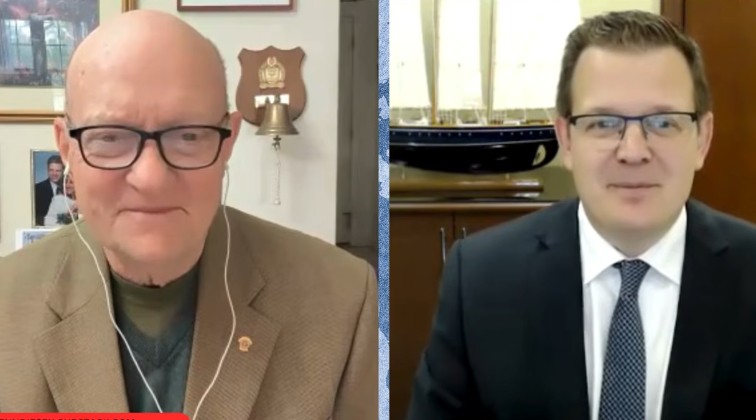
Editor’s Note: Colonel Lawrence Wilkerson, former Chief of Staff to US Secretary of State Colin Powell, joins Glenn Diesen to discuss the widening Iran war, Benjamin Netanyahu’s growing desperation at the UN General Assembly, and whether Israel and Saudi Arabia could face extinction. He also covers the risk of nuclear escalation, the impact of the US midterms on war planning, the Yemen and Red Sea dilemma, and the possibility of Iran sinking a US aircraft carrier. This interview was premiered on September 29, 2026.
TRANSCRIPT:
Introduction
GLENN DIESEN (00:00:00 – 00:00:16): Welcome back everyone. We are joined today by Colonel Lawrence Wilkerson, the former Chief of Staff to the US Secretary of State, who is always an excellent source on all the rogue behavior that took place there in the White House. So thank you for coming back on the program.
COL. LAWRENCE WILKERSON (00:00:17 – 00:00:29): Good to be with you, Glenn. I just had lunch the other day with Frida Strandh, so we had about a 2-hour lunch and she just unloaded. Same message, idiots in Europe.
Is Israel Facing Extinction?
GLENN DIESEN (00:00:32 – 00:01:20): Let me ask you something. There seems to be some dangerous developments going on now. That is, the desperation especially is quite dangerous. We see that for not just the United States but for Israel. The perception of being all-powerful, as being quite important for security. And we now see that this image has, to a large extent, begun to be diminished. And, well, if you look away from the United States and just towards the Middle East, some of those political entities which seemed so powerful in the past are now, well, much weaker than we thought. I was wondering, how do you assess the vulnerability of a state like Israel or Saudi Arabia at this point in time?
COL. LAWRENCE WILKERSON (00:01:22 – 00:07:55): I think we’re looking at possibly, and I would say probably in the case of Israel, certainly as a Jewish state in the Levant, extinction. With regard to Saudi Arabia, I’d say it’s 60/40 right now in favor of extinction. And I believe what you’re looking at, and I thought about this a lot because I was in New York and at the UNGA sessions, some of them, and off-site sessions with the Cuban foreign minister, for example.
And when I watched it later that night in the hotel and I saw that episode, I think it was on the 24th, where Bibi Netanyahu called the delegates “moral cowards”— and this was after, of course, 70 or so plus of them, 77 I think, diplomatic missions got up and walked out, and the only cheers and hoots came from that puerile cheering section for Israel. And for the first time, I think, in 81 years, the UN General Assembly officials, leaders, and others had to gavel repeatedly to keep the shouting and hooting from getting out of hand. That’s probably a first.
I’ve realized, I think, a psychological phenomenon that was taking place, is taking place. And it’s simple. It’s simplistic almost, in addition to being simple. But I think it’s revelatory. I think Netanyahu himself personally is collapsing. And what Netanyahu does when he is pressed hard and pressed in a way that might even be, shall we say, career-ending and even into prison results, he gets really desperate, and he turns to this kind of language and this kind of behavior, which normally would be utterly condemned.
And let me go back and say, in the 81-year history of the UN, I think I am right in saying that one of the few times the United States, the arbiter of much of what the UN Security Council does, as we all know, unless it’s vetoed by Russia or China or one of the other 5 permanent members. If you go back to South Africa, you see that we blessed that, and so South Africa was forbidden to come onto the floor of the UN General Assembly. Well, then you ask yourself, the fundamental question— South Africa’s guilt was apartheid, which was even at that moment falling apart under the pressure of fairly well-coordinated sanctions and other things, and just pure pariah status that she had assumed because of the apartheid.
And now Israel, the murderingest nation on the face of the green earth, is allowed to come in. And to spew its venom and its hatred from the podium through its prime minister. And the United States is responsible. So you have to conclude once again that the guilty party in the world, as people like Gideon Levy keep saying in Haaretz and elsewhere, is the United States. Israel is the culprit, maybe in the scene, I think out of control, even with regard to Trump, which isn’t hard to do.
As he said, he’s engaged on 7 fronts in 7 wars and he’s winning them all. I had trouble trying to figure out where the 7th one was, but I assume he’s talking really about the West Bank because that’s where he’s doing his damnedest deeds right now in the southern portion in order to foreclose entirely, if it’s not already foreclosed, any kind of viable Palestinian state, because that would do it. That would do it. So this guy is reprehensible and we’re backing him.
And Glenn, I’m not sure that it would be any different were somebody else president. I’m almost positive if Blinken, Sullivan, Blinken nod and nudge, as I call it, wink and blink and nod and nudge Biden were still president with Blinken and Sullivan, that we’d be doing the same thing. Might be a little bit more carefully orchestrated and less venomous and invisible, but we’d be doing the same thing.
So I asked myself a fundamental question: where are we? And where is Saudi Arabia? And where is Israel? And where is Kuwait and Qatar and UAE and Jordan and a host of other people that have been confederates, if you will, for a long, long time?
Very much a foreign policy speech, and it was called something like “MENA and the Future,” Middle East, North Africa, and Future. And she essentially said the Arab Spring was— Mubarak was the most visible and successful, she thought, example, and we needed to do this. We needed to clean house of the autocrats that we’d supported for so many years. She didn’t say that directly, but the hint was strong. So much so that Cheney said nobody read that speech throughout the bureaucracy. I don’t know what got Condi to do it. She certainly is not that kind of person. She’s worse now than ever before. Got her name on a Chevron tanker, so she feels all that bravado.
But she was right. It is time to divest ourselves of these tyrants because that’s what they are. They’re tyrants. They keep the majority of their people under their heels while they enjoy the riches that Divine Providence or whomever bestowed upon them with all that black gold. Yeah, I think their time is limited, and I think the time has come, and I think that maybe even Ansar Allah might be part of the justice that’s going to be visited upon them. So that’s a long-winded answer to your question.
Desperation and the Response of Gulf States and Iran
GLENN DIESEN (00:07:57 – 00:10:10): Well, it’s an interesting point to make though, that very likely other leaders would’ve acted in the same or similar way as Trump at least, because, but it also points to what you said about South Africa that we’re not reacting in this way anymore. And you can put the Europeans in that camp as well. So we’re all willing to go a bit further to make excuses for and support things we wouldn’t have done in the past. And there’s many ways this can be explained. One would argue moral decay. I think most of it goes to the desperation of our times, though— that they see their power slipping, and they’re willing to go a bit further in order to restore their power and look the other way as they did in Gaza— not just look the other way, give their enthusiastic support.
But when you see at the United Nations, so Trump making this casual remarks about annihilating Iran or threatening to annihilate Iran. And you have Netanyahu giving a very dark speech. Again, this thing with the beepers, it’s quite unbelievable this is actually being done. But what do the other actors in the region do now? Because if you’re the Gulf states, if they are going for an all-out war, those countries might cease to exist. And what about Iran? How long will they sit still? Will they wait for the US and Israel to essentially get all their troops in place and shape the perfect battlefield? Because if you express intent in this way, it doesn’t sound like a peace speech.
So how do you think the actions of the US, Israel, the silence at least of the Europeans, although Rutte, he claims now that Europeans are fully on board on this war, so well, fully on board in terms of allowing the US to use their bases, air bases. But what do you think the Gulf states and Iran are going to do here as pipsqueak?
A Regional War Turning Global
COL. LAWRENCE WILKERSON (00:10:10 – 00:15:28): And I mean that term truly pipsqueak as Europe is in terms of military affairs, I think this is a total affirmation of Doug Macgregor, John Mearsheimer, me, and other people’s prognosis and prediction that this is going to go regional, and the Europeans are going to be part of that regionalization, if you will. And after that, it is probably going to go global, and there is a lot behind that movement that would take an hour or two to discuss because it’s all about kind of momentum that developed starting roughly in 1890, took on new colors in 1929, and even newer colors in 1932 as Roosevelt took the helm in Washington and turned into the bloodiest conflict in human history in terms of casualties, 100 million or so.
That’s what we’re looking at right now, is that kind of march to folly that, as Barbara Tuchman so well said it, we’re looking at the same kind of wooden-headedness, the same kind of— in your term, desperation. I’d buy that as long as you add one other term: insanity. Because that’s what we’re looking at. We’re looking at leaders across the globe of consequence outside of this vast array of power that is developing around China who are insane, and they are intent on bringing what is now 2 regional conflicts, Ukraine rapidly spreading all the way to the Arctic as Norway captures Russian ships, for example, and already in Southwest Asia big time, and we are going to globalize it. That’s what we’re going to do.
And my great fear is, and you know what I’m going to say, is we nuclearize it. And I think the person most apt to do that is Bibi, because if we’re going to have some kind of military solution that is— I won’t say favorable, but at least can be sold by Donald Trump in Washington, who’s a good seller of lies, as a victory rather than a defeat or at best a draw, then someone’s going to have to use some pretty powerful weaponry to do it. Because this country of 92, 93 million people, as big as Western Europe, and the real, real power in the Gulf— and now finally the GCC countries and others in the region are realizing it, even Jordan and Egypt— and realizing that after this is over, they’re going to have to deal with that country as the real power in the Gulf and maybe they better be thinking about some behind-the-scenes diplomacy to make sure that’s not too painful for them as it develops.
If you look at all of that and then you think of what Bibi’s going to do, and I think there is at least a 60-40 chance he’s going to use nuclear weapons because he has no way on this earth with the military power conventional at his beck and call now. Nor does the United States, of bringing Iran down in the colossally defeated fashion that he wishes and is the only condition he’ll accept. So that tells me that we’re looking at maybe even the nuclearization of these conflicts at the very beginning and maybe the end of the Levant with Bibi Netanyahu. I can’t see how he thinks he’s going to get out of this with conventional weaponry.
Even the $2 billion-plus, if they’re delivered, of these various types of 2,000-pound bombs, if Congress is stupid enough, insane enough to approve this, and it looks very much like they’re going to, though there is some debate, then he still doesn’t have the wherewithal to bring Iran to its knees, which is the only condition he will accept. And I have to conclude that he has another plan behind his back, and he’s going to implement it at the last minute or the appropriate moment.
And also have to include, now that Iran has demonstrated that they can match and even exceed Mossad in their intelligence capability, that Iran is going to know. Even if it’s submarine-launched, they’re going to know, and they’re either going to coincide or they’re going to preempt. I suspect if it’s submarine, they’re going to coincide, but they’re going to be ready. And when those submarines launch their first Tomahawk-like cruise missile with a nuclear warhead and it comes in, then they’re going to unleash. So we’re going to destroy Israel in the process too.
Does Bibi want it that way? I think he would prefer to go out that way to going out embarrassed and even jailed. The Haaretz had a piece this morning. I didn’t think they’d bring this up again. It’s so ironic, it’s so fitting, it’s so appropriate. One of the biggest problems he’s got in terms of the criminal case against him is the sale by the Germans of those German submarines to Israel and the shady conditions under which they took place, particularly with respect to him. This is God’s irony. If you will.
What Comes Next on the Escalation Ladder?
GLENN DIESEN (00:15:30 – 00:16:28): Yeah, well, I keep wondering though, because it does look like we reached the limit of where we currently are on the escalation ladder. I’m just thinking, well, what might actually come next after this? Are we talking about a massive attack on Iran’s energy infrastructure? Is it nuclear weapons? Would the US try to pull the Europeans in? The whole idea of annihilating Iran. I mean, Trump, he likes to go for the headlines with his language. But at the same time, he is the president of the United States, and the Iranians have said we will not just sit by and be passive anymore and respond to what is being done against us. I’m just— if I was in Tehran, what would I expect perhaps the United States might be planning to do here?
COL. LAWRENCE WILKERSON (00:16:31 – 00:19:48): If I were in Iran, and I think this is true from the few people that I have talked to whose views I trust in Tehran, both university people and one IRGC individual whom I’ve known for a long time, Iran is ready for whatever comes and they don’t know what’s coming. I think that’s true. They simply— this president is so deceitful, so dishonorable, so mercurial, so all over the map, if you will, that they don’t know what’s coming.
And the idea that they were thinking that the midterms would be— Trump used that himself in a reverse form: “Don’t worry about the midterms, dude, I’m elected. And I’m here for 2 more plus years. I don’t have to run.” That’s essentially the message he sent. They were, to a certain extent, wondering if the midterms— at least wondering, maybe calculating, some of them— that the midterms might change things a bit, especially if they were tremendously adverse, and that Republicans had to concentrate on keeping what power they could maintain rather than continuing to attack Iran.
Of course, you could have looked at it another way too, and one or two of the individuals did look at it the other way, and they pointed out that might make them even more desperate. Either way it goes, I don’t think that’s in their calculation anymore. I think their calculation is straight Donald Trump, the way Araghchi and Pezeshkian and others have interpreted him. They have no idea what he’s going to do, but they know what they’re going to do. And if what he does is A, B, C, they’re going to do D, E, and F, and their strikes are going to be globally encompassing.
You can say ours are too, but they really aren’t. What we’re doing is impacting basically Iran. What they’re doing is impacting the world. Check out the Korean ship that tried to get through, that tried to get a slot in the Panama Canal and had to pay a $4 million surcharge just to get in line because that is how difficult it is to get through the Panama Canal now.
So I think Iran has still got the escalation ladder in its hands, and they know the top rung on it is use of nuclear weapons, but they have got several rungs to go before they get to that rung, and those rungs are going to be devastating increasingly as they go up that ladder, the world community. I don’t think they want to do that, and I don’t think China wants them to do that. I don’t think Russia wants them to do that. But I’m convinced that these leaders that are now in charge will do that if Trump does what they think calls for them doing that, or Bibi, or the two together.
But I was thinking we’re in for a rough ride if— No, I was just saying we’re in for a rough ride if Trump doesn’t declare victory and leave. That’s what he should do, however way he wants to couch it. Blame Mohammed bin Salman, blame Zayed, but whomever, but just declare victory and leave. Get out.
Trump’s Options: Annihilate or Leave?
GLENN DIESEN (00:19:50 – 00:20:49): Well, that’s one way one can interpret, though, the speech that Trump gave at the UN. He was by positioning himself as being all-powerful. And he was making a big point. That was the context of annihilating Iran. Like he said, “I can make a deal so Iran will be a very powerful country, or I can annihilate them.” So this is all in his hands.
But given that he will only wait after the midterm, it looks as if he can go both ways still though. On one hand, if he wants to do a humiliating peace, as you said, pack up and leave, it’s not going to be popular in Washington. He’s going to have to wait until after midterm. If he wants to, in his words, annihilate Iran, also not going to be popular. And he would also want to wait after the midterm. So how are you reading him? Do we know anything yet about which direction he will go? And again, he might not know himself, but how are you reading the situation?
The Midterms and Domestic Politics
COL. LAWRENCE WILKERSON (00:20:51 – 00:26:02): Militarily, and I have to speak that way first, there is no way Donald Trump could annihilate Iran. Even looking at 5,928, whatever it is now, nuclear warheads, there is no way he could annihilate Iran. Now, he could bring a lot of damage on Iran if he were willing to use a lot of nuclear weapons, but he cannot annihilate them. Now, he could inflate the world if he put all the Sejjil missiles in target range and fired all their missiles because they’re the most powerful now. And what would that get him? Nothing except destruction across the face of the globe. So I think you have to accept militarily that there’s no way Donald Trump can in conceivable means destroy Iran. That’s the first point.
The second point is I’m not even sure Donald Trump is aware that his administration is very much planning and going to use segments of what I’ll call the militia, and I include in that ICE forces, to help them do this, never leaving power. Now, whether Miller and Vought and Hegseth and others who are planning this know what Trump thinks about what they’re planning, I don’t know. I don’t know that Trump is even in on this, but I don’t think they’re planning on leaving power if the midterms go favorably for them, which it is increasingly looking like it’s an impossibility that it will. That they will, then we won’t see this. We won’t see this possibly until the end of the second 2 years.
But if they are going to go dramatically against the Republican Party and against the administration, then they are going to take action to prevent that. Now again, I don’t know if Trump knows this or not, but I do know there’s a segment underneath Trump that is very much planning for this, and there’s a segment in the military that’s very much planning both militia and active, that’s very much planning to assist them. So that’s where we are in that.
Well, when we get into the middle of that, whatever the resolution or the denouement of it might be, what’s that mean for Iran? Maybe fundamentally they’re right about thinking about the midterms as being a possible game changer with respect to this war. The focus, Glenn, is going to— I’ve been alive in this country for 80-plus years. The focus is going to turn on those elections like a laser almost overnight. And depending on how they go, that laser is going to be used elsewhere to burn things if they’re going bad for the Republicans. And I don’t discount the leadership of the Republican Party being right in there as a cheering squad. I hope not, but I can’t guess that will be the case.
So this is to Iran’s advantage, actually, for a reason that I either intuit or know, and that is that we’re going to be in chaos starting about the first week in November through the end of November or longer, depending on what happens, which will be nothing but an advantage for them because there won’t be any more war to speak of.
So this domestic situation, one of the things, Glenn, that we learned, I think my students would all agree, 400-plus students, in doing case study after case study after case study from 1945 on, one of the things we learned about national security decision-making in this empire is that since World War II, domestic politics has played a very huge role and often a decisive role in national security decision-making. That’s going to be the case here, big time, going to be hugely the case.
One wonders which way it’s going to go though, because it could wind up being a civil war inside the United States, which of course Iran would probably cheer. But that’s a real unknown in this progress towards some kind of resolution to both the Ukraine war and the war in Southwest Asia. And the world, I think, with the exception of a few scholars in Europe and a few in Asia, doesn’t understand that component of American decision-making, that domestic politics plays a much larger role than it does in any other country in the world. And I include the countries in Europe which taught us how to do this, or who taught us how to do this.
So that’s the unknown right now. How much is that going to benefit Iran, and how much is it going to be deleterious to the empire? It’s also probably coupled with what’s happening with that attitude of Israel first anyway, destroy the bond between Israel and Washington if there’s any Israel to have a bond with.
The Changing US-Israel Relationship
GLENN DIESEN (00:26:04 – 00:26:54): Yeah, well, first of November is only five weeks from now, but again. The way things are moving now, I think the world will be a very different place in 5 weeks already. One can look at the economic situation, the energy situation, but one thing that also catches many people’s eyes or focus would be the divisions between the United States and Israel. I’ve spoken about this before. I have never seen this in my lifetime the way you can even have up to the Vice President, J.D. Vance, making the point that the US foreign policy should not come after Israel. I never heard a vice president speak like this. So how do you think this can change as we move forward? Because the US, Israel is the center of— Sorry?
COL. LAWRENCE WILKERSON (00:26:55 – 00:26:57): You broke up. You broke up.
GLENN DIESEN (00:26:58 – 00:27:10): Sorry. No, I asked, do you think the US-Israeli relations can change fundamentally over the next 5— or not just 5 weeks, but in the months ahead?
Netanyahu’s Options: Lebanon, Syria, Turkey and the Samson Option
COL. LAWRENCE WILKERSON (00:27:14 – 00:31:39): I think that depends majorly on who replaces Netanyahu. I’m almost sure he’s going to lose, even all the cheating and everything that he’s done. I think the fabric, the body fabric of Israeli Jews right now is opposed to him continuing in power. I don’t know how they’re going to affect this. They may have a little civil war themselves. They almost had one earlier, you may remember, when he was trying to change everything in the government. But I don’t think he’s going to be the leader after these elections, if these elections take place.
Now, when he smells this time and blood in the streets, he’ll figure out a way to cancel these elections. That might be what tempts him to go ahead and attack Iran on his own and hope America falls. But I can’t figure out how with conventional means he’s going to do that. Even if he gets all these airplanes we promised and all these bombs we promised, it’s just more bouncing of the rubble. It’s not really a war-winning change. So how does he affect that, especially if he’s going out? Well, first, he keeps himself from going out, and then second, he uses the so-called Samson option.
We’re in for, I think we’re in for a real ride up till November 3rd in both the Levant and here. I haven’t even talked about what he’s going to do in Lebanon. What’s he going to do vis-à-vis Turkey and Syria in general? What’s he going to do in the southern part of the West Bank where right now he’s trying to foreclose any possibility of a Palestinian state based on UN resolutions? What’s he going to do with Jordan? The king has now pretty much said he’s opposed to what Netanyahu is doing, finally found his courage. What’s he going to do with Egypt, who’s the only army in the Middle East who influences significantly in a conventional way from outside Israel?
And what’s Turkey going to do? Erdogan is just a mouthpiece for all manner of things, but he could wake up sometime, and we could see something very different coming out of Turkey. Colonel Doug Macgregor seems to think Turkey is the unknown in this, that they might enter the fray at any time, particularly with regard to Syria.
And you’ve got the leadership in Damascus now, from people in Damascus whom I’ve been communicating with for 10, 15 years, who were telling me now they were euphoric, most of them, about what’s happening. Now they’re not so euphoric. They’re looking at what’s happening in Damascus, and it’s not necessarily totally al-Qaeda’s fault, but it is a part and parcel of the problem in Damascus with Assad gone, because that draconian power is not there anymore to stamp down on some people and what they’re doing, whether it’s criminals or whatever. But Damascus is sort of in turmoil right now, especially opposed to the way it was euphoric and everything when first was invested by Al-Qaeda. But it’s a dimension that Israel could take.
Someone said to me the other day, “You studied it, you see that highway from Israel to Damascus, what’s to stop Israel from taking Damascus?” Nothing. Nothing conventionally, militarily. They could take Damascus in a heartbeat. It wouldn’t take very long at all. Now they’d have a pretty huge guerrilla war, I think, if the people that took it in the first place were energized to go against them. But I’m hearing there are all kinds of schisms there too, so you wouldn’t know who would do what to whom in that situation. I say there’s a 50-50 chance Netanyahu will take that bite and go and take Damascus and then present it as a fait accompli, just pretty much the way he’s done northern Syria and the places that he’s invested.
So this isn’t over by any stretch of the imagination conventionally, but I think every step that Israel takes, every expansion it makes, every new front it opens is another death knell in Israel’s existence. So when Netanyahu realizes all that and perhaps realizes there’s potential he’ll lose the election and go to jail too, we may have a different leader and a different concept of what he’s got to do to survive. And what he’s got to do to ensure Israel survives. That’s a dangerous moment.
Syria, Turkey and the Worst-Case Scenario
GLENN DIESEN (00:31:41 – 00:33:13): Yeah, well, that’s how I would define the dangerous world. That is all these unknown variables, and one thing that could change before the first of November as well would be the ability of Syria to stay together, as you just suggested. I don’t like to say this, but seemingly the only thing that keeps Syria together now is al-Sharaa. I am no fan of al-Qaeda, but I think the regime change of Assad was a predictable disaster and it’s disgraceful, and this is the consequence, but it is a strange situation we have made for ourselves where peace now depends on the sound leadership of al-Qaeda. And this is not what people thought would happen after September 11th, I assume. But yeah, here we are.
But if he’s not going to be able to control the situation, Syria falls apart. I spoke to Joe Kent about this as well, because he was worried that Turkey and Israel could then be locked in a turf war, essentially, not just what they want to control, but what they don’t control, the opponent would control. So it’s a little bit like in Ukraine. The Russians don’t necessarily need Odessa, but they can’t accept that NATO takes it. So you end up in this very dangerous situation. And at the same time, the Iraqis might cross the border from the east, because they don’t want that instability. So what is the worst-case scenario here?
COL. LAWRENCE WILKERSON (00:33:13 – 00:34:58): You just described it. I think we could have a real war with a lot of characters playing in it for different motivations and different reasons. And that’s a tragedy of blooming, because that’s going to turn into a solid “Choose your sides, choose your weapon, and let’s go at it.” And then you add the rest of the game into it, all the way to the Arctic through the heart of Europe, and you’ve got all the recipe you need for a global conflict.
And Glenn, there are people in this country who are talking right now about how we need this conflict, how we might even need it to go nuclear because we need to reduce a lot of the population on the face of the Earth. We need to reduce it fast, not slowly, and we need the revenues and the destruction of debt that would occur were it to be global or near global. They’re talking about this. They’re talking about it in the Pentagon. And some of them are not stupid. They’re actually talking about history and how it demonstrates this and that about what you can accomplish in a global conflict as opposed— and the speed with which you can accomplish it, as opposed to the slow, laborious movement of democracy. And of course they don’t like democracy either. So we got people really thinking about these things, people in high places, people with lots of money behind them, lots of money behind them, trillions of dollars.
Yemen and the Red Sea Dilemma
GLENN DIESEN (00:34:58 – 00:36:03): Well, the last thing I wanted to ask was well similar to the dilemma of Trump after the midterm. That is, annihilate or leave. And that’s with Yemen because it looks like the U.S. and Saudi Arabia for the matters locked in a difficult situation. On one hand, they can put an end to the war by ending the blockade on Yemen, but then Yemen will grow much more powerful, or they can try to annihilate Yemen as well. But they tried that for many, many years. It does seem though that the US could aim to do a limited, not strike but operation against Yemen, at least try to open up the Red Sea. Or do you think this would be too much at this point?
Because from what I understand, Saudi Arabia has asked the US 3 times now, I think I have to double-check this, in 3 times for helping them against fighting the Houthis in Yemen. But where’s the United States going on this? Because I can see them going both ways, to be honest.
COL. LAWRENCE WILKERSON (00:36:04 – 00:41:58): Yeah, I think you’re right. It is 3 times that the request has been turned down, and I think what Trump did on the second or the third one was he sort of threw the ball to the Europeans. And that’s when we got the French, we got the Koreans, I think, maybe some others who are saying they’re sending something down there to look like they’re helping. I don’t think it’s anything formidable. I’m not sure Britain can even sail a single warship out of the home waters and have it get to any place.
But what you’re asking, I think, is an important question. It’s not an overarching question for the region, but it could be. But right now it’s an important operational and even tactical question because I think we’re looking at Eritrea, for example. Djibouti just wouldn’t work because Djibouti is buried under 6 or 7 different nations’ militaries, and you’d have trouble getting your leg up and out, but they’re looking at Eritrea and its coastline for a possible amphibious operation launched across the Red Sea into the flank, if you will, of the Houthis.
And that to me is a recipe for disaster because once you try to get those amphibious bottoms in there to collect them in order to pick your Marines up and take them over, or if you anticipate taking them over in Ospreys, the Houthis are simply going to blow the hell out of you while you’re getting together. There’s no safe assembly area in Eritrea. So I’m hoping what I’m hearing is just some parlor talk and not really what we’re contemplating.
Same goes for that southern shoreline, which I know a little bit about from my work earlier, all the way back to 1990, trying to get ultimately the United States out of supporting Saudi Arabia in that war. For so long. That coastline’s tough. The ports are tough. The Saudis found that out. They simply went in and blew the cranes up so they couldn’t offload equipment and such, which was not coordinated with us, I’m told. And we weren’t too happy about that because a lot of that was to get the stuff in for Mercy Corps and others that were fighting the largest cholera outbreak probably ever, was killing thousands of people, and to feed people who were dying of starvation too. So that was pretty nasty of the Saudis to do that. All to say that that southern coastline is not conducive to that either.
So I would say the advice coming to Trump from Pete Hegseth— and maybe not Petey, he’d take anything on anytime, God would be on his side. But from Caine and others whom probably Trump trusts more on things like this than he does his exes, is “Don’t try this. Don’t try this. You don’t have enough Marines, you don’t have enough amphibious bottoms, and the Houthis will probably blow you out of the water. And where are you going to be then?”
Will Iran Sink a US Aircraft Carrier?
And then you come back to that other phenomenon that most of my comrades are talking about in Newport and elsewhere right now. When is Iran going to sink an aircraft carrier? I even made some inquiries when I was in New York. When are you going to sink an aircraft carrier? You, Iran. This is an interesting conversation because they could, they might, but they haven’t. So what’s your calculation on why they haven’t? Mine is just straightforward. If we kill a 5,000-person ship, and therefore most of those people are dead too, if not at least a majority, because there are enough escorts to pick them up.
And the Iranians, they would probably follow international law and move out, as they should, as we did in World War II, for example, when we would sink a Japanese carrier or a Japanese capital ship, we’d pick up the survivors. Most of the time they did the same, but not always. But it is a rule of the sea. Would the Iranians come out knowing that Trump’s boys would probably shoot them as they came out to pick these people up out of the water?
So what kind of above-the-fold, front-page, right-side story is that going to produce in the Washington Post and the New York Times? 5,000 Americans, the capital ship of the United States Navy, $16 billion, the air wing and everything gone. Is that going to switch America’s support, which is dismal right now, for this war? They’ve got to be thinking about that because they do know a little bit about our domestic situation.
But that’s a huge question in my mind too as a military man. Because when is the death knell going to be issued? When and where and by whom on the aircraft carrier? Because it is obsolete. Trillions of dollars obsolete in the whole chain of things. And the Iranians could deliver that blow at any moment. They could deliver that blow. And I’m told there’s significant hesitation amongst the leadership as to whether they should deliver that blow or not.
The criterion I was given was if many, many aircraft start launching off those carriers and striking inside Iran, which is going to be difficult because they’re standing off so far, so it might never happen, then we might strike one. That’s a tactical instrument, if you will, that could become strategic instantly if the Iranians decide to take one out.
Irrationality, Restraint and Hawkish Shifts in Iran
GLENN DIESEN (00:42:00 – 00:42:22): That’s one of the great ironies, I think, in this war. That is, the reasoning for attacking Iran is because they’re all irrational, crazy mullahs. At the same time, we are depending on their restraint, so their rational capacity. But it has to be said also—
COL. LAWRENCE WILKERSON (00:42:24 – 00:42:36): After this UNGA session, I think even Americans are changing their mind about the irrationality of Iran’s leaders as opposed to the irrationality of Bibi and Dahl.
GLENN DIESEN (00:42:39 – 00:43:30): But it has to be said, the war has definitely fueled the more hawkish groups in Iran as well. So those who were just willing to make concessions, compromises, and exercise constraints, they are losing numbers fast. So you could see major shifts in the Iranian position as well, though, that they would take a much more hardline position, which is why I find it strange that they just offered de-escalation to Trump across the region. It seems like an out. And Trump kind of dismisses it. Again, I’m not sure if it’s this real estate bargaining, the art of the deal thing, or if he just doesn’t want to go for it. It’s hard to say. Anyway, so do you have any final thoughts, Colonel, before we finish off?
Final Thoughts: Lessons from Hiroshima and the Pentagon’s Ethical Dilemma
COL. LAWRENCE WILKERSON (00:43:32 – 00:45:32): If you go back and you look hard at the use of the nuclear weapons by the United States against Japan, and you look at the people who were opposed to it and the arguments they put forward. One of them was Dwight Eisenhower, and his son said afterwards that his father was down— I think that’s the word he used— down about it. He didn’t like the idea because it was not in the lexicon of West Point, if you will. You didn’t drop a bomb intent on killing 50,000 plus or more civilians. She just didn’t do it. I’m told Eisenhower was really alarmed also when he found out the results of Tokyo firebombing by Curtis LeMay’s B-29s killed more than the 2 atomic bombs.
So there is argument amongst the U.S. military, I would assume, like that happening in World War II, a far more existential conflict, if you will, on 2 fronts. Lots of money spent, lots of casualties. And yet this is, I think, presenting the same kind of dilemma to the military and the Pentagon, those who have some ethics and have some morals and are still around. And there are a few. XF has not been able to root them all out.
So I’m sure that argument is going on. And what do you do to that argument? Again, back to my tactical point that could become strategic. If the Iranians decide to take out a U.S. aircraft carrier, does that change the whole equation? Does everybody then become a Curtis LeMay? “Kill them at any cost. Get them.” That would be a dramatic change, I think, because right now the attitude in the United States is at least 60%. And possibly more against this conflict.
Closing
GLENN DIESEN (00:45:35 – 00:45:38): Well, Colonel, as always, thank you so much for taking the time.
COL. LAWRENCE WILKERSON (00:45:40 – 00:45:49): Surely, thanks for having me, especially coming from Moscow. I want to know the name of that brig or whatever she is.
GLENN DIESEN (00:45:50 – 00:45:53): The vessel behind me? Yeah, I’ll find that.
COL. LAWRENCE WILKERSON (00:45:54 – 00:46:07): It almost looks like maybe a 3-masted clipper type, like we had for a long time. Not a long time there, it was so fast going back and forth. Anyway, I’m an aficionado of ships.
GLENN DIESEN (00:46:08 – 00:46:10): I’ll look into it. Thank you.
COL. LAWRENCE WILKERSON (00:46:10 – 00:46:12): All right, take care. Bye-bye.
Related Posts
- John Mearsheimer: US Pullback, Alliance Breakdown and Wars (Transcript)
- Full Transcript: President Putin Remarks at Valdai Forum 2026
- Douglas Macgregor: Israel vs Turkey and Qatar: New US War Strategy? (Transcript)
- Transcript: The Inescapable US China Rivalry – John Mearsheimer
- Transcript: This Is Trump’s Best Leverage in China Talks – Grant Newsham