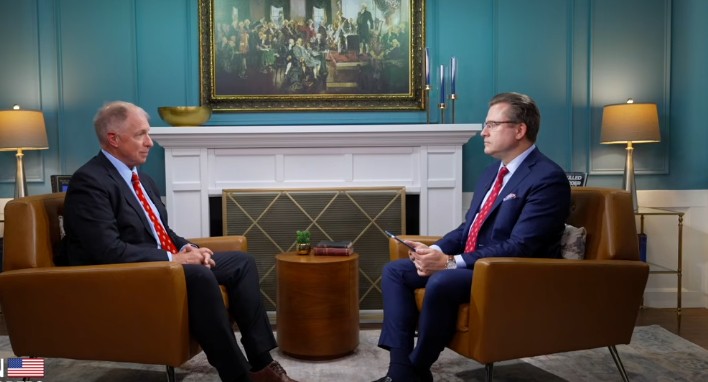
Editor’s Note: In this episode of American Thought Leaders, host Jan Jekielek sits down with Grant Newsham ahead of the Trump–Xi Jinping summit to examine what is at stake in the U.S.-China talks. Newsham explains why he sees China as engaged in a fight rather than a competition, and discusses fentanyl, rare earth leverage, Chinese political warfare, AI, and the financial pressure points President Trump could use. A must-watch analysis of U.S.-China relations, Communist China’s strategy, and the leverage America holds. This interview was premiered on September 24, 2026.
TRANSCRIPT:
What’s at Stake in the Trump–Xi Meeting
JAN JEKIELEK (00:00:55 – 00:01:04): This is American Thought Leaders. And I’m Jan Jekielek. Grant Newsham, such a pleasure to have you back on American Thought Leaders.
GRANT NEWSHAM (00:01:04 – 00:01:05): Well, I’m always glad to be here.
JAN JEKIELEK (00:01:06 – 00:01:15): President Trump and the paramount leader of Communist China, Xi Jinping, will be meeting in the very near future. What’s at stake?
GRANT NEWSHAM (00:01:17 – 00:03:05): Well, it’s going to make a difference in this fight that we’re in with the Chinese. And this is not a competition. This is a fight. And when the Chinese come here, they are very much testing will. And they’re looking at President Trump. They’re looking at the United States. They’re sizing them up to see just how willing they are to fight and to resist. And they’re always checking will of their intended targets. They’re assessing it, reassessing it.
So they’re very much looking to see what President Trump is willing to give them, what he’s willing to concede. Is he willing to sort of hand over things and favors just to have a deal? Or is he willing to say no and walk away if necessary? Is he willing to raise topics that they don’t want raised? Fentanyl, human rights, intellectual property theft, this nonstop spying, the persecution of the Chinese diaspora, of Chinese and Chinese Americans. Is he willing to talk about these things and implicitly or explicitly threaten the Chinese with real reprisals, with real punishment for that? Or does he just want to have a meeting at the end and both sides say it was a great success?
And that’s what they’re watching for. So I think that is, to me, that’s the high stakes here, is we’re in a fight with the Chinese. And they’ll tell you that as well. This is not a competition between 2 rental car companies to see who provides better service and maybe comes out a little bit ahead. To the Chinese, this is a fight to the finish and one side is going to win, one side is going to lose. So when Xi Jinping comes to the United States, they are looking at things probably a bit differently than we are. And we’ll see how that turns out.
JAN JEKIELEK (00:03:07 – 00:03:14): What if it does just turn out to be a meeting, as you say? Is that a win for Communist China?
GRANT NEWSHAM (00:03:15 – 00:04:42): I think it is. If the U.S. shows that it’s not willing, as I say, to raise topics they don’t want to talk about, and if it shows any willingness, even verbally, to do things that might suggest our commitment to our friends in Asia and elsewhere, but particularly Japan, Taiwan, just to name 2, does it look like our commitment to them isn’t quite as solid as it should be? Well, the Chinese will look at that and they will think that is a win for them. And the aforementioned partners in the region will look at it as well and they’ll say, “We don’t like this.”
And it is that sign of sort of seriousness, steadfastness on the part of the Americans, and as represented by President Trump, that the Chinese are looking at. And they would very much like to see some sign of a lack of resolve and a willingness to sort of ignore topics the Chinese don’t want to talk about, and a willingness to concede on different things—tariffs, export controls, technology restrictions. If they see any suggestion that we’re going to back down just so we can get a deal, to reach a deal for a deal’s sake, then from China’s perspective, all of that would be a win. From the United States perspective, that would be sort of a defeat, and it would certainly push us back more than one would like.
The Philippine Defense Secretary Confronts a Chinese Note
JAN JEKIELEK (00:04:43 – 00:05:26): I’m going to dig into that in a moment, but you’re reminding me of, at this conference recently, the defense minister of the Philippines got a note ostensibly from the Chinese envoy, the lead Chinese diplomat, and decided to show it to the world. It was basically demands of what he was supposed to say or do, or what the framework in which he’s allowed to operate. Again, I’m going to show a bit of that clip here. And then I’d like to get you to comment on it.
VIDEO CLIP BEGINS:
GILBERTO TEODORO (00:05:26 – 00:05:26): The law of gravity and the law of mass works in international law, unfortunately. Just like— Is just like—I have a note here. I think this is from China. You should have joined the— And may I read it?
GILBERTO TEODORO (00:05:41 – 00:05:51): “China’s position on the South China Sea arbitration is clear, consistent, and firm. They have no position. The arbitration violates fundamental principles of international law.”
UNIDENTIFIED SPEAKER (00:05:52 – 00:05:56): Next, my question goes to Mr. Junan.
GILBERTO TEODORO (00:05:58 – 00:07:28): How can you deal with a country in an international forum beyond the question asked to me, disrespecting the organizers of this forum? How do you expect to deal with it civilly? I ask you the question, is this the right paper to post to me when I’m being asked a question on the floor?
So perhaps basic decency and behavior is what China needs to do. This is actual coercion, bullying and aggression. I will keep this paper as a memento of how desperate China is and how ineffective its position is in the face of a free audience. Thank you very much for the person who gave me this piece of paper. You have just done your country a great service.
UNIDENTIFIED SPEAKER (00:07:29 – 00:07:29): Mr. Aung emphasized that stability lies not merely in the sense of conflict, but in managing the library,
GILBERTO TEODORO (00:07:29 – 00:08:38): I think it is well known to the public, to everyone here, about the Philippine situation where we face challenges daily from the People’s Republic of China, which tries to occupy and illegally assert its presence over our territory, and especially our exclusive economic zone in contravention with the UNCLOS. A Korean military leader, Minister Yoon, previously said, “We live in a very interconnected world and there is no right for any state of that matter to appropriate an international common for its exclusive use or right, contrary to what the international norms clearly state.” So the Philippines has been forced to enter into creative defense arrangements and alliances.
VIDEO CLIP ENDS:
GRANT NEWSHAM (00:08:40 – 00:11:26): Well, Defense Minister Teodoro is great. He understands how the Chinese operate. He understands Chinese political warfare. And he’s also—he speaks very clearly, which means he thinks very clearly. And he dismantled the Chinese for this. This was absolute boorish behavior, but pretty typical from the Chinese Communists when they barge in and hand him this set of talking points that he’s supposed to slavishly recite. And this is ignoring any sort of protocol that civilized people follow. And Teodoro was not—I don’t think he was surprised by this. He’s dealt with the Chinese for so long. And then as I said, he dismantled them.
But it gave you a sense of how the Chinese Communists operate, but it also shows you a very effective approach to it. It’s not to back down; it is simply to take them on and make your case. And it does help when you’re on the right side of all of this. The particular issue that they were talking about was the South China Sea and Chinese efforts to control the whole thing despite their entire legal case for it and their political case for it being demolished by the Permanent Court of Arbitration in 2016. And usually those kind of deals, actually, they leave neither side particularly happy, or those sorts of decisions by the court. But this one was overwhelmingly in favor of the Philippine position. It destroyed everything the Chinese were arguing. And yet they’re still harping on this. And once they’d lost the case, the Chinese now say, “Well, it’s just a piece of scrap paper, has no meaning.” But in fact, it does to everybody but the Chinese.
And the Philippine defense secretary really performed masterfully. This must have embarrassed the Chinese to no end. They’re used to intimidating, bullying, and have people cower. But you could see from his response that that wasn’t what they got. And it must have really disappointed them. And similarly, when Xi Jinping comes to Washington, if it comes up that we need to respond in this way or President Trump needs to respond this way, he should speak directly and forthrightly. And that will be something that does make an impression on the Chinese. If he laughs it off, tries to split the difference about the things the Chinese are trying to get and the excuses they give him and the threats they may make, the Chinese will have won.
How China Treats Weaker and Stronger Countries
JAN JEKIELEK (00:11:28 – 00:13:21): Well, I think the way the Chinese leadership works with countries it perceives as weaker than itself is different than the way it works with the country it perceives as stronger than itself. And so specifically, I’ve spoken with President Panuelo, former president of Federated States of Micronesia, recently with President Whipps of Palau. And it’s very common behavior for the Chinese diplomats to dictate how things are going to be. And it’s difficult for them to basically stand up to it, which these people have, but it’s much more common to not.
In the case of the US-China relationship, my observation is that at that level, of course, I remember during the Biden administration, there was that kind of meeting where there was a lot of chagrin, right? And the Chinese diplomats were kind of embarrassing the Americans. At the higher level, it seems to me there’s just a lot of sort of warmth and, “Look, we’re working together on this. Let’s come up with a deal. Let’s publicly put on a common face.” I think it’s a different type of interaction, especially with the knowledge that the U.S. president is known for his dealmaking and specifically his ability to bring together an industry, a lot of success.
GRANT NEWSHAM (00:13:22 – 00:15:16): Well, it often is that sort of a back and forth or an interaction at these kind of summit meetings, but not always. You recall when President Reagan met with the Russian chairman, Gorbachev, in Reykjavik, Reagan basically walked out and that sent a message. And it was considered really a great faux pas by the commentary, the chattering class in the United States that, “Oh, this cowboy is bringing us closer to World War III.” But actually it was a sign of steadfastness that made an impression on the Russians. It made an impression on Americans as well. Sometimes you have to stand up for yourself.
And as I say, Reagan did it more than once. And you remember the speech that he gave where he said, “Mr. Gorbachev, tear down this wall.” And that too caused hair to catch on fire at the State Department and throughout the Ivy League, no doubt. But it was the right thing to say and President Reagan knew that it was and the Russians would tell you that they wished he hadn’t said it, but it was a powerful statement because an American president really had the nerve to stand up instead of always thinking, “Well, how can we calm things down? How can we de-escalate? How can we just get along?” Sometimes you have to stand up.
And as I mentioned earlier, if 800,000 dead Americans from fentanyl since 2013 isn’t enough to have an American president stand up to the Chinese and say the fentanyl comes from China, of course, then nothing is. So one hopes to see President Trump actually remember that he’s a real estate guy from Queens and show some of that sort of persona.
Fentanyl as Drug Warfare From Communist China
JAN JEKIELEK (00:15:16 – 00:15:22): Remind us how we know this, that the fentanyl is a drug warfare from Communist China.
GRANT NEWSHAM (00:15:22 – 00:17:20): Well, there’s a couple ways to look at it. One of the China committees in the US Congress issued a report a year or two ago that was just outstanding. In great detail, it described the origin for it, the Chinese Communist Party’s support for the fentanyl precursors that are made in China and then moved to Mexico and elsewhere, and then ultimately into the United States. That was a prosecutor’s brief. It is very well done, and I recommend people track that down.
And then there’s just the commonsensical aspect of this. China has a surveillance network that George Orwell couldn’t have dreamed of, and the suggestion that somehow you have these drug makers and drug pushers actually operating without the Chinese Communist Party knowing—that is fantastic in the sense that you just can’t believe it. I would suggest that anyone who thinks that’s the case go to China and go out of your hotel room and walk around and draw a mustache on a picture of Xi Jinping, the first one you see, and see if the police are at your hotel before you get there or 5 minutes after. They know what they’re doing.
And additionally, I used to do a lot of work involving organized crime, and we did cover the Chinese, and it always tracks back to some arm of the Chinese state. Always. It can be the PLA, MSS, the public security, but the Chinese organized crime does not operate without the support and the protection of the Chinese state, and that’s just the reality of it. So you have those several ways that you can actually understand and get a sense that the Chinese have a direct involvement in the fentanyl that comes into the United States. And then, as I said, the numbers—800,000 and counting.
Chinese Organized Crime and Illegal Marijuana Operations
JAN JEKIELEK (00:17:21 – 00:17:54): And not just fentanyl. I was just reading a great report in the City Journal from Christopher Rufo about a county in California where basically entire subdivisions are growing operations. And you basically wander there even as a sheriff at your own risk. You get fired upon. It’s basically Chinese organized crime that’s ruling the place. And they estimate it’s about a $2 billion annual industry just out of this one county in terms of marijuana grow ops.
GRANT NEWSHAM (00:17:55 – 00:19:28): That was a good report. And as I said, this doesn’t happen without the protection of the Chinese state. And you look at what it does to the United States, to have organized crime operating with impunity inside our borders. And if local law enforcement is unwilling to do anything or unable to do anything about it, it tends to have this sort of destructive effect on local societies in particular. If it was Mexican gangs doing it or Croatian gangs, whomever, it doesn’t matter. It’s not a good thing. And yet it’s happening. And it’s not just in California. The marijuana industry in the United States from Oklahoma to Maine out to California is known to be controlled largely by Chinese organized crime.
And you look at what has the response to that been? What sort of punishment has been levied against the Chinese Communist Party for doing that? Nothing that I’ve noticed, which gives you a good sense of the effect of Chinese political warfare, Chinese proxy warfare, subverting so much of America’s ruling class, its political class, that they won’t look at what is plainly obvious and take countermeasures accordingly. So that was a very good report. And it’s not the first time actually that those things have been brought to our attention.
JAN JEKIELEK (00:19:28 – 00:19:55): You can sort of imagine a scenario where the president or a diplomat would bring up the issue of, for example, these massive marijuana growing operations that are clearly entirely Chinese organized crime. And they’ll say, “Well, yeah, it doesn’t seem like you can control your crime very well, right? How can you expect us to do that? That’s not us.”
GRANT NEWSHAM (00:19:56 – 00:21:54): Well, then what you say, “Fine, your top 5 financial institutions will no longer be able to operate in the US dollar system. We’re going to delist every country—excuse me, every Chinese company on the New York Stock Exchange and everyone that is registered to operate in the US. Additionally, there’s going to be no technology exports to China unless the president himself personally approves it.” This is something that we’ve seen before. In fact, in the first Trump administration, President Trump did raise fentanyl with Xi Jinping, and he shrugged and said, “Well, you’ve got a drug problem, I don’t.” And that was really what a mafia boss would say to a rival gang leader. He said it with that sort of contempt. And that is how China has said it. They got away with it, actually.
You look at what has not been done to the PRC for having slaughtered so many Americans, ruined so many lives. And we’re just talking about the dead when you’re talking about that 800,000 figure. The ones who have been incapacitated, walking zombies, and the families that have been destroyed, the neighborhoods that have turned into these hellholes because of that. The damage is much greater, and the Chinese are glad to have that. You do the equivalent of taking three or four divisions of Marines or army off the battlefield every year. Many of the people who die are people who otherwise would serve in the military or who would otherwise have productive careers, say working in industry and the manufacturing companies we’re trying to get back. But from a Chinese perspective, this is very much a win-win.
But this glib suggestion, “Well, we don’t know what’s going on”—there’s no reason to believe that, and we know better than that. And even if you hear the excuse, then the challenge is to act regardless of that. And if they complain, well, the answer is you know why.
China’s Rare Earth Leverage and the Tariffs
JAN JEKIELEK (00:21:56 – 00:22:21): It can be difficult for us to operate possibly because of leverage the Chinese Communist Party has developed over America, perhaps in rare earth minerals would be one area that’s very prominent because they exercise that leverage and showed just how much they have not too long ago. And I wonder how much of this plays into the calculus that’s happening.
GRANT NEWSHAM (00:22:22 – 00:24:19): Well, it does somewhat. And you saw at the beginning of President Trump’s second term, when he was getting pretty tough tariff-wise on the PRC, that for the first time ever, they played the rare earth card. People knew for a couple decades that it could happen, and yet they never had, and yet they finally did. When he really went after them on tariffs, they said, “Well, we’re going to cut off rare earth and critical mineral exports to the United States.” And reportedly, some U.S. companies, big ones, came into the White House and said, “We’re going to have to shut down if this continues.” And it seemed to have really stopped the president in his tracks when the Chinese did this.
But it was really a case where President Trump was the guy handed the hot potato that all his predecessors and most of Wall Street, the business class, had a hand in warming up to a really hot temperature. But that doesn’t mean that the Chinese are not vulnerable to other things that we can do. And they tell you what they don’t like. When Xi Jinping complains about technology restrictions, when he complains about blocs being formed to weaponize trade, to make it harder for them to export, not just to the United States, but to Europe and elsewhere, he really doesn’t like that because they’ve got an economy that depends on exports. That’s the only bright thing that their economy has now.
And the exports also earn them the convertible currency that they use to do things like buy Australian iron ore to make steel to make their navy. So they do have their own vulnerabilities if we would choose to play them. So the fact that they do have us dependent on the rare earth processing part of it and things like pharmaceuticals as well, it doesn’t mean that we have no cards to play, and we certainly do if we choose to play them.
JAN JEKIELEK (00:24:20 – 00:24:28): Well, you could easily argue that the tariffs are precisely us playing those cards.
GRANT NEWSHAM (00:24:28 – 00:24:51): Oh, very much. And it is something the Chinese don’t like. They always tell you what you should be doing in a sort of perverse kind of way. When the Chinese complain about something, it means you should do more of it, and it’s actually possible to establish China policy just by looking at what they don’t like and what they complain about and say that you shouldn’t be doing.
Document 9 and China’s Objectives
JAN JEKIELEK (00:24:52 – 00:24:56): Yeah, but Grant, why would you want to be belligerent like that?
GRANT NEWSHAM (00:24:58 – 00:27:00): Well, read Document 9. And you say, “Well, what’s Document 9?” And that’s basically a speech that Xi Jinping gave around 2013, shortly after he took over. And he’s saying that one of our systems is going to succeed, the Chinese one or the American one. He described the U.S. system of freedoms and individual liberties as really the enemy of mankind, basically. And he said one of us will win, and we are in a war with these people. And if you don’t defend yourself and always think that you can split the difference or with some concession or showing the open hand of friendship that we mean no harm, that the other side will reciprocate, well, at some point you ought to figure out that they’re not going to.
And the Chinese, as I said, have been very clear about what their objectives are, and that is regional domination and then global domination. And the freedoms that we take for granted, we think are fundamental, to the Chinese Communist Party, they are anathema and they want to get rid of that. So what I’m talking about really is not being belligerent. Rather, it’s simply prudent measures to defend oneself, particularly after you haven’t done it when you should have.
So the surgery or what have you is much harder because we’ve waited so long. But if we had just taken these steps earlier and not done what we could to help the Chinese build into a very powerful economic and military force with the political strength that comes with that, we wouldn’t have to do these things that seem so belligerent. But in actual fact, this is just what normal people would do to protect themselves from somebody who said that they do not have our best interests in mind and that we should really acquiesce to what they want. So it’s a choice.
Political Warfare and Cognitive Warfare
JAN JEKIELEK (00:27:01 – 00:28:15): You wrote an excellent book that we sat down about some time ago called When China Attacks, and the first chapter is very important. It shows what an initial Chinese attack would look like using these asymmetrical or unrestricted or hybrid warfare means that don’t really look like warfare. They could look like something else. And you have to take time to establish that something is really happening. And I think the same principle—that was a more acute scenario where there’s these blue hull ships going out doing things, and it’s not really clear that it’s a military operation, but this also, of course, applies to the drug warfare and information warfare and especially legal warfare and so forth.
How far have we come to understanding that Communist China weaponizes the things that we use as part of our system, for example, our legal system against us in a very powerful way? And also makes it difficult for us to see that they’re actually fighting. How far have we come in understanding that dimension?
GRANT NEWSHAM (00:28:16 – 00:29:47): I think we’ve made some progress. It might depend on what time of day you ask me about that because it’s very easy to say, in fact, it’s probably correct, we have not got nearly the understanding we should have, though it’s better than it was. But we have not done what’s necessary to protect ourselves. We just can’t, for some reason, get that done. And that really is our elected representatives who have that responsibility. So I’m not really all that optimistic about what we’ve done to try and fend off this attack, much less go on a counter-offensive and, for example, have our own political warfare campaign or scheme to use against the PRC. And they are vulnerable to a lot of things we could do, but we just haven’t gotten our heads together enough to do that.
But there are good people just behind me on Capitol Hill who do understand this. The China committees do excellent work. Congressman Moolenaar from Michigan, the chairman of one of the committees, is very good. And there are people who do understand it, want to do something. But sometimes there seems to be something on Capitol Hill that would almost make the Earth stop rotating on its axis. And once again, back to fentanyl. If 800,000 dead Americans and the body count increase continues, if that isn’t enough to get us to take serious measures, it’s hard to know what.
JAN JEKIELEK (00:29:47 – 00:30:14): I think this is a good example because there’s a few people that might say that 800,000 people is a direct result of Communist China’s drug warfare on America. And I think the majority of people would say, “Well, yeah, the drug situation is bad, but you’re being an extremist blaming this on China,” or something of that nature, which of course is precisely the Chinese information war narrative as well. Right?
GRANT NEWSHAM (00:30:15 – 00:32:15): Oh well, that’s the ideal from China’s perspective when you can get your target to blame it on themselves. And you saw this. It’s not drugs, but you saw it on Wall Street. How often did you hear people say, “Well, the Chinese aren’t really communists. They just want to get rich. There’s no reason why we shouldn’t recommend that this company sell out. You just move everything over to China. That outsourcing and return on investment, that’s what the cool people do. Manufacturing, only losers do that.” Well, if you can get your enemy, your target, to say those things, think that he’s doing really what makes sense and what is best for the nation. Well, how much better does it get when you have people who are too afraid to call out what you’re doing? That’s even better.
For many years, the rote response over at State Department, when anything was suggested about, say, helping Taiwan or helping the Japanese or anything, the response was often, “Well, China won’t like it.” Well, China won’t like anything short of surrendering. But there is very much a cognitive warfare, a psychological aspect to what we’re talking about. And the Chinese have been very successful really at playing to the greed and the narcissism of America’s elite classes, also playing to the fears that many people have of having World War III with nuclear weapons or suchlike. But they have been really quite successful at that.
You’d hear it a lot when businesses would say—you still hear it—”We just have to be in China.” Well, you can get people to ignore the evidence of what happens to companies that go to China. Well, you’ve done very well for yourself. And if you can get Americans to make that case for you, that’s even better. And that’s part of really the Chinese MO.
Does President Trump Understand the Threat?
JAN JEKIELEK (00:32:17 – 00:33:16): When you read books like Lee Smith’s The China Matrix, where he has a pretty significant interview with the president and he asks about this question, and a number of other things I’ve heard from the president on the topic, it seems to me it’s clear to him that the CCP cost him the 2020 election. Through a variety of means, some of which were more recently unearthed in a more rigorous way, let’s say, okay? Which, of course, he takes very seriously, clearly, and probably a lot more than that. And so, because I often hear people saying things like, “The president’s just a dealmaker, he doesn’t understand the threat.” It seems to me he does understand the threat pretty clearly, and I’m curious what you think about that.
GRANT NEWSHAM (00:33:17 – 00:35:52): I think he does. In fact, I’m almost convinced of that. He understands the nature of the Chinese communists and the Chinese Communist Party. He was a real estate man and he’s used to dealing with corrupt local governments and corrupt unions, etc. And it’s really a range of people. And he understands the dynamic that is the PRC. And he understands what they’ve done. I think he knows it very well. The gutting of American communities by moving manufacturing overseas, the drugs, etc. And he’s from New York. He doesn’t have to look far. And he knows that.
At the same time, he is the president and it’s really easy for people who are not in the ring, the commentariat like me, to say, “Well, you’ve got to do this, you’ve got to do that.” But when you’re the man in charge or the person in charge, it’s often not quite that easy and you’re going to have different constituencies pressuring you, telling you to do this or that. And then there’s America’s donor class as well. And sometimes you will have even the military. For a long time, we had senior uniformed officers who were insisting there was nothing to worry about from China, that we just had to understand them. If only they would tell us what their intentions were. So if there’s one person who is the lightning rod for a lot of different ideas, it’s the president. So it isn’t quite as easy as just walking into the room with Xi Jinping and laying down the law and walking out.
But he understands, I think, what the threat is, I think, very well. And you mentioned the 2020 election, and I think the evidence is compelling, if not conclusive, that the Chinese had a hand in it. They really did not like his first China team during the first Trump term, and they wanted those people off the playing field, because they were effective. The Dave Stilwells, Matt Pottingers, Miles Yus, even Mike Pompeo. Now, these people were very good. For the first time, they had a good China team on that. And the Chinese did not want that to continue at all. But also there’s COVID. And you could tell from the president’s first reactions to the outbreak of that virus that came from China that he knew where it came from. He knew who did it.
JAN JEKIELEK (00:35:52 – 00:35:52): Hit.
GRANT NEWSHAM (00:35:53 – 00:36:15): And I think he knows that he had America really firing on all 12 cylinders until COVID hit. The economy had never been better. Minority employment had never been better as well. The country was really going along smoothly. And then COVID hit. And I just might jump in.
JAN JEKIELEK (00:36:15 – 00:37:03): And in my estimation, I don’t know if you would agree with this or not, but I think the first tariff deal that they organized with the Chinese Communist Party, the one they didn’t renege on overtly, still basically went into the dustbin in effect the moment all the COVID madness began. And that’s, again, pretty obvious. That was the first time in my mind, this is the thing I wanted to get your comment on, that the Chinese Communist Party was faced with having to do something that wasn’t already part of their plan, that they were very happy to agree to. Would you agree with that? First time in decades. Okay, first time in decades.
GRANT NEWSHAM (00:37:04 – 00:38:01): Yeah, I’d say probably since 1947 or so. Yes, the Trump administration, the first one, it was the first time in all the years I’ve been following this that any administration has actually stood up to the Chinese Communists and what they’re doing. And it was a shock, probably not just to the Chinese, who had been pretty used to getting their way with their lobbyists and their proxies in Washington greasing the skids for them. But it was also a shock to a lot of Americans, I think, who had been calling for this for a long time. But you’re right, it was that first Trump term that showed what could be done, that the idea of there being no alternative to accommodating the PRC was proven to be incorrect and that it was President Trump who deserves the credit for that.
China’s Energy Vulnerabilities
JAN JEKIELEK (00:38:02 – 00:38:47): Well, one thing they’re probably very unhappy with is, and I was actually even surprised looking at these numbers the other day, that they’re finally being forced to pay market rates for oil, which they desperately need. Right? And I think that’s a direct result of all sorts of US activity. I know that’s happened. I think that’s astonishing and incredibly important. But I don’t think anybody knows this has happened. So this perception thing that you’re talking about is very obviously very important to them. And that’s in a way the thing they’re best at is manufacturing that perception even when it’s grossly at odds with reality.
GRANT NEWSHAM (00:38:48 – 00:39:54): There’s an expression that I heard years ago applied to the Chinese: “Fake it till you make it.” And this is a country that presents an image of really just being an unstoppable juggernaut, having the wisdom of the East, and they play the long game, that somehow they have just figured out how to make a country, an economy run really well. But in actual fact, it’s a very poor country. If you go to China and get out of the few shiny cities, it gets pretty grim pretty fast. By their own admission, there’s 600 million Chinese at least who live on $5 a day or less. Youth unemployment is officially admitted to being about 17-20%, when in actual fact it’s probably closer to 50%. So it’s a country that’s got a lot of problems there, but they do manage to put on an image of probably being more successful than they actually are. And that does sometimes tend to cause people to freeze up and wonder what to do about it all.
JAN JEKIELEK (00:39:54 – 00:40:08): But what do you think about this reality that they’re paying—I don’t know what, it’s probably 50% more, 40% more for oil than they have gotten away with paying for a long time.
GRANT NEWSHAM (00:40:08 – 00:41:16): Well, that’s got to be a huge problem. Sometimes you will hear, “Well, it’s not quite the problem people think because the Chinese have cut their oil consumption, they’ve saved up a ton of oil in their strategic reserves. They use a lot of coal, nuclear, and the so-called solar or green energies as well.” So you hear it’s not that big a deal. But look at the Chinese behavior. Look at what they say. They are worried because you do get used to getting free oil or pretty much free oil for a long time from Venezuela in particular, from the Iranians as well. And once you have to start paying for that, and China is still a big country that uses a lot of oil. And if you have to start paying for it in real money, you’ve got to earn that money somewhere. And they don’t have an unlimited supply of convertible foreign currency. So I think there is a deception that’s going on where the Chinese act like there’s no big deal, but in actual fact, I believe they are very worried.
China’s Support for Russia, North Korea, and Iran
JAN JEKIELEK (00:41:16 – 00:42:03): Well, and another thing, since we’re talking about Iran a little bit, the CCP is supporting Iran. It’s very clear in a number of ways. Same with Russia. Even as the president—as we’re filming, the president apparently is going to be imposing further sanctions on Russia. We’ll see what exactly comes of that. And then North Korea, I’ve been told by a number of people I trust that the regime wouldn’t last very long if it didn’t have significant financial support and cover basically from Communist China. So those seem to me to be significant topics that one might discuss in a meeting like this.
GRANT NEWSHAM (00:42:04 – 00:44:40): Well, there ought to be. You figure that without Chinese support, the Russians would have a very hard time prosecuting the war in Ukraine the way they are. The financial support, the political support, the Russian drones and the technologies, the materials that they get from China. This is essential. Without it, Russia would be in a lot more trouble than they already are. And that’s considerable. You look at North Korean support for Russia as well, both manpower, millions of artillery shells, missile technologies and actual missiles, probably. That couldn’t happen unless the Chinese gave their approval because you are correct that if China wanted to, it could turn off the electricity and close off the fuel and the food and you’d have North Korea really out of business in a very short time.
But it really works to China’s advantage to have North Korea as a functioning state that it can use to, by proxy, back up the Russians in Ukraine. The Ukraine war keeps the Americans occupied and the Europeans too. So they’re less able to focus on the Western Pacific, focus on China and what China’s doing as well. So the North Korea issue really ties into Chinese strategy. And also the Russians are very closely watching. It is something that should be raised.
And also there is the matter of the Chinese apparently providing targeting data to the Iranians so that they can hit American targets and kill Americans in the Gulf region and also hit our friends as well. So everybody knows the Chinese are doing this. And the question is, are you going to raise it and do something about it. And when you say do something about it, I mentioned not long ago the response can be something that the Chinese don’t like, and that’s cut their access to the U.S. capital markets and to the U.S. dollar system. And that’s just one example of what you can do. And then there’s also the idea of publicly exposing and even seizing Xi Jinping’s personal wealth and the wealth of top Chinese Communist Party figures. And so there are things that you can do to make sure that there is a downside to what the Chinese are doing.
Targeting the Personal Wealth of CCP Elites
JAN JEKIELEK (00:44:41 – 00:45:26): I’ve argued in my own recent book that the Chinese Communist Party’s North Star is its own survival and supremacy at all costs. Anything else is second to that. So what you’re describing would really be a shot across the bow, seizing some of these assets or stopping them or holding them or something like this. And I wonder if the knowledge that that’s the case would be precisely the reason why people wouldn’t do it. Because it would be saying, “Well, we’re actually going to—actually, it is war. We can do it your way. I’m not going to do it kinetically, but we know what you care about most.”
GRANT NEWSHAM (00:45:27 – 00:45:35): Well, actually, that has the advantage of not being war in the sense that most people interpret it as shooting at somebody.
JAN JEKIELEK (00:45:35 – 00:45:41): It has the plausible deniability, or implausible perhaps deniability, I don’t know.
GRANT NEWSHAM (00:45:41 – 00:47:36): Oh, well, you’re just doing a little research. That is all it is. And the idea that we would be facilitating this illegal export of wealth from China—well, we shouldn’t be doing that. We should actually be helping the Chinese because they complain about capital flight of money, wealth being illegally, improperly moved out of China. Now they’re actually demanding their officials bring it back. Well, we’re just helping them out by identifying where it is. And that’s one way to explain it all: “Look, we’re just helping you enforce your laws.” Because if Chinese people can only export $50,000 in currency every year, convertible currency, well, how are you paying $20 million for an apartment in New York? How did Xi Jinping get so wealthy? So we would just be helping them. But if he could produce a note from, say, the Central Committee saying that it was lawfully exported, we’d be glad to consider that.
But we should be doing these things, in my opinion, if it’s going to help us avoid a shooting war, that this sort of strategy is one that we really need to be doing. You’re identifying a key vulnerability of this regime and going after it. And you think about it, and this is something Xi Jinping and other Chinese elites cannot excuse away as the Americans bullying them, trying to contain China. But this wealth that they have amassed and moved out of the country, this is something they’ve done on their own. It’s not something any foreigners have done to humiliate China, but rather this is just really the bosses at the top of what amounts to a criminal organization.
JAN JEKIELEK (00:47:36 – 00:47:50): Technically, I think by their own laws—you would know this better than I do—you’re not allowed to do that with some pretty harsh penalties. If I’m not mistaken, maybe you can comment on this. Well, that is true.
GRANT NEWSHAM (00:47:50 – 00:48:55): You’re not supposed to do this, no leaders anywhere, but particularly in the Chinese Communist system. These guys are paragons of virtue, and they know. It was corruption that played a large part in bringing down the old Nationalist regime in China before the Communists took over. And the Chinese Communists have probably outdone the old Nationalists in this regard. And the penalty, as you will note, when officials are brought up on corruption charges, when you find a ton of gold bricks in their houses, et cetera, it’s corruption. But then you lose access to the black hair dye that top leaders get, and you do not have a very bright future, and you can get shot for doing this. And those 600 million people living on $5 a day, they’re not going to be very understanding of a Chinese leader who has done so well for himself rather than being the soul of egalitarianism.
Breaking Through the Great Firewall
JAN JEKIELEK (00:48:55 – 00:50:30): Now, if they know about it. Because this is obviously highly selective, right? When a dossier is used and exposed—look at the gold bricks, all that kind of stuff—and all the Chinese know about it, it’s because the regime has decided that this is going to be the person that they showcase as being the corrupt one, and they will put them, at best, under kind of administrative arrest or whatever they call it; at worst, it’s the death penalty.
So let’s talk about freedom of information in China. And this is one of the things I’ve been thinking about a lot lately, is that it’s actually not that hard to break through the Great Firewall of China, not at all, in fact. We use very effective technologies all the time to help Chinese read The Epoch Times, and millions and millions of them do so. However, there’s a kind of a limit on what you can do with that. The cost isn’t big, but it’s significant. And there’s only so much you can do. That’s something that could very easily be facilitated in this very asymmetrical way that we’re just describing here, right? Why not open up way more of that firewall? America puts a great value on free speech. We really were, especially we’re expecting it of our European counterparts. We have our top diplomats basically talking about that. So maybe there’s a good opportunity here. And maybe some of those Chinese would actually be able to see the reports of the wealth of the people who haven’t been put on the chopping block.
GRANT NEWSHAM (00:50:30 – 00:53:16): Well, I think with a little imagination, you could make it into a very popular show. Say every Thursday afternoon, the Americans are going to reveal one more official and lay out his real estate, his bank accounts, his relatives overseas with green cards, resident permits. And you never know who it’s going to be. And you’d have people tuning in. And as you say, you have to get around the blocks, but that could be done. And people are innovative and you can use some imagination. And I think word does get around, and I think it would be very effective.
When the Chinese heard about the possibility of the Americans putting out a report on the wealth of China’s top leadership, the first time they did it during the Biden administration, the Chinese embassy in Washington was calling around demanding that this be stopped. And some years before that, around 2012 or so, remember when the New York Times and Bloomberg did reports on the wealth of Chinese leadership, including Xi Jinping’s family. And this was very good. And the Chinese went berserk. I’ve never seen them that angry about something. And you can see how effective that is. And once again, you can get this information into China and get it where it needs to go. And it doesn’t have to bring the whole thing down, but it would cause a whole lot of concern.
And you’ll notice from the Chinese reaction, most recently, to AI. The Chinese spy chief, one of the things he said that was a problem that they didn’t like was using AI for cognitive warfare, for basically passing information messages into China. And they’re very sensitive about this sort of thing because it not just goes to the legitimacy of that regime, which doesn’t have much since nobody in it has ever been elected to anything. But there’s also a sense of the masses, all of these Chinese, the 1 billion Chinese people just being too much to handle. And you got a sense of that during the COVID response in China when it was so draconian that you had people out on the streets, people who’d had enough. And that rattles the Chinese Communist Party. So once again, I think this would be an excellent show. Every Thursday, somebody’s name gets revealed and you get the word out. And I think that would be a popular one in the PRC.
JAN JEKIELEK (00:53:16 – 00:53:28): And the goal here, just to be clear, isn’t to make people angry, but it’s to reveal the things that they care about the most and use those as leverage. Do I understand that right?
GRANT NEWSHAM (00:53:28 – 00:53:49): Well, it’ll take care of itself. And it’s up to the people who hear the information. They’re not going to like it, any more than we would. But at the same time, if they never hear about it, or they don’t have the details, it’s hard to act, hard to motivate people to do things.
JAN JEKIELEK (00:53:50 – 00:54:26): But I guess what I’m trying to get at is you say you can see by the reaction—I’m not talking about the people here. I’m talking about the diplomatic missions or whatever. When they’re getting angry, when they’re agitating, “This is unreasonable, this is completely inappropriate,” all of that, you argue, from what I’m hearing, that you should do more of that thing. When you see that kind of reaction, that’s the thing you should do the most. But the reason isn’t because you want to get people angry or emotional. It’s because it’s revelatory of the thing that actually is helpful in this fight that you’re describing. Do I understand that right?
GRANT NEWSHAM (00:54:26 – 00:55:35): That’s what I’m trying to get at. Well, yes, you want your opponent on his back foot. You want him angry, and he makes mistakes when he’s angry. You don’t want him to have that confidence that allows him to just move against you freely without any sort of concern or opposition. But you want him to be the one who’s responding to this and having to explain himself. Read the Chinese press for a few days and read the things that are said about us, about the West, about free people. And go on the attack. Why don’t we do the same similar things? If you don’t challenge this sort of stuff, the other side’s going to be able to operate freely. And all we’re doing is really presenting the truth. It’s not like we’re making anything up, but rather we’re just presenting accurate information. And you do want the other side to be worrying about what you’re going to do rather than the reverse, where we’re always wondering, “Well, what’s China going to do?” Well, they should be worrying about us.
Xi Jinping’s Arrival at Joint Base Andrews
JAN JEKIELEK (00:55:36 – 00:55:52): So President Trump is reportedly going to be greeting Xi Jinping personally at Joint Base Andrews. That is not typical. It’s happened in a variety of contexts in the past, but not often. What’s your take?
GRANT NEWSHAM (00:55:53 – 00:56:38): Well, he’s the president and I’m not. I don’t know why that is being done. It’s one of those things that at some point when you’re not the person in the position, you have to step back and say, “Well, they must have some reason for doing it.” I’m not sure I would have, not after the harm and the damage and really distress that the Chinese Communists have caused our nation. I’m not sure that I would have rolled out the red carpet for them. But that said, I’ll leave that up to the people who actually do decide the policy here.
The AI Race and the Chinese Regime
JAN JEKIELEK (00:56:38 – 00:58:03): You mentioned the commentary on AI. And one of the things that was revealed in the recent Anthropic report was that the Chinese regime was basically using the US models for intelligence gathering purposes. And actually, some of their methodology and even information was revealed through that process. I even saw groups like Shen Yun Performing Arts being targeted in there. This is something that we followed very closely. I’ve been thinking about this AI question, right? And I think this whole interaction reveals a number of things. But one of them is perhaps the AI, especially since they were routing some of these requests from China directly through Claude apparently and so forth. Maybe they’re not as advanced as they’re pretending to be. On the flip side, we also know, I think pretty convincingly, that their intent with AI is to go no holds barred. I think Xi Jinping has said that. And I think just this idea that AI is almost like the perfect control tool if you can control it. So we’re going to go all out and win the AI race. How do you view this?
GRANT NEWSHAM (00:58:03 – 00:59:23): Well, I mentioned the Chinese spy chief who was commenting on this not long ago, and he really described this as strategic. It’s a strategic fight. It isn’t just scientific and technological competition, but rather a strategic issue. And he was calling for China and Chinese AI developers to go all out, really just no stops, and to win this fight. And they understand, I think, at least they obviously put a lot of importance on this. And that is the objective on the Chinese side, is to win it.
And if you read what he said, he actually understood the uses of it just like a spy chief would, for intelligence gathering, for example. He was as much concerned about it being used against China. And he laid it out, this cognitive warfare, intelligence gathering, information leakage. But they’re also projecting. And you can bet that, as they always do, the Chinese will use all of this offensively against us as well. And they say they understand.
JAN JEKIELEK (00:59:24 – 00:59:46): Well, but what’s at stake also is having something that you can’t control anymore. So is going all out, what does that mean really, right? Because I imagine they have at least a few people that are saying, “Hey, this thing could actually get out of our control.” And that would be the one thing they prize above all else.
GRANT NEWSHAM (00:59:47 – 01:00:36): I believe he said that his comments were said in connection with the idea of guardrails that you hear a lot about, some sort of vague guardrails, and therefore we have to hold back. I think that he was saying, “Damn the torpedoes, full speed ahead,” was how I read it from him. And also, this is the country that developed the CRISPR baby, that the idea that somehow they’re worried about their AI development going too far if it gives them some advantage. I’m not quite—I would buy that one. But you say it’s a different way of looking at things. And once again, the CRISPR baby is a pretty good benchmark for how they think about these things.
JAN JEKIELEK (01:00:36 – 01:00:37): They’re not into guardrails.
GRANT NEWSHAM (01:00:38 – 01:00:39): Not really. It’s not a thing.
Human Rights and Hostage Diplomacy
JAN JEKIELEK (01:00:40 – 01:01:45): Yeah. And this is something I want to explore actually with some experts in the field in coming episodes. I don’t have a very clear answer to this because this exact point, what you’re describing, is being used by some as a pretext for massive regulation. And then of course, there’s institutions that would love to preserve an advantage for themselves using the real specter of Chinese victory in AI as the pretext. So it’s a mess. I guess that’s what I’m saying. And I’m going to try to tackle that as best I can.
Finally, you mentioned human rights as something that’s worth considering. What would you hope to see in this space? We’ve had Pastor Ezra Jin actually released, obviously because of the president’s efforts. But is there a cost to that? How do you see the human rights piece playing out with this summit? I think it might get raised.
GRANT NEWSHAM (01:01:46 – 01:02:28): Actually, it might get—I’m not sure I would bet on it, but it’s possible. But when you raise human rights with the Chinese Communist Party, the PRC, unless you have a 2×4 that comes along with it, they don’t care. Yes, there sometimes can be a little embarrassment. But at the end of the day, if that’s all you’ve got, I don’t think that really is an issue for them. But if you take the People’s Bank of China’s license to operate in the United States or in the U.S. dollar system and suspend that for 9 months, that will get their attention. But something has to be with it as well, some kind of leverage.
JAN JEKIELEK (01:02:28 – 01:02:29): It has to be that.
GRANT NEWSHAM (01:02:29 – 01:02:42): And with the idea that if you let Jimmy Lai or someone else out and then grab another person, well, there’s going to be problems. So it has to be done carefully, but it is potentially useful.
JAN JEKIELEK (01:02:43 – 01:02:59): But by itself, it’s probably going to have limited results because the State Department actually has recently had to tell us that they are picking up people in China, right, to be used as leverage. Well, there’s any number.
GRANT NEWSHAM (01:02:59 – 01:03:19): Yeah, no, it’s unlimited. Any number of people. And it’s what they do. They’re like the old Barbary pirates who used to take hostages of American sailors, but it is what they do. And it’s a cost-benefit analysis they do, and it seems to work well enough for them.
JAN JEKIELEK (01:03:19 – 01:03:41): They’ve kind of upped it, so that’s interesting. That’s to the point where the State Department has commented on this not too long ago. So that’s again to your measure of this. It seems like probably the U.S. has done something well if that’s what you’re seeing, right? Of course, it’s not something you would ever want to see.
GRANT NEWSHAM (01:03:42 – 01:04:38): No, it isn’t. But also, I’m afraid that they understand how we operate. And if they can give us a little concession every once in a while, and then we think, “Well, got that solved.” And then they just grab some other people. I think they are playing us a bit here. And one of the few things that Henry Kissinger said that was actually pretty accurate about China, I think it was Kissinger, was that in dealing with China, solving one problem is like an admission ticket to a lot of other problems to be solved. And that’s sometimes what you can have with the PRC. We tend to think an agreement resolves everything and now we just go on from a better place. But to the Chinese, no, it’s not that way at all. It isn’t as if things necessarily get easier just because you have reached an agreement.
Final Thoughts
JAN JEKIELEK (01:04:39 – 01:04:46): Well, Grant, thank you for this excellent conversation. Perhaps a final thought as we finish up?
GRANT NEWSHAM (01:04:47 – 01:06:22): Well, it’s going to be very interesting to see President Trump dealing with Xi Jinping when he comes to the United States. And sometimes you tend to say, “Well, these meetings don’t make that much difference.” But this is one, I’d say, where it is going to move things in one direction or another. And as I noted, the Chinese are looking to see how much will we have. Both to defend ourselves, to defend our principles, to defend our friends. And they’re pretty good at reading the other side of the table. And if we look like we’re too eager to make a deal for whatever reason, they are not going to be impressed with that and we’re going to act accordingly. You’ll just get more from the Chinese of what you’re already getting.
But if you show that “This is enough, and we are going to stand up for ourselves, our friends, our principles,” then we will be in a much better position. And there was that expression by James Lilley that was always a good one, that he says the Chinese Communists first they try to bribe you, then they try to scare you, and then they’re stumped. And hopefully we will leave them stumped after this meeting. And I say, we haven’t given up anything just to say that we’ve reached an agreement, had a good meeting. You have to stand up sometimes, but the game’s not over.
JAN JEKIELEK (01:06:23 – 01:06:26): Well, Grant Newsham, it’s such a pleasure to have had you on.
GRANT NEWSHAM (01:06:26 – 01:06:27): Well, thank you. I appreciate the opportunity.
JAN JEKIELEK (01:06:29 – 01:06:34): Thank you all for joining Grant Newsham and me on this episode of American Thought Leaders. I’m your host, Jan Jekielek.
Related Posts
- John Mearsheimer: US Pullback, Alliance Breakdown and Wars (Transcript)
- Full Transcript: President Putin Remarks at Valdai Forum 2026
- Douglas Macgregor: Israel vs Turkey and Qatar: New US War Strategy? (Transcript)
- Transcript: The Inescapable US China Rivalry – John Mearsheimer
- Transcript of Col. Lawrence Wilkerson: Iran War Spreads – Could Israel Fall?