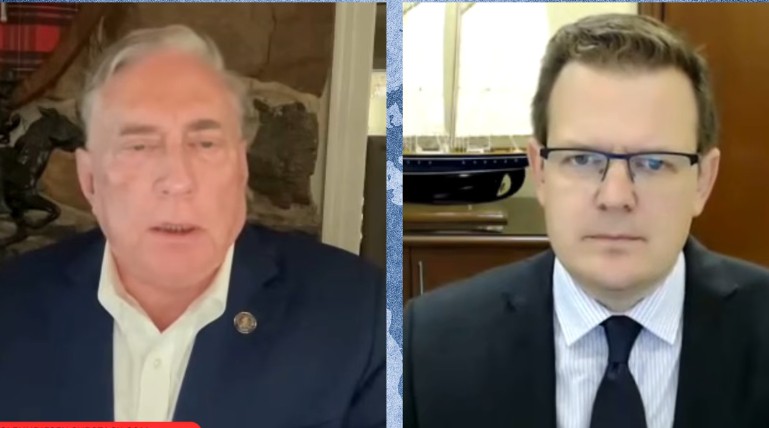
Editor’s Note: In this interview, Glenn Diesen talks with Colonel Douglas Macgregor, former advisor to the US Secretary of Defense, about the US military buildup for another round of war with Iran, Israel’s regional ambitions toward Turkey and Qatar, and the possibility of a nuclear escalation. They also discuss Trump’s midterm calculations, the future of Israel, a possible move against Cuba, Sergei Lavrov’s view of US-Russia diplomacy, and the end of American hegemony as the US financial system comes under strain. This interview was premiered on September 30, 2026.
TRANSCRIPT:
Introduction
GLENN DIESEN: (00:00:00 – 00:00:11): Welcome back. We are joined today by Colonel Douglas Macgregor, a former advisor to the US Secretary of Defense, also an author and a combat veteran. So thank you for coming back on the program.
DOUGLAS MACGREGOR: (00:00:14 – 00:00:15): Happy to be here, Glenn.
No Real Deal With Iran
GLENN DIESEN: (00:00:16 – 00:00:44): So we see that the US military strategy against Iran has taken on some different forms. It began with a decapitation strike. There’s been focus on deterrence. Some of compellence in terms of trying to open up the Strait of Hormuz. None of it seems to have been working though.
I was wondering, what do you see happening next? What the US, what the Trump administration might try to do next militarily? Because they don’t seem to have settled on peace yet.
DOUGLAS MACGREGOR: (00:00:47 – 00:05:23): No, I think the rumors of any sort of agreement or “deal,” as the president likes to call it, are grossly exaggerated. There doesn’t appear to be any real willingness to reach an agreement unless it involves the unconditional capitulation of the Iranians to whatever Washington wants. So I don’t think we’re going to see much change there.
In fact, yesterday I was talking to a colleague and he’s very expert on matters, particularly in Russia. And he said to me, “The interesting thing is that Washington’s proxy in Ukraine has lost the war to Moscow, to Russia, but the Russians have yet to consolidate or secure their victory.” In the same sense, I think we can argue that the US military, which is operating as a surrogate for the Israelis, seems to have lost the war with Iran. Over any number of different issues, not the least of which is control of the Persian Gulf. But the Iranians have yet to secure their own victory. In other words, we’re in a limbo at this point.
And what history teaches is if the Russians are going to be victorious in Ukraine and the Iranians are going to be victorious in the Middle East, they’ve got to secure their victories. They’ve got to take decisive action. Thus far, the Russians have seemed unwilling to do that, and it seems as though the Iranians at this stage are really willing to wait on the assumption, I think, that the pain inflicted on the global economy and also the United States by the closure of the strait is going to work to their advantage. And they probably assume that we will never come back to the bases that are being destroyed, which is not a bad assumption, but I think they are underestimating the determination of the Israelis to drag us back into the region.
So this leads to some important questions for the Iranians. What are they going to do to ensure that we don’t come back in some other form? We may have largely left at this point, although I guess the drop-dead date for our departure from Iraq, complete evacuation of the country, is 30 September. I assume we’ll meet that deadline. I don’t know how many of us are still in Iraq, but the point nevertheless remains: what is Iran going to do?
We know that what we’re engaged in right now is a massive military buildup for another round of war with Iran. Anybody watching what’s happening in the United States Air Force knows that. Our forces are building up. We’re committing more and more airmen and others to Great Britain and Germany, to bases in those countries, from which presumably we will fly bombers. And large numbers of bombers can be quickly flown in, prepared, loaded with weapons, and sent off to action.
The question is, when does this happen? Well, it could happen before the elections or it could happen immediately after. It sounds as though there is a readiness to wait until after the elections. Presumably that’s because we’re trying to replenish a lot of stocks, missiles, precision-guided munitions, and so forth. Then we have the 40,000 2,000-pound bombs that are being shipped to Israel. And even if Israel wanted to deliver all of those, they couldn’t. So my assumption is that a lot of those were, are meant for U.S. use. And we will use Israel as a launchpad for the next round of attacks.
So I think the best that we can say at this point is there’s been no real fundamental change in the situation between ourselves and Iran. And this is probably the last hurrah for the United States military in its attempt to bring Iran to heel. Now, what does that mean? What condition other than total capitulation are we prepared to accept? I don’t know. And I don’t know how much destruction we can create. We certainly can create a great deal, but will it result in the disintegration of the Iranian state, which is obviously what Israel wants?
I don’t know what we want other than whatever Israel wants. So it’s a very difficult situation right now, but I don’t see much sunshine on the horizon. Let’s put it that way.
Can the US Win the War With Iran?
GLENN DIESEN: (00:05:25 – 00:06:17): I’m glad you compared it a bit to the Ukrainian case because in this instance as well, we have European leaders who want to say they want to fight Russia, but they don’t explain how they’re going to defeat Russia.
They don’t— they can’t point to military they can use, and they don’t even explain what war means. Are they going to fight them in Ukraine? They’re going to launch missiles? But there’s not a convincing path to victory, and I guess that’s a similarity to Iran.
Do you see any convincing story here in terms of how the US can win this war? Because this combination of geography and the new weapons technologies puts Iran in a very favorable position. Do you think the US would go in with a land force, like actually take over parts of Iran or Yemen for that matter, or will it be bombing campaign?
DOUGLAS MACGREGOR: (00:06:17 – 00:10:43): Well, the truth is we have almost no army at all by historical standards. We’re under 450,000 in the so-called standing army or regular army. We don’t even use those words of “regular army” much anymore. I don’t know what the plan is involving reservists and National Guardsmen. I think that would probably rub up against the Congress in ways that are not very popular. And I’m sure that President Trump doesn’t really want to bring in large numbers of reserves and national— I don’t see much happening on the ground.
Now, that doesn’t exclude some possibilities. Could we conceivably find a way using Marines and soldiers to get into the Gulf? Other than to make President Trump and his supporters happy. And by that I mean the Israelis who are pushing him into war. There’s Chabahar, on the coast of the Indian Ocean or the Arabian Sea, whatever you want to call it. I don’t know that that will be well received because that’s a very important port for a lot of people outside of the region. So I just don’t know what you think you can accomplish with ground troops.
Now, can you do things with special operations forces? Probably, but that didn’t go very well the last time we tried it. And I think at that point we decided perhaps we should take another approach to deal with the supposed enriched uranium. So right now I think this is largely an air and missile operation.
The real question is when it becomes clear that Iran is not going to capitulate, do we turn to the use of nuclear weapons? And I don’t care if somebody wants to call it a tactical nuclear weapon or otherwise. A nuclear weapon is a nuclear weapon. That ostensibly opens Pandora’s box. That can lead to all sorts of terrible outcomes, rapid escalation. It could even bring in the Russians and the Chinese.
We seem to have assumed that we’ve pacified the Chinese on the basis of this last visit. I’m not sure why we think that. I don’t think the Chinese are stupid. And it turns out that there was very little discussion, or if there was, we don’t know anything about it, concerning Taiwan. And unless we’re willing to stand by the Shanghai Communiqué that occurred back in the 1970s, where we absolutely renounced any further interest in making Taiwan an independent state, the Chinese aren’t going to take us very seriously.
Now, when it comes to the economic side of the house, our condition is very fragile. We’re watching the 10-year bond— the yield continues to rise. It’s obvious to everyone that the so-called Federal Reserve is not exerting much control over anything. So this whole economic structure in the United States could suddenly overnight go into code blue, if you will, collapse in ways that we haven’t seen in 100 years. But just because you haven’t had an earthquake in 100 years in a place like Naples doesn’t mean you’re not going to have an earthquake. I think the same thing is true for us financially.
So we could see something really awful quickly here in the United States that would change the complexion of the entire operation. What do we do if we can afford nothing, if we have no more money to spend? And we already have a problem with worn-out equipment and tired people. This business of abusing your standing force repeatedly month after month, year after year doesn’t work very well.
So I don’t see us achieving anything of value, but then again, I don’t know all of the plans and maybe there’s some secret sauce in all of this that I’m not aware of. I don’t exclude that as a possibility, but I just don’t see Iran capitulating, period. And the rest of the region is in turmoil. Everything’s falling apart. The Saudi Arabia, the statelets, everything. And I don’t think that we can depend on the Turks to sit quietly forever. I watch their television. I watch briefings by former officers. Looks very serious and tense to me in Syria and in the Mediterranean.
Could Israel Go After Turkey or Qatar?
GLENN DIESEN: (00:10:46 – 00:11:23): Yeah, that’s what worries me. That is usually— well, the US has often had the advantage as the global hegemon to be able to control all the variables and just focus on one at a time. But if the economy goes south, if the war spreads as we saw it did to Yemen and the Red Sea, and kind of the wildcard here would be Israel, I guess, because, well, Israel is the one who initiated this war summer of last year.
But when I watched Netanyahu speak, I was wondering what else is on Israel’s plans. Do you think they could go after Turkey or Qatar? I mean, and if so, what exactly does that mean?
DOUGLAS MACGREGOR: (00:11:25 – 00:14:43): Well, let me go back to something that you said that’s very important. One of the key assumptions of American military hegemony, and we’ve always dressed up this notion of hegemony as the “rules-based liberal international order.” Give me a break. Whose rules? Our rules. When do they apply? When we say they do. To whom do they apply? Whomever we say. So it has nothing to do with international law.
We continue to hear Putin, the leadership of Iran, even President Xi, they talk about international law. There’s nothing for which we have more contempt in Washington than international law. So it doesn’t mean anything.
The problem with hegemony though, is that you have to be able to project decisive military power anywhere in the world on a moment’s notice. Well, I think it’s perfectly obvious that that no longer can be achieved. We don’t have that power anymore, and I don’t see any evidence we’re going to get it back. But I think that President Trump, in the final analysis, has decided that he’s going to try and reverse conditions. In other words, he’s trying to relive the unipolar moment again. It’s not going to happen. It’s a bad idea. The unipolar moment is over. Let it die.
Let’s live in the new world that involves many powers because we are no longer the dominant power either in economic terms or military terms and financial terms. And we’re fighting this, and it’s making matters much worse for us and for the rest of the world. But President Trump shows no signs of abandoning that. Now, I think he identifies unconditional support for Israel as part of this bid to reclaim or reattain global military hegemony. That’s a bad idea.
But the Israelis know something. If they can’t keep us engaged in the region indefinitely, if they can’t drag us back in and they cannot win against Iran, how long can they reasonably expect to survive in the region? You can’t tell everyone in the region that surrounds you that they’re subhumans. And that the most important thing they can all do for you is to die, which is effectively what the Israelis are telling people. This is about Jewish supremacy in the worst sense of the word.
It’s very difficult to develop new allies in the region under those circumstances. And the ones they have have now been exposed to the sunlight, which means if you’re in the UAE or Saudi Arabia, there are millions, tens of millions of Muslim Arabs. Also Muslim Turks and Iranians have all figured out these people are traitors. They have betrayed the interests of Islam, the interests of their people, the interests of the world that is Islamic.
So it’s just hard for me to imagine anything positive resulting from more warfare. On the contrary, I think it could finish off our interests in the region and make any future position for the United States impossible. But perhaps there’s some secret sauce, something that we haven’t heard about. Who knows? We’ll have to wait and see.
Trump, the Midterms, and the Billionaires
GLENN DIESEN: (00:14:44 – 00:15:11): Well, when Trump made this speech of his in the United Nations, he was making a big point that it can make Iran a very powerful, prosperous country, or it can annihilate them. Besides this show of power, it’s interesting that it’s all tied to the midterms. That is, even if you would want to take a deal, or he wants to go all-out war, he wants to wait until after the midterms. Do we know yet what he might actually do in this case?
DOUGLAS MACGREGOR: (00:15:11 – 00:18:16): Well, I hear people make that case. I don’t see it because there’s nothing he can do to improve his position for the midterms. All you have to do is look at the current polling data. He’s losing airspeed and altitude at a very, very rapid pace. He’s about as popular in the United States as the plague right now. There’s very little interest or support for the Iran war.
Now, of course there is on the Hill, but that has to do with money. That has to do with the fact that members are receiving money from sources that are pro-Zionist. They also are benefiting from insider trading and all sorts of special deals that the financial system in Zionist hands can provide to them. So they’re going to stick with the war, at least at this point. If it ends badly and Trump loses, they’ll all say, “See, we told you so.” That’s what Congress does. It waits till everything falls apart, then it washes its hands and says, “We’re not responsible.”
I don’t think the American people are quite that stupid anymore. I think the American people have figured a lot of things out. They know that Trump has gone back on every word he’s ever given. He’s betrayed every trust that you can imagine from his own party, from his own support base. And I think Americans are increasingly disgusted by what they see as an exercise dressed up as government, which is almost kleptocracy.
So I don’t know that the whole midterms plays that much of a role. I think one of the few times when President Trump has been completely honest is when he’s spoken and said, “I’m really not worried about the midterms.” And I think he has to make a decision or had to make a decision. “Do I bend in the direction of my supporters, my base, and others who are opposed to these policies? Or do I stick with them?” And I think he’s decided he’s better off sticking with these policies because that’s where the money is. The billionaires that support him, the billionaires that got him elected, the billionaires that are driving policy. They’re his best shot at staying in office.
If he betrays them at this point, which I would call Charlie Kirk-like— in other words, goes through an epiphany and says, “Oh, I was wrong”— does he end up like Charlie Kirk? I’m not sure about that, but he certainly ends up in a lot of trouble because then the guardrails that prevent him from facing impeachment are gone. See, if most of the Congress is still willing to support the Zionist war that we’re in, what makes anybody think that they will suddenly not support whatever it is that Trump wants?
In other words, Trump has got to be very careful. Everything he does, everything he says, everything he represents now depends on the support of the people that put him where he is, not the American people. The American people are just not prominent in this equation of power.
The Future of Israel
GLENN DIESEN: (00:18:19 – 00:19:14): We see something similar in Europe, by the way. That is, the war the elites are pushing for, the— it’s quite obvious that the people don’t want it, which is why there’s all this manipulation, censorship, but also why the leaders are at the end of the day so unpopular.
But about the relationship between the US and Israel, it seems interesting because the US backing Israel without any conditions is obviously, it enables Israel to do things it would otherwise not do. However, if the US will pull back now, it would leave Israel much more vulnerable and unpredictable, reckless. Do you— Yes, I agree with you. What would be the future of Israel though? Because eventually the US either has to pull back voluntarily or, the economy, regional powers, Iran, I mean, it might be forced to do so. What happened, again, it’s a hypothetical, but what happens with Israel, don’t you think?
DOUGLAS MACGREGOR: (00:19:15 – 00:21:40): Well, right now, I think for the reasons you just outlined, President Trump is absolutely not going to abandon his unconditional commitment to Israel. That’s going to remain in place. Now, that could change if in fact not only does this war fail miserably, which I think it will eventually this year in all probability, but his own political position is destroyed by the economy.
If that occurs, if we go into the tailspin that I think we probably will— I mean, you could bring on a number of brilliant analysts, everyone from Ray Dalio to Luke Gromen to Alasdair Macleod, you take your pick, and they’re all telling you the same thing. We’re headed into something not just worse than 2008, but probably something worse than the ’29 crash.
So if they’re right, and I think they probably are, this is the last hurrah. That’s why I say this is the last major military push that we can mobilize and muster. If that doesn’t work, the economy crashes, where does Trump go? He’s probably finished. Even then, his dependence on the Zionist billionaires is probably not going to rescue him. But that’s, I’m talking about the perfect storm.
And as far as Israel goes, I think it’s very obvious that, again, as I said before, if we are suddenly disengaged from the region, if we are suddenly defeated militarily in our last attempt, we’re out. And if we’re out, Israel is probably not far behind us. A lot of Israelis are moving to Cyprus. Some friends in Cyprus contacted me and told me that the place is largely being purchased by wealthy Israelis. Whether or not that money comes from Israel or it comes from the United States, I have no idea, but a lot of real estate is being bought there to the point where the Cypriots are very, very unhappy.
Greece, downtown Athens, I’m told, is largely purchased by, once again, Israelis moving there. They’re moving into places in Belgrade, in Serbia. It— that does not buttress confidence in the state of Israel, does it?
GLENN DIESEN: (00:21:43 – 00:22:14): I was going to say that might need some explanation. You say if the US pulls out of the Middle East, which looks increasingly likely, but then Israel would follow. But of course Israel is a state in the Middle East. Do you suggest they would— people again are fleeing, but there will be— the government will be left, an army will be left, their nuclear weapons will be left. How— again, this is dangerous speculating, but how will this occur though?
DOUGLAS MACGREGOR: (00:22:17 – 00:24:51): Well, the real question is, could Israel become a normal state in the region? The man who knows more about this than I do is Chas Freeman. So does Alastair Crooke, they have talked about this. Can Israel be a normal state in the Middle East? I think they’ve all concluded that’s an impossibility.
Was it ever possible? Yes. We’re about to go into October and you’ll remember the 1973 Arab-Israeli War that broke out in October, the so-called War of Atonement. That changed things strategically on the ground in the region. When Sadat attacked with the Egyptian forces, managed to cross the Suez and defeat the Israelis on the other side and drive them away, his goal was never more than regaining the lost territory. Sadat never had any intention under any circumstances of advancing further and into the heart of Israel with the goal of destroying Israel. He was not interested in that. The Egyptians have never been interested in that. Now, maybe Nasser in his wild fantasies was, I can’t, I’m not sure. For that.
But my point is, that worked out rather well in retrospect. Now, as far as Syria was concerned, that was a different animal. They failed. Had they succeeded and invaded Israel proper, which was not impossible, that would have changed things dramatically. They had a different set of goals from Sadat in Egypt.
And so the question is, what is now possible? I don’t know that Israel could be a normal state. I just don’t. It might have to— excuse me— under great pressure withdraw behind fortress walls. But is that a long-term solution to the problem of Israeli security? I think they know it isn’t. Otherwise, they would never have embarked on the greater project, which is supposed to solve that problem.
If you’d conquered most of your surroundings and you’ve created a giant security zone at the expense of other people’s countries, then presumably you will be more safe. I think that’s what the Israelis have thought for a long time. It hasn’t worked. I don’t think it can work. So that means, can you go back to being little Israel? I don’t know. I think it’s a— that’s a tough one to answer. It may be easier to simply evacuate.
Chaos and the Push Against Cuba
GLENN DIESEN: (00:24:54 – 00:25:36): I’d always hoped that when the day came when the United States weren’t able to— was not able to sustain collective hegemon anymore, that it would put— they make the alliance systems and try to convert them into some regional security structures, that is in Europe, the Middle East, and East Asia, just so to have that stability.
But instead of forming these inclusive security structures, we see instead a lot of the frontline states, be it in the Europeans against Russia or the Gulf states against Iran. God forbid there’s something similar in East Asia, but it creates, yeah, a real chaos. It’s unfortunate.
DOUGLAS MACGREGOR: (00:25:37 – 00:28:24): Chaos is a good word for the Trump administration because in the midst of all of this, there are serious interests in and preparations for attacking Cuba. And it’s— I find that ridiculous. I think it’s insane. I don’t see anything positive about going into Cuba. We invaded Cuba 3 times before the Second World War. People don’t know this, starting in 1898-99. And each time that we intervened in Cuba, we wrote a constitution, we supervised elections, we tried to set up government. It all failed. I don’t see that we would have any more success today in Cuba than we did in the past.
But Secretary Rubio obviously represents that lobby. And again, this goes back to the fundamental problem in American foreign policy. Most Americans on any given day don’t pay attention to what happens overseas. They don’t really care. And that can be viewed in 2 ways. You can say, “Oh, well, this is horrible because they’ve lost control of their government.” I agree. On the other hand, I always thought it was a very healthy thing. Why should we be interested in meddling in other people’s countries? We have a perfectly nice country here now.
But that’s not been the view of the, during the 20th century when we had the capability to project power, we’ve done it. Whether or not we needed to, that’s another matter. For debate. Now you’re saying something that’s true. We cannot do what we did in the past. That’s been displayed obviously in the Middle East with Iran. I think we’re going to see more evidence for that in the future simply because the world has grown up. It has recovered from the Second World War. We have multiple great powers now. They all have interests. Thankfully, they don’t want war, especially with us.
What— we don’t seem to care about that. We’re determined, as I said before, to sort of relive the unipolar moment, whether or not it makes sense to do so. And it doesn’t. So I wish I had some good news to offer you, but I just don’t. I think we’re going to go forward in October. October is a strange month. A lot of strange things happen in October. We could see things blow up in any number of different places.
I think what we recently saw in England with the attempted attack on an airbase there that we utilize for our bombers is the tip of an iceberg. I think we’re going to see more of that in the future. And eventually, I think we’re going to see large numbers of people all around the world that want us out. We’re no longer viewed as a guarantee against someone harming them or intervening in their country. We’re now a magnet for trouble.
Lavrov and the State of US-Russia Relations
GLENN DIESEN: (00:28:27 – 00:30:39): Yeah, well, also in the— well, in terms of invading Cuba and, well, I guess enforcing the Monroe Doctrine of not having any foreign powers establish themselves near the US, it seems unnecessary though, because from what I understand, neither the Chinese nor the Russians would, as they demonstrated in Venezuela, ever dream of actually trying to confront the US in the Western Hemisphere simply because it would be insane. So you don’t— I just think if the US goes in with the heavy military weapons, it’s not so much the Chinese or the Russians have to worry about. It’s more the regional pushback. So it can get themselves into a quagmire.
But on the topic of bad news, I actually am in Moscow now and had the chance to— well, I saw Sergei Lavrov today give a talk, have the chance to ask him questions. And one thing that really stuck out from what he said was how the attitude towards diplomacy with the US appeared to have changed. He talked about Alaska and he said that the Americans had put forth a deal which demanded some big compromise from the Russian side. They agreed to this compromise. And after this, it was based on the idea that they would deal with the root causes so there’d be no NATO. And suddenly after this, we— there’s no more. They never heard back from them. They don’t talk about no NATO anymore.
Suddenly, Trump talks about this as if it would be a conflict only between Ukraine and Russia. And with the new sanctions, weapons, in the words of Lavrov, he said “Trump is more similar to Biden every day that passes.” Every sanction has been extended and a few new ones added.
How do you see the Russian American partnership moving forward? Because one of my great hopes for the US was to put an end to the whole Cold War, which has gone on for a century now. These powers don’t really need to be enemies. I mean, that would stabilize Europe as well. But we see it go the other direction. What do you see Trump going— well, what is the strategy here? Because I don’t get it.
DOUGLAS MACGREGOR: (00:30:42 – 00:34:59): There is no strategy. Historically, we’ve really never had a strategy. The only clear, coherent articulation of a strategy, in my judgment, came from George Washington. And Washington essentially articulated 2 things. First, we’re not interested in being involved in other people’s wars. So we need to disengage ourselves from any possibility of being dragged into future wars overseas beyond our borders. Secondly, frankly, we English-speaking people are going to conquer the North American continent. We’re going to march from the Atlantic to the Pacific.
That was our strategy. That’s what we did. If you go back and look at the various wars we fought, they were largely about this one country from Atlantic to the Pacific. That was English speaking with one constitution and one law and one people as a result.
The next time you had any sort of strategy, if you want to call it that, articulated was the strategy of containment that came from Kennan, which then was subsequently militarized and led to the tragedy in Vietnam because Kennan at no point was arguing for any sort of armed conflict with communism in any form, anywhere, at any time. That went by the wayside.
And then after 1991, when we discovered we were the last man standing, we were the preeminent power in military, economic, financial, and political terms. Instead of setting out to build a better world, as we say, one in which we would treat the rest of the world with mutual respect, respect other people’s customs, way of life, laws, and so forth. We decided, no, no, no, under the guise of spreading democracy at gunpoint, we were going to make everything better for everyone, whether they liked it or not.
So I don’t know what you’ve got going now other than an extension of what started in ’91. You’ve got to go back to the draft defense planning guidance of 1991, authored by Paul Wolfowitz. Normally adopted, but it leaked. And it was the thing that people internally continued to point to. And that said, “We’re number one. We should make sure we remain number one. We should be prepared to go anywhere and challenge anybody to guarantee that we remain number one.”
And they treated a series of interventions as laboratory experiments. To see to what extent we could establish, we said, new liberal democratic regimes, but in reality we meant puppets that would then do our bidding, trade with us on our terms, and so forth. So you have the series of interventions after the failures in Somalia and Haiti, you then go to the Balkans, and from the Balkans you ultimately go to the Middle East, and that of course is triggered by 9/11.
But instead of focusing on what was allegedly the problem, which was this small group of Islamists in Afghanistan, it became a regional-wide crusade, in my judgment, to make the world and the region safe for Israel. And that seems to have been the permanent strategic imperative and has remained so. There we are.
And what do we get for it? I think— we looked at the trillions of dollars in the national debt that rose between 2001 and 2022, over $28 trillion added to the national debt. We concluded that about $8 trillion of that was due to defense spending. And we had borrowed all the money, which means we printed it. No one will buy our bonds, which means that we have to print it. The petrodollar is dead, so you’ve got to print it. How much longer can you print before it all falls apart? I think that about sums it up, Glenn.
The End of Western Primacy
GLENN DIESEN: (00:35:01 – 00:36:25): It made me think about something a friend and, well, former colleague of yours, Lieutenant Colonel Daniel Davis, I was with him in Istanbul a few days ago and he was giving a speech. He was making the point that in Washington they still live in 1992 as if it will be the Wolfowitz Doctrine. And I thought, we have a similar problem in Europe. That is, we have militarism without a military. They all talk about war, but they don’t have a military to use. So we were all living in the past, like it’s at least 30 years ago.
But this shows the shift though in world order. I guess it’s just my last question is, we were not adjusting to it voluntarily. I would have liked to see the politicians recognize the distribution of power and calibrated their policies accordingly, but we’re not seeing it.
So how do you see the, I guess, big question, alas, but how do you see the world order we’re entering now? Because if this era of dominance is over, it’s not just a failure, end of the last 30 years. It’s centuries of Western primacy though. Well, what is— how do you see the world shifting after this? I mean, if you add the end of the current financial system led under the US, it’s again, by definition, it becomes unpredictable. So I don’t have a lot of patience for predictions though.
DOUGLAS MACGREGOR: (00:36:25 – 00:40:59): Yeah, if you drag out Paul Kennedy and his “The Rise and Fall of the Great Powers” and you look particularly at Great Britain and the British Empire. British Empire was not militarily overwhelming in its capabilities. It had a very large and powerful navy. It was designed to protect their empire. The empire was overseas.
We started out filling the shoes of the British Empire after World War II, when Eisenhower threw the British, the French, and the Israelis out of the Suez in Egypt. People said, “Well, this was a very wise move that cultivated tremendous support in the Arab world and the Muslim world for the United States.” But in reality, he was also making sure that we were the sole great power that would dispose over the oil resources in the region.
Subsequently, Nixon, who creates the petrodollar, tries to make Iran the sort of proxy force for us to maintain control. And since then, we have been building up our position in the Gulf because we wanted to be sure that no one would try to displace us. Ultimately, no one did really, but a war has started because of Israel. And the interesting thing is that all of these attempts to maintain control of the oil resources are now at risk of complete and utter failure. And along with it, our entire economy, not so much because of the oil dimension, but because of the spending.
Remember, we used to have taxes associated with war. When you went to war, you had to pay taxes. You had to buy war bonds, all this sort of business. We handled the Korean conflict so well that there was practically no debt whatsoever left over from the Korean War. Because we taxed. But after Nixon comes in and we bankrupted ourselves in Vietnam, we go into this money printing spiral where there’s no accountability. Because if it never affects the broader population, well then nobody notices and you continue to print money.
I think we’ve reached the end of that process and Paul Kennedy describes that inevitable future for us in his 19— what, ’82 work? I would encourage everybody to go back and read it. I’m sure Paul Kennedy would love to hear that, but he wrote this brilliant, brilliant piece and it deserves more attention than it gets. So I don’t see any off-ramp from disaster at this point.
Now, will that be the end of us as Americans? Of course not. But we will have to turn inward and deal with our issues for— fortunately, we can do that. We’re an island. We’re not the Roman Empire. We don’t have borders with millions of barbarian armies bearing down on us. We’ve got barbarians, but we can reverse that. The Romans couldn’t do it. We can, we can survive the barbarian incursions because we did it to ourselves.
Europe has got to do the same thing. Their problems are all internal. They’re not external. There’s no threat from Russia. I think the European population hasn’t realized that. I think we’re part of the problem. As long as this NATO thing exists, because we continue to support it and insist upon it, as long as we have forces on the ground in Europe, the globalists will resist any positive change in European society. Civilization. They are only interested in themselves. They’ve got the same problem where you are that we do. It’s perhaps not as kleptocratic, but close.
And at the end of the day, the only way Europe will liberate itself is to get rid of these governments. They’re going to have to rise up and liberate themselves. That’s why I talk about the revolutions of 1848. The good is that the states are weak. And the forces that support them are weak so that they can have success. They can rebel. There doesn’t have to be as much bloodshed as there was in 1848. They can win and they can steer a new course.
I don’t know if they can do it, but I think they can. Or maybe I should say, I don’t know if they will do it, but I suspect they’re getting close. That’s certainly true in Great Britain from what I’ve seen.
Prosperous Without Ruling the World
GLENN DIESEN: (00:41:02 – 00:41:26): Yeah, well, if we see the unpredictability and the coming chaos from all this, from what was awaiting us, I can understand why Trump wants to reverse the decline and restore the global primacy of the ’90s. But again, it just seems like it’s making matters much worse, and it’s again refusing to see that— I mean, I think already come to an end.
DOUGLAS MACGREGOR: (00:41:27 – 00:41:40): I think there’s something. Yeah, there’s one thing more that I would say Americans know, but their government doesn’t: that we can be prosperous, free, and independent without ruling the world.
GLENN DIESEN: (00:41:43 – 00:41:47): Well, and on that note, Colonel, thank you so much for your time. I always appreciate it.
DOUGLAS MACGREGOR: (00:41:48 – 00:41:49): Sure. Thank you, Glenn.
Related Posts