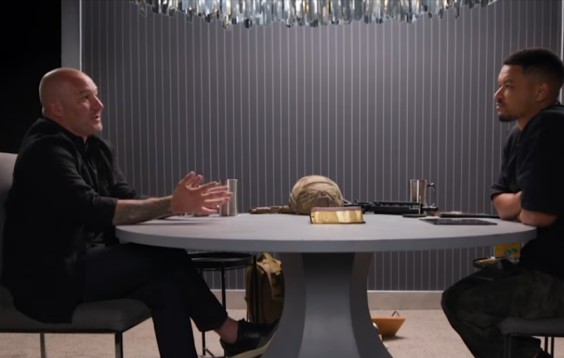
Editor’s Note: In this candid conversation on The Diary Of A CEO, Steven Bartlett sits down with former Navy SEAL, CIA contractor and podcast host Shawn Ryan. They cover his military career, how podcasters and influencers can be “captured” or fed planted guests, his disillusionment with politics, his years of addiction in Colombia, and a terrifying psychedelic experience that led to exorcisms and a deepening Christian faith. Shawn also opens up about family, integrity, and what a good life means to him today. This interview was premiered on October 1, 2026.
TRANSCRIPT:
From Navy SEAL to CIA Contractor
STEVEN BARTLETT: (00:01:47 – 00:02:40) Shawn Ryan, you have lived a remarkable life for so many different reasons. I feel like you’ve lived several different lives as well, dare I say. But for anybody that might not be familiar with your smash-hit show and your incredible journey through the military, can you give me a top line on the career that you’ve had before you got into podcasting for those that might not know?
SHAWN RYAN: (00:02:41 – 00:03:29) Yeah. Joined the US Navy at, I think I enlisted at age 17, went straight into the Navy SEAL program, went to BUD/S, went to SEAL Team 8, spent 5 and a half years in the Navy and then left that, became a real estate agent. I had read a book by Donald Trump way back then on This Is It, How to Get Rich. It inspired me to become an entrepreneur and failed miserably.
So then I looked at government contracting, started contracting for Central Intelligence Agency, started a small State Department gig, got picked up for the CIA contract, did that through Blackwater, then jumped over to a company called [SOCT], and then wound up getting picked up direct contractor for the agency with no middleman.
STEVEN BARTLETT: (00:03:29 – 00:03:39) And you said in that you wanted to be a Navy SEAL. Now, for international audiences that might not know what a Navy SEAL is relative to just being in the Army, what is the distinction?
SHAWN RYAN: (00:03:40 – 00:04:48) A Navy SEAL stands for sea, air, and land. So you operate in the sea, air, and the land. It’s special operations. So it is one of the most prolific special operations units in the world. You go through a training pipeline that’s a couple years long. You go through BUD/S, which if you make it, without getting hurt or without getting rolled back. That’s 6 months. I didn’t make it without rolling back, so I think I spent about 9 months there.
Then you go to jump school, then you go to SQT, SEAL Qualification Training, which is kind of where they turn you into— I guess I shouldn’t say they turn you into a special operator, but that’s the final school. Then you get your SEAL Trident, and then you spend another year to year and a half training at your SEAL team before you ever even get the opportunity to deploy for the country.
Diving, jumping, land warfare, demolition, small unit tactics, lots of time in a kill house, lots of time in land warfare, all different operational environments, desert, winter, jungle, you name it, we’re in it.
STEVEN BARTLETT: (00:04:48 – 00:04:53) Is it equivocal to the SAS, which is the British version of the special operations team?
SHAWN RYAN: (00:04:53 – 00:04:56) I would say, yeah, SAS or SBS. Okay.
Haiti, Afghanistan and Operation Red Wings
STEVEN BARTLETT: (00:04:57 – 00:05:05) And you must have seen some pretty horrific, interesting, unforgettable things while you were on those tours of duties around the world.
SHAWN RYAN: (00:05:05 – 00:06:00) Yeah. Operated in a lot of different environments. The first thing I ever saw that was warfare-ish, it wasn’t really hot. I thought it was hot at the time, but 2004, we went to Haiti when Aristide got pulled out of power. It was the first time I’d really seen true poverty.
And I don’t know if you’ve ever been there, but I mean, the sewage goes right into the streets. All the prisoners had broken out. We’d— there were dead bodies floating around the water, bullet holes everywhere. Every once in a while I’d see a car on fire. I mean, it was just mass chaos. It really wasn’t anything compared to what I would see later on. But that was the first place. And then Afghanistan, we went there after Operation Red Wings happened. That was the biggest loss in SEAL Team history at the time.
STEVEN BARTLETT: (00:06:00 – 00:06:02) What was Operation Red Wings?
SHAWN RYAN: (00:06:02 – 00:06:04) Have you ever seen the movie Lone Survivor?
STEVEN BARTLETT: (00:06:04 – 00:06:04) No.
SHAWN RYAN: (00:06:05 – 00:07:08) Okay. There was a sniper element on a mountaintop that was surveilling a town that had a high-value terrorist in there. And the sniper hide was compromised by a goat herder. Goat herder went back to town, and told everybody what he’d seen. And then they ambushed the element up there. Helicopters went down, and then there was one guy that survived it. And so it was the biggest loss ever in SEAL Team history at the time.
That happened on June 28th, and I think we were there by late September, early October, I believe is when we were there. We did some, hit some targets, but they were pretty much all dry holes. Grabbed a couple of prisoners. Stuff like that. And then we actually went home early, and then I went to Iraq. Well, I went to Iraq. My platoon went home. I decided I wanted to get out at that point. It just, for me, it wasn’t really what I thought it was going to be.
STEVEN BARTLETT: (00:07:08 – 00:07:09) What was it?
SHAWN RYAN: (00:07:09 – 00:08:35) I thought it would be a lot more combat. I wanted to go out every night and do the job, do direct actions, do CQB, do sniper stuff, whatever.
And so I had an OIC, which is kind of like the leader of a SEAL platoon. He had found a way to farm us out to conventional units that were getting hit. We’re getting hit on supply routes with roadside bombs. Suicide bombers, stuff like that. And so we would attach into these conventional units and train them up. “Hey, this is how you run surveillance. This is how you come up with a mission, basically.”
And we would teach them everything from how to plan the mission to how to set up a sniper hide, how to shoot, how to insert, how to exfil, how to position all the different teams. And then we would go out there, we would take them with us and hunt the people that were killing our guys. And every time we went out, we had killed the bad guys, the terrorists, within 24 hours of being out there. And then we’d move on to the next unit. And that was my last deployment.
How the SEAL Teams Changed Him
STEVEN BARTLETT: (00:08:36 – 00:08:38) When you came back from the SEAL team, were you a different man?
SHAWN RYAN: (00:08:39 – 00:08:39) Definitely.
STEVEN BARTLETT: (00:08:40 – 00:08:41) In what way were you changed?
SHAWN RYAN: (00:08:43 – 00:09:29) A lot of ways. You learn a lot of critical life lessons in the SEAL Teams and being environments like that, and your personal drive just goes through the roof. What you realize that you can accomplish as a human being is far more than I think what the normal person thinks. Your ability to work in stress, in extreme stress, goes through the roof.
There’s another side too. I mean, you get addicted to adrenaline. You get addicted to those type of environments. You succumb to the culture that comes with that, which is a lot of drinking, fighting, all those things.
Are Podcasters Being Compromised?
STEVEN BARTLETT: (00:09:30 – 00:09:43) So you were in the Navy SEALs? You contract with the CIA for a while, and then I guess the other pretty tremendous accomplishment is you now have built one of the biggest podcasts on planet Earth where you interview people just like I do here.
SHAWN RYAN: (00:09:44 – 00:09:45) That is correct.
STEVEN BARTLETT: (00:09:45 – 00:09:52) Do you think podcasters are being compromised by guests being planted? Yes.
SHAWN RYAN: (00:09:52 – 00:10:36) I have no proof, but yes, in a couple of different ways. So here’s one example. But not just podcast— let’s go influencers, not just podcasters. So Trump administration crushed it in the elections and the election cycle, right? Different podcasts, they really utilized the podcast. They saw the power of it, they utilized it, and it was a great tactic.
And then afterwards, I think a lot of podcasters and influencers, they felt powerful because they got close to the president. They got close to the administration. And if you saw what happened, do you remember the first Epstein file release?
STEVEN BARTLETT: (00:10:37 – 00:10:37) Yes.
SHAWN RYAN: (00:10:37 – 00:10:47) When they had all these people show up and they were holding up the binders and shit. They did not understand that the minute that happened, they were captured.
STEVEN BARTLETT: (00:10:47 – 00:10:48) Who was?
SHAWN RYAN: (00:10:48 – 00:10:50) Everybody that was in those pictures.
STEVEN BARTLETT: (00:10:50 – 00:10:51) Oh, okay. Yeah.
SHAWN RYAN: (00:10:51 – 00:11:08) They can no longer be a free thinker because maybe they are a free thinker, but the appearance that they just gave off is that they are in a tribe, and they were smart to do this. And I’ve had several invites. I always turn it down because, no, I don’t know. I’m not doing that.
STEVEN BARTLETT: (00:11:09 – 00:11:09) Invites to where?
SHAWN RYAN: (00:11:10 – 00:11:11) Invites to wherever.
STEVEN BARTLETT: (00:11:11 – 00:11:12) The White House.
SHAWN RYAN: (00:11:12 – 00:12:19) Football games, the White House, this, that, public events where you’ll be seen, where you’ll be photographed, where it looks like everybody’s on one team and we’re all having a party and we’re all friends and all this shit. That’s a way to capture what you’re doing without you even realizing it and showing the world, “Hey, look, we have Steven. We’ve got him. We’ve got pictures of him holding binders up. We’ve got pictures of him at dinners with us. He’s on our team.”
And maybe you didn’t want that, but you were so fixated on being close to power that you didn’t even realize it was happening. And now those people are all captured. It feels like once-in-a-lifetime stuff. “Hey, we want you to come ride on Air Force One, ride on Marine One, do this, do this with us, do this.” No, I’m not doing any of that shit. I know what this is. You’re trying to capture me and put me into a group.
You can’t allow that to happen. Otherwise you hit a ceiling. And the minute that happens, you’ve hit the ceiling. And you don’t know what kind of decisions these people are going to wind up making later on.
STEVEN BARTLETT: (00:12:20 – 00:12:21) So that was one of the ways you can be captured.
SHAWN RYAN: (00:12:22 – 00:12:26) That’s one of the ways. You’re talking about people being inserted into the podcast circuit.
STEVEN BARTLETT: (00:12:26 – 00:12:27) Yeah.
SHAWN RYAN: (00:12:27 – 00:12:33) Yeah, I think there are definitely people that are in the podcast circuit that are planted, but maybe they don’t even know.
STEVEN BARTLETT: (00:12:33 – 00:12:35) Guests or hosts or both?
SHAWN RYAN: (00:12:35 – 00:12:36) Probably both.
STEVEN BARTLETT: (00:12:36 – 00:12:37) Probably both.
SHAWN RYAN: (00:12:37 – 00:13:26) But like you said, we were talking about it offline, but yeah, I think there are guests that come out of nowhere and all of a sudden you see these people that nobody’s ever heard of and they get just unfathomable traction and numbers. But it’s not because they have a good life story. It’s not because of something miraculous that they’ve done. It’s just they’re talking about current events.
And I think the way that this works is, you could talk to somebody for 2, 3, 4, 5 hours. But the mission, the piece of info, it may only be one sentence that they know is going to hit, that they know they’re hoping gets clipped.
STEVEN BARTLETT: (00:13:27 – 00:13:27) Or they can clip.
SHAWN RYAN: (00:13:28 – 00:14:17) And then that goes viral. Or maybe we’ve done something. This has happened to me. These people can come on and they’ll make predictions about what’s going to happen in different geopolitical events that are going around the world, Ukraine, Israel, Iran, whatever it is, whatever the thing. And then you get a text, “Hey, I told you this was going to happen.”
And it’s like, you did tell me that. How the f*** did you know that? And it’s like, how do you even remember that you said that? Because you did 50 shows, you did 50 different podcasts and in a 2-month span, how do you remember you said that on mine? And when I have things like that happen, I’m like, “Oh, they got me.”
Spies, Moles and “Speculative Narratives”
STEVEN BARTLETT: (00:14:18 – 00:15:54) I wouldn’t have believed any of this. As an ordinary civilian, I wouldn’t have believed any of this stuff even existed until I started learning about the spy organizations around the world. And because how do I say this? You kind of grow up thinking the world is as it seems. And then you see, I don’t know, James Bond, and you go, “Okay, that’s a movie.” And at some point, I realized that these things were actually true.
That there are lots of different spy agencies and networks around the world, and they use all these operations. They compromise people. They put them in certain situations. There are people living here in New York City right now that are living lives we assume are real. They’ve got families, they’ve got jobs, they’ve got businesses, they’ve got all these things, but they’re actually planted from another country. And that other country is funneling them money to support them and prop up a fake life.
When I learned all these things, I suddenly became very cautious generally about calling anything a conspiracy. And then you sit here with these spies. I mean, you’ve interviewed a lot of CIA spies. If I’d heard someone saying this on a podcast, I would’ve thought they’re a conspiracy theorist. I would have dismissed it and gone, “F***ing idiots.”
Now, maybe from doing this, no, no, no. It makes logical sense to me. If I was insert adversary, that’s what I would do. I would get insert great podcast guest. I’d get that because I’d know that the minute they have one good podcast performance, every podcast calls them. You can do 100 million views off just one good podcast performance. And can you influence a podcast performance? Can you send traffic to a podcast theoretically? Could you? Of course you could.
SHAWN RYAN: (00:15:55 – 00:16:36) I think you can. I think that they have people inside of all the platforms that we use. Here’s an example. I started talking about a certain subject very early on, and I’m not going to say we got shadow banned, but there was a lot. I’m still not even in the top most— what is that section on YouTube? The most popular podcasts.
We’re number 3 on Spotify today. We’ve been the number 1 on YouTube several different times, but I can’t get into the— my show will not appear in popular podcasts because it’s something that I was saying a long time ago. It had to do with terrorism.
STEVEN BARTLETT: (00:16:37 – 00:16:39) Oh, this section?
SHAWN RYAN: (00:16:39 – 00:16:39) Yeah.
STEVEN BARTLETT: (00:16:40 – 00:16:40) Oh.
SHAWN RYAN: (00:16:40 – 00:16:49) You’ll never see mine in there. We get 150 to 200 million views a month. It’s not in there.
STEVEN BARTLETT: (00:16:49 – 00:16:52) Yeah, you’ve got more US views this week than Rogan has.
SHAWN RYAN: (00:16:52 – 00:17:23) It’s odd, isn’t it? But anyways, so I think that there are people inside, and I’m not saying that the companies even know, because that’s how this game works. This is the intelligence work is the primary job, but the cover is, “Oh, I’m just an employee at YouTube.” You know what I mean? “Oh, I’m just an employee at Meta. Oh, I’m just an employee at TikTok. Oh, I’m just an employee,” but it’s a mole inside the organization that nobody really realizes is happening.
STEVEN BARTLETT: (00:17:26 – 00:17:26) Hmm.
SHAWN RYAN: (00:17:26 – 00:17:33) Annie Jacobsen calls it speculative narratives instead of conspiracy theories.
STEVEN BARTLETT: (00:17:33 – 00:17:34) Speculative narratives.
SHAWN RYAN: (00:17:35 – 00:17:36) Speculative narratives. I love that.
STEVEN BARTLETT: (00:17:37 – 00:17:50) I mean, she knows a lot about conspiracy theories herself. I mean, she’s basically studied and proven a lot of them aren’t conspiracies, so I’m guessing she’s saying that in a way that is supportive of the idea that these speculative narratives are often true.
SHAWN RYAN: (00:17:51 – 00:18:07) I’m not complaining. I have a great partnership with YouTube. I love— they’ve been great to me. You know what I mean? I don’t really give a shit if I’m in that or not. I just find it very odd that we’re not. It’s just, “Well, this doesn’t make much sense.”
Trump, Kamala Harris and Turning Away from Politics
STEVEN BARTLETT: (00:18:08 – 00:18:19) I think with all platforms, there’s a human element where there’s someone at the office picking. I mean, that’s the case with all— it seems to be the case with all these platforms. Did you endorse Trump before the election?
SHAWN RYAN: (00:18:20 – 00:18:40) I was supportive of him. I wanted him to win. I don’t think I gave any official endorsements or anything. I did get put in that sphere. What nobody remembers is I offered the Democratic Party— I mean, you can look it up. I think it’s on the Washington Post. We were talking to Kamala’s team. I wanted to have her on. I wanted to have everybody on.
STEVEN BARTLETT: (00:18:40 – 00:18:42) So they said no? Kamala Harris’s team said no?
SHAWN RYAN: (00:18:43 – 00:19:04) They said no, but it wasn’t just a hard no. We were talking about it. We were coming up with an outline. I had all these things that I wanted to talk about. They said, “Well, we don’t want to talk about that. We don’t want to—” I said, “I’ll tell you what, you guys just tell me what you— I don’t care what you want to talk about. I know I can hold my own. So you give me the topics and I’ll develop the outline. How about that?”
STEVEN BARTLETT: (00:19:05 – 00:19:06) And when Trump came on, was there anything he didn’t want to talk about?
SHAWN RYAN: (00:19:07 – 00:19:09) There were no guidelines.
STEVEN BARTLETT: (00:19:09 – 00:19:14) I think this should be a little bit of a lesson for the Democratic Party about how to navigate in these environments.
SHAWN RYAN: (00:19:15 – 00:19:17) Yeah, they’re learning.
STEVEN BARTLETT: (00:19:17 – 00:19:22) When Kamala came on my show, which was after the election and after she’d lost and all that stuff, no guidelines.
SHAWN RYAN: (00:19:22 – 00:19:24) Oh, really? Zero. That’s good.
STEVEN BARTLETT: (00:19:24 – 00:19:30) She didn’t tell me there was anything I couldn’t talk about. But I think at that point they had nothing to lose. I actually think at that point she didn’t even have the same team anymore.
SHAWN RYAN: (00:19:31 – 00:19:32) That’s good.
STEVEN BARTLETT: (00:19:32 – 00:19:42) She came in, she was, in my view, she was honest. She said, “Joe Biden kind of screwed me over.” She was swearing. There was none of this cookie-cutter, polished politician sense of bullshit.
SHAWN RYAN: (00:19:42 – 00:19:43) You got the real thing.
STEVEN BARTLETT: (00:19:43 – 00:19:45) She just was super relaxed.
SHAWN RYAN: (00:19:45 – 00:19:45) That’s good.
STEVEN BARTLETT: (00:19:46 – 00:19:51) And I just wish she’d offered that side of her to shows like yours beforehand, because it would’ve been good to see the comparison.
SHAWN RYAN: (00:19:52 – 00:20:10) Yeah, that’s what I wanted to do. And I had RFK on when he was still running as an independent. But yeah, we got very close to Kamala, and then at the last minute, oh, they backed out. I wish it would’ve happened. I don’t think it would’ve changed the outcome, but I wish it would’ve happened.
STEVEN BARTLETT: (00:20:11 – 00:20:13) Have you changed your opinion on Trump now?
SHAWN RYAN: (00:20:13 – 00:20:14) Oh yeah.
STEVEN BARTLETT: (00:20:14 – 00:20:14) Really?
SHAWN RYAN: (00:20:14 – 00:20:15) Yeah.
STEVEN BARTLETT: (00:20:15 – 00:20:15) Why?
SHAWN RYAN: (00:20:17 – 00:20:34) Oh man, just for a multitude of reasons. To put it plainly, I’m not really happy about anything that’s happening right now. I think he’s totally gone against what he said he was going to do. And what do you think? Are you happy?
The War in Iran
STEVEN BARTLETT: (00:20:35 – 00:21:09) I’m not an American, so I tend to try and— but I think, I mean, one of the things I think a lot about is this situation in Iran and how much of a blunder that appears to be. I don’t know a ton about the military or war or conflict, but logically, I can’t reason my way out of that situation. I can’t find a good outcome at this point to what’s going on there. And because you have been a service person, you served for America, I was curious to get your perspective on what you think is going on there. And do you see a golden bridge or a positive outcome?
SHAWN RYAN: (00:21:11 – 00:21:22) No, no, I don’t. At this point, I don’t know what’s going on there anymore. Nothing seems to make any damn sense to me. I don’t think there’s any positive outcome for America.
STEVEN BARTLETT: (00:21:22 – 00:21:30) When you talk to your former colleagues in the military, what’s the general sentiment around the deployment and the situation there?
SHAWN RYAN: (00:21:30 – 00:21:35) They think that they are involved for another country’s interests.
STEVEN BARTLETT: (00:21:36 – 00:21:37) Whose interests is it for?
SHAWN RYAN: (00:21:39 – 00:21:42) I think Israel probably has the majority of the interest here.
STEVEN BARTLETT: (00:21:42 – 00:21:49) I sat with JD Vance. He said that we’re the senior partner. But it sounds like your colleagues are saying that maybe that’s not necessarily the case.
SHAWN RYAN: (00:21:50 – 00:21:52) It doesn’t seem like that’s the case to me.
STEVEN BARTLETT: (00:21:52 – 00:22:00) Do you buy the narrative that Trump invaded or started the war for reasons related to nuclear weapons?
SHAWN RYAN: (00:22:00 – 00:22:01) No.
STEVEN BARTLETT: (00:22:01 – 00:22:03) No. What do you think the real reason is, Shawn?
SHAWN RYAN: (00:22:04 – 00:22:11) I don’t know. Anything I say would just be speculative, but I don’t think they’re for our interests.
STEVEN BARTLETT: (00:22:11 – 00:22:18) And so why would Trump be sucked into doing something for a non-American country’s interests?
SHAWN RYAN: (00:22:18 – 00:22:20) That’s a great question. I don’t know the answer to.
STEVEN BARTLETT: (00:22:21 – 00:22:24) Do you think America would be better off if the Democrats had won?
SHAWN RYAN: (00:22:25 – 00:22:35) I think that these are seemingly more and more to be one and the same.
Is America Losing Its Superpower Status?
STEVEN BARTLETT: (00:22:36 – 00:22:43) And this is why you’re retracting from politics, is because you’re sort of— it sounded like you were a bit disillusioned by one of these candidates?
SHAWN RYAN: (00:22:45 – 00:23:35) Yeah, I’ve had— I mean, I just— pretty much every one of them that I’ve had on has just lied straight to my face. Really? And to everybody who watches. What I’m interested in is, I think that there is a possibility that maybe it’s already happened, but I think that there’s a possibility that America may no longer be the superpower. Or will not be shortly for a multitude of reasons.
I mean, if you look at the power that China’s power structure— nuclear, they’re going nuclear— and we’re still batting around this shit here in America. Should we go nuclear? What are we going to do about our power grid? And the petrodollar— I mean, you’ve had, what’s that guy’s name? He does a great breakdown on it, Professor— the game theory guy.
STEVEN BARTLETT: (00:23:35 – 00:23:37) Yeah, Professor Jiang.
SHAWN RYAN: (00:23:37 – 00:27:42) Yeah, he does a great breakdown of it. And I mean, when you think about it, it’s, holy shit. And you think about everybody that we’ve pissed off in America. I mean, even Canada, for example, they wanted to pipe in, what is the Keystone Pipeline? Biden said no, they don’t want it. Trump says— so they start to make deals with other countries, China. Now Trump is penalizing him for it. I can’t remember the exact tariffs, but it went from somewhere around 25% to 50% to 100% or whatever.
But we’re penalizing them and it’s, shit, man, 4 years ago or less, they wanted to pipe it in. Now we got this new guy, he won’t, and now we’re going to penalize him because they’re not going to pipe it in. And they’re looking at us like, “These people are f***ing crazy.” They’re dealing with a schizophrenic. How do you do business with that? I mean, as a business owner, as an entrepreneur, you can’t do business with an entity like that. You can’t.
And I think the whole world is seeing this, because it’s happening to damn near the whole world except one country. Israel. But everybody else, we’re destroying our relationships with. And does the US put in the majority of the money and put in the majority of the risk with a lot of the things? Yes, we do. But we still need allies, and you can’t just shit and ruin everybody’s trade infrastructure and oil trade and penalize people for making changes for something that they tried to do earlier with you. And it’s happening all over the world.
And so one of the things that I’m interested in, that I’m looking for is I want to start talking to— starting with the UK, I want to talk about what did it look like for the UK when the US took the superpower ship back in World War II? What did that actually look like? Because all we hear is all this doom and gloom and, “Oh, it’s going to be lawless. It’s going to be, our currency is going to go to zero.”
Look, that all might happen. It might. I don’t know. I’m not— but it might be— maybe it’s— I don’t know. Maybe it’s a good thing. Was it that bad in the UK when— so I want to bring on a historian to actually find out what exactly did that look like. I’ll tell you one thing. If we do lose it, it’s going to take a lot of PAC money out of U.S. politics. It’s going to hopefully force politicians to actually look at our country and concentrate on our country.
“50 States in 50 Days”
Another thing I want to do— I probably shouldn’t even be saying this— I want to do a thing called 50 States in 50 Days where you go to the poorest parts of each state and just film it and look at this shit. Look at this shit. Why are we sending all of our money to all of these other foreign countries when this shit is happening right here in New York?
Tomorrow we’re going to be in New Jersey, and the next day we’re going to be in Wisconsin, and then we’re going to go to California, Alabama, Mississippi, Florida, every single state, and just show how much poverty and how disgusting certain parts of this country are. And why the f*** are we sending all of our money to all these foreign countries instead of taking care of our own people. It’s disgusting. Our politicians have totally abandoned us. They’re just— they’re runaways.
And then I want to call out every single senator, congressman, governor, and just look at this. This is your state. This is your state. This is the state that you represent, and this shit is happening all around you. Look at this.
STEVEN BARTLETT: (00:27:42 – 00:29:04) There’s both, I guess, a disrespect here at home, but there’s also, as you point at, a disrespect of allies. And you can put the tariff there and whatever, but I think one of the things that made the US the superpower that it is still, but that’s increasingly in question, is there was this peace by strength or whatever the phrase is. You’re strong because you never really have to say you are. You don’t act like a bully, but we just know you’re strong.
And then the minute you start acting like a bully, we start going, “Is that strength or is that insecurity?” The minute you start insulting countries and being rude about their leaders and saying that Canada is the 52nd state or whatever Trump said, that’s when it starts to look a little bit more like insecurity. And also that’s when I think some of these nations go, “Shit, maybe we need to band together ourselves instead of banding together with the United States.”
And I think you’re seeing that in Europe now with what’s going on with Iran. The European leaders are now coming back together and saying, “F***, we might not be as safe as we thought we were with the US’s leadership. And so we need to form a new type of leadership.” It’s a really interesting time. And you know what, one might say that China are playing it very smart. Not making enemies with anybody. That calm strength.
SHAWN RYAN: (00:29:05 – 00:29:10) They don’t need to do anything. We’re watching us self-destruct right now in real time.
STEVEN BARTLETT: (00:29:11 – 00:29:15) Do you care about the 2028 election? Are you going to get involved in it if the politicians all want to come back on your show?
SHAWN RYAN: (00:29:17 – 00:29:36) I don’t know. I mean, it depends. Right now, I think probably not. If there were to be some type of a third party then I would probably get involved. But right now, with what I see, I just don’t really see any strong candidates.
The Guest Who Raised Suspicions
STEVEN BARTLETT: (00:29:37 – 00:29:43) You mentioned you had someone on your podcast called Blerim who said something which was slightly suspicious to you.
SHAWN RYAN: (00:29:43 – 00:29:44) Blerim Skoro?
STEVEN BARTLETT: (00:29:44 – 00:29:45) Yeah.
SHAWN RYAN: (00:29:45 – 00:29:58) Yeah, yeah. I think that ICE got him and they’re trying to deport him out of the country or something. We got an email about it, which, if he was an asset and actually did all that stuff for us, which, I think he did—
STEVEN BARTLETT: (00:29:58 – 00:29:58) What happened?
SHAWN RYAN: (00:29:59 – 00:30:27) I guess I don’t know the full scope. I just know that he got wrapped up by ICE and it sounds like they’re going to deport him and that he’s worried that if they deport him that he’s going to be killed. Apparently ICE doesn’t care about that. But yeah, he came on and we were talking about, it was a life story. Basically in a nutshell, he came on and he got recruited out of prison to infiltrate the Islamic terrorist cells, the Muslim Brotherhood.
STEVEN BARTLETT: (00:30:27 – 00:30:28) He’s an American.
SHAWN RYAN: (00:30:28 – 00:32:14) He is from, I can’t remember, Eastern Bloc country. He was able to infiltrate all these huge terrorist cells that had huge weapons caches. And he would go and he was a CIA asset, and he would go and do the deal. And then all of those caches would get shipped to another country where it would, and then it would be in CIA’s hands.
And so we had this long conversation about this, and then all of a sudden he starts talking about Russians getting nukes into the US. And it was just so out of left field, it made me think, I just said earlier, you could talk to somebody for 2, 3, 4, 5, 6, however many hours, and maybe they just need one thing inserted into the podcast to start a new narrative or to reinforce a current narrative.
There’s a big— back then, still is today, big narrative. We all need to hate Russia. Maybe we do, maybe we don’t. I’m not saying either way. But for us to be talking about the global war on terror and his time as a CIA asset infiltrating terrorist networks and derailing massive weapons caches back to wherever they were going. And then all of a sudden, for him to talk about the Russians bringing in nuclear warheads or whatever it was into the U.S., I was like— and I think I challenged him right on the show, and I said, “How do I know that you weren’t sent here just to put that one sentence into the show that came out of left field? That doesn’t fit anywhere with any conversation that we’ve been talking about.”
STEVEN BARTLETT: (00:32:15 – 00:32:15) What did he say?
SHAWN RYAN: (00:32:16 – 00:32:30) He was taken aback. I don’t remember exactly what he said. You could probably find the clip somewhere. But that’s how it happens. That’s how it happens. I’m not saying that he is or isn’t one. I’m saying that’s what it looks like when it happens.
Episodes That Never Aired
STEVEN BARTLETT: (00:32:31 – 00:32:40) And your gut sometimes tells you that you’re interviewing someone who is probably still working on behalf of an agency. Uh-huh. Do you delete a lot of episodes?
SHAWN RYAN: (00:32:42 – 00:32:49) No, I’ve had episodes that I didn’t delete or that I never aired. I’ve had, I don’t know, not very many, but I’ve had a handful.
STEVEN BARTLETT: (00:32:50 – 00:32:51) What is the reason typically?
SHAWN RYAN: (00:32:52 – 00:37:11) Well, one time I had a guy come on. This was about the COVID vaccine. And he comes on and he’s talking about how the COVID vaccine was developed in a lab and was patented way before COVID even came out. And it was very compelling. And I didn’t really think about it until afterwards, but afterwards when I was thinking about the interviews, ’cause some of these interviews I’ll think about all weekend or days to weeks sometimes after they happen.
I mean, it sounded super compelling and maybe it was real, I don’t know. But every time he would, it was COVID-19, COVID, COVID, COVID, COVID. But then when he would say, he wouldn’t say the COVID vaccine was patented prior to 2020, he would say the SARS vaccine was patented prior to. So, but the narrative was the COVID-19 vaccine was patented long before COVID-19 ever even came out. But like I said, he would switch it. He would switch it. We would be saying COVID, COVID, COVID, but then he would say the SARS vaccine.
And so he left, and I was like, I mean, there’s got to be a million different— there’s thousands of variations of SARS and COVID. And so why did he keep switching it? Why didn’t he just say the COVID-19 vaccine? Why did he switch it to SARS? And so that clicked, and it just made me think, maybe this isn’t factual.
And I don’t want to— I’ve done speculative narrative interviews, lots of them. But once again, we were talking earlier, we have audiences of millions and millions and millions of people, and I don’t want to put something out that’s not factual and then have somebody make an important medical decision based on— yeah, based on bullshit. And I just didn’t want to gamble that, so I never released the episode.
And I talked to lots of doctors, and it was a charged subject at the time. And so I didn’t like the vax. I took it, but I regret it. But whatever, you know what I mean? It doesn’t matter. I didn’t want anybody making that type of a— I know that people trust me. I couldn’t live with myself if I found out that guy was totally full of shit, feeding a bullshit narrative for whatever. And then you got people either taking it or not taking it based off what he said. So I never aired that.
I’ve had another guy— I was interested in a lot of the stuff going on in the World Economic Forum, and I had this guy that I thought was an expert on the World Economic Forum come on, and he couldn’t even tell me what it was. I was like, “Well, what is it? Is it a business? Is it a nonprofit? What is it?” He couldn’t even tell me. And then he would just start talking about all this conspiracy shit, and I’m like, “Look, if you can’t even tell me what it is, you really have no business being here. So let’s just end the interview right now.”
And recently I had one where this woman on, supposedly she worked for the agency. Then when I started talking about agency stuff, of course everything’s classified, so we hide behind the classification system. And the only thing she wanted to talk about was the polygraph. And I’m like, “For the polygraph? Who gives a shit about the polygraph?” Everybody in there has to take a polygraph. Why are we talking about the— is this something that you researched really hard on what a polygraph’s like? So to make yourself sound legitimate because you’re not talking about anything else.
And something that may be classified that they don’t want out is how to defeat a polygraph. So, and that was within the past couple of months. And we ended that one pretty quickly. I think she knew exactly, so we’ll never release that one. But I don’t care, you know what I mean? I just don’t want to knowingly put things that are bullshit out there. I mean, it’s going to happen. We’re going to make mistakes. I’ve made mistakes. But knowingly, just for views? Nah, I have no interest in that.
Two Years in Colombia
STEVEN BARTLETT: (00:37:12 – 00:39:41) And then once you did your stint through the security era of your life and through the— after your CIA contracting role, at 34, you moved to Medellín, Colombia, and spent 2 years drinking alcohol.
SHAWN RYAN: (00:39:42 – 00:39:49) Yeah, I started in Cartagena and ultimately just decided I’m going to camp out in Medellín.
STEVEN BARTLETT: (00:39:50 – 00:39:53) Did you get involved in the drug-dealing networks while you were there?
SHAWN RYAN: (00:39:55 – 00:39:57) Yes, I did.
STEVEN BARTLETT: (00:39:57 – 00:40:10) How would you categorize this season of your life in Colombia? Because before then, you’re a SEAL, you’re doing contracting work with the CIA, and then it appears that in this season of your life, when I look at it from a bird’s-eye view, that it represents instability.
SHAWN RYAN: (00:40:12 – 00:40:18) I think what it represents is, just talked about addiction to adrenaline.
STEVEN BARTLETT: (00:40:18 – 00:40:18) Yeah.
SHAWN RYAN: (00:40:19 – 00:41:50) And I wasn’t getting that adrenaline anywhere. And I would be in the States and it was boring to me. It was boring going to the bar and that life just, it had no appeal to me. It was boring. And then on top of that, I was tired of listening to everyday average Americans talk about the war, give their opinions on what we should be doing when none of them have done anything. It just didn’t sit well with me.
So that’s why, when I said I went down to— I didn’t want to hear English. I didn’t want to hear people asking me for my opinions. I didn’t want to hear their opinions. I don’t think their opinions mattered. I didn’t think that at the time anyways. And so I went down there and it became a game to me. It wasn’t the dealing. I never really dealt. It was more setting up the network that gave me the rush in infiltrating networks and figuring out who the players are and all that and being able to insert myself into the middle of all of that.
In retrospect, it was probably the most dangerous thing I’d ever done. I didn’t care. I didn’t really have any value for my own life. I wouldn’t say I was suicidal at the time, but I was in it for the thrill. And to me, there was nothing else that was going to give me a bigger thrill than that. And I figured if this gets boring, then I’ll probably just die down here.
STEVEN BARTLETT: (00:41:51 – 00:41:53) “I’ll probably just die down here.”
SHAWN RYAN: (00:41:53 – 00:41:55) Yeah.
Bugged by the Colombian Police
STEVEN BARTLETT: (00:41:56 – 00:42:02) I mean, it sounds like you came pretty close to getting in significant trouble. At one point, your apartment was bugged by the police.
SHAWN RYAN: (00:42:03 – 00:46:15) Yeah. Yeah, I had come home and I was probably— I did a lot of drugs down there, a lot of cocaine. And I don’t know, I was on 3, 4, maybe a 5-day bender. And there was this bridge down there that was called— in this area called Barrio Antioquia. I don’t know what it’s like now, but back then you couldn’t get in there. You couldn’t get a taxi to drive you in there. You couldn’t get in there without going through several police checkpoints. But that’s where the cheapest and best coke was. And that’s where all the players are. It’s all coming out of that specific neighborhood.
And I used to go in there for a thrill and go up the chain, go up the dealer chain, find whose boss is whose boss is whose boss. Anyways, I went down there with a bunch of girls and we went to this bridge called the Puente de los Locos. And it was all these— it was a homeless camp of just insane people. And I went down there with a huge stack of cash and just threw the money up in the air. I wanted to see what would happen. Of course, they all got up, and it was a mad dash. And we almost didn’t get out of there because they had surrounded me. There was hundreds of people.
And so we wound up getting out of there and in a car, and we got back to my building where I was staying at my penthouse. And one thing I always did was I always took care of the doorman at the building. All the security guys, the doorman, they control who comes in and out. They can inform you if people are hanging around that maybe shouldn’t be. People are looking for me. And so that was part of my network, was taking care of them.
And so anything I got, if I got coke, they got coke. If I got booze, they got booze. If I went clothes shopping, they got clothes. If I got groceries, they got groceries. They always got tipped. When I was leaving, I would give them a bunch of my clothes. I just always took care of those guys.
And I came back and this guy, his name was Freddy, and he said that the police were after me. One thing, being a foreigner in Colombia, it’s almost a sin for them not to try to take advantage of you. And I had built a lot of trust with Freddy. He was my favorite guy. And I was pissed. And I started yelling at him, “Man, I give you all kinds of stuff. Why would you lie to me to try to get more out of me? I always take care of you.”
And he said, “I’m not doing that.” He said, “They came by and they wanted copies of your passport. They wanted to know where you came from, who you are, who you work with, all these things.” And I just thought he was full of shit. And he said, “Look,” he said, “they told me that they have pictures of you throwing money up at a bridge in Barrio Antioquia.” And we had just come from there. And so I was like, “Oh shit, he is not lying.”
And what he was telling me was that they had supposedly planted a bug in the light fixture outside of my door and that they had set up an observation point in a building across from me. And so I went up and scrubbed myself of everything. Kind of scanned around to see if I could pick up who was looking at me, who was watching. I’m pretty sure I saw it and got rid of everything, got rid of all the coke, got rid of everything. And then I did an SDR to a couple of different internet cafes.
STEVEN BARTLETT: (00:46:15 – 00:46:16) An SDR?
SHAWN RYAN: (00:46:16 – 00:46:39) An SDR, that’s a surveillance detection route. And it’s a route that you develop to figure out if you’re being followed or not. So, I did that, didn’t pick anything up, bought a couple of different tickets to different places, and was out of there within 12 hours, never to go back.
Chasing Adrenaline and the Turning Point
STEVEN BARTLETT: (00:46:41 – 00:46:53) And when you got back to the United States, presumably, had you changed? Was that enough of a close call for you to give up the cocaine habits that you had at the time? No. No?
SHAWN RYAN: (00:46:54 – 00:47:37) I tried. I had cleaned it up a lot. I’d cleaned it up a lot. But I started getting bored, and so I did a couple of trips, a trip or two maybe to Panama. Panama was a lot tamer than Colombia, but it’s just as easy to get in the middle of it. And then I did one to Costa Rica. And then I can’t remember exactly how many. I’d gone a lot of different places. I went to Honduras. I went to San Pedro Sula because it was literally the most dangerous place on the planet at the time. So I wanted to go there and feed my adrenaline. I had toned it down a lot, but I didn’t clean it up 100%.
STEVEN BARTLETT: (00:47:38 – 00:47:41) What was the turning point for you in that season of your life?
SHAWN RYAN: (00:47:41 – 00:48:23) There were a lot of turning points. One turning point that made me clean it up quite a bit was my best friend was leaving contracting, and he had a horrible addiction to opiates. And so he became my purpose. He became my purpose. I wanted to help clean him up. And so in order to clean him up, I had to clean myself up. And I think we made a lot of headway. Ultimately, he did succumb to his addiction years later. But that was a turning point. And in the middle of that journey, I’d met this— I’d started my therapy myself.
STEVEN BARTLETT: (00:48:23 – 00:48:24) What was the catalyst for you to go to therapy?
SHAWN RYAN: (00:48:28 – 00:48:38) I just knew I needed something, and I had to set an example for my friend. “I’m doing it, so you should do it too.”
STEVEN BARTLETT: (00:48:38 – 00:48:41) There was this call on Mother’s Day as well, which I’ve heard you talk about.
SHAWN RYAN: (00:48:41 – 00:48:42) That was in Colombia.
STEVEN BARTLETT: (00:48:42 – 00:48:43) That was while you were in Colombia?
SHAWN RYAN: (00:48:43 – 00:48:45) That was while I was in Colombia.
STEVEN BARTLETT: (00:48:45 – 00:48:46) What was that phone call?
SHAWN RYAN: (00:48:46 – 00:49:43) That was a— I always thought I was ODing down there. My ankles would swell up from lack of blood circulation, and that would freak me out and lots of things. And I remember my friend told me early on, he said, “You don’t have to worry about ODing on coke until things start to slow down. If you’re on speed and then everything seems slow, that’s when you’re riding the edge.”
And so that started happening. I realized it was Mother’s Day once, and I called my mom in the middle of that because I thought it was going to be my last day alive. And so that’s— yeah, that was a realization point.
Therapy
STEVEN BARTLETT: (00:49:43 – 00:49:44) And then you found this therapist.
SHAWN RYAN: (00:49:45 – 00:49:46) And then I found this therapist.
STEVEN BARTLETT: (00:49:47 – 00:49:53) Was that a challenge to go to a therapist? There’s a lot of stigma associated with going to therapy, especially at that time.
SHAWN RYAN: (00:49:53 – 00:50:13) Yeah, I mean, it was definitely a blow to my ego, but at the same time, I didn’t really have any friends. Most of my friends were still operational at the time, and I didn’t have any friends where I lived in Florida. And so nobody really knew me, and I didn’t have anything else to do. I was like, “What the hell, I might as well try this.” And it did help. It helped a lot.
STEVEN BARTLETT: (00:50:15 – 00:50:16) How did it help?
SHAWN RYAN: (00:50:16 – 00:50:52) I think it’s amazing how many of your own problems you’ll work out yourself in your head just by telling somebody who has a seemingly unbiased opinion, just with a couple of questions. Kind of how both you and I interview. You don’t say much and people just spill it. And then you can see them working things out in their head as they go along. For me, that’s what therapy was. And it’s also somebody that can hold you accountable for different things.
Ibogaine and Psychedelics
STEVEN BARTLETT: (00:50:54 – 00:51:03) And around that time you did ibogaine treatment, which I’m somewhat familiar with, just after that time, because I worked in psychedelics for a couple of years— well, a year.
SHAWN RYAN: (00:51:03 – 00:51:04) You worked with psychedelics?
STEVEN BARTLETT: (00:51:04 – 00:51:06) I worked in psychedelics in the industry.
SHAWN RYAN: (00:51:06 – 00:51:06) Oh, okay.
STEVEN BARTLETT: (00:51:07 – 00:51:14) And I just— when I was between leaving my first company and really starting this podcast, I did a year in working in a psychedelics business.
SHAWN RYAN: (00:51:14 – 00:51:15) Interesting.
STEVEN BARTLETT: (00:51:15 – 00:51:50) That was focused on mental health. So ibogaine was one of the therapies that I came across and studied and saw the huge efficacy around addiction. But I’ve actually never met anybody that did ibogaine. But I remember at the time when I was working in psychedelics, they told me that there was this thing called ibogaine you could take. It was quite an intense treatment, quite a long treatment, but there are several cases where people do one dose of ibogaine in a therapeutic setting and their addiction is cured. That’s what I was told. And I was like, “This is crazy.” And you did ibogaine, right?
SHAWN RYAN: (00:51:50 – 00:53:22) I did ibogaine. Done twice now. Oh, wow. And yeah, the first time was amazing. I went down there, actually, that was actually after I’d started the podcast. I have a feeling we’re very similar. You probably wrap your entire life up into what you’re doing. And we were having, I had a 6-month-old at the time, my son. And I wasn’t present with them because my mind was always in business. All I thought about was business, business, business, the podcast business.
I needed something to just slow my mind so that I could be in the moment and actually be present with my wife and with my son. At the time I had kicked a lot of things. I wasn’t drinking hard alcohol anymore. I mean, there was no coke for a long time before that. But there were still some pharmaceutical meds that I would dabble in, sleeping meds.
But I went down there to be in the moment. That was it. Help me compartmentalize or manage business stress because so many opportunities are coming. And if you, you know the deal, you feel it’s, “Do I need to do all these opportunities? Are these all opportunities all good for whatever? Am I a fool if I turn this down?” And I went down there for that. And when I came out of it, had no interest in drinking again. I quit all the sleep medications. I quit the Adderall. And it was effortless. It was effortless. And I was able to be present with my wife and son.
STEVEN BARTLETT: (00:53:23 – 00:53:30) And where do you find yourself today as it relates to alcohol, the substances we’ve talked about, and your mental health?
SHAWN RYAN: (00:53:31 – 00:53:50) I’ve never been better. I haven’t had a drop in over 4 years. I don’t take sleeping medications. I don’t take Adderall. I actually have no vices. None. And then I went to do it again, and the next one didn’t work out so well for me.
“I Think I Saw Hell”
STEVEN BARTLETT: (00:53:50 – 00:53:51) The next ibogaine journey?
SHAWN RYAN: (00:53:52 – 00:53:52) Yeah.
STEVEN BARTLETT: (00:53:53 – 00:53:53) Was this recently?
SHAWN RYAN: (00:53:54 – 00:53:56) This was about, I guess, about 3 months ago now.
STEVEN BARTLETT: (00:53:57 – 00:54:01) And this is the one where I saw on your show you said you think you visited hell?
SHAWN RYAN: (00:54:02 – 00:54:05) Yeah. Yes, that would be the one.
STEVEN BARTLETT: (00:54:05 – 00:54:14) So for anyone that doesn’t know what ibogaine is and what the journey is like, is it a drink that you take and then it’s a 12-hour—
SHAWN RYAN: (00:54:14 – 00:54:15) For me, it was a pill.
STEVEN BARTLETT: (00:54:15 – 00:54:16) It was a pill?
SHAWN RYAN: (00:54:16 – 00:54:16) Yeah.
STEVEN BARTLETT: (00:54:16 – 00:54:16) Okay.
SHAWN RYAN: (00:54:16 – 00:54:19) It’s from a root in, I think, Gabon, Africa.
STEVEN BARTLETT: (00:54:19 – 00:54:19) Okay.
SHAWN RYAN: (00:54:20 – 00:54:37) Yeah, they say it’s the most powerful psychedelic you can do, and I believe it. That, and then at this particular place, you do 5-MeO-DMT a day after your ibogaine journey, and it’s some extremely powerful stuff.
STEVEN BARTLETT: (00:54:37 – 00:54:40) Has it changed you, that second?
SHAWN RYAN: (00:54:40 – 00:57:04) Yes. It’s changed a lot of things. I saw you had Dr. Huberman on the other day. He was talking about his faith and all that stuff, and I’m on my faith journey as well. But one thing is when it comes to psychedelics is I’ve done ibogaine twice. I’ve done psilocybin a handful of times. I’ve done 5-MeO a handful of times. And I got so much out of the first one and I had a very healthy respect, I really prepared for them.
And then I forced myself to kind of get looser with it because I saw all these other people doing it. And I would get these answers to things, really tough business decisions or something that might seem really beneficial to you, but you don’t understand why it’s happening or you think there might be something else behind it. I would do maybe a psilocybin journey and think on that and it would be like everything became clear. All of it.
You could see what the motivations are behind the person that wants to do business with you. You could see the thing over here that’s going to happen if you take that step and commit. Or maybe you see what happens if you don’t. You would be like, “Problem solved.” And this has happened multiple times and not just with business, with family, with relationships, with friends. You would be able to piece together these super complex problems. And it would make sense. And I believe it was real.
But also at the same time, I believe that, and I always have, I believe that you are potentially opening yourself up to a spiritual realm that maybe we should not have access to. And that’s something that I always took very seriously. Even when I did loosen up, I would always pray before it. And as my journey through Christianity became stronger and stronger, I would take it more and more seriously, the praying before and during. Which led up to this last one, which was, yeah, I think I saw hell. I know I did.
STEVEN BARTLETT: (00:57:05 – 00:57:06) You know you saw hell?
SHAWN RYAN: (00:57:06 – 00:57:06) Yeah.
STEVEN BARTLETT: (00:57:07 – 00:57:15) Give me some context on how one would know that was hell, and if you can at all. I know it’s difficult to say these things in human words, but what was it?
SHAWN RYAN: (00:57:16 – 00:58:34) It was total emptiness. When I say I saw, I didn’t see fire. I didn’t see any of that. And where I really felt it was in the 5-MeO experience. And there was nothing. It was the most amount of fear that I’d ever felt in my life. It was the most amount of anxiety I’d ever felt in my life. There was no God. There was no Christ. There was— and it felt like eternity. And this went on for an hour and a half-ish.
It felt like I was going through the most intense exorcism you could ever imagine. That’s what it felt like. And it felt like things were trying to maybe leave— maybe not trying, maybe I was trying to get these things out and they wouldn’t leave. But it felt like abandonment. It’s the most horrific feeling you could ever even imagine. And it was more real than anything I’ve experienced in real life.
STEVEN BARTLETT: (00:58:35 – 00:58:36) What could you see?
SHAWN RYAN: (00:58:37 – 00:58:40) In this specific experience, I couldn’t see anything.
STEVEN BARTLETT: (00:58:40 – 00:58:40) Okay.
SHAWN RYAN: (00:58:41 – 00:59:52) I mean, my body was contorted. It was doing things that the human body shouldn’t do. There was a friend of mine with me. I told him I didn’t want him to come down when I did it. And I didn’t want to talk to anybody for weeks after this except my wife, a guy that is a spiritual mentor of mine, and some priests. But I called him several weeks. He kept checking on me.
And he said, “Man,” he goes, “I know you told me not to go down there,” but he goes, “when I heard you down there,” he said, “I didn’t know if you were hurting people. I didn’t know what—” he’s like, “I just felt like I had to check.” And he goes, “I peered around the stairwell.” He just said, “I’ve never seen a human body doing what you were doing.” And this is a MARSOC GWOT veteran who is, “I’ve seen it all in the Marine Corps. I’ve seen horrific shit.” It was a really bad experience.
STEVEN BARTLETT: (00:59:53 – 01:00:03) What do you think it was? Because some people say, “Well, you had a psychedelic experience,” but you think it was something more than just a psychedelic hallucination per se?
SHAWN RYAN: (01:00:03 – 01:00:50) Yeah, I think it’s what I told you. I think that when you dabble in psychedelics, there can be benefits. And I also think that you are opening yourself up to a realm that we were never supposed to have access to spiritually. And I think that you are naked in a world that you or I or nobody living today truly understands. And with that comes— I mean, you’re at a vulnerable point. Things can access you, and you can access them.
Supernatural Events and a Battle for His Soul
STEVEN BARTLETT: (01:00:51 – 01:00:55) And from what I saw from watching your videos over the last couple of weeks, your life has been different ever since.
SHAWN RYAN: (01:00:56 – 01:01:06) Mm-hmm. It’s been different, all right. It’s been dark. Really?
STEVEN BARTLETT: (01:01:06 – 01:01:06) Yeah.
SHAWN RYAN: (01:01:06 – 01:01:47) It gets better. It’s been a lot of supernatural things, things that I just, I mean, I can’t even believe I’m saying, I talk about some of this stuff, but it is real. And I don’t really care what anybody thinks about me, but it has been supernatural things that have happened. It has been nightmares. It has been very odd coincidences. Synchronicities, lots of that kind of stuff. And you know what it’s all done? It has drawn me much, much, much closer to Christ.
STEVEN BARTLETT: (01:01:48 – 01:01:58) I heard you describe that some supernatural things that were going on in your physical environment, but I think you— one of the videos I was watching maybe a week ago, you said that things were falling off the walls in your house.
SHAWN RYAN: (01:01:59 – 01:02:00) Not in my house.
STEVEN BARTLETT: (01:02:00 – 01:02:09) Not in your house. In other places. Your use of the word dark is really fascinating to me. Is the darkness because of the nightmares, or is it because of your mental state, or is it something else?
SHAWN RYAN: (01:02:09 – 01:06:45) Darkness is because of all of it together. So I’ll give you a— I don’t want to talk too long on this, to be honest with you, but I’ll give you the example of the picture frames coming off the wall. So I was in Maine. I did a podcast up there. And I was at my in-laws’ house and I had been put on this, I mean, it’s no secret I’d done some exorcisms now, with 2 different priests who’ve also been spiritual mentors of mine.
And I went up there and I kept having these nightmares, these recurring nightmares, different scenarios, but it would destroy my family. I’m sure you’ve had dreams like this. You wake up and it takes you a couple minutes to realize it was just a dream. Well, I kept having these, and what all this has done is drawn me further into Catholicism. I grew up Catholic, fell away from it. Now I’m back in because I think they’re some of the only ones that have an understanding of this realm.
And I’ve been thinking about having this bishop on from the Catholic Church, and I had had this dream where he kept, kind of we were about to do the podcast and he kept sending me these cryptic homosexual messages like he wanted to get with me or something. This was in my dream and it was just making me furious. And it made me hate the Catholic Church. Made me hate it. I woke up from it. I was like, “I don’t want to be a part of this anymore. This is disgusting. Why?” It was a vivid dream. But yeah, I never met him and I still have never met him. But I just kept getting, it was vivid. It was like, “What? We’re coming here to do the podcast to talk about the book.”
So I wake up, these priests had put me on this prayer regimen. It’s called the Liber Christo Method. And so you say it at 6 AM, 12 PM, 6 PM. So I go out, I kind of shake it off, and I’m like, “All right, I’m going to go out and I’m going to start my prayer regimen.” And so I start the prayer regimen, and in the middle of it, I start the St. Michael’s Prayer, and a picture frame flies off the wall. And I’m like, “Holy shit.” All right, I just had this weird dream that makes me hate Catholicism. Now I’m doing this prayer and this picture frame flies off the wall.
And then it’s Sunday, so then I’m going to Mass. So I go to Mass and I’m with this guy, we’ll call him Hendo. And he protects me, protects my family, and has turned into a spiritual mentor of mine and a good friend. And we’re going to Mass together and I’m telling him about these things that are happening. And he knows all the prior stuff. A whole bunch of stuff had happened prior to this too.
And we get into Mass and I go and I take communion. And immediately after I took communion, I had an allergic reaction, immediately. And so this is all— I think we went to 8 o’clock Mass. So this is all within about 2 hours from end of the dream to the prayer to now we’re at Mass, maybe 7 AM, I don’t know. So I go up, I take communion, come back, I’m kneeling down, my face feels like it’s on fire.
And he looks at me and he’s like, “Well,” he’s like, “what’s wrong with you?” And I’m like, “Is my face red?” And he’s like, “Yeah.” He’s like, “Your veins are popping out in your forehead and you look like a tomato.” I’m like, “Man, my face feels really hot. I think I’m having a reaction to communion.” And I mean, this is seconds after. It’s not even enough time for an allergic reaction to happen. It happened seconds afterwards.
And so, it’s these weird— and right before that, I had told him, we had got there a little early, and I was like, “Yeah, it’s so weird because these things seem to happen in sequences.” And I was like, “It’s just one after the next, and then nothing will happen for a while.” And then we went into Mass and bam, there it is. That kind of stuff has been happening to me for 3 months now.
STEVEN BARTLETT: (01:06:46 – 01:06:46) Ever since that?
SHAWN RYAN: (01:06:47 – 01:06:48) Ever since that.
STEVEN BARTLETT: (01:06:49 – 01:06:59) I guess the outstanding question I have is, there’s this experience you had 3 months ago, there’s these experiences you’ve had thereafter, and I guess the audience would be thinking, what is the conclusion of this?
SHAWN RYAN: (01:07:00 – 01:08:14) It’s really interesting because I’ve been a huge proponent for the psychedelic community and all the good that it’s done. But the minute you do something and you say something negative about it, pisses everybody off. They don’t want you to talk about it. “How dare you?” There’s two sides to it and people need to know that, you know what I mean? And make their own decisions. It’s not all good. I just proved that.
And do I know what it is? No. Do I know for certain that it came from psychedelics? I’m not saying that it did come from psychedelics. That seemed to be the trigger point, but it kind of appears to me like I’m the only one that’s willing to talk about both sides. Because people are really upset that I’m talking about what happened to me, my journey. And like I said, I think that it opens you up to a forbidden realm that maybe we shouldn’t have access to. I mean, a lot of people say it lifts the veil. Yeah, it lifts the veil, all right. But maybe we have that veil over us for a reason.
What an Exorcism Is Really Like
STEVEN BARTLETT: (01:08:15 – 01:10:02) Subsequently, you’ve had several exorcisms which you’ve talked about over on your show. What is an exorcism? Because many of us only know a movie called The Exorcist, and that’s our only reference point for an exorcism. But from what I understand, it’s a priest that does a process on you with the intent of removing something that is demonic. Is that broadly what happens?
SHAWN RYAN: (01:10:02 – 01:11:47) Yeah, the movies are very extreme in comparison to what I’ve been through. I didn’t do a backwards spider crawl up a wall or anything even close to that. But I don’t really want to go too far into it because I’m still in this process. To my knowledge, there are 2 types. There are possession, which is where you’re not really in control of your body and your mind.
And then there is oppression, which is things start happening around you, and it could be all the things that we just talked about. It could be financial, it could be health, it could be trying to destroy your family, it could be trying to destroy your faith, it could be all of that. But you’re still in control of your mind and your body. And so from the priests that I’ve talked to, they all think that it is oppression. Oppression, not possession.
What is it? I mean, it’s a series of prayers. They try to figure out what it is. I don’t know exactly everything that they’re doing. Some of them have been done in Latin, some of them have been done in English. One of the commonalities seemed to be, “Hey, we’re going to do a series of these and we want to see if we get any reactions to certain prayers or certain parts of prayers. And if we do see a reaction to a certain part, then we can eliminate certain things and kind of dial in on what we think exactly is going on.”
The Toll on His Family
STEVEN BARTLETT: (01:11:48 – 01:11:55) And you are right in the middle of this at the moment. Yeah. How has it been for your family, for Katie?
SHAWN RYAN: (01:11:56 – 01:11:58) I mean, it’s been rough.
STEVEN BARTLETT: (01:11:58 – 01:11:58) Really?
SHAWN RYAN: (01:11:58 – 01:12:10) Yeah. I mean, imagine coming home to your wife and kids and saying, just being honest, “I just got done with my 5th exorcism today.”
STEVEN BARTLETT: (01:12:10 – 01:12:11) Yeah.
SHAWN RYAN: (01:12:11 – 01:12:41) And then thinking about the things that are going through their head because, you think about what goes through your head. Exactly what you said, the movies. “What is he— is he in control of his own mind? What is going to happen?” And I have the same questions. How bad is this going to get? What’s going to happen next? Is this ever going to go away? Is this just mine to carry for the rest of my life? What does my wife think? What does she think when she goes to bed next to me every night? Does she think I’m a crazy person?
STEVEN BARTLETT: (01:12:43 – 01:13:01) I was just imagining my fiancée’s actually— I think it’s probably one of the first times she’s ever been here, but she just happens to be here today. She’s in one of the other rooms, and I was just thinking, I was imagining coming home and saying that to her. She is very spiritual. She’s very religious as well, so I imagine she might pray for me. I imagine she’d want to pray for me.
SHAWN RYAN: (01:13:03 – 01:14:03) Well, then you have an amazing woman, and so do I. And she’s been with me every step of the way. She’s been there for some of them. She’s seen some of the things happen, but it’s been tough. It’s been really tough. And what’s interesting too is when I started talking about this, you feel like you’re alone and you’re crazy. And yeah, I never really have cared what other people think about me, but this is pretty personal stuff.
But especially with the psychedelics thing, I had extremely influential military figures— SEALs, SF guys, Delta— all these guys have reached out and said, “Man, I thought I was the only one that had that kind of an experience.” And they’re telling me how brave I am for talking about it. But I guess what I’m saying is I’m not the only one that this stuff happens to. I guess I’m just the only one that decided to articulate it.
Faith, Baptism and Steven’s Own Beliefs
STEVEN BARTLETT: (01:14:03 – 01:14:04) How are you?
SHAWN RYAN: (01:14:05 – 01:14:17) I’m good. Yeah? Yeah. That’s— I was going, there is a positive to all of this. And for me— Are you a Christian?
STEVEN BARTLETT: (01:14:17 – 01:15:14) It’s a good question. I was raised Christian in a very, very Christian household. So, to some degree it’s somewhat in your bones. I think at 18, 19, I started having lots of questions. And then I became— I was one of those people in the New Atheist movement, they called it, that got really interested in reading all the Richard Dawkins books. And I went through that phase where I just wanted to argue with everybody because I was trying to form my own opinion. And I came out of that and stopped caring.
And now I find myself in a place that I describe as agnostic, but curious. And that curiosity, I think maybe from doing this podcast, frankly, and interviewing some of the people that I have, has continued to develop. So I find myself in a place where I think it would be extremely arrogant for me to say that I didn’t think there was something more, but I couldn’t say what it was. I couldn’t define it like some people are able to define it, like the Christian apologists, like Wes Huff can define it. I can’t define what that means for me.
SHAWN RYAN: (01:15:15 – 01:15:25) Well, don’t you think it’s interesting that all these people keep coming on your podcast and bringing this stuff up? People that maybe you would never expect, like your most recent one, Andrew Huberman.
STEVEN BARTLETT: (01:15:25 – 01:15:28) Yeah, no, it is fascinating. It is truly fascinating.
SHAWN RYAN: (01:15:28 – 01:15:29) That’s what started happening to me.
STEVEN BARTLETT: (01:15:30 – 01:15:31) Oh, on your show?
SHAWN RYAN: (01:15:31 – 01:15:46) Yeah, that’s where the seed was planted. I grew up, like I said, I grew up Catholic, but that’s what started to happen to me is all these people started coming on and it was fascinating to me to hear their journey, but I was like you on the fence.
STEVEN BARTLETT: (01:15:47 – 01:15:48) You got baptized quite recently.
SHAWN RYAN: (01:15:49 – 01:15:50) Yeah, I can’t remember what year.
STEVEN BARTLETT: (01:15:51 – 01:15:52) 2024, I think it was.
SHAWN RYAN: (01:15:52 – 01:15:53) Yeah, on Easter.
STEVEN BARTLETT: (01:15:53 – 01:15:53) Yeah.
SHAWN RYAN: (01:15:54 – 01:16:20) It’s just funny how it works. But so where I was going with all this stuff that’s happening and it’s scary and, but it gets less scary and less scary. And what it is doing is it’s strengthening my faith and my wife’s faith in Christ because the things that are happening are just undeniable.
Why He Went Public and the Bible Series
STEVEN BARTLETT: (01:16:21 – 01:17:06) You said to Tucker Carlson in July, “I’m going through a crazy spiritual transformation right now.” It must be somewhat difficult to share this with the world. For lots of different reasons, because it’s a subjective experience. So to communicate that publicly, I could see as you were explaining it, you’re well aware that people will think it’s, “What’s he talking about?” Or it’s some whatever.
When you deliver your truth, you also acknowledge as you’re saying it, but some people will think I’m just saying, but you just have to take my word for it. So it’s not easy to make that decision to share it. What inspired that? What inspired your decision to come out and tell your audience very publicly that you’re going through this? A couple reasons.
SHAWN RYAN: (01:17:07 – 01:19:23) One is we get access to a lot of people that nobody gets access to, and we get a lot of time with them. I ask them on my podcast, I just ask the questions that I’m genuinely curious in for myself. And on top of that, I feel like it’s kind of maybe my responsibility or maybe I’m supposed to do that, because I do have one of the biggest podcasts in the world and I’m just a normal guy. And I think a lot of people realize that about me. And because I get the access to the people that I get access to, I think it’s important that I ask those kind of questions.
One thing that came out of this for me is I’ve never— some of these things, some of these supernatural type things happened the night before I had Cardinal Burke on. And he is very high up in the Catholic Church. And so one thing I decided I wanted to do is because I got way more involved in politics than I wanted to be. And now I think pretty much all of them are just lying pieces of shit. And so I don’t really want to do it anymore. Well, that leaves a huge gap in my content. And I’m not saying I will never do it again, but it’s unlikely.
So now I have this gap that’s opened, and I am obviously very interested in Christianity now. And I’ve read maybe half the Bible, maybe a little bit more, understand maybe 5-10% of what I’ve read. So what I want to do is, just like I was saying, I think I’m supposed to ask these questions. And I get access to people that almost nobody gets access to. And so I want to do a series breaking down every single book in the Bible on my podcast, and it’ll take several years to get through it all. But right when we kicked it off with Cardinal Burke, the night before, all these wild supernatural things started happening the night before. And so to me, that’s a sign, “Yeah, I am supposed to be doing this.”
STEVEN BARTLETT: (01:19:24 – 01:19:28) Were those the supernatural things we talked about before, or is this lots of other different set?
SHAWN RYAN: (01:19:28 – 01:19:31) The timing— you cannot make the timing up.
STEVEN BARTLETT: (01:19:32 – 01:19:36) And have supernatural things ever happened to you before that experience you had 3 months ago?
SHAWN RYAN: (01:19:38 – 01:19:38) Not like that.
STEVEN BARTLETT: (01:19:39 – 01:19:39) Not like this.
SHAWN RYAN: (01:19:39 – 01:19:48) This is the spiritual realm playing out in real time. A battle over my soul.
STEVEN BARTLETT: (01:19:48 – 01:19:49) A battle over your soul?
SHAWN RYAN: (01:19:49 – 01:19:50) Yeah.
STEVEN BARTLETT: (01:19:51 – 01:19:59) And this is why you have to pray several times a day, is to, I’m assuming, to reinforce which side of that battle is winning?
SHAWN RYAN: (01:20:00 – 01:20:04) It is to release oppression.
STEVEN BARTLETT: (01:20:04 – 01:20:08) And you don’t know how long you’re going to have to do that for or how long this is going to take?
SHAWN RYAN: (01:20:08 – 01:20:09) No idea.
STEVEN BARTLETT: (01:20:09 – 01:20:14) Really? Do you know when you’ll know that that battle for your soul has been won?
SHAWN RYAN: (01:20:14 – 01:20:20) All I’m told is that you will just— you’ll know. You will know. It will be very apparent.
Losing Advertisers Over Faith-Based Content
STEVEN BARTLETT: (01:20:23 – 01:20:24) Is it difficult to be you right now?
SHAWN RYAN: (01:20:26 – 01:21:42) Yeah. I know what this is for me. And now that I know what it is, we were talking about responsibility earlier. Now that I know what this is, this is a battle between good and evil. Now I’m no longer on the fence. I can’t pretend that I don’t know. So for example, I’ve already had advertisers who have been with me for years. We just had a meeting on how to deepen the relationship with this one particular advertiser because they’ve been with me for so long, and they just canceled because they don’t advertise on faith-based content.
This is a life insurance company who wants to get to people who give a shit about their wife and their kids so that if something goes wrong, their wife and kids are taken care of. Now, I’m sorry, what f***ing audience are you trying to reach? People that give a shit about their families and you don’t want to advertise on faith-based content? They are maybe the only ones that put family at the very top of the priority list. And you’re going to cancel when I get farther into that?
STEVEN BARTLETT: (01:21:43 – 01:21:45) How do you feel about that decision? What do you think that is?
SHAWN RYAN: (01:21:45 – 01:21:53) I think it is an influence to try to get me to not talk about it, just like the series of events that happened the night before I had Cardinal Burke on.
STEVEN BARTLETT: (01:21:53 – 01:21:55) You think it’s part of the battle for your soul?
SHAWN RYAN: (01:21:55 – 01:22:48) I think that my platform, as well as yours, has a lot of power. And when you have the ability to reach more people than you and I could ever count in a lifetime, and you’re leading people to that book, it pisses a lot of entities off. It pisses a lot of people off. There’s no more pretending for me. I know what this is, so I have to make a decision, because I do believe in heaven and hell. And so if I say we can’t do the Bible series anymore because we’re going to lose advertisers, I can’t take any of that money with me after this is over anyways. It sucks. I have goals. I’m sure you have goals.
Living in Alignment
STEVEN BARTLETT: (01:22:50 – 01:24:03) I think me and you have both probably seen a pattern in the guests we’ve interviewed. You focused a lot on life stories. One of the remarkable things I noticed in the life stories, often when I’m asked, “What is the pattern of these successful people?” I always cite that in their stories, there is a moment when they made a decision that was against their near-term incentives.
And often, I mean, this could be, I think about Jimmy Carr. He had a great job and he went to do jokes in pubs for 5 or 10 years and got paid nothing for it. Or Derren Brown, one of the world’s great illusionists who had a great job but went and did card tables in Bristol for 10 years because that was his thing. You look at these moments in their life, you go, “Only an idiot would have done that at that moment.” But consistently what it leads to is a better place.
And I think when you were saying there’s a short-term sacrifice potentially to pursue living more in alignment, I don’t know, the conversations I’ve had is every great person that I’ve interviewed has got that in their story, sometimes several times. They’ve all walked away from something that other sane humans might not have because of the strength of the incentive. In the pursuit of alignment with themselves. Yes, there’s some near-term turbulence, but consistently, living out of alignment is, I think, a much worse long-term place to be.
SHAWN RYAN: (01:24:04 – 01:24:05) It’s like, you’re right.
STEVEN BARTLETT: (01:24:05 – 01:24:22) Do you know what I mean? We kind of talked about it even with booking guests on the podcast. Yeah, I could have insert famous celebrity person on, but then I’m incrementally swaying away from my own alignment. And in the near term I might get a couple more subs, yep. But over the long term, I have a life I hate.
SHAWN RYAN: (01:24:22 – 01:24:22) Exactly.
STEVEN BARTLETT: (01:24:23 – 01:24:23) You know?
SHAWN RYAN: (01:24:23 – 01:24:28) Exactly. You become part of the herd. It’s easy to be part of the herd.
Courage Is Contagious
STEVEN BARTLETT: (01:24:29 – 01:24:34) What is your goal now? Is there a central goal that you orientate yourself towards?
SHAWN RYAN: (01:24:34 – 01:24:35) In podcasting?
STEVEN BARTLETT: (01:24:35 – 01:24:37) In podcasting, with your businesses?
SHAWN RYAN: (01:24:37 – 01:24:42) In podcasting, I think it’s a couple of things. I think it’s, we already talked about this.
STEVEN BARTLETT: (01:24:43 – 01:24:43) The Bible game.
SHAWN RYAN: (01:24:43 – 01:26:36) But I think that your team actually sent me a similar question before we got here, and I thought a lot about it, because it always changes. But there’s one commonality, I think, in my show, and I just don’t want people to be afraid to ask questions, and I don’t want people to be so tribal. I have a pretty open mind, regardless of what people think about me. I’ll talk to both sides. I’ve had Brokhau on several times, and Cenk Uygur is a friend of mine. Tucker Carlson’s a friend of mine.
And so I’m open to all ideas. I’m able to say I’ve made a mistake. I’m able to hold myself accountable for things. And I’ve publicly made statements saying that I’ve messed up, saying that I’ve put out misinformation unknowingly, and I have to correct the record because I just really pride myself on integrity, and we don’t see very many people left holding themselves accountable.
And so, a couple through my show, I just want to show that you can ask questions and take a stand for what you believe in, and maybe the repercussions that you have come up with in your head aren’t going to be near as severe as what you might think they’re going to be. They say courage is contagious, and I think that this country needs— I think the people in this country need courage. And so I want to show you can talk about these things and ask questions, and it’s going to be okay, man. It’s going to be just fine. Yeah, you might get a little bit of hate, but I’m still here, and I’ve covered some of the most controversial shit on the planet. I think that’s really important.
What a Good Life Means Now
STEVEN BARTLETT: (01:26:36 – 01:26:39) And what does a good life mean to you these days?
SHAWN RYAN: (01:26:40 – 01:27:58) A good life to me is just create memories with my wife and kids. I think we’re both in very good financial situations. And I don’t know where you came from, but I didn’t come from money. And what I’ve realized is you hear it. And nobody’s going to believe me when I say it, but you just can’t buy peace and you can’t buy happiness. You have to create it yourself, and you’re not going to create it with money. Yep, it will take some financial stress off, but it brings a whole other side of stress.
And so, you have to do what you love, and you have to live in the moment, as much as you can and create as many memories with the people that you love as possible. And so it’s made me, I wouldn’t say back off my business ’cause I’m a workaholic. I know you are too, but you have to work smarter and look for the power plays. And sometimes no is the best business decision you could make, not because it was a bad deal, because it wasn’t the right deal. Does that make sense? Smarter decisions.
STEVEN BARTLETT: (01:27:58 – 01:28:25) It’s a narrative that I hear from fathers and mothers much more than anybody else, because now they really do have to think deeply about priorities. Whereas, I’m yet to have children. I hope we’ll have— I will have children soon, but right now my life is probably a little bit more selfish in that regard than yours is, because the competition for my time is my business and my partner, my fiancée.
SHAWN RYAN: (01:28:25 – 01:28:26) But you love your business.
STEVEN BARTLETT: (01:28:26 – 01:28:27) I love it.
SHAWN RYAN: (01:28:27 – 01:29:16) There’s nothing else you’d rather be doing. So for whatever it’s worth, I think you’re doing the right thing. The time for you to build is now. Because when you do have kids and you do realize how fast they grow, when your kid’s born and then 6 months you look back and you’re like, “Holy shit, he was this big and now he’s this big.” And now he’s this big 5 years later. And you’re like, I mean, it makes me tear up right now. It’s like, where did it go? Where did the time go?
So build, man. Build it as big as you can get it right now. Look for the smart deals. And then I hope you do get the opportunity to raise kids. But business can destroy a family. You got to be careful of that.
The Battle Between Business and Family
STEVEN BARTLETT: (01:29:18 – 01:29:29) Why is that the warning that you give me? Is that from experience? And what you said, you almost tear up thinking about the speed of growth of your son. Why?
SHAWN RYAN: (01:29:30 – 01:29:41) You only get one shot at this. You’re everything to them. And if you’re not there, somebody else will be everything to them.
STEVEN BARTLETT: (01:29:45 – 01:29:46) Where is this coming from, Shawn?
SHAWN RYAN: (01:29:47 – 01:31:37) You can see it sometimes. It’s a battle. I mean, it’s a battle for me. And so the time, you hear people complain about it and try to find it all the time. What is the right balance? How do you do the balance? I don’t know. I do the best I can to figure it out, but you can see how much time they want to spend with you and all the phone calls and all the business deals and the shit that seems so important because it’s going to put you at the next level.
And you’re probably like me, your team’s like, “Holy shit, Steven’s got to pivot and we got to get the shit done in 12 hours.” And it’s those kind of phone calls, “Hey, this guy went on this, we’re going to shift this podcast to this day, put this one in, this thing hit.” It’s a chessboard, you know what I mean. And that’s a 24-hour-a-day business to be the best. You’re always switched on. Even when you’re not trying to be switched on, you’re switched on. Pistons are firing in your brain all the f***ing time.
And you got your 2-year-old over here that just wants to play trains with you, and you can’t get in the mode. You can sit there and push a toy train around, but they know when you’re there and when you’re not there.
STEVEN BARTLETT: (01:31:40 – 01:31:45) Have you got regrets in this regard? Or is it guilt? What is the emotion?
SHAWN RYAN: (01:31:45 – 01:31:54) Yeah, there’s some guilt. With that being said, I am very close with my kids, but I could be closer.
STEVEN BARTLETT: (01:31:55 – 01:31:56) And that really matters to you, doesn’t it?
SHAWN RYAN: (01:31:57 – 01:32:01) It takes a lot for me to leave home to come do stuff like this.
STEVEN BARTLETT: (01:32:05 – 01:33:45) Incredibly admirable, you know? And dare I say that even, I think about all the gifts my parents gave me by demonstrating the values of work and striving and overcoming. And I think generally, some of the gifts that I look back on as a young kid, where we didn’t come from money, some of the things that I’m most thankful to my parents of is just— it’s nothing they said. It’s not that they pushed the trains around with me. It’s the fundamental lessons they gave me about life by vicariously watching how they conducted themselves.
And one of the things I think about with my mum is just she never complained. She just worked all the time for us to make sure that we were good. And to the point that at one point she started sleeping on this bag of rice in the back of her little corner shop. And she never complained. And through that, she taught me the lesson of hard work and striving.
And there’s no possibility that I’d be sat here now with a life that I love doing something that I love with a perspective that has been helpful for me in terms of dealing with hardship and all those things if I hadn’t watched her through her absence teach me this lesson. So I sometimes, all I say that to say that the nature of the absence I think also matters, because that’s going to be the story. I think for a lot of us, that was the story for me. It’s, “Where was my mum?” My mum and my dad, they were out working for— but it’s a trade. It’s a trade.
SHAWN RYAN: (01:33:46 – 01:33:46) It’s a trade.
STEVEN BARTLETT: (01:33:47 – 01:33:51) Yeah, it’s a trade. Because am I as close to them as I might have been otherwise? No.
SHAWN RYAN: (01:33:52 – 01:33:54) But you’re talking about necessity.
STEVEN BARTLETT: (01:33:54 – 01:33:55) Yeah.
SHAWN RYAN: (01:33:55 – 01:33:57) And what we’re talking about is abundance.
STEVEN BARTLETT: (01:33:57 – 01:33:59) Yeah, yeah, true. Yeah.
SHAWN RYAN: (01:34:00 – 01:34:01) And there’s a difference.
Glacier: Solving His Own Privacy Problem
STEVEN BARTLETT: (01:34:01 – 01:34:05) So what’s your conclusion there? Is there a conclusion? Is there an action to take? Is there—
SHAWN RYAN: (01:34:06 – 01:34:44) I’m still figuring it out. But the conclusion is look for the power plays. Look for things that make sense. Hold off for the right deals. Only do what you really believe in. The quick money is all bullshit. My newest business, Glacier. I didn’t know that was going to come, but I knew something big was going to come that made sense. And I’ve turned down so many opportunities because I just didn’t feel like it was me. And then this came along and it was just me solving my own problem.
STEVEN BARTLETT: (01:34:45 – 01:34:47) And it’s a privacy and digital security mobile app.
SHAWN RYAN: (01:34:47 – 01:34:48) Mm-hmm.
STEVEN BARTLETT: (01:34:48 – 01:34:49) What does it do?
SHAWN RYAN: (01:34:50 – 01:35:52) We made the simplest phone privacy app that’s out there. It’s got a VPN, it’s got secure DNS, and it has burner numbers. You walk around every day, you have all these apps. These apps are sucking information out of your phone. They’re pushing it to data brokers. That’s being sold to who the hell knows who. I mean, I just had Byron Tau on. He thinks that the Iranians attacked a base by buying data from a data broker and then attacked a US base because of it. Basically tapping into soldiers’ phones just through everyday data broker marketing it.
And so what the secure DNS is, is it blocks all that from getting sucked out of your phone. The VPN is great, but that’s not the focus. The real win here is the secure DNS and the burner numbers. I mean, now you can hand out burner numbers. “Yeah, here, you can get a hold of me on this burner number.” When you feel like that burner number has been abused, you just hit the button, it goes away, they can never contact you again, and you buy another one.
STEVEN BARTLETT: (01:35:53 – 01:35:55) What a cool product and very well aligned. Thank you.
SHAWN RYAN: (01:35:55 – 01:37:13) Yeah, thank you. Look, for me, I’m not going to do 2 podcasts a week forever. I love to do this. 2 a week, it’s too much for me and my family, especially traveling around and doing foreign countries and this other stuff. I have to slim it down. So I’m eventually going to go to 1 a week. And I’ve been given this platform and I want to start businesses that I truly believe in that solves a real problem. ‘Cause I love business.
I also think about the other side, “Well, what if I was solely a dad and husband and I didn’t get any of the phone calls and I didn’t have a creative outlet?” I love the creativity of business and creating your way on how to win. I mean, I think a lot of people hit a roadblock and, “Oh shit, didn’t work.” There’s always another way. There’s always another way to win.
And that’s one of the things that I took, and one of the positive things that I took from my days at contracting for CIA and being a Navy SEAL, is there is always a way to win, but you have to be creative enough to find all the different avenues to the goal that you want to get. And reverse engineer that.
STEVEN BARTLETT: (01:37:13 – 01:37:15) And dare I say, have a bit of persistence.
SHAWN RYAN: (01:37:15 – 01:37:24) Yeah, a lot of persistence. It’s an education, and you get smarter along the way. So in a long way, I think that’s my conclusion.
What Is Love?
STEVEN BARTLETT: (01:37:25 – 01:37:36) We have a closing tradition on this podcast where the last guest leaves a question for the next guest, not knowing who they’re leaving it for. And the question left for you is, “What is love?”
SHAWN RYAN: (01:37:37 – 01:37:47) What is love? The first thing that comes to mind is love is what you’re willing to die for.
STEVEN BARTLETT: (01:37:49 – 01:37:50) And what are you willing to die for?
SHAWN RYAN: (01:37:51 – 01:37:51) My family.
STEVEN BARTLETT: (01:37:54 – 01:39:21) Shawn, thank you. Thank you for being an inspiration for us podcasters. We’ve learned so much from what you do. I think the big lesson that I’ve taken from you is actually just around what we talked about earlier on, is you’re such a high-integrity person that lives with such great alignment to what you believe. You do things your way. And that’s why I think people like you, I admire so much because in the world we live in, it’s so easy to copy and follow and all those kinds of things.
But there are some people I look out there and I go, “Do you know what? That person’s doing it their way.” I know who they are because what they’re producing is so N of 1. There’s only one of them. And so those are the people that I have the most respect for as a podcasting peer. And you’re certainly one of them.
And as well, with the subject matter we talked about, you being in pursuit of your truth and your alignment, even in spite of there being obvious costs like losing advertisers or what people might think— again, it’s a demonstration of your integrity as a man. And then lastly, your real focus on family being at the heart of it and seeing the emotion in your face as you describe this battle that I know a lot of my audience have every single day in their own lives between ambition and goals and these types of things, but then the love of family and kids and all those things is another wonderful reminder for me at this point in my life where I feel like I’m about to tussle with the same situation.
So, thank you for doing all that you do. I’m a great fan of yours, both as a fellow creator and podcaster, but also as a man. And the service for the country as well is something that is of great admiration. So, thank you, Shawn.
SHAWN RYAN: (01:39:22 – 01:39:24) Thank you. I was really excited to meet you.
STEVEN BARTLETT: (01:39:24 – 01:39:24) Oh, thank you.
SHAWN RYAN: (01:39:25 – 01:39:26) Great job with what you’re doing.
STEVEN BARTLETT: (01:39:26 – 01:39:45) Thank you so much. Thank you.
Related Posts
- Transcript of Rupert Spira Interview: Mayim Bialik’s Breakdown
- Transcript of IVF Pioneer Robert Winston Interview on TRIGGERnometry
- Transcript: Mike Glover Interview on Doomsday Prepping – Tucker Carlson Show
- Transcript of Richard Werner: Greatest Fraud In Human History – Peter McCormack Show
- Transcript: World’s First AI Actress Interview on Piers Morgan Show: ft. Tom Conti, Tom Bilyeu & Prof Jiang