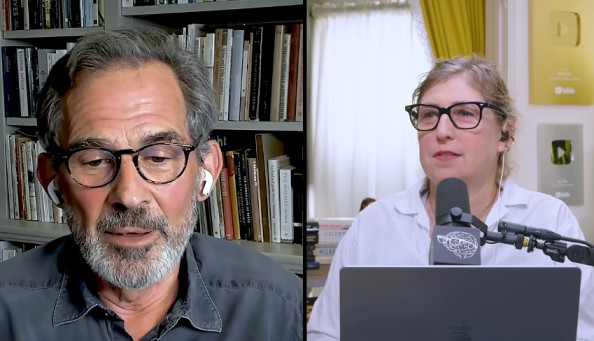
Editor’s Note: In this episode of Mayim Bialik’s Breakdown, Mayim Bialik and Jonathan Cohen sit down with Rupert Spira, a leading teacher of non-duality and the Direct Path, to explore the true nature of consciousness, awareness, and being. Rupert explains why the paradigm of separation is the root of personal suffering and global conflict, guides Mayim through a live experiment in the experience of “I am,” and reveals why enlightenment is not an exotic experience but a simple recognition available to everyone right now. This interview was premiered on September 29, 2026.
TRANSCRIPT:
Introduction
MAYIM BIALIK: (00:01:04 – 00:01:05): Hi, I’m Mayim Bialik.
JONATHAN COHEN: (00:01:06 – 00:01:07): And I’m Jonathan Cohen.
MAYIM BIALIK: (00:01:07 – 00:01:30): And welcome to our breakdown. We’ve got a lot of shocking questions to ask today. What if every major religion has actually misunderstood not only the true nature of God, but our true essence? What if there was a fast track to enlightenment that all of us can access for free right now?
JONATHAN COHEN: (00:01:31 – 00:01:40): And what if we’ve actually been lied to about what enlightenment actually is? We’ve been sold courses and books and steps and paths, and none of them are actually leading there.
MAYIM BIALIK: (00:01:41 – 00:02:49): Our guest today does not promise anything except access to the part of you that has always been and will always be. Rupert Spira is a leading voice of clarity in contemporary spirituality, He is known for his ability to guide people to a direct experience of their innate happiness, their essential nature. He uses what’s called the Direct Path approach. I had never heard of it, but he’s going to explain non-duality to us. And this is, I’d say, one of our more intellectually astonishing episodes.
He listened to our episode with Bernardo Kastrup to prepare for this episode, and he holds incredible retreats, which you can learn about at rupertspira.com/events. He’s got a podcast. It’s the Rupert Spira Podcast. I highly recommend You Are the Happiness You Seek: Uncovering the Awareness of Being, which is a fantastic exploration of all of the questions that we ask. But I’m going to be honest, we ask a lot of them today. It is a pleasure to welcome Rupert Spira to The Breakdown.
RUPERT SPIRA: (00:02:50 – 00:02:52): Thank you for inviting me. Pleasure to be with you.
Rupert Spira’s Path and Mission
MAYIM BIALIK: (00:02:52 – 00:03:27): I’ve heard your name from many different people. Pete Holmes, who we’ve had on the podcast, spoke about you actually in our episode. And obviously we have a lot of other overlap. You’re one of these names that kind of keeps coming into my life. People keep mentioning you here and there, and obviously your body of work is vast and so important, and we can’t wait to get into all of it. But I wonder if you can give our audience a little bit of an introduction to, to put it plainly, who you are in terms of your mission and your life path and how you intersect with others and why it’s important.
RUPERT SPIRA: (00:03:27 – 00:06:30): So I have been exploring and practicing the nondual understanding for exactly 50 years. And for the first 35 years, it was just my private practice. I was working in my studio as an artist. It never occurred to me to write about these matters or speak about them. Anyway, 15 years ago, I did write a book. I thought I would then just go back to my studio and spend the rest of my life in my studio, which is what I always thought I was destined to do and indeed wanted to do.
And then I started getting invitations to speak and hold retreats, and one thing led to another. And so I then gave up my life as an artist and just devoted my time full-time to writing and speaking about the non-dual understanding, writing, holding retreats, meetings, and so.
Why does it matter? Because our culture is founded on the assumption of separation, that we are all separate individuals, separate from each other, separate from the world. And I don’t need to describe the inevitable consequence of the paradigm of separation which informs our world culture. One quick look at the news will show that the inevitable consequence of the assumption of separation outside of yourself, out in the world, but the extent of sorrow, suffering, anxiety that people feel on the inside is the inevitable consequence of the assumption of separation internally.
So why does it matter? Because any solution to the sorrow and conflict which we witness in our world today from within the existing paradigm may at best temporarily alleviate the situation but won’t make any fundamental change. A fundamental change has to come from outside the paradigm, and that is what the non-dual understanding suggests— that the recognition of the unity of being, the unity that underlies everyone and everything.
So that’s why it matters, because it is the ultimate answer both to sorrow, anxiety on the inside, and conflict in the world between individuals, communities, and nations. And my mission— I wouldn’t go so far as to call it a mission, but My vision is just to share my understanding, such as it is, with as many people as would like to know about it.
Why Separation Leads to Suffering
MAYIM BIALIK: (00:06:31 – 00:06:59): A lot of people might hear this and think, oh, that’s something for optimists. That’s something for people who are not engaged in the world. He doesn’t know what it’s like to be me. Can you explain why suffering results from this separation, both on a personal level and on a larger level. And if that also leads to an explanation of nonduality, this would be a great time for that too.
RUPERT SPIRA: (00:07:00 – 00:08:10): If we don’t recognize who we essentially are, if our identity is derived solely from our thoughts, our feelings, our narratives, sensations, perceptions, activities, relationships, and so on, we will inevitably feel that we are a fragment, incomplete, lacking something.
And likewise, conflict. Again, if we feel that we are an individual separate from another, that what we essentially are is separate from the other, then that will allow us to treat others in a way that we would never want to be treated ourselves. It denies the fundamental unity that we share with all beings, and therefore, conflict is the inevitable consequence of this belief in separation.
What Is Non-Duality?
MAYIM BIALIK: (00:08:11 – 00:08:33): I’m holding just 2 of your books here, which I especially am recommending You Are the Happiness You Seek because of the sort of format, which I think is really helpful because it’s taking the questions that we all want to keep pushing on to be met with some sort of equanimity. But can you explain a little bit what non-duality is?
RUPERT SPIRA: (00:08:34 – 00:10:30): Non-duality, it’s the understanding that underlies all the great religious and spiritual traditions, and that has been spoken of for the last 3,000 years by different people at different times in different cultures, in different languages, in different ways, and so on. But the core understanding that lies at the foundation of all the great religious and spiritual traditions is the same understanding, and it’s very, very simple. Namely, peace and happiness are the nature of your being, and you share your being with everyone and everything. That’s basically it.
Now, why does it seem to be complicated? Why have the traditions elaborated so many methods and pathways and practices and so on? Because of our difficulties and objections and questions. So when we’re met with a non-dual understanding, we say, let’s take the first definition: peace and happiness are the nature of your being. You might think, “Well, that’s funny. When I look inside, I don’t find peace and happiness. I think conflict and suffering and sorrow and anxiety punctuated by brief moments of peace and happiness. I would say that suffering was my bottom line, and peace is just a brief respite from it from time to time.”
So then in response to that, the teaching then has to elaborate a pathway to help people recognize that actually the fundamental of nature of their being is peaceful. And depending on the time, the place, the person, how intellectual the person might be, how in their feelings, how heart-centered the person might be, the teaching will elaborate different pathways to suit different temperaments and different levels of understanding. So the non-dual teaching has grown very complex. It’s expressed in so many different ways in different traditions, but the core understanding is very, very simple.
Why Do People Kill in the Name of God?
MAYIM BIALIK: (00:10:31 – 00:11:56): Even though when many of us look inside, we’re not tapping into peace and happiness, the notion that many meditators and those of particular religious traditions, those who have transcendental experiences, people who have had psychedelic experiences, there’s a similar message there. We are all connected and that our true essence The truest essence of us is not what many of us are interacting with when we look in the mirror, when we look inside.
But one of the things that I think is a challenge for a lot of people, we’re in an age of spiritual but not religious, right? And I’ve been a person of faith my entire life. And one of the things that people most point out to me is religion is the cause of all of our suffering, all of the wars that are fought, all of the people killing in the name of God. You could even look at, our current political climate, the global climate, how much of our life— and I’m being the devil’s advocate here, right? I have my own personal explanations, but I wonder if you can speak to, from the perspective of if peace and happiness is at the core of all of the great religious traditions for thousands and thousands of years, why do people fundamentally kill, pillage, take land in the name of God?
RUPERT SPIRA: (00:11:58 – 00:13:04): Simply because they misunderstand the core message of their religion. And when the founders of those religions— and of course the founders of the religions didn’t realize they were founders of religions, that came later— but when the founders of the religions were speaking about these matters, that they were usually speaking to small groups of people, but when they passed away, others who didn’t share their understanding then took their teaching, appropriated it, mixed it with their own level of understanding, misrepresented it, used it for their own egoic purposes and so on.
So as the religions evolved, they got more and more distorted and then used in the service of the ego. Whereas, and hence giving rise to all the atrocities that you mentioned. What we now know of as religion is so very far from the fundamental truth that the founders of the religions spoke of.
Does Non-Duality Require a Belief in God?
JONATHAN COHEN: (00:15:31 – 00:15:40): Does non-duality require a belief in a higher power, in a universal force, or a deity or God?
RUPERT SPIRA: (00:15:40 – 00:17:36): Absolutely not. Nonduality requires you to explore, challenge every single belief you have— not only the belief in an external God or a higher power, but your belief in yourself as a man or a woman, as a person. And in fact, it primarily requires an exploration of yourself, because all you know of the world, or indeed a higher power, stands in relationship to yourself.
So your knowledge of anything— your knowledge of the world, your knowledge of a higher power, your knowledge of anything— will always be a reflection of your knowledge of the nature of the knower. So everything that is known stands in relationship to the knower, be that an ordinary thought, an emotion, the world, a higher power, the idea of God. Everything stands in relationship to yourself. It is always you that knows your experience.
So non-duality fundamentally asks you to question that you, that self upon whom all your other experience relies. And it basically says, until you understand yourself, until you know who you truly are, you cannot know what anything is, because everything stands in relationship to yourself.
So no, not only does non-duality not require a belief in a higher power, non-duality is a questioning of all beliefs, even our most fundamental belief Namely that I am primarily a body, primarily a person, primarily a man or a woman. It’s a very gentle but radical investigation. It makes no assumptions at all.
“I Am That I Am”: The Highest Expression of Truth
MAYIM BIALIK: (00:17:37 – 00:19:27): For many of us who use a text, let’s say, that is quite old, if nothing else, right? We can know that it’s old. What you’re asking me to do, and I’m happy to do it, but what you’re asking me to do is to step out of even the most basic texts, right? Specifically of Judeo-Christianity, because the Old Testament is already— forgive me— several, several steps away from this peace and happiness that we’re seeking. And there are many, many beautiful aspects to Judeo-Christianity and to those kind of origins.
But once you get to the Old Testament, And I’m speaking as someone who has studied it for most of my life in one form or another. Once you get to the Old Testament, there is a God of vengeance and wrath, and there is territory, and there is a lot of suffering that we are essentially, and most of us don’t keep to this, but the notion of many of these religious traditions are about tribalism and about territory, right?
When I tap into the parts of, let’s say, religious experience that are beyond that or before it. Yeah, I think about what it must have been like for Moses to have a mystical experience that then was written about, right? Or I think about what it was like for prophets to be in some sort of dream state and envision things that no one could yet imagine. How do we reconcile that most of us have been handed traditions that already are quite far removed from these original sources?
RUPERT SPIRA: (00:19:28 – 00:20:19): Well, some of the Old Testament may be far removed, but I would also suggest that the Old Testament contains within it what I consider to be the highest formulation of the absolute truth. Ever spoken by anybody in any tradition at any time.
God replied to Moses when Moses asked God, when he— I think he was due to see the Israelites the next day, and he said to God, “When I meet them, who shall I tell them that you are? What can I say to them about who you truly are? How can I explain? They don’t understand what you truly are. They have all these beliefs about you, and— but what can I say about them to let them know who you truly are?” And as you well No, God said, “Tell them that I am just what I am.”
MAYIM BIALIK: (00:20:20 – 00:20:22): Ehyeh asher ehyeh is the Hebrew, yes.
RUPERT SPIRA: (00:20:22 – 00:20:43): I would suggest God saying, “I am just I am.” That idea, that statement is the foundation of all the great religious and spiritual traditions. It’s the high— I would suggest the highest expression of truth in the English language if properly understood.
MAYIM BIALIK: (00:20:44 – 00:20:59): I want you to help us expand that out. Let’s remove the Old Testament from it. Let’s remove Judeo-Christianity from it. Help us understand why this concept is literally universal.
RUPERT SPIRA: (00:20:59 – 00:21:06): Can you say from your experience now, “I am”? Is it true of you?
MAYIM BIALIK: (00:21:07 – 00:21:11): I think so, but I really respect you. So if you tell me that I’m wrong, I’ll believe you.
RUPERT SPIRA: (00:21:11 – 00:21:15): No, no, I’m going to— I’m going to say, of course you can say that.
MAYIM BIALIK: (00:21:15 – 00:21:17): Okay, of course I can say that, Rupert.
RUPERT SPIRA: (00:21:17 – 00:21:27): Of course. I mean, let me ask you the opposite question, Mayim. Can you say of your experience now, “I am not? I do not exist?” No, of course not.
MAYIM BIALIK: (00:21:28 – 00:21:30): Saying “I am not” presupposes that I am.
RUPERT SPIRA: (00:21:30 – 00:21:49): What I wanted you to say when I asked you, can you say from your experience now, “I am”? What I was hoping you would say and what I want you now to see as true that yes, of course, that “I am” is my most fundamental experience. But “I am” refers to the experience of just being.
MAYIM BIALIK: (00:21:50 – 00:21:53): It’s consciousness, awareness, nothing mystical.
The Golden Thread of Being
RUPERT SPIRA: (00:21:53 – 00:23:44): This is nothing to take religion, meditation, philosophy, non-duality, everything, nothing. I’m not referring to anything spiritual or enlightened or just the ordinary intimate everyday familiar feeling of being. You’re having that experience. You have it all day long. Everybody has it all day long. Just that simple.
And common parlance betrays this. All day long, we either think or feel or say, “I am waking up. I am tired. I’m having a shower. I’m having a cup of tea. I’m traveling to work. I’m answering an email. I’m lonely. I’m sad. I’m excited. I’m in love. I’m 22. I’m 47. I’m married. I’m divorced.” On and on and on and on. “I’m having a conversation with Mayim and Jonathan,” etc.
Always, always, always, “I am” temporarily qualified by a thought, a feeling, an activity, a state of mind, an age, or a relationship. But the “I am” is the same “I am.” When you say, “I am now having a conversation with Rupert,” and you said this morning, “I am now having breakfast,” it— you referred to the same self, the same being.
So being is the— it’s the golden thread that runs unbroken throughout all experience, and it’s the only experience there is that is constant. The awareness of being, the experience of being. No other experience you have ever had— experience consists of thoughts, images, feelings, memories, sensations, perceptions, and so on. None of those are constant. They are all temporary, coming and going continually.
MAYIM BIALIK: (00:23:45 – 00:23:50): But I’m always here having all of those experiences, thoughts, feelings.
RUPERT SPIRA: (00:23:51 – 00:25:32): You are always present, having your waking state experience. You remain present during your dreams, aware of your dreams, and you remain present in deep sleep, aware of nothing. So this “I am,” this just simple awareness of being, it runs continuously present through all experience and is temporarily qualified by the content of experience— thoughts, images, feelings, and so on.
I’m trying to answer you, but experientially, not philosophically. I’m trying to draw it in answer to your question about what God meant by “I Am That I Am.” This awareness of being is your primary experience. It’s your most essential experience.
Take a newborn infant. A newborn infant doesn’t know that it is a newborn infant. It doesn’t know that it has just been born. It doesn’t know that it is a girl or a boy. It doesn’t know that it is a person. It doesn’t know that it has a mother. It doesn’t know that there is a world. But it has the experience of being. It can’t conceptualize that experience, of course, but the core experience of being is its primary experience.
I want, first of all, to draw attention to this ordinary, familiar experience of being before it is qualified by experience. If being was like the screen, experience would be like the movie. Can I do an experiment with you?
An Experiment in the Experience of Being
MAYIM BIALIK: (00:25:32 – 00:25:33): I love an experiment.
RUPERT SPIRA: (00:25:33 – 00:26:02): Okay, great. Go now to the— just to the ordinary, intimate, familiar experience of being. The experience that enables you to say, “I am,” before that experience is mixed with the content of your experience, before any thoughts, feelings, sensations, perceptions, memories. Try and go there and then tell us something about that experience if you can.
MAYIM BIALIK: (00:26:06 – 00:26:11): Well, it’s still It’s quiet.
RUPERT SPIRA: (00:26:12 – 00:26:14): It’s quiet. Yes. Yes.
MAYIM BIALIK: (00:26:14 – 00:26:18): And I would say if I had to describe it, it’s unproblematic.
RUPERT SPIRA: (00:26:18 – 00:26:32): Only refer to the experience, not to any ideas, just the pure, simple experience of being. Does it have an age? Imagine you don’t have the faculty of thinking and remembering.
MAYIM BIALIK: (00:26:32 – 00:26:37): Ah, no. Then it has no age. It’s got no age. It’s got no age, it has no gender or shape.
JONATHAN COHEN: (00:26:37 – 00:26:37): Yeah.
RUPERT SPIRA: (00:26:38 – 00:26:45): Prior to— imagine that you don’t yet have the faculty of perception. It’s like you’re deeply asleep, right? But you’re wide awake and aware of being.
MAYIM BIALIK: (00:26:45 – 00:26:45): Right.
RUPERT SPIRA: (00:26:46 – 00:26:54): Is the experience of being— if you just isolate the experience of being, does it— is it located anywhere?
MAYIM BIALIK: (00:26:54 – 00:26:54): No.
RUPERT SPIRA: (00:26:54 – 00:26:59): Does it have any extension in time or space prior to thought and perception?
MAYIM BIALIK: (00:26:59 – 00:27:00): No.
RUPERT SPIRA: (00:27:00 – 00:27:42): How would you describe philosophically something that has no extension in time or space. Eternal and infinite. It has no extension in time, which is just another way of saying it’s eternal, and it’s not expended in space. It has no finite dimensions. It’s infinite.
We’re not talking philosophy. We’re just talking your experience. Not some mystical experience, not some enlightened experience, not some experience that some sages have access to that we don’t have access to. Just the ordinary, intimate, feeling of being before it is mixed with or qualified by experience. It’s eternal and infinite. Now go back to the idea of God. How would you describe God’s being?
MAYIM BIALIK: (00:27:43 – 00:27:46): I mean, we call it Ein Sof, that which has no end.
RUPERT SPIRA: (00:27:47 – 00:28:05): That’s another way of saying eternal. Yeah. God’s being is infinite and eternal. You recognize that your own being, before it is mixed with or qualified by experience, is infinite and eternal. And God’s being must be infinite and eternal. How many infinite eternal beings can there be?
MAYIM BIALIK: (00:28:05 – 00:28:07): Just one.
Your Being Is God’s Being
RUPERT SPIRA: (00:28:08 – 00:29:49): Just one. And this is the— this is the core understanding at the heart of non-duality. There’s only one being, that your being is God’s being, the only being there is.
But the reason we feel that we’re temporary finite beings— in other words, separate individual people and so on. It’s because our being— we don’t experience our being purely, essentially as it is. We experienced it mixed with our thoughts, feelings, sensations, and perceptions. So instead of experiencing the pure “I am,” we experience “I am tired, I am lonely, I am sad, I am a man, I am a woman, I am,” etc., etc., etc.
So that all the methods, I would suggest, in all the great religions and religious and spiritual traditions, one way or another, more or less directly— not necessarily as directly as I have just done with you— that the purpose is to take you to your being before it is qualified by experience and to recognize that your being is God’s being, the only being there is, that there is only God’s being. And everyone and everything borrow their apparently independent existence from that one being.
That’s non-duality. And I don’t think it differs very much from your religion. It doesn’t differ from any religious or spiritual tradition if you go right to the core of that. The language we use and the methodology we use, of course, differs, But the core understanding is the same.
JONATHAN COHEN: (00:29:50 – 00:30:16): I think this particular experiment is the fastest way to access something that so many teachers and paths, but to be able to that quickly drop into something that is spoken about and courses are sold on and yet that right there, all of a sudden, you can have access to it right away.
RUPERT SPIRA: (00:30:16 – 00:30:19): Exactly. Exactly. Unmediated access.
Peace Is the Nature of Being
JONATHAN COHEN: (00:30:20 – 00:30:35): How do we know that the nature of the human experience or our natural nature is that to be peaceful, joyous? I don’t want to misquote you, but you gave a description at the beginning of the podcast, and then that answers it.
RUPERT SPIRA: (00:30:36 – 00:31:43): The very first thing that Mayim said when I said, “Go to your being,” and I could see that you not just following me philosophically, but you— I could see you had gone back to your being. I think the very first thing you said was, “It’s quiet.” That’s it. That’s it.
Your thoughts may be agitated, your feelings may be sorrowful, your body may be in pain, the world may be in chaos, but if you go to your being, it’s quiet. You didn’t make it quiet by stilling your thoughts, or it its nature is peace, irrespective of what is taking place in your thoughts and feelings. Its nature is peace. And that’s not— it’s not a belief. You— it was the very first thing you said, Mayim. You said, “It’s quiet.” That’s it.
Now, that peace is available— is available to everybody, 24/7, just by virtue of the fact that everyone is continually having the experience of being. Everyone is aware of being, and anyone can go to their experience just like we did then and access this peace.
Being and Consciousness Are the Same
MAYIM BIALIK: (00:31:44 – 00:31:55): When we talk about consciousness as fundamental, this is, I think, a philosophical question. Where does this come from, this ability to have I-am-ness?
RUPERT SPIRA: (00:31:56 – 00:33:34): The fact that you are able to say from your current experience “I am” means that not only that there is being, but that you are aware of being. Your table can’t say, “I am.” The table is. It undoubtedly is. But it can’t say, “I am.” There’s nothing it is like to be a table. But you can say, “I am,” because you are aware that I am.
So, when you say, “I am,” what you’re really saying is, “I know that I am. It is my experience that I am. I am aware that I am.” Yes. Now take these 2 statements. One, “I am.” And 2, “I know that I am.” Now take the I that I am and the I that knows that I am? Are there 2 different I’s in you, or is it— it’s you that knows that you are?
In other words, your being is self-luminous or self-aware. You are aware of yourself, the same self. So the being that you essentially are is not an inert being. It’s aware being or awareness or consciousness. So the words being and consciousness are synonymous.
Near-Death Experiences and the Locus of Perception
MAYIM BIALIK: (00:36:41 – 00:37:18): Jonathan and I speak to a lot of people who have extraordinary experiences, many of whom are declared dead, let’s say, in hospitals, and they’re brought back. And in many cases, they are witnessing and experiencing things that seem to be as if consciousness is a thing that leaves a body and can go other places. How do we reconcile these kind of conversations, which do happen in the world of theoretical physics and things like that? How do we reconcile that with the I who’s in this meat suit right now?
RUPERT SPIRA: (00:37:19 – 00:38:09): When people say they’re lying on a hospital bed, they’re having an operation, they wake up in the operation, and they view the operation from the corner of the room. What has changed is the locus of their perspective. Consciousness hasn’t moved or changed. They’re just looking at the world from a different location. Their perceiving faculties, right, have been altered.
And because of this close connection between consciousness and perception, they mistakenly believe that consciousness has left their body. It’s not. They’ve just had an altered state of perception, means that they’re now experiencing the room from a different location in space. It’s perception that’s changed, not consciousness.
MAYIM BIALIK: (00:38:09 – 00:38:18): So they’re still them. I mean, the most important thing for us is that they’re still aware, right? That they are them.
RUPERT SPIRA: (00:38:19 – 00:38:58): You don’t need to have a near-death experience to experience this change in the locus of your perception. Imagine tonight you fall asleep in LA, you dream that you’re on a Caribbean beach. Yeah. Now you view that Caribbean beach from the location of somebody on the beach. In the Caribbean. Your consciousness hasn’t moved, but your locus of perception has moved from L.A. to Caribbean. So we’re all quite familiar with this, that the mechanics of perception changing.
MAYIM BIALIK: (00:38:58 – 00:39:23): But I’m not picturing things that are actually happening on that Caribbean beach. I think that’s my challenge is when people are reporting things that are happening in rooms that they’re not in. And information seems to be existing in ways that the I who I am can’t— and I don’t know either. I’m not convinced here.
RUPERT SPIRA: (00:39:24 – 00:40:00): But you’re asking me questions about the content of consciousness. My interest, and I think our interest, is the nature of consciousness. Whether you’re having a regular experience, like each of us now is having a conversation like this, whether you’re having a psychedelic trip, whether you’re having a vision of God, whether you’re having a near-death experience or an out-of-body experience or whatever— nevertheless, whatever you’re experiencing, however ordinary or extraordinary it might be, it takes place in consciousness and it is known by consciousness.
Is Consciousness in the Brain?
JONATHAN COHEN: (00:40:01 – 00:40:05): We have people try and say that consciousness is in the brain?
RUPERT SPIRA: (00:40:06 – 00:41:12): The reason we think this in our culture is because just for the last few hundred years, we’ve been brought up in a culture that believes that the evidence of sense perception— sense perception gives us apparent evidence of a physical world, that pre-existing us as a person. So we presume that consciousness is generated by the body, which in turn was generated by the world, and so on. So we have this vision, this paradigm of matter being the fundamental reality and consciousness being a derivative of it.
But this is in fact not consistent with our experience. If you stay very close to the evidence of experience, Being aware is your primary experience. Nobody has ever experienced anything prior to consciousness. Have either of you ever had an experience of anything— 2 things: one, prior to consciousness, and 2, outside consciousness?
MAYIM BIALIK: (00:41:13 – 00:41:24): Not me. Not this one. Jonathan, do you believe, either for yourself or other people, that you can have memories in utero.
JONATHAN COHEN: (00:41:25 – 00:41:32): Yes, but that would be still being aware of—
MAYIM BIALIK: (00:41:32 – 00:41:33): this is up to Rupert—
JONATHAN COHEN: (00:41:33 – 00:41:34): still have consciousness.
RUPERT SPIRA: (00:41:34 – 00:41:54): Yep, yep. You could have a memory in you, an experience in utero, but if you did have an experience in utero, where would that experience take place? In consciousness. What would it be known by? Consciousness. Let’s say you have a vision of God. Where would that vision take place?
JONATHAN COHEN: (00:41:55 – 00:41:55): In consciousness.
RUPERT SPIRA: (00:41:56 – 00:42:27): The only place it’s possible for any experience to take place— in consciousness, known by consciousness. Now ask yourself, have you, or indeed anyone— think of the billions of people, think that include all the animals, trillions of beings— Has anybody ever had an experience prior to consciousness? Consciousness is the prerequisite for experience. An experience without consciousness is not an experience.
JONATHAN COHEN: (00:42:28 – 00:42:49): What the materialist point of view would say, well, of course that’s the case because we have a brain. And so if we have a brain that has our consciousness in it, I can’t have an experience or a memory or a vision without having the brain. And then therefore, which, so it doesn’t fully explain it.
RUPERT SPIRA: (00:42:49 – 00:44:45): I understand that. I would say a mind rather than a brain. I understand it’s not possible to have objective experience without a mind. For instance, it’s not possible to see the world, experience the world without the faculty of perception. A human mind consists of thinking and perceiving. I agree, in the absence of thought and perception, there is no objective experience— deep sleep. But that doesn’t tell us anything about consciousness. It just tells us about the absence of thought and perception.
The reason that a materialist scientist would say that consciousness is generated by the brain is simply because they don’t realize how profoundly they have bought into the prevailing materialist paradigm that presumes matter is the ultimate nature of reality. They have simply subscribed unconsciously to that belief, built a model of reality based on it. And not only that, their identity is invested, and their whole career and their identity is invested in that belief.
So they are perfectly capable of following the conversation that we’re having now. But if your identity is invested in a belief, then you’re no longer willing to really scrutinize that belief because you’re— it’s not just the belief that’s at risk, it’s your identity, your sense of yourself that is being challenged.
And if the— your sense of yourself, your sense of your ego, it feels— the ego always has to be invested in something, in some belief, or If the belief is taken away from the ego, the ego dies. So that’s why people defend their beliefs so tenaciously, people that are perfectly intelligent enough to recognize that matter is obviously not the fundamental nature of reality, but because their identities are invested in that belief, they hold onto it.
Why Materialism Dominates Our Culture
MAYIM BIALIK: (00:44:45 – 00:44:56): I like that for 35 years you were making beautiful pottery and thinking all these things, and now you get to, like Godzilla, you get to come into the world and be like, “You’re all wrong. Matter is not the nature of reality.” Of reality.
RUPERT SPIRA: (00:44:57 – 00:46:40): 2 reasons why that this prevailing materialist paradigm has just taken over our entire culture, and we could explore either of them. One is that most people feel that being the body is their primary experience. That’s a mistake. Being aware is your primary experience.
If you think that being a body is your primary experience, you will then consider that awareness or consciousness is a faculty of the body, like breathing or digesting. You’ll think it’s something that the body has or generates. But being a body is not our primary experience. Being aware is prior to the sensations and perceptions that constitute our experience of the body.
Our only knowledge of the world is sense perception— seeing, hearing, touching, tasting, and smelling— and we think that our sense perceptions are like a clear windscreen onto reality. We believe the evidence of sense perception, and sense perception tells us there is a physical world outside our individual mind. I would suggest there is a reality outside our individual mind, but it’s not a physical reality.
So the combination of these 2 aspects of our experience— one, the belief that being a body is my primary experience, and 2, believing that the evidence of sense perception conspires to create this prevailing materialist paradigm that dominates our world culture. But neither of them stand up to the scrutiny of experience. Neither of those 2 beliefs stand the scrutiny of inquiry or experience.
Awareness Never Changes
MAYIM BIALIK: (00:46:41 – 00:46:55): I wonder if you can give us any window into how we can expand this into individuals who don’t communicate in the ways that we typically would to assess awareness.
RUPERT SPIRA: (00:46:55 – 00:47:09): You are now aware of your experience, the sight of my face, the sight of your room, the sound of my voice, your thoughts, and so on. Now go back. It’s morning your time. Go back to dinner last night.
MAYIM BIALIK: (00:47:10 – 00:47:10): Okay.
RUPERT SPIRA: (00:47:11 – 00:47:15): Whatever you were experiencing at dinner last night, you were aware of it.
MAYIM BIALIK: (00:47:16 – 00:47:16): Yep.
RUPERT SPIRA: (00:47:16 – 00:47:25): Obviously, the content of your experience now and the content of your experience yesterday have changed numerous times.
MAYIM BIALIK: (00:47:25 – 00:47:25): Okay.
RUPERT SPIRA: (00:47:26 – 00:47:33): What about the awareness with which you are aware of this experience and yesterday’s experience?
MAYIM BIALIK: (00:47:34 – 00:47:34): It’s the same.
RUPERT SPIRA: (00:47:34 – 00:47:40): It’s the same. And what about the experience that you had 10 years ago? Is it the same awareness or different awareness?
MAYIM BIALIK: (00:47:41 – 00:47:43): The quality of awareness changes over time.
RUPERT SPIRA: (00:47:44 – 00:47:49): The content of awareness changes over time. The quality of your experience has changed.
MAYIM BIALIK: (00:47:49 – 00:47:50): Sure.
RUPERT SPIRA: (00:47:51 – 00:48:22): Now you’re having a friendly conversation. Last night you were having an argument with a friend or whatever. In other words, you can have 2 very different types of experience, one very positive, one very negative, one very pleasant, one very unpleasant. But the awareness with which these 2 different experiences are— it’s the— is the same. The awareness is the same. Now, imagine that last night you had had far too much to drink and you were drunk. So you were experiencing an altered state.
MAYIM BIALIK: (00:48:22 – 00:48:24): Oh yeah, yeah, right.
RUPERT SPIRA: (00:48:24 – 00:48:27): You were aware, whatever it— whatever that altered state was, you were aware of it.
MAYIM BIALIK: (00:48:30 – 00:48:30): Yes.
RUPERT SPIRA: (00:48:30 – 00:48:40): The content of your mind, the content of your experience had changed, but you were still aware of the experience. Yes. The awareness hadn’t changed. The content had changed.
MAYIM BIALIK: (00:48:41 – 00:48:41): Yes.
RUPERT SPIRA: (00:48:42 – 00:50:07): Take that even further. Imagine that you were very sick, or imagine that you went through an episode of some severe mental or emotional trauma, and the content of your mind was severely changed. I’m bringing in what you said about people with locked-in syndrome, or go to the extreme, more extreme than just getting drunk.
What I’m trying to point out is that the awareness that the person with, say, locked-in syndrome has, and the awareness with which you and I are aware of our current experience, is exactly the same awareness, the same quality. The content is very different. But the awareness hasn’t changed. The screen is always the same. The movie can be a love story, it can be a horror movie, it can be— but the screen is always the same. Consciousness is like the screen. It doesn’t change.
You can check that in your experience if you ask yourself, what is that? Okay, I’m going to do the experiment again. I am— you are now having the experience of being aware. So tell us about that experience. You are aware that you’re conscious. Don’t tell us about what you’re aware of. Don’t tell us about your thoughts, feelings, memories, but just that pure experience of being aware. How would you describe it?
MAYIM BIALIK: (00:50:08 – 00:50:11): Well, it doesn’t feel that different from being.
RUPERT SPIRA: (00:50:11 – 00:50:32): Perfect. It’s the same. Now imagine now that you’re deeply depressed. Yeah, imagine that now in this moment. Imagine that you’re deeply— you’re still having this conversation, but underneath you’re feeling wretched and depressed. And yeah, now do the same experiment. Tell us about the awareness with which your deep depression is known.
MAYIM BIALIK: (00:50:33 – 00:50:38): I’m blending the wretchedness with the awareness.
Unblending: The Ultimate Healing
RUPERT SPIRA: (00:50:39 – 00:52:02): That’s the primary methodology of the nondual understanding. Unblend your being from the content of your experience. For the vast majority of us, for the vast majority of time, our being, or the experience of being aware, or consciousness, is completely blended with experience. So we don’t know ourselves as we essentially are. We don’t know the pure “I Am” with its inherent peace and fullness. We know, “I am lonely, I am depressed, I am agitated,” etc., etc.
But if you unblend your experience just by going back to the simple awareness of being, you recognize that your being is whole, unblemished, unhurt, untarnished, that there’s a place in you that has never been traumatized by anything that has ever happened to you.
So this recognition of the nature of your being, it’s the ultimate healing. Not the healing that takes place in 20 years’ time after 20 years of therapy. And I’m not saying that’s not valid. It’s valid and necessary. But the ultimate healing is to recognize that your being now is whole, is perfect, is at peace. It’s never been hurt by experience, just like a screen is never hurt by the movie.
MAYIM BIALIK: (00:52:03 – 00:53:14): What I’m struck by, and this is one of Jonathan and my favorite games, One of our favorite games in the hundreds of episodes that we have done here over the years that we’ve been sitting talking to people is there are a few messages that are universal, whether you’re speaking to philosophers, theoretical physicists, healers, internal family systems folks, people like Pete Holmes who have done the work on themselves. There are a few very, very basic universal messages And everybody’s going to get them different ways.
Some people are going to go to South America and they’re going to have an ayahuasca experience. And some people are going to do the classic psychoanalysis with a therapist who’s also doing Jungian shadow work. And some people are going to be in their pottery studio and they’re going to study and learn. I don’t know how many ways Jonathan and I can bring this information to be. I love it because everyone needs to hear it a different way. How many times has my therapist told me, “Unblend from that hurt part. Unblend.” This is the work that you do.
The Direct Path
RUPERT SPIRA: (00:53:15 – 00:54:37): Well, Jonathan, you said something very interesting. I think after the first experiment I did with Mayim, you said something like, “That’s the most direct way. That’s the—” I think you said it’s the fastest way that I’ve ever seen anyone. If I were to give what I do a name. It would be the Direct Path. It’s not a term that I coined. And the Direct Path means exactly what you referred to, Jonathan, just that it’s— you go directly from whatever you’re experiencing straight back to your being.
Whereas, and I can do that with you two because I know that you’ve— not only are you knowledgeable and experienced and you’ve explored these matters, you can’t do that with everyone. And that’s why the traditions have elaborated so many methods.
For some people, for instance, their trauma, their shame, their fear, their sorrow is so intense that they just can’t get through it. They can’t turn away from it and go all the way back to their being. And therefore, the traditions elaborate more progressive paths that may involve exploring your trauma, your shame, your guilt, to soften up the mind, so to speak, before it’s ready to go directly back to being.
JONATHAN COHEN: (00:54:38 – 00:55:10): The path that you provided was extremely direct. And what I was struck by was Mayim, who will say often her mind is so busy, often with song lyrics and endless ideas. For her to say that it was quiet is actually more striking than I think our reflection and our response to the exercise may have indicated initially. I do want to put a really emphasize this. It’s very rare that she ever says something is quiet.
RUPERT SPIRA: (00:55:10 – 00:56:15): That’s a beautiful observation. When I asked you the question, Mayim— go back to your being and tell us about it, I didn’t really want you to tell us about it, but I wanted you to go there. To ask you to tell me about it means that you have to experience it. If I were to ask you now, tell me about the tingling sensation at the soles of your feet, you would go to that experience. You wouldn’t think about dinner last night. You’d go to that experience.
I wanted you to go to the experience of being and taste it. And it was beautiful. I didn’t comment on it, but you paused. I asked the question, you paused, and then you said, “It’s quiet.” It’s in that pause You had turned your attention away from the content of your experience. You were not thinking about your thoughts, your feelings, the interviewer. You just went back to your being and you tasted it. You recognized it and you came back. It’s peaceful. That’s the essence of meditation.
Returning to Being in Daily Life
MAYIM BIALIK: (00:56:16 – 00:58:28): If you had asked me to do this 5 years ago, 10 years ago, I don’t know that I would have the slightest. I’m one of those people, I’m a— I’m not a slow learner, I’m a fast forgetter. I’m one of those people, and that’s just the way God made me. I need this information a lot of ways. I need to come at it from every neuron, right?
So I’ve had a few instances of this, and I hate to tell people there’s no quick way to this. For some people there is. We spoke to Thomas Campbell’s a great example. The first time he tried Transcendental Meditation, he was skyrocketed into the universe and lost time, lost space, all this amazing stuff. That’s not my experience.
But when I was practicing Kundalini yoga, there’s a lot of conversation about ways to get in touch with this part. And I’m not saying that’s the only way. People do it a million different ways. But for me, I remember I was in my class, and there’s all these meditations that they do throughout. And it’s a very, very serious practitioner, the woman who’s our teacher.
I don’t know what it was on this particular day when we were doing this meditation. It was like I could hear the inside of my brain. That’s the best way to describe it. It’s like everything went quiet. It was like I went underwater, the best way to describe it. Or if you all of a sudden put in earplugs And it was like, and I, it was like I could hear silence, the sounds of silence. And I of course was thinking, which I know is a different place to be, but there was this moment where there was no thought.
And it was just, it was, I don’t want to say it was nothing. It was everything, that’s the best way to describe it. That place is a place I keep trying to get back to, right? It’s the place I keep trying to return to. And I do believe, and this is from a lot of years of a lot of anguish and yes, a lot of complexity. Some of us have more impediments than others to get to that place. So that’s what I keep trying to get to.
RUPERT SPIRA: (00:58:29 – 01:00:14): I think that it is as a result of all this preliminary work that you have done that enabled you, when I asked you the question, what is the nature of your being now, to pause and say, “It’s quiet.” Now, having— in other words, in that moment, you went directly, yes, back to your true nature. You didn’t go via Kundalini yoga or via mantra meditation or via— so now all you need to do in future is, instead of having me ask yourself the question, you can just pause and you can ask yourself, “What is the nature of the awareness with which I am aware of my current experience?”
Whether you’re depressed or agitated or lonely or excited or sick, you just— but what is the nature of the awareness with which I know this experience? And that will take you straight back. And all that you need to do is stay there rather than answering the question and then describing it. Just stay there. Just stay there for a few minutes and then go back out into your life. And every time you go back there, it gets easier.
To begin with, your being is just a place you visit in yourself in between all the other experiences. Then you stay there for 10 seconds, you go straight back to it. But each time you go back to your being, the capacity that your objective experience has to take you away from your being weakens, and it gets easier and easier to go back and easier and easier to stay there until in time, you begin to feel that you live there.
You don’t just visit it from time to time. It’s like, “This is who I am. It’s always— I can live there. I can still go out into the world, but I don’t leave home. I stay in my being.”
JONATHAN COHEN: (01:00:15 – 01:00:17): Is this the answer to everything that ails us?
RUPERT SPIRA: (01:00:18 – 01:01:18): It’s an answer to the existential sense of lack and the conflict that dominates most people’s lives, yes. It’s not an answer to earthquakes, so not everything, but in terms of our personal psychology and relationships, conflict in relationships, individuals, communities, nations, yes.
Blaise Pascal, the French mathematician, 300 or 400 years ago. He said that all of humanity’s— I’m sure you know this— all of humanity’s problems can be traced back to the fact that a person cannot sit alone in their room without doing anything, by which of course he included thinking. In other words, they can’t go back to their being for 5 minutes and stay there. All of humanity’s problems come from that. So, Jonathan, I would answer I would say yes.
Being in Relationships and Conflict
JONATHAN COHEN: (01:01:19 – 01:02:07): Thinking about us being able to go home into ourselves, into our being. And my sister actually and I, we have this saying, we’ll chat and be like, “What’s going on? How have you been?” And sometimes it’s like, “Oh, too much doing, not enough being” as the reason why we’re out of balance or feeling shitty or, I don’t think people have a being practice. We don’t have the practice of how much being have I done in my day, in my week as a health metric. But what does it look like in couples? What does it look like when 2 people are in an argument at each other to return to being before you continue interacting?
RUPERT SPIRA: (01:02:08 – 01:04:39): You are completely lost in your thoughts and feelings and you are reacting from your thoughts and feelings. You’re upset, you’re hurt, you’re irritated, you’re angry. And we all know what that feels like. You’re responding to your partner from that place in yourself.
Now imagine it in that argument if you were able to take a step back from your thoughts and feelings to the experience of being where it’s peaceful. There’s no reactivity there. There’s no resentment there. There’s no hurt there. You were able to go back there, and then from that place, you were able to stand as that and then continue the conversation. It would have a profound effect on the quality of your response. That’s one thing.
The second thing, you remember my initial provisional definition of non-duality. Peace and happiness are the nature of your being. That’s the first thing. Secondly, you share your being with everyone and everything. There’s only one being. Now, there’s only one being, then if you— I know we all understand this, but if you really feel that your partner is not another being like you, your partner’s being is your being.
That the space in your room in LA and the space in my room in the UK, it’s the same space. They’re not 2 individual spaces. There’s only one vast space in the universe, seemingly separated by every building into numerous spaces, but there aren’t numerous spaces in the universe. There’s one space. Likewise, there’s one infinite being— in religious language, God’s being— seemingly bounded by thought and perception, seeming to appear as an individual being, but in reality the same being.
Now, if you not only understand that but feel that— and that recognition of our shared being is what we commonly call love. That’s what love is, the felt recognition that we are one, that we share our being. If you feel— if you’re having an argument with your intimate companion, and yet you feel that their being is your being. In other words, you are them, they are you. Again, how will that affect both the quality and the content of your conversation?
JONATHAN COHEN: (01:04:40 – 01:05:19): From my experience, it will change the tenor, it will change the tone, it will change how quickly I respond, it will change how much I hear their perspective or not. Where I get a little tripped up and where I think psychology and we’ll call it a spiritual perspective of interconnectedness maybe start to overlap is, well, do I have to do what they want? What if their emotions are not— it’s when it gets into the practical, do I really want to go to this event or actually I don’t and then they’re going to be upset? And how do you navigate hurt feelings on that level also?
RUPERT SPIRA: (01:05:20 – 01:05:58): I don’t mean to imply that you will therefore agree on everything. There will still be disagreements because disagreements take place at the level of the mind. Disagreements are always between minds. 2 beings never disagree. The being never disagrees with anything. It’s 2 minds that disagree, and all of our minds are conditioned and limited. So there will inevitably be disagreements between minds. But if those disagreements are negotiated, from a felt sense of shared being, then the disagreement doesn’t then lead to conflict, animosity, and so on.
JONATHAN COHEN: (01:05:58 – 01:06:05): And potentially a lot less hurt feelings if someone decides, “Wait, I just, I’m not available,” or it becomes less of a narrative.
RUPERT SPIRA: (01:06:05 – 01:06:41): Extend this between warring nations. You don’t have to look far at the wars that are happening in the world. Imagine if the perpetrators of these wars knew— not just knew, but felt— that they shared their being, that they were one, that they shared their being with the people that they were attacking, it would be impossible. So this would have a profound effect, not just individually, but in society in general, if this understanding, the unity of being, became mainstream.
Hurt Is What You Feel, Not What You Are
MAYIM BIALIK: (01:06:41 – 01:07:46): Jonathan and I had an incident that I’ll be very vague about, but Jonathan had his feelings hurt this weekend. Something occurred in me that was kind of beyond the content, and I don’t know if it was a moment of enlightenment, but when I sort of tuned in, all I felt was that this was a person. And I don’t know that I was the hurter. Someone hurt this person, right? But that’s what I sort of tapped into.
And I’m not saying I do this perfect, by no means. But it was interesting that sometimes when someone is hurt, a connection point can just be that, right? Just recognizing that someone is hurt without trying to fix it or explain it Or defend it, right? I mean, am I getting close to what it looks like to cooperate? If you have two people who are in that state, I think that’s where it can feel impossible because no one has a touchpoint, right?
RUPERT SPIRA: (01:07:46 – 01:09:46): Yes, absolutely. So one person is hurt, and then the second person you describe that they listen, they’re open, that they don’t attack, they don’t defend, they In other words, the person who is listening, allowing, they are standing in their being. They’re not standing in their reactive mind. They’ve taken a step back.
So the person who is non-reactive, open, understanding, tolerant, considerate, gentle, kind, they are modeling being by standing in the face of the other person’s hurt. And in a way, that is the— that’s the most healing position you can take, because you’re modeling for the other person the place that they can go to in themselves.
For instance, Jonathan, you were hurt. It was obviously not your body. It was your psychological self. There was a self in you. When you felt inside, you felt, “I am hurt.” But now, if you had asked yourself, “But who am I deeply in this moment? Who am I really?” Hurt is what I feel, not what I am. If hurt was what you are, then you would always be hurting. But hurt is something you experience from time to time.
So if you had been able to unblend yourself from your hurt, just take one small step back, that my being lies behind my hurt, that the hurt is just the movie on the screen, I am the screen. It doesn’t mean that the hurt feeling would not continue, but you’d no longer be feeding it with your belief that it’s who you are. And without that support, it would gradually diminish.
Feeling the Feeling vs. Stepping Back
JONATHAN COHEN: (01:09:47 – 01:09:59): I wonder what the balance between the idea that one should feel the feeling, allow it to dissipate, versus step back slightly and do that process.
RUPERT SPIRA: (01:09:59 – 01:11:08): To feel the feeling, you have to stand as the witness of it. Someone says to you, you’re feeling depressed, and they said, “Well, feel the full— feel that feeling, be aware of that feeling fully.” That places you— that suggestion places you in the position of the witness. Be aware of your depression. So in a way, just that statement invites you to take a step back and be the space for your feeling, but know that you are the space.
And just like physical space, nothing that takes place in physical space can hurt it. It’s the same with your being. Nothing that takes place in your experience can hurt the being or the awareness within which that experience takes place.
And by saying, “Feel the experience,” what you’re really being asked to do is be the allowing of the experience. Stand as that allowing openness that allows the experience to arise. But you aren’t that experience. You are the space in which it arises.
What Enlightenment Really Is
JONATHAN COHEN: (01:11:09 – 01:11:21): Do you think what you’re describing, being in this space, being the witness at this level, having an awareness of our being, is this what you believe the word enlightenment means?
RUPERT SPIRA: (01:11:22 – 01:12:13): The way I would define enlightenment would be the recognition of the nature of being. So there are 2 steps. There’s one step is to unblend yourself from experience, go back to the experience of being or being aware. That’s the first step, to recognize I am fundamentally awareness. I’m not what I am aware of. That’s the first step. That’s not yet what is traditionally called enlightenment, but it’s a— it’s one step on the way.
The next step is to recognize the nature of the awareness that I am. It’s inherently fulfilled. It’s peaceful. It’s ever-present. It has no limits. So enlightenment would be the recognition of the nature of being.
JONATHAN COHEN: (01:12:13 – 01:12:17): So first is unblending from thoughts, feelings.
RUPERT SPIRA: (01:12:17 – 01:12:31): Yeah. Take a step back from the content of your experience. Recognize yourself as the witness. Of that experience. But that recognizing yourself as the knower or the witness is not yet what is traditionally called enlightenment.
MAYIM BIALIK: (01:12:31 – 01:12:48): Wait, does that have to be positive? Because enlightenment, you think, oh, enlightenment is— I mean, I don’t mean to apply good and bad and positive and negative to this, but most of us think of enlightenment as a state of bliss. So is it a positive recognition or not necessarily?
RUPERT SPIRA: (01:12:48 – 01:13:14): Strictly speaking, it’s neither positive nor negative. But as a— it’s legitimate to say it’s positive with reference to the previous negative content of your experience. But really, the idea that enlightenment is positive is a thorn that is used to remove the thorn of your previous negative experience. When it’s done that, both thorns should be thrown away. It’s neither positive nor negative.
JONATHAN COHEN: (01:13:14 – 01:13:39): Also, because I’m auditioning for Rupert’s assistant, if peace and happiness are the nature of our being and we are recognizing the nature of our being as you did when you went to being aware at the start of this exercise, then naturally that has a lot of positivity, for a lack of, not to put a label on it.
RUPERT SPIRA: (01:13:40 – 01:14:05): Yes, absolutely. In fact, that was what I was going to add. That we could say enlightenment is the recognition of the nature of our being and living that recognition to the best of our ability in our life. So it would include the expression of that understanding in our life. So it’s not just an inner experience, it’s a lived experience. Yes.
Enlightenment Is Not an Experience
JONATHAN COHEN: (01:14:05 – 01:14:30): There’s a lot of, I think, misnomer about the nature of enlightenment because It’s sold as you are now glowing and sort of you don’t walk anymore, you generally hover around the world, which seems pretty cool. And then it’s also described as there is no such thing as enlightenment. There are only moments of enlightenment that you can then try and stitch together more frequently.
RUPERT SPIRA: (01:14:30 – 01:15:43): Jonathan, I couldn’t agree with you more. I think the word enlightenment is one of the most, if not the most misunderstood word in the entire spiritual literature and has caused people to travel not only intellectually but physically around the world in search of some exotic experience.
Enlightenment is not an experience. It’s not an exotic experience. It’s not an experience at all. It’s a recognition of the nature of that which experiences. It has nothing to do with what you are experiencing. So it’s not a blissful experience. It’s a recognition of the nature of that which experiences.
So I agree that— and by the way, I fell into this trap for years. I’m not immune to this misunderstanding. I had this misunderstanding for years that enlightenment is some marvelous, extraordinary experience that if not try hard enough or practice long enough, maybe in 20 or 30 years’ time, I will have this marvelous experience. And if I haven’t had this marvelous experience, it means I’m ignorant. I don’t know my own being.
MAYIM BIALIK: (01:15:44 – 01:15:45): You’re not trying hard enough.
RUPERT SPIRA: (01:15:45 – 01:15:59): There’s a story from the Zen tradition. I think it was Shunryu Suzuki, a Zen teacher. Somebody asked him in one of his meetings, “Why do you never talk about your enlightenment experience?”
MAYIM BIALIK: (01:15:59 – 01:16:00): Experience?
RUPERT SPIRA: (01:16:00 – 01:16:05): And apparently his wife, who was sitting at the back of the hall, stood up and said, “Because he never had one.”
MAYIM BIALIK: (01:16:06 – 01:16:06): It’s always the wife.
RUPERT SPIRA: (01:16:07 – 01:16:10): Oh, it’s always the wife. Absolutely. Yeah.
JONATHAN COHEN: (01:16:10 – 01:16:49): We hear a lot of people who have had these miraculous awakenings from being a pure materialist to sitting down and doing Transcendental Meditation and having an internal journey that revealed the nature of reality, or someone who started meditating and after a few sessions got hit with this sense of knowing that the universe is fully interconnected and just feeling all the bliss and their brain or wherever hormones are coming from release everything. And all of a sudden they’re on the best drugs in the world.
MAYIM BIALIK: (01:16:49 – 01:16:52): And it lasts. I think that’s what’s interesting.
JONATHAN COHEN: (01:16:52 – 01:17:15): Yes. Some people it lasts and other people they have this unbelievable moment and then realize that reality is not what they seem and their life changes. And then they don’t necessarily live in that state always. But yeah, I’m curious how you reconcile that with slow moments of realization as just everyone on their own path.
RUPERT SPIRA: (01:17:15 – 01:19:13): Jonathan, I think what you are describing is not enlightenment. It’s the effects that enlightenment may have on a person’s mind. So, enlightenment is the recognition of the nature of being, and it’s not an experience, let alone an exotic experience.
Now, that recognition, it can happen very quietly. There’s just this recognition, then your mind comes back. You may not even know the— when I say you, the mind may not even know that it has been interrupted by this plunge into being. The mind might just carry on, but it will be affected by this brief recognition of your true nature. And the more and more of these recognitions you have, the more and more the mind will gradually be impacted by it. So in this case, I’m describing one end of the extreme. The mind may barely register that anything has happened.
On the other end of the extreme, you could have this glimpse of your true nature, this recognition, and that recognition may have such a powerful effect on your mind and your body that there’s this terrific expansion of the mind, or, and/or, a great relaxation of the body, which we, as we all know, when the body relaxes, it often— we often cry or laugh. That’s an expression of relaxation.
So this, the effect, the aftereffect of this transparent recognition of your true nature can in some cases have this terrific effect on the mind and/or the body. But that would be the aftereffect in the mind and the body of this transparent recognition of your true nature. It’s not the recognition itself.
Synchronicity and the Consciousness-Only Model
JONATHAN COHEN: (01:19:13 – 01:20:06): If we explore the interconnected nature of individuals and all things, what do you make of synchronicity? And is there something about becoming more aware of this interconnection? Meaning, as we unblend, do we become more aware of it?
Mayim. In the last, I think it was yesterday, she said to me, “In the last 3 days, 3 different times, I think about someone and they either call or I call them and they’re like, ‘I can’t believe I’m thinking about you.'” Now, this is obviously not a double-blind experiment, but it seems like there is a state that we can achieve, a more being state. People call it, well, you’re going against the flow of life. And there seems to be something where we become more aware of the interconnected nature of everything.
RUPERT SPIRA: (01:20:07 – 01:22:22): Yes. Under the prevailing materialist paradigm, these kinds of events shouldn’t happen, or if they did, they would be explained by coincidence alone. But they happen far too often to be explained by coincidence, and they can be explained very, very easily under the consciousness-only model, that this new paradigm that places consciousness as fundamental, namely that the mind that we are on the inside and the matter that the world appears to be made out of on the outside are in fact two different aspects of the same reality.
Just like when you fall asleep and you dream that you’re on a Caribbean beach, you view the Caribbean beach from the localization of the person you seem to be on the Caribbean beach, and that person’s experience seems to be divided into mind on the inside and matter on the outside. But when you wake up, you realize that there weren’t these 2 separate realities, mind and matter. It was all the activity of the dreamer’s mind.
So if we consider that the world, as I would suggest, the world that consciousness is the ultimate reality of the universe and that we are all localized perspectives within consciousness, and that we look out through our perceiving faculties at what is in fact the activity of consciousness, but it looks like a physical world only because we see it through the lens of perception. In which case, what the world is on the outside and what we are on the inside are the same system.
So we should expect that there would be a very close correspondence between what appear to be physical events in the world and our own internal psychological or emotional life because they are two aspects of the same system. And this would explain synchronicity. You have a thought about something, which is a mentation, it’s a mental event, and there’s a physical— it corresponds to something physical in the world because the world is not really physical. It only looks physical because we view it through the lens of perception.
MAYIM BIALIK: (01:22:23 – 01:23:16): I’m not saying that you’re a far-out person, but for me in my head, this feels like a very far-out idea because these 3 synchronous things that happened happened after I had some sort of shift in a lot of— there’s a lot of other pieces to this, it’s not important for us to talk about, but something happened where I felt a shift and then this happened, that 2 days later.
So I’m trying to think, is it possible that whatever shift had happened that made me feel more connected, coherent, whatever it is, that that opened me up to seeing or being part of these synchronous moments. I guess my question being, are people who are tapping into this more likely to experience these moments of connection and synchrony?
Is There Anything Other Than Knowing?
RUPERT SPIRA: (01:23:16 – 01:23:24): Certainly more likely to notice them, but I think also more likely to experience them. Yes. Can we do another experiment? Can I ask you another question?
MAYIM BIALIK: (01:23:24 – 01:23:28): Yeah, it’s kind of stressing me out because I want to get it right. But yes, go ahead.
RUPERT SPIRA: (01:23:29 – 01:23:42): So just take your current experience. Yeah, this conversation, your thoughts, feelings, sensations, perceptions. Is there anything to your current experience other than the knowing of it?
MAYIM BIALIK: (01:23:43 – 01:24:02): This one is disturbing because I want to say, of course there is. I make an imprint in this world. I’m moving around. I put the key in the car. But I think the answer is no, which begs the question, How do I know any of this is real?
RUPERT SPIRA: (01:24:02 – 01:24:14): You’re right that it— there’s nothing to your current experience other than the knowing of it. It’s very easy to check that. If you were to remove knowing from your current experience, what would remain?
MAYIM BIALIK: (01:24:15 – 01:24:17): I would not have an experience.
RUPERT SPIRA: (01:24:18 – 01:24:23): You would not have an experience. Yeah, that you can’t even say there’d be nothing because you wouldn’t be there to be aware of nothing.
MAYIM BIALIK: (01:24:24 – 01:24:26): No, it would be the absence of anything.
RUPERT SPIRA: (01:24:27 – 01:24:33): Have you ever had an experience of anything other than the knowing of experience?
MAYIM BIALIK: (01:24:33 – 01:24:33): No.
RUPERT SPIRA: (01:24:34 – 01:24:37): Is there anything to any experience other than the knowing of it?
MAYIM BIALIK: (01:24:38 – 01:24:38): No.
RUPERT SPIRA: (01:24:39 – 01:24:54): How do we know that there is anything other than knowing if you admit from your own experience that knowing is all you ever experience? How do we know that there is anything other than knowing?
MAYIM BIALIK: (01:24:55 – 01:24:55): We don’t.
RUPERT SPIRA: (01:24:56 – 01:26:05): We don’t. So, it’s not— I’m not the one that’s far out. The people who are far out are the people who— and this is our world culture— are the people who believe that there is something other than knowing called matter, because matter is considered to be that which exists outside consciousness or outside knowing.
Not only do they believe that matter is the ultimate reality, but they then believe that knowing or consciousness is generated by matter. That is far out. It’s madness. It’s like believing that waves generate oceans and movies generate screens. And yet our culture is founded on that single idea.
And look at what is taking place in the world. Could it be that this— the madness of our world, the extent of the sorrow and the conflict is a direct consequence of this mistaken view of reality that we have, the paradigm of separation?
MAYIM BIALIK: (01:26:06 – 01:26:50): How many people have I met in my life, or how many people have all of us met who say, “I know the truth with a capital T.” And it usually is. It’s a belief system or it’s a religion or it’s a set of whatever that they believe you should believe in. Meaning, I mean, it’s kind of the foundation of a lot of religious kind of misdirection. But that there are those, to me, those people are the same far out as materialists at point, right? For you to suppose that you found the one God that knows what I should eat, drink, cover my head with, all of that, that’s far out.
RUPERT SPIRA: (01:26:50 – 01:27:04): It’s just a refinement of materialism. It’s materialism with a religious name. And the consequences, as you said at the beginning of the conversation, that they’re even worse than regular materialism. But it’s basically the same belief.
What Happens to Consciousness After Death?
JONATHAN COHEN: (01:27:05 – 01:27:12): What happens to our knowing when our physical bodies no longer exist? Because it’s hard to know what happens to our knowing.
RUPERT SPIRA: (01:27:13 – 01:27:22): I would suggest that the same thing happens to knowing when your physical bodies exist as will happen to the space in your room when your house is one day demolished.
JONATHAN COHEN: (01:27:25 – 01:27:28): It just goes back into the collective space.
RUPERT SPIRA: (01:27:28 – 01:28:07): It doesn’t even go back. It was never— it was never a separate space to begin with. It was always only the vast space of the universe. It doesn’t go anywhere. It was never limited in the first place. It assumed an apparent and temporary limitation. When that limitation was removed, it was just revealed as it eternally is.
This— I think the same will happen with your being. Your being will not be liberated from its limitations. I would suggest your being, our being, everyone’s being is already God’s infinite being temporarily clothed in human experience. And seeming as a result to be a finite person.
JONATHAN COHEN: (01:28:07 – 01:28:19): Do you think that character of being evolves in some way, learns, grows, or do you think it’s simply just the nature— it just exists and doesn’t change?
RUPERT SPIRA: (01:28:19 – 01:28:42): No, I think the experience of being you have on the moment you’re born and the experience of being you have on your deathbed is the same experience. The screen at the beginning of the movie and the screen at the end of the movie, no change in it. It doesn’t evolve. The content of the movie evolves, but the screen doesn’t. It’s the same. Consciousness doesn’t evolve.
JONATHAN COHEN: (01:28:43 – 01:28:46): Consciousness does not evolve. It’s the same consciousness.
RUPERT SPIRA: (01:28:47 – 01:29:14): The mind evolves. Mind, which is the activity of consciousness, thoughts and perceptions, emotions. The mind evolves, grows, changes, and so on. But the consciousness that is the fundamental nature of the mind doesn’t evolve. The awareness with which the Buddha knew his experience is in exactly the same condition as the awareness with which you and I know our experiences. There’s no change.
The Soul and Reincarnation
JONATHAN COHEN: (01:29:15 – 01:29:22): And the idea of the nature of the soul as this continually reincarnating—
RUPERT SPIRA: (01:29:22 – 01:30:32): that the soul is the religious name for the mind, the mind in the broader aspect, the individual mind. And yes, the individual mind may well— there’s nothing to suggest that the individual mind doesn’t continue when the body dies.
If the mind were likened to a wave on the ocean, if an individual were likened to a wave on the ocean, just a temporary localization of the one ocean, When that wave dissipates, that would be the moment of death. The energies that constituted the wave while it existed may not dissipate entirely into the ocean. They may spread out in the ocean as ripples, and those ripples still have an energy to them. Those ripples could gather together and form the basis of a new wave.
So I think there is legitimacy to the idea that the soul outlives the body and possibly reincarnates. I don’t want to go— now we’re in the realm of belief. I’m not talking from my experience, so I’m cautious to go there.
JONATHAN COHEN: (01:30:32 – 01:31:36): I appreciate that. And also, people do try to reconcile some of the backend, call it the mechanisms of our existence, and how is it that people seem to contact those people who have past. What is the nature of a human being, both an awareness and being aware of ourselves is an aspect, and also the unique characteristics that make up us.
We’ve spoken to people, a medical doctor who lost a husband and then began to change her understanding of the nature of reality because had after-death communication and interaction with this person and said, “Well, we can’t only be matter if all of a sudden I am now connected to an energy that is— I’m aware of this energy and communicating with this energy outside of physical form.” It starts to break down the materialist point of view.
RUPERT SPIRA: (01:31:37 – 01:32:38): During this conversation, I’ve tried to stay very close to only speak about what we can verify in our current direct experience. Of course, that leads me— because knowing is the only substance that has ever been known or could ever be known, I think that’s a legitimate reason for building a model of the universe based on the fact that knowing or consciousness is fundamental, simply because it’s our experience.
You can then extrapolate that model and use it to explain how someone might come in contact with someone after they had died, But there— so the model can explain that, which of course materialism can’t. But it’s still going into the realm of speculation, using the model to explain phenomena, which I do do sometimes. I’m willing to do that, but I try to be cautious about what I can say for certain from experience and what is then building a model of experience to explain something.
Nothing Is Ever Created or Destroyed
MAYIM BIALIK: (01:32:39 – 01:33:40): Sam Harris is often critical of kind of coming up with an image of the external world based on one’s internal experience, right? Especially very specific and kind of intimate experiences for meditation. We can’t necessarily build a world on that. But I think it’s really, it’s very important. And it’s a line that we appreciate you toeing with us because we think that there’s been such a separation between sort of these schools of thought of people who say, “I’ve experienced things that I know are true or can be verified in some cases.” And what does it say about the larger kind of nature of our experience?
I had a really dumb, 7-year-old question, is there room for all the souls in the world? I need to stop thinking like that. I was thinking if everybody’s consciousness is just all It’s just all floating around and everybody dies, but nobody really dies. We’re just all there in oneness. Where do we go? Is there room?
RUPERT SPIRA: (01:33:40 – 01:35:40): There’s a line in the Bhagavad Gita: “That which is never ceases to be, and that which is not never comes into existence.” So that which is— let’s go back to religious language that we started with— that which is is only God’s infinite being, eternal, infinite, self-aware being. And that’s all there is. And it’s continually modulating itself, localizing itself as a seemingly finite mind, and then viewing itself through the perceiving faculties of that finite mind and perceiving itself as the universe. There’s no real physical universe there. It’s just what God’s infinite being looks like. When it’s mediated through the finite mind.
So that nothing— in the ultimate analysis, the very, very highest teachings, they say there’s no creation. When you hear that, it feels like a denial of our experience. It feels like a nihilistic point of view. It’s not that at all. In fact, it’s an upgrading of the world. It’s not a denial of the world.
What it’s saying is that nothing Nothing new comes into existence because anything that came new into existence would be something that was temporary and finite. All there is is God’s eternal being continually modifying itself in all the forms of experience but never actually ceasing to be itself. So, nothing is ever created, and by the same token, nothing is ever destroyed.
You never die. You were never born. You never really die because you never came into existence. The space in your room never came into existence as a separate space and therefore won’t go out of existence as a separate space. It was just seemingly limited by the 4 walls, but it— the separate space never came into existence, and it won’t die. It won’t go away. It’s the same with our being.
MAYIM BIALIK: (01:35:41 – 01:35:45): “There’s nothing new under the sun.” That is the Ecclesiastes version.
RUPERT SPIRA: (01:35:45 – 01:35:50): Exactly. You see, it’s there in the Old Testament, correctly understood. It’s all there.
Rupert’s Parting Advice
MAYIM BIALIK: (01:35:51 – 01:36:31): Rupert, this has been unbelievable. Your writing is obviously incredible. You do amazing retreats. But if nothing else, podcasts exist so that people who never would know about you or who wouldn’t have the patience or the ability to kind of read your books— I’m so grateful that we get to have this format. I don’t even credit you with the wisdom. It’s the wisdom that has been passed down to you that you have this incredible ability to transmit. What would you like to leave us with for people who maybe are new to this kind of thinking? What would be something that you’d like to leave us with as a sort of punctuation to this incredible conversation?
RUPERT SPIRA: (01:36:32 – 01:37:14): I would just suggest to everyone, from time to time, pause. Take a step back from the content of your experience, whatever the content is— your thoughts, your feelings, your relationships, your— just pause. Untangle yourself. Take a step back. “What is it that is aware of my experience?” And that, just that question, takes you back from the content of your experience to your being, the fact of being or being aware, and just stay there. Just go back there. Just rest there. That’s your home. You’re always safe there. You’re always at peace there.
MAYIM BIALIK: (01:37:15 – 01:37:23): Rupert Spira, thank you so much. It’s been such an honor to get to speak with you. We really, really appreciate your time. And yeah, just thank you so much.
RUPERT SPIRA: (01:37:23 – 01:37:29): Thank you very much for inviting me. It’s been a pleasure and an honor to be with you both. Thank you, both of you.
Mayim and Jonathan’s Reflections
JONATHAN COHEN: (01:37:33 – 01:37:36): I’m ready. What’s the matter?
MAYIM BIALIK: (01:37:37 – 01:37:42): My brain hurts. It’s not Rupert Spira’s fault. It’s just, it’s a lot.
JONATHAN COHEN: (01:37:43 – 01:37:50): You know why? Because you’re holding on so tightly to your experience that you’re not willing to look at the screen, I guess.
MAYIM BIALIK: (01:37:50 – 01:37:58): Well, it’s not even about looking at the screen. I need to be one with the screen and know that the screen doesn’t change no matter what the movie is.
JONATHAN COHEN: (01:37:59 – 01:39:15): I was thinking about how similar this was to things that Michael Singer talks about, but in a different way. The notion that I am not whatever I’m experiencing— sadness, hunger, other emotions. Hunger is harder because you kind of want a sandwich, but you have to move through your emotions, but you don’t have to be in them so much that they drown you. And how is it that by having a practice of coming home to ourselves, even in a very simple way, it can help us move through the experiences that we have and remember that part of us?
I thought about you, and I thought about a lot of the somatic work you’ve done, a lot of the trauma work you’ve done. This notion comes up across people, especially who have complex PTSD, that there broken in some way, that their experiences have marked them. And even especially if they’re young childhood experiences, they get very intertwined with them naturally, and they can lose a familiarity or remembering that there is an aspect of them, even in this moment, that exists outside of all of those experiences and that they can access it.
MAYIM BIALIK: (01:39:15 – 01:40:03): Well, first of all, I think what you just said is beautiful, but a little bit I feel That’s not the main message I got. The main message I got is we’re all in a state of blending to one extent or another, all the time, all the time. And everyone has a different path to ways to unblend that. There’s not one path, there’s not one answer.
I’m sure that we could map out the kinds of people who do better with this than that. But you know what, what I’m thinking is, F everyone who’s ever said to me, “I know what will work for you,” because guess what? You don’t. It’s a process of figuring out what kind of person you are and what you need.
JONATHAN COHEN: (01:40:03 – 01:40:14): Earlier in the episode, you experienced the true nature of reality. You had a glimpse of enlightenment, and you come 90 minutes later, swing in your fists.
MAYIM BIALIK: (01:40:14 – 01:41:32): You know why I think that is the difference, let’s say, between your experience and mine? Because I think everything that you said is true. I think that everything that Rupert said is also true. But I am struck by the ways that we’re encouraged in our culture, in our family, in whatever language we speak, to get there. And I think it’s got a lot of variability.
And we’ve spoken to people, as you said, Dr. Tara Swart, who saw her dead husband at the foot of her bed. Not a vision, but it was him, right? We’ve spoken with people who’ve died and seen things and experienced things and traveled places outside of the room that their body was in. We’ve spoken to a variety of people, right? We’ve spoken to people with all these different experiences.
And for some people, being abducted by aliens might be the way to get in touch with this connection we have with all of humanity, God, and the universe. Who am I to say that I know, right, that someone did or didn’t have an experience? That’s the experience this universe gave them. I can’t explain it. I don’t know. But the people who’ve died and come back seem to have the best idea. We chose this. We’re here for Earth school. Class is in session.
JONATHAN COHEN: (01:41:32 – 01:41:37): And also something made the song lyrics in your head go away. So that was amazing.
MAYIM BIALIK: (01:41:38 – 01:42:01): That’s true. So much more to talk about. Please join us over on Substack. Cannot wait for you all to hear not only the conversation over there, but we can’t wait to hear from you what this episode resonated in you, what this brought up for you. So please check us out on Substack, Mayim Bialik’s Breakdown, bialikbreakdown.substack.com. And from our breakdown to the one we hope you never have, we’ll see you next time.
RUPERT SPIRA: (01:42:01 – 01:42:08): It’s Mayim Bialik’s Breakdown. She’s going to break it down for you. She’s got a neuroscience PhD or 2.
MAYIM BIALIK: (01:42:09 – 01:42:10): One fiction, one science.
RUPERT SPIRA: (01:42:10 – 01:42:14): And now she’s going to break down. It’s a breakdown. She’s going to break it down.
Related Posts
- Transcript of Shawn Ryan Interview on Diary Of A CEO Podcast
- Transcript of IVF Pioneer Robert Winston Interview on TRIGGERnometry
- Transcript: Mike Glover Interview on Doomsday Prepping – Tucker Carlson Show
- Transcript of Richard Werner: Greatest Fraud In Human History – Peter McCormack Show
- Transcript: World’s First AI Actress Interview on Piers Morgan Show: ft. Tom Conti, Tom Bilyeu & Prof Jiang