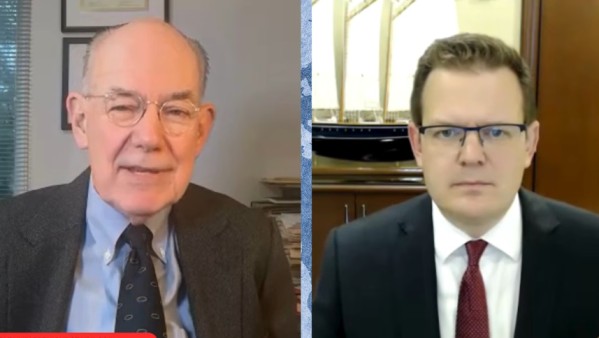
In this interview with Glenn Diesen, University of Chicago professor John Mearsheimer explains why the United States is avoiding escalation with Iran in the Strait of Hormuz and what the final US withdrawal from Iraq means for America’s security umbrella over the Gulf states. He also discusses buck-passing, Israel’s influence on US Middle East policy, the nuclear question, and the growing danger of a war between Europe and Russia as the US pulls back from its alliances. This interview was premiered on October 1, 2026.
TRANSCRIPT:
Is the US Escalating With Iran?
GLENN DIESEN: (00:00:01 – 00:00:36) Welcome back. We are joined today by John Mearsheimer, a professor at the University of Chicago, to discuss what is happening now in the Middle East. I’m glad to see you because this is quite confusing to me. We see Trump at the United Nations threatening to annihilate Iran after the midterms. At the same time, we see huge movement of arms. The US just pulled out of Iraq after 23 years. Well, how are you interpreting all of these events? Are we looking at an escalation, or is there any other way of looking at this?
JOHN MEARSHEIMER: (00:00:38 – 00:04:28) Well, with regard to the question of escalation, it appears that the United States has no interest in escalation. And the best evidence of that is that the Iranians have been attacking ships in the Strait of Hormuz. In a quite vigorous way over the past few days. And according to news reports today, the Iranians claim that they hit 4 ships overnight, and yet the United States is not retaliating.
In the past, this would have led to a tit-for-tat strategy where the Iranians attacked vessels in the strait, and then the United States responded against targets in Iran, and then the Iranians responded against targets inside of countries like Saudi Arabia, Kuwait, and so forth and so on, where you had American military bases. But so far, we have not seen any evidence of that. For quite a few weeks now, the United States has stayed away from going up the escalation ladder militarily.
The Iranians themselves are a different question. There’s all sorts of evidence that more oil is now coming out of the Strait of Hormuz. And apparently, that is somewhat weakening Iran’s bargaining position. And many people are hypothesizing that the Iranians really don’t have much choice but to escalate.
For example, it’s quite clear that a lot of oil is being loaded in Ras Tanura, which is the principal port in Saudi Arabia. Earlier in September, earlier in this month, there were about 1.5 million barrels a day being loaded onto tankers at Ras Tanura. That’s 1.5 million in early September. It appears that now about 6.5 million barrels a day are being loaded onto tankers at Ras Tanura. Well, it is possible. I’m not saying that this is likely, but it is possible that the Iranians could decide to hit Ras Tanura to restore their leverage over the United States in this conflict.
So what’s going on here is that people do not see evidence that the Americans are interested in escalating. At least at this point in time. And they do see lots of evidence that the Iranians have an incentive, a powerful incentive to escalate, and that there are targets the Iranians can go after, like Ras Tanura or the pipeline that goes across Saudi Arabia that was shut down for a while but now is operating at 40% capacity and is on its way to being restored to full capacity. So the Iranians could go after the pipeline as well as Ras Tanura. And there are, of course, other targets in places like the UAE and Kuwait as well. And of course, the Iranians will surely continue to target vessels that are trying to go through the Strait of Hormuz.
So that’s the basic situation as things stand today. With regard to escalation, but as you know, Glenn, what the situation will look like in a week’s time is hard to say because this war has great potential to escalate on both sides.
Buck-Passing in Europe and the Gulf
GLENN DIESEN: (00:04:31 – 00:05:25) That’s a good point. Next week, the world can look very different already. I was wondering how you see the wider U.S. strategy, though, because you use concepts like buck-passing, that is to have, shift the cost of war to someone else. And I was wondering if you see any of this now in the US strategy, because certainly in Europe, we’ve seen some of this, the desire to essentially put the Ukraine war on the shoulders of the Europeans, that they have to finance this.
And we heard similar reports in the Middle East that the US has been seeking for countries like Saudi Arabia to take more of a direct role. Do you think there might be Again, to be honest, the US also asks Europe to take greater responsibility in the Middle East. But do you think this is something the US might try, or has this option been exhausted by now? That is, make its frontline states carry the weight.
JOHN MEARSHEIMER: (00:05:26 – 00:09:02) Yeah, just to talk about Europe for a second, what’s going on there is that the United States is trying to buck-pass to the Europeans and get the Europeans to be principally responsible for supporting Ukraine. So that the Americans can back off as much as possible. And in that case, the Americans have a partner that they can buck-pass to. The Europeans are deeply committed to the Ukraine war, and they are willing to allow the United States to buck-pass to them. So it works there.
But the question you have to ask yourself with regard to the Gulf, and the Iran War is who can the United States pass the buck to? I mean, the Saudis, the UAE, Kuwait, none of these countries are capable of picking a fight and winning a fight with Iran.
And in fact, what the United States is trying to do, as I said in my opening comments, is avoid getting into a shooting match with the Iranians. Remember, we started off with this 40-day bombing campaign. Then we had a number of tit-for-tat campaigns, which were limited military strikes by both sides against each other that went on for a few weeks at a time. We stopped engaging in those tit-for-tat operations because, number one, they didn’t work, and number two, we were expending precious munitions.
So what we’re trying to do now is just sit on the sideline and not get involved in a military engagement with the Iranians and instead rely on economic pressure. It’s the blockade plus the Bessent strategy to strangle Iran economically, to cut off all Iranian economic intercourse with the rest of the world, plus the blockade. Those are the sort of 2 aces in the hole for us at this point in time, or at least so we think, but we’re not trying to buck-pass to anyone to fight the war for us because again, there’s nobody there.
Just one final point on buck-passing. The real buck-passers here, and they’ve done a brilliant job, the real buck-passers is Israel. Israel dragged us into this war. They bamboozled Trump, got us into the war. They engaged in the 40-day bombing campaign with the United States, but once that was over with, the Israelis have largely remained on the sidelines. And they’ve turned the responsibility of dealing with Iran over to the Americans.
But just to make a final point here, we cannot buck-pass to the Israelis. I mean, if there is a military in the region that has the capability to engage the Iranians, it is the Israelis. But we’re not buck-passing to the Israelis. They’re buck-passing to us.
GLENN DIESEN: (00:09:03 – 00:09:09) Yeah, I was going to say in the Middle East, it looked, it went the other way. That is, the Israelis buck-passed to the United States.
JOHN MEARSHEIMER: (00:09:10 – 00:09:10) Yeah.
Can Economic Strangulation Break Iran?
GLENN DIESEN: (00:09:11 – 00:09:37) But do you see this economic strangulation as convincing? Because it doesn’t, it could work. I mean, again, I think there’s strong connections economic to other centers of power. They lived under sanctions for a long time. So I see that argument. But at the same time, every state has a breaking point. Do you see any indicators that the U.S. might be successful in this strategy?
JOHN MEARSHEIMER: (00:09:38 – 00:12:54) Well, there is no question that the United States and others are inflicting massive pain on the Iranians, and this has been happening for a long time, and we are ratcheting up the pain now. It is quite clear for that, for the immediate future, the Iranians can withstand this pain. They have enough oil out on the open seas that they can sell to sustain them probably into December.
But let’s assume that we begin to push them toward the breaking point. The question you want to ask yourself then, Glenn, is what are they going to do? And we are assuming that they are going to throw up their hands, and that is the end of the story. But I do not think that is true. I think what they are going to do is escalate. And as I said before, they are operating in a target-rich environment. There are places like the Saudi port at Ras Tanura. There is the Saudi pipeline. There are all sorts of targets in the UAE. And they can do a great deal to damage the flow of oil coming out of the Gulf and do damage to the international economy.
And on top of all this, you want to understand that even though more oil is getting out today than was the case earlier this month, earlier in September, that is, the fact is that if you look at oil prices, especially prices, you look at bond yields and assorted other economic indicators, the West is in real trouble. And there’s no sign that our situation is improving in any meaningful way, despite the fact that more oil is coming out of the Gulf. So, we’re under tremendous pressure, and if the Iranians escalate and shut down ports like Ras Tanura, Fujairah in the UAE, and so forth and so on, which they can do and do quite easily, that will make our problems even greater.
I would also add that this whole operation of blockading Iran is putting huge pressure on the U.S. Navy, and it is not clear how much longer the U.S. Navy can sustain this blockade. The American Navy is not that large in size, and because the Bahrain naval base where the 5th Fleet, U.S. 5th Fleet, was located has effectively been eliminated, the logistic of maintaining a blockade are quite significant.
So the United States is under a lot of pressure. You don’t see that when you listen to President Trump speak or Scott Bessent speak. But I’d bet a lot of money that behind closed doors, the two of them and Trump’s other advisors are deeply worried about where this is headed.
Existential Threats and the End of the US Security Umbrella in the Gulf
GLENN DIESEN: (00:12:56 – 00:14:17) It seems that many of the world’s hotspots are adversaries of the United States, there’s a recognition that there’s a shift in world order. There has to be a rebalancing. You can’t go from an international system where the US has essentially the final say to a new system where it’s able to be confronted largely successfully by the Iranians, balanced by the Russians, and increasingly so by the Chinese.
So how do you see this rebalancing happening in, well, primarily in the Middle East, because it looks as if the main allies of the United States would, if they’re not backed, would at some point have to readjust to new realities. That is, it has to accommodate Iran, otherwise they’re going to put themselves in a very difficult position. But so how can the United States, what can it do? Because if it confronts Iran, as you said, Iran has the possibility to essentially destroy a lot of these nations by going after the energy infrastructure. And if the U.S. doesn’t go after Iran, then these countries will have to adjust to new realities and begin to make deals, cut some deals with the Iranians. So, well, it’s a bit of a dilemma for the U.S. here. How do you see— is there a way out of this dilemma?
JOHN MEARSHEIMER: (00:14:19 – 00:22:51) Well, let me make a general point and then answer your specific question. Just as a general point, I think it’s important to keep in mind that both the Russians and the Iranians view the United States as an existential threat. I think the Russians have correctly understood from the beginning of this conflict, and that goes back, I think, to 2014 when the conflict actually broke out, but it certainly goes back to 2022 when the war broke out that’s now taking place. The Russians understand that the United States is out to knock Russia out of the ranks of the great powers. And this is just another way of saying that the United States is an existential threat.
And if you’re Russia and you’re facing an existential threat, you’re not going to surrender. You’re going to fight to the last person. And if you have to use nuclear weapons, you’ll use nuclear weapons. And I think a lot of people just don’t— we’re not willing to recognize that basic fact of life. That means there are limits to what you can do to push the Russians around, and that means you could end up in a nuclear war if you’re not careful.
Now, to switch to the war against Iran, it’s absolutely clear that Iran is facing an existential threat. Trump has on 7 occasions, according to my count, threatened to wipe Iran off the face of the earth. And he did it just recently at the United Nations. The Iranians are not going to surrender. They’re going to do everything they can to prevent the United States from winning. And this means that there are just real limits to what we can achieve in the Gulf. And that’s been manifestly clear since February 28th.
We are putting enormous pressure on the Iranian economy and on the Iranian people. We are punishing them in truly significant ways. But do you see any evidence that the Iranians are throwing up their hands or getting ready to throw up their hands and surrender? There’s no evidence whatsoever, any more than there’s any evidence that the Russians are getting ready to throw up their hands and surrender. Again, these countries are facing an existential threat, and when you face an existential threat, you do not quit. You escalate. You look for every opportunity you can find to inflict pain on the other side. So, this is what we are up against.
Now, to get to your more specific question, what can the United States do in the future to protect countries like Saudi Arabia, Kuwait, and the other Gulf states? And the answer is very clear: not much. As you pointed out before, Glenn, today represents our final day in Iraq. We’re pulling out of Iraq. We’re finally getting out of Iraq. Remember, in 2003, March 19th, if my memory is correct, we went to war against Iraq, and we’ve been there pretty much all the time since March 19th. We did have a significant drawdown for a while, but we then put significant numbers of troops back in in 2014, and we have been there since, but now we are out. We are leaving Iraq.
I think what you are going to see is a great reduction in American forces in other states in that region because the United States cannot provide security for countries like Saudi Arabia and Kuwait and the UAE in ways that it thought it could, and they thought it could before February 28th. I’ve said this before, I didn’t realize before February 28th how vulnerable all those bases were. I knew there was some vulnerability for sure. I understood that the Iranians had lots of ballistic missiles and drones, but I did not fully recognize how effective they would be. And the fact is, they have been deadly effective.
And it makes very little sense for us to rebuild those bases in any meaningful way. And even if we do rebuild those bases, Glenn, the fact is that over time, the Iranians are going to build more missiles, more accurate missiles, and more lethal missiles, and more drones and more lethal drones. And those bases, if we rebuild them, will be more vulnerable than ever. So, I don’t think it makes much sense from our point of view to rebuild the bases, and I don’t think it makes much sense from the perspective of the Gulf states to depend on the United States to defend them.
And by the way, when you talk about the Gulf states depending on the United States, you want to remember that the United States has not only failed to defend the Gulf states, it dragged the Gulf states into this war. So, if you are the head of Saudi Arabia or the UAE, you should be thinking long and hard about how close a relationship you want to have with the United States.
So, anyway, I think moving forward, our security posture in the Gulf is going to be much different than it was before February 28th, and our military presence is going to be greatly reduced. And the states in the region, I believe, will depend less on us than they have in the past. But this, of course, raises the question, what do you do if you’re Saudi Arabia moving forward? How do you provide for your own security? It’s quite clear you can’t rely heavily on the United States. You may be able to rely a bit on the United States moving forward. There may still be something of a security relationship with the Americans, but it’s not going to be like the old days. And you can’t really rely on the Russians or the Chinese to provide security in any meaningful way. They can help on the margins, but not that much.
So I think if you’re Saudi Arabia or any other country in the region, you really have 2 options. One is to work out some sort of modus vivendi with the Iranians. And this, of course, is quite easy for the Iraqis because they’re both Shia countries, and they have been operating pretty much on the same page in recent years. But for the other countries, it’s much trickier because they’re basically Sunni states. But even there, I think if you’re Saudi Arabia, the smart thing to do is work out some sort of modus vivendi, some sort of détente with Iran.
And then the other option is to develop nuclear weapons. I would imagine that the Saudis are spending lots of time these days thinking about developing a nuclear deterrent of their own. I would imagine that the Iranians are doing the same thing. If I were any state in the Persian Gulf region at this point in time, and I was thinking about how to maximize my prospects for survival moving forward, thinking about nuclear weapons would be high up on my agenda. That’s not to say I would get nuclear weapons, because as you know, getting nuclear weapons is not an easy matter. The United States and the Israelis would go to enormous lengths to prevent that. But nevertheless, nuclear weapons are the ultimate deterrent. Given what we just said about the viability of the American security umbrella, nuclear weapons are something that I think you have to at least countenance. But I think the key here for these countries moving forward is to work out a modus vivendi with the Iranians.
What Happens When the Hegemon Pulls Back?
GLENN DIESEN: (00:22:53 – 00:24:37) Well, you walked a little bit into my next question because I did want to— I wonder how you see the risks now that the US, out of necessity, has to begin to pull back a bit its security commitments. Because when the US was a hegemon, it made sense to, well, in the old way, divide and conquer, if you will, or divide the regions into dependent allies or balanced adversaries. That is, in Europe, you have loyalty from the Europeans who are security dependent, and they balance the Russians. The Arabs or Gulf states are loyal, and they balance the Iranians. And similar security arrangements in East Asia.
What happens when the US pulls back though? Because it looks like— well, if you look at East Asia, Japan either has to learn how to balance China itself, it has to get nuclear weapons, it could spiral out of control. Otherwise, they have to make some deal with the Chinese. You can say the same in Europe. If the US pulls back, what do the Europeans do? Because some of the Europeans are now saying we need a new NATO but without the US. So this is militarism without a military, so it doesn’t make much sense. Alternatively, they have to make peace with the Russians, which is going to be difficult at this point. And you described a similar situation in the Middle East.
So what is the risk? Because again, back to this theme, whenever there’s a massive shift in power, there’s a hegemon repositioning itself, it will disrupt a lot of regions all at the same time, which is, at least in my opinion, part of the chaos we’re currently seeing? And what should the US do? I know this is a lot of things packed into one question, but it’s kind of speaks a bit to our time, I think.
JOHN MEARSHEIMER: (00:24:39 – 00:29:44) Well, we should put China aside, and we can talk about that later in the program, and I’m more than willing to do that. And that’s a very important area, and we just had this big summit between Xi Jinping and Donald Trump in Washington, D.C. So we should talk about China, but let’s leave that aside. Let’s bracket that issue for the moment, and let’s just stay with the Middle East.
Here’s the problem that the United States faces. And by the way, what we were talking about a few minutes ago had more to do with how the Gulf states should react to a reduced American presence in the region moving forward. But let’s talk about what the U.S. policy should be in the region. And I think it’s quite clear, as we were saying, that our military presence will be greatly reduced. I mean, think about the importance of the naval base that we had in Bahrain. That’s where the 5th Fleet was located. That really mattered greatly for us for purposes of projecting power. It’s hard for me to imagine at this point in time that that naval base is going to come back to life and the United States is going to be able to operate in Bahrain in the future the way it did before February 28th. I think that world has gone away. I think our bases are going to be greatly reduced. And as we were saying before, our security umbrella over these various Gulf states is not going to be the same as it was before February 28th.
So how should the United States think about dealing with Iran? It seems to me that the smart thing to do would be for the United States to work out some sort of modus vivendi with the Iranians, to really alter its relationship with the Iranians. I know this is not a popular argument to make in the mainstream media. But the Iranians are not an aggressive state in the sense that they’re running around starting wars, initiating wars all the time. And in fact, in its history, in the history of the Iranian nation-state, there is no evidence of it ever initiating a war. And it’s never indicated that it was interested in initiating a war against any of its neighbors.
So this is, despite the rhetoric in the West, not a highly aggressive state. It’s been highly aggressive when it’s responding to aggression from the United States and the Israelis. There’s no question about that. It has no choice. But the idea that it’s bent on initiating conflict, initiating wars, and conquering territory, I don’t see any evidence of that. So I think the United States could work out a modus vivendi of some sort with the Iranians.
But the fly in the ointment, Glenn, is Israel. Israel does not want to work out any kind of modus vivendi with Iran. The Israelis are basically bent on wrecking Ukraine. Excuse me, wrecking Iran. They want to break Iran into a handful of states. They want to do to Iran what was done to Syria. The Israelis, rightly or wrongly, view Iran as a mortal threat, and they have their gun sights on Iran. And my argument is that that’s not going to change. The Israelis are going to remain committed to wrecking Iran. And that means the United States is going to remain committed to wrecking Iran, because when it comes to U.S. Middle East policy, we all know the Israelis have enormous influence over our policy. It may be a bit too strong to say that they control our foreign policy, but they come very close to controlling our foreign policy in the Middle East. For sure.
And I think therefore, it’s going to be extremely difficult for the United States to work out a modus vivendi with Iran. But at the same time, I think it’s going to be almost impossible for the United States to maintain a formidable military in the Middle East along the lines with the one that’s existed really right up to now. So I think we’re in a real quandary moving forward in terms of how we are going to think about the Middle East.
Diverging US and Israeli Interests
GLENN DIESEN: (00:29:46 – 00:30:58) Well, you would think that the relationship between the US and Israel would begin to shift, though, given that the overlapping interests, well, they’re becoming less overlapping interests. So, for example, after ’67, the Israelis proved themselves to be a real force fire. Suddenly, the US larger dominance, it kind of overlaps perfectly with Israel’s desire for, well, part of the region dominance, at least. And, but then you see the United States beginning to rethink because, well, the Arab states, that relationship is kind of being hurt by the partnership with Israel.
But now we seem to be entering another stage where the US has an interest, as you say, in at some point finding a new arrangement with Iran if it can’t be defeated. But at that point, that would be seen as a possibly existential threat for the Israelis. So do we see, like, as the US has to begin to pull back, does that signify a more severe split between the Americans and Israelis? I probably put that, explained that in an awkward way, so I’m not sure if you got it.
JOHN MEARSHEIMER: (00:30:58 – 00:35:19) No, no, I understand exactly what you’re saying. I think it’s a great question, and I think there’s no doubt, Glenn, that Israel’s interests and America’s interests in the case of how to deal with Iran are at odds with each other. And as you know, the United States and Israel have had conflicting interests on a number of issues in the past, including the Palestinian issue. But the point is, given the power of the lobby in the United States, the United States invariably ends up dancing to Israel’s tune. And the question is, will that be the case here?
I think, Glenn, for the foreseeable future, the Israelis, or to put it slightly differently, the Israel lobby and the Israelis have a hammerlock on US policy. And it’s going to be very hard for the United States to go in a different direction than the one Israel wants us to go in over Iran. I know public opinion in the United States on Israel has changed drastically. There’s no question about that. And that may manifest itself in a change at the policy level at some point down the road. But I don’t see that happening anytime soon. I may be wrong. I hope I’m wrong, but I don’t see it.
So I think the Israelis will keep us deeply engaged, at least politically, or in terms of our articulated strategy. But in terms of the forces in the region, as I was saying before, I don’t think we’re going to be able to keep forces in the region in the future the way we have in the past. That’s not to say we’re going to leave the Middle East altogether, because that’s not going to happen. But it’s going to be a very tricky issue for us.
The Nuclear Issue
Now, let me throw one other issue on the table that I think will matter a lot moving forward, and that’s the nuclear issue. It is possible that we will not get a nuclear deal between Iran and the United States. We will not get a new JCPOA, and it is also possible that the Iranians will decide to build nuclear weapons, or even if they don’t decide to build nuclear weapons, it will look like they’re building nuclear weapons from the Israeli and the American point of view.
And given how deeply committed both the United States and especially Israel are to preventing Iran from becoming a nuclear weapons state, the incentives for both the United States and Iran to, excuse me, both the United States and Israel to attack Iran to prevent Iran from acquiring a nuclear deterrent will be very great. And we can do that with bombers and missiles that are deployed far away from the Middle East. In other words, we can fly B-2 bombers out of Diego Garcia and use them against Iran, or we can use missiles shot at great distance. And the Israelis, of course, can use their air force to attack Iran.
So what I’m saying to you is, I think working out a modus vivendi with Iran from our point of view would be a good thing. But it may be the case that it’s very hard, if not impossible, to do that because of the nuclear issue. All of this is to say, it’s very hard to see, Glenn, how you get some sort of meaningful peace agreement or meaningful agreement between the United States on one side and Iran on the other side that produces stability in the region and allows the United States to significantly draw down its forces and pivot to Asia, which has long been our principal goal in the foreign policy realm. It just— it’s hard to see how we do that at this point in time.
Europe, Russia and an “Ugly Victory”
GLENN DIESEN: (00:35:21 – 00:37:31) Yeah, well, that’s what I meant. When the US pulls back, there’s going to be a lot of— in that vacuum, Saudi Arabia might feel very insecure. It might want nuclear weapons. Iran, as you said, if I was advising the Iranians, I would probably— maybe not the nuclear get nuclear weapons, as that would trigger its rivals to do the same. But at least a threshold state, make sure you have the material, the know-how, so you can put it together if it would be required.
So, no, this is the tricky part, because I think for the US to pull back, you would have to put something else together, which means almost seeking a settlement between the Gulf states and the Iranians. And after decades of essentially organizing an alliance system against the Iranians, it seems to be, yeah, that would be a difficult thing to get an entire political class on board with. It would be, because we build narratives about good guys and bad guys when we want to push our policies forward.
Let me just ask you about, do you see a similar dynamic in Europe though? Because again, in Europe, we, I think after the Cold War, we went on board with, let’s expand NATO instead of having an inclusive security architecture because we needed to keep America on the continent. So we can’t— at least it seemed like we’re willing to make Russia an enemy to some extent in order to keep this Europe. But now the US is pulling back, at least it’s buck-passing. It wants the Europeans to take care of themselves.
How do you see— how can Europe adjust to this though? Because again, you have some of them talking now about nuclear weapons. They want to do the nuclear sharing. They’re talking about war with Russia. Would the US have an interest then instead of reviving what we were discussing in the early ’90s, instead of having common security? Because if it does and the conflict ends between the Europeans and the Russians, why would the Europeans, I guess, give the US so much influence on the continent? It just seems like the whole system unravels.
JOHN MEARSHEIMER: (00:37:33 – 00:41:40) Well, just to talk about what I think is going on in Europe, as I’ve long argued, Glenn, I think the Russians will win an ugly victory. In other words, at some point the shooting will stop and you’ll get a frozen conflict. And you’ll have a dysfunctional Ukrainian rump state. And very importantly for your question, as I’ve long argued, you will have poisonous relations between the Russians on one side and the Ukrainians and the Europeans on the other side, and even the Americans on the other side.
I don’t think the Americans will be able to completely divorce themselves from Europe. And the Europeans will certainly go to great lengths to make sure that does not happen. So, it will be the Russians on one side, the Ukrainians and the Europeans for sure, and to some extent the Americans on the other side. And there will be poisonous relations between those 2 sides.
Now, as you know better than I do, if you look at what is happening today in Ukraine in terms of how they talk about Russia and how they talk about the future, those poisonous relations are going to be poisonous relations on steroids. It’s really quite remarkable how hostile people in the West, especially in Europe, especially in countries like Britain, are to the Russians. And if the Russians win this ugly victory, as I think they will, this is not something that’s going to sit well with the Europeans. Or the Ukrainians. So you’re going to have big trouble in Europe for as far as the eye can see.
If you think about what we’re saying here, Glenn, is that there’s really kind of no way to shut down the troubles in the Middle East, and there’s no way to shut down the troubles in Europe. And in both cases, but especially in Europe, you could imagine a war starting up again between not just Ukraine and Russia, but between Europe and Russia. It’s a very real possibility. And I think, by the way, as you well know, the Europeans are doing a lot of things that make this more rather than less likely.
You would think that the Europeans, after everything that’s happened since 2014, would be working overtime to stabilize the situation and create a situation moving forward where the prospect of war is greatly reduced. But exactly the opposite is happening. I find it hard to understand what the Europeans are thinking, given how little military capability they have. Do you really want to pick a war against Russia, which has much more conventional military capability than you do? And by the way, has many, many nuclear weapons. And will probably use them if it feels it’s in desperate straits. If I were the Europeans, the last thing I’d want to do is pick a war with the— pick a fight with the Russians, but they appear bent on doing that.
So all of this is to say, I think you’re going to have trouble in Europe as far as the eye can see. And I think the Americans will greatly reduce their presence in Europe. There’s even talk about halving the size of the American troop levels in Europe at this point in time. But nevertheless, I think the Americans will remain engaged somewhat. They won’t pull out completely. So what you see here is the trouble will continue in the Gulf. The trouble will continue in Europe even once the shooting stops in both cases. And the Americans will be involved, but not as much as they were in the past. So it’s a very bleak picture when you think about the situation in these 2 strategically important regions.
Kaliningrad, Finland and a Dangerous Moment
GLENN DIESEN: (00:41:42 – 00:43:51) Even if the Ukraine war would be resolved tomorrow, or Ukraine would sink into the ocean, or whatever it would be, the root causes are still there though. That is, we still have a divided Europe. We’re still trying to decide where the new dividing lines are. So this could just replay itself in Moldova, Georgia, should they go east or west? It requires domestic manipulation and also foreign involvement.
So, but not only this, over the past years, we celebrated to a large extent NATO expansion to Finland and Sweden. But again, I’m here, I should say, I’m in Moscow now. And I asked Sergei Lavrov, how did this expansion of NATO to Finland and Sweden impact the strategic calculations of Russia? And he went on, pointing out the pressures on Kaliningrad, and he says, “This gives me—” he used the word “goosebumps” because “we have no chance to fight for this. This is our soil, a million Russians living there.” By the way, it’s nuclear armed. He didn’t point that out, but that’s kind of important.
But also he said with Finland, they used to be the largest neutral state there in the north, and now he— hear the president of Finland talking about striking in Russia and all this war rhetoric. So he used a very harsh language. I would say that they’re getting sick of the Europeans becoming a bit too comfortable. It signifies that Russia’s deterrence is no longer respected. When smaller countries like Finland can talk about striking Russia, go to war, let’s put pressure on Kaliningrad. I mean, all of this kind of, the Russians feel like they have been pushed into a corner now and that this is not going to continue anymore for much longer.
I was just wondering, how do you see this overall situation? Because I think the Europeans just thought, oh, we can escalate a little bit more, a little bit more, because the Russians never push back. And no one told them that, no, they won’t push back until they decide to do so. But I just feel like we’re reaching a very dangerous point here.
JOHN MEARSHEIMER: (00:43:54 – 00:51:14) I think we have reached a very dangerous point here already. When I listened to Radosław Sikorski talk about putting pressure on the Russians in Kaliningrad, massing troops on the border of Kaliningrad, I just shake my head and say, has he lost his mind? This is not what you should be doing. This could have catastrophic consequences.
I am a hardcore realist, as you know, Glenn. It is not like I am some sort of pussycat analyzing international politics. I understand full well the importance of military force, the importance of deterrence, that threats are sometimes necessary. But when I listen to people like Sikorski talk, I just think that— I think he’s lost his mind. I kind of don’t get it. If anything, what people should be doing is trying to damp down these tensions and do everything possible to end the Ukraine war. Sooner rather than later. But that’s not happening. And by the way, when you listen to the rhetoric coming out of Britain, it’s really quite shocking the extent to which the British seem to be committed to fighting a major war with the Russians. Quite amazing.
Why the Causes of the Ukraine War Still Matter
But I’m going to make a general point here on— with regard to what’s going on. I think that a lot of what we see today can be explained by how you think about the causes of the war. And you and I both believe that this war was caused by NATO expansion, EU expansion, and the color revolutions. Of course, NATO expansion is the key because NATO was bent after April of 2008 in bringing— committed to bringing Ukraine into the alliance. And this, of course, is what precipitated the war that took place today. So, the basic cause of the war, in our view, was turning Ukraine into a Western bulwark on Russia’s border.
The alternative view is that— and when I say alternative view, this is the conventional wisdom in the West— the alternative view is that Russia is an imperial power. Putin is an imperialist. There’s not much difference between him and Adolf Hitler. And he’s bent on not only conquering all of Ukraine and making it part of a greater Russia, but he’s also interested in effect in reestablishing the Soviet Empire in Eastern Europe. That means that when he’s done with Ukraine, he will move into the Baltic states, Poland, Romania, countries like that. He is a threat to all of Europe, and he therefore has to be contained.
Now, if you have that worldview and the Russians win an ugly victory or win any kind of victory, that tells you that what you have to do is prepare for the next Russian aggression. Because the Russians in this particular story are bent on conquering more territory beyond Ukraine. Well, the problem here is that the vast majority of people in Europe buy the conventional wisdom, which is why it is the conventional wisdom. And they think Putin is— he’s bent on conquering territory all across Europe, and he has to be stopped. And this is why we think war with Russia is inevitable.
You and I believe, and I think the evidence supports us almost completely, that this conventional wisdom is poppycock. Putin has never once said he had any interest in conquering all of Ukraine, and he’s never once said he was interested in conquering territory beyond Ukraine in Eastern Europe. Furthermore, if you look at the capabilities of the Russian military, it should be evident to everybody that the Russians have spent many years trying to conquer the eastern one-fifth of Ukraine, and they’ve had a devil of a time doing that. Does this look like an army that’s poised to conquer all of Ukraine? Does this look like an army that’s poised to strike into Eastern Europe? Certainly doesn’t look like that to me. I don’t know what people are talking about.
And of course, in the West, you get all this rhetoric about the massive Russian casualties that they’re suffering every month and the problems that the Russian army is having here, there, and everywhere. And you then say to yourself, well, if that’s true, why do you believe that the Russian army is the second coming of the Wehrmacht and it’s poised to conquer huge swaths of territory in Europe? Doesn’t seem to make sense. But you make those arguments and they just don’t stick. People continue to believe that we’re dealing with an imperialist who has a lot of capability. And when he’s done with Ukraine, he’s going to continue his march westward.
So you and I have a very different view, and that matters for how you think about the future, for all the obvious reasons. I think it’s clear to you and me that Ukraine is not going to become a part of NATO. It’s not going to be integrated into the alliance. That ship has sailed. And therefore, it’s time to end this war and do everything possible to bring Ukraine back to life and make sure that another war between Ukraine and Russia doesn’t start out. And certainly a war between Russia and any European country doesn’t break out, whether it’s Finland, the Baltic states, Poland, or what have you.
That’s our view, right? And it’s consistent with our view that this was about NATO expansion. And now that NATO expansion is off the table, it’s possible to work out some sort of deal, maybe not a meaningful peace deal, but some sort of agreement that greatly minimizes the possibility of another war. That’s our view, but that’s not the view of others because they buy the conventional wisdom on why this started.
So you can see that the debate on why the war started is not merely history. It continues to plague us, and it will continue to plague us moving forward. And the fact that the European elites discard facts and logic and make these arguments about Hitler— I mean, about Vladimir Putin being the second coming of Adolf Hitler, right? Which is certainly not true. Just makes a bad situation worse moving forward.
Nationalism and the Limits of Conquest
GLENN DIESEN: (00:51:16 – 00:53:19) Even if Russia had the material capabilities to restore the Soviet Union or conquer Western Europe, whatever it is, I mean, forget about all of that. Imagine only Poland. I see some problems here. Even if they had the material capabilities, first of all, they would enter, they would have 40 million Polish, not a single one of them would want to live under the Russians. That’s a nightmare.
In Russia’s society as well, they concede on Donbas. They kind of see, they get the humanitarian argument for why they intervene, but they also see the argument that you can’t have NATO in Ukraine, this existential threat. So this is the source of support. You can’t get more than 5% of the Russian population who would support invading Poland, like incorporating into a Russian empire makes no sense. What about Russia’s friends, which has been keeping it afloat? The Chinese, the Indians. None of them would support this. They understand now the Russian position. You don’t have to agree with invasion, but to understand it, none of this makes any sense.
And you would think this would be part of the discussion. And I guess that’s just my final point. That is what you suggest: if Russia has this— if it’s expansionist, then we have to send weapons and stop it because it’s the new Hitler, all of this nonsense. But if Russia sees this as NATO expansion as an existential threat and they’re responding, then we should talk and put this thing to a halt instead of sending more weapons where we just go up the escalation ladder.
You would think though, which one of these two is it? That this would be put all our greatest minds together and discuss it, debate it. But the fact that you can’t even discuss it now, because if you argue that they’re actually seeing this as a defensive war, they see this as an existential threat, then you’re legitimizing it, you’re supporting them, you’re spreading Russian propaganda. So you can’t even discuss the most important thing of our time we have to discuss. It is quite remarkable. Anyways, any final thoughts?
JOHN MEARSHEIMER: (00:53:20 – 00:56:38) Yeah, 2 points. There’s some evidence that in Britain there are people who are interested in locking individuals like you and me up. Yeah. For making these kinds of arguments, right? It’s really quite remarkable.
But just one other point, Glenn. Your arguments about Poland, which are right on the money, apply to western Ukraine as well. This is why the Russians have never shown any interest in conquering all of Ukraine, because they understand full well that the western half, and maybe even a bit more of Ukraine than just half, is filled with ethnic Ukrainians who would fight like wild dogs against a Russian occupation.
Look, the most powerful political ideology on the planet, as I always emphasize, is nationalism. And if you’re a country like Russia and you invade a country like Poland, or you invade western Ukraine, you’re going to run tremendous resistance from the local population. And this is what the Russians found in Afghanistan. It’s what the Americans found in Afghanistan. It’s what we found in Iraq. It’s why Trump has no interest in invading Iran. What would happen if we invaded Iran? The Iranians would fight like wild dogs because nationalism is a remarkably powerful force. Local populations don’t want a foreigner coming in and trying to run their politics.
One final point on this is I always remind people the Soviet Union, which is the precursor of Russia, once occupied a huge swath of territory in Eastern Europe. It was basically a nightmare. They had their hands full with the Czechs, the Hungarians, the East Germans, the Romanians, the Albanians, the Yugoslavs, and so forth and so on. Remember, they had to put down a major insurrection in East Germany in ’53. They had to go into Hungary in ’56. They had to go into Czechoslovakia in ’68. They almost went into Poland a handful of different times. It was a nightmare. As I like to say, they’ve been there, done that, and it did not work out very well.
The Russians understand full well that nationalism is a remarkably powerful force. And the idea that they would want to conquer Western Ukraine or Poland or the Baltic states is a nonsensical argument. It just makes no sense from their point of view. And there is nothing the Russians have said that indicates that they don’t understand the logic that you laid out and I just piggybacked on. They have never said we want to invade any of these countries and we think it will be easy. They have evinced no interest in invading these countries because they fully understand what would happen.
GLENN DIESEN: (00:56:40 – 00:57:47) Just to add one point on what you said. Past century as well, Europe was a key centre of power in the world, so you would, so it would have some wider strategic purpose. But these days, with the economic shifting to the east, and the Russians are reorienting their economy accordingly, if they march from Berlin, what are they going to do there? It’s not as if this is the main gravitational force of the world. It’s shifting very fast to Asia. So no, nothing. No, this. If it made sense, that would be one thing. But as you say, it doesn’t make any sense at all.
Before you go, I want to, yeah, tell our listeners that they should definitely go and check out your own YouTube channel because you started it recently. You put out these excellent episodes, very clearly, specific topics, and it’s very informative and at least I make sure to follow it. So, yeah, go to John Mearsheimer’s website if not YouTube, and also the Substack. So thank you very much for taking the time.
JOHN MEARSHEIMER: (00:57:48 – 00:57:55) Thank you for the kind words, Glenn, about my YouTube channel, and thank you for having me on the show. As always, I thoroughly enjoyed our conversation.
Related Posts
- Full Transcript: President Putin Remarks at Valdai Forum 2026
- Douglas Macgregor: Israel vs Turkey and Qatar: New US War Strategy? (Transcript)
- Transcript: The Inescapable US China Rivalry – John Mearsheimer
- Transcript: This Is Trump’s Best Leverage in China Talks – Grant Newsham
- Transcript of Col. Lawrence Wilkerson: Iran War Spreads – Could Israel Fall?