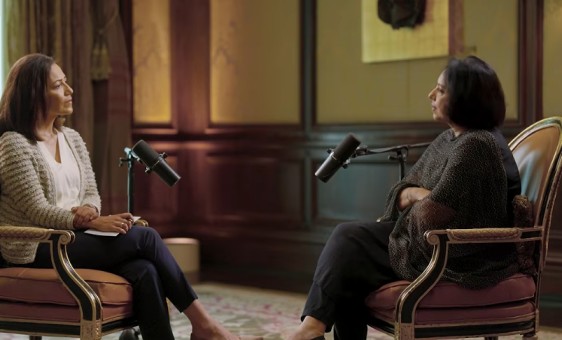
In this episode of The Mishal Husain Show from Bloomberg Weekend, Suhasini Haidar, diplomatic editor of The Hindu, discusses the challenges facing Prime Minister Narendra Modi at home and abroad. From the Gen Z “cockroach” protests in Delhi over the electoral roll and the police crackdown on protesters and journalists, to the fallout of the Iran war, H-1B visa restrictions, strained India-US ties and a tenuous peace with China, Haidar explains why 2026 has become a year of reckoning for India’s place in the world. Read the full transcript of this interview below:
Introduction
MISHAL HUSAIN (00:00:55 – 00:03:05): From Bloomberg Weekend, this is The Mishal Husain Show. If you followed the Gen Z, or so-called cockroach protests in Delhi a few months ago, you probably know that in the last few weeks they’ve been back on the streets, this time with concerns and demands about India’s election system, the handling of the electoral roll.
The integrity of an election system would of course matter anywhere in the world, but perhaps especially so in India, which prides itself on being the world’s biggest democracy. This episode is partly about that movement, but also where India finds itself internationally, especially in relation to the Trump administration.
There are a number of factors and live issues complicating that relationship right now. The impact of the Iran war, especially on the Gulf countries with which India has a close bond. And immigration. Indians see the possibility of going to the US on H-1B visas for high-skilled immigrants now significantly reduced.
All of this intrigued me as I spent a week in India for Bloomberg’s New Economy Forum. And for this episode, we wanted to find someone who could take us on a journey through what India is facing at home and abroad. That is essentially how we came to record with Suhasini Haidar, diplomatic editor for The Hindu newspaper and someone who has her own show on YouTube called World View.
And while her work is usually outward-looking, she has seen those protests in Delhi for herself and seen how the police responded, including by detaining journalists who were there like her to observe and report.
As ever, my written notes will give you more of the context, beyond what we discuss here. Bloomberg subscribers can access them with every conversation. And here’s what happened when Suhasini and I sat down together. Busy few days here in Delhi.
A Book on India and Its Neighbors
SUHASINI HAIDAR (00:03:05 – 00:03:09): It is always busy. Yeah, especially on the foreign policy beat.
MISHAL HUSAIN (00:03:10 – 00:03:10): And you’re working on a book?
SUHASINI HAIDAR (00:03:11 – 00:03:21): I’m working on a book about India and its neighbors. So it’s not a subject that most people even think about because it just seems like such a lost cause.
MISHAL HUSAIN (00:03:22 – 00:03:23): Immediate neighbors, you mean?
SUHASINI HAIDAR (00:03:23 – 00:03:35): Immediate neighbors. What’s called the SAARC neighborhood or the South Asian neighborhood. Those are not even words you hear in Delhi anymore because the idea of South Asia has gone away. South Asian cooperation is at a low.
2026: The Year the India-US Reset Went Off the Rails
MISHAL HUSAIN (00:03:35 – 00:03:58): I’d love to start further afield because I know that you study India’s relationships, its global relationships, and also there’s a lot that surrounds you here at home, particularly in the last few months. Can you perhaps begin by taking stock of the year and what you think have been the most striking developments? What is most on your mind at this point?
SUHASINI HAIDAR (00:03:59 – 00:04:54): As a foreign policy analyst, you try very hard not to make it about personalities, but it does seem as if all the world’s events are being driven by leaders behaving badly or doing things unilaterally without telling others. So I would say that the year 2026 has really not turned out as India had hoped it would. It was meant to be the year of the reset with the US.
And right at the beginning, there was this conversation between Prime Minister Modi and President Trump, and everyone thought now things are back on track. They’ve got a framework for a free trade agreement, but more importantly, they’re back on the same page. And then the Iran war happens, and so many calculations have gone off the rails.
So I would certainly say one of the big themes of the year has been this disappointment that the India-US relationship, perhaps after this year, will not able to go back to the past.
MISHAL HUSAIN (00:04:55 – 00:05:04): So 2025 was a difficult year, the first year of President Trump coming back to the White House. But this year began with a feeling that that could be managed or put in the past.
SUHASINI HAIDAR (00:05:05 – 00:06:59): Correct. And the idea that once the trade issues were sorted out, that the Trump administration was, everything was fine on the strategic side. But after a while, one bleeds into another and trust issues that have really come up now.
The idea that for 25 years, the US and India had this relationship that went year on year getting better. Sometimes it was a faster pace of ties, sometimes it was slower. But for 25 years, there’s been this idea that the US has India’s back. And now it is the US that is causing all the uncertainty, that is calling out India on so many things, including this US-Pakistan relationship, which really puts the government in a spot.
The Rise of Middle Powers and Strategic Autonomy
As a result of that, we’re seeing I would say 2 foreign policy trends that are showing up, which is A, the idea of the rise of the middle powers was something articulated by Canadian Prime Minister Mark Carney, but we’re seeing it in practice. India doesn’t traditionally see itself as a middle power.
It sees itself as an emerging power, one that has its eye on the global high table.
But suddenly it’s taking comfort in numbers from all of these other powers that are equally hurt by one superpower or the other, US, Russia, China. So Canada, Australia, Japan, Brazil, these are all relationships that we’re suddenly seeing new momentum to despite other issues. It seems as if that’s one place where India is more and more seeing itself in the world.
And the other big trend I think that we are now seeing is the need for an assertion of what is called strategic autonomy. For years since I think Prime Minister Modi came to power, we’ve seen a sort of derision about non-alignment, that this was India’s Cold War past.
MISHAL HUSAIN (00:06:59 – 00:07:19): I’d love you to explain that a bit, Suhasini, because I think this will probably be a theme of our conversation. Strategic autonomy or non-alignment, as the policy used to be called in the past, or a version of it. Does it essentially mean India should be self-sufficient diplomatically, not rely too much on one partner or another?
SUHASINI HAIDAR (00:07:19 – 00:08:15): I think what it means is that India will consistently pursue the tools it needs to make its own decisions, and it will not be part of any bloc in the world. That was the idea, frankly, in 1946 or ’47 when then interim Prime Minister Jawaharlal Nehru actually announced what India’s— free India’s foreign policy would be.
And there were a lot of themes to it, about 8 or 9. One of them was that India would not be part of bloc politics. Of course, at that time it was the US and Russia. Now it may be US and China, but the idea that India has too many interests in the world and too many restraints because of its population, because of the way it had been left after colonization, that it needed to make friends with as many people as it could and not be caught into somebody else’s power tussle.
The Gen Z Protests in Delhi
MISHAL HUSAIN (00:08:16 – 00:08:38): Okay. So I just wonder how the domestic picture here fits into all of this, because this summer there were those really striking protests centered very close to where we are right now in Delhi around the Jantar Mantar protest site. And that Gen Z movement has resurged in the last few weeks. So paint a picture of that, what you think it means, where you think it’s going.
SUHASINI HAIDAR (00:08:39 – 00:09:51): So we call it the Gen Z movement as a borrowed term because we’ve seen these protests in the rest of South Asia. Pakistan had the Youthias, if you like, the Imran Khan supporters. Sri Lanka and Maldives have seen different kinds of street protests, eventually seeing a change in government. Bangladesh saw a very abrupt change with Sheikh Hasina being really pushed out of the country.
Nepal saw the toppling of the entire political system because all the traditional parties went away in the elections that followed. But they really toppled the government, these Gen Z protesters. What we’re seeing in India is perhaps part of a regional trend, but it’s something more.
If you were born as Gen Z are, if you were born at the beginning of this century, if you’re as old as this century, think about what the last part of this decade has meant, what the 20s have meant for the century. From 20 to 25 is your most turbulent period, if you like. You’re finding yourself and you’re seeing these global shocks and shock after shock. It’s not just one kind of shock that tell you that your future is even more uncertain than you ever thought it was.
MISHAL HUSAIN (00:09:51 – 00:09:52): Because of AI, you mean?
SUHASINI HAIDAR (00:09:52 – 00:10:47): I think it’s so many things. I think it begins with the COVID pandemic, the kind of lockdowns India had particularly. I think it goes on to the kind of conflicts we’ve seen in the world, the Russian invasion of Ukraine, the Israel, the attacks, and then how Israel responded to them.
We see increasing, as you said, AI taking away the idea of jobs, but it also comes along with a huge anti-immigrant feeling in so many parts of the world that once welcomed Indian professionals, the US and Europe. So you’re seeing the dreams dimming a little bit.
And if you were to add each of these shocks in the first part of this decade, you would see that it’s a generation that’s really looking very unsure about where it’s going to head, unhappy with the kind of authoritarianism that they see growing as well, because that’s another trend, not just in India.
MISHAL HUSAIN (00:10:47 – 00:11:06): I mean, I’m curious about why that is as pronounced as you suggest, given that the economy right now is one of the fastest growing in the world. The Indian economy does have a strong growth rate. So why does Gen Z not feel that there’s enough for them in this country?
SUHASINI HAIDAR (00:11:06 – 00:11:25): I can’t even speak to what those numbers mean because they’re far removed from the average person. It almost feels like that real boom and the growth and all that surge is behind them because the last few years have seen these economic shocks.
MISHAL HUSAIN (00:11:25 – 00:11:37): And is that particularly the case if you are a graduate? Because I think the graduate unemployment rate is particularly striking or the job prospects compared to those from a different section of society?
SUHASINI HAIDAR (00:11:37 – 00:12:41): I think there’s a broad sense of despair that not only is it difficult to get into a good graduate program, but even when you come out, there may not be a job waiting for you. And I think coupled with the constant changes, I’m stressing this point because I can see that real concern amongst the youth that what does all this mean?
When US President Donald Trump does what he does, it may seem as if it’s a Truth Social post and maybe tomorrow he’ll change his mind. But what he’s essentially doing is telling you, you cannot trust your own tomorrow. “I will decide when I put 50% tariffs on exporters in India or I will shut down the H-1B system” or what’s happened more recently, the top Indian companies losing their ability to hire Indians. What you’re essentially saying that even the promise of the past, you may not have realized it, those are going away.
MISHAL HUSAIN (00:12:41 – 00:13:03): But the actual issues that took Gen Z out on the streets on these 2 notable occasions, one was about the exam system, but more recently it was about the integrity of the electoral system. So is it turning into frustration with political leadership at home, a government that has been in power now for more than a decade?
SUHASINI HAIDAR (00:13:04 – 00:13:09): I do see this real frustration amongst those who have come out to protest.
MISHAL HUSAIN (00:13:09 – 00:13:11): And you saw it, right? Yes, I was—
SUHASINI HAIDAR (00:13:11 – 00:14:38): I happened to be able to get through the barricades. So I was actually covering the protests from the street over the weekend. These are not professional protesters. We know what political activists look like. We know what professional protesters look like.
A lot of these are just children who— or I shouldn’t be patronizing to use the word children, but these are the youth that feel their voices are not being heard and that rather than hear their voices, the government is trying to just shut them up.
And so, yes, this issue is not something traditionally Gen Z protesters have come out on because who goes to vote even? But suddenly it seems as if everything— your identity, your citizenship, your right to adult franchise— all of those are being brought into question. And at a time when they are already feeling stifled by the government on the previous round of protests, I think this is something that just caught fire and people said, “Let’s go back.”
I think it was also that the protests the first time around were just so successful because they were able to get the government to ask a minister to resign, which has not happened in 12 years. It felt like the youth or the Gen Z protesters were able to do something hardened political parties had not been able to do. So I think there was this feeling that maybe we can be successful once again.
“Mother of Democracy” and the Police Crackdown
MISHAL HUSAIN (00:14:38 – 00:14:55): Did you see manhandling of protesters and journalists? Because to me at least, there was this quite striking contrast between some of the images I saw and the Prime Minister at the same time talking about this being the “mother of democracy”?
SUHASINI HAIDAR (00:14:55 – 00:15:17): I mean, when the government says India is the “mother of democracy,” that might be completely true in the ideal because look, India is the world’s most populous country. It has the world’s most number of religions, I think, including the religions that were born here. So this is actually the center of the world when it comes to pluralism, when it comes to democratic traditions that—
MISHAL HUSAIN (00:15:17 – 00:15:21): The biggest exercise in democracy. And it is a huge exercise when it happens every 5 years.
SUHASINI HAIDAR (00:15:22 – 00:17:53): Exactly. And that actually is India’s USP. It’s India’s unique selling proposition that we are this massive democracy, a massive country that is more or less rule-abiding, that is more or less pluralistic, egalitarian, secular. These are all things that were guaranteed to India. But I think when the government says it, people don’t react positively simply because it seems as if those are the very things the government is hitting out at.
The treatment of journalists is another huge concern, and each of them can be a separate discussion. But when you asked about how people were treated, it was just an inordinate use of force. The number of protesters who could have made it to the center of Delhi when a 4-kilometer radius was under complete lockdown and internet had been cut off completely in the central part of Delhi, and 35,000 troops were brought onto the streets, special new Police SWAT teams were out there.
There was one point at which someone had a photograph of 30 or 35 police officers running behind one girl just to arrest that one girl. When you have that kind of a scenario, and then even the few that do make it to the front and raise a few slogans— I mean, that’s all I saw them do was raise a few slogans asking for the election commissioner to resign. The kind of brutality they faced because they were detained straight away, they were put onto buses.
And this is journalists. They were there covering the story. We were trying to cover the story. And there was this constant pushback from the police. And the stories they told us about how they were beaten up on board the buses they were taken— this is in detention. These are basic human rights.
But more importantly, I think for journalists, what really shocked them was that they weren’t even able to cover the protests, which is their job. So it was a right to livelihood issue, cameras taken away, phones taken away, computers taken away, equipment taken away. And then these journalists put on buses, herded out of the city center.
So it may not seem like a lot. We watch protests around the world and we see police out there, even using firepower. But I think it was an inordinate use of force, just as it was on July 20th when the previous round of protesters faced tear gas, they faced pellet guns. So I think there is this idea that every protest is seeing tougher and tougher sort of clampdowns by the police.
The Iran War and Its Impact on India
MISHAL HUSAIN (00:17:54 – 00:18:12): Can we dig further into the impact of the Iran war, both politically in terms of relationships and economically? Do you discern an economic impact? Is there something that, is India suffering inflation or is there an energy impact?
SUHASINI HAIDAR (00:18:12 – 00:18:37): I think people are definitely feeling the pinch. Fuel has gone up and the rupee has plummeted. So those 2 things itself have taken the prices of a lot up. Recovering from COVID was hard enough. And then the Russian invasion of Ukraine meant a new clampdown on food and fuel and fertilizer prices that everyone in rural India faced. And of course, most of India lives in rural India.
MISHAL HUSAIN (00:18:38 – 00:18:48): So Prime Minister Modi was there in Israel right before the war began at the end of February. Do you think he was told that Israel was about to attack Iran with the US?
SUHASINI HAIDAR (00:18:49 – 00:20:23): I mean, there is no way that he did not realize that there was some kind of a conflict coming because he says it in the Knesset. He actually said that whatever comes, India will stand shoulder to shoulder with Israel now and in the future. Did he know that it was going to come 2 days after he flew out of Tel Aviv? I doubt that, but there’s no way of knowing. The government has always denied that it had any idea.
What actually made it a little more shocking was the immediate reaction of the Indian government to the conflict itself, that it took 4 or 5 days for the government to react to the killing of Iran’s Supreme Leader, Ali Khamenei, and even more to react to the killing of 168 at that school in Minab. That sort of was a little more surprising. It seemed to denote that there was a real shift in Indian policy.
But like all things, and that’s why I say that the strategic autonomy aspect of what we’re seeing in Indian foreign policy seems to reassert itself because you realize that then the government decided that this was not going to be the policy, that actually India would begin to condemn violence on all sides. And of course, by then Iran had begun to hit back. So India was also condemning the violence on Gulf countries.
And remember, in the Gulf, India has 10 million citizens because they don’t get citizenship there. They’re just there to work. 10 million citizens are in the crossfire
MISHAL HUSAIN (00:20:24 – 00:20:26): and all affected, their livelihoods,
SUHASINI HAIDAR (00:20:26 – 00:20:26): absolutely, their
MISHAL HUSAIN (00:20:26 – 00:20:27): safety,
SUHASINI HAIDAR (00:20:27 – 00:20:40): travel, safety, trade, energy imports, remittances. India gets maybe $150 billion, $40 billion in remittances. It’s the remittance earner in the world.
Pakistan as Mediator
MISHAL HUSAIN (00:20:40 – 00:20:47): And then the country that it sees being a very visible part of the effort to bring the war to an end is Pakistan.
SUHASINI HAIDAR (00:20:47 – 00:20:48): Correct.
MISHAL HUSAIN (00:20:48 – 00:20:51): Which hurts, troubles.
SUHASINI HAIDAR (00:20:52 – 00:21:08): It clearly hurt the government because we heard the external affairs minister not saying on the record, of course, it was a closed-door parliamentary committee meeting, but he used the term “dalal” and said India is not that, which means a middleman or a fixer or even— So
MISHAL HUSAIN (00:21:08 – 00:21:09): it’s like a derogatory term.
SUHASINI HAIDAR (00:21:09 – 00:21:19): Yeah. And his point was, “We are not.” So I think the government felt it took reputational damage amongst its own supporters because here was Pakistan being feted by the world.
MISHAL HUSAIN (00:21:19 – 00:21:22): And the president of the United States in particular.
SUHASINI HAIDAR (00:21:23 – 00:22:34): And to be fair, Pakistan actually did quite a comprehensive job in terms of bringing all the players to Islamabad, in terms of having a text that eventually did produce some kind of a ceasefire for a little while. But I think people forget that it wasn’t just about why Pakistan took that role or whether India could have played that role or not. The real question was, why was Pakistan picked by Iran as the mediator? Because there were others in the world.
And I think it was because Iran was trying to minimize the role of Israel in the room. It wanted to keep that negotiation between Iran and the United States. Pakistan does not have any relations with Israel. Doesn’t recognize Israel. There was no question that India could not have played that role.
But yet there was a sense over here of grievance, of foreign policy commentary really saying this is something India should have been at the forefront of, even suggesting now when India is playing a slightly more important role when it comes to conveying messages between Moscow and Kyiv, that India is playing catch-up in a sense. I don’t agree with that. But yes, it was a concern.
Is the Shift in India-US Ties Permanent?
MISHAL HUSAIN (00:22:35 – 00:22:57): So in terms of India and the United States, is the feeling that this administration, the next 2 years of this administration will likely be difficult, but then India will repair its relationship with the US with a future administration? Or do you think something more fundamental has happened, that this shift and effort that India has made over a long period to get closer to the US is in question?
SUHASINI HAIDAR (00:22:57 – 00:23:50): I think the shift unfortunately is more permanent for 2 reasons. One, because whether the Republicans lose control of the Senate and the House immediately in November and Trump is unable to do much more or whether Republicans lose the next election, it seems as if there is a bipartisan consensus on things like immigration, on Indians getting these H-1Bs and getting share of the tech pie there in the US. It seems as if there’s bipartisan consensus also on India’s relationship with Russia.
But the other reason is not about the governments at all. It’s not about Mr. Trump and Mr. Modi’s relationship at all. Let’s remember that India and the US did not have much— a very good relationship for decades during the Cold War and even after that.
MISHAL HUSAIN (00:23:51 – 00:23:53): Yeah. India bought its weapons from Russia.
SUHASINI HAIDAR (00:23:53 – 00:24:06): Russia, exactly. And the fact was that this relationship, which is a really, really great relationship between India and the US, has been built on the backs of ordinary people. It’s a real people-to-people relationship.
H-1B Visas, Deportations and “Indentured Servants”
MISHAL HUSAIN (00:24:06 – 00:24:09): People like those who got the H-1B visa.
SUHASINI HAIDAR (00:24:09 – 00:24:15): Absolutely. And waves, there was one wave of doctors, there was one wave of software engineers, hardware engineers.
MISHAL HUSAIN (00:24:15 – 00:24:22): Well, you’ve got Indian Americans running some of the biggest American companies, Google, Microsoft.
SUHASINI HAIDAR (00:24:22 – 00:24:31): Exactly. There’s all these memes about how all of these companies are run by Indians and many more Indians in public life. Many more Indians across—
MISHAL HUSAIN (00:24:31 – 00:24:32): J.D. Vance is married to an Indian American.
SUHASINI HAIDAR (00:24:32 – 00:25:21): Well, Zohran Mamdani. There’s so many Indian Americans, what was called the “Samosa Caucus” developing inside the Congress. So, I mean, there was this sense that the Indian immigrant was cherished in the US. That’s no more the case.
That one image of Indians being deported, shackled, literally in chains, being put onto ICE planes and sent back. That has shattered, in a sense, something much deeper. It’s shattered the idea that the US was essentially, for India, benign power. That yes, the US has been involved in conflicts around the world, but for India, it had not harmed India in any way. And that sense has gone down right to the bottom.
MISHAL HUSAIN (00:25:21 – 00:25:44): Sounds as if then it becomes personal. There’s a particular phrase that J.D. Vance used, which was to say that companies needed to stop importing “indentured servants.” I mean, explain the connotations of that in India. Indentured labor was the way that Indians were taken by the British to work in Africa, for example.
SUHASINI HAIDAR (00:25:44 – 00:26:48): It’s the unrecognized part of the slave trade, the idea that Indians were taken as bonded laborers to such far-flung areas of the world, islands where the British didn’t— weren’t able to govern, they would send these Indians, the Caribbean islands as well, the U.S. as well.
And the idea that a vice president of the United States, one who has visited India, one who is married to someone of Indian origin, would use a term that is so pejorative and that in India is inextricably linked with its colonial humiliation. It just sounds— perhaps it was just a bad choice of words, but it was an unnecessary choice of words to begin with.
So these were H-1B professionals. These are the best educated. In fact, one Indian minister said, “It’s a good thing if the US is not taking our H-1Bs anymore because they’ll be here and American companies will be forced to come to India.” There’s a deep sort of knee-jerk reaction, but it’s visceral to a huge amount of Indians.
MISHAL HUSAIN (00:26:48 – 00:26:50): It sounds like it’s not going to be forgotten. That term?
SUHASINI HAIDAR (00:26:51 – 00:27:21): I think what’s happened over the last 2 years is that India has very clearly seen a side of the US that maybe was there in terms of experiences and anecdotal. It was never expected to be part of the American establishment that they somehow saw Indians as lesser beings. And maybe Indian exceptionalism is a little too much. There’s this sense that “we are not like other immigrants.” And now that has gone away.
India and China: A Tenuous Peace
MISHAL HUSAIN (00:27:21 – 00:27:43): We haven’t yet talked about China, Suhasini, and that’s long been a complex relationship for India. How do you think things are at present? Is the result of this disappointment with the US— does it make it more likely that India over time moves closer to China, however difficult historically that relationship has been?
SUHASINI HAIDAR (00:27:43 – 00:28:09): On the face of it, I cannot see how India and China can have what is termed as a close relationship for a very basic reason. They share a 3,500-kilometer undemarcated boundary. They don’t even know where the line is in most places. Both sides have their own idea of a line, and that’s why something like in 2020, armies clashed, 20 Indian soldiers were killed.
MISHAL HUSAIN (00:28:09 – 00:28:15): That was very unusual, wasn’t it? Decades before, undemarcated as it is, that border has not been a problem.
SUHASINI HAIDAR (00:28:15 – 00:29:13): Because there were rules of engagement and those rules were really broken. Although frankly, there was no gunfire. But even so, it definitely shows you how tenuous that line between the two of them are.
Secondly, China is seen as having this “no two tigers can live on one mountain” kind of idea about Asia. So if you’re going to have a leader in Asia, the Chinese don’t think there’s more than one. India sees itself not only as an Asian power, but also a global power, or at least has that aspiration. So the idea that India would not be able to grow, it would have to grow despite China rather than because of China.
The third is the many different frontiers China and India now have between them. And it’s not just the India-China boundary. But it’s the India-Pakistan boundary where more and more military chiefs are saying, “We may as well be talking about a single front here.”
MISHAL HUSAIN (00:29:13 – 00:29:14): Sorry, what do you mean?
SUHASINI HAIDAR (00:29:15 – 00:29:30): Well, when India fights China and India fights Pakistan, those are 2 very, very different kinds of conflicts. You have the LAC on this side, the Line of Actual Control. You have the Line of Control with Pakistan on the other. But in the last conflict in 2025, military—
MISHAL HUSAIN (00:29:30 – 00:29:31): The last conflict with Pakistan.
SUHASINI HAIDAR (00:29:31 – 00:29:35): With Pakistan. Yeah. May 2025, the 4-day conflict which
MISHAL HUSAIN (00:29:35 – 00:29:37): happened after a terror
SUHASINI HAIDAR (00:29:37 – 00:30:02): attack in Indian Kashmir, bombed terror sites in Pakistan which followed. And then there were all kinds of drone battles, social media battles, but also military Air Force operations as well. After that, military officials said that they felt that China was actually supporting Pakistan quite directly.
MISHAL HUSAIN (00:30:03 – 00:30:06): Okay, because Pakistan was certainly using Chinese hardware.
SUHASINI HAIDAR (00:30:06 – 00:30:34): There was one military chief who actually said that “we feel like we’re fighting one single front and that we have to be prepared for this eventuality anyway.” So it’s— it seems unlikely if that is just the last conflict and there’s been a kind of growing conflict between India and Pakistan since 2016, then it seems unlikely that India and China will trust each other. However, they do more trade with each other than ever before.
MISHAL HUSAIN (00:30:34 – 00:30:36): That’s what’s so interesting, that that keeps growing. However,
SUHASINI HAIDAR (00:30:36 – 00:31:02): $150 billion in trade, of which $100 billion is the deficit that India faces against China. You also see comments like the external affairs minister saying, “It’s so much bigger an economy, what do you really want me to do?” There’s even a sense of helplessness or frustration about where they can go. For the moment, there’s a tenuous peace with China, and I think that’s the best that can be hoped for.
A Reckoning on India’s Place in the World
MISHAL HUSAIN (00:31:03 – 00:31:15): It sounds as if this year is really leading to a sort of fundamental reckoning on India’s place in the world, that that’s what this year has taught or revealed.
SUHASINI HAIDAR (00:31:16 – 00:31:55): I think so. And I think the last blow is yet to come because we still have see what the US decides to do when it comes to sanctioning India for buying Russian oil. And I hate to go back into history, but in 2019, up till 2019, India had always said, “We don’t accept US sanctions, we don’t accept unilateral sanctions, we only accept UN-backed sanctions.” In 2019, India broke because of its good relationship with the US and because, frankly, Trump’s bullying. India accepted the US’s farman, diktat, that it give up all Iranian oil.
Modi, 2047 and the Mood at Home
MISHAL HUSAIN (00:31:55 – 00:32:13): That brings me back to then the sentiment at home about political leadership. The next election, general election, is not till 2029. Do you think the Prime Minister will run again? Because in this system, which is not a presidential system, he can, can’t he? He can continue for as long as he feels able.
SUHASINI HAIDAR (00:32:14 – 00:33:29): There are certainly no term limits, and Prime Minister Modi has in the past said that he’s already got his eye on 2047. That’s when India turns 100. He has a plan for what he calls Viksit Bharat, or developed India. At that time, he will be 97 years old in 2047. So it is— it’s hard to say.
I think what’s important is what we’re seeing right now is something we’ve not seen in 12 years. And this is not about electoral politics because frankly, the ruling party has been winning election after election. I think it is about recognizing that there is a sentiment, there is a mood, it’s a credible mood that is unhappy on a number of issues. The economy, perhaps, maybe a few on foreign policy, perhaps a large number just on the stifling of democratic freedoms.
Because this is the midpoint now of this particular term. It’s about what’s going to happen in the next few months. Is the government going to continue to take this very stern posture? Is there going to be one clampdown after another? Or is the government going to loosen up a little bit, acknowledge that there are problems, acknowledge that perhaps after 12 years, Prime Minister Modi needs to do a press conference, answer some questions that are not scripted?
MISHAL HUSAIN (00:33:29 – 00:33:31): He’s never had a press conference?
SUHASINI HAIDAR (00:33:31 – 00:33:55): He has not. I mean, no, I should correct that. He has addressed unscripted questions from the press on 2 occasions, once at the Biden White House in the US and once or actually twice now with Mr. Trump. But apart from that, he has not taken unscripted questions once. I mean, the government makes the point he doesn’t need to, but it does stand out.
MISHAL HUSAIN (00:33:56 – 00:34:21): I was in the room when he was addressing Bloomberg’s New Economy Forum, and there was a long look back at achievements since 2014. He didn’t strike me as someone who was going to in public comments sort of opened the way for, perhaps we need to do things differently. Although I did see in the summer that he did an Instagram post that addressed Gen Z and the Cockroach Party.
SUHASINI HAIDAR (00:34:21 – 00:34:46): As I said, we’re in the middle of it right now, so it’s hard to say which way this is going to go. But I certainly think the government is recognizing at least that it doesn’t have all the answers. That even if it feels it has done a lot of good in 12 years and has won these 3 terms, that not everyone is seeing that as all positive.
Journalism Under Pressure
MISHAL HUSAIN (00:34:46 – 00:34:53): And for you personally, I mean, as diplomatic editor of a major newspaper, it’s clearly interesting times. There’s certainly enough material for your book.
SUHASINI HAIDAR (00:34:53 – 00:36:12): Oh, absolutely, for both. I think it’s important to remember that it is times when journalism is under pressure, that are the best times for journalists in a sense to really understand what it is that— where their position vis-à-vis a government is.
If nobody is getting access and if journalists are indiscriminately being detained just for covering a protest on the streets, there is a sense, I think— and I was at this big demonstration by the Press Club— there is a sense that this is an important moment for us as well. We are also going to be asked, “Where were you when India was changing?”
In a sense, I think the last 12 years have been unprecedented when it comes to the kind of restrictions the government has put. It’s not the first, obviously. Everyone talks about the Emergency 50 years ago. But for my generation of journalists, I think it’s the first time we see the Prime Minister really cut access to the media the way they have. Ministers become inaccessible.
But it’s not just access. It is the weaponization of social media to discredit journalists and journalism by extension that I think we’ve all dealt with the effects of. And in that sense, as I said, this could be a turning point.
MISHAL HUSAIN (00:36:12 – 00:36:14): Suhasini Haidar, thank you so much.
SUHASINI HAIDAR (00:36:14 – 00:36:16): Thank you. It’s always a pleasure to see you.
Related Posts