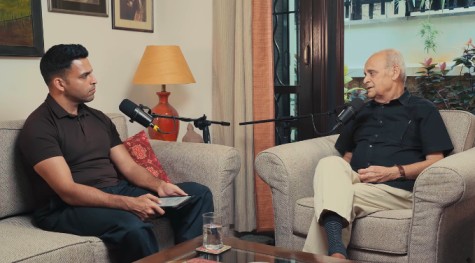
In this Bharatvaarta interview, former RAW chief Vikram Sood joins Roshan Cariappa to discuss Elon Musk’s Starlink and India’s data sovereignty, the growing strain in India-US relations under Donald Trump, and the funding behind street protests in Delhi. Sood also weighs in on the spreading Middle East crisis, the changing nature of warfare, and why education and self-pride are central to India’s strategic autonomy.
Elon Musk, Starlink and India’s Sovereignty
ROSHAN CARIAPPA: (00:02:14 – 00:02:17) Namaste, sir. Welcome again to Bharatvaarta. Always a pleasure talking to you.
VIKRAM SOOD: (00:02:17 – 00:02:23) Thank you for having me over for the discussion. I always enjoy talking to you.
ROSHAN CARIAPPA: (00:02:24 – 00:03:18) Pleasure being here, sir. So last time we spoke about your book, Great Power Games, and it was a fascinating discussion. We covered many aspects on how modern warfare works, geopolitics works, and aspects of sovereignty and so on. I feel like there’s never a dull day or a dull month in geopolitics. There’s something or the other happening. Feel like we should talk to you more often. So glad to have you back.
Wanted to get your views on the recent Elon Musk and Starlink controversy that’s ongoing. Right. While it is obviously a revolutionary technology and so on, there is also something in exchange, right, which is our sovereignty itself, our data, our sovereignty and so on. And we’ve seen how Starlink has been used, let’s say, in the Russia-Ukraine conflict and so on. What are your immediate thoughts on it? And I may have some follow-up questions on that.
VIKRAM SOOD: (00:03:20 – 00:03:29) There’s no doubt that this man has the capacity to develop new things, new technology. Tesla and
ROSHAN CARIAPPA: (00:03:31 – 00:03:31) SpaceX,
VIKRAM SOOD: (00:03:31 – 00:04:44) taken over X and now this. My point is that by doing this, he’s got 3 weapons in his hand. Media to spread the word, to create media sovereignty in a manner of speaking. The second is Starlink is the security apparatus. He will give or able to be able to collect all information from my country and take it away. We can’t do a damn thing. So that means you’re actually surrendering your sovereignty by letting him take over this.
And then he’s got Tesla as a technological innovator. So he’s covering the 3 modern aspects of life and controlling that and manipulating that. That is why I don’t think the Government of India is in a hurry to sign any deal with him. And he is apparently rankled about a certain— what did he call him?
ROSHAN CARIAPPA: (00:04:45 – 00:04:47) “Prime Minister Ambani” or something.
VIKRAM SOOD: (00:04:47 – 00:06:22) “Prime Minister Ambani” or something. That’s the signs of a frustrated and arrogant man. That, “I’m saying so, why aren’t you listening to me?” Because he is used to Trump listening to him and he thinks that we will also listen to him the same way. No, I don’t think they’ve got the right country for that. I would be surprised if we agree to all he says. I would be surprised if we even have it because it’s not for us.
You want to develop, develop yourself and do it wherever you want to use it. What is the advantage for me? I have more disadvantages if he switches it off at a time that doesn’t suit me. He switches off passing on vital information to us or taking something away or does not tell at a right time that there are insurgents gathering at a certain place or this is what they’re talking about to each other. Then it’s of no use to me. Right?
I don’t know, it’s a security aspect. I’m not talking about the commercial, that I don’t know. But this is a, for me, that is the baseline or the top line, that you meet my security fears, you let me deal with it myself, but he will not agree to the data not being swamped out. So I don’t think there’s a deal there.
ROSHAN CARIAPPA: (00:06:23 – 00:06:31) Right. And we’ve seen before how they’ve interfered as well, right? I mean, in Kargil, for instance, our satellite navigation was—
VIKRAM SOOD: (00:06:31 – 00:06:31) They never passed on this.
ROSHAN CARIAPPA: (00:06:32 – 00:06:32) Yeah.
VIKRAM SOOD: (00:06:33 – 00:06:42) So they will give you information as it suits them. If it doesn’t suit them, it suits only us, there’s no guarantee it will come.
ROSHAN CARIAPPA: (00:06:45 – 00:07:07) But at the same time, can we block out these things citing sovereignty? Is there a middle ground here? Is there a way we can impose restrictions, regulations, get them to Indianize in a way that we can experience the products and services without impacting our sovereignty?
VIKRAM SOOD: (00:07:07 – 00:07:25) I don’t think so. I thought this is an all-or-nothing game. It is a part of a new pressure that the Americans are going to be building on us in the months ahead.
Big Tech, Tariffs and the US Squeeze on India
ROSHAN CARIAPPA: (00:07:28 – 00:07:45) Right. So perhaps more than ever, we’re seeing a lot of these tech leaders with all these photo ops with President Trump and so on. So safe to assume that all of them are co-opted as part of the broader state, US state strategy.
VIKRAM SOOD: (00:07:45 – 00:07:50) And then they’ve also been sidelined from employing more people.
ROSHAN CARIAPPA: (00:07:51 – 00:07:51) Right.
VIKRAM SOOD: (00:07:52 – 00:08:02) All these 5 or 6 Indian companies have been, there have been restrictions put on them of further employment of Indians. In their companies.
ROSHAN CARIAPPA: (00:08:04 – 00:08:05) Right.
VIKRAM SOOD: (00:08:05 – 00:08:25) So, they are tightening us technologically. They’ve been tightening us economically, trade tariffs and all that. Although I don’t think trade tariffs is a very smart idea because it only hurts them. Also, it raises their prices.
ROSHAN CARIAPPA: (00:08:25 – 00:08:25) Right.
VIKRAM SOOD: (00:08:26 – 00:08:44) So they are not in a— I think Trump doesn’t have concentration powers, ability to concentrate and think the issue through.
ROSHAN CARIAPPA: (00:08:45 – 00:08:45) Fires and thinks later.
VIKRAM SOOD: (00:08:46 – 00:10:09) Yeah, and then thinks later. Then he thinks something else and turns around. You spent all your energy, blocking oil and diesel from Russia, whipping everybody around, and then you go and buy oil from them. I mean, what is it that makes this man go? And that means today’s yes can be tomorrow’s no without any reason assigned because he wants to bring down the prices in his own country. Elections are at hand. So he wants the prices to come down so that people can vote for him. After that, he’ll come back to the same thing.
But I doubt if Putin is not seeing through this game the way it is being played by the Americans. So this business of linking economics, oil, energy. So all the time, what? “I must have everything first. You can wait. I’ll lower the prices because I need the gas and the oil.” Sorry, I need the diesel. So I lower the price or I import it and lower the price. But if it is my concern as a friendly country, I also want cheaper diesel. No, then I’ll be penalized.
ROSHAN CARIAPPA: (00:10:12 – 00:10:12) Right.
VIKRAM SOOD: (00:10:13 – 00:10:18) So this kind of thing doesn’t work and it doesn’t do much good to your Indo-US relationships either.
ROSHAN CARIAPPA: (00:10:19 – 00:10:24) Right. So at least the game is out in the open, basically.
VIKRAM SOOD: (00:10:24 – 00:10:25) It’s out in the open.
ROSHAN CARIAPPA: (00:10:26 – 00:10:40) Right. So this sort of utopia that people perceived of a global liberal order, where some of these things like tech platforms were assumed to be universal goods and so on, right? All of that has come crashing down.
VIKRAM SOOD: (00:10:42 – 00:10:53) The most scary part for the Americans, I think, is that the Indians want to think now, think strategically and see what’s good for me,
ROSHAN CARIAPPA: (00:10:54 – 00:10:54) right?
VIKRAM SOOD: (00:10:55 – 00:12:38) We’ve learned our lessons, and this Atmanirbharata has a new meaning. You’ve got to do it on your own. No one is going to do it for you. They will stop you from doing it, in fact. And that’s what they’re trying today in Delhi. It’s not out of the blue, this thing. This thing has been building up over months. Right.
So we are now looking at a stage where the Indo-US friendship is at a fairly low plateau. The trade deal hasn’t come through. On the tech side, we’ve been ruled out. We’ve been given a step treatment, singled out for employment purposes. For companies that have done so much good for them, they’re now imposing restrictions on them. So that is the second thing.
Militarily, they’re also not happy. We’re buying things from all over, not just from them. We refused to criticize Russia. So our— and we don’t propose him for the Nobel Prize. Well, that is the first hit. I think that’s where he started getting angry with us. The Pakistanis went, said, “This is our offer.” And then on a plate, they offered him 3 mud earths and said, “This is a rare earth that we offer you.” And so he’s happy with that. We won’t do that.
“Tighten Your Seatbelts, the Climb Is Not Going to Be Easy”
ROSHAN CARIAPPA: (00:12:40 – 00:12:58) You recently wrote, “Tighten your seatbelts, the climb is not going to be easy.” I wanted to understand the significance of that. And if you could just talk through us, I mean, talk through that in terms of how this will shape up in the next couple of months. What do you mean by that comment?
VIKRAM SOOD: (00:12:58 – 00:13:05) No, I just meant this, that they’re going to go after you. So tighten your belt for the high climb.
ROSHAN CARIAPPA: (00:13:05 – 00:13:05) Yeah.
VIKRAM SOOD: (00:13:07 – 00:16:53) Because they are, after the elections are over, I don’t know what will happen in the midterm elections. Whether he wins or not, whether he gets impeached or not, I don’t know how it comes out. But the point is that the Americans are now feeling, how should I say, the aura that they had about themselves, they’re realizing it is not going to be easy. You can’t kidnap a president, kill another, and say, “I’m looking after the world.” It doesn’t work.
You think that you can overpower Iran in 2 days and everything will be over. It’s a civilization you’re dealing with. They’ve been preparing for this for 15 years, that one day these chaps will come at us. And they used novel techniques. Military techniques were different. They didn’t go for high-powered weaponry. They went for the novel drones and smaller weapons, but long distance and able to hit places of interest. They never thought the Iranians would ever hit American bases. But they did that. And they’ve not said we are not going to win, that we’re going to stop or we’re going to apologize, nothing.
So America’s track record has been a little poor when it comes to winning wars. They might win battles, but they lose the war. Even North Korea, South Korea was an armistice. Vietnam was a loss. Afghanistan was a loss. Iraq was a loss. Now Ukraine is going to be a loss. And Iran is a loss. So where is your capacity to look after my interest when I need you? None.
But on the other hand, their pressure on India and others who they think are coming in their way to retain global hegemony, who want to be regionally strong and powerful and independent, are a threat to them. And if they allow India to do what it wants to do, then others will also jump in. Indonesia will say, “Why not me?” Brazil will say, “Why not me?” So that is their fear that if you don’t put this down now.
They made the mistake in China, as they admitted themselves in that conference in Delhi, in the Raisina conference, I think, that Raisina Dialogue, that “We made a mistake by giving China so much help. Make no mistakes, we’re not doing it again for you,” or words to that effect. So if that is the attitude, then you better get prepared. We’ve tried our best. We’ve gone around shaking hands and meeting him, inviting him and all that. But it’s a leader who does not operate through systems, but operates through his own view of looking at things. You don’t know which way you’re going to go. Tighten your belts, sit down and watch, and do what you can for yourselves.
Is Trump an Aberration or an Instrument of the Deep State?
ROSHAN CARIAPPA: (00:16:56 – 00:17:13) Do you think Trump represents the wider strategic interests of the US or he’s an aberration? Why I’m asking is we have an election coming up. So do you think that things will temper down if there is a knock on the Republicans and he loses some bit of popularity in the elections, post the elections?
VIKRAM SOOD: (00:17:13 – 00:18:18) What I keep hearing is that the Americans are fed up with these wars. These are wars of— they’re gaining nothing from it. So this should stop. They’re not interested. With a man’s popularity down to 30% or something, obviously people are unhappy. You’re losing the war, your prices are going up, your dollar is going adrift, you have a trillion-dollar, $40 trillion debt. It goes up $1 trillion a year or a month, I don’t know, but it goes up phenomenally. How are you going to pay that?
And then you don’t want the dollar to slip away because if the dollar slips away and euro or the yuan becomes currency, then they are in huge, huge trouble. So they will want to retain this unless they change their attitude towards India and unless they show evidence of that, unless they show faith, I, for one, wouldn’t take them seriously.
ROSHAN CARIAPPA: (00:18:20 – 00:18:26) But do you think then that Trump is an instrument of the deep state, or do you think he is just an outlier?
VIKRAM SOOD: (00:18:26 – 00:18:42) Likely candidate, because he’s not applying himself to anything. He’s just doing what he wants to do. Maybe that is the game, to look and sound and play erratic. So everybody’s kept guessing.
ROSHAN CARIAPPA: (00:18:43 – 00:18:43) Right.
VIKRAM SOOD: (00:18:44 – 00:18:49) And you enjoy your 4 years and move on. Make your money, move on.
ROSHAN CARIAPPA: (00:18:51 – 00:18:52) Right.
VIKRAM SOOD: (00:18:52 – 00:18:55) Looks like a Bombay film, but could be.
Has the India-US Relationship Been Hurt Permanently?
ROSHAN CARIAPPA: (00:18:58 – 00:19:03) And you think that the India-US relationships have been hurt permanently?
VIKRAM SOOD: (00:19:04 – 00:23:45) There’s no permanency of that kind. I mean, it was different for the communists and the Americans to have that kind of relationship with each other, which still exists. But with other countries, you get into a trough and you try to get out of it. But if we think that we are going to be numero uno with them, that is not going to happen. We will never, our relationship will never reach to that level that will become the best in the world.
It might improve with the next president who may look at things differently. It may have an even better look with the next prime minister who we have here, if it is not Modi, for instance. I mean, elections are elections. So he could win handsomely again, but that’s for the future.
Barring that, as India and USA, I don’t, the Americans have predated ideas about ourselves, us. They have built a narrative about India in their minds. Backward, colonial, the colonial hangovers are still with them. We are lazy, whatever that suits them to say that we are not very smart. So, but that’s not true. Not for nothing, we have the tech cities in Bangalore and Gurgaon and Pune and other places and more coming up because we are able to do things like that.
Or that poor fighters, all that is a— they got taught all this, I think, by the Brits. “Don’t trust them, keep them down, don’t give them too much, and they will let you down in the end. They’ll do their own thing.” That’s their narrative about India, and now they want to work on that. They have been working on that. So when we talk about becoming one of the largest economies or one of the largest regional states, they’re horrified. How can they do that? Right. They need you for your markets. They need you for your resources, full stop. They don’t want you to go around becoming the strongest regional power in the world.
And years ago, 2004 or ’05, they had drawn up a list of 25 countries, Islamic, who had to be reordered, as it were, deconstructed and reconstructed. This was after 2000, then after 9/11. And I think it is there in my book, The Ultimate Goal, where they said, “This is what we’re going to do.”
They tried it in Egypt, tried the mob violence, the Tahrir Square where they used to congregate. And there was this Wael Ghonim who had come from New York, who was sitting in UAE, who was sending out tweets every day. “We have decided that we will hold a rally at so-and-so place.” Everybody would turn up there. “And then at 2 o’clock, we will reach Tahrir Square.” So that’s how demonstrations were created. And Mubarak had to go. Mubarak left. They held elections. And who do you find as the Prime Minister? The Muslim Brotherhood person. So that’s not what they wanted. So they staged another coup. Then you had General Sisi as the President. Or whatever. So that’s how they have worked. Regime change didn’t work in Iran. They’re going to try here.
Strategic Autonomy and the China Factor
ROSHAN CARIAPPA: (00:23:49 – 00:23:53) Yeah, I mean, I think strategic autonomy kind of worries them, obviously.
VIKRAM SOOD: (00:23:53 – 00:23:54) It’s not in their book.
ROSHAN CARIAPPA: (00:23:54 – 00:23:54) Yeah.
VIKRAM SOOD: (00:23:55 – 00:23:56) “Either with me or against me.”
ROSHAN CARIAPPA: (00:23:57 – 00:24:18) Yeah. And we are not going to be as subservient as let’s say Japan or South Korea are one of those folks, right? So then what is the way to deal with them? One approach is that they also fear China from becoming a dominant power, and the only, let’s say, counterbalance to China in the region would be us, right? I mean,
VIKRAM SOOD: (00:24:18 – 00:24:18) yeah,
ROSHAN CARIAPPA: (00:24:19 – 00:24:21) given our size and structure and other things.
VIKRAM SOOD: (00:24:21 – 00:25:42) But China also— you see, we have a problem. The Chinese also say that, “I am numero uno in the world, maybe Asia at least. So, everybody else must come and pay homage to me. Nobody is my equal.” So, how do you deal with a country which says that I am superior to you?
Although ideally speaking, theoretically speaking, looking at the geographical map of the world, what do you see? You see, and this is becoming my pet line these days. You see the Arctic, Russia, China, India, Indian Ocean. Straight down one line. You see 3 nuclear powers. You see 3 of the strongest armed forces. You see 3 of the biggest markets. You see at least 2, well, not 3 biggest, but 2.5 markets because the Russian population can’t consume as much as the rest of us can. Or you see 3 of the most, or at least 2 of the most resource-rich countries.
ROSHAN CARIAPPA: (00:25:46 – 00:25:47) Two of the oldest civilizations.
VIKRAM SOOD: (00:25:49 – 00:26:11) Yes. So why can’t you sit down together and say, “Let’s have a go at it again”? Well, then you need three, just three statesmen at the same time who will say that we will do it like this. That is the fear.
Regime Change and Protests on the Streets of Delhi
ROSHAN CARIAPPA: (00:26:13 – 00:26:16) But the US doesn’t fear pushing us to China’s side?
VIKRAM SOOD: (00:26:17 – 00:28:07) No, it wants us to be just subservient to them. And it thinks that the mind says, in their mind, you just go and bash the fellow. In 2 days, we have killed Iranian president, then it’s over. It’s not so simple. You could do these kinds of regime changes in autocratic countries. You cannot do it this way in a country which is democratic. Because if there is one point of view, there is another one equally loud. And if it is not settled in the parliament, it can’t be settled on the street.
You watch this movement that is going on now. After a few days, people will start going home fed up with the blockages, fed up with all this traffic nonsense. They start giving it up. So, you can’t bring about a change in India on the streets. When you have a parliament, when you have a rule of law, when you have a Supreme Court, you cannot just decide on the streets that, “This is it. This is what we want. This is what we’ll take.” It won’t happen.
थोड़ा चलेगा, their attempts to do it will carry on because who is giving them money for this? People are coming from outside Delhi. You got to make them stay somewhere. You got to feed them. You got to take them to the venue. Now the venues are
ROSHAN CARIAPPA: (00:28:08 – 00:28:08) not
VIKRAM SOOD: (00:28:08 – 00:28:18) within Delhi, but they’re outside. How are you going to get them there? How are you going to bring them back? And where are they going to stay? Who’s paying for all this?
ROSHAN CARIAPPA: (00:28:21 – 00:28:31) Is there any element to this that is even remotely organic? That something people were frustrated about a particular issue, whether it’s the NEET exams or—
VIKRAM SOOD: (00:28:31 – 00:28:50) Wael Ghonim was the man who came from New York, settled in UAE. On Twitter, he would give instructions to the Egyptians for the Arab Spring, and they would demonstrate that day. You got an example of a similar sort here.
ROSHAN CARIAPPA: (00:28:52 – 00:28:52) Yeah.
VIKRAM SOOD: (00:28:52 – 00:28:52) Huh?
ROSHAN CARIAPPA: (00:28:54 – 00:28:59) Yeah. The funny thing is, I think he used to work for one of the larger firms. Google. Okay.
VIKRAM SOOD: (00:28:59 – 00:29:30) He went back to Google. So why is it that suddenly 2 or 3 guys have decided they love the country so much, they hate this man so much that they have to do something about it? I have no— either you’re an Indian or you’re not an Indian. You can’t have dual loyalties, dual attitudes.
Trust in Institutions and the Democratic Process
ROSHAN CARIAPPA: (00:29:32 – 00:29:44) What do you say to folks that are saying that these institutions, they don’t have the same trust in these institutions anymore, they’ve been compromised and so on. So what is the recourse for people who say that?
VIKRAM SOOD: (00:29:46 – 00:31:26) Indian institutions. I don’t know. I don’t think that our institutions are all that bad. They’re probably slow. But what is wrong with our institutions? You sometimes get decisions from the courts which seem odd. But you have access to the court. You can present your case.
It is true also that in, like in every other country like ours, the waiting line is huge. It takes years to decide cases. That has to be reformed. Not the thinking of the system, but that backlog and the cases that so quickly end up there. We have to work out a system where they end up at the lower court. Otherwise, the backlog will continue into years, into decades. It happens many times, you see a case of somebody else decided after 13 years, after 10 years, after the man has gone, and so on and so forth. So that is our problem.
And do you know that our police-to-population ratio is one of the smallest in the world? Yeah. The Americans are twice, and they’re 10 times better equipped, and they’re ready to kill.
ROSHAN CARIAPPA: (00:31:27 – 00:31:28) Yeah, they use force.
VIKRAM SOOD: (00:31:28 – 00:32:09) They all carry a gun. So that is their policing. That’s their way of doing things. And yeah, we need some kind of an overhaul in the civil services, in the judiciary. In the corporate world, in the media, having so many channels, having so much stuff, the tendency is to switch off everything, forget it.
ROSHAN CARIAPPA: (00:32:12 – 00:32:22) Right. Yeah, I find it a bit strange that people are talking about democracy and crisis and so on. They don’t respect the democratic process.
VIKRAM SOOD: (00:32:22 – 00:32:27) No, they don’t. They want to finish it on the street.
ROSHAN CARIAPPA: (00:32:27 – 00:32:32) Yeah, they want to arbitrate all these things on the streets. They don’t even want to go to the courts.
VIKRAM SOOD: (00:32:32 – 00:33:25) How many statements has the Leader of the Opposition made in Parliament apart from one reply to the Prime Minister’s speech, maybe? Yeah. How many hours have they spent in Parliament and outside Parliament? Leading demonstrations. So, these are things that you watch.
I mean, you can’t say, “I want a democracy, but I’ll get it on the streets only.” You will get democracy in the Hall of Parliament when you vote for it or get voted out. That’s where democracy lies. It doesn’t lie on a stone-wielding or a sword-carrying protester outside.
Youth, Protests and How the State Should Respond
ROSHAN CARIAPPA: (00:33:26 – 00:33:41) Right. But sir, young people seem to be a particular target for these kinds of movements and so on, right? And it has a very big precedence even in, let’s say, the ’60s or whatever. I mean, it was the youth in the US that were targeted.
VIKRAM SOOD: (00:33:42 – 00:33:48) The youth are, they’re idealistic up to a point.
ROSHAN CARIAPPA: (00:33:49 – 00:33:50) But also delusional.
VIKRAM SOOD: (00:33:50 – 00:34:52) They think that things can be done quickly like this. “I’ve read this book and I will do it like this.” Okay, try it. But we all go through that stage. At my time at college, it was being a Naxalite which was the hit. And then they went and found out it’s not so easy sharing your poverty with the next man, as it were. And many came, many of them came back to college. Many of them came back and found they had been rusticated.
So, होता है। You get through this phase of. So let children be children. Let them do this for a while. Don’t hurt. As long as there are no fatalities, as long as there are no such thing, this will not last long.
ROSHAN CARIAPPA: (00:34:53 – 00:35:10) How do you think the state should handle it? Because it seems like a tricky situation, right? Because on the one hand, they have to enforce law and order. On the other hand, they can’t be seen as too harsh as well. I mean, the social media world, people are recording videos.
VIKRAM SOOD: (00:35:10 – 00:35:23) It’s very, very difficult to define this. A lot depends on how lucky you are on that day. You might wallop with your little stick somebody and he gets hit on the head and he dies.
ROSHAN CARIAPPA: (00:35:24 – 00:35:24) Right.
VIKRAM SOOD: (00:35:24 – 00:35:28) You didn’t mean it. Yeah. ठीक
ROSHAN CARIAPPA: (00:35:28 – 00:35:28) है। Yeah.
VIKRAM SOOD: (00:35:29 – 00:36:10) But that’s how your instructions are not to use the bullet gun or something. Then, or incidents happen when you are cornered, then the man pulls out his gun. He’s not going to die for, without putting up a fight if he can. So, it’s always a question of how lucky you are also in handling the crowd. Right. But a day or two of firm handling takes the steam out of many people.
ROSHAN CARIAPPA: (00:36:12 – 00:36:17) Right. So, we expect that. It should die down, hopefully.
VIKRAM SOOD: (00:36:18 – 00:36:27) I think it will die down. I hope so. I mean, I am one of those. We are only looking at Delhi. How many demonstrations have been held?
ROSHAN CARIAPPA: (00:36:27 – 00:36:29) Elsewhere it is pretty lukewarm. I mean, they haven’t gotten the response.
VIKRAM SOOD: (00:36:31 – 00:37:05) Bangalore is a Congress city. What has happened? Mysore, nothing has happened. Chennai? So, Delhi में हो रहा है। It’s all a big show. And when you ask the honorable leader of the movement, “What is your plan for tomorrow?” He says, “I don’t know. I have to work on it.” “What’s your next step?” “I haven’t thought of it.”
Foreign Funding and India’s Recourse
ROSHAN CARIAPPA: (00:37:07 – 00:37:16) Sir, if we do realize that all of this is foreign funded as it seems to be, right, and we follow the money trail and it leads back to—
VIKRAM SOOD: (00:37:16 – 00:37:19) I’m not saying foreign, all of it is foreign funded.
ROSHAN CARIAPPA: (00:37:19 – 00:37:32) Let’s say some of it, right, reasonable part of it could be that, right, or they may be working through proxies and so on, and we figure out that let’s say CJP is a front, right? What is our recourse in that case, right? I mean, what do we do about it?
VIKRAM SOOD: (00:37:33 – 00:37:36) I’m sure we have lost the FCRA. What is FCRA?
ROSHAN CARIAPPA: (00:37:36 – 00:37:44) No, no, not just for them, but for the country that has been abusing the process and everything. Nothing.
VIKRAM SOOD: (00:37:45 – 00:37:52) You can’t short of declaring war on them unless you want to do a counter to them
ROSHAN CARIAPPA: (00:37:52 – 00:37:53) and
VIKRAM SOOD: (00:37:53 – 00:37:54) create trouble for them.
ROSHAN CARIAPPA: (00:37:57 – 00:38:00) So an unconventional attack needs an unconventional response.
VIKRAM SOOD: (00:38:02 – 00:38:04) Yes. Counterterrorism is just as bad as terrorism.
The FlyDubai Incident
ROSHAN CARIAPPA: (00:38:08 – 00:38:21) So shifting our gaze to what’s been happening in the Middle East. Recently, we had this FlyDubai incident, right? I wanted to get your thoughts in general, and I’ll follow that up with a few questions.
VIKRAM SOOD: (00:38:22 – 00:38:28) I’m not sure what actually— yeah, what we’ve read in the press is that this copilot was a—
ROSHAN CARIAPPA: (00:38:28 – 00:38:31) tried to hijack the plane and crash it into a building and so on.
VIKRAM SOOD: (00:38:32 – 00:39:10) He was an Islamist in uniform and he wanted to take the plane to Tel Aviv and smash it. So apart from that, they will do investigation. They’ll check out on his antecedents, who he has met, whether he was sent or is doing it on his own. I don’t know that. But if our pilot had not intervened and opened the door, the plane would have gone down.
ROSHAN CARIAPPA: (00:39:12 – 00:39:13) Right.
VIKRAM SOOD: (00:39:15 – 00:39:23) Yeah. So, and if that man who came in, that carpenter, Israeli carpenter, he didn’t know how to handle the stick,
ROSHAN CARIAPPA: (00:39:24 – 00:39:24) It
VIKRAM SOOD: (00:39:24 – 00:39:46) could still have gone down. I know how fate takes over. This thing was not destined to crash. So that’s how it is. It’s a one-off operation, I hope, and it was a madman’s plan. It didn’t work, fortunately.
ROSHAN CARIAPPA: (00:39:46 – 00:39:51) You don’t see that as part of a wider, perhaps a network of people who are trying to destabilize the region?
VIKRAM SOOD: (00:39:51 – 00:39:54) There will always be people who keep trying these kinds of stunts.
ROSHAN CARIAPPA: (00:39:55 – 00:39:55) Right.
VIKRAM SOOD: (00:39:56 – 00:40:05) I mean, you always have fellows driving their trucks into camps, blowing themselves up, killing people.
A Spreading Crisis in the Middle East
ROSHAN CARIAPPA: (00:40:08 – 00:40:22) Right. And last weekend, the Houthis bombed the airport in Riyadh as well. It’s become a full-blown crisis there, right? I mean, it’s migrated.
VIKRAM SOOD: (00:40:22 – 00:40:24) Don’t you see how it is spreading?
ROSHAN CARIAPPA: (00:40:24 – 00:40:25) Yeah, that’s what.
VIKRAM SOOD: (00:40:27 – 00:40:35) Ukraine. Gaza. You have Gaza, people start to forget Ukraine.
ROSHAN CARIAPPA: (00:40:37 – 00:40:37) Right.
VIKRAM SOOD: (00:40:38 – 00:41:15) You have Iran attack, people start to forget what has been happening in Gaza. हाँ, you start this Houthi-Arab-Saudi तमाशा, somehow Iran is getting into the background now. Lot of people are talking about what will happen to Saudi Arabia, what’s going to happen in Somalia, in Sudan and the shift. I think they’re all playing for time so that when the elections are over in the United States, they will decide what their next step is going to be.
ROSHAN CARIAPPA: (00:41:18 – 00:41:22) You think they’re acting in cahoots with each other? Let’s say the Iranians and the Houthis.
VIKRAM SOOD: (00:41:23 – 00:41:24) Iranians and the Houthis work together.
ROSHAN CARIAPPA: (00:41:25 – 00:41:32) Right. And maybe the rest of them as well, because all of them come together for a common cause in that sense, in the region.
VIKRAM SOOD: (00:41:33 – 00:41:40) There could be one greater Islamic cause. There could be one regional cause which could be Sunni versus Shia.
ROSHAN CARIAPPA: (00:41:40 – 00:41:41) Right.
VIKRAM SOOD: (00:41:42 – 00:42:07) You could have it like that also. Or you could have a territorial war, which is the Arab world versus the Iranians and Yemenis, South Yemenis, that kind of thing. So it’s a mess. You’re my friend, but you’re my enemy’s friend.
ROSHAN CARIAPPA: (00:42:10 – 00:42:10) Right.
VIKRAM SOOD: (00:42:10 – 00:42:17) ये सब है वहाँ पे। We never know who’s exactly all totally with you or totally against you.
ROSHAN CARIAPPA: (00:42:17 – 00:42:27) It seems like there’s a lot of tactical support between the actors, but when you zoom back, you see in terms of strategic alignment, right? I mean, there are a lot of gaps, right?
VIKRAM SOOD: (00:42:29 – 00:44:08) Yeah. So that’s the Middle East was always like that. Conglomerate of factionalized out of, nobody likes each other too much. The Arabs, Saudis don’t like the UAEs. The UAEs don’t like Saudis. There’s some conflict between Bahrain and the rest or Qatar and the rest. Then the Iranians, nobody seems to like them except for the Lebanese and the Syrians. So all this is there and other countries take advantage of this when it can.
And democracy is a strange meaning in the Arab world. I don’t think it really exists. And they don’t care if this person who was an ISIS man has been appointed president and he sits down and chats with Donald Trump. So, you are doing this because this is what your interest is. Demands today, however you may define that interest, which means that stated values don’t exist. That he’s Islamic, he’s a terrorist, doesn’t matter. He had a $10 million demand on his head. He’s a president now.
ROSHAN CARIAPPA: (00:44:09 – 00:44:10) All he needs is a suit and a tie.
VIKRAM SOOD: (00:44:11 – 00:44:16) Yeah. So that’s how it works.
The Changing Nature of Warfare
ROSHAN CARIAPPA: (00:44:18 – 00:44:41) But when you look at all of this, right, I mean, I feel like the mode of war itself has changed, right? Because these kinds of unconventional, what can we call it, escalations, right? Finding certain weak points and vulnerabilities and attacking those strategically has become mainstream right now. Right? I mean, there’s no full-scale escalation like this, what we saw in, let’s say, Russia and Ukraine.
VIKRAM SOOD: (00:44:41 – 00:44:54) No, no. Now people are saying that the next generation of warfights, battles, or wars will not be with heavy guns or heavy tanks.
ROSHAN CARIAPPA: (00:44:54 – 00:44:55) Yeah.
VIKRAM SOOD: (00:44:55 – 00:45:50) We’ll have hundreds and thousands of these small little things. Small bombs, lethal, which are, you may fire 50,000 in a day at a much lower cost. And maybe the other side can bring down 30,000 or 40,000, but 10,000 will do the damage enough to last a long time.
So the game would turn to smaller weapons and this computer-charged or computerized activity or Starlink will freeze information or mislead information. So you’ll have more of these fellows sitting behind computers fighting the war. Tanks and artillery guns and all, we don’t need them.
How India Should Read the Middle East
ROSHAN CARIAPPA: (00:45:51 – 00:45:55) How should India read the situation in the Middle East? What should we do? What should we not do?
VIKRAM SOOD: (00:45:57 – 00:48:32) I think we’re doing a pretty good game now, not doing anything. What can you— we don’t want to get involved in this fight. We don’t want it to spread beyond us. I mean, come near us. We can’t stop it in any case if it spreads further. All we have to hope is it doesn’t cross the India-Pakistan border. Somebody might get into his head that let’s do a massive terror attack on India, invite a response, and then we get in, then they do something. But I don’t think that will happen. Somewhere in the minds of our policymakers, they would have thought of this. What next?
Most of our— we’ve always had warm relations with all the countries. We never had any problems. 9 million Indians live there of Indian origin, live in the Gulf Arab world. And they have, they’ve never complained about them. They’ve been pretty law-abiding, as always they are. They just want to earn their money and come home or keep sending the money home.
So unless some leader, some tyrant says, “All non-Muslims out, throw them out.” Even if he does that, what are we going to do? We’re not going to attack him in return. They are our citizens. We have to accept them in any case. So you have to find other means of retaliating, economic and so on and so forth. But what is the leverage we have? It’s mostly the other way around. The only saving grace is that they can’t afford to send these 9 million back because who will run their country?
ROSHAN CARIAPPA: (00:48:33 – 00:48:34) Yeah. That’s true.
VIKRAM SOOD: (00:48:35 – 00:49:21) So that is, that’s a hypothetical question. It is not going to happen. दस बारह बीस इधर उधर चीज़ चलता रहता है or some malfunctioning of system or some crime or whatever. But otherwise, as a community, they are, I think they’re quite safe. They might become victims of their wars among themselves. Where an Iranian bomb or a Houthi attack, that could hurt them. But then they’re not targeted. They would not have been targeted. That would have happened in the course of war, not as a deliberate act of the Houthis to kill Indians.
ROSHAN CARIAPPA: (00:49:22 – 00:49:36) Right. Yeah. Even otherwise, as India becomes a more prominent part of global trade, given how interconnected everything is, we do have to worry about impact on food, fuel, other things as well.
VIKRAM SOOD: (00:49:37 – 00:50:51) Food, fuel. Fuel is the most important thing. If you don’t have fuel, you don’t have fertilizer. If you don’t have fertilizer, you don’t have agriculture. So that is going to be, I believe, it’s not going to happen immediately. It’s going to be another 10 years or so. They seem to be saying that there is oil under the Godavari and somewhere in Ahmedabad and one more place somewhere near Mahanadi River.
So, well, by the time you really discover it, you bore wells and pull it out and convert into a refinery, it’ll take 10 years, 12, 15 years. That’s not what we can do. We don’t have that time. So our only hope is that the war ends as soon as possible and we get back to business. Because otherwise the year, next year is going to be very tough if they carry on like this,
Israel, Gaza and the Endgame
ROSHAN CARIAPPA: (00:50:52 – 00:51:10) right? I want to take a small tangent and ask about Israel. Yeah, I mean, it’s now more than a couple of years that October 7th happened and you saw what happened beyond that as well and so on. What do you think is the endgame for this?
VIKRAM SOOD: (00:51:16 – 00:52:36) I think the Israeli society is also now a little divided. They want to give the Palestinians some rights, not just no rights as Netanyahu would do or has been doing. So that the more practical approach to all this is to, well, they have a right to live. So we must make arrangements for them.
Unless that happens, and mind you, none of the Arab countries want the Palestinians themselves. They don’t want them to come. Jordan doesn’t want them, although they lived in Jordan mostly. They don’t want them back. Gulf countries don’t want them. Saudi Arabia doesn’t want them. I don’t think Iran wants them, even though it’s been in cahoots with Hamas and Hezbollah and all these people. They don’t want them. So I have no solution. I have no solution. And these chaps have messed it up so badly, so viciously. That the desire to come back to as we were won’t happen.
Sovereignty, Dependence and the Lakshman Rekha
ROSHAN CARIAPPA: (00:52:39 – 00:52:53) Right. So we started this conversation talking about sovereignty, right, through the Elon Musk and Starlink issue. I want to end the conversation also talking about sovereignty. There are a lot of these trade-offs that we’re making, which impact us economically, socially, and so on, right?
VIKRAM SOOD: (00:52:53 – 00:52:53) Sorry, what?
ROSHAN CARIAPPA: (00:52:53 – 00:53:26) There are a lot of these trade-offs in return for maintaining our sovereignty that we are making, that impact us economically, socially, and so on. How do we decide what things we’re okay being dependent on, and what thing we absolutely will not cross the Lakshman Rekha, and we have to indigenize there, and if it takes a few years or however much time, we should develop these capabilities ourselves? Because I don’t think it’s possible for us to be totally independent immediately.
VIKRAM SOOD: (00:53:27 – 00:53:28) That would be silly.
ROSHAN CARIAPPA: (00:53:28 – 00:53:31) Right. So how do you play this balance out?
VIKRAM SOOD: (00:53:31 – 00:57:35) I think there are 2 or 3 things that I would look at when I want to make a deal. Security. Security, not of physical security, but security of agriculture. What am I getting? Am I getting seeds or beans or GM food that will destroy my agriculture and stuff like that? Or we’re going to trade in such huge quantities that my own market goes dead for my own farmer. So agriculture, your security, the kind of security, the weaponry exchange or whatever you do.
And the third thing I want to look at, if I can get assistance for building my schools and colleges with the equipment, what goes inside the computer and all is mine, not theirs. So what the child or the girl or the boy learns is something Indian on it, not a manufactured story about how bad or wicked the Indians are or sly comments like that. So unless you build this core up now, this core of the youth that is growing, who realize that we are good guys. And we are civilized. Self-pride is a big thing. Unless we could do that, that’s what you could get from outside.
I mean, factories and those are details that you can always work around and say, okay, what you want in a particular production factory, manufacturing unit, that’s not an ideological issue. That’s a purely commercial issue. But these things are going to affect your mind, your behavior, your ability to defend yourself or be on the offensive if necessary. Any education must teach you the Indianness of Indians. Not that we were slaves.
I remember, going off on a tangent, near Qutub Minar, you’ve been to Delhi? Yeah. Mehrauli, on the way to the Qutub Minar, there is a gift shop for all these statues and replicas. So one day I just had some spare time, I walked into one. And there on the wall was a photograph of a person called Kursi Nashin. So and so, so Narendranath or something, Kursi Nashin. It was that this gentleman was allowed to sit in a chair in front of his white colonial master. That’s what they reduced us to.
And we carried that for a long time. Our behavioral pattern, on both sides. I am the boss and you are a menial. Not that we are two human beings. I am a little above you. I got lucky. I got a better job than you did, but so be it. And for sake of discipline, we’ll keep that, but nothing else.
Civic Sense and Social Responsibility
ROSHAN CARIAPPA: (00:57:37 – 00:57:40) I think we hugely underplay our capabilities as a people.
VIKRAM SOOD: (00:57:40 – 00:57:41) Hugely, I think. Hugely.
ROSHAN CARIAPPA: (00:57:43 – 00:57:52) We just see perhaps the road is falling apart. There’s garbage strewn on the side of the road, and we somehow feel that, oh, we cannot maybe invent a new technology or develop something on our own.
VIKRAM SOOD: (00:57:52 – 00:57:55) And I also feel socially we’re not responsible.
ROSHAN CARIAPPA: (00:57:55 – 00:57:55) Yeah.
VIKRAM SOOD: (00:57:58 – 00:58:11) We just don’t bother. If I chuck the kuda out of the window, that’s my job is done. Or have you seen the Japanese go to football stadium anywhere in the world
ROSHAN CARIAPPA: (00:58:11 – 00:58:12) after?
VIKRAM SOOD: (00:58:12 – 00:58:12) हाँ,
ROSHAN CARIAPPA: (00:58:12 – 00:58:13) they clean up after.
VIKRAM SOOD: (00:58:13 – 00:58:34) They clean up after. Their section, it’s all spotlessly clean. हमारे यहाँ तो नहीं होता ना, कहीं भी नहीं होता। Those are values that have to, they don’t come suddenly. They come, these are socially responsible attitude.
ROSHAN CARIAPPA: (00:58:34 – 00:58:40) Do you think it will come with more prosperity or do you think that it requires— No, it should come with more
VIKRAM SOOD: (00:58:40 – 00:58:40) education.
ROSHAN CARIAPPA: (00:58:41 – 00:58:42) More education?
VIKRAM SOOD: (00:58:44 – 00:58:48) It won’t come with prosperity. No, I don’t think so.
ROSHAN CARIAPPA: (00:58:51 – 00:58:51) Right.
VIKRAM SOOD: (00:58:52 – 00:59:18) I mean, if everybody gets more prosperous, everybody will buy a dustbin. Yeah, that’s okay. But the attitude of throwing things out of the window. And you’re traveling in a train and you see how railway platforms, how bad they look. You drive down here on the main road, see the filth on both sides?
ROSHAN CARIAPPA: (00:59:18 – 00:59:18) Yeah.
VIKRAM SOOD: (00:59:19 – 00:59:21) It’s there in every country, every city.
ROSHAN CARIAPPA: (00:59:23 – 00:59:23) Right.
VIKRAM SOOD: (00:59:24 – 00:59:27) So those are things that we have not been able to work out.
ROSHAN CARIAPPA: (00:59:31 – 00:59:31) But hopefully we will.
VIKRAM SOOD: (00:59:34 – 00:59:36) Hope so. Always hope.
ROSHAN CARIAPPA: (00:59:38 – 00:59:41) All right, sir. On that optimistic note, we’ll bring an end to this conversation.
VIKRAM SOOD: (00:59:41 – 00:59:41) Thank you.
ROSHAN CARIAPPA: (00:59:42 – 00:59:45) As always, a privilege and a real pleasure talking to you.
VIKRAM SOOD: (00:59:45 – 00:59:46) Thank you.
ROSHAN CARIAPPA: (00:59:46 – 00:59:49) Thank you so much for sharing your views on Bharatvaarta.
VIKRAM SOOD: (00:59:49 – 00:59:50) Thank you.
Related Posts
- Suhasini Haidar on Modi’s Challenges – Mishal Husain Show (Transcript)
- Alexander Mercouris: Protests Across Europe & End of the Ukraine Peace Talks? (Transcript)
- Horizons Forum 2026: Jeffrey Sachs Keynote Address Transcript
- Jeffrey Sachs: ‘I Am a Defender of Ukraine’ – NATO Fights to the Last Ukrainian (Transcript)
- Ambani vs Musk, Trump’s Hostility & India’s Foreign Policy w/ Meera Shankar & Zorawar Singh (Transcript)