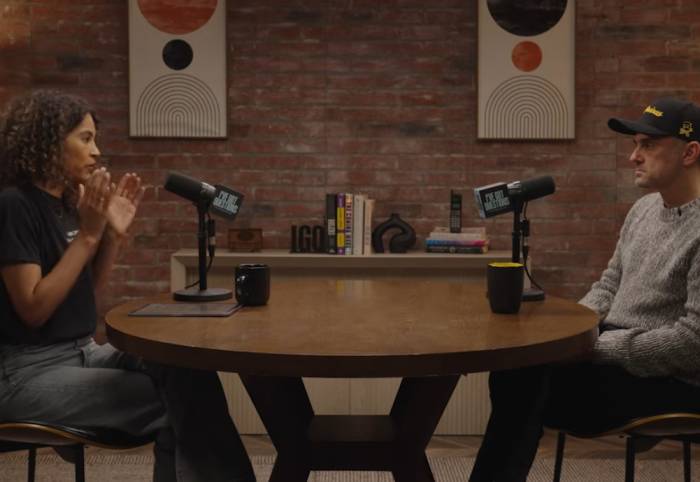
Editor’s Notes: In this episode of the I’ve Got Questions podcast, futurist Sinead Bovell sits down with entrepreneur Gary Vaynerchuk (Gary Vee) to discuss the potential end of the social media era as we know it. They explore how AI, voice-first technology, and augmented reality are poised to disrupt current platforms and fundamentally change how humans consume content. Throughout the conversation, Gary Vee offers strategic advice for creators on how to build a resilient brand and “squeeze the living shit” out of today’s opportunities while preparing for an immersive, agentic future. (Feb 5, 2026)
TRANSCRIPT:
The Beginning of the End of Social Media
SINEAD BOVELL: We’re almost two decades into this era of social media and we can feel like it’s a constant because we’re so used to waking up scrolling or talking about social media. But the reality is the industry is a variable. It’s not a constant as all industries that are born of different technologies.
So I’m trying to understand, are we at the beginning of the end of the social media era? And if we are, what’s coming next? Today I’m sitting down with Gary Vee, one of the legendary, earliest creators in the social media economy. He was one of the earliest people to write checks to companies like Facebook and Twitter. He has a notorious track record for understanding what could be coming next and where we’re going.
I’m Sinead Bovell and this is I’ve Got Questions. Okay, so I have a thesis. There’s three parts to it. I’ve teased it out on social media a little bit. I’ve written about it in my Substack, but I’ve never put it together for anyone in its entirety until now. And I think you’re the perfect person to run this through.
GARY VAYNERCHUK: Well, I’m flattered.
The Three-Part Thesis on AI and Social Media
SINEAD BOVELL: So I think we’re at the beginning of the end of the social media era. Okay, part one of the thesis. So I think, and they’re all tied to AI, I think AI cracks the current value proposition of the social media platforms in their current state.
So we post because people watch us, right? Whether I’m signaling that I’m single or taken, that I’m employable, that I was at the beach the other day.
GARY VAYNERCHUK: There’s consumption on the other side.
SINEAD BOVELL: We post for human receipt.
GARY VAYNERCHUK: Yes.
SINEAD BOVELL: If we can’t verify that I’m posting for a bunch of R2D2s or actual people, that psychology of signaling starts to break. So I post. But what is the incentive? Because the feedback is not guaranteed.
GARY VAYNERCHUK: Want to start?
SINEAD BOVELL: Okay, I’m going to build them all and then you can.
GARY VAYNERCHUK: Yeah, no worries.
SINEAD BOVELL: Okay, part two, the better AI gets and the more reliable this technology gets, especially as it transitions towards voice first, the less I’m going to want to pull out my phone and it’s going to start to break that habit that we formed of opening, swiping, watching, viewing, and I’m just going to say “Alexa, Uber, order this thing, do this thing” and I’m not going to open and watch.
And then the third, AI, it’s a general purpose technology like the Internet. And these technologies don’t mean that we do the same thing, just faster or more automated. We do different things. So I think, you know, television, YouTube isn’t automated TV. It was new people that gained influence. So I feel like we’re on the beginning of something entirely new that will have threads to the social media economy, but it’ll be unrecognizable as going from cable to TikTok.
The “And” Not “Or” Environment
GARY VAYNERCHUK: Couple things. So that’s awesome. This is so fun. This is already my favorite podcast ever. I would argue that cable and TikTok are not wildly different. Okay, so that’s put on a shelf.
SINEAD BOVELL: Okay.
GARY VAYNERCHUK: Go back to the beginning.
SINEAD BOVELL: Yep. The value prop.
GARY VAYNERCHUK: Yeah. The reality is it will be “and” not “or.” If you work, if your numbers, let’s just go where I think you’re going. Correct me if I’m wrong. So I don’t believe AI bots or agents consuming content eliminates the reality that humans could also consume that content. So I view it as an “and” environment versus “or.”
To your point, to many people’s points in fake fraud media world pre-social, like bots in digital marketing. You know, if I see 14 million views and I know that that’s actually only 300,000, that creates a new, you know, micro-dynamic.
SINEAD BOVELL: Sure.
GARY VAYNERCHUK: But if the results of what I want to happen happen from the 300,000 people that actually saw it, if I’m now posting and 99% is bots, but 1% is human and all my metrics are 99% fake, but 1% is human or AI or bots or agents or wherever we go, if the results that I want are still grounded in the 1% of human instead of 100% human, I’m still going to be incentivized to do it.
If I say I’m single and the only people that are trying to date me is an AI agent robot, bad, it’s possible. But if it is also going to be people just drowned out metrically and maybe optically by data, robots, agents, well then I’m still going to do it.
If I am going to sell wine or get stopped by 500 people in the street and say, “You changed my life,” even though yesteryear it was 100,000 views and that’s what resulted it and now it’s 40 million views, but it’s really only 100,000 views, I’m still going to do it. So the question becomes, if there is still human consumption, no matter how drowned out in an overall metric and the actions are executed on by those humans, I don’t think we walk away.
SINEAD BOVELL: So you’re saying, okay, if I’m selling makeup and sure, now I maybe have a million views, some of those are going to be synthetic.
GARY VAYNERCHUK: Correct. One of the cool things about why I think we, I built one of the biggest marketing companies is I don’t care about marketing in a silo. And I think the marketing industry does. I care about what marketing does for a business.
SINEAD BOVELL: Right. Yeah.
GARY VAYNERCHUK: So I’ve never worried about anything other than, I do this all the time. Like trying to remind people like this is not art class. We have to drive this insurance company’s business. Right? So that is a comp to what I’m saying.
The Voice-First Revolution
SINEAD BOVELL: But how does this happen on the same platforms? Because what I’m envisioning is cable and then TikTok on the same channel. And that’s…
GARY VAYNERCHUK: This is where I think you’re wildly right. So I think one of the things you said is like, you know, so AI, I could not agree with you more about voice. In fact, we started talking about this. I’ve got some good receipts in 2016, 2017 because I became infatuated. I started seeing early AI. I’m like, “Oh shit, Alexa’s a beast.” You know, like I really, voice war.
SINEAD BOVELL: And we’re in the worst voice technology we’ll ever be.
GARY VAYNERCHUK: Oh my God.
SINEAD BOVELL: And it’s the most conversational for us.
GARY VAYNERCHUK: I only prompt in voice now.
SINEAD BOVELL: Yeah.
GARY VAYNERCHUK: I only prompt in voice.
SINEAD BOVELL: And there are entire businesses that are now voice first. So you go into their offices, there are startups, they’re not typing, they’re talking. And it’s much more natural, by the way.
GARY VAYNERCHUK: I’m so pumped about that. As someone who can’t write for shit.
SINEAD BOVELL: Right? Somebody pumped. Yeah.
GARY VAYNERCHUK: Anyway, so I’m a buyer. I’ve got another build on yours.
SINEAD BOVELL: Okay.
GARY VAYNERCHUK: Because you’re talking about a very smart thing. When distribution changes, everything changes. I also believe forget about voice. And I’m with you on that. That’s one thing. Where is it?
SINEAD BOVELL: So you do agree that voice could break that loop of open phone and watch something?
GARY VAYNERCHUK: For sure. And open phone and watch something is being battled on not just by the voice devices, but, but this is coming.
SINEAD BOVELL: Glasses.
The Glasses Revolution
GARY VAYNERCHUK: Glasses. I would argue that voice would be an “and” because we still want to consume visually. I think it’s glasses. I think voice, to your point, may be a dent in consumption. But I think if glasses pulls off its mission, whether it’s Meta, whether it’s…
SINEAD BOVELL: Google, Apple, who knows who’s coming in?
GARY VAYNERCHUK: Could be some secret lab. Right now there’s a Chinese based company, someone building something that when glasses comes that I believe glasses is the most obvious thing brewing that is going to do to phone what phone did to television and what television did to radio. I fully agree.
SINEAD BOVELL: And so, okay, so let’s paint this new economy. So maybe you throw on your glasses and, or you have AirPods. So when Apple dropped AI translation in their AirPods a couple months ago, and it is amazing that you can do translate anything. Anytime I saw an AI in your ear, that is the beginning of that behavior. AI in ear talking to AI.
I mean, social media companies are now actually competing with people talking to ChatGPT versus going on those platforms.
GARY VAYNERCHUK: 100%. You know, I wrote a book. There it is. I wrote a book, “Day Trading Attention.”
SINEAD BOVELL: Yes.
GARY VAYNERCHUK: I think it’s the only asset and I think you’re touching on this. They’re all competing.
SINEAD BOVELL: They’re all competing.
GARY VAYNERCHUK: I mean they’re competing with sleep, they’re competing with working out. They’re competing with us doing what we’re doing right now. Netflix versus TikTok. TikTok versus the New York Times.
The New Content Ecosystem
SINEAD BOVELL: Doing the live experiences which we can get into. But let’s paint this ecosystem, right? So you maybe throw, someone’s going to throw on glasses when they need to see something, but it can’t look the same way. Right. You can’t be scrolling TikTok with your eyes. The format has to change. So I think that 90 second video clip, we are at the beginning of the end of that as the center of gravity.
GARY VAYNERCHUK: I think video is a very big deal for human beings. So I think that’s the dangerous part of this. So let’s talk about it. Couple things. I believe and I have a feeling as I’m starting to get in here with you that you’ll see this as well. I think augmented reality is a huge winner. You know, AR is going to be very big.
If we really do go to glasses and we’re really here, we could have a third guest right now. And she’s here. So I think, I think video starts to get very three dimensional and interactive. Correct. It gets really powerful. So to your point, like watching a 30 second video in a box on your phone is absolutely going to feel as mundane as like the old motion pictures.
SINEAD BOVELL: Totally.
GARY VAYNERCHUK: Like, you know, like you see, like they used to move it manually. Like no doubt. I think that again, I’m just looking at everything I can see with my eyes right now. If it goes back to the Sphere in Las Vegas, that venue.
SINEAD BOVELL: Yeah.
GARY VAYNERCHUK: Like do I watch Star Wars 67 in 20 years where everything is activated? I think so.
SINEAD BOVELL: Everything.
GARY VAYNERCHUK: That’s right. Like it’s not limited, but it will be in video form. It might be in AR three dimensional form. As the technology grows. I’m in the movie, like it gets really immersive. Like I don’t see how we are not robots at some point. You know, probably not in my lifetime. Maybe in my lifetime. This stuff sometimes goes pretty fast. But hopefully I live long.
But yes, I think that is the case. I think it’s the glasses and AR content becoming the winner in that decade. What video in this device? I think this is the distribution. Like for example, the LLM, you know, AEO, GEO thing that you brought up about Uber or utility when I’m going into Uber, I’m going into Uber. I’m not on Instagram anyway. I don’t think that’s taking away. You know what I mean?
Yeah, yeah, I’m in Uber anyway. Yeah, I’m in Uber for 13 seconds and I go back to Instagram now. It’s frictionless. To your point, it’s so easy. But I’m not worried about that part that you brought up. I think voice plus glasses is bad for phone and we reset and I agree. I think in the beginning, just like this is such, I’m going to make a prediction.
SINEAD BOVELL: I’m very passionate about.
Early Adoption and Evolution
GARY VAYNERCHUK: I believe a lot of the early executions will be silly. They will be one minute videos that just show up in your glasses. Because a lot of people won’t be used to the new distribution. The first commercials on television were radio. Yeah, it was a photo and a man read it just as if he was on radio. And it took time for us to understand how. Correct.
So totally new operating system, voice interface and AR interface. In a world where we’re wearing this predominantly, I think it’s going to get so good 10 years after it comes out that people will struggle to take their glasses off because you won’t even be able to live in the world because you’ll be missing too much 20 years after.
Just like the iPhone. You may know this. The original big app on the iPhone was drinking a beer, like silly. We didn’t know yet. That’s a long cry from Uber or Instagram or what have you. And so, yeah, I think that those are the themes I agree with.
The Future of Social Media and Technology
SINEAD BOVELL: So it’s either the current players and they’re probably planning for this because you do see Meta step into AR glasses. But the future, it’s not a continuation. Right. You don’t just pile on the new thing. There is an app or some kind of experience waiting to be born that combines either the glasses and/or AirPods and/or some form of a pendant. That’s a new type of interaction. That’s just not this.
GARY VAYNERCHUK: This has no shot.
SINEAD BOVELL: It’s. This has no. Yeah, I mean, it will take time. This is tomorrow.
GARY VAYNERCHUK: Correct. I think it’s, you know, I think it’s still. I think this has got a decade. For real.
SINEAD BOVELL: Do you think it has a decade?
GARY VAYNERCHUK: I do. Because I think the glasses that I’m talking about and the voice interface, universal everywhere we turn, has more work to be done. Meta’s Project Orion, I think is hoping for six years from now. And that’s they’re ambitious and hopeful. So. And then even when it comes out, I mean, this was my thing back then. When the iPhone came out, I’m like, all of you are going to have an iPhone. They all laughed at me. Because they all love their BlackBerry.
SINEAD BOVELL: So did TechCrunch. Everybody slammed the iPhone. It was going to bomb, of course, fail miserably.
GARY VAYNERCHUK: People don’t understand. People don’t understand what people value. At the time, for me, it was an easy read. I’m like, the Internet’s on this and not like the BlackBerry, like the real Internet. This is a computer. So, you know, I think that it will be that kind of window. But this will be replaced by a more extreme version of this. Just so you know.
The Shift in Social Media Behavior
SINEAD BOVELL: Do you. Okay, so I think, I mean some of the data that I’m seeing show that we’re starting to show that we want something new or we’re ready for what’s next. Whether that’s people spending less time on social media, especially Gen Alpha. And I know that that’s something that you’ve talked about. People want to live in the world now.
GARY VAYNERCHUK: Love that. I agree.
SINEAD BOVELL: I love that too.
GARY VAYNERCHUK: I think it’s barbells. Okay, I think we’re going to go into extremism on both. Look, the technology is too intoxicating to the human being. We only go one direction.
SINEAD BOVELL: It’s always extreme.
GARY VAYNERCHUK: Yeah. It’s always. The new technologies win. People held on to candles and lanterns, but electricity won. People stuck with their horses for a little.
SINEAD BOVELL: Yeah, yeah, we just go to the next.
GARY VAYNERCHUK: We’re going to. Because it’s just too. It’s just, it’s too obvious. It’s the most historical truth of man. From the wheel to AI. We will go move forward.
SINEAD BOVELL: Yeah.
GARY VAYNERCHUK: And we will have pockets of adjusting. Everyone smoked then. No one smoked. And by the way, smoking starting to come back. Not vapes.
SINEAD BOVELL: Right.
GARY VAYNERCHUK: Cigarettes. The cool kids in Brooklyn are starting to do it again. You could see it. It’s starting to happen. Alcohol. No. Yes. No. Yeah.
SINEAD BOVELL: Yeah, it is.
GARY VAYNERCHUK: Cannabis.
SINEAD BOVELL: Yeah.
GARY VAYNERCHUK: Most people don’t know the history. They don’t understand. Go back 150 years and we were good. It’s medicine.
SINEAD BOVELL: Yeah. Canceled and then it’s back.
GARY VAYNERCHUK: Correct. So we ebb and flow in the micro. We’re tired of all this for sure. And then there’s. Kids always want to be cool. So I’m going to get a CD player. Just. Yeah, like there’s all that. But in the macro. The tech will win.
The tech could be getting so extreme. The fun thing to think about is that’s how it’s always gone. Is this so extreme that it does create this counter on the barbell? Do we start understanding the weekends more? Do we go in hyper acceleration of AI to a three day, two day work week. What the f* does that mean? Five days of leisure. Now you are yoga-ing and climbing a mountain. You know, extreme capitalism might look like socialism. This gets really fascinating.
What I meant by that, everyone is, you know, seven companies become trillions because of this technology. And they have all the moats. Well, they might, you know and jobs are just getting. Government’s going to get involved and make them subsidize the carnage. So I don’t know. These are all the fun questions I think about constantly.
Technology as Gateway to Real Life
SINEAD BOVELL: Yeah. And I think we do ebb and flow. I think we’re going to go through a dip where people are going to go offline and we see a bit of a renaissance. And I think marketing companies are going to figure out how do I leverage technology? Because it’s not that you’re getting now a telegram to tell you where the new thing is in the park. Companies are going to figure out how do we use technology to get people into offline experiences that are worth attending. And that’s coming. It’s happening and we’re seeing it.
GARY VAYNERCHUK: I would argue that’s been happening. I would argue that technology has been the gateway drug to in real life. I’ll give you an example. Do you know how many people are going to go out on a date tonight that it started in their phone tonight?
SINEAD BOVELL: Most people. Yeah.
GARY VAYNERCHUK: Do you know insane that is. I would argue that’s been happening literally in New York. We’re in New York City right now.
SINEAD BOVELL: Yeah.
GARY VAYNERCHUK: Tonight is tonight Wednesday or Thursday?
SINEAD BOVELL: Wednesday.
GARY VAYNERCHUK: Okay. Tomorrow night. I’m just going to go with Thursday. Tomorrow night. Do you know how many people are about to go on a date tomorrow night in New York City where that started with a DM on Instagram or Tinder or something else like LinkedIn apparently. Yeah. Substack writers are get on fire, you know. That happened digital to then go to have a meal or a drink or a coffee. It’s been happening.
I think we in society are tackling a lot of anxiety around a lot of issues. Geopolitics is not chill, not 2002. I think modern parenting had a tough chapter the last 30 years. So we have a lot of insecurity in the early 20s and 30s in society in Western first world countries. I think we’ve become dramatically materialistic. Unfortunately. Materialism has really had a good run. I think we’re really overly.
SINEAD BOVELL: We’re really done subscribe from that.
GARY VAYNERCHUK: I mean I’ve been. My whole life’s been unsubscribed for that. And I think so much of my happiness.
SINEAD BOVELL: My 30 year old tea.
GARY VAYNERCHUK: Yeah, I love that. Well that’s cool. You know that’s ironic. Cool the other way. I’m like oh, she’s cool. So I think there’s a lot going on that makes it easy for us to not be accountable of our own shortcomings and say, ooh, it’s you. And so that’s what I’m spending a lot of time thinking about, which is why we’re, for example, you know, this with data, a lot more people are saying they’re going to unplug than actually.
SINEAD BOVELL: Right.
GARY VAYNERCHUK: We talk big announcing it. That’s what people are like. Gary, in the recent poll, I’m like, not interested. Stop, stop.
Gen Alpha and the Future of Social Media
SINEAD BOVELL: I think it’s less. People are talking about moving offline, but hardly anyone’s going. We’re seeing it in some of the data. With Gen Alpha, they’re physically not getting the same phones and they’re not signing up on the same phone that I see. Or they’re in DMs.
GARY VAYNERCHUK: I agree.
SINEAD BOVELL: They’re not on Seed.
GARY VAYNERCHUK: That’s right. I see that there’s a lot to watch with them. I have a 16 and 13 year old and I spend so much time on youth culture. There’s a lot to see how it all plays out. I think there’s a lot of ironic cool. I think Gen Alpha is doing its thing against Gen Z, which is so fun to watch because I got to really watch Gen Z do it to Millennials created a whole new dynamic.
When I was growing up on Gen X, we didn’t even know that we were in Gen X or I didn’t know what a boomer was. We found another thing separate us.
SINEAD BOVELL: Yeah, yeah.
GARY VAYNERCHUK: I always hate it. I hate the whole generational thing. As if religion, race, gender wasn’t enough things to divide us, we added another thing. You know, there’s a lot of tension and I think that seeps into how we view technology. I think we’re blaming technology. And I also think we’re posturing. I think we say something in a poll or a survey and we have.
SINEAD BOVELL: We are aspirational. So your dating profile, your LinkedIn, your resume is who you hope to present yourself. And you probably answer a poll in that way too.
GARY VAYNERCHUK: You’re very sweet. I would argue that we’re full of s* and we’re hypocrites. You know? I think we. I think we’re audacious. I think we. I think people think they can trick people. You know, one of the great things that happened in my life, luck of the draw, DNA wise parenting circumstance, was my intuition’s really on and it’s really hard to trick me.
And I think that scared me because I was like, wait a minute, I don’t want to trick the 99%. I want the 1%. You know, intellectual, successful, optimistic, good to like me. I’m not going to trick. I think a lot of people get away with tricking people or think they can trick people because they’re trickable.
Authenticity in the Age of AI
SINEAD BOVELL: So brings me to an interesting point, because we’ve been hearing a lot about the word “authenticity,” especially as it relates to AI. So people saying, okay, AI is coming, there’s going to be AI influencers, or. I mean, I think Adam Mosseri did a big mini essay on Instagram talking about the rise of AI on the platform. And we know, we see what you’re seeing, and we’re going to try to figure this out. Instagram’s going to have to figure something out.
But for the meantime, try to be authentic. Authentic, because authenticity is going to win. I feel like we’re off to shaky ground. If we’re thinking about authenticity in relationship to a machine, I feel like that’s already out. I think authenticity should have nothing to do with the AI or anything else. I don’t even know where we’re going with that, with authenticity.
GARY VAYNERCHUK: That’s a great. I love how you think. Couple things. Let’s go backwards. Is it authentic to make art on a canvas? It’s one of my favorite historical events. When the canvas was invented, all the artists said it was radical. They said it wasn’t real. They said, if you make art on a canvas, it’s not real. You must make it on a building.
The amount of people that just heard that, that had never knew that, and they think that’s real art. And like an NFT. No way. Digital art. Right? So machines. Was it authentic for people to show up on radio and television? Because that was a machine. So, those are machines. Did that require. Did you have to. Was he only authentic to the people that were on that lawn?
Because, f*, I surely felt something as I went to MLK Elementary School, and it was a big deal for me as a kid. That speech, you know, I get where you’re coming from, but I think it goes further back. Was it authentic to write down words on a piece of paper with an ink pen versus saying it to someone? I don’t know. It depends on my point of view, is the intent and the actions are the authentic part, not what’s distributing it.
SINEAD BOVELL: Yeah, totally the intention. Because we quickly go to authenticity just being. Don’t put effort in. I mean, but if you’re looking at someone like Wes Anderson, I’m sure his movies aren’t cheap to make, but they’re authentic to him.
GARY VAYNERCHUK: Well, that’s right.
SINEAD BOVELL: So authenticity. It’s like we shouldn’t. It shouldn’t even be in comparison to others or machines. It’s what is interesting to you.
GARY VAYNERCHUK: Plus what can you do? You earlier said my Substack. I’m so not jealous or envious but I’m like man, I’m so capable of communicating with my words and thank God that can translate into written. But to write, I’ve got nothing. And sometimes authenticity is incredibly insular and solo.
SINEAD BOVELL: Totally. It’s not. It shouldn’t be a performance. Often the fact that we immediately went to how you present yourself to the world and it comes down to how you. It’s missing the point.
GARY VAYNERCHUK: I’ve never. By the way, my by the way. Actually, back to the original creator. I am one month away. In a month will be the 20th anniversary of me making my first YouTube video. YouTube wasn’t even six months old.
SINEAD BOVELL: Congratulations.
The Agentic Economy and the Future of Brand Building
GARY VAYNERCHUK: No lighting, no audio. And I did that for five years and by that time everybody did have lighting and audio. And I don’t know, it just felt fine. And guess what? It did great. And it worked because I knew what I was talking about with wine. I was knowledgeable about wine, I was passionate about wine. And I really wanted people to learn about wine that were under 40 from a non-pretentious person so they could enjoy it instead of thinking it was some academic test.
I feel like I can do that with an AI movie right now too. And it will be authentic.
SINEAD BOVELL: It’s whatever is interesting to you. If you are someone too that likes the frills and likes the perfection, just because people are saying AI can maybe do that, if that’s what inspires you, keep doing that. Because we don’t want to adapt away from ourselves because of a machine. And I think we’re running in circles around it.
GARY VAYNERCHUK: There’s a really funny saying that modern parenting has for little kids that says this is the saying they’ll say to a kid, “don’t yuck, they’re yum.” And my kids are 16 and 13 and I heard that 10 years ago and I was like, that’s awesome. That’s how I see life. This was more about like, don’t say that snacks are not nice because they love them. That’s interesting to them, but that’s where you’re going.
And that’s just like, I’ll be honest with you, that’s my number one thing. I don’t understand people’s audacity to think that people should see the world the way they see it. I’m passionate about sharing my observations, but I’m in the business of conviction, not convincing. And I think we are all spending way too much time on convincing.
SINEAD BOVELL: I agree. Okay. I want to step into the agentic economy because I think we see it quite similarly. And we talked about it a little bit and you had painted an example at an event. You were doing a Fireside chat. And just in case anyone’s listening that isn’t familiar with what is going to happen in a voice-first agentic economy, can you give us an example of where we could be going? And then we’ll talk about what that could mean for people who think they have a message to say and how does the agent find you or a brand?
Voice-First Shopping and AI Agents
GARY VAYNERCHUK: Yeah, I think what you’re setting me down a path of is this concept where you just walk in and you’re just like, “Hey, Alexa, you know, I have six boys coming over for dinner tonight and I want pizza. And one of them’s lactose intolerant.” Enter. That’s, you’re done. You don’t even say enter. I’m laughing that I’m saying enter.
You know, we’re in a place where you’re going to talk this out and if you do not name the brand or you’re not specific, the agentic is going to make the decision for you. It’s a very big deal. We’re also going to set our preferences. There is a day of reckoning coming where I can tell you, for me, I’m going to set the deodorant I buy and it will be set and repeat, and the agent’s going to buy it for me. And I’m not going to be seduced by an end cap at Walmart.
And will an ad on social media compel me enough to change my settings? Maybe. Actually, possibly. In fact, that could be the biggest of them all. You can really prove advertising in a world where, imagine if Amazon buys Snapchat, has a feed during that short term era, as we’re changing platforms and I see an ad for something and I’m not liking it. I’m actually resetting my preferences on the reordering of my shampoo to this shampoo. You’re going to find out how valuable advertising is fast.
SINEAD BOVELL: It is about to change so much. I think if you’re buying a wedding dress, sure, you’re going to be in the mix. You’re going to be watching, looking at.
GARY VAYNERCHUK: Or check this out. Or for some people, pickles. You’re right about wedding dresses.
SINEAD BOVELL: Sure. These high ticket items.
GARY VAYNERCHUK: Correct. I’m actually really fascinated by pickles. Do you like pickles?
SINEAD BOVELL: I do.
GARY VAYNERCHUK: Good. Me too. Do we like pickles enough that we’re really going to be deliberate about it?
SINEAD BOVELL: No, I don’t.
GARY VAYNERCHUK: I don’t think so either. For me. But let me give you one that I will be just because this is fun: wine.
SINEAD BOVELL: Okay.
GARY VAYNERCHUK: I’m not going to be like, “Hey, agent, just $20 wine. Whatever you think best deals go.” I like wine too much. I’m going to be in there with it. It’s going to be, and 90% is going to be you price, convenience, set reorder. For me, reorder the product going to be Internet of things. When it’s down to a little bit, it’ll reorder itself. All that.
But it’ll be fun to see who cares enough about pickles to set pickles. Will you do toothpaste? How do you feel about toothpaste?
SINEAD BOVELL: I’m chill.
GARY VAYNERCHUK: I’m chill.
SINEAD BOVELL: I’m chill on it. I’m chill.
GARY VAYNERCHUK: Give me something mundane that you’re not chill about. Perfect.
SINEAD BOVELL: Supplements.
GARY VAYNERCHUK: Beautiful. There you go. So let me say me could give a.
SINEAD BOVELL: Okay.
GARY VAYNERCHUK: I’ll be like, whatever. Actually back to where the world’s really going. I’ll go to Atria, my bougie place here in the city. They’re going to do blood work and whatever the right math is. I take it. So.
SINEAD BOVELL: But for you, I’m comparing it. I’m running it through an AI. I’m just.
GARY VAYNERCHUK: That’s right. And you’re not going to be like “order supplements, just keep me good.” No, no.
SINEAD BOVELL: We’re going to converse about it.
GARY VAYNERCHUK: And so I’m painting the picture that I think we’re all going to, which is we’re going to all learn that everyone has things that they really care about. I mean there are people listening right now. They’ll be like, “I’m not letting my AI order my beer. I’m going to be specific.”
SINEAD BOVELL: Sure. And there’s a place for you.
GARY VAYNERCHUK: That’s what’s going to be so awesome. We’re all going to be in a place of, and it’s going to be so cool. We’re going to figure out what we actually care about and things will change. I may have my beer set and forget just so I have beers for company.
SINEAD BOVELL: Yep.
GARY VAYNERCHUK: And then I might go on a trip. And I’m like, “Oh, I’m into microbrews now.” And then I might reset it. And that whole interface of watching your life of what you care about, what you don’t care about. Some people think you should really, you know, I’m going to blow you away. You said car. I don’t give a f*.
That’s crazy, because I know car is big ticket. People really care. The logo, the color, the leather, I don’t. So Gary will be like, “Car, best price, best deal, whatever.” The arbitrage is that I care about time, convenience, you know.
SINEAD BOVELL: Yeah. AI will meet you where you are.
GARY VAYNERCHUK: And where you are at all times.
SINEAD BOVELL: And also you’re going to set your intention. So for me, with food, I would be like, “Okay, I have people coming over to Pizza Party. Organic. Try to go low on the microplastics if you can. This is my budget.” I’m good. I don’t need to see what it looks like. And I don’t need to pick things somebody else might not.
GARY VAYNERCHUK: My wife spends 15 hours trying to make sure every single part of the food she puts in her body is clean. Now, AI will do that for her. They will do it for you real way too.
Breaking Through in an AI-Driven World
SINEAD BOVELL: But then how does the pizza parlor, the skincare, the supplement person, the somebody who has something to say break? Where are you in that stack?
GARY VAYNERCHUK: I don’t know. And I kind of know.
SINEAD BOVELL: Here’s what I have no ideas too.
GARY VAYNERCHUK: Okay, so first, what Google did as being a toll booth for the world for 25 years is wildly misunderstood. OpenTable, you know, Kayak, you know, Priceline, the amount of companies that were built on top of Google search to become massive companies on the arbitrage of Google Ads, Bookings.com, Travelosom. I mean, it’s insane that’s about to happen with LLMs agents and what have you. There’s going to be.
But the question becomes, do the companies that have the control of our attention want to get into the businesses? So will Google with Gemini during this era, because there’s so little friction, will they decide instead of sending people to H&R Block, do they want to become H&R Block? Does OpenAI want to get the ad revenue from Geico or do they want to compete with Geico? Because everyone’s going to go through their funnel.
So to your point, how do you break through? One, this is going to send the world into a frenzy of understanding why brand is so important. You know, there is, this goes back to religion. Things are going to have to really matter or it’s just going to all happen in the backdrop. How you get something to matter will come in a million ways.
Back to your point, I’m actually massively bullish on experiential marketing. Popping up at Coachella and the Super Bowl, doing your own stuff, having a running club, hiking club, fishing club. Yeah, I’m very into it. Again, I think the way the world’s going to work is whether it’s, we’re still going to live. Right. You know, Ready Player One is going to come at some point, some version of it, but we’re still going to live for a little while, especially us who are listening right now.
I’m going to the Super Bowl in a couple weeks. That Saturday, I’m going to walk around before the game and do events and go to parties. By the way, I really did take note of your T-shirt. It’s funny you brought it up. I take note. I’m like, “That’s cool. I want that.” Maybe I don’t want my AI to keep ordering me blank black shirts. Maybe I want that one. I’m going to be able to, in two seconds be like, “I want that.” And it’s going to go cook.
And so in a lot of ways, it might be more extreme. See what I just, yeah, maybe more we, no friction. You can have what you want all the way. And what makes us want something is word of mouth, a conversation, walking down the street.
SINEAD BOVELL: You know, it’s kind of like real life influence.
GARY VAYNERCHUK: Real life influence. Right. But by the way, there’s going to be something that we consume.
SINEAD BOVELL: Sure. We’ll be digitally connected. No one’s going, yeah, whatever the.
GARY VAYNERCHUK: You know, whatever the YouTube or the Instagram or the TikTok of the day is, whether it’s an AR app. I mean, look at, if Meta wins, I promise you, Instagram’s going to have a place. If Meta wins this, they’re not going to be like, you know, it’s going to be something.
And by the way, it may be as mundane. I’m looking at you right now. There’s a blank wall here. It is potentially as mundane. And this will break your heart, maybe depending on your vibes right now, it might be that scroll. I don’t think so. I do think in the short term, it will be.
SINEAD BOVELL: I think, sure. There’s in between times, like I said.
GARY VAYNERCHUK: About the radio ad. Exactly.
SINEAD BOVELL: Yep.
GARY VAYNERCHUK: Long term, definitely.
SINEAD BOVELL: It’s going to be unrecognizable.
GARY VAYNERCHUK: Yeah, of course. Because history has told us that.
SINEAD BOVELL: Yeah, okay. So how does, if you are an economist that has some course to sell or whatever it is that you’re doing in the future. Understanding. Yes.
GARY VAYNERCHUK: How.
SINEAD BOVELL: How brand, how things resonate with people, how you sell a mission that you bring someone on board. That’s, I feel like we’re now in a time where it’s really easy. A TikTok finds you because of algorithms. And that’s the selling part. I think you’re going to have to make your brand so resonant and so, because everything can be instant and everything is going to be much more. I don’t know. I think it’s going to be trickier, but maybe easier.
GARY VAYNERCHUK: Yes.
SINEAD BOVELL: It depends on where you are in the stat.
GARY VAYNERCHUK: You’re thinking about it, so. Right. And notice I said the same thing.
SINEAD BOVELL: Yeah.
GARY VAYNERCHUK: Here’s what you and I don’t know, which is why I don’t even think about this s*. I think about it in the macro, but I do not try to go further. It goes back to discovering Pearl Jam in a bar. I will know when I see it.
SINEAD BOVELL: That’s it.
GARY VAYNERCHUK: That.
SINEAD BOVELL: That’s it.
GARY VAYNERCHUK: You got it. You and I agree. I’m sure people are like, oh, wow.
SINEAD BOVELL: Yep.
GARY VAYNERCHUK: And I’m saying the next part that you’re trying to do in your world that is meaningful and you need to.
SINEAD BOVELL: You do you. Yeah.
GARY VAYNERCHUK: I can tell you for me, what’s going to happen is when it’s here.
SINEAD BOVELL: You’ll see a signal and you’ll be like, this is.
GARY VAYNERCHUK: That’s it. Like when Vine was five seconds in, I’m like, this. And then, you know, Jerome Jarre and Logan Paul and King Bach. Like, I understood it. And I also knew. I’m like, oh, short form. Remember, six seconds only.
SINEAD BOVELL: Yeah.
GARY VAYNERCHUK: And I was like, oh, this is a new paradigm. Right. And now here we are. Right. Like we’re in a shorter form, snackable. You know, some people think it’s slop. I’m like, okay, like, one man’s slop is another man’s dinner. Right?
SINEAD BOVELL: Yeah.
GARY VAYNERCHUK: So, you know, I think that. I think the principles are the same. I think you’re right. I think. I’ll tell you what I like about your vibe. I think you’re right. That we’re in the very early predominant.
SINEAD BOVELL: Yes.
GARY VAYNERCHUK: I think. I think you’re right. I. In fact, I know. Let me phrase. I really think you’re right. That we’re in the beginnings of the crack. I think that you’re young. I can tell you what mistakes I made. I thought they were going to happen faster.
SINEAD BOVELL: Yeah.
GARY VAYNERCHUK: I’ll never forget when I launched winelibrary.com in July of 1997. Thank God I wasn’t making prediction videos. I was like, by the year 2000, right. Everybody will buy everything in. Yeah. So, you know, these gray hairs come in handy.
SINEAD BOVELL: Yeah.
GARY VAYNERCHUK: Notice how I said some things? You’re like, oh, wow. When I said 10 years, you know.
SINEAD BOVELL: Yeah.
GARY VAYNERCHUK: It takes time because look at what’s happening with AI. There’s so many dynamics you can’t predict. Several years ago, I was like, oh, because I have some nerdy ass friends, I’m like, oh, AI is getting close, right?
SINEAD BOVELL: Yeah. Yeah.
The AI Backlash and Fear of Job Loss
GARY VAYNERCHUK: I don’t think I could have even understood how profound it really was, but I was like, oh, it’s coming close. I could have never predicted then, even though I was. I knew it was close, that there would be such a backlash because. Because I couldn’t have predicted that everyone was going to be so scared shitless that they were going to lose their job that they’re going to be mad at AI in any form.
Do you know that most people’s negative opinions of AI in a commercial in content is all actually predicated on their own fear that they’re going to lose their job because of AI? As you know, they’re not even going to know if it was AI generated or not. The technology is too profound. We’re all going to consume unlimited content in 24 months and have no f*ing clue if it’s real or not. Now the girl’s blurry and you’re like, oh, that’s an AI model. We’re dangerously close for no one having any chance of guessing.
SINEAD BOVELL: I think we’re already here.
GARY VAYNERCHUK: I agree.
SINEAD BOVELL: I think we’re.
GARY VAYNERCHUK: I agree.
SINEAD BOVELL: I don’t think anyone can tell.
GARY VAYNERCHUK: I think we’re in an era where. Let me say it a different way. I agree that every person listening has consumed an AI person and did not realize. But I think you know what I’m about to say. Many are consuming AI people in their feeds right now and they can tell it’s AI.
SINEAD BOVELL: Got it.
GARY VAYNERCHUK: So that’s going to go away.
SINEAD BOVELL: Yeah.
GARY VAYNERCHUK: So I’m with you.
SINEAD BOVELL: Yeah.
GARY VAYNERCHUK: On the first part. I know that.
SINEAD BOVELL: Yeah.
GARY VAYNERCHUK: It’s the second part that’s going to get them.
Tech Incumbents Under Pressure
SINEAD BOVELL: And weird AI gets really interesting to me because the pressure that I think we know we’re at the beginning of whatever’s going to come next in social, we’re seeing the cracks. It’s not even unique to social media as an industry. Any tech company that was any tech incumbent born of the Internet era is feeling the pressure. We’re seeing it with dating apps. Netflix. Okay, so Netflix stepping into the creator economy. They’re going to be putting some YouTube videos on Netflix podcasts. Great. Everybody was really excited. The headlines were, this is amazing. Amazing. If you’re a creator or podcaster.
I didn’t see this as a good signal for Netflix. To me, this is an incumbent under stress. They’re stepping into a mature industry. Podcasting and the creator economy. It’s a mature industry. We’re going on almost two decades. Netflix is a tech company. Yes, they’re in the business of Hollywood, but they are first and foremost an innovator. And for them to not be reinventing and instead stepping. To me, this is consolidation.
GARY VAYNERCHUK: Let me tell you how bundling. Let me tell you what my. Let me tell you how I process that. Yes.
SINEAD BOVELL: And okay, that’s it.
GARY VAYNERCHUK: I think you’re right. It’s the classic Holly. It’s the last 80 years of media consolidation, fragmentation, pendulum swings. Consolidate, break up. New things come up. Consolidate, break up. I mean it’s the same old shit. Sumner Redstone was trying to do this 25 years ago with Viacom. Like in cable. It’s all the same thing. But we don’t know what they’re doing. That’s one thing for sure. And I that like, you know, to.
SINEAD BOVELL: Look at the market signals. But we don’t know what they’re actually.
GARY VAYNERCHUK: Working on, especially in the game that they’re all playing now, which is the secrets of what they’re working on have too much value.
The Future of Entertainment
SINEAD BOVELL: And no one, and that’s even with AI companies. No one’s talking anymore because everyone’s coughing. What I’m waiting for in entertainment. And I’m actually not interested in watching a movie with digital twins of Leo and Brad Pitt. To me that’s not interesting. And that again isn’t what the future is, just an automated present. I think no one’s doing that. Or hopefully not.
What’s interesting to me is the kid that’s in their basement right now working with AI to bring in a new type of entertainment that we can’t even imagine, and it seems so radical, is going from Broadway to movies. It’s a different type of entertainment and.
GARY VAYNERCHUK: I think when the distribution is more voice and glasses and not phone, it’s.
SINEAD BOVELL: Going to all make sense.
GARY VAYNERCHUK: Correct to your point. I could not agree more. There’s a seven year old girl right now in her basement in Toronto.
SINEAD BOVELL: Yeah.
GARY VAYNERCHUK: Who is working on something and she will be our Scorsese and our Spielberg and it’s going to be an immersive AR environment. And we’re going to be like, holy f*, it’s.
SINEAD BOVELL: And it’s totally.
GARY VAYNERCHUK: That’s right. Yeah. And it’s great. And it’s great.
SINEAD BOVELL: Yeah.
GARY VAYNERCHUK: But I also think in the same way that from an ironic lens, people want to read a newspaper.
SINEAD BOVELL: Totally. They’ll want to sit down and watch.
GARY VAYNERCHUK: A movie or reboot their old iPhone from 2026.
SINEAD BOVELL: Nostalgic.
GARY VAYNERCHUK: And go through like, I think social in feed. You’re so young, you’re going to see the whole thing. You’re going to see people doing it in 40 years as a counter to full immersive. This is going to seem like the simple day.
SINEAD BOVELL: Yeah. Yeah. And when you power this with AI and this gets interesting when you, you have all your photos, you have all of your calendar, everything that you’ve done on your phone, you could one day theoretically pass this to AI and say, make me a documentary of my life.
GARY VAYNERCHUK: And it’s by the way, I mean, that’s why I filmed myself.
SINEAD BOVELL: Oh, you’re going to have. Yeah.
GARY VAYNERCHUK: Like for five and a half or.
SINEAD BOVELL: Seven years passing that down to your kids.
GARY VAYNERCHUK: Oh, my God. I mean, there’s. We are so aligned. You’re right. Like the early videos is like, I know this is weird. I’m having a man follow me in a camera back in 2015 when I did DailyVee, I’m like, but do you understand that I didn’t know either of my grandfathers. Do you know how cool this is that my grandchildren are going to be able to like, really know who I was? Not all like me. Holy cow. Only famous people used to have a glimpse. This is way deeper.
Advice for Creators: Positioning for the Future
SINEAD BOVELL: Yeah. Footage of your life. Okay. So if people are listening though, and they’re. They hear us talking about the creator economy is going to look like something different. We’re going eventually somewhere else and you’re on a maybe a five, ten year time frame. Even though things are starting to change now. I mean, I’m a creator, so I benefit from this world and I know it’s changing. What should creators be doing today to start positioning themselves for what’s coming? Going more agent first. How should we. What should we be posting doing?
GARY VAYNERCHUK: Showing up, not getting over crippled by tomorrow.
SINEAD BOVELL: Yep.
GARY VAYNERCHUK: So it’s flying two planes at once. So step one in all this noise, keep doing what you’re doing. If it’s working.
SINEAD BOVELL: Yeah.
GARY VAYNERCHUK: The more people know who you are, no matter what happens in technology, that is going to matter. So I actually would argue the number one thing a creator can do right now is squeeze the living shit out of the discoverability that is TikTok. I have transformed to every platform. I’m one of the few humans on earth that has millions of followers from LinkedIn to Snap.
SINEAD BOVELL: Yeah.
GARY VAYNERCHUK: YouTube to Facebook. Right. I’ve done it in real time. In fact, it’s one of my biggest pet peeves of creators, that they’re too one dimensional, that they’re. They’re only on one or two platforms. So I go vertical, this is going to go horizontal. And so that’s got a whole different thing to it. But the amount of brand and awareness they create right now will service them incredibly well.
SINEAD BOVELL: Mm.
GARY VAYNERCHUK: Right. Yeah. Now the transition. Here’s where you’re going. The transition of, like, we’re all here and now we’re all over here. They have to make sure they make that transition. Right. Yeah. Yeah. Because the MySpace friends I had did not. Dane Cook could be the biggest. I mean, he had whatever his wants and needs are. Tila Tequila, whatever her wants and needs are, their personalities. But they didn’t take their MySpace fame and attack Facebook and Twitter the way I thought they should or could have.
SINEAD BOVELL: Yeah.
GARY VAYNERCHUK: Right. So I think it’s extracting, but this other plane has to start to be built where you have to start challenge yourself to know what’s coming.
SINEAD BOVELL: To know. Yeah.
GARY VAYNERCHUK: You need to know what Lovable is. And vibe coding. Maybe it works for you. You need to know what’s going on with live shopping because you might be better at the QVC part than the content stuff. You need to start trying to use an agent or AI or for research. Like, you have to start getting on the treadmill because the marathon’s coming.
SINEAD BOVELL: Yeah. Right.
GARY VAYNERCHUK: So you got to get on the treadmill. You don’t have to become you and a f*ing savant or technically deep. But you have to start flirting. You have to start flirting while extracting.
SINEAD BOVELL: Yeah.
GARY VAYNERCHUK: I can tell you for myself, I plan on going nowhere.
SINEAD BOVELL: Yeah.
GARY VAYNERCHUK: And I’m trying to extract the f* out of the current. And I’m dangerous. I’m knowledgeable about tomorrow and what it.
Defining Your Value Proposition
SINEAD BOVELL: It seems like you’ve done, and I think every creator needs to be able to do is what is your value proposition? You have to be able to answer the question, what is your value proposition? Decoupled from the medium of the moment. So it doesn’t matter what the platform is of this moment. Maybe it’s YouTube, maybe it’s TikTok, maybe it’s whatever comes next. But what your value proposition is, you can translate it on all the platforms.
GARY VAYNERCHUK: This is why I’ve told so many people through the years, like, don’t trade on looks, they go away. Don’t trade on, you know, like, like, what are you trading on?
SINEAD BOVELL: Yeah. What’s your mission? What’s your value? It’s whatever the medium of the moment is, it should be independent of that. It’s above that.
GARY VAYNERCHUK: Well, that’s why everything has worked for me. Like, I’m audience. What’s in it for them?
SINEAD BOVELL: Mm.
GARY VAYNERCHUK: I’m in a full 51/49 mindset with the world. I want to give it more than I’m asking for in return.
SINEAD BOVELL: Yeah.
GARY VAYNERCHUK: Makes me feel like I can never lose.
SINEAD BOVELL: I agree.
GARY VAYNERCHUK: This podcast, what am I doing here? I’m desperately trying to say something that brings value to your audience. I have context for your audience. It allows me to deliver content that has a higher propensity to do well. I’m not worried about who’s going to discover me. I’ll take it. I’m a human. I’d like it.
SINEAD BOVELL: Yeah.
GARY VAYNERCHUK: I’m deft. I’ll tell you one thing, because I know how I roll. I really hope that somebody who used to think I was a bozo because I was yelling in 13 second videos like, wait a minute, there’s a little more depth, Gary Vee than I. Of course I’m a human. But my main intent is I need to respect this distribution.
SINEAD BOVELL: We’re here now, your context.
GARY VAYNERCHUK: And how do I as a human being say things that might bring value, that might be a compliment to the things they’re hearing from you? Which gives them two data cents that allows the—oh, yeah, it wasn’t me siloed. It was you prepping them three episodes ago saying something that’s been in their head. I have a little spin on it, a different voice on it. And all of a sudden.
SINEAD BOVELL: Yep, yep. And okay. And this would be more of a personal question. You’re over under on live. I know you’re saying live shopping is the future and I think it’s the present. Is the present. Do you think that that’s also the on ramp to where we’re going next in terms of a social ecosystem?
The Power of Live Streaming
GARY VAYNERCHUK: Well, it’s happening too. In fact, I would argue Twitch and Kick and these live streamers, Kai Cenat and Aiden Ross. I would say that’s even further along than live shopping. I would say live is very obvious. Massive. Yeah, I think you would slay. It’s a huge commitment. It’s a crazy thing. It’s not for most because it’s a level of always on that is intense.
But what’s going on on Twitch and Kick right now, YouTube live is massive. And it’s really doses like a 24 hour-a-thon with you answering. Hey everybody on the podcast. I’m sure all of you would love her to commit from a 9 to 9, 12 hour available to you. Come to this Twitch answer. I’ll answer questions. Because right now you’re getting her brilliance through the podcast. They want to be able to interact.
SINEAD BOVELL: Yeah.
GARY VAYNERCHUK: That’s the digital version of what you’re talking about in analog. That’s the halfway point.
SINEAD BOVELL: Yeah. Live. And it’s really interesting because it’s participatory. Everybody’s there together. So it’s not just asynchronous like social media. Yeah. It’s sports real and you only in this moment and it never happens again.
GARY VAYNERCHUK: It’s awesome.
SINEAD BOVELL: And to me, I don’t know if it’s—
GARY VAYNERCHUK: But not only does, but it’s actually—
SINEAD BOVELL: Double good because then you can share—
GARY VAYNERCHUK: It after of course they clip the f* out of it. Put it everywhere. That’s right.
Focusing on What’s Working
I just want to say something to you that I also think is going to really land for everyone else. You strike me as dangerously close to a next level and I’m going to say something right now that I desperately hope brings you value because it’s wildly intended for that. If as I’m recapping this last hour, the more you think about the not what’s not working, but what’s about to work, I feel like that’s going to really service you well.
SINEAD BOVELL: Thank you.
GARY VAYNERCHUK: My ability to not dwell or get myself over concerned about the many things that are not working because in a macro I have incredible belief in the human race because we’ve proven it will actually create a different energy in you that I think will extract your brilliance even more. I genuinely believe that.
SINEAD BOVELL: Thank you. It’s on the record, so we’ll take note.
GARY VAYNERCHUK: You know what I mean?
SINEAD BOVELL: Yeah.
GARY VAYNERCHUK: Do you see where I’m going?
SINEAD BOVELL: Yeah.
GARY VAYNERCHUK: I think you’re just a conscious person. I think that helps you a lot. And I think, man, there’s so many things that are challenges and there’s so much going on. But I think the reason I got into root causes, self esteem, parents. Real s* is all these are just byproducts, you know?
SINEAD BOVELL: Yep.
SINEAD BOVELL: Yeah.
Technology as a Net Good
GARY VAYNERCHUK: I don’t know. I think we’re in an incredible place and don’t forget I’m part of the era. 2008, Obama, all the this stuff was changing the world. It was nirvana. We’re on the other side now where a lot of the we’re getting exposed to, you know, our shortcomings are coming out, our angst is coming out.
SINEAD BOVELL: They definitely are.
GARY VAYNERCHUK: I think technology is wildly historically obvious that it has been net good for humans. Penicillin was a good invention. Electricity was a good invention. The automobile was a good invention. And unfortunately, someone today will drive drunk and hit someone. You know, I think we focus on the 0.001% of bad and don’t see the 99% that’s good.
I really believe that, by the way. And I think for you specifically, the way you’re thinking and the way you’re rolling, I felt very compelled to share that.
SINEAD BOVELL: Thank you. I’ll take it. Thank you. This is a pleasure.
GARY VAYNERCHUK: For me too.
AI and the Future of Work
SINEAD BOVELL: That’s a wrap. What impact do you think AI will have on the workforce? And do you think we are headed for an identity crisis?
GARY VAYNERCHUK: And this is the question that’s fascinating about AI. What else can I do? Very few people have the courage to ask that question. Why? Because they look in the mirror in the morning and they see an engineer or a doctor. They don’t see a person.
SINEAD BOVELL: If they’re not looking at artificial intelligence and asking, what are we going to become with this technology, would you say it’s the beginning of the end for them?
Related Posts
- Jeffrey Sachs: US & Israel Attack Iran – War Is Spreading Across the Region (Transcript)
- Diary Of A CEO: w/ Security Expert Gavin de Becker (Transcript)
- Is AI Hiding Its Full Power? w/ Geoffrey Hinton (Transcript)
- U.S. & Israel Strike Iran – What Happens Next? w/ Dr. Roy Casagranda (Transcript)
- The Attack on Iran — Why Now? w/ Ian Bremmer (Transcript)