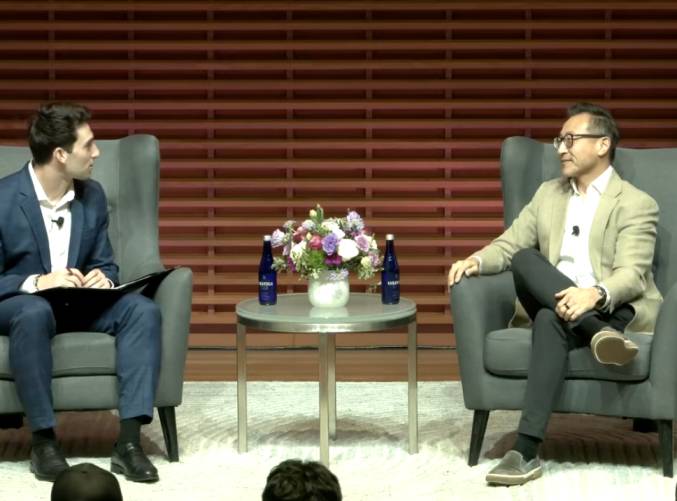
Editor’s Notes: In this installment of Stanford GSB’s View from the Top, Joe Tsai, co-founder and Chairman of Alibaba, shares his journey from navigating a cross-cultural childhood to building one of the world’s most influential tech giants. He dives into the early days of partnering with Jack Ma, the strategic pivots that led to Alibaba’s dominance in e-commerce and cloud computing, and his perspective on the global AI race. Tsai also offers candid advice for aspiring entrepreneurs on the importance of finding the right people and winning locally before attempting to scale globally. (Feb 5, 2026)
TRANSCRIPT:
JEREMY TEPPER: Joe, welcome to View from the Top.
JOE TSAI: Thank you, Jeremy. Very happy to be here.
JEREMY TEPPER: Well, it’s an honor to have you here. And as I was preparing for this interview and trying to wrap my head around just how massive and global Alibaba has become, what really struck me is how you have navigated across cultures throughout your career. East and west, law and business and sports and tech. So I actually want to start with your first cross-cultural major experience. You were born and raised in Taiwan and you moved to the US at age 13 to attend the Lawrenceville school in New Jersey. What was that like for you?
Navigating a New Culture
JOE TSAI: It was scary. My first, well, first before I went, I never went to seventh grade. I was in elementary school in Taiwan. And then my mother said, “Joe, I’m going to send you to school overseas, but you have to learn how to speak English.” And I didn’t know how to speak English, so I went to an English cram school for one year and skipped seventh grade. So I went into Lawrenceville in the eighth grade.
During that cram school year, I basically memorized vocabulary, but I couldn’t put together a sentence in English. And that was sort of—so imagine you didn’t really know the language, you don’t know how to communicate, and then you’re in a completely new cultural environment. Just kind of just land, I mean literally like fresh off the boat, right. And landing in this very unique environment. Boarding school. It’s an all boys boarding school, so that has its own sort of pitfalls and you just have to fit in.
I think I wanted to be one of the guys. I wanted to conform. I wanted to fit in. I look different, I dress different, I speak a different language. So it’s very important for me to feel like, get accepted by the rest of the guys. And then very quickly I went into sports. I got cut from the baseball team, unfortunately. Imagine a kid from Taiwan, Little League baseball. And I didn’t make the team, didn’t make the swimming team.
But then I said, the hell with it. I’m going to try completely new things. I played football, American football, and then got into lacrosse because I couldn’t play baseball. It’s a spring sport, lacrosse, and baseball is spring sports. Couldn’t make the baseball team, so I went to play lacrosse.
So the funny thing is, yesterday Jeremy and I, I think he was very worried, so he wanted to have like a prep session. We spent—so yesterday we spent an hour to prep for this talk. We talked nothing but sports.
JEREMY TEPPER: Yeah, we both love sports. And I’m a huge Lakers fan. And obviously Joe is a big sports fan and a Nets fan and a Liberty fan.
JOE TSAI: So we talked about that. Yeah, I won’t blame you for that. But anyway, the Lakers are doing better right now, so congratulations.
JEREMY TEPPER: Thank you so much. Thank you.
JOE TSAI: And then we found out that we were both football players in high school.
JEREMY TEPPER: Yeah, undersized linebackers. Well, Joe, you found your footing. You kind of rebounded from those early sports challenges. You got into lacrosse. You went to Yale for undergrad and law school.
JOE TSAI: Right.
The Leap to Alibaba
JEREMY TEPPER: You found yourself at a tax law firm and ultimately went into private equity. But just four years into Joe’s investing career, he came across a guy named Jack Ma, who was building a company alongside 17 other co-founders. It was an online marketplace. Zero revenue and a few thousand users very early. So what convinced you that was the time to make the leap?
JOE TSAI: It was not only zero revenue, Jack didn’t even have a company. It wasn’t incorporated. And so Jack, all Jack had was a domain name and a fresh website. And I still remember the first time I went to see him. I climbed up the stairs of the second floor, second story apartment. There were a bunch of shoes outside. You take off your shoes, you go inside, and we talked for about an hour.
And I thought Jack was fascinating. He had just charisma, that leadership quality. Jack used to be a teacher. And I think teachers make very good leaders because you have to communicate well. You also have to be able to identify good talent, good students, and develop them like what teachers do. So all those quality kind of came through. And that was what I was really, I found very appealing.
I couldn’t understand the business plan because the Internet was new to everybody at the time. And he was talking about using the Internet to get all the companies in China that makes stuff and trade stuff to overseas and have foreign purchasers and buyers coming to the website to buy stuff from China. It’s a wholesale marketplace. So Alibaba’s first website was actually an English language because it was made for the rest of the world.
So an hour into the conversation, I said, “Jack, let’s, you know, I need to have a bathroom break.” So I go into the bathroom and there were like 10 toothbrushes on the sink.
JEREMY TEPPER: Yeah.
JOE TSAI: And I decided, you know, I would say this to young people when you want to switch jobs or when you find a new job and you want to do something new. Find the people, the people that you want to partner with, the people that you want to follow, the mentors that you want to learn from. And to me, Jack is both a friend, a business partner, and also a mentor. He’s taught me a lot of things, and I felt like I could learn a lot from him.
And also at the time, the Internet, if your business had a .com name in it, everybody thought that you were going to become a millionaire in six months. But for me, it was Jack. That personality, that leadership quality that actually came through from having been a teacher.
Finding the Right Co-Founders
JEREMY TEPPER: Yeah, you clearly struck gold in that partnership with Jack. And a lot of our classmates here at Stanford are thinking about starting companies and looking for co-founders. So what’s the right formula? What should they be looking for in their co-founders?
JOE TSAI: Well, first I think they should—it’s something that you can get along with, like, do you want to go out and have a beer with this person, you know, after work? I think that’s the first test.
I think the next thing is complimentary, being complementary. So something that they’re good at, you’re not good at, and something you’re good at, they’re not good at. Having that complementary mentality, whatever that word is, being able to complement each other is really, really important so that the founders are not stepping on each other’s feet.
Alibaba started with 18 founders, and I think we all complimented each other. Well, people brought different skill sets to things. And I think as you think about starting companies, it’s, you know, it’s not like you want to go out and find 18 people to found a company with, but I think only two or three founders sometimes is a problem because as you scale the business, your culture gets diluted and there’s no founder around to touch have touch points with employees.
And having 18 founders, we had that advantage. You know, we were able to—each founder is able to touch more employees of the company, so I think that’s important. And then just people that you feel you want to spend 24/7 with and have a good time, because as a startup, you’re not going to go home very much or this work-life balance is not going to be something you should be focused on.
JEREMY TEPPER: Yeah, I guess I should ask, did you have a toothbrush in the apartment as well?
JOE TSAI: Yeah, I brought my toothbrush afterwards.
JEREMY TEPPER: Oh, perfect.
Bridging Cultural Divides
JEREMY TEPPER: So I want to touch on this point of having this many co-founders, 18 in total. It’s very, very unique. And in joining them at Alibaba as CFO in 1999, you were really entering—
JOE TSAI: By the way, I was for three months, and then Jack fired me because he said, “Joe, you have no clue how to do operations.” I was like, “All right, fine, I’ll be the CFO.”
JEREMY TEPPER: Well, yet again, you rebounded from baseball to lacrosse, COO to CFO. Now, that group of co-founders had some connectivity to each other already, and you were kind of the new person coming in. You’re an American educated lawyer and investor. You’re from Taiwan. They were all Chinese mainlanders. How did you find a way to bridge that cultural—
JOE TSAI: I think the first thing is—well, I’m usually more of a listener, and I approach the work just with humility. I’m there to learn. I didn’t know anything about the Internet. I had never worked with a company where it’s majority mainland Chinese in China, because all my prior work experience had been either in the United States or in Hong Kong.
So for me, it wasn’t my place to come in and tell people what to do. So I listened a lot and just try to, again, that Lawrenceville experience, try to blend in, try to be one of the crowd, one of the person in the community. And I think that’s helped me a lot.
I think you have to bring everything you do, you have to bring a sense of humility to the work, because there’s going to be people, you’re going to find your colleagues, your partners that are smarter than you are that can teach you a lot, and you need to approach your work with that kind of mindset.
JEREMY TEPPER: Yeah. Going in and being a listener and being a humble one at that clearly served you well. Now, over time, Jack really became this larger than life figure, the face of the Chinese tech industry. And you were there for the entire journey, but largely behind the scenes. Why is that?
JOE TSAI: Because he’s better at being in front on the stage.
JEREMY TEPPER: I think you’re doing pretty great.
JOE TSAI: He’s a better speaker. He’s a better inspirational leader. Right. I think it’s very, very important. I mean, I think I would like to think I’ve improved over the years in terms of communicating to people, but he’s a natural for him. Just getting on stage, have all the employees in the same room and just say, “Here’s our direction. This is why we’re doing it.” And he’s very persuasive. So he’s better at it.
The Sand Hill Road Experience
JEREMY TEPPER: Well, it’s another great example of finding somebody with a complementary skill set and working together toward the same mission. Now, your first step with Jack, as I understand it, was flying out here to Sand Hill Road, just a few minutes away to pitch investors and raise your seed round. How do you remember that trip?
JOE TSAI: That didn’t go very well. I think we struck out. We had something like 15 meetings. We didn’t get a single investor interested in investing in our company. And that’s because I think at Stanford GSB you’re taught to show up with a PowerPoint or something, right? You have to show people something, a demo or something. We didn’t have anything. We came empty handed.
And people are like, “Jack, what’s your business plan?” Jack says, “I don’t have a business plan.” He actually said, “I don’t have a business plan.” But the trends at the time in China was, I mean in hindsight you could have seen was the intersection of Internet technology and also China coming into the WTO, which meant trade between China and the rest of the world was going to explode.
And today you go to China. China is a manufacturing powerhouse. Everything is made in China and they’re getting better and better, higher and higher quality, higher and higher tech technology. But the seeds were sown back then. That was just on the cusp of entering into the WTO and imagine getting all these manufacturers and trading companies bring all their products online for the rest of the world to see. That was the business idea.
But Jack didn’t just talk about the business. He said, “My mission is to make it easy to do business anywhere.” That was our mission at the time. That’s what we told investors. And today that is still our mission. You can go on our website, Alibaba website says to make it easy to do business anywhere.
JEREMY TEPPER: That’s incredible. So a mission first leader with no business plan. Did you guys come back from that trip, incorporate feedback from those investors?
Lessons from Early Fundraising
JOE TSAI: Not really, because the investors just looked very baffled. They didn’t give us a lot of feedback. They were kind of reticent. They were just, I think they just wanted to reject us outright. But that experience was important because we came back and we said we have to do what we believe in rather than have investors tell us what we should do. And I think that was a very important lesson.
And then fortunately we were able to raise some capital. Some investors finally very skeptically bought in. I still remember our Series A round. We actually had Goldman Sachs come in. I mean you think, you know, you went to Sand Hill Road and you got Goldman Sachs. At the time, Goldman was investing like large private equity deals and then they had sort of a, you know, emerging technology investment business. And I happen to know, have a friend who is a partner who’s running that business.
And then she calls me up and she said, “Joe, you know, I’ve got good news and bad news.” And at the time, you know, by then I was so, you know, disappointed with all the rejections. I was like I can’t stand any bad news. So tell me the good news first. And she said, “Well, we have our investment committee have approved the investment in Alibaba.” I was like that’s great. I was about to hang up. She said, “Wait, wait, you want to hear the bad news?” And I said, “Fine, what’s the bad news?” And she said, “Well, we also decided to back five other companies that’s very similar to your business model and we’re just going to see, let you guys compete.”
JEREMY TEPPER: You guys did and you rose to the top. You guys raised the round from Goldman Sachs, then another round from Softbank and then it was really off to the races. Over the next 10 years you guys launched payments, messaging, a consumer to consumer marketplace, a business to consumer marketplace, advertising, and a cloud infrastructure offering which is now the fourth largest in the world and has 40% market share in China. So Alibaba became a super app.
Now one of those major in-house wins was Taobao, Alibaba’s consumer to consumer marketplace. Can you take us back to the moment of launching Taobao against what was at the time a real monopoly from eBay China?
The Secret Launch of Taobao
JOE TSAI: It was back in the early 2000s. eBay had acquired a company called EachNet. So immediately they had a large market share and at the highest point they had like 90% market share of consumer e-commerce. And we were the new player coming in.
And so one day, well going back, I mean I think I was talking to the dean here and she mentioned someone, Jane Sun, who is the CEO of Ctrip, and her husband was the first CTO, John Wu, first CTO at Alibaba. He came from Yahoo. So sorry, this is a long-winded story.
And when Jack decided to launch a consumer marketplace, Taobao, he was very excited. He had talked to Masa at Softbank and Masa was very supportive. And because it’s a big idea, Masa will support anything that’s big, anything that costs a lot of money he will support. And Jack’s very excited. He said, “I got the money from Masa, I’m going to do this.” And he goes to John Wu, our CTO, and John said, “No way in hell, over my dead body are we going to do this.”
And that’s because John had worked on Yahoo Shopping and it was not successful. So he didn’t have a very positive view of us going into the consumer e-commerce space. But then obviously Jack overruled everybody and I was, I didn’t know strategically, I couldn’t make that judgment. But I decided that we were going to structure it so that financially we weren’t going to get totally hurt.
So actually from day one, Taobao actually was a joint venture, 50/50 JV between Alibaba and SoftBank. And it wasn’t until like six, seven years later, when Yahoo invested in us, we took the opportunity to fold in the rest of Taobao into Alibaba to own 100%. And that was the big, the best decision we’ve ever made. Otherwise today, Taobao will still be half owned by SoftBank. Right? And we wouldn’t know where it would go.
So, but when we started Taobao, it was a secret project. And if you guys know Alibaba a little bit, pretty much almost all the startup new businesses went through this apartment, the Jack original apartment, with the shoes and the toothbrushes. So we took away a team of seven people into this apartment. They all had to sign NDAs. They couldn’t tell their colleagues or spouses or anybody. So one day, you know, the person that you’re sitting next to, the cubicle next door, at the cubicle next door disappeared. And they, you know, people are like, where do they go?
So the first seven people seeded the Taobao business. They went to the Jack, the Jack original apartment to, you know, do the work, create that marketplace. And then our first, when we launched it, the first items being sold on Taobao came from everybody’s closet. Everybody just went to their closet and said, “What do we have? What can we find to sell it on Taobao?” We seeded that marketplace with a lot of junk. That’s how this thing started.
And I remember it was for almost a year, we kept it a secret project. I mean, the website was launched so people knew Taobao existed, but nobody knew it was connected to Alibaba.
JEREMY TEPPER: It’s really quite remarkable when you think about how it combines what has made Alibaba so successful. The complementary skill sets between Jack the visionary, your CTO at the time, who had a more conservative mindset, and then you structuring the joint venture and then the focus that you guys applied to get this off the ground.
You guys had a lot of success with Taobao. Obviously. Within two years, Alibaba took back the market, you guys took 60% market share. And eBay China ultimately closed down. Now today, Alibaba is one of the most successful and important companies in the world. One in six people on this planet interacts with Alibaba’s ecosystem regularly now. I think that’s right.
JOE TSAI: I need to put that into our investor presentation.
JEREMY TEPPER: Fact check me on that. Yeah. If you want me to join, I’m happy to hop in. So now you’re in a different position. You are the incumbent, like eBay once was, and you’re facing up and coming challengers.
JOE TSAI: Yes.
JEREMY TEPPER: So how do you guys continue to innovate from that incumbent position?
The Challenge of Innovation at Scale
JOE TSAI: Well, we don’t always do it right. We’ve gone through periods where, when we stopped innovating and we suffer from it. As a large company, by definition, we have 120,000 employees. It’s very difficult to have people in such a large place. Everybody has their role. Right. It’s very difficult to get people to think about new things, about the future, innovate.
Because when you have an established business, then you have to set business plan, you have to set established goals, you have revenue projection that you need to meet, and all those things get preoccupied and take you away from an innovative mindset. And then some people will say, “Well, why don’t you just set up a division called the innovation division to have those people innovate?” That doesn’t work either because those people tend to get lost. And also, you’re not going to allocate the best talent to that, you know, because the innovator’s dilemma basically, by definition means that what your core business is the most important thing and you’re going to allocate the most resources to it because it generates revenues and profits and value, enterprise value for the business.
How do you address that? How do you deal with it? I think it’s always, there’s no perfect answer. But I think the one thing that you need to do is to instill in people some sense of ownership. They’re not just working for their boss. Everybody should work for their customers. And, you know, a lot of people want to make their boss happy. But I think the most important thing Jack would say is to make your customer happy. You are, if you’re the owner of the business, then you care about the customers, right?
And then you have to, then if you care about the customers, then you start to worry, “All right, my customers are using, they’re used to using the product this way. But what if someone else comes in with something different?” Like you know, in our business, a different way to engage with the platform. You know, we started with a listing, then a search, now it’s short video. Like different ways of engaging with the platform. You have to start thinking about these things because your customer is not going to stay with you forever if you don’t innovate.
So I think sense of ownership, worrying about what the customers will want in the future, and you have to be a step ahead. Almost like what Steve Jobs says, you need to just invent something and then tell the customers that’s what they need. I think that’s the mindset you need to have.
The other thing is you have to make decisions very quick. And in our business, in a high growth technology business, you are always living with a deficiency of information that allows you to make the perfect decision. And so you have to be able to tolerate not having full information and then just making a decision and commit to it. And then if you find out you’re wrong, pivot fast in a different direction. So having that agility is also key to being innovative.
Going Global: The 2014 IPO
JEREMY TEPPER: Yeah, that agility, that sense of ownership has clearly worked for Alibaba. You guys went public in the US in 2014 in what was at the time the largest IPO in history. And it marked Alibaba’s arrival as a truly global company in line with Jack’s original vision. And this was a global company with access to now global investors. Why was that important, being global?
JOE TSAI: Why is that important, access to global investors specifically?
JEREMY TEPPER: Why is that important, access to global investors specifically?
JOE TSAI: Well, I think having investors in your company and being a public company, they’re one of your constituencies. And you know, of course I started this talk by saying, you know, we do what we believe in, we don’t listen to investors. But now as a large company, we have very smart investors that give us feedback about the industry, about what our competitors are doing. Not just competitors in China, but competitors around the world. Right. We were in a globally competitive industry, especially talking about AI cloud. You know, that’s, you know, that’s a global business. So you get a very good perspective from global investors.
But of course, at the time when we decided, when Alibaba went IPO in 2014, we were going to go list in Hong Kong, but we ended up not doing that. We went to New York. There were a lot of considerations that went into it. I would like to tell you there was some intricate reason and we analyze everything, but the simple reason was the New York Stock Exchange is, you know, well known, and there was a lot of market liquidity. Most global investors, I think still is today are American or have American roots. So it was natural for us to sort of tap into the capital markets in the United States.
Returning as Chairman
JEREMY TEPPER: Well after the IPO you stepped down as CFO and stepped into the role of vice chairman. And Alibaba went through a 10 year period which you discussed earlier was on the less innovative side, a 10 year period of challenge. And you returned as chairman in 2023. You talked about quick decision making. So can you walk us through the quick decisions you made when you returned as chairman?
Strategic Focus and Resource Allocation
JOE TSAI: Number one, I wouldn’t say I made the decision. We collectively, as a new management team, including our CEO Eddie Wu, we decided what we were going to focus on. We were going to focus on our core business of e-commerce and we were going to focus on AI and cloud. We were doubling down. I mean we had a cloud business, but it’s a CPU-based compute business. We decided that AI is going to drive future need for cloud GPU-based cloud computing business.
And so you pick those two lanes where we’re going to be extremely good at, we’re going to be extremely competitive and then the rest of the assets or businesses that we have are just less important. And you have to decide what’s important, what’s not. So deciding what’s important, first decision, the second decision is okay in the lanes that we want to be very good at, what kind of resources we want to allocate to, whether it’s capital or people, you want to put the best resources into it.
The third decision is on the rest of the stuff. Let’s sell them or get rid of an exit or whatever. Somehow manage them in a way so that it’s not distracting to the management team. It’s very important. Management team has limited bandwidth. You only have 24 hours a day. You’re not going to be able to watch eight different businesses.
I mean we used to go to investors and say Alibaba has six different divisions and this here, these segment and that segment, that’s stupid. You know, if I was an investor, start listening to a guy you know that says I have six businesses, then they’re going to say what are you going to really focus on? There’s no focus. So we actually streamlined a lot of that. We sold unimportant assets or non-strategic assets.
But then there are some businesses that are in the gray area. They are not core core. However, they have strategic value. One example is our food delivery business. It’s a business called Element. We were getting killed by our competition. We had, you know, had like, only 20% market share, our competition, like 70% market share. And every investor is like, when are you going to exit this business? Just get out of food delivery.
And I told people we are. You’re right. Food delivery itself, we may not want to be in the food delivery business per se, but the whole delivery infrastructure was going to be important for e-commerce because it’s an instant commerce delivery infrastructure. If you want to buy stuff, you order meals, they’ll come to you in 30 minutes or even shorter period of time. But what if in the future people want to buy clothing, luggage, their cell phones, whatever. They want it in 30 minutes.
If I sold that business, I would have lost that quick delivery infrastructure. And so even though that business itself was not core to us, it has strategic importance. So we had to sort of decide in the gray area what to do with those. There were a lot of businesses where a lot of the management teams of those gray area businesses came to us and said, oh, we’re strategic and important. And we’re like, I’m like, you’re not.
JEREMY TEPPER: I would hate to be one of those folks.
JOE TSAI: But then you have to be a little bit direct. You have to say, I’m sorry, I know you’ve worked very hard, you’ve done a very good job, but you’re just not going to be core to our business. And we kind of have to find some way to either find a partner for you to take on the risk or do something different.
The AI Race: Companies vs. Countries
JEREMY TEPPER: Yeah. That clarity and focus on the strategy has served you well over the last few years. You and the team you brought up doubling down on cloud computing and AI. So I want to talk about that. AI is really the newest arena for a race between the world’s two largest economies, the United States and China. How do you see the race playing out?
JOE TSAI: I think AI is a race among companies. But AI shouldn’t be a race between countries. It’s a technology. It’s electricity. I described AI as having access to AI as having access to water and air. Can you imagine if a country denies another country something that’s essential to life?
So I don’t see this race as a race between two countries. I think there is a lot of areas where people can cooperate and benefit the world. AI today has achieved a lot in the medical area. We’ve been able to have AI tools that could detect early stages of pancreatic cancer. And I mean, a lot of these positive benefits should be available to everybody.
So I don’t subscribe to this view that there should be a race between two countries. I can understand that there’s a school of thought that says if the military gets a hold of AI, that whoever runs faster or develops AI faster for military use will have supremacy. But let’s just limit that to the military field and let AI capabilities proliferate around the world. And that’s the way to go, I think.
JEREMY TEPPER: Yeah, I think most people today would agree that AI has this potential to be hugely transformative globally, but yet there are two very different strategies between Chinese companies and American companies. China, Chinese companies have access to very low cost of energy. They’re pursuing mass distribution open source, like Alibaba is. And American companies have a hardware semiconductor advantage. So maybe we don’t call it a race, but which approach do you think will win?
JOE TSAI: We have to define what winning means. I think for me, winning means it gets proliferated. I hate the word diffusion. I wanted to say proliferation. But then people bring in kind of the analogy of nuclear weapons, whatever. So AI should be used by the most number of people and in whichever society where they have most people use AI and benefit from AI is going to be the winner.
Building Qwen: Scaling AI Through Experience
JEREMY TEPPER: Well, Alibaba has pursued that strategy. Qwen Alibaba’s model recently surpassed 700 million downloads globally. It’s the leading open source model in the world. How much of Qwen’s success, your success in building Qwen as a product comes from prior successes scaling other products like Taobao?
JOE TSAI: A lot. If you think about these large scale Internet companies with hundreds of millions or even billions of users, the problems that we try to solve is the problem of scale, the problem of concurrent users coming in. So the problems of parallel computing. So having that experience really helped us in developing the right algorithms to, you know, ultimately that turned into AI.
And our effort in, you know, the modern AI as we know it is based on the transformer architecture. So we had development efforts dating back to 2019. And remember, this is like three years before OpenAI publicly came out with ChatGPT. But we didn’t put enough resources into it. Right back then, people were still debating whether that’s the right technology path versus something different.
But once back, you know, in 2022, when ChatGPT came out, I think everybody woke up and said, we need to double down, we need to put those investments in. But by then we would have, we had already, you know, years of three, at least three years of development, development in transformers, but also large scale computing.
That’s all we had invested in our cloud infrastructure back 17 years ago. When we decided that our e-commerce business was getting so large in terms of users and also the data that we have to manage, we have to develop proprietary software to manage computing clusters. And basically my layman’s way of thinking about it is your software enables clusters of 50,000 computers, 100,000 computers, to work and think like one brain, even though they’re located in different data centers. Right.
So that’s the technology that we develop, proprietary that formed the basis of our cloud computing business today. So we went into cloud computing out of necessity, not because it was a hot thing back 17 years ago. Nobody has heard about cloud computing. Nobody really thought it was a business. So, yeah. So basically we had a lot of good foundational work that’s done before sort of the current craze about the current version of AI.
Sports Investments and Following Your Passion
JEREMY TEPPER: Yeah. Well, it will be interesting to see how this competition plays out. I want to return to a lifelong passion of yours on this point of competition, sports. You acquired majority ownership of both the NBA’s Brooklyn Nets and the WNBA’s New York Liberty in 2019, and together they were recently valued at nearly double what you acquired them for. How did you know these were great investments and not just passion projects?
JOE TSAI: I didn’t. I thought they were safe investments in the sense that the value was not going to go down. I think a few years ago I gave the analogy of if you live in New York City, you see a, you know, rooftop apartment, Park Avenue apartment, that’s. You buy into it, you’re not going to lose money because it’s in a good location. It’s a prize asset that everybody wants.
So I thought the downside was going to be protected. But I did not anticipate how much value the valuation of these professional sports teams have increased over the last few years. There are two leagues in the United States, the NFL and the NBA, where there’s tremendous amount of value being created. And that’s because of the media rights, meaning broadcast rights, streamers and TV networks pay a lot for these media rights to be able to broadcast your games. And that’s supported the increase in valuation.
JEREMY TEPPER: Yeah, you applied that investor mindset, assessing risk in becoming an investor in these two amazing franchises. Now, you turned a true passion sports into an investment strategy and business school. Advice on passion is somewhat mixed. Some say avoid turning it into a career, and others say you got to do what you love. Where do you stand?
JOE TSAI: I can’t imagine if you woke up every morning, you went to work and you hated your job. That’s, you know, that’s not a recipe for success, but you don’t, you know, you could be passionate about a lot of things, but at least you have to be interested in what you do and you want to do it better. Whether you call it passion or something different or dedication or interest, you know, there’s gradations.
You know, if one of you says, “I’m passionate about cooking” and then you go out and try to open up a restaurant, that’s great. But that’s probably not why you went to Stanford Business School for, you know. So my advice is find the people first. Find the people that you want to spend time with. And then obviously the mission of the company and the stuff that you do is something that you have an inherent interest in. Whether you call that passion or not. You should be passionate about your colleagues, about your co-workers. That’s what I call passion.
Q&A: Capital Allocation and Business Structuring
JEREMY TEPPER: Well, with that, Joe, I’d like to turn it over to a few of my classmates who have prepared questions for you. Hi Joe, thank you so much for coming over and speaking with us today. My name is Katherine. I’m a current MBA 2 student and before GSB I actually spent 3 years working at JP Morgan Hong Kong as a coverage banker for Alibaba Group, working across many business units and then ecosystem players such as Alicloud, Huma, Alipicture, Ali Health, et cetera.
What really amazed me is Alibaba’s capability of pioneering very sophisticated business structuring and capital allocation. Looking back, what are some decisions that you’ve made or the group have made are misunderstood by the market, but it’s really critical for the growth of the company?
JOE TSAI: Well, I would like to think we’re very sophisticated in technology, in products, this and this. You know, I mean I think we do a pretty decent job in terms of managing the capital markets and, and I guess so-called financial engineering. I’m sorry, your question is what is…
JEREMY TEPPER: Yeah, what are some decisions on business structuring and capital allocation that are potentially misunderstood by the market yet to be very critical for Alibaba’s growth today?
The AI Investment Challenge
JOE TSAI: Yeah, yeah, look, I think today everybody is worried about the amount of capital that’s being allocated to AI. Different at the different layers. Right. In our company, AI means a full stack of things. You know, how much money we put into developing our LLM, how much CapEx we make into our cloud infrastructure. So there’s, and also we have, in order to sort of test how good your AI is, you have a consumer application. Right.
So we now have the Chengwen app which is our consumer app. So how much money do you allocate to promoting marketing, to promote the consumer application? So along the full stack you have to allocate capital. And I think every company that’s serious about AI is doing all these things and perhaps that’s the part that investors are trying to figure out whether you’re allocating correctly to different parts of the stack.
I don’t think there is the right, I don’t even have the right answer for you, but I do think that these three things that I’ve mentioned, a consumer AI application, the large language model that’s backing up, that’s supporting the application, and also the infrastructure that’s supporting everything, those are equally important. And you kind of have to anticipate that. You just have to believe that there’s going to be demand like infrastructure, you know, the infrastructure investments.
You have to be very forward looking, securing data center capacity, securing the energy, buying the equipment. There is a lead time to it. But I think that your judgment of whether there’s going to be demand should be based on what ultimately the users, the enterprises that are going to need a demand as opposed to some philosophical pursuit of AGI. There is a lot of philosophical pursuit of AGI right now that’s driving the demand. But then at the end of the day, you need to kind of look at what the market can bear.
Maintaining Alibaba’s Culture
JEREMY TEPPER: Hi Joe, my name is Hong, I’m MBA1 currently at GSB. I was also a coverage banker at Credit Suisse in Hong Kong. And I wanted to ask you a question on Alibaba’s culture. People often describe Alibaba’s culture as having a very strong Ali flavor, AKA Alibur in Chinese, with its own language systems and expectations. While this has helped drive performance, it can potentially also create pressure and bureaucracy. How do you think about the trade off between maintaining a strong corporate culture and ensuring openness, inclusiveness and innovation as Alibaba continues to mature in the future?
JOE TSAI: Like I said, you have to like the people you work with. So I think if I were to define what is the essence of Ali, it is, you want to have a beer with your coworker after work or it’s not even after work because it’s also part of work because you’re spending time with your coworkers and I think that’s important.
And you know, the culture. How do you avoid bureaucracy? Right. Well, you have to define what’s important, what is not, and be able to tell people that their division is not important. You have to have the guts to tell them. I think a lot of companies make mistakes because they don’t want to hurt the people. I mean use the word inclusive. I’m sorry, we’re running a business. We can’t include everybody in the enterprise. If they’re not going to be contributing to where you want to go, you have to let them know.
The Most Challenging Step in AI Transformation
JEREMY TEPPER: Thanks Joe for all the great sharing. So I’m Musea, second year MBA. Sadly I’m now coverage banker for Alibaba, but I actually work as a product manager in China and also build partnership with Alibaba cloud and broader ecosystem. So I was wondering since Alibaba’s ecosystem and also full stack AI strategy as you mentioned, really fascinated me. So from your perspective, what has been the most challenging and most difficult step to made but is really crucial for the company in terms of AI transformation?
JOE TSAI: I think what is difficult is every part of the stack that I mentioned that we have to invest in costs a lot of money and then you invariably people ask, what’s the ROI? But like I said, you have to have a certain belief that it is strategically important and you’re not going to focus today on ROI.
And the other thing is it’s not like we came to this with a well designed grand plan that these are layers of the AI stack that we have to. They all come sort of in different moments and if they didn’t have their own individual success at their layer, then they wouldn’t have gotten attention. Right. So it was a very bottoms up process. Then when you look back in hindsight, you think, well that’s kind of haphazard because there was no grand design to begin with.
What if your LLM development was unsuccessful? Then you would not have put any more resources into it. And it turns out that having a really good large language model, a large foundational model is really, really important in the AI race. I’m not talking about race between countries, I’m talking about race among companies. So those are some of the difficulties and in a way there’s a little bit of luck involved. But then at the end of the day I go back to the people you have to work, you know, identify the right people to work on these projects.
Rapid Fire Round
JEREMY TEPPER: Thank you, Joe. And thank you to my classmates for those thoughtful questions. Joe, before we wrap up, we’re going to do a View from the Top tradition, the Rapid Fire segment. Are you ready?
JOE TSAI: Yeah.
JEREMY TEPPER: All right, let’s do it. City that feels most like home to you.
JOE TSAI: Taipei. That’s where I was born.
JEREMY TEPPER: Favorite sports arena food.
JOE TSAI: Barclays center for sure.
JEREMY TEPPER: Ok, but what item at Barkley Center?
JOE TSAI: I can know for some reason. I’m thinking of the Vietnamese Banh Mi pork sandwich.
JEREMY TEPPER: All right. Yeah, I’m a hot dog guy, but yeah, that’s great, too. Best purchase you’ve ever made through Taobao.
JOE TSAI: Oh, a pair of gym shorts. Under Armour. Nice. I think I bought them 10 years ago. I’m still wearing them when I exercise.
JEREMY TEPPER: It’s a great endorsement for Under Armour, the app on your phone that you use most.
JOE TSAI: I have two apps that use a lot most. One is a Quinn app because that’s now it’s an assistant for me when I do research, you know, whatever. I want to know something, I go to the Quinn app. The other one is Twitter. I get all my news. If I want to know what’s going on in the world, I can get it instantaneously from serving. I mean, now the algorithm is so good, so they know what I’m looking for. It’s basically subjects on AI and sports. Those are the two things.
JEREMY TEPPER: Well, last rapid fire question on sports. Would you rather win an NBA title with the Brooklyn Nets or become a professional lacrosse player?
JOE TSAI: Oh, that’s a tough one. Both have low probability, but I’ll take the NBA title.
JEREMY TEPPER: All right.
JOE TSAI: NBA title it is.
Final Advice: Win Locally First
JEREMY TEPPER: And to close one final question, and this one isn’t rapid fire. What’s your best piece of advice for those in the crowd today hoping to build a global company?
JOE TSAI: I don’t think you should think about global. Building a global company from day one, because you have to win local. It’s if you have a grand plan. I mean, the world is a large place. To build a global company, you have to have a lot of infrastructure that starts with small pieces. So you have to win. Have small wins. So think about small wins and win locally where you start. You have to win the market where you started.
And then you can think about going overseas, going global, because with those winning local battles, you’re training your team, you’re developing talent that enables you to be a global player. So you got to start somewhere.
JEREMY TEPPER: Ladies and gentlemen, Joe Tsai. Thanks, Joe.
JOE TSAI: Thank you.
Related Posts
- Transcript: Maya Angelou’s Greatest Life Lessons on Oprah Podcast
- Transcript: The Next 50 Years: Humanity, AI, Power w/ Yuval Noah Harari
- How to Stand Out in an AI World by Thinking Better, Not Faster: Sol Rashidi (Transcript)
- Modern Wisdom: w/ Alex Petkas on True Story Of The Odyssey (Transcript)
- Reconstruction: Malcolm Gladwell Interviews Barack Obama (Transcript)