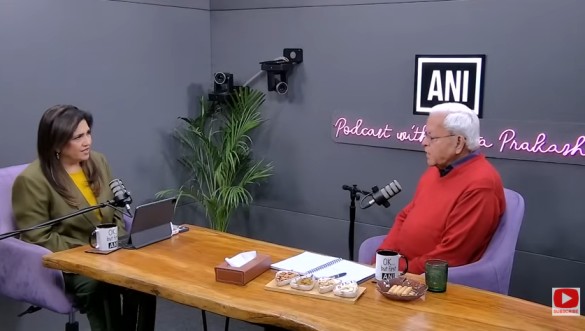
Here is the full transcript of former Indian Ambassador Ashok Sajjanhar’s interview on ANI Podcast with Smita Prakash, on “The U.S. Military Action in Venezuela: A Legal and Geopolitical Analysis”, premiered January 10, 2026.
Brief Notes: In this high-stakes episode of the ANI Podcast, former Indian Ambassador Ashok Sajjanhar joins Smita Prakash to deconstruct the seismic geopolitical shifts of early 2026, starting with the U.S. military’s “extraction” of Venezuelan President Nicolás Maduro. Ambassador Sajjanhar offers a searing legal analysis of how “Operation Absolute Resolve” violates the UN Charter and signals a return to a “might is right” global order where oil and rare earth minerals are up for grabs.
The conversation explores the startling reach of Indian spiritualism in South America, the “bizarre” U.S. ambition to buy or occupy Greenland, and why the apparent failure of Chinese weaponry in Venezuela has reshaped the Indo-Pacific military balance. From the trust deficit in India-U.S. trade relations to the looming “string of pearls” threat in Bangladesh and Pakistan, Sajjanhar provides a masterful roadmap for navigating a world in total flux.
Introduction
SMITA PRAKASH: Namaste, Jai Hind. You’re watching or listening to another edition of the ANI Podcast with Smita Prakash. This episode is a discussion on the American action in Venezuela—the extraction of a sitting president and bringing him to trial in the U.S., the intention expressed to buy Greenland, and no fig leaf at all. It’s for oil and resources, and world leaders are hesitant to criticize, let alone challenge or condemn.
No one wants to antagonize President Trump, who’s made no secret of his contempt for any head of state or government who takes a contrarian stand. No country wants a reviving of trade tensions or undermining bilateral relations.
To understand more on the issue, we have a longtime practitioner of foreign policy, Ashok Sajjanhar, former Ambassador of India to Kazakhstan, Sweden, and Latvia. Ambassador Sajjanhar, thank you so much for being part of the podcast. We’re trying to make sense of what is happening in the world, and I guess even after recording this, half an hour later, I think things might change for all you know, because everything is in such a state of flux thanks to the American president.
We don’t even know what the word is—whether we should say extricating a sitting president, kidnapping. Everybody’s using different words of what actually happened that night. And my first question to you would be: has the U.S. violated international statutes that govern the use of force in these kind of situations?
ASHOK SAJJANHAR: Thank you very much, Smita, for having me on the show. It’s such a great pleasure because you’re doing such a wonderful thing. So my compliments to you and your team.
SMITA PRAKASH: Thank you.
Violations of International Law
ASHOK SAJJANHAR: So I think the short answer to your question would be yes, definitely, and not one, but a number of statutes, number of principles, laws, regulations globally. It has violated first, if you look at the UN Charter, the UN principle—you know, there is an independent country, there is a sovereign country, and you have violated its territorial integrity and sovereignty. So obviously that is a huge, gross violation of international law.
The second would be, in terms of Article 2 of the UN Charter, where it is mentioned that use of force in settling any disputes is not permitted. There are two very short exceptions to that: one, if you are in self-defense, and the second is if it is authorized by the United Nations. And none of that really held in this particular case. The third I would say is, even as far as—
SMITA PRAKASH: Threat has to be imminent.
ASHOK SAJJANHAR: Has to be imminent, yes. And you cannot—and it has to, you know, it has taken place. It is not that you are going there preemptively, you are trying to deal with something. If it is in self-defense that you are doing it, if you’ve been attacked and you are vulnerable, then you respond to that, then you use force. Not if you think that something might happen to you, some action might take place from the other side after 10 days, 15 days, and you are going and taking preemptive action. That is not permitted.
So it is self-defense, and also it is authorized—prior authorization. And the second on that would be that you are, as you said, you use the words “extricating.” Some people use the word, you know, it’s a presidential ruler, but you have taken one president out, the other person has come in, and there are others also waiting in the wings, like Edmundo González, who fought the election. They want new elections. María Corina Machado, she wants elections. So they are waiting in the wings.
So the Permanent International Court of Justice has ruled against picking up a ruling head of state, a person in position as the head of state, because his persona is to be treated as inviolable. So you have taken him, you say that the elections that were held were fraudulent and we don’t accept him, we don’t recognize him. But that argument does not really cut.
The Narco-Terrorism Justification
SMITA PRAKASH: The U.S. also says that it’s legally justified because of narco-terrorism against America. So is that legal? Is that justified? If it is—of course, everybody knows it’s oil and natural resources which the Americans want from Venezuela. But what they’re saying is legally narco-terrorism. So victim of terrorism is what?
ASHOK SAJJANHAR: Yeah, no, this is what they are saying that in court—
SMITA PRAKASH: They’re going to say that.
ASHOK SAJJANHAR: Yeah, as per their own domestic law. Because, you know, the charge that has been leveled against them also is that you did not take permission from the Congress, and you cannot wage war against any other country without getting the authorization from the Congress.
SMITA PRAKASH: But they’re not calling it an act of war.
ASHOK SAJJANHAR: That’s exactly what I’m saying. That’s what they are trying to defend in their domestic context—that it is a legal, it’s a law enforcement measure.
SMITA PRAKASH: When I come to domestic politics, when Trump is able to say that I’m not the first one to do this—George Bush senior got Noriega. So if he’s done that, I’ve just continued with that same policy. And then the Saddam Hussein thing has happened. There are several who they’ve taken out. Here, they’ve not taken him out, they’ve just pulled him out and brought him to America.
So when it comes to that and to face drug trafficking charges, there are precedents which Trump is pushing forth. But will the Democrats be able to do anything in this matter? Or have they just said, all right, do what you have to?
ASHOK SAJJANHAR: No, I don’t think they have said that, because I think this is one avenue that they have got to get back at Mr. Trump. Coming back to what George H.W. Bush has done to Noriega in Panama in 1989—exactly 30, 40 years ago, by the date, because it was the 4th of January, 1990 that he was extradited into the United States. But then, you know, two wrongs do not make a right. That was wrong as it stood. This is also wrong as it stands, both international law and domestic law.
And whatever they might say, you know, about narco-terrorism—and you will hear so many Republicans, and I have over the last few days been speaking, many of them tell me, you know, we are going there to restore democracy. So are they going there to restore democracy as they have done in Afghanistan, the sort of democracy that they restored in Iraq, in Libya? Is that the sort of democracy? They say it with such a straight face as if they believe in it. But I don’t think any one of them believes that it is narco-terrorism.
Because even as far as drug cartels and drug trafficking is concerned, I think there is evidence to suggest that Venezuela has not been the biggest transporter of drugs into the United States. Cocaine—much more of it is being processed in Colombia and other places and it is finding its way. And even fentanyl, it is finding its way into the United States from many other sources. But as you said very rightly, there are other considerations why Venezuela has been targeted.
The Question of Venezuelan Sovereignty
SMITA PRAKASH: And there’s also—I mean, we’re going to run Venezuela. Are the Venezuelans going to just accept it that America runs it? How are they going to run it? Are they going to send Marco Rubio to run Venezuela? Where else is he going to run? Cuba? Is he going to run Greenland now? Where all are they going to send Rubio to run?
And even about narco-terrorism, you’re getting different views from the American administration. Some are saying, yes, it is to restore democracy, it is against narco-terrorism. But there are others who are absolutely point-blank blunt on American television and saying it’s for oil. You know, I think that fig leaf is not there anymore.
ASHOK SAJJANHAR: Yeah, no, absolutely. You made two very important points. Number one is how are they going to run it? I’m using it in that term because you also used it like this, because Mr. Trump used it on Saturday evening in his press conference—that now we are going to run Venezuela. What does that mean?
Now just the next day, he also said that Rubio has spoken to Delcy Rodríguez, who has said we will do everything that the United States wants. These are his words. And he said she didn’t have any choice. But after that, we have seen what Delcy Rodríguez has said. She said we do not want to be again a colony of any other empire.
SMITA PRAKASH: Does she have a choice?
ASHOK SAJJANHAR: We do not wish to be. But you see, she has to walk a very thin line, because, you know, coming to the other point—in terms of there are protests and demonstrations, and she has declared a seven-day mourning for those people who died in this operation, Operation Absolute Resolve, that the United States had carried out.
So basically she knows that there is a great deal of support as far as Nicolás Maduro is concerned, as far as the leftist government is concerned. There might be, you know, one-fourth of the population which is outside, which has fled—the diaspora—which wants change. But within the country, and particularly as far as the army is concerned, the law enforcement authorities, they have the power with them and they still appear to be very much with Nicolás Maduro and this establishment.
And so she has to walk a very thin line. We’ll really have to wait and see. You know, this is an evolving situation, because Mr. Trump says that we have demanded 30 to 50 million barrels of oil from Venezuela, which we are going to get from there. And it is Marco Rubio and Pete Hegseth and Stephen Miller who are going to sort of deal with it, and I’m going to see how the funds that accrue from the sale of this oil at market rates on global markets, how we are going to use it for the benefit of the two countries.
How does the United States have, in my humble opinion, how does that have a claim to this oil that is coming from Venezuela?
Oil and Resources: The Real Motivation
SMITA PRAKASH: So basically, if any country has oil in the Western Hemisphere, it’s up for grabs for the Americans?
ASHOK SAJJANHAR: And not only oil, because, you know, let’s not forget as far as Venezuela is concerned—oil, it was drilling about 3 million barrels in the early 2000s. Right now it has been less than a million barrels a day. So, you know, that is not all that much, although everyone touts it as saying 303 billion barrels of oil—that means the highest reserves in the world, much higher than Saudi Arabia, Iran. It has huge reserves, 20% of the global oil reserves. But—
SMITA PRAKASH: And no nuclear weapon.
ASHOK SAJJANHAR: No nuclear weapons. And if you want, we can speak about it as to why it has not been exploited so far and what are the possibilities. Because you would recall, your viewers and listeners would recall, that on the first day when Mr. Trump was giving his press conference, he said that American businesses are going to invest big, billions of dollars in Venezuela for exploiting, for mining and drilling this oil. So we can talk about it.
SMITA PRAKASH: But in addition to—he said this on the flight in which he said that he spoke with oil companies before the extraction of the president and after the extraction. So he spoke with oil companies before he spoke with congressmen, before he spoke to U.S. politicians. He spoke to the oil companies about the action that is going to be taken in Venezuela. I mean, it sounds bizarre, but he’s absolutely honest about it, that it’s business, it’s pure business.
ASHOK SAJJANHAR: Yeah, that’s what he is about. And he thinks that, as far as the United States is concerned—you know, we used to call Britain the land of shopkeepers. That’s what Napoleon called it, the country of shopkeepers. And here it is a country of business—that if you show me where the money is, where the green bucks are, I’m going there.
SMITA PRAKASH: And no nuclear weapon.
The Geopolitical Implications Beyond Oil
ASHOK SAJJANHAR: I’m going there, no questions asked. So that is one. But I wanted to come to the other point also. That is a very important point that you had raised. It’s not only oil, there is so much else. There is gold in this Guyana highlands.
I was in South America just about 10 days ago, and not in this part, but in Brazil, Argentina, Uruguay, and basically also speaking to them about what they think of this new national security strategy that had come out from the United States. All of them are very nervous, but the point I’m making is that after the Venezuelan operation, all of them are going to become even more nervous.
But in Venezuela, whether it is gold or it is rare earth minerals, or it is coal, or it is diamonds or it is phosphorus, there’s huge deposits of all these other minerals. And there might be difficulty in being able to mine and exploit oil, but all those can also be exploited by the American countries.
SMITA PRAKASH: So if you think about South American countries being nervous, you’re seeing African nations too. They are nervous too. I mean, South Africa brought it up in the UN, not anybody else, not European Union, not China, but it was South Africa which moved a resolution.
But before we come to that part of it, you were mentioning Ms. Rodriguez, will you please tell me your connection with her?
The Spiritual Connection: India’s Reach in South America
ASHOK SAJJANHAR: I don’t have a connection in that sense, but I was totally unaware that she would be rising to this particular position because we had an opportunity to host her when she was in India less than a year ago, actually in February 2025.
And she had come here to participate in the India Energy Week. And she is a big devotee of Sri Sathya Sai Baba and I happen to be on the board of Sri Sathya Sai Trust here. So she had wanted to come and pay respect, pay obeisance to Baba’s samadhi.
And so we had received her and she had come along with the Venezuelan ambassador and along with some of the other people. And she’s also the Minister of Oil. In fact, that is her position. That’s what got her. She was participating in this meeting.
SMITA PRAKASH: And so what is the, I mean how did Sai Baba’s reach go across till Venezuela? What was, how did that happen with South America?
ASHOK SAJJANHAR: There is a lot of interest in Indian spirituality, Indian spiritualism. There’s a lot of interest. You go to even places like Argentina, even places like Brazil. And although there has been so much of civil war, strife amongst the people there, but they look upon many of the God men from India.
Anand Maima, the Acharya Rajneesh, all of them are very popular there. The Brahma Kumaris, they have huge followings there. So here, and I understand that even Mr. Maduro himself is also a very…
SMITA PRAKASH: There’s a picture doing the rounds of him sitting on the side and he looks like any Indian in fact in that cross-legged, sitting down and playing.
ASHOK SAJJANHAR: Yeah, they will do everything because they want to be one and they want to sort of get all the blessings and the benefit and everything. So whatever their policies in the political arena might be. But as far as this…
The Greenland Gambit: America’s Next Target
SMITA PRAKASH: Let’s get back to global politics because it is so bizarre that just after the Venezuela operation, President Trump said that we want to buy Greenland. This is, what is the latest, that one.
How do you see this is the full extent of America’s military might which is so evident now. Within two days you are seeing one operation where they extricate a president, a sitting president and then say that we want to buy Greenland. Is it possible to buy another country like that?
ASHOK SAJJANHAR: I think they just want to occupy it. I don’t think they are interested in paying.
SMITA PRAKASH: But they haven’t ruled out military operation if needed to bring Greenland into their orbit.
ASHOK SAJJANHAR: Yeah, buying would mean a commercial transaction. I buy something from you, I give you consideration.
SMITA PRAKASH: So they buy it from Denmark.
ASHOK SAJJANHAR: No, they are not willing to have to talk to Denmark. You remember this Stephen Miller, the deputy chief in the White House, and he has said what is Denmark’s claim over Greenland? They have no claim over it. We are the ones, we are part of NATO. We are there to guarantee the security of the Arctic of all the NATO countries. And so it should come to us.
He is not, Mette Frederiksen, the Prime Minister of Denmark, she has suggested many times that I would like to have a discussion on this subject. Whatever you want to do, the collaboration, commercial, exploitation of minerals, etc., we can discuss about that. Except sovereignty. Sovereignty is something that is out of bounds.
But Mr. Trump has not responded positively to any of that. So it is not as if they want to engage in negotiations. They just want to go and occupy it, maybe have a conversation with the people in Greenland and as they said…
SMITA PRAKASH: Just $1 million per family.
ASHOK SAJJANHAR: Yeah.
SMITA PRAKASH: This is whether it’s up for grabs or not, whether it’s up for sale or not. Just buy it.
ASHOK SAJJANHAR: Yeah, we’ll bribe it. Bribe you and sort of, we’ll ask you for…
SMITA PRAKASH: It’s not an Amazon sale or something, but that’s how it… Well, we’re living… You know, speaking of Denmark, let me come to those European countries which lecture the rest of the world, especially developing countries like ours or what they used to call third world nations.
We are always being lectured about rule-based order, multilateralism, democracy, rule of law, all those things. What happens now? Why this mealy-mouthed response to either the Greenland issue or the Venezuela issue?
Europe’s Dilemma: Between Principles and Pragmatism
ASHOK SAJJANHAR: Yeah, Greenland, to be fair to them, they have, about eight, nine of them have got together, as you know, and they have sort of issued a statement. But of course…
SMITA PRAKASH: I mean, Canada has said that they will. Which is so strange that Canada is now in an axis against… Well, against is a very strong word. But this protection of Greenland against Trump’s marching footprint.
ASHOK SAJJANHAR: Yeah, because Canada thinks, feels that it is also on the same sort of… So let’s come together, let’s get together. Because he’s mentioned so many countries. I think fortunately for Canada, when he was mentioning Cuba, Colombia, Mexico, and Greenland.
And I think till yesterday the discussion, the furor was who exactly will be after Venezuela. And as you mentioned very correctly, the Americans have said Greenland comes first. So at least the Canadians must be heaving a temporary sigh of relief that they have not been mentioned by Mr. Trump like this.
SMITA PRAKASH: But Mr. Carney is, I think, nervous.
ASHOK SAJJANHAR: Yeah, yeah, yeah. Anyone would be nervous, particularly since you are a part of the Western hemisphere. So I remember, there was a time when we in India used to think, oh, we are far away from the United States. So the intensity of our partnership, comprehensive global strategic partnership, cannot be so strong.
I think now we are very happy that there are a couple of continents between us and America and we are not a part of that Western hemisphere, hemispheric defense, etc.
But coming to this part, it is, you’re very right. I think the word that you use, it’s quite bizarre that with a straight face they can sort of speak about this and can they expect that if they were to make a move, if they were to go into Greenland, what would be the status of NATO, the NATO alliance as such? It will completely disintegrate.
Some of them have said, I think the German Foreign Minister Baerbock has said that if something of that nature happens, then the American bases will be off limits. Then it is all gone.
SMITA PRAKASH: But, you know, but then America is the guarantee of security for Europe. Can Europe actually, can the European countries actually get together and tell America that you can’t use the bases anymore, it’s off, take your aircraft and leave?
ASHOK SAJJANHAR: You know, that is why they have been, as you said, that is why they have been mealy-mouthed, because they think that they need the support of the United States, both in the context of Ukraine, because if the United States would completely disengage itself from there, then it’s going to create very many difficulties.
As it is the US stance in which it is tilting so much towards Russia, that has created problems for them. If it were to withdraw completely from there, then of course it would be a different ball game altogether.
And I think that is why they have been sort of trying to balance, while coming out against the US position on Greenland, so opposing it, but still not going to the extent that we are going to defend the territorial integrity and sovereignty of one of the European member states.
SMITA PRAKASH: Yeah. And I guess they don’t want to trigger any kind of trade war related measures that Trump might, you know, start all over again.
ASHOK SAJJANHAR: Yeah, yeah.
Ukraine and Venezuela: A Double Standard?
SMITA PRAKASH: Now that you mentioned Ukraine, let’s do. Has the debate ended with this Venezuelan attack? The Venezuelan operation, so do you think the debate has ended on the legitimacy of Putin’s attack on Ukraine?
ASHOK SAJJANHAR: Let me put it this way. Russia has criticized the American action very, very strongly. Right. But not all that strongly. I think the reason for that is because Russia also wants, number one, America to stay engaged as far as the Ukraine issue is concerned, because it knows that America is very much tilting towards Russia.
You know, what happened in Anchorage, in Alaska. What happened? The 29-point plan that Mr. Trump had initially come out with. It was, the Europeans said it had all been written by the Russians. It was the Russian wish list and which Marco Rubio and the others had to come and say, no, it is not. We have discussed with them, but we have discussed with Ukraine.
But the point is that the Russians don’t want to make America so angry that it stops supporting them. So that is why they have been critical. They do not think that their operation in Ukraine can be equivalent to the American operation in Venezuela.
American operation in Venezuela is a big no-no, because they say that as far as Ukraine is concerned, it is our people whose religious rights were being violated, whose linguistic rights were being violated. None of that was happening in Venezuela. What was happening in Venezuela? There’s no equivalence in that sense.
China’s Silent Angst: $100 Billion at Stake
SMITA PRAKASH: But then why is it that China and Russia have not stepped up in defending Venezuela when they invested so much in it, militarily, diplomatically and over the years, so much? Why is it that we are not seeing anything from Russia or China?
ASHOK SAJJANHAR: You know, what could they have done? Let me ask you, what could they have done? Could they have sent their military there? That is out of the question. Although, the Chinese weaponry in Venezuela is huge, meaning from what I understand, from 2014 onwards, although before that, till about 2000, it was the American weaponry that was going to Venezuela. But over the last 10, 12, 15 years, it is basically Chinese. It is Russian. Chinese is the largest component.
SMITA PRAKASH: The delegation was sitting there.
ASHOK SAJJANHAR: Was sitting there. Yes.
SMITA PRAKASH: When the extrication happened.
ASHOK SAJJANHAR: Yeah. So both, as you said very rightly, Smita, both in terms of investments, meaning I’m sure it will come as a huge surprise to your listeners and viewers that China has invested more than $300 billion in South America, more than $300 billion. And out of that, more than $100 billion has been invested in Venezuela. More than $100 billion.
And so you can understand the nature of the angst, probably, but silent angst. Yeah. And the dynamics.
SMITA PRAKASH: Typical Chinese. Typical Chinese, you won’t know what they are planning and what they’re doing, because America does everything with a lot of political noise and apparent display of its might, whereas the Chinese will do it in an insidious manner.
So one really doesn’t know. They’re not going to let that kind of investment go unprotected. So they would be doing something right? Or just let it be that. Write it off.
ASHOK SAJJANHAR: No, I don’t think they will write it off. But they had been receiving, for instance, large quantities of oil from there.
SMITA PRAKASH: You know, the tankers are still there.
The Shadow Fleet and China’s Oil Interests
ASHOK SAJJANHAR: They are still there officially, not really, but much of it, what I understand, was coming over the last eight, nine months at least through the shadow fleet. So if you look at the official documentation, how much of oil has gone to China because of the sanctions from March 2025, I don’t think you’ll be able to find any official documentation to suggest how much of oil has gone.
But otherwise, about 80% of the oil that was being drilled by Venezuela, about 900,000 barrels per day, out of that, about 650 to 700,000 barrels per day was going to China. And so it was huge. And this was a part of that loan for oil. So they have given them so much of loans, so much of grants, as I said, more than $100 billion. And that was being required, something similar to what Russia and China have signed in this Siberia 2 agreement in which much investment has come from China and oil and gas is going to China from Russia.
So similarly from here, lots of that was going. But I think at the Global South level, they are definitely going to raise a lot of opposition, China much more than Russia, because Chinese weaponry has also been seen to be quite duds because they were not really able to respond. 150 aircraft coming in and the Chinese weaponry—
SMITA PRAKASH: But they didn’t even try to use it. I mean, the weaponry is lying there, but somebody has to fly those birds. Somebody has to use that weaponry. If it wasn’t used, then how can you blame the Chinese weaponry right now?
The Effectiveness of Chinese Military Technology
ASHOK SAJJANHAR: It was incapacitated. That’s what they say, that it is cyber kinetic actions that the Americans were able to do that they were able to get all of them disabled. Something that Mr. Trump said, “We could get all the lights put off in Caracas. We have expertise of that nature.” I think that also really referred to much of the weaponry.
So in the Op Sindoor, we were able to show how ineffective the Chinese weaponry is. And I think here also, of course there the narrative was changed by China, by Pakistan, by some of the others. So the global narrative was a little different. But here, of course, it is quite—
SMITA PRAKASH: So after this operation, would you say that America has ended the debate on China replacing America as the world’s top military power?
ASHOK SAJJANHAR: Top military power. I don’t think ever China was a challenger to the United States.
SMITA PRAKASH: At least they wanted to say it.
ASHOK SAJJANHAR: No, they wanted to say it, but I think their control over other countries, their influence, dominance over other countries in the area of trade, in the area of investment through the Belt and Road Initiative, and as I said, $300 billion in South America itself. So these are huge numbers. So as far as trade is concerned, investment, they of course cannot be challenged.
SMITA PRAKASH: And Venezuela, it was military also, right?
America’s Global Military Presence vs. China’s Limited Reach
ASHOK SAJJANHAR: It was also military. But if you look at the presence, where is it that China can exercise its military might and influence? For instance, now if you look at the United States, 80 countries, it has bases in more than, there are different figures, anything between 750 to 900 sort of stations where they are placed, whether it is in South Korea, Japan, Philippines, you name it, Australia, Cyprus, Europe, Middle East, everywhere.
Where does China exist? Djibouti, maybe it has sort of control in Hambantota and Gwadar and others. But those are not strictly military bases. So they might have, they can’t, don’t even have the capability and capacity to go through the first island chain. They are so constricted and restrained there. So I think as far as military might is concerned, definitely—
SMITA PRAKASH: But I believe in Chinese social media sites already the talk is that people are saying that if America could do this, it’s about time that we go and occupy Taiwan and all the islands that we have been threatening and we’ve not really taken action. What’s stopping you now? This is the kind of conversation which is happening in Chinese social media sites.
ASHOK SAJJANHAR: Yeah, social media. As you know, social media might say whatever it wants to, but—
SMITA PRAKASH: I will do when it has to.
ASHOK SAJJANHAR: Yeah. But I don’t think China has ever been restricted or restrained by what international law says, number one. Number two, I think as far as Taiwan is concerned, it doesn’t consider that to be an issue of international law.
The Hypocrisy of International Law
SMITA PRAKASH: So why give only China a bad name? America doesn’t care either. Yeah, they went inside Vietnam, they went into Korea, they’ve gone into Venezuela, they’ve went into Iraq. I mean, I can’t even, if I start naming or we talk about European powers, they are colonial powers, they did it too. So if in 2025, 2026, we are discussing China not having any respect for international law, none of the other western powers who lecture us Asians have any respect either.
ASHOK SAJJANHAR: Okay, two points there. China is the new kid on the block, okay? It is now flexing its muscles, it is now reaching out and sort of wanting to have its place in the sun. As far as all these European countries, you are very right. What Belgium did in Africa, what all the other colonial powers, Portugal didn’t go up. Portugal, you know, Smita, let’s face it. Portugal and Spain in 15th century were more powerful than the United States and Soviet Union of the 20th century.
SMITA PRAKASH: Look at the size and look at China.
ASHOK SAJJANHAR: Yeah, yeah, it doesn’t matter. Okay.
SMITA PRAKASH: You know, there, it’s a seafaring nation.
Historical Precedents: The Treaty of Tordesillas
ASHOK SAJJANHAR: So yes, again, again, you’ll be surprised that in 1494, what is called the Treaty of Tordesillas, the Pope divided the world into two parts. Half will belong to Portugal, the other half will belong to Spain. So that is how, of course there were other maritime powers like the United Kingdom and France, which did not agree with it. But that was the fiat, that was the diktat of the Pope in 1494, that sort of thing. At least in our world today it doesn’t exist.
But the other point that I want to make is that those colonial powers were at that time, before the Second World War, before all this rule of international law, international order, etc., they did not exist. There was no United Nations at that time. It was only sort of concert of Europe, spheres of influence, that is. And Mr. Trump is trying to take us back to that era. But as far as might is right, might is right. As far as, and you have your own sphere of influence, spheres of influence and have your own associations.
SMITA PRAKASH: Will you allow China to have its sphere of influence or no?
The Taiwan Question: Military Balance Over International Law
ASHOK SAJJANHAR: Not at all. I think as far as Taiwan is concerned, because that is the issue that we were discussing, if you permit, I will just make one point there because that’s a very important issue that you had raised. I don’t think it is international law. I think it is the military balance in the inter strait relations, in China and Taiwan, that when it finds that it has that dominant power that it is, and also when it is reasonably, not reasonably certain, but quite confident that America is not going to intervene.
At the moment, there is still that strategic ambiguity. Will America come or will it not come?
SMITA PRAKASH: I don’t think America will bother. Yeah, but that’s the sad part.
ASHOK SAJJANHAR: Yeah.
SMITA PRAKASH: The reality I think is that yeah, they’ve got other priorities.
ASHOK SAJJANHAR: You gave a prefix. I don’t think now the Chinese will not work on that. The Chinese want absolutely foolproof because they know that number one, if they try to sort of, Taiwan is also what, how many? 30 million people or so. They are also, and they are well provided with American weaponry, very sophisticated American weaponry. And Japan, Madam Sanai Takaichi has said what she had to say, that if there is attack on Taiwan, how Japan also might could get involved.
So I think these are all question marks in front of China why it is sort of holding back, ongoing, not international law. International law China has violated many times when its national interests are involved.
China’s Violations in the South China Sea
Just to give you one example, in the South China Sea, Philippines took China to the Permanent Court of Arbitration that ruled totally against China, completely rejected its claims that it has that 9 dash line 2,000 kilometers from China. All that sea belongs to China and freedom of navigation. That’s how Quad came up in 2017. It was revived in 2017.
So China, against UNCLOS, the UN Convention on Law of the Sea 1982, it has occupied all those islands which don’t belong to it. Under UNCLOS they belong to Vietnam, they belong to Philippines, they belong to others. But it has gone, it has complete violation of international law.
So I think in the case of Taiwan it is definitely not international law. It is when it feels that it is powerful enough to be able to occupy. So at the moment what it is doing is without any kinetic violence, it is trying to launch these pressures by trying to tell, give this signal, messaging to Taiwan that you don’t have any way out but to unite with China.
India’s Measured Response to Venezuela
SMITA PRAKASH: Let’s come to India now since we are talking about Asia. Indian response has been very soft. It’s very pragmatic or carefully worded statement that was put out and that also by the Joint Secretary External Affairs. He put out the external publicity division. He put out the message, nothing strong that has come out so far at least at the time of recording this.
The Congress party on the other hand very critical of the Venezuelan action, American action in Venezuela, and they have criticized the BJP to say that yours is weak. You shouldn’t have done this. You should have taken a principled stand. How do you see this?
ASHOK SAJJANHAR: Two points here. One is I think Indian position is very prudent, very measured. The situation is still evolving and we are trying to balance both in terms of our national interests and the overall international principles and ethics involved. So we have expressed grave concern, deep concern and we have maintained the position that we had articulated in the Russia-Ukraine conflict.
What Prime Minister Modi had said in September 2022 in Samarkand, he had told Mr. Putin, “Not an era of war, go through dialogue or diplomacy. That’s the way to go forward. Battlefield is not the place to settle any dispute.” So I think that is the, that go in for discussions and the welfare of the Venezuelan people is what is important. So I think that is the point.
And since it is still evolving, we don’t know what, that it’s not a regime change, it’s only a change of the presidents. The same system, the same government continues. So we’ll really have to wait and see as to how things develop and evolve.
Second point, you know, there used to be a point when if in 1956 Hungary issue takes place, we will give a statement. Anything happening anywhere in the world, we had to sort of give our position. Not any longer. Why should we need to? What are our interests? Fine. As far as principles are concerned. But you said very rightly, every day, day in and day out, right to protect in Libya, there are aircrafts going from the—
So we should be, the first paramount importance is your national interest. Principles are also important. Ethics, morals are important. Try to merge the two and that is what we have in my view tried to do. And if there is need for another statement, we will come. This is an evolving situation. But in addition to our JSXP, the official spokesperson, Dr. Jaishankar has also spoken. He’s also said we are very concerned and we are keeping a very close watch and a very close eye.
India’s ASEAN-Style Pragmatism
SMITA PRAKASH: I also think that a number of our reactions are nowadays somewhat similar to how ASEAN reacts. They also don’t give out statements for everything that happens in the world. This is also we are doing our thing and we are watching because it doesn’t involve us right now. So what involves us, we will talk. Otherwise we are not interested in giving our two bit on it. I mean that’s what I see that change happening in the Indian stance.
ASHOK SAJJANHAR: No, absolutely. I quite agree with you. Because we are really focused on 2047.
SMITA PRAKASH: And the trade deal.
India-U.S. Relations and Economic Strategy
ASHOK SAJJANHAR: The trade deal in the short term. But short term, that is a stepping stone to Viksit Bharat 2047. I don’t want any conflicts with anyone. To the extent when I need to, I’ll do my ops in Durbut. I will not allow it to get out of hand, as the Russia-Ukraine conflict got out of hand, as the Israel-Hamas conflict got out of hand, there is continuing.
I knew I wanted to control the narrative there also. I did what I had to do. Within four days I was able to stop because I do not want to fritter away my resources. Meaning where my territorial integrity, the well being of my people is impacted, is attacked, I will take action. Of course that is non-negotiable. But everything else I will make sure that my focus stays on economic growth.
SMITA PRAKASH: Right. What about India’s energy needs? Does it get impacted in any manner? Now with this whole Venezuela situation which is happening, will petrodollar impact, will that impact on India’s long term plans? Viksit Bharat ki baat karate. Will it, will that affect in any manner?
ASHOK SAJJANHAR: No, I don’t think so, because I think how much of oil did we import from Venezuela? I think it was about 60 thousand barrels per day last year which was about $255 million. In early 2000s we were importing much more from there. But now because of sanctions and also because we need to recognize it is heavy crude, we have the Reliance Refinery Jamnagar, that is the only one that can really refine that product.
So hamari haar uski utility limitation. So it’s very limited. It’s not like, out of total quantity of how much, $90 billion that we are importing, 255 million. So that is very, it’s less than 1%.
SMITA PRAKASH: And where would we buy oil from if this is happening? If America is going to be controlling Venezuelan oil now, putting more oil in the market, where are we going to be buying it from?
ASHOK SAJJANHAR: Maybe we could buy it from there. But we are also, we have been buying oil and LNG also from the United States. So our energy needs are being met from there also. If you remember even during Trump 1.0 when he was talking about the huge trade deficit that the U.S. had with India, we had started importing more aircraft, more LNG, more oil from there.
And we’ll continue to do that because we need to do that. 85% of my oil needs are met through imports. I hardly have any reserves domestically. Any exploitation of those reserves though that’s a U.S.-Venezuelan oil market. And of course the Russian oil is Russian oil.
SMITA PRAKASH: Yes. Reduced it. And I think Trump, just yesterday, I think he spoke about that. Finally, my question to you would be that, what are the foreign policy challenges that you are seeing? Can we do any kind of long term planning at all with the speed with which changes are happening in the world? And 2026 looks like, it’s opened up in the first week itself with this kind of a churn. What are the mistakes that we should avoid doing in the next year in 2026 and 2027?
Navigating U.S.-India Relations in a Turbulent Era
ASHOK SAJJANHAR: I think this is a broad picture assessment that you’re talking about. I think first our relations with the United States. Although there has been a lot of bumps that the relationship has faced, particularly from, I would say, June onwards. June 17, when Prime Minister Modi had that conversation with President Trump, when he was in Canada, for the G7 and all. Back from Canada. For the G7. They were to meet in Canada. That didn’t happen.
And that’s when I think Prime Minister Modi, in so many words on a one-to-one basis, told him that there was no third party involvement in the India-Pakistan cessation of hostilities. So after that things started going downhill. But in my view, I think we have handled the situation so far very well.
Although Mr. Trump keeps on, for the last two months I’ve been hearing him say that India is reducing oil import offtake from Russia. This, that. So if he’s convinced, why doesn’t he remove that 25% tariff that he had imposed, the additional tariffs? Why doesn’t he remove that? Because yesterday also he made the same point.
SMITA PRAKASH: That, when he was talking about the Apache helicopters and things like that, that time he said that India has reduced the imports.
ASHOK SAJJANHAR: Yeah.
SMITA PRAKASH: So 25%.
ASHOK SAJJANHAR: Two things here in context of India-U.S. relations. Number one, we should not be conflating what Mr. Trump is saying or doing with what America, our relations with America as such. Because I think that there is a huge amount of goodwill that has been created over the last 25 years. Whether it is amongst the business, amongst the people. There might be a small segment, from the MAGA crowd etc., who are speaking out against H1B.
SMITA PRAKASH: So what they say and what they do.
ASHOK SAJJANHAR: Yeah. So that I think we should not take that. That the whole of America is anti-India. We have very good constituencies in the U.S. Congress. Meaning I have been, I’ve served in Washington D.C. and I know that the largest caucus that we have in the House of Representatives U.S. is Indian, in the U.S. Senate is Indian. So there’s a huge measure of support and I think we should capitalize on that.
Number two, trade has its problems. We are negotiating. India is negotiating in good faith on trade. We want a win-win solution from there. Mr. Trump looks upon it as a zero sum game. He wants to go and say that I have conquered India what no one else was able to do. We want that it should be a win-win, that it benefits them, it benefits both of us.
So far, all the agreements that he’s been able to get, Smita, whether it is with allies, partners, Japan, ROK, EU, etc., or for that matter developing countries, Indonesia, Vietnam, etc., he has been able to say America first, America first. I got $750 billion of investment from EU, 600 from Japan, 350 from there. Indonesia, tariff free for American products. We will still impose 19% tariffs. That sort of a thing.
He’s not been able to get with India, he will not get it with India. So we are negotiating in good faith. But there are so many other areas where our cooperation, collaboration, we just extended that 10 year defense agreement. We have so many visits of delegations that are coming here. We have, this YUDW exercises in Alaska that took place there. So I think the other elements of the relationship are moving forward. We should continue to take them.
SMITA PRAKASH: And insulate them from temper tantrums of the President.
ASHOK SAJJANHAR: And trade. And trade work on that. So, try to work on that. But of course, I grant that the level of trust, what Mr. Modi, the expression he had used when he was talking to Joe Biden in 2022, he said that this is a “partnership of trust.” And what he said in 2016, if you remember.
SMITA PRAKASH: Oh, there’s a huge deficit in that.
ASHOK SAJJANHAR: Yeah, yeah. So that I was recognizing that what he said in 2016 when he was addressing the joint session of the U.S. Congress, that “we have overcome the hesitations of history.” I think those hesitations of history are back again. That trust has been very strongly eroded. We look at that so that, we don’t make ourselves vulnerable.
So how do we not make ourselves vulnerable? Diversify. We have got a FTA with the UK, with EFTA, with EU, also with Australia, Oman, New Zealand, etc.
SMITA PRAKASH: You’re saying diversify, whereas some people are saying we made a pivot towards diversity. China pivot towards Russia, back to Russia and now towards China. Did we pivot at all?
The China Challenge and Regional Dynamics
ASHOK SAJJANHAR: No. You see, China, you cannot pivot. Because whatever might be your problems, Smita, with the United States, they are not laying claim to 93,000 square kilometers of your territory in Arunachal. They are not doing the salami slicing. They are not sitting on 38,500 square kilometers of Aksai Chin.
So we have problems with America, but our problems with China are much more severe. Whether it is that, whether it is Tibet, whether it is Pakistan. Of course, you can see that Pakistan has emerged as a factor in India-U.S. relations also. Which it has. But we are well capable of dealing with Pakistan, whatever it does. We are quite capable of dealing.
But I don’t think that as a rebound against the United States that we can go and sit with China. Our problems with China are much deep rooted and I’m very happy that you came to China because that was going to be my second point. So try to deal with your relations with the United States as best as you can and try to get the trade agreement also.
And I think hopefully within the next few weeks, months, we should be able to get there. Because once Mr. Trump realizes, the facts of the case, come to him that India is not going to budge on that, this is the best offer that we can make. I think we’ll be able to get a deal.
We come to China, China, of course, normalize, stabilize relations. But you know what people are talking about, BRICS summit level, that for the time being, for a long time, it’s off. Because over the last five years since Galwan, Smita, I have not seen one instance where China is willing to accommodate you. China is not willing to accommodate you.
SMITA PRAKASH: And if China is fishing in troubled waters in the sense of Bangladesh, Pakistan, this nexus that and this revival of a new kind of a SAARC, in Kunming, that meeting that took place. How do you see this also happening? This is also new.
ASHOK SAJJANHAR: No, absolutely. This earlier it used to be known as the “string of pearls” that, it’s trying to circle India, encircle India, so that, India is not able to get out of this, not able to play its due role. As far as global affairs is concerned, India has grown and India has been able to, in my view, again, as far as our neighbourhood first policy is concerned, there are many people who say it’s been a miserable failure.
In my view, it has been quite successful because bar, when we are talking about neighbourhood first. Because that will also be part of, response to your question in terms of what do we look at 2026 and 2027. That you can’t really control what is happening in other countries. But once that happens, for instance in Sri Lanka, JVP came to power. JVP was, staunchly anti-Indian. But we have been able to incorporate that. We have been able to engage them.
SMITA PRAKASH: Like Maldives.
India’s Neighbourhood First Policy
ASHOK SAJJANHAR: Yes, I was coming to that. AKD came here. His first country of visit was India. Mr. Modi was the first foreign leader to go there. The Prime Minister Harini also came here, first country. So we have been able to, get Sri Lanka on our side to say that the Sri Lankan territory will not be used against India’s security. Similarly in Maldives. Similarly even in Afghanistan.
So the point I’m making is that whatever all these countries throw at us, we through our mature diplomacy, through our sober handling of issues. You remember in Maldives when that whole thing about Lakshadweep happened and two of the ministers made those comments, “India out.” The government of Moizu came with “India out.” But beyond that, these things also happened and there were so many calls that Indian government should come out strongly against them.
Indian government did nothing of that sort. And we had a very measured approach. Similarly, people who are pointing fingers because Pakistan is a different cup of tea. Those who are pointing fingers on Bangladesh, I think we need to recognize we have again, following a very prudent policy there. The fact that Mr. Jaishankar was.
SMITA PRAKASH: Yeah, yeah. I was surprised that it wasn’t the Vice President but it was the EAM who went for the last rite, the funeral ceremony of Khalid Azir. And he went out there, even shook hands with the Pakistani Deputy and Singh. But yeah, interesting to see when election. The more important was Tariq Rehman sending out a message.
ASHOK SAJJANHAR: That you need us and now, when you are in opposition, etc., etc. Whatever you did in 2004, that Chittagong Arms haul, etc., etc. Paresh Barua and all that.
SMITA PRAKASH: Sheikh Hasina is here. In spite of that, we can have relations with the BNP.
ASHOK SAJJANHAR: Yeah. Because we have always maintained, I have been.
SMITA PRAKASH: But not with the Jamaat, right?
Bangladesh’s Political Future and Regional Stability
ASHOK SAJJANHAR: No, not with the Jamaat. I have been visiting Bangladesh over the last two or three years, every year. And the message I try to give to them, meaning of course that we are willing to work with any government that is in power. So don’t hold it against us that we were working with Sheikh Hasina. She was the government in power.
And earlier I remember when I was in Dhaka, Bangladesh in the early 90s, then Begum Zia was the Prime Minister. We tried to work with them. So for us it is the will of the people that reign supreme.
And right now also we have been calling for free, fair and inclusive elections. So with the involvement of Sheikh Hasina. So let us see what elections next month bring about. But the message from Dr. Jaishankar was very clear that Bangladesh needs India. So your policies should be tailored accordingly. And Bangladesh and Jamaat, they were together in 2001. But right now I think BNP also faces some sort of a challenge from the Jamaat.
SMITA PRAKASH: They would certainly want to win an election with the participation of the Awami League because it gives us some kind of credibility to the election. I mean even Mohammed Yunus, if he is going to be supervising this holding of election, if it is just the BNP and some parts of the Jamaat, it won’t have that kind of legitimacy. Unless the Awami League in some form, maybe not Sheikh Hasina herself, but in some form participates in the election. It will be interesting.
ASHOK SAJJANHAR: No, you are very right. You see, number one, legitimacy, credibility. But equally importantly, if I may suggest that, if you want stability and if you want security, because if you have kept 30, 35% of the population which is supportive of Awami League, if you have kept them out of exercising the franchise of not voting, then there is going to be unrest.
So if you want stability in the country and if you want to focus on the country as far as good growth is concerned, let it be an inclusive election. But my own reading of the situation, if you ask me, Smita, on this is that Awami League for this time is not going to be a part of these elections.
Because I do not think that either Mr. Yunus or Tariq Rehman, they have that statesman-like bend of the mind. Muhammad Yunus wants Jamaat and BNP to come to power. Tariq Rehman wants to come and he thinks that I should get—they have been out of power since 2006. Yeah, 20 years. I want to come to power, whatever it is. So if I get them, then also I’ll be able to make it because that’s a discredited party. But still it is my majority in the—that might be reduced and he wants full control.
Closing Remarks
SMITA PRAKASH: It’s going to be interesting this year with Nepal also going to polls and Bangladesh also going to polls. So we’ll get you back, sir, to explain to us once the results are out in these two countries. Thank you so much for coming to the podcast and explaining these events to us.
ASHOK SAJJANHAR: Thank you so much. It’s been such a great pleasure and I wish you all the very best for the coming year.
SMITA PRAKASH: Thank you. Thank you so much. Thank you for watching or listening to this edition of the ANI Podcast with Smita Prakash. Do like or subscribe on whichever channel you’ve seen this or heard this. Namaste. Jai Hind.
Related Posts
- Bialik’s Breakdown: w/ Channeler Lee Harris -Part 2 (Transcript)
- Scott Ritter: Russia Threatens Strike on Finland & Baltic States (Transcript)
- PBD Podcast #778: Who Is Sadhguru? (Transcript)
- Larry Johnson: Trump’s Naval Blockade & Ceasefire Collapse (Transcript)
- Prof. Mohammad Marandi: What Really Happened in Islamabad (Transcript)