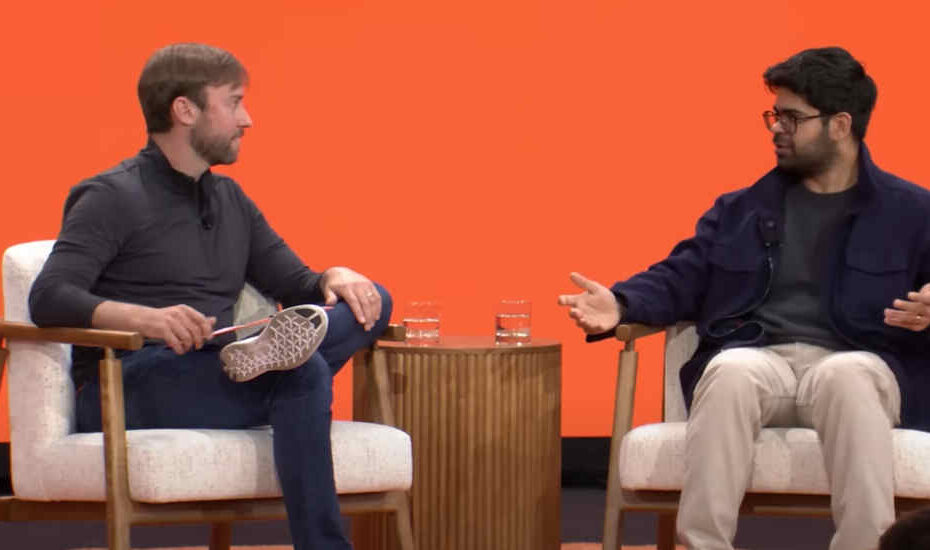
Read the full transcript of Aravind Srinivas, CEO of Perplexity in conversation with General Partner of Y Combinator David Lieb on “Perplexity’s Race to Build Agentic Search” at AI Startup School in San Francisco on June 16, 2025.
Current State and Growth Challenges
DAVID LIEB: Aravind, I see you every two or three months and you give me an update on the latest on Perplexity. Why don’t you just tell these folks where you’re at? How are things going? Do people use Perplexity? Do you guys use Perplexity?
ARAVIND SRINIVAS: Well, whether you believe it or not, I have infrastructure issues every day. So there are a lot of people using it and this usage is actually growing to the extent that we don’t actually know how to deal with it. We have to rebuild the infrastructure to scale the next 10x. So definitely a lot of people in the world using it. Thanks to all of you as well.
What is next for us? The browser. That’s the big bet we are making as far as the future of the company goes. Everyone here is like, “Why should I use Perplexity when there’s search and other AI apps?” Of course ChatGPT has a bigger distribution than us. Every other AI app is trying to put search as a layer in it. All of them support citations, a lot of them support some of the verticals we have put work into.
Yes, we’re always going to continue to remain better than others in that category, but I think the browser and agents are truly the next bet that we want to make. We think about it as an assistant rather than a complete autonomous agent, but one omnibox where you can navigate, you can ask informational queries and you can give agentic tasks and your AI with you on your new tab page, on your sidecar, as an assistant, on any webpage you are makes the browser feel like more like a cognitive operating system rather than just yet another browser.
The Vision for Browser-Based AI
And we hope to make it like a cloud where you launch several tasks in parallel that are running asynchronously and pulling all your personal contacts, your email, your calendar, your Amazon, all sorts of social media accounts that you have and you go and do research on real estate, the markets, and these are all just processes running on your browser. That’s never been possible before. And Chrome was exciting when each tab was its own process. We think about each query or each prompt could be that. And that will be our new browser comment. So we’re putting all our energy into that.
DAVID LIEB: This was going to be the hard question I saved for the end, but since you queued it up, I’ll do it right now. I think if Sam Altman were still on the stage today, he would say, “Oh, yeah, that’s what we’re doing.” And I think Sundar at Google probably would say that’s the direction we’re headed as well. So it feels like there are a bunch of players now, many of them very well funded, going in generally the same direction. How do you see the world? Do you think that there’s going to play out where there’s actually a bunch of different use cases and you can own a very important one that others won’t want to own, or are we in for a major competitive look?
Competition and Differentiation Strategy
ARAVIND SRINIVAS: If something is really worth doing, it’s really natural that people with a lot of funding will go and do it. People said Perplexity is a great product. Now everyone is trying to do something that can answer any question with sources. Cursor was a great product. Now OpenAI is trying to buy Cursor’s competitor, Anthropic, launch Codex. Like Claude Code, Google has its own rival tools.
So it’s only natural that when there’s a lot of money to be made in a certain sector, people are going to try to copy it. And there’s only a limited amount of things you can be world class at, whether it’s being building great models or building one or two really good products. So you’re obviously not going to win on everything.
For us, this is the only thing we care about. Accuracy at the level of answers, accuracy at the level of tasks, orchestrating all these different tools, the browser is much harder to copy than yet another chat tool. That said, I’m fully working with the assumption that OpenAI will also build its own browser. Anthropic will also try to build its own browser. Google already has one called Chrome, so it’s completely reasonable to expect them to do it. And the only mode you have is speed. You have to innovate, you have to move faster than everybody else. And it’s like running a marathon, but at an extremely high velocity.
Focus and Hands-On Leadership
DAVID LIEB: Right. Yeah, I really agree with your statement that you can only focus on one thing and be world class at one thing. And just to give you guys a little glimpse into it, we were backstage before this talk and he was showing me some of the new stuff that they’re working on. And there was a bug.
ARAVIND SRINIVAS: Right.
DAVID LIEB: And he stopped everything he was doing to figure out what was wrong with this bug, why was it not doing the right thing? And if you think about what would the CEO of a large company do in that situation, probably they would hand it off to somebody else on their team. So that’s like a good piece of evidence that you actually mean what you say.
ARAVIND SRINIVAS: Yeah, I love triaging and fixing bugs. I know it sounds trivial. Is that the best use of the time of a CEO? There are a lot of people who would think otherwise. Recently, people are like, “Oh, I hope this behavior is rubbing off on others.” I’ve noticed even Sundar is doing bug support on X right now.
The Origin Story
DAVID LIEB: Okay, let’s go back to the beginning. Most of the folks in the audience here are either students or recent grads or grad students. And I think hearing your story of how you started perplexity would be really interesting to them because it’s probably exactly the world that they’re in now.
ARAVIND SRINIVAS: Yeah.
DAVID LIEB: Tell us how you got started.
ARAVIND SRINIVAS: We started the company without actually having a clear idea of what to build, which is the opposite of what YC advises, which is start from a project and turn it into a company. I really think at this point in time, when AI is improving so fast, you don’t have to rigidly stick to any one idea when you’re getting started. But the most important thing is you don’t change the idea every week. You shouldn’t do either.
So start with something, brainstorm, think about it, and then try to immediately build it and get it in the hands of people. One tool that we were building was natural language to SQL, which we actually thought about it as a search tool, searching over relational databases. I love Twitter search, but the original version of Facebook Graph Search, I loved that when I was much younger, so I wanted to rebuild that, but using language models. And I love Twitter as a platform.
So there’s no good way to search over Twitter. There still is no good way to search over Twitter, but at least at the time, we organized the entire Twitter’s data in the form of relational tables and just converted every user’s query into a SQL query. And ran it against the database and it was really, really good. And that’s what got us started.
But at some point we figured it’s better to scale this across the web and we cannot make every website in the form of tables. And neither is it actually easy to answer all sorts of questions. So we bet on the fact that language models can do all the reasoning and parsing and structuring later. But the more important thing is to start with something more unstructured. And that ended up becoming perplexity.
Finding Co-founders and Choosing AI
DAVID LIEB: Got it. And maybe one step before you actually left to go start the company. How did you find your co founders? How did you decide that machine learning and AI was the area you wanted to focus on?
ARAVIND SRINIVAS: Because that was the only thing I was good at. I was not good at anything else. Okay, so what’s the point in starting company? I cannot start a delivery company or a social media company. I’m not the right fit. The only thing I knew was AI and machine learning.
In fact, it’s funny, we started an AI company, but we made fun of not even training our own models, but only the foundation models of stuff we don’t train. We train so many different models. But that’s the extent to which you need to have the intellectual humility to know what you’re good at, what is actually doable for you with the resources that you have access to.
And the co founders are people I knew from grad school. So we’d been talking and discussing ideas for a long time, and I think grad school is a great way to identify your co founders. You don’t talk to them with the long term calculation of, “Oh, this could be my co founder of my future company.” You talk to them because they’re interesting people. And I think that’s essentially the value of the Y Combinator network. So even if your first startup year fails, you get access to a lot of amazing people and maybe they could be a future co founder. So that’s essentially what grad school was for me.
The Breakthrough Moment
DAVID LIEB: That’s awesome. Okay, so you launched this first version of Perplexity, which is largely to do Twitter search effectively. At what point did it start to work? And you maybe internally felt like, “Oh, we should keep working on this. This is going to be something to explore.”
ARAVIND SRINIVAS: Yeah. So whoever we gave early access to, they were all very excited about it. They kept using it repeatedly. I think there is a phenomenon in products where there’s an initial wow factor and then mostly either drops completely. That means you never had real retention or it definitely drops with their sustained usage.
So when we saw that for the relational database searches like Twitter, LinkedIn, GitHub, we knew that there was something magical about combining large language models in search. But then what we did is we dreamt bigger and said, “What if we just give answers and cite the relevant sources.” We launched that as a discord bot and that was also continually being used. It was not like a one day usage and people started ignoring it.
So that’s when we decided we had the courage to launch it. We launched it seven days after the ChatGPT launch, especially at a time when ChatGPT did not have web search. That was a good moment. And I think many of the successful AI products that people speak about today, cursor included, all were 2022 launches or early 2023 or late 2022 launches. So they’re all old people in the AI timescale.
For me, the aha moment was New Year’s Eve. There was close to 700,000 queries. And I was like, “Okay, this has the crappiest name for a consumer product. It’s called Perplexity. Very hard. Nobody even knows how to share it.” And then it was so slow. Took seven seconds to answer for a query at the time. And it was making a lot of mistakes, hallucinations, and a no name company, no name founder, one or two million dollars in seed funding.
Despite that, people were caring enough to sharing screenshots and on New Year Eve, when you could be watching Netflix. So that’s when I knew there was something real here. And I started optimizing for committing to just this mission.
Realizing the Scale of Opportunity
DAVID LIEB: Okay. And at that point, on that New Year’s Eve, did you in your head think, “I’m building a thing that could really compete with Google and take over a market as big as what Google offers,” Or was it just a toy for you?
ARAVIND SRINIVAS: The first time the thought occurred to me was when Google wrote a blog post, Sundar wrote a blog post about Bard. That was around the time when we were raising Series A funding and everybody said, “Okay, Bard is going to do whatever you’re doing.” And it’s like, “Why do I have to build Bard? Why not just do it on Google, where you have all the distribution in the world? So why do you have to build a separate product? Just update your core main.”
DAVID LIEB: You have the best possible asset to do this.
Building Agentic Search: The Browser Strategy
ARAVIND SRINIVAS: Exactly. And when I kept thinking it was pretty obvious you cannot if people can get answers to “best hotels to stay in San Francisco with a view of the Golden Gate Bridge,” or like Bay Bridge or like, “where can I stay in New York next to the Central park with good amenities,” or like “which flight is the best thing for me to take to fly from SF to London?” If you get direct answers to these questions with booking links right there. How are you going to mint money from booking and Expedia and Kayak and like, you know, or like same thing for shopping. How are you going to take money from Amazon and like Walmart for the same ad where they’re all bidding against each other?
It’s not in their incentive to give you good answers at all. So that’s when I realized that they have to build a separate product, but they can never capitalize on their core distribution. And 2023 especially, and large part of 2024 too. Google had like maybe the fourth or fifth best models at any moment. So as a startup outside Google, you had access to AI that was better than what Google internally had, which was unprecedented. Right.
Until then, if you had to compete with Google and you had to build something that needed a lot of AI in it, good luck. Right? Because you never have an AI outside Google that’s even equal, leave alone being better. But now it’s a completely reversal of the situation thanks to OpenAI or anthropic or open source models. So that plus innovator dilemma, plus the fact that we could make a lot of mistakes and it’s fine. Whereas for Google, one mistake thanks to stock. Like you remember the live demo of Bard where it failed and the stock went down by 6%. So we knew that there was a lot of advantages for us.
DAVID LIEB: Yeah, I heard you talk about this recently. But Google specifically has been trying to build perplexity, like experiences and AI mode. Yeah, they just changed the name of it. Each Google I O and then not.
ARAVIND SRINIVAS: I’m not, I’m not like saying something. Yes, Right. So it’s like, look, it might sound a little cocky to say that, but it’s true. The same feature is being launched year after year after year with a different name, with a different vp, with a different group of people. But it’s the same thing, except maybe it’s getting better, but it’s never getting launched to everybody.
The User Experience Focus
DAVID LIEB: One of the things I’ve come to admire about you is you really have a focus on the user experience. And, and you told me how you kind of learned that from Larry Page by reading the book about Google. Why do you think Google has lost.
ARAVIND SRINIVAS: That ability well, it’s a much bigger business, right. And it’s not founder led anymore. It’s hard to take risks. I think they are great people. No one in this audience would think Google has incompetent people. I think they’re like really great engineers. It’s largely the incentive structure. It’s hard to like, you know, take a hit on your own stock and do the thing that’s long term. Correct.
So you know, honestly I’m happy that that sort of dilemma exists because otherwise where’s the opening for startups, right? And then if startups can succeed, then it’s going to be monopolies getting bigger and bigger and that’s not great for the world. I actually am very happy that we are able to win. And they’re also like able to like ship new products and people are like first time comparing right?
Earlier for access to information. You would never even bother to compare an alternative to Google that was considered a waste of time, a joke. Now at least you’re like, oh, I first go ask this app, like I’ll ask Google or I’ll ask ChatGPT or last perplexity or ask Gemini and then maybe you don’t even ask Google anymore. You just ask the AI apps and there are a bunch of AI assistants and the phone makers will start offering all of them as alternatives. It’s not going to be like a locked in default search option. So I’m really happy that they’re competing in a world where a monopoly hopefully doesn’t exist and that creates a more fair ground for everybody.
Competition and Market Response
DAVID LIEB: You were also telling me backstage about you are facing this increased competition from a variety of folks, but, but if you look at your numbers, you haven’t really seen the effect.
ARAVIND SRINIVAS: I read all the Twitter comments, every time the Google I O exactly the same set of comments repeated this year. Google I O Last year was AI Overview and “Perplexity is dead.” This year was AI Mode and “Perplexity is dead.” And I read all of that too and it’s always fun. I love it actually because they know that they’re all thinking, I don’t even expect these things. Or the people in the company are thinking Google wouldn’t build this or something like that. But the reality is like nobody actually gets exposed to those features.
But competition is real. Okay, let’s assume, let’s accept that OpenAI is extremely well funded, doesn’t have all these innovator dilemma problems, wants to actually ship search onto ChatGPT. ChatGPT is the most successful consumer AI product out there. And so competing against it is very difficult, which is why I really want to push the company more on the browser side.
And I think Comet, the browser will be an abstraction layer about chatbots. You could even imagine if you permit Comet, all your chatgpt chats can be fed into that AI and you don’t even have to worry about memory or personalization or any of these things. And it’ll do a lot of new things that a chatbot cannot do, like accessing other tabs, accessing your browsing history, going and completing forms for you, like paying your credit cards, buying stuff for you and being a scout, you know, going and doing all the research for you, that sort of thing, like periodic recurring tasks.
I think that’s the magic that the browser enables for you and putting it into like mobile, like building mobile versions of this browser is going to be very hard. Like just engineering wise, it’s going to take many months. So I’m not really worried about like someone else trying to copy this. It’s going to take time.
The Browser Advantage
DAVID LIEB: For anybody switching to a different browser is like a pretty big decision for a user. What do you think will be the very short term things that your browser will do so much better than what I can get today in Chrome that will make me want to switch.
ARAVIND SRINIVAS: The perfect blend of AI, navigation and agents is what we’re going to offer and might sound like a boring answer, but no one’s done that. And there are like hundreds of millions, probably close to a billion people using AI these days, so the market’s already pretty big.
DAVID LIEB: What’s like a specific example of how I would do that, you know, if I had access to it tomorrow?
ARAVIND SRINIVAS: You can schedule your meetings, you can reply to some of your emails that you don’t even want to read. You can like for example, let’s say you’re hosting a Y Combinator event and you say I only want to accept Stanford dropouts and it can go through the entire list of people who applied and just filter based on who’s in order to scrape their LinkedIn URLs filter based on whether they were Stanford and whether they dropped out or not and then accept it. Like that level of multi step reasoning is something you can uniquely do by the way. I’m not saying that’s a good filter. I wouldn’t get another voice. So hopefully you’re more open.
DAVID LIEB: Yeah, we look for DeepMind researchers also. Yeah, yeah, don’t worry. Okay, cool. Let’s talk a little bit about how you run the company now.
ARAVIND SRINIVAS: Right?
DAVID LIEB: I don’t know if you wanted to say how many employees you have?
ARAVIND SRINIVAS: Yeah, we have about 200.
AI-Powered Development at Scale
DAVID LIEB: Okay. So the company’s getting bigger. You now have access to code writing, AI tools. Are you guys just like full in on that stuff? Are you vibe coding everything? What’s it look like?
ARAVIND SRINIVAS: I mean, you don’t want to wipe code everything, right? Like, we frequently run into infra issues and you don’t want a wipe coder right there fixing it on live things, on production. Like I do want like people well trained in regular software engineering infrastructure, distributed systems. Like you don’t want to replace these skills.
But yeah, front end design, that’s where we are seeing tremendous adoption. Like Cursors being used by everybody. We made it mandatory to use at least one AI coding tool and internally at Perplexity it happens to be Cursor and like a mix ofCursor and GitHub Copilot. But yeah, we definitely made it compulsory.
And so the way machine learning people are using it, AI people are like sometimes they read a paper and they can just upload a screenshot of the pseudocode and ask Cursor to just edit the files to implement this new algorithm and then it’s able to write its own unit tests and then run an experiment pretty quickly. That is reducing the experimentation time from three, four days to literally one hour.
Or there are people who don’t know design and so sometimes I just give them feedback where I take a screenshot of my iOS app and I said, this button needs to move here with an arrow and they upload my screenshot to Cursor and then ask it to write a change to the SwiftUI file. So that level of change is incredible. Like the speed at which you can fix bugs and ship to production is crazy.
DAVID LIEB: The more bugs there are, as long as you can fix them fast.
ARAVIND SRINIVAS: Yeah, bugs are always ahead of how fast people can write code though. But just to be clear, I’m a big fan of all these tools, but it is also introducing new bugs and many people don’t know how to fix them and they don’t even know how the bug got introduced and they have to go find it again. So it’s not perfect. And I actually like the more newer tools like Claude Code seems to be far smarter than what cursor is able to do. So I’m actually really positive that this is the right future. But there are issues right now in.
Building Enduring Value in the AI Era
DAVID LIEB: Talking to a lot of the folks here. One of the major questions that I’ve heard is as these coding tools get better and better and better. What is the actual enduring value of a company like yours if increasingly it’s easy to replicate what you have done using these tools? What’s your take on that general type of question?
ARAVIND SRINIVAS: Brand definitely has a big value. There are cursor competitors, perplexity competitors. OpenAI will have their own cursor. OpenAI has perplexity within ChatGPT that did not kill any of these companies. So there is a certain brand value that once you acquire the scale of like several millions of users, paying users, you don’t actually die that fast. You earn the right to survive and keep building. So brand is important.
Narrative is very important to the brand. Like you have to communicate to people. Why do you even need to exist? For us it’s the focus on accuracy. Okay, let there exist 100 chatbots, but we are the most focused on getting as many answers right as possible. We focus on speed, time to first token on app or web. Like we’re still the fastest despite doing search. We focus a lot on how we present the answer.
So there are some things you are obsessed about because you care about it. And that becomes your narrative and your brand identity. And if you manage to get reasonable amount of distribution, not saying 100 million users, but tens of millions, then you’ve earned the right to keep playing the game no matter what other people ship. Until then it’s definitely a challenge. You have to worry about it. Even now we worry about it and the only solution is to move fast.
Network Effects and Stickiness
DAVID LIEB: And keep shipping beyond brand. Do you think about any network effect, types of things emerging with perplexity?
ARAVIND SRINIVAS: Brand has network effects, right? Like people tell each other about the brand, but no AI product has within app network effect. It’s not like WhatsApp where if you build a WhatsApp rival, Meta has definitely a questionable brand. People don’t necessarily trust Meta’s products, they think these are ad products. Despite that, nobody is able to switch up WhatsApp that easily because all your contacts, your groups, everything’s there.
AI doesn’t quite have that yet, mainly because you can easily export your ChatGPT history, upload it somewhere else or things like that. I think the browser will definitely be one play to figure this out because as your browsing history, which again you can still export, but not the same as just getting a CSV dump and your passwords, your wallet, your agent remembers you. There’s a lot of tasks that are running on the browser that you rely on your day to day life and work.
That’s one way to get the product A lot more sticky and create more network effects. Especially if multiple people rely on the same set of tasks, you’re sharing it with them. That’s one way to get all this into the next level.
Business Model and Partnerships
DAVID LIEB: It also sounds like a lot of the stuff that you aspire to solve for users requires integrations or partnerships or something with a bunch of other companies in the world. And if you can continue those to be good, then there is somewhat of a network effect in the sense that your product will be good and some competitor would have to build the same integration or same deal with these providers. What does that look like, do you think in the future, does Perplexity do deals with all the airlines in the world and all the hotels and all the e-commerce providers?
ARAVIND SRINIVAS: So we already work with SelfBook, they power all the hotel bookings natively done on Perplexity. We work at TripAdvisor to surface all the reviews of hotels and different places. We have collaborations for the maps, we work with Yelp. We also for shopping, we have a lot of merchants who are directly selling on us and then we work with firmly to support the bookings native purchases. So there’s already a lot of partnerships. Shopify is one of our partners. On finance, we work with FMP Sports, we work with Stats Perform.
So there’s a lot of data providers already working with us on these verticals and we just think it’s going to expand further as agents start to do things different people are okay with becoming MCP servers. Some people are not. Some people just want to preserve their websites.
The browser agent will be generic enough that it’ll respect whatever the third party wants because at the end of the day, the agent is the one that’s being permitted by the user to act on their behalf. And if there is no MCP server, it’s still fine. You can just use these tabs as if the user would have done it. And that’s the key advantage of the browser that you do not have.
If you commit entirely to just the MCP vision, you require these third party MCP servers to work reliably. The data that they send you with the MCP protocol has to be perfect. Your chatbot has to deal with all these issues that exist. On the other hand, if you just ground up design it as the way a human would use that website, you have full control over how to do it. You don’t have to rely on someone else doing the engineering on their end.
Revenue Strategy and Competition with Google
DAVID LIEB: Let’s talk next about business model. Your main competitor Google, their business model as you’ve talked about, is selling ads and you think that prevents them from being really good at what you’re doing. So what will your business model be and how will you get it to be on the order of magnitude of Google’s?
ARAVIND SRINIVAS: I don’t know if we’ll ever get order of magnitude profits as Google, just to be clear. And I don’t think that’s needed. No one in the history, even Google themselves never has had another business that had the margins that Google has. So it’s completely reasonable to get something far, far better than any public company out there right now and be still way below Google.
Number two, I think the subscription revenue is really encouraging. We never expected to get this far and then we think we can grow at least a few billion a year in just subs, which is a great business.
Usage base pricing, where people are paying an agent for completing a task or people have recurring tasks and they pay based on every single use of the task and they normalize this system based on how much it would take to hire a person to do that for them is going to be a thing. I don’t exactly know how it’s going to play out. What are the margins going to be on that? Potentially it’s going to be way better than subscriptions in terms of volume of people who would pay for it. But it might be lower margins because it’s usage based. So you’re still going to be spending on all those queries.
Someone might be paying a subscription to one of these AI apps and might not have used it for an entire month. And so that’s good margins on that user. So I don’t actually have a clear sense of how this is all going to evolve, but all I know is subscriptions and usage based pricing are going to be a thing transactions. If people start buying more through AIs, taking a cut out of the transactions is good. It’s going to be. CPAs have historically been way lower margins than CPCs, which is why Google never became a transaction platform. Which is why I said you’re going to make a lot of money here. You may never make as much money as Google.
DAVID LIEB: Yeah, Google’s business model is potentially the best business model ever. So yeah, it’s fair to not.
ARAVIND SRINIVAS: Maybe it was so good that you needed AI to kill it basically.
Advice for Entrepreneurs
DAVID LIEB: All right, we’re going to do some audience Q and A in a little bit, but before we get there, I kind of wanted to understand your advice for the folks in this room, right? If you were in their position back whatever it was four years ago, what would you advise they do?
ARAVIND SRINIVAS: I would say work incredibly hard. There is no substitute for it. Don’t think you’re very smart, strategizing the right way to build a company despite all what big model labs are doing, you should assume that if you have a big hit, if your company is something that can make revenue on the scale of hundreds of millions of dollars or potentially billions of dollars, you should always assume that a model company will copy it.
Mainly because they are really looking for revenue. They raise tens of billions or close to 50 billion and they need to justify all that capex spend and they need to keep searching for new ways to make money so they will copy anything that’s good. I think you got to live with that fear. You have to embrace it and realize that your moat comes from moving fast and building your own identity around what you’re doing.
Because users at the end care. When you are trying to get a specific person for your house help, you are searching for that specific person. You’re not going for a general agency that handles all of it. So I think there’s real benefit from embracing that fear and sleeping with that fear and waking up every day and feeling excited about what you’re going to build because that’s the only thing that’ll keep you going.
DAVID LIEB: Well, you guys are the perfect example of how it’s possible to go up against somebody as big as Google. That’s great. All right, let’s do some Q and A. We’ll start on the left side here. Go for it.
Audience Q&A
AUDIENCE MEMBER: Hi, my name is Sami and I just want to personally thank you for helping me get a 100 in my theory of knowledge course. Would not have been able to do it without you. No shame. Quick question for you. You know, with your recent partnership with Nvidia to ship AI models across Europe, there’s been talks about perplexity being installed on all Samsung phones or pre installed and that could lift your valuation towards 14 billion according to sources like Bloomberg. It’s a heavy responsibility being the default search engine for the mainstream population. What do you think are the most important factors at perplexity to prevent hallucinations or incorrect data from being given to the masses? Thank you so much.
ARAVIND SRINIVAS: Thank you. Hallucinations is something we really care about. We’re building benchmarks internally to keep up to date with that. The only way there is to keep building a better search index, keep capturing better snippets of all the web pages and then these models are getting fast enough that you can have them reason multi step for every query without incurring too much cost. And so that’s another way to reduce hallucinations.
DAVID LIEB: I want to ask you about the innovators dilemma. So if you were in Sundar’s shoes or the Google co founder’s shoes, what would you do? And how would you come up with maybe changing their business model, even if it’s a worse model? So if you were running Google, competing against yourself, what would you do?
ARAVIND SRINIVAS: I think I don’t envy the job at all. Nobody in the world wants that job. It’s a very difficult job.
DAVID LIEB: Would you sacrifice the business model in order to get the next product or would you ship it as a separate product? If you’re Google, would you just build a separate thing that is the Perplexity competitor and sacrifice the distribution advantage that you have in the short run?
ARAVIND SRINIVAS: Yeah, genuinely, I don’t know. I think I can say all what I want, but they have more data on what their users are doing and there are a lot of people in the world who hate AI, by the way. So I think just throwing AI down people’s throats on such a massive distribution area is not easy. What I would do, I definitely don’t know and I don’t want to be in that position. Also, by the way, if ads are part of every AI answer, you’re going to hate it too. And so it’s good that there’s alternatives like us.
AUDIENCE MEMBER: Hey, Aravind. My name is Akshat. So in a recent interview with Nikhil Kamath, he asked you for an internship at Perplexity. So I was just wondering how that arrangement is going.
ARAVIND SRINIVAS: He came to the office, he spent a couple of days. I mean, he hasn’t posted about it, so I’ll let him post about it. But we did spend time with him. It was not a proper internship, but we did speak to him for a while.
AUDIENCE MEMBER: I want to start by saying thank you very much for your very candid answers. I really appreciated that. So a lot of startups, they find some cool application of foundation models and then they’ll build something off of that. But then if it does gain traction, then the foundation models will consolidate that into their own infrastructure. And Perplexity sort of has that issue too with a lot of LLMs adding search, like ChatGPT, Gemini, companies like Cohere. So I was just wondering, how would you approach something like that? Would you try to pivot, just get better at what you do or?
ARAVIND SRINIVAS: I think I would say pick something you want to be known for. Yes, there are other people integrating search, but we still want to be the fastest and most accurate. And obviously I cannot just say that and then stop. We need to figure out a new strategy too and build new products that don’t exist yet.
So our browser will be that bet for us. And browser and search are not too distinctive products. They’re actually the browser is a natural graduation step from search, just like how Google graduated from Google Search to Chrome. And Chrome is the main reason they got billions of daily queries from hundreds of millions. So when Google IPO’d, they had no browser and they had maybe 100 million queries. Now it’s 10 billion or something.
So the browser is an important part of that. And then. So that’s why we are making a massive bet on that. And agents can only be built with a browser. I’m very convinced about that vision, that if you want to have a mobile agent that you can actually build and implement without being restricted by whatever OS rules that Apple or Google sets in terms of not being able to call third party apps, expecting every mobile app to have MCP servers and then connecting all their data to your thing is not going to be that straightforward. Nobody wants to be disintermediated by an AI that quickly. So the browser will be a great way to build all these things. Thank you.
Overcoming Failure and Finding Motivation
DAVID LIEB: So, as a lot of us here have done, we’ve tried, we’ve failed at our startups. Some of us have been more successful than others. Some, like me, have failed. When you’re in that moment, failing over and over again, what do you tell yourself as CEO or as an entrepreneur? To win, to teach yourself to win. What do I tell myself when I feel like I might fail?
DAVID LIEB: Yeah, or when you’re in that very specific moment of failing where you feel like everything’s crashing down on you, or this feature isn’t working, or this bug has popped up. How do you get through that? And what do you think your biggest motivational factor is in that realm? Or maybe at the beginning, before it started to take off, what gave you the hope to keep working on it versus just go back to OpenAI and get your job?
ARAVIND SRINIVAS: I just watched the Elon Musk videos on YouTube. No, I’m serious. I can tell you which video. There’s a video where there’s a third failure in a row. And “what do you think?” And he’s like, “I don’t ever give up. I would have to be dead or incapacitated.”
DAVID LIEB: So you’d say you’re also never going to give up.
Staying Grounded Despite Success
ARAVIND SRINIVAS: Yeah, I hope to. I hope to stay that way. So not easy. I think he’s done it for way longer and that’s why you all respect him. But there are examples of great entrepreneurs who have done this despite all the odds stacked against them. So what do you have to lose? Let’s just keep going.
DAVID LIEB: Thank you.
ARAVIND SRINIVAS: Yeah.
The Future of Web Traffic and Content Creation
DAVID LIEB: Yeah. My question is about the sustainability of Perplexity, not in terms of the business model, but just in terms of the web in general. A lot of studies have come out recently showing that AI search engines like Perplexity drive a lot less traffic to websites.
So I’m curious, what do you think the web will look like in five to 10 years when a lot of these websites aren’t getting as much traffic and so they have to cease their operations? The web will just be a lot quieter of a place for content creation. How do you think Perplexity fits into that? And what do you think the web will look like in that era?
ARAVIND SRINIVAS: I think that there are going to be – the web is already pretty long tail and there’s a massive power law. So I feel like the power law is going to get even more skewed. That is very obvious.
There are going to be certain brands that are well known and they’re going to preserve direct organic visits. But those who are trying to game the SEO system and trying to get traffic, I think they’re definitely going to have a harder time.
Handling Plagiarism and Political Bias
DAVID LIEB: Hi, Aravind. Good afternoon. Firstly, where do you place the line between summarization and plagiarism in report generation? And how do you avoid IP violations in your product? And secondly, how do you deal with political bias and personal interest in news articles and other human written sources?
ARAVIND SRINIVAS: Yeah. I think there are cases where you actually have objective truth, right. Like what was the score in the NBA game? What is the live weather right now in San Francisco where you don’t want to be wrong ever on those queries and people know what is true.
But even there you’re trusting, right? You’re trusting some data provider who’s tracking the live game, the TV that’s showing you the number or Apple or Google’s AccuWeather, all these things. So at some point it all relies on trust. And trust is built over time based on being accurate reliably.
And so trying to surface the right data from the right people who have earned the right to be surfaced in AI is how we think about it for accuracy. Now there are things that don’t have one clear accurate answer. I think there the best thing we can do is offer all the perspectives and not really take a clear opinion on what is right and wrong when there is no clear answer to that question.
DAVID LIEB: Do you measure how accurate you are at that job by user feedback in some way?
ARAVIND SRINIVAS: We don’t actually measure it today. We should. An eval set should be built for that. Questions where there is no one objective answer. The problem with building an automated eval for that type of thing is what is the right answer? It’s subjective, right?
If there are questions about the origins of COVID and there’s so many different opinions of that. Relying a lot on Wikipedia as a source and can say, maybe for a human rater, you’re like, “Okay, saying all the things Wikipedia said. It’s a good answer.” But maybe what you want is to say stuff that is not there in Wikipedia and that relies on having a much better human evaluators pool much smarter people who are supposed to rate these things and they’re not available for scale AI style evaluations.
Go-to-Market Strategy and Audience Targeting
DAVID LIEB: I think we have time for one final question. You get it?
ARAVIND SRINIVAS: Awesome. Hi, my name is Angela. Thank you so much for talking to us. I have a question about your go to market strategy. You had a great campaign for students. It’s how I and assume many college students learn about you guys. But then also you had a collaboration with Kalshi, which is a little bit different audience. So I’m just trying to understand how do you decide which audience you’re trying to get.
I think one perspective here is trying to get into distributions of users that you don’t typically have access to on your traditional marketing channels. There are a lot of people who don’t use Twitter or LinkedIn and they all exist in the world. We just are living in a bubble here.
And there are some other businesses that have good access to them. Traditional businesses – you could imagine the kind of people who use Costco regularly may not even be using AI on a regular basis. And so if that’s the kind of people you’re going for, then it makes sense to change your strategy to reach them.
But also remember that it’s good to grow with adjacencies. You don’t want to have some overlapping sets of people who would be the word of mouth carriers as they help you expand to more non overlapping circles. So I think that’s how I think about it. There should be some overlap, but your distribution should keep evolving over time. Thank you.
DAVID LIEB: All right. Aravind, thanks for joining us.
ARAVIND SRINIVAS: Thank you. I appreciate it.
Related Posts
- Anthropic CEO Responds to Trump Order, Pentagon Clash (Transcript)
- Elon Musk on CyberCab, FSD and Optimus @ Brighter with Herbert (Transcript)
- Alexandr Wang’s Remarks @ AI Impact Summit (Transcript)
- Demis Hassabis On AGI, Advice For Indian Engineers, AI In Gaming & More (Transcript)
- Transcript: Google CEO Sundar Pichai Speaks @India AI Summit