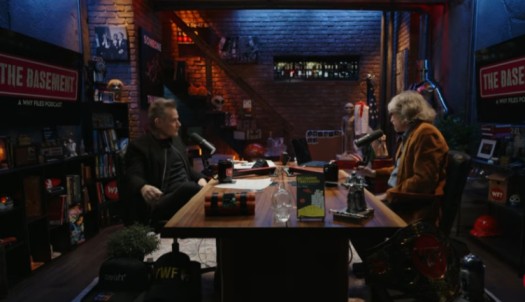
Editor’s Notes: In this installment of the Basement series, host AJ sits down with anthropologist and science writer Eric Wargo to explore the fascinating and often “taboo” intersection of quantum physics and precognition. Wargo challenges the linear view of time, presenting evidence that the future can influence the past through phenomena like “retrocausation” and closed causal loops. From Einstein’s block universe to documented cases of artists painting disasters before they occur, this conversation bridges hard science with the mysteries of human consciousness. Whether discussing time travel, dreamwork, or the science of synchronicity, Wargo offers a compelling paradigm shift that suggests our future may be pulling us toward specific outcomes. (March 31, 2026)
TRANSCRIPT:
Introduction
AJ GENTILE: Today I’m sitting down with Eric Wargo. He’s an anthropologist and science writer. But that’s not why he’s here. Eric has spent the last decade researching one of the most taboo ideas in science. The possibility that the future can influence the present.
HECKLEFISH: Taboo? I’ve been saying this for years. Every time I get married, I get the feeling it’s a bad idea. Then boom.
AJ GENTILE: This isn’t time travel in the sci-fi sense. Something more profound. He calls it precognition. And he argues it’s grounded in Einstein’s block universe.
HECKLEFISH: Block universe? Sounds like we’re the lizard people. Keep the good timeline locked up.
AJ GENTILE: The evidence comes from quantum physics experiments, lab studies that seem to prove retrocausation. Dreams that come true years later, artists who paint disasters before they happen.
HECKLEFISH: Every year I dream I’m going to get audited by the IRS. Then boom.
AJ GENTILE: Eric has five books on the subject. His work bridges hard science and consciousness research. And this conversation gets out there. We talk about time loops, precognitive dreams, the science of synchronicity, and how the future might be pulling us towards specific outcomes. I think you’re going to like this one. Let’s go down to the basement.
Doctor Wargo, welcome to the basement. I’m excited. I’m excited for this.
ERIC WARGO: I’m excited too.
On Monitor Lizards and Unusual Pets
AJ GENTILE: Before we get started, tell me why on God’s green and glorious Earth would anyone own a monitor lizard? Why?
ERIC WARGO: Yeah, well, okay, so my oldest daughter Emily is really into reptiles and lizards. She has been wanting — she watched all the reptile influencer videos on YouTube and just really wanted this certain kind of monitor lizard. And initially it was like, “Yeah, we’ll get you one when you’re 13.” And then it never went away. And then, you know what, I kind of started wanting one too.
AJ GENTILE: Really?
ERIC WARGO: Yeah. Monitor lizards are the coolest. When I was a kid, monitor lizards were just the coolest animals on earth. Komodo dragons are monitor lizards. And so my father-in-law said he’d help out financing the vivarium. And yeah, so last April we got a baby spiny-tailed monitor lizard and he’s grown into a lovely two-foot-long little creature that we love dearly.
It’s been a very interesting experience learning about reptile husbandry and having a pet in our lives that is not a typical pet. I mean, we have cats, and of course I love my cats, but I grew up with dogs. Reptiles are very different.
AJ GENTILE: What’s his name?
ERIC WARGO: His name is Sunflower.
AJ GENTILE: Are you feeding him live insects?
ERIC WARGO: Live insects, yeah.
AJ GENTILE: Okay.
ERIC WARGO: Yeah. But he’s delightful. They’re very intelligent in their own way. It’s not the same as a mammal, but he’s very chill. We handle him and pet him. Unfortunately, the difficulty with lizards, and especially monitor lizards, is they require very high temperatures. He has a basking rock that’s like 110 degrees and very bright lights in his enclosure. But no, he’s awesome.
It’s fascinating to bond with another kind of animal. It’s fascinating enough to bond with a cat or any other kind of mammal, but to develop a bond with a reptile is really another level if you’re an animal person — which everyone in my family is.
AJ GENTILE: Same. So it recognizes you?
ERIC WARGO: Oh, sure. Yeah. It took a lot longer to develop that bond. It took a few months to get him comfortable with us and comfortable with us being around him first of all, and then eventually handling him and so on. It’s not like a kitten or something like that. But no, he’s great. And he looks forward to seeing me every morning when I go in greeting him.
AJ GENTILE: Greeting you at the door.
ERIC WARGO: Yeah, he’s really cool. So I’m glad you asked about that.
AJ GENTILE: How long does Sunflower live?
ERIC WARGO: Well, knock on wood, he could live as long as 20 years.
AJ GENTILE: Wow.
ERIC WARGO: Yeah. And we’re hoping that he will because he’s awesome.
AJ GENTILE: I’ve had birds, so I guess it’s kind of the same thing. Because you wouldn’t expect them to recognize you. But my little Maxi, he definitely did.
ERIC WARGO: Well, birds are incredibly intelligent. They’re mammal-level intelligence. That doesn’t surprise me. What kind of bird was it?
AJ GENTILE: He was a cockatiel. It was a while ago because I have cats now, and they wouldn’t do well with a cockatiel. I’ve thought about an African grey, but they live so long that it would outlive me.
ERIC WARGO: Right.
AJ GENTILE: So you have to will your pet to somebody. You don’t want to be on the receiving end of that.
ERIC WARGO: Right, right, totally. Well, I highly recommend monitor lizards. They’re very, very cool.
AJ GENTILE: I feel bad for her roommate in college, wherever she goes.
ERIC WARGO: Well, I kind of suspect dad will be — but that’s, we’ll cross that bridge when we come to it. We’ve still got eight years or so until that happens.
Background: From Anthropology to Parapsychology
AJ GENTILE: Speaking of college, your PhD is in cultural anthropology.
ERIC WARGO: Yes.
AJ GENTILE: And then you moved into more psychology.
ERIC WARGO: Okay, well, I grew up with parents who were psychologists. And when I studied anthropology, I really studied psychological anthropology. So I got a real basis in psychological theory and psychoanalysis and so on.
After I got my degree — finally, after a long time that I don’t even want to talk about or remember — I was not suited to academia. So I did what everyone who has a degree and can’t be an academic does, which is become an editor and writer. Washington, D.C. is where those people congregate because it’s full of nonprofits and scientific organizations and the government, and people who are hiring editors and writers who are smart and have too much education and no real-world experience. And so they work directly or indirectly for the government or for the nonprofit world.
AJ GENTILE: What is it like to grow up with two psychologists as parents? That sounds difficult.
ERIC WARGO: Yeah, I don’t recommend it.
AJ GENTILE: I mean, there’s got to be advantages. Like, you’ve got a problem, you can talk to mom and dad and really get to the root of it.
ERIC WARGO: Well, my dad was a psychologist. My mom had a master’s in psychology, but she didn’t work in the field. My father was more of a scientific psychologist — he wasn’t seeing patients and stuff like that. But that was a natural basis for me to work for a psychology organization in Washington, D.C.
For many years I was an editor and then editorial director of one of the two big psychology scientific societies in the United States, both of which are based in Washington, D.C. And indirectly, that job is part of my backstory that led me to doing the work I do now — even though the work I do would be completely rejected by my former psychology colleagues.
AJ GENTILE: They don’t like this.
ERIC WARGO: They do not like this stuff. They are the most — I mean, studies have even been done on the degree of hostility towards parapsychology of different academic fields. And psychologists are number one. Anything smacking of ESP or parapsychology — they have a chapter on pseudoscience at the end of their Psych 101 textbooks, and they’ll put parapsychology in that.
AJ GENTILE: I remember that from my own studies.
ERIC WARGO: Yeah. And the extreme prejudice toward parapsychology really came to disturb me when I saw it firsthand. This was around the time that I was learning about — I grew up with that kind of knee-jerk assumption that ESP is a myth. But after I had my UFO sighting, which we can talk about, I was reading Jacques Vallée and he’s talking about psychic phenomena like they’re real. And here’s a smart guy taking this subject seriously. And I felt, well, I need to do my due diligence here and read up on it.
That was the huge paradigm shift for me. That was the huge ontological shock. I didn’t have any problem with UFOs, but I had a huge problem with the existence of anything like ESP. But I realized — I was reading around the time that Daryl Bem’s prominent research came out, his “Feeling the Future” studies — and I was like, “What the f* is going on here?”
AJ GENTILE: We’re going to say that a lot today, I think.
ERIC WARGO: Excellent. And then I realized I’ve had those dreams. I’ve had precognitive dreams. I’d had a dream about 9/11 on the morning before 9/11. And I had just swept it under the rug. That’s what you do when you don’t have a mental box or a cultural box to put an experience in. It just leaves your head. You think, “Well, there’s no place for this experience to live,” and it just goes away.
So people often find, “God, I’ve been having these experiences, but I just didn’t even think about them.” And that was true for me too. I’d been having precognitive dreams, and because of my unexamined belief system, I just didn’t let it trouble me.
But my colleagues — when Daryl Bem’s paper came out, which was in 2011, a manuscript draft of it came across my desk because it was about to be published by our rival psychological society. And my colleagues were considering writing an angry letter to the journal saying, “This is preposterous and should never be published. It makes the field look bad.” And that just seemed so unscientific to me.
Scientific Hostility and the UFO Sighting
AJ GENTILE: It’s a theme that comes up over and over on this show when I speak to scientists — scientific hostility from the scientific community.
ERIC WARGO: Right, right.
AJ GENTILE: Well, we’ll get into the details of Bem’s work, which is amazing. Take us to the UFO sighting. And in full disclosure, I asked you a few questions before we came in here about what you’d be comfortable talking about. I wasn’t sure you’d be okay with the UFO story, so I was excited that you would be, because some people are embarrassed by it.
Eric’s UFO Sighting and Its Aftermath
ERIC WARGO: Okay, sure. Well, in my case, it wasn’t anything up close and personal. It wasn’t a close encounter. I mean, it would be a close encounter of the first kind. A sighting of two orbs sort of dancing with each other. This was in Philly, on July 4th, 2009. My then girlfriend and I were camped out — there’s a, I don’t know if you know Philly at all, but in front of the art museum, my favorite art museum, there’s a long sort of green belt kind of area. I was camped out with a bunch of people, lots of people there gathering, waiting for the fireworks to start. The fireworks don’t start in Philly until sort of later in the evening, unlike a lot of cities.
So we were camped out there, and Sheryl Crow was playing on the steps of the art museum. We couldn’t see her, but we could hear the Sheryl Crow concert. Sheryl Crow, who, it turns out, is really into UFOs. I didn’t even know that at the time.
AJ GENTILE: Did she see these?
ERIC WARGO: I have no idea.
AJ GENTILE: Because these were seen.
ERIC WARGO: Yes, they were seen by others. So anyway, I see this thing, I show my girlfriend, and I tried to film it. I had one of those flip cams that they were selling for a couple of years back around then, and nothing came out on the film, but it was far away and the light was bad. But anyway, definitely wasn’t a firework, definitely wasn’t Chinese lanterns. It wasn’t anything like that. I’ve seen tons of satellites in my life. I know what satellites and everything else, what that stuff looks like. It was not anything like that. It was like, wow, that was weird. And then the next day I got on to MUFON and found that there had been other reports of the same thing.
AJ GENTILE: Were you a UFO guy at that point?
ERIC WARGO: I wasn’t. I mean, I’ve always sort of in the back of my mind been interested in the subject, but I never, until then, had any idea that there were serious people actually studying it scientifically and so on. I didn’t know who Jacques Vallee was and all that. But anyway, when I saw that there had been other reports of the same thing in eastern Pennsylvania on the same night, I thought, okay, well, I’ll make my report to MUFON. And so a MUFON guy called me and I made my report. So the encounter itself was not spectacular, but it was enough to get me to start reading.
And so as one does, one reads. I was reading Richard Dolan’s books and Jacques Vallee’s books, and you’re —
AJ GENTILE: — like, these guys are actually really smart.
ERIC WARGO: These guys are actually really smart. And this is really compelling. I had a blog at that point where I was writing about science fiction films and stuff like that, but I started writing blog posts. At the time, I assumed it was extraterrestrials, so I was having fun with the extraterrestrial hypothesis.
But the fact that this topic dovetails with parapsychology in so many ways, and the fact that you had really smart people like Jacques Vallee talking about psychic phenomena that occur often in conjunction with UFO encounters — that part was really, I guess when people use the word “ontological shock,” I mean, it wasn’t an all-at-once shock. But it was a kind of gradual paradigm shift for me to first countenance the idea that, well, maybe psychic phenomena are real, maybe these things really happen. And then gradually realizing, well, I have these experiences, I have precognitive experiences and so on.
AJ GENTILE: Did you run this by mom and dad?
ERIC WARGO: No.
AJ GENTILE: No. Ever?
ERIC WARGO: No.
A Painful Year and the Turn to Art
AJ GENTILE: No.
ERIC WARGO: Actually, my father passed away that year. That’s kind of an interesting aspect of this experience because this happened in July 2009. My father had cancer at that point, and he passed away that September or October. A lot of life upheavals happened — my girlfriend broke up with me in that September, my father passed away. A lot of real heavy stuff.
And to deal with my father’s passing, he had gotten into oil painting after he’d retired, and he had all these oil paints and equipment, easels. He’s the kind of hobbyist who buys every possible piece of equipment for their hobby and in most cases doesn’t even wind up doing it. But he did.
AJ GENTILE: I know that guy.
ERIC WARGO: Yeah, you know that guy?
AJ GENTILE: I’m kind of that guy, too.
ERIC WARGO: Yeah. But anyway, so he had all this great oil painting stuff, and I had never been a painter, but I thought, well, I’m going to take all this stuff back to Washington, DC. And so I wound up spending about six months getting really into oil painting and painting these gigantic paintings of UFOs, which are still now in my house. And so that was kind of my way of working through a lot of issues, just diving into art. But yeah, it was a very painful year in a lot of ways.
AJ GENTILE: That emotion probably makes sense for your story.
ERIC WARGO: Yes, it does make sense. And working through it via art is something I write about in my book From Nowhere — it’s funny the way UFOs and paranormal experiences often inspire people to do art.
AJ GENTILE: Yes.
ERIC WARGO: And they work through it that way. It’s just like in Close Encounters, he has a UFO encounter and builds a sculpture in his living room. And Jacques Vallee —
AJ GENTILE: — is one of the characters in that movie.
ERIC WARGO: Yeah, yeah. And you could remove the UFOs from the story completely and make it a story about a male midlife crisis. Suddenly ambivalent about his family, needing to work through these visions that are coming, create art about it, and bond with other people who are on that same journey.
But yeah, it’s interesting that my UFO sighting was directly over the Philly Art Museum, which, in fact, some of the important works of art that I talk about in my writing are in that museum. It’s my favorite art museum, bar none.
AJ GENTILE: Did you seek out other experiencers or mutual support or anything like that?
ERIC WARGO: Not at that time, no. I mean, it wasn’t the kind of thing where I needed support. Again, it was not an up close and personal kind of thing. I was not abducted. It was not an ontological shock for me to see a UFO. It was just really cool. It got me to do the reading. But no, I didn’t talk to other experiencers at that point.
The Influence of Jacques Vallee
AJ GENTILE: Well, we talked earlier about how history will probably be very kind to Jacques Vallee about his prescience on the subject. What was it about his writing that made you go, okay, this is something different?
ERIC WARGO: Well, he is a brilliant thinker and a very nuanced, subtle thinker.
AJ GENTILE: His background is bananas.
ERIC WARGO: Bananas. But the thing is, what’s more interesting to me than even his scientific background is his interest in hermeticism and alchemy. Because I had gotten really interested in alchemy in the 1990s. I lived for a couple of years in Prague in the middle of the 1990s. There were a lot of American expats living in Prague, and Prague was sort of the capital of Renaissance alchemy. There was a conference of alchemists, sort of an academic conference on alchemy, and a big museum exhibition on Rudolph II, who was the emperor who supported and was the patron of alchemy and all that. This was sort of fermenting at the time when I was living there.
I didn’t know anything about alchemy before I lived in Prague. But that experience living there and talking to some of the scholars who came for that conference got me really turned on to alchemy. So for many years, around the end of the 90s and beginning of the 2000s, I was really interested in Renaissance alchemy and hermetic thought. And Jacques Vallee is very much grounded in that hermetic philosophical tradition. That’s what makes him so fascinating. On the one hand, he’s a scientist, but he’s so much more than that.
AJ GENTILE: And I think I have the Emerald Tablet behind me.
ERIC WARGO: Do you?
AJ GENTILE: Yeah, there it is, back there on the wall.
ERIC WARGO: Oh, awesome.
The fact that he brought so many multidisciplinary influences to his work was really appealing to me. And he wasn’t just a smart guy. I mean, like Richard Dolan — fantastic researcher, just like, this is fantastic, he’s an actual bona fide historian doing real research. But Jacques Vallee was bringing all these different influences to his thinking, and I just really —
AJ GENTILE: He’s a venture capitalist for 15 years.
ERIC WARGO: Yeah. So just so many angles to his thinking. I really, you know, I still have a shelf of all of his books, which I’ve read and reread.
AJ GENTILE: So what specific thoughts, what specific ideas does Jacques have about connecting psychic phenomena to UFOs that attracted you?
ERIC WARGO: Well, I don’t agree with everything Jacques Vallee says. In fact, I’ve kind of come to disagree with a lot of his basic ideas, which doesn’t matter. I just respect him as a thinker and as someone who is thinking way outside the box.
So, first of all, just saying, look, put the extraterrestrial hypothesis aside for a while and think about the other dimensions of this phenomenon that don’t fit that box — that was very important for me. Like, oh yeah, this doesn’t seem like aliens visiting us from outer space. This is something very different. And his showing that this phenomenon goes back to the dawn of history was very important. And his attempts to think about this in terms of human consciousness and human society and culture, and the idea of UFOs as a control system — I think that was a very interesting idea. My favorite book of Jacques’s is The Invisible College. I’ve got a first edition that I found — treasured.
AJ GENTILE: That’s right. You’re a vinyl collector, aren’t you?
ERIC WARGO: I’m a vinyl and a book collector. I’ve got a very sizable library. Vinyl’s too expensive, honestly.
AJ GENTILE: It is.
ERIC WARGO: That was a few years, and then I thought, okay, I can’t do this anymore. But books — I continue to buy many, many books. I think I keep eBay in business.
Are We Seeing More UFOs Now?
AJ GENTILE: Same. Do you think we’re seeing more orbs nowadays? Because you see them showing up in Renaissance paintings even before. Are we seeing more now, or has it always been this way?
ERIC WARGO: It’s hard to tell what’s an effect of the Internet and what’s an effect of the culture around UFOs that sort of makes people notice them. I don’t have an answer to that. I don’t know.
My sense is that these orbs have been around from the start. And what are they? I don’t discount the extraterrestrial hypothesis. I think that, honestly, I assume that the universe is teeming with civilizations many, many, many more advanced than ours, who would naturally send out automated probes and technology to monitor everything going on in the universe. I think we’re living in a surveillance state, cosmically speaking. I think we are being surveyed and always have been. There have been orbs floating around our planet since before there were humans, probably just keeping tabs on things and, who knows, nudging things or whatever.
So my assumption is that there’s that. But does that account for the whole of the UFO phenomenon? I tend to doubt that.
The UFO Disclosure Landscape and Deep Politics
AJ GENTILE: It doesn’t feel like it. And something I want to talk to you a little bit later in the show is, for my brain, it’s easier for me to reconcile that this is more of a local phenomena. Crossing these vast distances, I just can’t get my mind to wrap around that these societies have broken the lightspeed barrier and they’re here. It’s just easier for me to comprehend that this is a local phenomenon, that it’s based on consciousness or it’s multidimensional or something like that.
ERIC WARGO: Yeah, yeah. And time travel — I am fully on board with Mike Masters’ thesis that time travel could be a part of it.
AJ GENTILE: Sure. So Mike Masters, anthropologist — the Grays are…
ERIC WARGO: Who says that? Yeah, he’s looking at it. He’s a physical anthropologist and he’s looking at it more from the standpoint of morphology of Grays, that for all kinds of reasons, they look like what we might evolve into. I’m less persuaded by that argument. He’s of the school of thought that extraterrestrials are going to look like everything, that they’re not going to be humanoid. I kind of disagree with that. I think that convergent evolution is going to result in humanoids everywhere.
AJ GENTILE: So that’s the Copernican principle. That’s interesting — that life, no matter where it evolves, is going to take sort of the same course.
ERIC WARGO: Same course, yeah. Not life, but civilization. Cultural beings — they’re going to have taken a certain path to get where they are, and that path is going to take them through bipedalism and having something like hands and a head on the top of a vertical body. My money would be that the universe will be full of humanoids. So that part I don’t necessarily agree with with Mike on. But the reality of time travel, the fact that it is technologically going to be possible, and if it’s going to be possible, then it already exists. I think there are all kinds of reasons that that hypothesis should be front and center.
Convergent Evolution and the Humanoid Form
AJ GENTILE: Well, let me pick your anthropology brain for a second, because you just made me think of something I hadn’t considered. So if humanoids are going to evolve everywhere, does that mean primates would evolve everywhere?
ERIC WARGO: Something like that. Some proto-primate species. Yeah.
AJ GENTILE: That’s interesting. So then you have to just keep going back through evolution. So then mammals, or some type of mammal, would evolve everywhere. Or are we talking — I hate to even say the word reptilian, but a reptilian humanoid.
ERIC WARGO: You know, there’s the idea that had mammals not taken over the earth after the Chicxulub meteor, that reptiles would have potentially evolved an upright, humanoid-like, intelligent…
AJ GENTILE: It’s one of my favorite sci-fi tropes.
ERIC WARGO: Of course, of course. And there was a — I’m trying to think if he was an anthropologist — Dougal Dixon wrote some books in the 80s sort of projecting what would these alternative evolutionary…
AJ GENTILE: I’m going to have to write him down. Dixon.
ERIC WARGO: I think I’m getting that right. But I know that somewhere there’s a sculpture of sort of a reptilian humanoid that’s a hypothetical reptile.
AJ GENTILE: I smile too when I talk about it. But there’s 10% of my audience that’s screaming at us right now that the Reptilians — this is totally real. It’s definitely real.
ERIC WARGO: Yeah, I know. I don’t know what to make of that. I mean, I’m starting to take, you know, David Icke…
AJ GENTILE: …some interesting theories.
ERIC WARGO: Some interesting theories. He’s been proven right. We’re now seeing that — oh my God, he was right about a lot of stuff.
AJ GENTILE: He was. And it’s just the presentation that’s off-putting.
ERIC WARGO: It’s the presentation. And then there’s the reptilians idea — I have trouble with that. But whatever. At this point in my life, I’m not rejecting anything. This is definitely a time of ontological shock in a lot of ways. Political ontological shock.
Psyops, Disinformation, and the Disclosure Narrative
AJ GENTILE: And what you read on the disclosure narrative — is this a psyop? Are we being prepared? I know we’re speculating. I just kind of want your thoughts.
ERIC WARGO: I just don’t know. You could ask me the same question every day and I’d tell you something different, because I flip-flop. I mean, I think there’s definitely psyops going on. I don’t think anyone would disagree with that. A lot of disinformation.
I tend to agree that it seems like there’s obviously really a there there, but that it’s being obfuscated by interests in the military industrial complex who don’t want it disclosed for various reasons. So they’re running all this interference. And then there’s people who want it disclosed, but very few people — maybe those ten people that James Fox talks about — know the full picture. Everyone else is playing on some team, but they don’t have the full right story. So it’s just a very confusing landscape.
And in fact, that kind of got me off of the UFO topic. I spent a couple of years really going down the UFO rabbit hole after my sighting. And then it’s like, oh my God, this field is just so full of people who are too credulous, or people who are obviously covering things up, and people who are spreading disinformation and so on. And that was long before the current wave since 2017. So I just sort of put the UFO topic aside, and it’s only in the last couple of years that I’ve sort of gotten back into it. But I can no longer keep track of who all the players are.
AJ GENTILE: That’s hard.
ERIC WARGO: And who’s trustworthy and who’s not, and who’s got an agenda.
Hidden Technology and the Military Industrial Complex
AJ GENTILE: Well, I recently was attacked by the New York Times — which means I’m probably over the target — for saying that our government probably has anti-gravity, probably has some type of zero-point energy, and is probably at least working on some type of time travel technology. I know you’re familiar with T. Townsend Brown’s work, maybe you’re familiar with AC gravity, Dr. Neli’s work in anti-gravity. You tend to agree there’s technology there.
ERIC WARGO: Yeah, Jesse Michaels’ stuff red-pilled me on that. That was another topic that I had sort of been really skeptical about, which is good.
AJ GENTILE: That’s good. That’s your reaction initially?
ERIC WARGO: Yeah, I think it’s important to have skepticism toward all this. But seeing the story of Thomas Townsend Brown — I’m convinced that what you’re saying is probably correct, and that this is probably all in the hands of defense contractors who are not beholden to FOIA requests.
AJ GENTILE: No. That’s how it was put — said that recently in the documentary.
ERIC WARGO: Right.
AJ GENTILE: That that’s how they would hide this technology.
ERIC WARGO: Exactly, exactly. It’s all making a lot of sense — why we don’t know more than we do. I think that’s been the big benefit of the whole disclosure movement the last several years. We’re all learning a lot more about how the government works, how the military industrial complex works, how these secrets can be kept, how people can be kept in the dark — everyone can be kept in the dark. Presidents, let alone you or me.
AJ GENTILE: Sure, they’re just temporary employees.
ERIC WARGO: They’re just temporary employees. When I sort of departed from the UFO topic in about 2011, I started reading about the Cold War, because I realized that a big part of the backstory here is the CIA and the Cold War, the military industrial complex and defense contracting and all that. So I acquired a big library of books on what is now called deep politics.
AJ GENTILE: Right.
ERIC WARGO: And I recommend that for anyone who wants to think about UFOs. You cannot think about this topic until you have learned a bit about what the United States did after World War II, and how our intelligence community works, and how the defense industry works, and how defense contracting works. And I think what we’re seeing is that those deep politics are really at play.
Science, Paradigm Shifts, and Materialism
AJ GENTILE: From Roswell to Stargate all the way through everything. Yeah. Well, I consider you a thinker. So let’s just play for a second.
ERIC WARGO: Well, I’m glad you do.
AJ GENTILE: Everybody does. You don’t come under a lot of fire from skeptics. Even people who are skeptical of your work say that it’s thoughtful. So I think you have a lot of respect from the scientific community. Do you feel there’s hostility?
ERIC WARGO: I don’t think the scientific community is really aware of me. If you’re talking about mainstream science, I think people who are interested in these topics are often hostile to mainstream science. And that’s where I get the pushback — because people see me as a materialist.
AJ GENTILE: And you don’t consider yourself one.
ERIC WARGO: I consider myself sort of a materialist. But I want to see — the answer is not to throw out materialism, or to pretend that the last four centuries of science are bullshit, or that we’ve been looking in the wrong direction. Science does need — like every other human institution — a lot of problems addressed, a lot of biases corrected. It’s ripe for some major paradigm shifts. And that’s what I’m pointing to. What needs to happen is a paradigm shift within science and within other fields as well.
But I’m not someone who would say that the last four centuries of materialism has been a dead end. People who say that materialism is dead — really? How many medications are you taking? How old are you and you’re still alive? Guess who you have to thank for that fact?
AJ GENTILE: So look, I hate big Pharma too, but I’m kind of glad they’re there.
ERIC WARGO: Exactly.
The Future of Suppressed Technologies
AJ GENTILE: So that takes me back to just the thought experiment for a second — what does the world look like if those technologies become public? We’re in sci-fi world now, but what does that look like?
ERIC WARGO: If they became public all at once, I could see where that would be really disruptive. I wrote about becoming time-faring, sort of trying to take a kind of techno-utopian view of these technologies transforming our lives. The reality is they’re going to be secret, and they probably need to be. It’s going to be a long time before they trickle down into our everyday lives. It’ll probably happen first in the realm of computing —
AJ GENTILE: Meaning like quantum computers?
ERIC WARGO: Quantum computers, yeah. Which I think are devices that are going to facilitate communication across the fourth dimension.
AJ GENTILE: Sure. We’re even seeing that proven in labs now.
ERIC WARGO: Yes, absolutely. But potentially, anytime you’re talking about vastly superior energy sources like zero-point energy, or time travel — these are things that could be turned into weapons. So there are probably very good reasons why we don’t know about them. But it also makes one incredibly angry that if there are better fuel sources out there that the oil companies have been suppressing — which I firmly believe — that needs to end. We need to do what we can to bring at least some of these technologies to humanity and solve our problems, rather than create more problems.
AJ GENTILE: I see this fight between Jung and Freud in all your work — where you lean into sort of this positive view, and then you just pull it right back like, “Ah, okay, we’re not going to get there.”
ERIC WARGO: No, I’m not saying we’re not going to get there.
AJ GENTILE: You’re not?
The Block Universe and Time Loops
ERIC WARGO: No, I think eventually. But there are a lot of opposing forces, you know.
AJ GENTILE: Yep. Well, at least looking at time loops and how you basically solve the grandfather paradox for me, which we’ll get into specifically. I don’t think we’ve turned time travel into a weapon, because we haven’t.
ERIC WARGO: I’ve heard things.
AJ GENTILE: What have you heard?
ERIC WARGO: I’ve heard that there are weapons based on manipulation of time. Then that’s literally all I’ve heard. But I have heard that and I don’t. What do I do with that? I don’t know.
AJ GENTILE: But did that source tell you what the actual practical mechanism was?
ERIC WARGO: They didn’t know. And they didn’t know either that they’re telling me something that they had heard from somebody who’d heard it. So that’s the problem with this whole field is you’re dealing with people who’ve heard rumors from people who’ve heard rumors, but I believe it. Everything that we know about Stargate, it makes sense. It makes sense to me. If the Nazi die Glocke, sure, the Bell stuff is real, then certainly we have done something with that.
AJ GENTILE: And well, if you’re working on anti-gravity, you’re working on time.
ERIC WARGO: Right, right, right. These are all connected. So yeah, if you have anti-gravity technology, you have kind of time manipulation technology. So they all go together.
AJ GENTILE: Okay. I’m trying not to let you scare me, but I do believe it. I don’t know if we should take a quick break before. No, we can get into block universe, because I think that’s sort of the structural pillars of a lot of this. What that is, and we can kind of just create the foundation for people who are maybe new to that.
What Is the Block Universe?
ERIC WARGO: Sure. So what is the block universe? When Einstein published his first paper on special relativity in 1905, he wasn’t thinking cosmologically. He was dealing with questions of light and how light works and how reference frames work. But his math teacher, Hermann Minkowski, saw the implications of what he was saying — that if this is true, which it seems to be, then what’s true?
AJ GENTILE: Connecting.
ERIC WARGO: If relativity, special relativity is true, if there’s no objective reference frame, then there is a point of view on any moment that feels open-ended, from which it’s actually in the past and it’s already happened.
So you and I sitting here talking right now, we feel like we are moving through a timeline and it’s open-ended and we have no idea what’s going to happen next. But there’s a point of view on which all of this has already happened. Just as we think of the past as solid and fixed, the future is also solid and fixed.
What he called this was the space-time continuum. And it’s come to be called the block universe because you can sort of visualize it as a big block in which one of the dimensions is time. So we may think we’re just bodies moving through the universe, but from that four-dimensional perspective, we’re worms, we’re snakes. We’re snaking through that four-dimensional block and the present moment is a cross-section — a three-dimensional cross-section of that four-dimensional reality.
And that future already exists and theoretically can interact with the past in different ways. You can have things like what we call wormholes now, which were theorized actually pretty early, by Einstein.
AJ GENTILE: By Einstein, Rosen.
ERIC WARGO: Yeah. But before that, I think it was Gödel who solved Einstein’s field equations in a way to show that you could have a path through space-time that actually wound up in your own past.
AJ GENTILE: Yes.
ERIC WARGO: And this was — Einstein was not thinking in these terms. He was initially just as alarmed by the idea of time travel as pretty much anyone is. Because the first thing you think is, wait, no, that can’t happen, that would lead to paradox and so on. He thought that too, but then he came around because his colleagues were showing him, no, the math shows that this is possible.
And then we have things like wormholes where you could create a passage through space. But if you take one of the mouths of the wormhole and move it near the surface of a black hole and then move it back out, then they’re out of sync with each other and you can have time travel.
AJ GENTILE: Right.
ERIC WARGO: So yeah, there are other possibilities too — warp drives, Alcubierre warp drives and so on, which are time machines as well as space machines. So the block universe is sort of the basic premise that makes all of this possible. And it’s still not really questioned among most physicists.
AJ GENTILE: So this kind of throws away the many worlds interpretation.
ERIC WARGO: Yeah. As far as I’m concerned, it does.
Jung’s Scarab and the Time Loop
AJ GENTILE: So can you explain? Because this was mind-blowing to me. As I told you earlier, I did an episode on synchronicities based on Jung’s famous scarab story. And part of my research was time storms. I was halfway through the episode and I went, well, sh, I’m wrong about all of this. It doesn’t happen a lot where someone just changes my whole point of view on a specific topic. But you did, because I think you solved the grandfather paradox.
ERIC WARGO: Well, do you want to talk about the scarab story?
AJ GENTILE: We can do that. Yeah.
ERIC WARGO: Yeah. Honestly, this is my favorite example of a time loop. It really is the best illustration of what I mean by a time loop.
Okay, so for people who don’t know, this patient came into Jung’s office one morning, and she told him a dream that she had had the night before — that someone gave to her this piece of jewelry in the shape of an Egyptian scarab beetle. And right as she’s telling him this dream, he hears a tap on the window behind him. He turns around and there’s a rose chafer beetle, which was sort of the European equivalent of the dung beetle or the scarab.
And he opens the window — whatever else you want to say about Jung, he was a brilliant shaman — and he took the beetle, handed it to her and said, “Here’s your scarab.” And it was this mind-blowing moment for both of them.
AJ GENTILE: Yes.
ERIC WARGO: And he said that it was the moment that opened his patient up to mysteries and so on. It was really a decisive turning point in her treatment.
Now, he described this and he used the term synchronicity to sort of collapse this time dimension and say, time doesn’t matter here. She’s telling the story about a scarab and then a scarab shows up. But really what was happening — she had a precognitive dream. This was not synchronicity. This was something unfolding in time in the wrong direction. This woman had a precognitive dream about being handed a scarab beetle, and lo and behold, the next morning it happens.
And while anyone who keeps a dream journal and is aware of precognition would say, yep, that’s what happens — what makes it so hard for people to grasp is: but wait, it was her telling him her dream that got him to open the window and give her the scarab. Without that element, this would not have happened. So they think, isn’t that a paradox?
But it’s not a paradox, it’s actually a loop. It’s a tautology. Because her dream caused her to tell her doctor the dream, which caused the doctor to turn around and see a scarab beetle and give her the beetle, which is what caused her dream in the first place. So it is a loop. It is a causal loop.
AJ GENTILE: What blew my mind was she wasn’t seeing the future, she was remembering it.
ERIC WARGO: She was remembering the future. Yeah, she wasn’t seeing the future, she was remembering it in a way. Pre-membering.
AJ GENTILE: So sending information back to her.
ERIC WARGO: Yes, to her younger self.
AJ GENTILE: So she didn’t really have to do anything. It was going to happen. She remembered it happened. That’s what’s kind of — once you get your mind around it, which isn’t that hard if you just let everything else go — many worlds, all that. She’s just. It just unfolded. I think you call it the backstory.
ERIC WARGO: Yes, yeah, yeah. Her dream was part of the backstory of that event happening in the office. But when you tell a story like this, the problem I always have with my books is: how do you tell these anecdotes? Because if causation is circular like that, you could start the story anywhere. You could start the story with the beetle showing up at the window, or you could start the story anywhere in that narrative. It’s all sort of equally causal.
And that throws us off because we’re used to linear stories. So it’s hard to wrap our heads around that. But that’s the opposite of a paradox. A paradox is something that can’t happen.
AJ GENTILE: Right.
ERIC WARGO: A tautology is something that must happen and therefore is not interesting in a way — not interesting to a logician. But it’s the way the world works, I think. So in a time travel universe, in any universe where time travel or time-traveling information is allowed, then everything on some level is tautological.
Teleology and Retro-Causation
AJ GENTILE: You said it must happen. That sounds like teleology to me. That sounds like Plato and Aristotle.
ERIC WARGO: This is teleology. The whole reason why people reject this is because in the time of Francis Bacon — Francis Bacon is the one who rejected teleology from the story of science.
AJ GENTILE: Let’s explain teleology.
ERIC WARGO: Yeah. So Aristotle codified these four different kinds of causation. One of them was efficient causation — that’s what we understand as causation, one thing leading to another, like billiard balls. But one of them was teleological causation. That is to say, the end — telos, meaning the end — is in some sense causing what happened before it.
Now, this was a part of the Aristotelian framework for centuries. But then in the 1500s, Francis Bacon, sort of one of the first real thinkers about trying to create what we now think of as the sciences, wrote a book in which he basically laid out what causation was and banned teleological causation. He said we can’t accept causation from the future.
And the reason was that teleology, at that time, the only teleology people could imagine was God’s divine plan.
AJ GENTILE: Right.
ERIC WARGO: Okay. And the idea was getting rid of God, taking God out of the scientific equation. So what they did was throw the baby out with the bathwater. They threw out teleology. And ever since then it has been rule number one in science that causes travel in a single direction. And you can’t have anything that defies that unilinear causal story.
AJ GENTILE: But your future is pulling you toward this result.
ERIC WARGO: Yes, that’s what I’m arguing. And what more and more physicists are arguing is that — no, retro-causation. That’s the new word for teleology. Sort of a non-divine teleology.
AJ GENTILE: And we’ll get to that later — not just in theory, but in practice. Some cool experiments proving that. Before we go to the break, I would love to come back with a couple more time loop stories because people love those, and then talk about creativity.
ERIC WARGO: Yeah, sounds great.
AJ GENTILE: But the last question is: why are we wired, programmed, evolved to perceive time in this linear way?
ERIC WARGO: That is a great question and I don’t have an answer to it.
AJ GENTILE: I don’t think anybody does. I was hoping you had something, but you —
Precognition, Dreams, and the Nature of Intuition
ERIC WARGO: I mean, you can speculate about why it’s important for an organism to perceive time in a certain way and not another way. I can certainly say that you can imagine why you would want to perceive only the present moment or perceive only a very narrow slice of time that was synchronized with what’s happening in your environment and your body and so on. I don’t want to be responding right now to what’s going to happen in 10 seconds.
AJ GENTILE: Worry about the bear. Don’t worry about the future.
ERIC WARGO: Right, yeah, you worry about what’s happening right now. So that’s going to create sort of a collapsing of — it’s not going to be helpful. It’s not really going to be adaptive to be precognitive all the time. Just the same way it’s not going to be adaptive if I’m only responding now to something that happened ten minutes ago. You want to be responding in the moment to something happening in the moment. And if you’re going to survive now, there’s going to be a certain advantage to having a certain amount of memory for things that have already happened, which might happen again. Likewise, there’s going to be a certain advantage for knowing what’s — having an inkling of what’s coming down the pike.
AJ GENTILE: Inklings and intuition.
ERIC WARGO: So what we’re talking about when we talk about precognition is we’re really talking about intuition, what has always been called intuition. And what I’m arguing is that intuition is really based on real signals from a real future. And it’s not just calculating the odds of something happening based on what’s happened in the past. It’s actually getting signals — indirect and fuzzy signals — from an actually existing future.
AJ GENTILE: That’s a great cliffhanger. Be right back. We’re back. Can we define what precognition is, or at least how you define it?
Defining Precognition
ERIC WARGO: Yeah. Precognition is being influenced by a future experience in some way. Some people will say “seeing the future.” I don’t think it works that way. I don’t think it’s a kind of perception. I think it’s a kind of memory — memory going in the opposite direction, basically. But being influenced by a future emotional experience, for instance, or just an interesting experience. Something salient in the landscape of your future that exerts an influence on you in the present.
Now, via a dream, via intuition — a lot of people when they’re meditating will have flash kind of visions. These often turn out to be precognitive. People who are prone to sort of having a vivid imagination, or very suggestive — they’ll have visions, or they’ll hear voices. It’s different for everybody, but in one way or another, it’s that future experience kind of leaking into the present and influencing you.
AJ GENTILE: So if dreams are — I know we don’t really know — but if it’s consolidation of memories, organization of memories, that would make a lot of sense that it’s connected to this phenomenon.
ERIC WARGO: Yeah, it makes every bit of sense based on what mainstream psychologists will tell you about dreams, which is that they’re involved in the making of memories. Well, if precognition is a form of memory, and if at night your long-term memory is being formed based on recent or past experience, well then why not future experience as well?
AJ GENTILE: And you’re a long-time dream journaler.
Dream Journaling and Lucid Dreaming
ERIC WARGO: Yes. I’ve been interested in dreams my whole life. But I had one of my professors in graduate school in the early 90s who was a psychoanalyst. I had some seminars on psychoanalysis and Freud and got very interested in dreams through that. And I started keeping a dream journal, I would say, in the mid-90s — ’94, ’95.
AJ GENTILE: You still keep it up?
ERIC WARGO: Yeah, when I can. I have little kids now.
AJ GENTILE: Right.
ERIC WARGO: I understand it makes a lot of things hard. Yeah, as much as I can, I still keep a dream journal. I used to keep an electronic dream journal — I used to keep a Word file open. Back in the 90s it was WordPerfect. I still have old WordPerfect files that I can’t open because they were password protected and they’re now on little floppy disks. Who knows what’s in those?
AJ GENTILE: You must be a badass lucid dreamer.
ERIC WARGO: You know, I’m not that great at lucid dreaming. We were talking about lucid dreaming before the show, and I went through a period when I was really into it and I was having some luck. Every now and then I’ll have a lucid dream, but it’s not a regular thing for me. I used to be better at getting into a lucid state from meditating on the edge of sleep — I sort of had a technique and I kind of lost it. I lost the knack. But then again, when you have kids, you don’t have time for that stuff.
AJ GENTILE: You don’t. It’s really hard to do.
ERIC WARGO: It takes a lot of practice. It does. And I even achieved an out of body experience.
AJ GENTILE: I wanted to ask — that was just on the tip of my tongue. Is lucid dreaming connected to out of body experience? Astral travel?
ERIC WARGO: Yeah, I think out of body experiences — well, here again, this is controversial — but I think they’re part of the same spectrum, and that they’re just particularly vivid lucid dreams. But I think they’re precognitive.
AJ GENTILE: Have you had any of these?
Out of Body Experiences and Calendrical Resonance
ERIC WARGO: Yes. I would say I’ve had four definite out of body experiences. One when I was young and I had no way of processing it — it was very cool, but like, what the f*, you know. And then I had a couple of spontaneous ones in the late 90s.
AJ GENTILE: Was something going on in your life?
ERIC WARGO: I don’t really remember, honestly. I did write them down though, and one of them turned out to be — you could argue it was precognitive of what I did right after I got up out of bed to investigate my dream. And then the one that I was able to successfully induce — this is after months of working with one of the manuals on how to have lucid dreams — turned out to be a wild, weird, random experience, but it turned out to be very vividly precognitive of events exactly a year in the future.
AJ GENTILE: Really?
ERIC WARGO: Yeah. This is one of the really interesting phenomena of precognitive dreaming — this aspect that I call calendrical resonance, where you will have a dream about an event on the exact same day a year later, or multiple years later on the same date. This is something that anyone who does precognitive dream work notices. It’s a very, very common thing.
AJ GENTILE: A couple of weeks ago, I had a very vivid dream about dad. I woke up and said that was weird, and it was his death day, which I’d forgotten about.
ERIC WARGO: Okay, well — consciously we’re not aware of the date necessarily. I certainly am not. I couldn’t tell you what date it is right now. But unconsciously we’re aware of that. And the same kind of process that’ll make you feel, “Oh God, I’m feeling sad today” — and then you look at the calendar and it’s like, “Oh, it’s the day my dad passed away.”
AJ GENTILE: Yes.
ERIC WARGO: It’s that same process that’s pre-minding you.
AJ GENTILE: Pre-minding.
ERIC WARGO: Pre-minding you of something that’s going to happen on the same date in a year, or in 10 years, or multiple years. I’ve had precognitive dreams — my longest distance precognitive dream that I’ve clocked so far is 26 years.
AJ GENTILE: What? You have to tell us what these are.
ERIC WARGO: Well, the problem is most precognitive dreams are really boring. They’re not things that would make sense to other people. It’s not like a dream about a terrorist attack or something like that. But nevertheless, it’s very common. Anyone who does precognitive dream work over any length of time will tell you — yeah, you have dreams that are on the pre-anniversary of events.
I had precognitive dreams about very specific details of the births of both of my daughters exactly a year beforehand. Now that’s a year — it’s not nine months, it’s a year before — with very specific details. So there is a way in which we are unconsciously aware of the date. And it may be in fact that dreams are part of a system that’s not only consolidating memories, but constructing your internal timeline.
AJ GENTILE: Well, what was your one-year one and your 26-year one?
The Out of Body Experience — One Year Later
ERIC WARGO: We’ll talk about that out of body experience first. This was wild — it was sort of a two-part experience. I was doing these meditative exercises to induce an out of body experience. I had had semi-success previously — you’ll go into a lucid dream, or you’ll have a sleep paralysis type experience, or you’ll have Kundalini kind of sensations. But this time, boom. It feels like I am just in reality.
AJ GENTILE: You skipped all that hypnagogic craziness.
ERIC WARGO: Just went straight.
AJ GENTILE: Wow.
ERIC WARGO: But where I was — I was down near the floor of a closet in my hallway, in front of my wife’s shoes. She kept her shoes on the floor of this closet. And I’m staring at these shoes. I can’t really control anything. I’m just staring at my wife’s shoes. And it was really weird.
And I had a sensation of being weighed down — a scary sensation. I was being weighed down by my cat, Cindy. Couldn’t see her. She was on my back somehow, weighing me down.
AJ GENTILE: On your physical body or on your astral?
ERIC WARGO: On my astral. Whatever.
ERIC WARGO: Just strange. And it was kind of associated with a feeling of terror — almost like that sleep paralysis kind of feeling of terror. But in this case, I’m staring at my wife’s shoes and my cat is sitting on my back. And then it changed. I was immediately in my office, which was maybe 10 feet farther down the hall. And I was up by the ceiling of my office, looking down through the window onto the street below. I was in my office, but up by the ceiling looking down through the window. And there were these two green lights that looked like eyes — kind of like green glowing eyes looking at me. But there was no face or anything like that. It was kind of spooky.
And then — this is all unfolding over the span of maybe 10 seconds — I remembered the main instruction of the manual I was following, which was: keep your flights short. Go back to your body immediately, because you’re not going to remember it otherwise. So I don’t think I had a sensation of flying back to my body, but I basically just woke up at that point. Wrote it down. Everything. I really didn’t know what to make of this experience.
But then, exactly a year later — a year minus one day, I think it was off by one day — I found myself at that closet I told you about. That’s where we used to keep our medicines and stuff like that. And I dropped an Advil on the floor. And I was down on the floor rummaging among my wife’s shoes looking for that Advil I’d dropped, because I was worried my cat Cindy — the one that had been weighing me down — I was worried that she was going to eat, or had eaten, this Advil. And Advil is very toxic to cats.
AJ GENTILE: Yes.
Out-of-Body Experience Revisited
ERIC WARGO: So I couldn’t find the Advil and I wound up taking her to, it was a whole ordeal taking her to the hospital, to the pet hospital.
AJ GENTILE: Did you remember the experience when you’re kind of rooting around the shoes like,
ERIC WARGO: I don’t remember exactly at what point I realized, put this together. I think it was the second experience that jogged my memory of the out of body experience. So that same day, that same evening, I got up on a ladder in my study to change the light bulb in my study. And I stood up there and I looked down. Sorry, I banged the.
AJ GENTILE: That’s okay. I’m excited.
ERIC WARGO: I looked, I was up by the ceiling of my study and looking down through the window and I saw two little green lights.
AJ GENTILE: The eyes.
ERIC WARGO: And it wasn’t eyes, it was my power cord from my laptop. It was an Apple laptop that has a little green diode.
AJ GENTILE: This guy right here, right there.
ERIC WARGO: It was the green diode, but it was being reflected in two panes of glass. There was two green dots. It’s something I wouldn’t have been able to see if I was down on the floor, but I saw it up from where I was and that’s what I think. I go, “Oh my God. This is the scene from my out of body experience.” So then I think I pieced together the rest of it, that this was not an out of body experience, it was a precognitive experience of an in-body experience in a different location.
AJ GENTILE: You were on the show.
ERIC WARGO: Now I know a lot of people have out of body experiences which they experience, they see their bodies and so on. So I’m not saying that that’s what all out of body experiences are, but I think it’s a hypothesis that people should consider who are interested in this topic and who are able to achieve these things, which is very difficult and I’ve never been able to do it again.
AJ GENTILE: Can anybody learn this though?
ERIC WARGO: Yeah, theoretically. The book I was following — now I have a lot of books on out of body experiences, including some of the old classics. There’s a really great book from like the 1930s that’s fantastic and I wish I could remember the name of it. But there’s a more modern teacher in Australia named Robert Bruce who does sort of bodywork kind of stuff and he wrote a very, very good guide. Now I don’t agree with his cosmology, but his techniques are very sound, I think. And he really understands how you induce these things. So I was following his guide. I think Astral Dynamics is his book.
AJ GENTILE: He’s like the awake to sleep method, that type of thing.
ERIC WARGO: No, it’s more — it involves meditating. It involves learning to meditate on different parts of your body and feel sensations throughout your body. Sort of a body scan kind of thing. That’s very crucial, honestly. And I’ve found it to be really important just for meditating in general. It’s counterintuitive, but you’re going to access that precognitive thing by focusing on physical sensations.
AJ GENTILE: Really.
ERIC WARGO: Yeah.
AJ GENTILE: Okay.
ERIC WARGO: And anyway, so learning to sort of scan your body and feel kind of energetic sensations in all parts of your body is what is kind of the doorway to having these experiences, according to him. And it worked in one case for me.
Dream Journaling and Precognitive Dreams
AJ GENTILE: So for people listening that want to start — I’m asked about lucid dreaming all the time because I’m obsessed with it. I say Dream Journal is the gateway. You must start. You can’t do it without it.
ERIC WARGO: Right.
AJ GENTILE: And the more you journal, at least in my experience, the better you get at remembering.
ERIC WARGO: Right, absolutely.
AJ GENTILE: Do you go back to your journal when something feels weird sometimes?
ERIC WARGO: The pioneer of precognitive dream work was a guy named J.W. Dunn, who I talk about in all my books. He was an aeronautical engineer in the early 20th century and he recommended — he lived in a time when records took up physical space — and so he recommended just keeping three days worth of dream records and then throwing them out.
AJ GENTILE: Oh, no.
ERIC WARGO: Yeah, because I mean, my dream journals, I printed them out for a while and that turned into binders that were really thick. And that’s just from a few years.
AJ GENTILE: Did you tell us your 26-year precognition? Did you tell us—
ERIC WARGO: No, I didn’t tell you that.
AJ GENTILE: We have to remember that one.
ERIC WARGO: Okay. It’s not that interesting, but it was interesting to me.
AJ GENTILE: Well, these are all very personal.
ERIC WARGO: Yeah, they’re very, very personal. But the point is no one would have the time, let alone storage space, to record every dream over the course of your life and compare every dream over the course of your life to every experience over the course of your life. So he confined it to just going through the last three days of dream records and catching those short-term precognitive dreams. But yeah, it becomes too big a task. I know someone who lives this reality totally. She keeps voluminous dream records and goes through and tracks every connection between her dreams and reality. And it’s mind-boggling. But it would drive me crazy.
AJ GENTILE: It’s a great task for AI because it’s great at pattern recognition.
ERIC WARGO: Yes. If AI is aware of your actual waking life experiences. See, you have to be recording not only your dreams, but you have to be recording everything. And that quickly becomes an unmanageable sort of task.
The 26-Year Dream and 9/11
AJ GENTILE: Well, tell us your 26-year dream. And then you had a 9/11 dream, didn’t you?
ERIC WARGO: Yeah. Okay. The 26-year dream was this. It was a dream about being in this certain environment. I’m blanking on the name of the artist. He was sort of a precursor of the surrealists. Anyway, I was in this very specific environment, moving around this square, and there was a character with a gun firing at a guy. It was very stage play-like and very much like the work of this certain painter. And the scenario was very specific. I wrote it down at the time, but I’ve always remembered that dream because it was just so particular and specific.
And then this past year, I was reading a book about another artist and they talked about this artist that I’m trying to think the name of. And it was just a sentence about this person’s art that was exactly what happened in my dream. And it was just like, “Whoa.” And it really struck me. And then there was something else on that page that was really mind-blowing to me. It was like a really important reading experience.
AJ GENTILE: What was that?
ERIC WARGO: It’s too personal to say, but I thought, “Oh my God, this is my dream that I had.” And so I went back to my dream journals and guess what? It was the same date.
AJ GENTILE: Holy sh.
ERIC WARGO: 26 years earlier.
AJ GENTILE: Calendrical.
ERIC WARGO: I just think this is happening all the time and we’re just not aware of it because who records their dreams? If they do record their dreams, do they go back to their dream records? Probably not. I kept dream records for decades without even being aware of the topic of precognitive dreams. And it’s only thanks to the fact that I had been keeping those dream records that I’ve been able to identify a lot of precognitive dreams from that time period.
But most precognitive dreams go undetected. So I think this is the mental shift people have to make. People think that if you had a precognitive dream, it must be something super significant and there’s a reason you were the one who had this premonition or whatever. No, I think it’s an automatic process that the brain is constantly doing, and we’re just not aware of it.
AJ GENTILE: Could our dreams just be littered with all these just minutiae of the future?
ERIC WARGO: Absolutely. Yeah, it’s minutiae of the future. That’s a great way of putting it. Because they’re so minute and specific that they’re hard to tell these stories to other people often. I mean, it’s the dreams about plane crashes and 9/11 and stuff like that that makes a good enough story to tell someone else. But just having a dream about some very random, specific personal experience in your day — that’s meaningful to you.
AJ GENTILE: Right. “I spilled coffee on my shirt.” It’s bothering me.
ERIC WARGO: Exactly.
AJ GENTILE: You dreamed about that two days ago.
ERIC WARGO: Right.
AJ GENTILE: In some way, but you can’t really recognize it because it hasn’t happened.
ERIC WARGO: Right, right. Exactly.
AJ GENTILE: It’s difficult to get your mind around it, but I love it. So what is it about 9/11? Because there’s a lot of precognitive dreams about 9/11.
ERIC WARGO: I would bet that everybody dreamed about 9/11 before it happened.
AJ GENTILE: Were you in New York?
ERIC WARGO: No, I wasn’t. I had just moved to Washington D.C. actually a week beforehand. I’d moved on September 1, 2001. I was living in a suburb of D.C. and working in the Tenleytown neighborhood, which is far away from the Pentagon. In fact, as it was happening and people were saying planes hit the Pentagon and stuff like that, it took me a long time to realize, “Oh wait, that’s where I live now.”
AJ GENTILE: Yeah.
ERIC WARGO: But that morning — and I still have the dream record — it was just a dream about two identical buildings that had these corrugated gray facades, and they were mosques somehow. And there are other details in the dream which I sort of decoded afterwards that also made sense in terms of the events. But I wrote it down. And I don’t even think that as the events were happening, I was thinking of that dream. I think it was the next day that I looked at my dream record and thought, “Oh, sh. I sort of had a dream about this or related to this.”
I had never before, nor since, dreamed about two identical square buildings that have gray corrugated facades. The topic of Islam was not on my radar at all until that morning of 9/11 when suddenly it came on everyone’s radar.
AJ GENTILE: Right.
ERIC WARGO: And I was able to do an electronic search of my records — did the term “mosque” ever show up? No. That’s the one time in my life I’ve ever dreamed about mosques or anything related to Islam. And there were symbolic aspects of the dream that I don’t want to go into — again, too personal — but that related to the topic of suicide, which makes sense in terms of the events of that day.
AJ GENTILE: So if lots of people are pre-remembering 9/11, they’re not having an out of body experience. They’re not experiencing it. They’re more reminding themselves of just watching—
ERIC WARGO: The news experience of watching CNN.
AJ GENTILE: Wow. Yeah, yeah. There’s a lot of stories like this. In one of your books you talk about the Michael Richards case.
ERIC WARGO: Yeah.
AJ GENTILE: Would you mind regaling us? I know you’ve told it a million times. It’s a great story.
Michael Richards, David Mandel, and Precognitive Art
ERIC WARGO: It’s wild. Yeah, it’s one of the best stories, honestly. I mean, well, tragic, but I mean one of the most clear stories I think of precognition in the arts.
AJ GENTILE: We can invite everybody to look this up as you’re telling this.
ERIC WARGO: Yeah, just look up Michael Richards. And we’re not talking about Michael Richards the comedian who was on Seinfeld. Michael Rolando Richards, who was a sculptor in New York in the 1990s. He was sort of an up and coming young Jamaican American sculptor.
Over the last couple years of the 90s, he made a series of sculptural self portraits of himself dressed in a flight suit where he had fallen to the ground, parachuted to the ground, or where he was crashing to the ground. And in the most famous case, he’s standing vertically erect in a flight suit and he’s being pierced by multiple little airplanes.
On the strength of his growing body of work, he got studio space in Tower One. The Lower Manhattan Cultural Council gave out studio space to a cohort of like 15 artists twice a year. So they would spend six months in their studios high in the towers and then there would be an exhibition at the end, they’d show their work. Anyway, so he was one of the summer 2001 cohort and he was working — apparently based on people who had visited his studio before the attacks — he was working on a self portrait of himself riding a burning meteor and another self portrait of himself as a fallen angel, of his torso having fallen to the ground.
AJ GENTILE: Wow.
ERIC WARGO: He was the only one of that artist cohort who was in his studio. He had stayed the night in the studio on the night of 9/11 and was killed in the attacks. He was on the 92nd floor, and the 91st floor was the top floor from which anyone was able to escape the building.
He had lots of sculptures also of planes crashing. There’s a watercolor that he did of a burning plane. Just incredible imagery. But there’s that one sculpture which is called Tar Baby versus Saint Sebastian, of himself being pierced by airplanes. And that he died as a martyr on 9/11 is just stunning. It is stunning.
AJ GENTILE: The other artist — was it Stephen Mandel?
ERIC WARGO: David Mandel. David Mandel, yes. I don’t know if he’s still alive, actually. He was already a retired art teacher living in London. And he had a history, a life history of precognitive dreams. What he did was he painted watercolors of his dreams.
Anyway, on the morning of September 11, 1996 — here is another calendar resonance example — he wakes up from a dream in which the Twin Towers in New York are collapsing. He actually does a drawing of it. And what he always did when he had a dream that he thought might be precognitive, he would take the drawing to his local Barclays bank building and have himself photographed under the clock of the Barclays bank to have a date stamp.
AJ GENTILE: Again, we can see this photo.
ERIC WARGO: We can see the photo, yes. And anyway, then a few months later, he had a dream about planes crashing into the towers, and he did a watercolor of that too. And so five years to the day after that one dream—
Artists, Creativity, and Precognition
AJ GENTILE: Is this what got you interested in creativity?
ERIC WARGO: No, these cases — I mean, there are so many cases, they’re not necessarily as vivid as that.
AJ GENTILE: But artists seem to be sensitive to this.
ERIC WARGO: Yes. Anyone who’s creative, using their imagination, they’re tapped in to their intuitive precognitive abilities. When I wrote my first book on precognition called Time Loops, it was the connections to creativity that really interested me the most, even more than dreams. Because a lot of people don’t identify with dreams. Some people who are really into dreams really love hearing about dreams, but a lot of people don’t really want to hear.
AJ GENTILE: No.
ERIC WARGO: But everyone can connect to creativity in some way, if not in the arts and sciences, whatever. Flow state. And I was really intrigued. Honestly, it was Philip K. Dick, because he had regular precognitive dreams, and he was very aware of how his stories played out in his life afterwards. Philip K. Dick was really the first case. And also Morgan Robertson, who wrote the story about the Titanic.
AJ GENTILE: And then let’s get into Philip K. Dick, because he’s everybody’s favorite. So Morgan Robertson — which I covered — was the Titanic story.
Morgan Robertson and the Titanic
ERIC WARGO: Yeah, the Titanic story. So in 1898, Morgan Robertson, he’s this sort of science fiction writer, writes this novel called Futility, about the biggest ocean liner ever called the Titan, which hits an iceberg on its third voyage.
AJ GENTILE: This is the unsinkable Titan in the novel?
ERIC WARGO: It’s called Unsinkable, yeah. And it’s on its third voyage between Liverpool and New York. It strikes an iceberg and almost all the passengers die because there’s not enough lifeboats — that’s even a plot point in the story. And so 14 years later, he’s as stunned as everyone else to read the New York Times headline that the Titanic sinks and most of the passengers are lost because there’s not enough lifeboats. Really incredible story. That’s one of the most famous.
AJ GENTILE: Well, he also wrote about World War I later on as well.
ERIC WARGO: Yeah. He had a number of stories that people have argued were prescient of things. It’s been argued that he sort of precognized technical developments like sonar.
AJ GENTILE: Right.
ERIC WARGO: He’s another one of these artists whose life was full of synchronicity. I argue synchronicity is what it feels like when we’re precognitive and we don’t know it. It feels like, “Wait a minute, how can these coincidences be happening?” And it’s your own precognitive brain that’s guiding you through life. Because you don’t have a concept of precognition, you’re surprised by it. But I think it’s precognition, really.
Philip K. Dick and Precognition
AJ GENTILE: Just to connect this to people listening — everyone has that experience where you’re thinking of somebody random and they call. Everyone has it.
ERIC WARGO: Everybody, yes.
AJ GENTILE: So Philip K. Dick, who invented “Precog” — right — Minority Report.
ERIC WARGO: It’s actually another one of his stories in which he used the term “precog” first. But yes, he’s the inventor of the term, and precognition factors into a lot of his fiction. He was himself very aware of precognition occurring in his life, and he was very thoughtful about it.
He would write a story and there’d be a character or some sort of plot element in his story, and then he would meet this character in real life, or he would read an article. He was an avid reader of popular science magazines and stuff like that. Like, he basically wrote about split brain research in Scanner Darkly, and then like six months later — before the novel came out — he read an article in Scientific American or something like that about split brain research. All kinds of examples like that.
He’s a wonderful case because you can not only see it happening with his fiction, but you can see it happening with his dreams, because he wrote tons of letters and we have his letters. And if you want to shell out a couple hundred dollars, you can buy his letters, which I did, and it’s totally worth it. If there are two things I recommend people shelling out the money for, it’s Philip K. Dick’s letters and Jacques Vallée’s journals.
AJ GENTILE: Can you get those?
ERIC WARGO: Jacques Vallée’s journals? Are you kidding?
AJ GENTILE: I’ve got to write that down.
ERIC WARGO: Forbidden Science, volumes one through six. But anyway, you can go through his letters and see him telling — he had this pen pal in the late 70s, I’m blanking on her name — he’d write these long letters to this person and tell about these dreams he was having. A lot of the rudiments of what became his Exegesis you can find in his letters. He was having dreams that would then play out in his life.
In a lot of cases, he wouldn’t identify it himself. I think this is in Time Loops — I talk about a dream he had where he was clearly precognizing Close Encounters like three years before the movie came out. The connections between this dream and Close Encounters are uncanny. And we know from his journals that he was really fascinated with that movie. When it came out, he got all excited about UFOs, and he was reading about UFOs, and he was reading Jacques Vallée.
AJ GENTILE: Yes.
ERIC WARGO: And there are interesting precognitive connections, I think, between him and Jacques Vallée going on.
AJ GENTILE: You have to tell us — wasn’t there one that was mind blowing, where Jacques Vallée pre-remembered something about a PKD story? Maybe it was Valis.
Philip K. Dick, Jacques Vallée, and VALIS
ERIC WARGO: I argue that. It’s an argument — it’d be hard to summarize.
AJ GENTILE: It’s a fun show.
ERIC WARGO: I think that Valis is Vallée, because — so what’s the story here? Jacques Vallée, in 1974, wrote the book we talked about before, Invisible College, where he develops the idea of UFOs as a control system. He talks about psychic phenomena, talks about Uri Geller, and he floats the idea that extraterrestrials could be broadcasting educational material to us like Radio Free Europe.
So exactly at the same time, but a year before his book is published, Philip K. Dick has his famous 2-3-74 experience and starts writing a novel based on it. The first version of this novel, which was published after his death, is called Radio Free Albemuth. And it’s about this teaching satellite that broadcasts things to awaken sensitive people on Earth. It’s basically the premise of Jacques Vallée’s book. But Jacques Vallée’s book had not come out yet. They did not know each other.
AJ GENTILE: Can you imagine running into them at a Berkeley bar?
ERIC WARGO: Oh, man.
AJ GENTILE: Oh, wow.
ERIC WARGO: Those are two people I would love to get together in a room. But at that time, we know that Philip K. Dick was hearing voices. He would get these names that came to him at night, these ideas that came to him. He even thought he was the subject of an ESP experiment, which I don’t rule out.
AJ GENTILE: He’d be the guy.
ERIC WARGO: He’d be the guy. And I think it’s more than uncanny that he winds up calling this extraterrestrial control system VALIS. And it actually looks like a French word.
AJ GENTILE: It does.
ERIC WARGO: And I confirmed this with Tessa Dick — that in 1977, like three years later, the same year that Close Encounters came out, he got really into UFOs and was reading Jacques Vallée’s books. She couldn’t remember the titles of Jacques Vallée’s books, but the most recent one was Invisible College. So I’m basically certain that he read Invisible College three years later.
AJ GENTILE: He must have.
ERIC WARGO: And I think he was precognizing it when he was initially crafting this story that became Valis, long before he did or even could read Jacques Vallée’s work. So I think there’s a connection going on there.
AJ GENTILE: Did you find any others with Philip K. Dick — just for the fans like me — in his work, that was precognition?
Philip K. Dick, Nabokov, and the Precognitive Artist
ERIC WARGO: Any other? Any other?
AJ GENTILE: Just examples of PKD predicting the future. Oh, I don’t mean to put you on the spot. I was just curious.
ERIC WARGO: No, just dreams where he would predict something in his life, basically. But the world becomes more and more Phil Dickian. It does by the day.
AJ GENTILE: When the androids are built, we’re going to remember, boy.
ERIC WARGO: Yeah.
AJ GENTILE: Did you ever see him talk in Mets Friends ’77, where he talks about — he was a Many Worlds guy, and he talks about The Man in the High Castle being an alternate reality. What do you think he was seeing? If Many Worlds is not a thing, you know.
ERIC WARGO: A person can be precognitive without having the correct theory of precognition.
AJ GENTILE: He could be wrong.
ERIC WARGO: He could be wrong. Who cares? In fact, there’s a part of me that thinks maybe you have to be wrong for it to work.
AJ GENTILE: Yeah.
The Nabokov Dream: Uncle Vasily and Stanley Kubrick
AJ GENTILE: You had a great story about — I forget the author’s name — of Lolita.
ERIC WARGO: Nabokov.
AJ GENTILE: Nabokov.
ERIC WARGO: So when he was — long before he became a famous author, when he was 17, he was this aristocratic kid in St. Petersburg, Russia, collecting butterflies and writing poetry and stuff. And his uncle Vasily dies and leaves him an estate, basically. So suddenly he is a rich man and set up for life.
But a year later, the revolution happens and sweeps away the wealth of all these aristocrats, and he and his family have to go into exile. But at that time, his Uncle Vasily appears to him in a dream and says, “I will come back to you as Harry and Kuvirkin.”
Fast forward 40-some years — he’s living in Ithaca, New York, working at Cornell, teaching English. Subsisting. He’s not rich anymore. And a friend calls him up and says, “Have you read the New York Times today?” There’s an article about how Harris-Kubrick Pictures has just purchased the rights to Lolita for a huge sum — something like $150,000, which at the time was a lot. So he learns basically from the New York Times that he is now a rich man.
And here’s the thing. It’s Harris-Kubrick Pictures. Kuvirkin, if you anglicized it, would be Kubrick.
AJ GENTILE: Unbelievable.
ERIC WARGO: Unbelievable.
J.W. Dunn and His Influence on Writers
ERIC WARGO: And then he got interested — maybe because of that, I don’t know — but he got interested in precognitive dreams and in the writing of J.W. Dunn.
AJ GENTILE: Who influenced a lot of writers.
ERIC WARGO: Yes, he influenced a lot of writers. Nabokov found Dunn’s book called An Experiment with Time, read it, and replicated his experiment. He did the experiment, which is basically: keep dream records and go back to your dream records for the last few nights at least, and see what matches you get.
And lo and behold, he got several hits — really nice hits of exactly the kind of thing you would expect. Like some vivid, fantastic scene in your dream, and it turns out to be a scene in a children’s cartoon that you see the next day or something like that. The two best examples are things he was watching on TV in the following couple of days — little scenes in shows that he was watching. The bulk of my precognitive dreams are like things on Twitter.
AJ GENTILE: Sure.
ERIC WARGO: But yeah, he replicated it. And J.W. Dunn was hugely influential on mid-century writers — J.R.R. Tolkien being one of them that people don’t realize.
Tolkien, Elvish Time, and J.W. Dunn
AJ GENTILE: No, I didn’t either until I read your work. Tolkien — what was the theory? Tolkien used the elves because they’re sort of immortal and omniscient.
ERIC WARGO: They’re immortal. Yeah. They sort of live in this timeless reality. Their cosmology was based on J.W. Dunn’s work. Christopher Tolkien found in his father’s writings drafts of Lord of the Rings and notes about elvish time and the elves — all sorts of stuff, including diagrams taken from J.W. Dunn’s books. So J.W. Dunn was influential on Tolkien. We don’t know, unfortunately, if J.R.R. Tolkien ever kept a dream diary, which would be awesome.
AJ GENTILE: Oh, yeah.
ERIC WARGO: Which would be awesome.
AJ GENTILE: Shell out for that one, too.
ERIC WARGO: Yes. But anyway, Dunn’s ideas, at very least, were influential on him. And he and C.S. Lewis talked a lot about it.
AJ GENTILE: Just to wrap up Tolkien — he has two unfinished time travel stories based on Dunn’s work.
ERIC WARGO: Yes.
AJ GENTILE: That’s fun.
ERIC WARGO: Yes. The Lost Road is one of them. I forget the other one, but he started writing a time travel novel. He and C.S. Lewis — because of Dunn’s book, or maybe it wasn’t because of Dunn’s book — they challenged each other. C.S. Lewis was going to write a space travel novel and Tolkien was going to write a time travel novel. So he got four chapters into it and never finished it.
There’s a precognitive dimension to that unfinished novel, too, that’s pretty interesting — I talk about it in one of my books. But J.W. Dunn was a really, really interesting figure.
The Beatles’ Get Back and Precognitive Creativity
AJ GENTILE: Well, we stumbled on a segue, and I have to pull another story out of you. We have Lord of the Rings, we have Peter Jackson, then we have the Beatles documentary, which everybody needs to watch. Everyone needs to watch.
ERIC WARGO: Everybody. Yes.
AJ GENTILE: So there’s some precognition there, which I wasn’t aware of until you told the story, and it blew my mind.
ERIC WARGO: I’m glad it blew your mind, because I was scared to tell that one. I thought, are people just going to go, “No.” Some people I’ve suggested this to looked at me with skeptical eyes. There’s no way of proving this stuff. That’s the problem.
AJ GENTILE: It’s unfalsifiable.
ERIC WARGO: It’s unfalsifiable. So all of this is speculation, but I’m aware of that.
AJ GENTILE: You can make connections down the road and all of that. It’s just interesting and fun. That’s why we’re here.
ERIC WARGO: Right. But yes, everyone should watch Get Back multiple times. It is one of the most phenomenal things — if you grew up with the Beatles especially — one of the most phenomenal things ever put on film. It’s unbelievable to be in that room with those four people and just watching their creative process. Just beyond interesting.
So the way the series starts — I’m forgetting the exact dates, but it’s like the first few days of 1969. They’re all in a room kind of noodling on different musical ideas. And Paul McCartney is there noodling on this idea, this musical idea. He’s kind of got the tune, but he’s struggling with the words. All he can think of is, “Get back, get back, get back to where you once belonged.” And then JoJo comes in.
I think I have the chronology written down — I can’t replicate it for you exactly. But a couple of days later, he thinks of JoJo. “JoJo left his home in Tucson, Arizona.” Whatever. A few days later, George Harrison leaves the band. This is the big cliffhanger ending of the first episode. George Harrison leaves the band — walks out. “See you around the clubs,” he says, and walks out, because he’s basically sick of Paul McCartney.
AJ GENTILE: Sure.
ERIC WARGO: And so then they have to make, like, three visits — I think they all convened at Ringo Starr’s house — to convince George Harrison to get back. To get back to where he once belonged.
And to add to this, that line — “get back to where you once belonged” — is something that Paul actually took from George Harrison. From another song George had written, Sour Milk Sea. George had written it and given it to another artist — I forget who recorded it. But basically Paul took this line, tweaked it a little bit, made it “get back to where he once belonged.”
So basically he’s noodling on this idea. All he’s got to start with is “get back, get back to where you once belong.” JoJo from Arizona, which sounds like Harrison.
AJ GENTILE: Joe Jarrison.
ERIC WARGO: Yeah. And right that morning — the morning before George leaves at lunchtime — he walks out of the band. “See you around the pubs.” Leaves at lunchtime. That morning, John adds the line: “But he knew it wouldn’t last.”
AJ GENTILE: That’s worth a re-watch. You’ll watch it completely differently now.
ERIC WARGO: But you can’t prove that. That’s the way it works, though. These things —
AJ GENTILE: They would have liked this theory. John would have liked this theory, I think.
ERIC WARGO: I think John would have. Yeah. That’s the way it works. Artists get inklings of things. They just get these ideas — where does this idea come from? But it’s like they have to work it out. Just kind of like Roy Neary in Close Encounters, having a vision of this tower thing and trying to work it out. What does it mean? What is it? You can reread Close Encounters as precognition if you want — like he’s creating this thing and then looks over at the television and sees what he’s been working on. That’s the way it happens in the lives of artists. They work out these ideas and then they open a magazine. It’s like, “Oh Jesus, I just wrote a novel about this idea.”
AJ GENTILE: Well, any of these stories that are kind of teleological, where you’re just sort of drawn to a conclusion or meant to be — you can go back and see that you could be in a loop.
ERIC WARGO: In a loop. Exactly.
Precognition, Creativity, and Mindfulness
AJ GENTILE: What is it about creativity and artists and emotion? Because all these seem to be tied to emotion.
ERIC WARGO: Yeah. I think artists are more sensitive, more in tune emotionally, and more imaginative. I think everybody has an imagination and everybody has an intuition, but some people prioritize it.
AJ GENTILE: That third eye is always kind of a little bit open.
ERIC WARGO: Yes. And they’re aware of it, and they’re noting it — at least mentally, if not on paper.
AJ GENTILE: Right.
ERIC WARGO: And that’s what it takes to notice this stuff. You have to be paying attention in your waking life to make those connections to the dream world and to the world of creativity. That’s why, again, meditation is so valuable — because it gets you to pay attention. Mindfulness. Just being mindful. The more mindful you are, the more you are going to notice this working in your life.
I don’t like when people talk about precognition as some kind of special power that only certain individuals have. I think it’s basic to our functioning and we’re just not aware of it. And I think becoming aware of it is what makes you a Precog. I think we’re all Precogs. But a Precog is someone like Phil Dick, who is aware of this operating in their life and develops an understanding of it — even if they’re not completely correct. They don’t need to be correct about it. They just need to be aware enough that they know it’s happening.
AJ GENTILE: Well, you’ve set up a great cliffhanger again for the break, because this isn’t magic — this is science and biology.
ERIC WARGO: Yeah, yeah. I think we can —
ERIC WARGO: But those could be magical. I don’t want to be the kind of materialist who says you can’t think of it as magic. It’s perfectly fine to think of it as magic.
AJ GENTILE: Quantum mechanics is magic.
ERIC WARGO: Sure.
AJ GENTILE: I don’t think anyone would. Feynman would say so.
ERIC WARGO: Sure. Yeah.
AJ GENTILE: All right. So can we talk quantum mechanics when we get back?
ERIC WARGO: Yeah, sure.
AJ GENTILE: All right. See you in a minute. We talked about how Einstein relativity allows for time travel. We talked a little bit about creativity, precognition. Let’s get into some of the science that makes this work. I guess Daryl Bem could be a good place to start.
ERIC WARGO: Sure. Yeah. So Daryl Bem’s a really interesting guy.
Daryl Bem’s Experiments on Precognition
ERIC WARGO: He’s a psychologist at Cornell. He’s emeritus now. His story is interesting. He was never interested in parapsychology really, until the 90s, I think the early 90s, when a colleague of his — I guess a colleague or another psychologist anyway, named Charles Honorton, who was a parapsychologist and doing parapsychology research — wanted someone who had training as a mentalist to sort of be part of his experiments, because that’s a good control to make sure that there’s no cheating.
AJ GENTILE: Sure.
ERIC WARGO: And Daryl Bem is a trained mentalist, and he didn’t necessarily have an interest in ESP or whatever. He just didn’t know anything about it. But he was game to sort of be part of these experiments to sort of ensure that everything was kosher. And Honorton got very positive results in these — I think they were telepathy experiments, if I’m not mistaken, or maybe the remote bearing. I’m not sure.
But anyway, Daryl Bem realized there’s something to this. He’s getting results. And so anyway, in the first decade of this century, he already had a very successful career on personality and various topics, and he was a very, very respected psychologist. But anyway, he did this large series of experiments in which he reversed cause and effect in basic psychology paradigms.
One of them being, like, priming. In a typical priming experiment, you’d be subliminally shown some picture or whatever and then see how it affects your behavior afterwards.
AJ GENTILE: Right.
ERIC WARGO: Well, he would do an experiment in which people perform on some test and then are shown something subliminal afterwards. So this kind of reversal of cause and effect. Anyway, he got significant results in, like, eight of nine experiments that he did.
AJ GENTILE: Can we explain the curtain test?
The Curtain Test
ERIC WARGO: Yes. Yeah. This is the most famous one. He had undergraduates sit at a computer and choose which of two curtains on a screen had a picture behind it. Now I’ll add — there wasn’t actually already a picture behind these curtains. It was generated randomly after the mouse click. So anyway, they make a mouse click and then it shows if they’re right or wrong. And they performed at chance — 50% correct, as you would expect.
AJ GENTILE: 50%.
ERIC WARGO: When the picture to be revealed was boring.
AJ GENTILE: Okay, right.
ERIC WARGO: Like a beach scene or something like that. But when the picture to be revealed was erotic —
AJ GENTILE: Yep.
ERIC WARGO: Emotional adults engaged in consensual sexual acts.
AJ GENTILE: Porno.
ERIC WARGO: Yeah. They did better than chance.
AJ GENTILE: I think 70-something like that.
ERIC WARGO: No, it wasn’t that high. The effect size is still small in these experiments. But statistically, because he had so many participants in so many trials, it reached statistical significance.
And then there’s another series of experiments that sort of reversed the typical order of a memory experiment. In a typical memory task, you might be shown a word list, and then you engage in some seemingly unrelated task that reminds you of certain words on that list. And then you take a test on the word list, and you’ll be expected to perform better on the words that you were reminded of.
Well, in his version, he had kids look at a word list. Then he tested them on the list, and then after the test, he had them engage in a task which subliminally reminded them of certain words on the list. And guess what? They did better on the words that they were subsequently reminded of.
AJ GENTILE: Just let that land for a second. They were reminded of certain words later, and those happened to be the words they did better on from the list.
ERIC WARGO: Yes. “Retroactive facilitation of recall” is what he called it.
AJ GENTILE: Just to be fair to the skeptics — in 2023, there was a replication issue, right, with Bem’s research.
Controversy and Replications
ERIC WARGO: Okay. There’s a lot of controversy about this. Immediately the skeptics jumped on this — this came out in 2011.
AJ GENTILE: Right.
ERIC WARGO: Immediately skeptics were enraged. My colleagues at one of the psychology organizations were enraged. Yeah. And then skeptics said, “No, this can’t be replicated. We tried to replicate it and we couldn’t.” But a lot of teams around the world did replicate it successfully. And don’t get on Wikipedia because you will see a completely biased version of this. But I think something like 83 independent replications, something like that. So yeah, fascinating, fascinating evidence for something like precognition. He would call it “presentiment” — “feeling the future.” That’s what he called it in his original article on this.
AJ GENTILE: So for the skeptics of Bem’s work, I think we have in the late 80s, physicist Aronoff’s split laser test as a “hold my beer” moment, right? That story.
ERIC WARGO: Well, yeah, this wasn’t Aronov. This was Howell and Dixon, I believe — also at Cornell, I think — where they took a laser beam, put it through a beam splitter to create two identical beams. And essentially they’re creating an experiment group and a control group like you’d have in a psychology experiment. And they did what was called a weak measurement on both of these beams, which is measuring the amplitude of the beam without interfering too much with the beam. And this is a challenge that we can talk about with these kinds of experiments — every time you measure something, you’re interfering with it in some way.
AJ GENTILE: Right. That’s the collapsibility.
ERIC WARGO: Yeah. And the challenge is to try and find ways of measuring things that don’t interfere too much, so that you can tell if a subsequent interaction is having a retro effect. Well, anyway, they split the beams, weakly measured both of the beams, and then did a strong measurement on one of the two beams. And lo and behold, the beam that got the strong later measurement was amplified like 10 times compared to the other beam, which suggests retro causation. Now you’ll get controversies and physicists will debate what this means and so on, but that seems to be evidence for retrocausation.
AJ GENTILE: John Wheeler’s delayed choice — certainly that would be another example.
Quantum Retrocausation and Delayed Choice
ERIC WARGO: Yeah. This is an active area of research and multiple experiments have been conducted like the one I just described, which seem to show retro causation. Then you also have the field of quantum computing, which is showing that you can have indeterminate temporal ordering of computations in a quantum computer circuit. And I admit I am not a physicist, I’m not a computing researcher, so this is all above my pay grade. But so many articles have come out in the last several years showing that you can invert causal order in a quantum computing circuit.
AJ GENTILE: Yeah. In Cambridge, they’re solving problems with information from the future.
ERIC WARGO: Yeah, yeah.
AJ GENTILE: Can we explain just a little bit about delayed choice? What’s happening there, how it connects to time, the photons going back to the source, changing their state — that sort of thing. Just to remind folks.
ERIC WARGO: Yeah, so okay. Let me take the example of —
AJ GENTILE: Or if you have a different favorite.
ERIC WARGO: Well, one of the experiments that I think excited John Wheeler — so his idea was that you could take light from a distant quasar, say, and choose to measure it a certain way. And it would show that your choice of how to measure it had influenced the light from that distant quasar.
Well, blanking on his name — Ali, I think — an astrophysicist, I forget which university, but he heard Wheeler speak and had an idea for actually testing this using mirrors placed on the moon by the Apollo astronauts, because they placed mirrors on the moon to bounce laser light back to measure the very minute changes in distance between Earth and moon in different phases of its orbit.
Well, they shot a laser at the moon — it takes like, I think, a second for light to get to the moon and back. So that’s enough time to change the parameter of the experiment.
AJ GENTILE: Unless you’re Nixon on the phone. Then it’s instant, right?
ERIC WARGO: Yeah. And it showed indeed that you can change how you’re going to measure light, and the light somehow seems to know.
AJ GENTILE: It seems to know. Seems to know.
ERIC WARGO: How it’s being measured. Yeah. Well, seeming to know something that you shouldn’t be able to know — that seems like telepathy. But another way of looking at telepathy is that it’s really precognition, that the light was influenced by that subsequent measurement, and that information essentially from the future traveled back in time along the world line of that photon.
AJ GENTILE: Right. It fulfilled its destiny.
ERIC WARGO: It fulfilled its destiny. Yeah. So there’s all kinds of reasons to think that yes, retro causation is a real thing at the smallest scales in nature — that quantum realm where you’re talking about individual particles behaving in seemingly impossible ways.
But there are certain circumstances where you can scale up that quantum magic. And that’s when this topic of entanglement comes in. When you entangle particles together, you can create a larger and larger object that enters the realm of objects that we’re used to interacting with. And you can demonstrate that quantum magic at a large scale.
AJ GENTILE: That could be the strong force measurement, right — just this entanglement of the equipment or a quantum computer.
ERIC WARGO: A quantum computer is a bunch of particles that are entangled together to create essentially an object that performs computations. And in those settings, again — we talked about quantum computers reversing cause and effect.
AJ GENTILE: Sure.
ERIC WARGO: You can have a material thing that is responding to its future.
AJ GENTILE: Yes.
Quantum Biology and the Brain
ERIC WARGO: Okay. And then set aside those ideas and enter the realm of biology, where more and more people are thinking that the brain could be a quantum computer or have quantum computing properties. And if that’s the case, add all these up and you get the idea that the brain could be a four-dimensional information processor that is responding to its future as well as responding to its past.
AJ GENTILE: So on the show I’ve covered quantum biology — with the cryptochromes in the bird’s eye, which has been proven that they’re entangling with the magnetic field — quantum processes in plants where they’re —
ERIC WARGO: Finding that photosynthesis is a quantum process.
AJ GENTILE: They’re checking all the paths simultaneously. It’s superpositioned in real time on leaves. So clearly the quantum state can be held in a wet, hot place.
ERIC WARGO: Right, right. And that’s always been the point of skepticism — “Oh, you can’t have entanglement occurring in a warm, wet environment like the brain.” But it’s increasingly being shown that actually you can, and that life is scaling up these quantum effects.
AJ GENTILE: I want to ask you about microtubules in a second. Before we move to that — what did Niels Bohr say? How did he address retrocausality? I know he didn’t like any of this.
The Bootstrap Paradox and the Nature of Creativity
ERIC WARGO: No, he did not. Niels Bohr is a really important figure in the sort of century-long denial or refusal to look at retrocausation. Because ever since the 1920s there has been this idea that retrocausation could explain a lot of this spooky quantum stuff. But the idea just keeps getting shoved aside, partly because of Niels Bohr’s personality. He was just a very forceful personality and he sort of got the whole field of physics to basically agree to not interpret what was going on at a quantum level, and just say it’s random and just accept that the world is random on a fundamental level. And that’s the answer. And you just have to wrap your head around that.
Well, a lot of people have not wanted to wrap their head around it. They have not been satisfied with that answer. Einstein famously said, “God does not play dice.”
AJ GENTILE: That’s right.
ERIC WARGO: But Niels Bohr basically dominated the field until really the last couple of decades when what’s called the Copenhagen interpretation — and he was from Denmark, so it’s called the Copenhagen interpretation — when it’s kind of broken down. And now you have this kind of flurry of rival theories going on in the field. So you’ve got, besides the Copenhagen interpretation, you have many worlds theory that we talked about, you’ve got Bohm’s pilot wave theory, you’ve got multiple rival theories. But retrocausation, or some version of retrocausation — and not all physicists call it retrocausation — the problem is they use different terms sometimes to mean the same thing.
AJ GENTILE: Like what? What do we look at after?
ERIC WARGO: Well, they’ll tell you that to be really precise, you can’t talk in terms of causation anymore. And you need to talk in terms of constraints. They’ll use different language because they don’t want to give this impression that somehow energy is traveling from the future to the past and stuff like that.
There’s a team that wrote a book relatively recently called Beyond the Dynamical Universe, which is basically making this same argument that I’m talking about. But they don’t use the term retrocausation. And they take pains to distinguish themselves from other physicists who use the term retrocausation. But they’re basically talking about the same thing, which is that something happening in the future is constraining what’s happening now. And thus that’s a kind of information traveling backward in time.
For us ordinary humans who need to be able to grasp this somehow, we need these clumsy expressions like “influence” or “information traveling backward in time.” We need to be able to put it that way so that we can wrap our heads around it. But a physicist will have a more precise way of talking about it. The basic idea is that what happens in the future influences what’s happening now, and what’s happening now influenced what happened in the past.
AJ GENTILE: It’s so elegant. I don’t know why there’s such resistance to it. It’s so elegant.
ERIC WARGO: Well, it takes away free will. Or it seems to.
Determinism, Free Will, and the Precognition Paradox
AJ GENTILE: It does. That’s something kind of stressful about your theories — determinism and free will. So if everything that’s going to happen is going to happen regardless because we’re on this timeline, then why does anything matter?
ERIC WARGO: Well, right. That’s where people’s heads go. But the more you sit with it, you get to another place.
AJ GENTILE: I think that’s a devil’s advocate, because I’m on board.
ERIC WARGO: Yeah. That’s what hangs people up. That’s people’s hang up. It is a literal hang up. People get hung up on this question of free will and they think, “Oh, well, then if it’s going to happen anyway, what’s the point?” But just think about that for a second. You cannot know the future. That’s the thing. This is what I call the precognition paradox. You cannot know the future.
AJ GENTILE: Right.
ERIC WARGO: You don’t know how the future is going to unfold based on your actions. And just laying in bed in the morning and not getting up and putting on your pants and going to work — that’s an action just as much as getting up and putting on your pants and going to work.
AJ GENTILE: That’s true.
ERIC WARGO: So it’s like, you’ve got to do something. And I’m a Zen guy.
AJ GENTILE: Really?
ERIC WARGO: Yes. And when you sit with this, when you sit with the block universe as a koan — as a kind of riddle — you reach a point where you go, “Holy s, that’s beautiful.” And it’s liberating. It’s liberating to get rid of the baggage of free will. Like, who fing cares? It’s easy for you to say, well, you know, but honestly, this is a point you can get to when you treat this as a koan, as a riddle to be solved, and don’t just turn away from it.
But that’s unfortunately what generations of physicists have done. They’ve turned away from it because this trespasses on some philosophical idea that’s really important for us as Westerners.
AJ GENTILE: True.
ERIC WARGO: And it’s distorted their interpretation of the science — which is not scientific either. We’ve talked about ways in which scientists don’t behave scientifically. Well, generations of physicists have avoided a very obvious and elegant conclusion — or a very obvious, elegant hypothesis about nature — simply because it is philosophically and culturally kind of uncomfortable. And that’s not behaving scientifically either.
AJ GENTILE: No, it’s not. Fortunately, they all haven’t. So eventually the evidence is just going to stack up.
ERIC WARGO: Yeah, but acquiring that evidence is tough because of this problem of distinguishing between — when you measure something, you’re interfering with it. So is your measurement simply changing the future? It is very hard to test this experimentally, for exactly the same reasons why it is hard to prove that my dream about two buildings with corrugated facades that were mosques on the morning before 9/11 wasn’t a coincidence. Of course you can’t prove that. That will always be the counter — the uncertainty principle. So that uncertainty principle is right there at the heart of the topic of precognition.
The Bootstrap Paradox Explained
AJ GENTILE: So before we talk about Penrose and Hameroff, which everybody listening knows, let me pull another story out of you because I love the bootstrap paradox.
ERIC WARGO: Yeah.
AJ GENTILE: Did you — you’ve addressed this, I think, in your work. Can you explain what that is?
ERIC WARGO: Yeah, so the bootstrap paradox is my favorite. It’s another way of putting a time loop. Basically, here’s an example that David Deutsch, the physicist and quantum computing pioneer, uses in a paper that he wrote in the 1990s. He says, okay, you have a Nobel Prize-winning mathematician, and he has access to a time machine and he goes back in time and finds himself — his younger self — studying in the library, and gives him the proof that he later won the Nobel Prize for solving. So he basically just gave it to himself in the future. And there’s nowhere in that causal loop where anybody actually did the work.
AJ GENTILE: Right.
ERIC WARGO: Of solving that math problem. Okay, well, that’s what makes steam shoot out of people’s ears.
AJ GENTILE: It’s bothered me since Star Trek: The Voyage Home.
ERIC WARGO: Exactly, right, exactly.
AJ GENTILE: How do we know you didn’t invent the thing?
ERIC WARGO: Exactly. At the heart of any time loop is this bootstrap paradox. But again, it’s not really a paradox. “Bootstrap paradox” is a misnomer. It’s a tautology. It’s not a paradox. In fact, I think that everything is bootstrapping.
AJ GENTILE: Wow. I hadn’t —
ERIC WARGO: It goes all the way down. In a time travel universe, in a universe that allows time travel at all, ultimately everything is bootstrapped. Everything’s a bootstrap.
AJ GENTILE: I guess it has to be.
ERIC WARGO: And this is why I love the topic. This is why I wrote my last book, Where Was It Before the Dream? Because it is an answer to that question of where does a new idea come from? Well, it’s literally like that proof that is given to the younger self by the older self. And it doesn’t come from anywhere. It literally comes from nowhere, in the sense that there is nowhere in the history of an idea where somebody actually did the work of solving a problem. It just literally is given to your younger self by your older self.
AJ GENTILE: And that’s plagiarism of the future.
ERIC WARGO: “Plagiarism of the future.” So this is the time loop at the heart of creativity, I think. And it’s literally creation ex nihilo. We’re gods. Creators are gods because they’re creating from literally nothing. There is literally nowhere in the history of an idea that some little imp is hammering it together, putting it together. Nowhere. Your brain is not piecing together things and creating a new thing. It’s receiving it as a gift from its future self.
AJ GENTILE: You are the muse of yourself. When I’m having good ideas now, I find myself thanking my future self. “I appreciate that. That’s a good idea.” Is that driving some of your work?
Flow State, Creativity, and the Four-Dimensional Machine
ERIC WARGO: Yeah, totally. I think it’s an inspiring way of thinking about art and creativity, but about just creative solutions in general. I think that’s what’s happening. It’s easier to show with art because you have an artwork that then is something like a dream journal that you could then compare to a later event in a person’s life. It’s a little harder with things like inventions and scientific theories and stuff like that. They just are not as amenable to that kind of confirmation process and that kind of comparing with a person’s biography. But I think that that’s what innovation really is — bootstrapping.
AJ GENTILE: What do you think’s happening with flow state and sort of unconscious behavior?
ERIC WARGO: Flow state is when you are cooking in terms of that bootstrapping.
AJ GENTILE: That’s your future self just kind of giving —
ERIC WARGO: Flowing into the — yes, flowing unimpeded. Anyone who’s doing some skilled activity — a martial artist, a jet fighter pilot, a brain surgeon — they’re in a zone.
AJ GENTILE: Yes.
ERIC WARGO: They are not thinking about their free will. This is another reason I tell people, stop worrying about free will. Your best self always comes out when you’re not thinking deliberately about your will. Every time you’re exerting your will, your best self is that in-the-zone state. When you are a machine, you’re part of a machine — and you’re part of what I think of as a sort of four-dimensional machine that’s cycling through time as well as space. That’s the Zen thing. Zen masters are all about finding that state where you are not freely willed. You are doing what must be done.
AJ GENTILE: I’m going to go off script a little bit because something just occurred to me as you’re saying this. As a martial artist, as a performer, and sitting here in this room when things are moving well, it’s very automatic. But I will find myself with a second dialogue, almost observing. It’s happened here a couple of times today where I’m just sort of observing — “Oh, that was a great question. Oh, this is really interesting. It’s going well” — that sort of thing. Or if you’re performing, you’re doing stand-up, you’re like, “Oh, the audience is kind of rough tonight. Let’s try this material.” What do you think is going on in the mind when we’ve got these split monologues?
Libet’s Gollum and the Neuroscience of Consciousness
ERIC WARGO: Yeah, it’s a great question. I come back to an idea that I talk about in Time Loops a bit, called Libet’s Gollum. Benjamin Libet was a neuroscience researcher.
AJ GENTILE: Terrifying, terrifying research.
ERIC WARGO: Terrifying research about how we’re out of sync with reality.
AJ GENTILE: We may have to describe the experiments, but —
Remote Viewing, Precognition, and the Question of Consciousness
ERIC WARGO: Yeah, well, that would be fine. But the thing is, the upshot, I think, of his research is that we are actually pulling our meat puppet strings from the future. And that those moments that you’re describing, like I’m a martial artist too, you have those moments where you kind of mentally replay something really great that you just did. Well, what if that’s your freely willed self pulling your meat puppet strings in the past? What if that’s where your free will is being exerted is on your past behavior? Again, how do we prove that? I don’t know. But it exists whether
AJ GENTILE: we want to prove it or not. It happens to people in flow state. Even when you’re sinking a bunch of baskets. Yeah, you’re on. Something’s going on.
ERIC WARGO: Yeah, totally. And you talk to psychics. Remote viewers go into that state too when they’re cooking.
AJ GENTILE: What do you think remote viewers are — are they remembering the future as remote viewers?
ERIC WARGO: And this is a big debate. There’s a big debate in the field. I mean, I think that’s a hypothesis that needs to be tested and no one’s testing it.
AJ GENTILE: Well, I saw you criticize Pat Price. I’m a huge Pat Price fan. And when you kind of described what Pat was doing, it made a lot of sense to me because remote viewers are wrong more than they’re right. But when they’re right, they’re definitely right.
ERIC WARGO: Yeah.
AJ GENTILE: So they’re just remembering they were right.
ERIC WARGO: That’s the hypothesis that needs to be falsified before we assume that remote viewing is actually sending your consciousness across space to some other location or to some target. It needs to be falsified that you’re not previewing or pre-membering the feedback you’re going to get afterwards. True.
And this is something very small experiments have been done to try and test, but not on any scale. I always tell remote viewers — unfortunately, I’m not an experimental parapsychologist. I don’t have the setup to study this myself. But I think someone who has the means should set up experiments where — and unfortunately, these kinds of experiments are the kinds that would be done at any psychology laboratory where you have to deceive your subject. And I think that’s why these experiments don’t happen.
AJ GENTILE: We’re just — Stargate never ended, I don’t think.
ERIC WARGO: Right, but are these experiments that would falsify the precognition hypothesis?
AJ GENTILE: They’re probably not. Probably not focused on it.
ERIC WARGO: I don’t know.
AJ GENTILE: Did you remote view your wife’s shoes?
ERIC WARGO: I did not remote view my wife’s shoes. I precognized being on the floor hunting for an Advil that had dropped among my wife’s shoes.
AJ GENTILE: Yeah, so remote viewing.
ERIC WARGO: But I’m saying it’s an open question. I put it out there because no one else is voicing it. And I think it’s really something that the field needs to address.
AJ GENTILE: Well, that’s why I asked you forward, because when I read your work, I put it down and I just thought, “Oh, sh, I hadn’t considered that.” That’s why I ask you these questions. Maybe it’s not even your field, but you’re here, so might as well pick the brain.
ERIC WARGO: Yeah, but remote viewers will get understandably touchy about it because it’s important. It feels validating of a certain belief system about consciousness — that it leaves the body and so on. And I get it. People don’t want cold water thrown on that.
And I’m just saying, look, if you’re going to really believe that, you need to test it. That’s the point of being a materialist scientist — really testing rigorously and taking the most reductive version of a story and seeing if that reductive version can explain the results. And maybe it can’t. I’m open that maybe there is more to remote viewing than precognition. I certainly talked to people who are very convinced that that’s the case, but it needs to be done in the context of studies that are published where you can look at the evidence.
AJ GENTILE: Hard to get that published.
ERIC WARGO: It’s hard to. Yeah, it is.
AJ GENTILE: Probably not an accident that Jacques Vallée was hanging around SRI in the 70s. Probably not an accident.
ERIC WARGO: Probably not an accident. And he was one of the first people to raise this possibility, by the way. I mean, it’s in his journals. He had lunch — this is 1978, I think — with the SRI guys and said, “How do you guys know this isn’t precognition? You’re treating this all like this is clairvoyance, and this could be all precognition.” He was very early on that kind of bandwagon that this may be precognition.
AJ GENTILE: Has Vallée addressed the microtubules and Penrose-Hameroff work yet?
ERIC WARGO: Not that I’m aware of.
AJ GENTILE: Where do you stand on that quantum process?
ERIC WARGO: I’m very much in favor of Hameroff’s work.
AJ GENTILE: The anesthesiologist side.
Microtubules, Memory, and the Mechanics of Precognition
ERIC WARGO: Yeah, microtubules. I think microtubules could be the answer. I am not personally that interested in the question of consciousness.
AJ GENTILE: You’re not?
ERIC WARGO: No, I think it’s a red herring. I think if something’s going to come out of this search for consciousness, it’s going to be a sort of serendipitous discovery of the mechanisms underlying precognition. And I think that’s where the significance of microtubules is.
So we were talking about memories being consolidated. Okay, so guess what it is in neurons that reshape the synapses every night when you’re dreaming and creating new memories.
AJ GENTILE: Microtubules.
ERIC WARGO: Microtubules. So if these microtubules are the little quantum computers that are pre-sponding to their own future states, it makes perfect sense. It really creates a perfect little hypothesis for how precognition works. And microtubules aren’t the only structures in cells that seem to have quantum computing properties. But that’s what I think is the significance of microtubules.
I’m not convinced by any of the explanations for consciousness, and I’m not convinced by Hameroff and Penrose’s theory that it’s —
AJ GENTILE: Are you not interested in it?
ERIC WARGO: I’m not really. I think consciousness is — people are being premature in thinking that we can get to the part of what consciousness is, because there are really good arguments to be made that consciousness is an illusion.
AJ GENTILE: You’ll never get a satisfactory answer.
ERIC WARGO: No, you’re never going to get — yeah, and that’s the other thing. No physical explanation of consciousness is ever going to satisfy anybody. And I’ve read a lot of them. I find a lot of different physicalist interpretations of consciousness interesting. This is illuminating. But this is not the ultimate answer.
Likewise, I find non-physicalist interpretations of consciousness interesting. But none of them are satisfying. None of the stories about consciousness are satisfying. And I think that suggests that consciousness is not a problem that can be solved right now. Or we’re using the wrong terms.
Anxiety, Survival, and What We Precognize
AJ GENTILE: Where are you on the soul then? And life after death. And our death is just waiting for us. Right. We’re being pulled toward it.
ERIC WARGO: Well, we’re being pulled towards our survival. I think we’re being pulled towards survival. I think that’s how precognition — that’s how time loops work in the life of an organism. We’re being drawn generally towards our survival.
AJ GENTILE: I watched you describe anxiety this way. Now that you mention it, yeah.
ERIC WARGO: I think anxiety could be a signal — a signal of our future withstanding of challenges and threats. If precognition is drawing us towards an existing future, then it can’t be drawing us towards a fan of possible futures. So it’s drawing us towards a single future in which we are experiencing our survival of something.
You’re not going to experience your survival if there hasn’t been a challenge to your survival, if there hasn’t been a threat there. So we’re not going to precognize a future that’s all roses and all good things and nothing bad ever happening. Nor are we generally going to precognize hitting the brick wall of death. We’re going to precognize close calls.
And guess what? That’s what people often have precognitive dreams about. Close calls. Situations in which we say, “Wow, that sucked, but it could have been worse.” That is the basic thought, I think, at the heart of most precognitive dreams — “but I survived.” And we could be talking about something as trivial as the sink backing up. Really minor threats and upheavals. Little things. Challenges that happen, or things that challenge our security in one way or another. Our peace of mind. Things that challenge our peace of mind. But — “I’m still standing.”
AJ GENTILE: Well, when people say, “Why do we want to watch a train wreck?” That’s why.
ERIC WARGO: That’s why. That’s exactly it. Why were we so glued to CNN on the morning of 9/11?
AJ GENTILE: Because it wasn’t us.
ERIC WARGO: Because it wasn’t us. Yeah. There’s that great — it’s supposedly an Aristotle quote. I don’t know if it actually appears in Aristotle, but: “Luck is when the guy next to you gets hit with an arrow.” And that’s a very interesting thought because it’s not — luck is when nobody gets hit with an arrow.
AJ GENTILE: Right, right.
ERIC WARGO: It’s when the guy next to us. And the thing is, it’s not because we’re bad people and we wish harm on other people. That would be kind of Freud’s dark view of human nature. The point is it’s pure semiotics. You can’t have a signal without that contrastive signal. So you can’t have “I survived” without something representing the possibility of not surviving.
And that, I think, accounts for people’s fascination with disasters and death. It’s not that we’re bad people or we’re excited by that. It’s that on some basic reptilian level — we started by talking about reptiles — on some basic reptile level, we like that message: “But I survived.”
AJ GENTILE: You look at sunflowers sometimes and you’re like, “I get you.”
ERIC WARGO: I get you.
Life After Death and the Limits of the Model
AJ GENTILE: Well, what happens after we die? Where’s that consciousness?
ERIC WARGO: That’s out of my lane. I don’t know.
AJ GENTILE: You don’t have any feelings? We’re allowed to speculate.
ERIC WARGO: Okay, so intellectually, I would say, well, I think death is probably the end. But the thing is, I don’t think it’s possible to really believe that. I think we all, deep down — whether we say it or not — we all believe in God and we all believe in afterlife.
AJ GENTILE: Agreed.
ERIC WARGO: And we cannot help but believe that. So I can sit here and intellectually say why I don’t — I haven’t seen evidence that convinces me otherwise. But deep down, of course I believe.
AJ GENTILE: Sure.
ERIC WARGO: But I genuinely have not seen convincing evidence that we precognize things that we don’t survive to learn about. But that is an interesting question. There are a tiny handful of precognition cases that seem to be about things that happened after a person’s death. A tiny handful.
Edgar Allan Poe, his story — something about Gordon Pym. I forget the story, but he has a story about these four people in a lifeboat who — three people cannibalize the fourth person in the lifeboat, and it has the names. And then after his death, decades after his death, there was a real case with those exact names, and they cannibalized some of the people in the
AJ GENTILE: lifeboat. I was in my Synchronicity episode. I got it wrong. It’s a time loop.
ERIC WARGO: Yeah, well, that would not fit my model.
AJ GENTILE: It wouldn’t.
ERIC WARGO: Right.
AJ GENTILE: But why not?
ERIC WARGO: Because it was after his death.
AJ GENTILE: Oh, right. He pre-remembered it. Right.
ERIC WARGO: On the other hand, coincidences do happen.
AJ GENTILE: They do.
Objectivity, Evidence, and the Spark Behind the Theory
ERIC WARGO: They are part of the universe. And by that argument of the law of large numbers, which is what debunkers throw at this problem all the time — they’re wrong to do that. But nevertheless, it is real that coincidences happen. And those names were common at the time. And cannibalism at sea was actually surprisingly common. So you can make the argument that was pure coincidence. But that just validates my favorite theory. Right. You know, how do you know what
AJ GENTILE: to throw away when you’re going through the stories like, “Ah, that’s probably not it.”
ERIC WARGO: Well, you know, this is a problem. Nobody’s objective completely. And this is why science is so important. Because science is a collective enterprise of throwing away people’s pet theories and individual biases and seeing what the evidence really shows. So you’ve got to have that attitude — that’s skepticism.
And I will say I’ve been led to a theory of precognition based on evidence, from a place of not at all believing in anything like precognition, based on the evidence of my own experience correlated with other people’s experience, correlated with scientific findings, correlated with the plausibility of a physics that explains it — putting a lot of pieces together.
But will I be objective in tossing out a certain piece of evidence that doesn’t fit my theory? I mean, the thing is, I don’t know of any other cases like that Gordon Pym one.
AJ GENTILE: Right.
ERIC WARGO: There aren’t a lot. You tell yourself
AJ GENTILE: you would be objective. Yeah, but it’d make a great story. Maybe we’ll keep it in. What was that spark? For someone who’s trained as a cultural anthropologist working in science —
ERIC WARGO: What was that?
AJ GENTILE: What was that spark that made you go time loop? It seems so far out of your field. Was it a culmination?
ERIC WARGO: It was a culmination. Yeah, yeah.
AJ GENTILE: Reading film.
ERIC WARGO: Yeah. And the different pieces of the argument have all been made by other people. I’m just assembling what — I’ll name Igor Novikov, who is a Russian physicist. He was the one that really debunked, for physics, the grandfather paradox idea — that you could have paradoxes caused by time travel. He’s the one who really said, “No, you’re thinking about this wrong.” Anytime you go back in time and have an effect in time, that’s part of the backstory of the present, including your travel, your journey through time.
So he was basically articulating something like a time loop or bootstrap paradox. In fact, his term for bootstrapping is “gin” — the mythological creatures in Islamic mythology that just appear out of nothing. He called them gin. And this was in the context of writing about wormholes and how you might have an effect arising from traveling through a wormhole, where something arises literally from nothing.
So Igor Novikov was writing about this in the 90s. All these ideas have been floated before.
Orbs, Time Ships, and Reversing Course in Time
AJ GENTILE: Arriving from nothing reminds me of something else you talked about. This is how we know we’re kind of toward the end, because now I’m off script — I’m just asking my questions. Orbs appearing from nowhere, orbs splitting apart.
ERIC WARGO: Yes. That’s what I talk about in Becoming Time Faring.
AJ GENTILE: So what are we seeing there?
ERIC WARGO: I don’t know. But that behavior of objects appearing from nothing and splitting into two, or merging and disappearing, which you get in some reports of UFOs — that is consistent with a single object traveling, reversing its course in time.
AJ GENTILE: How does that work?
ERIC WARGO: Well, say you have a time ship. Let’s say you have an orb time ship. You’re sitting in your orb and you pull a lever to reverse your temporal direction and travel back in time. What that’s going to look like to you on the inside — you’re going to pull that lever and suddenly the external world — this is presuming you could see outside your ship, and there are a lot of problems with this — but when you pull that lever, suddenly everything outside your ship is going to look like a film in reverse. Everything’s going to look like an H.G.
AJ GENTILE: Wells story.
ERIC WARGO: Well, H.G. Wells in his story mainly went to the future, really. But
AJ GENTILE: he talked about how he watched things happening.
ERIC WARGO: Yeah. But in this case, if you pull the lever — say you’re going in your orb time ship in ordinary time and you pull the lever to go into reverse, you throw it into reverse — suddenly everything outside your ship is going to look like it’s in reverse, and you’re going to see history happening backwards. Like a film on rewind.
From an outside perspective, the outside observer — what they’re going to see is two identical time ships converging and disappearing.
AJ GENTILE: Yes.
ERIC WARGO: That’s what it’s going to look like to an outside observer. And likewise, say you’re enjoying the history rewinding for a while and you decide, “I’m going to throw it back into forward.” You pull the lever again. What that’s going to look like is two time ships emerging from nothing and traveling apart.
So an outside observer would see an S-shaped movement — an object over here, two objects splitting over here, and then those two objects merging and disappearing, and that other object flying off. That’s what it would look like.
I worked this out for myself using flip books. Yeah. I was mentally going through, “What would this look like?” My animation skills aren’t great, although I wound up doing little stop motion animations on my website. You can find them there for some of the stuff I talk about in that book. But I worked this out in flip books using little orbs — what it would look like. And it’s really trippy, this visual effect.
And it is consistent with some descriptions of UFO behavior. So that’s why I support Mike Masters, or at least the plausibility of his hypothesis. Again, I’m less interested in the anthropological part of it, but in the behavior of these objects, there are all kinds of reasons to think that they are manipulating time. And that’s one of them — that they could be actually reversing their course in time, actually physically traveling backward in time.
AJ GENTILE: What about when we see multiple — more than two?
ERIC WARGO: You could have a single object that reverses its course multiple times. In the time stream, that would look, for that duration of time, like a swarm of objects. We see that — we see swarms. Yeah. In fact, the example I use in the book is apparently Wernher von Braun — now he wasn’t there to see it, he wasn’t at the Trinity test — but apparently he wrote in his diary that people at the Trinity test reported seeing swarms of objects.
AJ GENTILE: A lot of tests, we’ve seen this.
ERIC WARGO: Yeah. Well, like — what if it was a single object? A single guy in a time ship, wanting to get multiple vantage points on this single event, and scrubbing it back and forth.
AJ GENTILE: Scrubbing a timeline.
ERIC WARGO: Scrubbing a timeline back and forth. What it would look like to an outside observer is a swarm of objects.
AJ GENTILE: And why are they moving the same way? Because it’s the same ship.
ERIC WARGO: It’s the same ship.
AJ GENTILE: Yeah. Scrubbing a timeline.
ERIC WARGO: Yeah.
AJ GENTILE: Okay. Blew my mind again.
ERIC WARGO: Yeah, I wish I’d brought those flip books because it’s —
AJ GENTILE: If you have them online, we’ll throw them in.
ERIC WARGO: Yeah, I have them online. There’s a website. My daughter helped me make little stop motion animations of flying saucers merging and stuff like that.
What to Take Away from Time Faring
AJ GENTILE: What are we missing out of Time Faring that we should cover? I mean, I think I got through all my stuff. I’ll talk to you for hours.
ERIC WARGO: Don’t get hung up on grandfather paradoxes. These hang-ups that people have about time and time travel — they’re totally false. They’re myths. And the thing is, they’re falsehoods that have been promoted by some of the greatest minds of our time. Like Stephen Hawking.
AJ GENTILE: Yes.
ERIC WARGO: He thought that time travel was impossible because it would lead to paradoxes. But the whole first chapter of my book is why that’s a complete non-starter. Time travel does not lead to paradox.
AJ GENTILE: If you get on board with that — and block universe and delayed choice — everything just seems to make sense now. Everything just seems to fall right in, elegantly, perfectly. Yeah. Everyone needs to read your books for sure. What else did we miss, Eric?
ERIC WARGO: I don’t know. We covered a lot.
Where to Find Eric Wargo
AJ GENTILE: Where should they go? Where do you want them to go? The Night Shirt — if you’re into sci-fi, The Night Shirt.
ERIC WARGO: Yeah. I don’t really contribute — I mean, I don’t have time to blog anymore. Lately I’ve been putting some things on my Substack. It’s also called The Night Shirt. And they can find my books on my website, ericwargo.com, and they’re all on
AJ GENTILE: Amazon. And nobody should follow you on Twitter, right? Let’s not —
ERIC WARGO: Oh, I’m encouraging you — I’m on Twitter. I don’t really post that much on Twitter anymore. I had a great following a few years ago, and then when Twitter changed, I lost — you know. I had a good engagement, a good audience on Twitter. And then half the people left Twitter, and then half the people stopped posting, and it became kind of a hell site. But I’m still there.
AJ GENTILE: Okay.
ERIC WARGO: And they can interact with me there. They can DM me or whatever.
AJ GENTILE: Well, I definitely want to check out your Substack. I didn’t know you were doing that. The Night Shirt was mostly the way I prepared for this conversation. But talk about a rabbit hole — so fascinating. That stuff is evergreen, by the way. Doesn’t matter that you haven’t posted in a while.
ERIC WARGO: Well, actually, on my Substack I’ve been reposting a few of the older articles that I really liked on The Night Shirt that no one sees anymore. I reposted those on the Substack.
AJ GENTILE: I’d love to see you go back to those old ones with new commentary — things that you’ve learned through your writing.
ERIC WARGO: Well, that’s what I did. I sort of rewrote those pieces and added to them and so on. But yeah.
AJ GENTILE: All right. Dr. Eric Wargo, huge influence on this channel and my storytelling. Thank you so much. This is great.
ERIC WARGO: This has been really fun. Really fun.
AJ GENTILE: You come in for every book.
ERIC WARGO: Cool.
AJ GENTILE: All right. Thanks, Eric.
ERIC WARGO: Thanks.
What Checks Out: The Science Behind Eric’s Work
AJ GENTILE: So here’s what checks out about Eric’s work. His PhD is from Emory University. He worked as an editor for psychology organizations for years. The block universe theory is real. It comes directly from Einstein’s special relativity. Herman Minkowski formalized it in 1907. That’s the idea that the past, present, and future all exist simultaneously. And most physicists accept this. It’s not fringe science.
Now, let’s talk about Darrell Bem’s experiments. This is where things get interesting. In 2011, Bem published nine experiments showing precognition effects. Students chose which curtain hid erotic images before the computer even generated them. Memory tests where future studying improved past performance. The results were statistically significant.
And here’s what most people don’t know. Bem’s work has been replicated. A 2015 meta-analysis found 90 independent experiments. Many showed the same effects. The replication crisis you hear about is focusing on failed attempts by skeptics, but successful replications do exist. I just had to bring that up just to keep us honest.
Now the quantum physics part — that’s real too. Wheeler’s delayed choice experiments — I’ve talked about that a million times. The quantum eraser studies. These show measurement choices can retroactively affect past events. Quantum computing researchers are now working on something called indefinite causal order computations, where cause and effect run backwards.
Closing Thoughts & Outro
ERIC WARGO: I know, I know.
AJ GENTILE: And Eric’s personal stories are compelling. His 26 year precognitive dream. The calendrical resonance patterns. Artists like Michael Richards sculpting himself being pierced by airplanes before dying in the Twin Towers. David Mandel dreaming about the towers collapsing exactly five years before 9/11. These cases are documented.
And I keep coming back to Jung’s scarab story. The patient dreams of receiving a scarab beetle. The next day Jung hears tapping on his window. A beetle. He catches it and hands it to her. Eric calls this a time loop, not synchronicity. The dream caused her to tell Jung, which caused him to notice the beetle, which caused the dream in the first place. It’s a closed causal loop.
This connects to a lot of topics I’ve covered on the channel. The episode about synchronicities touched exactly on these patterns. The time travel episodes, from Project Pegasus to John Titor, even the CIA’s Gateway Process Research, they’re all exploring the same fundamental question: does consciousness transcend linear time?
I don’t know. Eric’s work is thoughtful. He’s not rejecting materialism or mainstream science. He’s arguing for a paradigm shift within it. The future might not be fixed, but it might be influencing the present in ways we don’t understand.
His books are great — Time Loops and Precognitive Dreamwork and the Long Self. You can find them on Amazon. And check out his blog, which is super interesting, especially if you’re into sci-fi. It’s called the Night Shirt. We’ll link all this stuff below.
Eric brings serious academic credentials to these questions. And that matters in a field full of speculation. Now, thanks to scientists like Eric, we might eventually get some answers to what are probably the most important questions ever posed.
I thought I had more, but I guess not. Until next time, be safe, be kind and know that you are appreciated.
[Outro music and closing segment]
Related Posts
- Transcript: World’s First AI Actress Interview on Piers Morgan Show: ft. Tom Conti, Tom Bilyeu & Prof Jiang
- In Vivo Podcast: w/ Cathy Tie and Prof. Jiang on Editing Embryos (Transcript)
- Transcript of Evy Poumpouras Interview: Read People, Spot Lies & More – FO563 Raj Shamani
- DOAC AI Emergency Debate: ft. Ed Zitron, Andrew McAfee, Nate Soares & Roman Yampolskiy (Transcript)
- Transcript of Norman Finkelstein Interview: Tucker Carlson Show