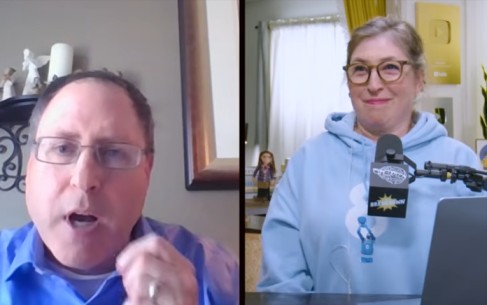
Editor’s Notes: In this captivating episode of Mayim Bialik’s Breakdown, Mayim and Jonathan Cohen interview John J. Davis, who shares his remarkable story of being clinically dead for seven minutes following a surgical complication. John describes a vivid journey beyond “the white light,” where he was guided through a celestial orientation center, viewed his own life review, and even glimpsed past incarnations. He details a profound encounter with a divine being who gave him a specific mission: to return and tell the world that there is no death. This episode offers a unique and touching exploration of the afterlife, challenging our understanding of time, consciousness, and the enduring nature of the human soul. (March 31, 2026)
TRANSCRIPT:
Introduction
MAYIM BIALIK: Hi, I’m Mayim Bialik.
JONATHAN COHEN: And I’m Jonathan Cohen.
MAYIM BIALIK: And welcome to our breakdown. Well, folks, today we’re going to take you beyond this world. What if I were to tell you that we have a guest who didn’t just have a near death experience. He died. And for seven minutes he was dead in an operating room. He had an experience that takes much longer than seven minutes to detail.
He’s here today to share the very, very elaborate, detailed, complicated and very touching story of what he saw on the other side. This is different than any near death experience we’ve ever talked about. And John J. Davis is here to explain in detail why he believes he was chosen to have this experience and what very specific message he was tasked to impart to all of us when he was brought back from death.
We’d like to remind you, please follow us on Substack. There’s content there you cannot get anywhere else. Hang on to your hats and glasses and welcome, John J. Davis, to the breakdown. Break it down.
John J. Davis’s Story Begins
JOHN J. DAVIS: Thank you so much for having me on. I always love to share my story and I hope that it gives your audience the kind of hope that it has given me for all these years.
MAYIM BIALIK: Stories of people who have been declared dead and have come back are fascinating to people for so many reasons. And one of the reasons is because the stories are often colorful, fascinating, entertaining. But the other reason is that people who have experienced the things that you have experienced have an access to a knowing and a wisdom that literally comes from some other place that you get to then impart to people. So before we even get to your story, I wonder if you can start us off with why do you think this happened to you in particular?
JOHN J. DAVIS: Sure, that’s a great question. And it’s a question that I’ve thought about ever since this happened, because my story started back in 1987. That’s when this whole thing happened. And it has to be a God thing, because I remember every single detail like it happened yesterday. And every time I tell the story, it’s like I’m right back there again.
But I don’t know why I had the experience that I did. I always thought, why didn’t they just give it to Oprah or someone like you both, who has an audience? I don’t have anything. I don’t have a podcast. I don’t have a radio show. I don’t have anything. But all I’ve ever done is do what they told me to do, which was to share what they showed me. So I don’t know why they gave it to me.
The Accident That Started It All
MAYIM BIALIK: So take us back to the time that you were 21 years old and walk us through what led to your near death experience.
JOHN J. DAVIS: Yeah. So here’s how the whole thing started. My dad was in sales. He had a floor covering business in sales his entire career. And one year he won a sales contest. And part of what he won were these two mopeds, or what we would call scooters nowadays. And we used to ride them all over the neighborhood all the time.
One day I was out riding and I had an accident and I slammed into a tree. And the way that I landed, I tore the tendons off my right hand. And I needed to go in and have them surgically reattached. Well, I was only 21, and I had never had surgery before. I don’t think I’d ever even spent any time in a hospital, really.
So my mom drives me down to the hospital, to this clinic, and they wheel me into the operating room. They start to prep me, and they started to give me the anesthesia to knock me out. Well, something terrible happened, and I had a horrible allergic reaction to the anesthesia and it stopped my heart. And I died.
Crossing Over: The Orientation Center
MAYIM BIALIK: Were you aware that anything was going wrong, or were you, at this point, what we would call unconscious?
JOHN J. DAVIS: I was totally awake. The anesthesia hadn’t taken effect yet, but I could feel the warmth going through my arm. So all of a sudden, everything went black. And the very next second, I woke up, and I was standing in the most beautiful building I had ever seen. It was this beautiful white marble. White, polished marble.
A lot of times when we hear about near death experiences, we hear about a person having some kind of an accident. They’re floating above their body, looking down, and they become aware of a tunnel, and they start to move down the tunnel. And at the end of the tunnel, there’s a white light. But before they get to it, they’re met by somebody. A relative, a friend, a family member, somebody who passed before them and tells them, “It’s not your time.
Well, what they did with me somehow, and I don’t know how they did this, they put me on the other side of that white light. That’s where my story starts. So here’s what happened. As I’m standing in this beautiful white marble building, it was so long, I could not see the end of it. Right about then, in my left ear, I heard, “My name is Alan. I’m your spirit guide.”
Well, nobody had ever talked about spirit guides. Back in 1987, I had never even heard the term before. So I just thought, this has to be some kind of an angel, because I was raised Catholic and we never talked about spirit guides. Well, apparently, every single one of us, before we come into a lifetime, we have a spirit guide who helps us plan our lifetimes, and they’re with us throughout our entire lives.
Well, my guide, Alan, was telling me in my left ear every single thing he was showing me. And he told me where I was. I was in what is called the orientation center. And it’s the place that all of us go to when we finish a lifetime.
MAYIM BIALIK: Okay, I’m going to stop you right here.
JOHN J. DAVIS: Yeah.
MAYIM BIALIK: We got to walk it back a couple steps.
JONATHAN COHEN: You’ve never been to the orientation—
MAYIM BIALIK: I’ve never been to the orientation center. So you’re laying on the table, and you’re aware they’re going to anesthetize you, and you feel the warmth of the medication, which is not unusual, but it sounds like something. Did you remember anyone saying, before you kind of went away, did you remember anyone saying, “Something’s wrong, he’s having a bad reaction”? Do you remember anything before it went black?
JOHN J. DAVIS: No. Nothing. Well, the last thing I remember is the feeling of the warmth, the anesthesia going through my arm.
A Different Version of Consciousness
MAYIM BIALIK: So everything goes black. In your conscious experience, was John, who previously was on the table being anesthetized, aware that John was no longer on the table being anesthetized? Meaning when you opened your eyes and you saw that you were in this white marble, endless building, did you have any sort of like, “What the heck is happening? I should be on the table”? Or were you transported to a different version of you?
JOHN J. DAVIS: That’s a great question. When I first opened my eyes and I was standing there looking at this building that was so long I couldn’t see the end of it, my first thought was, “Oh, my gosh. I had no idea the hospital was this big.” I didn’t know that I died. I think if I had known that, I think I would have asked so many more questions. I didn’t know that I died. Everything was going so fast, and Alan was talking to me so quickly.
MAYIM BIALIK: Okay, I’m going to stop you there again. I’m going to stop you there again. I can almost roll with spirit guide. Why is his name Alan?
JOHN J. DAVIS: I don’t know.
JONATHAN COHEN: When he’s not a spirit guide, he’s working at H&R Block. Yeah.
JOHN J. DAVIS: Yeah.
MAYIM BIALIK: Okay, so do you have any association to the name Alan? Do you know anyone named Alan?
JOHN J. DAVIS: No, not anybody. Not a single person.
MAYIM BIALIK: Was it Alan with one L or two?
JOHN J. DAVIS: Two Ls. A-L-L-E-N. Oh, wait—
MAYIM BIALIK: A-L-L-E-N. So that’s usually the way a last name is spelled.
JOHN J. DAVIS: Yeah, that’s how he spelled it.
JONATHAN COHEN: How did you get into talking about how he spelled his name?
MAYIM BIALIK: Great question. How did you know that your spirit guide Allen spelled it A-L-L-E-N?
JOHN J. DAVIS: That was my very first impression. It was almost like I could see it written across my forehead. A-L-L-E-N. Allen. And ever since then, that’s always what I’ve called him.
MAYIM BIALIK: All right, so we’re dialing back in. He whispers in your ear, “My name is Allen. I’m your spirit guide.” This is the question I’m asking sort of about your consciousness. Did you have a notion of, “I’m actually on the table,” or were you just in this new place?
JOHN J. DAVIS: I am fully me, just like I am ordinarily, but I was standing in this place, and I had no recollection that I was laying on that table. Everything was happening right then and right there. I was present 100% in this building.
Seven Minutes of Death
MAYIM BIALIK: Once things went black on the hospital side of John’s experience—
JOHN J. DAVIS: Yeah.
MAYIM BIALIK: What we know happened was that for approximately seven minutes you were dead. Meaning everybody was likely some form of freaking out, calling a code, trying to revive you. I’m not sure if they informed your family what was going on, but just to provide a framework, for seven minutes you were dead.
JOHN J. DAVIS: Yeah, exactly.
MAYIM BIALIK: During that time, you and Allen went all sorts of places.
JOHN J. DAVIS: Exactly. That’s exactly what happened. I had no idea until the very end that anybody was even working on me. When I came back at the end of my experience, I was laying on the table, I opened up my eyes and everybody was staring at me, looking down at me like, “Okay, we got him back, we got him back.”
But during this whole experience, I felt like I was gone for an hour or two. It just went on this huge, long journey that went on forever, but chronologically it was only seven minutes.
MAYIM BIALIK: And this is something that we talk about a lot, which I think is one of the most compelling aspects of — I don’t even want to call this a near death experience. It was a death experience. Right. Like by all measures, you were dead. But this is what’s fascinating to me. You came back with a lot more than seven minutes worth of experience, information and consciousness.
The Orientation Center of the Afterlife
MAYIM BIALIK: I’m wondering if you’ve ever found yourself stuck replaying a conversation over and over because you want to be completely sure that your friend doesn’t secretly hate you. Or have you ever spent hours researching a minor ache or pain, even when the doctor said you’re fine because you seem to have doubts and fears that just will not go away?
Well, you might be surprised to learn that experiences like that — a distressing, unwanted thought getting stuck in your mind and you feeling like you’ve got to do something to solve it or stop it or be like 100% sure about it — these can all be signs of obsessive compulsive disorder, or OCD.
OCD is nothing like the stereotypes that you’ve heard, like, “Oh, I like things organized.” Real OCD is actually a serious condition that can kind of focus on anything. It could be your morals, your relationships, your identity, your sense of reality. What makes it so debilitating is that it often fixates on exactly the things that you care about the most.
I have OCD myself, so I know it’s very misunderstood. It’s hard to even figure out what’s going on, let alone get the right kind of help. I’m here to tell you about NOCD. That’s the world’s leading provider of specialized OCD treatment. All of their licensed therapists go through extensive specialty training to identify and effectively treat OCD. Help you manage it so you get your life back in live face-to-face virtual sessions. They help you reclaim your time, your confidence and your freedom.
NOCD is also covered by insurance for over 138 million Americans. That includes support between sessions. You never have to face OCD alone. If any of this sounds like you or maybe someone you love, NOCD can help. Book a free 15-minute call to get started at learn.nocd.com.
The White Marble Building
MAYIM BIALIK: You know, we talk a lot here about alignment — making sure that your life is aligned with your authentic self and what you’re trying to do. So you’re in this white marble building and you have this notion that you’re on the other side of the white light. So you and Allan — does Allan have a body?
JOHN J. DAVIS: You know what? He was standing to the left-hand side of me. I never actually looked at him. Everything was happening so quickly. He was taking me from one place — here, then here, then here. But I never stopped to look at him. Everybody else that I saw, they look just like we do. They look just like us.
So here’s something that’ll blow your mind. So I’m standing in that building. I look to my right and as far down as I can see are these beautiful white marble columns, maybe 20 or 30 feet high, about 6 feet apart — so far down I couldn’t see the end of it. In the middle of this building were all these tables, about the size of a person’s average kitchen table, made of beautiful white marble. And there were two people sitting at every one of these tables, again going as far down as you can see. And my guide Allen said they’re called orientation counselors.
And so I look over to my left, and this is the part that was the most extraordinary. On the left-hand side of this building, again, was beautiful white marble, polished white marble. But every six feet apart, there were these tunnels that looked like they had been cut out of solid marble — absolutely 90-degree angle doorways, about six feet apart, all the way down as far as you could see. And my guide said, “This is how people get back to the other side.”
MAYIM BIALIK: Oh, gosh.
JOHN J. DAVIS: Because the other side — that’s home. Earth has never been our home. The other side is our home.
Passing Through the Tunnel
JOHN J. DAVIS: So he said, “Look at the next tunnel.” So I look up at the next tunnel. There was a man coming through. He was an elderly gentleman, probably in his 80s or 90s. And he was doing this — he had his right hand over his chest, like he had heart pain or chest pain. And my guide Allen said he just passed from a heart attack.
So remember, we talked about there’s two counselors at every one of these tables. There was a woman who was sitting closest to that tunnel. She stood up, she walked over to him, she took his hands in hers and she led him back to the table. And they sat down across from each other. And she started talking to him. But I was too far away to hear what she was saying.
But my guide Allen told me that on the other side, the orientation counselor’s job is to help people remember where they’re from. Because most of us, when we leave the other side — or heaven, or the afterlife, whatever you want to call it — when we come into a lifetime, most of us don’t remember where we’re from. So there’s a lot of fear and worry and dread about the process of dying. Especially for all of us here on Earth, it’s one of the greatest fears of humanity.
So the orientation counselors basically tell people, “This is how you passed. You just finished your lifetime here on Earth and now you’re back home again.” And so my guide Alan said to watch him, so I’m watching him, and the weirdest thing happened.
MAYIM BIALIK: Weirder than the fact that you died and a dude named Alan is walking you through the orientation center of the afterlife? I can’t wait.
The Reunion
JOHN J. DAVIS: This gets even weirder than that. You’re going to be so amazed by what happened. All of a sudden, I’m watching this gentleman who had a long life on Earth. He began to change from an elderly gentleman into a young man in his 30s. And Alan told me that at creation, God created all of us in our 30s. That’s how we appear on the other side. And so he was having what they call orientation — helping people remember where they’re from.
All of a sudden, when he is finished, he stands up, he walks off to the right, he walks down these three steps, and he walks into what I call the gardens. I don’t know if that’s what they call them, but that’s what it looked like to me. This beautiful, gigantic garden with the most beautiful green emerald grass and flowers and trees. It looked like a humongous English garden. Absolutely beautiful.
And there were all these people there. There must have been 100 or 200 people that were there waiting for this gentleman. And my guide explained to me that when we pass, all of us come through the tunnel, we go into the light, we go into the orientation center, and then we have what is called a reunion. And the reunion is all the people that that gentleman knew in his life who had passed before him — parents, grandparents, friends, siblings — all of them were there waiting, plus all the people who already knew him on the other side. And it was like a big party. Everybody was clapping, applauding, hugging this man, telling him he did a great job.
And my guide Alan told me, “People don’t realize what a big deal it is to come to Earth. There are many, many souls who don’t want to come here because it is so hard.” So many of the lessons all of us go through. And he said, “You really have to be a warrior when you come to a place like Earth.” And that’s why all those people are there.
You know what I’ve never understood? When I was in that orientation building, watching all this activity, there were no computers on those tables. There were no papers, no documents — nothing to tell them who’s coming through these tunnels. But those counselors knew. They knew who this gentleman was, and they knew when he was going to pass and what he passed from. And the only thing I can think of is that it has to be a God thing, because how in the world do you know who’s going to come through and when? But they know, because somebody told all those people in the garden when he was coming through. Because on the other side, nobody just stands around all day. Everybody’s busy over there.
JONATHAN COHEN: What are they busy doing?
JOHN J. DAVIS: Everything. They go hiking, they take classes, they go swimming, they visit with friends, they go to music festivals. Everything that you like to do here on Earth, they told me you can do on the other side. It’s an absolute paradise over there.
Telepathic Communication on the Other Side
JONATHAN COHEN: They know how everyone’s going to be there the same way that he knew Allan. Right? It’s telepathic communication. They’re like merged with a database of sorts — an energetic database —
MAYIM BIALIK: Sure.
JONATHAN COHEN: — whereby that information just becomes available.
MAYIM BIALIK: What is Allen’s voice like? Is he speaking like with a mouth? Is it being communicated to you telepathically? Is his voice familiar to you? Do you just have a knowing of what he’s saying?
JOHN J. DAVIS: It sounded like — have you ever listened to a voice recording and you can speed it up, like fast forward it? Yeah, that’s what it sounded like. It didn’t sound like you and I. It sounded like somebody had fast forward on the recording button. But it was very fast. It was going super fast. And I think that’s why I never even had time to think about what was happening. I was just going along with everything he was showing me and just listening.
And the weirdest thing too is I usually have a really bad memory. Like I couldn’t even tell you what I had for dinner last night. But I remember every single detail of what they showed me. And I think that’s the reason — because they wanted me to tell people what’s over there.
Billions of Souls
MAYIM BIALIK: When you talk about “they,” who are you referring to? When you say “I don’t know why” or “you know why they showed me this” — who is the “they” for you?
JOHN J. DAVIS: I guess all the people that I interacted with there. And as I tell you more, you’ll be able to kind of help me understand more about what I was seeing. But there were so many people over there. We think that Earth has a lot of people — like 8 billion souls here. There are, if not more, on the other side. God created billions and billions of us. And you would think that all of creation is here on Earth, but it’s not. In fact, a little bit later I’ll tell you more about the other places that we can go.
A Prolonged Experience of Death
MAYIM BIALIK: I’m really struck by the fact that the other people we’ve spoken to who have had NDEs — I don’t know if any of them were declared dead for something like seven minutes. Meaning, when we talk about near-death experiences, it’s usually people on this side of the light. Right? They’re having experiences and they’re given this option: do you want to go back?
Elizabeth Crone talks about how she was shown that there was a place beyond the mountains that once you go there, you do not come back. I think that John might be the first person that we’re speaking to who had a prolonged experience of essentially death and then being brought back by many interesting mechanisms.
The Life Review and the Afterlife
JOHN J. DAVIS: Yeah, my experience, all I can really say is it was weird. I mean, I had so many things happen and I look at my experience as I’m a piece of a jigsaw puzzle. We’re all trying to put this puzzle together, all of us who have had NDEs, and we’re all trying to figure out how this all works.
And I think what makes my story so unique is that they started mine on the other side of the light. So I think they want me to tell people that there’s nothing to be afraid of about dying. In fact, the happiest day any of us will ever have will be our last day. Because that’s the day we get to go home again. And all of our loved ones will be there, all of our friends. And believe it or not, our animals that we loved growing up, they’re all there. God created our animals with souls. And I saw two cats that I had growing up.
MAYIM BIALIK: Stop it.
JOHN J. DAVIS: Yeah, Boo and Muffin, and I saw them. They’re all there.
JONATHAN COHEN: You were 21 at the time.
JOHN J. DAVIS: Yeah.
JONATHAN COHEN: You died. But do you age up if everyone is supposed to be 30? If the old man ages back, do you age up? And it doesn’t sound like you were aging up, so you were still in a limbo state. You weren’t on the other side of the light, but you weren’t fully dead. Even though you were clinically dead. They knew that it wasn’t your time.
JOHN J. DAVIS: That’s exactly right. What happens is you just hit it on the head. When somebody passes, if they live a long life and they pass when they’re elderly, they age back down again. If a soul comes into a lifetime and they decide that they’re going to pass when they’re 10, that child comes back to the other side. But that child is also a soul of God. And that child ages up to the age that they normally were on the other side. So we age down and we age up to be in our 30s.
JONATHAN COHEN: So the afterlife is just a bunch of 30 year olds living their best life. Isn’t it weird not to have anyone of different ages? It seems weird.
JOHN J. DAVIS: Well, a person can appear any way they want to. It’s kind of like — it was so amazing. It felt like Harry Potter. It had that kind of magical feeling to all of this. But a person can appear to be any age they want to be. A lot of people will age up. It’s like if you pass when you’re 80 and your kids remember you at 80, you might age up when they pass, so they recognize you immediately.
JONATHAN COHEN: But you can shift. You can be 80 sometimes. You can come back.
JOHN J. DAVIS: Yeah. Yep.
MAYIM BIALIK: This was what happened to you. And this was the information that you’re receiving. So in theory, this information’s coming to you in English.
JONATHAN COHEN: Right.
MAYIM BIALIK: Because that’s your native tongue. Is this a diverse group of people that you’re seeing, or are you seeing like the people from San Jose, California?
JOHN J. DAVIS: There were every race, every ethnicity, everything I saw as I was in this experience. Everybody is there. It’s so varied. It’s like going to the building — and I’ll tell you in a minute, there was a building I went to that had this big, huge dome on it. And when I looked out the window of that building, I could see all these people walking back and forth. It was so busy. It was like going to Los Angeles, going to downtown at lunchtime.
MAYIM BIALIK: It makes me feel dead when I go to downtown.
JOHN J. DAVIS: Yeah. You see all these people walking. That’s what it looked like. So wherever it was that my guide Alan took me, it was really busy. It was a busy place. People just don’t sit around all day. Everybody lives their life, and when you finish your life and you get back to the other side, you just pick up where you left off — having all your friends, your family, doing all the things you like to do.
Then one of the things that was so interesting to me is you do the things on the other side that you love to do. It’s almost like people have jobs, but they don’t have to have a job to pay their bills. They pursue what they love to do. And remember when we talked about the orientation center, all those counselors that were there — all of them love to do that role. They love to be orientation counselors.
Well, here’s the next thing. This is even going to blow your mind even more. After this gentleman has this reunion with all those people, my guide takes me on this journey.
MAYIM BIALIK: Are you walking? How do you get place to place?
JOHN J. DAVIS: That is such a great question. I don’t know.
JONATHAN COHEN: I think he’s floating.
JOHN J. DAVIS: Yeah, because we didn’t walk, we didn’t fly. There wasn’t enough time. It had to be something with thought because instantaneously I was here. He was telling me what this was, then it was here.
The Building with the Dome
JOHN J. DAVIS: So he takes me to this building that is so large. We have nothing like it here on earth. And it was a rectangle building made of beautiful white marble with all these white marble columns all along the perimeter. And it was solid. Everything that I saw was solid. Just like if you were to touch your leg or your table, that’s solid. It was just like that. And I can’t explain how that’s possible.
So he takes me inside this building and we go into a round room, this perfectly round big room. And I look up, and all along the ceiling are these movie screens, just like you would go to see a movie. There must have been 15 or 20 of these screens all around the top of me. And my guide Alan said, “This is the Life Review.” Then all of a sudden, every one of the screens lit up and each screen was playing a different episode of my life.
MAYIM BIALIK: Oh, my gosh.
JOHN J. DAVIS: One screen had me as a little infant. Another screen was showing me as a toddler.
MAYIM BIALIK: Were these images that you have seen in home videos or photos, or were these spontaneous, original images of John?
The Life Review
JOHN J. DAVIS: Exactly. That’s exactly what it was. I had never seen those pictures before in my life. And every screen had a different episode of my life. And here’s what’s really interesting. The Life Review. My guide Alan explained to me, the Life Review was the greatest teacher of the soul. And the reason for that is when you’re watching these screens in your life review, you can feel how your actions affected other people.
When I was in, it was either second or third grade, I don’t remember which one. But we were at recess one day, and there was a boy in our class. His name was Troy. And Troy had something wrong with his legs. He had, like, either MS or Parkinson’s, but he couldn’t walk without crutches. So we’re at recess one day, and Troy fell. And I ran up to him. I helped pick him up and helped him put his crutches on. It’s something that any of us would have done. I never thought anything about that.
Well, one of the videos was showing that episode of my life as a little kid. And I could feel how that made Troy feel, that he appreciated that so much that I didn’t just ignore him, that I helped him. Well, on the opposite end of that, you also feel if your actions hurt somebody else. And that’s what Alan told me. He said, that’s why it’s the greatest teacher of the soul. If you’re a soul who intentionally hurt somebody else in your lifetime, you’ll feel what that person felt in your life review.
MAYIM BIALIK: This is what Betty said. Buddha Betty. She said she could see both the joy and the pain that had gone through every experience, and she simultaneously could feel that in her own body.
JOHN J. DAVIS: Exactly. That’s exactly what it feels like.
Time and Consciousness
MAYIM BIALIK: You’ve already described more than 7 minutes of information. You might say, well, John’s a very creative guy, and he’s spinning a fantastic tale about what happened when he had a reaction to anesthesia. But the amount of information that you have returned with, and this is typical of every NDE experiencer, the amount of information that you have returned with does not chronologically fit into the amount of time that you were not on this planet. So we have to conclude that time is not obeying the same rules when you are in this plane of consciousness. Whatever that means is the only way I can explain it.
JOHN J. DAVIS: Yeah, that’s exactly correct. We don’t have linear time here on the other side. And again, that’s one of the things I can’t explain. They don’t have time the same way that we do. And what’s really interesting is that if you both live to be 90 when
MAYIM BIALIK: you pass, we’ll be making each other crazy.
JOHN J. DAVIS: Yeah, yeah, my wife and I, too. Yeah, exactly. But when you get back, it feels like you just left. And I don’t know how that is possible, but that’s what it feels like.
Past Lifetimes
So we finished this life review, and he takes me to another building, another beautiful, gorgeous marble. And I don’t even know why a lot of the buildings look like marble Greek temples, but a lot of them do. But that’s not the other side, the totality. He just took me to a small area of the other side. In the best way that I can describe it, it was almost like, when you go to a college campus and you’ve got your science building, your English building over here, then your math building. That’s kind of what it felt like. Like he was taking me to all these different buildings that were on this campus. And wherever it was, it was really busy. A lot of people everywhere.
So here’s something else that will blow your mind. So he takes me on the inside of this next building. He showed me the outside of all these buildings first, and then we go to the inside. He walks me into a room that looks like a theater, just like what we would go to today to watch a movie. But there weren’t 100 seats. There was just one seat. And he said, “I’m going to show you past lifetimes.”
Well, I had to say I had a hard time with that because I was raised Catholic and Catholics, we don’t talk about past lifetimes. It’s not a thing. So I had a hard time believing this. So he has me sit down in this seat in this theater, and a movie starts to play. He said, “I’m going to show you three of your lifetimes.”
So the screen lights up like a movie again. And it’s me. I didn’t look like I look now because all of our DNA, our genes, all that stuff is always different, how you look. But I just knew that it was me. And I was an elderly gentleman. I had a shaved head. I was wearing a red gown, and I was in a monastery. And my job in that life was to teach young kids how to become monks. And that life took place somewhere in Southeast Asia.
And then the screen went blank. He said, “I’m going to show you another one.” So the screen lights up again and again. It’s me, and I’m a man. I have a wooden wheelbarrow, and I’m pushing it down this cobblestone road, and there are all these shoes stacked in this wheelbarrow. And my job in that life was I fixed people’s shoes. And that life happened somewhere in Eastern Europe.
And then the screen went blank. He said, “I’m going to show you one more past lifetime.” So the screen lights up, and it’s me again. And I’m standing in this rickety wooden boat on a lake or an ocean, and I’m throwing a net into the water like this, and I’m pulling it back in, hand over hand, back into the boat. And part of my job in that life was to catch fish for the village. And that lifetime happened somewhere in the Middle East.
And it was so extraordinary to me because that’s when Alan told me that we have been around for eons. We are as eternal as God is eternal. And if a person wants to have lifetimes, they can. On the other side, everybody still loves to learn. But there are certain things you can’t learn on the other side that you can only learn here on Earth or a place like Earth. And the things like that are anything that is hard, that is difficult, that’s a challenge. Because on the other side, it’s a perfect environment. It’s a place that God created for us that’s full of love and joy, compassion, the exact opposite of what it’s like here on Earth.
So if a person wants to come into a life on Earth to experience what it’s like to get a divorce or to lose a child at a young age, they have to come here to do that. Because on the other side, there is no negativity. There’s no war, there’s no hunger, there’s no poverty, there’s no aging, there’s no disease. None of that exists over there.
And then I thought, why in the hell would anybody leave the other side to come to a place like this? Why would anybody do that? And he told me, it’s because of what you become. It’s what you become for having gone through something difficult. And I thought, you know what? That makes sense. Because it’s the hard things that we experience that teach us the most.
The Planning Room
And that was the part of my experience that was a life review. The next place he takes me to, this one was different. It was a gigantic round building. It was very, very tall. There were white marble columns all around the circle of this building. And there was a big, huge dome on top of this building. And my guide said, “This is where we go when we plan a lifetime.” Well, I wish that I would have asked him, why do we go here? Why do we go to this building? But I didn’t think to ask that question.
MAYIM BIALIK: Well, you were busy being dead, so you were very occupied with other things.
JOHN J. DAVIS: Yeah, exactly. Exactly. And so he takes me, he walks me in, and we walk up to this white marble table. And sitting on top of this table is a scroll, a rolled-up scroll with a blue ribbon around it. And it looked like it was written on Egyptian papyrus paper, that kind of old looking kind of a scroll. So I picked it up and I took the ribbon off and I unscrolled it, or unfolded it, on the table.
And Alan told me, everybody writes their lifetime ahead of time. They write down all the things they want to accomplish in that lifetime. And it was almost like what we do when we have New Year’s resolutions that we fill out at the end of every year, all the things we want to accomplish. “I want to lose 15 pounds, I want to go back to college,” whatever it might be. And we write all this information down. And then what happens when you finish your life? You come back to that building, you get your scroll and you unfold it to see how you did.
Well, I looked down to try to read my scroll and it folded up again and I wasn’t able to read it. And I think the reason was because if I had known some of the things I had planned to learn, I would have done something that would have interfered with that. So I couldn’t read my scroll.
I look over to my right, and there was this huge, gigantic wall. It had to be miles long. It was all full of scrolls. And my guide said everybody that was in a lifetime back in 1987 had a corresponding scroll on this wall. So when they finished their life, they come back to this building and get their scroll and look at it and see how they did.
Well, then I looked to my left, and on my left hand side in this building was this gigantic window, huge sprawling window. And I looked out and there was a walkway. And this was the first time that I saw all these people. Everybody on the other side, so many people were walking back and forth. It was really busy. And everybody looks just like we do. And what’s so interesting is that everybody has a body just like we do.
And I have heard other NDErs say that we don’t have bodies, we’re just orbs of light. But that’s not what I experienced. Everyone looks just like you and I. Everybody is unique. Just as God created every single one of us.
So I’m looking at all these people, and on the other side of this walkway was the most beautiful thing I have ever seen. It was a lake, this beautiful round lake. It was so crystal clear. It looked like glass for the water. And have you both ever seen weeping willow trees? Yeah, the ones that go like this. They hang down, all their branches were hanging down and all the leaves were floating on the surface of the lake.
And that’s when Alan said to me, “Everything you like to do here on Earth, you can also do on the other side. Everything is there. All the beauty, the lakes, oceans, every kind of activity you like to do is all on the other side.”
The Library of Souls
Also, before we leave that big dome building, he takes me to another area that looked like a huge library. Have you seen Encyclopedia Britannicas?
MAYIM BIALIK: Of course.
JOHN J. DAVIS: You know, they’re those thick books. And all the books in this library looked like that. And they were all kind of a maroon color, kind of purplish. So he walks me up to a book, and every single one of these books had gold lettering on the outside, and they went vertical. The writing didn’t go horizontal, the writing went down.
So he takes me up to this book, and he has me read the outside binding, and it said, “Nina.” N-I-N-A. Nina. And he told me, “Nina is your soulmate.” Well, I had never heard the term soulmate before. Back in 1987, I had never even heard that term. But he told me, when God created us, he created all of us with a perfect mate that we have for eternity. And in this book is everything about that soul from creation, what their gifts are, the different lifetimes they’ve had, what they’ve learned. Everything is in these books. And every one of us has a book like that, and every one of us has a soulmate.
And I wish that I had known that I had died, and I would have asked Alan, does a soulmate come into our lifetimes with us? Because so many people have asked me, why haven’t I found my soulmate? And one thing I like to tell people is that what I learned from my NDE, one of the most important things I learned, is that it doesn’t matter if you don’t find your soulmate, because not everybody comes here to get married, to have kids. Other people come for different reasons.
And people think that they failed if they get to the end of their life and they never had the love of their life or they never had children. It doesn’t mean they failed. Just the fact that anybody comes here in the first place, they’ve already achieved something extraordinary just for coming here. And I like to tell people that we all have different reasons for being here. There are probably as many different reasons to be here as there are people on planet Earth currently. So that was the soulmate part.
A Cosmic Planetarium and the Library of All History
MAYIM BIALIK: Before we get to the other buildings, I just want to do, like, a little bit of a check in here. The level of detail.
JONATHAN COHEN: Unbelievable.
MAYIM BIALIK: The level of detail is unbelievable. And you seem like a sane person. I don’t believe that you’re not a well person. But the level of detail that you experience, just the fact that the writing was vertical, not horizontal. The amount of time it takes for one’s brain to receive this amount of information is not seven minutes. There is so much being downloaded, for lack of a better word, like this, the color of the books. I mean, this is a level of detail. Again, we are assuming that this is your recall. Right. A lot of people might say, “Oh, he’s filling in the blanks. He’s making it up.” This is your recall. This is reliably what you were experiencing.
JOHN J. DAVIS: And I haven’t. I haven’t even gotten to the best part yet.
JONATHAN COHEN: We’re going to get to the best part. I’m curious if this level of detail was available to you right away when you came back, or if it slowly integrated.
JOHN J. DAVIS: It was. It was instantaneous. I never forgot a single thing.
MAYIM BIALIK: Okay, keep going. So he takes you to another building.
The Planetarium: Life Beyond Earth
JOHN J. DAVIS: Yeah. So this other building was made of — it looked like stainless steel. Beautiful, beautiful metal building. It looked like a sports stadium. Like, we would go to watch football or watch a soccer game. So he takes me to the inside, and the inside — the first thing I notice is that there’s thousands and thousands of seats in this building. And all the lights are on. It was super bright. And he told me, “This is a planetarium.” Did either of you go on field trips when you were kids and see planetariums?
JONATHAN COHEN: Yes, absolutely.
JOHN J. DAVIS: Yeah, I did that, too. And they show you things on the ceiling. So I’m standing there with my guide, Alan, and this whole building is empty except for one person. There was a person behind me whose job was — he knew everything about astronomy. He knew about the stars, about galaxies, about planets. And he loved to share his information about astronomy.
MAYIM BIALIK: What did he look like?
JOHN J. DAVIS: I never turned around to look at him.
MAYIM BIALIK: Did he have a name?
JOHN J. DAVIS: No, he didn’t tell me. Here’s what happened. He spoke to me and he said, “Let’s begin.” All of a sudden, it goes pitch black. All the lights go off. So I sit down and I look up at the ceiling, and he starts to talk to me. And he said, “When you look at the stars, this is what you see.” And what he was talking about was all the people on Earth back in 1987, when they go outside at night and look up at the stars. This is what they know to be there. And our sun showed up, then Mercury, Venus, Earth, Mars, Neptune, Uranus, Saturn, Jupiter. All the planets in our solar system showed up on the ceiling. And then they disappeared.
And then he said, “When we look at the stars, this is what we see.” And he was talking about all the people on the other side at that point. This is what they see, or this is what they know about the universe. And all of a sudden, planet after planet after planet started showing up. First there were dozens, then hundreds, then thousands and millions and millions of other planets.
MAYIM BIALIK: What’d they look like?
JOHN J. DAVIS: There were all different kinds. Some of them had, like, like Earth, that had water. Other planets were just desert. Some planets were jungles. Some planets were just — it was all kinds of them. And he said, “There’s far more life in the universe than you can possibly imagine.”
And I think there were two reasons why they took me to show me this. They wanted me to tell people that Earth is only one of the planets. We’re not alone. There is far more life in the universe than just on Earth. And the other reason they showed me this was to tell me that Earth is not the only place you can come to to have a lifetime. There are virtually endless other worlds.
And here is something that I want to tell your audience, because this will kind of give them a perspective. Did either of you ever watch the original Star Trek with Captain Kirk?
MAYIM BIALIK: Yeah.
JOHN J. DAVIS: Yeah, that’s — I grew up on that. I used to come home from school and watch reruns of Star Trek. And I always believed there had to be other planets in the universe. There has to be. How could Earth be the only one?
So after my NDE, I started doing some research about astronomy. And I learned that in our galaxy, the Milky Way, there are about 400 billion stars. And they think that there are about 100 billion planets just in the Milky Way alone. And now that they have the research from the James Webb Space Telescope, they estimate that there are 2 trillion galaxies in the universe. If every single galaxy has 100 billion planets, can you imagine how many other worlds there must be?
And my guide explained to me that when God created us, he gave all of us, as part of our spiritual DNA, the love of learning, the joy of learning. So he created all these other worlds that we can come to to learn, and we have eternity to do it in. And that was my most favorite part about my NDE.
The Great Library: Watching History Unfold
JOHN J. DAVIS: So that was the planetarium, I call it. The next place he took me to — this was by far the largest building so far. It was so long I couldn’t see the end of it. It was beautiful white marble again, but there weren’t columns on the sides. The columns were only in the front. And it looked like our Supreme Court building in Washington D.C., with all the columns out front and all the steps leading up to it.
So we go inside and I notice immediately that it’s a library. It’s a huge, gigantic library. And there are all these wooden bookshelves, probably 20 or 30 feet high, with books going down as far as you could see. And it was really busy. There were all these people — people were looking for books, some people were reading, some people were visiting.
And he takes me over to the left-hand side of the library, and there are all these rooms. It looked like the rooms that we could go into a library today, a modern library that has study rooms. That’s what these rooms looked like. And they were about the size of somebody’s average living room.
So we walk up to this one room, and there was a woman in there. She had her back to me. She had straight black, or jet black, straight hair down to her waist. She was wearing like a purple gown or a robe of some kind. And she was sitting on the couch and she was watching on the wall. And this was really weird for me.
MAYIM BIALIK: This was what was weird for you?
JOHN J. DAVIS: Yeah, yeah, you’re right, you’re right. So remember, back in 1987 we had televisions that were those big, huge, gigantic 200-pound monstrosities.
MAYIM BIALIK: Yes.
JOHN J. DAVIS: You couldn’t mount those on a wall. But this lady, this woman, was watching what we would call today a 50 or 60-inch plasma screen television on the wall. And I was blown away because I had never seen anything like that before. We didn’t even have them yet. We didn’t have flat screen televisions.
So she was watching this, and my guide said, “Look at what she’s watching.” So I get closer and I can see that she’s watching a battle. And it was between Native Americans on horseback versus the United States Cavalry. And there was this huge battle going on. And I just assumed she’s watching a movie. And my guide said, “She’s watching actual history.”
And I said, “That’s impossible. We didn’t have video cameras 250 years ago. How could that possibly be recorded?” And he told me, “Everything gets recorded.” And I still don’t understand how that’s possible, but anything you’ve ever wanted to learn about in history, you can go to this library. You can go to one of these rooms, and you can watch actual history. You can watch the life of Martin Luther King, Jr. or Mother Teresa or Jesus. You can watch anybody’s lives and learn about history that way.
JONATHAN COHEN: It’s the first reality TV.
MAYIM BIALIK: It is the first reality TV. I mean, the explanation, if anyone’s asking, is that when things happen, that information — the fact that it happened — is its own recording. Right? Meaning that information then exists because it happened. Right. That configuration of molecules and all those things somehow exists in some sort of plane that can be accessed. I mean, yeah.
JONATHAN COHEN: If Earth is for learning, it’s not just for the people who have come here. It’s for intergalactic learning. Are there TV shows of other planets in the vast array of the universe?
JOHN J. DAVIS: I don’t know. I would think so.
MAYIM BIALIK: Who was the lady?
JOHN J. DAVIS: I don’t know. She was somebody who just wanted to learn about that part of Earth’s history. When I was in that building where I was doing the life review — I don’t know how it’s possible to record a lifetime if there are 8 billion people on this planet. All the things that are going on, especially now, politically — how is it possible for every single thing to get recorded? And the only explanation that I have is it’s a God thing. It’s just something we can’t possibly understand at this point.
MAYIM BIALIK: Well, I mean, and I happen to be a believer. I don’t know that I would necessarily place God as part of the explanation. And the notion is everything that exists — there’s no way that we’d say there can’t be people having as many lives as there are on the planet, because we know that they are having their lives. So in that very same way, that information is somehow available, right, in this other plane. I mean, I think just the way that — I mean, we’re not even done with the story. We have to get to the meadow. But in this way that we’re saying that these are the things that were imparted to you in seven minutes — people, seven minutes — this is the information that was downloaded.
The Castle: Royalty, History, and an Unexpected Encounter
JOHN J. DAVIS: So we leave the library, and the next place he took me to was a castle, just like you would see if you went to England or France — those beautiful stone castles. So he takes me to the inside of the castle, and the first thing I notice is there’s all this red carpeting on the floor. Very opulent, very decorative. And he said, “This is designed to help you feel what royalty would have felt like on the Earth during that time period.”
So we walk in and I notice on the walls, on both sides, and as far down as you can see this huge castle, there were life-size paintings all the way down. And what they were — they were life-size paintings of people that had lived in that time period in Earth’s history, like King George, Queen Anne, all the princesses and dukes and everybody who lived. You could walk into this castle, see what they lived in, look at the pictures of them, see what they looked like and what they wore.
And in front of every one of these pictures, there was a podium. And on top of the podium was a book. And the book was about that person’s lifetime. So if you wanted to learn about, say, Queen Anne, for example, you could go to the castle, look at her picture, and read about her lifetime.
Well, right to the right of me, something catches my eye. I look to my right, and there was a woman who was walking down this stairwell. You know how castles had those round stairwells you’d walk down? She was walking down one of those in this castle, and she had strawberry blonde hair to her shoulders, and she was wearing like a peach color, kind of an orange-peach gown or something. And she was walking up to me, and I thought, “Oh, crap, I’m not supposed to be here, or she’s going to kick me out or something.”
MAYIM BIALIK: Good to know there’s shame when you die.
JOHN J. DAVIS: Exactly. So she walks up to me and she said, “Is there anything I can help you find?” And I said the stupidest thing. I still can’t believe I said this to her. I said, “No, thanks, I’m just looking.” I could have asked her anything. Like, where am I? Who are you? I’m supposed to be having surgery. What’s happening?
MAYIM BIALIK: Are you Nina? No. Maybe it was Nina.
The Meadow and the Message
JOHN J. DAVIS: And Alan told me, he said, on the other side, this is what she loves to do. She loves to study history. And she knew everything about that era of Earth’s history. So if you’re on the other side, you wanted to learn about this particular part of Earth’s history. You can go to the castle, you can look at the paintings, you can read the books, and you could ask her anything. She was like what we would call a professor of medieval Europe.
MAYIM BIALIK: I was going to say, on the other side, what she likes to do is go up to people and ask if they need anything.
JOHN J. DAVIS: Yeah, yeah, that’s her job.
JONATHAN COHEN: If someone really likes organizing closets, what
MAYIM BIALIK: they do on the other side is organize every closet in the afterlife they can find.
JONATHAN COHEN: Are there closets to organize?
MAYIM BIALIK: I’m sure there are.
JONATHAN COHEN: Mime is going to do.
JOHN J. DAVIS: I’m sure there have to be. I do know this, though. You don’t have to wash laundry.
MAYIM BIALIK: I do like doing laundry.
JOHN J. DAVIS: Okay, so here’s the meadow part now. So we leave the castle and he takes me to the most perfect, beautiful meadow I have ever seen. There were rolling green hills. The sun was out. Not a cloud in the sky. And there were all these wildflowers. And then my guide, Allen, left, and I thought I was standing in this meadow by myself. So I go like this. I turn around to look at the rest of the meadow, and there’s a gentleman standing right in front of me. He had a white golden gown on, and he had a golden sash around his waist. And he had gold colored sandals that laced up his calves all the way to his knees. And he didn’t tell me who he was, but I knew this was the being that we know as Jesus. When I looked at his face, he was different than everybody else I saw.
MAYIM BIALIK: Sorry, I thought you were going to say he was different than every painter in history who’s like, he’s got blonde hair and blue eyes. Also he’s six feet tall when actual Jesus was probably like five, two. And very, very dark. Yes.
JOHN J. DAVIS: Yep, exactly. Well, that’s the part — when I went to look at his face, there was all this light that was coming. It looked like lightning coming out of his face. There was so much light that I couldn’t see what he looked like. But he spoke to me and he said —
MAYIM BIALIK: What did his voice sound like? What did his voice sound like?
JOHN J. DAVIS: It just sounded deep and authoritarian, but that’s all I know. And I think it’s because of what he said to me. He said, “You must tell them there is no death.” And that very second when he said that, boom, I woke right back up in the operating room.
MAYIM BIALIK: What?
JOHN J. DAVIS: Yeah, “You must tell them there is no death.” And what was so interesting about that is it was the way that he said it. He didn’t say, “You know what, John? When you have time, when you’re not busy, when it’s convenient for you, would you share — tell people what we shared with you.” He didn’t say it that way. “You must tell them there is no death.” And so that’s what I’ve been doing.
MAYIM BIALIK: So your eyes pop open. What happens next?
JOHN J. DAVIS: The first thing that I said to everyone who was looking at me when I opened up my eyes — I said, “What just happened?”
JONATHAN COHEN: You were supposed to say, “There is no death, John.” You’ve already started on the wrong foot.
JOHN J. DAVIS: Exactly. I already screwed up from the beginning. So I said, “What just happened?” Thinking that they knew what happened, and they said, “We lost you.” I said, “What do you mean?” They said, “You actually died.” And I thought, that’s insane. I said, “How long was I dead?” They said, “Seven minutes,” but it felt like hours. Yes, exactly. And I could not — my mind was so blown away.
Coming Back: Depression and Purpose
MAYIM BIALIK: Did you say anything to anyone, or did you kind of go into recovery, meaning they finish discharging you? When did you tell the first person what you experienced?
JOHN J. DAVIS: I told my mom on the way home. I couldn’t have the surgery. They had to postpone it, and we had to reschedule it. So my mom drives me back home. I told her immediately what had happened. And the only book that was out like this back in 1987 — do you remember Raymond Moody?
MAYIM BIALIK: Of course. We’ve spoken to him here. Yeah.
JOHN J. DAVIS: Oh, great. Excellent. He wrote that book called Life After Life, and my mom gave me that book, and I read the whole thing that day. And that’s when I realized, oh, my gosh. I saw what I’ve always been taught to be called heaven. I was in heaven. They don’t call it that. They call it the other side. I don’t know why, but they don’t call it — well, most of them call it home. They just call it home. But Christianity knows it is heaven.
So I read the whole book, and that’s when I realized that I had an experience that — what we now call an NDE, but there was no terminology for that back in 1987. And I went through a horrible, horrible depression for about two months after this because I did not want to be here. I wanted to be where I was. I never wanted to leave there. I wanted to go back and stay there. I even thought about committing suicide because I didn’t want to be here.
Well, then I began to realize that the kind of hope that that experience gave me, it wasn’t for me. It was for me to share it with others so that people don’t have to be afraid of dying. There is such a fear of death that we don’t even talk about it in our culture. But it’s going to be the happiest day any of us ever know, because we get to go home again. And all the painful things, all the trauma, all the hurt that you’ve gone through in your lifetime, it’s all gone when you get back. And it’s replaced with learning and knowledge and who you became.
And something I like to tell people is that in our culture, we are raised to believe that your success is based on what you have. What did you get in your life? Did you get the big house? Do you have the expensive car? Did you have the million dollar 401k? None of those things matter on the other side, because to them, success is based on who did you help in your lifetime? Who did you become? Did you live a kind life? Did you try to make a difference? Those are the things that matter.
Skepticism, Imagery, and the Nature of the NDE
MAYIM BIALIK: I want to give what might be a skeptical read of the descriptions that you gave, because the fact is, we don’t know anything about you at 21. We don’t know anything about what you experienced. The take that some people might have — and this would fit in a logical sense — if you were to tell me, “John, I was a 21 year old who loved Greek and Roman architecture. I was fascinated with medieval castles. These were the things that I enjoyed to study and learn about. I loved libraries.” Then we might say that the experience you had took all of the things that were in your brain, things that had been coded, and they transposed them onto your experience.
Elizabeth Crone talked about how she loves gardening and she felt that her experience of heaven was a garden, but that for other people it might not be a garden. That our personal makeup, our experiences, what’s been encoded, let’s say, on this planet in this incarnation, might be placed into our NDE. So can you describe for us — were there elements of things that you knew about and were interested in that played into your NDE? Or do you believe that some of the images and imagery that you saw and experienced are those universal images that you believe many people might have if they have an NDE?
JOHN J. DAVIS: My initial thought when all this happened was this must have been some kind of a dream or some kind of a hallucination. But then, even in my life now, I don’t remember my dreams. I rarely remember what I dreamed about. I’ve never had hallucinations. I wasn’t on any kind of medication back then, and I hadn’t even gone to college yet. I didn’t go to college till I was 29. I had never studied anything about Greek or Roman architecture. I didn’t know anything about art history. I didn’t know anything about libraries or any of the stuff that they showed me. It was all — everything was so new to me. I was like, oh, my gosh, this stuff is really real. It was absolutely extraordinary.
And every single time I share my story, I feel like I’m right back there again. And it’s that same wonder, that same feeling, like we mentioned earlier about that Harry Potter feeling that everything is magical. It’s absolutely the most extraordinary place I have ever been.
MAYIM BIALIK: Well, my next question — and I don’t mean to have a death match against NDEers — but when some people have an NDE, their experience is obviously different from yours, and many of them have very elaborate and very fleshed out images of where you go and what the life review is like and the life planning. The elements are — I would say close to identical, right, that we see statistically. And we’ve gotten to speak to Jim Tucker and Bruce Greyson, all these people who study and catalog these things from a clinical perspective. So I’m curious what your take is. And I’m not asking you to go head to head with other NDEers, but is your personal belief that this place — this place that you went — is that the place that we go, or was that your experience?
JOHN J. DAVIS: It’s one of the places we go. The places that they took me to — everybody, at some point, goes there. It’s almost like the hub of a city. I got the impression like wherever I was was like a planet, this huge, enormous planet, and he only took me to one particular part of it. I only saw a small part of the other side. But it’s something that — if it was just me in all these buildings, I would think, okay, this must be something that I am creating somehow. But there were thousands of people everywhere, all in these buildings. All these people were studying and visiting, and so many of these buildings, everybody seems to utilize.
What Clinically Happened in Those Seven Minutes
MAYIM BIALIK: What is your knowledge now? And even in — God bless us — in 1987, things were not as sophisticated as they are now. Besides the plasma TV bit. What is your clinical explanation that you’ve been given, meaning — had you coded? Was there no pulse? What actually went on in those seven minutes, as far as you know?
JOHN J. DAVIS: All I know is that they told me they had the paddles, they were using paddles on my chest, but that’s all I know. I don’t know — they may have told me other things, but I don’t remember.
MAYIM BIALIK: That’s enough that you were dead, my friend.
JOHN J. DAVIS: And I know they had to do it more than once, but I don’t remember how many times they had to do it.
Faith, Framework, and Coming Back Changed
MAYIM BIALIK: I want you to, as best as you can — so you’re very depressed when you come back. What was your kind of notion? Especially with the religious framework that you had, there are so many aspects of your story that, again, do not fit into traditional Judeo-Christian storytelling, right? It’s not part of, let’s say, Catholicism. When you came back, did you feel like, “Guess what, Mom, I also met Jesus?” Did you have a Catholic or a Christian grounding? Or did your definition of existence have to expand at that point?
Parenting, Purpose, and the Nature of God
JOHN J. DAVIS: It was. It was really weird because when I was standing there in front of Jesus, I didn’t get any kind of impression from him that there’s only one religion. It was more like every religion has truth to it, but not every religion has all the truth. And when I was over there on the other side, there was no feeling of, “This is where Catholics are,” or “This is what Islam believes.” It was almost like religion was invented by humanity. Religion wasn’t invented by God.
On the other side, I think this is the reason that I had such a hard time when I got back. Because on the other side, when we’re there, we can feel God. We can absolutely feel how much God loves you. It’s like you mentioned, you have kids. Your love for your kids, you love them so much. It’s absolutely unconditional. That’s what it’s like when we feel God’s love. It’s the most extraordinary feeling that you never want to be away from.
When you come into a place like Earth, it’s like being in a battle and you’re in a foxhole without a radio. You feel cut off. And I wanted to have that feeling again. I never wanted to be away from that feeling. And then I realized that, “All right, John, they told you what you’re supposed to do with your life.” It’s nothing to do with me. It’s all about the message. That’s what has to get out. And that’s what I’ve been doing ever since, just trying to share my story.
Finding Nina and the Soulmate Question
MAYIM BIALIK: Have you found Nina? Have you found Nina?
JOHN J. DAVIS: I don’t know. I have no idea. My wife and I have talked about that before, and we don’t know. I don’t know if the soulmate comes into every lifetime with us. I know that they can. I just don’t know how often that they do. I don’t know.
MAYIM BIALIK: We also don’t know if she could be Nina by another name. We don’t know.
JOHN J. DAVIS: Yeah, exactly.
Staying Connected to the Divine
JONATHAN COHEN: Have you found ways in this lifetime to feel more of that connection with the divine?
JOHN J. DAVIS: The biggest connection for me is when people reach out to me. They watch a podcast I was on, or they go to my website and they read about my experience. I think a lot of people feel like I am a conduit for them to know that their loved ones aren’t gone, that there really is a place. There’s a place that is more beautiful than I could ever explain. I don’t have the language to explain how beautiful it really is over there.
And the greatest privilege of my life has been to tell people that your loved one isn’t gone. They’re just — they just went home. And when your lifetime is finished, you’re going to be reunited with them.
There’s a woman that just called me the other day, and she lost her daughter Hannah when she was only 31 years old. And she just wanted to know that what I experienced was real and that — is her daughter still going to be there? Is her daughter okay? And I said, “I can absolutely tell you that she’s better than okay. She’s happy, she’s free of pain. She’s got the love of God, all of her friends, family members are there with her, and when her mom passes, she’ll be with her again, and it’ll be like they never left.” And that has been the greatest privilege of my life, to be able to tell people that.
Negative Experiences and the Life Review
MAYIM BIALIK: I don’t mean to be such a downer, but this is something I often ask people who’ve had experiences like you. What about people who have negative experiences here and do not want to see the people that have gone on before them?
JOHN J. DAVIS: They don’t have to.
MAYIM BIALIK: Right. Is there some sort of reckoning and deeper understanding on the other side?
JOHN J. DAVIS: The only thing that was explained to me was if that person didn’t know how their actions affected others, they’ll learn that in the Life Review. And it’s almost like that person has their aha moment. Like, “Oh, my gosh, I never knew that.” And that’s what the Life Review is for.
Because God — I always believed that there has to be a hell, that God created a hell, but he never did. There is no hell. Hell was created by mankind. God couldn’t throw away his children any more than any of us could throw away our own children.
And it’s kind of like, why does God allow evil to exist when he could just simply wipe it out? And the reason is because when he created every single one of us, he gave us all free will. And he knew that some souls might choose a darker path and not follow the path of light. But he also knows that the dark side can never win because there’s no greater power than God. And at some point, he knows all those souls will choose the right side. And when they have their Life Review, that’s when they realize, “Oh, my gosh, you can’t hurt people. You can’t murder people.”
Meeting His Wife and Sharing His Story
MAYIM BIALIK: Next question. On which date do you tell your wife what happened to you? Is that like a first date conversation?
JOHN J. DAVIS: It was funny. I met her in church, and this was after I had my NDE. It was about — I would say probably maybe three months after that that I told her what had happened. She had — she has a dream journal.
MAYIM BIALIK: You met her young?
JOHN J. DAVIS: Yeah, yeah. Her whole life, she kept a dream journal. And it’s like this thick of all of her dreams. And so she had a good understanding and a good appreciation for what I went through. She had read some different books herself about people’s experiences, what they call paranormal experiences. So we actually made a pretty good fit together.
JONATHAN COHEN: What was it like to start telling people? When did you realize all this information? And what was the first time you shared it, after the NDE or the actual being dead?
JOHN J. DAVIS: Early on, I learned that when I told my story, people were really skeptical. I was only 21. They’re like, “How much does a 21-year-old kid know about dying?”
MAYIM BIALIK: Seven minutes worth.
JOHN J. DAVIS: Yeah. There was a lot of skepticism and I didn’t have a large platform. I didn’t have anything back then.
JONATHAN COHEN: Did you tell your parents first?
MAYIM BIALIK: He told his mom on the drive home and she seemed cool with it. My mother would be like, “Stop with that nonsense.”
JOHN J. DAVIS: Yeah. My mom was really — she was like, “Oh my gosh, tell me everything.”
JONATHAN COHEN: That’s a good mom.
JOHN J. DAVIS: So she was my first — the first person I told. And then all the years later, I would tell people at work. I did a lot of volunteer work for hospice, and I would tell people who were passing. I would say, “There’s something you might want to hear. Would you like to talk about my near-death experience?” And they were like, “Sure.” And that’s when I would tell them every single thing that happened.
MAYIM BIALIK: Is that why you chose to volunteer in hospice?
JOHN J. DAVIS: Yeah, that was exactly why. Because I know people.
MAYIM BIALIK: You were like, “I don’t have a podcast. Computers don’t exist, but the biggest platform I can find is people literally about to die.”
JOHN J. DAVIS: Exactly. That’s exactly it.
The Shared Death Experience and Dying Alone
JONATHAN COHEN: We spoke to a death doula and she talks about the shared death experience and people who are about to pass, seeing loved ones coming across the bridge to help them be guided over.
JOHN J. DAVIS: Yes, exactly. That happens all the time. And I found out that nobody ever dies alone. The other side always sends someone to get us. So all those people that had to be quarantined and on ventilators during the pandemic, none of them died alone. I’ve had so many people that have reached out to me and said that they felt so guilty because they couldn’t be there with them. And I tell them that it’s okay. They have someone that came to get them. Nobody passes alone.
What Is God?
JONATHAN COHEN: What do you believe God is? What do you understand God is? And is that the creator of all the life across the universe, or is it just for our earth, and does each other place where souls go have their own version of a God that’s the manager of that Walmart?
JOHN J. DAVIS: That’s something I’ve thought about a lot. The best way that I can describe God is it’s the most extraordinary feeling of love you have ever experienced. It’s like holding your child the first time, your baby smiles at you — that feeling. You feel God’s love. God is just love. He’s — I don’t even know how to describe him. He’s like our Father, our creator, who created all of us to share all of these experiences with.
But I don’t know if the person that we know is Jesus — I don’t know if that was God. My wife said that she thinks Jesus is the part of God that interacts with us, but I don’t really know.
And the other thing — your question, Jonathan, is so good because I have thought about that before too. If there are virtually trillions of other worlds, does every single world have its own other side? Or is there just — is the building that I was standing in, that orientation building, is that where all of us come? All of us come to the same place? I don’t know. I wish I did. I just don’t know.
JONATHAN COHEN: I’m going to posit a bet that they’re like regional managers doing a fantastic —
MAYIM BIALIK: — severance —
JONATHAN COHEN: — on their own little pocket of the cosmos. But it feels like a big job to create all the souls for each one of those areas.
Raising Children After the NDE
MAYIM BIALIK: How old are your kids?
JOHN J. DAVIS: 23 and 22.
MAYIM BIALIK: Oh, wow, you have big kids. So what can you tell us about sort of what it’s been like being a parent while having this experience and shepherding young souls through their stage of life they were when you died and came back?
JOHN J. DAVIS: The one thing that has been something that I’ve learned the most is that I know I love my kids to death just like all of us do. But I had to learn that they’re not mine — they’re God’s, they’re from God, just like all of us. And I am just simply here as their steward. And I know that each one of them came here for their own experiences, their own reasons for being here, and not necessarily believing all the same things that I believe.
I’ve told them what my experience was like, but I think that they’re at the age where they haven’t had a lot of their own experiences like that. They’re very science minded. So they haven’t had a lot of mystical experiences of their own yet. They are kind of like they want to wait and see. But they’re very open to everything I’ve told them. They don’t disbelieve it or disagree with it. They just tell me that they don’t know for sure. They don’t have their own experiences yet.
Holding Two Realities
JONATHAN COHEN: How do you integrate the knowledge and the experience that you had then — and that you still have, because it’s been embedded in you — with operating in the real world, paying bills, dealing with the frustrations that this life naturally has? How do you hold these two realities?
Reflections on the Near-Death Experience
JOHN J. DAVIS: That’s a really good question. Back in 1987, after this whole experience, I didn’t know how I was going to do that. It was like I had to learn how to walk in both worlds because on one sense, I didn’t want to be here. I don’t want to go through all the stuff we go through here. I want to be back on the other side again. Then I had to realize that. But you were given something that you’re supposed to share because it wasn’t about you. It was about the message. You have to share the message. So I just had to learn to walk on both sides. Kind of like I was on one side of the veil and also on the other side of the veil.
And I had to learn that you can still have a lifetime where you can learn and experience and grow here on earth, and still have all the knowledge on the other side. Because my job was to share with people, not to be afraid of dying. There’s nothing to be afraid of. It’s how we get back home again. And so I just had to realize that, okay, I’m on Earth. I’m here for as long as I’m supposed to be here. I’m also a spiritual being. I know about the other side, and that will come. I’ll get to go back when my time comes. But for the time being, I’m supposed to share what they showed me to give people the kind of hope that it has always given me all these years.
MAYIM BIALIK: It doesn’t sound crazy at all. Not just because we talk to a lot of people who have experienced things of this realm. But I’m mostly astounded by the level of detail, meaning the level of downloading of information is the only way to describe it, because time does not fit into the seven minutes that we know that you were dead. It’s so, so fascinating, and we just — we’re so grateful that you shared your story with us.
I know you do hypnotherapy with people. Many people come back from NDEs and they have acquired special abilities — synesthesia or precognitive things or seeing auras. You don’t have those things. You haven’t reported them. But I wonder, with this gift that you have that you get to share, how does that kind of factor into the hypnotherapy that you do with people?
Memory, Hypnotherapy, and Past Lifetimes
JOHN J. DAVIS: Yeah, it’s funny. People have asked me that before, too, and I feel like I kind of got gypped because I didn’t come back with anything. I don’t have any special abilities. I can’t hear my guide. I still talk to him all the time. I just can’t hear them. But I think what they gave me was the memory, because if this had happened to me and they didn’t give me any memory abilities, I wouldn’t have remembered hardly any of that experience. But I remember every single detail. And I think that’s because I’m supposed to share it all.
But I think that’s the only thing I really came back with — I’ve got this memory now. It was like it happened yesterday. That’s how clear it still is. It’s interesting because I was so skeptical. I’m usually a really skeptical person. And this is what I did after my NDE. About two months later, I made an appointment with a hypnotherapist. And I told her, I said, “I want to see if past lifetimes are real.” Because I had this experience where they showed me three lifetimes. And the way that I was raised, previous lifetimes isn’t a thing. So I go to see her, and sure enough, I saw three different lifetimes. And that’s when I was a real believer. I’m like, oh, my gosh, it is real.
MAYIM BIALIK: So you were able to get back there?
JOHN J. DAVIS: Yeah, I got to. I saw three different lifetimes. And that’s when I realized, oh, my gosh, my whole experience really was real. The whole thing was real. And what I do now is, since 1989, when I got my first certification, I’ve just been doing hypnosis with people all the time.
MAYIM BIALIK: There are things that we know about memory, right? There’s things that we know about implicit memory. There’s things we know about procedural memory. We talk about, if you get back on a bike, you can usually remember how to ride a bike. Or sometimes I’ll be trying to play a song on the piano, and I get stuck, and I can’t think of what to do next. But if I start again, the kind of body memory, that muscle memory will take over, and I can play the whole song, right? We know that there are different kinds of memory.
And the kind of memory that you’re talking about that people who have NDEs experience, it’s almost like it’s operating through a different component than the normal memory system that we use to learn the alphabet, learn how to play a song, learn how to ride a bicycle. This kind of memory that you’re describing, it often happens when people have profound psychedelic experiences or other transcendental experiences. But it’s as if there’s a different part of the brain, of this whole system, that is coding this information in a way that is much more salient, much more reliable, really. It feels more real, it feels more tangible, and it doesn’t get lost the way other memories seem to.
JONATHAN COHEN: Yeah.
JOHN J. DAVIS: Because my memory has never faded at all for this experience. Like, I couldn’t even tell you what I did last summer or what I even had for dinner last night.
MAYIM BIALIK: Yeah, it’s a totally different — whatever part of your brain is holding this experience, it’s clearly — it doesn’t even need you to be alive for you to have those memories.
Extra Sensory Ability and Other Civilizations
JONATHAN COHEN: Here’s a final question. We also speak to people who, as Mayim mentioned, have extra sensory ability. And I think more so than ever before, the topic of precognition, remote viewing, telepathy have come back into the popular vernacular. People are really, really curious. I am very interested in intuition and talk a lot about thinking that we have extra senses. Were you shown anything about extra sensory ability as it relates to people on this plane, in this space being able to increase their capacity here on Earth?
JOHN J. DAVIS: No, not really. The one thing I can tell you that was what I thought of as paranormal is — do you remember when I was in that library when they were showing me the war that was going on?
MAYIM BIALIK: Yeah.
JOHN J. DAVIS: I didn’t say out loud to Alan that that’s impossible. We didn’t have video recordings back then. I said that in my mind. But he heard that, and I don’t know how he heard that. There is some kind of a component of thought that exists over there that doesn’t exist here, that it’s instantaneous.
MAYIM BIALIK: Yeah. I mean, if Alan can exist as your spirit guide, he can also hear your thoughts.
JONATHAN COHEN: I had one other thing that occurred to me while you were talking before, when you were describing all the people on the other side doing their best stuff. Do they interact with people on this plane? We hear so much about people who are either getting communication from dead relatives. We also hear about people who are stuck in between worlds. Does that committee have to go, like, fish people out of the in-between world and help guide them back?
JOHN J. DAVIS: I don’t know. I do know that people on the other side, they can hear us when we talk to them. Both of my parents have passed and I know that when I talk to them when I’m driving, they can hear that. And I don’t understand how that’s possible.
JONATHAN COHEN: They’re so busy having fun.
JOHN J. DAVIS: Yeah. Yeah. But a lot of us get communication from them through our dreams. And that’s why my wife — my wife has such amazing dreams because she’s kept this dream journal for so many years that she gets a lot of information from dreams.
I’ll tell you something really interesting. She had a dream that she was on another planet and she was in an elevator with what we would call an alien. And the alien told her, he said, “Thought is all. Choose yours well.” And then she woke up, but she wrote it down so she didn’t forget it, but she knew that that wasn’t another planet.
MAYIM BIALIK: That’s Nina. That’s Nina.
JOHN J. DAVIS: Yeah. Yeah, that would be funny.
JONATHAN COHEN: This touches on aliens. If she was having a dream about what we would consider an alien, and there are all these other life forms potentially throughout the universe in all these different solar systems, then are they further advanced than us? Are they trying to contact us? How does it all interact?
JOHN J. DAVIS: All I know is that there are civilizations who are more advanced than us and civilizations that are less advanced than us, but they’re very spiritual. From what they told me, Earth is the hardest of all the planets. That’s why it’s such a big deal for people to come here. And we don’t realize that it really is a hard place to be. It’s a hard experience. But most of the planets aren’t like this.
Closing Thoughts and Where to Find John J. Davis
MAYIM BIALIK: John, thank you so much. And please let people know where they can find more information about you and all of the things you described and the experiences. It’s really fantastic. So where can people find all of that?
JOHN J. DAVIS: Sure, they can go to — my website is johnjdavisnde.com.
MAYIM BIALIK: And you’re John — you’re John Johan, correct?
JOHN J. DAVIS: Yeah. Yep.
MAYIM BIALIK: Thank you so much for letting us receive the message that you believe you were imparted to share. We appreciate it. I think it’s very touching, it’s thought provoking and I think for many people it’s really going to be transformative. So thank you so much.
JOHN J. DAVIS: Well, thank you so much for the invitation. I love to share my story and it was so nice to meet you both. Thank you for your questions.
Post-Interview Discussion
MAYIM BIALIK: I don’t even know if I’d call that a near-death experience — that was just a death experience.
JONATHAN COHEN: It said dead and came back.
MAYIM BIALIK: I’m thinking about Anita Moorjani. Her organs started failing. And I’m thinking of the spontaneous healing that she had after that NDE. But I think this is the first time we’ve spoken to someone who literally coded out.
JONATHAN COHEN: I think I’d want some superpowers if I came back.
MAYIM BIALIK: His superpower is the information that he has.
JONATHAN COHEN: You know what, it’s true — in all the Marvel movies, everyone has a little bit of something different and you don’t get to choose.
MAYIM BIALIK: Well, I think the question is also — I think that one of his superpowers, he may not identify it as such, because it’s different than precognition. Or it’s different than seeing auras, or —
JONATHAN COHEN: He’s very optimistic.
MAYIM BIALIK: Well, and keep in mind, Elizabeth Crone was also struck by lightning. So she had an experience, and her son also came back. Her son didn’t have an NDE, but acquired abilities after being struck by lightning. So we kind of have to separate that.
But what everyone who has an NDE has come back with is the greatest superpower of all, which is the knowledge that there is more than this existence. There is a force greater than us that is a source of infinite, infinite unconditional love. And it can suffuse you with a sense of belonging, acceptance, awareness. That feels like a pretty good superpower to me — if I knew that, and my job was to tell as many people I love that. He became a hospice volunteer worker. Can you imagine? He struts in the room — “Guess what, yo?”
JONATHAN COHEN: Your loved ones are on their way.
MAYIM BIALIK: He’s the dude at every funeral who’s like, “Don’t worry.”
JONATHAN COHEN: They’re having the best time.
MAYIM BIALIK: The first thing I thought is —
JONATHAN COHEN: — we’re just a bunch of spirits floating around. F*, I’m cool with a body.
MAYIM BIALIK: Which body? Valerie, did you wonder this as well? I’m curious.
JONATHAN COHEN: If Valerie wonders, you can choose whatever body you want.
MAYIM BIALIK: Okay, well, can I be the ideal weight for me? Like, are there people with different body types there? I’m thinking of, like, the great Renaissance paintings, and all the women were, like, beautifully curvy and they had bellies. I’m like, if that’s the ideal body, bring it on.
JONATHAN COHEN: Maybe you get to try a different body every day. You just get to shift. One day you get to be super muscular. The next day you get to be super curvy. The next day you get something in the middle.
Closing Thoughts and Farewell
MAYIM BIALIK: Here’s Valerie’s thought of the day. What if you hated everything about yourself on this planet? And you get there and it’s like, “I’d like a totally different form.”
JONATHAN COHEN: I think you can get a different form. And then you’ll have to come back here to learn about love and acceptance. Oh, Archie says yes.
MAYIM BIALIK: Archie says yes. I really highly recommend you go to John’s website to see these beautiful images of all the things that he described. I also love this notion of seeing yourself in other lives. I wanted to know, was he ever a woman? I’m assuming my soul is not gendered. What do you think?
JONATHAN COHEN: I think people often have more incarnations in one version than another.
MAYIM BIALIK: Cause we — I don’t even know how that would work. There’s a lot that is still up for debate.
JONATHAN COHEN: Turns out Earth school’s really hard.
MAYIM BIALIK: There was one thing that John said before we leave that I found particularly touching and interesting in terms of the relationship he has with his children. And I thought of the Kahlil Gibran — I think that’s how you pronounce it, I’ve never said it out loud — Gibran. The guy who wrote the Prophet. He has a very famous poem that I believe I read at one of my children’s namings.
“Your children are not your children. They are the sons and daughters of life’s longing for itself. They come through you, but not from you. And though they are with you, yet they belong not to you. You may give them your love, but not your thoughts, for they have their own thoughts. You may house their bodies, but not their souls. For their souls dwell in the house of tomorrow, which you cannot visit, not even in your dreams, unless you are John Davis. You may strive to be like them, but seek not to make them like you. For life goes not backward nor tarries with yesterday. You are the bows from which your children, as living arrows, are sent forth. The archer sees the mark upon the path of the infinite, and he bends you with his might, that his arrows may go swift and far. Let your bending in the archer’s hand be for gladness. For even as he loves the arrow that flies, so he loves also the bow that is stable.”
I thought of that when he talked about what is it like to picture your children, or really anyone that you interact with, as just another soul. Really, really love talking to John. Make sure to join us on Substack for more conversation about this episode and things you can only get over on Substack. From our breakdown to the one we hope you never have. We’ll see you next time.
JONATHAN COHEN: It’s Mayim Bialik’s —
JOHN J. DAVIS: Breakdown.
JONATHAN COHEN: She’s going to break it down for you. She’s got a neuroscience PhD or two —
JOHN J. DAVIS: And now she’s going to break down. So break down. She’s going to break it down.
Related Posts
- Transcript: Why Adaptability Beats Planning in an Unpredictable World? – Mr. Sanjeev Sanyal
- Transcript of Dr. Prathosh AP Lecture: AI Is Making Intelligence Cheap
- Transcript: Stanford’s Chad Jones on The Future of Jobs in an AI World
- Jared Isaacman: A New Era for NASA and American Space Exploration (Transcript)
- Transcript of Bill Gurley: Searching for Feynman at All-In Summit 2026