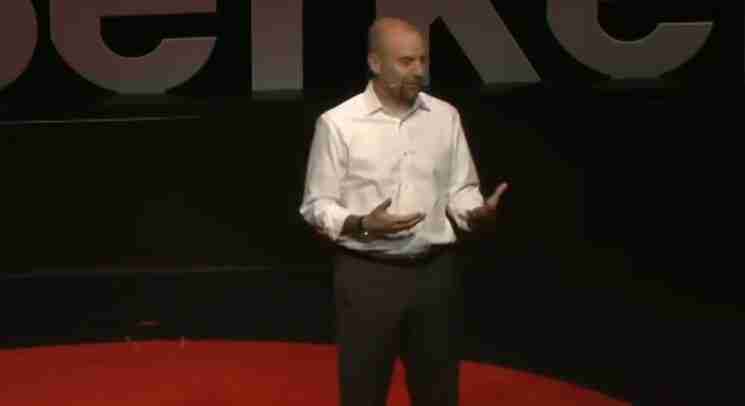
Read the full transcript of author Mike Robbins’ talk titled “Bring Your Whole Self To Work” at TEDxBerkeley 2015 conference.
Listen to the audio version here:
TRANSCRIPT:
The Challenge of Authenticity
MIKE ROBBINS: Alright. How many of you have ever been in a meeting or giving a presentation and you were nervous, but you were pretending not to be? All of us. Right? So my talk here today is on bringing your whole self to work, and I thought I’d start by sharing a time, one of the many times, that I was nervous, but I was pretending not to be.
It was actually a few years back, and I was in a meeting with my publisher. And I was pitching an idea for what I was hoping was going to be my second book. My first book had come out about a year earlier. It’s about appreciation, and I was in the meeting. And I was excited, but I was a little nervous.
Right? And I was meeting with the team and people who’d worked on my first book. But there was someone in the meeting who I hadn’t met before, and that was actually the president of the publishing company. They invited her to the meeting. So that was kind of a good sign.
But I was, you know, as you can imagine, I was a little intimidated by the fact that she was there. So you know how when sometimes you start a presentation or a meeting, you’re a little nervous at first and then you kind of get into it and, you know, that kind of goes away? Yeah. That wasn’t happening. Right?
And, I mean, it was like my stress was getting worse and worse. And it wasn’t like I was completely, you know, messing it up. But a few minutes in, I was just frustrated. I was sort of like, fighting with myself. I was saying the things I wanted to say, but it just didn’t feel right.
A Moment of Vulnerability
So I stopped and I looked right at the president, her name is Deborah, and I said, “Deborah, listen. You know, it’s an honor to meet you. I appreciate that you’re here at the meeting, but I noticed that I’m feeling really nervous and that I’m trying really hard to impress you. Can I stop doing that now and just be myself?” And literally, as it was coming out of my mouth, the voice in my head was like saying to me, don’t say that out loud.
Right? And it sort of hung in the air for… and I could look around the table, and I could see people’s faces were like, did he really just say that out loud? But what was interesting was after that awkward pause, Deborah laughed, as did everyone else around the table, as did I. More than laugh. It was like I took a breath. And I stopped pitching, and we just started having a conversation.
And the conversation ended up going well. They decided that they wanted to publish the book, which I was excited about. Ironically, the book was all about authenticity. It’s called “Be Yourself, Everyone Else is Already Taken.” Sometimes we teach best what we most need to learn.
The Importance of Bringing Your Whole Self to Work
Right? But what’s interesting is for the last fifteen years, you know, I’ve been traveling around here in the US and now around the world talking about things like appreciation, authenticity, compassion in the context of leadership and teamwork and success in the business world. And these are pretty simple concepts. They’re universal. But fundamentally, what my work is all about and what I’ve seen over the last fifteen years, both for individuals in a variety of different environments of working and also for organizations, particularly in the twenty-first century, is that what it really takes for us to be fulfilled and successful is an ability to bring our whole selves to work.
All of who we are. All the gifts, all the talents, the fears, the doubts, the insecurities, our heart, our soul, the things that matter most to us. But what that involves for us as individuals and also for companies and organizations of various sizes is actually a lot of courage. And as Dr. Brene Brown from the University of Houston says, “You can’t get to courage without walking through vulnerability.” And she’s right.
Vulnerability in Different Cultures
So vulnerability has been a big part of my work for many years. I was speaking actually at an event in Japan a few months back for a US-based company, but they do work all over the world. They invited me to a conference, leadership conference in Japan, three hundred leaders. And it was being translated. Right?
None of the people in the audience spoke English. And so I was talking to the translator before the event. And I was going over some things that I was going to talk about. And at one point I said to her, “I’m going to spend a lot of time talking about the importance of vulnerability. You know, for leaders and to connect and to be innovative.”
And she says, “Vulnerability?” And I said, “Yeah, vulnerability.” She said, “Vulnerability?” I said, “Yeah. Vulnerability.”
She said, “There’s no word for that in Japanese.” Now I don’t know much about Japanese. So I was like, really? She said, “Well, there is a word, but it’s a bad word.” I said, “You mean like a swear word?”
And she said, “No. No. It’s just bad.” And I said, “What does it mean?” She said, “Oh, it means weakness.”
And I said, “Oh, no. It means the same thing in English.” I said, “At least that’s what we think it means.” And then she looked at me and said, “Why would you tell anyone to be vulnerable?” And now I was getting a little scared.
I’m like, well, I said to her, “Well, because my research and my experience shows me that vulnerability is the key driver in human trust and connection.
So it’s fundamental for leaders. It’s fundamental for all of us to build trust, to connect with people.” And I said, “And also, it’s the birthplace of innovation, of change, of risk, of all the things that are most important to us. If we’re going to do anything new or different, if we’re going to grow, we’ve got to be vulnerable.”
She wasn’t buying it. And so she walks away. Okay. Fine. Right?
And I go to give my presentation. And not only did I talk about vulnerability in that particular talk, but we had some time. We did a little exercise. I had people pair up, and we’re giving them an opportunity to practice being vulnerable with one another. And after I got done speaking, the translator who I talked to before comes running over to me and she goes, “Oh, I… come here. Thank you for your presentation.” She said, “I get it now. I didn’t understand at first, but now I get it.” She said, “Vulnerability is not bad. It’s just hard.”
I said, “That’s right. It’s hard. It’s hard to be vulnerable. We don’t want to be vulnerable. It doesn’t feel good.”
It’s uncomfortable. It’s scary. And why is that? I mean, there’s a lot of reasons. I mean, on a more superficial level, we don’t want to look bad. Right? We don’t want other people to judge us. How many of you honestly find yourself from time to time worrying about what other people think about you? Most of us do. Right?
Some of us more than others, but we worry. But whenever I find myself worrying too much about what other people think about me, I always try to think of one of my favorite sayings: “You wouldn’t worry so much about what other people think about you if you realize how little they actually did.” Right? Because who are people mostly thinking about? Themselves.
Right? We’re all, “Oh my God. I can’t believe I said that. Oh my God. I can’t believe I did that.”
They’re not paying attention. Not as much as we think. So that’s kind of the more superficial reason. But at a deeper level, vulnerability is hard because we’ve all experienced pain in our life. We’ve all experienced disappointment.
We’ve had our hearts broken. And not just personally, even in our professional lives, at school, in the things that we do, we’ve wanted things. When you want something really badly, it becomes vulnerable because you could lose it or not get it. So we hold back. So it takes courage.
Creating an Environment for People to Thrive
And what I’ve seen for organizations, how do companies or how do organizations, groups of any kind, universities, places, clubs, groups, whatever it is, how do you create an environment that’s conducive for people to thrive? There’s two elements. One is a high healthy bar of expectation. Healthy expectation. Not perfection demand, not pressure, but high expectation, excellence.
And the other part is high nurturance. So you expect a lot and you nurture a lot at the same time, not one or the other. And most of us as individuals and in the groups that we’re in have a tendency to fall on sort of one side or the other. And what’s involved in nurturance? What has people feel nurtured?
Being seen, being heard, being valued, being appreciated, not just for what they do, but for who they are. What also has people feel nurtured is it being safe for us to be ourselves, to speak our truth, to disagree, to take risks. Yeah. It can be scary, but that it’s safe to do that. And what also creates nurturance is compassion.
Compassion. The normal human response, the natural human response to vulnerability is compassion, empathy. Now, those things are simple, but again, they’re not easy. But I’ve been fortunate enough to work with some organizations over the years that do this actively. And especially now in the twenty-first century, looking at how we do that in a conscious way.
Examples from the Corporate World
I was just at a conference not that long ago and I was on a panel with a few of my clients. And they were talking about some of the things that they do. Karen May, who’s a vice president at Google and is in charge of all learning for the whole organization at Google, talked about how they at Google specifically focus on trying to create an environment where people can bring their whole selves to work. She actually said that exactly that way. And she said, “What we try to do is create resources. We don’t make it prescriptive so anyone has to do x, y, or z, but we want people to feel safe that they can be themselves.”
Eric Severson, who’s the co-head of HR for all of Gap Inc. was there and he talked about a program that they’ve developed at Gap called Performance for Life. Based on research, based on data and the tagline of it is Performance for Life and the tagline is “Better You, Better Gap.” He said because what we’ve learned and what we’ve seen and what the data shows us is that when people are encouraged to be their best self and healthy and effective and successful in their life, they’re going to be more productive at work. We know that.
But it’s risky for companies too. It’s vulnerable. The old model of thinking of business is we’ve got to make sure the bottom line is where we want it to be. So this is really about us collectively having the courage, individually and together, to be vulnerable, to bring our whole selves to whatever we’re doing. So how does this relate to all of us as individuals?
Taking Risks and Being Vulnerable
A number of you in this room are college students, going to be interviewing over the next few years for your very first job. Some of us in here may be well past college age, far along in our careers in different ways, doing different things in our lives, but the question becomes, are we willing to take the risk? Are we willing to go for it? Are we willing to try? And at the end of the day, it does come down to how we relate to ourselves.
And we can’t really change the environment around us. You know, the most recent book that I wrote is called “Nothing Changes Until You Do.” So it’s an internal process. And if you think about this for yourself, where are the places in your life? Where are the places in your work?
Where are the situations, the circumstances, the conversations that you want to have? The risks you want to take? And where do you find yourself holding yourself back? And with compassion, can you challenge yourself to step beyond what might be safe, what might be comfortable? And I’ll close with one final thought because all this stuff makes sense.
Right? We get this. The question isn’t whether we get it. The question is whether we practice it. And do we have the courage to do that? And we do. But years ago, I remember a coach of mine said something to me, very simple but profound. I never forgot it. I was scared. I was nervous.
I was trying to get my business started and get things going. And he said to me, “Mike, you’re living your life as though you’re trying to survive it.” He said, “You have to remember something very important. Nobody ever has.” Thank you very much.