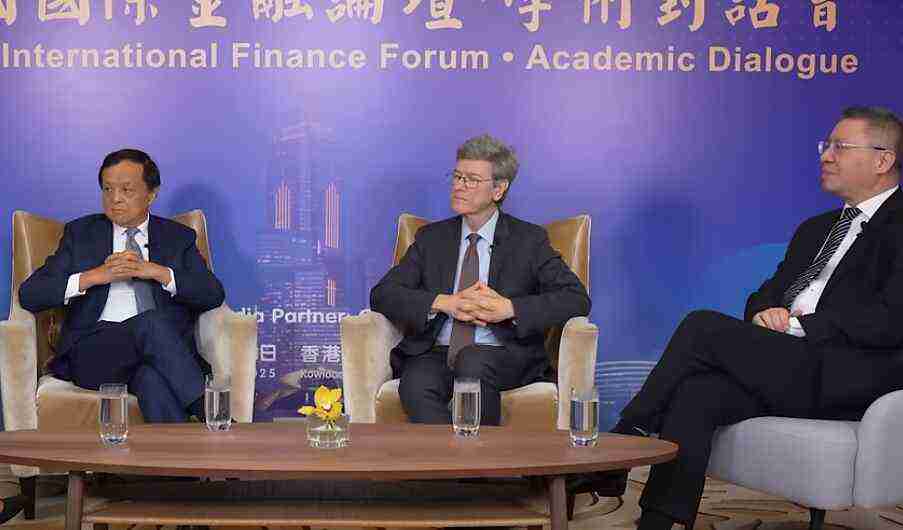
Read the full transcript of China Academy’s discussion titled “China’s Strategy to Trump 2.0” with Jeffrey Sachs, Zhang Weiwei & Charles Li at China International Finance Forum on Jan 20, 2025.
Listen to the audio version here:
TRANSCRIPT:
INTERVIEWER: Wave Media and thechinaacademy.org, we are here at the invitation of the CIFF to speak with three distinguished speakers: Professor Jeffrey Sachs from Columbia University, one of the most influential economists of our time and the foremost proponent for sustainable development and peace in the world today; Mr. Charles Li, the former chief executive of the Hong Kong Stock Exchange, and it was during his tenure he started innovative programs such as the Hong Kong-Shanghai Stock Exchange and the Hong Kong-Shenzhen Stock Exchange, and currently he’s the founder and chairman of MicroConnect; and our very old friend Professor Zhang Weiwei, who is not only very influential in policy advisory, but also one of the most popular political scientists in the public sphere in China. His books on the rise of China, “The China Model, China as a Civilizational State,” has sold multiple millions to the Chinese people. And he also has nearly 20 million followers on social media in China.
So here we go, 21st of January today, China time, which is still 20th of January. So we’re the first day into Trump’s new administration, inauguration day. He has promised so many threats, he has said so many, floated around so many promises. Are we really going to see a shock and awe moment and changes in global geopolitics? Is he really going to end the war in Ukraine within a day, as he said, or is he going to be mellowed into the institutional bureaucratic inertia and nothing really is going to change?
CHARLES LI: You want the Americans to answer first?
Jeffrey Sachs on Trump’s Potential Impact
JEFFREY SACHS: Okay, as an American, I’ll speak about our new president. I think that we are likely to see some real changes from the Biden period. I do think the Ukraine war is likely to end and that’s a hugely beneficial thing. I think there’s actually more likely to be peace in the Middle East and between the U.S. and China than was true of the Biden administration. Trump believes in going it alone, but he’s not especially warlike. He doesn’t like international rules. He doesn’t like the UN. He has pulled out the first day the U.S. from the Paris Climate Agreement and from the World Health Organization. This is part of the Trump idea that any global rules are a constraint on American freedom and sovereignty.
I don’t agree with this. I think countries agree together to do things for a reason because it’s mutually beneficial. But in the Trump ideology, agreements with other countries is just a constraint on your own action. So he believes in unilateralism, but he doesn’t especially believe in war. In fact, I think on balance, he will avoid war even more than Biden did. Biden represented the mainstream military industrial complex of the United States. In the mainstream U.S. approach, war is part of American power. For Trump, I think tariffs, threats, embargoes, isolation, and other things are more the arsenal that he likes.
Trump is going to be nasty in the Western Hemisphere, probably more than he’s going to be in the Eastern Hemisphere. So I’d be more worried today in Canada or Mexico than in China. Let’s put it that way. With Canada and Mexico, Trump doesn’t exactly know or care where the borders are, necessarily. He thinks Canada is part of the United States. He thinks Mexico is a pain in the neck for the United States, and he’ll do what he wants to do. And so I wouldn’t feel very comfortable being the United States’ next door neighbor right now.
But when it comes to China, he didn’t mention China in the inaugural address. He said he wants peace, and I’d rather believe that, actually, at least peace among the major powers. I think the other thing to say about Trump is he believes that the United States is exceptional, and he believes that the big powers are different from all the rest of the world. He rather likes big, powerful countries and powerful leaders. And so I think, actually, whatever he does on trade and tariffs and other things, which will not be friendly, necessarily, to China, he will want a good relationship with President Xi Jinping. He’ll want a good relationship with Vladimir Putin. This is not the same with Biden.
Maybe also Biden’s health or status, we don’t know, prevented diplomacy, but Biden was completely uninterested in normal diplomacy among leaders. Trump is much more interested. So it’s a mixed bag. Again, if I were Panama, Canada, Mexico, I’d be pretty nervous today. But being in China and in Hong Kong, I think it’s a pretty benign start. Nothing surprising, if anything, less antagonistic than one might have expected. Trump says he wants to visit China. That’s a good thing.
Absolutely. I hope that happens. Trump says he wants peace. I really hope that happens, because that’s the single most important issue for the whole world. And he didn’t even mention in his inaugural address all the other threats to the world trading system. So let’s see. But first day, we’ve all survived it. America is now much less bound by international rules, but not going to war, at least between the major powers.
Charles Li on the Disruption of Global Norms
CHARLES LI: I’d like to at least supplement some of the points first. And I think this is the first day of the Trump 2.0. And I think the whole world is going to be looking at this with tremendous amount of interest and anxiety and some corners with pleasure. I think in my mind, what is really going to change from now is that the norms or the sort of rule or order that we have been all used to for the last 50 years are going to be changed.
So essentially, the new administration is going to disrupt that norm or that order.
INTERVIEWER: Do you think China, or specifically Hong Kong, is a beneficiary of the old world order?
CHARLES LI: Well, in so many ways, everybody is a beneficiary of that order. And then everybody dislikes some elements of that order. And so I don’t think anybody is always completely happy with that. And even America, you know, part of America loves that order and would love to continue to maintain that order. But part of America thinks that order has totally ignored them. So they wanted to disrupt that order. The same as with any other country, any other region.
Even China, when you use the word China, as if there’s only one China, there are many elements of China. Some of the elements, you know, the part were beneficial of that order. And some of the part could be the beneficiary of the disruption of that order. So I just think we just all need to, the puzzle is going to, is being dispersed. The old puzzle, we need to re-put the puzzle back together. And I think it’s a much more interesting world. And it’s a world that’s full of challenges, but you need to be agile and adapting. And it is not a world that you can just like the one that you can stay there. And so a lot of things could change.
Zhang Weiwei on China’s Role in a Changing World Order
ZHANG WEIWEI: And it reminds me of the allegedly very famous remark made by Harry Kissinger, “It’s dangerous to be the enemy of the United States, but it’s fatal to be the ally of the United States.” And when I look at this situation, as you mentioned, Canada, Denmark, and Greenland, whatever, this remark comes to my mind. And indeed, you know, I think China can most probably play some very important role, because China is already the largest trading partner with over 140 countries. If really Donald Trump and his America decide to withdraw from globalisation, we will carry on globalisation, new style. We are in this position. De facto the largest economy by purchasing power parity since a decade. So the world will become different. But China is perhaps slightly more ready than many other countries to cope with Donald Trump.
INTERVIEWER: Let me ask you something very specifically and see how it is received in Hong Kong and over in the West. Just before the inauguration a couple of weeks ago, actually, end of 2024, China launched the two sixth generation fighter jets, an amphibian vessel, and another drone carrier all within the week. Do you think that message is well received? I mean, well with quote unquote, “well received” by the Trump administration, was it necessary for the sake of world peace to release, show your muscle at that particular time?
Jeffrey Sachs on Great Power Competition and Mutual Security
JEFFREY SACHS: I don’t think that it makes much difference whether it’s two weeks before or two weeks after. The basic point is, we have three military superpowers armed to the teeth. And you could add India also as a major nuclear power that is also not so powerful in the conventional arms, but significant globally. None of these three powers can defeat the other, even conceptually other than through world self annihilation.
In other words, the only threat that China faces from the United States is tantamount to a full nuclear war. The only threat that the United States faces from China is tantamount to a full nuclear war. The United States could not defeat Russia, Russia could not defeat the United States. Given all of this, the fact of the matter is, we’re actually secure the major powers. If we don’t blow up the world, the only risk to the major powers is world destruction. So if we stay out of each other’s lane a bit, keep space between each other, don’t provoke each other, the world actually is stable.
The problem of the last 30 years was that the United States didn’t know that there were two other superpowers whose lanes they kept crossing. So the United States thought Russia was a pushover, nothing to worry about. If we want to expand NATO to Ukraine, nothing Russia can do. If we want to expand NATO to the Caucasus region, nothing to do. If we want to expand NATO to Central Asia, nothing Russia can do. Well, the Ukraine war resulted from that kind of thinking, and it proved that the United States cannot beat Russia in its own neighborhood with conventional arms, and that any attempt to escalate, Russia would escalate, and we’d be on the way to world destruction.
So the United States, I think learned a lesson from this. Well, let me put it this way. The United States should learn a lesson from this, which is that its own behavior was obnoxious, provocative, and dangerous. The question is, did the United States learn the same lesson vis-a-vis China? Because there obviously are two provocations by the U.S. in China. One is Taiwan, and the other is the South China Sea.
And if the United States is halfway sensible, it will say, “We’re not going to disturb you in your own neighborhood, this is your own business.” And if the U.S. does that, there will be peace, there will be normal relations, there will be mutual security. If the United States says, “Well, we can do what we want,” or “It’s worth provoking China,” there will be disaster. Trump is probably a little bit less likely to provoke China than Biden was. Biden’s administration was really incompetent. And they were rude to China, did not engage in diplomacy with China.
JEFFREY SACHS: A couple of meetings were held so that not everything fell apart. But basically, it was a terrible administration. The United States is in a very confused mood. And when I say the United States, all I mean is the elite in the security system. Because the U.S. mentality, and Trump expressed it in his inaugural address, is the U.S. is the exceptional country. And if you take that belief seriously, you end up creating a lot of trouble, because other countries just want you out of their front yard or backyard. And so, whether Trump gets that and uses restraint, that’s the major test of his presidency, actually. A smart president is one who exercises restraint in the mutual interest of the major powers. A stupid president is one who provokes the other major powers. And so, this is Trump’s single biggest challenge, because the world’s fate depends on this kind of challenge.
Trump said that he understands Putin’s point of view that, in other words, if he were Putin, and I’m putting a little bit of words in Trump’s mouth, but if he were Putin, he’d understand why NATO enlargement wouldn’t look good. If he does the same thing, putting himself in China’s perspective, and sees the United States arming Taiwan over China’s big objections, or militarizing further the South China Sea, and building up missile systems, building up AUKUS, building up military relations, urging Japan to re-militarize, and so forth, he would understand that the U.S. is provoking a lot of the reaction that it is pointing to, and rather both sides should calm down.
Look, the United States, Trump can’t even accept Greenland as being an independent country. He thinks Canada is a state. What he’s really saying is, the Americas are our backyard.
INTERVIEWER: He wants to see a passageway, right? Is that the reason why?
JEFFREY SACHS: Look, there are many reasons, but it’s a kind of crude American imperialism, I would say, that goes back to his favorite president of 1896, William McKinley. So, it basically says, this is our neighborhood. Don’t encroach on it. Now, the point I’m making is not that it’s right to threaten Mexico or Canada, but if Trump uses the same logic just a little bit, and understands China’s point of view about America’s actions, he would then adopt a more restrained point of view. And if he does, and says, “You know, we don’t want to have war with China over the South China Sea, or war with China over Taiwan,” this would improve global security incredibly.
So, all of this is to say, yes, China’s making huge advances in many armed systems, in missile systems, in nuclear, in hypersonic systems, and so on. Not surprising. But we don’t want an arms race. We want mutual restraint. And this is really the question of whether the two sides can be smart enough to say, if we back off a little bit, don’t encroach on each other’s core interests, then the tensions will come down, and we could actually make more money, have a better life, have more security, and so on.
CHARLES LI: But I agree that the big powers are wise enough, and I at least hope that they won’t really engage in a pattern of activity that ultimately leads to mutual destruction. And I think we also agree that the U.S. has a lot to do, you know, can do a lot to restrain so that it does not really have a slippery slope to get into it. But it’s also important that we know, and the world knows, that the Chinese leadership has thousands of years of wisdom behind it. And the key is also, you know, we can hope that the U.S. is going to be smart enough not to do certain things to provoke it. But it’s also important to also, we also know, that even if you intentionally or unintentionally, you know, by mistake did anything, that we’re not going to get into a Ukraine situation, because the worst is that the U.S. maybe just poking, you know, some issues, troubles here and there. We’re not going to fall into the trap. And I have great confidence in our leaders that China will handle the world affairs like a real adult.
Discussing Chinese Wisdom and Restraint
INTERVIEWER: I’m going to double click on the word “China wisdom,” and I’m going to ask each one of you gentlemen to maybe sum it up in the most concise way possible, because there’s so much like official talks, the diplomatic talks about, you know, Chinese wisdom, how a world where the narrative is incorporating Chinese wisdom, you know, the Chinese model, Chinese way of thinking is going to be a more peaceful, more sustainable world order. That’s been said in so many occasions, but I don’t think if people hear it, you know, they think about it as another diplomatic jargon. So really, does it make a difference, like the cultural, the civilizational traits of China? And when you say China wisdom, what specifically is it? Because I don’t hear, I don’t think a lot of Westerners are hearing it. We’re saying it, but they’re not hearing it.
CHARLES LI: Well, in my mind, it’s just one word in Chinese proverb, “yi jing zhi dong,” you know, react to action with inaction. You do not act, you observe, you, you know, there’s no great English translation for it.
INTERVIEWER: You know, funny, the funny thing is, you know, the TikTok refugees that they flirt to Red Note. Actually, one of the screenshots that I saw is by, it’s in English, it’s very American. They said, “Oh, China, do nothing, win.” That’s close to it, no?
CHARLES LI: That’s really do nothing until you see something, you know, and, and not trying to, not trying to preempt every other move the other side has made, just stay and the adults stay.
ZHANG WEIWEI: When the United States became the world’s largest economy, roughly in 1890s, it started war against Spain and conquered Cuba and the Philippines and other territories. When China became the world’s largest economy by purchasing power parity in 2014, technically, China can, you know, take back all these islands in the South China Sea within 24 hours, but China did not do that militarily. We prefer to have a negotiated solution. So this is a kind of wisdom, in a way, you know, for instance, now we consider Philippines as a troublemaking country from a Chinese point of view, but we use water cannons rather than shooting guns, cannons, whatever. But we have also put the situation under control. As a result, we have this whole friendship and unity and prosperity with ASEAN, because Philippine behavior, whatever, is not that even welcome within ASEAN, and the Chinese way to handle it is also well received in ASEAN.
So this is one way to see how we can do these things with tough and hot issues with wisdom, with Philippine politics goes ups and downs, you know, you have slightly longer vision. That’s the key difference between China and the United States in terms of this world outlook, international relations. For the United States, it’s a friend or foe, either with us or against us. For the Chinese, you see, Chinese wisdom is a friend or potential friend. You have a longer vision.
Debating China’s Economic Position
CHARLES LI: The one thing I do not agree with Professor Zhang is that Professor Zhang likes to go back saying that China is already number one from a purchasing power perspective. I don’t know why we wanted to do that. And it’s a technical explanation of some economic rules that could potentially put China number one. I don’t think China wanted to be number one. Why do we want to be number one? Because there’s a responsibility coming, you know, from being number one. And that itself is not terribly Chinese.
Chinese, we want it to be number two, number three. It’s okay. We don’t need to be number one. We just mind our own business and do our things right and help ourselves, help the world and be a responsible neighbor. And we don’t need to be the cop and the big boy on the block and telling other people what to do. We just want to be left alone.
ZHANG WEIWEI: No, the point is, especially in the field of geopolitics, if you underestimate your own power, your own strength, it could also create serious problems.
CHARLES LI: You can overestimate yourself, but you don’t tell everybody about it.
ZHANG WEIWEI: In fact, when this last governor of Hong Kong launched so-called political reform in Hong Kong, he thought China’s economic size is smaller than the UK. Because by this U.S. dollar-based calculation, it was. So at that time, Russia made a huge lesson. The United States treated Russia as if its economy was the size of Spain. So it pushed this expansion of NATO, even at the risk of war. So Putin today only mentioned purchasing power parity. Russia is the largest economy in Europe, larger than Germany.
CHARLES LI: Because I believe, you know, saying you’re number one, both creates external anxiety and creating unnecessary internal stress. Because if we all believe we are number one, we become cocky, we become arrogant. The Chinese are not that. And if you think your opponents or the rest of the world think you’re number one, and then they are going to become more demanding and more challenging and more anxiety, greater anxiety, because they think that you’re coming to potentially change the world. And I’m very happy, at least in my life, I’m very happy always to be number two, number three. Never want it. So I want Professor Sachs sitting in the middle, and we are surrounding you and paying deference to you.
Assessing China’s Economic Strength
INTERVIEWER: But do you think that some level of confidence or cockiness is necessary for China now? I mean, I don’t know. I mean, I hear things left, right and center that I get confused as well. Is the Chinese economy still strong, going strong? Or is the Chinese economy hitting some sort of, you know, going off some sort of a peak with the real estate market is down, the stock market is down, you know, the consumer confidence is down? I mean, which way is that? I don’t know.
JEFFREY SACHS: China has a very strong economy, and it’s going to continue to be even stronger in the future. And the basic reason is that China is technologically dynamic. And it is already at the forefront of a large number of technologies that are the key technologies for the next 30 years. Electric vehicles, zero carbon energy systems, fourth generation nuclear, of course, battery supply chains, hydrogen economy, advanced shipping, 5.5G.
These are the technologies that the world needs to make the energy transformation, to make the digital transformation. And China is very strong and very dynamic, also in those technologies and the manufacturing ecosystems, especially where we are in the Greater Bay Area is absolutely extraordinary, I would say unique in the world. So, you know, what’s said in the media, day to day, well, that’s day to day news. But China, like any large economy has ups and downs and quarters that are bad or quarters that are good, and the COVID was a disruption and so forth. But you have to look at the fundamentals and the fundamentals are very, very strong. And that’s very good, because not only is it good for China, it’s good for the world.
China’s Peaceful Track Record
JEFFREY SACHS: I do want to come back to this question about China’s statecraft. And just to say, of course, we can theorize, but I would point to two historical facts that I think are positive and important. First, China hasn’t been in any war for more than 40 years. This is extraordinary. The US has been at war basically every day for the last 40 years, and usually in a number of places. China had a one month war with Vietnam in 1979, since then.
JEFFREY SACHS: And that kind of long peace is, I think, the best evidence we have about China’s statecraft right now. There’s another historical piece of evidence that I think I personally believe in, though it’s argued and debated among historians and scholars, there was a long, long period of several hundred years, basically 500 years of what has been called the Confucian Peace in the region of China, Korea, Japan, and Vietnam, lasting really from the beginning of the Ming Dynasty until the British invasion of China in 1839 in the First Opium War. And so this long period almost had no war at all. China was undoubtedly then, whether it’s PPP or market prices, though the concept didn’t exist of GDP, it was by far the dominant power.
But China didn’t invade Japan. China never in its history invaded Japan, except when the Mongols were briefly running things from in 1274 and 1281. Other than that, for 700 years, it was never an invasion from China to Japan. China never invaded Korea in its history, as far as I know. China invaded Vietnam, yes, six centuries ago, in 1410 or so. So this is a long, long peace. And I think that is part of China’s statecraft. It is part of a Confucian order, if one could call it that.
I believe that that’s true. Some of my colleagues in the U.S. say, “Oh, no, that’s not true. China has to be like every other country,” which in their mind is war all the time, because in America, it’s war all the time. And why? Well, Europe has been basically at war for 1000 years. And the fundamental difference is China unified and mainly stayed unified for 2000 years, whereas Europe was fragmented. Then it colonized other parts of the world, and they fought. Even Donald Trump in his inaugural address, he expressed the kind of 1950s happy vision of America, that we fought our way across the continent. It was a very bloody bunch of conquests by colonial power. We’re not supposed to say that in Trump’s America, but the truth is it was an expansionist imperial period. And that’s a different history from China’s history.
So bottom line for me is there really could be a big difference of statecraft. China, cautious, friends or potential friends. And this makes a lot of sense. We had one sensible president during my lifetime, which was President Kennedy, who tried peace. And he had a very wonderful line. He said, “Across the gulfs and barriers that now divide us, we must remember there are no permanent enemies. Hostility today is a fact, but it is not a ruling law.” And so he talked about the fact that don’t think about enemies and friends. But when you get to Biden, it’s all, “You’re our friend, you’re our enemy.” And that’s the mentality that’s so dangerous.
TikTok Controversy and U.S.-China Tech Tensions
INTERVIEWER: Can I move on to something that perhaps compared to the history, the philosophies that we’re talking about, perhaps a little bit trivial, but we’ve been collecting questions online and from our network of friends and media. We received like hundreds of them. But one specifically that kept popping up is about TikTok. And it’s very topical. And I know in the inauguration speech, he didn’t mention it, Trump didn’t mention it, but he had like a reality show style, sort of like a “Meet the Press” Q&A throughout the day. And I’m listening to some of that. And the major part about China is about TikTok, about Biden.
And I suppose it’s worthwhile discussing because it potentially sets an example of many of the economic wars and the commercial wars have been fought between China and the U.S. and potentially in Hong Kong too, because Hong Kong sits in between the international financial order and the market and the mainland. So what is your expectation on what’s going to happen? I mean, he called up the ban for 90 days and he says, “You’re going to make money in the U.S. and we’re going to own a part of that.” Is China going to give it up? I mean, where do we stand on this? A lot of people are asking.
CHARLES LI: I think there’s clearly a dichotomy between what TikTok is being perceived and dealt with politically and what has really TikTok being perceived and used in reality. I think in in politics, the reason it was banned is all because they think it’s from China, but most ironically has nothing to do with the Chinese government or anything to do. This is purely technologically. It’s just an application that grows on its own, like any other social media that we are now taking granted in our life.
It has really nothing to do. It’s most detached from reality is to think somehow TikTok is part of the instrument of China. But that precisely, it is not that, but the government, the U.S. political system somehow take that into something that is completely is not. And they’re using that as a basis to actually take that decision, even forcing China. If the government actually indeed or the China indeed did that, you could say that you could negotiate with China and Chinese government or the state has nothing to do with the rising of that. And then in reality, it is probably the most widely used the Chinese product ever in history, globally and in America.
It is that economy that the political action taken, which has no real political solution to it, is creating a traumatic and completely unanticipated, underestimated reaction from your own population.
JEFFREY SACHS: One of the most remarkable parts of this is that everyday Americans are dealing with everyday Chinese directly through the retina. That never happened before. And so, you know, as a professor, I’m always interested in my students knowing Chinese students and so on. But suddenly this is at a scale of tens of millions of people that that nobody told them make the connection. They’re making the connection on their own and they’re saying “We’re friends. What are they doing up there dividing us?” So it’s it’s actually showing off your cat. Yeah, it’s actually extremely interesting and a positive phenomenon.
CHARLES LI: What’s happening? If they had done it, most of the people probably never thought this is the Chinese product. Exactly. Because the name itself has nothing to do with China, right?
ZHANG WEIWEI: For one thing, it shows, you know, how detached from their own people, these American politicians, lawmakers and detached from the Chinese people, from other peoples. This is a problem, you know, and if, as Donald Trump said, you know, it would be happy to have a joint venture with 50% ownership.
My understanding is it’s about 50% ownership of TikTok America, not TikTok global. And then it’s a matter of negotiation with ByteDance, the parent company of TikTok. And then it has to do with whether there’ll be a transfer of technology, has to do with algorithms, etc. But then there’ll be, have to be approval from the Chinese government.
INTERVIEWER: And there’s a law prohibiting that, no?
ZHANG WEIWEI: Yeah, there is a very clear cut regulations on that, restricted technologies. And then if there is a negotiation between certain American companies and, say, ByteDance, whatever, what will be the shareholding structure? My own guess is ByteDance will have a golden share, to have the final say. So whatever percentage…
INTERVIEWER: American money can come in, you can write it on and make the money you want from the capital investment point of view, but executive decision, we are not letting it go.
ZHANG WEIWEI: Anyway, it will be a negotiation between companies. On certain matters, there will be approval of the Chinese government. So this is, in other words, that ByteDance will have the final say, or the Chinese will have the final say, not the American government, American presidency.
CHARLES LI: I can really disagree, because you’re saying that you potentially could influence an American decision that the government of China is going to… I don’t know why you say that, Professor Zhang, because that’s not the case. That’s really…
I don’t know… Anybody knows what’s going to happen ultimately. This is the first time political decision hit the rock, hit the rubber of the road with the popular, you know, real, real popular sentiment that has nothing to do with politics. It’s everybody, every day, spending hours on to something. We all do that. It’s just part of life now. And out of certain that is being brought into the political arena, all the political issues about being put into ordinary people’s life, and not eventually going to find the right balance of resolving it, you know, in terms of who by what, who do that. That’s all technicality in the end.
But this is the first time we see a big geopolitical level decision is coming directly into a conflict with ordinary people’s lives. And I, I don’t know how it’s going to come out. But if I have to bet, I always say people’s popular people’s, you know, sentiment ultimately will prevail, particularly in a democracy, particularly in electoral democracy, like in the United States, they will figure out a solution that ultimately allow the coexistence of some political consideration at the same time allow the people to carry on with their lives, including using whatever they like to use in social media.
JEFFREY SACHS: I think it is good to understand all the various motives in the US side, because it’s a big range. One is, there is a definitely a paranoid view in the US, that anything Chinese is a threat to US security. So we shouldn’t underestimate a group in the Congress, for example, of the US that just takes the view, “Of course, this is the Chinese government spying on us,” and so on. So that’s, that’s one real point, but not necessarily the only or even dominant point.
The second is that a lot of our social media in the US basically operate at the behest of the US government, and TikTok does not. So one thing that really got the Congress annoyed was things on TikTok that the US political elites didn’t want the public to see, for example, the pro-Palestine side. And one shouldn’t underestimate that because we know and we’d learn more that Meta and YouTube and others are so censored, when it’s, and of course, in America, that’s impossible, but it’s real. So this is a second, second motivation.
I’m sure that there is maybe some reciprocity, well, China, you have to do this, if we’re going to do this kind of… Economically? Economic or online or whatever. And that’s no doubt a real bargaining point. And then there is Donald Trump wants to make money. So we want to get in on this business. This is very successful. He said apparently, you know, well, this will be a trillion dollar business if this is properly owned and operated. So never miss a chance for money. And so there’s a lot of motives going on. We’ll see how it plays out.
ZHANG WEIWEI: But the United States must be very cautious because the Chinese foreign ministry has already made at least two statements in the past week. One is that we should not allow any robbery of Chinese companies. If it’s a Chinese company, it should abide by Chinese laws, which means approval of the Chinese government for any selling of sensitive technology.
INTERVIEWER: Yeah. Interesting times.
The Future of the International Financial System
INTERVIEWER: I know you’re pressed with time, but can I squeeze in another one about de-dollarization, maybe internationalization, BRICS currency, which Trump said anybody gets on board with de-dollarization, “I’m going to tax the hell out of you.” What’s going to happen in the financial world now? And where does Hong Kong sit in between the international finance world and mainland? We said before, they’re not necessarily always on par, for example, with the ETFs and the cryptocurrencies. So maybe lumping all that together into a sort of foresight into the financial world and the near future. Who do you want to start? It’s completely up to you, gentlemen.
JEFFREY SACHS: I’ll start, but you guys are the experts of what’s going to happen here. My own view is that China should internationalize the renminbi because relying overwhelmingly on US dollar transactions is not sensible at this point. It’s too risky. It is too much vulnerable to US official intervention and meddling. Russia had $300 billion of reserves seized just by a stroke of the pen. And I can tell you the mentality in Washington and in London and in Brussels is we take what we want and we steal it as we want. And they really act in that way.
If I were the BRICS countries, I would say that’s fine and good what the US wants to do, but there are many ways to settle an international transaction. And it doesn’t have to be a dollar based through the SWIFT system. So my own prediction is that 10 years from now, we have a very different international settlement system in which the renminbi and perhaps some other currencies are playing a larger role.
INTERVIEWER: But not crypto.
JEFFREY SACHS: I don’t think crypto is either. I don’t see it having any value at all. And I see it having a negative value relative to central bank digital currencies. Because a currency, you know, yes, you could give a license to somebody to counterfeit money. Why do you give a license to someone to print money instead of the government if you want monetary control, which I believe in, if you want a banking system that is stable with a central bank that stands behind it? Why have crypto? Crypto is just an invitation, from my point of view, to trouble or arbitrary redistribution of wealth that makes no sense.
And as someone who holds dollars, I don’t love Bitcoin edging in and saying, “Well, we have $2 trillion of wealth.” Well, where did you come from? You know, out of the blue, I don’t, you didn’t make anything. All you did was pump more CO2 into the atmosphere. You wasted a huge amount of computer time. You added nothing of value to the world real economy, nothing. So where did that wealth come from? Well, evidently, it came from the rest of us. It added to inflationary pressures. It reduced monetary control. So I’m not a believer in crypto. I am a believer in digital currencies.
That’s quite different. That’s a mechanism for payments. But then comes the role of the Renminbi in particular. To my mind, China is the world’s high saving country. And that saving is good for development all over the world. China should be investing in the rest of the world. And to invest in the rest of the world means an outflow of capital to build factories or to buy sovereign debt or to invest in foreign private bonds and so forth. And that means the Renminbi denominated assets.
That means Hong Kong being a decenter, I think, for finance, for outflows from China. Outflow is not a bad thing. It means China buys up a lot of productive assets in other places in the world, which is good for China and good for those places where China is investing. It’s a win-win proposition. It’s not a zero-sum proposition. So I would like to see China internationalize the Renminbi. I’d like to see Hong Kong be not a dollar-based financial center, but a Renminbi-based financial center to a large extent, not just offshore Renminbi, but an integrated financial system. And I believe because China is so efficient in low-carbon energy systems and other things that the world needs, that investing through Belt and Road and other initiatives is really a wonderful win-win activity for China and the world. I want to see more of it. I want to see Hong Kong as the great financial center that intermediates all of that. And I don’t believe that that can or should be done in dollars. I think it should be done in Renminbi to a very large extent.
CHARLES LI: Yeah, I think I very much agree with Professor Sachs there. Obviously, China had a big decision over the next decade or two, because internationalization of Renminbi and maintaining capital control are two things that you have to trade off. And so I think in the next two decades, the trade-off is something you can’t really do internationalization of Renminbi to its full extent with capital control. But there are a lot of strategic benefits that China still thinks is important to China of maintaining a certain level of that.
So let’s assume that the current status of capital control or free convertibility is not going to be happening right away in the foreseeable future. And Hong Kong’s role is actually becoming extraordinarily important. And Hong Kong could become that, let’s call that currency triangle. That essentially is three legs of that triangle. And so that we are able to find a way to internationalize Renminbi as much as possible while living with capital control. So that triangle, the first leg, bring the world to Chinese capital inside China through the southbound of StarConnect, so that we can bring energy and resource, large energy and resource company, particularly sovereignly owned companies like Saudi Aramco and others, where the Chinese are the biggest customer of their energy and resources, and essentially bring them to Hong Kong and allow the Chinese domestic investors to invest through southbound without breaking capital control, but in large style so that Chinese can become the customer.
We are the customer of their energy. But if we can also be the equity holders of their energy player, so that’s a natural hedge. You’re rising crude prices or customers suffers, but our shareholder benefit and vice versa. Meanwhile, we buy that equity in Renminbi, and then the sovereign of all those countries taking the Renminbi, and what they can do is immediately buy into Chinese sovereign bond so that they become China’s creditors rather than us always become creditors of the West, particularly the US. So that big leg, bring the world to Hong Kong with Chinese money, not having to leave China.
The second leg of that currency triangle is really bring the world to Hong Kong or bring the capital, Chinese capital that is in Hong Kong, taking them to the world. Because today, China needs to, you know, begin to invest in other countries, begin to move into other market, begin to, you know, export its manufacturing capacity and many other things to the world, going in different places so that it does not becoming, you know, being held a hostage of the trade war. So I think going with Chinese players, creating international expansion, but bring that capital market operation in Renminbi in Hong Kong.
The third leg of that triangle is to bring the real economy into the digital currency, not crypto, digital currency into, you know, what I’m doing is really a new exchange, is a cash flow driven exchange, but completely handled in a digital platform so that we are able to bring finance from a PE multiple based future speculative sentiment driven market that drive everybody obsessive about sentiment into a cash flow, discounted cash flow driven, bring finance, bring Wall Street back to its basics. So through digitalization, and essentially using revenue-based financing, RBF, rather than traditional equity and debt. And that will fundamentally change the way currency is deployed. And we do no longer have to rely on everybody believing in something. That’s why stock trading higher rather than if we can’t see the future, clearly, let’s look at a much shorter future, which is really a limited window of discounted cash flow driven digital financing that really allow all sorts of little guys using little revenue streams as underlying self-financing financial transactions, so that we no longer have to only invest in stocks, which only 40,000 companies in the world that are traded in the global exchanges. So essentially hundreds of trillions of dollars are trading, literally only tens of thousands of underlies. And, you know, we’re all looking at behind us, if there’s a big line behind me buying the stock, I will buy 20,000. It’s all speculation. Now we find nobody’s behind me. That’s why everybody’s running out of the market.
INTERVIEWER: Is that also Chinese wisdom in terms of how it materializes in the economics of that?
ZHANG WEIWEI: I just add one example to support their views. That is at this particular moment, Chinese companies are going abroad in large, massive scale. So Hong Kong can play a very important role in providing legal and financial services.
Having said that, I want to come to another point that has to do with a view presented by your friend, former Greek financial minister, Yannis. He said, because of this digital currency payment system, big data, etc., China and the United States now represent two approaches, very different, which may represent two different worlds in the future. One is represented by SWIFT, which is a highway full of holes, yet many people are still using it, full of traffic. Another is represented by the Chinese payment system and Chinese digital currency, which is a super new highway, not very much used yet.
Then came to this Red Note, because Red Note is just one app. Actually, TikTok, TEMU, Shiyin, etc., are very popular in the United States and in many other countries. Behind this is Chinese technology, not only algorithms, but also in terms of how to organise production, supply chain, industrial chain, manufacturing power, and also other powers. In theory, these new TikTok refugees and what they represent, they all shift to the Chinese market and use Chinese currency. Let’s do it in a digital way. It’s one way to internationalise Chinese currency, and then it’s also another new way of payment as a way to get out of current troubles.
JEFFREY SACHS: Just to add to this very much, a lot of the Chinese companies are using open source platforms, much more than in the United States, where there’s a lot of proprietary thinking. But China is building open source, and it’s bringing more and more players from all over the world to this shared open source standard. There will be a tipping point where you better be on that platform because it’s too narrow to be on a platform that is a proprietary platform. So I think China’s bet on open source is a winning bet as well.
The New Optimism and Confidence of China’s Young Generation
INTERVIEWER: If we’re ready to wrap up, let’s get a final word from Professor Zhang Weiwei. I’m a bit biased here because we’ve been working with him for the past over a decade, and no sort of exaggeration, we literally created content that literally shaped a generation of how Chinese youth worldview is. So can I get a quick sum up from you about what is the sentiment on the ground with Chinese youth these days? Because this is the question we’re getting from our international audience. And given the new red note craze, everybody is wondering what do Chinese people think?
ZHANG WEIWEI: This is a new generation, and it’s a smartphone generation. And I would say, compared with the previous generations, 40s, 50s, 60s, 70s, 80s, this V generation is by far the most self-confident generation. And so this is also the reason why, when they have this communications exchange of views in this red note with their American counterparts, they feel no barrier. They talk from their mind freely. I think this is very good, very positive for China.
And, you know, indeed, I had the slight different views on this with Charles. That is, you know, I mentioned why we should be a bit more self-confident. In a way, as I said, you know, this football, the basketball player, Yao Ming, of this height. I said, when China is already this high, this tall, you cannot hide yourself. If you look at CIA’s website, it’s about Chinese economy, always purchasing power parity. The CIA would set number one economy for one decade. So in their strategic planning, that’s why there’s so much worry that China is beating us.
Same with this latest ASPI report for Australia. We said out of the 64 critical technologies, China is leading the United States in 57. And what’s more important is, even a few years ago, it’s only China led the United States, perhaps in 5, 6, 7 areas. But this 50-something became reality in the last five years, when the tech war and trade war started, since 2018, 2019. So that’s why, you know, when the trade war, tech war broke out, I made an open comment in China TV, I said we should give an award to Donald Trump. He will allow us to develop much faster. It’s nicknamed the nation builder.
CHARLES LI: I want to make sure that I’m not disagreeing with, you know, so essentially, I believe that you need to be strategically arrogant, but tactically humble. You need to think, you know, confidently, you need to act humbly. Or you need to believe in confidence, but you act in humbleness. Because, you know, once you get flipped this around, you know, you’re not going to win. But if you don’t have the confidence, you’re not going to win. But if you act, you know, excessively confidently, you’re not going to win. So I just think strategically arrogant, we absolutely believe in ourselves. But technically, we act humbly, because we don’t want anybody else to take the wrong way. We want everybody to work with us, rather than everybody getting alarmed, and start to become obstacles.
JEFFREY SACHS: Let me come out for humble, humble, that we need mutual humility. On all sides, the world’s very complicated. We have a lot of hard work to do together to solve global problems. Arrogance is a huge threat. And one of my favorite books that I already knew 60 years ago was by Senator William Fulbright, who was the chairman of our Senate Foreign Relations Committee, and he wrote a book called “The Arrogance of Power.” And he said, this is so self destructive. So I don’t think arrogance is anybody’s friend. What we really need is a lot of cooperation. We need a lot of humility in the face of some very big global challenges. And we need a lot of friendship, which now is on Red Note and TikTok. And so fortunately, the people in the United States and China are making the connections. Maybe they will inspire the leaders to make the connections too.
INTERVIEWER: That’s a beautiful note to end. Thank you so much for everything.
Related Posts
- Transcript: President Trump Remarks at Wheeler High School in Marietta, GA
- Transcript: What It’s Really Like Inside Trump’s World w/ Maggie Haberman & Jonathan Swan
- Transcript of Rolling Stone Interview: Zohran Mamdani
- Transcript of Tucker Carlson Interview: The Mishal Husain Show
- Transcript: President Trump Speaks at FIFA Reception in New York City