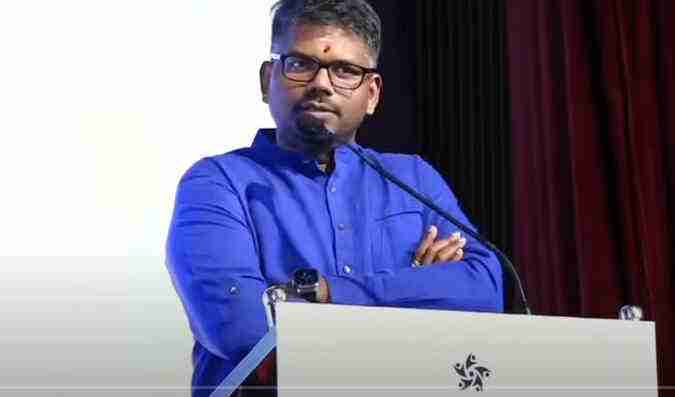
Read the full transcript of Indian lawyer and columnist J Sai Deepak’s talk titled “Civilisation, Constitution & The Myth Of Secularism” at Citizens Council Mangaluru on December 21, 2024.
Listen to the audio version here:
TRANSCRIPT:
J SAI DEEPAK: Namaskaram. Good evening and thanks to the Citizens Council of Mangaluru for giving me an opportunity to engage with the audience.
Gratitude and Appreciation
First of all, I’d like to thank Shri Bhatt for having taken the pains for following after me for close to six months and in fact over a year to somehow get me to speak here. Not that he had to do it. It just so happens that my schedule has been fairly chock-a-block with other commitments. But otherwise, considering the beauty of this place, there’s no need for any other incentive for me to come here.
I’ve come here often on the way to Sringeri and other places. When I got off the flight today, one of the first questions that popped in my head, what is it that you guys eat that all of you are so good looking? That’s a serious question and I’m really interested in understanding what is the genetics of this place, what makes everyone so good looking, regardless of the gender. And I think this is one of those parts of Bharat which has been blessed with abundance in every possible form, whether it’s culture, nature and people in terms of human resources.
So, I’m happy to be here. This topic is something I think I’ve done to death on multiple occasions. So, I was thinking, how do I actually present something different here? And how do I make it still relevant to the challenges that we face as a society?
Clarifying Personal Identity and Motivations
So, just a bit of a correction based on the introduction, no factual correction. Usually what happens is social media has the tendency to magnify people beyond their actual worth and also glorify them. Perhaps, I don’t know, maybe there’s a certain sense of hype surrounding individuals once they appear on the screen. One, I must confess, I have no interest in the pursuit of any civilizational cause.
Nor am I interested in pursuing anything which takes me away from my professional commitments. Let me be very clear about this. When they were actually putting together the introduction, two or three words that I preempted, even before they could think of it, was the word activist, was the word civilizational warrior and whatever something else, dharmic warrior or whatever it is I said. None of those words shall be used.
The sole identity that I subscribe to at least as an individual from a professional perspective is that of a lawyer. I will live as one and die as one and nothing more. I have no other aspirations. The reason why this is important is that if the message has to be relatable to the audience, then the person must be equally relatable to the audience.
It makes very little sense to put someone on a pedestal and then hope that the message of that person will relate or resonate with the audience. Perhaps there is a myth going around that I have committed myself full time to the cause of service of dharma. Not one bit. It’s less than 15% of my time allocation in terms of my professional commitments, family commitments and then whatever remains goes here.
But the model that I am trying to perhaps push is that it is equally possible for working professionals to take some time out in the service of this cause. If I were to ask people to jump into this cause full time, I don’t think I’ll find even 5% success. Nobody is going to do it. Everybody has their own jobs.
Everybody has their own responsibilities, their bills to pay, their EMIs to address. So where is the question of asking people to jump into this cause full time? That’s not going to happen. So the model that I think that works, at least for the here and the now, let’s see what happens in the future, is telling people to strike a balance between both their commitments, their familial commitments and their societal or religious commitments, in whichever order of priority they see it.
So my interest in taking up this cause has been extremely selfish. Very very selfish in the sense that I don’t wish to walk out into society or at least send my child into one, where the sporting of Hindu symbols becomes the subject of ridicule or becomes the target of attacks, either in the name of secularism or in the name of constitutional morality, whereas civilizational identities take a backseat. So if anything, my motive or motivation behind getting into this Agni Kund, so to speak, is only because I am trying to create a safe future for my own family. That’s it.
Beyond that, there is no incentive here. The fact that there is an incidental benefit for the society is, as I said, incidental. It’s a second order effect. It’s not the primary intended effect.
But since I am trying to address the larger optics of it or the larger atmospherics of it, obviously the target of that message happens to be the society, but the intended beneficiary happens to be my family. I am very clear about it. If I do not present this model, what will happen is maybe 15-20 people will at best join this so-called ongoing movement. There won’t be any stakeholdership or participation from the rest of the society.
And the same set of talking heads will go to different platforms. We will get visibility. Our books will sell. A couple of selfies here, a couple of selfies there. Instagram likes will increase. And then a few shots and reels on YouTube will do the rounds. But would it have achieved the intended effect of widening the participation of the general Hindu society from its Kumbhakarna slumber into the actual issues that stare us when it comes to our existence and civilizational survival?
Avoiding Premature Deification and Glorification
I would always say that Hindus have a fairly huge problem of deification and glorification before performance is achieved.
Either on the policy front or the cultural front and especially on the political front, don’t make that mistake. Don’t deify and glorify people. Make sure that they deliver the goods that they’ve been voted for. That would be my single biggest message before I start on this topic. Otherwise, what’s going to happen is this will become — and one of the reasons I have taken a step back from public engagements or even lit fests for that matter, is that the same set of faces are going everywhere.
And I don’t wish to join those proceedings unless and until I know that it’s not just a question of relevance but a question of impact. It must have an impact and not just a question of individual relevance. So maybe there is a bit of acerbic honesty in this. I would request you to digest it because I think we are at a certain point in our history where if we don’t address these issues with withering honesty, then this din and the noise that is created around individuals will drown the actual challenges that we are beset with.
The problems are so large and are so huge that no single individual has the ability to address it on his or her own. It is going to require collective participation. It is going to require collective contribution. And therefore, the model, a working model of striking a balance between your professional regular lives and your ability to contribute to Dharma as well.
Personal Journey Towards Constitutional Law
Coming to the topic, one of the reasons I’ve been speaking, writing on the subject extensively is thanks to my own personal experience of trying to project and present certain causes before constitutional fora such as the Supreme Court on subjects and institutions which are close to my heart.
So most people don’t know as to what I do in terms of practice. Let me just say that so that you know why this transition has happened. I began as an engineer turned lawyer. And my primary area of practice is actually intellectual property law and competition law. Even if I say so myself, I have some degree of expertise over the last 15 years. I’ve been the advisor to multiple governments on implementation of IP policies. I’ve also represented Bharat in trade negotiations with the United States. I’ve done all of that.
So why did I make the jump to constitution at all in the first place? So when I joined law school, constitution was the actual goal. But you see, constitution doesn’t pay bills. It’s a very poor area of practice. It’s not exactly a place thriving with a lot of money. And activism has no interest. I come from a lower middle class family. I was very interested in settling my student loans and quickly climbing the social ladder.
That was my very clear incentive. So I said, let me spend some time pursuing Lakshmi in the hope that I get to pursue Saraswati after that. And the idea was that I split, let’s say, my practice areas in such a way that my money comes from the Delhi High Court and my passion is vetted and satisfied in the Supreme Court on the constitutional front. That’s how I have largely divided it.
So a lot of times what happens is, as a consequence of all these social media engagements or public engagements, people somehow get the distinct impression that I’m going around asking people to contribute funds to my cause. I don’t need money from anyone. I have no interest in soliciting funds whatsoever. You want to contribute? Contribute to your local goshala, to your vedapata shala, to orphanages here, to schools here. Those have been Hindu priorities traditionally and those should continue to be Hindu priorities for eternity.
Transition to Independent Practice
As far as my own transition is concerned, I’ll blend it with the topic so you know why this has been so personal for me. 2016, that is from 2009 to 2016, I was part of a law firm. I rose to become the youngest associate partner in March 2015, by which time I had developed a fair reputation as someone who could argue in court without the need for a senior, by which time my opposing counsels had said, if you were not part of a firm, we’d start engaging you for arguments.
So by 2016 is when I decided to quit and go independent. Now, as long as you’re part of another outfit, it’s very difficult for you to take positions because the organization will pay the price for your positions. And particularly if they happen to be politically incorrect positions and you’re fairly vocal about it, they may or may not agree.
But without blaming them for anything, the fact of the matter is, I decided to prove myself exclusively on the anvils of professional commitments for the first seven years. People should know me for my professional competence before they know me for my opinions was my approach to it. Because every Tom, Dick and Harry can have an opinion. So what?
Why should people hear you? Why should people pay attention to what you’re saying? They will listen to you provided you have done something, you have something to show for. And therefore the strategy, very clear strategy, at least a calculated one, was establish yourself and then you start talking on the subject.
So for close to seven years, I spent my time keeping my mouth shut, keeping my head down, proving myself exclusively as a competent commercial litigator in the Delhi High Court. 2016 June is when I went independent as an independent arguing counsel, which is in the mold of a barrister wherein you don’t interact with the client. Your sole job is to argue in court. You don’t file, you don’t draft, you just argue.
So your clients are other lawyers who want you to argue. And the actual client is the client of that lawyer. So the client is in a relationship with the solicitor, who is the one who prepares the matter. The solicitor engages the barrister to argue in court. So I happen to be in the arguing mode. So that’s the practice model that I jumped to. Because by then I had already established a reputation as someone who could fairly argue in court.
Getting Involved in the Sabarimala Case
Around that time, the Sabarimala case was raging before a three-judge bench. And the three-judge bench was asking itself whether this matter is serious enough for it to be referred to a five-judge bench. And therefore arguments were going on, I think, between October 2016 and February 2017 before the three-judge bench. There was one organization called People for Dharma, which was looking for lawyers who could take up their cause pro bono. Now they didn’t have access to me.
I didn’t have access to them. Neither of us knew of the other’s existence. Someone on social media, later that person met me and revealed his identity, put out a message to them, a public tweet in fact, that if you’re looking for someone who will fight this cause passionately, regardless of any commercial incentive, go to this guy because he’s serious about these things. Now, I don’t know how that person had read this about me from a distance, but that’s how they said it.
That’s how the opportunity landed on my table. And when the opportunity landed on my table, I realized, with growing awareness and concern, that Bharat had achieved a certain unfortunate stage, where all the institutions that inform its identity and civilization will now have to prove their worth before constitutional courts as to how their practices are constitutional.
Religious practices and traditions that have survived and that have existed for thousands of years will now be tested on the annals of the Constitution in front of an Anglophone audience. And traditional practices will now have to be conveyed and packaged in English for them to understand whether it is constitutional or not.
Now, remember, all these people, just like us, at least most of us, are people who have gone through an English education system, with or without any traditional exposure to our customs and traditions. Or even if there is exposure, there is a decent chance that they look down upon those traditions. So this is not a primary audience of children in schools. It’s not a secondary audience of people in colleges.
It’s a tertiary audience with a lived experience of constantly having looked down upon their culture for 30 years or 40 years. And you’re trying to convince them in a span of a week or so, that this practice is not misogynistic, that this practice is perfectly valid. Ask yourself a simple question. Somebody brings their life experience to their jobs.
And you’re hoping to argue against their life experience and their worldview in a span of a few hours, trying to convince them as to why this practice must continue. Genuinely speaking, I didn’t think we had any hopes of success. No hopes of success. You can’t even convince children today of your customs.
How can you hope to convince adults with set egos and set patterns of thinking, who occupy those positions, which obviously give them a certain degree of importance. There is no incentive for them to be convinced otherwise, to be persuaded otherwise. But why was the representation still necessary?
The representation was necessary because if you don’t vocally express your point of view, it is as good as the point of view not existing. People will therefore say there is no alternative point of view. There is no alternative opinion. So sometimes even if it happens to be a losing battle at the outset, at least in round one, your job is to continue hitting and kicking the door to try and pry that door open for your point of view.
So knowing fully well that the odds were stacked against us. And when I mean we, it’s a huge team of, let’s say, a variety of lawyers. Perhaps I was the youngest to argue in that particular matter. Everyone put their best foot forward. If you had legends like Mr. Satish Parasaran, including Dr. Singhvi was arguing from this side for God’s sakes.
Dr. Singhvi argued for the Travancore Devaswom Board, defending the tradition on behalf of the temple in defense of the practice. A host of voices, some of the most stellar voices produced by the Indian legal fraternity, did argue from this side and still managed to come out only with a 4-1 verdict. One opinion in your favor, four against you. And the one person to deliver a verdict in your favor happened to be a lady in the cause which is supposed to be about women.
The dissenting opinion in favor of the tradition came from a lady. And the men were saviors of women in that cause. This is unfortunately how contemporary feminism works, where men become more feminist than women themselves.
Rising Hindu Consciousness
And in the process what happened was, there was a moment of churn created. Allow me to say this, everything that has happened since 2018, especially since the birth of the Sabarimala movement has only led to a rising Hindu consciousness.
Before 2018, not many people had heard the words, “Naishthika Brahmacharya”. People in the north of Vindhyas, several parts of that country had no knowledge of this particular temple, despite Russians, Argentinians and Brazilians coming to this temple with proper deeksha. Any number of videos put out by foreigners, basically saying, “We understand this, why can’t you Hindus and Indians understand it?” That was the extent of the problem.
But sometimes I think these challenges are moments of learning and moments of churn, because they pry open the conversation from a confined box and the entire Pandora’s box is opened. Gender, jati, temple, everything comes out. And then people start thinking, okay, what do we actually know about this particular subject, for us to have such strong opinions on. People started revisiting.
From there in 2018, when the first negative verdict came out, so many people who had written off Keralites and Malayalis as communists, who were irredeemable and incorrigible, the women of Kerala took out processions in defense of the temple, thereby establishing that political choices and religious beliefs need not necessarily coincide. They could be different. And that possibility was out for people to see.
So the educated women of the most literate state of the country came out on the streets, protesting against a verdict, which was apparently meant to liberate women, in defense of a practice that was apparently misogynistic. Look at the irony of it. And they said, “We know this practice better than you think we do. You don’t need to come and save us. We can defend ourselves.”
“There are better things for you to defend us against, not this. If at all you would really wish to intervene and protect us, there are other serious issues. This is luxury litigation. People who are utterly jobless or whose only job is to take pot shots at Hindu institutions are the ones who are behind it.”
And who constantly think that Hindu institutions must be in a perpetual mode of reform and everything that they know and practice for the last thousand years must be junked and discarded. That seems to be the motive behind it. So it was a moment of learning because it opened my eyes to how little I knew about an institution of which I thought I knew some. What is the meaning of this practice?
How is it supposed to be observed? All the myths associated with the Sabarimala Deeksha, I had to unlearn. And I was put in touch with a brilliant set of people who were vastly more qualified than I am, and I was, or I will be ever, on the subject of Dharma, who decided to download all their knowledge upon me, giving me the opportunity to present this before a court of law.
Perhaps what I’m trying to do is to say that it was not a solo act. I just happened to be a glorified articulator and messenger of their opinions and their points of view before the highest forum of the land. And the credit must go to all those people who were behind the scenes. I also walked away with the glory partly because of social media representation.
And the fact of the matter is a lot of Ayya Pradeeksha, I mean, Bhaktas, withstood lathi blows on the ground. I didn’t have to face a single lathi blow. Two, my star argument of the deity’s rights came from a boy younger than I and a non-lawyer. His name is Parundhaga. He was part of the team.
He basically said, “If women have rights, doesn’t the deity have rights?” That was the seed of the argument. And I then thought about it. So the strength of a lawyer need not be that he is the origin of an idea. He must just be open to ideas and then he must know how to build an argument out of it and to develop that argument further. That’s what happened.
Princely States and Their Deities
From there, I went to the next experience, which was the Padmanabhaswamy temple case, where I happened to represent the chief tantri of the temple. And then I realized what kind of a relationship did princely states of Bharat have with their deities. Mysore, Chamundeshwari, Jagannath, therefore the Gajapati of Odisha, Mewad, Ekalingji, then Kochin, I think Purnathraisa. So every princely state seems to have its own deity and every princely family, when it negotiated its accession with the Indian state, primarily was saying, take everything else away, but leave our rights with respect to our deities intact. Because this is our hereditary institution. If you break this relationship, there will be real consequences for us.
The fear of karmic consequences was very, very real for them. And so if you go through the negotiations, I think the right hand man of Vallabhbhai Patel, who wrote a book on the integration of states, and who released the white paper on how integration must happen, captures it brilliantly as to how these parties negotiated with the Indian state.
And then I said, okay, if 90% of the princely states were Hindu princely states, and the basis of the partition was a division between Hindu princely states and Muslim princely states, how did Hindu princely states come together to come out with a non-Hindu Bharat? How is that possible?
So each of the parts have very clear religious allegiance. But apparently the unit that they form is a secular unit which has no religious identity at all. Is this what they negotiated for? How does this even work?
That explains the absence of the word secularism partly in the original constitution. Because they were all participants and stakeholders to how the constitution will be framed, because it would have a bearing on their surviving rights after the accession, including the religious rights. How do you call this a secular constitution if it has a specific provision for protection of the cow? If it has a specific article, Article 295A, under which the Union of India from the Consolidated Fund of India continues to pay an annual rent to the Padmanabhaswamy temple for the lands that it has taken from the temple.
So temple payment is made out from an apparently secular constitution. How do you explain this? Which is why I believe it’s important for us to understand the entry of secularism into the Indian constitution very, very clearly.
Secularism and the Emergency
For all practical purposes, it was pushed and forced into the draft or rather into the body of the document only during the emergency. So those who wish to bat for the constitution and its integrity and whatnot, have a lot to answer for because this concept and this principle was inserted in the constitution during the most unconstitutional period of Bharat. When for all practical purposes, all checks and balances were in a state of animated suspension.
So how do you then constantly bat for secularism? That is a question of fact. That is a question of history that needs a very clear answer. Even the most hardcore of Hindu voices somehow are wedded to the concept of secularism without realizing what its origins are and its devastating catastrophic effect on the civilization as a whole.
Now, how do we understand secularism in Bharat? It says, the state has no religious identity. The state shall maintain an equal distance from all religions and all faiths. And the state shall never use its funds, which are supposed to be secular funds, for the promotion of any particular faith or any institution of any particular faith. In your lived experience, has Bharat done any of these? The answer is a no.
So either the definition of secularism in this country is a khichdi or we are fundamentally a hypocritical state. These are only two possible conclusions that I can come out with. Now, the consequence of insertion of secularism in the context of Bharat has been a large scale, wholesale brainwashing of the entire population, which has the effect of telling the population that it shall never have the right to proudly wear the civilizational identity of this country on its sleeve. I’ve said this before, I’ll say it again.
Secularism is a political evangelical tool, whose job is to sever your roots between you and your past as a state, as a society, as a country. What they will do is that it’s a river called secularism. They’ll take you to that river, ask you to dunk in that river and then your baptism is done. And thanks to the baptism, you’re now “secular Hindus”.
Morons were oxymorons or oxymorons were morons. So according to me, secularism is that particular water body to which we are all taken to convert and come out with a lens which is completely brainwashed.
Origins of Secularism
What is the origin of this word? What is the origin of this concept? I’ve written about this, but before me stalwarts have written about this extensively. So whatever they’ve written, I’ll just summarize it in 15 minutes so that you have a clear picture.
Around the 12th or the 13th century in Europe, long, long ago, not so long ago, whenever long ago, the point is that around 12th century, when there was only one denomination of the church, which is Catholicism in Europe, the relationship between the church and the rulers was an extremely tense relationship. Because the church effectively is based on the doctrine that human existence is divided into two kingdoms, kingdom of the earth and kingdom of heaven.
The church has monopoly over kingdom of heaven. Rulers are allowed to rule the kingdom of earth. But since earth is subservient to heaven, the ruler is subservient to the church. Therefore, a tussle goes on for close to three to four centuries between the church and Christian rulers, not just rulers, Christian rulers.
During this entire period, what happens is that kings try to take over the property of the church, to control its ability to interfere with administration. Hid money as much as possible so that the church’s ability to comment on administration comes down, so that the power that they wield over society comes down. And then the church also does a few things wherein apologies, confessions are sold for money. So a general, let’s say, frustration or angst against the church as an institution starts building in European society.
That gradually leads to the Reformation movement with Martin Luther, not Martin Luther King Jr., but Martin Luther, who is the founder of the Lutheran brand of denomination of Christians. And well, mostly if you see Lutheran denomination, you’ll find it in Germany for God knows what reason. So he begins a movement of reformation where he challenges the monopoly of the church.
When he starts challenging the monopoly of the church, he then comes out with a protest against Catholicism, which results in the Protestant movement. A protest against the manner in which the Catholic Church operates, controls all religious aspects, and basically says you shall not have access to salvation unless and until you go through the church, specifically the Catholic Church. He tries to break the monopoly of the Catholic Church on salvation and all other aspects of religious behavior as well as non-religious behavior.
That Reformation movement results in several Christian states of Europe choosing sides, some choosing the Catholic Church’s side and some choosing the Protestant side. Results in a huge fight, multiple treaties, and the final treaty is what we know as the Treaty of Westphalia.
So the Treaty of Westphalia was not some kind of a political treaty. It was fundamentally a religious treaty wherein the monopoly of the Catholic Church over Christianity was completely broken. And for the first time, the treaty recognized that Christianity shall henceforth have two denominations, Catholicism and Protestantism.
Now, once you do this, the concept of separation of the church and the state comes from that treaty, which is to say the Catholic Church will not interfere with the rights of individual European rulers to decide whether they want to be parts of Catholic Christianity or Protestant Christianity. So therefore, separation of the church from the state is basically, it still retains the Christian character. It only says the Catholic Church will not tell us whether we should be Catholics or Protestants. And the ruler of each European state will have the power to decide whether he wants to be on the Catholic side or on the Protestant side.
But the concept of secularism in Europe never meant give up Christianity. That the state shall have no identity. The state shall have a Christian identity. The ruler shall be a Christian. The only difference is whether he would be a Catholic Christian or a Protestant was the distinction.
Compare that with what we are being told about secularism in Bharat. European secularism translates to retention of the Christian identity. It only says you will remain equidistant from denominations.
Why? If you happen to have a Protestant minority population in a Catholic majority state, then there must be safeguards to protect the interest of those denominational minorities. And therefore, the majority-minority concept, in terms of protection of the rights of the minority, is to be traced to that particular situation, where minority Protestants had to protect themselves against majority Catholics and vice versa. However, the existence of a minority Catholic in a Protestant majority state, would not require the state to give up its Protestant majoritarian identity and vice versa.
So they were entitled to have their own identities. And I’ll give you a simple comparison. Think of it as a fight between Vaishnavites and Shaivites. If the king happened to be a Shaivite and you had a minority Vaishnavite population, he would have to safeguard their rights.
But that doesn’t mean he would have to give up his own Shaivite affiliation. And he would still be a Hindu king, but with a Shaivite identity, who basically says, I will employ laws in such a way that they’re equidistant from both sects. This is not Dharma Nirpekshita. It is Pantha Nirpekshita.
Dharma Nirpekshita means I don’t have an identity. I’m equally distant from different religious identities. Pantha Nirpekshita means I have a religious identity, but I’m equally distant from the Vaishnavite and the Shaivite.
The Myth of Secularism in Bharat
Secularism, when exported to Bharat, like every other European export to colonized societies, was meant to divide the society and to prepare it for ultimate conversion. Secularism is the intermediate step before you give up your religious identity altogether. And this is a documented, intended, let’s say, strategy that they themselves say in their correspondence.
Why is it that the definition of secularism in the mothership, which is Europe, allows them to retain their national religious identities, but when it is exposed to countries like Bharat, it results in countries like Bharat having to give up their civilizational identities and religious identities. Why?
Which is why I use the words consciously, the myth of secularism, because what has been perpetrated on us is a mithya, which has got nothing to do with the original story of secularism in the mothership, namely Europe. So the next time someone says secularism means separation of the church from the state, please ask that blessed idiot to explain why does it speak of church and the state? Why not any other institution? Why does this concept speak of the church?
Because the history of secularism is the history of the church. Hence the words separation of the church and the state. Second, the other compromise that was struck between the rulers and the church as part of this principle was, since the territory of the church will be separate from the territory of the king in terms of the jurisdictions, the king shall never be allowed to appropriate property of the church. In this country, what it is translated to is the appropriation of temple property by the secular Indian state.
So it was meant to ensure that the king shall never have the right to interfere with the financial independence and autonomy of the church. It has taken the exact opposite consequence in this country. For all practical purposes, we are glorified Mekhala putras and putris, who have zero understanding of how these concepts have devastated our society fully and entrenched unnecessary concepts in the heart of the society, hopefully not forever. And idiots on social media fight on saying, “You are secular, I am pseudo-secular” and ulta.
Give up the concept altogether. Because secularism in its truest form and definition is incompatible with Hindu philosophy. It is incompatible with Hindu ethos. It is incompatible with Hindu administration.
Dharma and Hindu Governance
Because Hindu governance is based on the concept of rita and dharma. The king is seen as the torchbearer of dharma. The king is effectively seen as the one who will advance the cause of dharma. And dharma can take a religious connotation, it can take a spiritual connotation, it can take a political connotation.
So, it can become raja dharma or it can become even sanatana dharma. But raja dharma is also to be traced only from sanatana dharma. There is no way you can divorce or dissociate the two. When someone says that Bharat should embrace secularism, it effectively means, dharma’s position in politics and policy making should be completely dislodged.
Whereas every other country which subscribes to a particular religious identity gets to fashion its laws on the basis of its religious beliefs except us. So, 52 countries with an Islamic identity can source their laws and their beliefs and policy from sharia and the Quran. Christians can do that. You still have kingdoms, monarchs in Europe.
Whereas we abolished princely states, completely insulted them by abolishing even privy purses, forced them to sell their property, forced them to rent out their ancestral lands. How many know that close to about 126 temples in Tanjore are still controlled by the descendants of the Maratha Empire? There is a Bhosle who is still responsible for 126 temples in Tanjore. He doesn’t go around in a bench.
He goes around in a scooter. The head of such a great samsthanam goes around in a scooter. The Pandalam family a couple of generations ago had to work hard to make ends meet. And what are we constantly told about our princely states?
That they were collaborators, that they managed to keep our way of life alive, when they knew it was extremely difficult to defeat the British because that was the largest colonizing empire ever known in history. So, they did what they could to strike a compromise with him and still preserve our way of life and our institutions is lost on us. All of this because we have purchased distorted European ideals lock, stock and barrel without asking, is it relevant to me? Does it apply to me?
What are its consequences for my identity? That’s the fundamental question we should have asked. The unfortunate reality today is that even those institutions and organizations, which are supposedly guardians of Hindutva and Hindu Dharma, also swear by the very same devastating concepts without changing the definition or without asking whether it is applicable remotely or not.
With no intention to embarrass anyone, my only suggestion is, when it comes to some of these issues, try not to get sucked into the social media battles of BJP versus Congress. Think for yourself. Because it’s such a non-productive, useless conversation. Because it sets such a low bar for the conversation with no original thought possible. Because both sides agree on certain issues.
They may only point out each other’s hypocrisy, whereas I am basically saying, we should not be accepting certain rules of the game which have been taken for granted. Instead of asking who is more secular, we should start asking why secular. Let’s have an open debate on the subject. Why secular?
What is its impact? And it extends to a host of other values. I am not here trying to take pot shots at any organization. I’m only trying to say, since you have taken the interest and initiative to attend a lecture on such a boring topic, I’m assuming that you’re open to slightly more different points of view than the standard Congress versus BJP trope.
Because I am sick and tired of it. I am done with it. It is way past the sell-by date. We are consuming expired goods, which can lead to nothing good.
So focus on three things. What is good for our civilization? What is good for that identity which informs the identity of the civilization? Who is doing a better job of protecting that particular identity?
Are they doing it enough? Can we push them to do better? Those are the only questions which, according to me, are relevant. Everything else is hogwash. And everything else is white noise meant to keep you occupied and away from the actual problems. Sure, at the time of elections, at the time of hustings, we all have our choices. And there you never get to make an ideal choice like bad, better, worst or bad, bad or worst. So that’s the hierarchy of, let’s say, virtue in this country at this point, politically speaking.
So there you go for the least harmful option in the hope that you can at least push them to do something. Because the other side has clearly said, “I am here to destroy you. I’m going to adopt a Scotch death policy.” Even that fellow doesn’t realize that he is committing political suicide when there is an empty field open to protect Hindu identity openly.
Right now, the political option of an unabashed, let’s say, representative of Hindu security and Hindu interest is lying on the table like free money, unclaimed. But he is anyway given up because he is obviously controlled by external motivations and sources.
Decolonizing Discourse
So when you start discussing these concepts, for a moment, keep the political lens aside and focus on something deeper. And two, the purpose of introducing decolonization as part of our discourse is to question everything that we have taken for granted till date, since 1835, when that blessed English education system was inserted into our consciousness to brainwash us over the years.
You have to realize what they said when they introduced that system. Forget the so-called Macaulay dialogue that people keep quoting and citing. That’s irrelevant. There is actually something deeper.
They realized after multiple battles that the one aspect of Bharatiya society that they must not touch is religion. Because you can take over our resources, you can do whatever you want. The moment you touch religion, you will get a bloody nose. 1857 proved it even further.
So between 1835 and 1857, they had multiple such experiences and then they realized, this community will resist immediate forced conversion because they have been fighting that brand of forced conversion for 800 years before that. So we have resisted the sword openly. So therefore, we are comfortable picking up the sword to resist the sword. And therefore, they start a slow poison, which will take effect over generations, like time bombs that will explode, where Hindus themselves will stand outside universities protesting against CAA, against NRC, idiots of the first order.
And that bomb is exploding almost 150 years after it was set in motion. You are trying to protect your present while your future is standing up against you. And when this happens, they are hoping, remain Hindus, but remain Hindus on paper only. Only for legal purposes you will remain Hindu, because by the time you are out of this laundry, which I call the English education system, the Indian education system, we would have brainwashed you properly.
Hindu, Hindu, Hindu, weak Hindu, weak Hindu, weak Hindu, I am not a Hindu, I hate Hindu. Stages of conversion. So it’s only a matter of time. And therefore, the word Hindu at this point, if I had to take a head count of practicing Hindus, we are not even 800 million, according to me, because the test is how many of us would defend our religious institutions with conviction.
And I wouldn’t pick the number at more than 50 percent of 800 million, leaving us at only 40 crores. That’s a very, I know, I understand it’s a fairly alarming assessment. But based on my experience, I don’t think the number is beyond 50 percent of the total number on paper. And when conversations happen about reclaiming our spaces, if the conversation had taken place in 1850s, there would be no room for negotiation or compromise.
Today, the ones who are saying, “Give us all our occupied sites back.” And this legislation that stands in the way of legitimate reclamation of occupied sites are being called extremists, not by others, but by Hindus themselves, proving that the education system has done its job. That the slow time bomb has clearly exploded properly. You know, 40,000 sites at best is a number within the broken, truncated, moth-eaten Bharat that you see today.
But if you start from Afghanistan till Bangladesh, and you compare the total number of temples that have been destroyed, 40,000 is an underplayed number. Completely underplayed number. How many Jyotirlingas have been lost and how many Shaktipeeths have been lost? It’s a simple calculation you start with and then you look at every other temple possible.
Mulasthan becomes Multan, Ajmer becomes Ajmer. You have all these names and still you think 40,000 is a huge number. It’s such a huge number, it can come only from the mouth of a rabid Hindutva extremist such as Sai Deepak. Sorry, the reality is, despite going through that laundry, I have not been whitewashed yet.
I have managed to retain that germ a bit more, for God knows for whatever reason. But you will realize as you read history, that if there is a community that has allowed itself to be colonized over decades post-independence, the stellar textbook example will be that of the Hindu community. So what you have done in 1947 is given yourself a paper independence, which is why it is Swarajya, which is self-rule, but not Swatantra, which is ruled by your own principles. So today we are Swarajya, but we certainly are not Swatantra by any yardstick.
Because you are ashamed of your policies, you are ashamed of your past, you don’t have the guts to implement any of your political thoughts or your administrative thoughts in action. They are only relegated to ornamental speeches about how great we are and how we are the founders of democracy. That’s it. And the one document that is constantly being cited against you to say that if you take such a position, you are taking an anti-constitutional position, therefore happens to be the constitution itself.
Understanding the Tension: Constitution vs Civilization
Hence the efforts to understand, is the constitution fundamentally pitted against my civilization? Or over the years has it been interpreted in such a way that it appears pitted against my civilization? Is there a problem with Gangotri? Or is there a problem with Ganga outflowing in Noida?
By the time it passes through the plains, has it become dirty? So hence the attempt in whatever little I have written to understand, how is this tension going to be understood? How is it going to be played out? Fortunately, I have stayed away from the political, let’s say, noise as much as possible to focus on these questions.
Because remember, the other side operates in silence and they get the job done in silence. We believe in making a lot of political noise without undertaking policy changes. Politics is temporary. Policy is long term.
If you believe that civilization is long term, your investment therefore has to be in policy. And therefore, the horse which, I mean, behind which the cart is placed has to be policy and politics must be a driver of the particular policy. We actually place the cart before the horse. We will celebrate every municipal election.
We will celebrate every panchayat election without asking, has it changed the status quo on education? Has it changed the status quo on our own children rebelling against our culture? Has it changed the situation where beef consumption becomes normalized across parts of the country? When generations of our ancestors fought to prevent it.
And today you have a situation where you have an advertisement with a couple walking into a restaurant where beef consumption is shown, with Thyagaraja Krithi being played in the background. Imagine if this could have happened 150 years ago. That is the story of so-called Hindu resistance and how we are an independent society. We are being told, “You are independent because we tell you, you are independent.”
But you will still follow the rules that we set about 150 years ago. For all the rebels among youth, you want to break the rule? Break the colonial rule in your head. Thank you.
Related Posts
- Transcript: Maya Angelou’s Greatest Life Lessons on Oprah Podcast
- Transcript: The Next 50 Years: Humanity, AI, Power w/ Yuval Noah Harari
- How to Stand Out in an AI World by Thinking Better, Not Faster: Sol Rashidi (Transcript)
- Modern Wisdom: w/ Alex Petkas on True Story Of The Odyssey (Transcript)
- Reconstruction: Malcolm Gladwell Interviews Barack Obama (Transcript)