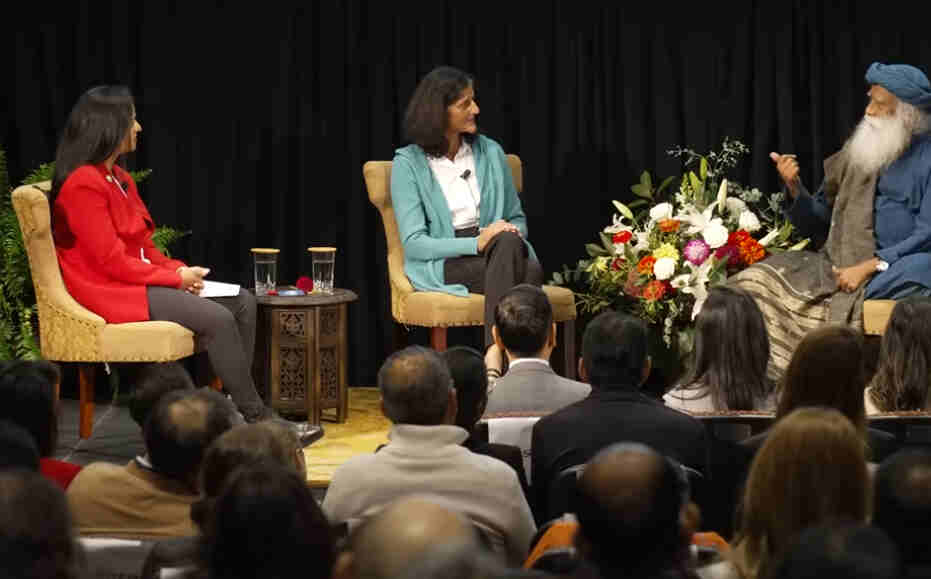
Read the full transcript of an insightful conversation between NASA Astronaut Sunita Williams, and Sadhguru on “Conscious Space Exploration”, at Sadhguru Center for a Conscious Planet on 11 October 2025. The conversation was moderated by Dr. Kavya Manyapu, Space Scientist, Innovator, and Educator at NASA, and was held at Harvard Medical School.
Opening Remarks
DR. KAVYA MANYAPU:
Namaskaram. And good evening everyone. It’s really an honor and privilege to be here today. And it’s especially an honor to be sharing the stage with two of the extraordinary people here.
SADHGURU:
We have this say stage, not space. Okay, What?
DR. KAVYA MANYAPU:
Today we really have the rare privilege of bringing together two extraordinary explorers. We have with us astronaut Sunita Williams, one of the most decorated and celebrated astronauts. She is a veteran of three spaceflight missions logging over 600 days in space. That’s two years, guys.
She’s conducted nine spacewalks totaling over 62 hours, an all-time record for women to date. She has flown on four different spacecrafts developed by different countries as well. And she’s become the first person—you guys will like it—from Boston to complete the first Boston Marathon and a triathlon in space.
And she has also served as a US Navy captain and test pilot with over 3,000 hours in 30 different aircraft types, truly pushing the frontiers of human possibility. Among her several recognitions, she has received one of the highest awards, civilian awards from the Indian government and president of India, the Padma Bhushan award.
And of course, our next explorer is Sadhguru. A vision…
SADHGURU:
I didn’t go anywhere. I did only local trap.
DR. KAVYA MANYAPU:
A visionary and mystic who has illuminated the path of inner exploration for millions. Today’s theme for our panel is conscious space exploration. What does this really mean for me? This is not just a topic. It’s actually shaped by a quest for two great longings.
One that of the outer exploration of space and reaching towards the cosmos. And the other to actually explore the inner space and the journey towards consciousness. And Sunny and Sadhguru, I actually endearingly call you my space mom.
SUNITA WILLIAMS:
I know.
DR. KAVYA MANYAPU:
And Sadhguru, you’re my cosmic dad.
SADHGURU:
I’ll ignore the first word, go with the second part.
The Human Drive to Explore
DR. KAVYA MANYAPU:
And to have you both here today with me on this stage, it’s truly more than a dream come true, as it really feels like for me, a convergence of both the outer and inner explorations coming together.
Sadhguru, we’ll begin the dialogue with you. Why are humans driven to explore space? And from your perspective, is there a deeper purpose beyond survival and curiosity that really compels us to go to space? Do we have to even explore space at all?
SADHGURU:
Say, once you have come here as a human being, whoever you are, wherever you are in your life, you want to be something more than what you are right now. The only way you can do that for most people is by enhancing their experience.
Whether you explore space or you go shopping, it’s fundamentally same desire that you want to expand in some way. So the language of how this finds expression is different from person to person. If you know only money, you will think more money. If you know wealth, you will think more wealth. If you know pleasure, you will think more pleasure. If you know knowledge, you’ll think more knowledge. If you’re looking above the sky, you will think more space.
But the longing is you want to be something more. You cannot stop this. So many very pacifist philosophical and religious teachings, they have tried to stop it, saying, “You must be content with what God has given you.” But they have not been able to stop one single human being from dreaming and desiring. Hello. Not one. They have not been successful even in the minutest percentage.
When they put fear into you, or let’s say today you have some ailment, then you say, “God, I don’t want anything more. This will do. Just if I get healthy, that’s all I want.” But you want health. The moment you get healthy, hmm? Ready for the next thing? Yes or no? You’re ready for the next thing, whatever the hell the next thing is.
So you cannot suppress this, because this is the nature of the human being. The evolutionary part of it, if you want to look at it that way, is this possibility became alive in the life on this planet. So all other creatures are happy with their boundaries. They create their boundaries. They live with their boundaries. Only if you infringe on their boundaries, they get brr.
Local dog. You know, you don’t see that anymore because they’re all—they’ve all become like this, you know, there are no more dogs left in America, as far as I can see. At least you won’t see them. They may be somewhere otherwise. If you see in India and all street dogs are there, if somebody enters into their territory, they’ll go, okay, so that instinct, you see the dogs at least peeing all over the place. They’re not because of a urinary problem, because they’re fixing their boundary.
Territory is very important for all creatures. They’re designed like this. It’s only after our cerebral cortex opened up. We—when we are in danger, we want territory, we want to build walls. When everything is fine, we want to expand every individual human being. This is not just about one Genghis Khan or Alexander the Great. They found massive expression. But others are shopping, they’re turning houses into warehouses. I’m sorry, on the side. Okay, I can.
So, because they want to be something more, they want to cover more space. But somebody looked up, this was not enough. We thought there. All right.
The Limitless Nature of Human Longing
How much expansion will settle you for good? Can you tell me? You are in the space business. How much expansion? Suppose we send Sunita to the next galaxy. We—will you be finished? No.
So we want to expand limitlessly, but we are approaching it in a very constipated manner, little by little. Little by little. All right. No, the longing is to become everything we want to know all. We want to be everything in the universe. But it’s finding very constipated expression. This is what we need to change. This is what we call as consciousness, where you moved out of the boundaries of your experience.
Because ultimately that’s all you’re seeking. You’re see, you want to see how it is to run on this in the space. All right, I gave her a thumbs down because she won the marathon. That’s not fair. There was no gravity.
So essentially we want to expand. There is no limit how much we want to expand. Right now we are thinking moon, Mars, like this. But suppose somebody comes up with the technology, you can go to galaxy Z. You will be gone there, yes or no.
So the longing is for limitless expansion. Exploration is a very small expansion. So we must start looking at it, looking at this in a different way, that we’re exploring so many things. Even in this world, we are still exploring many things about our own nature, about things, about solutions for the problems we have. We’re exploring. We must look at it that way. Just this childhood desire of wanting to go somewhere. So I am going. That’s not the important thing. We’re going there to see how—how it works. How can we make life better? This should be the thing.
Space Exploration as Human Collaboration
And when we talk about how can we make life better? If you just take one slice of life in human history, let’s say, let’s take 20th century. Well, we are all products of 20th century. Fortunately, we were in spaces and also at times when these things didn’t happen. But if you look at 20th century, the most major, the many, many scientific and technological developments happen. That’s a different matter.
But the most major events are World War I, World War II, Vietnam, Korea, this one, that one. Why is this happening? Because we’ve made this planet into like a birthday cake and we’re cutting it into pieces. “This is my—this is my piece. That’s your piece. I want to have a bite of her piece.” Problem.
I think because at one point at the developmental stage of this space explorations, United States and Russia work together. US and India have worked together. Europe has worked together. I think once we leave our atmosphere, at least here also, we need to do this, but it’s asking for too much. All right, but once we leave this, these differences, are you black or white, man or woman, American or some other nonsense? What you are must be left here.
All our problems, we must leave here. This exploration must come with some purity of how we approach human—human longing to know. That’s what it should become. Not an American longing to know, not a Russian longing to know. No human longing to know. It must become a collaboration. It used to be like that to some extent, but unfortunately, now it’s becoming a—because we are seeing once again, as a military possibility, unfortunately. I hope we drop that in future leadership. And.
DR. KAVYA MANYAPU:
Thank you so much, Sadhguru. I think this was—
SADHGURU:
Nobody explains in zero gravity. If I shoot a bullet, will it kill somebody or it’ll just bounce out?
SUNITA WILLIAMS:
I think it will just keep going. Oh, I think it will go through. This is a question I had.
SADHGURU:
Didn’t you throw something at somebody in these nine months and it hit them?
DR. KAVYA MANYAPU:
Yes.
SUNITA WILLIAMS:
Maybe I wanted to do it more than that.
Human Potential in Extreme Environments
DR. KAVYA MANYAPU:
I think the explanation you gave for the longing, I haven’t heard that anywhere, at least in the community of space scientists and explorers that we work. And now you know why I call you my cosmic dad.
I want to bring you here into this conversation, Sunny. You had the unique opportunity of spending time and space not once, but three times. And the third time was—we know how that went. Like, very unexpected. Adapting to the extreme environments of space. You were supposed to be there like for two weeks.
And I remember you and I having a chat before you went into quarantine that hey, like, oh, only two weeks. I wish you stayed up there for longer and it was more like we’ve trained for so long and then it turned out to be a nine month unexpected mission.
So as someone who has had this, had spent extensive time and space, what have you learned about human potential when faced with challenges and really pushed you to the limits of the body and mind? And part two of that is—can you sort of elaborate from your perspective, would you want to go back and explore space? Like after everything that you have been through?
SUNITA WILLIAMS:
Well, first of all, I just want to say it’s an honor to be here. It’s an honor to be here in your presence at Guru. So thank you so much for this opportunity, Kavya. Thank you for bringing your parents together. I guess a long absence, but you know, space exploration, this is amazing to sit and listen to you talk about it.
And it’s funny because we’ve have this conversation in our office about how we want to leave low earth orbit and go on and explore. And it just seems natural and right that we leave as humans. We have the ability to make those judgment calls as humans to explore, to look further in the universe. And so we’re all humans, we have that ability to try and do that. We’re not set by boundaries like you talked about in some.
So we want to explore those boundaries and push those boundaries. I think everybody does. And so I think I totally agree. Our time in space was a little bit longer than we had planned. But it was an opportunity to push those boundaries and look at ourselves and what we were doing and understand our role in that exploration of pushing boundaries.
So I don’t know, I feel like it’s a challenge more than anything else and some of that and an opportunity maybe have to look inside a little bit as something that seems as though it’s an issue, a chore, a problem, and understand what is it actually teaching you.
The Nature of Exploration and Discovery
I think one of the other things about space exploration, to tap into it and any type of exploration, it leads you, once you get to one step to asking a question about the next step and asking the next question because you don’t even know. I feel like we don’t even know what to ask. I feel like we don’t even know where we’re actually going to go or what’s on the other side of that rock that we are going to look at.
So you want to get to that point of exploration, so you can ask the next question. So I think that’s very important. I think that’s what drives most human beings. Just that wonder, like, why do we get to the mountain? Why do we go to the top? I know Kavya is a huge mountain climber, and I know there’s a desire like, you’re right there. Should I go to the top?
DR. KAVYA MANYAPU:
The top is right there.
SUNITA WILLIAMS:
Because that’s going to tell me what—
DR. KAVYA MANYAPU:
To do on the next side.
SUNITA WILLIAMS:
So there’s always that next question of what’s out there, what’s next? And I think that’s sort of the definition in my mind of exploration and having been in space for one week, and then it turns, you’re like, oh, this is again, another opportunity, another thing to learn while we’re there and enjoying it.
I think this is what we’re all looking for. We’re all looking for that next question, the next step, and the next question to try and answer.
The Nature of Human Desire and Cosmic Exploration
SADHGURU: If I can say one thing, this desire that every human being is invested with, which is the very nature of our existence, we want to be something more. So somebody is just right now thinking of buying a new dress. That’s their way of being something more. Somebody wants to buy a car. Somebody wants to buy the planet.
But suppose we make you the queen of this planet. Will you be fulfilled? No. You will look at the moon, all right? You should have called her the cosmic mom. So if you give you the moon, will you settle? No. You want the solar system? If you give the solar system, will you settle? No.
So if you really look at it, if you go physically exploring the universe, you will be lost forever. Not nine months, nine billion years, you will be lost because it’s that much. Neither the men of science or women of science, nor people who claim to be men of God have any clue where it begins, where it ends.
So when you explore something like that, you must find another way. If you go into it like this, you try to measure the depth of the ocean with a foot scale, you will obviously come back and say, it’s bottomless, isn’t it?
So I’m saying, if you are exploring this with a specific purpose, to know the nature of our solar system, how to make life better, how to make life a little larger than the way it is right now for humanity and maybe even for other life, if humanity has to live in Mars, first thing is we must transport a few trillion microorganisms and make them thrive there. Otherwise we cannot thrive.
All those things are fine. But just for the sake of seeing, if you go, it’s an endless sightseeing. Even an ocean feels like that. If you dive, it’s an endless sightseeing. But the space is definitely endless sightseeing, isn’t it?
DR. KAVYA MANYAPU: And this actually is a great segue into what I was going to ask you.
SADHGURU: I’m sorry, did I take away your question?
Carl Sagan’s Pale Blue Dot and Inner Experience
DR. KAVYA MANYAPU: No, no, no. This is great. This is great because the famous planetary scientist Carl Sagan, you know Carl Sagan, he has talked about the pale blue dot referring to Earth, emphasizing how infinitesimally small we are and the fragility of Earth. And you, Sadhguru, have also mentioned about how small we are. Minuscule part that we are in the Earth.
SADHGURU: Nobody here thinks they’re small. They’re very big in their family, in their office, wherever they are.
DR. KAVYA MANYAPU: Yeah, small in this vast cosmos. And I want to share that in one of the recent programs you had conducted, so for me, these what you have mentioned and what Carl Sagan’s quote have resonated with me a lot intellectually. And growing up listening to Carl Sagan as well, he was very much part of me just throughout my career, my journey.
And then I hear you say that from an inner experience. And to actually, in one of your programs, to actually have experienced that, not intellectually, but if I may share with every cell of my body on how infinitesimally small we are, was really profound and transformative. And thank you for giving us an opportunity with your work for us to experience something like this.
So my question to you is, as we continue to explore space, you also are a champion of, we need to engineer ourselves internally through inner engineering, or rather go inwards and journey inwards. How do you see exploring and cultivating this inner awareness as essential for explorers like us who want to go explore space?
The Cosmos in a Mustard Seed
SADHGURU: I can tell you two anecdotes that happened way back when Adiyogi was speaking to his seven disciples who are today celebrated as Saptarishis, as the seven Sages. They are curious like you. They are asking, what is the nature of this creation? How is it made? Where does it begin? Where does it end?
He’s a bit bored with them. So he says, how big is this creation to look up in the sky? It looks limitless. How big is this? Where does it begin? Where does it end? He says, your entire cosmos. I can pack it into a mustard seed. Very good packing, isn’t it?
DR. KAVYA MANYAPU: We should learn that for our packaging of spacecraft.
SADHGURU: So he said, I can pack your entire cosmos into your mustard seed. Mustard seed is more a metaphor of the smallest possible thing. I can pack it into this much. Because he’s talking about how time and space is a projection of your mind. If you rise a little above that, it’s all here. So for what is here, you shouldn’t go too far.
But the important thing is, this is why I said the orientation of this space exploration should shift to utilitarian. Because anyway, it’ll go there. People will think. Already people are thinking how to mine the moon, Mars, whatever, whatever. It is utilitarian for that purpose. You go as far as you want to go, it’s fine. But sheer sightseeing, if you want to go, you’re going to be lost for nine billion years or forever. In our perception of life, nine billion years is you’re gone.
Another thing he said. And they went on poking about, what is it made of? How is it made? By now, he was thoroughly bored with those people. He simply said, just five elements only. With five ingredients, the whole creation is made. The five elements of nature, which are Earth, fire, water, space and air. So these five ingredients are there in everything. So it’s just five things causing so much mischief.
So do not go about. What he’s trying to say is he gave them methods. Don’t go about trying to find out everything because you have a finite amount of life. You don’t have an infinite life. Whether it’s individual human being as humanity as a whole on the planet itself has a finite amount of life. We must understand this. It is not forever.
It’s just we are at its best time trying to make it worst. That’s another matter. We are at the best time, you know, for humanity in many ways. Never before human beings had these capabilities. But this much comfort, convenience, technology works above all. You don’t have to go forage in the forest to find your food. It’s organized. If you just put it on the phone, it’ll come and land in your house.
So this was never, never possible, that survival was so well organized. Still, unfortunately, there are famines in the world and all that. That’s something we have to tend to. But largely, at least for 80%, 70 to 80% of the population on the planet, survival is better organized than ever before. No question, isn’t it?
So when this is so, it is time to explore. Explore for the sake of knowing, you must turn inward. Explore for the sake of use. You must go out. This is my take.
The Overview Effect: Seeing Earth Without Borders
DR. KAVYA MANYAPU: That is so powerful. This is exactly the convergence of inner and outer exploration. And turning to you on the same topic here, Sunny, you and we’ve had conversations on this that when you saw Earth from space, you don’t see any borders. And I remember exactly today, about 15 to 20 years ago, we had this conversation on how she had never seen borders in space and astronauts.
And you often talk about what’s called this overview effect, the effect that they have when they see Earth from space. I want to ask you, can you share your experience on that and how has that changed your perspective on life, humanity, human consciousness?
SUNITA WILLIAMS: Yeah, I was reflecting on the mustard seed.
SADHGURU: You thought I’m very small looking.
SUNITA WILLIAMS: Yes, exactly. Mustard seed. Mustard seed size. Right. But I was just thinking about that and I mean, looking at the planet from that perspective, what an honor it was to be able to do that. I wish a lot of people would have that perspective, to be able to at least take a lap, as I call it, around the planet and look at us from that perspective.
Every person, of course, that I know, every planet, every plant, every animal, every mountain, every rock is here that I know. Maybe there’s something else out there. But everything that we know, you’re looking at it. When you’re looking at our planet from that perspective and you’re not there, which is a little interesting. It’s a big planet. Of course, it doesn’t look like a mustard seed. It looks a lot bigger than that.
But everything is bundled up right there. That’s it. And that’s a feeling that makes you feel very small. Wow, that’s everything we know. You can look out into the universe. We have a mirror, amazing windows. Or you can go on a spacewalk and you can look out into the universe and you can see billions of stars and there’s a lot out there. But everything that we know is right here.
SADHGURU: One tiny little mud ball.
SUNITA WILLIAMS: One tiny little mud ball in that big, huge, vast universe. And it really puts things in perspective. And again, associated with that, what Kavya mentioned is there are no obvious borders beside for landmarks on the planet. And it really makes you. And usually you go to the window and what’s there? The ocean. 71%, I think. Right. Not just 70%, but 71% of our planet is ocean.
And so you usually see blue and then you get a splot of some other beautiful color, brown or blue or gray. And that’s where the people and the plants are. And the dog that you love is all right there. And it’s just, and we’re all together and that’s it. This is our one home.
And I think that perspective is one that I wish we could share. Everybody could have the opportunity to have. And so when we look at not just exploration and utility of going to space, but just the ability, put it that way, for other people to have that perspective would be amazing.
I think my dad one time said to me, he said, you know, we were talking about people who are geniuses and stuff. And I was like, I get to go to space. That’s all I get to do. There’s nothing more than that, right? Yes. I had to do well at school and I had to be physically fit, of course. But that’s not genius. The people who are genius, who could see all those things without their two eyes. I get to see that the planet is round. So by the way, the planet is round. And I get to…
SADHGURU: Because there are still…
SUNITA WILLIAMS: It’s not flat.
SADHGURU: No, there are still a lot of people teaching the planet is flat.
Genius and Perspective
SUNITA WILLIAMS: That’s why I’m telling you. So as many people out there. So you tell your friends, your family, your children, the planet is round. But I got to see that. That doesn’t make me a genius. It just gave me that opportunity. So I wish everybody would have that opportunity.
The people who figured that stuff out without having to see it with their own two eyes, those are geniuses. And when you can do an inner look and you can figure out how to do that, which I would love to hear more about it because I need some help. If we could do the inner look, that is incredible, that will open up amazing, endless opportunities as well as when we get everybody a lap around the planet to think about ourselves and where we are in this universe in a different, unique way.
DR. KAVYA MANYAPU: So that. How do we do it? Turning to you, Sadhguru, are there any practices or anything that what Sunny asked about turning inward and even for the community out there that’s designing spacecraft, we want to go explore the space. And for all the space leaders making all these policies and everything, are there any inner practices or anything that we could actually implement so we could have that experience?
Because obviously we can’t launch everybody into space just yet to have that view of Earth. But could you please guide us on that?
SUNITA WILLIAMS: I feel like we all can do this. How.
Inner Practices for Space Explorers
SADHGURU: Can everyone do it? Absolutely. No question about that. But is everyone interested in doing it? No.
SUNITA WILLIAMS: Everybody here?
DR. KAVYA MANYAPU: Everyone here?
SUNITA WILLIAMS: Yes.
SADHGURU: They will say yes if I tell them. If I tell them, okay, sit here for another five days. We’ll see. Say Sadhguru tomorrow, my uncle’s daughter’s birthday. I have a dent. I need to go. Okay. Do I have how to be poem? It’s just on the internet. I mean Instagram yesterday or day before.
So as I said, see, you’re mixing these two words. I said you turn inward for pure knowing. You turn outward for impact, for use, for utility, to help. They’re two different things. Now you’re saying, okay, can you teach us some practice that we can put to use in the NASA whatever?
DR. KAVYA MANYAPU: Well, can we have these?
SADHGURU: No. You have a job. I know you can’t help.
DR. KAVYA MANYAPU: We want to have some. What kind of tools can we use that by increasing the inner awareness, we are better custodians as we go into space.
SADHGURU: That’s a different aspect. We can talk about that. Is that what you’re asking? Or about how to know?
DR. KAVYA MANYAPU: The second? How do we practice and get these tools so we can actually make better decisions as we explore space? So the internal knowing can actually help us do the utilitarian part of exploring space in a much better, safer way.
The Challenge of Division in an Expanding Human Footprint
SADHGURU: That is unfortunately something we have not practiced on the planet. We are making useful things one against another, all right? All the time. We are trying to extend that into space because we are the same people. No matter where we go, we are the same people.
First thing is, unfortunately, I’m not—I’m 100% for science. But the present attitude of science, not everybody, but largely it’s become everything that you see, you want to know how to use it. Whether you see a planet or a microscopic bacteria, people are extracting protein out of bacteria. Come on, leave them alone.
SUNITA WILLIAMS: I love it.
SADHGURU: Invisible things also, you want to extract something. So this can be very disastrous as our capacity increases. If we are very low capacity, whatever your attitude is, okay, you know, if you are an ant, you climb over my foot and go, no problem. If you become an elephant, you can’t step on my foot. Hello. Now you have to walk with full awareness. You can’t step on anything because whatever you step on gets destroyed.
Right now we are becoming bigger than a dinosaur—human being. Our footprint is bigger than any goddamn dinosaur anytime in history of this planet. We are so big. Each human being, what they’re capable of with their technology available to them. If the footprint is too big when it’s like this, there has to be an inclusive experience of life within you.
This thing about everything is divided—gender, we are acting like two separate species. Nationality, we are, of course, we have to fight endlessly. Race, religion, caste, creed, you name it. God, damage through universities, fighting between each other, all right? Anything. Football clubs, fighting with each other. Fans, I’m saying, not footballers. Just everything is how to divide.
You must understand, as you get more and more empowered, you must become more and more inclusive. Otherwise you’re a disaster for yourself and for everybody. So as your capacity to go into the space gets enhanced, if you’re still in the same mode that you’re constantly seeing you versus somebody.
The Problem with “Star Wars” Thinking
See the movies that came. Because tomorrow I’m speaking to these people who are doing Monolith. You heard of that? The Space Odyssey. They’re making another documentary on that movie. So I had not seen that. So they said, “You must watch.” Three days ago I sat down and watched the movie. Well, it’s phenomenal. In 1968, they saw the things that they saw.
But a lot of science fiction writers at that time were already talking about many things. And I think a few of the ideas which were fiction have actually come into science as a possibility. Because it was an idea, an exploratory idea.
Nobody made “Star Laugh.” They made “Star Wars,” isn’t it? Why do you think if aliens come, they will come with guns, just like you? Where did you get this idea?
In India, there are whole lot of stories about aliens. You know, if you see Mahabharata, Ramayana everywhere, there are Yakshas, Gandharvas, Ghanas, all kinds of people. They never came with guns, nor did we go at them with anything. They were all welcomed. They had different capabilities. Some were dangerous, so we kept away. This is how the stories are describing.
But why are we thinking if they come, they’ll come with guns at us? Because you have to sell the movie. But it’s infected a whole generation of people. All the children are thinking aliens will come, we must fight, we must do this. What makes you think they are intending to fight with you?
My experience of alien life, they’re never confrontational. Because whatever I have seen, their competence and their ability to move and everything is so absolutely fluid. They don’t have to fight me. They can poof, go away. Okay, so why do they have to fight me? There is no need for them to fight.
We don’t know what capacities they have, what type of life they are, how they are made, whether they have physical kind of thing or they’re something else. You don’t know. Why are you assuming they will come guns blazing? And what damage we have done to generations of people? Because every child thinks if alien comes, I must be ready with my gun to shoot them. How sad is that?
I’m saying this has to go—means you must step out of your limited way of understanding things. Where is the limitation?
Understanding the Mental Body: The Software of Human Experience
Will, can I take a few minutes? See, this is the structure of how we are experiencing life. I’m talking about one level only which we call as Manomaya Kosha, which is mental body. Here, physical body is another matter. There’s a mental body. As there is a physical body, there’s a mental body. This is the software. This is hardware. That is software.
We’re talking about the software because all your behavioral patterns, your attitudes, your approach to life is according to your software. What kind of software you loaded on your computer, that is how it operates. Doesn’t matter what is the hardware, isn’t it? Hardware can function here or here, but it doesn’t decide the direction of operations. It’s the software which determines this. So we’re talking about the software.
We look at human mind or human mental body like this. There is an intellect which we call as Buddhi. If I ask you, should I ask you those in the upper chambers—if I ask you, would you want your intellect to be sharp or blunt?
Sharp. They want it sharp. Because an intellect is useful only if it’s sharp. If you’re carrying a sharp instrument in your hand, let’s say you’re carrying a very sharp knife in your hand. Now the hand that holds it must be very conscious. If it is little, la la la la la, I may cut her or cut myself. It’s happening.
If you had the brain of an earthworm, you would be fine. You would be quite meditative. Yes or no? Now you have a certain level of intellect. To develop this cerebral capability took millions of years of R&D. You may call it—you may dismiss it as evolution, but it’s actually research and development. So many things were done right, wrong, this way, that way. And then it came here, all right? It didn’t just happen like that overnight. It’s not on the sixth day all this happened. It took millions of years to get your cerebral capability to this level.
And now human beings are suffering it. Where is all the human suffering manufactured? In Massachusetts? Up here, isn’t it? So if you had half a brain, or maybe quarter—half also is dangerous. If you had a quarter, you would be quite peaceful. You have a certain level of cerebral capability. It’s driving you nuts.
Why is this happening? See, the knife is there. Nowhere has it ever happened a knife jumped up and stabbed somebody. Did it happen? No. I’m asking, in your research, no.
SUNITA WILLIAMS: Yes, in your research.
SADHGURU: In space it may happen.
DR. KAVYA MANYAPU: Maybe in space.
SADHGURU: In space.
SUNITA WILLIAMS: It could happen.
The Knife and the Hand: Identity and Intellect
SADHGURU: Nowhere in this world, nowhere on this planet has it ever happened a knife jumped up and stabbed someone. It all depends whose hands it is. The same knife has saved millions of lives through surgery and kitchen, cutting vegetables. The same knife somebody uses to take life. Both have happened. But knife is not dangerous. It’s the hand that holds it.
So if you have a sharp intellect, what holds it? This. In the yogic way of expression, we call this Ahankara. Ahankara does not mean ego as it’s normally these days they’re propagating. Ahankara means identity. Because what you call as ego is just your identity.
I am identified like this. I am a man. I am identified with a few body parts. And I think I am a man. Suddenly everything that I think is like a man, isn’t it? I think I’m Indian. Suddenly everything I think is like Indian.
See, there is a national flag hanging—India. If you think I’m American, American, American, you see the flag, tears will come to you. Just a piece of cloth. Hello. People have fought for it, died for it, killed for it. Isn’t it? Yes or no? All over the world. Not in any one nation. I’m saying everywhere.
What is it? It’s just that we have to work from your childhood. “This is your identity.” Now, once your identity is like that, this knife that you hold as Buddhi or intellect, it only veils in that direction. You understand what I’m saying? It’s all about protecting your identity.
When you try to protect your identity in a crude way, they say you’re an egoist. If you do it in a certain way, the way everybody else is doing, they’ll call you a patriot, all right? Hello.
Memory: The Massive Silo Within
So this identity is connected to another dimension of mind which we call as Manas. Manas is a massive silo of memory. See, right now what you call as my body is a silo of memory, isn’t it? There is evolutionary memory. That’s why if you eat a piece of bread, you become like a woman, you become like a human being. If you give the same piece of bread to a dog, it eats and becomes a dog. Because evolutionary memory has not faltered for a moment. Never confused.
And there is genetic memory. A thousand years ago, your forefathers, what kind of nose they had, that nose is sitting on your face right now. Telugu nose, I am seeing.
DR. KAVYA MANYAPU: Make my husband watch this video.
SADHGURU: So I’m saying the memory is there. Elemental memory, evolutionary memory, genetic memory, karmic memory, conscious, unconscious levels of memories, articulate and inarticulate levels of memories, whole lot of memory. This entire body is memory, isn’t it?
How did it come into you? You know, your parents, those stingy people, very stingy. They could have given one billion cells at least to you. They gave you one each. One goddamn cell carried all this, or no? Hello, one cell. Just look at the amount of information it carried.
So I’m saying every cell in the body is far more intelligent than your intellect. Unfortunately, in today’s world and education systems, you are teaching people and making people think the most intelligent thing is your thought. Your thought is not the most intelligent thing. Even simple things you can’t figure out with your thought.
Thought is the dumbest part of you right now. Every cell in your body is doing phenomenal things that you cannot ever think through. Isn’t it? A billion things a moment it is doing. So intelligence is spread across, memory is spread across. But you are employing only this one thing because your education system has told you the way you think is everything.
This is a European crime committed upon the world. Yes. You from—it’s from Oslo.
DR. KAVYA MANYAPU: You know, can I mention one thing?
The Body’s Intelligence in Space
SUNITA WILLIAMS: It’s very interesting because I think when we go to space, it’s hard for us to figure it all out. Like, our brains are like, “Oh my gosh, I don’t feel good,” whatever. But your body amazingly adapts. It knows what to do. I don’t have to tell it. It does it over time. It takes a little time, but it all does it.
And then it almost gets to the point where it finally has to remind your brain, like, “Hey, you’re okay. You’re in space now and you can actually live here.” And your whole body can adapt. I think that’s pretty incredible. So, like, you know, just to springboard on what you said, I think everything about human beings—because your…
SADHGURU: Body carries the entire evolutionary memory of going through various phases of this planet’s evolution itself is written into this. It knows. If you cut into a tree, the rings in the tree tell you what all the tree has gone through. Similarly, with your consciousness, if you cast lies into this, everything that this planet has gone through is here. Everything the entire creation has gone through is right here.
If you look deep enough, it just needs a certain level of application. It’s not like you do one practice and tomorrow you are going into it. No, but with a simple practice, you can transcend your identity. You don’t have to sit here being a man or a woman or an Indian or an American or something, or something else. You can just sit here as a piece of life.
If you sit here as life, knowing life is very simple because you become something else—creature, all right? You become another kind of creature. That life seems to be so complex and impossible to understand. Are you life or no? Then what’s the big deal? When you are life, what’s the big deal about knowing what is the life nature of this life? It is not a big deal. That’s very simple that every human being must do.
One Truth, Many Realizations
See, truth is only one. Only one. But realizations are at many different levels. So people think there are various kinds of truths. No, there is only one truth, only one. But realization is at various levels. If you realize this, you are here. If you realize that, you are there. If you realize that, you are there. But there’s only one goddamn thing.
And this Ahankara connects to the memory. This is information. See?
SUNITA WILLIAMS: See?
The Nature of Identity and Memory
SADHGURU: How many children do you have? One. Only one. You have no. Anybody has two children? Yeah, if you have two children, same genetics, same food at home, probably you send them to the same school. Do you go like this? Hello. And not you? She went into the ocean, you went into the space. Look at you.
SUNITA WILLIAMS: Papa. The same.
SADHGURU: No, I’m saying. Have you seen in many homes, same input. One goes like this, one goes like that. Not about right and wrong. They go different ways. Same information. Depending upon how they identify with it, accordingly, it’ll do things.
So right now, whatever memory you may carry, it’s the identity which determines how your intellect will function. How your intellect will function depends on how you behave in this world. How you treat the world around you, how you treat yourself, how you treat the situations around you. Everything. So fundamentally you need to change your ahankara or your identity.
Ancient Wisdom on Education
So this is why there used to be this in India. That children were not allowed to study anything till they are 12 years of age. Because the idea is you shouldn’t burden the child. Child should grow physically and mentally as much as possible. Just play, eat, sleep, that’s all. Exhaust yourself with activity. Eat as much as you can, sleep as much as you can. Your body and brain will grow well.
At the age of 12 Vidyarambam will happen. That means beginning of education will happen. For that, first thing that they were told is “aham brahmasmi.” That means my identity is cosmic. They didn’t go on the spacecraft. They were first thing before education. Because education is seen as an empowerment.
Any empowerment that’s given to a human being whose identity is crippled. That they think they are man, they are woman, they are this, they are that, these people. If you empower them, they’ll only cause more and more damage to all life, including themselves. Because if you want to empower something, first thing is it must be inclusive. If it’s not inclusive, if you empower that one, it will just cause damage. Because empowerment is dangerous.
See, right now we get to break the atom or fuse the atom. See, what are we doing? We are threatening each other. Okay? We’ll obliterate you. I’ll obliterate you. Everybody will be obliterated. Maybe, maybe some people be left somewhere who are not important on this planet. Or at least we think they are not important. Those people somewhere living some Eskimo family mess because nobody bothered to bomb his igloo. It’s not worth it. It’s too expensive. The bombs.
Chitta: Intelligence Beyond Memory
So the fourth part of the mind, this memory can be broken into 8 parts or further into 16 parts. As to different types of memory, let’s not go there. The fourth part of the mind is called as chitta. So this is an intelligence within you which doesn’t have an iota of memory.
Why is this important? See, memory is the thing which is powering you right now. Your knowledge, your ability to be in space or your ability to do this or that. Just about everything that people are doing. But the thing everybody is. You know, last session everybody was feeling insecure every. Because AI will take over their job.
See, if you send a AI machine into the space, that guy will walk wherever he wants. He doesn’t need to breathe, he doesn’t need to eat, he doesn’t need to shit. How convenient. I’m saying, anyway, it’s going to happen because anything that we can do physically and intellectually, a machine will do it better than us. No question. Whether it’ll take 10 years, 15 years, 25 years, we don’t know. But anything I can do with my body, anything I can do with my intellect, machine can do it better than that because it’s all about data, process and expression.
So the fourth dimension has no memory. It’s pure intelligence. We can call it whatever we want, but essentially it’s something without memory.
The Unity of Life
See, because it’s your body is one kind of memory. We say, that’s your body, this is my body. We can say, both of us speak Telugu, let’s hold hands. We come from the same place. Come on. We ate the same food, we ate the same things. We bond identifying. But still, that’s your body. This is my body. Unless they bury us in the same place, then we become same soil. Till then we won’t get the point.
It’s the same stuff because it looks different, it feels different. But is it the same soil? Hmm? Yes or no? You ate in the moon, or you ate here only, right?
SUNITA WILLIAMS: Only here.
SADHGURU: This is the same stuff as every other stuff. It’s right now so different, we can’t imagine that this and that can be same. This is my mind. That’s your mind. Here and there we may overlap, but that your mind is my mind, isn’t it? But there is no such thing as my life and your life. The fundamental life that we are talking about is a phenomenon which is on everywhere. Inside also same thing. Outside also same thing.
It’s like there are oceanographers. You particularly dive into the ocean. Probably you can feel it better than being in the space. In the ocean, there’s so much life. They all have come from the ocean. They’ll go back into the ocean. A fish or a shark, or even a whale that’s alive today after hundred years. Where is it? Just dissipated into the ocean. Maybe a new shark has come. Maybe a shock has become a, you know. Shrimp. We don’t know. Hello. We don’t know. A cat has become you. You have become a dog. Something from the soil. So many things have become so many things.
Isn’t it the air that we breathe? Also today, what I’m inhaling and exhaling tomorrow morning, maybe not a dinosaur, but something else is inhaling and exhaling. Yes or no? Yes. So I’m saying it’s the same bloody stuff. Even physically, mentally, but in its present manifestation, that’s you. This me. Hundred percent. But the life that you are and the life that I am cannot be two different things.
The Bubble Metaphor
So what is the difference? Why is it so different from one person to another? It is this fundamental. Let’s get this one thing straight. I know lot of people will make you know on the Reddit. They are all on the Reddit. You are Red. You, you’re not Reddit, right? Okay. They all live there, so they will all start something. But let me put this in perspective.
See, one way to look at this is your body is a bubble that you did. Suppose both of us go blowing soap bubbles. You blew your bubble. It came this much. My bubble is this big. I said that’s my bubble. Big one is my bubble, small one is yours. Happened, isn’t it? Poop. It went. Then you don’t say. This is my air. This is your air. You don’t know whose what is what. There’s no such thing as you and me.
So you and me exist in physical manifestation because it’s bound by memory. You and me exist in psychological manifestations because it’s bound by memory. Because my memory is different from your memory and how I process my memory is different from how you process your memory. The difference is fundamentally rooted in how you identify yourself, how I identify myself.
All this is fine for functional purposes, but as life, there is no such thing as your life. And my life, it’s a huge phenomenon. Did you blow a big bubble or a small bubble? Now, the practices that you’re talking about is about blowing a little bigger bubble. Because if you blow a little bigger bubble in your experience, you will become more life and less body, less mind.
Becoming More Life, Less Mind
This is the most important aspect of yogic practices. You become more of a life, less of a body, less of a mind. Because if you are in the body, that’s you, this is me. No way to make these two things one. Isn’t. Doesn’t matter what you think. Even lovers who are getting together, they think they made it one in two minutes. They’re different, isn’t it? Hello. Even people who think they are absolute friends and we are one. If you go to the ice cream shop, you like this, I like that.
I’m saying in terms of memory, no two memories can be same. You call it body, you call it mind, but essentially it’s memory. Block your memory. My memory cannot be the same. How you process your memory, how I process my memory can never be the same. Depends on many things.
If both of us are identified with the same thing, this is what armies are trying to do. Everybody’s identified as one thing. Same uniform, same thing. Everybody, boom, boom, boom. That’s needed to create a fighting force. Otherwise, if everybody thinks differently, who will fight? You know? So there you’re trying to merge the identity to some extent, but there also, they are never the same. They may look all same for outside observers. No soldier is absolutely one with the rest of the battalion there. Everybody has their own mind. Everybody has their own thinking. Everybody has their own experience of conflict. You know, it’s not the same.
So these things, trying to merge bodies, trying to merge minds is impractical and unnecessary. It’s just that that is you, this is me perfectly fine. This is how you should be. You’re a woman, I am a man. It’s nice. It’s like this. There is no need to think. Why is this different. Why can’t we become same? Not necessary. But as life we must know this. But knowing it intellectually is not good.
This is why the yogic and spiritual practices are this. It makes your bubble big. Because the bubble is big. Now the quantum of life that is there within you is much more dominant than the physical body that you carry or the mental structure that you carry. So if you sit here, you sit as life.
When I tell people if I sit here, if I sit here for two days, I don’t have a single thought because my mind is this much compared to what I am. I have a very small mind. I’m saying it’s only this much compared to who I am. So it is there. Is your little finger always kicking up whatever you’re doing? No, just like that, my little finger, it stays there. When I want to use it, I can use it.
Entering the Big Bubble
DR. KAVYA MANYAPU: And since you said it’s a big bubble, right. I’ll just ask is it possible to enter your mind or that big bubble for a few seconds to experience life the way you do?
SADHGURU: You can if you’re willing, but you can’t enter with your body and your mind if you keep it aside. Yes.
Becoming a Multi-Planetary Species
DR. KAVYA MANYAPU: So this brings up a great question I’ve been thinking about. So right now we are at the privilege of talking about and investing in technologies to make humans multi planetary species. So what does that mean if we are going to become in fact a multi planetary species? What does this really mean to be human? Especially in all of the aspects that you just talked about. And would that fundamentally change anything about human consciousness?
SADHGURU: Not about consciousness, everything else. All our living practices, day to day things, how we grow vegetables will change on Mars for sure. Hello? Yes. So I’m saying, if it was not for this division that we have created among human beings and whatever last 25, 50,000 years, non stop we’ve been fighting with each other. If that was not there long time ago, probably we would have gone to different planets long time ago.
It’s just that division which doesn’t allow us because it needs a whole humanity to exert that force to get there, that has not happened till now. It was very nice to see in 50s and 60s the United States. I know the aeronautical stuff, I’m sorry, the space sciences, Russian ones, the USSR and even India was in its nascent stage, but they also collaborated and few other countries collaborated. And that was a very good effort. It should have continued.
But the moment we think we are thinking of space like we are thinking of airspace, see, the sky belongs to you, goddamn it, what is this sound? Because we can bomb you from the sky now. We can bomb you from the space. So the space also. This is my space. This is your space. But the planet is moving, it’s spinning. Never the same piece of sky, but we can’t get it.
All this because we have invested so much in our differences and those differences have matured into discrimination. Serious discrimination where I’m willing to kill you. Discrimination. Not just okay, you mind your business kind of thing. Discrimination to a point where I want to kill you. With this level of discrimination, getting more and more empowered becomes more and more dangerous. They will. Everybody will have missile stations in the moon. So you can’t tell those stories to your children anymore, Chandamama. Because probably you can see them if they’re large enough.
Values for Space Exploration
DR. KAVYA MANYAPU: And sunny. You’ve lived in a tin can up there with international crew and thinking about this concept of yeah, we might most likely become a multi person planetary species at least at the way the space industry is accelerating. What does that mean to you for somebody who’s been up there, in terms of values and the inner awareness that we need to build. What do you think are based on your experience that we should take with us forward and maybe leave things behind as we get into this outer world?
The Essence of Yoga in Space
SADHGURU:
Say one thing to her. Hello. Hello. Yeah, you know, I was at the Chicago Science Museum because we had a series of paid meetings with them, full day meetings because we were thinking of starting exploratoriums in India for schools, a few of them. It never happened though. But I had a very rich experience there.
There is a model of this conical spacecraft. Three people are sitting in the full of wires. That day I looked at this. Somebody lives in this for a month, two months. Well, they must be yogis.
SUNITA WILLIAMS:
I think you do want a little bit of… You have to find your own quiet time. And when you’re in small spaces like that, for sure. So you have to sort of do a little introspection, right? So maybe there was a little hint of being a yogi that way. I’m not sure it is.
SADHGURU:
See, yoga does not mean you’re doing a certain kind of practice. The word yoga means union in some way. You’re one with what’s around you. You’re a little bit of a yogi without that. You can’t live in that camp.
Unity Beyond Earth
SUNITA WILLIAMS:
Absolutely. One with that space for sure. But so what do we bring forward? Right? I think conversations like this are really important. I’ve heard, you know, in our organization, people want to be first to set rules of engagement because we’re worried about other people, for example. And so that is a driver.
And, you know, whether or not people recognize that there’s a little bit of a space race out there. For what purpose? Right. That’s the question. For what purpose? And like I mentioned, people have said to set rules, engagement, maybe for some physical purposes. Also, sort of, like we mentioned, there’s a utility in maybe being first in getting there.
But I think, again, more importantly, discussion falls back on setting rules of engagement. So how do we do that appropriately is, I think, really important. And having discussions like this as we go further to understand what is really important and why we really are doing this is really valuable, I think, your insights of, you know, trying to figure out why do we have the perception that we have differences.
Why is that so strong identity? Yeah, but it shouldn’t be. When we come back to it, we’re all really the same. And getting back to the very beginning of our conversation as we leave Earth, we’re all humans. Everybody in this room is a human. We’re all sharing the same life, as far as I can tell. We’re all sharing the same life, as you’ve mentioned.
And we need to appreciate that and understand that as we go further, maybe we’ll find aliens. I’m not really sure, but at least we will go together.
One funny thing about aliens, when you brought up aliens, I was thinking about I had an opportunity to live underwater for a little while in a habitat, and we would come back to the habitat after a dive and just lay on the sand and just watch life. Sort of like you were mentioning before.
I think the creatures around you can understand how you feel. If you’re scared of them, you’re not scared of them. I was telling my sister about this guy who was underwater with us who was sort of not scared of anything. He could go up and just sort of pet a nurse shark, and that shark would just stay there.
One day he went over to this rock and I was diving with him, and he put his hand out and this fish jumped on his hand from the rock. And he put my hand there, and the fish jumped on my hand. I was like, what is happening? Why? Why is this fish so calm? It’s because we’re calm.
But to me, those are aliens. But they weren’t worried about us. They weren’t scared of us. And as we go further, we should not be worried about the aliens that we would encounter. I agree. The aliens, if we are going as one human species as one people, we just go and we discover and we understand and we share.
Space Exploration and Conscious Planet
DR. KAVYA MANYAPU:
So Sadhguru, your vision for a conscious planet, right? It is so powerful. It’s sort of bringing us to look within. I mean as a space industry we’re all looking outward. The conscious planet really draws us into looking within for the ecological well-being of the planet.
And just last week I was at a very major space conference and we were talking about sustainable space and resilient Earth. So on one hand, as you talk about and championing these massive international initiatives like Save Soil in bringing our attention to our planet. But on the other hand, you know, the space industry, whether that’s government or agencies, we are talking about technologies to go to the moon and Mars and keeping humans alive in space and maybe even more importantly resources and mining on the moon and Mars.
So I wanted to understand your perspective on, do you think space exploration can be a catalyst in your vision of conscious planet? And are there any deeper, is there a deeper purpose that can guide us as we plan for these massive endeavors in space? And just bringing back the conversation of what does it mean to be human? And what Sunny expressed and you expressed in the past few minutes here, I all sort of see it coming together, but I think we, I really want to understand your perspective on that.
The Inner Journey
SADHGURU:
See, till now only about 600 people have gone into the space. If I’m right to take 600 people, how much technology, how much expense, everything to take all the population to go up there and have that perspective, it’s not practical, all right? It’s not possibility of taking a whole population to realize something from there.
I’m saying you don’t have to go that far right here. If you distance yourself from all things that you have accumulated. Simple. Before you go to bed, like you change your clothes, you keep everything down mentally. Your home, your relationships, your body, your mind, your ideas, your philosophies, your qualifications, everything. Keep it on the bedside.
You’ll also sleep very well if you do this. Okay? You keep it aside and sleep immediately. This will happen. Just do it for some time. One day you will wake up in the morning like you just born. You can go and have a medical check that day. Your doctor will say your cellular age is something half your age, hundred percent.
I’m telling you because the nature of your body is shaping your experience in many ways. Similarly, the nature of your experience is also shaping your body. You know, last year I broke my head a couple of times and went into emergency surgeries. So whatever MRIs and MRIs that, you know, I’ve never really been in hospitals like that, but all that they were doing and the doctor, my surgeon is saying, “Sadhguru, how is this possible? You have the spine of a 30 year old.”
I said 30. I thought it’s 25 maybe, but I thought it’s, you know, going below 30 is little. He think it’s, he’s breaching the thing. I’m saying what is your body? That’s your experience. That’s one way to live. What is your experience? That’s your mind and body.
You can shape your mind and body by your experience, isn’t it? At least with your mind, you know, by your experiences, your mind gets shaped or not. That’s what we’re talking about, Sunita. By your experiences, in many ways, your mind, your perception, how you understand life, how you see life, everything is changing. That is true with your body also. How your experience is, your body also alters itself like that.
So what is consciousness is this that you stretch yourself like spacewalk, okay? You leave the known territory of your memory and step out right now. People have instilled so much fear about anything that is unfamiliar, rather anything unfamiliar.
Well, she was talking about this shark and this little fish. This has been a living experience for me right from my childhood. I just picked up venomous snakes just like that. Indian cobra, you know, if it bites you, you have four and a half hours. The Viper bites you, you have two and a half, three hours. The King Cobra bites you. No, max, 40 minutes. It’s a lot of time.
I’ve handled them always right from childhood. At one time they were all over my bedroom. They slept with me. When I wake up, I woke up by millimeters. I’m a dead sleeper. When I sleep, I’m dead. I’m not somebody whose light, how the alarms went off, go off. I sleep through it without any problem. All right?
So when I wake up, I learn to wake up by a millimeter at a time. Because they’re all over. They generally like to go into the pillowcase and into the whatever your blanket you’re covering yourself with. You have to wake up by a millimeter only. Sudden movement will kind of make them agitated. Otherwise they’ll just come like this.
A wild snake, I’m not talking about pet snakes. A wild snake, you just pick it up like this. It will simply come without any resistance. You show little anxiety. It’ll go for you because it’s reading your chemistry just like that.
The bees are like this. When I was in the jungles, people always wondered how do you survive in the jungle? No support, no food, nothing. See these are all these. The movies will show you if you walk into the jungle, fruits are hanging everywhere. Nothing like that. To find one scrap of food, you have to work with very hard. Okay.
I’ve lived for weeks. How I survived mainly honey. I just drank honey. When I parked my motorcycle, I pulled out my petrol tube like that. This it would be this big. I kept it extra long and I went up the trees, stuck it into the beehive and just drank. They thought I am just one more big bee.
If you show little anxiety, they’ll go for you. If they bite you in this area, 10, 15, you will die. Suppose out of fear you opened your mouth. One goes and bites inside. One is enough. It’ll kill you. You will suffocate to death. But they never bit me. I sucked half a liter, three fourths of a liter out of it. And it gets over. One chamber gets over. You have to stick it in another place.
They were quite okay with me. They thought I was one of them. Because I don’t show any change within me. You show little change. It’s finished. So life is like this. It’s very sensitive to everything. But because you are having a, for lack of words I’m saying people are in a state of mental diarrhea because of this diarrheal problem non stop. It’s running simply.
All the other sensitivities have gone down. The very experience of life is gone. Their experience of life is right now only their physiological structure and their psychological structure. Both are accumulations over a period of time, isn’t it? You’re only experiencing what you have gathered. You are not experiencing the nature of life that you are.
Once that happens, every exploration becomes simple. What is your level of interest? How far do you want to go? That varies from person to person. Some people like to travel all the time. Some people like to be at home. It’s okay that their choice, that is all depends on what type of information they have. Memory they have. Accordingly, they do their thing. It’s all right.
Everybody need not be doing the same thing. But the important thing is no human being need to be in a state where their own body and their own mind tortures them through life. That need not happen. But that’s happened large scale.
DR. KAVYA MANYAPU:
And so as we… What you mentioned was we do need to build that inner awareness and be able to build that human potential.
Beyond Awareness: The Nature of Identity
SADHGURU:
Don’t even say, inner awareness. Because then they think it is inner awareness and outer awareness and whatever. Whatever. There’s no such thing. The thing is this. Right now, if I put a pin in your little finger, your little finger will be the most dominant part of your body right now. Yes or no? Why? Because something intense is happening here.
So wherever maximum is happening, that will be your attention. Right now, the maximum is happening on your phone. I thought it’s an extension of one’s body, you know, hello. I have not seen a whole lot of people without it. So wherever maximum activity is happening, that’s where your attention will be right now. This is going endlessly. That’s what it is.
Why this is going endlessly is it is all in the hunker. How you identify yourself right now. I identify myself as… I mean, I don’t want to get political, but let’s stick to man, woman, okay? Let’s not go to nationality. It gets into trouble.
Right now, I think I’m a man, too much of a man. Because that’s all I know by myself, by this, my identity is with this. When it’s like that, the only thing that I can think of is woman means something else. All right, counter. Because biologically it is a counter. But that is so for all the creatures.
But the creatures have been controlled by nature itself. That their awareness about their sexuality and the female or male being your counter is only seasonal. Rest of the time, they don’t care who is who. But nature has released us from those seasons and those kind of restrictions. Now the whole world is immersed in that.
All right, it’s very unfortunate. Nothing wrong with it. It’s just a limited aspect of your life. You must be able to conduct it consciously, in a dignified manner. It’s over, but whole world is filled with it. Because there is no control over this. What you are identified with it. That kind of diarrhea will happen.
So essentially, physically, physiologically, you are also a medical doctor, are you?
SUNITA WILLIAMS: No, PhD doctor.
The Mind and Identity
SADHGURU: Okay, so if you eat bad food, you will have diarrhea. In India, in all the alternative systems, like Ayurveda, Siddha, everything, whatever ailment you go with, first thing is they’ll purge you. They’ll give you certain medicines which will just purge you clean. They will ask you, “Is just pure water coming?” You drink water, only water should come. Then they will do the other treatment. Because first thing is to purge.
So what type of diarrhea you have depends on what type of food you have consumed. Isn’t it? So first thing we do is, you’re having diarrhea, stop eating, just drink water. But if you don’t eat that food which is causing diarrhea, diarrhea will continue.
Right now this is the same problem with the mind. You identified with something that you are not. When I say something that you are not, on the surface you are a woman. But as a life, you’re not a man or a woman. There’s no such thing. On the surface, you belong to a certain nation, certain identity, certain many things. But deep down as life, it’s one phenomenon.
So because you’re identified with the surface, there is a bit of a diarrhea. How strongly you’re identified, that much diarrhea you have, because you’re eating poison and thinking it’ll be okay. It’ll not be okay, because if I tell myself I am something other than what I am, this will suffer. So this mental diarrhea is happening. Non-stop thought process is happening because you are identified with something other than life.
So the first and foremost thing we did before education is my identity is cosmic. Because as you sit here, whether you know or you don’t know, everything that’s there on this planet in some way is there in this body, right? Yes or no? People, doctors are telling you these days, I see people are sucking on magnesium, potassium, sodium. I need… You do that up there?
SUNITA WILLIAMS: We just eat what we have. I don’t ask questions about it.
The Cosmic Connection
SADHGURU: No, I’m saying these days everybody is sucking on, “This is magnesium I need, I need potassium, I need sodium.” Like this is sucking on it. So every goddamn element that’s there on the planet is there in your body. Because after all, it is a planet. Whether you understand or not, Mother Earth will suck you back one day. All right?
Just a question of little… You can prance around for some time, but it will suck you back anyway because it threw you out and it’ll suck you back. It is not just this. Every aspect of everything that is there in this universe is also there within you in a very minuscule way. It will take a lot of exploration to see that. But it is there because creation happened in such a way that what happened here and what happened there is not different, the same thing, but permutations and combinations of expressions.
But fundamentally it is saying here our life may be hydrocarbon. There, if you go, it may be something else that we have not thought of, something else that we can’t wrap our heads around. But fundamentally, life process and consciousness will be the same everywhere.
This is why for thousands of years, Eastern civilizations have been talking consciousness, consciousness, consciousness. Because in that space, everything is one and there’s no conflict with anything. And you can know just about anything that you wish to know. Do you have the time and inclination? That’s another matter.
It’s like, suppose there’s a hotel here with thousand rooms. You go and check in, they give you a key card, your thing opens only your room. You want to check, she’s in the next room. What is an astronaut doing? And you want to go, it won’t open. But there is a maid or somebody there who cleans that floor. She’s got one key card, it’ll open her room, also your room, also whatever room she wants. But if she goes to another floor, it won’t open.
But there is a manager, he’s got another card which opens every room in the hotel, but he’s not been to every room. He randomly checks this room, that room, to see everything is okay. He’s never been to all the thousand rooms. So does he have time and inclination to see every room? Generally, no. So has there been anybody on this planet ever who knew everything? No. But have there been people who had the keys? Yes, many.
The Gift of Presence
DR. KAVYA MANYAPU: And I wish we could take back these insights to our colleagues. And I’ll come back to that in a little bit.
SUNITA WILLIAMS: I have one add there. It’s interesting. I think one of the greatest gifts of going to space and living in space is the ability to just super hyper focus on what the task is at hand for this moment in time. I think there’s a lot of… One of the things I’ve tried to pass on to high school kids and stuff is I feel sorry. You live in a world of a lot of distractions.
And if you can try to minimize some of those distractions, you can actually really, really, really focus on the here and now and what you are actually really just doing. And that was a gift for being in space. You know, people talk again. Kavya, you asked me about being up there for a long period of time. I had nine months to be present.
And I think it was one of the hardest things of coming back to Earth. And we’re all plagued with this. There’s so many distractions here that it’s hard to actually be present in yourself and what you’re doing. And that was a really nice aspect of being in space.
SADHGURU: Congratulations to you. You’re still healthy and sane.
SUNITA WILLIAMS: Yes, thank you. I find sort of like what you mentioned, being able to go into the woods, into the jungle, or someplace where you’re not distracted by so much other things that are going on in life is a gift. And it’s one way to maybe center and focus. And it took me to go to space to realize that.
So I’m sharing that with other people that I think it’s very valuable. And you can maybe start, maybe then just maybe just start the exploration.
SADHGURU: The thing is that aspect of what you’re saying, for that to happen, whether you go to space, definitely, or you go into the ocean or you go into desert or into a jungle, if you remove the social support and you’re there by yourself, suddenly everything gets super focused because otherwise you won’t survive. It’s as simple as that.
So in terms of activity, largely because our survival processes in society means survival process is ensured by many people working for you like this. It’s not in question. The moment it comes into question, you will become super focused. You need to put everybody in some situation. You can’t take them to space, it’s too expensive. You can put them in a desert or a jungle or in the ocean.
Intelligent Life Beyond Earth
DR. KAVYA MANYAPU: And switching gears here a little bit, since we’re talking about space and there were aliens in our conversation here…
SADHGURU: Couldn’t help but… Somebody sent you all that.
DR. KAVYA MANYAPU: No, no, this is not… I cannot help but ask. So last year, Sadhguru, I had an opportunity to go to Kailash and Manasarovar and there have been several stories and mysteries surrounding, you know, Manasarovar and maybe aliens.
So actually this is a question to both of you. So Sadhguru, do you believe from your experience there is intelligent life out there in the universe or even maybe on Earth? And if it is, or if it is not, what does that mean for us humans? Like, I feel like it’s a very profound realization. And then for Sunny, you have looked out into the cupola, looking down into…
SADHGURU: The cosmos and is anybody else running with you?
SUNITA WILLIAMS: Nobody saw it. There’s no record of it. But I did do it.
SADHGURU: No, was some other guy running. Who’s the alien guy?
SUNITA WILLIAMS: Oh, the alien, yeah, of course. Yes. It was a race.
SADHGURU: Yeah.
DR. KAVYA MANYAPU: And what do you also think about possibility of intelligent life? I would love to hear your thoughts, both of your thoughts on that.
SADHGURU: He’s been there.
SUNITA WILLIAMS: I mean, I mentioned real quickly from looking out into the universe, the billions of stars that are there. And it seems to me very arrogant for us as a species to think that we are the only ones out there. There’s something else out there. It might not be every chemical combination that we have here to form a human being. Might not have the same gravity, but how could it not be something else out there?
So I think for sure there’s something else out there. We have an obligation to represent our species and I hope we can do that peacefully and setting potentially the rules of engagement in our little yard as we go to explore further in the universe. So I absolutely think there’s probably something else out there that’s true.
DR. KAVYA MANYAPU: I want to ask this. Are you an alien by any chance? Because you have like, you seem to know everything about everything in the cosmos.
SADHGURU: This happens to me these days. It’s changed otherwise. When I first came to United States, when I stand in the immigration line, they used to say whatever, “Aliens,” what are that? Resident aliens.
SUNITA WILLIAMS: Resident aliens.
SADHGURU: So I would look around in the line, I was the only one who fits the description. So I’ve been through that. People thought I am an alien. It was written there on the board, I am a resident alien.
SUNITA WILLIAMS: Well, we’re happy to have you here on Earth as our resident alien.
SADHGURU:
Well, I have a reputation of being very logically correct. I don’t want to sit in a university and lose that reputation. Because right now human thought process is such, you have to take them from 1+1 is 2, 2+2 is 4, 4+4 is 8. This is the only way. If you say, do the calculus and say it is trillion, people will say you’re nuts.
And to communicate what I’m communicating, which is just on the borderline, very important. People see that I’m well rooted in logic, I’m more logical than them, that I’m more solidly rooted in logic than anybody else that is around me generally, whether it doesn’t matter. They are doctors, scientists, engineers. I am more logical than them because generally so-called spiritual people have this reputation that they got air in their head and generally hot. Suddenly they will talk about this and that for which there’s no basis. I don’t want to go into that realm.
But in my experience of life, I’ve experienced other kinds of life. I don’t want to call them aliens because they belong to this universe. Why do you call them aliens? They belong here. Everything. You keep discriminating against everything. Why? Someone came from India, he has to stand in the line where it says he’s an alien. Someone else came from another galaxy, he has to stand in a line where it says alien, not necessary.
Encounters with Other Forms of Life
So I won’t call them aliens. There is life. I’ve had very strong interactions with them, different types of them. Mostly they are very shy. None of them came with guns. They just, if you show any little aggression, that’s how it’s been. In some places they’ve been more inquisitive, wanting to explore something where we set up certain experiments with people who are in certain condition and things happen. There are videos of that which we put it out and which caused a lot of trouble for us because people want to resist anything that is new.
And at the same time, do I know something about them? No. Just feeling that life, making conjecture in my head. But I know it could be all absolutely wrong. Because we are thinking from our experience of life, our idea of what is life.
The Intelligence of Plant Life
We are able to accept microscopic bacteria and virus as life only now. We are able to accept plant as life only recently. They can hear sounds, they can respond to sounds. They understand what our intent is. If you have an intention of plucking this thing right now, a lot of chemical changes will happen there because, no, I didn’t do anything. I just have an intention. This white flower, I want to smash it up. Lots of chemistry will happen there because it knows I’m going to do it.
Smart or no? Smarter than you or no? For their life, they are very smart. Because they are sedentary in nature. They can’t go by themselves. All animals, animal life is far dumber than plant life because animal life has legs. If danger comes, you will run, fight or flight you will do. Plant life is rooted and sedentary, can’t go anywhere. So its sensitivity is very profound and fantastic.
When I lived in the jungles, I felt the plants like, literally embracing and exploring me like that. Because they are so sensitive and so intelligent. Because they develop these things over a period of time. Because they can’t run from me or from anybody for that matter. Because they’re rooted. They’re super intelligent and super sensitive.
But it’s taken us millennia to just recognize they are alive. Many sages, mystics, yogis always said they are life. This is why we bow down to tree. In the east, always tree means always worship worthy. Because it’s far more sensitive than me. Anything that’s more intelligent than me, more sensitive than me, a larger possibility than me, this is human nature, you will bow down. Generally.
Well, people have been taught there is only one God up there. Only to him you must bow down. Well, that’s their problem. But anything which is more intelligent than you, more competent than you, more sensitive than you, has a bigger possibility than you, should you bow down or not? Must have the humility.
The Humility to Learn from Others
So almost everything in the universe, a single atom, has more potency than you or no? As a person, should you bow down or no? So this whole thing about “this is our territory, United States and Mexico. Okay? This is our territory. So you cross, we’ll shoot.” Don’t take this further into space. If you cross, we will shoot.
They must come. They must set up a university here. What do you think? An alien university. Should they set up or no? Yeah, yeah. You must learn their ways. Because we couldn’t go there if they came. Definitely. They’re smarter than us. We should bow down or shoot.
We are barely going into our own solar system. We’re struggling still. All right, but they came from somewhere that we don’t know where. Should we bow down or no? Because they are much smarter than us, more intelligent than us, everything. We must allow them to set up a university.
But they may teach you. They may teach people something which is not good for your country, not good for your identity, not good for your own selfish modes. It may not be good. Whenever people do something which is beyond the established boundary of what you think is the right thing, if it’s in a religious sphere, it’s called blasphemy for those things. Well, at the least, you get ridiculed. At the worst, you get crucified.
Or somebody just expressing their opinion about the shape of the planet. They got killed, isn’t it? So why won’t we kill the aliens? Why won’t you do that to me?
The Cost of Crossing Boundaries
As I was saying yesterday, 123 death threats I have. They’re not following up, fortunately. Inefficient idiots. All right, but they may get efficient at some point, because I am vulnerable. I am all over the place. No security around me, nothing.
So I am saying, just for crossing one boundary, this has happened to people throughout the human history, isn’t it? Why? You have an established fixed memory thing. If I go over that now, suddenly you are in space, a different space. That space seems dangerous. But anything not known to us always seems dangerous.
And communities have been like this. If a stranger came, first thing you shoot, then find out who is he, yes or no? This is how it’s been. The tribes and various communities around the world, this is how it’s been. Only it’s been much better in the east than in the west, where people have always welcomed other kinds of people that came.
We were excited. Recently our school made a trip to this. I could not go there. I knew about it, but I couldn’t make it. There is a tribe of Africans who came some 300 years ago to Northern Karnataka, coastal Karnataka. They have lived right there without mixing up with the local population. They just maintain their genetics and their whole culture. Just like that, 300 years, full on African people.
Children were so excited going there and meeting them. They’re speaking fluent Kannada, but they kept their genetic integrity and stayed there as a tribe. I’m saying if somebody comes from somewhere, if they are very different, we must be excited. We must be excited and welcoming.
No, we have learned to shoot everything that we can’t identify as myself. So this must change if we want to explore other aspects. Otherwise it will go into ridicule or it will go into worse things.
—
DR. KAVYA MANYAPU:
And I could probably keep going on because I don’t want to stop this conversation. But to honor the time, I’ll ask one last question before opening it up for audience. Both of you have experienced perspectives that most humans don’t. One from the inner consciousness perspective and one from outer space. And a lot of what you shared today, both Sadhguru and Sunny.
How can we take these insights and turn them into what kind of practical actions can we go back and share with our space community so we can be better custodians of both the planet as well as going into space? Whether that’s policies, space policies, or the way we work. Would love to hear your thoughts on that.
—
Practical Actions for Space Exploration
SUNITA WILLIAMS:
I’ll just offer one thing. I don’t know if I have an answer or a bigger thought for space policies, but in general, it made me think about it when you were talking Sadhguru, just about observations, making observations and sitting back and taking the time to actually just observe and being able to then extract and go beyond the boundaries.
And I think space exploration allows us to do that a little bit because it gives a little bit of excuse for being able to see things a little bit differently. I’m just thinking back to the time I had up there with a fellow astronaut, John Pettit, who did this Saturday morning Science, where he would just actually he was calling it more science of opportunity. Just taking advantage of the environment to show how things work, which are different than how they work on Earth.
Like growing crystals and the edges of the crystals grow versus the faces of the crystals. Just because you just pluck out gravity and the crystals grow differently up there. Just amazing little things he could do while he was up there. And just the power of observation. Just taking time to do something very simple. And just look at it and it sort of defies the things that we think of here on Earth.
Again, because gravity is such a huge component, but it’s just a metaphor for looking at things a little bit differently and just making observations, being able to make observations which allow you to go beyond the known boundaries of what you contain yourself in.
So I think that’s one valid reason why space exploration is good. I think it’s, I simply say it’s like making, forcing people. It’s a forcing function to think outside the box and make those observations which here you’re a little bit clouded and you can’t do that.
So I think that is one huge benefit and to not lose sight of that as we keep pushing forward, that’s going to allow us to open your mind and your thought process to again going back to the mountain analogy, the next peak, if that’s what you’re looking for. But at least just if maybe not that’s what you’re looking for, but at least just being able to think a little bit differently and being open to other concepts.
—
Space as a Unified Human Endeavor
SADHGURU:
See if we are thinking of a policy at one point, probably it’s still there in paper. That is space should never become a conflict zone. I think it’s still there on paper, but there’s nobody to enforce it. But the world bodies have taken back seat. There are no frontline world body. Nations will do how to dominate each other will be the process. So inevitably it will go to space. That means it will go to Moon.
At least now we should make a policy beyond Moon. We should not go beyond Moon. We should go as humanity. Yes.
—
SUNITA WILLIAMS:
Why were you clapping?
The Nature of Exploration and Human Experience
SADHGURU: What a terrible compromise. I’m suggesting up to moon. Even moon cannot be divided between you and me. Space. All right. Future conflicts may happen from there. It is already. You know, missiles can be launched from the space to move away from that.
Well, there’s whole lot of geopolitic and politic which is not something that we can predict that tomorrow it’ll happen. Not in our hands. So let’s not waste time on that.
But this exploration, there are many ways to look at this. In yoga we call this Anda Pinda Brahmanda. Anda means individual life. Pinda means larger life. Brahmanda means the source of life. So within your experience, Anda is physical body. This is individual Pinda. If you allow, your mind can become a larger life. Your mind is little larger than the body. Unless you’re that kind. Yes or no? Your mind is little larger than the body.
But there is a source of life which is also right here. See, the problem with the source of life is it can’t thrive just here. It’s inside also. It’s outside also. We were using the analogy of soap bubbles. Air is inside also. Outside also. Inside it looks individual characteristics are there, but outside is the same thing. But till the bubble breaks, it’s separate. Right now that’s our condition. Till the bubble breaks, this is separate. That is separate.
So the source of life, the problem with source of life is the same thing inside, same thing outside. That’s why I was trying to tell the ocean. In the ocean, it’s enveloping inside, outside, both are life. Only the source of life for the fish is inside it and outside it. The same for us. We are also fish like that, floating around in this. But we are in a protected bubble there also. Because if you pull them out of the ocean, they will struggle and die.
The Crisis of Modern Well-Being
But right now we are reaching a point. Even though we are in the bubble, we are struggling, we are gasping for breath when our stomach is full also. This is the first time this is happening to humanity. Because never was humanity’s stomach really full. It was many times, but always there was proportionate activity. It was a must activity, not a choice activity, not like a morning jog. You had to walk, you had to fight, you had to do things, you had to plow the land.
So always it is only in this generation, when we were growing up also, how much you should eat as much as you can. This is always the way. How much you should eat as children, as much as you can. But today, no. How many calories have you eaten today? The first time.
So what this means is the fundamental force which was driving us, which is this instinct of survival, kind of suddenly it doesn’t know what to do. When it doesn’t know what to do, we’ll start doing all kinds of things with ourselves. Mental health you’re seeing becoming a pandemic proportion. There are many, many reasons. One fundamental thing is that instinct of survival is not on.
Suicides below 15 years of age. In 2023, in India, 7,200 children below 15 years of age take their lives. When you’re 12, 13, 14, you must be bubbling with life, excited about every damn thing in the universe. Just about everything, isn’t it? But they’re taking their life because they’ve seen the whole cosmos on their phone. You didn’t see all that up there. They saw the whole cosmos on their phone, all right? Completely. They’ve seen everything. They’re just bored with everything.
So this is because the survival instinct has become weak, because bread is there. Simply this is a very beautiful moment in the human history that we don’t have to fight for our survival. This means we can unlock our genius. We don’t have to be worrying. Will she grab my bread? We don’t have to worry. Everybody has bread. It’s a very nice place, but most people can’t make use of it. They’ll work against themselves.
This is something I don’t want to say but, well, in the last session we said this already. Who is predicting this mental illness pandemic will translate into suicide pandemic at some point. It’s not my thing. Many responsible scientists feel by 2060, 20% of the living population may want to commit suicide.
Already the self harm in western countries like United States and Europe and various states, various nations, the self harm levels have crossed 30, 32% among certain age group between 12 to 18. The girls are around 32%. Boys are around 18 or 19%. Self harm. Self harm means intent to commit suicide. Don’t have the courage, you understand? I cut myself a little bit but I don’t have the courage to really cut myself. So self harm has reached this level at that age group.
All this because we don’t know how to handle the well-being that we have worked for for generations and generations. People worked hard to come to a place where we don’t have to fight for the same piece of bread, isn’t it? That’s what generations worked for. That’s what our parents and grandparents worked for. To see that we don’t have to grab the same slice of bread. You have your piece of bread, I have my piece of bread. And see what we’re doing with that.
Beyond Mind and Intellect
This is simply because there is no touch with life. We are trying to exist here just purely as physiological and psychological creatures which we are not. That is only one part of us. As I told you, my mind is only this much in me. People think my mind is great. It’s a laughing matter. Because in my life, in my experience, my mind is such a miniscule. Something much larger is happening here. Life is happening. You cannot figure out life with your stupid mind, isn’t it?
In this bone box, what’s happening is not a great deal. It’s good enough for survival. We’ve handled it reasonably well. But now we are turning it against ourselves and it’s so damaging. If your hand started punching you in the face, it’s pretty bad. But from inside, your intellect is poking you from inside all the time. Most human beings are using their intellect to poke themselves. Or if they have an opportunity, they’ll poke somebody. Constantly happening, isn’t it? In social situations, you poke somebody or poke yourself.
Because we must understand this. Somebody else can create situations for us. Well, Sunita is sitting here. Somebody created a situation by intent or accident. It doesn’t matter that you see. Supposed to go out for eight days. Goes out for nine months. Like you got stuck in a traffic jam for nine months. Your own car. There is air conditioning, all right. And you’re in known terrain. But you’ll freak and go crazy. Fifteen minutes. If you stop, you’ll go crazy.
Nine months. You’re stuck in an unfamiliar place and you don’t know whether they will be successfully managed to get you around. They’ll assure you. But you don’t know and nobody knows. But to keep your sanity and be there, you need to be at least bring that much. No.
SUNITA WILLIAMS: I think you need to be present.
SADHGURU: Of course.
SUNITA WILLIAMS: I think that’s key.
The Power of Presence
SADHGURU: That’s the whole thing. If you let your thoughts run away, it will kill you right there. Your imagination will kill you most. Most of the time it’s people’s imagination killing them. We were discussing today morning or yesterday about fear. Fear factor. What is fear? Your thought is creating a situation which has not yet happened, isn’t it? So you’re something that doesn’t exist. If you suffer something that doesn’t exist. I’m sure in the university the medical school has some terrible names for that. I don’t want to use them there or. No.
You are suffering something that does not exist. What happened 10 days or 10 years ago. People can sit here and still suffer. They are suffering their memory. They can suffer what may happen day after tomorrow. Already they think they’re suffering life. No, they have no taste of life. They are suffering their memory and imagination.
Two fantastic faculties that a human being has. That we have a vivid sense of memory. That’s why we have a rich life. If you remembered nothing of what happened yesterday, you would sit here like a zombie. Isn’t it? We remember every tiny detail from our childhood and this and that. That’s why there’s a rich sense of life using this memory. There is a fantastic sense of imagination and that we suffer even before all kinds of things. Horrors you create in your head.
So the problem is we have not taken charge of our faculties. If you don’t take charge of your faculties, exploring anything is impossible. Best you stay in your bed.
DR. KAVYA MANYAPU: Sadhguru and Sunny. Are you okay taking one or two questions?
SADHGURU: If you are.
SUNITA WILLIAMS: Yes, absolutely.
Questions from the Audience
SADHGURU: Please. The question should be to her, not me. Okay, this is the one. This was just about. At that time it would have been relevant, but it came now, “how to be?” This me is you. But you, what are you? A bundle of bits and pieces of knowledge, experiences, and very firm conclusions and prejudice, is it? That is not my conclusion, just an exploration.
“Is there no other way to explore other than demerit all and admonish everyone?” If you allow time, I can make the admonishments amorous. But you have a date with your beautician or your psychiatrist, or maybe just a dentist or organic, of course, your baker, your banker, or maybe a baker for the birthday cake you need. With all this seemingly busy life, I’m here to teach you how to be.
So my question: what excites me about space is as we know, our bodies itself has so much space, you know, in between ourselves and in space as well, there is a lot of space. So what excites me about being in space is how to correlate the space within with the space when we are out there, you know? So can you talk about your experience along those lines? And maybe Sadhguru can chime in too?
No, no, no. It’s for those who will be in space, not me.
SUNITA WILLIAMS: Almost not enough space for my hair. I had good hair when I was up there, so space hairstyle became very famous.
SADHGURU: It was nice.
Experiencing Space
SUNITA WILLIAMS: Definitely space hair. So I think the question is, what is space like? Essentially, how do you experience space when you’re there? So, Kavi and I have talked about this before. I think, you know, being on the space station or working at NASA or working at any space program, it’s busy, right? There’s, you’re just busy. Just, I mean, “how to be” just right there was reminding me of that. It’s just you. You can wake up in the morning and you can just look at the timeline.
SADHGURU: How do you know what morning? Sixteen sunrises you have?
SUNITA WILLIAMS: I know. We pretend we set a clock at a certain time, and we pretend that’s morning, and then we take 24 hours from then. But you can get up every morning and you can just get going. You can look and just, you can occupy your time with all activities that you’re going to do.
I think one of the most important things for me was to sort of just remember where I was, remember, take advantage of that for a second. Every day I would get up in the morning and brush my teeth. Because I wanted to brush my teeth first and foremost. Go, brush my teeth.
SADHGURU: Toothpaste, go.
SUNITA WILLIAMS: No, it was mouthwash after it became toothpaste. Right. And then just to sit for a moment. And usually it would be in my crew quarters and just sort of be there, be there, present for a moment, knowing where I was, but knowing also then in my head where I was as I was getting ready to start the day. Not just like it was the day to just get going and do this, do that. It’s like, where am I in my conscious effort to be present right now?
SADHGURU: There was no Sabbath, no Sunday holiday, nothing.
SUNITA WILLIAMS: We have Sundays so people can sleep in. So that is one good thing. But every other day, every workday is filled. And so taking a moment to do that.
SADHGURU:
Managing Inner Space and Daily Perspective
Is a great way to just start the day, to put everything in perspective of what you’re doing. And it really sort of, I think, to me, not necessarily minimized those tasks, but put those tasks in perspective of what’s really important. And thinking about also having a moment away from all the other people was also a small blessing just to be by yourself in that moment and to just organize. So I think that that is how I managed my inner space.
Now, the space in the spacecraft, right? We each have a sleep station, so you have your own space that you can be able to do this with. And then we have different laboratories. And usually in every different laboratory, somebody would be working. And I think being able to take that time that I mentioned in the beginning allowed me every morning after I had that little time to get up and see these other people in the space station and genuinely say, “Good morning.”
It wasn’t like just like, “Good morning,” like words. You just say good morning as you walk away and you don’t really think about it. It’s just some reaction. It was like, genuinely, “Good morning. I hope you have a great day.” I didn’t say that part, but that’s what I felt in my heart, like, “Good morning. I’m going to have a good day. You’re going to have a good day.” And I think that’s a way to manage a smaller space. Even though, like I mentioned, it’s a big space because a bunch of laboratories, but it’s a smaller space that you have to maintain in.
DR. KAVYA MANYAPU: Does that make sense?
The Experience of Spacewalks
SUNITA WILLIAMS: So, wait, what? Oh, the space. Oh, so space again, I think there’s a parallel to what I was just talking about. Spacewalks are very busy also, and so…
DR. KAVYA MANYAPU: We put them to work.
SUNITA WILLIAMS: Yeah, you do put us to work. And so that is the first and foremost thing on your mind is I don’t want to mess up because that’s going to cause things to get delayed and I’m going to have to do this, this, this. I just want to make sure I can do all my activities, right? So your brain is thinking about that. I just want to make sure I get to do everything I’m supposed to do. Now I’m not going to say every time I went outside for a moment it was like, “Whoa, where am I?”
SADHGURU: What am I? You’re not on a string, right?
SUNITA WILLIAMS: We are tethered. But you definitely, you can do that, you do that yourself. So I remember on my first spacewalk I went outside in the dark and so went outside the hatch. My helmet lights are on and I go out and I go to my work site and I’m doing whatever I’m supposed to be doing. And then the sun came up and I saw the earth like flying below me and I grabbed on real fast.
It was just a natural reaction because it’s like where am I going to go? You know, I go and I was like, remember, okay, I’ve already tethered, I’ve already been out here for half an hour, I’ve been working. Why am I so scared all of a sudden? But it’s just, you’re, it’s an instant moment where your perspective changes and then you get back into work once again and you’re working away. I think on one of my spacewalks on my second flight we had some time where we were waiting.
SADHGURU: Did the moon come and knock your head?
Finding Comfort in the Uncomfortable
SUNITA WILLIAMS: No, nothing we hid. But on that second flight we had a moment where we were waiting because people were trying to fix what we were doing or trying to figure out what the problem was. And we, me and this Japanese astronaut Aki Hoshide were discussing about where we were over the planet. And we’re having this back and forth and I reflect on that because what a change it is when your experience base tells you everything that’s happening is okay.
Where you can then have a conversation or even just like a little argument about like, “I think that’s Strait of Gibraltar.” “No, I think it’s this over here. I think that’s that country.”
SADHGURU: Da da, da.
SUNITA WILLIAMS: Back and forth a little bit. But like how your perspective can change that much to this last flight when we were out doing our tasks which Nick and I were out and then Butch and I were out, Butch and I were doing a task which was very hand intensive. Again just out there doing the task and I was taking off little nuts and bolts, like real small. And you’re wearing essentially like snow gloves while you’re trying to do this.
And I’m thinking. And they asked us to do this for five bolts. And I’m thinking to myself, “This is impossible. This is an impossible task.”
SADHGURU: But if you drop them, they’re not going anywhere.
SUNITA WILLIAMS: They’re going to float away.
SADHGURU: They’ll float away.
SUNITA WILLIAMS: And they’re very worried about that because it could go and become a micrometeorite or damage part of the robotic arm and things like that. But I was just like, “I’m just going to do it. Like, be in it. Be in it right now. I’m not going to argue with them. I can’t believe they asked us to do this. I’m just going to do it.”
SADHGURU: Sorry. Sorry.
SUNITA WILLIAMS: I said sorry, your fault. And we did it. And actually we got magically enough, we got all those people pieces and parts, and we’re able to put them in our trash bag. But it was just an interesting perspective of “This is an impossible task. They’re asking us to do this. We’re out here in space and they’re asking us to grab nuts and bolts. This is a crazy, crazy thing. How are you going to do this?”
And you can. And what it convinced me of is you’re not comfortable in a situation. You can get comfortable in a situation. You have that experience. You don’t think you can do something. You can do it.
SADHGURU: One big hand for Sunita.
One Flag in Space: A Symbol of Unity
DR. KAVYA MANYAPU: Sunita, first of all, thank you so much for this amazing conversation. I do want to close it with one thing which is still have one more question. Yes, just one last thing. Sort of bridging the conscious planet and conscious space exploration. I like to say it like conscious space exploration for conscious planet with this.
This is the very first picture of planet Earth taken from space on Apollo 17. And this is a reminder of humanity, like as one human race or humanity as a whole. And a few years ago, a couple of my colleagues and I started an initiative where we wanted to send this as a symbol of humanity into space. And we call it “One Flag in Space, the Blue Marble.”
And this is that tiny blue dot. And I take it everywhere I go on mountains, underwater, everywhere and Sunny actually honored it by taking this into space. It’s a reminder of, it’s a reminder of not only exploration, but unity and human consciousness. And more importantly, our collective responsibility for protecting our only fragile home.
SADHGURU: We definitely need a global flag and a global anthem. We are all right from childhood singing our national anthems and national flag and going on thinking we are rather surrealists.
DR. KAVYA MANYAPU: Can I get a photo with my space mom? It cost me dad.
Related Posts
- Transcript: Maya Angelou’s Greatest Life Lessons on Oprah Podcast
- Transcript: The Next 50 Years: Humanity, AI, Power w/ Yuval Noah Harari
- How to Stand Out in an AI World by Thinking Better, Not Faster: Sol Rashidi (Transcript)
- Modern Wisdom: w/ Alex Petkas on True Story Of The Odyssey (Transcript)
- Reconstruction: Malcolm Gladwell Interviews Barack Obama (Transcript)