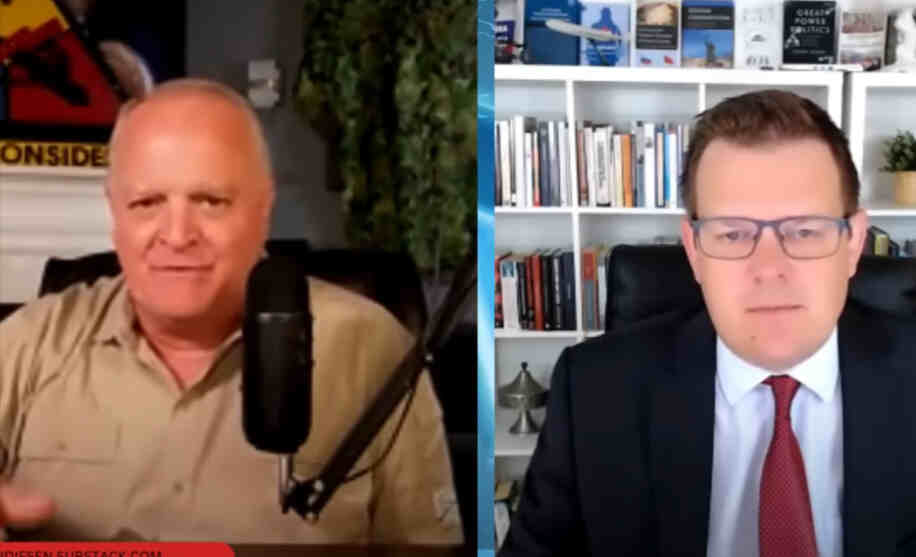
Read the full transcript of 4x combat veteran and host of the Daniel Davis Deep Dive YouTube channel Lt. Col. Daniel Davis in conversation with Norwegian academic Prof. Glenn Diesen on “Trump’s Threats Against Russia Backfire”, August 1, 2025.
The Current State of the Ukrainian Battlefield
GLENN DIESEN: Hi, everyone, and welcome back. We are joined again by Lt. Col. Daniel Davis, four times combat veteran, Bronze Star Medal for Valor and Bronze Star Medal for service. Also the host of the Daniel Davis deep dive on YouTube. So welcome back to the program.
DANIEL DAVIS: Great to be here. Thanks for having me back. I appreciate it.
GLENN DIESEN: So I wanted to first ask you about what is happening in Ukraine at the moment, because the war has gone through many different stages as the technologies developed and especially the drone technology. In the beginning, of course, Russia thought they could pressure Ukraine and NATO into a peace agreement. Then it turned into war of attrition.
So we’ve gone through this. It looks as if at many points the Ukrainian army’s been incrementally moving towards collapse. But what’s happening now seems a bit different in terms of the Ukrainian army becoming exhausted. I was just wondering how you effectively read the battlefield at the moment.
The Mechanics of Modern Warfare
DANIEL DAVIS: Yeah, I kind of look at it in similar vein that the mechanics of war are playing out as they just nearly have to when you have such a dramatic imbalance in the inputs that go into a war of attrition that we have here, where you have one side, the Russians, that have an advantage in the air, they have an advantage in air defense, advantage in the armaments of war, their industrial capacity, and above all in the manpower pool, just the number of people from which they can draw.
And the other side, the Ukraine side, is deficient in all those categories. And in many ways, they’re actually growing further apart as time goes on, especially in the manpower pool as well. The only place where you have parity is in the drones. And that is a big issue. That’s a big one because it’s not decisive, but it has dramatically changed the nature of modern warfare on the conventional level.
And so that advancement in capacity has enabled the Ukraine side, with fewer men, to lure slower. It’s not going to change the outcome. It’s not going to change the nature of an attritional war because they still keep losing men every day. They still keep imposing casualties on the Russian side every day, but not as many because of how the Russians fight. And there’s just not as many Ukrainian men.
Shrinking Ukrainian Forces
And you’ve seen over the last four or five months especially. And Julian Rivka, the German journalist, has really chronicled a lot of this. The density of forces on the Ukraine side keeps shrinking. I’ve actually introduced or interviewed on my channel some journalist from the Ukraine side who’s been multiple times on the front line, and he said his own observation matches that, that he’s seen the number of Ukrainian men that have, that are targeted with defending a certain sector or a certain city or village. They keep shrinking. There’s not as many of them.
And now then you see the Russians are also, they’re advancing in how they’re fighting the war. And so you know, these so called “meat waves” that they are alleged to have done earlier on now then they’re not even allegedly doing that now then they minimize the number of troops that actually get to the point of contact. And they’re using a lot more flanking maneuvers much more effectively because they have the troops, they can do it, they have the reserves.
The Ukraine side does it. And when they start having a penetration or loss in one area, they have to move troops from somewhere else. But then the Russians will then increase the pressure in that point and they start going back. And it’s just like putting your finger in the die. You run out of fingers. But the holes keep coming and the water keeps leaking. And I think that’s kind of where we are.
Critical Battlefronts
And when you look at the current context of the battlefield, you see that the, especially around the Pokrovsk, which is kind of the central part and that’s definitely the Russian main effort right now. They have supporting efforts in Kupiansk on the northern part of the eastern front and in Kherson on the southern part of the eastern front.
But that Pokrovsk area and the Konstantinovka in the area, there’s a couple of different pockets forming there. Kupiansk is forming a pocket. Russian troops are there, they’re inside the city, in the outskirts there. They’re inside the city of Pokrovsk there. That literally could fall within a matter of weeks now. It’s been remarkable and it’s a testament to the fighting capability of the Ukraine side. It’s held out this long. But there is a breaking point and I think they’re getting close to it there.
And if that falls too, and depending on how it falls, it could open up additional avenues for the Russian army to exploit further. They’re already in the Dnipropetrovsk area. They’re also in the Sumy area, they’re in the Kharkiv area. So you see there’s many places where fighting is going on. The Ukraine side simply doesn’t have the manpower and the resources to forever defend and not eventually crack somewhere.
The Casualty Rate Narrative
GLENN DIESEN: It’s interesting though that given that Russia dominates in air power manpower, well, most of the areas and the Ukrainians are taking obviously then many more casualties. But why is it that we still see in the Western media that the Ukrainians enjoy favorable attrition rates, i.e. that the Russians are losing more men than Ukrainians because it doesn’t really make sense from any of the metrics we’re looking at on the battlefield.
DANIEL DAVIS: You know, I was actually on an X post live show with some folks that were very much pro Ukrainian.
And it’s ironic because I am pro Ukrainian people. I am all for protecting the people and the continuation of this war is the worst thing imaginable for the people in the country of Ukraine. So I very much care much more about the Ukraine side than I do about the Russian side.
But when you take a look at what’s actually happening and then you try to reconcile that with the statements and words, it’s just what we want to be true. On this particular X show I was talking about there, someone was talking like they had seen a textbook somewhere, a military textbook that said the attacking force has to have a three to one advantage over the defending force because the defending force can draw the attackers in and then they can kill more of them. That’s why you need a three to one advantage. That’s what he read in a book apparently.
And I’m like, okay, that’s in a book and that is a general truism. But the way this fight is being done now is the Russians have adopted and changed their tactics and how they approach these so they don’t just go slamming in there. They prioritize their troops at the expense of the other side. So at the expense of speed probably is a better way to put it.
Russian Tactical Evolution
So Russia is willing to take a lot longer to achieve an objective by prioritizing firepower, drones, missiles, artillery, rockets, you know, airstrikes, et cetera. And they will pulverize an area as opposed to sending in, you know, a big infantry or armor wave to try to punch through something like that. So that makes it go a lot slower. But that also means that the Ukraine side is under a withering weight level of fire.
And the idea that the side that’s under the massive fire bombardment and the disparity is going to suffer less casualties than the guys who are taking it slow and easy. It just doesn’t stand up. But most people in the west don’t care about what the reality is. They only care about what the narrative is.
And so it keeps people supporting the war because nobody’s paying attention to this. You know, not many regular Americans or regular Europeans are doing the detailed analysis that I’m talking about right here. They just hear the narratives that that’s spoken by these and they see four star generals or members of parliament or leaders of different countries and they say these statements and they just take them at face value because I want to, if anything that makes it sound like it’s worse for Russia is good for most in the West.
And so these leaders exploit that and they move on. Problem is you can only keep that up so long because the actual realities on the battlefield will eventually play out and at some point spin and truth are going to clash and truth will win out 100% of the time. You can’t spin the realities. At some point, truth wins out.
The Paradox of “Pro-Ukrainian” Positions
GLENN DIESEN: This is the strange part for me throughout this war that is that the people calling themselves the pro Ukrainians are the one who supported the regime change in Kyiv. They supported the NATO expansion. They opposed the implementation of Minsk agreement. They opposed offering Russia security guarantees in 21 when they were going to, when they knew that the consequence will be a Russian invasion.
They pretend the Ukrainian casualty numbers are low. They ignore the Ukrainians who are snatched off the street and sent to the front line very much unprepared. And again, they just advocating for anything that keeps the war going as opposed to accepting compromise, especially given that the war is being lost.
And it’s just strange to me that these people are the ones who have been able to monopolize on the so called pro Ukrainian position and anyone else would be pro Russian, anti Ukrainian. It’s a very strange way they’re dominating the narrative though, when you put it.
DANIEL DAVIS: All together like that too. It’s really a powerful punch to show all of those things you mentioned are counterproductive for the Ukraine, people, country, land and cities. And it puzzles me why you keep going this long. We’re talking three and a half years now and too many people still don’t get it. And that’s really sad to me.
Trump’s Ultimatum to Putin
GLENN DIESEN: Well, Trump is now, as he says, angry with Putin. He says Putin is giving him a lot of BS and the deadlines have changed again. It’s down to 10 days now. I’m not sure how many days are.
DANIEL DAVIS: Left, but August 9th is the 10th day.
GLENN DIESEN: August 9th. Okay, so what will happen then on August 9th, in your opinion?
Trump’s Sanctions Strategy and Its Limitations
DANIEL DAVIS: Well, what Trump has said is it’s going to be sanctions. Now, whether there’s additional things, we’ll wait and see. But the Blumenthal and the Lindsey Graham sanctions package, which Blumenthal is advocating since, still vehemently said it needs to be a 500% tariff on anybody who does business with Russia, not a 100%, which by itself is kind of silly. There’s not much chance that would actually work, that would actually compel the change in the secondary sanctions with specifically China, India, Brazil, number of others who get Russian petroleum products as well as a bunch in Europe who still get them.
So one wonders, will Trump say, “Okay, I’m not going to sanction any of the people in Europe, so we’ll let them pass. They can keep buying Russian petroleum, but Indians, yeah, we’re going to sanction them, and then Brazilians, yeah, we going to go after them.” That’s not going to play well in India. If you see you actually put sanctions on them because they’re buying Russian oil and you don’t put it on Europeans who are also buying Russian oil, you can see, well, that’s going to cause a severe backlash.
And will could cause India to say, “We’re just going to move out of your orbit and we’re going to move more closely into the Russia or the BRICS or the Chinese orbit.” There’s lots of reasons why they may not want to do that, too. They appear to want their own political and economic independence, to be freelance actors, to do whatever they think is in their national interest. But they don’t want to be compelled to go into just the American orbit. And I doubt that they will.
The Reality of Russia’s Sanctions Resilience
So the question is, what is going to happen with that? What I suspect is going to actually happen is Trump will level a new package of sanctions on Russia, which Russia will just go, “Okay, we’re pretty much made ourselves sanctions proof. Maybe it’ll hurt a little bit.” But Russia has made themselves effectively sanctions proof when 18 packages from the west since this war started haven’t compelled any kind of a change in reaction.
So it’s absurd to think that another one is going to do something when the others haven’t. And to try and do these reciprocal sanctions or secondary sanctions, they call them on these other countries to coerce them into taking actions antithetical to their national interests that would benefit us, that’s just not going to happen. It’s been very unrealistic and could harm us even more.
I mean, I think you can make a pretty strong case that the 18 rounds of sanctions have hurt Western Europe more than they’ve hurt Russia. And trying this would just exacerbate that.
Trump’s Diminishing Options
So what I suspect is that basically this is going to serve as the last chance that Trump had to reach any kind of diplomatic outcome of this, because he will have played his last cards. And I can’t even imagine that he would play these cards. It has no effect. Russia doesn’t change on the battlefield or in the air. They continue on with these almost now daily hundreds of drone and missile strikes that keep getting through all this stuff I just described on the battlefield. None of those things will change. And then what’s Trump going to do? He has no more cards to play, and so now he’s just left himself as well. Then the war will just continue.
On Newt Gingrich yesterday on Fox News, he speculated that Trump may then also increase dramatically, in his words, the amount of ammunition and weapons that we give to Ukraine. Here’s the problem. We don’t have a dramatic amount to give. We’re already, it’s by many credible resources that the Pentagon is already alarmed because we’re below right now the minimum threshold of ammunition stockpiles that we need for our own national security.
So unless you want to deplete those even further and then leave our national security at risk, should we get into a war, God forbid, with Russia or China, I mean, we’ll have screwed ourselves before it even gets to it. And I just don’t think that Trump would do that because that wouldn’t make any difference anyway. We’ve already tried everything in the world, so it won’t make a difference. The Newt Gingrich is wrong even on that point there, too.
So bottom line, I guess the general answer to your question is the war will just continue on and Russia will continue to methodically destroy Ukraine and kill their troops until at some point the line just breaks. And I think you have a dramatic roll up of the line somewhere. I think that could happen at any time. It could also drag out many more months, maybe the end of the year. I don’t know. There’s too many variables that I can’t predict that I don’t have access to. But it’s all bad for Ukraine.
Trump’s Understanding of Russian Motivations
GLENN DIESEN: Yeah, it’s… I’m wondering if Trump understands Russia, though, because he switched now from talking about NATO expansion to suddenly speaking about European peacekeepers in Ukraine to supervise a ceasefire. Do you think… Well, on this premise, do you think he understands what Russia is actually after? Because one could say that he’s just ignorant. But in the past, he kept pointing out that he can understand why Russia would be worried about NATO expansion. He was making the point that this was Biden’s fault. He shouldn’t have expanded NATO. For years and years, people said this would result in disaster. But now suddenly he doesn’t talk about this anymore. So it’s hard to just write him off as being ignorant because he has had his finger on the pulse for so long. So how do you explain…
The Impossibility of Peacekeeping Without Peace
DANIEL DAVIS: It’s unclear to me. I think it’s probably going to be largely irrelevant. There’s not going to be any peace to keep there. I mean, the only conditions that will allow a diplomatic end to this war, where the war could literally stop overnight, is if the Ukraine side capitulates to all the political requirements of Russia, which are draconian. There’s no question about that. It’s virtually impossible for Ukraine to do it, though they should.
The only reason we’re in this position now is because we have refused. As you pointed out earlier in this episode here, we had many diplomatic off ramps over the years, both before the war started to prevent it as well as many going on through it. And we have rejected the mold. This is the cost for having failed to do to prevent the war from coming in or take any of these other diplomatic off ramps. The most recent one was June of 2024.
And then now the one we’re currently in right now, every time we have said no to the off ramp and kept going, the conditions got worse. And so that’s where we are now. These draconian positions, negotiating positions that Russia would stop the fighting if they get, are going to be far worse if we keep going. And until Russia finally just says, “All right, we’re not even worried about a negotiation anymore, we’re merely going to conquer on the ground what we think we need to ensure our security against the entire Western world.”
And however they choose to define that, that’s what’s left. And then there won’t be any terms. They’ll just be, “This is what you get from what we haven’t destroyed,” et cetera. So it’s going to get worse. And so I don’t think that there’s going to be any kind of a negotiated settlement. We’ve, I think we’ve lost a chance of that. And I think that it’ll be sealed on August 9th whenever Trump does whatever he’s going to do in response to his 10 day deadlines expiring.
Russia’s Position on Root Causes
GLENN DIESEN: Yeah, Trump makes the point that he has nice conversations with Putin, but then the night comes and the missiles fly. But if the… I can understand the position in Moscow. If Trump only presents the idea of an unconditional ceasefire without addressing the root causes again, the reason why Russia invaded to begin with, which was to restore Ukraine’s neutrality. They would probably not have much faith anymore in the negotiations and thus seek a…
The Contradiction in Trump’s Claims
DANIEL DAVIS: I find that really, really odd by President Trump’s talk, because he keeps saying, “Four or five times we thought we had a deal, and Putin talks to me nice in the morning, and then there’s missiles flying at night.” And when you look at the readout of what both sides have said about those calls, the most recent one, I think was on July 4th. Third, if I’m not mistaken, the Russians were always polite.
Sergey Lavrov says that we are professional, we’re diplomatic, and we’re not going to engage in all this hyperbole and all this other stuff, but we’re also very adamant on these are the conditions. So there’s no evidence that Putin has ever said anything other than “We’ll stop fighting if these conditions are met.” And when those conditions aren’t met, he does what he said, he just keeps fighting.
So I don’t know why anyone would think they had a deal unless Trump on the phone agreed to the terms that Russia said and then didn’t follow through. That’s the only thing that would make any sense, which would be weird in a different way. But there’s no possibility, in my view, where Putin gave Trump any indication to think that he was going to give Trump something he wanted, short of those addressing the root causes that you mentioned.
And so I don’t know why Trump keeps being surprised when his requirement for a 30 day unconditional ceasefire, which would only help the weaker side, isn’t accepted by the stronger side. I mean, it’s irrational, and yet that’s just what we have. So it’s hard to make sense out of all that.
Russia’s Response to Shifting Timelines
GLENN DIESEN: Especially at the final stages of the war. You see the collapse intensifying. And this is the point. We go to the Russians and ask them to capitulate, and effectively, if they end the conflict or drop their main objective of no NATO expansion, and then accept new European peacekeepers, as we’ll call them, in Ukraine, which would be a stepping stone to NATO. It’s a weird time to ask for Russia to capitulate after three years of war. But how is Russia reacting to this, though? The latest is the one day because they have gotten some different timelines. The war was going to end in 24 hours. We ended up with 100 days, then it was 10 to 12 days. So how are they reading this? Are they responding to the…
DANIEL DAVIS: Well, first it was before I was going to Trump was going to enter office, then it was 24 hours, then it was 100 days, then it was a few days, not weeks, but a few days. And then it was well a couple of weeks and then it was okay, 50 days and then now it’s 10. So it’s a lot. And none of them have mattered. None of them have meant anything. There’s many times where Trump has threatened all kinds of things and never followed through with them and then just changed the timeline.
So I think that now, to answer your question directly, Russia just looks at these and they just go, “Yeah, whatever he said,” they don’t pay any attention to it. They can’t put any faith in anything Trump says or any trust in it. And no matter what Trump sets days or months or weeks or anything else, any kind of timeline, if the conditions that the Russians from a position of superiority are not addressed, they’re just not going to, it’s not going to matter what the other side says. They’ll continue doing what they’re going to do.
Russia’s Long-Term Strategic Approach
They have a methodical plan in place. They have the resources to conduct it. They have the time to conduct it because they don’t have any near term objectives, time wise of their own. If there’s a break in the Ukraine military in the next month or week or 10 days, then they’ll react to that. If there’s not and if the Ukraine side continues this remarkable but ultimately suicidal strong fighting and continues to just lose slowly, Russia can do that too.
They’re willing to do whatever it takes to accomplish their long term security. And that’s what I think few in the west understand is that they’re not on a timeline, the Russians aren’t. They’re on an objective. And if it’s done quicker, medium or slow, it apparently doesn’t matter to the Russians. They have the plan and the resources to conduct them all.
Strategic Cities and Logistics Hubs
GLENN DIESEN: It might speed up soon though. You mentioned earlier these cities from Pokrovsk, Konstantinivka, Chasivyar and Kupyansk, but these are all larger cities which are looking that are all going to fall. Well, Konstantinivka probably later than the others. But these are also not just big cities where you can build up a very critical force to move on, but they also are quite important logistics hubs. So and afterwards it doesn’t seem to be that many front lines or well, not front lines but what’s well fortified defensive lines left before the near…
Ukrainian Defense Capabilities and Manpower Challenges
DANIEL DAVIS: There are, I mean you can make some. There are, I mean Seversk is another one that’s not far. Liman can potentially be fortified harder. And you look and there’s a number of geographic locations, river lines, et cetera, there’s plenty of places you could defend from. So they can do it if they have the resources to build those and the manpower to man them.
One of the problems that was identified, I think it might have been Julian Rivka, just a couple of days ago, actually said some of these fortifications, where they actually had them built, they didn’t have enough manpower to operate them. So the Russians just walked into them, basically because the Ukraine side didn’t have enough to man the fortifications it had.
So we keep getting to that manpower issue. That’s the real, I think, fulcrum of the whole deal is how long will the manpower on the Ukraine side last? Not whether there’s enough fortifications or other cities to fall back to, etc. But how long do they maintain the unity of a coherent army with which to conduct these defenses?
And that’s really impossible to know. I frankly, just being honest, I thought that might have reached its culminating point last summer, at the end of the summer, early fall, and obviously that didn’t happen. It still hasn’t. So I’m not making any more predictions other than that the fundamentals exist and it will happen at some point. We just don’t know what that point’s going to be.
The Risk of Direct US-Russia Military Confrontation
GLENN DIESEN: Yeah, no, I also thought Ukraine would have been exhausted long time ago, but, well, they’re persistent fighters, you know, you have to give them this.
My last question is more about the possibility of this deadline expiring and the United States actually engaging in some form of direct military actions against Russia. I ask because Lindsey Graham, he was making this statement that’s quite reckless, one could add, but he seems to be pushing for escalation that if Putin wants to know what happens after day 10, or, you know, back when it was 50 days, he said “you should look towards the ayatollahs,” so suggesting that America would bomb them, perhaps.
But there’s also been this more aggressive rhetoric from Dmitry Medvedev as well, the former Russian president warning Trump against threatening Russia, that this would be a direct war between the US and Russia. And Trump already responded that he should be careful. And, you know, so it’s this, it would be a great irony given that this wasn’t supposed to be Trump’s war and he was going to end it in one day, but he’s taking more and more ownership. Do you think it’s a possibility that this could result in a direct conflict?
DANIEL DAVIS: It’s always possible. That’s been my number one concern from day one of this war. That’s one of the key reasons that we needed it for our own national interest, to get it off the table so that we eliminate that possibility. Every day the war continues on, that risk remains. And the longer it goes, frankly, the higher the risk is that somebody either makes a bad decision, they miscalculate, they misinterpret something, or they think they can get away with just crossing this red line a little bit, but not realizing that the other side has said no, that is a hard one. If you cross that, then I will, and you don’t know where that’s going to be.
The Absurdity of Military Action Against Russia
The height of absurdity would be for the United States, and that means Donald Trump, because he’s the commander in chief right now, to take any military action whatsoever against Russia. It was either Newt Gingrich yesterday, or it might have been Blumenthal or maybe even Lindsey Graham, I can’t recall which one it was that said, “Yeah, what we need to do is get more on the other side of August 9th. We need to get more aggressive with long range stuff that will target more effectively strikes deeper inside of Russia, enabling the Ukraine side to do that with American capability.”
Because the problem is, I think that there are, this is one of, when I say miscalculation, there are clearly those in the west that think, “Well, we did stuff with ATACMS, with the Storm Shadow, with, you know, some of these other long range missiles, and it didn’t spawn a war. We didn’t, Russia didn’t attack Germany with Taurus missiles or when they use Taurus missiles or any of that kind of stuff. So they never will. So we can be a little bit more aggressive in doing it.”
And what we don’t know is where the Russian patience has been exhausted, where that comes into play. And there’s lots of folks inside Russia, I can promise you, that have been angry at Putin for not having responded earlier and we don’t know where that could finally trigger Putin to say, “That’s it. You, you, you know, the straw that broke the camel’s back,” so to speak, was finally reached.
And all of a sudden they do something that they may calculate, “Okay, this is just an answer in kind. This is just to send a message to you. We’re going to hit this ammo depot in Poland or in Romania or maybe this weapons factory for the Taurus missile in Germany itself, et cetera, just as a warning.” And now all of a sudden everybody gets freaked out. It’s Article Five time. And suddenly we’ve got this war that all too easily could go nuclear.
That is my big fear and one of the big reasons why we need to get this thing over with as soon as possible. But as long as the war continues, room for stupidity, miscalculation, misinterpretation will remain alive. That potentially could harm us all.
Changing Rules of Proxy Warfare
GLENN DIESEN: Yeah, I think this has been one of the key challenges in this war is that the rules of proxy war has been changed so much the past three years we’ve been working to define the rules. So again, in the beginning, you had people like Biden saying you couldn’t even send F-16s. “This would be World War Three.” Now it’s unproblematic.
So it’s this salami tactics or this incrementalism just doing a little bit step by step and then normalizing it. And every time the Russians don’t retaliate, it’s not seen as being cautious, but weak. And so it also sets a precedent. Now this is allowed essentially in a proxy war.
This is why it’s kind of terrifying to listen to the German Chancellor, you know, calling for taking leadership in the conflict or the war against Russia. This is if I was sitting in Moscow, I would retaliate against any NATO members. You know, the excessively aggressive Germans who do not have nuclear weapons would probably be my optimal target to restore some deterrence and make an example though.
But it’s no, it’s a. I fear that in this final stages, if Ukraine goes towards a collapse now, do you think the west could do something stupid? I mean, it’s.
DANIEL DAVIS: Yeah, I do.
GLENN DIESEN: There is some.
Desperate Actions in the Final Stages
DANIEL DAVIS: I think that there’s also going to increase the risk that Ukraine leadership does something stupid if a collapse scenario begins to unfold. And they say that, you know, battalions, entire battalions or fronts start to disintegrate or abandon the fight and Russians start like literally pouring through an open hole because Russia has the exploitation troops from all I’ve been able to gather that are positioned at numerous points, not fighting, just positioned for such an event. And if there’s a breakthrough, they can suddenly roll a lot of people in that undefended area.
In the event of something like that, I worry a lot about the Ukrainian leadership doing something alarming and desperate and potentially catastrophic like, I don’t know, with a dirty bomb possibly, or some other kind of really provocative attack against the Russian side in order to spawn an over retaliation that could then strike at the west and then draw in Russia or that Russia does some mass casualty kind of situation which would shock the Western Europeans and say, “Oh, we have to come to your help.”
I worry about that in desperation, doing something that is, that intends to cross the line somewhere in order to try to spawn a Russian response that would then be seen as a casus belli to launch into a war. That is one of my bigger worries as well.
GLENN DIESEN: Well, on that terrifying note of the final stages of this war. Thank you so much. This is, I can’t believe we got to this point. This should have been negotiated a long time ago, but, yeah, here we are.
DANIEL DAVIS: Definitely should have been. Thank you very much. Yeah, I totally agree. We should definitely get this off the table ASAP.
GLENN DIESEN: Thank you.
Related Posts