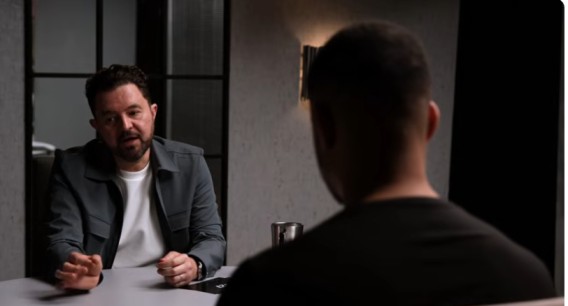
Editor’s Notes: In this episode of The Diary Of A CEO, entrepreneur Daniel Priestley joins Steven Bartlett to discuss the seismic shifts AI is bringing to the global economy and the workforce. Priestley explores his bold prediction that blue-collar trades could soon out-earn many white-collar professions as automation disrupts established industries. The conversation covers essential survival skills for the AI era, such as personal branding and entrepreneurial thinking, while also warning of potential financial risks ahead. Finally, Priestley offers a grounded perspective on why human relationships and family remain the most valuable assets in an increasingly automated world. (Mar 16, 2026)
TRANSCRIPT:
The Most Transformational Time in History
STEVEN BARTLETT: Daniel, I think we’re living in the most interesting, opportunistic, terrifying time to be an entrepreneur, a professional, to really be anybody, because this is a moment of such fundamental change.
And I really wanted to have this conversation with you today because I want to understand how you’re thinking about AI from an opportunity standpoint as an entrepreneur, but also just for everybody that’s working in a normal job and who is at risk of having their career, their livelihood, their identity, their qualifications made redundant because there is now an alien amongst us that can do so much.
So this conversation really is about giving people answers. It’s about being honest with them about what’s coming and it’s about preparing them, setting them up so that they have an advantage in the face of the future we face. So give me the 30,000ft view.
DANIEL PRIESTLEY: Well, my background for the last 25 years has been building companies from scratch. And I’ve been through the dot com and I’ve been through global financial crisis and I’ve been through Brexit and Covid. I have never experienced what we’re experiencing right now. I’ve never seen more excitement for the opportunities that are in front of us and I’ve never seen more fear for the disruption that is coming. We are living through transformational times. That is very similar to 250 years ago, where the end of the agricultural age ended and the beginning of the industrial age began.
AI and Robotics: Two Forces Converging
STEVEN BARTLETT: I would argue that it’s more significant because there’s two forces that kind of keep me up at night. The first force is AI, which is, you can think of it as just the replacement of the human brain from a sort of productivity standpoint. And then the other is robotics. And the problem is they’re coming in at the same time. And I was watching. I don’t know if you saw this the other day.
DANIEL PRIESTLEY: I did, yeah.
STEVEN BARTLETT: So I’ll put this on the screen for anyone that’s watching the video right now. But this is a demonstration that took place in China of how advanced their robots are. And I had to check multiple times to make sure that this wasn’t fake. They are doing backflips and landing perfectly on their feet. And so when you combine intelligence with the disruption of our physical form, our muscles, our body, our ability to pick things up and move them through time and space, it begs the question, where do we fit in to all of that?
DANIEL PRIESTLEY: Strangely, there’s something called the Jevons Paradox. And the Jevons Paradox is a paradox where when we think something is going to completely disrupt the way that we live and work, it often has the opposite effect. We thought that YouTube was going to completely wipe out television. And it’s true that Hollywood lost tens of thousands of jobs, but YouTubing created 500 to 600,000 jobs at the same time. And it used to take 150 people to make a TV show or a movie, and now it’s five to 10 people making YouTube videos as a little team, and they can have a wildly successful YouTube channel.
With the Jevons Paradox, if we currently said that in order to have a successful software company right now, today or in the last few years, you needed to have 10,000 customers and you needed to have a team of 50 people, and you needed to raise 1 to 5 million dollars to get a software company off the ground, if all of a sudden the cost and the commitment drops dramatically to have a software company and you only need 500 customers to make it work, and you only need two people on a team to make it work, and you only need a tiny bit of funding to make it work, what happens is, like YouTube channels, you can end up with literally millions of tiny little software businesses that are super successful for five to 10 people, and they do something niche and they do something special.
They don’t look like traditional software companies either. So a traditional software company would just do the software. Whereas these little software companies might do software, plus they might do dinner parties where the clients get together. They might have an annual ski retreat, they might have a podcast and a YouTube channel that goes with it. And all of that could be done by five to 10 people using AI tools.
So the Jevons Paradox would basically say that there are millions of unmet needs and that those unmet needs are not explored because the cost to explore them is too high. But because the cost to explore those has come down, now we can actually have millions of businesses that never existed, that we didn’t even know we needed to exist.
The Speed of Transition
STEVEN BARTLETT: I was sat here the other day with Dara, who is the CEO of Uber. He turned around Expedia, made it super profitable, turned around Uber that was losing 2 billion, made it generate about 9 billion in revenue, 10 billion in revenue. And he sat there and said to me that their 9,000 couriers and drivers won’t have jobs in the future.
DANIEL PRIESTLEY: It takes a long time to build.
STEVEN BARTLETT: But this is the first innovation that I’ve lived through that is built on—
DANIEL PRIESTLEY: It’s instantaneous, the Internet. The minute an AI learns how to be a lawyer in one place, it can be a lawyer in every place. The minute it learns how to diagnose a disease in one location, in one hospital, it can diagnose a disease in every hospital in the world. So it’s this instantaneous rollout because it sits on top of a network that already exists.
STEVEN BARTLETT: This is what actually Boston Dynamics said to me. I was watching a video of their new robot that’s working in factories. It’s a humanoid robot that can work in factories, pick things up, move things around. They said the great thing about robotics is if one of our robots on a shop floor in Boston learns something, all of our robots learn it.
DANIEL PRIESTLEY: It’s wild.
The Tesla Cybercab and the Future of Driving
STEVEN BARTLETT: Yesterday, Tesla built and they took this wonderful photo because they built the world’s first Tesla Cyber Cab. Now, if anyone doesn’t know what a Tesla Cyber Cab is, it’s the first ever fully autonomous car that doesn’t have a steering wheel and it doesn’t have pedals.
DANIEL PRIESTLEY: Yeah, you just hop in and there’s no steering wheel, no pedals. You can’t take control even if you wanted to.
STEVEN BARTLETT: The Cybercab is the company’s answer to vehicles like the Waymo. The two seater coupe unveiled in 2024, comes without a steering wheel or pedals. It’s guided by AI and they’re now making them. The first one was made yesterday. Again, over 100 million people’s job is to drive. And you can get one of these now for, Elon saying $30,000, you can rent them, lease them, you can buy a bunch as investment assets and set them out, set up your own fleet and connect them to different networks like Uber and all of those sorts of things.
DANIEL PRIESTLEY: And the cost to move around is going to go through the floor because my Uber to come here today was probably $50, and that will probably be six or seven dollars once that is rolled out.
So the thing with the Jevons Paradox is it doesn’t mean that everyone gets the same job and that there’s just more of exactly the same jobs. It means that the transformation creates exponential growth as a result of the transformation in an unexpected way.
So growing up, my mum worked in newspapers and there was probably half a million people working in newspapers as journalists and all of those sorts of things. And that has dropped by 80% in the last 25 years. But at the same time, the number of people who are bloggers, the number of people who have Substacks, the number of people who are doing the kind of work of journalists and actually making money as a result of content creation has gone 100x. So I think it’s something like three to four times more people now make their money in a way that kind of looks like a journalist than there ever were journalists prior to the technology that disrupted journalists. So it’s not that those exact same jobs are replicated, it’s that something similar emerges as a result.
The Supply and Demand Problem of Content Creation
STEVEN BARTLETT: I understand this, and when I read about the Jevons Paradox, I ran it through my head multiple times to understand how it fits in different industries. But there is a part of me that still thinks this is slightly different, because in the example you gave, where there was a content creation industry that was then disrupted by a content creation industry, I go, yeah, the skill of human intelligence was still rare and scarce, and only humans had it. So the disruption of the content creation industry to a different content creation industry was still owned by humans. That transition was still a human one.
But in such a world where AI agents can make — if you go on a lot of social media platforms, I shan’t name which ones, it’s just pure AI slop now. It’s just people’s agents churning out content that they haven’t touched or done anything about.
And then I started saying to you before we started recording that what we’re going to experience, and what I think a lot of people don’t fully embrace about this idea of becoming a content creator for a living or building a personal brand, is when you look at some of the graphs — and I’ll throw the graphs from the Financial Times article on the screen — there’s now a plateau of people spending time online for the first time in history. Well, for the first time in Internet history, Gen Z especially were the first generation to plateau in their time spent. But the amount of content, the amount of AI agents, the amount of people that are now choosing to do content as a living is exploding.
DANIEL PRIESTLEY: Yes.
STEVEN BARTLETT: So you have a supply and demand issue where there’s a set amount, really like a set amount of hours, sort of consumption hours, and then you have this huge exponential explosion in available content. Because a kid in Mumbai—
DANIEL PRIESTLEY: Yeah, the attention is a limited resource, but content is unlimited now. And AI slop is just rolling in. And also “AI slop” doesn’t do it justice. Some of my favorite things to watch are AI generated. I’m enjoying AI.
So think about it a little. When it comes to personal brand, think about it a little bit like an airport that has got this fog rolling in. If your airplane is already above the fog, then you can continue to fly. But if your airplane is not taking off already, then the fog is going to keep you on the ground.
So for example, you’ve invested so much into your personal brand and people will come along to see you live and they would love to go to a dinner party series that involves you. And there’s a whole community around DOAC. So all of those things mean that your airplane’s already up in the air, you can continue to fly. But if you were starting two years from now or a year from now, or maybe even six months from now, and you weren’t smart about it, there’s just too much AI generated content. You won’t get traction, you won’t get that liftoff moment. The same way that opportunity is coming to an end because of that AI generated content.
The Rise of Algorithmic Media
STEVEN BARTLETT: What I’m seeing in the algorithms — we do some data analysis every year on the variance of performance of pieces of content we produce on different channels. Now I’ve been making social media content for 15 years, so I have a bit of a mental history of every year doing this particular data analysis to see the variance between the worst thing we post and the best thing we post.
And this year we did the same, we ran the same analysis with my data science team, led by Austin and my team, to see if the variance between the worst thing we post and the best thing we post is getting bigger. Because what that is a proxy of is: is the algorithm caring less and less about how many followers I have, and is it caring more and more about whoever posts the most interesting thing today? Which is, if I was building a social media company and my primary objective was to retain people, I wouldn’t care if you have two followers and Steven has 500 followers. I would just care about who has the best thing.
So we did that analysis and it’s an almost perfect graph that looks like this. And this is the variance increasing.
DANIEL PRIESTLEY: Yep.
STEVEN BARTLETT: Which actually means that, okay, Steven’s taken off from the sky, but every day I wake up increasingly, it doesn’t matter what I did yesterday.
DANIEL PRIESTLEY: What we’ve seen is the end of social media and the birth of algorithmic media interest.
STEVEN BARTLETT: Algorithms, we call them.
The Creator Economy and AI’s Economic Risks
DANIEL PRIESTLEY: Yeah. So social media was all about connecting with your friends and finding out what your friends are doing, and algorithmic media is just finding out what the algorithm thinks that you should be watching today.
But with that said, there’s this multidimension to it, which is you’ve got books, you’ve got live events, you’ve got the podcast, and it’s the multidimensional angle that actually really sets you apart. The creators that just simply want to put a piece of content on YouTube and get paid through AdSense revenue and that really simple, that one dimensional model that’s coming to an end, but the creators that have a community and they meet up in the real world, all of that is part of an overall ecosystem that is very defensible because people want all of that packaged up together.
STEVEN BARTLETT: Why is it fundamentally defensible from — if we think about first principles or human Maslovian needs?
DANIEL PRIESTLEY: Let me give you a big answer to that, which is, if we go back in time to the agricultural age, farmers had to know when was a good time to plant the crops. And then they had to go out and toil the soil and put the seed in the soil. And the soil did most of the value creation in the economy. At the end of that process, the farmer had to know this is the day to harvest. And then we need to harvest that and we need to turn it into something and take it to market.
And AI is very similar, which is that it’s very good at doing the middle to the middle. It’s not good at knowing what to do in the very first instance, or knowing when to stop and how to take it to market. So the entrepreneur’s job is to do step one and two. Let AI do steps three to eight, and then do steps nine and 10, and to basically have a coherent, cohesive view as to what you’re trying to get the AI to create.
STEVEN BARTLETT: Theoretically, though, I could ask an AI agent to think about the goal that will benefit me the most and make as many AI agents as it needs to to fulfill that goal. And then it would start one business and that would start another business, start lots of different businesses, build another website, contact a supplier.
DANIEL PRIESTLEY: I think what you’re into here is two or three steps ahead of yourself, where all of this is theoretically possible. But we haven’t seen those kind of examples happening yet. Right? We haven’t seen whether that will ultimately unfold. I’m not saying it won’t. I think we are moving into a completely new economy.
Like when you lived in the agricultural age, it was completely, like, unbelievable to you what the industrial age would have looked like. It’s beyond all comprehension if you had an agricultural age mindset to imagine factory production or coal production.
Exponential Growth and the Coming Financial Crash
STEVEN BARTLETT: And the thing, the principle there that allows you to see what the future might look like when it’s exponential and not linear, is imagining any rate of improvement. And so this is how I think always in my business — when I’m thinking about which bet to make, I imagine if there’s just a 5% rate of improvement per quarter, eventually this happens.
And so with some things we’ve done on this show, we started two years ago, and for the first 18 months it didn’t work. And then six months ago it exploded. Because eventually the rate of improvement got to the point where it was viable. And now it’s the single most important disruptive thing we’ve ever done.
And I think about the example I just gave there of agents — I’m like, if you just imagine any rate of improvement, just imagine 1% a year. And obviously it’s way more than that. But imagine 1% a month. Eventually we get to a point where —
DANIEL PRIESTLEY: A team of agents — if nothing disrupts it. One thing that is very likely to happen in the next three years is the whole thing comes crashing down. It doesn’t financially make any sense to build the data centers that we’re building.
STEVEN BARTLETT: But you’re not saying that AI is going to disappear.
DANIEL PRIESTLEY: The technology itself is remarkable, but the financial model just makes no sense whatsoever at the moment.
STEVEN BARTLETT: At the moment, which is kind of typical of boot bubbles, right?
DANIEL PRIESTLEY: So over the last 180 years, there have been infrastructure buildouts that have bankrupted the economy consistently, again and again and again. In fact, there’s a pattern. Whenever we spend more than 3% of the overall GDP of the economy on an infrastructure buildout, it bankrupts the economy briefly for 10 years. Right?
So this happened when we did railway tracks. In fact, it happened twice in the UK and twice in the USA. Then we bankrupt ourselves putting the electrification grid in place. We bankrupted ourselves putting highways in place.
Now there’s something that makes this worse than ever before, and that is that when we built train tracks, they lasted for 100 years. When we built roads, they lasted 50 plus years. The telecommunications, fiber optics, 30 years. All of these investments were multi-decade investments that we could get benefit from and leverage for decades.
Data centers last three to four years before they need to be replaced. So we are building something that has a three to four year life cycle that costs hundreds of billions and it has to be replaced every few years. And there is no financial model attached to this that justifies it at all. So one thing that I’m predicting is that in 2029, 100 years after the Great Depression, we will see a massive financial meltdown based off the back of these data centers that have been developed at the moment.
STEVEN BARTLETT: And for someone that doesn’t know what a data center is?
DANIEL PRIESTLEY: So it’s like a big Walmart or an airport filled with computers. And those computers are running AI, right? So every time you go on AI, your request is going off to a big computer in a Walmart-sized building somewhere. But those GPUs, those computer stacks, those big ginormous computers, they are like iPhones — they last about three years before they get superseded.
This year ahead, we’re going to spend 650 billion. 650 billion sounds so abstract. It’s the equivalent of giving every single person in America an iPhone Pro with AirPods. But here’s the crazy thing — 95% of people who have been given the free iPhone are not willing to pay for it. And the tiny number of people who are willing to pay for it, they’re only willing to pay $20 a month, most of them.
So this $20 a month — everyone’s getting a free iPhone effectively. And then a small 5% of people are willing to pay $20 a month. The numbers are just astronomically out of balance.
STEVEN BARTLETT: The numbers are astronomically out of balance. So what happens next? You’re predicting in 2029 there’s a financial crash.
DANIEL PRIESTLEY: There’s not a zero percent chance that the financial model around what we’ve launched with AI is catastrophic. It’s a huge financial problem that very few people are talking about.
Skills and Professions That Will Survive AI
STEVEN BARTLETT: So let’s talk about, in a world of AI, what are the skills that survive and what are the professions that you believe survive? You’ve got children, Daniel — when they come to you and they say, “Dad, I’m hearing about all this AI stuff, and I’ve seen these robots in China doing backflips. What should I be learning now to make sure that the next 20, 30, 40 years of my career is prosperous?”
DANIEL PRIESTLEY: It’s the entrepreneurial skill set that is the most important skill set. It is essentially the skills of identifying an opportunity, prototyping fast and cheap experiments to see if you’ve got something that people want, taking it to market, making your initial sales, scaling up to your addressable market, and then exiting and then coming up with a new idea.
Because even if you’re in a big corporate, they’re going to want to prototype things, they’re going to want to spin out new products, they’re going to want to come up with new initiatives. And we need to step through that process of — is this a good idea or not? Can we validate it? Can we scale it? Right? And you want to go through that process as fast and as cheap as possible, the way an entrepreneur would.
STEVEN BARTLETT: And on that first point of identifying a good idea — is there any way to know if the idea that I have is a good idea or a bad idea?
Validating Ideas: The Six-Step Value Creation Loop
DANIEL PRIESTLEY: Yeah. This is a step that entrepreneurs call validation. And the rookie entrepreneurs that fail, they don’t do this step very well. So they don’t do market validation, they don’t do product validation. They simply get excited about an idea and then they go all in on the idea.
And what really experienced entrepreneurs do is that we come up with ways to do fast, cheap experiments. So, for example, last year I had two ideas, and I actually kind of liked one a lot, and I liked one a little bit. And what I did is I set up a waiting list campaign, and I basically invited people to join the waiting list for idea number one. And about 750 people joined that waiting list, and they filled in a set of questions so that I knew that 750 people were interested in this idea. This was my favorite idea.
And then the second idea, I invited people to join that waiting list, and four and a half thousand people joined that waiting list. So even though this wasn’t my favorite idea, it was way more exciting for people, and it was sitting on top of a much bigger need. So off the back of collecting four and a half thousand people on the waiting list and collecting all the data and the information, we went to some angel investors about a week later after doing that, and we raised a quarter of a million pounds, so about three or four hundred thousand dollars. And all of that took about a week or two.
STEVEN BARTLETT: With that example, how do you know that the business itself and the delivery of that idea actually meets their expectation? Because I can think of multiple examples where someone clicked on an idea that I had, but actually the delivery of that idea fell short of expectation. Because sometimes things can sound good when you see the flyer or the poster or the advertisement, but the reality of the experience is actually not that great.
DANIEL PRIESTLEY: So let me walk you through the six steps quickly. Step one is called Founder Opportunity Fit, and Founder Opportunity Fit is finding something that you want to do. Step two is validation — this is where we actually try and see, is there a market? Could we build something? Could we sell something? Right, so that’s two — validation. Can we build it? Can we sell it?
Step three is called Product Market Fit. And this is the next step where you’re actually trying to figure out, can we actually make this live up to people’s expectations so that they really like it? Is there a group of people who buy this and they’re happy with the purchase? And we want to do that carefully and cheaply.
And then finally, once people say yes, we can do that, we go to market. And go to market is making sales. And then after going to market, we scale up — step five. And then the final step is we exit. So we go through those six steps and we call that a value creation loop. And that value creation loop goes through those six steps, and each step has its own little job. And what we’re trying to do is just validate, go to the next step, achieve the milestones, go to the next step. And that’s how we do it as entrepreneurs.
New Opportunities in the Age of AI
STEVEN BARTLETT: So in a world of AI, are there any particular opportunities that you think are new and exciting that anybody listening right now could pursue to make money, whether it’s passive income on the side or to leave their current role and pursue entrepreneurship?
DANIEL PRIESTLEY: Well, the starting point is that everything is an opportunity, because what do entrepreneurs do? We find things that could be done better, faster, cheaper, or with more emotional benefits.
STEVEN BARTLETT: But has AI created any particular interesting opportunities, in your view, that you think that’s a huge arbitrage opportunity?
The Rise of Small SaaS and Niche Software Businesses
DANIEL PRIESTLEY: I think one of the best opportunities is a small SaaS company. So software as a service was an elite level business opportunity that very, very few people could enter. That was something that only maybe tens of thousands or hundreds of thousands of founders at most globally could have a software company. So it was very, very elite.
And the reason it was elite is because it was very, very hard to mobilize the talent required to build a software company. You probably needed maybe 10, 20 or 30 developers to build a software product that would actually be a good software product. You needed to raise millions of dollars to get through the costs of developing software companies. And you probably needed 10,000 customers to have a break even software company.
Now, because of AI, all of those costs have massively come down. And there are software companies that are wildly profitable, that have 500 customers or a thousand customers. They service a tiny little niche. They attach a community and some media and some training to those little software niches.
So one of the most exciting things is that if you essentially said that I would like to take what I know, turn it into a playbook, take that playbook, ask AI to advise me on what software we could create, and then use AI tools to build out that software, you’re able to get very deep into that journey for almost no money.
STEVEN BARTLETT: I was thinking about this the other day because in my company we’re rebuilding our entire ATS ourselves. So an ATS is basically the system you use when you recruit people. Everyone’s name goes into the ATS. It’s kind of like a search engine tracking — yeah, like a database of where candidates who have applied for your company currently are.
And over the last couple of years, I’ve paid tens of thousands of dollars every year for an ATS for my companies. And this year I thought, actually, I reckon we could build an ATS in a couple of weeks ourselves. And it could be bespoke to us. So we started that project. I saw the first version of it yesterday. We started a week ago. And the first version I saw was like, oh, this is significantly better than what we were using before because it’s bespoke.
DANIEL PRIESTLEY: Yeah.
STEVEN BARTLETT: And this made me think about the opportunity of creating software generally, which is that in a world where it becomes, as you say, cheaper, easier, faster, we’re all going to be using more software, but we’re probably not going to be paying other people for their software. Especially when it’s these kind of tools — productivity tools and systems.
DANIEL PRIESTLEY: It’s purely a tool. It’s very easy to replicate. But if it’s a tool that comes with a community, if it comes with education and training, if it comes with agents —
STEVEN BARTLETT: Education and training, yeah.
DANIEL PRIESTLEY: So for example, if you were to do an ATS, an applicant tracking system, a hiring tool, and you had the DOAC system and method — that I can go and attend the training as to how you onboard people, how you create culture, how you do things at DOAC — I’m now interested in the software because it comes with that exciting training.
If there was also a boot camp that I could go to that was attached to that product, if there was also an annual retreat or a dinner series, if there was also some funding opportunities that came with that. So once upon a time you were simply going to focus on creating a software tool because that was so labor intensive and also it had a natural moat or protection around it that you didn’t have to get creative.
But now we live in a world where AI lets you build the product pretty quickly. It helps you to do all these other things that we talked about and suddenly it’s actually quite a fun product that you can spin up. What you’ve already created would have probably cost 500,000 in six months.
STEVEN BARTLETT: Oh my God, six months.
DANIEL PRIESTLEY: Not that long ago.
STEVEN BARTLETT: Yeah, it would have probably taken about 18 months total end to end.
DANIEL PRIESTLEY: And you’ve done it in a week.
STEVEN BARTLETT: Yeah. And so everyone else can do it in a week. And in fact, if that’s anyone’s business right now, there’s going to be a thousand new ATS systems a day. One’s going to trend on Twitter. People are going to download that one, then they’re going to jump ship because a new one emerges and it’s better, it’s more agentic or whatever. And so again, I think — are we seeing software generally become a commodity?
Software, Content, and the Commoditization Problem
DANIEL PRIESTLEY: What we’re going to see is all business opportunities be like YouTube content. If I went back 25, 30 years ago and said there’s going to be 10 person unfunded little TV studios that produce content every single week for almost no money, you would think that’s crazy. Seinfeld used to cost 5 million an episode. The Simpsons and Friends, these were all multi million dollars per episode. And we’ve now replicated that. That can be done by a tiny little team for free every week.
STEVEN BARTLETT: It’s interesting because the minute we say that, the answer is to do these things that are now easy and free and cheap to do. It’s almost like we then don’t acknowledge the fact that if everyone’s doing it, it’s no longer a valuable thing to do.
DANIEL PRIESTLEY: It’s less valuable.
STEVEN BARTLETT: Yeah. As it becomes easier, the other axis is the decline in the value. So we’re saying to people, go be a content creator. But the very fact that they can — without needing a CNN size skyscraper production equipment — also means everybody can, which means that it’s actually losing value at the same rate that it’s becoming easy, theoretically.
And so what I continually think about from first principles is: what is it that I can bet on that is irreplaceably human, which only I can do and a kid in Mumbai cannot do? And so when we say software, I go — kid in Mumbai. And then we say content, I go — kid in Mumbai.
DANIEL PRIESTLEY: Well, physical experiences in the real world.
STEVEN BARTLETT: I agree with you.
DANIEL PRIESTLEY: Standing on a stage and telling your story is something — I mean, you already see that thousands of people show up to see this and to be part of, to be in a room with other people who are sharing an experience. The thing that the AI version of you can’t do is turn up to an event.
STEVEN BARTLETT: I agree. So I say what I say because I genuinely want to be challenged here. I sit here with these AI experts and CEOs because I genuinely hope that they say something that tilts the current belief that I have and makes me go, oh, actually, that’s a good point. I’m in search of good points on the subject matter.
So when I said what I just said about content and software becoming increasingly commoditized — and because it’s becoming commoditized, we’re tempting people to go do more of it without acknowledging the fact that the very fact that people are doing more of it means it’s less valuable and it’s more of a commodity.
The Case for Small, Lifestyle-Driven Businesses
DANIEL PRIESTLEY: What I’m saying though is that these things have to go together. Anyone who’s doing real world experiences — I think what’s going to happen is you’ll go to a conference and that conference will come with custom software that lasts two or three weeks. That is really, really interesting and it relates to that conference. And that software was created as a SaaS product for the attendees of that conference and it kind of pops into existence very briefly.
These things used to be separate and now they all cluster together. So it’s a buffet of things that you all put together. If we take most successful businesses now, they do social media — that used to be a standalone business. It was crazy to think that a hair salon could also be a media business.
I’ve met with tens of thousands of entrepreneurs and the number of people who want to go big is tiny. It’s a fraction of the entrepreneurial community. What most people want is a business that provides an amazing lifestyle. They want to live and work from anywhere. They want to be able to travel, they want to do three or four days a week. They want to drop their kids off at school. They want to do non-monotonous, interesting work that is a little chaotic, a little creative, a little bit fun, a little bit challenging. They want to work with a small group of people that they get to know and enjoy and travel through life together.
And those are the types of things that the majority of people actually want. Very few people actually want big. So one thing that I’m noticing is that it’s probably harder than ever to build a big business, but it’s easier than ever to build a small, successful business.
So if we were to say that a business that does 1 to 5 million of revenue with a team of 10 people — that is totally, super possible. But once you go beyond that, it’s becoming harder and harder because you get disrupted more frequently. So you have to be an elite athlete of entrepreneurs to withstand the constant disruption and the constant change that’s coming.
So because your natural mindset is to think really, really big, you’re probably missing that for many people who are working in an annoying corporate environment and their job is monotonous and they feel tethered to a desk or they feel tethered to a team that doesn’t really care about them — a lot of those people are going to actually end up in small, dynamic little businesses that will never be big, but they’ll be great, they’ll be fun, and people will have flexibility and great opportunities as a result.
Blue Oceans, Red Oceans, and the Marketing Agency Example
STEVEN BARTLETT: I think you’re right. I do have a bias towards trying to find big opportunities. But actually I think the big blue ocean opportunity — which is for anyone that doesn’t know, I think of Red Oceans from the book called Blue Ocean Strategy as very competitive, hyper competitive, horrible markets where it’s like a race to the bottom. You’re all doing the same thing, saying the same thing. And you all think that your unique positioning is unique, but it’s actually not. The market doesn’t value it any differently.
Like a wine company saying that their wine is a year older or using a fancier word on the label — it’s a red ocean, a bloodbath. A blue ocean is uncontested waters where you have room to grow, much less competition. And there is actually something fundamental to your proposition, your business idea, the value you’re giving to the world that is unique.
I’m looking for blue oceans. And yes, I will try and build a big boat in the blue ocean because that’s my nature. But also, life is easier when you sail in blue oceans for everybody, even if you want a lifestyle business.
I think one of the great examples at the moment is if you started a marketing agency when I started one in 2014 — especially a social media agency — you were in the blue ocean.
DANIEL PRIESTLEY: You were, briefly.
STEVEN BARTLETT: They say blue oceans often last for 10 years. In 2024, my best friends — I’d say 70% of them run marketing or brand agencies.
DANIEL PRIESTLEY: Yeah.
STEVEN BARTLETT: I’m having the same therapy session with them once a month at the moment. And if you look at the big four, big five agencies in the world — the WPPs and Martin Sorrell’s business, they’re all —
DANIEL PRIESTLEY: They’ve all competed away their margins.
STEVEN BARTLETT: Struggling.
DANIEL PRIESTLEY: They’re struggling. Yeah.
STEVEN BARTLETT: They’re losing their profit, they’re losing their market share.
Disruption Cycles, Festivals, and the Value of Real-World Experience
DANIEL PRIESTLEY: AI and digital technology means that this disruption cycle happens in months, not years anymore. So you said a blue ocean can last for years or decades. Not in the world of AI. As soon as we’ve identified that you’ve got a blue ocean, we can replicate that real fast and come and fly out to your blue ocean with lots of competition.
Here’s something that’s interesting. Throughout all of history, whenever you find societies that have low social mobility and hyper competition, there’s lots and lots of festivals. So you go into medieval times, they’ve got a festival for every season, they’ve got a festival for every life event. There’s just constant festivals. You go into rural Africa, rural India — and it’s festivals, festivals, festivals.
STEVEN BARTLETT: Right.
DANIEL PRIESTLEY: Weddings, funerals, seasonal festivals. It’s a huge part of human culture that we have lost in big cities. We don’t do a lot of festivals. It’s rare that we do a lot of these real world experiences. But I don’t necessarily think it’s a blue ocean because as soon as people realize how much people want to do festivals and want to do real world experiences, a lot of companies can also add this to the mix.
I think what is defensible is community, experience, and embracing the constant chaotic change and coming up with new stuff all the time.
The Power of Human Connection in Content Creation
STEVEN BARTLETT: One of the bets I’m making, it goes back to what again, reasoning up from first principles. If the question is, what can I do that an AI agent or AI could not do? And especially in the context of what humans will continue to need.
When you were born, Dan, you were born with a bunch of needs, and those needs fundamentally haven’t changed. One of them is connection. I think you’ll always be able to discern what is real human connection from artificial connection.
I remember being 16 years old in my psychology class at the back when they told me about the rhesus monkeys experiment where they got a rhesus monkey, this little, small, little monkey. They pretended that its mother was a wire mesh, so they made a wire mesh mother. The rhesus monkey grows up to be a psychopath because its fundamental human need of connection is not met. They then did it with a cloth and the rhesus monkey grew up to be a bit more stable. And then obviously they showed the examples where the rhesus monkey actually had a physical flesh mother and it was fine.
So I say this to illuminate the fact that we have fundamental needs that if not met, there will be consequences. One of ours is connection. So as a content creator, I can sit here and I can tell you what happened today, right? I can say, at 6 o’clock, this guy broke into this bank and then he left. I think that’s a commodity now.
I think the thing that I can do as a podcaster, as a behind the scenes content creator, as a streamer — this is why I’m so bullish on streamers — is they’re making irreplaceably human content. There’s no AI that can. An AI can tell you what happens in menopause. An AI can’t tell you its experience of menopause.
DANIEL PRIESTLEY: Yes. We need to find something that only we can say as humans. And every single person has this, by the way, but a lot of us overlook what we can say as a human.
I recently came across a financial planner and his name is Matt Pitcher, and he gave a TED Talk. And the TED Talk is about what it was like for him to meet 100 people who won the lottery. So he had a partnership as a financial planner with the British Lottery, and every week someone wins the lottery and then he goes in and meets them a week later after they’ve discovered they’ve won the lottery.
STEVEN BARTLETT: Wow.
DANIEL PRIESTLEY: But what he did is he looked back at his history and he had lots of different things that he was doing. But he looked back at his history and he connected some dots and he said, “Hey, wait a second. There’s something that only I can talk about. There’s something that is my thing that I’ve experienced, that I lived through, that I’ve sat in those living rooms. I’ve sat eye to eye with those people, and only I can talk about that.”
And because of that TED Talk, he’s had half a million views in the first few weeks. And his business is obviously going to explode and all of those kind of things because he found something that only he could say.
I believe that every person has something that’s human that only they can say. That’s highly relatable. You shared with me an interesting philosophy when we first met. I did my first episode on Diary of a CEO and it got millions of views. And I said to you, why is it that my episode got millions of views, but a few weeks ago, there was a billionaire CEO who only got a few hundred thousand views, and a few weeks before that, there was a billionaire CEO who only got a few hundred thousand views. And you said, “Daniel, relatable beats impressive.”
STEVEN BARTLETT: Yeah.
DANIEL PRIESTLEY: And a lot of people think that they have to cure cancer or launch a rocket to Mars or that they have to win a Nobel Peace Prize or float a company on the NASDAQ. And actually each individual person, we have to discover what I would call your personal intellectual property or your personal intellectual capital.
Your personal story, your personal playbooks — your triumphs and your disasters, the things that you’ve done that are interesting to a certain group of people, that you can quantify, that you can describe, that you can give me what it was like. Those are your personal playbooks. Now, once you have personal playbooks, you have the ability to turn that into all sorts of products and services through AI. But it starts with having personal playbooks.
Why Less Content Can Mean More Impact
STEVEN BARTLETT: I think this is the key mistake that a lot of content creators are making, which is because it’s easy to make stuff now, it’s tempting just to churn stuff out.
DANIEL PRIESTLEY: Yeah.
STEVEN BARTLETT: Whereas I’m making less content now in a world of AI. If you look at my LinkedIn, I used to post — if you go back like three or four years — I was just churning stuff out. Quote pictures, anything, just a bit of data.
DANIEL PRIESTLEY: Yeah, yeah.
STEVEN BARTLETT: Now I go, well, if everyone can do it… The reason why my LinkedIn — you’ll see almost every post I post now is a human story about something I’ve gone through. You’ll see photos of me, you’ll see photos of my family.
DANIEL PRIESTLEY: You’re saying stuff that only you can say.
STEVEN BARTLETT: Only I can say.
DANIEL PRIESTLEY: Yeah. So we all have to find what is the thing that only you can say.
STEVEN BARTLETT: And no robot, no AI, could ever say that because it hasn’t lived that experience.
DANIEL PRIESTLEY: Yeah, it’s got all the data, it’s got all the knowledge, but it’s got no lived experience. And also, from a business perspective, an AI can never stand on a stage, an AI can never host a dinner party. An AI can never meet someone face to face and put their hand on their shoulder and say, “Hey, I’ve been through what you’ve been through and you’re going to be okay.” So all of those things AI can’t do. So once you discover something that only you can say, it becomes a superpower.
STEVEN BARTLETT: I think my best performing post this year was actually me proposing to my fiancée. A prime example of something that is irreplaceably human, which is getting down on one knee and telling another human being that you love them. There’s no AI that has ever—
DANIEL PRIESTLEY: I mean, listen, it’s never experienced it.
STEVEN BARTLETT: Yeah, exactly. So there’s something so human about that.
DANIEL PRIESTLEY: It’s relatable. It’s not impressive.
STEVEN BARTLETT: It’s relatable from first principles. I ask myself, which type of content am I making that is creating the strongest parasocial relationship with the person on the other end? If I post on my LinkedIn, “everything happens for a reason,” how much have I moved the needle on our relationship, my relationship with you? Probably zero.
If I talk about something more human, some struggles that I’m having from a human perspective, if I’m more honest, authentic and open or vulnerable about the experience I’m going through — like streamers who sit there for seven hours. Did I say this last time, that I asked a streamer a couple of questions?
DANIEL PRIESTLEY: Yeah, yeah.
STEVEN BARTLETT: And I asked the streamer, like, what do you do? And he was like, “Oh, nothing. I just sit there and stream for seven hours and watch Judge Judy with the audience. And we chat.” I say, and this is a prime example of parasocial — they actually talk to you. They go, “Chat, let me know if you think X, Y or Z. Chat, drop W’s in the chat.” That’s a friend.
DANIEL PRIESTLEY: It’s wild.
STEVEN BARTLETT: That’s the closest thing to a friend. It’s the strongest parasocial relationship.
DANIEL PRIESTLEY: What you said about the football game where the loudest cheers in the audience came for those streamers who were just—
STEVEN BARTLETT: —connecting with people. They’ve built friendships basically with their audience. So I think in a world of AI where just informational content — which is “this thing happened” or “this is what the gut microbiome is” — is going to become commoditized, the thing that isn’t commoditized is content that creates relationships with audiences and then, as you say, converts relationship into stronger experiences like IRL events and so on and so forth. I’ve got a couple more ideas that I haven’t fully shared with the world yet, but I’m just awaiting the right time about all of this stuff.
Building a Personal Brand and Product Ecosystem
DANIEL PRIESTLEY: So it’s not one piece that is adding the value, it’s the ecosystem of pieces. So it’s having something to say that only you can say — let’s call that your personal playbooks, let’s call that your personal intellectual property. It’s having the people, or your community, that you’re going through life with — let’s call that your ideal customers, but your ideal personas if you want to make it a clinical definition in marketing speak.
That gives rise to a personal brand. When those two things touch, you then end up with a personal brand, right? As if by magic, you end up with a personal brand because you’ve got intellectual property and you’ve got an ideal customer who connects with that. And you are the person who embodies it. So you give rise to that.
And then the question is, well, how do you make money from that? Well, you productize it, you create products and services, and it’s the product and service ecosystem that makes money. It’s not one product or service. It used to be that you could just have a product or service that you offer, and now it’s the product and service ecosystem.
The people that I see making the most money at the moment, they don’t do one thing. You don’t do one thing, right? So if I look at your personal P&L, you’ve probably got 27 different ways that money came and hit your bank account last month. There’s speaking, there’s podcasting, there’s AdSense revenue, there’s sponsors, there’s shareholdings in different companies that you’ve got. There might be some one-to-one coaching that you might have done. There might be an appearance fee, there might be some book royalties, there’s multiple books, there might be some software that you’ve launched.
So there’s all this stuff that sounds crazy and chaotic in a pre-AI world, but in a post-AI world it’s not that hard to create all these different products and services and to be launching different things and to be going on a journey with people and having a product and service ecosystem. I’m the same, by the way. I’ve probably got 20 different things that I’m involved in at any given time.
Which Jobs Won’t Exist in Five Years?
STEVEN BARTLETT: I was reading yesterday that for the first time — I was reading a few things. One of the interesting things I read is that Spotify said their best developers haven’t written a line of code since December, thanks to AI, which again is a whole other conversation. Maybe we should touch on that. What are the occupations that you genuinely believe won’t exist five years from now as we know them? People say lawyers are going to be disrupted.
DANIEL PRIESTLEY: Well, I recently had a legal case that I had to resolve and it was going to cost us £50,000, so $60,000, to start the process with a law firm. We took matters into our own hands and we used Claude and we actually fixed the process and resolved the process by spending $20 a month. And Claude gave us a coaching session on how to handle it, gave us multiple decision tree pathways, gave us the documents that we would need, gave us an Excel spreadsheet of “do say this, don’t say this” in the negotiation. And it made me realize, my goodness, what is a lawyer going to do? Because if all they do is charge for time for money to regurgitate contracts, I don’t need that anymore.
STEVEN BARTLETT: Multiple reports say legacy legal, tech and data firms have lost roughly 20% of their value so far in 2026.
The Disruption of White-Collar Work and the Rise of the Trades
DANIEL PRIESTLEY: $280 billion was wiped off the value of publicly traded companies like that in the last week. It’s wild because we’re not going to need that. I don’t believe we’re going to need these business models as they currently stand. I think they’re going to have to change and adapt.
I think a lawyer needs to take a completely different shape. Part business coach, part lawyer, part prompt engineer. They’re going to be the key person of AI in the room, where the lawyer’s job will be to work with you on your AI prompting and help you get the resolution. You’re probably going to need a lot less of a lawyer’s time.
Blue collar work has been devalued, and we’ve seen people who work with their hands and people who turn up to your house and fix your house in a devalued role. But it could be in the next couple of years that these are the roles that are elevated the most, and that plumbers regularly earn more than lawyers, simply because the nature of the economy has changed.
One thing I’ve learned over the last 25 years is the pendulum swings. Very few things stay the same. There is always this swinging pendulum. And the swinging pendulum is like, “Oh yeah, white collar work behind a screen is the high value thing.” “Oh, no, it’s actually blue collar work with your hands.”
You talked about supply and demand. The government disrupted the natural way children go out and find opportunities in the world by making university loans come along. And they said, “Oh, everyone can just take out a university loan and go to university. In fact, you must and you should go to university, get yourself in debt, or else you’ll never get a job anywhere if you don’t do a university degree.”
And lots of young people who should have been plumbers, electricians, concreters and bricklayers went off and became a master, got a master’s degree in the mating habits of butterflies and some random degree that doesn’t have a job attached, and they ended up in $60,000, $70,000, $80,000 worth of debt to get this degree that no one was asking for. That market distortion means that we now don’t have many plumbers and electricians, and the blue ocean is now being a tradesperson.
The Jobs Most at Risk from AI
STEVEN BARTLETT: I was looking at the top 10 jobs according to AI that are most likely to be disrupted, and it said things like drivers, with McKinsey estimating 30% of them will be automated by 2030. Customer service representatives and call center reps — same — with 50% headcount reductions after AI rollout according to some estimates, going up to about 80%.
I actually saw a tool on my timeline yesterday that is real human voice, indistinguishable from humans, that’s just launched and is causing a huge stir. So they’re thinking that will replace even more of the customer service roles.
I did speak to the CEO of Klarna. TLDR, as he said, “We currently have 7,000 employees. We’re going to be able to get down to 3,000 after summer because of AI.” And they’ll be using their existing team members that are in customer service roles to do more sort of bespoke white glove VIP work.
DANIEL PRIESTLEY: VIP stuff will go up. In fact, Jevons’ paradox would suggest that a lot of the dehumanizing repetitive work will go away. But actually, if there are AI bots that are really good at setting appointments for a VIP human person to have a conversation, then that work will go through the roof. Because right now, most companies wish they could have more VIP conversations, but they don’t have a lot of the low-level appointment setting stuff happening. And if the cost of appointment setting goes to zero, then the affordability of the VIP level treatment becomes much more feasible.
STEVEN BARTLETT: Retail cashiers, admin assistants, bookkeepers and payroll clerks, sales development reps, warehouse workers — with Amazon and others reporting that robots now assist or replace labor in roughly 40% of fulfillment tasks. And that Boston Dynamics video, which I’ll put up on the screen, shows a humanoid robot working in a factory.
DANIEL PRIESTLEY: What’s nice about some of this is that many of the jobs here are jobs that a lot of people don’t actually like doing. They are repetitive and dehumanizing. They’re late nights, they’re early mornings. So potentially, provided there is a Jevons’ paradox — that something happens that’s more fun, more humanizing, more interesting, more VIP, more chaotic — it could be a very positive thing.
STEVEN BARTLETT: Fast food workers.
DANIEL PRIESTLEY: I used to be a fast food worker.
STEVEN BARTLETT: So did I, at McDonald’s. I think it was two days.
DANIEL PRIESTLEY: I did two years at McDonald’s.
Where Do Displaced Workers Go?
STEVEN BARTLETT: Oh, really? Because this disruption is happening at record speeds. Where do all these people go? Even in examples like, “Oh, they could do AI labeling,” they need to be upskilled and trained. And I worry that the rate of disruption isn’t going to meet the rate of creation of new opportunities. And I really do worry about this.
I think people wonder why I have these conversations on this podcast over and over again. My philosophy to having conversations on this podcast is basically, I’ll say to my team, “Steve, do you want to have a conversation about this particular subject, the gut microbiome?” And I’ll say, “We’ve covered it,” which basically means I’m no longer curious. I have the answers. I know about the trillions of gut microbes, and I know how the gut-brain axis works. Let’s move on.
I keep having these conversations about AI because I feel like I’m getting no good answers.
DANIEL PRIESTLEY: Okay, so here’s what’s interesting. There is something which you have, which is this elite mindset — “How do I organize society so that everyone gets a job and everyone does stuff?” And this is the trap that many people have fallen into. And it’s actually at the root cause of socialism. The root of socialism is that “I know better than everybody else and I will come up with a way of running society so everyone gets looked after.” That’s the top-down mindset.
The crazy mindset that actually works is: if we give people education and training, and we make opportunity transparent, and we actually let people know what’s happening in the market, and we give them price signal data, they will self-organize and reorganize. They will have a bottom-up revolution and they’ll find amazing, interesting things to do. The money is in the economy.
STEVEN BARTLETT: You think that’s true?
DANIEL PRIESTLEY: That’s called capitalism.
Market Distortions, Youth Unemployment, and the Student Debt Crisis
STEVEN BARTLETT: I know, but capitalism works in the UK — let’s take the UK as an example — because we’re all just screaming at each other about brown people. We’re not talking about the real alien, which is the fundamental economic disruption of AI. There’s a report that came out yesterday showing that unemployment in the UK has —
DANIEL PRIESTLEY: — it’s up 25%, and youth unemployment has grown by more than 25%.
STEVEN BARTLETT: It’s like 16.1% of people between 16 and 24 are unemployed now. And we’re still not talking about the economy. We’re talking about brown people.
DANIEL PRIESTLEY: When people feel that they can’t get ahead, they look for somebody to blame. And this is historically consistent. What is really happening is that the government has become so big in the economy. The UK government is now 45 to 50% of all spending in the UK economy. That’s essentially getting socialist. Every amount of government spend is a market distortion, regardless of what it’s for. And I’m saying there are plenty of things governments should be spending money on. But all government spending is a market distortion. It’s not market driven, and there is a monopoly on spend. So therefore it is a market distortion. The more government spending you have, the more market distortions you have.
STEVEN BARTLETT: What do you mean by market distortions?
DANIEL PRIESTLEY: A market distortion is where the markets are not really able to function because there is some big organization like the government spending money and taking away price signals and taking away the realities of the market.
A great example is what happened with student loans. In a capitalist society, what would have happened is that young people would have heard, “Oh my goodness, there’s a shortage of bricklayers. Have you heard that bricklayers are making £300 a day? Wow, I would love to make £300 a day. I’m going to go be a bricklayer.” And there would be a market-driven pull towards being a bricklayer. A young person would get a job at a bank and the bank would say, “Hey, can we please pay for you to do a finance degree? Because we need more people who’ve got a finance degree and we will actually pay for you to go through that.” So that’s a functioning market. It’s basically based on needs and wants and things that are needed within the economy.
What the government did is they created what’s called a market distortion. They said to all young people, “We are going to give you as much lending as you like to go out and take whatever university courses you want.” There’s no price data, there’s no signaling data. It’s just: if you want to borrow £50,000, you can go to any course. If you’re really interested in the breeding habits of butterflies, go and do a master’s degree in that. It doesn’t matter whether there are jobs associated with it — you must go and get a university degree.
So they set up an entire system that pushed young people to go get £50,000 worth of debt and do a degree that no one was asking for. That’s a market distortion. We now have a bubble of over £280 billion worth of debt that will probably never be repaid. We have an entire generation of young people who are saddled with this debt that takes away all motivation. There’s no point in working because they pay such high taxes. Every single time they make a payment to pay off their student loan, they pay £600, but the debt goes up by £650. It’s absolutely insane.
And that’s a classic example of governments meddling with the markets, creating a market distortion. And now we have hundreds of billions of dollars worth of people who are very angry, very upset, because they are trapped in a student debt that will not go away for decades.
STEVEN BARTLETT: Rishi Sunak, the former Prime Minister of the UK, wrote an article last week, which you might have seen, where he said that if the UK fails to fix its productivity problems and seize the opportunity, the country risks becoming a tourist theme park.
The UK Economy, Socialism, and the Millionaire Exodus
DANIEL PRIESTLEY: Yeah, not even a good tourist theme park. There’s not a lot — at least a lot of other countries have beaches and mountain ranges and ski resorts, and the UK doesn’t have a lot of that. We have to let markets function. The issue that we have, and this is actually a trap that you’re falling into, is trying to figure out, top down, how do we organize society, which is socialism. The top down approach of trying to fix this problem for everybody is the socialist mindset and it doesn’t work.
STEVEN BARTLETT: If you were the Prime Minister, and you can see the future that’s coming, what would you do?
DANIEL PRIESTLEY: So the number one thing the UK needs to do is reduce government involvement. We need to get the government spending down less than 35%.
STEVEN BARTLETT: Where’d you cut?
DANIEL PRIESTLEY: Well, there’s loads of places to cut. Getting involved in trying to do wind farms and solar farms and all of this 40 billion and all this sort of stuff, preventing companies from accessing natural gas that is just sitting under our feet, is a crazy thing to do. Spending 20 billion trying to give away one of our islands to someone is a crazy thing to do. There’s all sorts of crazy things that the government is spending money on.
Bureaucracy is a crazy spend. Do you know the Birmingham City Council, they wanted to migrate from SAP to Oracle, from a CRM system with SAP to a CRM system with Oracle, a software system. So they wanted to migrate from one software system to another software system. They thought that it would cost £19 million, which in itself is a very high amount, to migrate from one software to another software. It cost £220 million.
STEVEN BARTLETT: So you’re saying that you think the government should just do less stuff?
DANIEL PRIESTLEY: They should be involved in less stuff because what’s happening right now is that there is so much government spending that the benefits for succeeding are being eroded by taxation and people are just leaving.
See, here’s the thing with capitalism. The only benefit of capitalism is the creative entrepreneurial process. That creative entrepreneurial process that produces amazing companies and amazing innovations, and it creates stuff that is better, faster and cheaper for everybody’s lives. That comes from capitalism. But if you take away the incentives for doing that, you essentially don’t have that happen within your country. And then as soon as you don’t have that, you don’t have any economic growth. And then as soon as you don’t have any economic growth, all you’re left with is the debt. And the debt erodes your economy and kills your economy and you don’t have any growth to counterbalance the debt. So you enter a downward spiral.
And that is basically the same socialist scam that happens over and over again everywhere that it’s tried. You’re essentially trying to get rid of the worst elements of an economy, which is cronyism and extraction. But that happens under socialism. You just simply lose the one thing that doesn’t happen under socialism, which is the creative process, the entrepreneurial process, the innovative process that creates new value in the economy.
So what we’ve currently done in the UK, we’ve taken away all incentives for people to be in the UK and to succeed. I’m sure you know people personally who are no longer in the UK as tax residents, who should be in the UK as tax residents. They liked the UK, they enjoyed living in the UK, but what happened? They left. You and I had a debate with a guy a year ago and he said, “Oh no, people are not going to leave the UK, we can tax them as high as we possibly can, we can ramp up the taxes.”
STEVEN BARTLETT: Gary Stevenson.
DANIEL PRIESTLEY: Yeah, Gary Stevenson. And Gary’s prediction was that rich people are not going to leave. And he also predicted that the house prices are going to explode and that we’re going to have these horrible house prices. What’s happened? Housing market has gone flat because people are leaving. The economically active producers, providers, they have left in their droves and the economy is now in real trouble. If you ask anyone who has left, what do they tell you is the reason that they left the UK?
STEVEN BARTLETT: Well, it’s one of two things. It’s generally, I think they feel a sense of pessimism about building their future in a place that feels like it’s on managed decline to some people. And then the other cohort will say —
DANIEL PRIESTLEY: Tax reasons, high taxes, and it just feels like you can’t get ahead.
STEVEN BARTLETT: And also the third I’d say is they think that talent is elsewhere. So they think they can get capital and talent employees if they move to America or Dubai or whatever else.
DANIEL PRIESTLEY: Yep. And if you go to Dubai, low taxes, and if you go to America, lower taxes, more opportunities. So we are living in a time where a lot of countries are exploring this socialism thing and unfortunately it’s a scam.
But what’s interesting is even your mindset is we need to fix this top down, as opposed to fix it bottom up with AI. We need to give people price data, price signals.
STEVEN BARTLETT: What does that mean?
DANIEL PRIESTLEY: It means that they need to be able to see what’s happening in the economy. A young person needs to know that someone’s making a lot of profit. They need to be able to see there are opportunities to do this, there are opportunities to do that. They need to also see, “Oh, this is no longer an opportunity.” So this was a great opportunity five years ago, but it’s not such a great opportunity now. A lot of young people are going to discover, “Oh, wait a second, I could get into house renovations because a lot of houses need renovating,” and they go, “Oh cool, I’ve heard about someone who’s making money doing that. I’m going to go do that.” So that’s just having access to price data.
The Millionaire Exodus: Why It Matters and What to Do
STEVEN BARTLETT: When I look back over the last couple of years, data from Henley and Partners in 2023 says 3,200 millionaires net left the UK. In 2024, 9,500 millionaires net left the UK. In 2025, projected 16,500 millionaires are expected to leave the UK, which is a record outflow. And predictions that have not yet been published warn that the trend is likely to continue into 2026. When you think about this, I guess there’s two questions, which is, why does this matter? And then the next question is, what should I do about it on an individual level?
DANIEL PRIESTLEY: So why does it matter is because 1% of people pay for 30% of the bills and 10% of people pay 60% of the bills. So if they leave, then those bills get passed on to everybody. We’ve seen this here in New York. We’re at the moment in New York, and this socialist Mayor Mandani has basically just come out today and said we need to put everybody’s taxes up because we need to spread the bills of the city across all the residents because people are leaving. So he wants to propose a 9.5% tax rise on all people who own homes, regardless of the value of those homes. So essentially, when rich people leave, they leave behind a lot of bills that everybody else has to pay that they were previously paying.
STEVEN BARTLETT: In his February 2026 preliminary budget, New York Mayor Zorhan Mandani proposed a 9.5% property tax increase to address a projected 5.4 billion budget shortfall. This proposal acts as a last resort alternative to his preferred plan, which was increasing taxes on top earners and corporations, to fill the revenue gap.
DANIEL PRIESTLEY: He promised free stuff. And he promised that everything was going to be paid for free. Nothing is free. Someone has to pay for everything. If the rich people leave, there are not people who can pay for all the free stuff. And that’s what New York is suddenly discovering.
So why does it matter? Because rich people essentially create the growth. They are the high taxpayers, whichever way you want to say it or discover or discuss it. It is a small group of people who pay a lot of the taxes. You don’t want those people to leave the economy.
What do you do about it? The number one thing to do about it is you need to identify the opportunity that’s right for you. That’s called founder opportunity fit. What you’re looking for is an opportunity where you can earn money no matter where you are in the world. If you’re somewhere that you don’t perhaps like being for any reason, you can pick up and move. So the best kind of businesses and the best kind of opportunities at the moment are the ones that are not geographically limited to a particular city.
STEVEN BARTLETT: It says that in New York, personal tax income remains pretty strong, but business tax collections have started to soften. Recent reports show they are roughly 378 million lower than initially projected, as business formation slows down in New York.
DANIEL PRIESTLEY: Yeah, it’s the same story. We’ve seen this over and over again. Socialism is like a hot stove that every generation has to touch for themselves. Essentially every generation of young people, they think they’ve discovered something new. They think, “Oh my goodness, what if we just go to the rich people and take it off them and give it to everybody else and we’ll redistribute the wealth.” And even though it’s been tried for 180 years since Karl Marx came along, it just doesn’t work. It is a disaster and it ruins economies over and over and over again. And trying to offer lots and lots of free incentives without any productivity gains is a downward spiral.
The Bear Case for AI: The Engels Pause
STEVEN BARTLETT: What’s your bear case for the future of AI?
DANIEL PRIESTLEY: Well, the bear case is that we have something called the Engels Pause. The Engels Pause is what happened in the industrial age where for 50 years all the wealth went to the top because of the new technology of the industrialization. When we went from agriculture to the industrial age, that new technology displaced so many people that there were revolutions off the back of it.
STEVEN BARTLETT: I mean, this is going to be even faster and more disruptive.
DANIEL PRIESTLEY: Yeah, it’s very, very disruptive. Yeah.
STEVEN BARTLETT: I said this once before in a conversation I had about AI, but I went to my friend’s accelerator in San Francisco, which used to be a software accelerator. And when I walked in there and went around — he has hundreds of entrepreneurs in there building stuff — I was like, “Why is everyone building robots?” He was like, “Oh, because —” and he showed me this — I said this on a couple of episodes ago — he showed me this frying pan which had a robotic arm attached to it. And he was like, “It’ll cook dinner for you.”
DANIEL PRIESTLEY: Yeah.
STEVEN BARTLETT: And he was like, so 10 years ago the expensive thing wasn’t actually the robotic arm. He’s like, all these pieces, they’ve been around for decades. He goes, “The expensive thing was the intelligence.” He goes, “Now it costs cents. Back then it would have cost me tens of thousands to build the intelligence that would know how to make your omelette for you.” So he goes, “What you’re seeing now is we’re actually in the Renaissance age of robotics.” And I looked around everywhere, I was like, “Oh, what’s that machine over there?” He goes, “That makes your perfume for you in the morning. You tell it how you want to smell today, it mixes — it has all these scents loaded in and it’ll make you —” and you can see the making.
DANIEL PRIESTLEY: Anything that has currently got a Bluetooth in it will have intelligence in it. So your toothbrush will tell you whether you’ve brushed your teeth well enough. And it’ll probably be the thing that books an appointment for your dentist and all that sort of stuff.
STEVEN BARTLETT: I’d go even further. I’d say even things that don’t, like my bed, my bed sheets, my —
The Bear Case for AI: Financial Bubbles and Economic Collapse
DANIEL PRIESTLEY: pillows, my mattresses, and they will all have access to agents and all that sort of stuff. My bear case for AI is not about the intelligence side of things. I generally believe that more intelligence means a better society. There’s never been a situation where lots of intelligence was a bad thing. So I think intelligence has a pretty strong bull case to it.
But financial bubbles are a real thing and I’ve lived through a couple of them. And what I’ve discovered is that they have widespread massive impacts on all sorts of areas of society that you wouldn’t even expect. And my real bear case for AI is that we over invest in these data centers, we cause a massive financial collapse and that we wipe out pension funds.
I don’t know if you know this, but they’re packaging up the debt for these financial assets and they’re selling that to pension funds as private credit. So all of these huge data centers, what they’re doing is paying 6% above inflation as a packaged up debt. They send it over. Now when they go to the pension funds, they say, “Oh, this is backed by Google and backed by Microsoft and backed by Amazon.” And then they say, “Oh, you know, it’s a 6% financial instrument backed by these huge companies.”
But unfortunately the mathematics of spending 600 billion a year on something that only has a three or four year lifespan — every single time in the last 180 years that we’ve spent more than 3% of our economy on an infrastructure build out, we’ve ended up with either a massive recession or a depression.
The Anthropic CEO’s Warning
STEVEN BARTLETT: Did you hear the Anthropic CEO? For anyone that doesn’t know, Anthropic is one of the large AI companies. They’re the maker of Claude. Did you hear what he was saying the other day in the article he wrote about his concerns?
DANIEL PRIESTLEY: Yeah, I saw. At Davos.
STEVEN BARTLETT: Yeah, he wrote it just after he left Davos. Dario Amodei.
DANIEL PRIESTLEY: Yep.
STEVEN BARTLETT: He said, “Humanity is about to be handed almost unimaginable power. And it is deeply unclear whether our social, political and technological systems possess the maturity to wield it. I believe we are entering a rite of passage both turbulent and inevitable, which will test who we are as a species. We are considerably closer to real danger in 2026 than we were in 2023. If the exponential continues, which is not certain, but now has a decade long track record supporting it, then it cannot possibly be more than a few years before AI is better than humans at essentially everything. The same AI enabled tools that are necessary to fight autocracies can be turned inward to create tyranny in our own countries. There is an alarming possibility of global totalitarian dictatorship. AI is so powerful, such a glittering prize that it is very difficult for human civilization to impose any restraints on it at all.”
And he said this remarkable thing about, in that essay, about imagining if there was an island with —
DANIEL PRIESTLEY: — a billion.
STEVEN BARTLETT: A billion geniuses on it.
DANIEL PRIESTLEY: Yeah.
STEVEN BARTLETT: What would happen to society? And I think — I don’t know. Do you know what? I hope I’m really wrong about this. But when I think about this idea that there’s 50 million geniuses on this brand new island and I ask myself, willing to work for free. When one learns something, they all learn something. You just take that as a first principle. You go, society is going to be very, very, very, very different. And maybe all of the advice we’ve been giving for the last 5, 10 years about how to be successful, how to be an entrepreneur, how to succeed in business, maybe it’s for an economy —
DANIEL PRIESTLEY: — that no longer exists.
From Industrial Age to AI Age Economy
DANIEL PRIESTLEY: Yeah. We’re going from a fundamental industrial age economy to an AI age economy. That is different. We will have different economic models. We also have a problem of aging. For all of human history, we’ve had a small number of old people at the top and a lot of young people at the bottom. And we now have 65% of all wealth in the economy held by people over 65.
And then you’ve got the financialized economy and the government economy, which is inflationary, and they pump money in as stimulus. So while the entrepreneurs are making everything cheaper, even free, the governments are actually inflating the economy and the financial systems inflating the economy slightly faster than productivity gains. So what’s happening is the entrepreneurs bring down the cost of everything and the governments and the financial system top it up with new stimulus.
According to the rules that the government runs by, as AI creates huge deflationary impacts, they can actually just inflate the economy. Like, unbelievably, they can pump huge amounts of stimulus into the economy. So this whole idea of UBI — Universal Basic Income — it actually stacks up from economic fundamentals, basics, principles, where you can actually, provided you’re getting the productivity gains where things are costing zero because of AI, you can actually just pump money into the economy and give money away for a period of time.
While we’re going through that transition, hopefully that prevents massive craziness from unfolding. And hopefully as a result of having a huge amount of intelligence, we find really interesting, fun ways to structure society and do things. We’re not necessarily leaving utopia. We shouldn’t necessarily be grieving the loss of sh*y jobs and grieving the loss of dehumanizing, low connectivity jobs.
We have ruined the way that we pair bond, we’ve ruined the way that we do community, we’ve ruined the way that families run. We’ve got people working two jobs just to survive. That’s not something to be grieving the loss of. We need a new system. Maybe AI is going to actually give us the breathing room that we need to actually create a system that gets us back a little bit towards the way that humans have flourished.
Universal Basic Income: The Case For and Against
STEVEN BARTLETT: Are we going to go towards UBI?
DANIEL PRIESTLEY: It seems like in the short term that would have to be the case.
STEVEN BARTLETT: So Sam Altman’s over here working to build OpenAI, working 24 hours a day — let’s just say theoretically we’re going to have to take some of his hard work away and give it to, theoretically, someone who is maybe not working. And I mean, Sam Altman, funnily enough, he actually backed a study called Open Research in 2024 that looked at the impact of UBI, and it showed that recipients who received UBI — which is money basically given to them — worked fewer hours and earned less money than the control group. Instead of using the freedom to find better jobs or to improve their education, many participants simply dropped off the workforce or reduced hours for leisure, resulting in a net decrease in household income despite cash payments.
DANIEL PRIESTLEY: Yeah, humans want stuff to do. We need a meaningful struggle. We need something that we’re up to in the world, and that is a very difficult thing.
The likely thing that I think will probably happen is that these data center investments will be so catastrophic financially that governments will have to bail them out, and then the governments will have to own all the data and all the data centers, and then the tech companies will have to essentially pay royalties back to the government over long periods of time to manage this kind of infrastructure build out. So you’ll have to have something where the government actually owns the primary asset, and that is the thing that pays for the UBI. I mean, we’re kind of theorizing and just kind of —
STEVEN BARTLETT: We’re going to find out.
DANIEL PRIESTLEY: We are going to find out.
STEVEN BARTLETT: This is going to be on the Internet.
The Financial Mathematics of AI Infrastructure
DANIEL PRIESTLEY: The mathematics bend reality at about 2029. The financial engineering required to make this thing work — you need something like a 45 times growth in the number of people paying for subscriptions and the number of businesses.
Take something that over the last 5, 10 years has been a product that has gone exponential, which is Ozempic and GLP-1 weight loss drugs. The amount of spend to build out and satisfy that demand is actually pretty minimal. Those companies spend about 20% of their revenues building new factories to produce new GLP drugs. So CapEx is about 20% of revenue. We’re seeing with the AI stuff, CapEx is hundreds of percent of revenue. So it is a financial feat that we’ve never attempted before.
Practical Advice for Navigating the AI Transition
STEVEN BARTLETT: Let’s bring this back to reality — the reality of the person listening and the pressing questions they have about all this stuff and what they should do. Is there anything else that you would give people that are listening right now in terms of advice to be able to weather the incoming turbulence that the CEO of Anthropic describes there?
DANIEL PRIESTLEY: Yeah, look, the things that I know are good for people — I really believe that everyone should build a little bit of a personal brand. So a personal brand means that 2,000 to 20,000 people know who you are. They know what you do, they know what your experiences are like, they could approach you about an opportunity that would be a good opportunity. So build a bit of a personal brand. Don’t be invisible in this particular time, because it is one of your assets — to take some of your knowledge, some of your playbooks, and to let people know that that exists.
Second one is, have a go at entrepreneurship. Join an entrepreneurial team, do an entrepreneurial side hustle, read some entrepreneurial books, watch some entrepreneurial videos that are out there, start the process of thinking, “Okay, the school system taught me to be a standardized employee, a standardized labor. The school system wanted me to fit in with an office or a factory. But actually there’s this whole other way of creating value which is non-standardized, called entrepreneurship.” This is spotting opportunities and coming up with solutions to it.
Play around with the game, even if it’s a small game. You might notice that there are dirty cars on the street and you might say, “You know what, I’m going to go and knock on doors and wash the cars and see if I can make a couple of hundred bucks in a day, because I’ve seen an opportunity, I’ve seen something that’s wrong, and I’m going to go and have a go at fixing it.”
STEVEN BARTLETT: A lot of founders are telling me — Mark Cuban said the other day — that one of the great opportunities now is catering for the gap between small business owners that don’t know how to use AI and helping them learn how to use AI.
The Opportunity in Baby Boomer Businesses
DANIEL PRIESTLEY: Yeah, huge, right? Join a founder team and help them do that. As I said as well, 65% of all the businesses by valuation are people over 65 now. So there is a mathematical certainty that two thirds of the businesses that run the economy by valuation have to change hands in the next 10, 15, 20 years. So this is a massive business opportunity.
Baby boomers want to get rid of their businesses. They want to retire. Baby boomers are willing to fund you to buy their business if you present yourself well, if you’ve got a little bit of a personal brand. So that’s a huge opportunity. So look into that. Cody Sanchez, a mutual friend of ours, she talks to people all the time about how to buy a baby boomer business and take it over and run it. So that’s a great opportunity. Play with these toys called AI Tools. Someone has given you a free iPhone, which you can just use, called AI Tools on the free account.
The Mindset That Separates Great Hires
STEVEN BARTLETT: That is such good advice that we don’t hear enough. Because I think people think there’s where I am right now in my life and what I do, and then there’s like Sam Altman and Elon Musk, and either I’m one or the other. But actually what I’m seeing as an employer who’s employing — we probably employ, I’d say, 20 people a month at current rate, we’re hiring 20 more people a month — is increasingly on our culture test, when we’re screening who the right candidates are, we’re looking for some kind of evidence that they’re playing or messing around with AI.
And one of my team members — she was trying to figure out how to get a hundred different documents to synthesize and understand the data within these documents. Now, there’s two types of people I can hire to do that. There’s the old fashioned way of doing that, where someone might sit there for four or five weeks trying to figure out how to get an Excel document to have the right formulas. And then there’s her, who we hired. Even though she doesn’t have skills in that particular thing, she has no experience in it. But because of her mindset and her agency, she went, “Maybe I could put this into Claude and ask, set up an agent to run this for me.”
By the time dessert came, she pulled her laptop over to me and showed it to me. And she goes, “Steven, I’ve run all those hundreds of documents into this file, and I can see the sentiment on every single post you’ve made on every single social platform, including every LinkedIn post you’ve made over the last couple of years. And we can see that actually, even though these posts get more likes, these ones are actually the best posts you’re doing.” She did that by dessert.
And I thought there and thought, “Isn’t that interesting?” How do you find people who have that bias in the modern world where they lean into change? She’s not—
DANIEL PRIESTLEY: Curiosity, isn’t it?
STEVEN BARTLETT: Yeah, it’s curiosity, but there’s also something which is like, I’m being fluid about your identity and what you know.
DANIEL PRIESTLEY: Yes.
STEVEN BARTLETT: Which is, she has no experience in—
DANIEL PRIESTLEY: —but “I can try.”
STEVEN BARTLETT: “I can try.”
Using AI to Solve Your Hardest Problems
DANIEL PRIESTLEY: And the one thing for anyone watching or listening is that don’t use AI as a search tool. Don’t use it the way you used it a year ago. Give AI your hardest problem and say, “Hey, help me to solve this problem.” So, for example, you might say, “I’m really struggling with these areas of my life. Here’s all the data, here’s all the information, here’s the PDF documents, here’s the backstory. Help me solve this, help me write it. What kind of piece of software might I be able to use to build here?”
I’ll give you a real example. One of our team members used AI to analyze all the sales calls for the last three months and discovered a huge opportunity. What they discovered is that 75% of all of our sales calls, the person who we were on the phone to mentioned that their spouse was a decision maker and that they needed to talk to their spouse — and that decision making, because it was a family business, meant that it was either a spouse or a family member. There was no point in our process where we invited collaboration with other family members. So none of our sales calls said, “Do you want to bring someone along to the sales call? Would you like to have someone do that?”
The AI analyzed it, discovered that opportunity, wrote a script as to how to invite people onto the call so that you get all decision makers on the call. And now our sales conversions are going up dramatically.
The Bifurcation in the Employment Market
STEVEN BARTLETT: I think this is the real bifurcation in terms of the employment market of what we’re seeing. Certain people have a positive relationship to disruption and technology and change. They get excited by it. Where others fall into cognitive dissonance, where they get so concerned that it’s going to take out their business that they ostrich, head in the sand. And then these other people have this inherent figure-out ability. I could say to a certain team member of mine, “Here’s a big problem,” and they would grab onto this big problem, and even though they have no proficiency in data or technology or AI, they will just plug away at it on a computer and they’ll figure it out and they’ll use all available tools — not their identity, what they learned in university, or their experience as the only tool in the toolbox.
DANIEL PRIESTLEY: That’s the difference between employee mindset and entrepreneur mindset. Entrepreneurs see problems as opportunities, they get excited by problems, and they apply the entrepreneurial process. And employees say, “Hey, wait a second, I was never trained for this. I was never told how to do this. I was not given the rule book for this. So therefore, I’ll just ignore it. I’ll stay away from it. Because problems — it’s not my problem.”
And this is the big fundamental shift. We need to say, “Hey, problems are great. We want problems.” And is this problem for me? How would I test my assumptions? How would I build something quickly and cheaply? How would I then test that? How would I then scale that? And it’s just those kind of few steps that if you embrace those entrepreneurial steps, then life becomes great.
Why Writing Matters More Than Ever
STEVEN BARTLETT: I have a contrarian take on that. I think writing is actually more important now than ever before, because writing is a proxy of understanding. And in the world of AI, what I’m finding when I look at my innovation teams or where breakthroughs are coming from in my company, it’s actually that someone had a really good question.
DANIEL PRIESTLEY: Yes.
STEVEN BARTLETT: So they were like, “Could we theoretically analyze all of our sales calls using Claude to see if there’s something interesting in there?” Now, that starts with someone understanding sales calls, understanding the tools that allow you to analyze them. They have lots of reference points, they understand lots of variant things, and that means they ask a really great question. So for me, one of the ways that I’ve been able to understand more things is just to write more often about them.
Pause, Reflect, Document
DANIEL PRIESTLEY: Can I go one step further, please? And that is a process called pause, reflect, document. If you do it correctly, you go into nature, away from noise and away from technology, and you take a pen and a paper and you sit in nature on a bench and you just pause and just let some boredom set in. You reflect on what’s going on, you try and zoom out to the bigger picture. You do some journaling and you do some dot connecting where you say, “What are some of the dots that have happened in the last five years? What are some of the bigger picture impacts that I’ve made? What are some of the problems that I’ve struggled with? What if this was possible? What if that was possible?”
We live in this incredible fast paced world where the one thing that no one allows themselves to do is to pause, reflect, document with a pen and paper. And those people who I know who are doing incredibly well are doing more and more of this.
STEVEN BARTLETT: Yeah, same. I mean, you’re one of them. You’re a person who — I mean, look at this. Yeah, this is a lot of books.
DANIEL PRIESTLEY: That’s my head.
STEVEN BARTLETT: But you tweet every day, you post every day, you’re constantly experiencing something in the real world, writing it down to develop your thinking. Richard Feynman talks about the process of understanding, where you learn something, condense it so an average person can understand it, then you share it with the world to collect feedback on that thought. He said that’s the fastest, best way to learn.
But actually, in a world of AI where ChatGPT can do all of that, we’re deferring our ability to condense, compress and understand to an AI because we think it’s creating an efficiency gain or a productivity gain in the near term. Like maybe today’s email will save you 30 seconds, but the tax you’re paying, I think, is understanding. And understanding is a proxy of therefore writing great questions. I find myself writing more. I wrote a memo — I was up till 2am last night writing a memo about my own—
DANIEL PRIESTLEY: —which means you are up late thinking. You are thinking clearly. And that was what you were really doing.
Looking Backwards to Move Forward
A great question I want people to reflect on — I want them to think about the last five years and ask the question, “When did I do something special that impacted a certain type of person? I can explain how I did it step by step and how it felt, and it would be of interest to plenty of people.”
That question contains what we talked about earlier, which is lived experience, feelings, playbooks, and connecting the dots, looking backwards and actually coming up with some things that only I can do, things that only I can say. That particular prompt, that particular question — to sit in nature and think clearly and memo and document and write a memo about it. I see so many people, and you and I have done this over the last couple of hours, we think so much about the future and the uncertainty of the future. But a lot of value comes from just looking backwards and connecting the dots and then thinking, “What is it that I now know that I want to take forward and add value to others?”
Innovation Through Wide Reference Points
STEVEN BARTLETT: Sort of adjacent to that, but related, is another thing I think a lot about, which is trying to get more information and experiences from a wide set of reference points. Because when I think about innovation, generally, innovation is the connection of two ideas or thoughts or principles that someone else hasn’t put together.
So I think about the non-stick frying pan. It was a guy who was fishing and was trying to make a material so his fishing tackle didn’t stick together. And his wife walks past allegedly and says, “I’d love some of that stuff on our pans.” And that ends up selling tens and tens of millions of non-stick pans. And even when you think about the iPhone, that was a combination of an Internet device, a music device and a telecommunications device put together, which you rarely found those three things in one space — three different reference points. To achieve that, someone would have had to understand music, the Internet and phones. And even Steve Jobs himself, his skill stack contains typography and design, which is why he was able to disrupt BlackBerry.
DANIEL PRIESTLEY: He stumbled into a calligraphy class at university and loved calligraphy. And he was the first company to ever have fonts. And those fonts became a huge differentiator on the first Mac. And it was only because he had combined calligraphy with computers that he created the font idea.
STEVEN BARTLETT: So maybe the future’s owned by the wide, not the narrow in this regard.
Becoming a Generalist in the Age of AI
DANIEL PRIESTLEY: Definitely become more of a generalist, become more curious and go out of your comfort zones. The industrial age asked us to simply specialize and do one thing over and over. The grandfather of capitalism is a guy called Adam Smith. And he said ultimately efficiency is about doing one thing in the process over and over and over. But he said it’s going to destroy the human spirit. He actually wrote about the fact that that destroys the human spirit — having to just twist this knob over and over. That creates the most value in the economy, but it’s horrible for you as a human.
And he recognized that problem from the very beginning. What we’ve been trained to do is just twist the knob, twist the knob, twist the knob, do the same thing over and over. What we need to relearn how to do is allow ourselves to become more human and say, “Actually, I’m going to explore nature. I’m going to explore this weird passion that I have for particular theater companies and how they run. I’m going to go and explore this thing about entrepreneur accelerators. I’m going to combine things.” It’s those rare combinations, and you need to trust your instincts that you’re actually pulling on a few threads and bringing them together.
Finding Your Path in the AI Era
STEVEN BARTLETT: I do that while still focusing on a job, et cetera, because I do this for a living. So I get to sit here. Someone walked in before you and they were talking to me. Alex Honnold was talking to me in that chair before you. That’s why the little Taipei statues behind us about, you know, then you’ve talked to me today about this and the next person will talk to me about neuroscience and bringing a human brain. And that’s allowed me to kind of connect these interesting reference points.
What I’m saying here is you don’t need to quit your job and go and live in Peru to orchestrate your life in such a way. I think you just need to be really intentional about resisting the urge to be a narrow person and to identify too much with one’s identity.
And so when I left my former business, one of the chapters I wrote in my book is how do I now resist all my labels? Because now I’m a social media CEO and it’s so tempting to gather around social media people, go to social media parties, put it in my bio, get social media opportunities, and just go further and further and further down that narrow line. So that’s why I went and worked in psychedelics and biotech. I worked in cancer biotech. I started to DJ. I started a podcast called the Diary of a CEO. I tried to do as many things as I possibly could to remain wide.
DANIEL PRIESTLEY: Yeah. And your superpowers are extra superpowers when you take them somewhere new. So if you’ve got social media superpowers within the social media bubble, everyone’s got those superpowers. But if you go and take them into a completely new place, you discover that actually what you learned over here becomes a massive differentiator over here.
STEVEN BARTLETT: Is there anything else the audience need to know about the big opportunities you see as we head into the future?
Improving the World by Improving Yourself
DANIEL PRIESTLEY: We all want the future to be bright. We all want the future to be amazing. And we love the idea of trying to improve the world. One of the best ways to improve the world is to improve your own situation. Because the world is made up of people who have their own situation.
When we try and fix every problem on the planet, it feels completely crushing and feels so much weight on your shoulders. When you actually say, “What’s my opportunity? If I improve the world by building myself a really great business that helps a few people, it helps 500 clients do something. And if I’m actually out there adding value in my unique way, and I’m finding a way through this AI weird adventure that we’re going on that’s actually helping the world.” So you’re bringing yourself forward, you’re discovering something.
I really want people to resist the trap of trying to fix everyone and fix everything. Try and figure out what is your opportunity, what is your way of adding value to others, what is your way of getting paid? What is your way of doing creative entrepreneurship? What’s your contribution to the world? And that is actually a contribution.
STEVEN BARTLETT: Is that difficult to do? Because I think it assumes a certain level of self awareness that is not always easy.
DANIEL PRIESTLEY: If you find it difficult to do, find someone who inspires you and see if you can join their team. So that’s totally a valid move as well. Just get onto a team where someone’s figuring this stuff out. Follow your inspiration. And sometimes your inspiration is to start something. Sometimes your inspiration is to help propel something forward. Being part of someone else’s team who does inspire you. Self awareness is a skill that we all have to learn. We’re all on a crash course with reality. Every single one of us is on a crash course with reality.
The Reality of Entrepreneurship and the Founder Myth
STEVEN BARTLETT: There’s a lot of narrative on the Internet that everybody can live their dream, and I wonder whether it’s good advice to tell everybody to quit their job and pursue their dream.
DANIEL PRIESTLEY: I believe that the new size of business that makes the most sense is small and dynamic and lean, and is probably close to 10 to 50 people. And that is the new size of company that is really shaking things up and doing stuff. In fact, it’s probably two to 20 people.
I think that being part of a small, dynamic, vibrant, entrepreneurial team is a great place for people to go and have a look and explore. Does that mean that everyone’s suitable to quit their job and go start something from scratch with a blank piece of paper? Probably not. That’s a particular role called the founder. Not everyone’s ready to be a founder in the same way. Everyone could probably get a black belt if they joined a martial arts and stuck with it. But not everyone can start as a black belt. That’s not where you start, even in those numbers.
STEVEN BARTLETT: So if we said everyone’s going to have a team of 10 to 50, those numbers suggest that 1 in 50 or 1 in 10 people are going to be a founder.
DANIEL PRIESTLEY: Possibly a lot more people are going to be founders. I really believe a lot more people are going to be founders. I also don’t think it’s wildly unnatural to be a founder. If you go through all of history, most people worked in little family businesses. That was actually the vast majority of people. Most businesses never got past 30 people. Our natural way of being is in family groups and tribal groups and little groups of less than 150 people.
We’ve built up this idea that to be a founder means Steve Jobs, Elon Musk, or something massive like that. And that you’re trying to build something that changes the world. I’ve got so many friends and clients who it’s them, their assistant and someone who’s like head of customer development. And there’s three or four of them and they’re having a great time and they’re doing 6, 700 grand worth of revenue. And they’ve got loads of flexibility. Everyone takes their kids to school, everyone finishes up at 4pm, they can travel, they can live and work anywhere. That’s really cool.
The Lifestyle Business Playbook
STEVEN BARTLETT: This is your most recent book, Lifestyle Business Playbooks: How to Have Fun, Freedom and Fulfillment with Your Own Business. You’ve written a lot of books. You could have written a book about anything. What’s this book about and who is it for?
DANIEL PRIESTLEY: This book is about the times that we’re living in. So what I’m trying to do, I’m trying to give people some hope. There’s such a negative narrative that AI is going to wipe out everything and that technology is going to destroy everything, and that all this negativity about the times that we’re in.
I’m trying to create a counter narrative that actually, more than any other time in history, you could live and work from anywhere. You could have a group of 500 to a few thousand clients all over the world. You could add value to people in a unique and interesting way. You could have a career that’s based on randomness and creativity and fun, and that there are some new rules to play by. And that if you learn the playbooks of entrepreneurship and if you learn the trends that are unfolding, that actually it could work out really, really well for you.
STEVEN BARTLETT: A lot of people want to, you know, they want a side hustle. They want passive income. What’s your general perspective on the reality of being able to generate passive income and a side hustle?
DANIEL PRIESTLEY: I think passive income reflects people’s desire that they currently feel that they’re working really hard and they hate work and they hate going to work, and that earning money is a horrible thing, and therefore they just wish it would just kind of take care of itself.
The truth is that when you discover what I would call a lifestyle business, where you work a reasonable amount of time and you have a lot of fun with great people, as if by magic, the desire for passive income just evaporates. You go, “This is better than passive income because I’m on a creative journey and I’m making great money and I’m having a lot of fun and I’m expressing myself.”
I think passive income ultimately comes from assets. It’s not passive income, it’s asset income. You’re either going to have to create an asset, which could be a business that is a digital asset, or you make so much money in your lifestyle business that you own traditional assets like houses or stocks and shares and all that sort of stuff. But I’m not really focusing people on the idea of passive income. I’m focusing on the idea of having a lifestyle business that supports the way you want to live anyway.
STEVEN BARTLETT: A lot of people would want that. But they’re scared, right? They’re scared that they have to quit their job and they’ve got a mortgage to pay. They’ve got kids. So it’s easier said than done, Daniel.
DANIEL PRIESTLEY: Yeah. So that’s why in the playbooks, Playbook 1 is called a side hustle or an apprenticeship. An apprenticeship — let’s say you currently earn $100,000 a year for a really big corporate. But you know that’s not your future. An apprenticeship might be that you join four boards for 20, 25,000 each and you actually work with some startups that are more entrepreneurial and you take a position where you have four companies that are paying 25 grand. So you still earn 100 grand a year, but now you’ve got four smaller startups that you’re learning from and they’re learning from you.
So that’s a version of an apprenticeship. An apprenticeship could also be that you go from working for a big traditional company to getting a job that pays almost as much, but with a smaller, more interesting business that you can learn from a founder. A side hustle is where you do stuff on the side and it’s open and shut. You build your entrepreneurial confidence. So those are like starting points.
And then after that — and these are not designed to make a big leap financially — we talk about a two person scout team scouting an opportunity. We talk about a four person fire starting team getting something started. We talk about an eight person core team running a really cool little lifestyle business. So it’s not like people think that they have to go from 0 to 100 in one jump. There are little steps along the way that make this really easy.
Knowing Yourself: Mission, Money, and Fulfillment
STEVEN BARTLETT: I think it’s really important with all of this advice to know your nature and to know who you are and honestly to know what you want from life, which a lot of people don’t. And they’re handed what they want from life from scrolling on Instagram or LinkedIn.
DANIEL PRIESTLEY: Oh, cool.
STEVEN BARTLETT: “I need to build a $5 billion AI company,” et cetera. I think I’ve noticed with myself that I started a business. I was really ambitious about the goals for that business and then I ran that business for some time. I left that business when I was what, maybe 20 years old, went to work in Silicon Valley as basically a consultant. And that was okay for a time being. But then eventually I realized that the money really doesn’t matter. It’s really about doing it with people you like and having a challenge.
So that then led me back into the ambitious building businesses, did that for six years, built a big business around the world and then left that. And then I went through a period where I guess I was kind of a consultant, freelancer type guy for a while. Again, fundamentally unfulfilling for me.
DANIEL PRIESTLEY: Yep.
STEVEN BARTLETT: Because going on a mission with a group of people — an audacious mission, really — regardless of what it is, that filled me up. It was never really about the money.
DANIEL PRIESTLEY: A lot of people discover this. A lot of people discover that more is not better. A lot of people discover that bigger is not more fun.
STEVEN BARTLETT: Do you know what else they discover? They discover that their idea of independence and freedom is also not what they thought. And this is a quite contrarian take, but I have more responsibility now than I’ve ever had. I could choose less responsibility and more freedom and I’d be less satisfied and less fulfilled.
The Reality of the Entrepreneurial Journey
DANIEL PRIESTLEY: Totally. Look at rich kids. They’ve got everything taken care of and there’s all this financial resource around them and there’s nothing for them to do. They live in a constant state of depression. We love responsibility, we love creative tension, we love being up to something in the world. There’s nothing greater than being up to something, to being on a mission.
Especially with a great group of people that you’re traveling through life with, that you’re on this rock with, and you find your group of people that you want to be up to something with and you natter and you solve and you get curious and you run ideas past each other and you voice note at 2 o’clock in the morning. That’s where the juice is, that’s where the joy is.
There’s a chapter in there that says “know when enough is enough.” And it says that a huge part of the times that we’re in is, we live in a time of endless scrolling. There’s no cue that says you’ve been scrolling long enough, go to bed. And it’s the same with business — that we think bigger would be better, having a bit bigger business, another product, another thing, another million would make you happier. And the truth is, it’s normally not the case.
STEVEN BARTLETT: Well, what is the case though, is that we all need increasing levels of challenge. It seems to me — this is why crosswords get more difficult and video games have levels — because they realize through the studies that when something becomes incrementally more difficult, you drop into a flow state and motivation increases. And if it doesn’t, then you lose motivation. And so I think this is why even in my life, I’m striving to make things bigger and better because it’s actually just a proxy of, I want to be challenged.
DANIEL PRIESTLEY: Well, there’s a couple of things. You can either go really big with one thing and just be really, really focused, or you can have challenge across a portfolio of interests.
One thing that is happening to your generation, if I can be so bold because I’m just 15 years older or whatever, is that you’ve taken all the energy that normally went into kids and you’re putting it into business. And the normal, natural thing that is meant to happen around this age is that you’re meant to struggle with a business or struggle with a way of providing, and also struggle with raising kids and all that sort of stuff. So there’s this reservoir of creative energy that is meant to be divided amongst a few projects.
And I’m seeing a lot of people where that misplaced maternalism or paternalism goes into just one thing. And then we’re expecting to get the joy and the fulfillment that would normally come back from family. And we wonder why that’s missing. It’s like, “Oh, I’m pouring myself into the creation of these companies, and they’re proxies for kids. Why don’t I feel this warmth back?” Because your biology’s not wired to receive warmth back from something other than a kid. So this is happening because we’re not having kids.
STEVEN BARTLETT: That.
DANIEL PRIESTLEY: Well, one of the things I encourage everyone to do is have kids, because it’s the best thing ever. And to have a portfolio of interests where you don’t have to struggle to get to a billion. You could say, “You know what? The business bucket’s full at 3 million, and I’m really, really happy with the revenue of 3 million and a team of 10.” And now I want to have a portfolio of interests that includes health and fitness or travel or teaching at a local youth group, or I want to play a bigger role in my church. There are all these other things where you say, “Okay, these are the portfolio of interests that are more human.”
Closing Tradition: What Fear Have You Overcome?
STEVEN BARTLETT: Lifestyle Business Playbook — going to link this book below for anyone that wants to give it a read, who is compelled by the lifestyle that Dan has described there, where you can have fun, freedom, and fulfillment with your own business.
As you know, Daniel, because this is, I think, your seventh time being on this podcast — record breaker — we have a closing tradition. The question that has been left for you is: what fear have you overcome to become who you are today?
DANIEL PRIESTLEY: I grew up on the Sunshine Coast. I dropped out of school — or I dropped out of university. I’ve got zero qualifications. I’m not particularly good at anything in particular. I’ve got no skills.
This was a huge fear — running my first ad in the newspaper. I put everything on a credit card just to run an ad in the newspaper for $8,000 and it had to work, or else I was in serious trouble.
I’ve had a weird 25 years. I’ve boom-busted over and over again. I had a massive boom in my early twenties, built a 10 million dollar company rapidly and then lost it. And then I built another multi-million dollar business and then lost it. And then I got wiped out by a Covid experience and had to reinvent the business, and then I had a negative experience with a co-founder and had to reinvent the team.
For the first 15 years it was boom bust, boom bust, boom bust. And the fear was that it would never feel like a sense of fulfillment. I’d never get to a place where I could actually say it was all worth it. And to just keep going and going and going when I felt exhausted was a massive thing.
STEVEN BARTLETT: You have a family.
DANIEL PRIESTLEY: Yeah. And the fear of, “Will I be able to provide for the family?” And the fear of, “Will my business ideas be valued by anyone else other than myself? Am I doing something stupid? Am I doing something that will fail again?” So it’s been a lot of fear. But every time I’ve pushed through that fear, we get to the other side, and actually it’s better on the other side. It’s even better.
STEVEN BARTLETT: Had you known how hard it would be, do you think that 21-year-old Daniel would have done it?
DANIEL PRIESTLEY: I don’t think I had any other choice.
STEVEN BARTLETT: But if I’d sat that Daniel down and said, “Daniel, this is what’s going to happen in the next 20 years. You’re going to go up and then you’re going to lose it all. Then you go up and you lose it all. You’re going to feel like this at this moment — it’s going to be the worst day — and you’re going to feel like this and then this and then this, and you’re going to be working hard the whole time. Then you’re going to lose faith.” Would you have done it secretly?
DANIEL PRIESTLEY: Yes. And the reason for that is I kind of like the roller coaster. I feel like I needed to go through boom bust, boom bust, boom bust. Because I secretly didn’t want a straight line. I think I actually want the more interesting story.
At 24, I was offered $14 million for my company and I blew it. I screwed up the negotiation and we ended up all walking away from the deal. I think it would have been the worst thing possible had I had $14 million at age 24.
Mapping the Journey: Success Over Time
STEVEN BARTLETT: So I’ve drawn a little graph here on this iPad. One axis is your success and the other axis is time. Could you draw for me what your career looks like in terms of success over time, including the ups, the downs, etc.?
DANIEL PRIESTLEY: Well, if we just talk objectively about what other people would have seen — I do this nightclub party and that’s amazing. And then I go and I get a job with a mentor and then we build this business that’s like 6 million in its first year. We go from zero to like 60 employees. And then I have a fight with my mentor and he tells me, “Go start your own business.” So I go right down to start from scratch again and I’m in a really negative place.
And then we get started and suddenly I’ve got myself a multi-million dollar business. And then the government changes the law and we have to reinvent that business. And then we get a new amazing contract and now we do a million a month. And this, by the way, this is only like age 24. And then we screw up the negotiation and it’s right back to the start.
And then I go to London and I start a new business and that goes really, really well, really quickly. One year in, we’ve got the Palladium Theatre and we’re doing hundreds of thousands a week worth of sales. And then the global financial crisis resets the whole business and I lose the major contracts that we have.
And then I relaunch the business. And then Covid comes along and by this stage, we’re in 11 cities doing a couple of million per city. And then I relaunch the business as a digital business and it goes off the scale again. I’m running out of space here.
And now we’ve figured out — okay, we own the assets, we own the brand, we’ve got a great team, we’ve got multiple businesses. And at the moment — and this is around the time I have kids as well — it starts to really become more stable and more fun and less up and down. But that was my starting point. Up, down, up, down, up, down.
STEVEN BARTLETT: And this is over the period of —
DANIEL PRIESTLEY: — how many years? This was from 20 to 35. It was just boom, bust, boom, bust. Punch in the face, get back up. Punch in the face, get back up. Zero, millions, zero, millions, zero, millions.
STEVEN BARTLETT: I say all of this because I think it’s important for people to realize the reality of what it takes and how hard it is. Oftentimes, if we want to have a high-performing podcast or write a great-selling book, we kind of describe it as a linear journey: “You’re going to do this, then you do this, then this is going to happen, then you do this. Stick at it for long enough and then why.” But actually, in my experience, the graph either looks like a boom and bust cycle — which is kind of what I’m seeing here in your graph — or it looks like nothing, nothing, nothing, nothing, nothing, nothing, nothing, something exponential.
DANIEL PRIESTLEY: Yeah, yeah, yeah.
STEVEN BARTLETT: Even this podcast — if you look at the graph, it is nothing, nothing, nothing, nothing, nothing, nothing, nothing, exponential.
DANIEL PRIESTLEY: 2 million, 4 million, 8 million, 16 million. Boom. Yeah.
STEVEN BARTLETT: And so the question for me always becomes, what would it take for you to survive? Either in your story, this boom and bust scenario, or in many of the things I’ve done in my life, this —
DANIEL PRIESTLEY: — long period of no feedback.
STEVEN BARTLETT: It takes a certain something in someone to be able to weather such a storm. And I guess what is that? You said a second ago, “I had no choice.”
DANIEL PRIESTLEY: Yeah, I had no choice because I have no skills. I’m not good at anything. I’ve got friends who are good at coding or good at editing, or they’re good at designing. They’ve got accounting or they’ve got dentistry or something like that to fall back on. I have no qualifications. I’ve got a driver’s license — that’s my only qualification.
And all I’m good at is organizing teams and getting people in the room and getting them excited and essentially encouraging them to work with me and build something together. So I kind of didn’t have a choice but to keep playing the game, keep trying. And by the way, I wouldn’t change any of that. There’s no point there where I’d go back and say, “Actually…” Because where I am now, every single one of those crushing drops is where I really learned something that I leverage today.
The Value of Failure
STEVEN BARTLETT: Something I said to someone who works in my team as my business partner now, Georgie Gibson, when she emailed me two years ago asking me to invest in a startup — a startup that I myself had failed at. I basically was trying to say, “This is not going to work, but do it anyway,” because the actual thing of value here might not be the million dollar exit. The lessons you learn from the failure are going to then be leveraged.
As I did at 20 years old when I went to Silicon Valley and started talking to people about this thing — I’d spent two years failing and was getting paid $70,000 a month to talk about this thing as a 20-year-old with no qualifications. Because I was one of the very few people who had failed in social media and therefore had a deep understanding and a rare skill.
“You’re no longer going on BBC Newsnight or in Forbes as the person who did this. But of all the things you’ve done in your life, this great failure is going to be the most valuable asset you have.” And this is what your story proves. Because every time, it goes higher.
On Resilience, Loss, and What Truly Matters
DANIEL PRIESTLEY: Yeah, it really does. Yeah, it was amazing. I can tell you what the moments feel like at the bottom and they’re horrible and alcohol’s involved and wanting to just completely hide and never be seen by anyone ever again. And then suddenly you go, okay.
I mean, I’ve got this friend of mine who’s an entrepreneur who’s failed several times and he says you feel like you’re on a tightrope and then you fall off the tightrope and you realize it was only 6 inches off the ground. You know, it’s not as bad as you think. And you can hop back on the tightrope and go, and you can go again, but every single time it’s just gotten better and better and better and bigger and bigger and more, more stable and more, like, reliable.
STEVEN BARTLETT: There is another story which is one that doesn’t have the survivorship bias. Because now, Daniel, you’ve been wildly successful. People walk down the street, people know who you are. You’ve got millions of people that tune in to watch you give advice.
But there’s also a version of reality where that wasn’t the ending. And I actually know someone who has fought for 15 years to build businesses all across the world and they just don’t have that self awareness piece. I don’t know if I’m self aware. Like none of us can actually know because that requires self awareness.
DANIEL PRIESTLEY: We’ve all got our blind spots.
STEVEN BARTLETT: They’ll continue to start businesses and it’s putting their family at risk. Now they go through the same boom and bust cycle, but it never goes higher.
DANIEL PRIESTLEY: Yep.
STEVEN BARTLETT: And if you were to ask me objectively, do I think they’ll ever have the moment you’ve had, now you have a survivorship bias that I have. We did something. It was hard, and then it paid off.
There Are No Happy Endings
DANIEL PRIESTLEY: Here’s the thing. There are no happy endings. Life ends abruptly. One thing that happens when you get a little older is you start discovering that actually when you’re under 40, you think everything ends well, and then later on, you discover there are no happy endings. Everyone dies. You get a phone call one day and someone who is an amazing person has a stroke. And that’s them. That’s it. What you thought of that. You thought they’d have 20 more years, and they don’t. Their entire life changes.
You’re left with the realization that it’s just an adventure. Sometimes the happy ending that other people would call a happy ending, an objective happy ending, is actually pretty miserable. In the middle of it, there are people who have everything. You’ve met them, and objectively, they have the houses and the cars and the private jets and all that sort of stuff, and they’re not particularly happy. They’re miserable. And then there are some people who lose all of that stuff, but then they reconnect with a group of friends and they’re, like, happier than they’ve ever been.
STEVEN BARTLETT: Something’s given you this insight.
DANIEL PRIESTLEY: Yeah. So someone very close to me, very dear to me, recently had a stroke. And yeah, you realize that the happy ending is not guaranteed. In fact, the opposite is guaranteed. You realize everyone dies, everyone decays, everyone gets old. If you’re lucky, you get old, and if you’re unlucky, you don’t get old.
So there comes a point where you have to release the idea that you’re going to have this happy ending. You’re going to have moments of triumph and moments of disaster. You’re going to lose people. You’re going to have everything taken from you. It’s guaranteed. Everything is taken from you.
STEVEN BARTLETT: How did that change your perspective? This loved one going through this?
The Legacy of Voice Notes
DANIEL PRIESTLEY: I realized that the mental timeline of endless decades spreading out ahead, endless amounts of health, endless amounts of relationships, is not guaranteed. It’s a nice fantasy that keeps us together, but it’s not guaranteed. And then the impact for me is to treasure relationships.
There comes a moment — I don’t know if this has ever happened to you yet — but you go, “Wow, I didn’t know that was the last conversation.” You don’t realize this, but one of the legacies that you leave behind — not you, because you’ve got this body of work — but one of the legacies that people leave behind is little voice notes that they leave in your phone, they leave in your WhatsApp. And you listen back to some of these voice notes and you go, “Wow, I didn’t know that was a treasure. Didn’t know that was a special thing.”
And this particular person who got impacted with the stroke, he was wonderful at voice notes. He had this thing that he would do called “It’s Not Lost on Me” voice notes. And I don’t even think he knew he was saying this, but it was one of his favorite phrases, which was, “It’s not lost on me.” So he’d leave a voice note and he’d say, “Stephen, it’s not lost on me how much you’re dealing with at the moment. And it’s not lost on me that you are responsible for a lot of people’s lives and all this. And I just want to acknowledge you.” So he would leave these voice notes and he did this with everyone. Like, it came out of the woodwork that everyone got these lovely voice notes from this guy.
And yeah, you don’t realize, but literally, that is a huge part of people’s legacy. You think you’re going to leave behind all this money. You think you’re going to leave behind all of this big stuff. You think you’re going to leave behind some huge financial structure, and in the end, you leave behind some really touching voice notes as one of the things that will be most treasured, if you’re lucky.
STEVEN BARTLETT: You’ve been listening to the voice notes?
DANIEL PRIESTLEY: Yeah, I have. Yeah. Really, really nice. Really, really nice.
STEVEN BARTLETT: What is that emotion in your face, Danny? What’s the range of emotions?
The Whole Game Is Relationships
DANIEL PRIESTLEY: It’s just the deeper awareness that — you know, we talk a lot about technology, we talk a lot about business, but the whole game is relationships.
STEVEN BARTLETT: It’s very easy to get that wrong, isn’t it?
DANIEL PRIESTLEY: Very easy to get that wrong because you’re surrounded by such a whirlwind and people want so much from you. A lot of people want a lot from you. And you think you have to lift people up around you and you have to do this heroic effort. Actually, a little text message, a little voice note means a lot.
It’s interesting for me. I figured out that we’re on a rock. We get a few little laps around the sun. That’s it. We literally pop into existence like an electron spinning around a neutron. And we’re on the rock. The most valuable thing is that we’re on the rock together. Like, you zoom out enough, we’re all just little dots. We’re all just little dots trying to figure stuff out. And we’re all trying to make sense of our own lives, and we’re all trying to ignore how difficult things can be.
But then you realize that it’s just the fact that we are moving through time together. But yeah, as I said, you hit a point where you realize that there is no happy ending. Unfortunately, there’s not. The ending is sad. When you hit a certain age, people that you really love get old and die, or they get illnesses, they lose a big chunk of themselves in one fell swoop. So while you’ve got those happy moments, treasure those happy moments. Really, really embrace them.
STEVEN BARTLETT: Do you have any regrets in this regard that might help me avoid having similar regrets?
Family Formation and the Core of Happiness
DANIEL PRIESTLEY: I really don’t. I’m really, really happy. The biggest relationships with my kids and with my wife and family formation, I’ve had unbelievably high highs. Like, I’ve been on the big boats, I’ve flown on the private jets. I’ve had parties in my honor. I’ve had big paydays. All of that cool stuff that people dream of.
Family formation is where the core of it is. That’s the core of happiness for me. The intergenerational passing of life, which is kind of like, wow. I think we’ve forgotten how cool that is. I think we’ve forgotten the idea that you’re passing on consciousness and that this being has their own consciousness. They do their own thing. They come up with their own ideas. They have their own challenges. Yeah, it’s wild.
STEVEN BARTLETT: Daniel, thank you. We’re done.
DANIEL PRIESTLEY: That was great.
Related Posts
- Transcript: World’s First AI Actress Interview on Piers Morgan Show: ft. Tom Conti, Tom Bilyeu & Prof Jiang
- In Vivo Podcast: w/ Cathy Tie and Prof. Jiang on Editing Embryos (Transcript)
- Transcript of Evy Poumpouras Interview: Read People, Spot Lies & More – FO563 Raj Shamani
- DOAC AI Emergency Debate: ft. Ed Zitron, Andrew McAfee, Nate Soares & Roman Yampolskiy (Transcript)
- Transcript of Norman Finkelstein Interview: Tucker Carlson Show