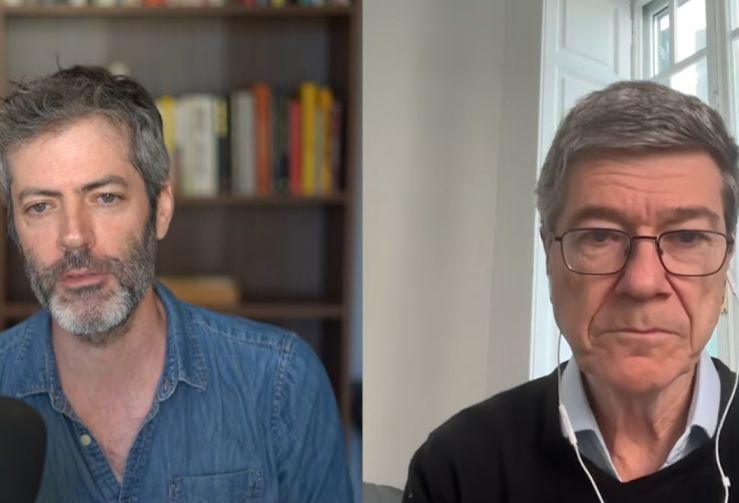
Editor’s Notes: In this insightful episode of the Dilemma Podcast, host Jay Shapiro sits down with world-renowned economist Jeffrey Sachs to explore the shifting landscape of global politics and international relations. Sachs reflects on his career evolution from a young American economist to a vocal critic of U.S. hegemony, outlining his vision for a cooperative, interconnected world. The discussion delves into critical issues including the “deep state,” the dangers of supremacist ideologies, and the current conflicts in the Middle East. From the philosophy of social democracy to the controversial Epstein files, this conversation offers a provocative analysis of the forces driving modern world events. (Mar 16, 2026)
TRANSCRIPT:
Introduction
JAY SHAPIRO: Dilemma Podcast. Jay Shapiro here. I have Jeffrey Sachs on the show today. You probably know Jeffrey Sachs. He’s a world renowned economist and author and he has been at the top level all over in his career and continues to be advising governments and economies transitioning from different things to one another.
So we start with kind of an overview of his philosophies and ideas in his career growing up and maybe departure points or pivot points based on things he witnessed or saw or disillusionments he had in the world that may have changed his sort of thinking or emphasis. I really love that part of the conversation. And then we bring it more towards what’s happening today. Of course, this madness in Iran and Israel. We talk about Zionism and his upbringing, things that he may have miscalculated as far as what would be forces in the world pushing things in certain directions.
We do get to Epstein at the end and I do ask the question about Judaism and the Epstein files, which I’ve been asking everyone lately. I rather like Jeffrey’s answer. So stick around for that. I think there’s a lot more to say about that and I’m going to keep talking about that on the show and exploring more of it because I think it’s really, really good.
He lays out this kind of overall philosophy of sort of type 1, type 2, type 3, which I rather like. So look for the graphics that I sort of trace through that.
And yeah, if you like what I do on the show, please do like and subscribe. It does help the algorithms. And I will remind you, if you really, really like what I’m doing on the show and you want to join the membership program, you can do that here through YouTube. And I host a live Zoom call with all the members on the last Sunday of every month at noon Eastern. And it’s really fun and I archive them online. The members should have that link now if you want to go back and watch past hangouts. But it’s really fun — we get to know each other a little bit, share ideas, respond to some of the things we’re thinking about and talking about.
And then Jeffrey also wanted me to remind you that he has an official YouTube channel. I put a link at the end and it’s down below because there’s a bunch of AI fakes of him going around. And other people like Yanis Varoufakis — must be very strange to have that happening to you, giving speeches that you never gave and hoping that they’re accurate enough. But his official YouTube channel is down below. Keep up with what he’s doing and now enjoy myself and Jeffrey Sachs.
Jeffrey Sachs: Origins of a World View
JAY SHAPIRO: Get under the hood of sort of the way you think and the philosophies that you might have about morality or economics or politics or whatever, and maybe how those have evolved over your lifetime a bit. Because I think we kind of all have them — we have sort of our origin stories of the way we think. But then we definitely have these pivot points in life, whether that’s a personal crisis or a world event or something that throws us in a different direction. And because you’ve lived and continue to live this very interesting plugged-in public life, can you walk me through a bit of that story — through Bolivia, through Poland, whatever else — and maybe where you are now and how you got there?
JEFFREY SACHS: Sure. Well, first of all, very nice to be with you.
JAY SHAPIRO: Yeah.
JEFFREY SACHS: I’ve been interested in how the world fits together from my first awakenings to the world. My whole career is international economics and then international politics and diplomacy. So I think it’s basically true, from my earliest intellectual opening to these questions, that I’ve been trying to take a world view.
When I was in high school, my parents took my sister and me to the Soviet Union for a visit, which was unusual in 1970. It was an eye-opening experience, but mainly a mind-opening experience — to start asking questions that I had no idea about: capitalism and socialism and a divided world. When you’re a high school student, that makes a big impression.
And from there I found, in the lobby of a hotel in Moscow, a pen pal who lived in Berlin — actually in what was East Berlin, near Alexanderplatz. And we wrote to each other for two years, the old email system with licking the stamp and putting it in the mail. And then I visited him after high school and that deepened my fascination with comparative systems, as it’s called.
And I went to university then to study at Harvard. These questions have captivated me for more than 50 years. And now I’ve had the good fortune to work in most of the world and to see most of the world.
And I think it’s true — I think it’s not naive to say that my view from the beginning, in a way based on earliest child upbringing in a tikkun olam tradition, was to make the world, help make the world work better.
My ultimate vision is a world that lives under shared norms and laws. I like the UN and I’ve worked for and at the UN for more than a quarter century — volunteering my time, I should say, to three Secretaries General — because I believe in it. It’s very weak, it’s not working right now, so I don’t want to leave any illusions about that. I would like the world actually to live in harmony and peace. And it sounds naive and dumb maybe, but that’s my basic motivation and has been for decades.
I should also add I’ve been doing practical economic and increasingly geopolitical advising for more than 40 years. And I’ve really seen the world from the perspectives of South America, or Eastern Europe, or Russia — as I advised President Yeltsin — or India, as I worked with the Indian government, or China. And I see all of these perspectives as absolutely legitimate, that each part of the world asks itself the question: how do we fit into a broader world? How do we find security and prosperity and well-being?
And when you visit all of these different places frequently, regularly, you don’t take sides — you have friends. I have friends everywhere. There isn’t a place in the world where I feel intrinsically the enemy or the outsider. And so I see the Arab perspective, I see the Iranian perspective, I see the Chinese perspective, I see the Indian perspective. And I don’t like the particular isms and I don’t like the assertions “they’re evil, we’re good.” That, to my mind, is the fundamental flaw in our thinking.
Disillusionment with American Foreign Policy
JAY SHAPIRO: Yeah, yeah, yeah, that’s great. And so I’ve noticed watching your career a drift towards — maybe a pivot, a sharp pivot — towards being quite critical of American bullyism, or something, or whatever you would call it. Were there particular inflection points of that historical trend where maybe you felt your mission — which I think would be safe to align with sort of market economics and what you were trying to do — that maybe a suspicion that the allies that you thought were on your side, maybe the Americans, were not?
I’ve noticed a resentment that you seem to have towards maybe the American undermining of your project or your belief in this. Is that fair to say? And when did that sort of emerge?
JEFFREY SACHS: Yeah, that’s more than fair to say. I would say it’s also very perceptive.
When I was a young aspiring economist — this is a half century ago — I studied at Harvard and I decided that I would devote my efforts to the international economy, as I’ve just explained. And I felt rather exhilarated that I was an American and that I was an American economist. I felt, well, America is the most influential country in the world and I’m a well-trained young economist eager to make contributions to global well-being. How good is this? So I felt intrinsically happy and proud that I’m an American in a world in which America is leading.
Now, even from my earliest days, when I was in high school and even junior high school, the Vietnam War was raging. Growing up in the community that I grew up in, the Vietnam War was not a popular war — it was an unpopular war. In 1967, when I was 13, I participated in marches in Detroit against the Vietnam War. By high school, I was an anti-imperialist. I believe that the Vietnam War was a war against imperialism, which I continue to believe more than 50 years later.
And so I was not uncritical of the United States, but I was proud of the United States also, and there were great leaders in the United States. President John F. Kennedy, who I saw flash by in a motorcade in 1962 when I was 8 years old — that was a very deep impression for me. And my first political love deeply was Robert Kennedy. And so I didn’t take the view that this was hopeless. I took the view that America’s basically good and misguided in the Vietnam War, then through Nixon and Watergate. And I thought, well, things need to be cleaned up. But still, being an American economist in the world was a good thing.
That changed over time through my experience and understanding and attempt to really understand more deeply over many decades what I was experiencing and what I was seeing.
Just an example: when you’re young, the Marshall Plan is just the most inspiring thing in the world. Winston Churchill called it “the most unsorted act of history.” When you’re a little bit older and you understand that some of the Marshall Plan counterpart local funds were used for CIA operations, you say, well, this is a more complicated story. And that grows on you. When you learn further about the so-called Left Behind armies and Operation Gladio and a lot of the absolutely sordid facts of the Cold War, you go even farther.
Over time I feel that I learned more about the US project and about the Deep State, which dates in my view to World War II, but especially to 1947 and the creation of the CIA — and to a whole side of America which actually I’ve come to believe is the predominant side of American foreign policy, that I find pretty evil, actually pretty misguided, basically hegemonic imperialism rather than “let’s make the world a better place.”
In my decades of work, I’ve come essentially to admire two of our leaders: Franklin Roosevelt, who I still regard as our greatest president, and John F. Kennedy, who I believe was becoming a great president and was killed for that reason by the US system — most likely by the CIA — and most likely the assassination was because Kennedy was trying to make peace.
And so I’ve come to certain intellectual views over many decades from experience both firsthand and just non-stop attempt to understand the environment that I’m in. The Deep State is a real concept for me because it is basically the state apparatus that’s hidden from public view. And we are a system that operates under confidentiality and classification, and that’s relentless, as we know now, if one cares to look at it. And I believe that there’s a great deal beneath the surface — the proverbial iceberg, where more is beneath the surface than is on the surface. And that’s just decades of experience.
And what I could say — if I just might add — I’m not a security official. I’ve never worked for the US government and never would at this point, period. And I never want to hold confidential documents, which I don’t and never have. But I hear a lot of things because I discuss the world scene with leaders all over the world on a regular basis. Basically every few days I’m meeting with somebody very interesting who can give me added perspective. And that experience over several decades has not endeared me to US foreign policy.
Free Trade, Ideology, and Being Used
JAY SHAPIRO: That’s — yeah, enough said between the lines there. Yeah, one more — this is fascinating, but one more question on this kind of broad sense of like your life living. What you just laid out is: do you feel used in a sense sometimes? I’m trying to put it this way — from the philosophical perspective, you promote free trade and you’re a believer in free trade and this sounds lovely, and you think that will lead to some better world and the kind of global libertarianism might rise all boats and all this kind of stuff. I wonder.
JEFFREY SACHS: That’s not my view, by the way. Just to understand.
JAY SHAPIRO: Okay, correct that for me then. But I’m curious — I guess I’m asking: do you feel like you’re undermined in your efforts by promoting free trade and then maybe realizing that the US government or the CIA or whoever is really not interested in this thing called free trade? They want some sort of ridiculously imbalanced kind of deal and fleecing people off. If you sort of catch my question — but yeah, correct me and sort of what your position is then.
Free Trade, Social Democracy, and a Lifetime of Disillusionment
JEFFREY SACHS: Yeah, basically I am a believer that an open, interconnected world — that is interconnected economically, socially, in the flow of ideas, in relations of scholars, in culture, in sports — is the right kind of world. I’m rather enamored of the fact that we all live on one small planet and we should be interconnected, learn from each other and benefit from our interdependence and our diversity. So that is my basic view.
There’s an economic component to that, which is that trade, in particular the flow of goods and services, can be a mutually beneficial activity. A larger market allows for more specialization. It allows for diversification. It allows for the fact that I can have my morning coffee in New York when the coffee is not grown in Central Park — it’s grown in Ethiopia or in Brazil or in Indonesia. And I really like my morning coffee, so I don’t want to have a closed world.
And that’s an idea that goes back to Adam Smith, who was really a great humanist, actually, and part of the Scottish Enlightenment and a very decent, wonderful person.
This is quite a different issue from libertarianism — almost completely different. It could be misunderstood because some free traders happen to be libertarians. My political ethos has been for half a century social democratic. So what does social democracy mean? It means that you believe in market forces, as I’ve just described, but you also believe in a strong role of government — for example, to ensure a decent standard of living for everybody in society. I believe in universal access to health care, universal access to quality education, and a strong role of government in a wide range of activities, such as environmental protection, the climate crisis, which I believe scientifically is absolutely a real and major crisis.
Libertarians are a very particular philosophy which also have Adam Smith as a progenitor, even though I believe it’s a wrong reading of Adam Smith. But libertarians take the view that there should be minimal government and that the role of government, to the extent that there is a role, has the roles that Hobbes and Locke in British philosophy gave them — which is stop people from killing each other and protect private property rights through the enforcement of contracts. Other than that, stay away.
That is a view that, in my understanding of economics built over more than 50 years, is morally wrong and practically wrong. It doesn’t lead to the kind of world that most of us want to live in, that I would say is for the common good. And it’s fallacious in the understanding of social dynamics. It does not solve critical problems — for example, protecting the earth’s environment. We understand this rather deeply in economics.
Over the course of two centuries, Adam Smith himself, in Book Five of The Wealth of Nations, talked about all the things government needs to do. For example, he was in favor of universal basic education back in 1776. But since then, over the course of two centuries, there are lots of reasons to believe that you need a government to make sure people don’t starve to death, that they don’t die of other privations, that the rich and the powerful don’t take over society, that the physical environment is protected, and so forth. Libertarians deny that on what I regard as basically a 17th century philosophical view, which is wrong.
Now, having said all of that — we could talk for hours about this — but I’ve been misunderstood on occasions where I’ve really learned how media and short attention spans work on complicated issues. When I was advising Poland in 1989, what to do — when you start from a state ownership economy, which is an extreme in the wrong direction, then almost all of your verbiage will be around markets and liberalization and trade. And you may then be interpreted as a libertarian, because if you were saying the same things in the American context, you’d be a libertarian, because we already have a market economy. So why are you preaching even more Milton Friedman type philosophy? And I was not doing that. I was trying to help them from one extreme to the middle, not from the middle to the other extreme. But it gets misinterpreted.
Short public attention spans are not classrooms, much less serious places of intellectual discourse in general. So there’s a lot of misunderstanding. I have an interview from 1989 that I like a lot because it has me clearly on the record. In 1989, Lawrence Weschler in The New Yorker interviewed me at length about Poland’s reforms and he started, “Well, you’re a libertarian.” I said, “No, no, no, I’m a social democrat. But when you start from here, you say the following things.”
So I’m happy that that’s clearly on the record because it allows me to say, look, don’t misunderstand — I never was saying that. Because there’s another — to anyone that cares, and the vast majority of the world has no reason to care at all — but to anyone who happens to care about my own intellectual journey, they say, “Oh, you had an epiphany, you made a big change.” No, it’s not like that. You have to understand the context in which one is making any kind of discussion or analysis to understand what they mean by that.
So in any event, that’s a long-winded answer to say that no, I’m not a libertarian, but I am in favor of an open world.
JAY SHAPIRO: Yeah, that was great. Well, I apologize for echoing an old wound from 40 years later or something.
JEFFREY SACHS: No, no, not at all. It’s a part of life.
Underestimating the Forces Against a Harmonious World
JAY SHAPIRO: No, that’s great. I do want to start steering this towards our modern crazy world that we’re in. But thinking about your upbringing and sort of your philosophical evolution — do you think there were forces, whether philosophical or deep state or just greed or whatever it is, that you may have misunderstood or underestimated, that would really throw a wrench into the way things would go?
I don’t know your particular engagement with Zionism growing up. I was a little closer to it. I also underestimated it as a force in the world. Maybe I just didn’t want to think such a crazy biblical thing was going to cause a problem. But I don’t know if you’ve had things like that — beyond Zionism — were there things that you underestimated along the way that have really shown themselves to be negative forces pushing down on that harmonious world you wish to emerge?
JEFFREY SACHS: Yeah, sure. As I said, American foreign policy I took as being basically benign, if sometimes misguided, and I don’t take that as the baseline anymore. I take American foreign policy as basically being maligned with occasional glimmers of goodwill.
So yes, when I was advising Russia in 1992 and 1993, I assumed that the US attitude towards Russia was benign or even maybe mildly beneficent — that the Cold War was over and now we would have good relations. And when I was advising both President Gorbachev and President Yeltsin, my main hope was that the United States would support the reforms that were underway in, first, the Soviet Union, then after it disintegrated, in Russia. And that support never came.
And I argued for it for many years, thinking, “But that’s the good thing to do. That’s what the Marshall Plan idea was. That’s what we need to make peace.” And it’s only after watching more deeply for 30 years and being able to reconstruct decisions by FOIA memoranda and minutes of meetings of US officials that I have come to the view that for the US, the Cold War never ended. The Soviet Union disintegrated — now the aim was to make Russia disintegrate or bring Russia to its knees.
So I misjudged that. I did not believe that to be the case. I thought, as I was advising President Yeltsin — and I said to him specifically in December 1991 — “I’m sure the United States is going to help you.” Those are literal thoughts that I conveyed to him in December 1991, and I believed it. And I went back to Washington and found a brick wall and couldn’t understand it and thought, “Well, they’re just dumb. Don’t they get what needs to be done?” But it wasn’t just dumb — though there are a lot of dumb people in Washington — it was also malignant.
And if you come to the Zionism — look, I grew up in a Jewish suburb of Detroit, in a basically secular household, though I had a bar mitzvah and went to Hebrew school and all the rest, and was of course pro-Israel, in a family with family members in Israel. I went to Israel for the first time in 1972, so 54 years ago, went back repeatedly, studied in Israel and so forth. And for a long time I said, “Well, there are two strands of Zionism and I’m on the labor side — Shalom Achshav, Peace Now — and we’re going to solve all this with a two-state solution and so forth.”
And you could ask, well, was that naive? To a certain extent, yes. Because Ben-Gurion seemed to me like just a grandfather figure, not a very, very tough operator that had a very dark side to him. And at the same time, in my view, Israel changed a lot. But the question of “did Israel change, or did you just learn what Zionism is?” is actually a very fair question. The answer is both.
But what Israel is today is completely different from how I imagined it — I would say 50-some years ago — how I experienced it personally. And so that’s another case of partly learning, partly disillusionment, partly the world changing in particular ways that it probably didn’t have to change. But it is a mix. It’s very different from how I imagined Israel more than a half a century ago.
Are We Already in World War III?
JAY SHAPIRO: Yeah. I mean, I’ve heard you of course comment on that — you think we’re already in World War III, this is what it looks like. Can you just bring me up to the moment of where you think we are now?
I guess given everything you just said, that word “disillusionment” seems to be universal. A lot of us have had these moments of disillusionment — again, these could be personal in our life, or it could be seeing something in the news. And the disillusionment of the world that a lot of us wanted to see emerge seems so, so far away now.
How do you see us getting through this moment? If you think we’re in World War III right now, I wonder if you think it looks very different a month from now, a year from now — where are we going through this?
Three Worldviews: Supremacism, Realism, and Coexistence
JEFFREY SACHS: Yeah. There are, I’ll say, three kinds of views, if I could simplify.
One is the nationalist supremacist view. “My country is the best and it deserves to rule.” That is a very popular opinion in different places in the world, but it’s especially popular in the United States. It has deep roots. I wrote a book against American exceptionalism several years ago. But that view is very deeply founded from the earliest days of the English settlements on the Eastern seaboard of North America.
There’s a second view, which is the world is dangerous. The only way to survive is through strength. And like it or not, that’s just a sad reality. So that’s a different second view. It’s not quite the first view. The first view is an exultant supremacist view. The second view is what’s called realism in international relations. I don’t like the term because I don’t like them grabbing what’s real and claiming that that’s real. But in any event, it is the view that the world is a war of all against all and you better be tough to survive.
And then there’s the view that I espouse, which is we actually all could get along. And in fact if we don’t get along, we’re going to end up all dead.
So the difference of the second view pre-1945 and the second view after 1945 is the nuclear reality. Realists, so called, could say, “Yes, but there have always been wars, Jeff. And when technology advanced, they became world wars. So that’s just the tragedy of great power politics,” as my friend John Mearsheimer puts it. And he’s a wonderful scholar and a very good friend, so I want to be clear about that. But I say tragedy in the nuclear age is something different. I do believe in a concept called the nuclear revolution, which is we’re in a different reality now. We’re on the verge of destroying everything right now. And we really are, in my opinion.
Israel-Palestine as a Microcosm
So getting to the third outcome, getting to living together — take the case of Israel and Palestine as the microcosm of this, to my mind, as the most natural point. If there are millions of Palestinian Arabs and millions of Jewish Israelis, they need to get along. That would be my starting point. I would have believed that at any point in my life. And whether it’s one democratic state or two states would not be the main issue for me. But an apartheid state, or what I do regard as a genocide in Gaza, or ethnic cleansing, or a Greater Israel project — I find abhorrent.
So on a microcosm level, the third viewpoint — “let’s live together” — applies to what I’ve long regarded as the two-state solution. But Ilan Pappé is convincing me that maybe the one-state solution is the only really viable one. Either way, I’m satisfied with both of them, just profoundly distressed at the approach of Likud since 1977, since its founding, which said, “Never will there be a Palestinian state.”
So given that, you ask, well, what’s really going on in Israel to propound that alternative? And it’s partly view one and partly view two. There are Jewish supremacists and Christian supremacists that read Genesis 15 and say, “It’s all ours.” And I’m pretty sure that Ben-Gvir and Smotrich are of that ilk. And Huckabee, the US Ambassador, explained a couple of weeks ago that he’s of that ilk. And I find that just unbelievably awful and dangerous and rather shocking — theologically wrong, empirically wrong, reckless, and everything wrong about it — and could get us all killed.
And then there’s a view in Israel which is, I would say, the hyper-realistic view. “Mr. Sachs, you don’t know what the hell you’re talking about. We’re in the Middle East, they’re out to kill us. So we’re going to fight back. And if we have to act preemptively, we’re going to act preemptively and we’re going to kill first. And that’s just the way it is. And we’re not going to be killed again. Holocaust, holocaust, holocaust — that is our background, that is our reality, that is our history, and it’s not going to happen again.”
I think probably Netanyahu is of that ilk rather than of the “we need to own all the land from the Nile to the Euphrates” ilk. Netanyahu probably doesn’t have much religious anything in him. He is, to my mind, the ultimate opportunist. But if he has a philosophy, it is, “We’re going to kill them before they kill us.”
The Two Dominant Strands of American Thinking
So to my mind, this is the microcosm of the world as a whole. In the US there are two dominant strands of thinking.
One dominant strand of thinking is, “We are the United States, we are the godly country, we are the second Israel,” from the first founding of the New England Bay Colony. And a lot of American rhetoric has been invested in that idea for hundreds and hundreds of years. Some Americans believe that.
And then there’s a second strand, which is, “We need to be the strongest and the dominant because it’s a Hobbesian world. It’s a war of all against all. China’s our greatest threat and we’re going to stand up to China.” That is the predominant view in Washington, in the Eastern university think tanks, because they’re all supported by the military or by corporate giving. It’s not necessarily “America is the God-given choice to lead the world,” but rather, “In a tough world, we better be number one.”
And then there’s my view, which is, “Couldn’t we all get along?” China’s not an enemy, Russia’s not an enemy, the Arab world’s not an enemy, Iran is not an enemy. My experience, honestly, at a personal level, is I speak to all of these leaders all over the world — to Chinese senior officials, to Iranian senior officials, to Russian senior officials. They’re not some extraordinarily evil counterparts. These are absolutely normal people, nice people. And I’m not being naive. Their arguments are more valid than our arguments in general.
So that’s the state of the world. We’re being governed by categories one and two — by supremacist ideologies and by this Hobbesian view of the world as a war of all against all. And to my mind, this is suicidal. We are on a path that is disastrous and it makes no sense.
My main recommendation in life, from my personal experience and my intellectual development and training, is: take a deep breath and talk to the other side. Because that, to my mind, is the number one thing missing in the world.
The Economic Stakes of Dominance
JAY SHAPIRO: Yeah, well, quoting Rodney King is always good. The Rodney King school of philosophy — I subscribe to that. But that was a great answer.
My question, as an economist who has this global perspective — tell me if I’m wrong. It seems that part of the situation we’re in is that category one and two thinking has also placed so many bets in the world that they need to pay off. If you follow my thinking — the dollar dominance and the exception that the US could run this entire huge debt and not experience hyperinflation requires a system internationally, something like the Strait of Hormuz staying open. Not that we’re getting that oil — people should understand that — but it’s traded in the dollar, or the investments flow back in our direction. All this kind of stuff is a general framework we’ve tied ourselves to.
Or you could talk about Ukraine and the corporations who’ve made the bet that they need that war to end in a particular direction, so the money keeps flowing in our direction. And if this stops, if this crumbles, if we pull out and go into the Rodney King version of “Can’t we all get along?” — well, then the dollar collapses and we suffer a lot of economic hardship, because we made a bet on dominating the world.
If you follow that — it’s my huge fear right now. The right wing, who’s suddenly becoming very skeptical of Trump and asking why are we in another foreign war, doesn’t quite understand it the way that maybe my leftist thinking worries about. I want that third world, that world of coexistence, but I worry that getting there rapidly crashes the dollar. More power to them, but does that make sense?
The Economics of Zero-Sum Thinking
JEFFREY SACHS: Yeah, it’s such a great question and it’s such a profound common view that is held and so completely wrong substantively in the economics. And this is really, you put your finger on something extremely important and that really needs explaining clearly.
And that’s the following: part of the view of the world as a war of all against all has an economic side to it, not just a kind of military and conquest side, but the economic side to it is a dark belief, sometimes hidden and implicit, sometimes quite explicit, that there’s really not enough to go around and if we want to maintain our well being, we have to defend it against those who would take it away.
And so there’s a zero sum thinking that is underpinning a lot of the type 2 typology, also the type 1 typology. We’re supreme, we deserve more, or the world is tough and they’re going to take away what we have. So we have to fight for it.
Malthus, Darwin, and Social Darwinism
JEFFREY SACHS: And I’ve tried to trace this deep misunderstanding philosophically to the last two centuries, to Malthus and to Darwin. Malthus was a proto economist parson also who wrote in 1798 in England a book very important and influential called the Principles of Population. But the essence of it was there’s not enough to go around because if there is enough to go around, the population of the world will grow until there isn’t enough to go around. And so we’re always more or less condemned to be near subsistence level in our world. That’s the Malthusian trap, it’s called. And it gives the idea that if you’re above poverty and subsistence, well, you’ve got something you need to defend. This is temporary, this is a big risk.
Darwin, who was a profoundly important and gifted scientist and a wonderful human being, also from every single account, in 1859 in Origin of Species writes, “Oh, I read Malthus and it gave me the idea.” It was the switch that clicked to understand what natural selection is. Because what Darwin said was, oh, there always are more individual organisms of the species than can survive. So it’s survival of the fittest. Which is a term that another thinker, Herbert Spencer, coined. But the idea was — I think it’s Spencer that coined it first — but in any event, the idea of Malthus and Darwin was, well, there’s a fight for survival and now the fittest will survive.
And what emerged from Darwin’s scientific idea was a school of social thought called Social Darwinism. And Social Darwinism said, the world is nasty and only the best can survive. Part of libertarianism plays on this. Ayn Rand libertarianism says you’ve got to let the great builders build because otherwise the takers will destroy society. So there’s a struggle and we need to let the Peter Thiels of the world run things because they’re the great men. Okay, this is just phenomenally ridiculous in approach. But anyway, that is the dime novel high school version of this.
But Social Darwinism became a very predominant philosophy. And it says, we’re in this war of all against all. Intrinsically that’s just the natural world. And it grew further. The Nazis took this idea from the German evolutionary biologists, by the way. So the Nazis didn’t create, and Hitler didn’t create the idea that the Aryan race needs living space — Lebensraum to the east — out of nothing. It was out of Darwinism transmuted through this Social Darwinist idea that society is a struggle.
China’s Rise Is Not America’s Fall
JEFFREY SACHS: Okay, so the point you asked — wouldn’t everything unravel — is actually based on these deeper views that have been carried forward in new ways. I’ll tell you as an economist who’s thought about this for 50 years, this is all completely wrong. We are not in a struggle for survival with others. China’s rise is not America’s fall. China’s not taking away our well being, period. In fact, China’s technological advances will make our lives better, not worse. Just like America’s technological advances made China’s life better.
It’s also not true that everyone gains by China’s rise. There can be people in Indiana and Illinois who really lose their jobs because of inexpensive Chinese imports. But that’s also a basic lesson of trade, that people win, people lose. The winners outnumber and out quantify the losers. So in a just society, you make sure that people who are hit by import competition get retraining, new jobs, social support, free health care, that they don’t face desperate outcomes. And that’s why I say social democracy is an economic approach to make sure that these gains from trade are very, very widely shared.
A Technological Golden Age
JEFFREY SACHS: We are in a technological golden age right now. Every day there are new rapid technological advances that are potentially absolutely wonderful. If we would calm down and understand. It doesn’t really matter whether Iranian oil is denominated for sale in renminbi or dollars. It has no meaningful effect on American well being at all. It doesn’t really matter whether Ukraine is in NATO or is neutral. It doesn’t matter at all. Israel’s well being does not depend on whether Palestinians have a state in Gaza and the West Bank at all.
If we really understood the economics, we wouldn’t have the Hitlerite wars for living space. We wouldn’t think that these crude ideas — that we need to capture land or bring Iran under our control so that they don’t denominate their oil in some other currency — is almost a meaningless idea. Because our well being depends on our technology, our know how, on peace, on being able to invest so that our roads and our railroads work and not break down in potholes and collapse and so forth.
Our well being is not based on a struggle with others. Our well being is based on our investments in our skills, our knowledge, our infrastructure, our businesses. And those will do better overall if they’re also interconnected with the same in other places of the world. And there’s enough to go around on this planet. Even the climate crisis, which is very real and very severe, doesn’t mean half the world has to die because we’re using two earths, this kind of thing. No, it just means you need to have solar power and wind power and geothermal and hydropower instead of coal. This is a completely different proposition.
So your question is exactly right. Nothing needs to unravel. Nothing. Our prosperity does not depend on defeating China, on cornering China, on limiting China. Our prosperity does not depend on us dominating the Middle East. But our survival depends on us not stupidly falling into a war of all against all, especially a war for no reason.
Elites, Bad Bets, and the Deep State
JAY SHAPIRO: Yeah, let me end it with this one then. That was great. It seems to me also that there’s a question about redistribution or the disconnect between the elites and these deaths of despair and whatever. I mean, this war is historically unpopular and they didn’t even try to ask anyone.
So I guess to defend a little bit, I get that you’re pulling the philosophical mistake people are making in my type 2 bets. But it does seem that there is an elite class that plays a different game and then drags everyone to war so they win their bets. It’s almost — I always picture it of, when I try to explain how world wars happen — it’s like everyone’s at a poker table and everyone’s holding a bad hand. They all think they’re going to lose the hand. They’ve all bet so much into the pot that they probably can’t afford it. Well, one way to not have to pay that pot is just to kill everyone else at the poker table. And then you take it all.
And it seems we’re being dragged into these wars by elites and corporations. And you could even fold in sort of the Epstein class debauchery that we’re seeing, because they’ve certainly made these kinds of bets and they want them to win. Like, if Ukraine doesn’t go the way they want, there’s people who will lose, and those are the people who — maybe that’s the deep state you’re talking about. Maybe it’s just that it’s a corruption of greed or however you put it. So we can end on that one, because I’m pretty dismayed.
JEFFREY SACHS: Yeah, no, this is great. I think you’ve got it exactly right. There was a European politician, Juncker, who had a famous statement. He said, “We know just what the right thing to do is. We just don’t know how to do it and get reelected.” And that’s a very interesting point.
The thing that interests me the least in the world is the reelection of an incumbent. People say, well, this war in Iran, this is stupid. This is crazy. They didn’t know what they were doing. But how’s Trump going to back down? How’s he going to save face? Who cares? Who cares? It’s the least interesting question for society. Of course, it’s quite interesting for Donald Trump, but it is not interesting for us. And whether a politician — what’s Zelensky going to do — these questions guide us. Like you’re saying, they’ve made big bets and they’re trying to salvage the bets.
A Political System Owned by Billionaires
JEFFREY SACHS: And our political systems are profoundly flawed and dangerous because we’ve put exceptional power into the hands of a few people. And our Constitution was supposed to protect us against that. But our political system in the United States became so corrupt that actually power is in the hands of a few people. It is in the hands of Elon Musk and Peter Thiel and a few gazillionaires.
We just had a story in the New York Times a few days ago that by their count, 300 individual donors gave 20% of all the donations in the 2024 election cycle — through 300 billionaires. This is extraordinary. Yes, our political system is owned and operated by a few people. And those few people are maybe Hobbesian in the sense that Thomas Hobbes wrote that they have insatiable desires for wealth, glory, power, fame. In other words, maybe they’re just mentally unstable and they’re not for the good of our society. That in general often happens to people who have hundreds of billions of dollars of wealth.
JAY SHAPIRO: There’s also the Adelsons and I just don’t want to forget about this religious fanaticism.
JEFFREY SACHS: That is hugely influential. Yeah. So your description is right. Decisions are made by a few reckless betters. Napoleon bet his society, Hitler bet the world. Trump in my mind is a darkly mentally unstable individual. Aside from being our president, I mean in a clinical sense — he is a malignant narcissist, he is a psychopath, in a clinical sense. You read the Hare’s profile, the 20 questions, and you compare that to Donald Trump as many people have in the peer reviewed literature, and you’ve got really psychopathy there.
So yes, this is what we need to stop because we can’t have the world bet by a few mentally unstable or super rich people who, like you say, are trying to take the whole pot. That’s not what life is about. Life is about what Aristotle, my favorite philosopher, said: Koinon Agathon — the common good, not the good of a few people.
Why Are There So Many Jews in the Epstein Files?
JAY SHAPIRO: I’ve promised my audience and myself to ask everyone on here this very explosive question of why are there so many Jews in the Epstein files? And I asked this to Ilan Pappé, asked this to Miko Peled. I asked this to Radhika Desai. I’m curious your take on it.
It is something for some of my worries I put on the table with you about the economics of the dollar dump. The things I don’t think the right wing quite understands. I think actually the only honest politician in America right now is Lindsey Graham who just said, “We’re going to make a ton of f*ing money. We’re going to get Venezuela and we’re going to get the Iranian oil.” I’m like, that’s the guy telling you what it is. And he’s trying to talk to those America First people who are getting a little upset that it seems like Israel First. He’s trying to tell you, like, hey, this is America First. We’re going to go take their stuff and give it to you.
But my question of why are there so many Jews in the Epstein files is — I have noticed a tension in America, and they’re going to look for a scapegoat as this kind of stuff comes down. People are just going to notice. So how do you answer the question, why are there so many Jews in the Epstein film?
Epstein as a Mossad Operation
JEFFREY SACHS: Well, I think it’s pretty straightforward. Epstein was a Mossad agent. And as a Mossad agent, he had, of course, strong Israeli backers. Ehud Barak being the chief, who was head of military intelligence for a long time. But he used that network for influence. So to my mind, this is a Mossad operation and a very unsorted one.
And I think one of the deep secrets, of course, is who killed Epstein. Because this man was suicided. Even his death announcement, we found out, was predated a day before, which is a little obvious, if you need any hints.
And so, yeah, this is a deep, dark operation with a lot of intention of compromising material. But also even beyond that, Epstein was obviously playing at a pretty high level of informal diplomacy. And he would not have been able to do that for one minute, one second if he weren’t officially approved. In other words, he was out there with the Indian government and with many other governments, representing himself as Israeli interests. And if he were doing that as a freelancer, somebody from Mossad would have visited him quite early on and said, “Mr. Epstein, you can’t do that. Don’t do that again.” Nobody visited him. He did this over a long period. So this was an Israeli operation and a very unpleasant one.
Closing Thoughts and Where to Find Jeffrey Sachs
JAY SHAPIRO: Yeah, that’s fair enough. I think there’s more. Neither of us are theologians, and I think there is a conversation to be had about, you know, is there actually in one of your type 1 or type 2s about supremacy, is there a problem with the chosen peopleness aspect of Judaism that somehow also bleeds into a psychology or an attitude which allows you to dominate other people, even pedophilia, whatever?
JEFFREY SACHS: Well, I do think, of course, this is the Jewish power party in Israel. This is Smotrich and Ben-Gvir. It’s real, that ideology. That’s the number type one ideology. And as we know, it’s late in our discussion, but chosenness meant a big burden. You are going to have to follow a heck of a lot of rules and you’re going to have a guilt complex and you’re going to, you better behave. So the idea of chosenness according to Rabbinic Judaism was simply a burden on your shoulders. But it can turn into a kind of supremacy in the hands of these maniacs. And it has, and it’s very, very dangerous.
And it is that type one, and they, you know, one of Netanyahu’s, who’s probably the type 2, which is we’re going to kill before anybody kills us. But one of his maneuvers, which is so ugly and destructive of real Jewish values, and that’s why I regard the Zionism of today as antithetical to Jewish values, not part of it at all, is that Netanyahu, already in the 1980s, sensed, “I’m going to get together with the Christian Zionists, with the most fundamentalist, right wing, far Christian evangelical Protestants who want Armageddon to accelerate. And we’ll outsmart them in the end. They’ll support Israel, they’ll do all these things.” But who cares? This is probably part of Netanyahu’s deep Machiavellianism, but what it has done is brought together two groups of supremacists together and they’re on a mad war in Iran right now. And this is the result, I would say, of Netanyahu’s dark Machiavellianism over many decades. It’s right now creating the early days of World War III.
JAY SHAPIRO: Yeah, well, on that lovely happy note, I will let you go. Where can people find you these days? I mean, you’re kind of everywhere. I did see you have a really awesome book club series that you do as well, which is maybe more aligned with the philosophical stuff that we talked about here. But where’s the best place for people to keep up with your incredible analysis?
JEFFREY SACHS: Yeah, I post everything I write and do on jeffsachs.org. There’s a YouTube official channel which I made because there are so many AI fakes of me, which is really a weird thing. I give 50 speeches a day, it seems, that I never give. So I have Jeff Sachs Official YouTube site. People can visit that.
JAY SHAPIRO: Should have you hold up like a sign right now just to prove you’re really him.
JEFFREY SACHS: Yeah, exactly. This is real. Real.
JAY SHAPIRO: Yeah. Well, that’s awesome. I really, really appreciate it. Maybe I’ll tap you again in the future, because you are, you know —
JEFFREY SACHS: Absolutely. Good to speak with you. Take care.
Related Posts
- Transcript: World’s First AI Actress Interview on Piers Morgan Show: ft. Tom Conti, Tom Bilyeu & Prof Jiang
- In Vivo Podcast: w/ Cathy Tie and Prof. Jiang on Editing Embryos (Transcript)
- Transcript of Evy Poumpouras Interview: Read People, Spot Lies & More – FO563 Raj Shamani
- DOAC AI Emergency Debate: ft. Ed Zitron, Andrew McAfee, Nate Soares & Roman Yampolskiy (Transcript)
- Transcript of Norman Finkelstein Interview: Tucker Carlson Show