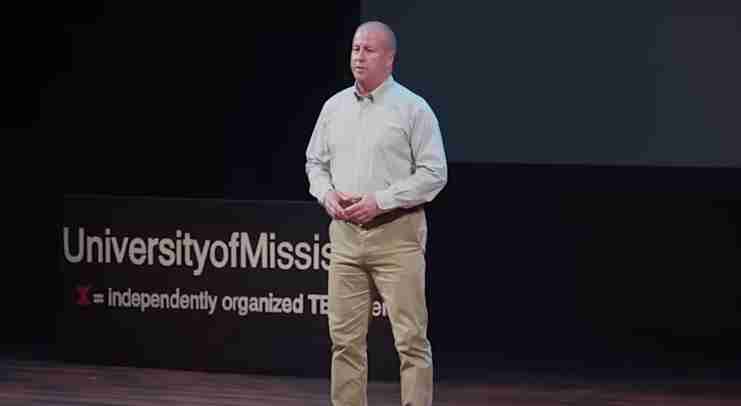
Read the full transcript of Vince Hafeli’s talk titled “Discussing Mental Health and Suicide in Construction” at TEDxUniversityofMississippi 2023 conference.
Listen to the audio version here:
TRANSCRIPT:
The Construction Industry and Mental Health
VINCE HAFELI: Look at this beautiful venue we’re in this evening. How did you arrive? I flew into a local airport. I traveled down a highway, came up the sidewalk into the building, opened the door, electricity, air conditioning, plumbing. Those all have one thing in common.
They were built and constructed by men and women. Men and women that work in harsh conditions, dangerous conditions. They work in the industry that I’ve been part of for thirty-seven years, the construction industry. While enrolled at the University of South Florida in my doctoral program, I landed on researching the topic of suicide in the construction industry. I learned that workers in my industry are more than four times likely to die by suicide as compared to the general population.
We lose a thousand workers a year to job incidents. They may fall from height. They may get covered in a trench collapse. They may get electrocuted. They may get hit by a car driving through a work zone.
We lose more than fifty-five hundred workers a year to suicide, and those numbers are underreported. We lose five times as many workers to suicide as we do to work injuries. Daily, we’ll lose two to three workers on the job. We’ll lose ten to fifteen that will decide to take their lives, but it can be a rewarding industry.
Personal Struggles and Professional Growth
If I think back over my career, both personal and professional, there’s been many highs and there have been many lows.
In 1989, I learned that my brother was terminally ill. Two months later, my father passed. Four months later, my wife and I lost our twin sons. In 1993, on my niece’s fifth birthday, that was my brother’s daughter. That would be the day that my brother would pass.
And we’d also just learned that my mother had an incurable form of cancer, and she would soon be gone. Yeah. While all this is happening, my career professionally is growing, but I’m doing what men from my generation, men that work in my industry are taught to do. I was macho. I was tough.
I didn’t share my emotions. I didn’t share my feelings. I didn’t talk to anyone about it. Didn’t talk to anyone. I remember standing at my dad’s funeral outside with friends and family and telling them that he was better off now that he was gone.
He was no longer in pain. He was no longer suffering. My goodness, he had lived to be an old man. He was fifty-nine years old. That’s not how I really felt. I was torn up on the inside. He was my hero. I held on to those emotions and those feelings and never did talk to anyone about them.
A Personal Crisis
In 2007, after another great day at work where I advanced further along in my career, I was very successful. Personally, I felt like I was a failure.
I came home from work and we sat and we had dinner. I don’t recall if it was during dinner or after dinner, but at some point something snapped. I had this pain, this suffering inside, and I just wanted it to end. I just wanted some peace and tranquility in my life. Calmness.
I went outside. I got in my truck, and I was driving to the location where I was going to take my life that night. And I received a telephone call. The call turned me around. I did what I had done since 1989, eighteen years later.
I laughed, I joked, I said I’m out for a ride, I’ll be home in a few minutes. I returned home, I went in the house, prepared for bed, went to sleep, woke the next morning, and went to work. Just another day like nothing had ever happened.
Breaking the Silence
For fourteen years, only three people knew of that night in 2007. My son and what would eventually become my ex-wife. And while going through and doing my research, I learned that some companies are starting to address mental health and talk about suicide.
So I told sixteen managers in our weekly meeting that at our next annual safety day, we were going to begin addressing mental health and suicide. We were already a great company with a caring culture, but we were going to even elevate our culture to a higher level. And for whatever reason that day, I can’t tell you why I hadn’t planned it. Suddenly, it just felt right to tell them about that night in 2007.
I looked around the room and talked to them individually and looked each one in the eyes I was talking. There was no emotion. There was no communication. There was no conversation. There was just me talking. And when I wasn’t speaking, you could have heard a feather hit the floor.
I looked at two of the people in the room and explained to them that there were letters in my desk drawers for them. They were my goodbye letters to them. They were my letters thanking them for making me the success that I had become, and also explaining to them that my deciding to leave was no reflection upon anything that they had done or not done. I finished talking and I said, “That’s all I’ve got.” They all got up, walked out of the room.
I sat there motionless, physically and emotionally drained.
Addressing Mental Health in the Workplace
So a few months later, we did what we said we would do. I stood in front of four hundred employees and told them that we were going to begin addressing mental health and suicide. I told them I had been there.