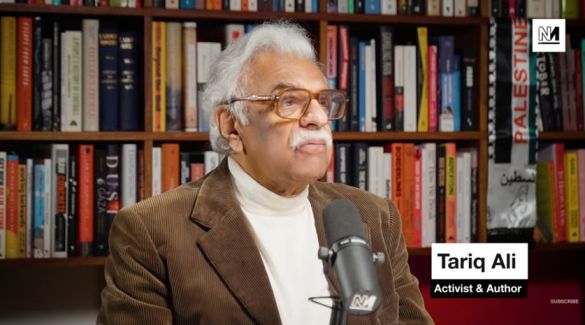
Editor’s Note: Born in 1943 in British India, writer and activist Tariq Ali has not only chronicled history but lived through many of its defining struggles, from anti-colonial movements to the Vietnam War. In this wide-ranging conversation with Aaron Bastani, he revisits the “forgotten” chapters of the 20th century, from Imperial Japan and Nanjing to the central role of China and the Soviet Union in defeating fascism. Ali argues that our mainstream histories, media narratives, and school curricula systematically distort these events—and that this misremembering shapes today’s geopolitics, from NATO and Ukraine to the rise of China and U.S. empire. Along the way, he reflects on socialism, the collapse of the USSR, the failures of the contemporary left, and what kinds of political forces may dominate the coming decades. [Premiered Jan 18, 2026]
TRANSCRIPT:
Living Through History
AARON BASTANI: I’m 41 years old. I don’t like saying that out loud. I don’t like reminding myself of it. I’m 42 in a month. But even I, when I talk about history, whether it’s with you guys or with our guests on here, it’s from books. I’ve not lived through it. I’ve not seen that much myself.
Today’s guest has read a ton of books. They’ve written a lot of books as well. But they observed some of the fundamental moments and episodes of the 20th and 21st centuries. They visited Vietnam in 1967. They were in the USSR in the 1980s as it ebbed towards its final twilight. They met Henry Kissinger and Malcolm X. They had a song by the Rolling Stones named after them. They inspired some pretty interesting people.
And this idea of history being something that you’re a part of and live through and observe is critical for people going forward. Churchill, who I’m not the biggest fan of, put it very well. He said, “The farther back you can look, the farther forward you can see.” And if you’re interested in some of the grievances, wars, conflicts of our own time, then you need to look back a really long way, often to before you were born. Even whether that’s Russia, Ukraine, U.S., UK, Greenland, the potential demise of NATO or Iran. We are living in the aftermath of events stretching back a really long time.
So with that all said, today’s guest is perfectly placed to talk about the events of the 2020s and 2030s in a much bigger historical context and in a very informed way. They helped found Verso, which is, I think, the major left-wing publisher in Britain. They’re active in the U.S. as well. And of course the New Left Review, which is a journal of left-wing ideas stretching back decades. Tariq Ali, it’s great to finally have you on Downstream.
TARIQ ALI: Very good to be with you.
A Radical Upbringing in Pakistan
AARON BASTANI: We’re very happy to have you. I’m going to start right from the top. You were born in 1943. It was a while ago, the world was quite different in a very different part of the world. You were born in what was then British India. What politicized you? Because you’d previously been on the record as saying you knew which side you were on from about the age of 11 or 12. Where did that come from?
TARIQ ALI: It came from my parents. If the truth be told, they were both radicals. They’d sort of broken with their families on various levels. And my father became a communist, and my mother soon followed suit. So we used to have a very interesting atmosphere at home.
One was when family visited and they were all ruling class people. And the second, which attracted me from a very young age, was when our house was sort of filled with peasant leaders, poets, artists—a completely different bohemian atmosphere. And it was hearing them talk to each other and sometimes to me, that made me think of what the world outside was really like.
And then growing up in that new country that had been created in 1947, Pakistan was enough to politicize someone. I was growing up. My father and his radical colleagues had set up a newspaper chain in Pakistan called Progressive Papers Limited which became rapidly a daily English paper, daily Urdu paper, and a cultural weekly magazine. It took the country by storm, became the largest chain of papers, and that educated a whole generation of people.
And of course, I used to go to the office sometimes and watch them do the typesetting and the proofreading and talking to people really is what did it. And I will say, Aaron, one thing that really did politicize me as I was still at school and I read in the newspaper that a black man called Jimmy Wilson had been sentenced to death in the United States for stealing a dollar. I mean, that just shook me to my core. I said, this sort of thing doesn’t happen here. A few slaps in a police station, if you’ve stolen something, and often you’re just let out. And how could this be true?
So my friends at school and I checked it out and I said, we’ve got to do something. We can’t just sit and talk about it. So I organized my first demonstration when I was about 14 or 15, and we marched to the American consulate. And there was a handful of us, about 14 or 15, joined by a lot of street urchins, and finally landed up at the consulate.
And I still remember that American Consul General’s name. Oswald Spenkler. That was his name. Hardcore Lutheran face. Not a smile, not an attempt to say, “I understand. These things happen. I will convey.” Why are you here? Why are you demonstrating? And took our names down and said, “I’m going to report you to the principal of the college, principal of your school.” Which is what he proceeded to do.
The principal of my school was actually a Catholic Irish priest who’d fought against the Black and Tans and so was quite sympathetic to what we’d done and said, “You shouldn’t have done it, but I’m proud of you.”
Vietnam and the Spirit of Resistance
AARON BASTANI: So you became a young adult.
You then go to the UK, you get involved in student politics, and you become a significant figure in this country with opposition to the Vietnam War. Now, for most people, dare I say almost everyone, their knowledge of student activism in opposition to Vietnam in this country will be very weak. It’s not recorded in the same way it is, for instance, in the United States, for obvious reasons. What was that like? And did you ever think that you guys would stop the Vietnam War? What were the demands? Because, of course, Britain famously wasn’t involved in that conflict. One of the few times it wasn’t joining the Yanks.
TARIQ ALI: Yeah, I think to explain that properly, I have to say that for us growing up in Pakistan and South Asia as a whole, the important revolution, the Chinese revolution, which took the world by storm in 1949. And I was 6. And I still remember the chants being shouted by workers and peasants and students and intellectuals. “We will take the Chinese road, brothers. We will take the Chinese road.”
And so that and the whole development of revolutions and anti-imperial resistance in Southeast Asia, the Vietnamese in particular, was part of our lives. I mean, to give you an example, when Dien Bien Phu fell and the French suffered a humiliating defeat at the hands of the Vietnamese, they’d said, “These bush generals can never defeat us.” An uncle of mine who was a film director, distant uncle, totally apolitical, rang up and said, “My son was born today. I’ve named him Ho Chi Minh.”
So this sort of stuff, even from people who weren’t directly political, it was like just growing up in a different climate, which was post-colonial. People wanted other countries fighting for freedom to win. So when I came to Oxford in ’63, I was already educated in these matters and quite obsessed with Vietnam. They had fought against the French, they’d fought against the Japanese, they were fighting against the United States, and one wanted them to win.
And so you said, what can we do? There’s not very much that we can do except agitate, demonstrate, educate, tell people in this country what was going on. And we did that to a certain extent, quite successfully. I mean, in those days, if I think back now, there are at least 50 or 60 Labour members of Parliament who were very sympathetic, who would come to speak, come to listen, join the demonstrations. They didn’t join the Vietnam Solidarity Campaign, but they joined the campaign for peace in Vietnam. And we were often united. So it is a very different atmosphere.
But the other episode that was still quite alive, which seems strange now, was the memories of the Spanish Civil War in Europe, that a lot of people had been on the side of the Republicans wanting them to win, Franco and the fascists to be defeated. And a lot of young intellectuals, mainly, but not exclusively students and others had gone to fight in Spain, actually taken up arms, joined the Republican side and fought. And memories of that event were still around. People recalled it and remembered it.
And so at the back of our heads was a feeling that if the older generation could do this for Spain, maybe we can do this for Vietnam, raise international brigades, go and fight with them, et cetera. So whenever Spanish veterans, British veterans of the Spanish Civil War joined our demonstrations, literally the crowds would part to applaud them. I mean, that’s how respected they were. So there were these traditions already and we sort of merged with them, so to speak.
Imperial Japan and the Forgotten Massacres
AARON BASTANI: You mentioned the Chinese Revolution in 1949, something else which is very, very rarely mentioned, particularly by Europeans and Europeans on the left. And it’s a bit of a tough pill to swallow is the role of Imperial Japan, and this has been touched on by some people, that the fact the Japanese could give a hiding to Russians at the start of the 20th century, the fact that, quite frankly, brown people or yellow people could go toe to toe with white Europeans actually radicalized and enthused nationalists, often not left-wing nationalists, but nationalists in some of these countries we’ve talked about. And that as well was a real moment, wasn’t it? You talked about 1949, but also that role of the Japanese, I mean, however horrendous what they did in the Second World War was, of course, it was horrendous. And prior to that as well, that was a major sort of cultural moment as well.
TARIQ ALI: Without any doubt whatsoever, the Japanese defeat, the defeat inflicted by the Japanese on tsarist Russia triggered off in the early years of the 20th century, the 1905 revolution, because people felt, Russian workers felt and others that God, the Tsar isn’t capable of defeating this Japanese power from the East. How can he do anything else?
And the people who actually welcomed the defeat of the tsarist Russians was Lenin and his comrades who said, “This is an absolutely fantastic event.” They had no doubt about it whatsoever. And without actually supporting the Japanese as such, they said, “The victory of the Japanese has weakened tsarism considerably and we have to take advantage of this.” So it had a huge impact, that particular victory.
And then of course, with Japan becoming a major world power, it started mimicking the United States. I mean, if you read the Japanese texts, which I had to do for one of my books, it’s obvious they were obsessed by the other big Pacific power there, the United States, how to defeat it. They were openly discussing it. The Emperor approved the attack on Pearl Harbor.
The Western Europeans and the United States didn’t lift a finger to defend China when it was occupied by the Japanese. Not a finger. And one of the largest massacres of the Second World War—of course we know the Judeocide—but very few people know about what happened in Nanjing, a totally horrific massacre for which the Japanese have never apologized, never paid reparations, and sometimes go and pray with Japanese political leaders at the graves of those who led that massacre.
So this part of history is now becoming very important again as we see, given the world we live in and the big rise of China, but it really does in China. It’s still remembered what happened at Nanjing and the fact that it’s hardly ever mentioned. If you look at all the big histories of the Second World War written by British, French, U.S. historians, Nanjing hardly merits a paragraph.
The Americans give it a few pages in their books because it concerns Japan, which attacked them at Pearl Harbor. But here in Europe, barely talked about and not known. It’s a very one-sided education that we get about the Second World War.
China’s Forgotten Role in World War II
AARON BASTANI: And like you say, in relation to China, that isn’t just a matter of historical memory anymore. It’s very, very central to how this global power now conducts itself. I mean, if you look at countries and casualties in the Second World War, first is the Soviet Union and I believe second is China, more than Germany.
And I’m pretty sure, we talk about the commemoration of World War II a lot in this country. It’s still pretty central to the country’s national identity and national mythology. If you were to ask most Brits, where does China figure in terms of casualties in World War II? They wouldn’t be saying just behind the Soviet Union. Do you think that’s the kind of thing that we should be teaching kids more in schools or—
# The Three Wars of World War II
TARIQ ALI: I think the way to teach the Second World War is really to argue that there were three different wars taking place. One was the war being waged by the Japanese against China, where the Second World War actually started, which is 1937. Yeah, and that’s where it started and then began to develop.
So there’s the Japanese-Chinese conflict, and then later the Japanese defeat of the British army at Singapore, an army that Churchill said could never be defeated, smashed into the ground by the Japanese. And that triggered a wave of nationalist rebellions, as you put it. And it’s true, all these leaders, most of them said, you know, nationalists basically function on the basis of “the enemy of my enemy is my friend.” They don’t think about too much else besides. And that was even more prominent in those days.
So the Japanese were initially popular till they began to behave extremely—never in China, but in other countries which they took: Singapore, Malaysia, Burma. People said they’ve defeated the Brits. There’s an uprising in Iraq as well. You know, the Iraqi nationalists in 1942 took power because of what was happening in other parts of the world, and especially after the fall of Singapore, which is a major event in the history of the Second World War.
Barely taught and, you know, this is a history I’ve always felt should be taught. And today they’re even beginning to write out the Soviet Union with the way in which history is sort of discussed in globules, not accepting or knowing perfectly well, but not fully understanding that had it not been for the two big triumphs of the Red Army in Stalingrad and Kursk, Hitler would have triumphed. He’d have taken Europe. There would have been European unity under fascism that we were getting quite close to.
One of the few politicians who does mention this, it has to be said, is Michael Heseltine, you know, one of the few from that old generation who remember the war. Most Labour people don’t talk about it, and they should, because people should be educated that that war was won by a united effort, a united effort that obviously included Britain, later the United States. But the Soviet role was absolutely central to the victory in Europe.
And the Chinese resistance, especially the Chinese Communist resistance against the Japanese, played a major role in helping to defeat Japan. So these are things which should be taught. You know, there’s no single history of the Second World War.
The Fall of Singapore: The Forgotten Collapse
AARON BASTANI: The person who’s actually very good on this, I mean, maybe you disagree. The person who I think is quite good on this is Peter Hitchens. You know, he says that people talk about Dunkirk, you know, forever and a day, but actually the fall of Singapore was—that was the moment where the British Empire as we knew it collapsed.
It was, I think, to this day remains the greatest fall of arms by any British military anywhere ever. And yet, I mean, I didn’t even read about it, maybe to my mid-30s, you know. You think we’re sending kids to school and they do history and dozens of hours a week of learning, and yet they don’t hear about any of this. And I think that’s by design.
TARIQ ALI: Yeah, but I mean, I think, by the way, I know Peter Hitchens well, and often we agree, you know, despite differences on many other things. Often we agree on world politics or various other things as well. It always surprises people, but we do.
And this is where I think actually that the role of the alternative media, the social networks, etc., is quite important. You know, like, we do it or you do it in particular in Novara, but others do, providing a different take on what’s going on in the world. That can be done and should be done on history.
I mean, what would have happened if there hadn’t been a Stalin-Hitler pact? What would have happened had the appeasers in Britain succeeded and caved into Hitler, which they wanted to do to defeat the Soviet Union? I mean, a bulk of the British ruling class would have been delighted if Hitler had smashed the Russians first before turning to them. But had he done that, he wouldn’t have turned to them. They’d have capitulated and, you know, the Duke of Windsor would have been made King of England once again.
So these are things that people don’t know about and history is very controlled now. You know, often you come across sort of journalists who’ve been working in mainstream journalism and who haven’t been well educated at school and they haven’t a clue.
The Decline of Intellectual Standards in Journalism
AARON BASTANI: Is it worse now than it was before? Is it getting worse?
TARIQ ALI: Much worse. Much, much worse than it was before. I mean, the 60s, 70s, even the 80s, you had a layer of people working in mainstream television who one didn’t agree with, but who were incredibly knowledgeable and certainly understood and knew their history.
Now it’s, you know, they’re given club views: do this, don’t do that, cancel this. Don’t ask why on television anymore because it confuses people. Because he or she tells the truth. This never happened on this scale before.
And you know, I mean, when senior journalists were interviewing lots of people from the left, there was mutual respect saying, okay, we don’t agree with each other, but let’s have some degree of honesty and integrity in the way in which arguments are conducted. That is gone.
And it’s not just here, you know, it’s a globe, it’s a pattern, a European and North American pattern. And Australia, it’s afflicted all the media networks in these countries. And when I used to talk to senior BBC people, they used to say Labour is worse than the Tories. That we were constantly under pressure from Alastair Campbell and the Blair government.
Why is your audience filled? I mean, Greg Dyke, then boss of Director General, said to me, “I once got a call from Downing Street: the last two Question Times have been packed with anti-war people.” And Greg said, “Look, it’s very difficult for us to find people honestly who are pro-war.”
And they said, “No problem.” The next time I went on Question Time, the place was packed by Kurds hired by the Foreign Office and Chatham House. I said, “My God, this is a strange audience.” And someone later whispered in my ear.
AARON BASTANI: That’s why I think, I think I may even remember that episode where there was a lady who was an Iraqi Kurd. Maybe it was you she was screaming at. I can’t remember, this is so long ago now. But she was saying, “We want to be invaded, we want regime change.”
And of course this is prior to the identity politics stuff, but people were basically saying, “Well look, you’ve got to center Iraqi Kurdish voices.” And it’s like, well, no, use your rational faculties. Is this sensible or is it stupid?
Media Manipulation and Public Opinion
TARIQ ALI: Exactly. The other thing on this, Aaron, is that, you know, we all moan. I do it too. I’m not excusing myself about the mainstream media. But sometimes when people get carried away and go over the top blaming everything on it, I said, “Well, in that case, answer me one question. If it is the media that is doing it, how come that 70% of Britons are opposed to what’s happening in Gaza? How do you explain that?”
So this imposes some—so I said, you know, the media plays its role, we know that. But to exclusively blame it is slightly puerile, really. It’s the politicians who are not trusted at all. And people don’t believe their politicians. They believe that politicians tell lies non-stop. And so this hostility to traditional politics is something that feeds anger.
And so people ignore the media. They don’t even hate it. They just don’t believe it because they’re just doing what the politicians tell them to do. So it’s an argument that still goes on.
But the other thing is that there’s no doubt the Internet has made a huge difference. And there’s no doubt that television networks abroad like Al Jazeera have made a huge difference. I mean, just to get different images, one just switches on to Al Jazeera. Even though it’s been brought under control a bit, it’s still there.
Inside Al Jazeera: US Military Interference
I remember once I was in Qatar giving a set of lectures at the university several years ago during the Iraq war. And they said, “What do you want to do tomorrow?” I said, “Can I go and see the gang at Al Jazeera who’ve interviewed me often, but I would like to meet them.”
So I went in, saw them, and I was talking to the head of the station who was a Palestinian, it so happens, and very, very good guy. And I said, “You get any interference from the government?” He said, “No, there’s agreement. We don’t talk about Qatari politics, we talk the world and it works out for us.” I said, “No, it certainly does. It’s very good.”
So, but he said, “Hang on, if you want to know whether we get interference, we do, but it’s from the American garrison embedded in the Al Udeid base, the largest military base in the Middle East.”
So someone sitting next to him said, “Tell him the story.” He said, “Okay. We had got footage from Baghdad from our team which showed—and we got the tapes as well. Finally, Air Force helicopter pilots, US Marines in helicopters sighting a car which had a father and a mother in the front and two children at the back, obviously a family out for whatever. And just for the heck of it, they bombed it, killing them. We’d filmed it all.”
And so naturally, when the film came in that night, we decided that this was going to lead our news programs the next day. So he said, “We led on it, led with it the early program, led with it on the afternoon program.”
Before the six o’clock news, he said, “Our security guards came running in and said, ‘We want to warn you that the American army is on the way.'” And he said, “A whole number of US jeeps and soldiers packed with soldiers with a general sitting in the front came in and the general walked into my office without any courtesies.”
I said, “Hello, what the hell are you doing, showing these images every hour and on the hour?” So he said, “They’re not made up.” He said, “We know that you filmed them there. God knows how, but you got the film. Is there nothing?”
So he said, “Isn’t this important, your soldiers basically shooting and killing innocents in cold blood? Isn’t that important news? If one of your news people had it, might a few of them not be tempted to show it as they did in olden times?”
He said, “Put a stop to it now,” and very threatening noises, and walked out. So he said, “This happens not all that regularly, but we are aware of this malign presence in our country which interferes in that fashion.”
The Reality of US Empire
AARON BASTANI: That really does underscore that, you know, US empire is alive and well, and we talk about these places being sovereign countries. They’re anything but. Actually, I think there’s remarkably few sovereign countries in the world these days.
That thing you said a little bit earlier about journalists, political figures not being as informed, as historically conscious or conscientious as in decades past, what was the inflection point? So you’re saying it was better in the 60s, the 70s, the 80s, the 90s? Maybe not the 90s. Certainly up to the 80s.
Was there a moment where you thought, “Wow, there really is no sort of intellectual hinterland for these people anymore?” In a way that there used to be when I was a young man in student politics growing up in the—
The End of Media Pluralism and the Post-Cold War Consensus
TARIQ ALI: World, yeah, there was a breaking point, and I mean, just before that, Aaron, the whole setting up of Channel 4 as a television channel, approved by Parliament, with the aim, as expressed in the parliamentary resolution that accompanied the setting up of this channel, of providing voices for the minorities in our country and what they relate to on every level, not just, you know, Blacks and Browns, but culture, alternative cinema, alternative documentaries.
That I think was probably the most innovative period of British television. And because Channel 4 was doing it and getting audiences, BBC2 had to do it to relate to that. So that period was very good.
When did it come to an end? I think, speaking broadly, I would say it came to an end of the collapse of the Soviet Union with the formal ending of the Cold War, that this absolute desire of showing how the west was superior to the Soviet Union in permitting dissenting voices, in permitting arguments, in creating channel.
If you look at the coverage in the Guardian, the Times, the FT in Britain and some newspaper channels in the United States as well, it was completely different because they had to show this. The Germans were the best. Actually, the German press and media were excellent in those times. Why? Because they had East Germany there so constantly showing these Germans, look, we have this, you know, you can do what you want, you can say what you want, you can buy what you want.
Consumerism, coupled with freedoms, basic, elementary freedoms, was very important part of the Cold War. Once that came to an end, one began to notice that this sort of openness and the provision of space for dissenting voices began to decline.
On the Gulf War, already the first Gulf War, the invasion of Kuwait, the way the United States knocked out the Iranian army on its way back from Kuwait, having decided to withdraw that, you know, I remember even in Channel 4 there was nervousness. Should we allow Bandung to do this? They did. So I organized a debate on Channel 4 on the Gulf War, which was reasonably good. But slowly you began to see that the powers that be knew that in these times we had to move on, so to speak.
And the related fact to all this is that many people assumed that now that the Cold War was over, with the collapse of the Soviet Union, China was safe under capitalism, that somehow or the other, mysteriously, magically, the American empire and American imperialism had come to an end as well. They wanted to believe it. It wasn’t the case.
And I remember arguing non-stop with people, good people, friends of mine, saying it is not going to happen. Why should it? They’ve just won a tremendous victory, destroyed an enemy which dominated the 20th century without firing a single shot. The Soviet Union imploded. China went its own way and abandoned any clashes or anything of the United States. Nixon went to China. A big opera was written called “Nixon in China,” which is worth showing extracts from at some stage. Very pro.
So I said, but do not make a mistake of assuming that because this has all happened, there’s going to be a peace dividend, which is what George Bush the first promised. It’s not going to happen. And how can it think seriously. American imperial interests have received an enormous boost and they’re going to carry on.
I hope they don’t. I hope they settle down and say this is now a period different from. But we should treat it like we treated the period after the Second World War where we coexisted and made friends with the Japanese and the Germans at a high cost. It should be added by keeping 40% of the Nazi apparatus in place and not doing too much in Japan. And the Emperor should have been got rid of. They didn’t, because they were constantly then thinking of the Cold War.
But now that that Cold War was over, it was assumed that perhaps they would treat Russia, China and all these other places as they had done Japan and Germany. That never happened. That never happened.
And Putin’s more coherent speeches says that, says, we were prepared. We were prepared to join NATO, we were prepared to join the European Union, we were prepared to be friends as long as we could carry on and defend our own interests as we saw them, like the Americans defend theirs. But work with them. Work with the Americans. But they did not want that.
And so they did not go down that route and went on a very destructive route instead, which was to try and break up these countries, divide them, which they’ve been doing in the Middle East and are now doing threatening ants where in the world too. So the notion that the American empire was on the decline, it was over, bar the shouting. And only old political dinosaurs talked about American imperialism. Well, history is not dealt too kindly with that particular view.
The Suffocating Culture of Conformity
AARON BASTANI: You know, we live in a moment where everybody talks about conspiracy theories which run rife. But I think there’s a truth content to conspiracy theories and conspiracy theorists which is in my lifetime certainly we’ve never lived in a more suffocating conformist culture. And I think one response to that is going to be the rise of conspiracy theories and heterodox thinking for the sake of heterodoxy.
There’s a great line in Confucius, “the gentleman seeks harmony, the idiot seeks conformity or uniform.” And I feel like that’s the path the west is going down. We’re not seeking harmony, we’re seeking conformity and uniformity.
And you mentioned China there. Maybe we disagree on China, I don’t know. It’s a market society, but I don’t view it as a post-ideological society. So when you look at for instance various business leaders in China, like the gentleman who runs Huawei or even Jack Ma, they talk about Mao Zedong thought, they talk about the CCP, but they also have this deep wellspring of ideas and thinking which comes from Chinese literature, Confucianism, Buddhism. And that might inform business strategy, that might inform how they treat their workers, their relationship to the state, their relationship to politics.
The equivalent in the west would be the CBI quoting Thackeray, you know, or John Milton or. I’m trying to think of a sort of, you know, Robinson Crusoe, I don’t know, you know, these kind of quintessentially this literary work that was central to the formation of English capitalism, British capitalism, but of course they don’t.
And I feel like this might sound like a stupid pointer. Why isn’t the CPI talking about English literature? But I feel like the west, people talk about the demise of the west, the destruction of the West. The demise of the west was certainly the demise of Europe as a partner within the Western empire, the American empire. It just goes hand in hand with this post-ideological moment.
If I was in the center right, I would be saying the collapse of ideology was a disaster for us because we no longer have the analytic tools to make sense of the world, to progress, to move on. Certainly doesn’t seem that way when you compare this country to somewhere like China. What’s your view on that?
China’s Historical Continuity and Modern Rise
TARIQ ALI: Well, I think there’s some very important books that have been written by China which should be read and are estimated. One of them is by a British historian of China, Mark Elvin, who is now a last dead. But he has written an account of China, including some of the things you were talking about with such enormous flare that the scale of scholarship and the level of it shook the Chinese.
And after a long, long time, just before he died, Mark got the news that his book on China was being published and had already been translated and was being published in China. And that gave him more pleasure than anything else because that’s where he wanted the book read.
And he explains the rise of the dynasties, the kingdoms, and how in years before the pre-Christian era, you had Chinese economists talking about inflation and how to deal with it. And that civilization and its impact shouldn’t be overestimated, but it shouldn’t be ignored or underestimated either.
And that goes quite deep, you know, that knowledge of who we are. It’s the only state in the world which has kept a fairly basic unity despite the civil wars of past and present, that China has existed as a state for thousands of years, you know, certainly over 2,000, and that, you know, it’d be crazy if people ignored the fact that that gives the Chinese population as a whole this feeling, sometimes wrongly, of superiority, but also feeling that we’ve been here a long time and we can handle anything that is thrown at us.
And some of the contempt that they’re now showing for the United States is linked to that because it ties in very well with this new form of Chinese nationalism. You know, we are who we are. We’ve made huge gains over the last 25 years. Our cities are better provided for, our social infrastructure is better. We’re creating a world to benefit our people.
And yes, there is a capitalist layer which is making lots of money in creating billionaires, and there are probably more billionaires in China today than in the west, but we have them under control via the party. This is. No one could have predicted this on the left, right, center, or wherever. It wasn’t predicted, but they did it.
After the failure of Mao and his attempts to deal with it via the Cultural Revolution, he basically called in Deng Xiaoping. This is the other interesting thing about that leadership. He called in Deng Xiaoping and said, okay, take charge, have a go. And they did. And with the results that we see, and one way the United States sort of indirectly or maybe even directly brought down the Soviet Union was by more or less provoking it into behavior like the United States. Arm, arm, arm.
Remember when the Soviet leadership decided to speed up its armament program. The Economist had a cover which read, “Ah, the joys of rearmament,” meaning we’ve got. And the Chinese know all this. They saw it. The advice they gave to the Russians was very different, more or less. Perestroika is fine, but forget glasnost. Maintain total control by the party, not realizing that the Soviet Union was set up in a very different way. But anyway, that’s a different question.
But the Chinese are aware of this, and I hope they don’t fall into the same trap of spending too much on armaments, because the pressures on them are sort of enormous at the time. Given the way the current US imperial leadership is acting, we can take what we want. What can you do about it on Deng?
AARON BASTANI: I think, again, for young people, when they worry about somebody being purged or being dumped by a political party, or they seem they’re out of the picture, you know, Deng was, I think, purged three times, you know, and he still becomes one of the most important political figures of the 20th century, you might say the most. I don’t think that’s true, but he’s certainly up there. So, yeah, never count yourself out.
TARIQ ALI: No, not in China. As long as you’re not sort of totally, you know, destroyed, which the Chinese by and large have not done on the level of leadership. I mean, it was easier for Deng to come back than it would be for Corbyn to get back into the Labour Party.
AARON BASTANI: It’s true, right?
TARIQ ALI: It’s true.
AARON BASTANI: It’s quite extraordinary when you think about it.
China’s Economic Dominance and Global Reach
TARIQ ALI: China, what has China done economically? It shifted the center of the world market eastwards. There’s no doubt about it. China is now on a global scale, in very different circumstances, occupies the same position that Britain did in the 19th and early 20th centuries, dominating the world market, British goods going everywhere. China does that now. You can see that.
I remember I was in Bolivia with my late friend Richard Gott wanting to buy something as presents for friends. And we went to the old market in Cochabamba and I said, my God, these plates look lovely. I’m glad they’re still making them. So I bought four. When I opened them and were returning to London, I turned over and it’s then made in China. So the penetration of the world market by the Chinese is quite astonishing.
Where they were left behind was on high level technology, and I think on that too. They’re catching up now, fairly clearly, this sort of clash between Pakistan and India, sort of the war they waged. The Indians had bought, very proudly, the latest French bomber jets, and I think the Pakistanis had got new Chinese bomber jets and they scored. The Chinese planes knocked the French out.
And the next day, I mean, this is the world we live in. The stocks and shares of the French Armaments Company went down and people were queuing to buy the Chinese jets. And at cricket matches between India and Pakistan, crowds would sometimes, you know, when the Pakistanis were doing better, crowds would do this. Five, four. We knocked down five. You could only get four. It’s a strange, strange world.
So the Chinese, I think, are going to be very difficult to destroy unless the United States decides that it’s better to have a world war and just send up China. Well, that will cost Europe everything if that happens. I mean, the Europeans have become, I mean, the British in particular, threatening Putin, boasting about it, showing off, we’ll deal with him. I mean, were they to do something gross, Putin could respond very quickly and then where would this country be? And people aren’t even thinking about that. They just don’t think about, oh, it’s fine, we just follow the Americans and they’ll look after us.
AARON BASTANI: I mean, I’m not so sure about that.
# The American Approach to Alliances and Self-Interest
TARIQ ALI: Well, why should they look out for you? They’ve never been like that, the Americans. They look out for their interest. During the Second World War, the sort of height of English heroism, Roosevelt wasn’t convinced. Before the Soviet victories happened, he thought Hitler would win. And he said to the Brits, in order to safeguard your navy, send it to us so we can look after it, at least for this coming period.
And thank God, Churchill refused. He said he was livid. He said, no, we can’t. How can we? We’re in Ireland, we can’t do without a navy. But that was the extent the Americans were prepared to go. They’d have done a deal with Hitler without any problem or doubts whatsoever had Hitler taken Europe.
They’ve always been like this. They’ve defended their own interests. All this stuff during the Cold War—freedom, democracy, not even mentioning capitalism for most of that period—it was effectively cover for what they were doing. And they’ve now started again very openly.
I mean, the thing about Trump is that he drives everyone mad, including us. He’s just pretty straightforward about it, and he says it sometimes. Well, Obama did the same thing. Obama chucked out more people than I’m chucking out. But he’s doing it via ICE and the atrocities, attendant atrocities. Obama did it quietly. That’s the big difference really.
AARON BASTANI: There was a horrific episode recently of a woman being shot by an ICE agent. And the whole point of Trump’s strategy on this stuff, I completely agree with you. It is not mass deportations. Of course it is. But like you say, Obama deported more people than Trump in his first term.
The point is images like that. The point is a left-coded woman being shot by an ICE agent in a moment of political antagonism. That’s the point of all of this—TV images, to show political dominance and polarization within the country.
The Collapse of the Soviet Union
You talked about the Soviet Union. I can’t think of many people I’d rather talk about this, actually. What did you feel about the collapse of the Soviet Union when it happened? Could you see it coming? And when I say, could you see it coming, could you see it over the course of the 1980s? Could you see it in the months ahead? Some people say they were completely blindsided by it. I’ll ask you a few other questions, but that’s a big one as it is. So was it in any way predictable to you what did ultimately happen?
TARIQ ALI: No. In fact, I traveled to the Soviet Union a lot in the 1980s during the Gorbachev period. And the first time I went there, it was to give a lecture at a conference in Tashkent organized by the United Nations on Afghanistan and the Soviet presence there.
And it was not a public conference, but the Soviet delegation consisted of about 40 or 50 people there, some of their top people. And my friends from other parts of the world said, are you going to do it or not? I said, I am.
So I gave a speech which was a very sharply critical speech of the Soviet Union and their decision to take Afghanistan. And I said at the time they took it—when this happened against many on the left, by the way—I’d said, this will now become a global conflict. The Americans will try and get revenge, and that region, Pakistan, Afghanistan, will be in trouble for decades to come. That is going to be the effect of this.
And people who don’t like thinking about alternative arguments said, no, no, this is treason, betrayal, Tariq Ali is attacking the Soviet, all this stuff. I said, that’s what is going to happen.
So when I went to Tashkent in 1985, I said all this. I said, some of us did warn you what was going to happen. And I took them through it. I thought that the result of this speech was they would attack me. Obviously I was prepared for that, but on the contrary, what happened shook me.
A lot of young Soviet scholars and others, probably many of them NKVD, KGB, people from the Foreign Office, et cetera, came and said, would you have lunch with us? So I said, yeah. So they asked me more questions and I replied, and they said, you may not know this, but we have just elected Mikhail Gorbachev as secretary of our party.
I said, well, I read about it. Are you excited? They said, well, we’ll talk about that in a minute. But we, when we were all at a big party cadre school and Gorbachev spoke on Afghanistan and three quarters of his speech could have been written by you. I said, if they decided to withdraw. They said, yeah, we have decided that this was a disaster, a Brezhnevite monstrosity which hasn’t done us any good, which is—they gave all the arguments—and we are going to withdraw.
So I said, God Almighty. And then later I went a number of times and met lots of people in the Soviet Union, very senior people, very close to Gorbachev. And they said that they asked for advice. What would you do?
The Importance of the Soviets
So I said, I’m tempted to say something very utopian. They said, say it. I said, what was the most important structure created by 1917? The Russian Revolution. I said, all you people go on about then in the party, fine. Obviously that was important. But for me, the single most important structures that emerged from 1905 and in 1917 were the Soviets—elected assemblies in a country which did not permit free elections, which basically took charge and where anyone could stand and where the only time the Bolsheviks decided to take power was when they had majorities in the Lenin, in the Petrograd Soviet and the Moscow Soviet and various other Soviets.
So that imparted, I said, something to this revolution which should have been kept going despite or after the civil war, at any rate, and you didn’t do it. They said, but would it surprise you to know that some of these points are being made by discussion by people like us inside the party? I said, well, it would surprise me, but I’m very delighted. So he said, nothing is settled as yet, so we shall see.
And then later on in that decade, I went and spoke to again to very senior people, including Primakov, who later became Foreign Minister and then Prime Minister and who was then had just been appointed head of the KGB. And I said to Primakov, what is going on, comrade? Let’s have it.
And he said, you’re having lunch with my very old comrade and colleague from Georgia. I said, yes. How do you know? He said, I am head of the KGB. I do know these things of who you’re meeting. I said, okay.
So they said that the big problem they foresaw was that Gorbachev had been completely wowed up by the West. He believed them, that the meetings with Reagan, with Thatcher, they said, how can he believe them? Fine, be friends, we don’t want war anymore, but do not think that their system is going to work here.
And they said, he was very adamant, saying, you people live in old times, constantly thinking the old. So they said, for us, it was really a crisis of leadership.
The Chinese Warning
And the Chinese warned Gorbachev. When Gorbachev arrived in Beijing, they were in the throes of the Tiananmen Square struggle. And Deng Xiaoping took him aside and said, do not make the mistake you’re about to make. Our model is still better for the Soviet Union as a whole. Gorbachev said, no.
Meanwhile, all the people gone with Gorbachev to China were looking around at Tiananmen Square and all the students, or a lot of them had mobile phones, had computers, and they were saying, God, China’s really developed. This is what we need, not understanding how the Chinese had done it.
So it was a huge disappointment when it fell in the way it did. There could have been other ways, I think. Giving independence or basically cutting loose the Baltic states and various others was fine and should have been done, but they could have preserved a democratic federal Soviet state with support from different parts of the country had they chosen to do so. But they didn’t do it.
And the results we see—I mean, there’s so much, older Russians say, yeah, the best period was under Brezhnev. They forget, of course, and they look at the nice things. We had cheap, subsidized electricity, housing, water, all that.
Social Dictatorships vs. Social Democracy
And that’s why I used to describe these countries, not in any sort of high flown theoretical language. I said, what they are is effectively the Soviet Union and the Eastern European states are social dictatorships. We have social democracy, an equivalent of sorts in the West. And they have social dictatorships, don’t tolerate any freedoms, freedom of the press and all this, but they make sure that the needs of the people are met. And it’s those needs that lots of people remember.
It’s like here when Corbyn at one event said, students used to study free at universities. This is what this guy—and people were, lots of young people who’d gone were in a state of shock saying what? They came up and surrounded him. He told me that and said, they said, was there really a time when higher education was free?
So this simple sort of straightforward social democracy which we’d had and which was taken away, people didn’t even know it had been taken away, that they already had.
Roy Hattersley told me once, during the Blairite era, we got caught in a waiting for our prospective guests in a restaurant and he said, it’s your lot’s fault that we didn’t have Healey as the leader of the Labour Party. He’d have defeated Thatcher. I said, who knows, Roy? Who would have done? He said, instead, we’ve been lumbered with these so-and-sos.
I said, yeah. He said, I’ve been, I get messages before I appear on the BBC signature. And kindly don’t use phrases like “social justice.” He said, I’m an old leader of the Labour Party and Mandelson’s ghouls are telling me not to use phrase like social justice.
So I said, what do you say, Roy? In private? He said, in private and public, I say, all we want is a little bit of social democracy. Okay, don’t give us too much, but please, just a little bit. He said, even that is narrow.
The Fatal Mistake: No Treaty on NATO Expansion
So similar discussions took place in Moscow. And they came down on the side they did and they signed away Europe—their what they had once signed without a treaty. That was a horrific mistake.
Lots of Russians told me that we pressured, we pleaded with Gorbachev, okay, we know what Bush One is saying. And Reagan said verbally, we know what the German Chancellor is saying, but please, let’s have a treaty in which it is spelt out that there will be no NATO expansion to the former states that were under our, that these areas will be kept free of weapons, that the Soviet Union will not be surrounded.
And the German Chancellor, Helmut Kohl had told Gorbachev, we give you our pledge. Not one inch eastward will we move. And these Russians who were talking to me said he believed them. Why? He said even with a treaty they’d probably have done it, but at least we developed something on paper.
The Downstream Consequences
AARON BASTANI: There’s a few things I want to say to that. I mean, I’m going to ask about the naivety of Gorbachev. Where did that come from? How did this guy get so much power whilst being so naive and fundamentally stupid?
But so many problems downstream from that moment, not just on the Russian side, because of course NATO did move east as just a fact and it has contributed to the foreign policy choices made by Moscow and specifically Putin, but also at the same time, Ukraine at that point, I think, has the world’s third largest number of warheads. It was number three in terms of being a nuclear armed state.
And it gave those up for assurances that Russia would respect its sovereignty, the Russian Federation, which it subsequently didn’t. And like you say, if there had just been treaties, if this had all been laid out, of course, people break treaties all the time. But this messiness goes to the heart, even of the Ukraine conflict right now.
And compare it to again, China, Russia, when there was China, the United States with regards to Taiwan and the US fundamentally recognizing the destiny of China and Taiwan as being one and the same. The word means one thing in English, it means something slightly different in Chinese. Both definitions suited both parties, although maybe the Chinese played the Americans a little bit.
And you compare that to this idiocy, it’s quite striking. And this was at that time the world’s second great power. It’d been one of the two great powers for most of the last century. How did Gorbachev get that much authority? This very naive, stupid man who subsequently became a bit of a laughingstock in Pizza Hut commercials. How did he ascend to this really, really senior position?
# Gorbachev’s Naivety and the Fall of the Soviet Union
TARIQ ALI: Well, the person who promoted him was—I’m trying to remember his name now—the person who was head of the Soviet intelligence agencies, member of the Politburo, and who knew that change was absolutely necessary for the Soviet Union to survive. That it couldn’t survive as it was, with this top-heavy state where you had to get permission, factories in different parts of the country had to get permissions before they decided how many pencils to put out. I mean, that degree of economic control he saw was a complete disaster.
He was ill himself, but he was a very strong player. And he promoted Gorbachev because he thought that as Gorbachev’s mentor, he had detected something in him. What he had detected in Gorbachev was, of course, a basic honesty. But combined with that honesty was a naivety.
And once Gorbachev emerged on the world stage, you know, it’s as simple as that. I think he was amazed at the way they flattered him. Not amazed in the sense, “oh, come off it,” but amazed in the sense that believing all this flattery—”you’re one of us.” He was one of us, Mrs. Thatcher said, the way he talked. Reagan flattered him. Bush senior, head of the CIA for some time, didn’t think they would achieve too much, but thought that this was the correct method.
Till they realized that the Soviet Union was there on a plate for the asking and that this Russian leadership—first Gorbachev and then even worse than Gorbachev, Yeltsin—were effectively prepared to give up. And at some point, Gorbachev, I think when Yeltsin toppled him, realized that there were other people playing cards as well. They had their cards in the throw and it was too late. Then he’d been removed from power.
But the position of power, which was a travesty in any case, was that it was the Secretary General of the Politburo who was the person in command. And this was, you know, the way the Soviet Union was structured from the time of Stalin onwards. And they kept with it. Even when they dumped Stalin, Khrushchev denounced him.
I mean, the famous story when Khrushchev made his speech denouncing the crimes of Stalin is someone from the hall, shocked that this was going on, said, “But where were you when all this was going on? Why didn’t you speak up?” And Khrushchev was very witty. The pin-drop silence said, “Who asked that question?” No one stood up. And Khrushchev said, “That’s where I was.”
So they were cynical, but I mean, they did want to reform the system. And I think some of the mistakes made by Gorbachev and then Yeltsin’s total capitulation gave the United States New Year’s gifts which they couldn’t quite believe they had got.
China’s Cultural Revolution and Political Education
AARON BASTANI: There’s a few things there. So, you know, we talked about the Cultural Revolution, which was insane. It’s one of the most insane things of the 20th century, which is really saying something. But I do think the Cultural Revolution did give a generation of Chinese leaders, including Xi Jinping, an immersion in politics and game playing and biding your time in a way that the Russian leadership had just lost, or the Soviet leadership had lost by the 1980s.
The Cultural Revolution, the unintended consequences of it are quite interesting. If you look at, for instance, the wisdom and the risk aversion even of corporate leaders in China who had a similar story—their father may have been, or their mother may have been persona non grata as a result of the Cultural Revolution. For instance, again, the CEO of Huawei, similar backstory to Xi, his dad was out in the cold. There’s a politicizing effect that is quite useful, I think, as you get older there. That’s the first one.
And then on needing to change course, of course, China famously changes course with Deng in a way that Russia wanted to. And then something goes very, very badly wrong. And there’s a great line from Eric Lee, which I think about a lot, which is he says, “In America, you get to change party, but not policy. In China, we can’t change the party, but we can change the policy.”
And one of the biggest 180s of 20th century history, and this is a real challenge to Democrats—one of the biggest 180s in terms of policy making and political economy was by China in the 1970s. And it wasn’t done by a democratic organization. It was done by a one-party state, which is really interesting. You know, the biggest shifts, repeatedly—Cultural Revolution, you know, great leap forward. Even Hu Jintao had some various things with regards to technological advances and so on. This is all overseen by a one-party state.
And right now we live in a moment where democratic polities like our own are actually incapable of doing something like that, responding to political problems like that, which is interesting. I want to talk to you now about British politics, where we are today. Maybe we’d even slag some people off. What do you make of your party? You know, you’re somebody who’s on X and social media and you have strong opinions, often supportive, comradely opinions. Doesn’t seem to be going very well, does it?
The Failure of Britain’s New Left Party
TARIQ ALI: No. I was very enthusiastic about the creation of your party. I was less enthusiastic about the way in which Jeremy’s close advisors, which include his good lady wife and Kerry Murphy, decided that the best way to build this party was exclusively around Jeremy and not share power in any way with Zara. I mean, she has their own problems, I grant you that.
But had they decided that they were going to build it as a united party, regardless of whether Zara had, out of impatience or whatever, jumped the gun and announced it—so what? You can get over that. But the constant public battle over this, mentioning money, just pissed off a lot of potential supporters, including myself. I said, these people are incapable of creating a party. And it’s very depressing.
One hoped that the British left had learned some lessons from the past, from the way, for instance, that Benn organized his opposition inside the Labour Party and his capacity to speak as a politician and as a political leader to the country at large. They may not have agreed with him, but he did it.
AARON BASTANI: There was a real respect for Tony.
TARIQ ALI: There really was. I know this they couldn’t do. And so they retreated into sort of sordid maneuvering in one way or another. And you know, I don’t know what’s going to happen. I mean, I personally have no problems because I live in Camden, which is Dharma’s constituency. And Andrew Feinstein, who took a lot of votes from him in the last election, will be the candidate, whatever umbrella is used. And so I will canvass and vote for him.
But the party as a whole, I think has been very disappointing. And you know, when the Independent Labour Party was set up in the 1890s, Engels was still alive and he wrote quite in a survey, he said, “It’s very good. I’m very pleased that this party is being set up. And of course the British left being the British left, they will fight each other as well, but ultimately something will come out.”
But the last thing Engels could have even imagined was fights over money, mutual recriminations, denunciations, leaking stuff to the press to discredit the other side. When I saw all that happening, I said, honestly, these people don’t deserve victory. Why are they behaving like this? Can’t they see that this is not the time for antics such as these?
We’ve got a huge problem on our hands with the rise of pernicious far-right groups together with the Tories who could form the next government—would be a very right-wing government. We’ve got a Labour Party which has caved in. To what? To anything that they think is going to help them win and be successful. They’ve got a leader who is a complete joke figure now. I mean, one of the most hated leaders in recent history, much more than Boris Johnson or Blair or anything like that. Why? Because people feel they were deceived, they were taken in by the lies that were told and they are not happy.
So there couldn’t have been a better chance to create a non-sectarian left party that could unite as many progressive people as possible. They didn’t do it. Then the Greens did it. I mean, they haven’t succeeded as yet. But Zack Polanski actually spoke like a political leader. Just a fact. It’s difficult to ignore that. I mean, you know, when you see him, as I did on television, he was quite effective. And so they’ve increased in support.
I think the only hope is some sort of coalition between the Greens and your party and whoever else is around to try and defeat Reform and Labour, which is sort of defeating itself. We’ll see what the May elections produce in Scotland in May. In Wales there’s been a big revival of Welsh nationalism and the latest polls are showing Plaid Cymru ahead of Reform and together with the Greens and other random votes, they could score successes in May. So there’s everything to play for. But, you know, so one shouldn’t give up, but it is very disappointing.
AARON BASTANI: Why do you think your party went down this path? They got 800,000 email signups which, let’s be honest, you shouldn’t over-exaggerate the importance of that. Many will come from abroad. Many will be people who are interested but aren’t on the left. Many will be interested but don’t want to deepen their relationship to the organization. But still the potential for hundreds of thousands of members and they really, really screwed up. Why do you think that is? I mean the briefing, the negative briefings, particularly against Zara Sultana to the Murdoch press.
TARIQ ALI: I think that Jeremy’s team had got so used to him being leader of the opposition and under assault by everyone within and outside the party, the media, that they’d got into a way of thinking, a habit, that this is the way you do politics—you brief against your enemies. But it’s one thing to do it when your enemies are the Labour right and a totally different thing to carry on using the same methods against your enemies, so-called enemies inside a party which is just being created. And it’s backfired badly in their faces.
And when I look at audiences, your party audiences, it’s quite elderly people who go to those meetings. Okay, so you can say that the young prefer watching things online, fair enough. But that’s not the impression I’m getting. The impression I’m getting is that people have been very disappointed very early on. And quite honestly, this is the first time that the left has decided to split even before the party’s formed. I mean it’s quite an achievement. You know, no one else could have done it as effectively as the British left. So it’s very disappointing.
And I mean also I have to say this since I’ve been critical of Jeremy. But you know, some of Zara’s statements reek of total naivety, innocence, bad advice, limited political education. I mean, asked on mainstream television, “What is your—what would you do if ABC,” she, at one point she said, “We’d nationalize everything.” And I screamed, I said, what world is she coming from? Nationalize everything. Which has been a disaster for the Soviet Union, for China, for Cuba. You know, you nationalize everything. It doesn’t work like that, as we’ve seen.
So it’s not good. And the only hope, to be positive, is that some areas where you have local organizations immersed in community work locally will produce your party groupings which will be successful. I hope so. But as you know, in a time of elections, etc., people, the way the media operates, they go effectively for leaders. So that, I’m afraid, is not going so well.
I mean, Jeremy is widely liked and respected and all that, and I’m very fond of him still, but I think they have blown it and it’ll take a long time to recover, if at all.
AARON BASTANI: The “nationalize everything” line made me laugh. Because it’s more radical than Lenin in the mid-1920s.
TARIQ ALI: No, even in 1917. What was the key slogan of the Bolsheviks which helped them to come to power? “Land, Peace, Bread.” Totally correct. Admired by many conservative politicians who hated Lenin, saying he had this knack for understanding how to approach the people. God knows where she got that from. I mean, it’s crazy, really.
AARON BASTANI: Yeah. If you were Bukharin and Lenin and Stalin in the early 20s and you heard that, you’d be like, what the hell are you talking about? Which, I know—that was the Soviet Union. It was the literal Soviet Union. It is quite funny. You mentioned Polanski. Do you think he’s a serious political figure? You know, they’re polling 15%. They could win. They should win double-figure MPs. They’re bringing lots of members, lots of money. But do you think he’s a substantial political figure?
The State of British Politics and Leadership
TARIQ ALI: It depends who we compare him to. You know, who are the substantial political figures in British politics today? I mean, I hate to say this, but there’s no doubt Farage is a very effective far right politician so far. He might blow it. He’s perfectly capable of blowing it.
There was an image I saw when it happened and later they repeated it. The point when the Prime Minister, the elected Prime Minister of the country, clearly organized by his wretched spin doctors, walks across from the front bench to go and shake hands with Farage in the House of Commons. And that image just gave it all away. This is what these people are. They have no ideas, no vision, nothing.
But to come back to Zach Polanski, I think he’s serving. He’s fulfilling a need today of having at least some politician who can say things as he sees them. And without him there would be nobody. I mean, I don’t agree with the Greens and wouldn’t join them, but you know, I think that one shouldn’t completely write him off. You know, these are someone who’s there. He said he would be in favor, where possible, of pacts with your party in Corbyn, in Zara, and being photographed with them and all that. That’s good. But generally it’s a grim picture in British politics, especially English politics.
The Decline of Political and Cultural Literacy
AARON BASTANI: So I suppose that there’s a couple of themes here about disenchantment with the political process. Political figures not being particularly impressive anymore, there being a lack of a hinterland with political figures and journalists as well. Compared to the 60s, the 70s, the 80s, somebody like James Marriott, who’s a columnist at times, interesting guy.
You know, the great thing with I think columnists on the right or center right. I don’t think he’s on the center right, actually, he’s just in the center, is that they can make you think, but you can think they’re wrong, but in interesting ways. And in many ways they’re my favorite kinds of columnists.
But there’s one thing he says which I do agree with, which is about the shift to a post literary culture. And it does feel like the west. And I know that goes beyond just the west, but that’s the context I’m familiar with. The west is just getting more stupid with mobile Internet, by the way, Navarro wouldn’t exist without it. I’m very happy for it.
But with mobile Internet, the addiction, the gamification of digital networks, the replacement, I think of TV by the Internet is even worse in many ways. People reading less and less and less, including children. You know, there’s an argument that actually bourgeois liberalism is going to die if that culture dies, let alone left wing politics. What are your thoughts about that?
TARIQ ALI: I tend to agree with that. I think left wing politics thrived precisely because there was quite a high level of bourgeois culture in this country and others. But certainly in this country that was very noticeable, but that is on the decline quite deliberately. They don’t want children to learn. Schools are interfered with constantly. Curriculums are changed when there’s no need for that to happen.
Certain subjects like history and literature are being completely attacked effectively by departments being closed on level of universities. So stupidity is being encouraged by the State, and only a very stupid state would do that because it refuses to look at the future and what the future might hold for this country. And I think that that is very depressing.
France: A Different Cultural Trajectory
France, by the way, is a bit different. If you look at what is happening in French culture today, it’s a country I follow. Some elements are similar. If you look at the mainstream media, I mean Le Monde today, you compare it to what that newspaper once used to be as an international newspaper, which you read to get the news. They had their correspondence in the Middle East, in Vietnam, etc. Were very brilliant intellectuals.
France still has this tradition of think tanks which are subsidized by the state, which produce interesting people, like Piketty, for instance, to give you one example, there are many others not so well known. France still has a culture where they haven’t stopped as yet subsidizing publishing houses. And each of the big publishing houses have their own bookshops, either attached or next door to the publishing house. And a lot of good stuff and interesting stuff is being produced in the French language. Critical, questioning things, questioning traditional ways of doing things. So that is all going on.
Germany’s Troubling Shift
It used to be going on happening in Germany as well, but the German shift has been very sharp. I mean, I used to think in the 80s, 90s, the early 2000s, that the German media was by far superior to anything in France or Britain. No longer the case, they’ve gone the same way and we’re going the same way. The combination of Ukraine and Gaza has done them in really. And they don’t know how to write independently anymore.
And they have a chancellor at the moment in me who’s quite honestly frightening. I mean, how is he? Frightened in the sense that warmongering, which the Germans avoided, is now back in action. And like Starmer, he thinks that this is the way to move forward, to stop the far right. I mean, that is not working in Britain and it’s not working in Germany.
But in Germany you have the problem. I mean, whereas in Britain the far right and Faragian gang are totally pro American, pro NATO. Yes, backing anything by and large, and boasting of friendships with Trump. In Germany, the AfD, this right wing party which is gaining ground and which has recruited people both from the Christian Democrats and the Social Democrats, including on the leadership level, is the only party calling for German independence in their own way, carefully, cautiously, from the United States of America, saying that Germany should end its warmongering against Russia in particular.
And in order to deal with this, you have to provide good arguments if you can. And Merz is playing into their hands because a majority of Germans, despite all the propaganda, despite batterings of anti Zionist Jews and others in the streets of Berlin and Hamburg and Frankfurt by the cops, very brutal scenes. 70% of the German population is opposed to what their government is doing in backing the Israelis blindly on Gaza.
And I’m not sure I didn’t check out the Ukraine figures what their view is on the Ukraine, but it wouldn’t surprise me if it was 40 to 50% wanted a negotiated settlement which they’re going to get anywhere whether they like it or not. And the German political elite just completely out of it, completely out of it. I mean the left party there does reasonably well but they’re divided too on NATO and things like that, you know, so we shall see what happens.
Europe’s Structural Crisis
So it’s slightly variegated what is happening in Europe and then you know, in Eastern Europe you have what you have, you have the Hungarians and some of the Czechs and the Slovaks basically saying that we don’t want a Europe which is run like this by unelected politicians, effectively backed by Germany and France. Enough is enough. So the European structures of the EU are in a huge crisis.
So in this situation actually if one has been totally straightforward, you need more debate, more discussion to get the population involved at some level rather than squeezing everything out. You know, that’s what the Guardian and the BBC program should be doing. But they don’t do it because the government doesn’t tolerate it.
I mean given the state of Starmer and where he is at in a complete state of decay where Labour members openly talk about getting rid of him, not a single set of straightforward critiques of why this is happening and their own part in it by the Guardian. Polly Toynbee clinging to any possible straws going around to defend this government. And then when they discuss who to replace Starmer with, I mean the people candidates they come up with are total jokes, joke figures from his present cabinet who are not going to go and get very far.
I mean I was told, I asked a BBC friend, I said, you know, I don’t agree at all with Edward Miliband, but the guy is not stupid. Why don’t you get him on more? Not allowed by the Labour Party. This is a member of the Labour cabinet. They advise us very strongly not to get him on. We have a list of people they want to represent the government.
Labour’s Leadership Crisis
AARON BASTANI: So the people that are being touted, people like Wes Streeting obviously and when you talk to actually mid ranking Labour people they’re like, he’ll be more. You know, Starmer has many things, but he’s not an ideological zealot. He kowtows to people like Morgan McSweeney, but it would be much worse with Wes Streeting. Now, the latest one is this gentleman called Al Carns. Don’t know if you know him.
TARIQ ALI: Who is it?
AARON BASTANI: He’s Al.
TARIQ ALI: Quite.
AARON BASTANI: This is the Hail Mary for the Labour right. So he was elected last year. Well, two years ago, 2024. He’s very tall, square jaw, ex military. And you ask some people, you say, well, why is he being touted? You say, well, he kind of looks the part. And I’m thinking, is it really that bad? I’ve never heard a word come out of this gentleman’s mouth. He may be very impressive, I don’t know.
But to go from winning a larger majority than Margaret Thatcher ever did to, you know, beginning to anoint some guy that nobody’s ever heard of, it really says a lot. And your point about the Ukraine as well? You know, we had Sergey Plokhy on here not long ago, a Harvard professor of Ukrainian history, and he said, you know, I said, you know, will Ukraine have to give up some of its land? He said, well, of course, that’s what happens in wars of national liberation. That’s just what happens. Borders move around, you might gain some land, you might lose some land. That’s what happens. And I find it strange that he’ll say that, but, you know, the German foreign minister can’t say that.
Ukraine, Fascism, and the Limits of Western Discourse
TARIQ ALI: I know, I know. And given the tortured history of the Ukraine, which is that it got all this extra land because during the period when Nikita Khrushchev was leading the Soviet Union, who just wanted to enlarge the Ukraine, it’s not that they were Ukrainians, but he just wanted to enlarge it as a state because he hailed from the Ukraine. That’s how it happened. Otherwise it shouldn’t have happened. And no one in those days dreamt about the Soviet Union ever breaking up.
And on the other side, you have open public demonstrations by Nazis, Ukrainian Nazis, who are descended from people who fought with Hitler in the Third Reich. This is ignored by and large. You know, don’t ignore it. Discuss it, defend it if you have to, but don’t ignore it thinking it’ll go away. So if Zelenskyy is removed, the people who will be very strong in the new government will be these fascists.
But the Americans and the Europeans together could push through a negotiated settlement that is reasonable to both sides. I think that’s the only way forward. But you wouldn’t hear European politicians say that. I mean, it just doesn’t happen.
And the other thing linked to this, which, you know, we were talking about the decay that’s taking place in British society. I mean, they were so committed to the Ukrainian business that they imposed a cancel policy on everything that was even slightly critical. I mean, the Conway Hall, for instance, refused to allow Stop the War to have a meeting on Ukraine because the position of Stop the War is we’re opposed to what Putin did, but we don’t want the war to carry on.
No, this is a hall created by the ethical society, by people. This is a place of freedom like Hyde Park is, you know, supposedly. And they are not allowing halls to be used or putting the prices up so much as Friends Meeting House did that it becomes impossible for any grouping not funded by, you know, multimillionaires to book places. The South Bank complex never has debates and discussions any longer. I mean, they, you know, you can hire the hall if you want to and book a debate. So this sort of effect on British culture is really bad from the point of view of educating your citizens, really bad.
China’s Success and the Democracy Question
You said earlier that China is contradictory because of some of the things it proves. And one of the things it proves actually conclusively is that you don’t have to be a democracy to be successful at capitalism. You know, the most successful capitalism in the world is in China, and there’s barely a trace of democracy in the traditional sense. You know, obviously they discuss among themselves.
And in relation to that, I remember being invited to Houston, Texas to speak to an anti-war meeting during the Iraq War. And the lady from the anti-war committee who came to pick me up said, “This is going to puzzle you, but the meeting’s totally sold out. Can you stay another day?” I said, “Alas, not.” But she said, “The people who booked it out are oil. All of them are millionaires and billionaires. But they said they want to hear you on Iraq.” So I said, “Okay.”
So I did. You know, I said what I normally say and went in. And afterwards, some of them had laid on a dinner for me. It was quite amazing. And one of them said, basically he said, well, they all attacked the Iraq War, by the way. None of them was in favor of it. But they said, “You know, we’re really concerned about China.” I said, “Yeah, I can see why.” He said, “Yeah, but not for the reasons you think. I mean, is it the case, Mr. Ali, could you tell us your opinion on that China has become so successful because it’s basically got a single party running the show?”
I said, “Well, this is arguable. I mean I could argue with you that it could have been more successful if it involved the bulk of the population in the changes that were taking place.” But he said, “But I asked you a question. China is a one party state and it is a huge success economically.” I said, “This is true.” He said, “Well, you know, I mean, why the hell should we bother?” I said, “Well, I don’t think your people—” He said, “You know, forget the people. I’m saying why should we bother with all this pretense when we could have a one party state, they could share the system and who needs unions and political parties?”
I said, “Well that is one way of looking at it, but it’s not the advice I would give.”
AARON BASTANI: But also what’s interesting, and that’s true, it is a very successful party. There’s a few things there. If you’re going to have a one party state, you need competent people. An incompetent one party state is the worst way to run a society. At least with democracy you can correct.
But also communists in China, and it’s almost impossible for critics of the left in the West to accept, communists in China, again they embrace these ideas of Mao Zedong thought, frugality, self-reliance. You have CEOs in China. Yeah, lots of it’s for show of course, but they’re wearing $25 shirts. So yeah, the one party system is actually probably a better way to organize market production in many ways. But you’re not going to be able to have your conspicuous consumption the same way. Certainly not under Xi. He’s really coming down on them. So you know, they might say that, I’m sure they do say that. But actually democracy suits those millionaires and billionaires very well in the States.
TARIQ ALI: Yeah, yeah, no, of course it goes without saying, they use it very effectively. And Trump is the sort of apotheosis of all this, you know, a billionaire himself, you know, the sort of joke figures like other billionaires like Musk, etc. wandering into the White House complaining that there’s no way to change their babies’ nappies and all this stuff going on. It’s to show a complete disregard for the system. Actually, you know, he doesn’t care. Everything can be manipulated, including judges. Well, we’ll see what happens with Maduro’s trial because the charges are so pathetic that it’s their loss.
AARON BASTANI: He has machine guns. Well, he is the head of state.
TARIQ ALI: I mean, it’s kind of going to happen, right?
AARON BASTANI: He’s the Supreme Commander of the Venezuelan Army.
TARIQ ALI: Yeah.
Building Enduring Left Institutions
AARON BASTANI: My last question, because you’re quite unusual in somebody on the left who’s built or been part of institutions over many decades. You know, the left loves bickering and internal arguments and division and the projects that start collapse. Your party hasn’t collapsed yet, but it’s trying its best. The New Left Review has been around since the 60s. Still going today. I subscribe. Verso’s still going. First question, why do you think the left is so incapable of building enduring institutions? Secondly, what’s the secret sauce at New Left Review?
TARIQ ALI: I can’t answer for the left. You know, I was hoping against hope that your party would succeed, and I still am, and, you know, fingers crossed. But Jean-Luc Mélenchon, the French left leader, said one thing to me which struck a chord. He said, “You know, what is it about the left, especially the far left, but not exclusively. They never, ever talk to people as if they could be in power one day.” He said, “They just don’t know how to do it.”
And he said, “One reason for my success is that I was in Mitterrand’s cabinet,” very similar to Ben, actually. Ben could do it, but these people can’t because they can’t imagine themselves being in power. And that affects them. But so that’s another story.
But the New Left Review, I think, largely, it has been, and the success has been due to the, largely due to the fact that we have managed to keep most of our intellectuals, even those who fell out with us, came back, never stopped writing for the magazine. And, you know, we had, I have to say this, it’s that gigantic figure in Perry Anderson who does something which the left tends to avoid doing, is reading very closely and carefully, intellectuals from the right and what they’re saying and dealing with them and answering them.
So we were very lucky to have him as editor, and he created a team around him, which, you know, some of us have been part of now for a very long time. And the magazine established its pace, its writing style, and we’ve so far succeeded in keeping that on.
The big question is which Stefan Collini posed at one stage, how long can you carry on a left magazine in this world situation which doesn’t favor the left at all? And I think that’s a, you know, not a foolish question, but I don’t believe that left thinkers, young thinkers of the left, intellectuals, people are going to die out. Because the New Left Review is, you know, quite firm in what it publishes and what it doesn’t publish.
Verso tends to publish all sections of the left, or most sections of the left. So the successes are based on different aspects of within the same networks. I mean, some of the Verso books that have sold incredibly well over the years, I mean, which no one would have guessed, but we did publish them. One was of course, Benedict Anderson’s Imagined Communities, an all-time bestseller, carries on selling and the other linked to it was an interview that came in from a French woman who had interviewed Rigoberta Menchú, a peasant woman from Guatemala.
Just a straightforward interview about the life she led. She wasn’t that radical. And this book I, Rigoberta Menchú, sold and sold and sold. She actually got the Nobel Peace Prize, believe it or not. God knows why they gave it to her because she’s a very decent person, but she got it. And so books like that sell.
And then we managed to have a continuity there as well. We had a huge crash when our distributors, American distributors in Britain, collapsed. But we raised the money, we went public, people backed it.
AARON BASTANI: You crowdfunded like a million pounds or am I—
TARIQ ALI: Yeah, yeah. And we raised it and we raised it through the Internet, really appealing, telling people what had happened and the response was fantastic. But you know, Aaron, I do worry that when are they going to start attacking publishing houses and saying they can’t publish A, B and C? It’s coming close to that. You know, books are being sometimes in other countries being turned down if they’re books on Gaza or Palestine or critical of Israel and things like that.
But so far we are safe and our books, our pamphlet series on Palestine is selling like hotcakes, actually, it has to be said. So there is a real demand for this and Verso will survive as long as we maintain our balance of publishing interesting, intelligent books from every different section of the left, or individuals belonging to groups and stuff, or not belonging to anything who turn in a good manuscript.
AARON BASTANI: Tariq, we’ll leave it there. Thanks so much for joining us on Downstream.
TARIQ ALI: Thank you.
Related Posts
- Transcript: World’s First AI Actress Interview on Piers Morgan Show: ft. Tom Conti, Tom Bilyeu & Prof Jiang
- In Vivo Podcast: w/ Cathy Tie and Prof. Jiang on Editing Embryos (Transcript)
- Transcript of Evy Poumpouras Interview: Read People, Spot Lies & More – FO563 Raj Shamani
- DOAC AI Emergency Debate: ft. Ed Zitron, Andrew McAfee, Nate Soares & Roman Yampolskiy (Transcript)
- Transcript of Norman Finkelstein Interview: Tucker Carlson Show