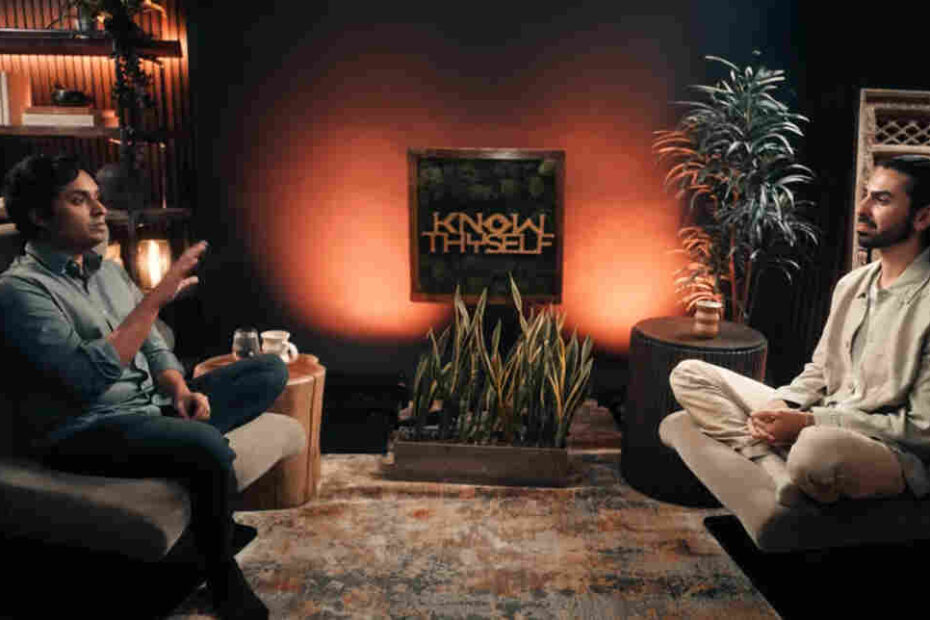
Read the full transcript of psychiatrist Dr. K’s interview on Know Thyself Podcast with host André Duqum on “How Eastern Wisdom & Neuroscience Unite to Unlock Human Potential”, July 22, 2025.
INTRODUCTION
ANDRÉ DUQUM: Hey everyone. Welcome back to Know Thyself. I am very looking forward to this podcast because our guest today has this unique depth and capability to integrate and synthesize the Eastern inner sciences with Western medical practices and to be really a bridge for understanding both.
He has this unique combination of being a Harvard trained psychiatrist, but also spending over seven years on and off at ashrams studying the contemplative practices. And so he has this incredible ability to help us understand what it means to be human and achieve human well-being. Dr. K.
Dr. K: I guess so.
ANDRÉ DUQUM: So good to have you, man.
Dr. K: Yeah, I mean, when you say the ability to achieve, I mean, we can try. Your mileage may vary. So I think that’s true of both Western medical practice and Eastern contemplative practice.
The Fundamental Gaps in Eastern and Western Approaches
ANDRÉ DUQUM: So to set the stage a bit, from failing out of college due to gaming addiction, to spending seven years at various ashrams, to becoming a psychiatrist, what did you fundamentally see lacking in both Eastern and Western approaches that’s really important to kind of set the stage for?
Dr. K: What a beautiful question. So I think there’s one fundamental weakness in the Eastern traditions and one fundamental weakness in Western science.
So the biggest problem with Western science is that it doesn’t work for people. I know that sounds weird, but literally what I mean is when we do a study on neuroscience, we are learning about the average brain. We are not learning about your brain.
It requires a human being who understands the science of medicine. And then they have to tailor what works or what doesn’t work for you. So each patient with their doctor walks an individual journey of applying scientific principles. And remember, science is about the average, right? So gravity is universal. Similarly, if we look at which parts of the brain do what, those are general rules.
So you require a tailoring down. This is why I think there’s a fundamental misunderstanding in the world today that we’re all learning about science, but we don’t realize that even if you understand neuroscience, it’s not going to teach you about your brain, it’s going to teach you about the average brain. So there’s a gap in translation.
That’s literally why we see that even if we understand something about neuroscience, if you explain that concept to someone, they can’t DIY it directly in their life. So if we sort of look at the Eastern traditions, that’s exactly what they did, right?
And I think one of the best ways to understand this is, Freud, for example, had no way to look inside someone’s mind. So he would sit with another person, he would listen to their words, and he would use their words to infer what is going on in someone’s mind. But I’m sure you know that there’s a difference between what you say and what you think, right? There’s a huge gap there.
So that’s sort of what the Eastern contemplative practices did. A yogi sits in the Himalayas, doesn’t talk to anyone, and he has the one tool that can actually observe the mind. You can observe your mind. I don’t even know if you have thoughts. I don’t know if anyone, everyone listening out there could be bots. And if you’re all watching us on the Internet or whatever, I could be an AI. There’s no way of you knowing, right?
So the fundamental problem with mind is that the West has no way to detect it, we have no way to measure it. And Western science is all about measurement. So we have to be able to track things. Blood tests, X-rays, whatever.
So in the East, we have the one direct way to observe mind, which is internally. So that’s why Eastern contemplative practices all DIY, right? No one else can do it for you. If you come to my office, I can therapize you as a psychiatrist, I can do surgery. I mean, I’m not going to do surgery on you, but a doctor can do surgery. So Western science is about doing things to you. Eastern contemplative practices are all about doing things yourself.
But there’s a big problem, because if anyone who makes a claim about Eastern contemplative practices says something, you have no idea if they’re right or wrong. So you have no way of measuring whether someone who makes a claim, if it’s BS or not, because there’s not a Western apparatus to verify whether something is successful or not successful.
So over on the West, we can verify things, but everything is general. Nothing is tailored to you. And over on the Eastern side, we have a lot of practices. But which ones work well? Do they work? Do they not work? Do they work better? Do they not work as good?
I see this as a huge problem when people engage with spiritual traditions. Because if you go to an ashram or something, or you go to a teacher and you have difficulty doing a practice, does that mean that you need to try harder or that the practice doesn’t work or that the practice isn’t suited to you? We have no way of really knowing.
And the one thing that I always found shocking is that I’d almost never encountered a guru who works with a disciple and says, “You know what, I’m not the best suited for you. You should go learn from somebody else. I have a recommendation.” We do that all the time in medicine. You should go see my friend who’s an orthopedic surgeon and he can take care of you.
But there’s no referral systems in the guru system. There’s no referral systems within gurus. Right. So what that ends up meaning is that a lot of people who walk Eastern paths are not actually on the right path for them. And then they sort of say things like, “Oh, meditation doesn’t work for me.” Well, maybe you should have a different teacher or use a different kind of practice. And there’s a whole mechanism and science behind that, which most people, I think, don’t know or understand or teach.
Vidya vs. Gyana: Information vs. Understanding
ANDRÉ DUQUM: Yeah, there is this pedestalization of the intellect and logic throughout all, you know, more and more of the world, I would say. But obviously Western side of things. And I’ve heard you speak to this distinction between Vidya and Gyana and how it’s important to understand the difference between the two because they’re not the same.
And yet we conflate information as knowledge as wisdom. And so how do you kind of distinguish between the experiential knowing that we can have gnosis in the body versus what we can empirically validate and information and knowledge in the external world?
Dr. K: Yeah, so it’s a great point. And I love Sanskrit because, you know, there’s this apocryphal saying that Eskimos have 100 words for snow. So anytime you have a culture that understands something very well, they will have a very sophisticated language for it.
So what I love about Sanskrit is I think it is the most sophisticated language for describing subjective experience. So even the word meditation, for example, is one word in English, but it gets translated over to at least a dozen, if not more words in the Sanskrit language.
So you mentioned Vidya and Gyana, and I think it’s a fantastic thing to start with. So these are both words that get translated as knowledge in some way. But I would say that Vidya is information and Gyana is understanding.
So information is objective, is transmissible. So if I tell you, you know, my car is parked over there, you can sort of, you don’t really know that, but I can transmit it. It’s also, so it’s objective and it’s transmissible. Gyana is subjective and non-transmissible.
Now, the tricky thing is that in the West, we value Vidya over Gyana. We say, unless you can prove it to me, I don’t care. Right? So that’s why science is so big. The big advantage of science is that it’s verifiable. But I think the shortcoming is if we look at information, information doesn’t change behavior and it doesn’t change your life.
I can tell you, “Hey, you should stop eating hamburgers. It’s bad for your cholesterol.” And I’ve tried. I worked as an addiction psychiatrist for a while. I still arguably do. And explaining to patients that this is bad for you does not elicit change.
So Gyana is what changes a person, but it’s untransmissible, which is the whole problem. That’s why we train psychiatrists, because even if I’ve walked my own journey, I can’t upload that to your brain. And so that’s sort of the dichotomy. I think Gyana is actually a lot more valuable. That’s what we kind of call understanding. Right?
You can have, I run into this quite a bit where there’s MBAs who have a degree but don’t understand how to run a company. So that’s the difference between Vidya and Gyana.
ANDRÉ DUQUM: What is the difference between someone’s disposition, I guess, and somebody who understands a concept and puts it into practice versus where it stays in the intellect and doesn’t have the capacity to be integrated? Because I’ve heard you speak to how a book will say information, but it’s awakening what’s the knowledge you already have within you, in a sense would be Gyana.
From Information to Understanding: The Transformation Process
Dr. K: So I guess the practical problem that I run into a lot is how do you take information and create change? So the moment that you have Gyana, the moment that you understand something, you have no choice but to change, right?
So I remember one time I was eating sushi with my kids and they had never had wasabi before. And they see this green paste and they’re like, “Oh, this is green tea ice cream. This is delicious.” And I’m like, “No, it is not green tea ice cream.” They’re like, “No, but it smells good.” And so, you know, they want to eat it.
And so obviously she’s like, spoon, took her spoon and I didn’t let her eat it. I was like, “Okay, just taste a little bit.” And the beautiful thing about wasabi is you can see information turn into understanding. If you watch a child try wasabi for the first time, because the first second it touches your lips, you’re like, “What are you talking about, bro?” And then it sort of hits the back of your head. You know, if you, that’s what it does for me. And then it’s like, “Oh my God, I’m so glad.” And they’re kind of, you know, it’s wild for them.
So if we sort of think about it, information doesn’t change behavior. In the moment that you have experience, the moment that you have Gyana, you cannot not change. So once the child has tried wasabi, if I give them a spoonful, they’re not going to eat it, right? Everything, the way that they treated wasabi before experience and the way that they treat it afterward is completely transformed. That is the value of Gyana.
Now if we, we can also talk about other examples of this. So my favorite thing is love. So especially nowadays people are struggling to date and stuff. And everyone has these ideas of what relationships are. They have all this information, especially driven by social media and short form content about what you should be and how the other person should be. And they have all these ideas about what a relationship is.
And once you actually experience love, once you experience a healthy relationship, you know what it is and you know what it isn’t. So information is something that’s transmissible. Once you understand something, there’s change that can’t be avoided.
Now the question really becomes, how do I move from one to the other, right? So I can read a thousand books on meditation. It doesn’t make me enlightened. I can also use an app for 10 years. It doesn’t make me enlightened. So how does that transmission happen?
I think there are two mechanisms. We can sort of look at the Western mechanism and the Eastern mechanism. So the Western mechanism, so we know that the moment you manipulate information is how we get understanding of it. So literally the parts of your brain that encode information.
So when I say something to you, it’s going to enter through your sensory, it’s going to enter through your ears, go to your auditory cortex, go to your hippocampus, which is where your short term memory lives. So you’re like, “Okay, I kind of get this.” That memory gets consolidated and really integrated into your brain when you start to manipulate it.
So what I’ll tell people is, you know, don’t memorize. I work with a lot of people who have ADHD and struggle to study and things like that. So don’t memorize information. What you need to do is play around with it. And what we sort of notice is if there’s anything in your life that you play around with, right?
So if you’re, if you really love food, for example, and you play around with cooking, you’re going to understand it way better than a cookbook can teach you. So it’s really the manipulation of information, the organization of information, which is why I think this is terrible. But there’s a trend nowadays for people to summarize, like “I read 10 books on business habits. Here’s the TLDR.” That’s going to go right into your short term memory and it’s going to get wiped when you go to bed.
You have to play around with it to really learn it and understand it. That’s the Western perspective. I’ll pause for a second. We can go into the Eastern if you want. But any thoughts, questions?
ANDRÉ DUQUM: No, I would love. Yeah, keep going.
The Eastern Perspective on Knowledge and Consciousness
Dr. K: So the Eastern is where things get weird. From the Eastern perspective, what I have really discovered and what I think is true is that there’s this collective unconscious that has all of the understanding of everything. It’s so interesting because what I’m about to say is going to sound crazy, but I encourage people to really pay attention to what I’m saying and study it for themselves.
So what I realized a long time ago, I’m kind of scientific by nature. And one of the things that always confused me is if I read a book, why don’t I understand it? So if my mind scans words on a page and I do that once, it doesn’t stick. If I do it twice, it doesn’t stick. If I do it three times, it doesn’t stick. But there are other times where I read it once and it does stick.
So if the information is really in the book, I should be able to read it and then I should know it. But that’s not what happens. So what really happens is the stuff on the page, and if you read a book and you’ll notice that you kind of get it, it triggers something within you. The understanding doesn’t exist in the book. You can’t have understanding in a book, literally, because if the understanding was in the book, anyone who read it would get the understanding.
You can have information in a book, but the understanding comes from within you. And the book serves as a trigger for your internal understanding. “Ah, now it clicks.” We even have subjective experiences that will describe, like, “the light bulb went off,” “it clicked for me.” So clicking is Gyan.
And then once you understand that, okay, hold on a second, this understanding comes from within me, then we can really experiment with it. So now the question becomes, what are the circumstances that allow things to click for me more? And this is really when you get into contemplative practice and there are certain practices that you do that will have things click for you more.
And then you can discover a couple of other things. The first is that stuff can click for you without you reading anything. So if you’ve ever been creative, if you’ve ever woken up one day and you’re like, “oh, this is what’s going on,” that doesn’t come from an external trigger. It comes from somewhere within you.
And then through that process of experimentation, and I tried a lot of different practices and things like that, what I sort of, now the understanding that I have is there’s a conduit between you and Brahman, which is the cosmic consciousness. And the more that that conduit opens, the more access to that information that you have.
And when you read a book, if you’re distracted, your conduit to Brahman is weak. So it’s not there. Attention is critical for the conduit to Brahman. And so once that conduit is open, it’s like I’m plugging in my ethernet cord and now I’m connected to the Internet, so now it clicks for me.
And literally what I’ll do is, I work with all kinds of people, degenerate gamers, but also CEOs of very successful startups and things like that. And the more that I’ve found that they can connect to Brahman, when I teach them those kinds of contemplative practice, their understanding of things and their performance in the real world drastically improves.
ANDRÉ DUQUM: I might try to ask you to verbalize a concept that isn’t fully conceptualizable. But when you speak to the collective unconscious and this Brahman and this field of all knowing and our ability to connect to it and be able to have cognition, what I think the Buddhists term as direct, non-conceptual, valid cognition. So the things that we can know irrespective of stimulus coming from the external world, like you’re speaking to, how do you, for a very logical mind, explain what that field is that we can open our channel up into deeper as you’re speaking to?
Dr. K’s Journey from Skepticism to Understanding
Dr. K: Yeah, so I think it’s a tough thing, but I think I’ve got you. So this is something that I struggled with a lot. So just to give you all some background. So when I first went to India, it was the worst time in my life. I was just in deep despair. And then something changed. I had some experiences and stuff and I was like, hold on a second, this is wild. What is going on?
So then when I was 21 years old, I started doing neuroscience research on meditators, specifically in the EEG lab. And I thought what happened to me was BS. And so then I started to, but I couldn’t deny the change. But I was like, how on earth does this work?
ANDRÉ DUQUM: What had happened to you?
Dr. K: I changed. Something fundamental within me changed. I had a couple of experiences in meditation that reframed my understanding of reality, reframed my understanding of who I am. And I’m not trying to sound woo, I mean this is the…
ANDRÉ DUQUM: Were they more mystical experiences?
Dr. K: Absolutely. So I just had experiences. And this is, by the way, this is not crazy. So this is well verified. So we know, for example, that certain mystical experiences will alter things in the default mode network and things like that.
But basically I was like, what the hell is going on? I want to understand. Even though it happened to me, I didn’t believe it in a sense. So I started this scientific path of, okay, if something is true, if this happened to me, there must be something. Either I’m crazy or this is true. That’s option number one.
If it is true, it must have mechanism behind it, because I don’t believe, and this is also what these texts say. This isn’t random stuff. There are spiritual laws, for lack of a better term, that observe, that are restricted to scientific mechanisms, basically. So the spiritual laws don’t change from day to day in the same way that the law of gravitation doesn’t change from day to day. So these should be understandable or verifiable.
So when I went down that road, that’s when I sort of tried to figure out, okay, what the hell is this consciousness thing? How does this work? How does this connect to people? And this is where I would say it’s going to be hard to explain, but I’ll… So if I look at you, André, what are you?
ANDRÉ DUQUM: I’m a guy. I’m a dude guy.
Dr. K: What does that mean?
ANDRÉ DUQUM: No, I’m joking. Who am I? What am I?
Dr. K: What are you? Who are you is like…
ANDRÉ DUQUM: What am I?
Dr. K: I mean, precisely, scientifically, what are you? What constitutes you?
The Layers of Human Existence
ANDRÉ DUQUM: Yeah. There are many different ways in which we could cut the onion and the different layers of myself from…
Dr. K: Okay, hold on a second. So that’s important. So the first thing, scientifically is there is more than one layer of you.
ANDRÉ DUQUM: We could look at the biological. We could look at the neurological.
Dr. K: Okay, so give me all the pieces.
ANDRÉ DUQUM: So biological, emotional, mental. Energetic.
Dr. K: What is that?
ANDRÉ DUQUM: It gets again, into the, a bit of the non-physical. So humans have a bioenergetic field that you can verify and test.
Dr. K: Okay.
ANDRÉ DUQUM: And fundamentally the awareness that I exist.
Dr. K: Okay, cool. So a couple of basic layers there. So the first is you have matter. So you have matter. We are all biological. Then we get into some weird stuff. So then there’s this thing called the mind. But we actually don’t know that you have a mind. We don’t know that. But if you ask human beings, we all share this delusion that we have a mind.
Now this is really weird because I don’t know you have a mind. You don’t know I have a mind. But every human being on the planet and animals appear to have minds. The first thing is that there’s a fundamental divide here which science really struggles with. But I think if you really use the principles of science without bias, you absolutely get here, which is that, so the basis of science is observation. That’s what human beings do. And we develop these things called instruments which help us observe. So X-ray machines, blood tests, whatever.
So we can make an observed statement that there is a part of you that is not physical, that cannot be measured, that’s your mind. Then we get into neurological, which maybe connects the physiologic to the mental. In the middle is neurology.
Now some people will argue that neurology exclusively creates the mind. I don’t think that that is a fair scientific conclusion. I think it’s a reductionist scientific conclusion. But nothing in our neurology explains the quality of subjective experience. There’s no reason why the brain needs to be self-aware for the brain to function.
In fact, we know that because you have nerves in your stomach that are acting and doing all kinds of stuff, interpreting information, creating peristalsis, creating, not creating gas, but managing gas and all that kind of stuff. And you don’t need to be aware of it at all. So there’s something else going on. So if you look at you, there’s a layer of you that is subjective, personal, non-physical.
ANDRÉ DUQUM: Like the taste of chocolate, the color of a rose. You can’t cut your brain open and find that anywhere.
The Material and Subjective Realms
Dr. K: Absolutely. So there is a subjective quality. So if we look at western science, so if I were to draw a line in the middle, and I would say that in the material realm we can explore. So I can develop a telescope to, even though my eyes can perceive certain things, I can develop an instrument to see something that is not visible to the human eye as a telescope.
I can also develop a microscope, which is a tool that allows me to observe things in the physical world that do not appear to be present in perception. And this is my favorite example of this. So I did some public health work many years ago and there was one of my professors was trying to build wells in Africa.
So they were trying to build wells and they were explaining to the population that they’re working with that, “hey, you guys need to build a cement well. Don’t just build a regular well.” And then they were like, “why?” And he’s like, “well, see you guys have a latrine over there and you have your drinking water over here. And since it’s sand or dirt or whatever, you have bacteria that travel through and into your well. And if you go through the trouble of building this cement well, the bacteria won’t hurt you anymore. You guys won’t get sick.”
And then they’re like, “what do you mean bacteria?” And he’s like, “well, in water there are these tiny little invisible creatures that you don’t see that make you sick.” And then they’re like, “well, I drink water every day. I’m not sick every day. How does that…” If you kind of think about it, it’s crazy. So he’s there and he’s struggling to explain this to them.
So there’s a lot of stuff in the material world that we require technology to be able to detect and understand. Our basic eyes are not sufficient to detect it. So then once we enter the subjective realm, there are similar technologies that we can use to get knowledge of things that are not visible to our basic level of consciousness.
So these are things like, you can say, meditation is a really good example. Psychedelics could be another good example. We can talk about that. But basically, in the same way that we must develop technology to enhance our perception of the material world, there are practices or technologies that can be used to enhance our perception in the subjective realm.
So once you do that and you go, once you develop your telescope and once you look through your microscope and look through your telescope, you will discover that there is this thing out there, that’s the best that I’ve got, that has all of the knowledge. And I know it sounds crazy, but that’s why these are things that have to be subjectively experienced.
And the reason I kind of explained this way is I think this is a scientific mechanism of subjective discovery that you have to do certain kinds of practices, like agni chakra practice is a good example which we can go into. And once you do these practices, you literally know things that you’re not supposed, you can’t know. And I would even say that… anyway, we’ll get to that later, but so I’ll pause there.
The Nature of Mystical Experience and Consciousness
ANDRÉ DUQUM: This is setting the stage really beautifully, I think, because we can look throughout history and see that there are realms of existence that we previously just did not have awareness of, that we eventually did become aware of.
And similarly, this five sensory world where we have experience through our senses of less than 1% of the electromagnetic spectrum, is very enchanting to perceive that all we can experience is reality through our senses. But again, you go into these deeper subjective experiences and you can experience things that aren’t of the five senses that feel valid and true and powerful.
Dr. K: Absolutely. You experience them? Yeah.
ANDRÉ DUQUM: So you had various experiences that kind of blew your mind open a bit. And on contact, it sounds like it reoriented you. What do you think happened to you?
I mean, you could look at it again through the many different levels, biologically, neurologically. There’s something so potent when you taste something beyond what you’ve intellectually just known and garnered. And I think that can transform us on contact. And so what happened to you more specifically?
Dr. K: On what level?
ANDRÉ DUQUM: Like you had a mystical experience or many of them.
Dr. K: Okay.
ANDRÉ DUQUM: Did your logical mind wrestle with trying to make sense of them?
Dr. K: Absolutely. That’s what I mean. That’s what I’ve been doing for 20 years.
ANDRÉ DUQUM: Yeah. Have you ever talked about them? What happened in your experience?
Dr. K: Do you want me to share my subjective experience?
ANDRÉ DUQUM: Would you like to? Is that comfortable?
Dr. K: I don’t ever share. It’s okay for you to ask, but I don’t share.
ANDRÉ DUQUM: No. Great.
Dr. K: We can talk about why if you want, but yeah.
States and Stages of Consciousness
ANDRÉ DUQUM: So how do you think about states and stages of consciousness then? Because you can have an expanded state experience and relate it according to your stage of evolution in a sense. How do you discern?
Dr. K: Yeah. So I think I can talk about once again what you’re talking about. I must admit the language that you use, I recoil.
ANDRÉ DUQUM: What specifically so I can know?
Dr. K: I’m not quite sure.
ANDRÉ DUQUM: Okay.
Dr. K: But like this spiritual woo woo stuff. Okay, so I know that sounds weird, but I know it’s weird. I’m not saying you’re a bad person or anything like that. I think what you’re saying is true. I think what you’re saying is correct.
I think there’s a fundamental problem because people who talk about spiritual mechanisms are usually not trained in science and people who understand science usually do not. They’ll use like a meditation app, but they usually do not go into the Himalayas to learn tantric upasana from some dude who has been there for anywhere between 70 and 700 years. They just don’t do that. These two worlds are so separate.
ANDRÉ DUQUM: Yeah.
Dr. K: So what I like to do is be precise about the language. And I’m not saying you’re not being precise. This is like a personal arrogance and frustration that I have with the spiritual world of like, people just toss around these words, like “elevating consciousness.” Like what does that mean? Yeah, like specifically.
ANDRÉ DUQUM: Yeah. And I would actually love to see if you have what version of…
The Neuroscience of Meditation and Mystical States
Dr. K: Absolutely. So let’s talk about mystical experience and how it transforms you. Okay. That’s what you want to do. Okay, cool. So first thing is let’s start with neuroscience.
So we know that when you engage in certain states of meditation, and our neuroscience in this, by the way, is in its infancy. And there’s another reason for that, which is that when we do studies on meditation, we don’t take a yogi from the Himalayas and study what happens to him. We usually take like 30 people and we’ll put them through a mindfulness course over the course of 12 weeks and observe some changes.
So it’s kind of like, you know, if you have an artist who’s been practicing for 30 years, if we’re studying art scientifically, we’re going to take a bunch of 18 year olds, give them a paintbrush, teach them how to paint, and then we’re going to try to see what they make. So a huge problem with our studies on meditation is that they’re done on novice meditators, not expert meditators. But that being aside, I can clip that if you want.
So here’s what happens when you attain a certain state of consciousness. And by a state of consciousness we can describe this as well. It starts with a one pointedness of the mind, right? So if you look at our general experience, our mind has lots of thoughts, lots of emotions. We’re like a light bulb instead of a laser beam. The energy is the same, but it is diffuse. I’m thinking about this, I’m worried about this. There’s a lack of one pointedness.
So the first step on the road of consciousness is diffuse mental activity or even absence of mental activity during sleep and things like that. Next step is what I would call the flow state. So flow state is when the mind is functioning, but it is one pointed and has a particular goal.
Flow state feels good. Our productivity improves. There is equal activation of our emotional centers and logical centers of the brain. We’re very goal directed. We’re not really using willpower because we’re like in flow. So there’s no effort or there’s some effort, but it’s not like trying to rein in my diffuse mind. Okay, that’s next step.
Still mental function, you still have somewhat awareness of who you are, but you lose some sense of time. Right. In flow state. Then we go to the state of and I would call flow state, something like Dharana. So Dharana is focusing on one object. So putting your mind on like one thing and focusing on that.
Then we move into Dhyan. So Dhyan is when there is a dissolution of self. So my subjective experience kind of moves outside of my body and becomes melded with the object that I am focusing on. So we sort of see this dissolution of self.
If you’ve entered like a state of meditation, you know, you can say like some days, “Oh yeah, I’ve been meditating this week. It hasn’t been working.” Like, what does that mean? And then sometimes you meditate and you’re like, “Oh my God, like this feels great.” What does it feel like? It feels like kind of like nothing, but in a good way. Right? So that’s the state of Dhyan. So that’s the second level.
Now neuroscience changes start to happen along this course. So you start to see autonomic changes. So our cortisol levels go down. Sympathetic nervous system kind of deactivates some, usually for most people, but depending on Kundalini practices and stuff, you can activate the sympathetic nervous system, which is part of the goal. So you basically get like an evening out of your physiology.
You also start to see, you know, so in the flow state, you see balancing of logical mind and emotional mind. They’re both active. Then you start to see destruction of the default mode network. So this is the part of our brain that gives us a sense of identity. So you start to like dissolve. Like you experience without being me, like I’m just here, but I’m not me. I’m just like something else.
So this we know really, really well actually scientifically. So if you look at meditators, their default mode network will deactivate. Here’s the really cool thing. So psychedelics are an awesome way to study some states of meditation because they’re the first time that western science can induce a certain kind of meditative state in a normal person. So you can separate out the long term effects. Like as you become slowly more enlightened, like, who knows what’s going on in your brain.
Ego Death and Psychiatric Healing
So what we know is that if you give someone a psychedelic and you’re looking for clinical improvement, just seeing things, colors, whatever, even having visions does not correlate with clinical improvement. If you want to heal trauma, if you want to recover from like treatment refractory depression, there’s one experience that correlates with literally psychiatric healing, which is ego death.
So the more ego death someone experiences during psychedelic treatments or practices, the more likely they are to heal. And that same thing happens in meditation as well. You experience some degree of ego death. That’s a deactivation of the default mode network.
And then the third, the last kind of area that we can sort of touch on a little bit is endogenous DMT production. Now, this is where we get into super extrapolated science. Like, this is something I’ve been working on for a while. But we know that the brain produces DMT, which is the active ingredient in ayahuasca chikuna leaf. Is it ayahuasca?
ANDRÉ DUQUM: Yeah, there’s one. The leaf aspect has that.
Dr. K: And so we know that it gets produced. And the really interesting thing is if you look at the neurochemistry of DMT production, we don’t know where it comes from. People will say it comes from the pineal gland. We don’t know that. But one thing we do know is it’s produced from serotonin.
So you require a really high level of serotonin to drive that metabolic process forward. And this is also why, as people become more and more technologically dependent, our serotonin balance gets messed up. Technology and things like that, which is why no one’s getting enlightened through meditation apps. Dopaminergic serotonergic balance is a little bit off.
So if you look at all these yogis and stuff, the reason you need a very specific diet that’s very serotonergic. There’s a serotonergic diet, there’s certain practices that fix your gut health. So serotonin comes from the gut predominantly is developed from tryptophan. And so you need a certain kind of tryptophan metabolism. You need a certain kind of serotonin metabolism. You can’t be depressed, right? So you can’t be anxious or things like that. Those imply serotonin imbalance.
And so once you kind of become a yogi and you’re free of depression and anxiety and all that stuff, then you’ve got ample serotonin in your brain that turns into DMT. Then you get to really explore the weird conscious realm. So that’s even beyond default mode network activation. So once you get there, then you have subjective experiences of consciousness. I mean, subjective experiences of weird stuff in dimensions and like astral travel and all that shit. That’s like super weird. So let’s. I want to…
The Pleasure of One-Pointed Focus
ANDRÉ DUQUM: I want to return back to the base. We’ll build our way up. Yeah, you mentioned how, and I’ve very much so felt this throughout my own practices, how there’s something inherently pleasurable about the concentrated mind.
Dr. K: Okay.
ANDRÉ DUQUM: And when you spoke to one pointed focus and single pointed focus and you look a little bit more macro in terms of society and throughout culture. How is the theft of our attention causing and like depriving our sense of self awareness?
Dr. K: Yeah, it’s great. So once again I’m going to answer a slightly different question. So let’s, about attention, why people are unhappy. One pointedness. We’ll get there. You got all the right pieces. I love it. I’m going to just reframe a little bit if that’s okay.
ANDRÉ DUQUM: Feel free to at any point in the future.
Dr. K: Just let me know if this is annoying. Is this annoying? Okay. No, just…
ANDRÉ DUQUM: Yeah.
Dr. K: Okay. So let’s talk about. First of all, let me ask you. When you say one pointed mind is pleasurable.
ANDRÉ DUQUM: Yes.
Dr. K: What’s up with that?
ANDRÉ DUQUM: Being concentrated on something is much more inherently pleasant in my own internal experience.
Dr. K: Why?
ANDRÉ DUQUM: Because I suppose it’s not distracted, which usually is unpleasant. There’s a subtle feeling, I suppose of anxiety inherent in a distracted mind.
Dr. K: Okay, cool. So let’s like tunnel down into that a little bit. When you are anxious, what is going on in your mind?
ANDRÉ DUQUM: It’s scattered, so it’s jumping from place to place.
Dr. K: Okay, let me know if this is inappropriate. Have you had an orgasm before?
ANDRÉ DUQUM: Once or twice.
Dr. K: Okay, so when you have an orgasm, what is going on in your mind?
ANDRÉ DUQUM: Nothing.
The Neuroscience of Attention and Bliss
Dr. K: Right. So you’re presumably focused or even in this transcendent state. If we sort of think about it like orgasm—and I know this sounds vulgar, but literally, if you look at the meditative texts, they describe orgasm as one of the four ways to spontaneously achieve samadhi, which is like a temporary state of enlightenment. And why do we all feel so good? Hopefully, presumably.
If we look at it, orgasm is like a really quick way to get a completely one-pointed mind. And exactly what you said, the more anxious you are—what I’ve observed as a psychiatrist is that the speed, flow and direction of your thoughts are all amplified when we’re anxious, when we’re depressed. Even in terms of psychosis, someone’s mind is not calm. So a calm mind usually means a one-pointed mind.
Orgasm is usually the thing that people connect to the most easily. But then also in like a flow state, it’s less one-pointed because your mind still is doing multiple things—it’s doing one thing at a time, but it moves from one thing to another to another.
So what we sort of notice is that one-pointedness of attention feels good and complete. One-pointedness of attention feels blissful. That’s why people love orgasm. Flow state feels really good, but there’s a gap there.
There are ways to achieve the one-pointedness of orgasm in your daily life. And that’s when you have 45-minute orgasms, but you’re not having sex. You just have these profound positive experiences which I think in the eastern tradition we call samadhi.
But I think if you look at those states, literally there is a mechanism in your body for you to produce the subjective bliss of orgasm. Whatever that mechanism is somehow gets activated by certain spiritual practices and certain spiritual trainings. This is why we call enlightenment bliss.
It’s weird because we call it anand, which means bliss. We also call it enlightenment, which means knowledge. We also call it things like freedom, moksha, liberation. But liberation, knowledge and bliss are not in the same ballpark. But there is one state that is the essence of all three of those things.
Technology and the Weakening of Attention
Now let’s talk about technology. That’s the backdrop. So what does technology do? The first thing that it does is it diffuses our attention. We love technology because it concentrates our attention for a little while. So when I’m watching a fantastic TikTok about a cat meowing in a really cute way, my mind becomes completely one-pointed on that.
Over time what we’re actually doing is the mind becomes weakened because the one-pointedness is triggered by a sensory experience. I’d say that forcing your mind to focus is hard. Getting it to focus automatically is really easy. But the more that I take the elevator, the weaker my legs get.
So what’s happening is the more we use technology, the more our mind becomes weakened in terms of focusing. And that’s literally what we see. If we look at increases in anxiety, increases in depression, increases in loneliness, literally we have a society of people that cannot control their attention.
What they hate more than anything else is boredom. And everything is boring except for TikTok. And the moment that you lose control of your attention, then if you have anxious thoughts, you cannot reign them in. The moment you have depressive thoughts—if I start to think anxious thoughts, start to think depressive thoughts, I go down a rabbit hole of that kind of stuff.
The only way I can get out of it is to watch another TikTok. So now this feels bad to be anxious. I want to run away from my anxiety. I’m going to turn to my phone. Then once again, the phone pulls my attention away from all of the negativity.
The Addiction Cycle
Now what’s happening is it’s almost like a mental cycle of becoming addicted to opiates. Where my body hurts, I have to take a pill to make it go away. But the more opiates that I take, the more it alters my mu receptors. And the more sensitive to pain I become, the more dependent I become.
So what we’re sort of seeing is addiction to technology because there is a weakening of our attentional capability. And then if we’re not using the technology, we’re suffering. And the only antidote we have is this. So we turn to this again, and then we get weaker and weaker and weaker.
We’re really hitting a critical state here, which is why we have mental health epidemiology. There are global pandemics of loneliness, suicidality, anxiety, depression. All these things are getting really bad. And I think it’s due to this fundamental attentional loss.
ANDRÉ DUQUM: In respect to the remedy for this and how we can cultivate practices that directly support us to have a more concentrated mind throughout our life—is trataka, or what practices would really support people to be able to instill as a daily habit throughout their life that can have them…
Practices for Reclaiming Attention
Dr. K: So basically, I’m going to answer in two ways. One is it doesn’t matter. Any practice that trains your focus is going to help. So dharana is like a focusing practice. Meditating on something, and with that fundament, let’s get to fundamentals.
Dharana is when you tell your mind to do something, it’s like training a dog. You tell it, “I’m going to look at this.” And the mind is like, “I don’t want to look at that.” And then you pull it back like a leash. You pull it back, you pull it back, you pull it back. That’s the fundamental thing that needs to be trained.
And this is what we know from studies like fMRI studies and EEG studies on various types of meditation, that that’s the common element—restraining our mind. So that’s one thing.
The reason I like trataka for a couple of reasons. One is that trataka is interesting enough from a sensory practice and is not just focusing on your breath. So it’s a different anchor. A lot of our energy is in our eyes. We’re very visually focused right now. If you look at cell phone usage, sure people listen to audiobooks, but we’re using our eyes a lot. We’re a very eye-heavy society. So I think that’s a good alumna or pillar to use.
I like using the eyes. It feels cool to do. It also feels challenging in a way that evokes some good ego activation because I want to be able to stare at a candle flame without closing my eyes. That feels badass. It’s very easy to get a sense of accomplishment when you do it for a long time.
The other thing that’s really good about trataka is it gives people a very quick example of a sensory experience that technology cannot give them. So we think that there are seven colors that the human eye can visualize. If you do trataka, you will easily realize there are more than seven colors that we can see, which sounds like a wild statement.
But when you do trataka, which is you stare at a candle flame for somewhere between one and five minutes without blinking, then you close your eyes and you’ll see colors in your mind that are not quite the same colors that we can see in the visual spectrum.
ANDRÉ DUQUM: It’s like a negative inversion of it.
Dr. K: Yep, exactly right. So it looks like a negative. So it’s this weird purplish, greenish, bluish. It’s absolutely a color, but it’s not like a regular color that you can see.
So those are three of the reasons that I like it. It’s something that feels different from breath meditation, which people get bored of. It’s not really mindfulness. It kind of feels badass. It’s challenging to do and it feels difficult to do in a non-boring way. You really have to strain yourself.
And then the fifth reason that I’ve never explained to anyone is that trataka is also a shuddhi practice for the Ajna chakra. So that means it’s a cleansing practice for your third eye. Which means that if you do trataka, we don’t tell people this, but if you do trataka, their connection to the intuition and the brahman and their own understanding of their problems will increase.
They will start to realize they’re doing wrong things in their life. So it’ll push them in the direction of spiritual growth, whether they like it or not.
ANDRÉ DUQUM: Sweet. I’m really looking forward to exploring that and topics around intuition and whatnot.
Since we’re here, what are your thoughts on how our thoughts are being commoditized and bought and sold in this neuroeconomic kind of fashion? Because when you dig deeper into this, you see this sort of matrix in how our attention in our mind and our thoughts are constantly being shaped and fought for. And so yeah, what do you think is important to remind people of there?
The Commodification of Attention
Dr. K: So I think the first thing to understand is that our attention is being farmed. Literally, we have become attention farms. If you look at ad revenue from a platform, how does any social media, TikTok, YouTube, whatever, how do they make money? They make money by having your attention. So they generate advertising revenue.
The other thing that people in advertising have understood for a long time is if I can control your sensory organs, I can control your wants. So what we’re starting to see is that you as a human being have one resource which is probably the most valuable thing you have in your whole life, which is your attention.
If you can focus your attention on a book and a study guide, you will get an A. If you can focus your attention on work, you will make money. If you get distracted, your attention is literally the most valuable thing. And if other people can get your attention, if they can get your eyes, if they can get your attention, they can get you to buy things. They can make money.
So literally, the most valuable thing you’ve got is your attention.
ANDRÉ DUQUM: So the reclamation of our attention is essentially the reclamation of our life.
Dr. K: Absolutely right. And that’s in a very literal sense. I don’t mean that metaphorically. Right now, what we’re seeing is that people have claimed your attention. And once they have your attention, algorithms start this process of what’s called online radicalization—it happens to everyone. It’s called online drift, actually.
Over time, your thoughts will be shaped by these algorithms, and then you’ll vote a particular way. You’ll get angry with a particular group of people. And so the key thing that’s going on there is, first of all, they’re shaping your attention 100%. You’re losing control of your life, because you don’t want to spend six hours on TikTok, but you end up doing it anyway, and you’re not even sure how or why.
What’s happening is as people take control of your attention, they’re taking control of your life. They’re inducing certain kinds of behaviors. They’re making money. Your life is objectively getting worse. And I mean objectively as in, this correlates with increases in mood disorders and anxiety, things like that, loneliness, suicidality. So it’s terrible.
ANDRÉ DUQUM: Anthropologically, what does losing our idle time and this continual numbing of negativity lead to individually and on a bigger scale as well?
Dr. K: I mean, anthropologically, I can’t answer, but I can tell you psychiatrically, neurologically, or spiritually. And you’ve got to let me know if I’m being an ass about poking at your question. I just—I’m trying to be a little bit precise. I’m not trying—I think they’re great questions. So what was the question again?
ANDRÉ DUQUM: Losing idle time. Numbing negativity.
The Importance of Idle Time and Emotional Processing
Dr. K: So idle time is really important. I think a really good example of the value of idle time is dreams. When our brain gets to idle, we have dreams. If you literally look at the way that we sleep, we have four stages of sleep, and then we enter REM sleep.
At the beginning of the night, you’re mostly stage one. And at the end of the night, as you go through multiple sleep cycles, the percentage of your REM sleep increases. So the first two hours that you sleep, you get maybe five to 10 minutes of REM sleep. The last two hours, you get way more. I don’t know exactly what the number is. I’d guess 30 to 45 minutes.
So when we look at REM time, REM sleep, what’s going on? That’s when we dream, we see a lot of emotional activation. Your brain, in the same way that if you eat something, your gut is going to pull out the good stuff and literally discard the bad stuff. Our mind does that as well. Our brain does that as well, and it does a lot of emotional processing with idle time.
When your brain, when you’re idle, your brain is not idle. It’s not like the blood flow to your brain decreases when you’re doing that thing. It actually stays about the same, even increases rapidly when you’re literally asleep and not doing anything. So idle time is time that the brain uses to clean things out, especially things like emotional processing, consolidating things into memory.
The Modern Crisis of Lost Idle Time
And so I think what we’re starting to see, getting to your question of anthroposocietally, what’s happening, as the idle time of our mind decreases, we are no longer processing the emotions of every day. So I’ll give you an example of what I mean.
Back in the day, we would go hunting, and you and I would go hunting, and let’s say I shoot my arrow and I miss the deer. And then you shoot your arrow, and then you hit the deer. And then I feel, I’m like, “Damn, that André guy, he’s better looking. His hair is better. He’s better with accuracy. This girl that I like is going to like him more.”
And then you and I, we’re carrying the deer and we walk back to our camp, and we’ve got two hours for my mind to do nothing. Basically, it emotionally processes on its own. And we know this because the brain has the ability to attain homeostasis. That’s what we do. And we do homeostasis with emotions as well.
Emotions don’t last forever. They normally just equilibriate. And my favorite example of this, which I’ve said a thousand times, is the perfect wedding day doesn’t last for a lifetime. The happiness of a perfect wedding day does not last for a lifetime.
ANDRÉ DUQUM: Right?
Dr. K: You were happy. You had a great birthday party when you’re seven, it’s not like you’re still happy. So emotions just naturally go away.
So in the past, what used to happen is we would process those emotions, they’d go away, and then I’d be okay by the time we get to camp. Now what’s going on is that throughout the day, we have no idle time. So when I have idle time, I pick up my phone. When I pick up my phone, it both suppresses certain emotions. And once emotions get suppressed, they do not get processed. So I’m storing them away in my unconscious.
And then it also evokes other emotions. So when I’m looking at it, you’ll notice this. If you look at your algorithms, you’re not going to feel good all the time. They’re going to show you something that makes you feel really good, and then next they’re going to show you something that pisses you off, and then they’re going to make you feel good, and they’re going to make you feel bad. They’re going to make you feel all kinds of things.
Because what these algorithms are figuring out, I don’t think it’s intentionally evil, by the way. I think they’re just learning that the more engaged you stay with something is the more emotionally activated you get.
So now what’s happening is we have a life where something bad happened at work. But instead of processing it, I’m using my device, which is evoking more emotions and suppressing those emotions so they don’t get processed. And then over time, these emotions just pile up, pile up, pile up.
And that’s why we see societal depression, societal anxiety. South Korea’s birth rate is super low because people, I think on some level, they don’t have the capacity to fall in love anymore. That’s a foreign thing. Even if we look at dating nowadays, people don’t fall in love very easily anymore. So there are huge negative effects of losing our idle time because our brain used to use that.
The Spiritual Cost of Unprocessed Emotions
ANDRÉ DUQUM: When you think about the accumulation of these impressions that our subconscious is always recording and taking for and is not having space to express or to process, what is the direct spiritual cost down the line of not letting these impressions sort of rise to the surface and stay out? What happens as they start to continue to accumulate over years and decades?
Dr. K: So spiritually and scientifically I’d say, I’m going to use spiritual language, but I’d say bad karma. Anytime you have some event happen in life, so if I get, since you got the deer and I didn’t, now I have, you’re a winner and I’m a loser, right? So this is a polarity that has been created of you’re good and I’m bad, that karma needs to be reversed, right?
So once I feel like a loser, literally, I can go to psychotherapy and I can have a therapist process that so I no longer feel like a loser. We all know that that’s a thing, right? But we’re basically correcting that karma. And I think psychotherapy and stored emotions is just one example of if I stop doing this, I’m going to accumulate a lot of what I would call in spiritual language, negative karma.
And that’s absolutely scientifically paralleled by emotional suppression leads to all kinds of negative outcomes, leads to a sense of hopelessness, leads to a sense of lack of self efficacy, which in turn will then karmically, if I feel like I’m hopeless and I can’t do anything, my median income will decline, my relationships will worsen. So it’s basically a massive accumulation of bad karma because we’re not balancing it. We’re not fixing that.
ANDRÉ DUQUM: Karma and that bad karma or accumulation there, would you say, directly links to our experience of suffering in life?
Dr. K: Technically, no, but practically, yes. So what that bad karma is going to do, the suffering is in a sense independent. But technically there are ways to not link those things. But I think practically, yes.
So if I feel like a loser and then I don’t believe that I’m capable of something that will have ripple effects for tomorrow, the next day, the next day, the next day, the next day, and then generally speaking, the amount of suffering in my life will increase. If anyone is watching this and you know that if you don’t take care of a problem, it almost never goes away and it almost always becomes worse, right?
So anytime you do not settle your karmic debts, they’re going to come back again and again. And what we’re seeing in society is a cycle of avoidance of karmic debt. So now, this thing is going wrong, I’m going to run away from it. And the more that you run away from it, the more the negative karma piles up and then you get trapped in the cycle.
And this is what my patients come to me with sometimes is they’re just getting it from all sides. They’re getting crushed at work, in romantic relationships, at home. They feel depressed, their body isn’t working right. They’ve got weird autoimmune things. So all this negative karma is piling up because you’re not settling it.
The Crisis Facing Young Men
ANDRÉ DUQUM: Because I know you support and work with so many young men. What have you observed in regards to the lack of rites of passages, Alexithymia, digital isolation. What is it specifically with young men that they, in this generation are prone to suffer because of these different things?
Dr. K: I noticed that you had a couple of different anchors in that question.
ANDRÉ DUQUM: I think there’s a lot of conflating different contributing factors to the depression and suicidal rates in young men and all these things. And so what do you feel is most prevalent to speak to here? I know alexithymia is something that you speak to, but as it relates to everything we just covered with the lack of attention.
Dr. K: So I think there’s a couple of different things going on. The first is that I think the core of the problem is that men have become spiritually bereft. There’s no spirituality within men generally anymore. So what started to happen? I think that’s the core of the problem.
And as men that I work with, in the back of my mind, what I’m always thinking about is how do I get this person spiritually connected? Because the moment that happens, all kinds of positive things start to come about.
So what does that even look like? What do I mean by spiritually bereft? There’s so many dudes out there who don’t know what the fuck they’re doing. They don’t feel good. They don’t know what they want. And since they don’t really know what they want, they look to other people and they’re like, “I think I want this. I think I want cars. I think I want to get laid.”
I mean, the number of men I’ve worked with who are incels and virgins and will go to a prostitute because they’re tired of being a virgin. “I don’t want to be a virgin anymore.” They’ll go to a prostitute. It’s not like their problems get fixed, they get worse.
So there’s a group of people who have no compass. So then they go in this direction. They’re like, “Oh, this thing will make me happy. This thing will make me happy.” But when they say they want that, their heart isn’t in it. So they’re not able to work hard enough to achieve anything. So then they feel burnt out, and they try to force themselves. They try to learn efficiency, they try to learn optimization. They long for discipline. They want willpower. None of that stuff is going to save them.
I’m not a fan of, I don’t have discipline. I don’t have willpower. I don’t think you need it. I know it’s crazy, but if you are inspired and passionate, all of the people that they want to mimic and they think, “Okay, if I become a CEO, if I do this, then I will be happy.” All the people that they want to mimic are driven by something that’s completely different.
Alexithymia and the Loss of Internal Direction
So I think that there’s a lack of, first of all, understanding what they want. Now, why is that? That’s for two reasons. One is men are Alexithymic. So what that means is that they’re colorblind to their internal emotional state. So we suppress basically all of our emotions except for anger. Therefore, we don’t know how we feel.
And so in the absence of that internal compass, we fill in that void through our perception. So then I look when I don’t feel like doing anything, I look around, I’m like, “What is this guy eating? Oh, that guy looks like he’s having fun. Maybe I’ll eat that too. And then maybe I’ll have fun.” But I’m not going based on what appeals to me. I’m copying other people.
Which is why I think the podcast space has exploded so much, because there’s a lot of people there who are directionless, who are looking for wisdom, looking for guidance. I’m not saying the podcast space is bad. I think you’re doing great work. I’m guilty of being in that space too, right?
So I think they’re not internally connected, they’re emotionally colorblind. So then they fill it with these external perceptions. And then when they try to do those things, the internal fire isn’t there. So then they fail. They don’t follow through. They kind of end up back to square one. Then they go looking for discipline, but that isn’t going to give them passion.
And so I think this is basically what’s going on, is men are looking for answers, but what they really need is direction. They need to find that internal direction and that they’re not connected to either.
Balancing Transcendental Practice and Shadow Work
ANDRÉ DUQUM: What do you think as the utility you could focus on with young men? But as generally, as a human being, the balance and necessity of the Transcendental Meditation work and what you could say is waking up versus the growing up and the shadow work. So, yeah, how do you think of that, both through the therapeutic lens and the meditative lens, as how they support things that the other doesn’t?
The Sequential Path to Healing and Growth
Dr. K: So I think it’s an issue of sequencing, usually. So if you look at, like, Transcendental Meditation, I don’t mean like the Maharishi Mahesh Yogi, I mean transcendental experiences through meditation. There are a couple of. There’s some really interesting literature from old stuff about this. But generally speaking, most people will get there by fixing their lives first.
So a lot of the successful people that I work with, they got everything they wanted in life, and they’re still not happy. So they come to me and they’re like, “I’m depressed.” And I’m like, “Okay, like, what are you depressed about?” And they’re like, “I don’t really know. I just don’t feel good. But I have everything that I want. My family is good. My career is good. I have plenty of money. Like, I just don’t know what I want.”
So even if you look at sort of this Eastern system of moksha and how to attain enlightenment, it’s Dharma, Artha, Kama, moksha. So dharma means do your duty. Artha means get wealthy. Kama means engage in pleasure, and then enlightenment comes last. So you kind of can’t meditate on an empty stomach. It’s very hard to.
And so for a lot of people, what I find is when I work with them. So I had a patient come into my office one day after about working together for two years, and he says, “Dr. K, like, we’ve been working,” and he’s been making. We had a couple of breakthroughs. He’s doing way better in his life. He’s like, “I’m still depressed. I feel like I’m not any better than I used to be.”
And then I said, “What do you mean by depressed?” And he’s like, “Well.” And then I sort of assess him clinically. “Are you having trouble getting out of bed? Are you going to work? Are you in your relationship?” He’s like, “Relationship is fine. I’m not tired. When I wake up. I’m just depressed at the end of the day.” And I was like, “Bro, you’re not depressed. You’re unhappy. There’s a difference.”
So if we look at shadow work, healing, trauma, all that kind of stuff, you got to fix all that stuff first, right? So there’s like, fixing your car and then there’s driving to the top of the mountain. So I kind of see it as sequential usually.
So oftentimes, as a psychiatrist, what I’ll do is when someone comes in, I will treat their depression first. And then we cross this, like, midpoint where now we were going from negative 100 to zero. We’re fixing what is broken. And for that, things like shadow work and stuff like that is very important.
But once we cross that zero, once you’re kind of healed, then you start the spiritual journey of 0 to 100 exceptionalism. Like, not optimization, but becoming what you’re really meant to be. Like, starting to flower. Like, you got to fix yourself first, and then you can build something.
ANDRÉ DUQUM: I like that conceptualization of getting to the baseline, being zero, then doing that work. What is that distinction between being unhappy and depressed? Because you mentioned there was a difference there.
Depression Versus Unhappiness
Dr. K: Yeah. So, I mean, depression is a pathologic state, right? It is a sickness of the mind. So. And the happiness, like, you can be not depressed and unhappy. Like, you can be, like, neutral, but there’s nothing wrong with you. I’d say, actually that’s where most people are, is that there’s nothing wrong with you.
So if we look at depression, what do I mean by pathology of the mind is people who are depressed will have a cognitive distortion that, “Oh, my family would be better off if I was dead. They wouldn’t have to deal with me.” This is where suicidality comes from.
You know, I had a patient who would keep a noose in his basement. And, like, his family loved him. He had a great family, but he’s like, “You know, just like, just in case. Like, you know, if I ever become a real shitter, then I can just hang myself and my family will be fine.” Right. “Like, they’ll be better off without me.” Like, so that’s what I mean by depression. It is a pathologic in nature, has a lot of cognitive distortions, a lot of cognitive biases.
But even if we get rid of that, you can be functionally working really well. Like, you’re not sick, your mind is not distorted, but you’re unhappy. Does that kind of make sense? And I think what really confuses people is, you know, half the people who come into my office are not depressed, they’re unhappy. But the language that we use is depression.
The other really interesting example of this is there are some people who are depressed, but it is still not pathologic because they genuinely have bad lives. So if you have a really objectively bad life and you are sad, that is not a malfunction of the mind. That is an appropriate reaction to your circumstances. And I think helping those people is very different. And generally speaking, SSRIs and medications and things like that, I do not recommend in those cases. You have to build a life that’s worth living.
ANDRÉ DUQUM: Yeah. I think what is so appreciated in the Eastern healing kind of modalities is they treat people as the individual that they are. And so like when you speak to this being a sequential process which varies depending on if you have generally a bad life or you need to more focus on your shadow work. Yeah, that’s really important. I’d like to focus kind of on the 0 to 100 now.
Dr. K: Okay.
ANDRÉ DUQUM: So now we’re at baseline. You know, we’re doing our. We’ve done our shadow work and we feel generally good. And so what is your model then of raising consciousness from 0 to 100? And I would just, in addition to that, if it’s not too much, what is like the actual yardstick for your own degree of enlightenment or unenlightenment.
The Path from Zero to One Hundred
Dr. K: Sure. So a couple of small nuances. I would say. Shadow work moves you from 0 to 50, specifically. Okay. Okay, so let’s talk about that for a second. Let’s talk about 0 to 100.
So I think there’s pathologic treatment. Okay. So this is like, “I’m depressed. I’m suicidal.” It’s a malfunction of the mind. We can correct those cognitive biases. And by the way, the people. The reason people feel that way is because they have so much suppressed emotion, like, it has to come out.
And I’ll give you just one example of that real quick. I know you’re asking about 0 to 100, but just to give people a sense of what the difference is. So I once had a patient whose parent died of cancer. And so they were left with one parent and the parent because they had also lost their spouse. Every day after work, would go to the bar for a couple of hours, like, literally two hours, would have some beers, would come home, and then be a parent.
And so when I asked this patient, I was like, “You know, how do you feel about your dad?” Like, who did this? And so he said, “Well, my dad did the best that he could.” So my patient is super compassionate and understanding. “This guy just lost his wife. Like, you know, I have a ton of compassion for that.”
And one day, like, about six weeks in, I sort of realized I was like, “You never. When I ask you how your dad did, you don’t say he did a good job. You say, he did the best that he could. Did your dad do a good job?” And this was, like, a really important moment because, like, you know, he didn’t do a good job.
So here’s my patient who’s lost one parent to cancer, and then the other parent is, like, not even coming home after work. So the parent needs to be doing twice the parenting. They need to be doing the parenting of two, and they’re out at a bar for two hours. Like, sure, they’re having their struggle. They can have their struggle and do a bad job for you.
So this kind of, like, guilt at being mad at their dad had been so deep and subsurface that it was creating this constant sense of depression. So once we, like, broke out of that, then they started to feel better. Does that kind of make sense? So that’s what, like, healing those deep wounds can look like.
Now, shadow work is a little bit different that, we can say can get you from 0 to 50 and the reason for that is because in life, in order to progress, we take parts of ourselves and we amputate them. Okay, so, like, there is no doubt in my mind, André, that I have done something to piss you off today. Are you pissed off at me?
ANDRÉ DUQUM: No.
Dr. K: Why not?
ANDRÉ DUQUM: You’re a nice guy. I like. I’m enjoying our conversation.
Dr. K: Okay, so see, like, also there is.
ANDRÉ DUQUM: An experiential moment, doesn’t have to persist into a continual experience.
Shadow Work and Reintegration
Dr. K: Great. So you just gave me the answer that I was looking for because it means I pissed you off today. Okay, so let me repeat back your words. “You’re a nice guy.” I agree, I’m a nice guy. Is it okay for you to be pissed off at nice guys? No. Right. So if I’m an asshole, then you can be pissed off at me. So already there’s a slight separation.
Second thing that you said. Not second thing. Third thing you said is, “Even if I’m upset with you in a moment, I don’t have to let that become my future.” Right? “I don’t have to let this moment of frustration become my future.” Because you’re André, you’re so spiritually developed, right? So you’re not going to hold on to that. But if we really pay attention to what you said there. Absolutely, I pissed you off. I’m not saying I did, but just maybe I’m doing it now. So, so, you know.
ANDRÉ DUQUM: Damn it.
Dr. K: Right, right.
ANDRÉ DUQUM: So.
Dr. K: So. So you’re spiritually developed. So you’re like, you let go of the pissed off. But we. But it still happened. So if we look at that right there. So you’re a very high functioning, well functioning, kind, good, spiritually developed human being.
ANDRÉ DUQUM: Keep going.
Dr. K: But in that process of becoming a host, right? So like, you’ve hosted me in a very beautiful, loving, caring way. You have to take parts of yourself and you got to wall them off. And what generally happens is if we really want to achieve 100%, we cannot wall off a single part of ourselves.
So the totality of success and perfection in life requires a totality of like a being. Right? You can’t lop off anything. So if we sort of think about, you know, courage and fearlessness. Courage is acknowledging that you have fear. And someone who is courageous will outperform someone who is fearless.
Someone who’s ignorant and doesn’t acknowledge they have fear or has no fear, won’t take their enemy seriously. Like, they’ll get stuck in situations where their arrogance, like, causes them problems. Whereas courage requires fear to have. You have to have an acknowledgement of that. And that fear is important information too. It’s a warning, it’s a danger.
So shadow work is like the sacrifices that we make to become successful undoing those sacrifices. So as we, you know, when I was. Take your pick of age, 9, 12, 15, 18, 21, 26, 28, I was always told that I should be a doctor. Right. And there were certain things that I wanted in life that I walled off. And so I made sacrifices to become a doctor. And now I’m reengaging in those things. So shadow work moves us from 0 to 50. It’s about reintegrating the parts of ourselves that we lopped off in order to get as far as we have.
ANDRÉ DUQUM: Another interesting, I guess, texture of that could be the frightened parts of ourselves that has become so identified and has now masqueraded as their voice of reason. So, like, we can have these alienated parts of ourselves, but then also like the ones that are, I feel like, a little bit more tricky to navigate is the ones where we’re literally, like, looking through the world as them. And so what do you think about those in regards to the shadow work?
Dr. K: Tell me about yours. Let’s see. That statement sounds like it comes from experience.
The Lens of Ego and Spiritual Growth
ANDRÉ DUQUM: Oh, yeah. I mean, there’s many. Let me see. There’s many different things that could come to mind. I would say, like many people who first moved to LA and especially stepping into more of what you might say is a spiritual or personal development space, there can become this subconscious pedestalization and importance on appearance of the thing.
Like in all the topics of life, one could say the spiritually focused topics and individuals could be the most attractive thing in a sense.
Dr. K: Absolutely.
ANDRÉ DUQUM: And so I think in different parts of my path, I’ve conflated spiritual knowledge, information, and appearance of well-being with actual superiority. And so when looking through that lens, you don’t realize. I didn’t realize I was doing it, but through the reflection of others, through my men’s group, through conversations on this podcast, I kind of get to see myself in a mirror, in reflection, and see those parts, I guess, more accurately.
Dr. K: Beautifully said. So we’re going to have you answer the question. Okay. You’ve already started us off. We’re halfway there. So when you say “see myself,” well, actually, first you said “I look through this lens.” What is that lens? Let’s be precise with our language. What is the lens?
ANDRÉ DUQUM: That lens specifically is, well, fundamentally inadequacy in a sense.
Dr. K: Okay, great. So the lens is not actually inadequacy. Okay. So inadequacy is tied to what? This is the lens that you’re looking through. And it’s interesting because you use the language of “see myself through others’ eyes.” So what are we talking? What is the lens? The moment that it gets corrected when you see yourself through others’ eyes, it gets corrected through spiritual practice.
So what is the lens? It’s ego. Yeah, it’s ahamkar. So ahamkar is the sense of “I.” You cannot be inadequate except without comparison. In order to make a comparison, there has to be a you and there has to be a we. I don’t wake up today and be like, “fucking right hand, you’re so pathetic. And left hand, you’re so beautiful.” They’re both part of me.
The moment that I separate them out and I elevate one and I decrease the other, that is a literal, a scientific function of the ahamkar, or the ego. So this is what you’re talking about is basically attachment with ego. The more you are attached to your ego. And this is, you talk about spirituality and the ego in the spiritual realm, which, one of my teachers was awesome. He said there’s two kinds of ego. There’s regular ego and then there’s the ego of having no ego, which is the most distasteful. “I’m egoless. I am so enlightened. I’m above everybody else. Look at all these. This guru is so popular, but I know more than them. I’m right.”
So that’s all ego. And now we’re really getting there. So shadow work will take you to zero to 50. And then if you want to go to 50 to 75, you must eliminate your or get rid of your ahamkar for the most part, or get control of it. We should say the question, I don’t remember what your original question was, but I think when do we get caught up in stuff and the language. I want you to go back and rewind and listen to the language that you used.
Because it’s the language of ego. So I see myself through the perspective of me, me, me. And the moment that I step out of that either through spiritual practice, which deactivates the default mode network, so the sense of self disappears. Now I can see myself as an object. I’m not attached to it. Or when I see myself through other people, when I utilize empathy. Now I’m putting myself in the other shoes, but I’m seeing myself from the outside once again.
So these are all mechanisms that will give you perspective on your ego. When we are trapped within ego, we don’t realize that it’s ego. If I talk to a narcissist and a narcissist is like, “this person did it wrong and this person did it wrong, and this. I’m surrounded by assholes.” If you’re surrounded by assholes, you’re the common denominator.
So that attachment with ego is what blinds us to the perspective. And it’s so interesting because the examples that you gave in your personal life are all examples of stepping outside of ego. Spiritual practice, conversations through podcasts, new perspectives. It’s all ego related.
The Slippery Nature of Ego
ANDRÉ DUQUM: Yeah, it’s interesting because we could really think of this as a linear process, but I think it comes in waves. And, you know, we’re using the easy terminology of zero to 50 and 50 to 75. It’s fascinating with these different parts of our identity that we’re unconscious to the process of which we’re looking through our ego. And it’s so slippery. And once we think we’ve gotten beyond it to a certain degree, it’s right there in some other context often.
Dr. K: Yeah, well said. So that’s a really brilliant thing. So it’s interesting. So when we think we’ve conquered it, it tricks us again. The thought that “I’ve conquered my ego” is ego.
ANDRÉ DUQUM: Exactly.
Dr. K: That’s the mechanism of tricking you. So the moment you say to yourself, “I’ve conquered it,” that’s your ego telling you, “hey, you’re getting really good at finding me. You’re getting really good at controlling me. I don’t like that. I’m going to tell you that you’ve won, so you stop fighting the battle.”
ANDRÉ DUQUM: Yeah, it’s an interesting matrix of mind that we live in. I just think also through the process of maturation and coming to a place of feeling safe within our own experience, these things start to bubble up to the surface. Has that been your experience? Working with people is the safety, the precursor to being able to perceive and heal and let go of these things?
Safety Versus Comfort
Dr. K: I mean, if you work with someone besides me, sure. So I will make you unsafe. What am I doing with you?
ANDRÉ DUQUM: I don’t feel threatened in any context.
Dr. K: Good. I’m glad. So do some shadow work and then we’ll talk. “I don’t feel threatened.” I’m fucking with you. But I mean, I think that honestly my approach tends to be challenging, unsafe. You know, the most common, the best feedback that I get from my community is “I feel personally attacked.”
So I think we actually live in a world where we, I know this is going to sound crazy, but we prioritize safety too much. So what is the, why would you want to be safe, André? In a situation. I’m not talking like I’m going to mug you, you know, but why is safety?
ANDRÉ DUQUM: I would say maybe if through the lens of comfort, then we don’t have to face off with the fearful parts of ourselves that the things.
Dr. K: But that’s contrary to the work that we need to do.
ANDRÉ DUQUM: No, exactly. But that’s why I use the lens of comfort. I think there is you, whether or not you admit it, create a safe space, even for confrontation to occur. And so maybe you don’t agree, so. But it seems like when you work with individuals, there is an inherent, “hey, I’m with you along this process, and even if I’m confronting you with something, we’re getting at truth here.” And it’s not me against you, it’s us looking at this neuroses together.
Dr. K: Beautifully said. So I rescind my earlier statement. I defer to your precision of language. Love the fact that you use the word comfort. So the reason, and I think you’re 100% correct. So what I try to offer people is compassion, but I think the word safety just, I mean, love it, love it, love it, love it, love it. Which is people conflate safety with comfort.
So I remember when I was working at Harvard and stuff, I one day talked to the head of security at MIT, and then I was talking to him about safety on campus. And, you know, one thing that he told me really stuck with me, which was, “it’s my job to make students safe, not make them feel safe. Those are two very different things.”
ANDRÉ DUQUM: Huge distinction.
Dr. K: Huge. And so love the precision in your language. That, yeah, when I heard the word safety, I thought about comfort. That’s oftentimes people, when we talk about safety, we oftentimes mean comfort.
Different Textures of Teachers
ANDRÉ DUQUM: It’s very interesting, too, because through the pleasure of this podcast, I’ve been able to meet a lot of great spiritual teachers and gurus and sages, however you want to describe.
Dr. K: Where does that leave you? I’m serious.
ANDRÉ DUQUM: Just a humble student on the path. No, the reason I bring it up is because there are so many different textures of teachers. Some that are extremely loving and others that are very intense and fierce. And it’s easy from the mind to place judgment on what somebody’s intentions are or how spiritually awakened they are.
But I think in developing our capacity to pay attention to the subtleties, we can actually see how, yeah, it’s just what you mentioned, what’s important is that you actually wake up, that you are safe, not that you feel safe, in a sense.
Dr. K: Yeah. So I think there’s so much good stuff there. One is an awareness of your reactions. So your vasanas, your mental conditioning, will cause you to react to someone in a particular way. And so awareness of that kind of thing.
The one thing that I would push you a little bit on is just because you make a judgment doesn’t mean that it’s wrong. You know, so I think there are many people also in the spiritual realm who will say, “oh, I’m being judgmental, therefore it is bad. Therefore I will let the guru take advantage of me.” Because that is…
ANDRÉ DUQUM: Yeah, yeah. There’s a middle way here.
Dr. K: Yeah. So I think that unfortunately, in the spiritual capitalism that we live in, there are plenty of false gurus.
Spiritual Capitalism and False Gurus
ANDRÉ DUQUM: Can you speak to that? Because this wellness industry, I mean, depending on how you look at it, is a $4 or $5 trillion industry. And there is this capitalistic notion of spirituality. Where does that go wrong? In so many ways.
Dr. K: So I think it basically, it gets hijacked. So I think this is when it goes wrong. One really common pattern is someone who has some degree of spiritual development that is authentic, then the ego. So the problem with spiritual development is that it gets harder over time, not easier.
We have this idea that as I become more competent, I get better. So my experience has been the opposite, that the more developed you become, the harder things get. So it’s kind of like climbing to the top of Mount Everest. Once you climb the first 10,000 feet, it’s hard, but the next 10,000 feet is harder. The next 10,000 feet is even harder.
This is where we get, and then I think subtler forms of ego come into play. So there’s the regular ego, then there’s the ego of having no ego. Then we get to the super dangerous territory of siddhis. You know what a siddhi is? Yeah. So once you develop siddhis, it becomes really hard to navigate in the world.
ANDRÉ DUQUM: What are those for people that don’t know?
Understanding Siddhis: The Hidden Powers in Spiritual Practice
Dr. K: Siddhis are, I guess you could call them psychic powers. So this is my favorite. So what I love about Westernization of spirituality is we talk. We love the part that we understand, and we just wipe away the rest of it. There’s this bizarre cultural appropriation that’s going on with spirituality.
So Patanjali’s Yoga Sutras, right? So everyone’s like, ashtanga yoga, eight-limbed yoga. Yoga’s great. Yoga’s great. There’s scientific studies on yoga and Patanjali sort of wrote the bible of yoga. I guess in the west people kind of call it that, right?
But he has the third chapter of his book. So he talks about what is an asana, what is a yoga posture, what is the mind like? There’s this conscious, the right knowledge, wrong knowledge. Basically everything is super scientific, super acceptable.
Then he’s got a very small section. Chapter three of his text is really small. It’s the shortest one. And he’s like, “By the way, here are all the psychic powers you can develop. Here’s time travel, here’s conquering death, here is teleportation. Here’s these things.” And he says if you, as you develop, here are the ways you develop them and don’t get distracted by them.
And it’s just this tiny little thing. It’s like an aside. He’s not saying, if you pay this exclusive price for this workshop, I’m going to teach it to you. He’s like, “By the way, if you do all the stuff at the beginning and you do pranayam and you do all these spiritual practices, these things will happen.” It is a warning. Just don’t mess around with it, right?
So as you get better and better and better and as siddhis and things like that develop, it becomes harder, not easier. So people are like, “If I had a billion dollars, I would start fixing things.” And if you develop a siddhi, your capacity to make the world a better place becomes way easier. But it has all kinds of negative stuff that goes with it.
Because then suddenly, I am saving things and who am I? It’s kind of weird, but you can even judge yourself where, if I could save someone and I don’t, what does that make me? So the ego that you deal with becomes subtler and subtler and subtler.
And there’s also an element of shakti there that the moment that you externalize your shakti—so I can add money to my bank account, I get compound interest. I become a millionaire, I have $10 million. The moment that I start spending huge swaths of money, my bank account will drop.
So there’s also a process on the spiritual road of, as you grow and as you progress, you’re building this Mountain of compound spiritual interest, money stuff, energy, shakti stuff. And if you start expending it in the utilization of siddhis, it will expend a gigantic amount of money. And we can talk about why that is and what happens and stuff.
ANDRÉ DUQUM: But that’s why it’s particularly dangerous. From ego to ego of no ego to that part of the siddhis is that could go wrong very quickly, in a sense.
Dr. K: Very quickly. Right. So the higher you are, the easier it is to fall and the more that it hurts. So I think in the spiritual capitalism realm, we have people who are not quite grifters, but I think they understand spiritually spiritual things. Vidya. But they haven’t done the work.
Then you’ll have people who have done the work. And then since the lineage of gurus is basically sort of not broken, but it’s hard to find. Now you have a lot of people who don’t have proper guidance and so they fall off the path. Even though they accomplish, they fall off the path very easily.
And then you have the people who don’t fall off the path. But they’re rare and usually hard to find, let’s say. We’ll say most of them are not in the public eye, I would say.
ANDRÉ DUQUM: Not that it’s not possible, but very few of them probably have an Instagram.
Dr. K: Yeah, but some of them do. Yeah. So I don’t think you can make the judgment that just because you have an Instagram doesn’t mean that you’re not spiritually developed.
ANDRÉ DUQUM: Yeah, this is one of those things where it’s hard to externally verify. But what do you think is the most clear barometer of actually gauging the, how true a teacher is?
How to Spot a Fake Guru: A Scientific Approach
Dr. K: Yeah, so it’s a great question. It’s a really, really challenging thing. So I have developed my own internal scientific rubric using multivariate regression analysis to spot a fake guru.
ANDRÉ DUQUM: What the hell does that mean?
Dr. K: Okay, great. So let’s talk about science. Right. So people who do the spiritual stuff are not trained in multivariate regression analysis. So let’s talk about multivariate regression analysis for a second.
When we’re doing science, we’ll do something like a randomized control trial. And then what we’ll do is we’ll realize, okay, what are the variables that contribute to this outcome? And you can sort of say, so any studies that say, “Oh, ADHD is 50% genetic,” that is through multivariate regression analysis. They look at someone who has ADHD and they look at all the factors that are contributing, and you can attribute some variables are worth way more than others.
Does that kind of make sense? The equation of ADHD involves 50% genetics, 25% upbringing, 25% technology use. So the first thing that I would say is the way to spot a fake guru. The only barometer that really works is internal spiritual development.
So game recognizes game. Once you know something, if you’re a chef, you can eat, it doesn’t matter. It can be some grandma who’s cooking you an omelette in the middle of Romania. And you know good food when you see it.
ANDRÉ DUQUM: Yeah. Those who know knows who know.
Dr. K: Exactly. Right. So that is the most important thing. Second thing is, I’ve noticed that there’s a trend of people who will talk a lot about things that they won’t teach you. Okay. So some people will say, and there’s some amount of—they talk a lot about what they know without sharing what they know.
And I’m arguably guilty of this as well, but I’m better than everybody. I mean, that’s why I don’t even pretend to be a guru. I try really hard to tell people, I’m not a guru. Don’t treat me as a guru. I’m just a dude.
But I think that that’s a really important part where there’s sort of this idea of, “Oh, there’s all this wonderful stuff. You have to pay $10,000 to get it.” Now, the really tricky thing is that there are some instances—I’ve had meditation teachers. I’ve paid everywhere from zero to five to six figures for meditation training of different kinds.
And I don’t think that just because you pay a lot of money means that it’s a scam. But I think that there’s a pattern, which is I’m going to talk a lot about the things that I won’t tell you.
The Price of Spiritual Teaching
ANDRÉ DUQUM: Yeah. But yeah, it’s just an interesting point there, too, that there’s almost this expectation that somebody shouldn’t charge for anything spiritually focused, which I understand where that’s coming from. But also, spiritual folks aren’t supposed to be inept and only live in a cave and not have financial success. I don’t know how we kind of separate those two often. So it’s an interesting balance of just—
Dr. K: Yeah. So I think that there definitely is this idea. I mean, we see this what we’re like. I show up on the Internet, and I say, “I’m here to help people.” And then if I try to charge anything, then people get really upset. They’re like, “If you’re helping people, why are you charging things?”
And this is something that’s so stupid, but I didn’t realize. So I used to do everything for free. And then this—I know this is going to sound crazy, but then I learned the hard way that if you do things for free and you do it for a lot of people, it costs more feeding one person.
ANDRÉ DUQUM: And there’s also probably an inverse relationship to how much people value it.
Dr. K: Yeah. There’s actually a really beautiful study on that. So I don’t remember the reference. I’ve been looking for it for years. Haven’t been able to find it. But I read the study. So it’s a great study on fraternities and how much people value the fraternity that you join in college.
And how much you value the fraternity correlates not with how good the fraternity is. So there are objective measures of how effective it is. Some fraternities have people who become president of the United States, and some people have fraternities that—some fraternities, people don’t go anywhere.
The number one thing that correlates with people’s value of a fraternity is how hard they get hazed. So there’s one fraternity that is an absolute shit fraternity. Ties up all their pledges naked on a tree with rope and pisses on them. The people who go through that are the ones who are like, “This fraternity is the best.”
So there’s absolutely this—there’s a great research that I have been able to find on wine and prices, where if you blind people to the price of wine, they can tell the difference between good wine and bad wine. But the moment that you show someone the price, they think more expensive wine is better.
So, yeah, you’re spot on that. There’s all this stuff around pricing and spirituality and what’s worth it.
ANDRÉ DUQUM: Okay. Yeah, I feel like we covered that. I guess just backtracking to the 75 to 100, where the rubber meets the road. And what you both mentioned in regards to karma and Vasanas.
Dr. K: I’m having a blast.
ANDRÉ DUQUM: Good.
Dr. K: Sorry I interrupted you. But, you know, we’re—
ANDRÉ DUQUM: Yeah, we’re picking up momentum. This is fun. This is my sweet, sweet spot in life, is I love this so much. But as it relates to karma and Vasanas, in terms of what’s coloring our perception in life, what is the link between the two and what’s important to know about how they function for those that want to spiritually grow. Does that make sense?
Understanding Karma and Vasanas
Dr. K: Yeah. So I wouldn’t tie that necessarily to 75 to 200, but let’s talk about karma and vasanas. So fun. Okay, so first thing is what most people—so everyone who talks about the theory of karma, most of the critics of theory of karma don’t really understand one fundamental aspect of the theory, which is that 99% of the karma that you and I do is mental.
So if we think about what the theory of karma is, karma is one thing. It’s scientifically verified, by the way: cause and effect. That’s it. They’re like, hey, causes have effects. And also, all effects have causes. There’s a chain of causality. This is a fundamental feature of existence, right? Which I don’t think is a scientifically wild statement.
Okay, so then if you sort of think about it, what is the effect? Do thoughts have effects? Do emotions have effects? Yes, absolutely. So we know from this very well-studied thing called cognitive behavioral therapy that if we can intentionally alter your thoughts, your depression will improve, your anxiety will improve, your ADHD will improve. Things will get better.
So most of the karma that we actually do is in our head. Now we’re seeing this in society with online radicalization and people going down the incel rabbit hole. Their thoughts are being nurtured in a particular way that creates their life. Okay, that’s the first thing.
The Nature of Mental Habits
So the second thing is that a vasana is a mental habit. So now we go to neuroscience for a little bit. When your neurons fire in a particular way, they’re likely to fire in that way again. So once you do something—like if you brush your teeth with your right hand, you don’t wake up tomorrow and brush it with your left hand.
So what a lot of people don’t realize is, if you look at your life and your life sucks, there is a 99.999% chance that your thinking is habitual. If I take a snapshot of the thoughts that you have on a day, and I take a snapshot over a hundred days, what I will see will be very similar. I’m going to wake up in the morning and think the same shit: I’m alone, I’m a virgin, I’m a loser, I’m this, I’m that, I’m whatever, right?
And even in a narcissist: I’m great, but I don’t want other people to see how ungreat I am. You know what you’ll notice is that your thinking is very habitual.
The big mistake that people make is that they think the reason I am thinking this way is because reality is this way. My thoughts are a reflection of reality. So here’s the thing that is not true. If your thoughts were a reflection of reality, I would be farting rainbows right now, right? So you can think all kinds of things.
Why Thinking Alone Isn’t Enough
And this is also where I don’t like some of these visualization people and spiritual capitalism—manifestation, visualization. Thinking doesn’t get you shit in life, bluntly, right? So I can think, I want this, I want this, I want this. I want to wake up every day, I want to stop playing video games. I was there, didn’t get me shit. Maybe your mileage may vary, you may have a more profound mind than I do, but generally speaking, thinking isn’t worth a whole lot, right?
Most of our thoughts—we have a bazillion thoughts a day. What is there to show for it? Nothing. So most of our thinking is actually neuronal patterns, which we also know from cognitive behavioral therapy. If we can modify those patterns, your life will change.
So the way that those patterns develop is a vasana. So when we think in a particular way over and over and over again, it becomes a habit of our thinking. We think the habit of our thinking reflects reality, and it doesn’t.
Breaking Free from Mental Patterns
So this is the key thing if you want to break free of this. First of all, if you break free of it, it’s huge because breaking free of your patterns of thinking is literally how people become exceptional.
So I once was in this beautiful class on Nobel Prize-winning experiments in physiology and medicine. We just looked at all the experiments that won people Nobel Prizes. The one common thread of how you win—literally how you win a Nobel Prize—is you think in a way that has never been thought before.
We all had this habitual way of thinking. This is the way we thought the world worked. The moment that you break out of that pattern—literally, you get a Nobel Prize. I mean, not every time and for everybody, but if you are a scientist and you see what is in front of you, instead of using your prior conceptions of what you thought existed in physiology, that’s when you win a Nobel Prize. You have to demonstrate that that’s true.
But I think what a lot of people don’t realize is their vasanas are holding them back in a really profound way.
Real-World Examples of Vasanas
So I’ll give you one or two simple examples. I’ve had patients who will get cheated on by their spouse. Now after they realize they got cheated on, they realize, oh my God, the warning signs were there. I ignored them. Why did you ignore them? Because of vasanas. Because you had a habitual way of thinking. You thought, okay, when my husband or wife stays out late, they’re working. That’s a habitual pattern of thinking. It’s not seeing the world as it is. You’re ignoring all these signs.
So a lot of our thinking is just habitual. And so if you want to break free, if you really want to start living your life well, you have to break out of your habitual thinking.
Another simple example: I got rejected from medical school 120, 140 times. And if I had let those pile up and I let each rejection create a habit of thinking, I would not have applied for the third year in a row. I would have given up.
So what you really have to do—vasanas are basically breaking your vasanas is breaking apart your mental karma, breaking apart the past. I know now I’m going to sound like some guru, so that you can build a new future. But genuinely, that’s what it is. CBT does the same thing.
How to Disable Vasanas
So what we want to do is break apart our mental habits of thinking so that we can think fresh, so we can look at our circumstances freshly and then act accordingly. Just because I’m 32 and I’m a failure in life doesn’t mean that I need to be a failure at 64. Nothing about the past determines the future in a very concrete way. And so you can change that thinking by changing your vasana.
And the way that you disable a vasana—really simple, really frustrating, and really hard and really great—ask yourself: have I had this thought before? If you’ve had the thought before, it is an echo of a prior thought. It’s not coming from now.
And what people will discover is that 99% of your thinking is not from today, here, now, or the world that you actually live in. It is from an echo of the past. At the top of the list is “I’m a loser.” At the top of the list is “the capitalist world is ruining everything,” right? And why? Because the price of a KitKat bar went up by 12 cents or it actually shrunk from 4 ounces to 3.8.
And so we get triggered in all of these ways. But getting triggered by the capitalist shrinkflation—which I get triggered all the time by, by the way—doesn’t actually improve the world or fix anything in any way. It doesn’t help me get better at anything. So you can take action by all means, but most people will have mental habits that they don’t realize, and it really binds their life.
The Role of Mental Volition in Karma
ANDRÉ DUQUM: There is a subtlety that you’re speaking to here that’s really important to hone in on. Because on the spiritual path, or I suppose in sincere authentic discovery, the focus is on not just what’s being done, but the consciousness in which what is being done—the mental volition.
And so, yeah, what do we not realize about how karma is generated from the volition or intention behind what we’re doing? There’s this analogy of two people who kill somebody. One’s a doctor trying to save their life. The other was maliciously trying to kill them. Two same outcomes, somebody died. Two completely different internal motivating factors.
And so I think part of being on the spiritual path is a deeper sensitivity to our mental volition and the intention of what’s driving our behavior. So how important is it to reveal what that is?
Dr. K: You tell me.
ANDRÉ DUQUM: I mean, I think it’s paramount personally, which is why I’m asking it.
Dr. K: Yeah, I know. I mean, that’s an opinion. It’s a question that you want me to reflect on. So just state your opinion. Tell me how it works.
ANDRÉ DUQUM: Well, we could pick apart any example like the one I just gave about the action. When there is a sincere desire for somebody’s—whether it’s a compliment or you do something for somebody that is genuinely for the betterment of that person with zero expectation of return, of being somebody who’s a giver, or there’s no expectation of being perceived for what you are doing—versus somebody who gives somebody something with a string attached, for example.
Those are two different dispositions where in the external reality it seems like the same thing happened. Somebody got a gift. But in terms of the internal experience and what it’s cultivating or what it’s perpetuating in terms of karmic momentum, or whether it’s freeing you from previous echoes of the past, like you spoke to, those are putting you on two different paths spiritually, in a way—different directions.
The Buddha’s Teaching on Attachment
Dr. K: Yes. Love the question. So let’s dive in a little bit. So I think this is where the conversation is not two paths. It’s subtlety. So they’re all actually on the same path.
The intention, I do not believe, is what creates the karma. So I think this is where, if we’re talking about 75 to 100, we’ve got to be super precise here. Okay? So what creates the karma is an attachment of any kind.
So this is something where I think if people want to understand spirituality, one thing I highly recommend is to study the teachings of the Buddha. And this is what’s really wild. Have you read the teachings of the Buddha or studied the teachings? Very few people have done that. Most people have all these ideas about Buddhism, but they don’t come from the Buddha. And the reason for that is because what the Buddha really said would not fly in modern society at all.
So a really great example of this is the two arrows, where this is a really famous thing that I didn’t really study the teachings of the Buddha—I learned it derivatively. And it’s like, if something bad happens to me, if I get dumped, that’s what life sends me. I can’t control that pain. The pain that I can control is calling myself a loser. So when life shoots one arrow at me, I shoot another arrow at myself. And that’s really where my suffering comes from. The pain is over here, but suffering is the attachment to the pain, the longing for something else.
So that makes perfect sense. As a psychiatrist, I’m like, oh, you’ve been dumped. Don’t beat yourself up. Love yourself, right? So we’ll sort of say this kind of thing.
But what the Buddha said is that applies to good stuff too. Don’t be grateful for good things happening to you. Don’t feel pride when you do a good job. Don’t get a trophy. Don’t do any kind of attachment to anything that happens to you from the outside world—that’s bad karma.
ANDRÉ DUQUM: That makes sense. Especially how many of us obviously have, for good reason, preference for praise over blame. But our attachment to both equally, in a sense, takes us away from our center.
The Nature of Karma and Attachment
Dr. K: Absolutely right. And the preference comes from… So this is what he said. He said that if you pay attention, the praise is not a problem. It is the greed that the praise creates that is the attachment.
So if I save you… Even if I work really hard to save your life and I attach myself to “I really want this to happen,” not out of any selfish reason, but out of a selfless reason. The really wanting is the karmic mind.
And this is why most of the spiritually profound people on the planet aren’t doing anything directly. They’re not out there feeding the poor and stuff like that. I always wondered this: why are all these spiritually advanced people sitting in caves in the Himalayas? They’re trying to break free from the cycle entirely.
And breaking free from the cycle doesn’t mean making the world a better place. Wanting to make the world a better place is absolutely a karmic attachment.
So the way that I break apart your example is there are different levels of karma, right? So if I have an ego and I want praise, if I’m a nice guy and not a good guy… If I’m a nice guy and I’m like, “Oh, André, I will pick you up from the airport. André, your girlfriend dumped you. Let me take care of you. Oh, my God, you’re friend-zoning me again and again. No problem. I’m going to get you flowers and eventually I will buy myself… I will punch the hole on coupons and I’ll get myself one free sex.” That’s what I’m looking for.
So that attachment, whether attachment to negative stuff is bad, but attachment to positive stuff is bad too. And where we are in society, we can’t say that. But if you really want to understand what karma is, it’s to do things with no expectation, not even a good expectation.
Practicing Equanimity as a Doctor
And I think that as a doctor, that works wonders. So when I show up in my office, I try my best to… Can I help this person? I don’t even know. I’m just going to try to do my best. If they get better, they get better. If they don’t get better, I’m going to try to learn.
You start responding in a very almost mechanical way to the environment. So if this patient doesn’t get better, I will respond to that in certain ways. But all of the responses are without any thread of continuity, for lack of a better term.
So if I save 10 lives, I’m not a good doctor. If 10 people die, I’m not a bad doctor. If I save a life, what am I going to do? I’m going to study this and I’m going to see what did I do well and what did I do poorly? If a patient dies, I’m going to ask myself, what did I do well and what did I do poorly?
This is equanimity: to not change your reaction to life based on what happens. That is how you break free of karma.
ANDRÉ DUQUM: There is a Taoist maxim that says, “The master does nothing yet leaves nothing undone.” And I’m curious what your thoughts are on being somebody who has a lot of activity in the world but does not generate further karma because of the place in which you’re doing things without the sense of being a doer. And so you do what needs to be done. You do what you ought to do in your environment. I would love for you to talk about that state of being and your thoughts on it.
Dr. K: Well, two or three things. One is beautiful Taoist maxim. I think that’s exactly what I was talking about. Never heard it before. Second is, let’s be clear, I’m not one of those people.
ANDRÉ DUQUM: Yeah, I know. But maybe strive to embody some of that in your life.
Dr. K: Yeah. I mean, who knows? So I stopped striving to be that a long time ago. Right. So if I’m embodying it, great.
ANDRÉ DUQUM: Yeah.
Dr. K: And also, if not, okay. Right. So I’m content to be one of the 8 billion people… or 7.9999 billion people who’s just floundering in the world attached with karma. Whatever.
ANDRÉ DUQUM: Do you really believe that fully?
Dr. K: Yeah.
ANDRÉ DUQUM: Because I feel like there’s parts of you also that is ignited by the fire of self-transformation. And you clearly have sought these things and these paths of self-realization for many reasons.
The Turning Point: Meeting His Wife
Dr. K: Yeah. So there have been parts of me that have done that. And I did that for a while. And then I was like, you know what? Nah.
So I’ll tell you. I know it sounds crazy, but so this happened very specifically. I have a moment. Okay. So I came back from the ashram at the age of 21. And for two years in college, I was just terrible with girls. Joined a fraternity, would go to parties, would get hammered.
I remember one time I went on this date with this girl. I asked her out the night before. We grabbed bubble tea the day after, and I had such a huge set of beer goggles on. I thought she was beautiful the night before. And everyone thinks she’s not attractive or anything. Just in the morning, it was not pleasing to me. And I was like, what have I done? Just a string after string of terrible relationships.
Then I go to India and I’m like, “Okay, going to become a monk. All this materialism. People want to be doctors. I’m better than them. And I’m going to be celibate. So I can’t be a loser if I don’t try to get laid.” Right.
So then I came back and I was like, “Ha ha, I’m going to be celibate.” And then I met my wife.
And so it’s so funny because, you know, in meeting her, I realized that a lot of what made me fail with women was all of these attachments that I had. And so then I was like, okay, I’m just… there’s no chance. I’m not going to ask her out. I’m never going to ask her out. I’m never going to try to get laid. I found her incredibly physically attractive. And I was like, this is a test of my spirituality. So then I went…
ANDRÉ DUQUM: I love this Indian accent that comes out every time something profound happens.
Detaching from Detachment
Dr. K: This is the only way I can keep my ego in check. I just have to laugh and make fun of myself constantly, because I’m just… I’m an idiot, man. Just a phenomenal idiot.
So then I go to her, and I asked her on a date. I didn’t realize we were dating. I didn’t ask her on a date. I was like, “Hey, you want to hang out sometime?” And it was a date. And 10 hours… I still didn’t understand it because I’m dumb.
But I think at some point I was like… And then I told her, I was like, “I’m going to become a monk. I cannot love you. Oh, I cannot. It is tragedy. Look how tragic I am. Oh, I have to pursue… I cannot give up spirituality for you. I have to strive for it.” Right? Strive for something great, André. Strive for that. Have that hunger, have that fire for that spiritual transformation.
And then I was like, you know, she’s hot, bro.
So then I struggled for a long time, and she was patient with me. She was patient with all my working things out. And one day I’d be like, “Oh, you’re great.” And the next day, I’d be like, “I’m going to be a monk.”
And so eventually I realized, okay, in this life, sure. Do I want spiritual enlightenment? Great. Sounds great. But in this life, not in this life. So I resigned myself. And it’s kind of weird. I realized I had an attachment to detachment. And instead what I did is I detached myself and allowed myself to be attached. Does that kind of make sense?
ANDRÉ DUQUM: Yeah.
Dr. K: I was so hung up on “I want to be detached.” And then I was like, forget it. Let’s just be attached. Let it go.
And so I decided to have kids. And the moment they were born, I knew the meaning of fear. And I was like, okay, this is what life is. I’m going to become enlightened… I’ll work… I’ll worry about it. I’ll procrastinate, bro. I’m going to just do this thing as best as I can. I’m going to enjoy life. I’m going to love my kids. I’m going to be terrified for my kids.
I did this thing with my kid the other day. So she’s… She wore shorts that were too short. And I was like, these shorts are too short. And it’s this crucial moment of fatherhood when you’re like, you can’t wear shorts that short. And then she was like, “No, it’s totally fine.”
And I was like, okay, I’m going to make you a deal. And I didn’t say… I didn’t say that. That’s what I thought in my head. She doesn’t get consent. And I was like, I’m going to wear my shorts as short as you wear your shorts.
And so I hiked my shorts up and they were strapped around. She’s like, “Ew, disgusting.” And I was like, “Yeah, I’m going to go see your friends. I’m going to hang out with your friends. I’m going to show up as your dad. Your dad’s going to be dressed like this.”
And was I attached in that moment? Absolutely. Was it good parenting or traumatizing parenting? I don’t know. But in that moment, I’m just going to be whatever kind of feels right in that moment. By all means, reflect and stuff. But you don’t have to do that stuff 24 hours a day. You can be a degenerate 8 to 12 hours a day, and you can meditate for a couple hours a day. It’s okay. I don’t know if that answers your question.
The Gift of Human Life and Spiritual Practice
ANDRÉ DUQUM: Yeah, no, it’s interesting because on one hand, you could perceive this sense of what a gift this life is and how there’s a sort of sense of urgency from one perspective to utilize the gift of being in a human body that can transmute these different karmas and wake up.
And you’re speaking to also, because I know you still do practices and you still… Regardless of whether or not we declare we’re on a path of sorts, we’re on the path regardless. Right. But yeah, I was just kind of curious about your perspective of that state of being that does and has a lot of activity in the world, but doesn’t have the perception of being a doer behind them driving so much.
Dr. K: Yeah. So I think it’s weird how you get there. So I’ve sort of gotten there, and so it’s interesting because if I look at myself objectively, my spiritual practice has intensified in the last two or three years in a way that it hasn’t been since I was 22 and into it.
So for 10 years, I was basically coasting the whole med school, Harvard, all that kind of stuff. And then a couple years ago, I sort of realized I need to get kind of back into it, and that hunger was there.
But I think I also realized the timescale also through some experiences. The timescale of this is lifetimes. So once I really understood that, once I had knowledge of that, the urgency disappears, the ability to procrastinate returns. And then you do the thing. But then I’m going to sit down, I’m going to hope for what comes. And even then I acknowledge that attachment, that there’s some degree of hope.
But the more you acknowledge your attachments, the more they dissipate. So the most attached person in the world doesn’t realize they’re attached. They think they’re right.
ANDRÉ DUQUM: So awareness, that’s important too.
Spiritual Development and Service
Dr. K: Absolutely. And I think that most people… I think it’s a fair, objective statement to say that on some level I have some degree of spiritual development. I think it’s clear in terms of the impact that I have because I don’t work harder than anybody else. It’s not clear that I’m smarter than anybody else.
But there’s some… there’s some spiritual force which I totally get, which is cultivated within me and is expressing itself through me. So that’s absolutely true. There’s a lot of shakti accumulation and things like that that I do on a very regular basis. I think that shows.
ANDRÉ DUQUM: Yeah, I think I know you have this jovial degradation of “Oh, I’m just this dude on the path.” I think it’s important to be also impartial about where our strong suits and our gifts and what’s unique about, I guess, our ability to serve and share, too.
The Statistical Improbability of Success
Dr. K: Yeah. So from an impartial perspective, I’m exceptional, right? I mean, literally. So if you look at… I was thinking about this many years ago where I used to be a complete loser at the age of 27. I had no money. I was dating my wife, so that was great. She was financially supporting me.
And I remember going to a Christmas party and meeting one of my friends from high school, and we were catching up and I was like, “Oh, what are you up to now?” And she’s like, “Oh, I’m an ophthalmologist.” And she’s like, “What are you up to?” And I was like, “I’m applying to medical school for the third year in a row.”
So if you look at the… what are the statistical odds for someone who, at 27, has a crappy GPA, no money, no anything to within a span of 10 years, be, arguably the most followed psychiatrist on the planet? I think that that is… there’s not ego, right? There’s… that’s a statistical improbability.
And for that to happen, am I a complete lucky outlier? Absolutely a possibility. But when I look at the Tantric work that I’ve done, the shakti accumulation, then it makes perfect sense because I’ve been accumulating Shakti for 20 years, and it starts to manifest.
ANDRÉ DUQUM: What is that?
Dr. K: So the way that I… What? What is what?
ANDRÉ DUQUM: Accumulation of shakti here.
Understanding Spiritual Energy and Shakti
Dr. K: So there are certain practices that you can do which will accumulate spiritual energy. Now we get weird. Okay, so finally, yeah, so there is energy on the level of matter, right? So we have matter, we have energy, and then we have energy in the spiritual realm. So it’s in that weird conscious plane.
And when you… so you can do a bunch of labor materially, but it may not manifest the way that you want, right? I can do all the right things. I may still end up without a girlfriend, boyfriend, whatever. I applied to Medical School 120 times. Nothing happened.
So if we look at things happening in the real world, material efforts are scientifically insufficient to create a material change necessarily. Sometimes it happens, sometimes it doesn’t. So the scientist part of me looks at this equation and says, there’s no question marks in the theory of gravity, right? The equation of gravity is… there’s no question mark. We can figure it out.
But in the real world, if we fail to achieve, that must mean that there’s a variable that we are not detecting. I think the best representation of that variable is shakti, or spiritual energy.
And for the Tantric practices that I’ve done, the way I describe it, and here’s why I think it’s so hard to understand scientifically, because you have to understand the mechanism. So imagine I have a field and there’s a river. So I start digging a trench. I start digging an irrigation ditch between the field and the river.
So the first 99 feet that I dig, there’s zero water irrigating the field. That last bit of earth that I dig, and suddenly one bit of effort, one unit of effort irrigates my entire field. Even when the 99 units of effort irrigated at 0%.
So this is why I think shakti is hard for people to understand, because you usually have to do a lot of work for a very long period of time and then it hits this critical threshold where then suddenly stuff in your life just starts going really well. And the reason is because you’re accumulating energy at that spiritual level which then reflects down into the material plane.
Truth Beyond Proof and the Nature of Intuition
ANDRÉ DUQUM: Yeah, I agree. And internally, in my experience, 100% feel that as well. And it’s interesting to look at… I mean, we’ve spoken to this many times throughout the conversation. One of the most incredible logicians of all time, Kurt Gödel, has incompleteness theorem, which simply put means truth transcends proof.
And so how there is a reality that we of course can’t conceptually always convey. That doesn’t mean that it’s not true, of course. Just like we spoke to the quality of experience and this accumulation of shakti energy, whatever words we want to use, which end of the day is futile anyways. It’s not this, it’s not… the thing in itself is real.
I’m curious how intuition comes into this because we spoke to this earlier. It is one of those things that from the materialist view, you could say is simply an accumulation of subconscious implicit learning. And where when you say you’re making a decision from intuition, it’s based off of pattern recognition. That subperceptual perhaps, but there is an alternative kind of deeper, energetic, slightly more woo explanation of intuition in third eye or third eye and ajna chakra cultivation.
And so how do you think about the cultivation of intuition and its ability to direct our life in a beneficial path?
Two Types of Intuition: Neuroscience vs. Transcendental
Dr. K: Beautiful question. So I don’t think it’s either or. So I think there are neuroscience mechanisms of intuition. I think this is a failure of language. So I’d say there’s two types of intuition. There’s the neuroscience intuition and there’s the spiritual intuition. I don’t think they’re qualitatively the same. I think they’re quite different.
So if we look at our brain, our brain processes a ton of information and then floats things to our conscious awareness in a illogical form. So you can walk into a room and immediately notice there’s tension in the air. That’s an intuition. If I ask you to explain why you believe that, you wouldn’t be able to tell me, but it will be true. That’s because the second you walk into a room, there’s all kinds of auditory processing, visual processing, there’s all kinds of patterns in your brain that trigger. So that’s one kind of intuition.
There’s another kind of intuition, what I think we call intuition, that is transcendental knowledge. That’s what I would call it. So intuition, fine, comes from the brain. But transcendental knowledge, which is frequently what people call intuition, and the reason they say that is knowledge that you have that you have no business of having. That’s how I would define it.
So one is… what are all the patterns that your brain has learned that is triggering, that is giving you an idea of what is going on? And even qualitatively, it feels quite different. So I would call intuition that is transcendental and knowing.
So if you go and people know this, right? So you will sometimes know something is true. It’s not an intuition. It’s… is this your gut? So sometimes I’ll have patients. I once had a patient who came in and said, “I have this really bad feeling that something is going to happen.”
And then I was like, so we do a lot of spiritual work, too. And so I asked her, I was like, “Okay, so is something bad going to happen to your kids? Do you know something is going to bad? Because if you know something bad is going to happen, then we have to go down a different route. But is this… do you know this is going to happen? Or you’re worried?”
And she’s like, “Oh, no, it’s not going to happen. I’m worried.” And even the way she sort of says it, she’s like, “Oh, no, it’s… not like a… it’s not like a premonition of the future.” And so then we did the psychiatry instead of the spirituality.
But… and so there’s a huge qualitative difference between the gut and transcendental knowledge. And this is also where a lot of people confuse the two, because they’ve heard of transcendental knowledge, they experience it, they’re experiencing a gut intuition, and then they think that those two are the same and your gut can be right. But I would call the transcendental knowledge… I call it a knowing.
ANDRÉ DUQUM: Do you have an example of that type of knowing in your life? And how does one cultivate that in their life?
Dr. K: I don’t share examples.
ANDRÉ DUQUM: Sure. Or maybe somebody else or when you kind of gave it, you know, that sense of knowing.
Cultivating Transcendental Knowledge Through Ajna Chakra
Dr. K: Yeah. So I think the best example is the one from everyone who’s listening. So I imagine most people who listen to your podcast know exactly what I’m talking about. If they don’t… not a big deal.
Second thing is how to cultivate that. I can absolutely answer. So I think ajna chakra practice is at the top of the list for cultivating conduit to the divine or cosmic consciousness or whatever. If you’re… if the kind of connection you want is knowledge.
So depending on which chakra you use, you will get a certain chunk of the divine. And if you want knowledge, then ajna chakra practice. So that involves third eye practices. So it starts with trataka. This is where… I made a whole guide about this and we talk about this stuff a lot on our memberships and things like that.
But ajna chakra practices or intuitive practices, I think they’ve helped me become a way better psychiatrist because sometimes when a patient walks in… I just have a sense of what’s going on with them. Is that my training or is that the spiritual practice?
I personally believe it’s the spiritual practice because even though I trained at Harvard, so did the other 50 psychiatrists I know who trained there. But they’re not able to do what I’m able to do. And I sometimes meet people on the spiritual path who can do that. I think it’s qualitatively different.
So third eye practices. Ajna chakra is really good. I mean, sorry, trataka is really good. That’s a great place to start. But then there’s other practices, like anulom vilom is really good.
ANDRÉ DUQUM: What’s that?
Anulom Vilom and Subtle Meditation Practices
Dr. K: So it is alternate nostril breathing done without the fingers. So when alternate nostril breathing… I’ll breathe in, and if you pay attention, you’ll get a sensation of coolness that goes up to the third eye. And then when you breathe out, it kind of goes out this way. So there’s the frontal sinus over here. So you kind of feel the air going in and out like a triangle. You sort of visualize that.
And ideally what you’re trying to do is feel it. Most people may not be able to feel it right away. You’ll feel it up to here or up to here. But as you practice more and more and more, you’ll feel it go higher.
And then anulom vilom is that same practice without using your fingers. So just when you breathe, you concentrate on the left nostril inhalation. Then when it… when you exhale, it goes out the right nostril. So you just put your attention like a triangle and going up to the top part, which is where another interesting principle is: the more physical your meditation practices, the less shakti you will accumulate most of the time.
So if you look at a meditation practice like nadi shodhana, or alternate nostril breathing, you’re using your hands, you’re closing off your nose, that is going to have a stronger physiologic effect and a weaker spiritual effect. So the more subtle your practice becomes, the more potent it’ll become.
The Reality of Chakras
ANDRÉ DUQUM: For those that have started experimenting with various practices and start gaining awareness to more subtler realms of their… of their being or their energetic body. I would just love to get your opinion both through the western lens and eastern lens on chakras and because it’s something that is very easy to disregard and we don’t have great scientific, or would you say any scientific evidence for.
Dr. K: I would say we don’t have great scientific evidence for.
ANDRÉ DUQUM: But what is the reality of them?
Understanding Chakras and Meditation Practices
Dr. K: So first, the reality is that you should be skeptical. I think it’s a completely reasonable place to start. So here is what we sort of know about science. There are some practices, for example, where I saw a trial on Anahata chakra, heart chakra meditation for depression. Very small trial, but showed positive results.
We haven’t gotten to the point where we can really do massive trials of 10,000 regular meditators, 10,000 heart chakra meditators. That’s really where you would see the effect size. So the trials just aren’t there yet. The research has not progressed in that direction. There are blips of understanding of this.
Now as a clinician, 100% real in the sense that there are certain meditations and there’s good literature about this. There are certain meditative practices which induce psychiatric illnesses if done wrong. Those are the practices that mess with kundalini and your chakras.
So when I was training, my guru once told me, or one of my gurus told me, “I can teach you chakra practice, but you need to come into the woods with me for a month and you’re going to get hypersexual. So if you do this practice where there are people around, you’re going to start behaving really bad.” So the guru was literally like, “Come into the woods with me and you’re going to get really horny and we’ll do something special that I won’t tell you.” Right? So it’s so shady.
But what I realized later as a psychiatrist, there’s good case reports and stuff like that. As you do these more energetic practices, the likelihood of things like bipolar breaks, mania, meditation induced psychosis actually increases. And so there are safe meditation practices, which is what you’ll get on an app, like mindfulness and guided meditations.
But if you do chakra oriented practices, there is good evidence that some—here’s what the data shows. There’s good evidence that some meditations will mess you up. Now, what we don’t have is studies on those meditations done under the guidance of a guru, done the way that they’re supposed to be.
And I realized many years later that as I do Muladhara root chakra practice, hypersexuality is the root chakra is where our sexual tendencies come from. And so that hypersexuality, that mania is transient and part of the kundalini rising through the chakra.
So I think that there’s some evidence that the practices done wrong will mess you up. Very, very minor evidence that these practices work in a sense. But they’re never measuring kundalini awakening. Right? They’re measuring depression. That being said, I do think they’re real, pretty confident.
And then if you really want to understand chakras, you need to do chakra practice and then have transcendental experiences, then you’ll understand them very, very easily. Because you’ll see them, you’ll feel them, you’ll have an experience of them. I don’t know if that answers your question, but—
ANDRÉ DUQUM: Okay, I want to dig deeper into this.
Dr. K: This is honestly, André, a once in a lifetime opportunity.
ANDRÉ DUQUM: Wow. Yeah, I feel the same way. Why do you say that? Just because of the topic of exploration and how—
Dr. K: Yeah, I go on neuroscience bro podcasts all the time.
Defining Enlightenment
ANDRÉ DUQUM: So, okay, so I want to ask you about enlightenment.
Dr. K: Okay.
ANDRÉ DUQUM: Maybe you can help me define what your perception of enlightenment is. But then also, do you see it as a dynamic process or a point to which you arrive and then you’re there? Once you’re there, is it a stage of consciousness that you just finish the job, in a sense?
Dr. K: Yeah. So I think, yes, I think that is the easier way to understand it, that you are done at some point. Right. So there is—yeah, I think you finish. So if we look at the—so here’s kind of what we do know.
Okay, so first, let’s look at different sources of information. So one is that there is absolutely a tradition where people say you reach a point, which is moksha. Moksha is enlightenment, liberation. And that’s not samadhi. Samadhi is defined as a very high state of meditation where samadhi is temporary enlightenment.
So the first experiences are to experience enlightenment for brief periods of time, maybe even longer periods of time. As you practice spiritually, you’ll get into these states. And I think this is what’s really challenging is that when a lot of people have experiences in meditation, I think oftentimes they don’t realize this is just the beginning of the journey.
So a good example is mindfulness. So mindfulness is—we think that that is meditation. That’s not meditation. That is the equivalent of stretching before a marathon. So mindfulness is technically, technically Sakshi Bhav, which is the witnessing attitude, which is putting on your running shoes. That’s where you start the journey. That’s not the end of the journey.
The problem is that very few people have started the journey in that way. And then once you start that journey, you will go into other states of consciousness and things like that. You will attain things like samadhi.
And then there is—but then the problem with samadhi and I think number of people who’ve experienced samadhi on the planet is pretty small. But the number of people who have come down from samadhi is really high. So then that means one of two things. Either enlightenment is not possible and the highest we can get is samadhi, or there is some way to be in samadhi forever.
I think the latter is true. Because if you experience samadhi and you continue to practice, there’s a good chance you will experience it again and again and again and longer and longer and longer. And then once you experience samadhi, you realize that samadhi is a temporary state which may last—
ANDRÉ DUQUM: For what, hours or days absorbed in that state?
Dr. K: I would say for most—I mean, I don’t know about—I would say moments to minutes. And if you’ve gone above 10 minutes, that’s I think, quite rare, but maybe not.
ANDRÉ DUQUM: And the internal experience of that would be what? In terms of, if somebody’s experiencing samadhi, it is complete dissolution of self?
Dr. K: No experience, no dissolution of self is prior to samadhi. It’s before samadhi.
ANDRÉ DUQUM: So what’s happening in samadhi?
The Experience of Samadhi
Dr. K: Just so I would say imagine—literally the best example I have is imagine coming for 45 minutes. The sensation of that for 45 minutes. Waves of orgasmic bliss just going through your body for 45 minutes. The other interesting thing is that it also comes with—no pun intended.
ANDRÉ DUQUM: What else does it come with? We’re reaching climax in this conversation.
Dr. K: It’s all about it. So it also comes with understanding of things. So there is a bliss element. There is a freedom element. I think that’s why we use these three words—translation is you know stuff that you otherwise shouldn’t know and big volumes of stuff.
So I think that’s the divine. I don’t know if you get this, but that’s the divine keeping us grounded by degenerate. You feel the degeneracy energy keeping us—you see now why I’m degenerate? Because if I’m not degenerate, we get too far. You get what I’m saying?
ANDRÉ DUQUM: That’s good. We need a balance to keep it balanced.
Dr. K: Absolutely. A grounding force that is keeping us anchored here. I don’t mean that, you know, it really is. So I think there’s just gigantic chunks of understanding that you’ll come back from. You’ll lose some of it, but you’ll keep some of it.
So that’s what I—there’s a sense of freedom. There’s a sense of bliss and then there’s a sense of knowledge. So that’s samadhi. And I think ego death is step one. So I’ve never heard of someone having a psychedelic experience that I think is samadhi. So I think you can get to early states and then even then Patanjali describes different states of samadhi. So they’re not all the same.
So there’s—I mean, there’s a whole—once you get to the top of Everest, there’s a whole other Everest and then another Everest and then another one. So they just go higher and higher and higher. Yeah, so that’s how I would describe it.
And—oh, here’s the thing. So you were asking about the permanency of it.
ANDRÉ DUQUM: Yeah.
Dr. K: So this is what’s kind of hard to understand. It’s absolutely temporary. It is for one moment at a time. And moksha is one moment at a time forever. It doesn’t actually have duration. It’s just one moment duplicated again and again and again. But not for infinity, not for a thousand years. It is just one moment after, one moment after. It’s just this moment and then this moment and then this moment and then this moment.
And even that’s wrong, because it’s not “and then”—it is this moment, this moment, this moment, this moment. So I think when you’re able to take that, I don’t know if that makes sense, and experience samadhi, I think that’s what moksha is.
The Impact of Universal Enlightenment
ANDRÉ DUQUM: Let’s say if everybody on planet Earth right now was in a safe environment and they experienced the bliss of their self that was not derived from any external circumstance, event happening, how do you think that would radically transform how we relate to the world and the dissolution of the thought that happiness is going to be derived externally?
Dr. K: I mean, so I think there’s no question that, at least in my mind, that experiences of samadhi radically transform your relationship with yourself and your relationship with the outside world. So you begin to realize that we’re all living in the matrix, which lets you chill out intensely.
Now, for that to happen across the globe, I have no idea. I think there’s a decent chance that—so you may say, “Oh, life becomes a paradise.” I think there’s a decent chance the human race dies out. So people who have attained moksha very rarely are conducive to life.
ANDRÉ DUQUM: They’re not having more kids.
Dr. K: I mean, they can have kids, they are having kids. But the thing that makes life go is generally speaking, attachment. Life is karma, right? It’s this action leads to this, leads to this, leads to this. So the moment that you—if everyone became enlightened tomorrow, I think everyone would be sitting in caves in the Himalayas. Except they don’t need to be caves in the Himalayas. Maybe they go on for a time, who knows?
And then if they have another kid, that kid is maybe not enlightened. So I don’t really know. It’s a really interesting thought experiment. But I think that there’s a reason why people will say oftentimes after enlightenment, you will have one final birth where you wipe away all your karma.
So Buddha hung around for a little while post enlightenment. There’s a great story about some student comes to him and he’s like, “You know, I’ve been all these other people, will you teach me?” And he’s like, “Sure, I’ll teach you.” And then the guy is there for a year or whatever, and then he’s like, “I haven’t learned anything.” Spits in Buddha’s face. And then he’s like, “F you, I’m gone.”
And then his disciples are like, “Oh, you can’t do that to them.” And so they start getting on, and Buddha’s like, “No, let him go. That’s fine. It’s just a karma that had to be completed.” So he did what he needed to do, and now he’s gone and I’m done. Maybe the human race dies out.
ANDRÉ DUQUM: Yeah, I think I was just—because we have so many notions around what success and how happiness is going to be derived. And so even if it being a momentary experience of our true nature or bliss of self or whatever words you want to use there. Yeah. You spoke to how it can radically transform our relationship to self and other.
The Neuroscience of Happiness
Dr. K: Yeah. And I think we even have some really interesting neuroscience hints. Right. So the whole problem is that we have this belief that happiness comes from outside of us. And this is driven by our dopaminergic circuitry. So the nucleus accumbens has a craving. And when you satisfy the craving, you get dopamine that feels like pleasure.
So we go on chasing things that give us pleasure. If you loved your first hamburger, you’re going to want a second one. You’re going to want a third one. Now the whole tragedy of life is that we develop tolerance. So your second burger is never going to be as good as your first one.
ANDRÉ DUQUM: Right.
The Neuroscience of Dopamine vs. Serotonin
Dr. K: So we develop tolerance. So chasing dopamine is never going to work because there’s a fundamental biological constraint that will never allow it to function. I love playing video games for the first hour, second hour, and unfortunately, I have patients who are like, man, cocaine is so great, but, like, the first hit is great, the second hit is great, and then you’re chasing that high for the rest of your life. So that’s just a fundamental limiting factor of dopamine.
If we look at enlightenment, I think that’s more serotonergic, where there is a sense of contentment or peace that is internal and independent of getting things. And what we also know, this is what’s really interesting, is that dopamine and serotonin are inversely related.
So if I play video games all day, I will get dopamine, but I’ll feel terrible at the end of the day. I’ll be like, oh, my God, I’m so dumb. I wasted my whole day. I should have been productive. And then if you work really hard for, like, a day and you’re engaged with it and you did something good, like, I remember I used to be on call for, like, 30 hours. So, like, you go to the hospital and you’re working for 30 hours, then you walk out and you feel—you’re tired, you were angry at times, it was a negative experience, but you feel so good. That’s serotonin.
So I think what starts to happen is as we sort of engage, if people have that experience, and this is true of, like, in psychiatry, too, of, like, I worked really hard and it feels so good. This is how I help people get out of addiction, is they start to feel really good about their lives outside of that dopaminergic dependency. And once you start to feel really good towards it, you naturally gravitate towards it. So I think if people were to experience that stage of samadhi, it changes their idea of where goodness in their life comes from.
ANDRÉ DUQUM: Yeah, there is that quote, roughly quoted from the Gita, about detachment is not having nothing, but nothing having you. And, like, I think renunciation is thought of, like, literally letting go of all your material desires versus the inner state of how you relate to the external world and things.
Dr. K: Yeah. Let’s not forget Krishna had arguably up to a thousand wives, so he wasn’t forsaking anything in terms of material pleasures. There’s an interesting post hoc sterilization of that. So nowadays, if you ask Hindus, they’ll be like, oh, he was just supporting them financially. It’s like, I wasn’t there and you weren’t there. But they use the word wife. So I think it comes with certain things.
The Purpose of This Earthly Realm
ANDRÉ DUQUM: I guess from the macro perspective, it seems like the goal articulated through many spiritual paths is the dissolution of the self and the stopping of this cycle of samsara, which you spoke to, like, in that thought experiment. If, like, attachment is sort of what keeps the game going, what do you think this, like, realm—I know it’s kind of a meta question, but what do you think, like, this realm is like, this Earth School? Do you, from a spiritual perspective, like, do you see this dimensional reality as serving a specific purpose for our evolutionary path?
Dr. K: It’s cleaning up spilled milk. So if you want to understand—so, like, this is—it’s so great. So love this question. Love the podcast, too.
So here’s what I think is honestly going on. Like, are we living in the Matrix? Absolutely. So here’s what’s going on. So we are a real thing, and then we have a false identification with the body and the false identification with the mind that I am, like, 100% convinced of. There’s good scientific evidence of this as well.
Once again, if we look at psychedelics and psychedelic healing, we know that the more attached you become to your life, your body—a narcissist is highly attached to their ego, to the perception of other people. We literally know that if you become less narcissistic, you will become better at relationships. You may not make as much money, but you will be happier for sure. And people will like you more and you will make plenty of money.
So generally speaking, if we look even at money, there’s some highly narcissistic individuals who make a ton of money. But generally speaking, if you take the average person, you make them less narcissistic, they will become more successful, even professionally and monetarily. So we know that disidentification with the self is healthy for you at a minimum.
Then we know from psychedelics that dissolution of the ego is trauma transformative in terms of healing. Okay, so that all that is there. Now then that just explains potentially a mechanism of stuff going on in our brains now. What’s the real nature of it?
So when you have those dissolution experiences, there is a subjective experience of something beyond this world that’s the real nature of reality. And we get falsely identified. And this is where I think there’s a really interesting logical principle that the more aligned with the truth you are, the more things improve, right?
So, like, if I have a huge cognitive distortion that I’m the sexiest person on the planet, my congruence with life will not work well. People won’t like me, I won’t get hired, I won’t make money, right? So does it kind of make sense? Like if I believe—let’s take psychosis. If I believe you’re a demon, that’s not congruent with reality, that won’t work well.
So I think that the more aligned we are with truth, when we send a ship into space, if we use the equation of gravitation in the right way, then that ship will function in the right way. So I think the more aligned we are with truth, the better we move in the world.
So I think if you take that general principle and you apply it to this, we realize that, okay, my true self is really not me. I’m not my body, I’m not my mind. I’m this other thing. I think that’s true.
The Creation Myth and the Cycle of Existence
Now, how did we get here? So they say that the Brahman was desirous of experience. So the Brahman was like this formless nothingness and it wanted to be a something, and then it manifested. So it was this ocean and it became a drop. But the moment that it became a drop, it got stuck. So we spilled some milk and now we’re stuck in this cycle. It created karma.
But the moment that you create cause and effect, you have causes and effects, and you’re kind of trapped in this cycle for a while. And eventually it’ll disillusion, dissolute. We’ll get there.
And even if you look at some of these creation myths, so now we’re like, we really don’t know if this is true. But it’s fascinating because if you look at texts on Bindu Visarga, they say that there’s a point of infinite matter, energy and consciousness, infinitely dense point that expands and explodes and creates the universe, and that there’s a period of expansion and distribution of matter, energy and consciousness. Then it reaches a critical point and then it starts to collapse and it goes back down to Bindu Visarga.
And so that sort of sounds like a singularity. It kind of sounds like the Big Bang. I think it’s really fascinating. There’s a great exercise I did many years ago, one that I’ve wanted to reproduce, which is like, I want to take quotes from physics textbooks and I want to take quotes from creation myths, from, like, Rishis, seers, and then see if you can attribute which one is to which, because a lot of them really sound very similar.
So I think we’re sort of living in Maya or illusion, like something like the Matrix, and there’s a part of us that’s real and we’re essentially running a simulation. Why did we do that? For the same reason that we love creating and playing video games. There’s a certain enjoyment to the ups and downs of an artificial world for the fake version of us.
ANDRÉ DUQUM: Yeah, I remember thinking of this, like, the phrasing it this way, that suffering is the cost of admission for the illusion of separation. As you go on the spiritual path and you hear it expressed in this way, like the ultimate, I suppose, desire is to get outside of the cycle and the wheel of Samsara and endless suffering.
But for those that feel like this life is inherently joyful and that there’s a lot of really amazing parts too, to wrap our head around—why the dissolution of our own uniqueness, in a sense, is like a good thing, like a desirable—I feel like some people would be confused around that, like, why would not being here be preferable over being here?
The Paradox of Desiring Enlightenment
Dr. K: I think the problem is in your wording. The wanting for dissolution doesn’t lead you anywhere. So I don’t know if this kind of makes sense. But you’re like the desire for being nothingness. That’s the problem. That’s never going to work. As long as you have a desire for dissolution, you’re trapped.
And I think that’s kind of what’s weird, is like—no, the whole point is that you should not have a preference for non-existence to existence. That’s true detachment that whatever happens, like, look, we’re all here, might as well enjoy it. And if things happen badly, that’s fine. Things happen great. That’s great too. But like, whatever.
ANDRÉ DUQUM: Yeah, it feels more spacious in that way. That enlightenment is viewed as sort of a natural return. A natural return of, like, of a larger cycle and almost an inevitability in a sense, I think, as opposed to like the forced will. I gotta wake up.
Dr. K: Yeah. So I think that you can force yourself to calm acceptance, but it’s never going to work, right? So, like, all you can do is resignation. So it’s like, look, man, we’re trapped, so we might as well make some sexually explicit jokes and have a good time and meditate a little bit. And, like, that’s what it is.
And, like, don’t eat—like, is there more to it? I don’t know. You don’t know. We’re just here, so we might as well enjoy ourselves. Enjoy the ride. Because you don’t know when it’s going to end, when it isn’t, you know? And I think all this longing for enlightenment, like, I think it’s great, it’s great to get you started and maybe it’s great for other people to finish. But, like, I couldn’t get that far. So I was like, man, not in this lifetime. Like, I’ll do it later.
ANDRÉ DUQUM: Yeah. Yeah. I just appreciate, I guess, the level of—it’s like a coming back into right relationship, like you said, with gravity in a ship of like our own desire.
Dr. K: Yeah. And so I think it’s normal to, you know, because you’re talking about this dichotomy, like, do I long for dissolution? Why would I want to destroy this uniqueness? And, like, you shouldn’t want that. Right. And then the whole point is that it was desired. Like the Brahman wanted us to exist. And here we are saying, like, bad job Brahman, like, I’m going to undo this. Right. Like, you created this video game and I’m going to erase it.
And so I think that too, like, there’s no way to escape that attachment. You see what I mean? Like, it doesn’t matter if you’re longing for Enlightenment or longing for a car. It’s still longing. That’s still the problem. And there’s no way you will never become enlightened if you desire enlightenment.
Video Games as a Mirror of Reality
ANDRÉ DUQUM: Is there a correlation you haven’t spoken to about video games and how it’s so much related to life?
Dr. K: So I wonder if there’s a cosmic waking up happening. So I don’t think it’s a coincidence that although I have no basis for this. Okay, this is just me—
ANDRÉ DUQUM: Yeah, yeah.
Dr. K: Farting with my mouth. But I think that there’s like a couple of weird macro trends going on. So one is like, there’s a desire for meditation. The second is we are creating artificial worlds. We are creating artificiality. So, like, we’re creating AI, we’re creating video games.
And I think that, like, as this is happening on a global scale, we’re starting to really—I think some people are starting to get a sense of what makes what’s real. So we—an AI can duplicate so many things, but it’s not human, it’s not conscious. So it’s kind of weird because we’re getting this evolutionary cycle where we have no choice but to realize what is consciousness.
Like the whole world is moving in that direction. Because an AI can talk like you, it can walk like you, we can have video of you, but it won’t be you. So then what is you? And then at the same time, we have all these people meditating. So we’re sort of—we’re creating a problem that makes it clear what makes a human and what doesn’t make a human. What part of a human is duplicatable with a machine?
And at the same time, we are also having subjective experiences of something like Samadhi, hopefully, if you’re lucky, through all these meditation apps. So I think they’re like, we’re kind of getting it from both sides.
Defining the True Self
ANDRÉ DUQUM: Yeah. On the pursuit of, I guess, exploring what’s really real. Modern science really rejects the notion of metaphysics in so many ways. And yet there’s also the dogmatic acceptance of religious views of the afterlife and of what a soul is. And I’m just curious, how do you define who we are in our essence? Like, to really know thyself, the core of who you are. Do you think we have a self that is at the core beyond all these thoughts and emotions?
The Nature of Death and Consciousness
Dr. K: Yeah, I think so. The first thing is, there are a couple of funny things about science because people will say that science doesn’t know what’s after death. That’s technically not true. Okay, I know this is kind of crazy, right?
We know what happens when people die because we’ve had people who’ve died who have been revived. That’s a medical fact. You can have someone who’s deceased and then you do chest compressions, they have some asystole or something like that, and their heart starts beating again and literally they come back to life. This person was dead, right? In a hospital. This happens every day. People die every day and then they come back and they have a conserved experience.
This is not something we get taught in schools because you can make the argument that you’re imagining it, but you have human beings across the whole globe that die, come back, and then they tell us, “Hey, there’s a light at the end of the tunnel. It felt really great.” This happens to people.
Now this is what I think is really tricky: science will say, “Well, that’s just the brain.” But that’s not really a scientific view. That is a biased view, not based on data. We have a presumption that all there is is the brain. But if you start with the axiom that all there is is the brain, then you say that the brain creates all experiences. That’s not a falsifiable statement. Does that kind of make sense?
ANDRÉ DUQUM: Yes.
Dr. K: So there’s all kinds of things that we assume that we think we know, that we really don’t know. We actually know what happens after death. It’s not a mystery, right?
Now the only issue is that how long do people die before they come back? That’s a separation. But we actually know people have died and they have some subjective experience of at least the process of death or maybe even post death. We don’t know how to line up that subjective experience with the fact that the body is dead for 60 seconds. Did that happen in the first second of dying or did that actually happen after? We don’t know that. That’s the first thing.
So I think that what’s real is, I do believe that our subjective experience, the capacity to experience, is what is our truest version of the self. Okay?
To know thyself is to not know anything outside of you. To know thyself is to sit with that which has no object but still exists. So you’re not your body, because I can take a piece of your body off and you’ll still be you. You’re not your mind. Your mind changes over and over and over again.
The one thing that is you—the one thing that literally defines you, and I don’t, maybe this is philosophy, I don’t think it is—is that you always experience yourself and you can never experience me. And that’s what fundamentally makes you you.
We can change your body, we can change your mind, we can change your finances. I’m Dr. K now, but I was Alok before. And then if I give up my license, do I stop being a doctor? I don’t know. So all of the attributes of our life and all the ways we define ourselves are literally not permanent.
The one permanent part that is you is you experience your life. And if you want to know thyself, you should spend time with all of that instead of all of the other stuff that people waste their time on, which is body, mind, career, whatever.
The Unchanging Self
ANDRÉ DUQUM: Yeah. It’s in that examination of the unchanging background throughout all states of waking, dreaming and deep sleep and the various forms of consciousness that we can start to experience what is really true and unchanging. Right. Because everything else is ephemeral and subject to impermanence.
Now, would you say, in terms of the continuity of that self throughout what we would perceive as time, what you might say that experiences is beyond time in terms of past lives, in terms of what comes next after death. How do you—what are your personal thoughts around that? If you want to, if you’re open to sharing.
Dr. K: Yeah, so I’m pretty sure that—so this is also where things get a little weird. But I’ve found, so I’ve had a set of patients that will have refractory mental illness. And by refractory mental illness, what I mean is mental illness that does not respond to treatment.
I’ve had a handful of patients that if I do past life psychotherapy with them, they are—we can’t say cured. They go into remission for extended periods of time. I personally believe they’re cured, but that’s not a scientific statement. We don’t really know what’s going on.
So one thing that I’ve found as a clinician is that when I treat, if someone has—and I don’t, this is a minority of people, by the way. There are some people that go to other people and they come to me. And then, not to say that I’m better than other people, it’s just that I work differently. I suck at treating a lot of people too. We all have our strengths and weaknesses.
So I do think there is at least clinical utility. There’s a great guy, I forget his name, who does research on this from University of Virginia, who I think is a psychiatrist and explores all these things. There’s actually a fair amount of evidence that past life psychotherapy can be healing.
Now, that doesn’t mean that past life is real. It just means that if you treat it as if it’s real and you do psychotherapy around whatever it is, it doesn’t indicate that it’s true. It just means that if you deal with it, if it’s true, it leads to good clinical outcomes. But I think it’s real.
Matter, Energy, and Consciousness
So I think that there is—if we look at us, we have matter, right? You have matter, you have energy that doesn’t get created or destroyed, and then it can’t be created, it just can be transformed. And then you’ve got this third thing, which is the capacity of subjective experience.
So when you die, where does that go? So this is where there’s some debate between Hindus and Buddhists. Buddhists will say that in the same way that your body will become the matter of your body will become a thousand different things. There’s no “you-ness,” but chunks of you will live on and manifest as other droplets.
I can take a drop of water out of the ocean, put it back into the ocean, pull another drop of water out of the ocean. Is that the same as the previous drop? I don’t know.
The Hindu view is that there’s a part of you that retains some degree of karma and then inhabits another body. I tend to lean into that one. It’s something that makes way more sense to me also through some of my meditative practices and things like that. I think that’s correct, but I think that the Buddhist view is probably technically more correct.
And I think they’re not contrary. I think on some level they’re sandwiched on top of each other. So in the same way that you have, I think even your consciousness can be subdivided into different levels. So there’s probably a package that moves between bodies, and then there is another layer that gets distributed.
ANDRÉ DUQUM: Yeah, it’s interesting to parse through our own internal dialogue around this because we have this innate desire for continued existence and also specialness. And so the Buddhist view, I think, bums people out a lot of times, you know, when they—
Yeah, but it’s interesting also how I think it’s Niels Bohr who says the opposite of something true may be something false, but the opposite of a profound truth might very well be another profound truth. And so both these perspectives can be right in different contexts and different ways of understanding. Would you agree with that?
Understanding Desire and the Self
Dr. K: Yeah. So I think when you say we have an innate desire, so I think this is where we go back to where we started, which is: what are you? Not, who are you? What are you?
So when you say an innate desire for existence, which part of you has that? Ego can have it, but I think it comes from biology, right? So we have an instinct towards preservation, but that desire is not us. That is just a mechanism of the body.
So in the same way that my GI system digests food, my cells want to live and want to procreate. That doesn’t mean that we have an innate desire. I think that’s actually a mistake. So the body wants to procreate. Fine.
And so I think a lot of that difficulty can be resolved if you understand these levels and understand that I have a desire to be unique. So I have a desire to live that comes from the body. I have a desire to be unique that comes from your ego. And the witnessing part of you has no desires. It’s just experiencing it all. It can’t have a desire.
The wanting must require—the wanting is balanced by a getting. And a getting requires an ego. So as you start to develop spiritually, it’s not you that wants it. You’ll say, “Oh, my body needs nourishment.” Right? You can feel that want, but it’s not you that wants it. It’s, you know, the body needs nourishment.
You can also say the ego, right? So my ego needs some amount of this. I think there are some highly developed spiritual individuals who have, in a sense, large egos, but I don’t think they’re trapped by their ego. I think they use their ego like a dog on a leash.
And there are times where to exist in the world in the public way that they do it requires a functional ego because otherwise your mission won’t be able to be completed because you’ll get taken advantage of and people will hijack you and things like that.
Personality and Spiritual Development
ANDRÉ DUQUM: Yeah, I feel like we have this notion often of enlightenment means complete dissolution of personality versus the attachment to that personality. And how we relate to desire or our personality just changes and it starts serving the unchanging part of ourselves. Would you agree?
And then I’m just curious your thoughts on how the relationship to our own personality and uniqueness, which is different for each person on the planet, changes as we awaken to that more unchanging ground, awareness of our being.
Dr. K: Yeah. So I would say first thing is that the people who have egos and are still, I use the word spiritually developed—I don’t know if they’re enlightened or not. Now I would say that, you know, as you become more awakened, I start to—I mean, I don’t know if I’m more awakened, but I’ve changed the way that I view myself, which is I’ve started to view myself as kind of like a somewhat competent but somewhat idiotic dog. Right?
So it’s like a dog that’s pretty good at certain things, but also messes up and is clumsy or whatever. You can just accept yourself for who you are, you know. I don’t need to be different. I’m great at some stuff. I’m going to try hard, I’m going to do a good job.
But I think you’re right that it’s about relating to your personality. I don’t think my personality has changed. It’s just I’ve realized I’m flawed. And that’s okay. Just because it’s okay doesn’t mean that I’m not trying to change it. Right?
So what should this instrument that is Alok be doing? This instrument that is Alok should try to do better in life. I should try to work harder. I should try to help people. And that’s okay. But also I don’t need to get caught up in it. If that kind of makes sense.
And on a given day, if I feel like taking a day off, then I’m going to take a day off because hey, I get that. I don’t know if that kind of makes sense. But I think you’re right that it’s not that my personality—I mean, sure, it’s special and unique and all that kind of stuff, but so is everybody else. So not really that I’m special. I’m just a certain constellation of things and that’s okay. That doesn’t make me good or bad. It’s just what I am.
ANDRÉ DUQUM: Got it. There is that saying that no amount of self improvement will make up for a lack of self acceptance. Do you agree with that?
Finding Dharma Through Self-Improvement
Dr. K: Yeah, I think so. I think “make up for” is the key word, or phrase, because I don’t think one is a substitute for the other. But I think that a healthy amount of self-improvement certainly makes the self-acceptance way easier, right?
So, like, if you look at someone—I’m kind of speaking clinically—when I’m working with someone who’s quite literally a failure at life, we’re talking like maybe late 20s, no job, no career, living at home, whatever. Like, they don’t have much to show. Self-acceptance is very hard to teach that person.
Whereas if they start to put together their life and they actually make improvements, what they discover is that even if they improve their life drastically, there is some amount that will never be perfect. And then it’s in that dichotomy that self-acceptance becomes easy.
So I think this is where you have to improve to realize the limits of improvement and what it gets you and what it doesn’t get you. And that’s when self-acceptance comes in. That improvement is never perfection. Improvement is never control. Improvement will never get you all the way there. There will always be a gap because you are not perfect.
Then the question becomes, what do you do with that gap? And some people will say—it’s not uncommon—some of the most successful people that I work with love that gap, depend on that gap, because it is the lack of self-acceptance that motivates them, gets them to try harder. The fact that they hated themselves and hated their life is how they went from zero to 95. And heaven forbid I give that up, because then where would I be? I’d be back at zero.
Understanding Dharma: Beyond Western Notions of Purpose
ANDRÉ DUQUM: I would love to get your perspective on Dharma and how we have so many notions about purpose, finding our purpose, living in our purpose in the West. But what is really important to remind people of what Dharma is, and its understanding and articulation from the Eastern view?
Dr. K: Okay, so that’s a big question, but let’s give it a shot. Okay, so the first thing is that Dharma is duty. But I think it’s hard to understand in some ways, and in some ways it’s really easy.
So the first thing about Dharma is that if you look at doing something difficult in life, Dharma is what allows you to do difficult things. So the reason Dharma is important is that if you live a life of self-gratification, your capacity to do things is very restricted.
So if all I want is pleasure, I can’t do a lot of things. And what people who chase pleasure, what the kinds of lives they find themselves in, is not very free at all, right? So I can’t work hard. I can’t push myself to do things. I can’t really create anything that requires effort. So it’s very restrictive.
So then the question becomes, then the second problem is, okay, so if I’m not chasing pleasure, how do I motivate myself, right? Because if I want to—and I see this a lot with people in medical school. So these are kids that decided to become doctors when they were like 12. And they worked really hard. They spent Friday nights at the library. They go to medical school. Their friends are going on vacation, and they’re $300,000 in debt.
And then they go to residency. They’re 31 years old. They’re making $60,000 a year. They have $300,000 in debt. And they haven’t been on a real vacation ever. And they have friends that are doing stuff.
So then we get into a second phase, which is, okay, if I’m not going to chase pleasure, there’s this idea of chasing delayed gratification. So I’m going to sacrifice today to be happy tomorrow. That, too, doesn’t really work because oftentimes what ends up happening is people move the goalposts. So it’s like, then the next thing, and then the next thing, and then the next thing, and when is it enough?
So some people go through life forgetting how to enjoy themselves. Because there’s this idea that I’ll retire and I’ll have a good time. I’m going to trade the best 40 years of my life between the ages of 20 and 60 to have 10 years at the end where I’ve got—I need a hip replacement, but I can travel the world. So there’s this delayed gratification which is still just chasing pleasure.
Dharma as the Antidote to Pleasure-Seeking
So the real antidote to that is Dharma. So Dharma is what allows you to do hard things. It gives you a motivating force that allows you to embrace difficulties in life.
And my favorite example of this is I have daughters. And so if someone were to, heaven forbid, threaten them in some way, that same thing—if someone pulled a gun on me, I wouldn’t want to deal with that. I wouldn’t be engaging with them. I’d try to run away or whatever, right?
But if someone pulls a gun on my daughter, then I’m stepping in the line of the gun, and it becomes easy. It becomes simple. It’s like, there’s no question. Like, 100%. I can have fear. I can have worry. I can have anxiety. I can have all kinds of negative states. And I’m stepping into the path of that.
So, Dharma—and it makes sense to people, right? Why would I do that? Because my daughter’s involved. So, Dharma, everyone in life is trying to figure out how to optimize, how to be efficient, how to use AI so they don’t have to work hard. Everyone wants to not expend effort or maximize the gain that they get from it.
So Dharma allows you to not do that. So when you do Dharma, it opens up your options. So if you’re no longer running away from pain and suffering or whatever. And even then, your brain—it’s fascinating, your brain makes this calculation about suffering and benefit and cost.
So even the kids in medical school, they do this out of selfishness. But they think, okay, if I sacrifice a year of my life, I will get two years of pleasure. It’s still chasing pleasure. At the end of the day, it’s just delayed gratification. It’s not giving up gratification. So Dharma is fundamentally what allows you to give up gratification and live in a different way. So it completely expands your options.
Distinguishing Dharma from “Shoulds”
The other problem is that a lot of people confuse Dharma with “should.” And a lot of people will be like, “I should do this. This is my Dharma. I should do it.” It’s psychologically a different thing. Dharma comes from a deeper part of you. “Shoulds” come from mental conditionings of society.
So when my parents were like, “You should become a doctor,” there was no passion to become a doctor. I ended up becoming a doctor for completely different reasons. But I did it out of Dharma. And then it became easy, like, from failing out to being at the top of my class became really easy if you’re doing it in service to something.
One last point about Dharma is that we know from addiction psychiatry and plenty of neuroscience and stuff that in order to give up something good, you have to replace it with something. So addiction is about conquering. Addiction is about wanting something more than what the addiction gives you, right?
So the addiction gives me avoidance and all this kind of stuff. But I want a life. I want to be able to live. I want to be able to hold my head up high. I want these kinds of things. And so Dharma kind of moves in that direction where Dharma can be the substitute for all of the other desires that you have to do your duty.
And I think your duty is determined a lot by being in harmony with your environment. So my duty as a doctor is different from my duty as a husband. So I’m not my wife’s therapist, right? If I try to be my wife’s therapist, it’s a mess. I’ve tried. Doesn’t work.
So I think the more people start living in service to their dharma—which, then there’s a whole question of how do you find your dharma—the better off your life will be. You may experience more pain, but your life will feel good and it’ll be easy to live. So it’s kind of strong that way.
ANDRÉ DUQUM: Yeah, it seems like a bit of a lubricant in terms of your experience of life. There is that saying from the Gita, that “when you protect your dharma, your dharma protects you.” And it’s just fascinating what comes on the path when you’re living in alignment with that. It does beg the question of how does one move from “shoulds” to authentic Dharma and discovery of that. What have you found for people as the biggest catalyst to really discovering and living in that?
Controlling the Senses to Discover Dharma
Dr. K: So the biggest catalyst is controlling your indrias or your sensory organs. So if we look at where do “shoulds” come from? So let’s be precise and scientific about this. Where do “shoulds” come from? “Shoulds” come from your perceptions.
So when I get told by my grandmother, “Oh, you’ll be a wonderful doctor one day,” when my dad tells me, when I’m nine years old, pulls me and my brother aside, says, “One of y’all is going to be a doctor. One of y’all is going to be a lawyer.” So when I—so if you look at most of what you want, right? And even when you say to yourself, “I should do this,” where is that idea coming from?
It’s coming—the “should” is a friction between the internal you and societal expectations. That’s literally what the word means. So finding your dharma is first getting rid of all of your “shoulds” and seeing what is left.
Now, the problem is that when we are faced with “shoulds,” that creates negativity within our brain. It creates anxiety, it creates fear, it creates lack of desire, right? Then we have to use willpower. So there’s this fundamental tension. And then what happens is, since the “should” creates an anxiety, my brain needs some way to fix that. That’s why we turn to dopamine. That’s why we turn to pleasure. That’s why we give in to wants, right?
The way I combat the “should” is by going towards a “want.” Because the “should” makes me feel bad. “I don’t want to study. I should study.” And so there’s a fundamental polarization, right? The moment I create a positron, I create an electron.
So there’s your dharma. And then when you get lost of that, you fill it up with “shoulds.” And then you have these compensatory wants, and then you have a struggle, which is the core struggle that most people have. “I should do this. I want to do this.”
Once you get rid of the “shoulds,” and you also get rid of the “want”—so once you get rid of the “shoulds,” then the wants will go away too, because they’re created by the “shoulds.” They’re created as an alternative or an avoidance of a “should,” right? So the reason I love playing video games is because I don’t want to work.
So there’s a certain amount of quietness and involution that is necessary for that. So to get away from your “shoulds”—and so the first thing that I would tell people is, you know, if there’s something in your mind that you should do, you’ll notice there’s always a want. So just step away from all that and just sit. Dharma will come from within.
Feeling vs. Wanting vs. Should
So when we get rid of your societal conditioning, you will discover that there are natural driving impulses, and the more that you give into those natural driving impulses—it’s not a want, and it’s not a “should.” I would say the best language to use is “feel.”
So I’ll give you a really simple example. I feel hunger, but I don’t need to satisfy it with a burger. That’s a want. I don’t have to—”I should eat a salad. I want a burger.” In hunger, does that kind of make sense? That’s how you triangulate the dharma.
So the hunger—and then what you do is you pay attention to what satisfies the feeling. It’s not a desire, and it’s not a “should.” “I will feel proud if I eat a salad.” That’s wrong direction. “I love it when I eat a burger.” That’s the wrong direction. What makes me feel sated? What makes me feel content? How do I remove the hunger?
And so if you look at sattvic food from ashrams, you’ll feel a lack of fulfillment from the dopaminergic standpoint. But your body will feel good. And so Dharma is about feeling. And feeling comes from within. “Should” comes from without. “Want” is to run away from yourself. Does that kind of make sense? Yeah. So that’s how you find Dharma.
ANDRÉ DUQUM: It’s freeing to reflect on how it does spring forth from within. And the—I guess—you mentioned kind of setting both aside, to be able to sit with yourself and actually listen to what those deeper feelings are is so essential. And I just think that as people are growing on their path and they make space for more of that silence, and to be able to sit in that quiet and pay attention to those things, what we desired so heavily from our “shoulds” in terms of desiring to improve our life come in a different context but more naturally when living in dharma that feels more aligned and joyful with our natural state.
Living in Accordance with Dharma
Dr. K: Yeah. So I think that when people start living in accordance with their dharma, their life almost always improves over time. In the short term, it can be really rough, but people get happier. They usually become more successful. Their relationships improve, their mood improves. Basically, everything gets better.
The second thing to keep in mind is that living in accordance with your dharma is usually initially very painful. So the way it’s painful is because it’s boring. So I would say that the reason people don’t sit with themselves is because it’s boring. So the first stage of dharma is going to be really, really unpleasant.
And there’s a beautiful kind of analogy to this, which is in the Hindu mythology, there’s this concept of churning the ocean. So there are the gods and the demons or the devas and the asuras, and there’s ambrosia at the bottom of the ocean. And so they’re like, “We’ve got to get that ambrosia.” So they start churning it, and the first thing that comes up is poison.
So I think there’s a beautiful analogy that we also find in psychotherapy is that if you want to get to the ambrosia, if you want to get to the light at the end of the tunnel, there’s going to be poison in the middle. And usually for even psychotherapy healing, we talk about the trauma first, and then we feel healed afterwards.
In the same way, to find your dharma is going to be a painful process for a while. And the reason it’s so hard for people is they don’t know. And you can’t know that on the other side of this boredom is going to be some sense of fulfillment. We don’t usually think that the more bored I am, the more fulfilled I will be. But that’s absolutely the connection. And since we don’t understand that, that’s why we run away from boredom and never find our purpose.
ANDRÉ DUQUM: That makes sense. And it’s just so important as we close out here, the continual, unending questioning of our pleasure seeking and fulfillment, of our dopaminergic activities will always end in a feeling of poison after. But you’re inviting the flipping it on its head and drinking the poison first, and then the pleasantness of experience comes as a byproduct after that.
Dr. K: Absolutely right. So I think contentment comes from living in accordance, in harmony with your dharma, but it’s not pleasurable.
Closing Thoughts
ANDRÉ DUQUM: This was such an incredible conversation, and I just love all the nuances and the playfulness and the challenging and all of it throughout. And yeah, you just have such an incredible capacity for staying grounded when exploring the mystical and the esoteric and the Eastern and still not being bereft of the soul food and the dense, really transformative insights of the inner sciences.
And so these are like, this kind of conversation is my favorite to have on the podcast. And it’s just a pleasure to meet you and become friends and we’ll run it back in the future, I’m sure.
Dr. K: Absolutely, man.
ANDRÉ DUQUM: Yeah. Thank you so much.
Dr. K: Yeah, it was an absolute pleasure being here. I know this is on some level work, but it didn’t feel like it.
ANDRÉ DUQUM: Yeah.
Dr. K: And you’re just spectacular, man. I’m not even going to attribute it to a particular quality. There’s something in you that’s just great.
ANDRÉ DUQUM: Oh, thank you, man. I didn’t sleep too well last night, so I felt like it wasn’t going to be as sharp today. But I’m glad you feel that.
Dr. K: Yeah, I mean, it’s good. So your frontal lobes were exhausted, so you got angry with me, and otherwise it doesn’t work.
Where to Find Dr. K
ANDRÉ DUQUM: Any last thoughts of where people can stay connected with you? Anything else you want to share?
Dr. K: Yeah, so people can check out our YouTube channel. I think there are two things that we’ve done that are more aligned with this conversation. So we tend to be very psychiatry, mental health focused, but we do have a membership side where we discuss a lot of weird esoteric concepts, where we talk about metaphysics and the nature of the soul and stuff like that, and also tie it back to improving your life, mental health, and things like that.
And then we do have a meditation guide that we get into some of these things with. So if people want more in line with what we do, I mentioned to you, I don’t usually get to talk about this. There are some cases, some small cultish little places where we get into a little bit. So if people are interested, they should check that out.
ANDRÉ DUQUM: Sweet. We’ll link all that down in the description. Thank you so much, my friend.
Dr. K: Thanks a lot, man.
ANDRÉ DUQUM: And everybody who’s been tuning into this episode of the Know Thyself podcast, let us know if you care to in which ways this episode was uniquely resonant with you, what came up for you and appreciate you, love you and be well. Until next time.
Related Posts
- Joe Rogan Experience: #2429 with Tom Segura (Transcript)
- This Past Weekend: #630 with Stephen Wilson Jr. (Transcript)
- Shawn Ryan Show: SRS #264 with Hunter Biden (Transcript)
- Tucker Carlson Show: Matt Gaetz on ADL, Israel Policy, and Identity Politics (Transcript)
- TRIGGERnometry: Christina P on Woke Culture, Feminism, and More (Transcript)