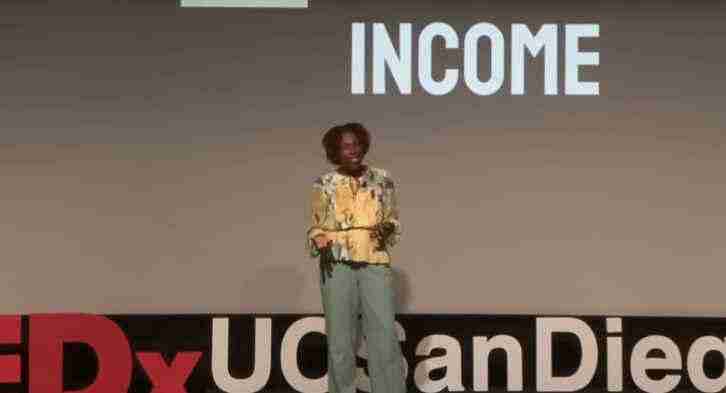
Read the full transcript of award-winning author Tanya Taylor’s talk titled “Dreams to Disability: How to Financially Prepare for the Unexpected” at TEDxUCSanDiego 2024 conference.
Listen to the audio version here:
TRANSCRIPT:
TANYA TAYLOR: I’m 16 years old. I’m in my backyard picking up the few pieces of clothing that I own off the clothesline. For this load of laundry, my mom had carefully hand-washed everything and sewed every hole that she could find. I delicately packed each item in the frayed suitcase that we had probably borrowed from a neighbor.
To everyone, this was a regular day in my small community in Jamaica. We lived in a rich environment. Lush green trees, fresh fruits, warm weather, and the most caring and supportive parents that made me feel like I could do anything. Because of that, at night, while my five siblings were asleep in our tiny bedroom, I laid wide awake, dreaming of traveling to some place with endless possibilities.
I had big dreams. And in less than 24 hours after packing that suitcase, one of those dreams would become a reality, because I was moving to New York City. Yeah, I only had $100, was undocumented, and had no idea where I was going to live. But those were minor details.
Pursuing Success in New York
I was going to change my life and my family’s lives. When I got to New York, I started studying the lives of wealthy, successful people, like Sam Walton of Walmart, and reading books like “Think and Grow Rich”, while creating big, audacious goals for myself. As I became more successful in my amazing career on Wall Street, I also began learning more about money, financial security, and how to ensure that I was protected from life’s biggest risks. I was that one person who always had a budget, bought everything that I could on sale, and had an insurance policy to protect every area of my life.
A Life-Changing Accident
Yet, one day, a freak accident would turn my world upside down. It started out as an exciting Saturday morning. I was busy preparing for a second round of interviews for my dream job, when my daughter asked me to take her on a quick errand. Not two minutes into our drive, and boom, boom.
We were violently rear-ended. We thought we were going to die. Obviously, we didn’t. But two days later, I could not get out of bed.
My entire right side was sore, numb, weak, tingling. I couldn’t turn my neck to the right, and I could barely raise my right arm. I had gone from the queen of killing it, to needing a hand to scratch my ear. Not knowing whether I’d be able to work, travel, or do any of the things that I loved ever again, I began to realize how easily the bricks that I had so thoughtfully laid were beginning to fall down.
Not only did I have to give up on my dream job, but I also had to give up on having any job. And the almost 12-month emergency fund that I kept was dwindling really fast, due to several large, unexpected costs, like my daughter’s illness, which some months cost thousands, or racking up large food bills because I could no longer cook. I discovered a sobering reality. We can plan for all the what-ifs in life.
But the words of the great philosopher Mike Tyson ring true: “Everyone has a plan until they get punched in the face.” In the aftermath of my accident, I started realizing how each of us face the possibility of becoming unexpectedly disabled. In fact, 44% of Americans who file for bankruptcy do so partially or completely due to income loss from medical issues.
So I started asking myself, “How can we get the word out that the disabling events have a high probability of happening? And even more importantly, how do we prepare for them?” In reflection of my own life leading up to this accident, I saw that we don’t normalize conversations around these types of disabling events. Instead, we just don’t talk about it, or we make it really scary.
But it doesn’t have to be that way. Take a group of 20-year-olds. The attitude is often, “Hey, I have my whole life ahead of me. I can take any risk that I want right now.”
The reality, however, is that one in four Americans 20 years or older will become disabled before we retire. So what do we need to do to remove the fear and to prepare ourselves? Well, Ms. Prepared for Everything, I am here to share with you three things that we can do to ensure our financial stability in the face of a disabling event.
Three Steps to Prepare for Disability
The first thing to know is how much are we bringing in and how much are we spending? Once we do that, we can figure out how to create a financial cushion that will become our lifeline if the bricks start falling down. Now, if we grab two to three months of our bank statements and our credit card bills and we start looking at our spending habits, it will tell us a story. When my client Sarah did this exercise, she found that she was spending a whopping $9,000 annually on Uber Eats.
“That was almost 10% of her salary,” Sarah said. So Sarah began cooking more and she picked up her food orders. In the end, she saved over $5,000 just by making those simple changes. The thing is, she didn’t sacrifice what she loved.
She just modified her habits. So this tells us that the changes that we make, they don’t need to be radical or restrictive. They can just be practical modifications. Now, once I realized the enormity of the impact of this disabling event, I also began having more conversations with professionals across different age groups and income levels.
And I posed to them this question: “Are you prepared for a sudden disability?” And the overwhelming response that I got was, “I have long-term disability insurance through my employer.” But did you know that your employer long-term disability insurance only covers a portion of your income?