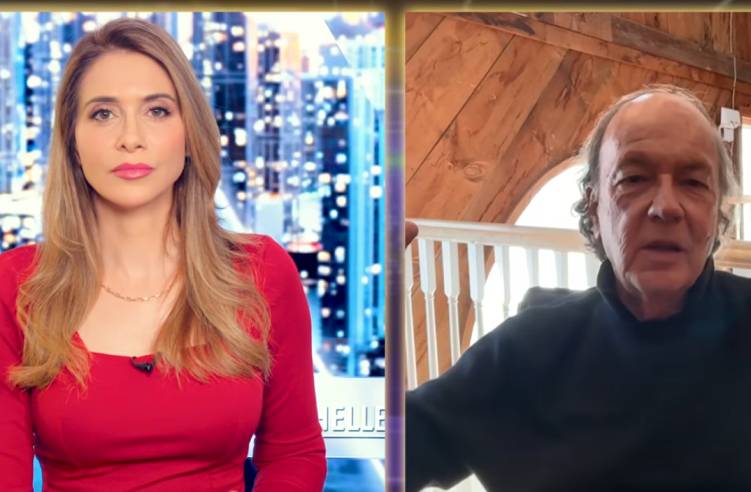
Editor’s Notes: In this interview from Miles Franklin Media, host Michelle Makori sits down with renowned economist James Rickards to discuss the convergence of a looming global monetary crisis and the destabilizing power of artificial intelligence. Rickards explores the core themes of his book, Money GPT, explaining how AI-driven market decisions and sophisticated deep fakes could trigger a systemic collapse faster than traditional safeguards can handle. The conversation also highlights bold predictions for gold reaching $10,000 per ounce and the potential for a strategic revaluation of U.S. gold reserves. This interview serves as a vital warning for investors on the importance of real diversification into tangible assets before the next major monetary reset. (Feb 17, 2026)
TRANSCRIPT:
MICHELLE MAKORI: Hello, I’m Michelle Makori. And this is the real Story where we go beyond the headlines, beneath the surface and behind the curtain to show you what is really happening with money markets and power.
My next guest has a track record of warning about financial shocks long before they make headlines. Jim Rickards is an economist, lawyer and investment strategist with more than four decades of experience in capital markets and national security. He’s widely regarded as one of the leading voices in global macro and currency strategy.
He’s the New York Times best selling author of Currency wars, the Death of Money, the New Case for Gold, the New Great Depression and most recently Money GPT. And he also serves as the editor of the Strategic Intelligence newsletter.
Now, Rickards has not just analyzed crises from the outside, he has operated at the center of them. He held senior roles at Citibank, Long Term Capital Management and Caxton Associates. In 1998, he was a principal negotiator in the Federal Reserve backed rescue of LTCM, a defining moment in modern financial history and beyond Wall Street.
Rickards has worked extensively with the U.S. Government. He’s advised the Office of the Secretary of defense and the U.S. intelligence community. He has participated in Pentagon financial war games, modeling the consequences of market crashes, cyber attacks and currency collapses. He’s also been involved in simulations examining economic warfare conducted by foreign adversaries.
And in his latest book, MoneyGPT, he argues that artificial intelligence may not just transform markets, but destabilize them, acting as the catalyst for the next systemic crisis. So today we examine the escalating currency conflict, the strategic role of gold, and whether AI could accelerate the world towards another monetary reset. Jim Rickards, very good to have you. Welcome to the show.
JAMES RICKARDS: Thank you, Michelle. It’s great to be with you.
Gold’s Path to $10,000 Per Ounce
MICHELLE MAKORI: All right, Jim, as I mentioned, definitely want to get into your book, which is very, very terrifying, to put it quite frankly, AI and nuclear war. But I think our audience would like to first hear your outlook on gold.
And one of the things that you’ve said recently has made a lot of headlines. It sounds like a bold call. In multiple interviews, you’ve said that you would not be surprised to see gold at $10,000 per ounce before the end of 2026. You said I can easily see gold going to 10k. Candidly, it would not surprise me. Not even a little bit before the end of 2026. You said that in December of 2025.
Now that is a doubling from current levels. So let’s begin there. How does gold go from roughly 5,000 to 10,000 in such a short period of time?
JAMES RICKARDS: Well, thank you, Michelle. There’s a fundamental case for it and then there’s a little bit of simple fifth grade math. We can use calculus when we have to, but try to keep the math simple. But I can explain that to the viewers.
So let’s look at the fundamentals. What’s driving gold to begin with? Why did it go from 1,800 to over 5,000? It’s about 5,100 today in a relatively brief period of time. A couple answers or a couple elements rather.
One is central banks are net buyers. They’ve been net buyers since 2010. That was the turning point. From 1970 to 2010, central banks were net sellers. The U.S. believe it or not, sold a thousand tons in the 1970s, even after Nixon closed the gold window. We all know the UK sold about a third of their gold in 1999. At the low, about $250 an ounce.
In the early 2000s, Switzerland sold a thousand tons. In 2010, the IMF sold 400 tons, half to India, half they didn’t disclose. But good reason to believe it went to China. And then that was the inflection point. That’s when central banks became net buyers.
Now, it’s not all the same. Central Banks, the sellers are the ones I mentioned. The buyers are Russia, China, Turkey, Iran, even though Iran’s non transparent and others. But what that does. Central bank net buying by itself does not cause gold to skyrocket, but it puts a kind of floor under the price of gold.
No guarantees, but central banks are pretty savvy buyers. They’ll, cliches but they’ll buy the dips. Though Russia did a brilliant job from 2009 to 2022. Today they’ve more than quadrupled their supply of gold from about 600 tons to about 2,500 metric tons. I like to say Elvira Nabiullina, who’s the head of the central bank of Russia, she’s the only central banker in the world who really seems to understand her job.
But as they say, they have quadrupled. But they did it 20 times a month, 30 times a month. Steady Eddie. Standing orders in London did not disrupt the market, but they did accumulate that much gold.
By the way, this is a quick aside. Russia got to 25% of their total reserve position in gold bullion safely stored in Russia by 2022 when the special military operation in Ukraine began. That gold is one of the reasons their economy has done so well.
Russia has been able to weather the storm partly because they had that gold in their reserves. Ironically, the price of gold has tripled since the war began. And the U.S. and the EU have worked together to steal $300 billion of Russian owned Treasury securities, U.S. treasury securities. Russia may have made a mistake trusting the United States, but on a mark to market basis at least Russia has made more on the gold than they’ve lost on the Treasury. So it really served its purpose.
But there are other central banks as well. So that puts the floor and that creates what I call an asymmetric trade, which is you have limited downside because the central banks are buyers, but you have unlimited upside. You can kind of enjoy the ride. So that’s part of it.
Supply and Demand Dynamics
Second thing, supply and demand 101, global mining output has been flat for the last six years. It’s not collapsing, I’m not talking about peak gold, but around 4,000 metric tons per year is the total output. But demand is going up for the reason I mentioned, which are central banks and other sovereign wealth funds and other large institutions buying ETFs and so forth.
So when you have a situation where supply is flat but the demand is going up. Well, the price goes up. That’s like I say, basic, basic supply and demand.
And the other point I make is that gold is usually touted as an inflation hedge. Actually the correlation between the gold dollar price of gold inflation is less than a lot of people think it’s not quite as automatic, but it is there. But gold is also an excellent deflation hedge and that’s also a hedge against geopolitical uncertainty.
So I don’t call gold the inflation hedge. I call it the everything hedge. When there’s uncertainty, wars, inflation or deflation, depression or boom, gold is a very good way to preserve wealth.
Actually, gold went up 75% in the Great Depression. The Great Depression, 1929 and 1933 was the longest sustained period of deflation in U.S. history. And yet the price of gold went up 75%. So it again shows you how gold can perform in all kinds of uncertainties. So there’s the fundamental case, and that’s going to drive gold even higher. But I, sorry, go ahead, Michelle.
MICHELLE MAKORI: And I get that. I get the strong fundamental central bank buying, flat mine supply, creating a strong structural foundation. I understand that argument. Of course, we’ve been covering how the excessive weaponization of the dollar following kicking Russia off the swift system has driven central banks around the world to accelerate their accumulation of gold.
My question though is that doesn’t necessarily result in a vertical price acceleration. We would be talking about gold effectively doubling from here. Now, is there a certain catalyst that makes gold double in a year or is it just a continuation of the same trend?
The Psychology of Price Acceleration
JAMES RICKARDS: Well, there are a lot of catalysts and we talked about some of them. But this is where, like I said, the little bit of math comes in. Now there’s the last 40 years I’ve seen enormous strides and insights into what’s called behavioral psychology. And you know, Daniel Kahneman, Amos Tversky, Dan Ariely and others have been the leaders in this and that what they’ve shown is that humans, we’re all humans, have biases. They’re just built in. You can say they’re good or bad, that’s fine, but they’re there and they’ve been able to demonstrate them empirically and through experimentation.
One of the biases is called anchoring. And anchoring means you get an idea in your head, could be a number or concept or something, and just you anchor on it and you begin to filter everything you see or hear through that one element again, what’s called the anchor.
Now, when it comes to gold, very simple Anchor is, you know, gold’s been going up, you know, went from 2,000 to $3,000, then $3,000 to $4,000 per ounce. Now it’s up to 5,000. And let’s just say you have 50 ounces. So when it goes up a thousand dollars, you made $50,000. If it goes up another thousand dollars, you made another $50,000.
So people get anchored on those two things, the thousand dollar jump. And again, if you have 50 ounces, you made $50,000. What they don’t realize, at least not right away, is that each thousand dollars increment is easier than the one before because you’re working off a higher base. In other words, it’s a smaller percentage gain.
So when you go from 2,000 to 3,000, yeah, that’s a 50% increase. That’s a heavy lift. But when you go from 3,000 to 4,000, that’s a 33% increase. Still a heavy lift, but it’s less than the one before. Well, when you go from 9,000 to 10,000, that’s only 11%. That’s kind of like a good month, the way gold’s been going.
So my point is, yeah, it’s going to take a while to get to 6,000 and get closer to 7,000, but it’s going to go 8, 9, 10 really quickly because those are very, those are much smaller percentage gains. And so that’s really how the market, how professional traders think about it.
So when you say 5 to 10 doubling, yeah, that’s mathematically correct. But what actually happens is it goes 6, 7, 8, and at the end it really gets momentum and goes to 10 in no time. So saying goal will go to 10,000 is kind of easy. And everyone’s out there saying it, but when you explain it the way I just did, through the behavioral psychology, it’s going to happen. But my point is it’s going to happen much faster than people realize.
MICHELLE MAKORI: Right. I mean, it sounds dramatic when you say 100% increase in a year, but then you keep in mind that it took a year and a half for gold to go from 2,500 to 5,000. So when you put it in that context, it’s actually not that dramatic.
So you’re saying we don’t even need any particular catalyst to see this acceleration. What happens though, if there is some kind of bigger dramatic event, if there is a treasury market malfunction, a big geopolitical escalation, perhaps even a decision to revalue gold, what would happen in that scenario?
Potential Catalysts and the Retail Frenzy
JAMES RICKARDS: Well, it’s a great question. The answer is exactly what I said, but it would happen faster. So you’re right. Could there be a catalyst, a war, a policy decision, something of that sort that triggers a more intense interest in gold? The answer is yes. But that just means it’ll happen faster.
Or what we haven’t seen, and this is very bullish for gold, Michelle, we haven’t seen the retail frenzy stage. I lived through the 1970s and 1980s. I remember in 1980 I worked at Citibank, and if I went from the bank to Bloomingdale, I was to go shopping at lunchtime. I never walked up the street without seeing a chain snatching. There was always somebody grabbing a gold chain off of somebody, minding your own business and running around the corner. It was daily.
But my point is that was the retail frenzy stage. You had people just popular journalists saying, sell everything and buy gold, which is usually not good advice. But that was the mentality. We’re not at that stage.
The buying I mentioned coming from central banks is coming from sovereign wealth funds, large endowments, some of the ETFs, et cetera. But we’re not at the stage where people are lined up around the block at a gold dealer to get bars and coins. That’s happening a little bit in China. I saw it. I was in Australia in late August. I saw a little bit of that in August at ABC Bullion, good friends of mine, but they’re the largest private gold refiner and seller in Australia, and they were lined up in the central business district there.
But that hasn’t really taken over. So if you get the kind of catalyst you’re talking about, and it’s a long list, but, you know, kind of war, political indecision or political events are all good candidates that could flip us into what I call the retail frenzy. And then it would just, everything I said would happen, but it would happen faster.
Gold Revaluation Under Trump: A Realistic Possibility?
MICHELLE MAKORI: Well, one of the things that could get us into a major acceleration is some kind of AI crisis, which I will get into, because that is one of the major fundamentals of your book, which, as I said, great read. Terrifying, but great read.
But before I focus on that, there has been some speculation amongst the gold circle that we could see gold revaluation and that it could happen under the Trump administration, more likely than any administration. And as background for our viewers, the U.S. treasury still values its reported 261 million ounces of gold at $42.22 per ounce. That was a number set back in 1973. Details that, of course, you provide in many of your other books.
But the idea of a possible gold revaluation is getting some buzz. The Federal Reserve last year released a research paper which analyzed how other countries have revalued their gold. They didn’t explicitly recommend that the US revalue its gold, but it did lay out in detail how five other countries have done it.
Then there have been a lot of people in the President’s inner circle talking about it. And I like to point out that there’s Donald Trump Jr., the president’s son, who has explicitly stated that his father’s administration is exploring a powerful economic tool under the Gold Reserve Act to reprice America’s gold. And if we have that ad, I’d like to pull it up now.
There it is. He is now granted speaking and is the capacity for a gold company. But he says, “Do you know the US Government has the legal power to change the price of gold with a stroke of a pen?” And then he goes on to say, “My father’s administration is exploring a powerful economic tool. The Gold Reserve Act gives the treasury the authority to revalue America’s gold reserves on the national balance sheet from their outdated book value of $42 to current market prices.”
He goes on and on saying that this would signal gold’s renewed importance in our monetary system, prepare America for a new era of sound money principles. Treasury Secretary Scott Bessent, a well known gold bug, has also floated, but then somewhat retracted the idea of a gold revaluation and monetizing the asset side of the balance sheet.
Rather, Jim, in terms of a catalyst for gold price surge, how realistic is a gold revaluation in your opinion? What percentage or chance do you think that has happening under the Trump administration?
The Mechanics of Gold Revaluation
JAMES RICKARDS: There’s a reasonable chance that that will happen. Your description is exactly right, Michelle. And they have been talking about it and you know, Trump is full of surprises. So it wouldn’t surprise me to see them do that. But I think it’s helpful for the viewers to understand a little bit of the background, what it means and what it doesn’t mean, before people get kind of too spun up about it.
So for this you have to go all the way back to 1933. At that time, the Federal Reserve actually held most of the gold. It was owned by the Federal Reserve System, which is of course privately owned by the banks. FDR took the gold from the Fed and gave it to the U.S. Treasury. And you’re right, today that 8,133 metric tons U.S. gold reserve is owned by the U.S. treasury, although I point out that people think it’s all in Fort Knox. About half of it’s in Fort Knox, the other half is in West Point. They’re both army forts. So I say, well, actually the army has the gold, but it’s on their property. But you’re right, it’s owned by the U.S. treasury.
Now, the Fifth Amendment of the Constitution, U.S. constitution says that the government may not take private property for public use without providing proper compensation or just compensation. Okay, so when FDR took the gold from the Fed and gave it to the treasury, that’s from private to public. What did they give the Fed in the form of compensation?
The answer is they gave them a piece of paper. It’s called the Gold Certificate, and it’s still on the balance sheet of the Federal Reserve. It’s a public record. You can go to the Fed website, hunt around a little bit, find the balance sheet. And on the asset side, the first item is Gold Certificate. It’s not gold. It’s a piece of paper supposedly backed by gold. But it’s what the Fed got in exchange for handing over the physical gold. And that is valued at $42.22 an ounce, which is as you described. And of course, the treasury carries the gold on their books at the same price.
Now, could the treasury revalue the price of gold to the current market? Roughly $5,000 an ounce, or any value in between? The answer is they could, and it’s been done before. This was actually done in the Eisenhower administration. Again, that’s a little historical footnote, but not that many people know about it.
But it’s really just an accounting entry. What would happen is the treasury would call the Fed and say, “Hey, Fed, you know that gold certificate you got? Mark it up to the current market, so from roughly $42 an ounce to $5,000 an ounce.” And now you’ve increased the balance sheet of the Fed, you’ve increased the value of their asset.
Well, accounting 101. Something has to happen on the liability side. If the asset goes up, either the liability or the capital goes up. Well, the answer is the treasury has an account at the Fed. It’s called the Treasury General Account. It’s no different. You and I have bank accounts and we put money in our bank accounts. Well, the treasury has a bank account at the Fed, this Treasury General Account.
So when the Fed revalues the gold, the Fed would also have to credit the Treasury’s account. All that money, that mark to market profit, would go into the Treasury’s account. At today’s prices, it’s about $1 trillion. That’s the amount of money that would just appear out of nowhere. But of course, that’s what the Fed does.
Now, when it was used before, when there’s been some talk about using it again, it’s when the U.S. hits these debt ceilings. Now, separate law puts a cap on the amount of treasury securities that the treasury can issue. You can issue up to this level, but no more. Well, Congress always raises it and they just keep increasing the debt level. But every now and then, Congress wants to fight about it and they don’t raise the debt ceiling and the treasury hits it and you can’t issue any more debt.
And then the theory is, well, now the treasury can’t pay their bills because they can’t issue any more debt. Technically true, there’s some workarounds, but that’s basically what happens. Well, without raising the debt ceiling, without issuing any more debt, if you did this accounting entry I just described, a trillion dollars would appear out of nowhere in the Treasury’s account. And they could spend a trillion dollars that would actually fund the government for, I don’t know, four or five months at the current rate of expenditure without issuing new debt. And that’s the point.
And that’s what happened in the Eisenhower administration in the 1950s. It was a little less dramatic. The Congress actually went home and the Treasury Secretary forgot to get the debt increase before they went home. It was kind of an oversight, but they did exactly what we’re talking about. The treasury called the Fed and said, increase our gold account and put the money in and we’ll spend it till the Congress gets back.
So the answer is it’s completely legal. It’s not difficult to do. It has been done before, and money would come out of thin air and be available to the Treasury. And if you did, to the current market price, it would be about a trillion dollars.
The Psychological Impact on Gold Markets
But here’s the point. I think this is important for the viewers, but that doesn’t do anything to the price of gold. Gold is a world commodity. It’s traded on world markets. You have Shanghai, you have Comex, you have the London Metals Exchange, London Bullion Market Association, ETFs. Gold is roughly $5,100 an ounce. It’s been bouncing around a little bit, but let’s just say over $5,000 an ounce. That’s the price of gold.
Having the treasury and the Fed make some accounting entries would not change that price. It would still be about $5,000. So again, we’re back to the psychology, and I think this is what you were referring to, Michelle. If the treasury did that, if the treasury and the Fed did what we’ve just been talking about, would it change the psychology? Would everyday Americans go, “Oh, wait a second, you know, the price of gold just went up 100 times?” It might.
Again, it’s an accounting entry. It doesn’t change the world market. It doesn’t change the supply and demand. It doesn’t change anything fundamental. But could there be a psychological spark that would say, “Hey, wait a second, the U.S. Government all of a sudden is paying attention to gold. The U.S. Government is treating gold as a monetary asset.”
I’ve told the treasury for years, you ought to buy gold. Your Treasury’s issuing all this debt and they’re spending the money on who knows what, a lot of waste, obviously. Why doesn’t the treasury just issue debt and buy gold and you get to keep the gold?
So I think that again, legally it’s possible. Politically, it wouldn’t surprise me to see the Trump administration do it. It’s just an accounting entry. It would put a lot of money in the Treasury’s bank account. Those are all important things. By itself, it doesn’t change the fundamentals in the world price of gold, but it could have a psychological effect.
MICHELLE MAKORI: I want to unpack a couple of things there. Firstly, would they have to mark it to current market prices or could you value it higher?
JAMES RICKARDS: Well, higher is interesting. You could definitely value it lower. You could value it a thousand or two thousand or anywhere in between. Could you value it higher? The accountants might object. The thing is, if you mark it to market, what you can’t object is like, “Hey, that is the price of gold.”
Now, you could do it multiple times. And this kind of gets to your point. If you did it, let’s just say $5,000 an ounce today, and then a year from now, gold is $10,000 an ounce, which is what we’ve been talking about, what I’ve been projecting. Could you do it again for another $5,000? The answer to that is yes. So there’s not necessarily a cap, but it’s not clear that, I’m not sure the accountants would let the Fed mark it above the market. But if you say, could you do it two or three times and follow the market, the answer is yes.
MICHELLE MAKORI: Okay, so you mark it to market. That sends a signal to Americans, maybe not a positive signal, maybe it’s a signal that there’s a reason that this is happening. And keeping in mind that an increase of a trillion dollars is just a year’s interest of the debt that’s already owed, given now we have $39 trillion in debt.
But what signal does this send to other countries if this were to happen, particularly countries like China, which we know have been accumulating gold at record levels and have probably been accumulating a lot more gold than they say officially, if this were to happen. And you’re saying that it would not surprise you if the Trump administration does that. You know, let me put you on the spot. What would be the percentage chance that you would give to this happening under this Trump administration?
Over 50% Chance of Gold Revaluation
JAMES RICKARDS: Oh, probably over 50%, you know, not 90, but 60, 65%. Yeah, I mean, they’re taking it seriously. Scott Bessent, our Treasury Secretary, is very seasoned hedge fund trader, used to work for George Soros and other hedge funds. I’m pretty sure Jay Powell would not do it, but Kevin Warsh might. Kevin Warsh seems more of a pragmatist. I’m not saying he would be banging the table, but he would certainly go along with it.
He wouldn’t really have much choice but to go along with it, because the treasury does own the gold. The treasury does have that account, and it’s been done before, and it was at the initiative of the Treasury. So I think if the treasury made that phone call, the Fed would have no choice but to go along. And, yeah, I would say well over 50%.
MICHELLE MAKORI: Well over 50% that the U.S. revalues its gold to market under the Trump administration. What signal does that send to the rest of the world? What do you expect from China under that scenario, which we know has been accumulating gold and has recently made its intentions known, that it wants the yuan to become a global reserve currency? What would you expect then?
China’s Gold Accumulation vs. Reserve Currency Ambitions
JAMES RICKARDS: But, well, first of all, and you alluded to this, Michelle, it’s important to understand, most of the world already does this. I mean, the United States is the only one saying gold is $42 an ounce. As I say, it’s historic cost accounting, if you want to be technical. But most countries, when they buy new gold, they put it in their reserves at either the price they paid or they market to market, or they do both. So this is not a shocker to the rest of the world, because it’s what they already do. It’s sort of common sense.
So in a sense, the US would just be catching up. But of course, the US is the largest single holder of gold. If you ask me what the effect is kind of psychologically in terms of the popular media. Again, it’s just an accounting entry. It does put money in the Treasury’s account. But what it does, it sends a signal to the American people and to the world that the US cares about gold.
And years ago, Ben Bernanke was asked in an interview about gold, you know what? Why, you know what? If gold’s unimportant, why does the US have 8,000 plus metric tons? And his answer was, he said it’s a tradition. He dismissed it. Now, Bernanke is smarter than that. He knows there’s a lot more to it, of course, but he was blowing off the question. It’s just a tradition, just sitting around. And a lot of public officials have more or less said the same thing.
There are very few people who take gold seriously as a monetary asset in the United States, even though the rest of the world does. And that’s increasing as the US has weaponized the dollar. I mean, I teach financial warfare at the US Army War College, and we talk about all this, we talk about this all the time. How you can use financial systems, payment rails and other techniques to fight wars.
The Weaponization of the Dollar
And kicking Russia out of SWIFT, which you referred to, freezing the Russian assets, which are in Belgium, by the way. They’re at a custodian called Euroclear in Belgium. Over $200 billion worth of treasury securities. Most of this mature, by the way, so it’s actually sitting in cash at this stage. But once you freeze that, and the US and Europe have been thinking of stealing it, we freeze stuff all the time. That’s one thing. Just means you can’t get it, but it’s still yours. Stealing it is different. And that is what they’re talking about.
But the rest of the world, China, Saudi Arabia, Taiwan, Japan, India, they’re watching this. They’re like, hey, what if the United States, what if I do something the United States doesn’t like? What if the United States doesn’t like what I’m doing? Are they going to freeze my treasury securities? Well, five, six years ago, that might have been unthinkable. But we actually did it in the case of Russia. So the answer is we might.
And if you were that central bank or that finance ministry, you’re probably looking at buying more gold. Because if you have physical gold in your possession, the US can’t touch it unless they invade or something extreme like that. So that’s one of the reasons they’re buying gold, is because the US can’t freeze it. And that is going to accelerate.
So now we’re getting into a world, Michelle, where gold is all of a sudden being taken seriously as a monetary asset. You know, I have a graduate degree in international economics and I received it in 1974. 1974. I was the last class where gold was still taught as a monetary asset. People know Nixon closed the gold window in 1971, but he said it was temporary. He said, we are temporarily suspending the redemption of US dollars for gold.
They thought they would get back to a gold standard, and they tried. At the Washington Smithsonian Accord in December 1971. I talked to two of the people who were at Camp David on August 15, 1971 when Nixon closed the gold window. I spoke to Paul Volcker and Ken Dam, who was the lawyer, and they told me, they said, yeah, we thought we were going to get back to a gold standard. But they never did.
But it really took until 1974 until the IMF demonetized gold and no longer required gold deposits to join the IMF and all that. But I studied gold as monetary asset. Since then we have three generations of scholars. If you know anything about gold today, you’re either self taught or you went to mining college because they don’t teach it academically.
But all of a sudden I think this thing of revaluing it by the US is a big deal. Even though I’ve said it’s just an accounting entry, it’s a big deal psychologically because it says, hey, wait a second, the US actually cares about gold. Maybe we should get some too.
China’s Push for Yuan as Global Reserve Currency
MICHELLE MAKORI: And before we go on to the other crisis, and I do really want to go into the AI angle, but I do want to focus on the geopolitical angle a little bit more because as you’ve mentioned, countries have been diversifying in order to protect against weaponization. And I just want to get your thoughts on what we heard from China recently.
And that was President Xi openly calling for the yuan to become a global reserve currency. That is a line that Beijing has spent decades approaching quietly but is now crossed publicly. And he said that China must build what he calls “a powerful currency,” one that is widely used in global trade, investment and foreign exchange and ultimately held by central banks.
Now, those remarks were delivered behind closed doors in 2024 by way of background, but they were only just published in the Communist Party’s top policy journal. And that is very deliberate signaling from China. As we know, China’s aggressively been stockpiling gold. Official holdings sit at around 2,300 tons according to the World Gold Council. Many analysts, including yourself, believe that the real number is far, far higher. Some between 5 and 10, some say 10,000 plus.
But that gold accumulation quietly pulls the yuan towards a hard asset anchor, that neutral reserve asset that you’ve been talking about that it essentially shows that the yuan on some level is implicitly backed by gold. I want to get your thoughts on the timing of the statement, why China’s coming out and making this known now. Do you think that China is gearing up for a big reveal of how much gold it actually has? Do you make much of the fact that President Xi is now saying this openly and unequivocally?
China’s Hidden Gold Reserves
JAMES RICKARDS: Great question. Let’s separate China’s gold accumulation, which is a big topic, from China’s role as a reserve currency and a trade currency and all that. Those are very, very separate topics, but I’ll talk about both.
The gold accumulation is exactly what you described. Their official holdings. I say official. If you go to the People’s Bank of China website, you know, it’s available in English and look at their balance sheet they have, it’s closer to I think about 2,800 metric tons. But they’ve been adding to it. So you know it’s been going up. That’s what they say they have again in 2009 they had 600 tons. So they have more than quadruple, almost five times the amount of gold, but it’s about 2,800 tons.
But they have another entity, it’s called the State Administration for Foreign Exchange or SAFE, S-A-F-E, that also manages the reserves, buys gold and is completely non transparent. So the People’s Bank of China has a kind of transparency but over here they’re SAFE, which was run by an ex PIMCO guy so knows what he’s doing and that’s where they accumulate gold.
And the reason, one of the reasons you know this, it’s not that hard to figure out. When China increases their gold reserves, they’re in big jumps. They’ll say oh, we’ve just increased by 300 metric tons or 500 metric tons. You know, maybe the next time they’ll go from 2,800 to 3,500, I don’t know. But they go in these big multi hundred ton chunks.
Well you cannot buy gold in those chunks. Good luck and call JP Morgan London, tell them you want 100 tons. They’ll say we’ll get back to you like in six months or something. You can’t do it. But if you acquire the way the Russians have done, the Russians are far more transparent. But 10 tons a month, 20 tons a month, go for a whole year, that’s 100 tons or 200 tons, et cetera.
If you can acquire off the books, which is what SAFE is, and then periodically, meaning every couple years, again, make an accounting entry, move it from SAFE to the People’s Bank of China. And all of a sudden the balance sheet of the People’s Bank of China goes up by 300 metric tons. Like, oh, yeah, there it is. They just increased by 300 metric tons. But they spent a year or two buying it off the books in SAFE. And that’s how they operate.
So if you want to know what the Chinese gold position is, you have to take the People’s Bank of China, which we talked about 2,800 tons, give or take, plus whatever’s in SAFE. And we don’t know that number, but I think it’s completely, given the pattern, given the history of this, it’s completely reasonable to assume that that number is at least 500 tons. And it could be, as you suggest, Michelle, it could be a thousand or two thousand or more metric tons.
China may actually be waiting to do, you know, a big reveal and say, oh, you know, the 2,800, well, it’s actually 4,000. We now have half the gold or maybe it’s 5,000 approaching the United States. So that’s real. It’s important. It goes to what we were talking about earlier, which is respecting gold as a monetary asset.
Why the Yuan Won’t Replace the Dollar
Now let’s flip over to the other part of your question, which is, is the yuan going to be a global reserve currency? Will there be a gold back yuan? Will the yuan replace the dollar? No, that’s all nonsense. I mean, I can create a currency right now. I can take this piece of paper and say, Michelle, I owe you a million dollars and send it to you. It’s a Jim Rickards note. Is that a global reserve currency? I don’t think so.
China has a lot of gold. They actually have more debt than the United States. The People’s Bank of China balance sheet M0, which is the central bank money is much greater than the United States. People talk about the US debt to GDP ratio. It’s about 124%, all time high, very not a good number. It has lots of bad effects. But the Chinese are much higher than that, closer to 300%.
So China is, and gold, what I look at, Michelle, I look at gold as a percentage of GDP meaning okay, how much gold do you have? That’s money and GDP is what’s your productive capacity. And China is much weaker than the United States. The real gold powers when you look at gold to GDP are Russia and Switzerland. The US is okay, not great. China is a pygmy. So China does not have enough gold to go on a gold standard.
And there’s a bigger problem, which is people don’t understand reserve currencies. They say reserve currency, the dollar is the leading reserve currency. The dollar is not the reserve currency. The reserves are in securities. Now they’re dollar denominated. And that’s really what people mean.
So when I have Japan or Taiwan or someplace and I say I have $500 billion or a trillion dollars in dollar reserves, what I have are US treasury securities. They’re dollar denominated. But that’s not cash. If you want cash, you have to sell the securities and get the cash. And so in other words, what makes the dollar the so called reserve currency with the dollar denominated leading reserve currency? It’s the securities market. It’s the treasury securities.
China does not have a government bond market. Not one to speak of. Not liquid, not large, no rule of law. So you’re never going to be reserve currency so called, unless you have a bond market and China does not. So they have no hope of being a reserve currency.
MICHELLE MAKORI: Well, they also have non convertibility and capital controls which would prevent the yuan from being a reserve currency. But I guess the interesting part is that they are bringing gold as a neutral reserve asset, as a settlement layer to create trust as they’re trading with other countries.
The BRICS Gold Settlement System
JAMES RICKARDS: Well that’s right. And that’s why I say, you know people. There’s a lot of talk a couple years ago about a BRICS currency. Jim O’Neill is a new article, he came up with BRICS about, you know, BRICS currency, you know, et cetera. And my point is there’s not going to be a BRICS currency. Not anytime soon, maybe 10 years, but not anytime soon. But they don’t need one because they already have one. It’s gold.
In other words, if you’re Russia and I’m China and I sell you semiconductors, manufactured goods and you sell me strategic metals and oil and natural gas and I pay you in yuan and you pay me in rubles, we’re now building up reserve positions in yuan and rubles. Well, okay, but how much Chinese food do the Russians actually need? I mean, how many yuan do you want when it’s not good for much else and vice versa. So they have to settle up periodically.
Now a couple things are true. Number one, you don’t have to settle up on a gross basis because the central banks can take care of that with local buyers and sellers. You settle up on a net basis. So if I owe you 100 and you owe me 90, well then on a net basis I owe you 10, not 100, number one. Number two, you don’t have to settle up in real time. You can do it quarterly or twice a year or once a year, et cetera. So when you get to periodic, not real time settlement and net settlement rather than gross settlement, you don’t need that much gold. So we can settle up in gold at a dollar price, actually ironically at the market and then that’s that. So the BRICS already have the reserve, have their trade settlement currency, which is gold.
Money GPT: AI and Systemic Market Fragility
MICHELLE MAKORI: Yeah. And they’re developing these parallel financial architecture rails to counter the west as we’re seeing the bifurcation of the global monetary system. Jim, we’re running out of time now, so I really want to focus on your latest book, Money GPT. And it’s not a book about choosing which AI stock. It’s a book about markets trust and systemic fragility in the age of AI. And what I appreciate is that you don’t argue that AI will malfunction, you argue that AI will function exactly as it is designed and that that’s where the danger lies. Talk us through that.
JAMES RICKARDS: Right, you’re right. It’s not a stock picking book. If you want Nvidia, buy it or not buy it. But that’s not really what the book’s about. The book talks about AI, what it is, of course, and how it’s now embedded in the financial markets. And I’ll get to the national security aspects of it in a second. But a couple things about it.
Number one, you know, everyday Americans, they go to their investment advisor and they sit down and what does the advisor do? He says, she says, well you know, how old are you and how many kids do you have and what’s your portfolio, what are your goals and all this stuff and they ask you all these questions and they say, well, I’m going to give you a customized financial plan and you come back the next week or whatever and they give you a plan. Two things. Number one, all those plans are out of a computer. It’s not like the individual is actually thinking hard about it. They just have computer programs behind it. And number two, all those programs are the same because, you know, it’s diversification and correlations and you know, the inputs are the same, the algorithms are the same. So basically everyone’s doing the same thing. And the same is true at much higher levels. You know, hedge funds and so forth. They all have the same programs.
The Fallacy of Composition in AI Trading
So now when you put AI into it, you get into something called the fallacy of composition. Keynes called it the fallacy of composition. And here’s the way that works. So let’s say you’re at a baseball game or soccer game or whatever, and you don’t have a good view because the person in front of you is really tall or they’re wearing a big hat or something you can’t see. So what do you do? Well, you can stand up. And if you stand up, you got a great view. It’s like, hey, I can see everything. That’s great. But what happens next? The person behind you stands up and the person behind her stands up and pretty soon the entire stadium is on their feet. And nobody’s better off because you all have the same view you had before. It’s just that you’re standing up.
So in other words, a strategy that works, the point is a strategy that works at the individual level. One person standing up does not work at the aggregate level, because when everyone does it, nobody’s better off. Now apply that to capital markets. Let’s say there’s some kind of financial panic and they happen like every seven or eight years. These are not hundred year events, or every seven, eight, nine years, et cetera. What’s the best strategy for you as an individual? Well, one of the best strategies is to sell everything, go to cash, go to the sidelines, wait it out, wait for the bottom to hit, and then come back in and buy bargains. This is what Warren Buffett does. It’s a pretty good strategy for the individual.
But what if everybody does it? All of a sudden you have all sellers, no buyers, markets are crashing, blow through the circuit breakers, you actually close the markets and very doubtful that you’d be able to reopen them anytime soon. So that’s an example of how a strategy that’s good for the individual fails catastrophically at scale. Now that’s been true for at least eight, you know, 900 years. I mean, you can find financial panics in the 14th century that kind of fit that pattern.
What is new is that AI is now making most of the decisions. The extent to which, I mean, we all know that, you know, the specialist system is long gone. 95% plus trading on the New York Stock Exchange is fully automated. It’s off the floor. So that there’s nothing new about that. But what is new is that the hedge funds, institutional investors, individuals, et cetera, are incorporating these AI algorithms in the decision making process. So it makes it much faster, there’s much more contagion and there’s no mediation, meaning there’s nobody around to say, wait a second, the market’s down 20%, maybe I should be a buyer. There’s no contrarian, there’s no individual asset allocator. It’s full automation. And the market would go straight down in that scenario. So that’s one danger, obviously. And I have a scenario on that in my book now. You combine that, take what I just said with deep fakes, right?
MICHELLE MAKORI: Yeah.
JAMES RICKARDS: You know, maybe we could do Ray Dowell.
The Deep Fake Scenario: Synthetic Powell
MICHELLE MAKORI: You have that scenario in the book where there’s a synthetic video of Fed chair Ray Dowell, as you call him, delivering fake remarks that he never gave. And you describe this very vividly how they don’t just fake the voice. They train on thousands of hours of real speeches and testimony and Jackson Hole footage. They replicate rumor caustics and then they replicate the wardrobe. And then you describe how they digitally clone the most powerful central banker in the world giving a speech that he never gave.
And then you go on to say how there’s a fake press release posted on the Fed website which is hacked to validate the speech. Media outlets pick it up immediately. Trusted sources, Bloomberg, CNBC, they amplify it before there’s any verification. And as you say, within minutes, the market are reacting. And then it’s not just the humans panic. The AI trading systems are trained to react to language cues. They scrape headlines, they pass speeches, they respond in milliseconds.
I mean, talk us through that scenario because it’s terrifying and it’s actually very, very conceivable. I mean, when Powell came out and said that the Department of Justice was investigating the Fed, that was very. I mean, that wasn’t so dramatic. But that was very out of line for Powell to say. And I initially thought, is this real? Is this a deep fake? Could it be a deep fake? I mean, it’s very conceivable that we have a scenario like this right on the horizon.
JAMES RICKARDS: Well, first of all, that’s exactly right. And I make the point. I say, look, here’s the scenario. And you know, thinking through this could happen, you should be prepared for it. What are the solutions for this? But it’s already happening. That’s the thing. The Republican intellectuals, I saw John Mearsheimer the other day, Victor Davis Hanson, others, where technicians are creating deep fakes of them giving speeches and seminars that they never gave. And they’re like, fighting it, but, you know, good luck. I mean, you’re fighting a losing battle. Mearsheimer called it Whack a Mole.
So the technology is there. There was a New York Times reporter who actually went to one of these deepfake companies and voluntarily gave them her voice recordings and pictures and all that stuff. And they created a deep fake of her with her consent, and she showed it to her mother, and her mother couldn’t tell. So if your own mother can’t tell, then the general public can’t tell either. So all this technology is out there, it’s being used. There are plenty of deep fakes around. We’ll see more of it as we get into the midterm elections. Could you do it with a Fed chairman? Absolutely. It’s not even that hard.
But then behind. And you described it brilliantly, Michelle. I mean, that is the scenario. But behind that there were three or four players, and one of them was a couple of hedge fund traders. They put them in New York. Mallorca is a beautiful place. I’ve been there, the Las Palmas. And you know, if you’re going to take down the world, it’s a nice place to do it from. But I also have a Chinese cyber warfare unit as well.
The Force Multiplier Strategy
And so the crooks in Mallorca, they’re the ones kind of creating the deepfakes and putting it out there, the servers around the Congo. Good luck finding those, et cetera. But the Chinese cyber warfare unit, they and military strategy use, you look for something called the force multiplier. And what that means is you’ve got a certain power, certain weapon you can use, but you like to use it in a situation where there’s something else going on that makes the weapon even more powerful.
So if you were going to take down the markets, you could just, you know, and this is one of my scenarios, they hack into the order entry system at Morgan Stanley. By the way, I like Morgan Stanley. I know Jim Gorman is a great guy, recently retired CEO, and just put in, you know, sell, sell, Meta, sell, Alphabet, sell, Apple, you know, et cetera. You. So you could basically hack the system, put in all these sell orders, and the market would go down before you could stop it or hit the kill switch.
This actually happened by the way, something like it. About seven, eight years ago with Knight Trading and Knight Trading, the Knight Trading system started flooding the market with sell orders. The problem is nobody could find the kill switch. It’s amazing how things always go bad, not one at a time, but twos and threes. Like the person has the kill switch is her day off. So she’s, where is she? You know, so stuff like that has actually happened.
But in this scenario, if you’re China and you want to take down the market, you don’t do it on a day when the market’s going up because you’re kind of swimming upstream. You do it on a day when the market’s going down for other reasons. And now you pile on, you’re swimming downstream, and you’re having more effect. So in my scenario, the crooks, the hedge fund, you know, sophisticated hedge fund hackers, they’re pushing the market down. And the Chinese are watching this and saying, hey, here’s our chance. Let’s use that down market as a force multiplier to make it go down even more. And then that’s what happens. Then you get the deep fakes and the panic and everything.
I described the interesting thing about doing a scenario or forecast of that type. The book is nonfiction, but if you’re doing a forecast, almost by definition you’re writing fiction, because it hasn’t happened yet. But I put it out there as a warning, like, hey, all this technology exists, it’s being used. Look out for this, because this could happen tomorrow, right?
Social Media Amplification and Bank Runs
MICHELLE MAKORI: And you talk about how social media exacerbates the kind of reactions, how that so easily triggers bank runs in seconds, in minutes, which really doesn’t even allow time for response. You can have a deep fake, you can have market manipulation. Then you have the reaction amplified through social media and the rapid rate in which is conveyed. So AI can easily trigger a major market crash. It’s a threat that seems so, so real. Is it being factored anywhere? Is there some level where this is being addressed that we don’t know about?
The Age of AI and Market Crashes
JAMES RICKARDS: Not really. I mean, I was colleagues and partners at various times with David Mullins Jr. David was the Vice Chairman of the Federal Reserve, but before that he was Assistant Secretary of the treasury at the time of the 1987 crash. October 19, 1987, the Dow Jones went down 21% in one day. One day, not a week or a month. In today’s Dow, that would be 10,000 points. It would be a 10,000 point drop in one day. That’s what happened.
But he worked with Nicholas Brady, who was the Secretary of the treasury at the Brady Commission. But he came up. He was the guy who invented the circuit breakers that we have today. Well, the market’s down a certain amount. Take a timeout, reopen 15 minutes, it goes down again just to try to give people time to talk.
My point is, in the age of AI, circuit breakers don’t work because, again, in effect, the robots have taken over. It’s not a question of people talking to each other and saying, hey, I’ll be a buyer. We’ll prop the market up. You don’t really get that chance with computers controlling everything.
But I do. I never do scenarios like that without offering a positive solution, to put it that way. And I recommend the use of cybernetics. Cybernetics comes from a Greek word, but originally means the helmsman or the person who steers the boat, so to speak.
Tapping the Brakes: A Solution for AI-Driven Market Crashes
But the way you could use cybernetics in a situation like this, and the metaphor I use is driving on snow is hard, but driving on ice is impossible. If you’re driving on ice and you slam the brakes, the car’s going to keep going. It’ll probably skid out of control and go off the road. But the car is not going to stop anytime soon if you’re on ice. And that’s why the circuit breakers don’t work.
So what do you do if you’re driving on ice and you need to slow down? The answer is you don’t hit, you don’t pound the brakes. You tap the brakes, tap, tap, tap, two hands on the wheel, slow it down gradually, and then keep it under control.
The way that would work in the stock market meltdown scenario is at a certain percentage down. Instead of shutting the market, just say, you know what? We’re only going to execute half your order. So if your sell order is a thousand shares, sorry, we’re only going to execute 500 shares, we’re going to put the rest in the queue, and then if it goes down more, it’s a 90% break. So 1000 share sell order, we’re only going to execute 100 and then put the other 900 in the queue, et cetera.
So that’s what I call tapping the brakes as opposed to shutting the market. And that should slow down the momentum a little bit. It’s not a perfect solution, but it’s better than the one we have. But the short answer to your question is no. These things don’t get addressed until they happen. Everyone runs around saying, well, what just happened? What should we do? I’m trying to warn people that it could happen and suggest that we should put some safeguards in place today.
MICHELLE MAKORI: Yeah, a chilling warning. You know, I want to read a line from the book because it is, in fact, very chilling. After the scenario that you describe, one of the characters, Sarah says, “Oh, didn’t you hear? Our bank was closed by the FDIC at 6pm this evening. They’re only insuring deposits up to $250,000. People forget that. The $30 million in the account was replaced with receivership certificates. Those can only be redeemed with bank asset sales. But the bank assets are impaired. For now, all the money is gold.”
And then you write. “Nick was numb, too numb to care much. At this point, there was not a thing he could do. He took another sip of the daiquiri. Is there anything left? He asked. Just the gold, she replied. Just the gold.” What’s the message you’re sending then, Jim?
Just the Gold
JAMES RICKARDS: Well, have some gold. Not 100%. It shouldn’t be 100% in anything, but I’ve always recommended a 10% allocation, physical bullion and safe storage. ETFs. Gold ETFs, they’re fine for price exposure if you just want to bet on the price going up or down. Okay, but it’s not gold. It’s a share of the trust on the New York Stock Exchange.
So have some physical gold. And that’s something that won’t actually, will perform very well on the kind of scenarios we’re talking about. But the point is, it can’t be frozen. It can’t be locked in by the FDIC or the US Government or anybody else. So that’s your reserve, by the way.
Michelle, one footnote. You described a scenario between Nick and Sarah. I like Daiquiris, by the way. It’s hard to get a good one, but the American bar of the Savoy does a good one. But Sarah, in the scenario, and you read it correctly, is a robot. She’s the robotic trading system for Nick, who’s a human, but so, so even he’s talking to a robot when they’re going through all this. But she has a nice voice and she gets it right.
MICHELLE MAKORI: Yes, Sarah is like Siri, I suppose. And yeah, I’m a fan of a good strawberry daiquiri every now and again as well. More of a pina colada type. But I could have a nice strawberry daiquiri every now and again. And you may need that, you know, if the world is coming to an end.
You do say, though you did touch on this idea of moneyness. And I know we’re running out of time, but I think that this was also very interesting concept and that you’re right that today we don’t know what money is. We know moneyness. What is that? What do you mean by that?
The Concept of Moneyness
JAMES RICKARDS: Well, we’ve sort of lost the thread. I mean, you start with the Federal Reserve. They have money supply numbers. Notice I said numbers, plural. So there’s M0, M1, M2, M3, et cetera. Even the Fed doesn’t know what money is because they have five different definitions. And then you can get into all the foreign currencies, Bitcoin, all the cryptocurrencies, decentralized finance, DeFi they call it, et cetera, on and on and on. So what is money at the end of the day?
My point is we’re kind of losing the thread. We think we know what it is, but we don’t really. And I make the point that I talk about Marcel Duchamp and Andy Warhol and just kind of quickly, in the 1930s, Marcel Duchamp, he had a branch of applied mathematics that no one has figured out to this day, but maybe they will eventually. But in his mind, he came up with a system to beat the house at Monte Carlo in roulette.
But he needed money to go gamble. So he issued a bond, and the bond had a picture of him, and Man Ray took the picture and they used shampoo to make little horns. It was, it’s supposed to be like Mercury, the winged God, but some people think it looks like the devil. The bond has a roulette table, but it has normal terms, interest rates, so and so, payable on this date, et cetera, signed Marcel Duchamp.
And he sold about 15 of these things, I think for 100 francs a piece, and got the money, went to Monte Carlo, lost all the money. His system never worked. But anyway, so that was that. So people kind of laugh about that. But what happened to those bonds? Well, the answer is they have outperformed French government debt, the French franc, US Government debt, every financial asset you can think of since the time they were created, their works of art.
But today they’re valued at a half a million dollars, up to a million dollars each, because they’re one of 10 or 15 works of art signed by Marcel Duchamp. So my point is it was treated as a gag at the time, but as a bond, it’s outperformed everything else you can think of.
Artists and the Nature of Money
So I always say the artists always get there first. Andrew Warhol once said, people who buy art, they’re just trying to show that they have a lot of money. They take money, they buy the art, they hang the art on the wall to impress their friends, and then eventually they sell somebody sells the painting and they get the money back. He said, why don’t you just take a big bag of money and nail it to the wall and that’ll impress your friends. And he actually painted a whole series of paintings which were just dollar signs, a long series of Andy Warhol.
But my point being, in their own way, these were artists who were creating works of art that have helped retain value better than stocks and bonds and almost any alternative you can think of. And so is that money or is it art? Well, it’s kind of an open question, but the point is, knowing what money is is actually a lot more difficult than people realize. It’s based on trust. And anything can be money.
When I was a, I was a kid, I had an uncle, he was a small time mafioso, but he wore a white suit and he used to, you know, they, they, you know, people like to give kids advice. Hey kid, don’t take any wooden nickels. As like an 8 year old. I was like, what the heck’s a wooden nickel? But in the Great Depression, towns and cities in the Midwest made wooden nickels because there was no money.
So they basically, it shows how adaptable people are. If the main money system fails for a hundred different reasons, people will invent other forms of money because they have to keep doing exchange. They have to buy goods and food for their family and so forth. So my point is we don’t really know what money is. Many definitions, maybe the artist got it right. But don’t underestimate human adaptability and the ability to come up with new forms of money to replace the ones we already have.
Money as the Foundation of Civilization
MICHELLE MAKORI: Right, and you do write very eloquently and articulately how money is one of the foundations of civilization. It’s not the point of civilization. It’s far from the most important feature. Still, it’s part of the bedrock and performs crucial roles. Money is an advance on barter. Money is an alternative to violence. Money facilitates commerce and investment and act as a store of wealth.
Money is among the institutions, along with law, religion and the family, that enable civilizations to be civil and avoid a Hobbesian war of all against all. Just as money supports civilization, so money relies on civilization for its value. Money’s value springs from trust, and trust itself depends on some institution, a central bank, a rule of law, a gold hoard, an AI algorithm to sustain it.
When institutions break down and trust is lost, the value of money is lost as well, only to await the rise of new institutions and new forms of money. So the cycle begins again. Money and the institutions that support it are traversing the greatest social dislocation in 2,500 years. This transition is so immersive that we can’t see it.
Does AI change everything? Is this the transition where AI changes the concept of money? Are we on the verge of some major reset triggered by AI, facilitated by AI?
JAMES RICKARDS: Yes. And a good metaphor here, Michelle, is kind of what you were referring to in the passage you read that you wrote that. That’s pretty good.
MICHELLE MAKORI: Yeah, yeah. That’s you. That’s, that’s your work, Jim.
The Fish in Water: Understanding Our AI Environment
JAMES RICKARDS: Thank you. The, the creature that knows the least about water is a fish. Meaning the fish is in the water. It’s immersed in the water, so it doesn’t know it’s in the water. That’s the environment. It’s only when you take the fish out of the water that the fish is like, hey, where’s the water? You know, then, then it becomes very aware, very suddenly that something’s missing.
So we’re in an environment. And I obviously spent a lot of time studying, working on economics and monetary theory and as well as national security. But I also have spent a lot of time studying communications theory. And here I go back to predicates, but Marshall McLuhan, who was right, medium is the message. But he did most of his work in the 60s and 70s. But I always say the problem with being 80 years ahead of your time is by the time when your time comes, everyone forgets who you were.
But McLuhan said all this in the 1960s, after the launch of Sputnik. He said the planet Earth has now become a human artifact wrapped in aluminum. That’s kind of how he was thinking about it. I think Elon Musk wants to send up a million AI satellites. I think McLuhan got that right.
But his point was that we’re immersed in an electronic medium, and we’re kind of like the fish in the water. We take the water for granted. We don’t even know it’s there. And all these media affect how we think about things, how we process information. AI is an extension of that. So I agree with you.
He made the point that most human artifacts are extensions of the human body. So a hammer is an extension of the hand, or a ladder is an extension of the foot, et cetera. Well, AI is an extension of the brain. Lots of problems with AI and I talk about those in the book as well. But yeah, we’re immersed in it. It’s so pervasive, we don’t even know it’s there. It’s on the dashboard of our car. I open my refrigerator, says, change the water filter. Well, that’s AI. I mean there’s a, there’s a thermometer in there and an algorithm and a clock and it’s telling me to change the water filter.
So, so we’re immersed in it. We don’t really know how extensive it is, but it changes the way we think about it because the medium is the message, it’s not the content, it’s the medium through which we receive and process the information. And it affects money just like it affects everything else.
The Reality of AI Market Dangers
MICHELLE MAKORI: Right. And I think we’re all still grappling with how this plays out. And it’s very hard for even someone like you to have some kind of definitive way of how this all evolves. But you do write very clearly. Two facts remain. The AI threat to market is already here and will not be solved easily. Investors who fail to take this reality into account will suffer correspondingly when the meltdown comes, as it certainly will.
So how should investors prepare? And is this AI the black swan that is very much on the horizon? And how should investors be preparing for this? As you say, they need to prepare, right?
JAMES RICKARDS: Yeah. If you really want to understand social media and communications and the kinds of things we talked about, I recommend a short story from the late 1940s. It’s called “The Girl with Hungry Eyes.” Very hard to find. Good luck finding it. I have a copy, but I won’t say much about it because it has kind of a surprise ending. But it really does a better job than almost anything you can think of of explaining what this electronic environment is all about.
But in terms of what investors can do, I’ll give you an answer. And most people just roll their eyes and go, of course we knew that. I mean the answer is diversification. And people go, oh Jim, everybody knows diversification is a good thing and it increases, gives you maximum return with less risk, et cetera. And people say that, but they don’t actually understand how diversification works.
I run into people, they say, oh, I’m diversified. I’ve got 50 stocks in 10 sectors. I’ve got minerals and mining, semiconductors, consumer non-durables. I’m highly diversified. And I say, no, you’re not. You may have 50 stocks, but you have one asset class, which are stocks, and they will be highly correlated at exactly the time when you don’t want them to be, when they’re all going down at once.
Real diversification, okay, have a sleeve of stocks, that’s fine. Cash, treasury notes, gold, real estate, et cetera. That’s real diversification because those asset classes are not highly correlated to each other. Some of them are inversely correlated, which is what you want. When one goes down, the other one goes up. It’s like, okay, I’ve still got some money here.
So I think treasury notes, you know, season to taste, five-year notes, 10-year notes, they can be volatile, but they’re poised to, interest rates are going to drop a lot. They’ll have very large capital gains. Cash, people say, well, it doesn’t have a high yield. Actually, it’s getting better. You can get 4% on cash these days. But the point is, cash, you won’t lose anything, assuming you’re in, say, let’s say, treasury bills. And it’s kind of an at-the-money call option on every asset class in the world because when things collapse, the person with cash can go shopping.
By the way, Warren Buffett has over a third of a trillion dollars in cash. Why does Warren Buffett have a third of a trillion dollars in cash? Because he sees what we’re talking about. He sees this collapse coming. Gold, we already talked about. You want 10%. And physical real estate. Too soon for commercial, I recommend residential or just land or farmland, something productive. And there are other asset classes, but that’s real diversification. Some will win, some will lose, but overall you’ll retain your wealth through the crisis.
AI Meltdown vs. Global Monetary Reset
MICHELLE MAKORI: Should a crisis happen, is it likely to happen that an AI-triggered meltdown leads to this global monetary reset which you’ve discussed in previous works? Could one trigger the other? What’s likely to happen first? An AI-triggered meltdown or a global monetary reset? Or does the one trigger the other?
JAMES RICKARDS: That’s a good question. It’s like a race to collapse. In my view, the AI threat is real. Danger is probably a better word than threat. No one’s threatening anybody. But the danger is there. There’s so much AI euphoria and AI bubble that people don’t want to, you know. And it’s real, it’s powerful, it’s here to stay. I’m not anti-AI. I’m not a technophobe. I get it. I spent a lot of time researching for the book. But the problem is there are certain dangers that are being overlooked because everyone’s so bullish.
Having said that, a global monetary crisis is perhaps more likely and perhaps coming sooner. There’s a global dollar shortage and people, when you say that, they can’t believe it. They’re like, wait a second, the Fed printed all this, printed $10 trillion. How can there be a monetary shortage? Well, the answer is the Fed is practically irrelevant. The Fed does print $5 to $10 trillion. They had done that, but they do it by buying bonds from the banks. The banks deliver the bonds, the Fed gives them money out of thin air. But what do the banks do with the money? They give it back to the Fed.
So all you’re doing is you’re inflating both sides of the balance sheet. But that money doesn’t do anything. There’s no velocity, it doesn’t get invested, it doesn’t get the consumption going. It’s sterilized was the technical term. Where does the money come from that actually does drive the economy? The answer is it comes from commercial banks. So Citi, Wells Fargo, Bank of America, JP Morgan, Barclays, HSBC, et cetera, the major eurodollar banks, they’re the ones who actually create money that people use for investment or consumption or, you know, media payroll, running a business or whatever.
And that is highly constrained right now. They’re fearful, they’re reducing balance sheets, they’re reducing derivatives exposure that could, and China’s feeling the pain, the pressure that could trigger a global monetary crisis. Not too dissimilar from the one in 1998 which I lived through and I negotiated that bailout. That’s sneaking up on us and people really don’t understand it, but that could actually happen before an AI collapse.
So either one could happen, but they could exacerbate each other. In other words, the monetary crisis could command, banks could start to fail and then AI could amplify the collapse. So that would be kind of a worst-case scenario, right?
Banking Contagion and the Digital Era
MICHELLE MAKORI: And look, in this book you lay out various scenarios how AI can be weaponized against the financial system, how it can trigger very scary market scenarios. You have a whole chapter dedicated to banking contagion. We can’t obviously get through all of this now, but you consider how AI GPT applications cause a bank run that spreads like a virus, full-scale liquidity crisis. And I really do recommend that people read the book because it is scary, but it’s important to have these ideas and you do actually give some concrete advice on how they should handle this.
But one of the things, and I’m going to go a little bit philosophical as we start to wrap up here. You make the point that we’re entering into an era where everything is digital and artificial and it’s hard to verify. And that comes not just from money, it comes from social interaction. People are interacting more and more online and less and less in person.
Do you think that at some point the pendulum swings and we kind of have enough of the digital, enough of the virtual, enough of the AI, and there’s a real return to face-to-face human interaction and to hard assets? Does the pendulum swing at some point? And what gets us there?
JAMES RICKARDS: I think it might. And maybe we’re already seeing the beginning signs of that in particular. I mean, I walked down the street when I was a little kid. My mother always said, hey, Jim, if you see somebody talking to themselves, keep away because they’re nuts. But today, everyone’s talking to themselves because they got the earphones and they got their little lanyards or whatever, and they’re talking to, or they’re FaceTiming and they’re walking down the street.
But the point is, everyone has their face on the screen. I’m surprised they don’t, well, like, actually they do walk through red lights, walk in front of moving cars, step in manholes, do all kinds of things because they got their face in the screen. And a lot of research just shows that that kind of digital interaction is more addictive than heroin. People literally can’t break it, can’t stop it. They do it 24/7, practically.
But is it satisfying? Are you doing anything other than wasting time? Are you losing human contact, the ability to socialize? And a lot of that was damaged by COVID. COVID is a separate subject, a big subject. But putting COVID on top of everything you just discussed, Michelle? Yeah, the social interaction is breaking down, but people still yearn for it. They’re still humans.
I have a huge library. It’s not digital, it’s books. I have like 7,000 volumes in my library. And I read books on a regular basis. Well, all the time, really. But so, yeah, now it could happen faster in a civilization or societal collapse. What’s going on in Minnesota is not just kind of pushed back against the Trump administration. It looks a lot more like the origins of the Civil War. And that could spread. So in some of those scenarios, you might get back to more social contact.
I just returned from a trip to Bosnia and Herzegovina, and it’s not a primitive country. It’s actually a fairly well-off country. But I was in villages and people were nice. I mean, food was great, people were nice. A lot of interaction, you know, went to wine tastings and so forth. I think people kind of miss that and do want to get back to it. So that’s some good news.
The Return to Tangible Assets
MICHELLE MAKORI: Yeah. On the social side, I’m wondering though if there’s that also drift to the hard assets, the tangible assets that you can touch and feel and stack. Leading you down in the gold and silver path here, Jim.
JAMES RICKARDS: Right. Well, nothing will accelerate that faster than the kind of monetary collapse you’re talking about because the digital assets can go away pretty quickly.
MICHELLE MAKORI: Well, Jim, I’ve been told I’ve got to let you go now, although there’s so many topics I would love to continue discussing with you, would love to have you back on again very, very soon. So many things happening on the macro stage and on the world stage. But for now I’m going to have to let you go. Any final thoughts as we wrap up and where can our viewers find more of your work?
JAMES RICKARDS: Thank you. I’m on Jim Rickards, so at JimRickards, R-I-C-K-A-R-D-S. My main flagship newsletter is Strategic Intelligence from Paradigm Press. Have a look if you want to subscribe to that. And my new book, MoneyGPT. By the way, my editor always insists on a happy ending. So in the conclusion of MoneyGPT, I explained why we’re not going to get to superintelligence or artificial general intelligence. AI will get bigger and faster and all that, but they’re not going to take over the world. So ends on a happy note. Thank you.
MICHELLE MAKORI: We don’t need to fear the singularity.
JAMES RICKARDS: No.
MICHELLE MAKORI: The AI overlords, no.
JAMES RICKARDS: I’ve spoken to Ray Kurzweil about it, you know, smart guy. But no, I wouldn’t worry about singularity.
MICHELLE MAKORI: Well, you know, just in case, I’m always very nice to my ChatGPT just in case. I’m always very polite and respectful when talking to AI. Jim, thank you so much. It’s been a pleasure. We’d love to have you back soon. Jim Rickards, we appreciate it. Thank you.
And as always, thank you for watching. If you enjoy our content, find it informative, educational, entertaining, all of the above, which we hope you do, please do share it and please subscribe. We also have a weekly newsletter and you don’t want to miss it because it has previews and specials and macro insights as well. And there’s a link in the description. It’s also on our website, MilesFranklin.com.
So as always, leave us your comments. Feel free to praise, whine, or just opine. We love hearing from you. We’ll see you soon. From me, Michelle Makori and the rest of the team, thank you for watching. Until then, stay sovereign.
Related Posts
- Transcript of PBD Podcast #860: w/ Tony Robbins & Christopher Zook
- Transcript: Mark Carney’s Keynote Speech at Canada Investment Summit 2026
- Escaping Interface Debt: Migrating to a Unified Icon System Before Series A
- How to Decide Which Home Improvements Are Worth the Cost
- Transcript: Howard Lutnick Interviews Nvidia CEO Jensen Huang at G20 Innovation Summit