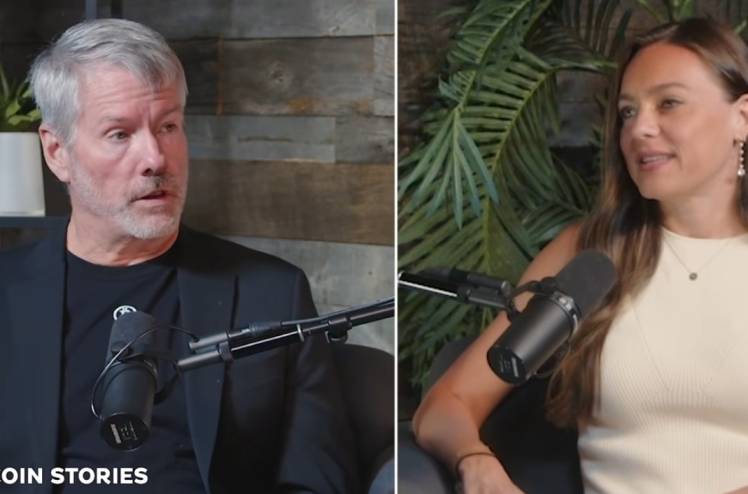
Editor’s Notes: Bitcoin’s most vocal critics argue that the experiment has failed, but Michael Saylor insists the story is far from over. In this in-depth conversation with Natalie Brunell, he addresses questions around Bitcoin’s stalled price action, alleged market manipulation, regulatory friction, and the risks posed by emerging technologies. The discussion also explores Bitcoin’s role as “digital capital,” its volatility, and the financial instruments that could shape its next phase of adoption. (Feb 23, 2026)
TRANSCRIPT:
NATALIE BRUNELL: Everyone wants to hear from him. Michael Saylor, thank you so much for joining me on the show. It’s great to see you. You’re one of the only bulls left, it feels like.
MICHAEL SAYLOR: I think there’s a lot of bulls out there. Just they’re waiting.
Bitcoin’s Price Drop and What Critics Miss
NATALIE BRUNELL: Well, let’s start right there. Bitcoin’s price is down, sentiment is pretty negative. The critics are saying the thesis is breaking. What do they not understand?
MICHAEL SAYLOR: Okay, first of all, it’s 137 days since the last all-time high. Four and a half months. Half the amount of time it takes to make a baby. Four and a half months. Now we’re off 45%, right? The all-time high is like $125,000. We’re at $67,500 or so.
There’s a famous video of me in 2013 speaking about the virtues of the iPhone and Apple, and it went viral for a while. “There’s not an 8-year-old on the planet that doesn’t want an iPhone 5.”
And if you go back and look at maybe the greatest company of our era, Apple, and the greatest stock — a stock that made people insanely rich — Apple releases the iPhone in 2007. The P/E of Apple is 30. The iPhone isn’t a success for two years. Around 2009, on the iPhone 3, people start to think — myself included. I didn’t think the original iPhone One or Two were that useful. There was no App Store, there was no cut and paste. They were kind of toys.
Around 2009, the iPhone starts working. It’s iPhone 3. By 2012, they’re around the iPhone 4 and iPhone 5. Everybody agrees it’s a cool product. Apple stock peaks, then it crashes. Between late 2012 and May 2013, Apple stock falls 45% — the same 45% Bitcoin falls. The Apple P/E goes to 10. The Ford P/E is less than 10. It’s being valued like a tired cash cow utility company — like no technology, no future. People are down on it.
You know how long it takes, Natalie, before Apple recovers to a P/E of 30 from 2013?
NATALIE BRUNELL: Years.
MICHAEL SAYLOR: Seven years.
NATALIE BRUNELL: Seven years.
The Apple Parallel: Patience in Innovation
MICHAEL SAYLOR: In 2020, Apple returns to a P/E of 30. So it’s a 13-year cycle from 2007 to 2020. The greatest company of its era — at many times the most valuable company, the most successful product, the product that a billion people agree is something they can’t live without, maybe the most successful product in the history of the human race — takes 13 years peak to trough to peak, and 7 years to recover.
And you know what it took for people to give Apple the P/E of 30 again? The endorsement of Carl Icahn and Warren Buffett. Two people who probably didn’t even use the iPhone that much, if at all. You never would have read a review from Carl Icahn or Warren Buffett on the iPhone. Are they at the top of your technology advocate list or technology reviewer list?
So that’s an example of how conventional markets evaluate innovation. And here’s the irony — right at the point that I give that speech, I’m saying, “Hey, this is an iPhone 5. There’s not a 6-year-old that doesn’t want this iPhone 5.” At the point I give the speech, there’s general consensus that the iPhone is something you can’t live without, and no one’s got a product nearly as good. And yet the conventional market is counter-trading it.
Big Tech and the Pattern of Underestimation
MICHAEL SAYLOR: If you got rich in the past decade, you probably bought big tech. You probably bought Apple, you probably bought Google, you probably bought Meta. Maybe you bought Amazon, maybe you bought Nvidia, maybe you bought Tesla. There’s no way you got rich without buying big tech. Big tech has been the primary screaming success. The stocks are up 10x, 20x, 30x, 50x. But in all cases, you find examples of the conventional market underappreciating and underestimating them.
With Apple, it was seven years through the wilderness. With Amazon, I remember for something like four to eight years, conventional wisdom was, “Amazon’s an awful company. They’ll never make any money, they’ll never amount to anything.” You almost could have bought Amazon anytime for a decade while conventional investors crapped all over it. It wasn’t until 2020 during the lockdowns that people said, “Oh wow, I guess we need Amazon.”
And of course, just this last week, Amazon’s revenue surpassed Walmart, and Amazon became the largest company in the world by revenue. But when could you have concluded Amazon was going to work? 2010? 2012? It was already obvious there was going to be no competitor to Amazon. No one could possibly do what they were doing by 2012 — eight years before conventional wisdom agreed.
Bitcoin as Global Digital Capital
MICHAEL SAYLOR: The same is true with Apple. So what about Bitcoin? At what point do you have the fundamental ability to conclude that Bitcoin is global digital capital?
What’s the evidence? The President of the United States is telling you. The head of the Fed, Kevin Warsh, is telling you. The head of the Treasury, Scott Bessent, is telling you. The head of the SEC, the head of the CFTC, eight other cabinet members, all the Middle Eastern sovereign wealth funds are telling you.
When in the history of the capital markets did a company ever buy $55 billion worth of a commodity and then loudly declare, “This is digital capital and this is the new money of the world”? Never.
Weathering the Volatility
NATALIE BRUNELL: What do you say to those out there who feel disappointed by the bull market — that we didn’t go higher than $126,000? And what is your reasoning for why we didn’t get to some of those price predictions that a lot of people wanted?
MICHAEL SAYLOR: Is $10 billion enough? Is $50 billion enough? At what point do you have enough fundamental insight on this?
You had enough to know that Amazon was unstoppable a decade before the world agreed. You had enough insight to know that Apple was unstoppable seven years before — probably 10 years, actually. In 2009, 11 years before the world agreed, you knew it was unstoppable. You have enough information to know that Bitcoin is unstoppable right now.
The world is eventually going to come to a consensus, and it’ll be the Warren Buffetts and the Carl Icahns of the world that create that consensus. They won’t be first — they’ll be last. They won’t make a huge amount of money. They’ll double or triple their money. They will enter, and the P/E goes from 10 to 30. They triple their money in a 12-month time period.
And if you’re able to think for yourself and weather volatility, you can 10x, 20x, 30x on your investment. But there really is no example of a successful technology investment where you didn’t have to weather the 45% drawdown and go through that valley of despair. Ours is currently taking 137 days so far. But it might take two years, it might take three years, it might take four years. If it took seven years, congratulations — it’s just like Apple Computer, the biggest success story of the decade.
Why Bitcoin Didn’t Go Higher
NATALIE BRUNELL: What do you say to those out there who feel disappointed by the bull market that we didn’t go higher than $126,000? And what is your reasoning for why we didn’t get to maybe some of those price predictions that a lot of people wanted?
MICHAEL SAYLOR: I think the market is evolving — the entire ecosystem is evolving and seasoning. If you look at all the dynamics, the derivatives market is migrating from offshore to onshore and it is maturing. As US regulated markets grow, that strips some of the volatility off of Bitcoin and some of the upside off of it. It damps the upside. It also damps the downside. Instead of an 80% drawdown, you get a 40 or 50% drawdown. So you’re seeing volatility damped on both the upside and the downside by the seasoning of the markets.
But you also have a situation where the banking establishment is embracing Bitcoin at a progressive but slower rate than people with short attention spans would like. It’ll take the banks four, five, or six years before they embrace an entirely new asset class. People would like for Bitcoin to be recognized in four months. But if the banks take four years before they start to bank it, extend credit on it, acknowledge it, handle it, trade it, and custody it — then what you have at the top of the market is $2 trillion worth of Bitcoin, probably $1.8 trillion, held by retail investors or offshore investors who cannot access the traditional banking system. They’re in the shadow banking system.
So if you had $1.8 trillion worth of capital and no one would give you a loan on it, how do you monetize it? If I posted $10 million of Apple stock with JP Morgan or Morgan Stanley, I could take a $5 million loan at SOFR plus 50 basis points and spend it. But you can’t even post $10 million worth of Bitcoin with JP Morgan or Morgan Stanley right now. Therefore you can’t take a loan. Therefore you have to go to a shadow banking system. You have to go offshore.
So how would you actually monetize it? You either have to sell it — the safe way is to sell it, but that damps the upside. What else can you do?
The Credit Problem Holding Bitcoin Back
MICHAEL SAYLOR: You can get loans — a very small amount of loans — from a few crypto exchanges where they don’t rehypothecate your Bitcoin. But the sum of that capital is probably only a few billion dollars. Maybe there’s a few billion dollars of Bitcoin credit that you can tap at SOFR +500 basis points or SOFR +400 basis points. That’s not SOFR +40 — that’s SOFR +400. So it’s 10 times as expensive to actually draw down capital, and how much capital? One-thousandth of the amount of capital available for securities portfolios. So there’s 1% or less of the capital available through the conventional banking system, and it’s expensive.
What else can you do? You can convert the Bitcoin to IBIT. Just in the past six months, some banks are starting to extend credit against IBIT — a bit more expansive than Bitcoin credit, a bit cheaper. But we’re only in the first 12 months, and it’s still expensive and still limited in its loan-to-value.
Now there’s a third place you can get credit. You go to a crypto exchange or an OTC exchange, and they’ll oftentimes give you a loan at 4%, 3%, 5%, or 2%. I’ve had people offer me Bitcoin-backed credit at 1% or 0%. What’s the catch, Natalie?
NATALIE BRUNELL: Right. That’s the question.
MICHAEL SAYLOR: There’s always a catch. The catch is they want me to transfer the Bitcoin to them so they can rehypothecate it. So if you have $10 million, you either cannot get a loan from a legitimate bank, or you can get a small loan at a 10% interest rate, or you can get a 3 or 4% loan — but then it gets rehypothecated. So your $10 million of Bitcoin gets sold once, gets sold twice, gets sold three times. You might actually create $30 or $40 million worth of selling, because the Bitcoin that you posted and transferred to the shadow bank or the crypto exchange gets rehypothecated three times.
So what’s holding down the price? I think what holds down the price of the asset is the lack of a fully formed, non-rehypothecating credit system. There’s a limit to how much you can rehypothecate certain other assets. When you post your home as collateral for a mortgage, the bank doesn’t turn around and sell the house on your street 10 times. If they did, the price of houses on your street would be lower.
So I think the lack of a fully formed banking system holds the price back. The existence of rehypothecation in the crypto economy damps the volume — it works on both sides. When people want to get short, they might get short at 50x leverage. When they want to get long, they go long at 50x leverage. So right now we’re in that bear market where rehypothecation is holding back the price, and I think at some point it reverses itself. We’ll just have to wait.
Volatility, Long-Term Vision, and Bitcoin’s Future
NATALIE BRUNELL: Well, you always say that volatility is vitality. So do you worry that your projections of Bitcoin’s 40% ARR could be changing and diminishing? Or are your bear, bull, and base cases pretty similar for the next 10 to 15 years?
MICHAEL SAYLOR: I look at 21 years, and I expect about 29% ARR over the next 21 years. I’ve always thought that we would have rallies and drawdowns. So I see it as a serpentine pattern, where it’s just slightly less than 30% over time. But there’ll be periods when it will surge and there’ll be periods when it will draw down — that doesn’t change.
I think, if you listen to people, someone will say, “Well, this weekend there might be some problem in Iran or in the Middle East. And if there is a problem in the Middle East and if the US does something with regard to Iran, then Bitcoin’s the only thing you can sell. And then Bitcoin price may crash and we’re worried about it.”
And I’ll say, “Well, if something happens in the Middle East, Bitcoin will be the only thing you can sell. It’ll also be the only thing you can buy.” And so that just means that a lot of people who want to trade on the weekend are transferring capital to crypto exchanges so that they can buy or sell — buy, sell, buy, sell — Bitcoin four times between Friday at 4pm and Monday morning at 9:30am.
If you’re a trader, what does that make this? It makes it the most interesting asset in the world for you. If you’re an investor over four years, what difference does it make whether or not it gets bought, sold, bought, and sold this weekend?
In fact, here’s the difference it makes. There’s capital — hot money — that’s flowing into this ecosystem, into the Bitcoin ecosystem, that otherwise would not be allocated. There’s a trader, someone’s got $20 billion of capital, and their choice is they can either leave it in the bank earning SOFR, or they can put it into the crypto exchange system and buy and sell and buy and sell. Maybe they’ll make 4% this weekend when Bitcoin crashes by 5%. There’s someone buying while there’s someone selling.
So people are like, “Oh, it fell 5%.” Well, someone woke up at 4am on a Sunday morning to buy it at a 5% discount. Someone’s going to actually make more money on the weekend than they would make holding conventional money for a year.
And that capital is not flowing into New York City real estate. It is not flowing into gold. It is not flowing into conventional derivatives. It’s not flowing into Nvidia stock. It’s not flowing into Apple stock. Why? Because you’re not buying and you’re not panic selling and rage quitting and buying and capitulating and leaping into the market on these volatility waves.
So Bitcoin is most volatile because it’s most useful. In the US, there are things like Reg T where you can’t have more than 2x leverage — we have laws that prevent you from going beyond 2x leverage. Well, there’s no such law in nature. In nature, you see one centipede and then you see 10,000 ants — 10,000 to one. There’s nothing fair about nature.
If you want to gang up 10,000 to 1 on the centipede, you get to do it. Just like if you want to trade Bitcoin 50x and cross-collateralize it to another token which is 10x and create a 500x machine, you can do it. There’s no one stopping you. Is it wise? Well, maybe 99 out of 100 times it isn’t. You get wiped out.
But the point is, if that’s the case, the people that do stupid things get wiped out and then in a year they won’t be doing it anymore. Presumably the people that are trading with 50x cross-collateralized leverage offshore on Saturday morning in response to a Reuters posting, panic selling Bitcoin, and then thinking, “Oh well, the world didn’t end on Sunday afternoon” — and then desperately buying it back — presumably those people have a reason to do it and they’re making money. Because if they weren’t making money, the free market would separate them from their capital. There’s no quicker way to go bankrupt.
So Bitcoin represents the global capital market. There are people doing things that you can’t do, that you won’t do, that you don’t choose to do, and they’re doing it with that asset. And that’s what’s creating the volatility. But it’s also creating the gravitational — the magnetic field — which is attracting all of the energy. All the financial energy of the world is being drawn into this space. All of the political energy, all of the digital energy — it’s all being drawn into this space because of that utility.
And I think you just have to make your peace with it. Either you’re short-term and you’re a trader — if you’re worried about what Bitcoin’s going to be in four days, four weeks, or four months, you’re a trader. Call yourself a trader, and then you better have a trading methodology, trading excellence, be in the trading business, or be neutrally hedged so it doesn’t matter to you.
You’re either that, or you’re an investor. You’ve got a four-year time horizon, and then it just doesn’t matter. All you’d be thinking is: a lot of capital is surging into the space and a lot of attention is being given to the space that otherwise would not be given — because of those crazy traders. And let’s just let them do their thing. Because I’m an investor. I’m holding for the long term.
Bringing Retail Investors Into Bitcoin
NATALIE BRUNELL: Well, I’m very passionate about empowering the average individual, and Bitcoin is still primarily owned by individuals. But I just had Lyn Alden on and she said that retail really did not participate in this last bull market. Why do you think that is? And what will bring the average retail investor into the best savings technology?
MICHAEL SAYLOR: I think the retail investors who are passionate and committed to digital capital, to Bitcoin — I think they found it already. They’ve had 10 years to find it. So if you’re looking for a non-sovereign store of value, bearer digital asset, I think that sometime between 2010 and 2025 you found it in one of those successive waves, and then you bought as much as you could possibly afford to buy.
I think that if you want to draw the next cohort of retail investors, they don’t want a 40-vol, 40-ARR asset. What they want is something more like a 10-vol, 10-ARR asset, or a 0-vol, 8-ARR asset.
So I think the way that we draw the mass of investors is by offering them something like digital credit — like STRC — where we say, “Here’s 11%, it’s tax-deferred, we’re stripping the volatility off of it.” The one-year volatility of STRC is less than the Nasdaq, less than the S&P index, less than gold. I’m going to give you an asset which is less volatile than conventional stores of value, but it’s a straightforward, defined 10% or 11%, and you get it monthly.
You can test this yourself, Natalie. I would challenge you to walk down the street and find 100 people and say: “Would you rather have 30% a year over the next 20 years, but you’re going to get 40% drawdowns and 40 volatility — it’ll be three times as volatile as the S&P index, and some years you won’t make any money and some years you’ll make a lot — but it’ll average 30%? Or would you rather have a bank account that pays 10% where you can take your money out whenever you want and just collect 10% while you’re waiting?”
Take the survey. I would think that 95% of the market wants a 10% bank account they don’t have to pay tax on, and only 5% wants the 30% a year. And I think that’s actually optimistic — that’s probably too pro-Bitcoin. I don’t think 5% of retail investors want to hold Bitcoin and collect 30% a year tax-deferred with a volatility that’s double or triple the S&P. It’s possible that number is 1 to 2%.
So the great mass of retail investors want something which is 2x, 3x, or 4x better than a bond fund. Or they want something that looks like the S&P but without the drawdowns. And so we’re going to attract retail investors to the ecosystem when we take the best of equity, the best of credit, and the best of crypto and put the three together.
What does that mean?
Equity is double-digit returns and tax-deferred gains. Credit is price stability, principal protection, low volatility, and a very defined, consistent cash income. Crypto — Bitcoin — is digital innovation, transformation, and 2x, 3x, 4x the productivity of the conventional economy. It’s massive growth.
Right now, the retail investor has to choose between massive growth and a roller coaster that’s pulling nine Gs — that’s Bitcoin. Or they take the S&P or the Nasdaq index and accept 15 to 20 volatility with good years and bad years, but over time 10% ARR or better. Or they accept a credit spread from an investment-grade bond of 70 basis points, which means they’re getting 4.5% interest — and it’s fully taxable as ordinary income.
So if you’re a California resident, you’re either getting 2% on your Apple bonds after tax — 2%, but you feel safe — or you’re getting 10 to 15% on your S&P and Nasdaq portfolio with not much yield and a conventional roller coaster. Or you buy Bitcoin and you’re getting 3x the roller coaster ride with better performance, but for the last 137 days people think you’re crazy.
Those are your three choices.
Engineering Digital Credit as the Next Step
I think the way that we break that logjam is we simply engineer digital credit. That’s been my passion for the past year. Can I actually take a 45-vol, 45-ARR asset — which is Bitcoin — and strip 80 to 90% of the volatility off it, strip 80 to 90% of the risk off it, and give you something four to five times over-collateralized? Can we create a double-digit yield? Can we do it in a way that’s a return of capital, so you get deferred tax treatment?
So you get the benefits of equity, you get the performance of equity, you get the principal protection of credit or a bond, you get a defined yield, you get paid monthly in cash. If you want to reinvest it, you just reinvest the dividends back into the principal and it becomes a consistent 11% tax-deferred growing asset. And when you want to get off the roller coaster — to pay your kids’ tuition or pay a tax bill — you just withdraw your money or you sell.
For that to work, you can’t have the volatility and the drawdowns of equity. You can’t have the volatility and drawdowns of Bitcoin. You need a credit instrument, you need an issuer that’s going to over-collateralize it, and you need to actively manage that credit instrument so as to create price stability.
I think STRC — or digital credit — is the way that we draw the next cohort of retail investors into the space. And I don’t know why we couldn’t draw 10 to 100x as many. If 2 to 5% of retail were able to find Bitcoin — and by the way, they’re not going to allocate 100% of their capital to it, just some portion — I think if we got 2 to 4% the first go around, I think we’ll get to 20 to 40% with digital credit.
And I think that is, in a way, one of the killer applications of digital capital.
Bitcoin Financial Instruments and Volatility Engineering
MICHAEL SAYLOR: Yeah, if you look at all the credit instruments, what are we doing? We’re stripping volatility off of Bitcoin and extracting yield and eliminating currency risk and eliminating capital risk.
So Bitcoin is like 45 Vol. Over the past year with Strike, we managed to get that down to like 38. With Stride and Strife, we got it into the mid-20s. With Stretch, we got it down into the teens, or the low teens even, for a while down into single digits. And then all that volatility we stripped off then flows into MSTR, the common equity, which is 80. So what we’re engaged in is volatility engineering.
And if you ask the average person, “Do you want a bank account that pays you 10%, or do you want a 30-year bond that pays you 12%, but you’ve got to wait 30 years?” Well, most people just want the 10%. They don’t want an extra 2% if the volatility doubles. Like, do you want 24 volume and 12%, or do you want 10% volume and 10%? Most people just want the truth is what they want — they want 10% in zero volume. “I want zero volatility, zero duration. Give me double or triple the money market, or quadruple the money market.”
So you can overthink this, but if you look at all of our credit experiments — and we’ve done almost 20 different fixed income deals — we did senior credit with EBITDA covenants, and that was not scalable. So cross that off the list. Then we did a Bitcoin-backed loan with Silvergate, but that creates too much collateral coverage risk and margin call risk. So cross that off.
And then we did convertible bonds, many of them, but they’re all 144A offerings, which means it’s illegal for retail to buy them. We can try to put lipstick on the pig and say, “Oh, it’s 144A, it’s over the counter,” whatever — let me translate it. It’s an illiquid market with about two or three dozen participants, and it’s illegal for you to buy it. How is it in any sense a good idea to create a product that’s illegal for normal people to buy? That’s stupid. So cross that off the list.
All those things are 10x, 20x over-collateralized. They trade like triple junk. The market’s broken. A bond that’s got $70 of collateral for every $1 of liability trades with a credit spread like a going-out-of-business junk company. Why is it broken? You can’t buy it. It’s over the counter. What is over the counter? It’s like 16 people getting together in a back alley to trade with each other, with one dud market with a bid-ask spread of 300 basis points, meeting on Friday afternoon from 4 to 5. And we call that 144A over the counter. It’s an illiquid, broken, non-transparent, crippled market. Make that go away.
The Case for Perpetual Preferred Stock
So after you’ve gone through all of that, now you start thinking about, “Well, how do I take it public?” It makes no sense to take a bond public. Selling a five-year bond and then taking it public as a listing makes no sense. Why? Because in four years, the bond’s only got 12 months left. It’s not a perpetual instrument. You’ve got this theta decay — a decay in the value of the bond because at some point it’s only going to have 30-day useful life. Why would you create a public security that eventually dies? That’s silly. So you have to create a perpetual instrument to take it public — ergo, preferred stock.
So then we basically think, “Well, we’ll create a perpetual preferred stock.” And we started by doing the straightforward thing — we’ll just pay a 10% dividend, or we’ll pay 8% with a conversion rate. Those were two ideas: Strike and Strife. They were very successful — 10x more successful than all the other preferreds. And we learned a lot.
But then what we realized is people don’t want duration, and they don’t want complexity. How do you value a convertible preferred stock? It’s just too complicated for people to figure out. What is the duration of a 10% preferred that yields 10% forever? You can calculate the McCauley duration — it’s a theoretical construct. It works out to be about 10 years when it’s trading at par. So it’s like a 10-year duration instrument, the same as a 15 to 18-year government bond.
You following the bond math here, Natalie? It’s kind of complicated bond math. If the bond has a duration of 10, then when interest rates fall 100 basis points, the bond should trade up 10%. How many retail investors understand that? Not many.
Duration math on a bond is complicated. But here’s the problem with it — if I have a duration of 10 and the forward interest rate expectation falls 100 basis points, the principal should trade up 10%. But when the forward interest rate goes up 50 basis points, the bond falls 5%. So every time Jerome Powell is giving a speech, the theoretical value of a 10-duration instrument is moving plus or minus 10%. How many retail people want their assets to fall plus or minus 10% during a Fed press conference?
When the perceived risk rises, when Bitcoin falls, the theoretical value — the collateral — falls. So it’s another way of saying that a long-duration instrument has a lot of volatility. “I’m going to give you 10% instead of 3%, but the security might fall 20% or 10% over the next three months.” That’s what we created, Natalie. Who wants that?
The Opportunity for Credit Investors
By the way, it’s a screaming home run for a credit investor. For example, if you think that SOFR is going to fall 150 basis points, and if you believe that Bitcoin is not going to zero but is going to trade sideways or appreciate 10%, the theoretical credit spread on something like STRF, STRD, or STRK falls to 100 basis points or 50 basis points. Right now you’re getting 600, 700, 800, 900 basis points.
What does that mean? That means if you actually believe in Bitcoin, and you think interest rates are falling, and the company is misunderstood, you’re going to buy that instrument at $100 and it’s going to trade at $250. You’re going to buy Strike at $80 and it’s going to trade to $160, because it’s a long-duration instrument.
What’s the theoretical value of an instrument that’s currently trading with a market credit spread of 900 basis points, but should be valued with a credit spread of 300 basis points? It should trade up to 200, 300, 400. So who wants the long-duration credit instrument? It’s someone who actually has a long view, a pro-Bitcoin view.
If Bitcoin is re-rated as collateral under the Basel rules, if banks start to custody it, if the credit rating agencies rate these things, then those long-duration credit instruments have a capital gain potential of doubling or tripling. But it’s like — what do you think about SOFR? What do you think about the forward yield curve? What do you think about the credit rating agencies? What do you think about the future of Bitcoin?
So that is an interesting investment. But notice how long it took me to talk about it.
NATALIE BRUNELL: It’s hard to understand. Yeah.
From Bitcoin Ideology to Financial Products: Simplifying the Message
MICHAEL SAYLOR: Now let’s move to retail. What do I want? I want to put my money in a bank. I want them to pay me 10%. I don’t want the government to tax it. Okay. How long was that conversation? That was like 12 seconds.
Okay, well, what if interest rates fall? It doesn’t matter. What if the credit of the company improves or falls? It doesn’t matter. Well, what if Bitcoin quadruples? Doesn’t matter. What if Bitcoin gets cut in half? Doesn’t matter.
What matters? Well, I’m getting paid 4% or 3.5% and it’s taxable and the government keeps half. So I’m getting 180 basis points on my money market, or I’m getting 11.25% and the government doesn’t tax it. Do I need to know anything else? Not really.
Okay, well, what’s the risk? Well, Bitcoin might go to zero forever. Okay, so you’ve got existential risk to Bitcoin. And then you have to trust this company, Strategy. Okay, well, how much capital do they have? Well, we just went and raised $9 billion to support your credit instrument. We will raise a billion dollars a week if necessary.
Well, what did they say? They said they’re targeting 100 bucks. What are they going to do if it doesn’t trade at 100 bucks? They’re going to raise the dividend rate. Have they done that? Yeah, five times.
Okay, so why are we focused on STRC? Well, because at the end of the day there’s a $300 trillion credit market and that $300 trillion credit market is collecting 400 to 500 basis points and it’s all taxable. And in order to get to 450 or 500 basis points, you have to accept credit risk of a junk bond. You have to accept the credit risk of an investment grade company. You have to accept the illiquidity of private credit.
Blue Owl is currently in the news right now. They suspended redemptions and people are freaking out — well, what if I can’t get my money out again? So you’re either accepting illiquidity or liquidity risk, or you’re accepting credit risk, or you’re accepting duration risk. Google just sold a hundred year bond. You have to wait 100 years to get your money back. Who bought that? Why did they buy that?
Okay, so duration, credit, liquidity — and then currency risk. You might get a higher yield in a certain currency and then you’re accepting the currency risk to the dollar. You’re accepting all those risks in order to get — what do you get? You get a 70 basis point spread for investment grade. You get 70 basis points more than the US government would pay you if you buy a bond from Microsoft or Apple. Or you get 275 basis points if you buy a junk bond. Or you get maybe 350 basis points if you buy private credit, which is illiquid, which is invested in a heterogeneous portfolio of private companies with 10,000 pages of complicated contracts that may or may not work out for you.
Okay, so that is the credit market. Now ask the question. You’re the retail investor. Do you want duration risk? No. Do you want currency risk? No. Do you want credit risk? No. Do you want to be able to get your money back? Yeah. Do you want volatility? No.
What do you want? Give me two to four times more than the money market and I don’t want to pay tax on it. I want good tax treatment. I want the same deferred capital gains tax treatment that I get from holding a long term investment. So give me fair tax treatment so I can compound my assets and my investments over time, give me some stability, and strip away all these other things.
The Evolution of Strategy’s Financial Instruments
So what that tells us is, at the end of our journey, we realize that there’s no point in creating bond type credit because a bond is always going to be short lived, inefficient, illiquid, and it’s always going to be fully ordinary income taxable. So it’s tax inefficient, it’s market inefficient. No point in doing it — it’s not a benefit to the investor.
These longer duration instruments, they’re for professional investors. If you’re a credit investor with a 10 year horizon and you have an opinion on Bitcoin and the Federal Reserve, you could double your money by buying one of our long dated credit instruments. Is it a good idea for you? Absolutely. You can collect 10 to 12 percent for 100 years on a credit instrument, and if the credit spreads compress, you’ll double or triple your money.
But retirees — 75 year old retired Chief Master Sergeants in the Air Force — they don’t want that.
And I guess the last point I’ll make is, in this journey we kept iterating. We’re like, well, let’s get rid of the defects of senior bonds, let’s get rid of the defects of asset backed bonds, let’s get rid of the defects of convertible bonds, let’s get rid of the defects of perpetual preferreds. And then people were like, well, can I just have the money monthly?
What do they want? They want stability. Give me a stable price, give me monthly cash income. Why monthly, by the way? Because we couldn’t do weekly or daily. If the NASDAQ or the conventional market supported daily or hourly, we’d be doing that. That’s an upgrade that a crypto entrepreneur can put in. You can create a stable coin or a savings coin — maybe like a buck token or something like that — where you’ll actually stream the dividend hourly or daily. That’s interesting. It’s just we couldn’t do it in the container of a NASDAQ listed preferred security efficiently.
So we created the most efficient stream of fixed income. We created the most tax efficient stream of fixed income. We created the simplest possible instrument.
Bitcoin for Everyone: From Ideology to a Simple Product
And the five year journey for the company is this: Bitcoin as digital capital — spend a thousand hours and you’ll agree with me, but you’ll still have to deal with brutal 45% drawdowns. And for some periods everyone’s going to hate and make fun of you. That’s one extreme.
And the other extreme — I’ll spend hundreds of hours to explain why Bitcoin is economic freedom and empowerment and financial sovereignty and a breakthrough in digital energy and the greatest thing in the history of money. And after I’ve done that, 95% of conventional investors still won’t quite understand it. And the Warren Buffetts and the Carl Icahns of the world, they probably won’t necessarily jump on that freight train with $10, $20, or $50 billion of their capital. That’s one extreme.
The other extreme is: would you like a bank account that pays you 11%? That’s tax deferred STRC. Okay, that was a thousand hours. This is ten seconds.
At the end of the day, here’s what I realize. The world doesn’t want you to write 10,000 pages of history to explain what’s going on — they don’t have time to read it. They don’t have 1,000 hours to read it all. The world doesn’t necessarily want 150 hours of explaining why they should get on the crypto roller coaster and accept exhilaration and beatdowns and everything in the middle and endure the toxicity.
The world just wants the answer. And they don’t want the answer even in 10 seconds. They want the product. They want the iPhone.
It’s like, I want air conditioning. How much time do you spend thinking about the water you drink or the cool air or the electric light? Someone just gave it to me. Do I think about it? Not at all. Do I like it? Yeah.
Give me a pill. I take it once a day. I don’t know how you manufacture it. It makes my problem go away.
And in this case, the greatest product in the world — it’s like, if I could cast a spell on you, Natalie. You’ll be happy and indestructible and immortal and have omniscience, and you’ll be omnipotent and all powerful and you’ll never want for anything ever again. And everyone will love you and agree with you. How long is that going to take? Five seconds. Okay, well, sign me up. Just give me that.
What is STRC? Oh, yeah. You buy it, it pays you double digit dividend. It’s tax deferred. If you give it to your heirs, then the basis steps up again. And so you can collect dividends for 10 years without paying tax, and then they can collect dividends for 10 years without paying tax. And what do I have to worry about? Nothing.
That’s what you want. That’s what you want from Coca Cola. That’s what you want from American Airlines. That’s what you want from Boeing. That’s what you want from Apple. Just give me the solution.
How many people want to study petrochemical engineering for 10,000 hours and then set up their own oil refinery in their backyard or their own nuclear reactor? Nobody. How many people want infinite free electricity forever? Everybody.
The commercialization is: take the technology, put it into a package that is simple, that’s straightforward, give it to the public. Well, okay, but we’re going to have to trust you. Yeah, like you had to trust Kellogg cereal. Like you had to trust Kraft ketchup.
You know why they called it Standard Oil? Because it was the oil that didn’t catch fire in the lamp or didn’t clog the engine — because it was standardized. It was always the same purity, the same quality. It’s like, what is this ketchup? This is the ketchup where if you actually put it on your food, it doesn’t give you disease, it doesn’t give you food poisoning. It’s safe.
Is there a precedent for consumers trusting companies to give them things that they love? Yeah. DuPont’s slogan: “Better living through chemistry.” And when chemistry became politically incorrect, it became “Better living through technology.”
There’s polyester and there’s lycra and there’s nylon and all these petrochemical products — and it turns out we built the world with them.
From Ham Radio to Mobile Phones: Bitcoin’s Path to Mass Adoption
And so I think that Bitcoin is growing up and we’re moving from the early adopters, the hobbyists. You remember, it used to be people liked radio — they were ham radio operators. They had a little antenna in their backyard, a ham radio set up in their workshop. They would study the semaphores and the physics, form clubs, get into their workshop, and broadcast over the radio network. People thought that was just great.
And then eventually you got to the point where six year olds have a mobile phone in their hand and nobody does ham radio anymore. But that’s how the industry started. You had to be very technically astute
NATALIE BRUNELL: Right.
MICHAEL SAYLOR: — in order to participate. And how did we commercialize radio? We put 6 billion mobile devices into the hands of teenagers and we gave them TikTok. And we were so good at it that now we have to actually pass laws to stop people from using the radio. Now we’re upset that they spend too much time playing with their radio.
And I think that Bitcoin will go through the same transition. We’ll go from hobbyists and ideologues and technology visionaries to eventually the point where 8 billion people just have the digital assets, the digital capital — it’s all on their phone. We just move it around in a savings coin, a stable coin, a security, a crypto asset.
NATALIE BRUNELL: It’s like, yeah, most people don’t understand how the Internet works but they obviously use it every day. They don’t understand how their iPhone is put together, but they use it.
And it is like that video you mentioned of you holding the iPhone saying everybody’s going to want this. And STRC seems to be that product that addresses the main market need of not wanting volatility but wanting a stable cash dividend. You have a 2 plus year runway for it with cash. MSTR is still trading at a premium. You guys are still buying Bitcoin.
But yet every time I see you on these news programs, it seems like they’re expecting Bitcoin to go to zero and you’ve gone from hero to — oh my gosh, what’s happening? Bitcoin’s dying. Do you ever feel like they’re rooting for you to fail? And how do you deal with that swing in sentiment?
The Power of Volatility: Why Bitcoin Makes Strategy the Most Interesting Company
MICHAEL SAYLOR: The struggle is real. The struggle is real. But to be more serious, when Bitcoin is hitting all-time highs, there’s a sense of exuberance and all of the media turns positive and it’s glowing and people are doing high fives. And when it draws down, there’s a gloominess to it and then people over-forecast to the negative.
I think that it’s the volatility that drives the engagement and the interest and the speculation, and there’s something to talk about — and they’re talking about us. You know what they’re not talking about? They’re not talking about real estate on the Upper East Side of Manhattan. They’re not talking about timber rights. People talk about all these non-volatile assets. Well, non-volatile assets means there’s no news, and if there’s no news, there’s no interest.
When I operated a public company, there was a period when we rage-quit the capital markets — when we were just so unhappy with the way that the capital markets treated us, we just stopped participating. I don’t know how many years it was, but we would put out a press release each quarter saying, “These are the results.” But we didn’t do a conference call, we didn’t do television, we didn’t do interviews. It was like, “Just read the numbers, value the company as they will.”
In a conventional company, you have information released once a quarter. So there are four times a year — four windows a year — where there might be information, where you might trade the stock four days, and you’re expected to not surprise the market. Which means that if you’re a well-run conventional company, you give guidance and then you hit the guidance, plus or minus. And it’s really not very interesting.
Someone could pretty much value one of those companies by making a decision once a year. Once a year, I decide to buy or to hold the stock and how much to hold. No news is good news and there’s nothing else going on. That’s boring, not volatile.
And then when we got into Bitcoin, we realized we’re holding this asset — and our website updates every 15 seconds, Natalie. Think about this cycle. We went from updating the financial markets with material news every 12 weeks — once every 12 weeks — to updating the financial markets every 15 seconds.
So yeah, you’re going to have weeks where Bitcoin is going to be down. Every time Bitcoin moves $10,000, the company makes or loses $7–8 billion. A $1,000 move is $700 million. Let me put this in perspective: it used to be that the company worked for an entire year to make $70 million.
NATALIE BRUNELL: So crazy to think so.
Bitcoin as an Economic Energy Generator
MICHAEL SAYLOR: Every $100 fluctuation in Bitcoin is the equivalent of one year’s work. So what we’ve done is we have plugged an energy source — a volatility generator, an economic energy generator — directly into the balance sheet. And the Bitcoin cycle drives a news cycle. The news cycle drives Bitcoin trading. Everybody is obsessing.
So you’re on television and someone’s obsessing, “Could it go lower?” There’s a skeptic thinking, “Maybe I should short the stock. I’m going to take $100 million out of my piggy bank and short it.” But you know what? They have to buy that back. Unless they’re lucky enough to short a stock that goes immediately to zero forever, it’s only a question of when they’re going to have to buy that $100 million back.
So you’re attracting some group of people that want to trade short, but there’s another group of people who are like, “This is totally overdone. Bitcoin is definitely going to go back to where it was, so I’m going to get in and buy $100 million.”
Now, if you didn’t have the volatility, the short seller would not have bet $100 million on your company. And the long player would not have bet $100 million on your company. And the market makers in the middle and the options traders — they wouldn’t have traded both. Then the Susquehannas of the world can create derivatives: “I’m going to give you a call option to go $100 million long but only post $5 million in collateral. I’m going to give you a put option so you can go $100 million short and only post $5 million in collateral. I’m going to make a million dollars doing that either way.” Everybody’s making a financial market in this.
It used to be that the Wall Street Journal would only write about you if you’re a public company. They don’t write about private companies. Why? Because every story is irrelevant. “I can’t buy or sell the thing I’m reading about. Why would I read about something if I can’t buy it, sell it, leverage it, gamble on it, make money off it?”
The classic word in the English language for “I have an interest in that company” is “I own.” “I have an interest in the company” means I own X percent of the company. If you’ve shorted the company, the last thing you want to read is good news — it’s terrifying to you. So someone says, “Some great thing just happened at Strategy.” Okay, you’ve got to read it. If you have a long interest in the company, what you want to hear is good news.
How do you make a company interesting? First of all, you take it public. But that’s only first-order interesting, because now there’s a ticker. But as I just illustrated, if you’re a well-run conventional public company, you’re only interesting once a year or once every 12 weeks because you never say anything otherwise. There’s news one day out of 100 — 1% of the time you’re interesting.
If you’re a conventional company, you’re not supposed to be that interesting. You’re supposed to never surprise anyone. The number of companies that can surprise to the upside every quarter, 40 quarters in a row, Natalie — that’s 1 in 100. So 1% of the time you’re interesting, and 1% of 1% of the time you’re interesting in the right direction. That’s 1 in 10,000. That’s the conventional playbook.
Making a Company Interesting Every 15 Seconds
Now, how do you take a company and make it interesting every day? How about every 15 seconds? You take it public. Then you put a lot of Bitcoin on the balance sheet and you let the Bitcoin vibrate — oscillate. That makes the company 1,000 times more interesting. Maybe 10,000 times more interesting.
If you go to our website, you find out we made or lost a billion dollars every few minutes. That’s more news than we generated in the first 20 years of the company.
NATALIE BRUNELL: You make us feel better about our portfolios.
MICHAEL SAYLOR: $10,000 move — $7 billion, plus or minus. What’s a $50,000 draw? $35 billion. Okay, so it’s a $35 billion drawdown. That’s going to arouse some interesting passions.
But here’s the other point. If you go to the charts tab on our website, you can actually chart all of these securities and assets versus each other. One of the cool metrics we’ve got is open interest divided by market cap. We benchmark open interest of MSTR versus Tesla versus Nvidia versus Google or Apple. Do you care to guess which company has the highest open interest versus market cap out of that entire Mag7 group?
Strategy. Our company. It’s not even close, Natalie. We’re at 80% of market cap in open interest. Some of these other companies — the seven greatest companies in the world — are at 4%, 5%. Not interesting. The greatest companies in the world, doing the most important things in the world, are an order of magnitude less interesting.
If you look at average daily trading volume — the liquidity per market cap — who do you think is number one? Strategy. We are. How did we manage to become the most liquid, most interesting company? It’s very simple. It’s like back to Iron Man. The idea of the Iron Man super suit is really cool, but you need the power source to actually power it up. You need an extreme power source in the balance sheet of the company. And the power source is Bitcoin. It’s digital capital.
When you go onto these shows, it’s tough taking your beatings during the bear market. You just have to be cheerful and constructive and keep pointing out, “No, actually we’re fine. It doesn’t matter. We’ll be good. It’s all going to work out very well.” And you have to explain why, and then you have to keep coming back.
And having said all that — they wouldn’t want to talk to you if you were a conventional holder of non-volatile assets. When’s the last time you saw someone representing a real estate investment trust — a diversified portfolio of Midwestern real estate — on television talking about the bear market in real estate and how they’re going to weather the storm?
NATALIE BRUNELL: Couldn’t name them.
MICHAEL SAYLOR: Can you even name one? Can you name a REIT?
NATALIE BRUNELL: No.
Why Being Interesting Is Critical
MICHAEL SAYLOR: They’re well-managed with diversified portfolios of non-volatile assets. Do you care? No. Are you interested? No. So it’s pretty critical that you be interesting. And the reason people want to talk — the reason you draw this toxicity, the highest highs, the lowest lows, the greatest extremes — is because it truly is interesting.
The breakthrough of the crypto economy is to create a financial asset which is interesting globally, 24 hours a day, seven days a week. Because if I want to cripple a financial asset, let me show you how I do it. I make it illegal for anyone outside the US to buy — that’s your first step down. Then I make it impossible to trade except from 9:30 to 4:00 — that’s the second step down. Then I force you to go through all sorts of AML/KYC and take three months to set up the account — that’s the third step down. Then I require $100 million of capital and qualified investor status to buy it — another step down.
If I just keep stepping it down, I cripple access. Then I take it off the exchange, make it a private instrument — a 144A or totally private. Another crippling step down. Then give it a six-letter ticker instead of a four-letter ticker. Hard to remember. Can you name any publicly traded stocks with a five- or six-letter ticker?
NATALIE BRUNELL: Metaplanet.
Bitcoin: Moving at the Speed of Light
MICHAEL SAYLOR: It’s hard. Like 1 in 1,000, 1 in 100. It’s hard. How about if I give it a CUSIP number? What if it was like “KO1997442”? There are a lot of ways to make something uninteresting — make it difficult.
And yet the crypto industry went the other direction. What if anybody on earth can trade this thing in 60 seconds by downloading an app to their mobile phone? How do you actually give access to the instrument in China?
We had a bank holiday the other day. It’s illegal to buy or sell publicly listed securities. What happens when the government of whatever country just decides to unilaterally declare 60 days of holiday? You can’t trade on Saturday, you can’t trade on Sunday, you can’t trade on President’s Day, you can’t trade on the 4th of July. Can’t, can’t, can’t, can’t. They all cripple the financial markets.
And the point I made that day was: on a bank holiday, you can move any amount of Bitcoin for 44 cents — a billion dollars for 44 cents in a few minutes. What we have here is a digital revolution. If you get it, you get it. It’s so obvious. Money wants to move at the speed of light, 24/7, 365.
Waterfalls don’t stop on bank holidays. Electricity doesn’t stop on bank holidays. Gravity doesn’t stop on bank holidays. The things that are actually changing the world — whether it’s an iPhone, running water, electricity, or airplanes — they work regardless of the opinion of a politician who would like to intervene to make them not work.
The reason Bitcoin is winning — the reason digital capital is winning — is because things that move at the speed of light, friction-free, 24/7, 365, globally, that can be programmed by an AI, that can be vibrated or transformed a million times a second, are going to displace — in a brutal Darwinian fashion — their slower, clumsier antecedents. The things that came before are going to be squeezed out of the economy and out of the marketplace. Because the thing that comes later is just better.
Quantum Computing and Bitcoin Security
NATALIE BRUNELL: Before we start to wrap up, I want to cover a really important topic, which is quantum. We have that saying in Bitcoin, “don’t trust, verify.” But a lot of people are just not technical enough to be able to verify. Is quantum actually an existential threat? I know you guys made an announcement recently, a strategy with regards to quantum and the future, making sure that Bitcoin is quantum proof. Can you kind of explain to people why you don’t see this as such a risk that seems to be priced in at some point?
The Quantum Threat Narrative: Separating Fear from Reality
MICHAEL SAYLOR: So first of all, the consensus of the cybersecurity community, broadly held, is that quantum risk, if it exists, is more than 10 years out. It’s not a this-decade thing. Whether or not there will be a quantum threat or a quantum risk is a question that is yet to be decided. But there’s certainly no consensus that there is any threat right now, or that there will be a threat materializing anytime soon.
Should a quantum risk materialize, at that point you’re going to see an upgrade in the software that runs the global banking system, the global internet, consumer devices, all the crypto networks, the Bitcoin network, everything digital — the AI networks, all of those networks that we rely on today, whether they’re governmental or financial or consumer or defense related. They’re going to get upgraded with post-quantum resistant cryptography. It won’t be a surprise. You’ll see it coming. We will all see it coming.
Bitcoin software — Bitcoin Core version 30. Right now we’re debating over upgrading from version 29 to version 30. The software does change. If you’ve got 30 versions of Bitcoin Core in an asset which is 17 years old, do the math in your head and figure out how long it takes for versions of this stuff to roll out. The nodes will upgrade, the hardware will upgrade, the wallets will upgrade, the exchanges will upgrade.
How will they upgrade? Well, wait 10 years. There will be global consensus about the best way to deal with it. There is no global consensus right now because there isn’t a credible threat right now.
So why do I not worry about it? Well, because everybody with anything at stake — whether it’s Google or Microsoft or Apple or Coinbase or BlackRock or Strategy or the US government or the Russian government or the EU government or the Chinese government or JP Morgan or Morgan Stanley — they all have to deal with the same issue. We all have digital systems that would be at risk if there was a credible quantum threat. When and if it materializes, I expect that there will be some software or hardware, or both, reaction to it.
The crypto community is actually the most sophisticated cybersecurity community. If you look at the security protocols that are used to move crypto around, they’re all multi-factor authentication with hardware keys, et cetera. If you consider the security protocols used to move bank wires around, or used to trade stocks, they are orders of magnitude weaker right now. I’m not going to elaborate on them for obvious reasons, but anyone that’s actually engaged in a stock transaction, bank wire transaction, credit card transaction, check transaction, or any kind of consumer finance or communication transaction, knows that the steps you go through in order to move Bitcoin out of cold storage, or to transfer it to someone else — especially when you’re moving it at scale — are extremely sophisticated.
So I think that the crypto security community will be the first to perceive the threat and to react to the threat, and they’ll be leading the way. We have announced a Bitcoin security program. Coinbase obviously has a security program. In fact, a lot of the money that I contributed early to the Bitcoin development process was actually for Bitcoin security programs — like the MIT Bitcoin security program. So I think that all of us that are large Bitcoin holders or users in the industry know that the security of the network is paramount.
The Pattern of Bitcoin Alarmism
But I don’t actually think that the quantum narrative is the greatest security threat to Bitcoin right now. I don’t think it has been. People joke — they’ve been concerned and talking about it every two years for the past 15 years.
I actually think there are a hundred narratives that people discuss that might be a security threat. Is there a bandwidth problem? Is there a nation-state attack vector? Does it have enough functionality? Does it have too much functionality? Is it evolving too quickly? Is it not evolving fast enough? Is it sufficiently decentralized? Should we make it easier to run on an iPhone? Should we make it not easier to run on an iPhone? The number of debates about what’s good for Bitcoin are mind-numbing, and there are many of them. They will continue. Quantum will be one.
It used to be: “The Chinese will control all the mining.” Then it’s: “The Chinese control the mining equipment. There might be a backdoor in the mining equipment.” Then: “The Chinese ban Bitcoin mining. The Chinese ban Bitcoin mining equipment.” The debates vary from “there’s a risk” to “oh no, there isn’t a risk” — back and forth. And at some point it gets silly because there are a hundred of them.
I would say at this point, the reason we’re talking about quantum is because all of the other risks did not materialize. A decade ago, people fought the block size wars. There are books written about it. The narrative was: “Bitcoin will fail because it doesn’t have enough bandwidth.” And people fought bitterly over this.
A few days ago I posted a screenshot of Clark Moody’s dashboard, and it showed that the fee structure of Bitcoin was 1 sat per vbyte for instantaneous performance. 1 sat, 1 sat, 1 sat, 1 sat. In essence, there is no bandwidth problem in the Bitcoin network. A decade after the block size wars — wars that people fought and died over — it was a non-issue. Eventually the free market solved the problem.
And at the end of the day, you always have this dynamic between the alarmist, the ambitious opportunist, or the idealist. You could call them the idealistic intellectuals, or you could call them the ambitious opportunists. “Bitcoin will boil the oceans. Bitcoin will fail because you can’t self-custody. Bitcoin will fail because of bandwidth.” And then it follows — “We can’t use nuclear energy, it’ll blow up the world. We’re going to boil the oceans.” Climate alarmists, whatever alarmists. There are 150 narratives that people spin up, and every one of them is a way to accumulate interest, engagement, influence, capital, or power.
The Economics of Fear
“It’s very important that we vaccinate every three-year-old on Earth at the cost of $10,000 a vaccine shot against yo-yo disease — the one that I just found, that hypothetically might well be an issue. So please give me $100 billion, let’s declare martial law, and let’s make it illegal for parents not to do this, because I’m here to save the world.”
It’s this God complex, this intellectual “save the world” context. It’s been going on for thousands of years, Natalie. It’s in the political process, the crypto process, and the Bitcoin process.
The fact of the matter is, none of the narratives that were going to stop Bitcoin or threaten Bitcoin ever panned out. They all turned out to be incorrect. The scalability. “We have to stop spam.” No, we didn’t. “We have to create smart contracts.” No, we don’t. “We have to double the block size.” No, we didn’t. “The miners are going to go bankrupt.” No, they didn’t. “No one will mine Bitcoin.” Yes, they will. “The Chinese will stop it.” Yes, they did. No, they didn’t. Yes, they did. No, they didn’t. “It uses too much energy.” No, it didn’t. “It’ll boil the ocean.” It didn’t. “Quantum will hack it.” No, it won’t.
And what is it that people are missing here? Well, first of all, 99 out of 100 of these narratives benefit the ambitious opportunists, because now they become famous. Al Gore made hundreds of millions of dollars preaching that the climate was going to collapse. 25 years later, it didn’t happen. Somebody got rich. ESG worked as a narrative, but the collapse didn’t happen. But the point is — if I wasn’t preaching it, how am I getting rich?
So what you have is this economic and political amplification of alarmist narratives, because it benefits the politician, it benefits the entrepreneur, it benefits those with a will to money or power. At one point, we decided that you had to stand six feet away from each other and wear a mask, and the government needed to buy hundreds of billions of dollars of masks. And if you didn’t wear the mask, you’re going to jail. And someone sold the masks. There is a very powerful feedback loop with these narratives.
Once you realize that, you realize that 99 out of 100 narratives are just a way for someone to accumulate money and power. And you ought to be skeptical of those narratives.
The Insurance Analogy
And the last point — a famous president said it: “You see 10 problems driving down the road at you. Nine of them are going to drive themselves into a ditch before they get to you.”
So how do I get rich, Natalie? Well, I convince you that it’s possible you’re going to trip on a rock and break your leg and not be able to work. So I sell you trip-on-a-rock insurance. What’s that cost? That’s going to cost you 1% of your annual income. Then someone else comes along and says, “Well, you might get a sneezing attack, Natalie, and I’m going to sell you sneezing attack insurance.” What’s that going to cost you? Another 1%. Then another guy comes along and convinces you that there’s a hypothetical chance your children will have autism, so he sells you the autism vaccine — whatever — and that’ll cost you 2%. Then someone else comes along: “Well, it’s quite possible that you’ll be driving and something will happen and you’ll wreck the car and won’t be able to work again. So here’s vocational insurance for driving.”
I come up with 100 possible things, and each of them is 0.01% likely to happen to you. The collective of all of them is 1% likely. But I sell you insurance that sucks up 100% of your income. So if you insure against every one of these parade of horribles — every hypothetical, every possible thing — you’re bankrupt. You were 100% likely to be bankrupt because you bought insurance against 100 things that were 1% likely to happen.
And by the way, if you had bought insurance against none of them, a decade would have gone by and you’d be 1% likely to have had one of them — and you would have just upgraded your iPhone software and the problem would have gone away. But the person selling you the insurance isn’t going to make a billion dollars if you just wait 10 years and upgrade your iPhone software. How am I supposed to get rich on that? How am I supposed to get elected governor of a state if I don’t spin up a doom narrative?
Weaponized Narratives and the Danger of Hypotheticals
The danger is when anything gets weaponized by an entrepreneur. “I want to raise money so I can hire a bunch of quantum-resistant developers.” Or: “I want you to sell Bitcoin and buy quantum-resistant yo-yo coin.” Or: “I want to be elected mayor, and the problem is that there’s hypothetically radioactive something in the drinking water in 10 years if we let nuclear reactors get built somewhere in the state five years from now. That’s why you should give me all your money so I can be elected mayor now, so I can pass a law to prevent the hypothetical problem 8,700 years from now.”
And of course, what you see is — when you have enough of these issues — I’ve had lawyers say, “Well, you know, you can’t do that because hypothetically, in 15 years, after 15 appeals, there might be a quasi-liability if you were to do this and that and the other thing.” And I’m like, “We’re going to go out of business next month if we do what you said. But in 15 years, hypothetically, there’s a 0.01% chance that we might have to pay 0.01% of our money to solve the problem.” And they say, “Well, I guess if you look at it that way, then I guess you’re right.”
That is pretty much the legalistic view. Politicians tend to be lawyers. Idealistic intellectuals tend to think that way. Ambitious opportunists think that way.
I can point to the fall of the British Empire. I can point to the fall of a whole bunch of states. I can point to Easter Island. I can show you the fall of the Roman Empire, the fall of the Carthaginian Empire. Every great city, every great mercantile network, every great empire, every great corporation — it all starts to collapse at the point that someone says, “Well, out of an abundance of caution, maybe we need to prevent this or we need to do that.”
Don’t Panic
I would say this entire quantum fear is just the latest iteration — because there’s nothing else to talk about. I can no longer raise money by saying that Bitcoin needs to be more scalable or have smart contracts or whatever. So this is the only way to be relevant and get attention.
And when this one falls, someone will say, “Well, at some point we’re going to upgrade to nanobots in the head and holobands, and Bitcoin’s not holoband-nanobot ready. We’re going to need to invest a lot of money in holoband nanobot chains, because otherwise your Bitcoin’s going to be worthless.” Someone will say it — I guarantee it. Because that’s the story of humanity since time immemorial.
Ultimately, you’re either going to have a constructive, optimistic view — which is: something will happen and we’ll just take advantage, upgrade the software or upgrade the networks, take advantage of the new technology, and we’ll all be richer and happier and live happily ever after. That’s one view.
Or: something’s going to happen and we’re just too stupid to figure out how to react to it, and we’re just going to lose everything. And so therefore I should just give all my money to this ambitious opportunist who’s preaching that the world’s going to end.
It’s silly, but it’s predictable.
What I would say is — like the back of The Hitchhiker’s Guide to the Galaxy: don’t panic. At the end of the day, lots of things will happen in the future. The human race will react to them. The people that chose to put their money in a bank in cyberspace will probably upgrade the hardware, the software, and the methodologies that protect that bank in cyberspace when they feel they need to.
Until that time, there are a hundred other things you’re probably better off using that bandwidth for. Look both ways when you cross the street, because you don’t want to be that egghead intellectual who walks in front of a truck because they’re worried about the 0.01% likely quantum threat that would be easily deflected with an iPhone update.
You’re not going to have a choice, Natalie, when and if there is a cybersecurity threat. Your business software is getting upgraded, your bank software is getting upgraded, the government software is getting upgraded, the crypto network software is getting upgraded. It’s going to be damn near impossible to avoid. Did you ever make a decision to upgrade all your systems to Y2K-friendly? Do you even recall that?
The Strongest Argument Against Bitcoin
NATALIE BRUNELL: I do recall that time period and everyone was terrified and it ended up being nothing.
MICHAEL SAYLOR: So everybody in the world was terrified. The war was coming to an end and it was nothing. But you know what? Billions of people didn’t do anything. Couldn’t have done anything, couldn’t have stopped it. It was a non-issue. And it would just be one of 10,000 examples of nothings that get overcome by the human race every few years.
NATALIE BRUNELL: Okay, so I have an interesting question for you. What do you think is the strongest argument against Bitcoin right now and why do you reject it?
MICHAEL SAYLOR: The strongest argument against Bitcoin right now is that it’s novel, it’s new. It’s only been around for a number of years. And maybe before I trust my entire life to it, I want to see it around longer.
It took 30 years for people to embrace electricity. Bitcoin’s been around for 17 years. So someone might very well say, “Did I wait until 17 years after the airplane got invented?” The airplane is 1903. How many people had flown in a passenger jet or passenger airline by 1920?
Maybe it’s still early and people just want to see more people try it out first and then follow. So will it take 20 years? Will it take 30 years? Will it take 40 years? The world is full of profound innovations that eventually were embraced by everybody, but it took more than 17 years.
And I think the answer is time. The early pioneers — it’s like, how many years after the automobile was invented before the Model T Ford comes along? And how many years after the Model T before everybody had a car? There’s a natural process of taking innovative technology, building it into a consumer device or an industrial device, and then having enough of a track record that people are willing to bet their life or their reputation on it. And I think we’re in that process of commercialization now.
On Cost Basis and Buying Strategy
NATALIE BRUNELL: That’s fair. So before your final thoughts, I was curious — you don’t seem bothered at all by cost basis. A lot of people right now are trying to find the bottom, looking at the technical charts, but you just seem unfazed. You’re just buying at any price. Can you address that for those who are thinking, “Well, if maybe it’s going to go lower, why not accumulate at a lower cost basis?”
MICHAEL SAYLOR: Well, you could think of us as dollar cost averaging, but the key point is we’re using equity — we’re not taking out a loan.
When we’re buying Bitcoin, if we sell equity and then we buy Bitcoin, then we bought the Bitcoin at $100,000 a coin. If we bought the Bitcoin at $200,000 a coin by selling equity, we’re simply swapping. We’re doing a perpetual, risk-free swap — swapping equity for Bitcoin.
When should you swap equity for Bitcoin? Whenever it’s accretive. If Bitcoin traded up 10% but our equity traded up 25%, then it’s accretive — it’s profitable to swap the equity for the Bitcoin. If Bitcoin then trades down 20%, are you glad you did it? Sure you are, because you wouldn’t have had the Bitcoin otherwise.
And if Bitcoin falls 10% or equity falls 20%, at that point you’ve actually de-risked the equity. There’s less risk to the equity if you’re actually putting a stable asset underneath it, especially if you’re doing the swaps at a premium.
So the only real question is: is it accretive? Is it profitable to the shareholders to actually do the swaps?
There’s a level at which it’s profitable to swap preferred stock for Bitcoin. There’s a level at which it’s profitable to swap common equity for Bitcoin. When you’ve done that, it doesn’t really matter. It is irrelevant what the future trajectory of Bitcoin is, if you’re swapping common equity for Bitcoin, because there’s no continuing liability for the next thousand years.
There is a theoretical path where it was dilutive to swap preferred. For example, if I’m paying 10% dividends on the preferred and Bitcoin returns 5% for the next hundred years, then swapping preferred for Bitcoin over 100 years will turn out to be dilutive to the common stock shareholders. So there’s a more complicated calculation for swapping digital credit for Bitcoin.
The calculation for swapping common equity for Bitcoin is fairly simple. Now if you swap debt that comes due in 10 years and cost you 5%, well then you need Bitcoin to appreciate more than 5% over 10 years for that to not be dilutive.
Now, if I swap Bitcoin for margin debt — if I simply borrow the money to buy Bitcoin at 10x leverage, say I buy a billion dollars of Bitcoin, post $100 million of collateral and do it on an exchange — if Bitcoin trades down 10%, you get forced liquidated and you lose your $100 million. Why is that risky? Because you’re borrowing the money for one minute.
So the real issue is: what’s the duration of the swap? Are you taking a one-minute flash loan to buy Bitcoin? If so, then the price of Bitcoin you paid versus where it is now matters a lot. Did you borrow the money for a decade? Well, then it will matter in a decade. Did you borrow the money perpetually, so you’re never paying it back? Well, then it’s not clear how important it is.
The financial math varies. The very simple way to think of it is: if you swap common equity for Bitcoin, it doesn’t matter what the price is. It just matters what the premium — what the relative valuations of the swap were — when you enter the transaction.
If you swap preferred equity for Bitcoin, it somewhat matters whether Bitcoin appreciates over the course of 30 years. But there are scenarios where Bitcoin could appreciate less than 10% a year for 30 years, we would pay a 10% dividend, and it’s still profitable to the common equity — because there are second, third, and fourth order dynamics that people don’t quite calculate.
In fact, we have 20 to 30 years to be right when we’re actually selling digital credit to buy Bitcoin. If you’re selling corporate bonds or convertible bonds, the duration of those instruments is much shorter — four years, three years — then you have to be right quicker. And of course, when you’re taking margin loans, these are one-month, one-day, or one-minute loans.
The thing that most retail investors don’t get is that the only credit they have is margin credit, which is one-minute credit. And if they’re wrong, they’re getting liquidated over the weekend. Whereas the credit we’re using — we could be wrong for 30 years.
Natalie, I can paint you scenarios where we pay 10%, Bitcoin returns 8%, we’re wrong for 30 years, and it’s still a good idea for the common stock. It would take us a few hours, a totally different podcast, and it would take delving into the first, second, and third order financial dynamics and the harmonics of the entire monetary network for me to explain that to you.
But the truth is, it doesn’t matter what Bitcoin does for the next hundred years if it’s common equity. And we’ve got a 10 to 30 year timeframe to be right if it’s digital credit. And we don’t engage in the other types of debt, so it just doesn’t matter.
That’s why our average price doesn’t make any real difference. What really matters is the nature of the security swaps we’re doing. There’s a difference between selling a billion dollars of STRC, which is a monthly variable rate, versus selling a billion dollars of STRF, which is 10% at par forever, versus selling a billion dollars of common equity. They have different dynamics, and the mathematics is more sophisticated than one can explain in a tweet.
And I guarantee you no critic of any of this has ever thought through the second order consequences, much less the third, fourth, and fifth order harmonics of what we’re doing.
On the Epstein Files and Bitcoin
NATALIE BRUNELL: There were some people who were very concerned that Bitcoin and the core developers were named in the Epstein files. People are very upset about the Epstein files. Was that a concern for you?
MICHAEL SAYLOR: It’s not an issue.
NATALIE BRUNELL: Why not?
MICHAEL SAYLOR: I guess they were getting tired of the quantum FUD and they moved on to the Epstein FUD.
NATALIE BRUNELL: Yeah, I mean, in the mainstream media they said it was Epstein trying to influence Bitcoin.
MICHAEL SAYLOR: Obviously Epstein might have used Apple phones and might have ordered something from Amazon. He might have at some point used Linux, and he might have funded a Democrat or a Republican. And if Epstein was involved with a Democrat or a Republican, or Apple or Google, or if he ever did a Google search — it’s like, okay, I’m keeping my Google stock.
If you’re a Democrat, you’re still a Democrat. If you’re a Republican, you’re still a Republican. He lived in America, Natalie — shall we all leave? This kind of contagion is just colorful for engagement. I know people that still live in New York even though he lived in New York, and I know people that are still staying in America even though he was American. The Republicans and Democrats are going to keep their party affiliation, and Bitcoin is Bitcoin. You can audit the code.
NATALIE BRUNELL: Yep.
Bitcoin as a Protocol for Prosperity
MICHAEL SAYLOR: It’s the same reason it doesn’t matter who Satoshi was. You don’t need to know Satoshi. Do you need to know who Prometheus was in order to decide not to set yourself on fire? Prometheus doesn’t matter. It’s fire. It’s a chemical reaction. You can study chemistry, you can figure it out. You can study thermodynamics.
Bitcoin’s a force of nature. Anybody can use it. There are people that I don’t agree with who may have used it, who talk about it or use it, or who came along before me, who will come along after me. We’re speaking the English language. There are a lot of people that you disagree with that also spoke the English language. Some of them even contributed words to the English language. Some of them even wrote books in the English language. Some of them were even English.
At the end of the day, it’s a protocol. Fraudsters use Arabic numerals. Criminals use English. Every movie’s got a car chase in it, and sometimes you hope that the person gets away, and sometimes you hope they get caught. And you’re still using the car.
I just think it’s a distraction. We shouldn’t get worked up over these things. We should stay laser-like focused on the big picture.
The Digital Capital Revolution
Bitcoin is digital capital. It’s a revolution in the capital markets. It’s a profound, once-in-humanity innovation. It allows us to tightly bind economic energy to the human being, to the corporation, to any entity. The ability to tightly bind economic energy to the individual is as profound as fire, electricity, or even the formation of fat in mammals. It’s a fundamental building block of life.
On top of that, we can create digital credit. We can create something better — digital money. You can create a bank account that pays you 8%, no volatility. How many people have that? Nobody. How many people want it? Everybody. What’s it worth collectively? Conservatively? $300 trillion.
There’s $300 trillion of credit, and everybody’s got garbage credit with no yield, with awful tax treatment, with massive risk — credit risk, currency risk. Very difficult. So you have a world which is not served well by the 20th century conventional finance assets, finance structures, finance ideologies, and finance protocols.
A New Digital World
You have a new world — a digital world with digital protocols, digital assets, digital capital, digital credit, digital money. Is it going to solve all the problems? No, there are going to be a lot of problems in the world that we’re not solving with digital money, digital credit, and digital capital.
However, walk down the street and ask a hundred people whether or not they’d like more money. Every one of them is going to say, “I’d like more money.” So there’s an obvious, unequivocally utilitarian opportunity for us here. It’s straightforward.
The money is not going to fix itself. Bitcoin is capital. You have to build credit on top of it. You’re going to have to build money on top of the credit. You’re going to have to go and market that. You’re going to have to get regulators to approve it. You’re going to have to put it in an ETF container, put it in a crypto token container, put it in a private fund, put it in a public fund — get the Japanese to approve it, get the Emiratis to approve it, get the Americans to approve it, get the Europeans to approve it, fight with the Chinese regulators to approve it, the Australians to approve it, the Canadians to approve it.
Then people are going to stare at it and say, “Yeah, it looks too good to be true. I don’t trust it.” And then you’re going to have to explain why it’s trustworthy, and then they’re going to disagree with you and they’re going to keep scorn on you, and then you’re going to have to keep coming back — because that’s just the way the world is.
The Future Is Already Here
30 years after this podcast, everybody will say, “Oh, yeah, digital money, of course. Of course we want that. Do you like electricity? Yeah. Do you like cars? Yeah. Do you like fire? Yeah. Do you like antibiotics? Sure. Do you like television or radio? Yeah. How about airplanes? Sure.”
Was there a time when all of these things were in disrepute and created incredible fear, uncertainty, and doubt? Every one of them. And this is just the latest technology transformation. It’s coming.
As William Gibson said, “The future is already here. It’s just not evenly distributed.”
In 30 years, it’ll be consensus. But you know what? You won’t have a job and I won’t have a job, because it’ll be uninteresting — because everyone will have embraced it. Like water, electricity, fire. “Yeah, of course.” There’s no opportunity once everybody agrees with you. It’s not interesting. When everybody agrees with you, they don’t interview people to ask whether or not your company is going to be installing running water in the new corporate headquarters.
NATALIE BRUNELL: No.
MICHAEL SAYLOR: So I think we’re very fortunate to live in interesting times and have an interesting opportunity. Onward and upward.
NATALIE BRUNELL: Well, that was very well said. I love when you call it “a protocol for prosperity.” And if it’s not going to zero, it’s going to a million, right? Thank you so much, Michael. It’s been great to chat with you.
Related Posts
- Transcript of Mohandas Pai Interview: Raj Shamani FO539 – Truth About India’s Tax System
- Transcript of Alex Hormozi Interview: The Diary Of A CEO – Jul 20, 2026
- Transcript of Scott Bessent Interview: The Way I Heard It with Mike Rowe
- How To Buy A Used Luxury Car Safely
- Only In America Interview: w/ Indra Nooyi (Transcript)