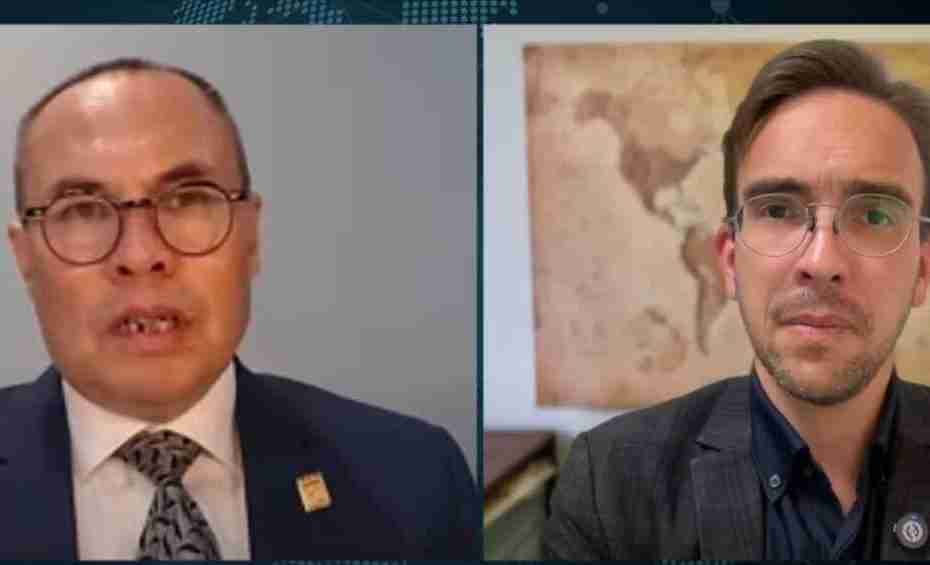
Read the full transcript of Pascal Lottaz Interviews Dr. Warwick Powell on Neutrality Studies episode titled “Tariffs Are HUGE Gift To China And BRICS”, April 5, 2025.
The interview starts here:
Introduction
PASCAL LOTTAZ: Donald Trump has slapped massive tariffs on almost all countries that have trade relations with the United States. And the stock market has fallen into an abyss over the past two days. What the hell is this all about? And is the US digging its own grave or is this some strange Trumpian master plan to create a new world order?
To discuss this, I’m talking today again with my colleague and friend, Dr. Warwick Powell, who’s an adjunct professor at Queensland University of Technology and a senior fellow at the Taihe Institute. Warwick, welcome back.
DR. WARWICK POWELL: Great to see you again, Pascal.
PASCAL LOTTAZ: Warwick, you wrote this fantastic article on Substack and there’s a second piece going to come out tomorrow or the day after tomorrow in which you analyze how Trump came up with these calculations and then actually you put things into perspective and you make the argument that, well, this is not going to be pretty first and foremost for the U.S. But can you walk us through it? Maybe first of all, with telling us how does Trump come up with these weird numbers of like saying Switzerland is slapping tariffs on the United States, Japan is slapping tariffs on the United States? These are really strange numbers that we haven’t seen before.
Trump’s Tariff Calculation Method
DR. WARWICK POWELL: Yeah, look, the methodology that underpinned the tariff numbers that were announced a couple of days ago ultimately were deconstructed and reverse engineered by numerous people on social media within a very short space of time. And what they discovered was that contrary to the promise, which is that these were going to be reciprocal tariffs, meaning that they would be calculated on the basis of what the individual nation by nation tariff and probably non-tariff barriers are estimated to be, we actually had something quite different.
What we had was essentially a methodology that took America’s trade balance with a given country and divided it by the amount of imports it took from that country. And for good measure, mainly marketing measure, it then divided that number by two and that became the tariff number. I think the division by two was really a way of saying, well, look, it could have been a lot worse, but look how generous we are, we’re cutting it in half. And you should be grateful for that.
So that’s roughly how the numbers were arrived at. And so this idea of reciprocity really is not part and parcel of the calculations at all. The objective is to radically tackle what Trump sees as a significant problem, which is the merchandise trade deficit that the United States has with a whole bunch of countries and in the hopes of ultimately rejuvenating manufacturing.
The other interesting thing to note, and this probably goes to the heart of why these tariffs aren’t reciprocal at all, is that countries that actually have trade deficits with the United States and don’t have tariffs in place at all have also been hit with tariffs. And Australia is a classic case in point where Australia runs a trade deficit with the United States. It has zero tariffs for the US and nonetheless has been pinged with the default 10%. So there’s a default 10% and then there’s the nation by nation calculation.
Inherent Bias in the Methodology
The other thing that is probably worth noting in all of this, Pascal, is that there is a sort of an inbuilt bias in this particular methodology that can sweep up all sorts of nations that have a trade surplus with the United States for actually quite basic and fundamental or natural reasons that have nothing to do with trade barriers, whether or not they exist.
I’m talking in particular about low income countries that often have trade surpluses with the United States because they sell a lot of raw materials, for example, or they sell a lot of low labor cost manufacturers into the United States, often out of factories owned by American multinational corporations. And they don’t buy a lot from the United States for a pretty simple reason. The things that the United States makes and exports tends to be too expensive for these countries.
So on all three of those fronts, I think it’s fair to conclude that these tariffs actually aren’t about reciprocity and they’re certainly about a wider concern, if you will, about America’s trade balance.
The last thing I’ll say at the outset, just to sort of paint the picture, is that the trade balance question that sits at the heart of all of this concerns merchandise trade. It doesn’t concern trade in services, whether that’s in software services, streaming videos, computer games, software licensing, or of course, tourism and education. And on both of those fronts, the United States runs actually a substantial surplus. So it’s a very narrow cast view of the world. But nonetheless this is what it is.
The Real Purpose Behind the Tariffs
PASCAL LOTTAZ: I guess it’s pretty fair to say at this point that this is a fig leaf, right, the reciprocity issue and maybe one that actually starts building up then negotiation leverage for Donald Trump in order to coerce states to change trade practices with the US the way Washington or Donald Trump imagines those. But the nature now of these tariffs, do we know how they’re going to work actually? I mean there’s these strange numbers, 20, 30, 40%. I think Vietnam was slapped with like over 40%.
DR. WARWICK POWELL: Right.
PASCAL LOTTAZ: And on what, on all the goods that are called made in Vietnam. I mean a lot of these goods are actually produced by US Companies who produce them in Vietnam.
Implementation Challenges
DR. WARWICK POWELL: The administration of it will be governed by the value of the goods as they land and the tariff will be calculated on that basis. There are some exemptions and there’s a bunch of fine print in the documents that came out of the White House and the U.S. Trade Representative’s office. But in essence the tariff is levied on the landed cost.
And as you say, there are going to be some significant complexities insofar as how these tariffs affect individual enterprises. Because many of the enterprises that will be swept up by these tariffs are actually American owned multinationals that have factories located in different parts of the world sending products back to the United States and ultimately earning profits out of the sales price in the United States that get repatriated back to shareholders, most of whom are American shareholders.
So the distributional effect of these particular tariffs on companies that operate like that is likely to see them having to make a pretty important decision and that is whether or not the company itself absorbs the additional price impact or ultimately passes on the cost to end consumers. Or in the process of making that calculation, Pascal, this will go to the heart of shareholder returns because the benefit that these companies get is that they are able to produce things in other countries at relatively low cost, selling to America at relatively high cost, have large profit margins that then become distributed to American shareholders.
I suspect that this set of tariffs was not designed with the intent on significantly disadvantaging the American rentier class. But that’s one of the things that’s going to happen.
Impact on Global Companies Like Apple
PASCAL LOTTAZ: Let’s say a product like the iPhone, which is substantially made in China, right? Design in California, made in China. And yet Apple is opening now different production plans around the world, also in India, but India has also been struck by these tariffs. I mean, is this the whip that Donald Trump is trying to use in order to coerce the manufacturing back into the US like come what may? And if it breaks a couple of necks, it breaks a couple of necks.
The Challenges of Reshoring Manufacturing
DR. WARWICK POWELL: Well, look, that’s certainly, I think, part of the theory behind all of this. So the idea of radically changing the relative cost structure is to compel firms that are currently producing outside of United States to relocate back into the United States.
Now, that’s all well and good in simplistic goods, but when you’ve got complex supply chains, that is actually far more difficult to achieve and to achieve successfully. So the challenge for many companies such as these is that they’re actually securing inputted goods from many countries. So even if they located assembly factories back in the United States itself, they’ve got to bring in a whole bunch of imported products so that they can assemble them, and all of those will be caught up in the tariff net.
The other point to remember is that for factories to be created in the United States, particularly ones that are reflective of the nature of modern manufacturing. So we’re talking about a manufacturing that is not at all like the imaginary that I think drives a lot of the discourse, namely this notion of a factory with a whole bunch of workers interacting with machines and materials with dirty hands and those sorts of things. That’s actually not modern manufacturing.
Modern manufacturing requires significant fixed capital investments. And much of that machinery actually needs to come from China. And if it doesn’t come from China, it’s going to come from Germany, Japan or the Republic of Korea, typically.
So the United States will need to increase its imports of capital goods substantially should it seek to move down the path of this so-called rejuvenation of manufacturing. The other thing that the United States will need to do to accomplish this is radically alter the supply chains for intermediate goods, the input goods that these manufacturing processes need. Many of these intermediate goods, in fact, most of these intermediate goods for the kind of manufacturing we’re talking about does not come from the United States in the first place. So that’s another bundle of things that will need to be imported or developed local supply chains, which will take a long time and will be quite expensive.
Infrastructure and Workforce Challenges
The third thing the US will need to do for this kind of modern manufacturing, Pascal, is come to grips with the need for stable energy at low cost and stable, high quality 5G telecommunications infrastructure to drive robotics and AI. Now, both of these two elements, the United States is not particularly well placed today to deliver, and it will also need substantial investment from a capital goods point of view.
And last and certainly not least, is that there will be a demand on a new type of labor force, and that is a labor force that is relatively high in terms of education levels, and have high literacy and numeracy standards, all of which have been declining over the last 40 years.
So to rejuvenate manufacturing, and I’m not criticizing at all the aspirations around what we’re talking about here, but if that is the aspiration, then there is a lot that needs to go into it to pull it off. And in the process of doing that, there is every likelihood that the rejuvenation will actually take place in a way that will leave the American industrial structure at a much higher cost level. So the adjustment costs, the transformation costs and the end outcome will actually be a far more expensive America than it is today.
The Currency Factor
PASCAL LOTTAZ: And this is a significant issue because even if the United States managed to bring back all of this manufacturing to onshore it right into itself and managed to produce all of these goods still by itself. Let’s say an iPhone, completely produced, designed and produced in the USA only. But if the price of that not only goes up, but the price of the US dollar also remains where it is. I mean, there’s just not going to be a market for these phones anymore.
So there’s an argument out there that part of the strategy right now might be to create the leverage in order to coerce other states into adjusting, actually starting targeting the exchange rate and weaken the US dollar. Do you think this might be an objective to create now a leverage, like something to bargain with, that Donald Trump really just pulled out of a hat?
DR. WARWICK POWELL: Part of the challenge in all of this is that a lot of these objectives and means are contradictory. So whilst there is a desire to, theoretically, I can understand that there may be some desire to reduce the value of the dollar. And in recent days that has been happening. Whether or not that will sustain is a different story. That’s number one.
Certainly it runs contrary, of course, to the aspirations of the Trump administration for the dollar to also be the reserve currency and the dominant currency in the world. So a weak United States dollar does not help the United States to accomplish that particular objective.
Obviously, making American exports more competitive by reducing the dollar in theory will boost exports. But having slapped tariffs on a whole bunch of countries around the world and many of those will actually begin to retaliate, those countries that can afford to buy American things won’t necessarily be that keen on buying American made things. And the smaller countries where United States might continue to have some leverage over simply won’t have the resources to afford American made things.
This is my point earlier and that is that many of these countries are not big importers of American made things, not because there are trade barriers, but because they’re relatively poor. So whilst this particular set of tariffs could be seen, and I know many people like to give the benefit of the doubt to President Trump in terms of his negotiating wherewithal and his instincts and perhaps it is about laying down something that can open up a negotiation.
Well, we’ll only know the answer to that, of course, over the course of a period of time. But in the meantime, we’re starting to see how the substantial players in the world, so I don’t mean the smaller nations who have far less leverage, but the substantial players in the world are starting to either prepare their own version of reciprocity in response or have already announced their version of reciprocity in response. And I speak specifically of China.
PASCAL LOTTAZ: What is that going to be? Because your article actually is entitled “Don’t Look a Gift Horse in the Mouth.” So you are actually interpreting these tariffs as a gift by the United States, a gift in disguise. But can you maybe make that argument?
DR. WARWICK POWELL: Yeah, look, China of course has announced a response. It’s a 34% tariff on all goods originating from the United States, which is of course a reciprocal number for what the United States has levied or announced that it will levy on China out of this particular round of tariffs.
The other thing about this, and I’ll come back to that in a moment, but the other thing is that over the course of the last week, China’s actually announced a range of measures which I think need to be viewed as part of a bundle of things. The Chinese government has announced prohibition on Chinese companies investing in American companies. China’s commercial regulators have announced an investigation on antitrust grounds of the proposed sale of the Panama Canal ports and that has caused the owners of the port concessions to defer indefinitely the dealings that they’ve been having with BlackRock to sell that particular set of concessions.
China has also announced overnight, an anti-dumping investigation into CT scanning tubes and last but not least, it’s also announced export restrictions on seven critical minerals and rare earths, together with expanding the list of firms in America that are impacted by these restrictions by adding another 27 firms on the basis that they are potentially involved in the manufacture of dual use technologies, i.e. civilian and military use.
So China has already responded with a range of measures which, if we’re talking about sort of a Trumpian world of negotiations, it certainly laid down a range of counter issues that need to be negotiated as well. So it’s building up the agenda that need to be addressed.
I should also mention that overnight we have seen President Trump extend the period for TikTok. So the TikTok ban was to come into effect on the 19th of January from memory. And he extended that on the basis that it would facilitate negotiations for some kind of a sales transaction. Clearly that hasn’t come to fruition and President Trump has now had to extend that by another 75 days in the hopes that something might come of those discussions. So there’s a lot of issues now on the bilateral negotiation table.
Why Tariffs Are a Gift Horse
Which brings us to the 34% tariffs and ultimately why I argue that it is a gift horse and it should not be looked at in mouth. The reason why is that tariffs, the significant tariff barriers for Chinese made goods into the United States market will have an impact on the relative price competitiveness of those goods and they will consequently affect the volumes and the sales, basically.
So Chinese made products, well, I think it’s reasonable to say that we can expect them to reduce in sales volumes into the American market. Similarly, the Americans having slapped tariffs on everyone else will also achieve the same effect on a whole bunch of other supplying countries and their companies.
Now, there isn’t much that America manufactures and which China imports that China can’t get from other places. And what I suspect the tariffs actually do, and I’m talking about China’s tariff response now, is that they in effect create a price signal to Chinese firms and Chinese consumers that will see many of them turn their buying power away from American made products towards substitute products from other parts of the world.
So in effect, the Chinese marketplace will move from being a destination for American exports to being a destination for European, South American, Canadian, African, etc. exports to fill the void. So China will in effect function as a cushion for many of the countries that have been adversely affected by this round of Trump tariffs.
Now, from a broader strategic point of view in terms of diversifying trade and ultimately moving towards an international multilateral trading regime where national currencies can play a more important role rather than trade predominantly being denominated in the USD, then this is precisely what needs to happen. And so the opportunity has arisen to accelerate this move towards currency multipolarity and diversifying the global trading network and in effect Pascal decentering the United States.
Now this is a historical trend that’s been going on for a while anyway. So the US market now represents a little bit less than 15% of total global imports. It’s nowhere near as important as it once was. And that’s one of the reasons why the United States in this particular moment does not have the same kind of leverage as perhaps it would have 20 to 25 years ago. So that’s what I think is starting to unfold.
PASCAL LOTTAZ: But when we now look at the way that also other countries are going to react, I mean everybody is still, I think to a good extent shocked of how to approach this, how to approach the fact that this beacon of globalization and free trade and Reagan and Thatcher and the neoliberal consensus under which we’ve been living for like 40 years that this is now, I mean, it has been on the back foot for quite a while, but this is a really slap in the face of most of everybody who thought, okay, this is how we deal with global trade.
Do you think that this will significantly impact also the decision making processes in other countries? Because at the end of the day, the United States has a lot of free trade agreements with a lot of countries and all of them are now basically the US tells them like we do whatever we want, we don’t care. We made a new agreement last time with Canada and Mexico and we don’t care about that. Right. Isn’t it now getting very clear that the US is not a reliable partner, not even in trade?
DR. WARWICK POWELL: Well, I think that that is becoming increasingly clear, Pascal. The long standing critique of the liberal international order, of course has been that the United States can exempt itself from the rules that it imposes on everyone else and can act capriciously. And it is showing just that.
So the facade of liberal benevolence has given way to what is in effect an exceptionalist narcissism. And the true colors have been revealed. And I think that the Prime Minister of Singapore, for example, earlier today or overnight gave a speech in which he basically declared the end of America’s role as the central figure in multilateral trade institutions and the culture of multilateral trade that has been part and parcel of the world for the last 50 or 60 years. And that in many ways is saying something that perhaps many have until now been a little bit reluctant to say.
How will that affect countries in terms of their own calculations? We’re starting to see, of course, a range of responses. The smaller countries and those that have particularly large exposures to the US Market are responding in ways that are entirely understandable and predictable, which is they are seeking to have bilateral negotiations with the United States.
However, those that don’t have as many eggs in that particular basket are now seriously thinking about how they can reinforce bilateral and multilateral trade institutions and strengthen their trading relationships with others, as well as intensify the diversification programs that many have been taking place in any regard.
So we see, for instance, that China, Japan and the Republic of Korea met earlier this week or a few days ago, a little bit before the Trump tariffs were announced, in anticipation of the tariffs, and made it very clear that they will be working hard to improve the trading relationships between those three countries.
Similarly, institutions such as the Regional Comprehensive Economic Partnership, which is the Free Trade agreement that the 10 ASEAN states, together with China, Japan, Korea, New Zealand and Australia have signed up to, I think is going to play an even more important role. Trade amongst these countries in terms of the Intra Regional Inter ASEP trade already represents 60% of the trade that these countries undertake anyway.
And I would expect that the future supply chain configurations around the world is an intensification of these sort of intra regional networks, partly because there’s the infrastructure to support it and partly because they can be institutional in a context of regional trade agreements, coupled with an ongoing discussion around how that ultimately feeds into a redesign of regional security architectures. Because a change in the global economic order ultimately will impact a global security order. And I think that that is something that we can expect to start to witness going forward.
The other interesting trade agreements, I think that will come into their own and they’ll have some pressure on them, but they’ll also be opportunities will be things like the CPTPP, which was the legacy of the original TPP, which the Obama administration kicked off, but which the first Trump administration pulled out of and Biden never jumped back on. And that covers many countries in both North America, Canada in particular, obviously countries on our side of the Pacific, the Western Pacific, as well as some countries in South America.
So these overlapping multilateral trade agreements I think are going to come into their own. And obviously there is still a commitment from many countries in the world to the World Trade Organization, notwithstanding the fact that everybody also knows that the WTO is imperfect in many ways, in desperate need of reform in many ways.
But nonetheless, having come into existence some 20 odd years ago through incredible and long term investments of diplomatic efforts, it’s unlikely that the vast majority of countries are just going to flush those institutions down the toilet. And I say that in large part because the United States is no longer the dominant trading partner in the world.
China is the dominant trading partner for 150 plus countries in the world. Which means that provided that China remains committed to multilateral trading institutions, it has sufficient heft to give ballast to these institutions no matter how much under threat they are from the United States, in effect sabotaging the multilateral trading order that the United States gave birth to.
PASCAL LOTTAZ: It’s not the first time that the United States sabotages the system that it itself created. I mean, let’s just think about how the United States basically sank the Bretton Woods system where the currencies were pegged to the US dollar and US dollar to gold. And then Nixon just throws that out of the window right the moment that this is not convenient anymore in order to encourage more trade with the US or like a beneficial, exploitational relationship.
But let me maybe ask you about the reaction of Australia now. I mean, you’re in Australia and what is your perception? How does the media report on this? Because, you know, within the allies, the system of the allies, criticizing the top dog has been something that was done in very polite ways so far. Is this slowly changing? I mean, how’s Australia now dealing the media with this situation?
Australia’s Response to Tariffs
DR. WARWICK POWELL: Look, from what I’ve seen, they are a little bit less polite than they were maybe even a week ago. And it has taken many in the establishment by surprise. Australia is a trading nation. It is deeply enmeshed in global trading networks and is fundamentally dependent upon the stability of multilateral trading institutions. That’s how Australia has managed to navigate previous episodes of tumultuous transformations in global relationships. And certainly I think sees merit in working with others to hold these institutions together.
The other thing that I think Australia will seek to do, whether or not it can succeed or not, is another story. And that is to continue to engage in bilateral negotiations with the aim of achieving some bilateral exemptions for itself. The risk for an Australia in doing that, of course is that it will need to give up a lot that might be tangential to the deal itself. So it might not be trade related things that it will need to concede so as to get a trade tariff related outcome.
The other point I think that Australia has learned, particularly in recent years, is that when it does experience barriers to market access, the quality of Australian products does tend to lend itself to being able to find alternative outlets, not always finding alternative outlets that bring the same price that the products might have received in their original preferred market. But certainly there are markets for Australian products, particularly in the commodities space that Australian exporters have successfully exploited.
Which brings me, I think, to, I guess, the sort of more strategic question, which is, in the event that these tariffs remain in place, and in the event that China maintains its 34% tariffs on American goods, which will include things that Australia exports, the gap in the market in China for many of these things, Australian beef, for example, will open up even wider. And so a country like Australia and other places that have meat proteins as part of their export portfolio will, I think, jump at the opportunity to expand their footprint in the China market. So these are the kinds of changes that I think are highly likely to take place as these trade patterns reconfigure themselves, largely because China will reduce what it buys from the United States and it will replace those with goods that are produced from other parts of the world.
PASCAL LOTTAZ: So overall, is your advice to the world to say, look, yes, this hurts, but just look at the other opportunities. The United States is not the only player in the game anymore.
Global Trade Reconfiguration
DR. WARWICK POWELL: Yeah, absolutely. Look, each country will have its own specific circumstance in terms of the extent to which their exports. Well, firstly, in terms of the extent to which trade is a big part of their economies. That’s the first thing. The second thing then, is the extent to which the US Market is a big part of their exports and to some extent, their imports as well. And increasingly, the number of countries that have a significant exposure to the US Market is diminishing.
The difficult position will be in the first instance for Canada and Mexico, who over the course of the last two to three decades, have really entangled themselves with the North American marketplace through previously the North American Free Trade Agreement and then the subsequent agreement that was entered into under Trump 1.0. And those countries presently are highly exposed in terms of the extent to which the US Market is important for them from a trade point of view, generally. And they also have limited alternative market options that they can pursue in the short term.
Nonetheless, when you listen to the Canadian Prime Minister, for example, and also the opposition leader, the one thing that President Trump’s various tariffs have done is galvanized the Canadian body politic around the need to invest in the infrastructure that they need to be able to diversify their trading relationships, and we’re starting to see some of that now. So on the east coast of Canada, a substantial LNG export facility is being constructed. Actually has some Chinese joint venture partners in that, and that will be up and running in two to three months time, enabling Canadian LNG to be exported into the Pacific market. So that’s going to be an important signal that will enable Canada to begin the processes of diversification.
Mexico has other challenges given the complexities of the supply chain interactions between it and the United States. And they will need to deal with those obviously on their merits. But most other countries actually are not substantially exposed to the American market as a proportion of their exports. And that’s the important point to remember.
You know, China for instance, exports many hundreds of billions of dollars to the United States. And on those measures you’d say, wow, that’s a lot. But in the scheme of China’s overall economy and the scheme of China’s trade, the United States certainly is not the make all and the be all and end all. And so countries will be able to adapt out of this.
Adaptation Strategies
The adaptation will involve a few things and it will take some time. The amount of time will vary place to place. The adaptations will be helped by ongoing support of global multilateral trading institutions because that enables global trade to continue to grow. It also will support the ongoing growth of Global South to Global South trade growth, which has been taking place at a much faster rate than trade growth in the Global North.
So that’s part of the story, of course, of the last 20 odd years, which explains in great respect the relative reduction in the importance of the American market in global trade. So the first thing is to ensure that the institutions are in place that will sustain the organic growth.
The second thing that will emerge I think will be domestic fiscal policy responses to boost local demand where appropriate. China, of course, at its two sessions a couple of weeks ago, already made some important policy decisions concerning both fiscal and monetary policy, which was undertaken in readiness basically for the impact of these tariffs.
The third thing that I think we’ll see is countries begin to coordinate their fiscal policy responses so as to ensure that their respective economies have sufficient demand impetus to support this reassignment of trade flows. Then we’ll start to see countries work harder at streamlining their bilateral trading relationships and also streamlining and improving the multilateral trading institutions that I described earlier.
All of those will require ongoing work to make them work better, to reduce transaction costs, to minimize the amount of red tape and friction and compliance costs and burdens that can be a friction in the free flow of goods across these countries.
Infrastructure Development
And of course, we’re continuing to see the development of critical transport infrastructure. So without transport infrastructure, you’re not going to get the movement of goods. And we’re seeing that both in terms of terrestrial transport infrastructure across the Eurasian continent, but also linking China into Southeast Asia and through China linking Southeast Asia to the greater Eurasian continent, all the way through to Europe, in fact, by rail. So that’s your terrestrial networks.
And we’re also seeing a significant development of strategic maritime infrastructure as well. And I’m thinking in particular of the recently commissioned Chancay port in Peru, which will fundamentally transform the ways in which Latin America will be able to trade with the markets of the Western Pacific.
Currently, the countries of Latin America or historically have had to ship via Mexico or the United States before sending their products to West Asia or the Western Pacific. Or if you’re on the east side of Latin America, you’ve actually got to come through the Panama Canal. All of that is slow and expensive. The Chancay port takes about 15 days off a 35 to 40 day transit process from Latin America to the markets of Asia and that’s a substantial saving for those markets to be able to have direct access.
So all of these things are unfolding as we speak and that will contribute to the reconfiguration of trade contours with the United States market being decentered.
PASCAL LOTTAZ: This is of course something that Donald Trump has said repeatedly he is going to put a stop to. I mean, he has been very hostile toward BRICS. He’s been very hostile and spoke openly about not allowing another reserve currency or a reserve basket to emerge, that this talk has to stop. And he will try to do whatever he can to make sure that the US Dollar remains the reserve currency and that the United States reclaims its position at the top of the food chain. That’s how he’s been portraying it. But this move, and I agree with you, is really doing the opposite. Do you think that there are more wacky ideas going to come along the way for the Trump administration to try to coerce the rest of the world into a trade relationship that he wants them to have with them?
The Financialization of the American Economy
DR. WARWICK POWELL: The U.S. look, I think you hit another issue on the head and I’ll touch on it first before hopefully being able to share some thoughts on that sort of coercion question. And that is this aspiration of maintaining the US Dollar as the global reserve. Now, the US Dollar has functioned at the global reserve in conditions where the US runs a substantial trade deficit that generates a demand for US dollars. If the US doesn’t run trade deficits, then one of the principal foundations of the US dollar as reserve currency disappears, you can’t have both. So this ambition to address merchandise trade deficit actually undermines the aspirations for the US dollar as a reserve. That’s one thing.
The risk as a result of all of this, what we’ve been touching on, is that notwithstanding the merits or otherwise of the policy ambitions around rejuvenation of manufacturing and such like, the measures that have been announced to date are unlikely to deliver success, in part because the causes of the problem have not been diagnosed properly and therefore the responses are the wrong responses.
The response is to try and tackle American hollowing out, the hollowing out of American manufacturing through trade policy. The issue that I would put on the table is that the trade imbalance is a consequence of hollowing out, not a cause of hollowing out. And to tackle the issues of hollowing out, you’ve got to touch on all of those things that I discussed earlier, around the labour force education levels, the telecommunications and energy infrastructure, the supply chains for intermediate goods, as well as importing substantial capital equipment.
Root Causes of Manufacturing Decline
But you’ve also got to tackle one other macroeconomic structural factor. And that is that the principal reason why American manufacturing hollowed out over the last 50 years is because the American economy financialized. And the financialization of the US economy meant that the market for financialized products, meaning stocks, bonds, derivatives, forex and real estate, became more attractive to money capital.
So much so that money capital would take the money out of manufacturing and instead of reinvesting it back into manufacturing, would commit that money into these fictitious capital markets. And when that happened, of course the owners of the manufacturing enterprises also started to seek better returns from those enterprises.
The first thing they did was invest in labor substitution through the implementation of the first generations of mechanization. So machines were the first things that actually took away the jobs of the traditional American blue collar working class. When they reached those activities where there weren’t machines that could reduce the cost of production, then the owners of that capital relocated that activity to places where labor costs were low. That was the pattern that took place in the late 60s into the 70s. And there was already talk in the 1970s about the problems of American manufacturing hollowing out.
When you look at the long run data from the 1950s through to now, what you see is that there has been a consistent and precipitous decline in the share of manufacturing employment and output as a proportion of GDP all the way to about 2010. Now all of this was happening well before trade with China. So China came into the World Trade Organization in 2010 and much of the job loss and output reduction had already taken place.
Come 2010, the situation actually stabilised. And for the best part of the last 15 years, manufacturing employment in the United States has been relatively stable. It’s had a little bit of growth, certainly not as fast as the labour market overall, but its output has been also quite stable.
So manufacturing hasn’t disappeared fully in America. Manufacturing still represents about 12% of global manufacturing. So it’s not like there’s no manufacturing at all. Even though when people talk about deindustrialization you sort of have this image that America makes nothing. America still makes some stuff, but the stuff that it makes tends to be quite expensive stuff and not particularly globally competitive, but nonetheless has markets locally.
The Limitations of Tariff Policy
That’s the sort of long run pattern of the hollowing out of manufacturing and its causes. Now none of this tariff policy response actually deals with root causes and so I doubt that it will succeed. When it doesn’t succeed, it does create the political conditions where something else will need to be done. And that’s where I think the coercive measures, the non-economic coercive measures for instance, could come into play.
Whether they are through the exploitation of—and when I say non-economic, I mean non-trade—it could be things where countries are significantly exposed in terms of US dollar denominated debts could be vulnerable to pressure. We’ve seen overnight the United States pressure the Argentinian President in relation to providing, agreeing for the IMF to provide an additional round of finance, US dollar finance to Argentina, basically saying, look, if we’re going to do that, we want you to tear up your currency swap agreement that you currently have in place with the People’s Bank of China.
So you can see that countries that have high USD denominated debts could become exposed to finance sector pressure. We obviously have security related pressure points as well. And countries such as Australia are particularly vulnerable to those in the current climate.
Security Pressures and Vulnerabilities
Australia has signed up to a security pact called AUKUS with the United States and with the UK, and that particular set of agreements commits Australia to a very long term procurement agreement for nuclear submarines. Now the debate in Australia is whether or not those submarines actually make any sense at all and of course whether or not those submarines will ever be delivered to Australia. But it does leave Australia particularly vulnerable to pressure from the United States on the security front.
Ditto the countries of North Asia. The Republic of Korea and Japan, where there are substantial American bases, can also come under some considerable non-economic pressure. And we’ve seen the situation in the Philippines of late as well. We don’t need to talk about the problems in Europe where the United States has exercised an incredible amount of pressure over the last 20 or 30 years to largely get what it has wanted.
So as the tariff policies don’t work or don’t live up to their promises, then there is the real possibility that the administration in America, in desperation, will seek to pursue those ambitions through alternative means.
PASCAL LOTTAZ: I see that danger as well, unless this entire tariff business actually has an entirely different agenda that we don’t see yet. But it’s hard to imagine what else could come out of this. You gave us a lot of very valuable insights, Warwick. Thank you very much for that. Is there anything that you would like to add or any place where people should go to to read more from you in the coming weeks?
DR. WARWICK POWELL: Look, my substack is probably the best place to go at the moment, which is warwickpowell.substack.com I think. Anyway, I know Pascal will put it in the comments below. I publish widely in a number of foreign affairs websites, but I normally provide links to those through my substack anyway. And obviously with the generosity of channels such as yours, I get to share some thoughts with people as well. So that’s probably the best place to follow me if people feel so inclined.
PASCAL LOTTAZ: Everybody follow Warwick Powell for his analysis on what’s going on in the economy and in international relations. Warwick, thank you very much for your time today.
DR. WARWICK POWELL: Absolute pleasure.
Related Posts
- Transcript of Mohandas Pai Interview: Raj Shamani FO539 – Truth About India’s Tax System
- Transcript of Alex Hormozi Interview: The Diary Of A CEO – Jul 20, 2026
- Transcript of Scott Bessent Interview: The Way I Heard It with Mike Rowe
- How To Buy A Used Luxury Car Safely
- Only In America Interview: w/ Indra Nooyi (Transcript)