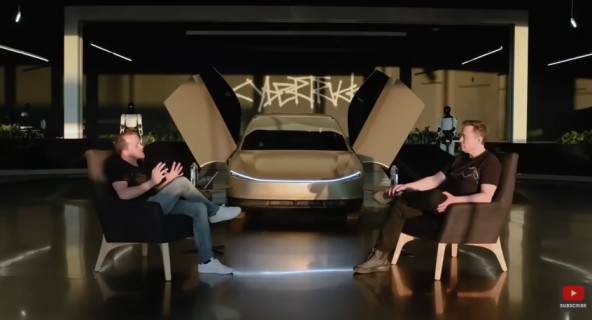
Editor’s Notes: In this recent interview, Elon Musk provides exciting updates on the future of Tesla, including the production timeline for the highly anticipated CyberCab at Giga Texas starting in volume this April. He discusses the revolutionary potential of the Optimus humanoid robot, which he envisions could eventually perform complex tasks like surgery and provide universal access to top-tier medical care. Musk also touches on the expansion plans for Giga Berlin, aiming to make it the largest factory complex in Europe, and emphasizes his vision for a future dominated by autonomous, electric transportation. This wide-ranging conversation offers a glimpse into Musk’s optimistic outlook on AI, robotics, and the ongoing transformation of the global automotive industry. (Feb 27, 2026)
TRANSCRIPT:
Introduction: Tesla’s Exciting Future
HERBERT ONG: Welcome Elon, and thanks for taking the time. I really understand that time is precious. There’s a ton of things to do to build a world of amazing abundance and so many things I can hardly imagine. What’s on your mind. SpaceX, Starlink, AI safe, AI for the future, Autopilot. So many things. But what, what is in your view still exciting about Tesla and why?
ELON MUSK: Well, I think Tesla is one of the most exciting companies in the world. It’s perhaps the most exciting, but Tesla and SpaceX, let me say, are the two most exciting companies.
We’re obviously expanding production, we’re making more cars, we’re going to roll out Tesla Full Self-Driving, which is really an AI driven car. So it’s Tesla AI software that drives the car just by looking like a human does. So Tesla has the most advanced real world AI and hopefully it will be approved soon in Europe. We were told by the authorities that March 20th it’ll be approved in the Netherlands, was what I was told. Hopefully that date remains the same. But I think people in Europe are going to be pretty blown away by how good the Tesla car is in being able to drive.
I think this year really it will be the case that, from a technical standpoint, you’ll be able to fall asleep in the Tesla and wake up at your destination. So that’s very exciting.
We’ve got the Optimus program which is going to be the first humanoid robot. And sometimes people say, “Well, what would that be useful for?” Well, who wouldn’t want their own personal C-3PO, R2-D2? But even better. You can think of, like, do you need a robot to take care of your kids, or walk the dog, or take care of elderly parents or something like that? Optimus can do those things. So that’s very exciting.
And we’re going to be starting production of the Tesla CyberCab here at Giga Texas. We have started production, I should say, but we’ll go to scale production in April, and have significant production towards the end of the year.
And if things go well, we would probably manufacture CyberCab in Europe as well, and also manufacture Optimus in Europe. So we’ve got the Tesla Semi coming out, the Tesla heavy truck, and that’ll be going to Europe hopefully next year. There’s so many things happening. It’s a long list.
HERBERT ONG: It’s a long list to make it an exciting company.
ELON MUSK: Yeah. And battery cell production. We’re going to start making battery cells at Giga Berlin. We have the Tesla lithium refinery that started up in Texas and the Tesla nickel cathode refinery that’s started up here in Austin. This year is really a tremendous number of things. We’ve got five factories starting volume production this year, five major production lines. We look forward to extending that to Europe as well.
Tesla’s Legacy and the Next 10–20 Years
HERBERT ONG: And I guess looking a little bit back, Tesla hasn’t done anything less but really transforming a whole industry. I think without Tesla taking that brave step to electrify mobility, the industry wouldn’t be where it is today. What would you want people to say about Tesla, let’s just say in 10 or 20 years from now?
ELON MUSK: In 20 years, I’d say Tesla’s got factories on the moon, actually. Basically, I see a very prosperous future for Tesla. It’s difficult to predict anything in 20 years, but if you say five years to 10 years, I could say Tesla has an extremely bright future. And I would say, “Hold on to your Tesla stock, it’s going to be worth a lot.” I think that’s my bet.
The European Automotive Industry: Innovation and Electrification
HERBERT ONG: Very cool. Coming back to the present, if you look — I mean, you’re always very well informed — if you look at the European industry, especially the automotive sector or even the German industry and automotive sector, what do you think about it? What do you believe are the main reasons for their current state?
ELON MUSK: Well, I think there’s not been enough innovation in automotive. Automotive innovation has been relatively low. The cars that are being produced are very much like the cars that were produced five years ago. There are not big differences.
I’ve said for a long time, really for 20 plus years, that the automotive industry needs to go towards electrification. And this would be true even without environmental concerns. An electric vehicle is a fundamentally better architecture than a gasoline combustion vehicle. It is much simpler, it is more efficient, it’s quieter, there’s no pollution within cities. So really all ground transport should be electric, and I think all ships and eventually all planes should be electric.
But the automotive industry has strongly resisted electrification. They’ve dragged their feet and they had to be pushed there by government. And then whenever they’ve had any opportunity to reduce the production of electric vehicles, they’ve done so. It’s just not a good strategic move. It doesn’t make sense.
Also, making vehicles autonomous is critical. I think it was about 10 years ago I said that in the future, any vehicle that is not electric and autonomous — like if you’re riding a vehicle and you have to drive yourself and it’s gasoline powered — it’s going to be like riding a horse and using a flip phone.
Which is to say, there are still some people somewhere that ride horses, but it’s rare. And some people somewhere are still using flip phones, but there’s not many. It’s going to be a niche thing.
So the future does not contain combustion vehicles, and there will be very few vehicles that are not autonomous. The future is autonomous electric vehicles. And so if the automotive industry does not move in that direction, they will be left out.
HERBERT ONG: So it doesn’t really sound like we should or could even be learning much from the legacy automakers. And I guess it really sounds like we should be focusing on what we believe the future looks like, right?
ELON MUSK: Yes. You can always learn something from a competitor, but strategically they’re just headed in the direction of the dinosaurs. They’re not headed for a good place. Dinosaurs are not around anymore.
What I’ve found with competitors in the automotive industry is it’s not that they’re going to steal our ideas. You can’t cram a good idea down their throat. If you say, “You must take this good idea,” they’re not going to. We can’t even force feed them our good ideas. That’s been my experience. So we need to do what’s logical, what’s sensible. And at Tesla, we’re essentially creating the future, and it’s a good future.
HERBERT ONG: We are building the future. They just build cars.
ELON MUSK: Yeah, it’s a good future. A future with electric vehicles that don’t emit poison gas. Literally. They’re quiet, efficient, and autonomous. Instead of having to be stuck in traffic, driving through busy roads — and sometimes people may fall asleep or they may have a medical emergency. If you’re driving yourself on the Autobahn going super fast and you have a seizure or heart attack or something, you could die. But if the car is autonomous, it can take you to a hospital. In fact, this has actually happened many times with Tesla cars.
Memories of Giga Berlin
HERBERT ONG: Right. Really cool. So if we look at Giga Berlin specifically — nearly six years ago we broke ground, four years ago we started production. I have a ton of memories. I know you have memories about it as well. What are the greatest memories? What do you tell people when they ask you about Giga Berlin and the people of Giga Berlin?
ELON MUSK: Well, first of all, I’d like to say thank you very much to everyone that’s helped build Giga Berlin. Thank you, Andre, and thank you to the whole team, because we’ve gotten an amazing factory built in a very short period of time and got into high volume production with good quality and good cost control. So I’m very proud of Giga Berlin and all the people in it.
HERBERT ONG: Thank you.
ELON MUSK: Yeah, it’s just cool. I like the art too. People have some fun. Coming to work should be something you look forward to. You’re coming to work with people that you enjoy working with. You’re doing useful things, you’re making things.
I have a lot of respect for makers. If you actually make something, you build something useful that people enjoy — I’m a big fan of makers. There are a lot of people who don’t make things, they don’t provide useful services. Whereas I have huge respect for people who make things and provide useful services. It’s an honest day’s work. So thank you.
Vision for Giga Berlin
HERBERT ONG: I don’t know if you have a vision for Giga Berlin, but if you do, what would it be and what do you think would have to happen for it to become true?
ELON MUSK: Ideally we would significantly expand production at Giga Berlin. We would also do high volume production of battery cells, probably also the cathode, the anode, lithium — so it becomes vertically integrated. And produce things like the CyberCab or Optimus and other products that Tesla will develop. So I think the exciting vision for the future of Giga Berlin is massively expanding it to do many more projects.
HERBERT ONG: Very cool. Do you have any advice for the team at Giga Berlin to basically work towards that vision?
ELON MUSK: Well, things certainly get harder if there are outside organizations that are pushing Tesla in the wrong direction. If there are outside organizations that are pushing Tesla in the wrong direction in Giga Berlin, it’s difficult to say that we would expand if we have to deal with that. I mean, I’m just — this is the truth.
HERBERT ONG: Yeah, it is the truth.
ELON MUSK: I mean, we’re not going to shut down the factory, but we’re not going to expand it either, realistically.
Audience Questions
HERBERT ONG: So as I said, I have a bunch of questions. I’ll just turn my tablet around and feel free to comment on them.
ELON MUSK: Sure.
HERBERT ONG: Hi Elon. Which is your favorite factory? Maybe Giga Berlin?
ELON MUSK: Well, a favorite factory is like saying what’s your favorite child. It’s not a fair question.
HERBERT ONG: I know it’s a question.
ELON MUSK: The thing is, I love factories. Honestly, I think a lot of people these days don’t love factories, or they haven’t even been to a factory. Whereas I’ve walked the line in every factory and I’m a big fan of factories. I love factories.
HERBERT ONG: This is a great place to be.
ELON MUSK: Yeah. You make things that have good utility, people love the product. Building a product people love — that’s great.
HERBERT ONG: Makes you profit.
ELON MUSK: Giga Berlin is an awesome factory. The vibe in there is cool. You walk around, it’s very clean. It’s quite beautiful inside and outside, and people seem quite happy making cars and soon battery cells, hopefully many more things.
HERBERT ONG: Many things to be proud of.
ELON MUSK: Yeah. It’s one of the coolest factories in the world, really. Honestly.
Next Products at Giga Berlin
ELON MUSK: “Hey Elon, which is the next product we will be building here in Giga Berlin?”
Well, I think there are a lot of exciting possibilities for what the next product is that will be built in Giga Berlin. We’ve started ramping up production of the battery cell, and we’re going to be expanding production of the Model Y, especially once we get approval for supervised Full Self-Driving.
Then from a next major product standpoint, I think most likely it is the Tesla CyberCab. But there are also possibilities of Tesla Optimus and the Tesla Semi heavy truck. Tesla has a lot of products coming out, so there’s a lot of potential. I think if things are looking good, we would expand Giga Berlin to whatever the most that we could.
HERBERT ONG: A gigantic manufacturing site. We have a lot of space.
The Future of Work, Optimus, and Life Advice
ELON MUSK: Well, assuming that the authorities are supportive and the people are supportive, then we would expand to probably make it the biggest factory complex in Europe.
HERBERT ONG: Very cool. That’s a cool future.
ELON MUSK: Yeah.
HERBERT ONG: All right, then we have Akhil, he’s got an interesting question.
ELON MUSK: Hi, Elon. So when do you realistically think we can have Optimus in the gigafactory so we don’t have to worry about ergonomics and stuff?
Well, we have to be a little careful about that one. I don’t want people to worry about their job. So I mean, the honest answer for AI and robotics is long term working will be optional. Like long term, which is 10 years from now or less, work will be optional. Like if you want to work, you can, like kind of like if you grow vegetables, you can grow vegetables in your garden or you can get them from the store.
It’s optional to grow vegetables in your garden, but some people still like to do it. It’s extra work to grow your own vegetables, but people enjoy the process. That’s going to be how work is in the future. It’ll be like, you can work if you want to.
HERBERT ONG: Very cool.
ELON MUSK: Yeah.
ONLINE QUESTION: How can we make sure that the adoption of new technologies like Optimus reach countries in the third world?
HERBERT ONG: I think it’s an interesting question generally.
Optimus: Challenges, Medical Potential, and Global Reach
ELON MUSK: Well, I think for Optimus we first have to succeed in making a useful robot. So this is a hard thing to solve. Nobody has solved making a truly useful humanoid robot. And then you have to make it useful and you have to scale production and it’s an entirely new supply chain.
For Optimus, we’ve had to design the whole robot from physics first principles. We’re designing every motor, every gear really. The hands are extremely difficult to design. To have a properly dexterous robot hand is very, very difficult. One of the hardest things to engineer.
So we actually first need to have at least one that is useful and then we can scale production. And at first the tasks will be pretty simple that Optimus does and they will gradually get more sophisticated. I think eventually Optimus could do medical work — like it could be a doctor, do surgery. And there’s long term potential for everyone in the world to have access to incredible medical care. Like better medical care than anyone receives today from humans.
So I think long term, Optimus as a surgeon would be incredibly good, super competent, and everyone in the world would get better medical care than anyone currently in the world gets.
Advice for Young People
ONLINE QUESTION: Hey Elon, what advice would you give young people for life?
ELON MUSK: What advice would I give young people for life? Well, I would say one thing is to err on the side of optimism, to be optimistic about the future. I think it’s better to err on the side of being optimistic and wrong than pessimistic and right. Your quality of life will be much better. So I would urge people to be excited about the future. I’m excited about the future. I’m confident the future will not be boring, let me put it that way. It’s going to be very interesting and I think it’s most likely to be great.
In terms of general advice, I guess I advise people to learn as much as possible. Read a lot of books, try a lot of things and I guess, enjoy life, just enjoy life. But working is also part of enjoying life.
HERBERT ONG: Totally. So find a job that you can actually enjoy.
ELON MUSK: Yeah. I think if you derive satisfaction from building things then Tesla is an awesome place to be because we build things, we make useful products and that’s a great thing.
Most Inspiring Moments
ONLINE QUESTION: What is the most inspiring moment in your life?
ELON MUSK: I guess when my kids were born — that would be the most inspiring moment. In terms of work stuff, I guess it’s when we had the first production Roadster at Tesla. That was really hard to believe, that we actually made a car that passed all of the regulatory requirements and you could actually go on the road with it legally. Because when we started out we didn’t even know how to make a car.
And on the rocket side, the first time getting to orbit was a huge relief. Getting the rocket to come back and land was very cool. The self driving stuff I think is pretty amazing.
HERBERT ONG: It’s amazing.
ELON MUSK: Yeah. I think the first time somebody experiences self driving where they’re just sitting there and the car takes them all the way from their home to their work and parks — it’s mind blowing.
HERBERT ONG: It is. I’m using it when I’m in the US all the time. It is a lot better than people can actually imagine.
ELON MUSK: I think it’s like magic.
HERBERT ONG: It is.
ELON MUSK: Yeah.
Closing Remarks
HERBERT ONG: Well, cool. Thank you so much for your time. Really good having you here. And yeah, hopefully we see you soon in Berlin again and show you around what we have done since you visited us last time.
ELON MUSK: Yeah. And once again, to the people of Giga Berlin, danke, danke…
HERBERT ONG: Thank you, Elon. Thanks for your time. Cool. Fun.
Related Posts