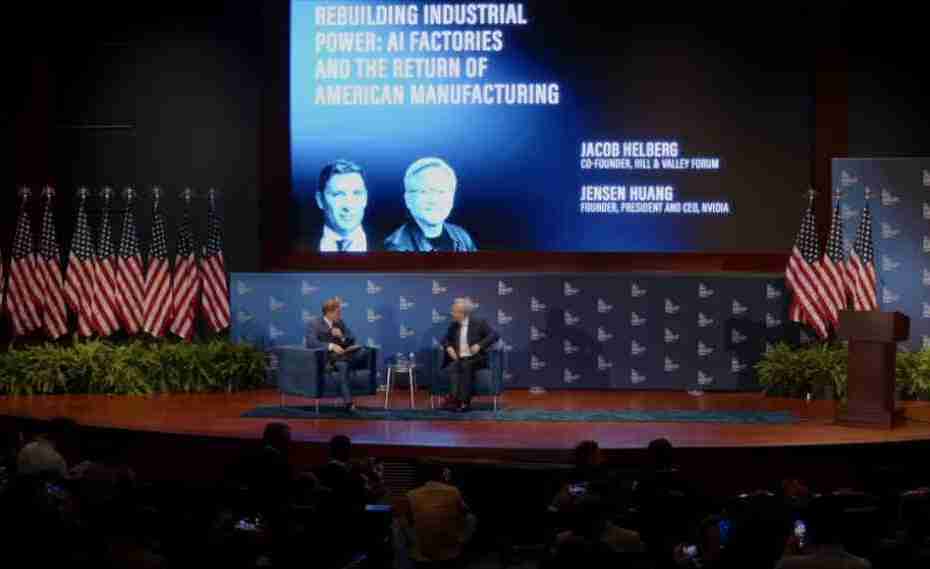
Here is the full transcript of a conversation between Hill and Valley Forum co-founder Jacob Helberg and NVIDIA CEO Jensen Huang on Rebuilding Industrial Power: AI Factories & the Return of US Manufacturing at Hill & Valley Forum 2025 on May 2, 2025.
Listen to the audio version here:
Introduction
JACOB HELBERG: Jensen, welcome to the Hill and Valley Forum. It’s great to have you.
JENSEN HUANG: Thank you very much. It’s very nice to be here.
JACOB HELBERG: You’ve positioned AI as a new industrial revolution with AI factories at the center of it. Can you explain to us what is an AI factory and why is it important to understand in the 21st century economy AI?
Understanding AI Factories
JENSEN HUANG: Oh, we’ve been talking a lot about AI over the last several years. It’s multifaceted and I think it’s helpful to look at it in this lens first. Of course, AI is a new technology. It’s a new technology in the sense that it’s built differently than software of the past. And this new software can do things that software in the past could not do. So it’s incredible technology. All the things it can do, all the things that we have to do to keep it safe, all the amazing things that it’s going to enable. Fantastic.
So there’s the technology layer, the second layer, which is rather new. In the last technology industry software production, it was done by humans typing. Now we have a new industry. And this software is produced with machinery. So you need a large supercomputer, you apply electricity to it, and what comes flying out of it are tokens. And these tokens could be reformulated into numbers and words and proteins and images and videos and three dimensional structures. And you know, it could, you could reformulate these tokens into all kinds of things. We call it intelligence.
And so this machinery, this machinery looks different than the machinery of the past. I call it an AI factory because it does one thing every single day. It’s producing tokens. And the layer above that is infrastructural. And this is the reason why we now internalize that. AI is likely going to be quite an extraordinary industrial revolution in the sense that this new technology is going to enable a new industry that I just mentioned, AI factories, the production of intelligence. But it’s going to go back and revolutionize and transform every other industry.
And so all of these tokens are going to go into health care and education. One of my favorites is education. I use it every day for education, financial services, engineering. We use AI every day for software programming and supply chain management. It’s about to go into manufacturing and so on. So forth. And so when you think about it from these three layers, it’s very clear this is as transformative, as impactful as electricity was before, and it’s going to revolutionize every industry. So it’s an industrial revolution.
JACOB HELBERG: So do you think it’s a paradigm shift in modern computing and that every factory that’s building physical things in the real world will also be accompanied by an AI factory?
JENSEN HUANG: Yeah, perfect. Absolutely. Every company that makes things today, so long as they move, you know, so let’s say you make lawn mowers and, and it could be Caterpillar, or they build construction machinery. Today it’s largely manually manipulated. In the future, it’ll be autonomous or highly autonomous, or semi autonomous or assisted. And when it becomes autonomous, then it’ll be software defined.
And so you’re going to have to produce those tokens, those software that feeds that tractor. And so in the future, every company that builds things will have a factory that builds the things that they sell, and then they’ll have another factory that builds and produces the AI that runs on that thing that they sell. And so it’s very clear when you look at car companies, you know, today’s car companies largely make cars, and. But it’s very clear that in 10 years time, every car company will also produce the tokens that runs in those cars.
The Evolution of Physical AI
JACOB HELBERG: You’ve talked a little bit about physical AI, the concept of physical AI over the last year for policymakers who are thinking about the future of American foreign, of American policy. Can you explain to us a little bit what physical AI is and how we should be thinking about it?
JENSEN HUANG: Take a step back. AI really came to consciousness, modern AI really came into consciousness about 12, 14 years ago when Alexnet came out and computer vision saw its big, giant breakthrough. And that was, I guess, 2012, around that time. When you take a step back, what is computer vision in its largest context is perception, perceiving the world, whatever modality of information it could be, of course, images, it could be sounds, it could be vibration, it could be temperature. And we’ve now developed AI models that understand the meaning of all of that information and can be quite smart about it.
So the first layer, the first wave of AI was perception AI. The second, what everybody started talking about maybe five years ago, was generative AI. And generative AI is where the AI model has learned how to understand the meaning of the information but translate it. So, for example, you could understand English and translate it to French, you could understand English and translate it to images. And so you could use, you could prompt it to generate images. So generative AI is essentially a universal translator, if you will, a universal translator that understand the language of humans language. And so, so that’s the next wave.
The wave that we’re in now is where you now have AIs that can understand, it can generate.
But as you know, intelligence requires us to solve problems and recognize conditions that we’ve never seen before. And the way we do that is we use reasoning, we apply rules and laws and principles that we’ve learned in the past, and we break the problem down step by step by step. And even though we’ve never solved this problem before, through reasoning, we can solve it. Okay? And so one of the unique capabilities of intelligence, and so we’re now in that this age called Reasoning AI.
And Reasoning AIs allow you to produce a form of digital robots. We call them agentic AI agents. It has agency. And so AI that can understand the task that’s been given, it can go off and learn and read, apply, use tools like calculators and web browsers and spreadsheets and then come back and does something for you. It could be something related to supply chain, so access SAP. It could be something related to HR, access to Workday. And so these agentic AIs are essentially robots, but they’re digital workforce robots.
So in the future, we’re going to be the generation of CEOs that are going to manage biological workforce as well as digital workforce and HR department for the biological workforce. And our IT department are going to become the HR of agentic AI. Right. And so, and so we have this, this is kind of the phase we’re in today.
Well, the next wave. And this is where the largest industries of the world are going to benefit. The next wave requires us to understand things like the laws of physics, friction, inertia, cause and effect. The fact that I tip that thing over, it’s going to fall. You know, when I said the bottle down is not going to go through the table. And so all of these common sense, physical reasoning abilities that children have that our pets have, most AIs don’t have, you know, I roll a ball over the kitchen counter and it goes up over the top and it disappears. Well, the AI thinks it’s disappeared, but you know, your dog knows it. It’s on the other side. It understands this concept called object permanence. And it didn’t go into another metaverse. And so it runs around the table and gets it.
You know, and a robot needs to learn that if you want to go from this side of the table to that side of the table, you can’t go through the table. You’re going to have to reason about how to go around the table. And so all of these type of reason, physical reasoning things is what’s called physical AI. And when you take that physical AI and then you put it into a physical object called a robot, you get robotics.
And this is really, really important for us now because we’re building plants and factories all over United States. And we’d like to build it in a way that takes advantage of the latest technologies. And so hopefully in the next 10 years, as we build out this new generation of plants and factories, they’re highly robotic and they’re helping us deal with the severe labor shortage that we have all over the world.
Winning the Global AI Race
JACOB HELBERG: So many people have talked about this concept, about the fact that we’re in an AI race globally. What do you think the US government needs to do to win that AI race? To have the very best AI technology.
JENSEN HUANG: First, in order to have a race to do well in a race, you have to understand the race and you have to understand the resources that you’re working with, the assets that you have, the assets you don’t have, your advantages and your disadvantages. And some of the things to realize is that AI is fundamentally at its core level. And going back to the three levels that we’re talking about, at each level we have to make sure that we understand the game.
And this game isn’t. There’s no 60 minute clock on this thing. This is an infinite game. And so most people aren’t very good at playing infinite games. You know, Nvidia is now 33 years old. We’ve been through three computer revolutions, from the PC revolution to the Internet to mobile, and now we’re in AI. And so you have to, in order to thrive across all of these different changes in the environment, you have to understand how to play games.
And so the things that I just described, understanding the game, understanding the assets, you have really important at the first layer, at the technology layer, the most important thing to understand is that the intellectual capital, and remember, 50% of the world’s AI researchers are Chinese. First, just take a step back and recognize that that important factor has to play into how we think about the game.
The next is AI factories. In order to do well there, you need to have energy. Because fundamentally we transfer, we transform electricity into digital tokens. Just as the last industrial revolution transformed atoms through energy into, you know, steel things and physical things that we know cars and things like that, buildings and things like that. And the generation before that, we gave it water into a machine called the dynamo. And what came out was electricity. And so now we have electricity go in and tokens come out. So the next layer requires energy.
The layer above that is just happening now. And it’s really, really important that we understand that ultimately the winners of the last industrial revolution wasn’t the country that invented it, it was the country that applied it. And the United States applied. Applied steel, applied energy faster than any country. Everybody else was worried about things like labor and, you know, horses being replaced by cars and, you know, those kind of matters. But the United States just. We just took it and ran with it.
And so the infrastructural layer above that is about the application of the technology. It’s about not being afraid of it, wanting to engage it, reskilling. Reskilling our workforce so that we’re able to apply it, encouraging people to adopt it. And so when you look at the, when you look at AI through the lens that I just described to the framework I just described, each one of the layers has its own, if you will, challenges and opportunities, and the game’s a little different in each one.
JACOB HELBERG: On the workforce point, the press has been so focused on weaving the narrative that AI could potentially lead to the mass displacement of labor and mass unemployment. Could you help paint a picture a little bit about what your prediction is for the impact of AI on the job market, but also more specifically on what you see as the potentially new categories of jobs that we’re potentially not even thinking about today that could actually come into being.
The Future of Work in the AI Era
JENSEN HUANG: Some jobs, new jobs will be created, some jobs will be lost. Every job will be changed. Okay, so let’s just break it down. It’s always easy to go to one extreme from another, but I always find it helpful when you break the problem down, reason about it from its first principles, and again, in this framework that I just described, at the lowest layer as, you know, and Jacob, you’re deeply integrated into venture investment. And you know what’s going on in AI and, at the foundational layer, it’s because of AI that San Francisco is back. Okay? Anybody who lives in San Francisco, you’ll know what I’m talking about. Just about everybody evacuated San Francisco now. It’s thriving again. It’s all because of AI. And AI creates a new type of job.
The fundamental reason is because it’s software development, but done in a different way. We’ve changed every layer of the technology as a result of AI. What used to be human coded software running on CPUs are now machine learning generated software running on GPUs. And so every single layer, the tooling of it, the compilers of it, the methodology of it, the way you collect data, curate data, use AI to guardrails, use AI to teach you, use AI to keep the AI safe. All of that technology is being invented right now and it creates tons of jobs at the next layer.
AI Factories: The New Industrial Revolution
This is where the giant opportunity is. Remember I just said that we’re going to create a new type of factory and this factory has electricity come in and it generates tokens out. A one gigawatt factory, let me just put it, one gigawatt factory. And we’re, you know, in the horizon building something like 7, 8, 10 gigawatts of AI factories. One gigawatt factory is $60 billion. $60 billion for one gigawatt. 100 megawatt factory is pretty commodity now. It’s pretty commonplace. And so you just divide that by 10. But $60 billion is the annual revenues of Boeing.
And to build it, you have to finance it. Creates a lot of jobs. You have to build out the site. The shell creates a bunch of jobs. Construction, you know, you got carpenters, you got steel workers, you got masons, you know, you got to build out that factory. $60 billion factory. This thing is gigantic. You have to have mechanical engineers, electrical engineers, plumbers. And then after that, all the low voltage stuff, all the IT and the networking. After that, operations, that entire cycle is about three years.
A whole bunch of new trade jobs have to be created. These trade jobs in the last computer industry, the last computing platform shift, the number one critical path for most companies growth is software engineers. Our, this next layer, AI factories. The number one is going to be trades, the tradecraft. And I think this is terrific. Our country needs to acknowledge that tradecraft is respectable work and it’s critical work and it’s necessary to build our country. And so we want to encourage tradecraft. Electricians, plumbers, you know, carpenters, steel workers. The whole span of it. We’re going to need a whole bunch.
And then now above that is when we can start talking about how are these AI agents going to change the work of doctors or financial service professionals or customer care or in our company, just as a starting point, every single software engineer is now assisted by AI assistance and the amount of code that we check into the company is incredible. As a result, our productivity has shot up through the roof and we’re hiring more people because it enabled us to create more things that the world desires, increases our revenues and increases our ability to hire.
And so I think that that layer above really wants to engage AI. As early as you can remember, it’s not AI that’s going to take your job. It’s not AI that’s going to destroy your company. It’s the company and the person who uses AI that’s going to take your job. And so that’s something to internalize.
JACOB HELBERG: There’s been such a huge amount of focus lately on bringing manufacturing back. A lot of people in the AI space have talked about the concept of how digital twins and manufacturing plants adopting digital twins could actually help enable rebooting manufacturing here. And simultaneously, the CEO of Apple, Tim Cook, recently said that one of the main bottlenecks to reshoring and making the iPhone here was having a good and precise robotic arm technology. So on both counts, it really seems like AI could be an enabling technology for manufacturing and reshoring. Could you tell us a little bit more about what your prognosis is on that?
JENSEN HUANG: Yeah, well, first of all, manufacturing is not about low cost labor. Advanced manufacturing today is software. The entire factory is software driven. The entire factory is one giant robot. And it’s a robot orchestrating a whole bunch of robots inside. And so these advanced factories has a lot of people in it, but it’s largely technology.
And so I think the first part of it is, is in our industry and I’ll just talk about mine. The ability for us to manufacture end to end, from silicon to the AI supercomputers here onshore is a terrific opportunity and I’m delighted that the administration is really encouraging and supporting the industry. The onshore manufacturing, this is high quality work. It’s advanced technology work. Doing it onshore is a fantastic opportunity for the country and I’m very enthusiastic about it. We’re huge proponents of it and we’re fortunate that we have partners around the world who are supporting us to do that. That’s number one.
Second, if we don’t get good at manufacturing, we’re going to leave behind a giant industry that is going to be propelled by the availability of energy. What country doesn’t want to get engaged in this new industry called AI? Why would you not want to produce AI? Why would you not want to engage in one of the most advanced manufacturing, you know, it’s manufacturing, it just happens to be numbers when it’s done. And just like it was electrons at the last industrial revolution, you know, most people couldn’t understand that you could create this thing through a machinery called dynamo.
Now we call it, you know, Nvidia AI supercomputers. But back then a dynamo, what produced, what came out of it was invisible. It’s electricity. Don’t touch it, but it’s electricity, it’s electrons. And now, you know, it’s a new form of electrons is numbers. And so of course we want to engage in this new industry. In order to do that, we have to have manufacturing onshore.
Digital Twins: The Future of Design and Manufacturing
Now the thing that is absolutely the case, because manufacturing is so technology intensive, we should do it in a digital twin first. We should do it in virtual reality first. Nvidia designs the most complex systems in the world. Each one of our generation R&D call it $20 billion, maybe more now, but call it $20 billion of R&D just to produce a family of chips. We design those chips completely in their digital twin. They existed for months and months and months long before we ever produced it. The moment I produced it, I know it to be perfect.
I know it because we’ve simulated it exhaustively and we emulated it and we put it into its paces. We should do the same with digital factories. These factories, large factories. We should completely create digital twins. Use artificial intelligence to create these digital twins. Operate it well. Virtual integration. Integrate these many magnificent structures completely digitally. Operate it, optimize it and use it for planning your output completely digitally.
And in the future, every factory will have a digital twin version in the future, and I’m hoping every human will have a digital twin version. Every car has a digital twin version. Every building has a digital twin version. Every city has a digital twin version. So this idea of digital twins is happening now and it’s all happening because of artificial intelligence.
JACOB HELBERG: Jensen, my last question for you is what is your expectation on the timeline by which we live in a world where AI enabled robots become a ubiquitous part of everyday human life?
The Timeline for AI-Enabled Robots
JENSEN HUANG: First of all, let me just say a self-driving car is a robot. Now it’s taken us about 10 years and now Waymo is in cities all around the nation and is doing fantastically. And it’s terrific to see the Waymos driving around in San Francisco and other cities. It took about 10 years.
Robots will take less time and the reason for that is because we can constrain the environments where the robots operate and so the robots don’t have to be as general purpose as a car. You know, once you’re in San Francisco you gotta work in every street and every single condition. And so in the case of a robot we could be a lot more constrained from the moment that something is prototypable, fairly functional to the time that it becomes high volume product, call it five years.
And so we have quite high functioning robots today. And so in some five years time we’re going to see robots get pumped out of these factories and every car company who makes cars today will be very good at building robots. They just have to, they have to get good at the software part of it, the AI part of it. But that technology is really fairly available.
JACOB HELBERG: Jensen, thank you so much for joining us.