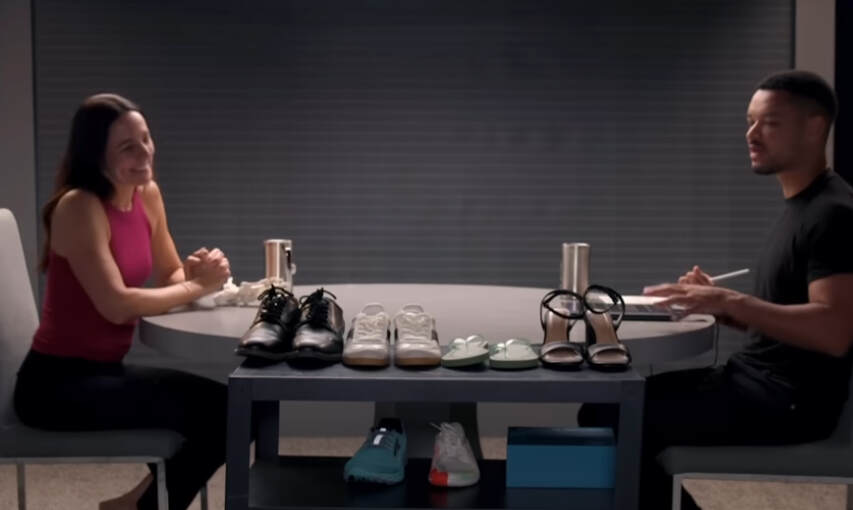
Read the full transcript of foot expert Dr Courtney Conley’s interview on The Diary Of A CEO Podcast with Steven Bartlett on “Your Toes Can Predict If You’ll Die Early! This Will Fix Plantar Fasciitis!”, May 29, 2025.
The Hidden Dangers of Modern Footwear
STEVEN BARTLETT: What are we getting wrong? And at what stage in our life do we get it wrong? It feels like you have a little bit of beef with shoes.
DR. COURTNEY CONLEY: A little bit.
STEVEN BARTLETT: A little bit of beef. I’ve got a range of different shoes here. But what is it that we’re doing, being sold or told, that is fundamentally not aligned with what it is to be a healthy, strong, happy human?
DR. COURTNEY CONLEY: I always say that if we started with our children and put them in the right footwear, I’d be out of a job. Because that’s when it starts. That’s when the foot starts developing, and that’s when we start to build strength and structure to the foot.
From a very young age, we start interfering with what goes on the foot. And when you think about all of the things that the foot can do, it’s why I’m obsessed with it. I mean, there’s bones and ligaments, and the foot should be designed. It’s designed to move the arch recoil, so it should lengthen and then it should contract. There’s four layers of muscles in here.
So when we look at the function of the foot, we have to respect that. And I think footwear can deter the function of the foot.
The Consequences of Weak Feet
STEVEN BARTLETT: So is the biggest risk just making sure I’m super clear that I will fall when I’m older? Is that the key risk?
DR. COURTNEY CONLEY: I mean, I think that is one of the sequela of what’s going to happen if we don’t start paying attention.
STEVEN BARTLETT: Yeah.
DR. COURTNEY CONLEY: So other than low back pain, there’s really no other diagnosis that you’ll see those types of numbers. And here’s the issue with foot pain. You can’t do much. You can’t go for a walk, you can’t go for a hike, you can’t do most things. You can’t walk to the mailbox when you have severe foot pain.
So it really starts to deter your physical health, your emotional health, your mental health. So it’s one of those things I’m extremely passionate about, because it’s not just about pain. It’s about what happens when you can’t walk and you can’t use your foot.
The Body’s Interconnected System
STEVEN BARTLETT: And is the foot connected to the ankle, which is connected to the calf, which is connected to the back? Is there sort of a whole body holistic issue here? Is it all interconnected?
DR. COURTNEY CONLEY: Yes, 100%. Especially when I see patients that have bilateral symptoms at their feet. So that would be both sides.
STEVEN BARTLETT: Okay.
DR. COURTNEY CONLEY: So, for example, if I see someone with bilateral bunions, which would be the bump on the inside of the big toe.
STEVEN BARTLETT: Yeah.
DR. COURTNEY CONLEY: Okay. You have to ask yourself, where is this abnormal load coming from?
STEVEN BARTLETT: Let me just check my bunions. Yeah, check, check. Yeah.
DR. COURTNEY CONLEY: Right. Where is it coming from? Is it something that has to do with the pelvis? Right. Because when I’m standing, if I tilt my pelvis forward, I should feel my arches drop. So there’s a direct correlation between what’s happening at your hips and your pelvis and what happens at your foot.
And when I were to tuck my pelvis, you should feel the arches lift. So when we start to see things happen at the foot, it’s a window. It’s a window to what’s going on not only at the foot, but everywhere else in the kinetic chain.
Common Foot Problems and Their Impact
STEVEN BARTLETT: When patients come to you, what kind of symptoms do they have that are connected to the foot?
DR. COURTNEY CONLEY: Bunions, neuromas, hammer toes.
STEVEN BARTLETT: What’s a neuroma?
DR. COURTNEY CONLEY: So a neuroma is a nerve irritation in between the toes. So the most common you will hear of is a Morton’s neuroma. And that’s typically in between the third and fourth toes.
STEVEN BARTLETT: Okay.
DR. COURTNEY CONLEY: And it can be very painful. Remember we talked about when you go to push off when you’re walking?
STEVEN BARTLETT: Yeah.
DR. COURTNEY CONLEY: The wider and the stronger the forefoot is, the more stable it is. So if I have a foot that doesn’t have splay or that looks like this, and you’re trying to push off of it, you can irritate the nerves within the forefoot.
STEVEN BARTLETT: Okay.
DR. COURTNEY CONLEY: And you can develop these nerve symptoms at the forefoot. Very painful.
STEVEN BARTLETT: What are the other types of injuries or symptoms that people come to you with that you then route back to the feet?
DR. COURTNEY CONLEY: Hammer toes.
STEVEN BARTLETT: Hammer toes.
DR. COURTNEY CONLEY: Which is the clawing of the toes.
STEVEN BARTLETT: Oh, okay. Yeah.
DR. COURTNEY CONLEY: Right. And this is what’s cool about the foot because it’s the only place in the body where you can see aberrant loads.
STEVEN BARTLETT: What does that mean?
DR. COURTNEY CONLEY: Abnormal load dysfunction. Because you can’t see it at the knee, you can’t see it at the hip. Unless you were to take imaging where you’d start to see structural change, but you can see it at the foot.
So you should be asking yourself, “Man, why am I developing hammertoes? And maybe I should pay attention to that.” Because bunions and hammertoes also will increase your risk of falling and also decrease balance. That’s a problem.
Plantar Fasciitis and Other Common Conditions
STEVEN BARTLETT: I had plantar fasciitis, which meant that I struggled to walk for a couple of weeks a few years ago when I was training for a football match. And that’s really what started me on my journey of understanding the foot and trying to understand how to strengthen it so that I could be more active.
Cause if you’ve never experienced plantar fasciitis, which I’m sure some of my listeners have, it really is an awful, awful thing. What’s the rest of the list of those kinds of injuries that people can get from having a weak foot? Is there anything else that we haven’t covered?
DR. COURTNEY CONLEY: Well, plantar fasciopathy is probably the most common. That’s your heel pain.
STEVEN BARTLETT: Okay.
DR. COURTNEY CONLEY: And I do think that that is a diagnosis that we need to look at a little bit differently. Achilles tendinopathy, also very, very common. Other tendon diagnoses. Posterior tibialis tendon. So that’s the tendon that runs along the inside of the foot, and it’s one of the biggest stabilizers of the medial column of the foot.
It’s a powerhouse that in the soleus, which is your calf lower, the calf muscle powerhouses of the lower leg, and all of these tissues can be strengthened and produce power. And we need to start looking at the foot just like we look at every other part of the body.
Dr. Conley’s Personal Journey
STEVEN BARTLETT: So what do you do for a living, and who are you?
DR. COURTNEY CONLEY: Well, I’m a chiropractor by nature. I went to chiropractic school. I knew that I wanted to get into some type of medicine that was proactive, not reactive. I didn’t quite have interest in surgeries or pharmaceuticals. Movement has always been a very big part of my life, and so I knew I needed to stay in that arena.
STEVEN BARTLETT: So what did you do?
DR. COURTNEY CONLEY: When I was younger, I was a dancer. I was a ballet dancer. And then I shifted gears into being a runner and then a triathlete. And I didn’t know at the time why movement was a necessity for me. I certainly wasn’t thinking, “Oh, I need to do this because of longevity or because I’m going to have a better VO2 max.”
And now, in hindsight, when I think about it, it was a means of survival. Movement was survival for me. And in my teens and into my 20s, I had some personal demons that I fought. And the one thing that was consistent, that I felt I could control was making sure that I stayed moving.
And the problem is, is when you have foot pain, you can’t do that. And because movement was a lifeline for me, it was a mode of survival. There were days where I was a dancer. I had all of the diagnoses. We just talked about bunions, neuromas, heel pain.
And when you tag on day after day of not being able to walk and not being able to move, you can go to some pretty dark places. And so I just, it was a mission of mine to figure this out and figure out how I can personally be able to continue to move, but then also be able to hopefully help other people.
STEVEN BARTLETT: It got tough for you, didn’t it? I can see it in your face.
DR. COURTNEY CONLEY: Yes.
STEVEN BARTLETT: Because for this to matter this much to you, then it’s personal, to say the least.
DR. COURTNEY CONLEY: It changed my life. When you’re, I think whenever we have a passion, there’s always this quest personally behind it. And so I saw what it did for me. And then over the past 20 years, being able to see what it has done for my patients is why I’m even more hard pressed to get this information out there.
The Power of Walking
STEVEN BARTLETT: Walking?
DR. COURTNEY CONLEY: Yes.
STEVEN BARTLETT: We don’t do much of that these days. It seems to have gone out of fashion with all the Ubers and the other ways to get around and all the sedentary behavior that we do living and working in offices. What should we know about walking and how important it is? Because I’ll be honest, I don’t walk that much.
DR. COURTNEY CONLEY: Yes. I always say it’s the most underrated, underutilized, easily accessible activity that most of us are not doing. If you think about, if you look at the research, on average step count that most people globally are taking, it’s about 4,500 to 4,900. Okay. Which means that there’s a lot of us that are taking less than that.
So when I’m working with my patients, we always look at baseline numbers. What’s your baseline? So, for example, if you had a person who was walking 2,500 steps a day, I mean, some of us would be like, “Wow, that’s not a lot.” But for a lot of us it is. If you were to walk an additional 500 steps in a day, your baseline is 2,500. You can reduce your risk of cardiovascular mortality by 7%.
STEVEN BARTLETT: Wow.
DR. COURTNEY CONLEY: Here’s a bigger wow. If you have a thousand step increase, you can reduce your risk of all cause mortality by 15%.
STEVEN BARTLETT: Dying of anything.
DR. COURTNEY CONLEY: All cause mortality, 15%. That’s a big number for a thousand steps.
A Patient Success Story
DR. COURTNEY CONLEY: So I have a story for you. This is a patient of mine, and it just warms my heart to talk about him. Because when I saw him, he was two years into a diagnosis of heel pain, 27 years old. So he had gone to see a bunch of people and the last doctor that he had seen told him to limit his step count to 2,500 steps a day.
STEVEN BARTLETT: Why?
DR. COURTNEY CONLEY: To rest. To rest the foot. Now this is chronic pain. Now we’re not talking acute heel pain. We are two years into this song and dance, and he’s being told at 27 years old to take 2,500 steps a day.
So he comes into my office, we’re talking about all of this. And he’s also a quadruplet. So it was one of the first quadruplets I think I’ve ever treated. So he has, which why I think pain is so difficult. It’s so complicated because now you have this 27 year old who’s seeing his siblings who are at 27, like, enjoy their life and doing all these things. And he’s being told he can take 2,500 steps a day.
So he’s now living in his father’s basement and he’s afraid to go above 2,500 steps. And he used to tell me, he’s like, “I cry a lot. I’m depressed.” And wouldn’t you be if. So there wasn’t any magic exercise that I was going to give him two years into this, there wasn’t any magic orthotic or magic shoe. He had done all of that. Shame on me if I would have done the same thing.
So we had a conversation and I knew I needed to get him outside and I needed to get him walking. That was my goal. Forget about the heel pain. We didn’t even focus, we didn’t even talk about the heel pain. I knew I needed to get him outside and start loading his foot.
Two years, this foot, by the way, when you’re walking four to six times your body weight, it can handle four to six times your body weight when you’re walking, but you don’t load it appropriately and muscles atrophy.
So I told him, we had a long, long conversation and I said, “We’re going to slowly start to introduce steps.” And if you think about this, if we were to say, add 1,000 steps a day, to some people, that might not sound like a lot, but to someone who’s taking 2,500 steps, that’s almost 50% of what they’re doing.
So we introduced the concept of a microwalk, which is a five minute walk. So a five minute walk is about 500 steps.
STEVEN BARTLETT: Okay?
The Power of Small Steps
DR. COURTNEY CONLEY: A 10 minute walk is about a thousand steps.
STEVEN BARTLETT: Okay?
DR. COURTNEY CONLEY: Right. So that makes it a little more digestible, right? So you’re talking to him, you’re like, “Listen, all I need is five minutes.” And so we started five minute walks.
For the first couple weeks, it was, you know, there were good days, there were bad days, and there still are, but we were starting to build his confidence in movement. We were starting to get him comfortable on his foot again. And it was one of those cases where I just really enjoyed working with him and watching what had happened.
Because if you look at step counts, I knew what number I was trying to get to. Because if you look at depression, for example, 5,000 steps a day can reduce the risk of having symptoms of depression. If you get to 7,500 steps per day, it can reduce the prevalence of the diagnosis of depression. So that was in the back of my head. I’m like, “We just got to keep working towards these numbers.”
So while we were doing that, we were strengthening his foot. I had him in different footwear, and at the end of each week, we were also talking about three good things. “Tell me three good things that happened to you this week.” And in the beginning of treatment, it was a struggle, Steven. It was a struggle for him to think about good things happening in his life.
And I spoke with him probably about a month ago, and his email is like, “My why.” He was like, “On average, I’m walking between five and 6,000 steps a day. I still have good days or still have bad days. More good days than bad days.” But he said to me, “I can’t tell you the last time I cried.” He’s going to church, he’s spending time with his dad, and it’s not the step count, it’s the person behind the step count. And that’s why I think this stuff is so powerful. I saw it change my life. I saw what it does to my patients. I mean, it has the capacity to improve not just your physical health, but how you interact with the world.
STEVEN BARTLETT: It has a completely different meaning when you understand the real sort of human consequences it can have on someone’s life, for better or for worse. And it’s not often until we have some kind of injury or issue that we realize that our feet and ankles were there.
DR. COURTNEY CONLEY: Yes.
STEVEN BARTLETT: And that’s certainly been the case in my life. It wasn’t until I got plantar fasciitis that I was like, “Oh, my God. I should have been doing something about this sooner.” And then, as I told you before we started recording, I’ve currently got a high ankle sprain. So I’ve pulled some ligaments in the top of my ankle training for this game called soccer aid. So I’m now going through the whole process once again of figuring out what I did wrong and what I should have been doing as a preventative measure to try and strengthen my feet.
The Problem with Modern Footwear
One of the things that I think most of us get wrong is our footwear choices.
DR. COURTNEY CONLEY: Yes.
STEVEN BARTLETT: And I’ve got a range of footwear on this table in front of me here. These are the types of shoes that most people wear from a very young age. I think we all wear shoes like this.
DR. COURTNEY CONLEY: Yes.
STEVEN BARTLETT: Sort of narrow shoes with a big heel, if anyone can’t see our conversation at the moment. So, like the typical trainer, what is the issue with wearing these from an early age?
DR. COURTNEY CONLEY: When I was doing research to have this discussion with you, it was fascinating to me. When you look at the statistics of, especially with children, with girls, around 70% are wearing shoes that are too narrow.
STEVEN BARTLETT: Too narrow. The end part.
DR. COURTNEY CONLEY: Yes. Remember we talked about the widest part of the foot should be the toes.
STEVEN BARTLETT: Mm.
DR. COURTNEY CONLEY: So when you look at a shoe like that, that is not the widest part. It’s tapered. See how the toe box looks like it’s tapered?
STEVEN BARTLETT: Yeah. It’s point, like, correct. Yeah.
DR. COURTNEY CONLEY: So when you put your foot in there, it’s doing this. It changes the structure of the foot. It’s like the lowest hanging fruit for me is just wear a shoe that fits your foot. Because when it’s in that position, it changes the structure. If I walked around with my arm in a sling for 10 years, would my bicep get weak?
STEVEN BARTLETT: Yeah. You’d lose your mobility as well.
DR. COURTNEY CONLEY: Correct. If you don’t use it, you’re going to lose it. And so that’s why I think footwear has such a big implication on our function. Men’s dress shoes.
STEVEN BARTLETT: Men’s dress shoes.
DR. COURTNEY CONLEY: Yeah.
STEVEN BARTLETT: I mean, that is crazy. The point on that.
DR. COURTNEY CONLEY: Yes. It’s funny. My brother lives in New York City and we have this conversation all the time and he’s like, “Look at this one. It’s wide.” I’m like, “Nope, that’s not wide.” And they’re stiff and they’re, you know, again, changing the structure of the foot. A lot of those shoes also have a little bit of a heel to toe drop.
STEVEN BARTLETT: Yeah.
DR. COURTNEY CONLEY: Yes. So that is when the heel to toe drop. So the heel and the toes sit in one plane, but when you have a higher heel to toe drop, it’s like you have a mini high heel on.
STEVEN BARTLETT: Yeah. What’s the problem with that?
DR. COURTNEY CONLEY: Well, if my foot is supposed to sit flat, I have tissues in the back of my leg that are in a good length tension relationship. I have even pressures across my foot.
STEVEN BARTLETT: Yeah.
DR. COURTNEY CONLEY: The second I go and change those things where I go into a heel, you put additional pressure on the front of the foot, you shorten the muscles in the back of the leg. So you start changing the function and the structure of not only the foot, but everything that sits above it.
STEVEN BARTLETT: Your calf, your hamstring, your back. Do you see a lot of back injuries that are relating to things like heels and. Yes, you do.
DR. COURTNEY CONLEY: It’s all, you know, I see mostly people come in for foot pain. And I always say to my patients, “I wish it was just about the foot. I wish I could just look at your foot and say, this is what it is. It’s all right here.” But it’s not, because there’s a body that sits on top of the foot. The strength of the hip, for example, controls the foot. It controls how the foot unlocks. So you have to take that into account when you’re looking at patients with foot pain.
STEVEN BARTLETT: But this, this is the shape because it’s fashionable, right?
DR. COURTNEY CONLEY: Yes. It’s my biggest, you know, I always tell even my daughter, because my daughter, you know, she’s like, “You make me wear these platypus shoes” and I’m like, “Listen, it’s function over fashion.” But I get it. That is my biggest challenge is making, you know, is looking for shoes. But they’ve come a long way. They’ve come a very, very long way. And I think that we’re getting there.
The Cushion Problem
STEVEN BARTLETT: Is there an issue with the thickness of the heel on these shoes? This big? When I say the thickness of the heel, I really mean the thickness of the sole.
DR. COURTNEY CONLEY: So the cushion and the cushion.
STEVEN BARTLETT: I mean, it’s really, really soft and cushiony. And there’s about an inch at the back here of sole.
DR. COURTNEY CONLEY: Yeah. The cushion conversation is always very interesting. There’s always a trade off. So there’s a lot of popular shoes right now that have a lot of cushion on them.
STEVEN BARTLETT: Yeah.
DR. COURTNEY CONLEY: And it’s hard to argue when someone goes into a store and they’re given this shoe that has this pillow on it and they’re standing on it for three seconds and they’re like, “Man, this feels really good.” The problem with cushion is that the more stuff that’s between your foot and the ground, the less you feel. So there’s a loss of sensory acuity, there’s a loss of sensory perception.
Remember, the foot is imagine the foot’s a sensory organization. And it is because there’s thousands of receptors that are screaming for information to help keep us upright in a biped. So when we start interfering with how that foot feels, you can expect there to be problems.
Now if you have someone that’s standing in place all day long, right. On concrete, on man made surfaces, there’s a time and a place. But my non negotiable is at least keep the foot in its functional position, which means a wide toe box. So you want to stand on concrete all day long, fine. Put some cushion underneath your foot, help yourself out. That’s okay. But at least allow those toes to splay so that you can have balance. You can have your foot in a position that can propel you forward.
What Natural Feet Look Like
STEVEN BARTLETT: I was just thinking about my foot as you’re talking and I’m pretty sure my pinky toe looks. I’m not going to be able to sell pictures on onlyfans of my feet because my pinky toe is kind of like crumpled in it.
DR. COURTNEY CONLEY: Like curls under right.
STEVEN BARTLETT: Yeah, it’s like curled under right.
DR. COURTNEY CONLEY: Kind of looks like a shoe. Like you had a shoe there.
STEVEN BARTLETT: Like, excuse me. No, no. But you’re right, it is, it is like that. It’s kind of like been pushed in and underneath and I guess that’s not natural.
DR. COURTNEY CONLEY: No, it is not.
STEVEN BARTLETT: How does a natural foot look like? Have you been to see a tribe who don’t wear these cushioned shoes? Have you seen what an uncushioned foot looks like?
DR. COURTNEY CONLEY: I’m obsessed. I watch people’s feet all the time. I was just in Belize with my mother and daughter for spring break.
STEVEN BARTLETT: Slightly creepy. Sorry.
DR. COURTNEY CONLEY: It is, isn’t it?
STEVEN BARTLETT: And you’re looking at people’s feet.
DR. COURTNEY CONLEY: On holiday. I’m always looking at people’s feet because it tells a story. It’s like watching someone walk tells a story. You can tell if they just got fired or if they just got promoted, you know, but when you look at someone’s foot. I was in Belize and with my mom and daughter and there were these two guys building a house a little bit off the beach, barefoot. And I’m looking at their foot and I’m going, “Wow.”
It was wide, it looked thick, it looked flat. And you know, I think in our society, if you will, when we think of a flat foot. We think, “Oh, this is bad news. We better go get an orthotic.” An orthotic is a device that you put underneath the foot to help modify loads.
STEVEN BARTLETT: What do they call those in the UK? Insoles.
DR. COURTNEY CONLEY: Like an insole.
STEVEN BARTLETT: Okay.
DR. COURTNEY CONLEY: Yes. And so I’m watching these guys build this house, and they’re coming up on their toes and they have all this, you know, toe range of motion and all this strength and power to their foot. And I’m like, “That’s what our foot was designed to do, is to be strong, to support.” It’s like building a house on sand.
STEVEN BARTLETT: Yeah.
DR. COURTNEY CONLEY: You have to have a foundation that you can build upon. And it was really cool to see. It really was.
The Insole Problem
STEVEN BARTLETT: When I had that pain in my foot, which they told me was plantar fasciitis, they recommended that I go to some foot doctor person, and this foot doctor person measured me up for insoles.
DR. COURTNEY CONLEY: Yes.
STEVEN BARTLETT: And I put the insoles in, and then I took the insoles out, and instead of that, I just wore different shoes.
DR. COURTNEY CONLEY: Yeah.
STEVEN BARTLETT: A lot of people’s first sort of diagnosis and the thing that they’re told to do whenever they have foot pain or back pain or whatever is go get some insoles. Is this what you think we should be doing? Because it’s really, really common. It’s like. It seems to be the. Like in medicine, they throw pills at you if you have certain symptoms. It seems to be the first thing that we do when someone has a foot problem or an ankle problem.
DR. COURTNEY CONLEY: First line of intervention is that’s why you want to change how we’re viewing the foot. It’s either if your foot hurts, here’s an orthoses, which is a foot orthotic. An insert.
STEVEN BARTLETT: Yeah.
DR. COURTNEY CONLEY: Or if it hurts worse, get surgery. If you look at the research on plantar fasciitis, okay, so itis being acute, it will tell you that putting an orthosis or something to modify the load underneath the foot can be beneficial initially. Because you want to offload something that hurts.
STEVEN BARTLETT: Yeah.
The Importance of Foot Strengthening
DR. COURTNEY CONLEY: But if you don’t use it, you’re going to lose it. So what they’re not… The part of the conversation that’s being missed is the “and” conversation. It’s where this insert “and” strengthen your foot. Because the goal should be to have an exit strategy for the insert and get your foot back on the ground.
Because I have patients, Steven, they will come in with 20 pairs of orthotics. 20 pairs of inserts. They’ve tried this one, they’ve tried that one. They’ve tried different shoes. Higher heel to toe drops, more cushion. And I’m sitting there going, we’re missing the boat here. Let’s have the “and” conversation.
One of the muscles that is a good predictor of having heel pain is it runs parallel to the plantar fascia. So it’s flexor digitorum brevis. It basically takes the four toes and presses them down. There’s ways you can assess for this. So we’ll look at their toe strength, and then it almost always correlates with the side that has the heel pain on. Because it shouldn’t be one of those conversations. You’re like, “Man, I wonder where this came from.” No, your foot is weak. Your foot is weak. There’s a lot of load going through it. And the structures are getting beat up.
The Modern Shoe Problem
STEVEN BARTLETT: There’s something Daniel Lieberman said to me, which I’ve never forgotten. He said, “If you took a child and you put them in 2 inch thick gloves from the day that they were born, and then you took those gloves off at 30 years old, can you imagine how deformed their hands would be?”
DR. COURTNEY CONLEY: Right.
STEVEN BARTLETT: And that’s very much the way that we live our lives. We spend pretty much all day wearing these big cushioned shoes that sometimes have these heels on. So it’s no wonder that so many people are getting foot problems, ankle problems, back pain.
DR. COURTNEY CONLEY: Yeah. One in three people.
STEVEN BARTLETT: One in three people.
DR. COURTNEY CONLEY: Foot pain. I mean, it is. It really is a statistic that we need to be paying attention to.
Understanding Plantar Fasciitis
STEVEN BARTLETT: We used this word, plantar fasciitis, but we didn’t explain what it is and what the symptoms of it are. Is it essentially like pain in the heel of your foot?
DR. COURTNEY CONLEY: Pain in the heel, yes. And they’ve played around with the terminology being at plantar fasciitis. So more of an acute issue versus plantar fasciopathy. Because oftentimes these cases will turn into having heel pain for very long periods of time.
STEVEN BARTLETT: Yeah.
DR. COURTNEY CONLEY: So then you have to treat it differently. You don’t treat something that’s acute the same as you would treat something that’s chronic. And so you have to look at, how can I build the resiliency to the foot?
STEVEN BARTLETT: How did it happen?
DR. COURTNEY CONLEY: How did all of this happen?
STEVEN BARTLETT: How did plantar fasciitis happen? Like, how did I get it? So I’ll tell you what I was doing. I was living my life as normal, and then I started training to play for this soccer game. And I started training several, maybe twice a week. And then maybe by week four or five or six, I get this horrific ongoing pain which lasted throughout the entire day where I couldn’t walk easily. It was especially bad in the mornings. And yeah, I thought I’d broken something or ripped something in my foot. And when they told me that it was plantar fasciitis, I’d never heard that term before. But understanding what I did there, how did I get it?
DR. COURTNEY CONLEY: I hear very similar stories with that diagnosis. There always seems to be some impetus of I added load too fast, too soon. I went on a longer hike. This was one of my favorites. I went barefoot during COVID around my house. And everybody wanted to blame the fact that don’t ever go barefoot. And I was like, maybe it’s just cause your foot was weak and you weren’t ready to handle these loads. You add loads too fast, too soon, and the foot just says, “You know what? You weren’t ready to give me this amount of load this quickly.”
STEVEN BARTLETT: Okay.
DR. COURTNEY CONLEY: And that’s when you asked me earlier about why do we need to pay attention to our foot strength? Is it just because we’re going to… We want to prevent falls when we’re 70? This is the why. Because we want to have healthy feet, strong feet, so you can say, “Hey, I want to go play a soccer game.” And I don’t want to worry about having plantar fasciitis in my 30s.
The Injury Cascade Effect
STEVEN BARTLETT: Or I mean now with this ankle sprain that I have, pulling my ligaments, which takes you out of activity for so long, which is horrific. That’s like a big part of this, which is if you get an injury, if you get a bad injury, if you get like an Achilles tendon issue, or you tear a ligament like I have, or even plantar fasciitis, the inactivity that stems from that causes a bunch of downstream issues.
So my muscles are going to atrophy. I’m going to lose muscle over this next couple of weeks. In my lower half, I’m going to get probably a little bit lopsided because the injury is on my right side. So now my left side’s having more of the burden. My lower legs, my upper legs, my lower back is probably susceptible now to some kind of injury as well. And it feels like this downward spiral of injury just because I didn’t strengthen my foot.
What do you think of these shoes? These are women’s heels, but listen, anyone can wear them. It’s 2025. What do you think of these shoes?
The Problem with High Heels
DR. COURTNEY CONLEY: Well, it doesn’t look like a foot. Your foot in that position is not the position it is supposed to be in. Now, with that being said, there is a time and a place. I don’t think I’m going to win the battle of you need to wear functional footwear 24 hours a day, seven days a week. Time in those shoes should be limited. Just like with other things. It’s moderation.
STEVEN BARTLETT: Do you see a lot of women getting injuries because they spend too long wearing heels?
DR. COURTNEY CONLEY: I don’t know if acute injury, but a weakening of tissue. Yes, because I live in Colorado now, so I don’t have that. There’s not too many women in Colorado that are wearing heels. However, when I go to New York City, it’s a different conversation, different environment.
So I have to say I have to use the… That is not the position that you want to keep your foot in. It’s changing the structure of your tissues, changing the pressures in the foot. Not to mention those aren’t… I don’t care what anybody says that’s not comfortable to walk around in. People will be like, “Oh, I’m really comfortable in heels.” I’m like, “Are you really though?”
STEVEN BARTLETT: The lengths we go to to look good, though, right?
DR. COURTNEY CONLEY: That’s right.
Choosing the Right Footwear
STEVEN BARTLETT: Okay, so let’s talk about some good shoes then.
DR. COURTNEY CONLEY: Okay.
STEVEN BARTLETT: I’ve got two pairs of shoes here.
DR. COURTNEY CONLEY: Okay.
STEVEN BARTLETT: One of them is Vivobarefoot, who are actually a sponsor of mine ever since I started talking about feet. And then I don’t know this brand. What is this brand?
DR. COURTNEY CONLEY: That is ultrarunning. So let’s talk about the things you want to look for in a functional shoe. My non-negotiable is the wide toe box. The toes have to be able to splay. When you think of all the diagnoses that we talked about, bunions, neuromas, hammertoes, when the forefoot can splay, the foot’s going to function better. So that’s number one.
Number two is having the heel and the toe in the same plane. Number three is having a shoe that is thin and flexible. When you wear this type of footwear, I call this a workhorse shoe because there is more loads going through all of your tissues, through your bones, through your ligaments, through your tendons, through your muscles, so your foot gets stronger. When you wear this type of footwear. There’s research on that.
Now you have to earn your right. This is the plantar fasciopathy conversation. You can’t go from wearing an aggressive high cushion shoe like this one here. Yes, with an insert, for example, and say, “Oh, this stuff makes sense. I’m going to go take that off, and I’m going to go wear this 24 hours a day.” You won’t like me.
STEVEN BARTLETT: Why?
DR. COURTNEY CONLEY: Because you’ll say, “Hey, my heel’s hurting.” Because you haven’t done the work. It’s, “Hey, let’s do these foot exercises. Let’s wear this for 10 minutes a day.” And then people are like, “Wow, that does feel better.” And then it’s a transition into wearing this more often.
Now, when you have patients that have had a very weak foot or clients that have had a very weak foot with different diagnoses, this is a hard shoe to walk around in for extended periods of time. So that’s when we’ll talk about footwear that still puts the foot in a wide position. Wide toe box. I love this shoe. And I also like the mesh upper because the toes can expand in here. I still have zero drop. Right. Where the heel and the toe sit in the same plane. But you’ll notice the difference between the two shoes is the amount of stack height or the amount of cushion. There’s more stuff.
STEVEN BARTLETT: Yeah. So on this shoe, it does look like the… You call it a plane? It looks level.
DR. COURTNEY CONLEY: Yes.
STEVEN BARTLETT: Okay. And it’s got a good toe box.
DR. COURTNEY CONLEY: Yes.
STEVEN BARTLETT: You can see from this side that the toe box is wide, so you can splay. But it is elevated.
DR. COURTNEY CONLEY: It’s elevated off the ground, but the heel and toe are in the same plane.
STEVEN BARTLETT: Okay, fine. But it’s still elevated, though. They’re still, like, quite a thick.
DR. COURTNEY CONLEY: Yes.
STEVEN BARTLETT: That’s not too much of a problem because it’s still tough.
DR. COURTNEY CONLEY: It depends on what your goals are. If I’m running, that is, I think, a great shoe to run on, to run with. Right. If you’re running on concrete, if you’re running on asphalt, you want a little something underneath the foot.
The Problem with Super Shoes
STEVEN BARTLETT: What about the Nike Alpha Flies, which is my…
DR. COURTNEY CONLEY: It make me start sweating.
STEVEN BARTLETT: Really? This is my current running shoe, and I bought it because it looks great.
DR. COURTNEY CONLEY: Yes. I mean, it’s…
STEVEN BARTLETT: I have torn the ligaments in my ankle, but I look good.
DR. COURTNEY CONLEY: Here’s the super shoe. Right. So here’s this shoe. Right. And here’s your super shoe over here.
STEVEN BARTLETT: Yeah.
DR. COURTNEY CONLEY: Okay. When you look at that shoe, there’s certain characteristics to that shoe that you definitely do not see in this shoe, one of them being the toe spring. So see how it kind of lips on the front of the shoe?
STEVEN BARTLETT: Yeah.
DR. COURTNEY CONLEY: Okay.
STEVEN BARTLETT: This part here? Yeah.
DR. COURTNEY CONLEY: Yes. So if I had that shoe on this table and I went like this to the front of the shoe, it would literally rocker for me. So it facilitates the rocker of the foot. Sounds great. You put that on, you’re like, “Man, this is great. I can fly.” If you don’t use it, you’re going to lose it.
So there is research that shows when you put your foot in a position with toe spring, you will weaken the intrinsic muscles of the foot. So I’m not saying don’t have race day and wear that shoe, right? The research will tell you 2 to 4% running economy people run faster because the shoe has the technology to facilitate gait.
But if you train in that all the time and you never let your foot get stronger, it’s just a matter of time. You’re going to say, “My hamstring, my foot, my this, my that.” And it’s like, that’s why the conversation has to happen is this is the shoe that you’re going to get stronger in, spend time in your training shoe, and then that’s your speed day, that’s your race day. So it’s having the shoe spectrum, knowing when to dance along the spectrum.
STEVEN BARTLETT: I feel like I can bounce in these.
DR. COURTNEY CONLEY: I mean, you probably can.
STEVEN BARTLETT: I literally, when I put it on, I was like, “Wow, I can bounce.”
DR. COURTNEY CONLEY: That’s right.
STEVEN BARTLETT: I think it has, like, a piece of metal going through the middle of it.
The Power of Stacking Therapies
DR. COURTNEY CONLEY: There’s carbon in there. You know what another fun fact is, though? Certain plyometrics. So plyometric is training the spring of the body. So think like jumping. There’s research that will show you that plyometrics also increase capacity in running by 2 to 4%.
So my conversation I have with my patients is, listen, what if we stacked therapies, right? What if you did plyometric work, which is jumping once or twice a week, and we worked on your strength and I had you in these shoes the majority of the time, and then on race day, you want to throw that shoe on. It’s like you’re like a running fairy. You’re like, running and things look beautiful and everything is, you know, because you have a strong body on top of the shoe. But if you put a weak body and a weak foot in that shoe, you got to earn your right.
Standing Desks vs. Movement
STEVEN BARTLETT: Should we be standing more often? Because most of us work and live in offices now and we sit at desks and I, you know, I do this podcast sat down. Do you think much about standing desks or how often we should spend bipedal or. I think that’s what you referred to as.
DR. COURTNEY CONLEY: I think that it’s more about movement.
STEVEN BARTLETT: Okay.
DR. COURTNEY CONLEY: I don’t know if standing in one place is any better than sitting in one place other than when you’re standing, you can actually like, you know, move around and, you know, make it more active standing. But it is a matter of taking movement breaks. Like that’s, I call them, you know, movement snacks.
All of us spend a lot of time either sitting all day long or, you know, standing at our desks. If we were to take micro walks, a five minute walk a couple times a day, the system stays moving, you’re staying active and you’re slowly, you know, inching up. That step count that we know is so important for not only physical health, but emotional and mental health. That’s what I like about it.
Walking and Dementia Prevention
STEVEN BARTLETT: I think you mentioned there was an association with movement walking and dementia. Alzheimer’s risk. What does the science say there?
DR. COURTNEY CONLEY: You know, when you look at step counts, if that was going to be our baseline, 9,800 steps per day can reduce the risks of dementia. But what I think is the cool part with that is 3,800 steps, you get 50% of the maximal benefit. So if you were to, let’s just call it 4,000, shoot for 4,000 steps, you’re going to get a benefit, a 50% benefit.
And some of my favorite research on looking at that population with walking is relationship walking. There’s really cool studies looking at walking in groups for the elderly population and how that has a social connection and it improves their emotional health and it combats loneliness and feelings of isolation, and that is the beauty of a walk.
The Rise of Walking Over Running
STEVEN BARTLETT: Run clubs are getting incredibly popular at the moment, aren’t they, all around the world? Are you seeing more and more people come to you as a result of that?
DR. COURTNEY CONLEY: Yes. I think also it was interesting. I was working at the running event in Austin, Texas, and I was teaching there. And so a lot of the shoe stores were there. And one of the bigger shoe stores had said that the majority of their clients now are actually walkers and not runners. And I thought that was pretty interesting.
And I’m thinking to myself, I wonder why that is. Like, are more people reverting to walking because they’re getting injured when they’re running? Are they? You know, I’m making all these conclusions in my head. I’m like, well, is it because we’re going in the wrong direction with footwear, because we’re creating this shoe that is basically doing the work for us and it feels so good and, you know, people aren’t putting the work in anymore. I don’t know. But I’m certainly going to do my best to change that.
The Foot Health Kit
STEVEN BARTLETT: You brought me a box, which I have here in front of me. Foot health kit. Yes, that’s what it says on the front of the box. Foot health kit. I mean, what is in this box?
DR. COURTNEY CONLEY: It’s like my little bag of treats. You know, when I started doing this, it was funny.
STEVEN BARTLETT: This is what you give people as a bag of treats.
DR. COURTNEY CONLEY: That’s right.
STEVEN BARTLETT: For their birthdays and stuff.
DR. COURTNEY CONLEY: I want people to start thinking about their feet because I think there’s such implications for their health. And I wanted to make it easy because when we think about all the things we need to do to stay healthy, it’s like, I have to strength train. I have to eat this. I need to VO2 max. I need my cardiorespiratory fitness. There’s a lot. So I wanted to make it easy. So I. First, one of the things that is in there are toe strengtheners.
STEVEN BARTLETT: So I’ll pull them out the box.
DR. COURTNEY CONLEY: So those are toe spacers.
STEVEN BARTLETT: Toe spacers, yes. So is this all the same thing?
DR. COURTNEY CONLEY: Right? Yes.
STEVEN BARTLETT: So these are toe spacers.
DR. COURTNEY CONLEY: Correct.
STEVEN BARTLETT: And then there’s this.
DR. COURTNEY CONLEY: Yes.
STEVEN BARTLETT: What’s this?
DR. COURTNEY CONLEY: Those are toe strengtheners.
STEVEN BARTLETT: Toe strengtheners. Okay. So that’s my toe workout. There is this thing, a band, and then there’s this ball.
DR. COURTNEY CONLEY: Yes.
STEVEN BARTLETT: So this is like. This is my foot gym.
DR. COURTNEY CONLEY: That’s right.
STEVEN BARTLETT: Can you show me how this stuff works?
DR. COURTNEY CONLEY: Absolutely.
Foot Assessment and Diagnosis
STEVEN BARTLETT: Okay. So these are my feet, and these are my ankles. So I had plantar fasciitis in. I believe it was this foot, actually. And then right now I’ve got a high ankle sprain, which is some kind of ligament here has been torn. And they told me that it’s torn on all three sides. So I’ve been in a boot for the last couple of weeks, but I’ve taken it off over the last week or two, and I was on crutches as well. What are you. The minute I took my socks off, you became fixated on my feet?
DR. COURTNEY CONLEY: Yes.
STEVEN BARTLETT: What do I need to be thinking about? And what can you see just by looking at my feet?
DR. COURTNEY CONLEY: You know, when you’re looking at this foot here, you can start to see this little. See this little bump here? You can start to see bumps on the top of the big toe. Okay. And the diagnosis is a hallux limitus or a hallux rigidus. And basically what that means is that you have formed arthritis on the top of the toe. So it prevents you from getting that full range of motion that we need when we walk and run.
STEVEN BARTLETT: Okay.
DR. COURTNEY CONLEY: Okay. If the bump goes out to the side, that’s what we call hallux valgus. That’s the bunion.
STEVEN BARTLETT: The bunion. Okay.
DR. COURTNEY CONLEY: Okay. So that’s why the foot is a window to mechanics, because you can see loads, aberrant loads. Right. Why is this forming here? So, you know, one of the first things I want to look at is how much range of motion. It’s all about the big toe. When we’re walking, we put a lot of loads and force that go through the big toe when we walk. You should have about 40 to 45 degrees to walk out of that big toe.
So here’s Eddie. Here’s 45 degrees up, up. Okay. So, yes. So what I want to see is how much range of motion can you see how he’s off the ground, though? I want the ball of the big toe on the ground. That’s a good amount of range.
STEVEN BARTLETT: That’s the first nice thing you’ve said about my feet.
Testing Toe Dexterity and Strength
DR. COURTNEY CONLEY: We’re just getting started. I’ll find something else. And then you want to look at toe dexterity. So in other words, can you isolate your toes? So can you lift just your big toe on the right. Good. And then on the left.
STEVEN BARTLETT: That’s actually quite hard. I’ve never had to do that before.
DR. COURTNEY CONLEY: It’s funny because when you’ll see people that have poor awareness to their feet when they try to lift their toes, you’ll see them their hands. I’m like, your back isn’t going to extend your toe and then put your big toe down and then extend your four toes. Yes.
STEVEN BARTLETT: No, that pinky is not. That’s not listening.
DR. COURTNEY CONLEY: There you go, in here. Okay. And then what I want you to do is you’re going to lift up all of your toes and spread them. And you can see 2, 3, and 4. Right. They don’t want to spread as much. Earlier we talked about those neuromas. The neuromas live within the toes here, right in between the toes. So if we have issues with nerve problems here, you got to be able to splay.
So you wear vivos. You know, when you allow your foot to be in a shoe where the feet can actually splay, you’ll start to see changes. But imagine if you were in a shoe where your foot. I mean, I was at an expo working a couple weeks ago, and this woman came up to me and she’s like, “Man, I can’t figure out why my foot hurts.” And I took her shoe off. And I’m telling you, her foot looked like this. It looked like a shoe. And I took a picture and I showed it to her, and I was like, “Does your foot look like a foot or does it look like a shoe?”
STEVEN BARTLETT: We don’t really know the difference these days.
DR. COURTNEY CONLEY: No, because remember, the widest part of the foot should be the toes. So that’s what we want to look for in the front of the foot. We also talked about that muscle. What side did you have the heel pain on?
STEVEN BARTLETT: I believe it was the right side.
Muscle Testing and Strengthening
DR. COURTNEY CONLEY: So one of the things we’ll do. And you can actually do this at home, you could use a credit card. So in my office, we can actually measure that. But if you were to do it at home, you just take a card and put it underneath the toe. Okay. And make sure you’re lined up here. Yep. And some people will also do that. See how you’re holding your leg? Just the toe. And then I’ll try to pull the card out from under you. And I shouldn’t be able to do that. I should feel some tension.
And then I’ll ask the patient, “Where do you feel this? What’s working?” And if they say my hip, my quad, it’s wrong guy. We’re talking about the foot. So you should feel that in the arch of the foot and maybe into the calf. Okay. Big toe flexor, hallucis longus. This guy. By the way, this muscle starts over here. It’s very important to strengthen this muscle when you have a history of ankle sprains. Starts on the fibula, which is the outside of the leg. It comes down, the foot, crosses under and inserts into the big toe.
Then I’m going to take the card and I’m going to put it underneath the four toes. The muscle that we’re looking for. Yes. That’s beautiful. See how you got that little. See, that’s the second compliment I gave you about three. I’m going to put this underneath your toes.
STEVEN BARTLETT: Yep.
DR. COURTNEY CONLEY: Right little. Yep. And then don’t let me pull the card out. And you should feel that in the arch of your foot. Patients that have.
STEVEN BARTLETT: I’m not really feeling it, to be honest. I’m not feeling any arch.
DR. COURTNEY CONLEY: Okay. Oh. What? Okay, There you go. Roll the bottom of the foot.
STEVEN BARTLETT: Like this.
DR. COURTNEY CONLEY: Yes. Just wake it up a little bit. There’s a bunch of receptors on the bottoms of the foot. So when we can’t feel things, and it shouldn’t surprise us, you know, if we’ve been walking around in footwear that compromises the function of a foot or we’ve had injuries, you start to lack what we can feel. So just wake it up a little bit.
STEVEN BARTLETT: And how long would you do that for in the morning?
DR. COURTNEY CONLEY: 60, 90 seconds.
STEVEN BARTLETT: Do you do this every day?
DR. COURTNEY CONLEY: I do. I’ll tell you when I. If I’m standing at my desk, I’ll keep the ball there.
STEVEN BARTLETT: Okay.
DR. COURTNEY CONLEY: When I come back from a run, I do this whole little setup. But I wear these all day.
STEVEN BARTLETT: What is that that you’re wearing now?
DR. COURTNEY CONLEY: So these are toe spacers. So they do exactly that. They splay the foot.
STEVEN BARTLETT: Why are you wearing that?
Toe Spacers and Foot Strengthening
DR. COURTNEY CONLEY: Remember when I was telling you about my years of being a ballet dancer? In pointe shoes, I wore orthotics for a long period of time. I wore ill fitting footwear and my foot was weak and things hurt. And we talked about why I needed to fix all of that. You can see my bunion here. So I work on all of this stuff all the time and toe splay is a big part of that.
So when I have these toe spacers in, they splay the foot for me. Every pair of shoes that I wear is compatible with a toe spacer.
STEVEN BARTLETT: So you don’t wear any narrow shoes.
DR. COURTNEY CONLEY: No, that’s my non negotiable. And this is important. There is a difference between a wide toe box and a wide shoe. So people will say, “Well, I ordered the wide.” The width will come here. That’s where they change the width. But if the toes are still tapered, the width has to extend into where the toes are. So that’s where you got to be careful. A wide shoe is not a wide toe box shoe. And if you try to wear these in just a wide shoe, you’re not going to be comfortable.
STEVEN BARTLETT: So if I wore this for one year, what promise could you make me? Or what could you tell me the benefit and the upside would be?
DR. COURTNEY CONLEY: You would definitely see improvement of the splay of your foot.
STEVEN BARTLETT: Yeah.
DR. COURTNEY CONLEY: And when you have the tissues, the splay, you can start to improve the strength of the foot.
STEVEN BARTLETT: And what’s downstream from strong foot?
DR. COURTNEY CONLEY: Go up the chain, you have better toe strength, you’re going to build a better platform. You’re going to have a jet engine on a jet engine. So your ankle mobility, then your knee extension, your hip extension, because your foot is doing what it was designed to do, which is be mobile and be strong.
We need to pay attention. If things go south from here, you can expect there to be changes up the chain. I see it all the time.
Foot Strengthening Exercises
STEVEN BARTLETT: Is there anything else that we need to be aware of? What is this other stuff here? You’ve got, like, toe strengtheners as well.
DR. COURTNEY CONLEY: So before we get to those with, you know, the big toe and the four toes, this is when you can use that band, right? So you just put your heel on there. You grab your four toes, right? It’s like you’re doing a bicep curl, but you’re doing it with your toes. And you press into the band and you lift up and you press into the band. There is research. Four sets, 12 reps. I mean, these are some of the things that they work on to improve function of the foot that helps with plantar fasciitis.
And then you go around the house and you grab the big toe. Keep that ball of the big toe on the floor and then press. Yes, right. And it’s a good place to start. You’re building strength in your foot. And if you want to really get after it, go for just the little guy.
STEVEN BARTLETT: Oh, my gosh. Little piggy. Let’s have a look.
DR. COURTNEY CONLEY: It’s really wild because the abductor digiti minimi, the muscle that abducts the little toe, is just as big as the big one. We just sort of like, “Oh, that toe’s just there to hit furniture.” It stabilizes the outside of the foot.
The Foundation of Athletic Performance
STEVEN BARTLETT: What is the difference between someone that does this and doesn’t do this?
DR. COURTNEY CONLEY: Well, let’s start with pain. And I use the word prevent injury. That’s tough for me. You want to create an environment where you can have the best opportunity for function. So when people strengthen their foot, they are going to have a foundation that’s going to have resilience to the rest of their system. This is what we walk on. You cannot build a jet engine on a paper airplane.
I’m working with a lot of athletes right now who are getting bigger, they’re getting stronger, they’re getting faster. And if you look at the rates of injuries at the foot, they’re going up because we know the amount of loads that go through the foot when we walk and when we run. So if we want to do a bunch of squats and do a bunch of deadlifts and do all the sexy stuff, but not pay attention to the foundation on which we’re putting all of this on, you’re going to run into problems.
So from a function perspective, you’re improving your function from the ground up. You’re providing a better environment for your body to decrease pain. And when we get older, you don’t want to be chasing your tail with this stuff.
Mobility and the Kinetic Chain
STEVEN BARTLETT: How does this dovetail into mobility and flexibility? Because that’s something I’m thinking a lot about at the moment. I realize that as I do a lot of upper body workouts and stuff like that, when you watch me pick up the weights and stuff and put them back down, I look like I’ve got the mobility of someone that you would think was double my age. And I wondered if a lot of it starts with our feet.
DR. COURTNEY CONLEY: So we talked about the big toe. When you’re walking, the big toe has to extend a certain amount. So when I’m walking, I have to have a certain range of motion out of my toe, and that gives me range of motion out of my knee and out of my hip if I cheat the system.
So let’s say this is the only amount of range I have. Let’s say I have a big toe that’s only going to extend 20 degrees. You’re going to compensate. You might shorten your stride. You might take shorter steps. You might not get access to hip extension because your toe isn’t going into full extension. So you will see some type of compensation.
The other one I think about is ankle mobility. I was listening to one of your podcasts, and you were talking about the story of you rafting in Bali, I think.
STEVEN BARTLETT: Oh, yeah.
DR. COURTNEY CONLEY: And how you were walking down the stairs and how it’s something that you want to be able to do. And I was thinking to myself, if you were to ask someone if you wanted to continue to be able to do that as you age, what would you work on?
STEVEN BARTLETT: Probably VO2 max endurance.
DR. COURTNEY CONLEY: Your hip strength, maybe. Your core strength, your hip mobility. I think very few people would say ankle mobility and toe strength, but here’s the deal. If you don’t have good toe strength, where are you going? You could be falling. If you don’t have good ankle mobility, same thing. So ankle mobility is a big one also. It gives us access when we squat, when we go up and down a stair, even walking.
Ankle Mobility and Strength
STEVEN BARTLETT: So what do you mean by ankle mobility? Do you mean my ability to go like this?
DR. COURTNEY CONLEY: This dorsiflexion. The ankle also plantar flexes, and it inverts and everts. But the one I’m talking about, when you’re, you know, this ankle dorsiflexion is something I look at with all of my patients.
STEVEN BARTLETT: And it’s not sat down, is it? Sorry, it’s not sat down as it stood up.
DR. COURTNEY CONLEY: You can do it. You look at it seated. Yes. But you want to keep that heel on the ground.
STEVEN BARTLETT: I mean, that’s all we’ve got there.
DR. COURTNEY CONLEY: We’re looking for about, you know, between 20, 30 degrees. But this range of motion is very restricted. Remember the high heel conversation?
STEVEN BARTLETT: Yeah.
DR. COURTNEY CONLEY: You walk around in a high heel for a long time. Ankle dorsiflexion is affected.
STEVEN BARTLETT: And what can I do to improve my ankle mobility to prevent myself getting injured or getting pains or issues with my lower leg, upper leg, back?
DR. COURTNEY CONLEY: I think joints, you have to look at joints from two perspectives, both mobility and stability. How well does it move, and how well can you control that motion?
So you can work on static stretching, dynamic stretching. The other thing I would be looking at here, though, is the strength of one of my favorite muscles, which is the soleus, this big calf muscle back here. Because it’s the soleus that helps control this motion.
And if you had a seated calf raise machine here, and we wanted to look at baseline, like, what can you do with your single leg?
STEVEN BARTLETT: Seated calf raise, which is this one, right?
DR. COURTNEY CONLEY: Yes. The capacity that the soleus can produce is it can put eight times your body weight going through your forefoot. That’s a lot. So there was a study that looked at return to run. So they were looking at how much strength, if you will, can we produce out of a seated single leg calf raise?
STEVEN BARTLETT: Yeah.
DR. COURTNEY CONLEY: One and a half times your body weight. Six times?
STEVEN BARTLETT: Well, six reps.
DR. COURTNEY CONLEY: Yes. Single leg.
So you would put one and a half times your body weight plates. Six times. That’s a lot. If you were to do it standing, holding half your body weight 6 reps. But we don’t train the lower leg like we do everywhere else.
STEVEN BARTLETT: No, especially men.
DR. COURTNEY CONLEY: Yes.
STEVEN BARTLETT: And don’t care about legs.
DR. COURTNEY CONLEY: Yeah. I always say the machine at the gym that should have the longest weight line is the seated calf raise machine. And it’s always open.
Running Form and Common Mistakes
STEVEN BARTLETT: What do you see the biggest mistakes that runners make outside of the alpha fly issue, wearing those big cushioned shoes? Is there a certain way that we run that is causing us problems? And also, are we running too much? Because some people, they really get hooked on running.
DR. COURTNEY CONLEY: I mean, I love it. I think running is one of the best forms of activity. I think if we wanted to keep it very simple, over striding is the enemy.
STEVEN BARTLETT: Over striding?
DR. COURTNEY CONLEY: Yes.
STEVEN BARTLETT: What’s an over stride?
DR. COURTNEY CONLEY: So if I’m running right here’s my foot. I want my foot to strike as close to my center of mass as possible.
STEVEN BARTLETT: As in, as close to your body as possible.
DR. COURTNEY CONLEY: Yes.
So over stride would be as if I landed with my foot all the way out here.
STEVEN BARTLETT: Got you.
DR. COURTNEY CONLEY: So our calcaneus, this heel bone was beautifully designed to absorb shock. When I over stride, and I can feel it. What am I going to do? That’s going to hurt. So you’re not going to do it anymore. You’re going to overstride and be like, “Ah, that hurts.” So I’m going to adopt my gait pattern and I might not over stride and bring that foot closer to me. So you strike differently.
STEVEN BARTLETT: You want the foot to hit in line with your body a little bit.
DR. COURTNEY CONLEY: In front of the body.
STEVEN BARTLETT: Okay.
DR. COURTNEY CONLEY: It’s the heavy over stride you want to avoid.
Understanding Foot Sensation and Cushioning
DR. COURTNEY CONLEY: But if I can’t feel anything, you don’t know. That’s the more stuff on the shoe you can over stride hot and heavy. And because you have all this cushion there, you’re like, well, yeah, so that’s the argument of allowing your foot to be able to feel things.
Gait Analysis and Common Issues
STEVEN BARTLETT: What about this whole thing with gaits and stuff? Because sometimes when I was videoed from the back and someone in the comment section was like, “your gait is wrong” or something when you run. So I don’t know what he meant. I couldn’t see his qualifications, so I kept it moving.
DR. COURTNEY CONLEY: But everybody has a certain gait.
STEVEN BARTLETT: What is a gait?
DR. COURTNEY CONLEY: You have a running gait or a walking gait. It’s just what happens when your foot strikes the ground to the time it hits the ground again. So you have certain stride lengths and step lengths.
If you were – if we had a treadmill here and I would have you start running, that would be your running gait. I’d be looking at you from the back, from the side, from the front, and seeing what happens when your foot hits the ground. When it comes back up into swing phase, what’s happening above the foot? So what are your hips doing? What is your pelvis doing?
So you’re really looking at the person and then you’re also looking at what am I seeing that I think could be a factor in either pain or poor performance. And then you see those things and you’re like, okay, let’s start working on this.
But this is the interesting thing with gait, right? Someone will see something and they’ll say, “okay, you need to start doing calf raises.” If they also don’t cue gait, right? Or let’s work on your cadence. Let’s work on some type of skill. Strength and skill light up different parts of your brain. So you can get really good at calf raises and great. But if you want to be a good runner, you have to look at different things.
STEVEN BARTLETT: So what’s the most common issue with someone’s gait?
DR. COURTNEY CONLEY: The over stride.
STEVEN BARTLETT: Over stride.
DR. COURTNEY CONLEY: And then also kind of the crossover.
STEVEN BARTLETT: Why is that a bad thing?
DR. COURTNEY CONLEY: It takes away some of that efficiency. So oftentimes you can see if someone’s crossing over when they land, they’ll have more of this kind of collapse through the extremity, if you will. We want to control the foot when it hits the ground. That’s why the hip conversation, right? The hip controls what happens at the foot.
The Barefoot Question
STEVEN BARTLETT: Are we supposed to be barefoot?
DR. COURTNEY CONLEY: We are supposed to let our foot function how it was designed, and that is letting the foot feel the ground. Now, we live on man made surfaces and we walk around on concrete. So for me to say, yes, we should all be walking around barefoot, that’s a conversation that’s difficult to have.
But the stronger that your foot becomes and the more resilient that it becomes, you can handle these things a lot better. And it makes interacting with your environment so much more fun and easy.
Toe Strengthening Tools
STEVEN BARTLETT: What it is.
DR. COURTNEY CONLEY: My daughter was a rock climber, and she was up in her room one day, and she had the bands around her fingers, and she was strengthening her hands. And I was looking at it, and I was like, “man, I want one of those for the foot.” And I’m looking for them, and I couldn’t find them. So I said, “well, here we go.” So I designed these, and they’re different resistances, so it’s the same concept as you would with your hands. You just put them around your toes.
STEVEN BARTLETT: Give me the easy one. Which one’s easy?
DR. COURTNEY CONLEY: That’s the easy one.
STEVEN BARTLETT: Here we go. Are they all the same size? Which you need different sizes for different size feet?
DR. COURTNEY CONLEY: Nope. So when your toes splay, you can slide those on a little easier.
STEVEN BARTLETT: My little piggy is completely redundant. It’s doing nothing. It feels like it’s disabled.
DR. COURTNEY CONLEY: Well, we’re going to change that.
Foot Muscle Strengthening Exercises
DR. COURTNEY CONLEY: So when you lift up all your toes, try to get your big toe to touch my finger. Yes. That’s abductor hallucis. That’s this muscle right here. So people that have bunions, it’s like, just strengthen that muscle. Right.
So that guy goes in and you hold right there. So now you’re strengthening inside of the foot. You’re strengthening the muscles inside the arch of the foot. If you can get that little guy to go out, you’re going to strengthen this guy.
So you’re just going to lift all your toes. Good. And then spread. Reach them forward. Try to keep the tripod of the foot, though. So I’m trying to lift all your toes, but keep that tripod. One, two, center of the heel.
STEVEN BARTLETT: So lift.
DR. COURTNEY CONLEY: Yes, yes, yes. And spread. Yes. Now press those toes to the ground as you spread them. Lift, spread, reach. Oh, that’s pretty.
STEVEN BARTLETT: Thank you. And that gets – you’ve got ones that get incrementally harder.
DR. COURTNEY CONLEY: Yes. So this would be harder. This would be hardest. So we’re doing like 30, 40 reps a day. That’s how you’ll know someone needs to work on this because they can’t keep those points. So they’re kind of like – it looks like their foot’s on an ice skate.
Rear Foot Strengthening
DR. COURTNEY CONLEY: So that’s the front of the foot. When you get into this part of the foot, the rear foot, there’s certain things you want to pay attention to. We already talked about mobility at the ankle, but you also want to look at what happens when that heel comes off the ground, because this is when all the magic happens.
Because the foot engages, the intrinsic muscles engage. It’s basically like I’m getting ready to propel forward. So there’s certain muscles that you want to have some good capacity to be able to get your foot in this ready position.
So two we can talk about is one that runs along the inside, and then this is posterior tibialis, one of the very big stabilizers of the arch of the foot, and his best friend, which is the soleus. Those guys help do this to the foot, help invert the foot.
Go ahead and stand up for me. Put your foot in here. I’m going to put this around your ankles.
STEVEN BARTLETT: Oh.
DR. COURTNEY CONLEY: There you go. Spread your feet a little bit. Toes pointing straight ahead. Which, by the way, we want to talk about gaits. When I’m moving from point A to point B, my feet should also look like they’re moving in this direction. If someone’s walking like this with their feet pointed out.
STEVEN BARTLETT: Yeah.
DR. COURTNEY CONLEY: I want to know why do they have a bone in their lower leg that’s rotated out, which could happen, but if not, you don’t get to walk like that. So we want the toes pointing straight ahead. As long as there’s no compromise structurally.
Ankle Strengthening Exercise
DR. COURTNEY CONLEY: So what I want you to do here is you’re going to keep the ball of the foot on the floor, and I want you to drive your ankles almost like you were going to sprain your ankle. Right. So you’re going to push into that range out. So you’re going to take your ankles and drive them into the band.
STEVEN BARTLETT: Into the band.
DR. COURTNEY CONLEY: Yep. Watch me here. So here, this way. Yes. Now keep that big toe on the ground. Yes. See, there’s your other compliment.
STEVEN BARTLETT: That didn’t sound like a compliment.
DR. COURTNEY CONLEY: But what you should feel here is that when you increase the arch of the foot, you should feel it also in the hips.
STEVEN BARTLETT: I feel like I just don’t have an arch in my foot. I don’t know. It’s weird. I don’t feel like I can.
DR. COURTNEY CONLEY: How about this? Put your hands on your chest. Rotate to your left as far as you can. Keep your feet on the ground. See, that’s pretty. See that arch? Yes. Now go this way. So that’s another way to work on how the foot feels, because the foot should change shape, it should lower, and it should increase the arch.
Daily Foot Exercise Recommendations
STEVEN BARTLETT: So do you recommend people do these types of exercise frequently?
DR. COURTNEY CONLEY: Oh, yeah. I mean, how often do you do it if you’re standing at your desk, you know, here’s your movement break. You rotate 20 times, let your foot change shape, do your toe yoga. Big toe, four toes. Lift all your toes, spread them and reach them forward.
The Problem with Traditional Foot Exercises
STEVEN BARTLETT: My physio gave me a towel and he put it on the floor and he said I have to grab it and pull it up and grab it and pull it up as part of my recovery from my injury. Have you, do you ever tell people to do that? You know that towel thing where you grab it?
DR. COURTNEY CONLEY: Yeah, I don’t.
STEVEN BARTLETT: You don’t?
DR. COURTNEY CONLEY: No.
STEVEN BARTLETT: What?
DR. COURTNEY CONLEY: I don’t want to get anybody in trouble here. No.
STEVEN BARTLETT: Call them out.
DR. COURTNEY CONLEY: When do you ever do this?
STEVEN BARTLETT: Never.
DR. COURTNEY CONLEY: Correct. So unless you were, and maybe in your initial phases of rehab where you are just trying to wake up the foot, you want to towel scrunch, pick up marbles like they – that’s a very common foot exercise. But from a functional perspective, that never happens in the gait cycle.
When you’re walking and you’re running, your toes never do this or they shouldn’t. Most people, when their foot is weak, that’s one of the biggest compensations that you will see. They toe grip, you’ll see them walking and it’s like they start gripping the ground.
STEVEN BARTLETT: Feet are weak.
DR. COURTNEY CONLEY: Feet are weak to compensate for something. Yes.
Personal Sock Preferences
STEVEN BARTLETT: Do you wear socks?
DR. COURTNEY CONLEY: I do not wear socks.
STEVEN BARTLETT: Why?
DR. COURTNEY CONLEY: I just haven’t found any that I love. My second and third toes, personal information here, are webbed. So basically there’s skin that comes up in between two and three. So as far as socks are concerned, most of the socks out there, like if you look at a compression sock, when someone puts it on their foot, it literally, like with my bunion, you’ll see my foot look like this because it’s just suctioning my foot together and it’s so uncomfortable.
So my option would be a toe sock. So a sock that just fits over your toes. But because my toes are webbed, I can’t wear them.
The Most Important Takeaway
STEVEN BARTLETT: What do you think is the most important thing that we haven’t talked about yet that we should have talked about as it relates to foot health and everything downstream from foot health?
DR. COURTNEY CONLEY: I mean, I think big picture, what I hope to do, my passion is to bring awareness to the foot because when we start doing that and we pay attention from getting stronger from the ground up, life gets easier. And I mean that not just physically, but just like we talked about wellness, because you’re able to move and get out there and walk and run and move like you want to. So that’s kind of the big picture here.
I think we talked about the importance of foot strength and foot mobility and driving home the importance of footwear. I think the biggest, or maybe the lowest hanging fruit for people is if this kind of work seems overwhelming, like “I have to strengthen my toe and do all this stuff,” just wear a shoe where your foot can feel the ground and your foot can be in its functional position. Start there because the research will tell you just doing that, you will start to improve the strength of your foot. And I think that’s key. And start small. Transition.
Real-World Transformations
STEVEN BARTLETT: It’s so interesting listening to so many of these, the comments on some of your previous work. People of all ages, but often people that are slightly older, talking about how transformative, finding out more information about their feet has been and changing their footwear in particular. Reading this one comment here from this guy says he’s 65 years old and when he discovered the zero drop wide box toe shoes, he lost all the pain in his feet, ankles, knees and hips within a couple of months.
DR. COURTNEY CONLEY: I hear it all the time. I hear it all the time. And it seems so counterintuitive to us because I think we’ve been trained to think that our foot needs stuff. It needs support, it needs cushion, it needs spring. And that changes the dynamics of how your foot interfaces with the ground. So when you bring it back to what it was designed to do, those comments you will hear all the time. And it’s a wonderful thing. It’s literally why I do this.
The Importance of Transition
STEVEN BARTLETT: Is there anything else we should have talked about that we didn’t that you think is pertinent to anyone that’s trying to get control of their foot health?
DR. COURTNEY CONLEY: I mean, I think I just want to make sure we highlight the conversation of transition because I think that’s where we lose people. When people listen to this, there’s bells going off in their brains going, “Man, this makes sense. This makes sense.” They want to go home, burn all their shoes and go buy a pair of barefoot shoes and call it a day. You got to earn your right.
So there has to be that transition. There has to be that “I’m going to step, I’m going to build, I’m going to have a shoe spectrum.” And that conversation of a shoe spectrum. There’s a time and a place. You have your workhorse shoe, you have your cheat shoe, and you know when to wear what.
STEVEN BARTLETT: Where am I now? I think I’m in the workhorse shoe. I’m trying not to wear any cushioned shoes as much as I possibly can.
The Problem with Cushioned Shoes and Ankle Injuries
DR. COURTNEY CONLEY: Well, when you think about it with ankle sprains, this is what I find fascinating, right? When that thing heals, when your ankle heals and you say, “Well, I’m going to go into a cushioned shoe,” some of these shoes are getting high. So you put the sole of your foot on a shoe that has a high cushion. You see the distance you have from your foot to the ground.
So let’s say you step on a rock and you have poor proprioception because your foot can’t feel real well. Because you have a history of ankle sprains, and you step on a rock and you have this far to go. Where do you think that ankle’s going? So my ankle sprain patients, I want them close to the ground. I want them to feel right. So it’s pretty wild when people are like, “I want to wear all this stuff.” Hiking boots. Another conversation.
The Truth About Hiking Boots
STEVEN BARTLETT: What’s wrong with hiking boots?
DR. COURTNEY CONLEY: Well, people will say, “I need a hiking boot because I want my ankles to feel stable.” And that’s not what they do. It might be a neurological hug. It kind of feels like, “I’m going to have this thing around my ankle.”
STEVEN BARTLETT: It’s going to protect me.
DR. COURTNEY CONLEY: It’s going to protect me. It doesn’t. And when you walk down a mountain, this foot has to do, remember we talked about this ankle dorsiflexion. If you have something that’s going to restrict ankle dorsiflexion, you have transfer loads. So you end up transferring load to the knee.
So when my patients say to me, “I need a hiking boot,” I say to them, “Listen, why don’t we just work on getting your ankle more stable, improving your mobility, so then you won’t need to feel like you need this thing around your ankle?” And that takes time. But in the long run…
Sport-Specific Footwear Considerations
STEVEN BARTLETT: Is there an issue if I’m wearing the barefoot shoes at the moment, and then I start wearing, like, football boots again, or I think you guys call them cleats?
DR. COURTNEY CONLEY: Yeah.
STEVEN BARTLETT: Is there a chance of me getting injured because I spent so long in the barefoot shoes? Now I’m…
DR. COURTNEY CONLEY: No, sometimes you can’t do anything about the environment of the shoe. So think of a cleat, an ice skate, a ski boot. There’s certain sports that require the stiffness. And so when you pay attention to your foot health, and then you put that foot in the cleat, you just make sure that when you get your foot out of the cleat, you do all the stuff.
You take that kit, you roll the bottom of the foot. When I get out of my cycling shoes, even though they are wider now, they have wide toe box cycling shoes, I’m always doing stuff for my foot because the cleat is an environment for the sport. So you pay attention before and you pay attention after.
Closing Question: Future Regrets
STEVEN BARTLETT: Courtney, we have a closing tradition on this podcast where the last guest leaves a question for the next guest, not knowing who they’re going to be leaving it for. And the question that has been left for you…
DR. COURTNEY CONLEY: Oh, this is going to be good, huh?
STEVEN BARTLETT: It is a good one. What do you fear you will most likely regret 10 years from now?
DR. COURTNEY CONLEY: This is a battle that I have in my head pretty much all the time. I love my work so much. It’s just the reason that I feel that there’s so much I want to do. There’s so much I want to learn. There’s so many ways I want to help people. And I work a lot, but I don’t look at it as work. I enjoy it, but I’m also a mother, and I need to find that work life balance where I don’t want to fear in 10 years that I look back and said, “Man, I worked a lot, but I really wished I would have gone to her soccer game.”
So I’ve created this life for me where I can say, “I’m not going to do that. I’m going to her soccer game.” And she gets mad at me all the time, but I tell her, “This is what happens when you own your own business.” She’s like, “Mom, quit saying that.” I mean, she knows I work my ass off, but at the same time, she also knows that I can drop anything and go be there for her at any time. And so that’s what I really want to work on and make sure that in 10 years, I don’t look back and say, “Gosh, I missed some of that.”
Final Thoughts
STEVEN BARTLETT: As I’m often told, you don’t get that time back either, do you? So it’s not something that’s very easy to correct. Courtney, thank you so much for doing what you’re doing. I am very much looking forward to your book because it’s been a bit of a black box. I think my feet, my foot health up until more recently when I discovered your work.
But also just from this conversation today, it feels like I now have a better understanding of how this thing that I thought was largely irrelevant is having a big downstream impact on a bunch of things that I really, really care about. But also, maybe most importantly, is just having a set of actions that I can take on a daily basis, on a weekly basis to prevent finding myself in a situation where I’m older and I fall or where I lose my mobility or movement or the meaning in my life because I have something wrong with my foundations. Hopefully, next time we see each other, I will have the strongest feet you’ve ever seen.
DR. COURTNEY CONLEY: I was just thinking the next time we see each other, there’s going to be so many more compliments on my feet. On your feet.
STEVEN BARTLETT: Yeah. One can only hope. Courtney, thank you so much.
DR. COURTNEY CONLEY: Thank you so much.
Related Posts
- Transcript: Psychiatrist Dr. Daniel Amen on The Checkup with Doctor Mike Podcast
- Chris Masterjohn on Joe Rogan Podcast #2420 (Transcript)
- Dr. Stacy Sims: How Women Should Eat & Exercise for Health – Mel Robbins Podcast (Transcript)
- Dr. Annette Bosworth on The Diary Of A CEO Podcast (Transcript)
- Transcript: Yoga, Stroke Among Youth, Gym Myths, Brain Health & Diabetes – Dr. (Col) Joy Dev Mukherji