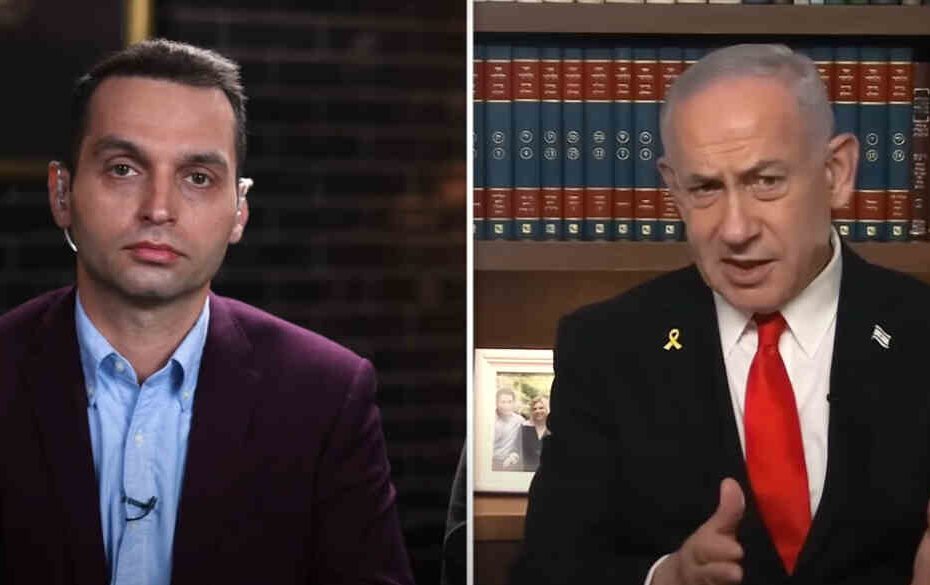
Read the full transcript of Israeli Prime Minister Benjamin Netanyahu’s interview on TRIGGERnometry Podcast, August 20, 2025.
The Moment of Attack
INTERVIEWER: Prime Minister Netanyahu, welcome to TRIGGERnometry.
BENJAMIN NETANYAHU: Glad to be with you.
INTERVIEWER: It’s great to have you on the show. As you know, what we do on the show is try to speak the truth, find out what the truth is, push back when it’s appropriate, and have an honest conversation. That’s why you’re here, and we really appreciate you taking the time to do that.
We have, obviously, lots of questions for you, including many of the things that are being said about Israel here in the west that you probably don’t agree with. Before we get to that, though, what I really want to ask you about is October 7th, and you had a very strange and unique experience that very few human beings have ever had, which is being in charge of a country of 10 million people when it’s attacked in this horrific way.
Where were you? How did you find out what was going on? And what was your immediate reaction? What did you think? What did you feel? How did you act in those moments?
BENJAMIN NETANYAHU: Well, it was 6:29 on Shabbat Saturday morning, got a phone call from my military secretary informing me that we’ve just been invaded by Hamas. The first thing that I asked was, “Is it a full scale invasion?” He said, “Looks like it.” And I said, “Can we get the Hamas leaders?”
But subsequently, I made my way to the military headquarters of Israel in Tel Aviv, called for a general call up of our reserves, hundreds of thousands, and declared war, and then proceeded to focus on the mission, winning that war. And I can tell you that in these moments, you’re really concerned with action, you’re concerned with decisions. You don’t wallow in the mire, as they say. You really think about what needs to be done now.
Processing the Savagery
INTERVIEWER: And have you and the people of Israel had time to grieve? What happened to process what happened to thousands of your people?
BENJAMIN NETANYAHU: To fully absorb this savagery I think is more difficult because you seldom encounter such bestial behavior. In fact, I don’t think you encounter it among beasts. I mean, the deliberate raping and murder of women, the beheading of men, the burning of babies in front of their children, the kidnapping of innocent people, grandmothers, Holocaust survivors, their grandchildren.
It is savagery on a scale that we haven’t seen since the Holocaust. And I think that it affirmed to me that we’re fighting a battle against barbarism, the battle of civilization against barbarism. And there isn’t a symmetry between the two today in this world of relativism. Yes, of course, everybody is the same. No, we’re not. We’re not the same.
We don’t prosecute wars that way. We don’t engage in such horrors. We don’t deliberately mutilate human beings. This is not what distinguishes our actions, but it distinguishes theirs. And they do it with a fiendish glee. They come with GoPro cameras. This is a savagery on a scale that is hard to absorb.
But I’ll tell you what it taught me. It said to me that we’re not merely fighting the battle for our survival, we’re fighting the battle for civilization against barbarism. And that is, that was true in the beginning of the war, and it’s still true today, even though some in the west refuse to acknowledge it.
The Reality of Leadership in Israel
INTERVIEWER: And it’s a strange question, perhaps. But does every man or woman who sits in your chair expect to get that phone call at some point?
BENJAMIN NETANYAHU: Well, they should be ready for it. And it comes. What we call the red phone rings constantly. It rings at 3 o’clock in the morning. My wife says, “Can’t you let us sleep one night?” And the answer is not many.
There are these interruptions because Israel is a country unlike any other. It is still surrounded by enemies committed openly and sworn openly to its destruction. And therefore it has to be vigilant and protecting itself constantly. And that’s the first role of the Prime Minister of Israel.
What We’ve Learned Since October 7th
INTERVIEWER: And since October 7, your forces have obviously taken control of significant swathes of Gaza. Your intelligence operatives have secured caches of documents and information, phone calls, intercepts, etc. What do you now know about how this happened, why it was able to happen, including, you know, what happened on the Israeli side to make this possible. What do we now know about October 7th that we did not know on October 8th?
BENJAMIN NETANYAHU: Well, what happened on the Israeli side needs to be investigated by an impartial commission, because it should be investigated top down, Prime Minister, down to the last pertinent official or military person. That has to be done.
But right now, what we do know and what we learned is that this was part of the Iranian terror axis. Iran had built this network of proxies with the goal of annihilating Israel by a simultaneous invasion from the south with Hamas, from the north with Hezbollah in Lebanon, with simultaneous pelleting of Israel massively with ballistic missiles with rockets from their various proxies, not only Lebanon and Gaza, but also from the Houthis in Yemen, from militias, Shiite militias in Iraq and Syria, and from Iran itself.
So this was meant to be a simultaneous surprise attack that would hobble Israel and destroy it. I think what happened was that they discovered that basically Hamas fired too soon. He didn’t coordinate, you know, the plan was there. Everybody knew that the plan was there. But for some reason, he went out and fired the first shot too early.
And in many ways, I mean, it cost us a horrendous cost of 1200 innocent people murdered savagely.
But it also gave us the time to block a potential invasion from Hezbollah and to organize the counterattack, which we proceeded to do from day one.
Intelligence Failures
INTERVIEWER: Prime Minister, can you – I know this might feel like a strange question, but I do think it’s important, and it’s a question many people are asking – you clearly have incredible penetration of the Islamic Revolutionary Guard in Iran. You have incredible penetration of Hezbollah. I don’t know how embedded your operatives were within Gaza and Hamas. How did your intelligence services not see this coming? I mean, you’ve talked often about the fact that the London Underground is smaller than the tunnel network in Gaza. How come you didn’t know? And if you did, how come it was not a red flag that all of this was about to happen?
BENJAMIN NETANYAHU: Well, all of that, I think, will be answered by this impartial investigation. But I think part of it was a mindset that said that Hamas is deterred and Hamas is not going to do it. And that’s a very big part of it.
But on day two of the war, I said, when Hezbollah joined after day one, they joined day two. And I said, “We will change the face of the Middle East.” Because for me, it was very clear that we were not only fighting Hamas, but we were fighting Iran with its various proxies, the noose of death that they wanted to strangle us with.
And I think that that’s the larger understanding that everybody has today. I don’t think many people believed me at the time, but it was obvious to me that it’s not enough to hit very hard, hit Hamas and Hezbollah, but that we’d have to deal also with their sponsors and the larger axis that made this possible.
So I think those lessons have been learned, certainly by Israel and by acting against Iran’s terror axis, which is meant ultimately to conquer the West. That’s what these people think. That’s what they believe in. It’s irrational. You say, “How could you believe that? Can you believe that people would actually think we delivered death to America and we destroy Europe?” They couldn’t possibly mean that. Well, what do you think? You think they mean it or not?
INTERVIEWER: Well, they keep chanting it, so I’m tempted to believe them. Yes.
The Rising Lion Operation
BENJAMIN NETANYAHU: So when you believe them. When you believe them. Exactly the point. When you believe them, then, since I believed it, I think that what we had to do was take on, ultimately take on Iran itself.
And of course, on day two, after you suffered the worst attack on Jews since the Holocaust, it may seem, you know, a ridiculous goal, an imaginary goal. No, it wasn’t. It was very clear. We’ll turn back. Israel will recover very quickly, very quickly and fight back and demolish Hamas and then demolish Hezbollah and then demolish the Assad regime and then hit, very strongly hit Iran in ways that surprise the world.
And I’m very proud of the people of Israel who stood fast. And I’m very proud of the soldiers of Israel. I call this incredible 12 day war with Iran, I call it the Rising Lion operation. And I did that because in the Bible it says that the people of Israel will rise like lions. And that’s exactly what our soldiers did. And I’m very proud of them.
Addressing Claims About Qatar and Hamas
INTERVIEWER: I think even your worst critics wouldn’t deny the incredible success you have had in taking down the Iranian proxies and Iran’s capabilities itself. But one of the things that we have heard here in the west, and I wanted to get your perspective on it, is that in the run up to what happened on October 7, for many, many years Israel was allowing the Israeli government was allowing Qatar to pump money into Hamas and using that in effect to strengthen Hamas against the Palestinian Authority to prevent a united Palestinian state. What do you say to those claims?
BENJAMIN NETANYAHU: Well, I think it’s hogwash. I mean we’re stuck with Hamas. I was actually against leaving Gaza and resigned from the government when he decided to tear out the settlements because I said this will be overtaken by Hamas and Hamas will use it as a platform, will use Gaza, de facto Palestinian state in Gaza to pellet us with missiles and rockets the surrounding cities.
This was pooh-poohed by the government. At the time I thought it was insane, but once they gave up Gaza, that’s exactly what happened. Hamas took it over and turned it into a terror bastion. And the question was, what do you do with it?
Well, there were various theories. One of it was that you have to have aid the civilian population in such a way that you don’t have diseases, so you’ve got to take care of the sewage, you’ve got to take care of electricity, you’ve got to make sure there’s no famine there. And that was the policy that advocated giving money, which was partial money, by the way, of all the money, the billions that went into Gaza, this was a fraction and it was monitored, so it didn’t really make the difference.
And it also, you know, what did they do with the billions that they got? Not from Qatar, the billions that they got, they built a terror city underneath terror tunnels. Have you been to Gaza? Have you seen it?
INTERVIEWER: No. No.
BENJAMIN NETANYAHU: You’re both welcome to come and I’ll make sure that you have a chance to see it. But you got to see the unseen underground city that they did. So they built tunnels with the vast aid that they got from elsewhere.
I didn’t believe that Hamas was going to make peace with us. I thought Hamas had to be constantly cut back. I myself, of the four military operations that we had since the rise of Hamas, since its takeover of Gaza, I led three operations to cut them down, not to accommodate them, killed some of their senior leaders.
But there was a question whether we had the consensus, both national and international, to go into Gaza and wipe them out. And the answer was we didn’t have it after October 7th. That changed. We had that consensus, at least for a while, until the Western leaders buckled. But that doesn’t change our understanding that we have to get rid of Hamas.
INTERVIEWER: Did you know the terror tunnels before October 7th? Were you aware that they were building them?
Western Leaders’ Response to Hamas
BENJAMIN NETANYAHU: Yes, of course we knew. We didn’t know the full extent because it’s underground and there are limited ways. I think Israel has very good intelligence, but intelligence is collection and that is always limited. And then you have to have your assessments. That is also limited. Yes. Did we know about underground tunnels? Of course, yeah, we know it.
INTERVIEWER: Prime Minister, you’ve just used the words “the Western leaders buckled.” And I’m assuming what you’re referring to is Keir Starmer’s statement on 25 July, where he said that the UK would recognize a Palestinian state. What is your response to that? And do you think that is just going to essentially encourage Hamas to continue their resistance?
BENJAMIN NETANYAHU: Yeah, of course it does. I mean, look, they commit the greatest savagery against Jews since the Holocaust, and the Prime Minister of Britain says, “We’ll reward you with a de facto state” which is what? Which is committed openly to repeating the October 7th massacre over and over and over again.
And they say, “Well, no, look, we recognize Israel’s right to defend itself.” You know, they always add that. You hear that, right? Yeah, of course. Yeah. Okay, well, they recognize Israel’s right to defend itself as long as Israel doesn’t exercise that right.
So now let’s imagine what would be the response of Britain if, well, in your case, about 15,000 people or 10,000 people would be butchered in one day and you’d have, I don’t know, 2,500 hostages taken. You know, would you say, “Oh, well, we should give our attackers a state right next to London?” Of course not.
What would the Americans say if you had 50,000 Americans butchered, okay, and thousands and thousands of Americans taken hostage? Obviously, they’d say, “No, we’re not going to give them a state.” Sort of. Not in New Jersey, but right in Manhattan. You know, that’s ridiculous.
So what? The standard that is being applied is not merely wrong, it’s just downright dangerous because you’re really rewarding these monstrous terrorists with the greatest prize. And that’s because of weakness. It’s weakness. It’s weakness in the face of distorted media, of packed social networks packed with bought bots.
But it’s also just these radical minorities which are protesting there. And by the way, you should ask your Starmer. Here’s a suggestion. Ask him. Okay, what do these protesters say about Britain? I know what they say about Israel. “Israel has to be destroyed. From the river to the sea.” You know, you think this is a massive continent. It’s all of 30, 40 miles.
Okay, but what do they say about Britain? Well, “Britain should go down.” What do they say about the UK? And the same for the protesters in the US – they burn Israeli flags, they burn American flags, and they burn the UK flag. So they’re basically a hostile minority supporting monstrosities.
And I think that it’s shameful the way that the Western leaders in Britain, in France, in Canada and New Zealand, the way they buckle under. They don’t have, you know, Europe has gone through the destruction of the Jews. 80 years later, that’s what they have to say. They attack the Jewish state and they give a prize for those who would destroy the one and only Jewish state. Shameful.
The Forever War Argument
INTERVIEWER: But Prime Minister, they would say that the amount of casualties that are now, that have now been inflicted upon the Palestinian people, the suffering that the Palestinian civilians are going through, that Israel has achieved practically all of its aims. And if Israel continues to perpetuate this war, what it’s going to do is it’s going to radicalize the population even more. So the more population gets radicalized, the more that joins Hamas. So essentially what Israel will be trapped in is a forever war. What do you say to that argument?
BENJAMIN NETANYAHU: I think the forever war is the opposite. I think if we leave them there and they’re committed to our destruction, then you’ll have a forever war. But what is happening on the ground is actually the opposite.
What is happening on the ground is we now have Gazans who are fighting Hamas because they see now, in the closing phase of this war, after we had to go through these seven fronts against all the proxies in Iran itself, and now we’re circling back to finish off Hamas and demolish its last stronghold in Gaza, they see hope.
They say, “Don’t let up, Gazans.” They kill Hamas, they fight Hamas, they die fighting them. And they’re saying, “This is our final hope to free ourselves from this tyranny.” You know, this tyranny that has caused them endless suffering and has not invested a penny of the billions that they received for the people of Gaza.
So quite the opposite. It’s free, you know, we’re fighting. You hear the slogan, “Free Gaza.” I agree. Free Gaza from Hamas terror. Free Gaza from Hamas tyranny.
Israel’s Military Conduct
Now, as far as Israel’s performance on the battlefield, this is, you know, this is the fraud. It’s not merely the starvation fraud. It’s a genocide fraud. If we wanted to commit genocide, we would have done it in one afternoon. We have the capacity, but we don’t do that.
You know, look at the way the allied forces fought in Fallujah. You know, look at the way they fought in Mosul. Took them nine months against 3,000 terrorists. Nine months, 3,000 terrorists. We face 10 times the number of terrorists.
And what do we do? We call up the Palestinian civilians and we say, “Leave the area.” Millions. Millions of text messages, millions of individual phone calls. “Please get out.” And Hamas stands there and tries to prevent them by shooting them, killing them.
So what do you think? Is that genocide? No, it isn’t. You know what? It isn’t. And yet Israel is being blamed. And of course, the ratio of combatants to non-combatants killed is about one and a half to one, which is probably a few. I mean, I think every civilian death is a tragedy. We do everything we can, as no army has done in history in such dense urban warfare, to prevent it.
But Israel can’t be – it’s not merely that it can’t be held to a higher standard. It’s held to an impossible standard. I mean, look at the Allies in World War II. You know what they did when they went into Congress? Do you know, what did they do? Tell me, what did they do that they call civilians to leave, that they give them, you know, caravans of food. Did anything like that happen? No.
The Modern Information War
INTERVIEWER: Well, let’s be honest, and this is an argument I’ve made myself. At the end of World War II, we flattened Germany because they made us, because we had to destroy the military infrastructure, the transportation infrastructure, to actually be able to win the war. But we live in a very different age now, don’t we, Prime Minister, where all the atrocities of war are instantly available to everybody around the world on social media. And that is something you said in your own press conference last week when you said, when you were asked whether Israel is winning the PR war, you said, “We’re definitely not.” And that’s putting it very mildly. So that’s the challenge you face now, isn’t it?
BENJAMIN NETANYAHU: Yes, but, you know, I never thought of Winston Churchill as a war criminal, but I guess he would be held as such today. But of course, it’s not really towards the end of the war that you flatten Germany when you cross the Channel in Normandy and you went into the cities, just bombed these cities, tank fire, artillery fire, air fire, without giving notice or anything like that. And you did it because you had to destroy the enemy.
So you’re right, it’s a different era. That’s why we are acting differently. And we are acting. We’re holding ourselves to the highest standard, and yet we’re being condemned by those who know better, who know better and even saw their own troops in Afghanistan or in Iraq.
Be that as it may, you know, it’s very hard to fight the deception, the lies, the starved children. The pictures of starved children are turned out to have cerebral palsy or other congenital diseases that leave them emaciated. And Israel is, of course, accused of starving children pretty much the way that in the Middle Ages, Jews were accused of killing Christian children for their blood.
So, you know, what do you do against the lie that circles the earth ten times before the truth has a chance to emerge? You have to shorten the war as speedily as possible. And frankly, we also have to do something about the algorithms and the social networks. This is a big challenge. I don’t want to dismiss it, but look, we Jews have been fighting and losing the propaganda war for about 2,500 years.
What’s different now is that we’re winning the ground war. We’re forcing. You know, what comes after the propaganda vilification is massacres, you know, and what we’re doing now, massacres that we were completely defenseless with right now. After the vilifications come the attacks, but we’re winning those attacks. That’s the change. And the faster we win, I think the faster the propaganda war will dissipate.
Coalition Politics and Government Unity
INTERVIEWER: There are critics of yours, Prime Minister, who will say, well, part of the reason that Israel is losing the propaganda war is when you have ministers like Smotrich making incendiary or inflammatory comments and there doesn’t seem to be any particular pushback from your government to this, they go, “Well, what does a Prime Minister really believe?”
BENJAMIN NETANYAHU: Well, what I believe, what I believe, I say in a parliamentary system, people are free to say, sometimes they say things they don’t quite mean. It happens all the time. It happens in any parliamentary system, as you know, and it happens in Britain too. But I think that on the whole, the people, the government is united. Most of the people are united, not all. You have a very active fringe.
INTERVIEWER: Prime Minister, forgive me, but these aren’t parliamentarians. These are people who are part of your government and they remain part of your government after they say these things that to many people, even your friends sound a little bit like ethnic cleansing is being discussed.
BENJAMIN NETANYAHU: Well, we’re not discussing ethnic cleansing. And to the extent that we have these conversations around the cabinet, the security Cabinet, that is actually not being discussed by these people. But they have disagreements with me, that’s part of a parliamentary coalition and they can leave.
And in fact, some of them have left the government in the course of this war. They came back because they disagreed with my decisions on hostage negotiations. They left or they voted against, or they did both. And that’s common. And to say, to describe this as anything but unique. This is a democracy, you know, I think there too, come on, understand, you know very well how that works in Britain and how it works elsewhere.
I don’t condone the idea of ethnic cleansing. I don’t seek to occupy Gaza and settle it. I think that our goal there is to make sure that we have a security belt which a security cordon which will probably…
INTERVIEWER: But Prime Minister, may I just interrupt when you have your finance Minister making a speech and talking about occupying Gaza. And there doesn’t seem to be any pushback within the government, people, quite rightly, in my opinion, would say, “Well, surely aren’t you condoning that type of rhetoric?”
BENJAMIN NETANYAHU: No.
The Challenge of Public Opinion and Historical Perspective
BENJAMIN NETANYAHU: And that is, it’s exacerbating Israel’s PR problem. I disagree completely. When somebody says, and I’m asked, is that your policy? And I say, no, it’s not my policy. I don’t intend to build the settlements or communities in Gaza and not Israeli ones.
I want a non-Israeli civilian governance after that is committed to living in peace with us and doesn’t condone terror, educate their children to terror, finance terror or launch terror, which is what Hamas does and frankly, what the Palestinian Authority would do too. So we’re not going that route. But I don’t want to build Israeli communities there. And I’ve said it openly.
And they asked me, “Your minister of finance says this, and what do you say?” Well, I say I disagree with him and I say that he’s entitled to say his things. That’s not ethnic cleansing. It’s a view. It’s a legitimate view, which I happen to disagree with.
But I can tell you that I think there too, the statements that nullify and challenge the various lies that are leveled at us, you just can’t keep up with it. It’s like a flood. I’m too busy winning the war, sometimes winning the actual war to debunk every single lie that is put against us or against me.
You’re vilified, you’re a war criminal, you’re a demon. You’re demonized all the time. And just say noise, put that aside. Win the war. Win it judiciously, use just means and have a just war that you have to win if you’re going to live and survive in this very brutal area.
And let me tell you, we will win it. And I think we’ll win the peace with it too. Because I think in our area, in your area too, people respect the strong and the strong have to win. The strong can be evil or they can be good. But you cannot lose. If you lose, nobody will make alliances with you. Nobody will make peace with you. You make peace with the strong, you make alliances with the strong.
The strong survive, but the strong survive not only through their guts, but also through their wits and through their commitment to their cause. And my cause is the survival of the one and only Jewish state, often against incredible vilification and lies, but that’s the way this cookie crumbles. But the state of Israel will not. Because what you’re saying, and look, I have a sympathy with what you’re saying.
INTERVIEWER: Of course I do, but when you say that this is just noise, I would strongly push back against that, Prime Minister, because if you look at particularly Gen Z and the younger generation’s opinions of view on Israel, they are, to put it mildly, Prime Minister, deeply unfavorable.
And those kids now, they are going to be the next ones to go into politics. They’re going to be the next decision makers. That must present you with a very real worry that Israel will not enjoy the same level of support, particularly from the US that it has once done when those kids come to be the decision makers.
Countering Organized Opposition
BENJAMIN NETANYAHU: Well, ask them in Britain and ask them in the US what they think of Britain and the US what do they think and what are they saying? That there’s a big campaign and it’s organized and systemic, and it’s financed to tear away traditional elements of support from Israel. It’s not just happening by itself. A lot of it is organized. And if it’s organized, you can counter it too. At the appropriate time. You just have to concentrate your attention to it. And I agree with you. That’s an important point.
And I’ll tell you what they’re saying. They’re saying, for example, those in America were saying, “We’re pro American, you’re pro American,” and you attack Israel, that is fighting the people who try to assassinate President Trump twice, not once, who bombed American Embassies, who murdered 241 American Marines in Beirut, who murdered and wounded thousands of Americans in Iraq and Afghanistan with their Iranian IEDs. Iran, that chants “Death to America,” “Death to the traitors,” to the heathen and so on. This is the people you support. And in fact, that’s where the support. Not only that, you heard some other outlandish things that they do.
I mean, they’re some of their most prominent spokesmen. They say, “Well, Netanyahu is trying to drag Trump into a war.” Did you hear that? You hear that one? Yeah. Well, okay. And what do I want to do? Because I want ground troops, American ground troops, boots on the ground to conquer Iran and bring about regime change and all that nonsense.
And thank God President Trump has proven an exceptional, exceptional friend of Israel, an exceptional leader. And he did exactly the right action, the precise action, using American power, and came in, I think, in a very forceful but judicious way. I think we’ve been very fortunate to have a leader in the United States who doesn’t act like the European leaders, who doesn’t succumb to this stuff.
But if you’re telling me that there’s work to be done on Gen Z and across the West. Yes. And by the way, it’s not only our job. We are, as your colleague Douglas Murray said, we’re the litmus test for the survival of the west, because these people are against the West. They’re not for the west, they’re against the West. And there’s the horseshoe effect of the woke left meeting the woke right and challenging the basic precepts of Western civilization. And I think that has to be challenged not merely by Israel or by me, but by you. And I know that you’re doing it, and I want to commend you for doing it.
The Future of Gaza and De-radicalization
INTERVIEWER: Well, we’ve certainly been challenging the woke. Right. And that’s one of many critics, but we’ll continue to do it. Prime Minister, I know you’re limited on time. We’ll just do a couple more questions. And I want to ask you about the future.
And I know that if I say to you, “Well, what does the future of Gaza look like,” you’re going to say, “We got to destroy Hamas.” We agree. You’re going to say, “We want the hostages back.” We agree. You’re going to say, “We got to demilitarize Gaza so they can’t do October 7th again.” We agree. And then you’re going to say, “And then we need a civilian government in Gaza that’s not hostile to Israel.”
And that’s where you lose me, Prime Minister, because I look at the poll, opinion polls, I look at the people celebrating October 7th in Gaza, I look at the fact that thousands of civilians crossed into Israel on October 7 to commit the atrocities that were committed, and I go, these people hate you, they hate you, they hate Israel and they hate Jews. How are you going to have a peaceful coexistence with those people, particularly given the fact that, as Francis mentioned earlier, they have been very heavily radicalized, not only through the education system, but through the fact that they’ve been on the receiving end on Israel’s war effort.
BENJAMIN NETANYAHU: Well, I think what you’re pointing out to is that you need also a program of de-radicalization. Now, has that been done in societies that have been conditioned to hate their adversaries? Yes, of course, it’s been done in two places, prominently in Japan and in Germany.
But it’s also been done in the Middle East. I mean, there have been very noteworthy programs, successful programs of de-radicalization in some of the Gulf states, which are actually proving to break this prototype of Arab societies that cannot seize the future. I’m not saying they’re model democracies, mind you. They’re not, but they certainly want to seize modernity and not go back to the savage and early medievalism that the Islamic fundamentalists want to drag us all to.
So I think that there is, there’s a need for de-radicalization. It has to be part of the reconstruction of Gaza, you not only reconstruct Gaza, you also de-radicalize Gaza. It’s going to be a heavy lift, but it’s necessary and it can be done.
The Importance of Historical Knowledge
INTERVIEWER: Prime Minister, final question we ask all of our guests on the show is what is the one thing that we are not talking about as a society and in your case as a civil civilization? I would say what are we not talking about within Western civilization that we should be talking about?
BENJAMIN NETANYAHU: Well, three things, history, history and history. This is an ahistorical generation that is being raised here. And if its sense of history goes back to breakfast, you’re lucky. And unless you know how we got here, you don’t know how to proceed from here. And that is, I think, lacking. Not lacking on your part, obviously. But would you agree, you think?
INTERVIEWER: I certainly would. But can you flesh that out for us? What are the lessons you would want people to take from history that you feel that they’re not?
Lessons from History: Taking Threats Seriously
BENJAMIN NETANYAHU: Well, I’ll tell you the lessons that we, the Jewish people took from history. Number one is when somebody says they’re going to annihilate, you take it seriously. Don’t wait for them to do it, but prevent them, as we did in the remarkable action that we took against Iran because they were developing nuclear weapons and they were going to have 20,000 ballistic missiles, one ton ballistic missiles that on a country the size of Israel, which is tiny, it’s like the size of Wales or New Jersey, that would obliterate us. So we had to take action and we didn’t wait for them to annihilate us first.
And I think that, I think in general, for the democracies, I would say, well, how about remembering Churchill’s warning? He said that the democracies fall into the slumber of democracies. And he said that it’s only when the jarring gong of danger wakes them up that they do something about it. Well, they might sleep through the jarring gong of danger because I think it’s gonging well enough right now.
You have these Islamic radicals, Islamist radicals that want to tear up Arab society. They want to subjugate all the Muslims, they want to destroy Israel, they want to obliterate Christians one after the other and they say they’re going after you. They’re developing intercontinental ballistic missiles that can reach into Europe and soon into the United States.
And Western leaders can go on blaming Israel for this, for fighting this common menace, or they can do something about it. And it remains to be seen whether they’ve drawn the lesson but we have, we’ve learned the lessons of history. Somebody says he’s going to kill you, wake up in time.
And something, that’s from biology too. For an organism to survive, it has to recognize danger in time. And it has two options at that point. Point to fight or fly, flight or fight. And we have nowhere to flee. We’re in our ancestral homeland and we’re not going anywhere. So we fight them, but we’re not fighting them only on our behalf, we’re fighting them on your behalf too. And I hope that you have the opportunity to carry this message far and wide. So I thank you for this.
INTERVIEWER: Thank you for your time, Prime Minister.
The Danger of Utopian Idealism
BENJAMIN NETANYAHU: Thank you. The mood music about history, which I agree in the last, let’s say 15 years has been intensely moralistic.
INTERVIEWER: Is that wrong? Like, should we not be trying to learn the moral lessons from the past? The biggest killers were utopian idealists. They were people who believed in a better world. Hitler, undoubtedly. It sounds weird to say it, but he’s an idealist. Stalin is obviously an idealist. Mao as an idealist. They think they are going to make a better world.
We now have a slightly sanitized and a self deluding, idealistic view of human nature and of what we’re capable of. They’ve been completely insulated from the beast and other people. And in themselves, knowledge of the beast is so important.
Related Posts