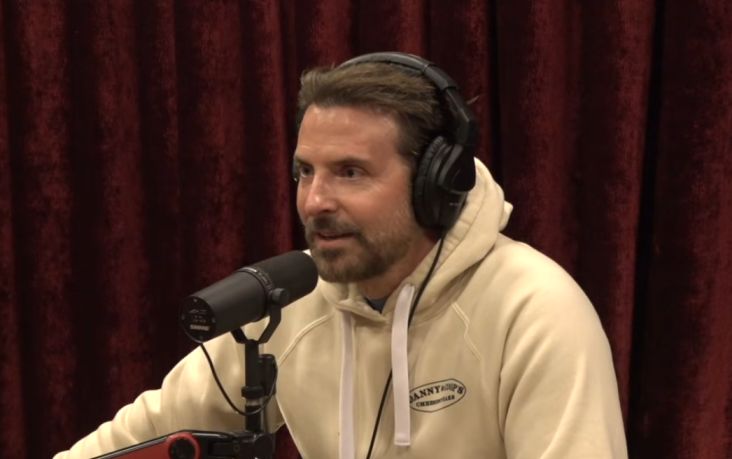
Here is the full transcript of Academy Award-nominated actor Bradley Cooper’s interview on The Joe Rogan Experience #2435, January 9, 2026.
Brief Notes: In this captivating episode of the Joe Rogan Experience, acclaimed actor and director Bradley Cooper joins Joe to discuss his profound creative journey, from the childhood impact of The Elephant Man to the grueling physical transformation required for American Sniper. Cooper provides a behind-the-scenes look at his film Is This Thing On, deconstructing the raw vulnerability of the stand-up comedy world and his own evolution as a filmmaker.
The duo explores the neurobiology of connection, the “low-level anxiety” of social media, and the looming existential questions posed by artificial intelligence in 2026. From his early days as a hotel doorman to singing live at Glastonbury with Lady Gaga, Cooper delivers an unfiltered and thoughtful look at the high-stakes world of performance.
The Twilight Zone Moment
JOE ROGAN: Hey, Bradley Cooper, what’s happening, baby?
BRADLEY COOPER: You know what it’s like when, like a Twilight Zone episode or something where you’re watching the TV and all of a sudden you’re inside the show and you’re looking at me and I got the… Yeah, all of a sudden I’m inside the show. It’s crazy.
JOE ROGAN: It’s weird for me, too. It’s weird for me that it gets weird for other people too. Like, when I see people being weird about it, I’m like, it’s okay.
BRADLEY COOPER: I feel comfortable. Just so you know.
JOE ROGAN: You look comfortable.
BRADLEY COOPER: But it’s excitement.
JOE ROGAN: It’s weird for me. Like, I was trying to explain this to someone. They’re like, do people have a hard time being comfortable on the show? I go, I kind of do too. It’s f*ing weird.
BRADLEY COOPER: Yeah.
JOE ROGAN: It’s weird that many people are watching.
BRADLEY COOPER: Yes.
JOE ROGAN: And then you start thinking like, oh, don’t f* it up. Don’t say that. Right.
Long-Form Content in a Short Attention Span World
BRADLEY COOPER: But if you think about it, the fact that you did this long form setup and that we live in a culture where people at least say that it’s all about short term, it goes against it. The people are interested.
JOE ROGAN: Yeah. Well, the short term stuff does work, you know, like, short attention span stuff is very popular, even with me. But I have been resisting it more and more lately. I’m like a f*ing heroin addict, slowly weaning myself off the drug.
And the more I wean myself, the better I feel, like, physically better, my brain works better, I feel more relaxed. I don’t feel like this… Sean O’Malley, the UFC fighter, he said, even when I’m just scrolling, even if it’s not anything about me, he goes, there’s just like a low level anxiety that I get. I’m like, yeah, yeah.
Because you know you’re wasting your time chasing a fix that you’re never going to get. And you’re just getting these short drips of like, oh, look at that. Oh, look at that. Oh, scroll, scroll, scroll, scroll. But that’s not what people really want. What people really want is something engaging, something you go, wow, that’s amazing.
Like a great documentary, which are still super popular. Like, a great documentary, they’re still huge on Netflix and huge on YouTube.
BRADLEY COOPER: And Oppenheimer was like three hours long. And that made a billion dollars.
JOE ROGAN: So people went, humans didn’t change. It’s just you can hijack the reward system by giving them some short attention span nonsense. And it just tricks their slow drip dopamine into continuing to watch this stupid sh*t. But that’s not what they want.
BRADLEY COOPER: No.
JOE ROGAN: You know, it’s not what I want.
The Need for Real Connection
BRADLEY COOPER: It’s the difference between, yeah, just a little drip of something that has the illusion that I’m getting what I want as opposed to what I actually need, which is sort of a reminder that I exist.
JOE ROGAN: Yes, yes.
BRADLEY COOPER: And that I’m communicating with somebody. And I can relate to it.
JOE ROGAN: Yes.
BRADLEY COOPER: Which is a different thing. And I only know this because I’ve never been on social media, but sometimes… There was one time I got on somehow, got on TikTok, and it was all police footage, you know, like… And I was just… I remember laying on my couch.
Forty minutes went by and I was just doing this. And it was like the first part of the video. And then what happened? And then like the second part, part two. And that was the only time I experienced… I thought, I got to stay away from this because I won’t leave the house.
JOE ROGAN: It’s bad. It’s bad for you, too, because it programs you to think that that is going on everywhere in the world. Like, if you have 8 billion people that are interacting with people all over the world, and you only take the worst examples of that and broadcast it, and then it becomes viral and millions and millions of people think it, it rewires your way you think about human beings.
Memory and Virtual Reality
BRADLEY COOPER: But the… And the other thing is about memory. Someone was talking about Niagara Falls the other day, and I thought I’d been there. Right. And I’m like, have I been there? Or did I see a video? Or was that one of the things when I put the Oculus on?
JOE ROGAN: Right, right.
BRADLEY COOPER: Honestly, I can’t remember, but I know what it feels like to be looking at it.
JOE ROGAN: Oh, yeah.
BRADLEY COOPER: So it’s changing the way memory works 100%. Yeah.
Dunbar’s Number and Memory Limits
JOE ROGAN: I’ve hit a wall in my memory, like a tangible wall, because… And I think it’s connected to Dunbar’s number.
And so the way Dunbar calculated it, there’s like, very close, intimate, close circle people, which is a small amount, and then immediate after that, there’s a slightly larger amount. And then it gets up… What was it like? It gets up to like a thousand people. 1,500 people. That’s the most amount of people you can keep in your head.
So it’s like five people that, like your tightest of tight, and then 15, like, slightly outside of that. And it gets all the way up to about 1,500 people. Recognizable people.
BRADLEY COOPER: But I would think I’d be able to… That you could keep in your head.
JOE ROGAN: Yeah, but I’m way past 1,500 people, so I’m f*ed up. Like, I am… Like, there’s people that I know really well, and then I see them and I’m like, I don’t remember his name.
BRADLEY COOPER: 1,500 sounds right.
JOE ROGAN: And it seems bad. Like, I’m like, why can’t I remember his f*ing name? I’m horrible with names, but it’s just because my hard drive sucks. It’s like I don’t have enough room.
BRADLEY COOPER: Right.
JOE ROGAN: It’s like, you know, when you… the old iPhones, it was like you’ve run out of Mac space. Like, ah, geez, I got to start deleting photos and videos now.
BRADLEY COOPER: Do you get anxiety with that or do you sort of breathe through and say, well, it’s just the way it is?
JOE ROGAN: I kind of just deal with it. Yeah, it is what it is. But my memory itself is very good and also very bad at the same time.
BRADLEY COOPER: Yeah, me too. I have a serious problem remembering people’s names.
JOE ROGAN: Well, you think about how many people…
BRADLEY COOPER: Like, as I was saying it, I was like… And I’ve watched it so many times. I was like, Jamie. Right? That’s Jamie. Like, as you were saying, do I remember any of the guys I just met? Can’t tell you one. I just met them, shook their hand. Look them in there.
JOE ROGAN: They say their names and it just goes in and out.
BRADLEY COOPER: Yeah.
JOE ROGAN: And some people get upset. “What’s my name?” I’m like, I don’t f*ing know. “Oh, you don’t remember me?”
BRADLEY COOPER: “You don’t remember what’s my name?”
JOE ROGAN: And you’re like, well, that’s why in Hollywood people love to say, “good to see you,” instead of “nice to meet you.” Like, b*tch, you met me two years ago. Like, I don’t remember.
BRADLEY COOPER: Yeah, Leonard Bernstein had a great thing that he would always be “I loved you in the last thing you did.”
JOE ROGAN: That’s funny. That’s funny. Speaking of which, I watched your movie. “Is This Thing On?” And it’s good. It’s really good, man.
BRADLEY COOPER: Oh, thanks.
Authenticity in “Is This Thing On?”
JOE ROGAN: It’s one of the best representations of someone attempting to do standup. It’s a really good film. And, you know, but it’s not really just about standup. It’s about these people with this… It’s about they’re actual human beings.
Like, these are complicated, real, not caricature-ish, not cartoonish people. Like, I get that these are real people.
BRADLEY COOPER: Right?
JOE ROGAN: Good. Complicated, real people that are trying to figure out their relationships.
BRADLEY COOPER: Good.
JOE ROGAN: In the context of this one guy, Will Arnett is attempting to do standup. Right. It was great.
Growing Up with Comedy
BRADLEY COOPER: I’m glad you say that. So you… Because, you know, I moved to New York in ’97 and… And then that was my introduction to any comedy world other than with my dad. I used to watch Rodney Dangerfield’s New Year’s Eve special. We used to watch it every year. And it was Elaine Boosler and Sam Kinison and Dice.
JOE ROGAN: Elaine Boosler.
BRADLEY COOPER: I forgot about her. I’m pretty sure he was on there. Oh, yeah. And I was obsessed with Dice. When I was in eighth grade, I memorized one of his records and I would do it in the train station with all my friends. Because back then that’s all you did, right? You would memorize stuff.
JOE ROGAN: Oh, yeah.
BRADLEY COOPER: There was no video to look at. You wouldn’t all sit around, you would just memorize. And then, you know, regale your friends, your impersonation of them. And then… And Richard Pryor was my hero. Hero growing up, that was my idol. So I had this thing with standup comedy.
And then I moved to New York and I’m all of a sudden immersed with these clubs. And Upright Citizens Brigade had just started. I did this movie, Wet Hot American Summer. And there was all these people I didn’t even know about The State. Remember that show on MTV? There was all this. And so I just, you know, little by little immerse myself into that world.
And I just became fascinated with the culture. And then Zach Galifianakis, who I met like in 2001, way before Hangover, I used to go and watch him do stuff. And I just love the culture.
And when Will was telling me about this, I was like, oh, let’s set it in New York and the Cellar. Because I just love the geography of the Cellar too, that you go in the Olive Tree and you walk down into this place. It’s this whole other world.
And it just felt like, yeah, I really wanted to… Can I… Can we pull this off where it’s authentic, where you were watching it at home and you get a sense of the fact that, you know, you feel like it got it, you know, within the striking distance. Makes me really happy.
Authenticity vs. Hollywood Comedy
JOE ROGAN: Yeah, it’s striking distance. It’s like the… One of the only films they’re like, “Punchline” was an interesting film. The Tom Hanks, Sally Field.
BRADLEY COOPER: Yeah, of course.
JOE ROGAN: But it was bullsht. Like, you watch it, like, what, they have lockers. Like, what the f is this? Like… And also, the comedy wasn’t good. It wasn’t real comedy. It was like it felt flat and fake and people were laughing at nothing.
The Will stuff felt real. Yeah, it felt real. You know, like the clubs felt with a guy trying to work out what it’s like to be on stage. An open mic. And then the fact you got Jordan Jensen, who I love.
BRADLEY COOPER: Yeah, of course.
JOE ROGAN: F*ing great. I texted her afterwards. I’m like, isn’t she great in the movie? She’s great.
BRADLEY COOPER: Yeah. I mean, the minute I started shooting her, I was like, oh, wait a second.
JOE ROGAN: Yeah, yeah.
Jordan Jensen’s Performance
BRADLEY COOPER: It was like… And the first thing I shot with her was one of her sets. And I was just up there with the camera and I came around and her profile and actually I felt like I was in “A Star Is Born.” She looked a lot like Gaga and Ally, like, singing “Shallow.”
Oh, wow. I had this weird moment. I was like, whoa. And then she was just incredible. And then as it went on, she had a larger part in the movie. And then that whole thing when they’re talking about the small penis and we go up to her and just her writing that down, and she was just so fluid. And I was like, oh, yeah, she’s got it, man. She’s got it.
JOE ROGAN: She’s great. She’s really great. She’s a really unique person. Like, a very unusual person. Like, even just talking to her on podcast.
BRADLEY COOPER: Grew up on a farm with two moms and… Amazing. Yeah, she could do anything.
JOE ROGAN: I know. She’s so fun. She’s fun on stage, too. She’s great. Like, very crowd…
BRADLEY COOPER: Very smart.
JOE ROGAN: Very smart. But her character, like, the way she interact… I’m like, oh, that’s so realistic. Like, “we should f*” like that.
BRADLEY COOPER: Exactly. Yeah, exactly, exactly. And then you go back to the East Village of Chinatown apartment. You know, they live in all one room. Yeah, I believe it. Yeah, me too.
JOE ROGAN: It was great. It’s like, you know, you’re never going to really capture stand up in a movie because it’s like, to capture what it is, you would need years.
BRADLEY COOPER: And also you would need a movie dedicated to it.
JOE ROGAN: Exactly.
BRADLEY COOPER: The movie’s not dedicated to it. Exactly. You know what I mean? It was just about, can I make you feel like you’re there, that you’re with him on stage?
JOE ROGAN: Yes.
BRADLEY COOPER: What that could be like. Yeah, you know, the silence and then the cameras, boom. There’s nowhere to go.
Authentic Audiences and Real Comedy Club Staff
JOE ROGAN: How did you work out the stand up scenes? Did you have real audiences?
BRADLEY COOPER: It was real audiences because you have to hit the quota of extras with SAG and all that. But we try to do it as authentic as possible, which was everybody that works at the Cellar, they’re there in the movie. Everybody who agreed to do it. So all the waiters and everything, the staff, that’s all people that work there. Liz, who’s the manager, who plays the manager. She’s the manager of the seller. So all those people are real.
But then the patrons. I can’t remember what the email was or what the ask was, but people who like to go to stand up comedy, who go regularly. And then once they were there, I never told them what was going to happen. I never directed them once. It was like, whatever they’re laughing at, that’s it. And I don’t do many takes, so you’re getting an authentic reaction now.
It’s hyped up because there’s cameras there and it’s a movie but they’re not told what to do.
JOE ROGAN: It feels like that.
BRADLEY COOPER: And so. And even in the mix, we never added anything. There was no added laugh, nothing.
JOE ROGAN: Oh, that’s great.
BRADLEY COOPER: Yeah, yeah. It’s all because I was like, it’s just got to be real because I wanted Will to just, you know, I just don’t want him to act right. I just want him to. And that’s why, you know, Shane Gillis was kind enough. The first time everyone up was here at the Mothership, Shane gave him four minutes of his set and Will and I flew to Austin.
And we’re sitting in the green room and Shane was like an hour and a half late. And Tony was there and he was so nice. I’d never met Tony before. And that’s where I smelled the thing. You know, I did this. Oh, the smelling sauce. It was, f* me. That sh is no joke.
JOE ROGAN: Yeah.
BRADLEY COOPER: And that was the first time Will ever went up. And we were just trying some of that material and went up as Alex Novak because I was like, when do you have an opportunity as an actor to actually do the thing you’re preparing to do and think about how much that would cost? You go into a room where there’s real people.
And then every step that you’re taking, you’re in a club. So he did that. And then when we went back to New York, he did it like three times a week, four or five times a night for six weeks.
JOE ROGAN: Wow.
BRADLEY COOPER: Just so he could understand what it’s like. And some people didn’t know who he was. You know, you get a lot of tourists come into New York City, and there were nights where you knew that he. When he said, Alex Novak, they’re like, cool, not like, you’re not Alex Novak. Right. Okay, let’s see what you got. And so that was really. That was really great.
The True Story Behind the Film
JOE ROGAN: How did you. Who wrote this film?
BRADLEY COOPER: He wrote it with this guy, Mark Chappell. It was a movie that was more about his. Based on this guy. John Bishop, who’s a real comedian, is a very successful comedian in the UK, and Will met that guy on a barge somewhere. And he was talking about his story, and he was like, yeah, I was in. I was doing something else. My wife and I were breaking up, and I walked into a bar, a pub one night. I didn’t want to pay the cover. That really happened to this guy.
So he put his name down and I called him. And then he was like, yeah, I’m getting a divorce, and got a couple chuckles. But he just loved it. Never done comedy. Nothing before that. And he kept going back, and he was obsessed by it. And then weeks later, his wife, estranged wife, walked into a place he was doing an open mic at with her girlfriends, and he was doing a set about their relationship. So that actually happened.
JOE ROGAN: Wow.
BRADLEY COOPER: I know. And then they got back together, and they’re still together. And then now he tours around the world, he makes a living as a comedian.
JOE ROGAN: That’s incredible.
BRADLEY COOPER: Yeah. So when he was telling me that I was doing another movie, and I remember, I was like, what are you working on? Because we’ve been friends for 25 years. And he was telling me that, and I was like, I just imagine Will because I know him so well, and he’s so charismatic and funny and just has this presence that is kind of lacking.
I don’t feel like there’s a male archetype now that fits him. He’s like Robert Mitchum. He reminds me of a young Robert Mitchum, Will Arnett. And he’s telling me that I’m like, his voice and that face. Stand up. I just couldn’t get it out of my head, Joe. And I was like, hey, man, can I read it? How far along are you guys?
And I read it and I was like, I didn’t quite. Because, like you, I’d never seen a movie that I thought nailed it. And I love stand up comedy so much. I was like. And I have no desire to try to redo it. And also, comedy is so massive right now and the specials are so great and cinematic right now that there’s no reason to try to make a fictional movie about something that we can watch as a documentary or a docu series or a show that is authentic.
I was like, so. But I still would really love to capture it cinematically. So what if it’s a foil and the movie’s about the two of them? That’s interesting. Yes. And you suck.
JOE ROGAN: That was one of the great scenes where Jordan was like, you’re bad.
BRADLEY COOPER: You’re really bad. And it’s much more about just what? Stand up comedy with anything. And you talk about this on your show, doing anything that puts you out of your comfort zone, anything that pushes you, you’re going to improve as a human being. That was really what that whole thing is about.
And I just love the culture and the world and I thought there’s so much tangible stuff there for me to get excited about cinematically and story wise. But really, it’s like it could have been anything. Just something that he’d never done that he had puts himself out there and that in doing it and doing it, he just sort of gets more comfortable, you know, and then the mic comes off the stand and then he’s leaning against the wall.
And by the end of it, and then the way it was structured, it allows him to do that vampire set at the end of the movie where all he’s doing is exercising what he’s feeling emotionally. Because he’s comfortable in this setting.
JOE ROGAN: Yeah.
BRADLEY COOPER: Because the old him, when he has that fight with her in the attic, he just would have kept that all inside. And he would have been catatonic at his kids assembly where we meet him in the beginning of the movie, because you just don’t know what to do with all that. But if you have an outlet, something expressive.
JOE ROGAN: Yes.
BRADLEY COOPER: You can exercise it in a healthy way. Yeah. So that, that’s, that’s. That really was the point of that whole part of it being stand up comedy and open mic.
Capturing the Reality of Starting Out
JOE ROGAN: What you really nailed is someone trying it for the first time. You guys really nailed that. You really nailed a beginner in comedy. It seemed completely realistic.
BRADLEY COOPER: Great.
JOE ROGAN: Yeah. And I think that’s one of the reasons why Kill Tony is so popular.
BRADLEY COOPER: Yes.
JOE ROGAN: You know, because you get to see that raw reality of someone who has never done stand up before. There was people that went up at Madison Square Garden in front of 16,000 people that had never done stand up before.
BRADLEY COOPER: No, no, no. That’s. Who knows?
JOE ROGAN: Don’t do that. You should be in a fing smoky room. Well, not smoky anymore, but a tiny fing room where disinterested people, where everyone’s bombing and you bomb to it. It’s not that big a deal because you might have some potential. But if you f*ing bomb in front of 16,000 people, the pain of that, you may never recover.
BRADLEY COOPER: Also, just thinking about the audio, because you’re going to hear your voice through the, you know, echoing. It can’t be just in it. So there, I imagine there’s an echo. So you’re not only bombing, but you’re hearing it reverberate.
JOE ROGAN: You don’t really feel the echo. You don’t hear the echo because you have monitors on stage. So it’s kind of. You pretty flat.
BRADLEY COOPER: Okay.
JOE ROGAN: But the noise of your voice where you’ve never heard your voice into a microphone before, ever.
BRADLEY COOPER: Right.
JOE ROGAN: And now you’re in front of 16,000 people doing it, and then Tony sitting there looking at you and Shane’s there and I’m there.
BRADLEY COOPER: It’s like a nightmare. It’s like you’re walking into a nightmare.
JOE ROGAN: Well, what. Just doing stand up in front of a guy like Shane Gillis is crazy. Crazy sitting right next to you. You’ve never done stand up. You’re going to do stand up right next to a guy who’s selling out arenas. That’s nuts. That feeling is nuts.
BRADLEY COOPER: But it’s wonderful to watch because you’re watching authentic reactions happening in real time.
JOE ROGAN: Yes. If your new Year’s resolution was change everything and be a new person, good luck. So instead of pretending you’re going to meal prep kale forever or do morning cold plunges, here’s one actually realistic thing. AG1. AG1 is a daily health drink that supports your energy, gut health, immune health, and helps fill common nutrient gaps. Just one scoop in cold water each morning and you’re off.
It’s got over 75 vitamins, minerals, probiotics, and whole food ingredients in there. So instead of guessing whether you need a probiotic or a prebiotic, or sorting through 10 different bottles of pills and powders, you can just do one scoop and get on with your day. It’s great because it feels like the grown up move, but for once it’s actually really easy.
It takes 30 seconds and you’ll notice the steadiness that sets you up for the day. Not wired, not crashing, just functional human being energy. I partnered with AG1 for years and if you want to give it a try, head to drinkag1.com/joerogan and for a limited time you’ll get a free AG1 duffel bag and free AG1 welcome kit with your first AG1 subscription. Order only while supplies last. That’s drinkag1.com/joerogan or visit the link in the description to get started. It’s not processed. It’s as clean a mental food as you’re going to get.
BRADLEY COOPER: Yeah, it’s true.
JOE ROGAN: It’s just that we. I think human beings really love seeing what it’s like when someone starts out doing something because a lot of people have these ideas like, ah, maybe I could try that or maybe I could learn how to play guitar or maybe I could do that. But it’s just the getting going and sucking at something in the beginning is terrifying for people.
So when they see someone just try it, I think they’re like, oh, look at him go, look at him go. He’s out there doing it, he’s on the bike, he’s moving. You know, it’s like you see actual people that are trying to do something that they’ve never done before and it’s exciting.
BRADLEY COOPER: And also the one thing I wanted to touch on is the craft of it all. You know, that it’s, that it takes a lot of work. I know that it’s not, you know, just, you know, the writing, you know, she says that one point, she’s like, you got to write, you know, keep going up. And I think most people, at least I didn’t know before I started going that people go up three or four times a night. I didn’t understand. So that was something I thought it was important to convey just the work ethic that’s needed.
The Evolution of Comedy Culture
JOE ROGAN: Well, New York is really great for that. And it’s always had a culture of that. It’s had a culture of guys hopping from club to club and doing set to set. Because there’s so many clubs in Manhattan. So guys would just, you know, I think the most guy I ever heard, one guy did eight, eight or nine sets a night. Like they just, like, that’s how many clubs there are. So you just hop all over the place. You start your night at like 8 p.m.
BRADLEY COOPER: Yeah, downtown there’s a ton. Downtown that you can go uptown.
JOE ROGAN: Yeah, go all over the place. We’ve got a lot of that here now. There’s just so many clubs in Austin now.
BRADLEY COOPER: I mean, we went there. What you built is incredible.
JOE ROGAN: Thank you.
BRADLEY COOPER: The culture, you know, I showed the movie to a stand-up who hadn’t done stand-up in like 15 years, and he said, the only thing that for sure you got wrong is the culture. I was like, what do you mean? He’s like, no, people aren’t that nice. And I was like, actually, I think you’re wrong. I was like, it’s changed. I was like, people are supportive now.
JOE ROGAN: It’s in where you go. There’s places where it’s not very supportive, really.
BRADLEY COOPER: But at least, like I used to go to the Cellar, like in early 2000s. Didn’t feel like it does now.
JOE ROGAN: Right. Well, I think Ari Shafir changed that a lot. He brought like the culture of LA to New York where you’re like more supportive of each other. It was always like dog against dog. Because really the way it all started out was in the 1990s, it was all about everyone was auditioning for a sitcom.
And if you and I were, if I showed up to audition for a sitcom, like, oh, f, Bradley’s here. He’s going for the same part. F that guy. You know, it was like, that could change your life if you got that sitcom. Now all of a sudden you’re f*ing huge. And I’m still like struggling to pay my rent, eating ramen. And it could have been me, right?
And so there’s this like serious resentment that happens in the 1990s because everybody, like the golden carrot at the end of the stick was the Tonight Show or, you know, hosting a late, if you could get your own late night show. Oh, my God, he made it. He’s a host of the Tonight Show. That was like the thing that only one person could get. And then there was like the sitcom. Like, if it really worked out, they’d make a sitcom around you and you get a development deal.
So there was, people would psychologically backstab people. People would talk shit to people before they went on stage. They would try to hijack their f*ing mind right before they, like, really. It was dark, crazy.
And then the Internet came around. And then the Internet, instead of people being your competitors, they became not just your friends and not just your colleagues, but also an asset. Because if you’re doing a podcast and you’ve got your funny friends on, then your podcast is better, right?
And then if you tell people about their podcast and their podcast is better, and then you go on their podcast, and that’s better, and everybody benefits from everybody else doing well. So it completely reversed the system. And then it became much more about being supportive of each other.
And then everybody kind of realized, like, hey, it’s way more fun when we’re all having fun, you know? And since the television thing kind of died off, the sitcom thing kind of died off with reality shows, and then it was really just more about getting clips up on the Internet and about getting, and then there was Netflix specials.
So it wasn’t just everybody trying to get an HBO special. There was way more specials. And then you could just upload specials to YouTube and became this way more collaborative, supportive environment. And then Ari Shafir took that, that we had kind of, like, established in LA and brought that to New York, and a lot of those guys ran with it.
BRADLEY COOPER: Yeah. I mean, that’s the way to go. People always say, you know, there’s a lot of room at the top. Yeah, there’s a lot.
JOE ROGAN: There’s a lot of room in stand-up, for sure.
BRADLEY COOPER: You know, and it’s like, and everybody has their own lane, even within this big highway. And everybody wants to be with other people. Who wants to be a lone wolf, really, for a long period?
JOE ROGAN: Yeah, there’s a few. There’s a few out there, but they’re all psychologically destroyed. They’re just a mess.
BRADLEY COOPER: Yeah.
JOE ROGAN: Who doesn’t want to have friends? It’s crazy.
BRADLEY COOPER: Yeah.
JOE ROGAN: I don’t get it. But, you know, it’s that aspect of the culture I felt like in the movie you guys nailed, which is a realistic aspect, a realistic portrayal of what it’s like, where a bunch of people just, they were all busting each other’s balls.
BRADLEY COOPER: Yeah.
JOE ROGAN: Oh, yeah, exactly.
BRADLEY COOPER: You could be supportive and still honest. That was the thing. There’s no lack of honesty or criticism. It’s just, it’s not done with the hope that you, for your demise.
JOE ROGAN: Yes.
BRADLEY COOPER: That’s the difference.
The Sitcom Era and Its Impact
JOE ROGAN: Yeah. I think the 90s, like, poisoned a lot of comedians. It poisoned them because it gave you this idea that the whole thing was about a means to an end, and that end was a sitcom. And everybody thought you just had to get a sitcom, got to get a sitcom. And that was what everybody was working towards. There’s people that were developing their entire act based around a persona that they could sell to the networks.
BRADLEY COOPER: Were you doing stand-up before your sitcom?
JOE ROGAN: Yes.
BRADLEY COOPER: I see. Okay, so is that how that happened? Did someone see you? And then they were like, oh, you got to try this show.
JOE ROGAN: Yeah, I got, I got ridiculously lucky. Like, you know, a lot of people say, oh, I work really hard to get on a sitcom. Nope, no, I got lucky. I did MTV. I never had any aspirations to act at all. I did MTV Half Hour Comedy Hour. I got a development deal and all of a sudden I’m living in LA and I’m on a sitcom.
BRADLEY COOPER: And it happened in a couple and a great sitcom.
JOE ROGAN: I was on a bad one first. I was on a bad one called Hardball. It was a sitcom on Fox where I played a baseball player. That show got canceled and unfortunately I thought it was going to go because I was retarded. I was, you know, 25 years old, 26 years old, and I was like, oh, this is going to take off. I should get an apartment. So I had a lease on an apartment.
BRADLEY COOPER: And I’m sure people were telling you that it was going to take off too.
JOE ROGAN: Oh, yeah, of course. Everybody believed it.
BRADLEY COOPER: Yeah, you’re going to win an Emmy.
JOE ROGAN: Well, the guys who made it, Jeff Martin and Kevin Curran, they worked on the Simpsons. They worked on Married With Children. They were really good. But then the Fox people came in and just ruined it. Like, the executives came in and they brought in a bunch of hacks and just ruined the show.
BRADLEY COOPER: Did you have fun doing it?
JOE ROGAN: Oh, yeah, I had a kind of good time, but I also missed comedy and I missed New York people and I wanted to get out of there. I was like, I got to get back to New York. F this place. As soon as it was over. But I was like, f, I got this lease. So I had a lease for a year and then I got a developer.
BRADLEY COOPER: How long were you in LA at that time?
JOE ROGAN: Oh, I was only in LA for a few months.
BRADLEY COOPER: Wow. Yeah.
JOE ROGAN: So I moved out there to do the show.
BRADLEY COOPER: Right.
JOE ROGAN: I got a lease, like almost immediately. And then I was out there for a few months. Show got canceled. And then I got a development deal to do something for NBC and they were going to do my own sitcom. But as we were developing it, they said, hey, there’s a show that we’re doing. It’s called NewsRadio. It’s already been picked up. We already did the pilot, but we fired one people, one person from the pilot. And we want you to read for this. And that’s how I got on NewsRadio. That’s how it happened. Like, that was this only second show I ever auditioned for ever.
BRADLEY COOPER: Wow.
JOE ROGAN: So I had one show that is canceled.
BRADLEY COOPER: You had a very unique track.
JOE ROGAN: Dumb luck.
BRADLEY COOPER: That’s nuts.
JOE ROGAN: Stumbled into it 100%. I can’t take any credit for it.
BRADLEY COOPER: Dumb luck.
JOE ROGAN: Just my ability to keep it together in auditions. Not track. With no acting experience at all. But it was just not, it wasn’t something that I aspired to. So it didn’t have the kind of pressure that it probably had for a lot of people.
BRADLEY COOPER: Probably didn’t have the same kind of elation too. Right. Like you put, I assume it was not something you really wanted. It was like, it was fun, but you weren’t like, this is, this is, like, this feels right.
JOE ROGAN: No, what it felt like is, ooh, I’m going to make, get money.
BRADLEY COOPER: Yeah.
JOE ROGAN: Get some money.
BRADLEY COOPER: Yeah. Then something’s wrong. Something’s wrong.
JOE ROGAN: I was like, this is good. I’m going to get money and I don’t have to worry about money. That’s how I thought about it.
BRADLEY COOPER: Right.
JOE ROGAN: And then when I was doing it, I was like, wow, I’m so lucky. Like, how do I stumble on? I’m here with Phil Hartman.
BRADLEY COOPER: This is crazy. Crazy.
JOE ROGAN: Dave Foley and Steven Root. Tierney. Like, this is nuts. Yeah, it was a crazy.
BRADLEY COOPER: Right.
JOE ROGAN: No, it was Paul Simms.
BRADLEY COOPER: Paul Simms, right. Yeah.
JOE ROGAN: Who just left Larry Sanders Show.
BRADLEY COOPER: Right.
JOE ROGAN: So he left. Yeah, it was crazy luck. Just stupid dumb luck.
BRADLEY COOPER: That’s right. Garry Shandling did that other show with Jeff.
JOE ROGAN: Yeah, it was. It was a lot of fun. So, but back in those days, like, everybody was working towards that and fortunately I already had that. So my thing was just like, continue to work on stand-up and just work on my stand-up and if this all goes away, I’ll just go back to being a comic and doing stand-up.
BRADLEY COOPER: In LA.
JOE ROGAN: Yes.
BRADLEY COOPER: Right. So and so that was new. Yeah.
JOE ROGAN: And that’s where I encountered like the worst backstabbing I’ve ever seen in my life.
LA vs. New York Comedy Scenes
BRADLEY COOPER: So you’re coming from New York where you didn’t feel that.
JOE ROGAN: You didn’t feel it as much.
BRADLEY COOPER: Right.
JOE ROGAN: You know, you felt like a lot of shit talking. But that was fun. You know, the guys would make fun of you. Bombed.
BRADLEY COOPER: Right? They were doing it to your face.
JOE ROGAN: Yeah, they were doing it to your face. And it was a more like, it was just a more ball busting, like, silly environment in New York. It wasn’t, no one thought they were going to get famous in New York. You know, they were all just, right, just doing sets.
But in LA, everybody had this idea to get a sitcom. And then in the 1990s, they started giving out development deals. That was the big thing. You get like 200,000, half a million dollar development deal, and then all of a sudden you have all this money and you’re living. And so everybody was working towards that.
So it became instead of, like people working towards just being a stand-up, it became stand-up was a means to an end. And then all these other people, they were in your way to get that goal.
BRADLEY COOPER: Jesus.
JOE ROGAN: And then your agent was telling you that’s what you had to do. And because they wanted that money too. So it was all like programming people to go after the sitcom.
BRADLEY COOPER: So completely different culture in the stand-up community there.
The Evolution of Comedy Culture
JOE ROGAN: Exactly. But then that all went away. It all went away like this. The idea of working towards a sitcom is not. It’s like working towards a career in HAM radio. Like, it went away.
BRADLEY COOPER: Well, you say that Ari changed it. How did he do it?
JOE ROGAN: Because he brought the LA culture to New York. Ari moved from LA back to New York and he. I mean, everybody that I talk to in New York is. Ari’s like, you guys are doing it wrong.
BRADLEY COOPER: And people listen to him.
JOE ROGAN: Yeah, well, because he was established and he was a really good comic.
BRADLEY COOPER: And they were like, okay, he’s right. Wow.
JOE ROGAN: And they would come to. They would come to LA. Like, a lot of guys like Andrew Schultz and a lot of these other guys, they would come to LA and they’re like, bro, everybody’s so nice here. And they’re all just having a great time. Like, why aren’t we doing that? Why aren’t we just having a great time?
And so it shifted. It’s just. It was the culture of the Internet. The Internet changed everything. Because there was no longer this one thing that 100 guys were trying to audition for. Now it was. Anybody could just put up something online. And then all your friends became assets. They all became, like, valuable to you instead of competitors.
BRADLEY COOPER: That’s cool. Yeah. Do you go up in these cities ever now?
JOE ROGAN: I do if I’m in LA. I’ll still do sets in LA. I haven’t been in a while, but, you know, most of the time I’m at my own club.
BRADLEY COOPER: Right.
JOE ROGAN: It makes it way. Also, I have teenage kids and they’re. I want to be home.
BRADLEY COOPER: Did you do the Cellar?
Comedy Clubs and Early Days
JOE ROGAN: Yeah, I did a seller back in the day, but more I did. I did the Stand. I did catch when it was there. I did. I always did. Danger Feels Dangerous was great because it was like Hole in the Wall. There was hardly anybody shot.
BRADLEY COOPER: His special.
JOE ROGAN: Yes.
BRADLEY COOPER: Yeah.
JOE ROGAN: It was big in the 80s and then something happened. And by the time I got there in the 90s, it was like dead. One time I went there and I had a spot at like 8:30. And I don’t remember what time the show started, but there was a few people on before me. And I got there and the people that were on before me were sitting at the bar. I go, what’s going on? There’s no crowd. I’m like, there’s no crowd, there’s nobody.
And so then this couple walked up and they bought tickets for the comedy show. And this guy Bobby, who was the doorman, like, step right up. He was a Scottish guy. Come on in. Have you seated? He seats them down. There’s no one there, just them. They sit down. Ladies and gentlemen, welcome to Dangerfield, your first act. And we all did stand up for two people. Yeah, the whole night was two people. And they had a great time, I’m sure, but it was weird. It’s like when you’re doing stand up.
BRADLEY COOPER: For just two people, you’re only looking at two people.
JOE ROGAN: But you also realize how much of your act is bullshit. How much of your act is like dance moves. It’s just nonsense, like English on the cue ball. It’s like you’re doing a lot of silly things that like don’t even. And you’re not connecting with real humans.
BRADLEY COOPER: Right.
JOE ROGAN: And when there’s two people there, it like cuts the fat out of all of your stuff and you recognize where the flaws in your writing are and the flaws in your delivery. But Dangerfields was. It was a wild little place. It was like a classic comedy club that didn’t have any. No industry went there. No agents, no managers.
BRADLEY COOPER: Were there always.
JOE ROGAN: Yeah. Was just like a bunch of weird degenerates. And it was fun. Wow, that was fun place. So I did that club a lot, but a lot of. I did the road a lot. Yeah. Because that was how I could make money and I could headline like I do an hour.
Because if you’re in the city, you’re doing 15 minute sets or 10 minute sets, like that’s great. But it’s hard to piece together an hour at a 10 minute sets because you kind of want to let the material breathe and put it all together, compose it into one big thing and you really can work on that a lot more if you’re actually headlining.
Comedy Specials and Performance
BRADLEY COOPER: Do you watch a lot of specials, comedy specials nowadays?
JOE ROGAN: I don’t. I watch a lot of comics. Like when I see a club.
BRADLEY COOPER: Right. But not, not like.
JOE ROGAN: No, I probably should. I probably should watch more of them. But really comedy is. It’s like an artistic form of hypnosis. And the real way to see comedy is to be there live. And you know, when the person’s locked in and you know, when they’re not, you feel it. They got you like they’re thinking for you. If I’m watching a tell and he’s at like the mothership and he’s killing, like we’re all like this. We’re like locked into his brain and we’re letting him like take us on a ride.
BRADLEY COOPER: Yeah, of course.
JOE ROGAN: It’s like a kind of a form of hypnosis.
BRADLEY COOPER: Yes.
JOE ROGAN: And I really think that a stand up special, as good as they are, you’re maybe getting 60 to 70% of the experience of actually being there.
BRADLEY COOPER: That’s why I enjoy watching them, to see how different people make them. Because there’s all different types.
JOE ROGAN: Yeah.
BRADLEY COOPER: You know, some are heavily edited, which always brings me out if there’s a way to keep it so you feel like you’re in the room.
JOE ROGAN: Right.
BRADLEY COOPER: You know, I remember it was a Mr. Tambourine man or the Chris Rock special, where when he changed the tone of it and he started talking about jerking off to porn and how he became addicted to porn. And it was that great filmmaker who, who’s a comedian, who does music. He did that thing during COVID when he was in his house, Bo Burnham, I think he directed it.
And the camera just keeps going on, keeps going on. By the time you don’t even realize it because you’re hypnotized, you’re right here on Chris Rock. And I think probably subconsciously, just thinking about it now, that’s probably one of the things because that’s kind of the frame I use the whole time on Alex, on Will. But I remember watching it going like, when the f* did this become a close up? You know? But that’s what it was happening. So there was a synergy between the camera and what he was doing in the place, or at least made me feel like cinematically I was there and this is what he was doing, hypnotizing me.
JOE ROGAN: Right. And then the opposite of that was the special that Chris Rock did where he changed clothes. So he was doing a special where he filmed part of it in one place and another part of it in another place. And he spliced the two of them together with different outfits. So you would have him begin a bit with one outfit on and then end the bit with a different outfit on it. And you’re like, what?
BRADLEY COOPER: Yeah.
JOE ROGAN: Whose idea was this?
Editing and Rhythm
BRADLEY COOPER: Yeah. Because the minute you cut and edit in any way, you know, even podcasts, audio wise, that’s the thing I’ve learned. You know, some people, you know, they edit the audio of a podcast, and you’re like, that’s not. Someone didn’t take a breath before they answered.
JOE ROGAN: Oh, like cutting out in between.
BRADLEY COOPER: Yeah. It’s a whole other rhythm.
JOE ROGAN: Right. Well, that’s the YouTube thing, right? YouTube, for a long time was doing these things where they would cut out all the pauses in between people talking things. And it became like a style of editing.
BRADLEY COOPER: Right.
JOE ROGAN: Where it’s, like, shocking, but my ears.
BRADLEY COOPER: Like, it’s impossible for me to get in.
JOE ROGAN: Right.
BRADLEY COOPER: It’s just impossible.
JOE ROGAN: Well, it’s. It’s the short attention span concept.
BRADLEY COOPER: Right.
JOE ROGAN: You’re just saying people are so stupid. You can’t give them any breaks. You can’t give any breath. You got to keep talking, keep talking, keep talking. And then.
BRADLEY COOPER: Yeah.
JOE ROGAN: And it’s like after a while, it’s.
BRADLEY COOPER: Just like this wash and. Yeah.
JOE ROGAN: Just trying to keep you engaged as much as possible by editing instead of by having actually interesting, compelling content.
BRADLEY COOPER: Yeah. Yeah. But it’s an interesting exercise. Yeah. I enjoy watching, like, I think Josh Safdie did Sandler’s one, and he was. And he did all this backstage, and he walked up, and then he was in many locations, but he was playing music a lot. Yeah.
I just like watching everybody’s different, you know, sort of exploration of different standup shows because it’s such a huge, viable market, so people, you know, it’s fun to watch how they do it. I think that’s probably why, because I watched so many of them, I wanted to do it, in a way, in a movie.
JOE ROGAN: Have you done Stand up at all?
BRADLEY COOPER: Never. Never, Never. No.
JOE ROGAN: Have you thought about it? When you were doing the film, did you think about doing it?
BRADLEY COOPER: No. No. Yeah. And I don’t know why, Joe. Yeah. But no, I just. It’s not like one of those things that I feel compelled to do. But would it. Would it be fun? Would I be scared? All those things. Will I try an open mic one night? Yeah, I probably should, but it’s not. I didn’t feel compelled to do it. No.
The Artistic Obsession
JOE ROGAN: The problem would be if you did it and it went okay, but you’re like, I think I could do better.
BRADLEY COOPER: And then I’m.
JOE ROGAN: And then you’re gone. You know me, I know everybody. It’s kind of the same thing with all of us.
BRADLEY COOPER: Yeah, of course, dude.
JOE ROGAN: There’s always a party. Like, I think I can do better. And then next thing you know, like, I got to leave. I got to go do a set. What the f* are you doing?
BRADLEY COOPER: Like, dad, I haven’t eaten dinner. No.
JOE ROGAN: It’s like all artistic pursuits, they can become an obsession, and they become an addiction, and they become a part of you. And then it’s like your brain naturally goes towards that pathway of thinking about that thing all day.
BRADLEY COOPER: Yeah. Which I love.
JOE ROGAN: Oh, it’s great. If it’s a fun thing.
The Elephant Man Moment
BRADLEY COOPER: I remember being 11 and watching the Elephant man and knowing at that moment. You okay?
JOE ROGAN: Yeah. Sweat.
BRADLEY COOPER: Yeah. Knowing at that moment that, like, oh, this is what I want to do for the rest of my life.
JOE ROGAN: When you saw the Elephant Man.
BRADLEY COOPER: Really? Yeah, I remember.
JOE ROGAN: How is it that movie?
BRADLEY COOPER: I mean, I don’t know. I mean, I’ve thought about it a lot. Obviously, David Lynch directed it. I remember the scene. Anthony Hopkins, I would love film, so I always loved film. My dad loved film. But it wasn’t like a conscious thing where I was like, this is it.
And I remember, you know, in my living room, it’s on the TV. I saw all the movies on the TV. You know, I never saw Apocalypse Now in the movie theater, Godfather or anything. Willingness, as long as it’s Runner, you know, None. It was all on the television and. But I was watching the Elephant Man. It was on HBO. It came through Philadelphia, where I live, Comcast, and they would show, like, it all the time.
And it was Anthony Hopkins coming in, and he’s seeing Joseph Merrick the Elephant man for the first time. And the way David Lynch shot it, you only see his shadow. And then Hopkins starts crying, and I don’t know, I was just like. I was there in that cellar with him, and I was like, I forgot I was in the living room. And then the whole movie was like that, and it came out. I was like, I just want. I want that.
JOE ROGAN: So was that, like, the first seed that was planted?
BRADLEY COOPER: Yeah, that was it. It was the first and only. It was. I was 11. It was like. It was like, bam. It was like a shot.
JOE ROGAN: There’s a scene right here.
BRADLEY COOPER: Yeah, it’s right. This is it.
JOE ROGAN: Look how young Anthony Hopkins looks.
BRADLEY COOPER: No, he was a crook. Stand up, stand up. Turn around, turn around, turn around.
JOE ROGAN: Wow. Wow. That was it.
BRADLEY COOPER: Wow.
JOE ROGAN: What is it like watching that now? Like, thinking that that planted a seed that changed your whole life?
BRADLEY COOPER: I’m like, well, first I thought, wasn’t it a shadow? But that was before. And then I’m like, oh, yeah. And then, yeah, then I was just in it. Then all of a sudden, I was there. Then I was like, is Joe in it? Does he know what I’m talking about? And then I was, and then as my brain started going, the movie kept bringing me in it. Yeah.
And then by the end, by that push in, I was like, I’m just watching this guy look at this thing for the first time. And then, f*, look at this beast, Anthony Hopkins.
JOE ROGAN: I wonder what he was looking at when he was crying.
BRADLEY COOPER: I know.
JOE ROGAN: You know, because, you know, pull that out of your eyeballs.
BRADLEY COOPER: And I wrote, so I went to grad school, moved to New York, wrote him a letter because our dean said somehow he knew him or he had. The school I went to, that I only got into because they let anybody in, they did that show Inside the Actor’s Studio. Do you remember that? On TV, on Broadway.
And so our thesis was the show. There was, like, our, not like our, there was a class that, but it was a class, like, technically a class. And so all these incredible people would come on, and Anthony Hopkins was there, and I was there for that. And then I wrote him a letter, just telling him. And I asked James Lipton. That was his name. The dean.
JOE ROGAN: Yeah.
BRADLEY COOPER: And then, you know, and then never, you know, I never heard from him ever. And then, you know, and now I know him. Dude. You know.
JOE ROGAN: Weird. It’s so weird, right? I never get over that.
BRADLEY COOPER: Me neither.
JOE ROGAN: Ever.
BRADLEY COOPER: And there’s some guys. I don’t know if you feel this way, too, but like, there’s some guys, like, then they become your friends, but still, I still feel a little bit of, like, extra energy when I’m around them. Like, it’ll never go away, right?
JOE ROGAN: Yeah, for sure.
BRADLEY COOPER: It’s crazy.
JOE ROGAN: For me, one of the big ones was Tarantino.
BRADLEY COOPER: Like, hanging out with Tarantino.
JOE ROGAN: It’s so odd. Going to dinner with him.
BRADLEY COOPER: Yeah, it’s crazy.
JOE ROGAN: Hanging out with him here, him coming to the club, he come hanging, hang out in the green room.
BRADLEY COOPER: That’s nuts.
JOE ROGAN: It’s just weird. It’s like, that’s Quentin Tarantino.
BRADLEY COOPER: Yeah, that’s great. Yeah. And it never goes away as close as you get. Even when your brain’s off, right. Because that’s always the litmus. Is my brain off when I’m with the person?
JOE ROGAN: Right.
BRADLEY COOPER: That’s like when, okay, right. And even, like, Clint Eastwood, who I did American Sniper with. I mean, it was always Clint Eastwood. And I got to a point where my brain was off, you know? But still, I’m just like, what if my dad was alive? If my dad was alive, he would flip the f* out.
The Fake Baby Scene
JOE ROGAN: What was it like doing that scene with the fake baby? Was that weird?
BRADLEY COOPER: It’s so funny. I was just talking about that two days ago, dude. And, you know, I’ve come full circle. I actually think it’s dope.
JOE ROGAN: Really? I think it’s f*ing dope because it’s so just like, wow, look at these people.
BRADLEY COOPER: Fully invested. And it’s a doll.
JOE ROGAN: Like a scene where you, like, kind of, like, moving.
BRADLEY COOPER: I could tell you the whole thing, dude. So we had three sets of twins, and Clint likes to shoot fast, which I loved and love. And they were crying, and they weren’t ready. And he was like, you know what? Let’s just, let’s put, let’s put the doll in. And I was like, okay. I was like, all right.
And I have a doll, and I remember, and I made a joke on set, and I was like, I was like, I’ll just save you 35 grand, because I moved his hand with my thumb, you know, like, I saved visual effects, like, 50 grand. Like, made a joke about it.
And then we got to post, and we were in Vancouver at the, doing the meeting. But, you know, everybody defers to the boss. I still remember being in a room, and I’m like, a theater. We’re watching, and they’re like, okay, Clint, so we did this, and, you know, the tank has dirt on it, and, you know, whatever visual effects they had done.
We get to the baby, and I go, okay, Clint, this is the scene. And it ends. And I’m literally behind Clint. I just see the back of his head, and I’m waiting for everybody to raise their hand, like, we got to spend more money and make the kid real. And I think the kid had, like, two fingers, too. Like, they weren’t even, it was like, an A. Yeah, there it is. Yeah, that’s me. I’m doing that. But, dude, it’s kind of dope.
JOE ROGAN: I love it.
BRADLEY COOPER: Now I’ve come full circle, so, and I raised my hand, and I was like, Clint, I just think that it’s clear, you know, that that’s not a baby. And can we at least just find out what the cost would be? And no. And no one said anything. And then I remember he was like, I think we’d move on.
JOE ROGAN: Wow.
BRADLEY COOPER: And that was it, dude. And that was it. And I was like, okay, okay. And I remember talking to the other producer. I was like, this is going to come back. I was like, bro, this is going to come back to haunt us. And I remember he said, no, Bradley, you’re too close to the movie. I was like, I don’t.
JOE ROGAN: So, dude, no. Everybody’s like, look, he’s moving his thumb. This is crazy. That’s a rubber baby. Crazy, dude.
BRADLEY COOPER: There’s another one, too. Yeah, yeah, yeah. It’s crazy.
Playing Real People
JOE ROGAN: What is it like doing a film like that where you’re playing an actual human being? Is that different than, like, a written character that has no physical body, that you can kind of become who you think the words represent? Yeah, but when you’re playing a guy like Chris Kyle, you’re playing a human, and you’re trying to figure out a way to make it as realistic as possible, but you’re acting. What is that like?
BRADLEY COOPER: I mean, the thing that just popped my head is the pressure. It’s like night and day. Because there are people that you have to serve, you know, especially with Chris Kyle. We started making that movie. He was alive. He got killed while we were, he was still negotiating with Warner Brothers, I think he, we just closed his deal, and then he was murdered on February 2, I believe. And it was just like, whoa.
And then, but in fact, we were like, now we really got to make this movie. And then Clint and I flew to Midlothian, Texas, and met with his family and his widow and his parents, and then the kids.
And I had played, I did the Elephant Man. I did it as a play in my thesis in grad school, and then I did it at Williamstown, and I actually did it in New York and London, so. And that, and even though it’s a long time ago, that was the first time I felt that responsibility because I actually love that guy, Joseph Merrick, and I did, and I felt that responsibility to him.
So I had done something like that before, but this was the first, this was the next time. It was massive, Joe. But I think that, that it’s like you’re always looking for what’s the fuel that’s going to allow me to work as hard as I can. And the fuel when you’re playing a real person is like, there’s like, four extra canisters or like vats of firepower for you to work hard because you just, you know, you’re looking across at the eyes of somebody saying, I’m going to serve your son or your husband or your father. It’s a major responsibility.
JOE ROGAN: Maybe even more major because now he’s deceased.
BRADLEY COOPER: Yeah, it was mind blowing, but it terrified me. And also, like, I’m 185 pounds at that point, from Northeast Philadelphia. This guy’s from Midlothian, Texas. SEAL Team 3. You know, it’s like, how. And the way Clint works the way we did work, you know, Kevin Lace, who was a SEAL Team 3 with Chris, was in the movie, played Dawber.
Jacob Schick was one tribe, which is what I’m wearing. He was a marine that, did you ever see American Sniper?
JOE ROGAN: Yes.
BRADLEY COOPER: Yeah. There’s that scene where he goes to the hospital, and there’s all the guys that have been wounded. Jacob Schick is one of them. You know, this is real, guys. It’s all real. So I step in, you know, I’ve got to, I’m going to die unless I believe I’m Chris. Right? Like, so I have to do whatever I can so that I believe I’m Chris.
If I believe I’m Chris, then I have a shot at everybody else potentially going along with this illusion. I just have to, I have to be absolutely fearless when I walked on set. So I just, it just made me work so hard that I’d never worked hard, that if it’s a created character, you know, it’s different, but it comes with a different set of challenges, you know, depends. It just depends on what it is.
But I do know, and then with Leonard Bernstein, I did the same thing. Huge responsibility, like, massive that I felt to his kids, to people that loved him, but mainly his kids, all three. His son has passed away since, but his three kids are like, okay. You know, they’re like, handing you. You know, it’s like if someone went to your daughter in 12 years and said, here’s this movie about your father. Do you know what I mean?
JOE ROGAN: Yeah.
BRADLEY COOPER: You know, and this guy’s sitting across and be like, okay, I’m going to play your father. That’s just a whole other thing. Because the truth is, like, if it’s good, it’s going to last a long time, and it’s going to be a thing that marks their journey. So I’m a part of whatever little part of Chris’s journey.
So you give somebody the faith that whoever has the power to give to that artist is just, you know, so it just made me work, you know, like, you just don’t stop working till you get to the point where you believe you’re him or you believe that he’s a part of you. Something’s working.
JOE ROGAN: Did you meet Chris Kyle?
BRADLEY COOPER: Never. Just talked to him on the phone once. Yeah.
JOE ROGAN: So what did you, like. What did you train?
BRADLEY COOPER: Oh, yeah.
JOE ROGAN: What did you do to try to, like.
Physical Transformation for American Sniper
BRADLEY COOPER: Yeah, well, here’s, it’s interesting, right? It’s like, well, I couldn’t do anything that would ever achieve what he achieved. But it’s like, what can I do to look like a master, right? So there’s three weapons. 338 Lapua, the .50 cal, the rifle. It’s like, what can I do? How much time do I have? I think I had like six months also.
Luckily, we’re the same shoe size, same age. He has a hole in his ear. I do you find things that, like, you know, same height. I was like, oh, this is great. And then I just like, but he’s 238 pounds. So the first thing was 6,000 calories a day. Found a trainer and.
JOE ROGAN: 6,000.
BRADLEY COOPER: Yeah, 6,000 calories a day. First I did it with real food. And that was a big mistake because I couldn’t get up. I remember the first week I did it, had an incredible chef, and then I couldn’t get up. Like I couldn’t move. Like I couldn’t move my stomach. So then I think we split like half of it into protein shakes, but it was still 6,000.
JOE ROGAN: When you say you couldn’t get up, like, what do you mean?
BRADLEY COOPER: My stomach wasn’t able to process that much food. Yeah. Whatever happened, I could.
JOE ROGAN: Was just getting blocked.
Physical Transformation for American Sniper
BRADLEY COOPER: Getting blocked. Like major pain. Like I was giving birth or something. What I would imagine. So then we change it and it would be like huge meal shake. Huge meal shake. Worked out twice a day. I had three rest days, no cardio. It was all about strength training. And it was all focused around deadlifting. And it was guy Jason Walsh, who I worked with.
And I did that. Yes. It would be like Monday, 5:30am and then a 4:30pm or like 3:30 Monday, Tuesday, rest Wednesday, Thursday, Friday, rest Saturday, Sunday. And did that. And I got up to 238 pounds. And a lot of it was like, because I was thinking about him, his neck. So I gained, like I would do all these, all the neck stuff and it was his shoulders, like, I just wanted so you could shoot over. And it’s like, you know, which we did all the time in the movie where the guys just, you know, Chris.
JOE ROGAN: How much weight did you gain?
BRADLEY COOPER: I went from 185 to 238.
JOE ROGAN: Whoa.
BRADLEY COOPER: Yeah. And all naturally because cancer’s in my family. I’ve had skin cancer and like I’m terrified of anything, so I was like not going to do that.
JOE ROGAN: So, you know, you take creatine or anything?
BRADLEY COOPER: I took creatine, yeah. Which by the way, I just started again like three months ago. Oh, it’s amazing, dude. I’m on this push up thread with a bunch of dads at my school and we do 100 push ups a day and if we don’t, you have to pay $10 into a pool. And then when we get to 800, we go to Chinatown and have a meal with the money.
And then I started taking creatine like two and a half months ago and we just upped it to 150. I was like, this is because I could only do. And we like YouTube. The perfect push up, which I didn’t know, which is like a whole other world. And then now it’s, it’s, I mean, creatine is incredible.
JOE ROGAN: It’s incredible for your brain.
BRADLEY COOPER: I know, I’ve heard you say that. Like, I can’t tell that because I also take zins all the time. So it’s like I don’t know what’s doing it.
JOE ROGAN: Yeah, me too.
BRADLEY COOPER: But, but yeah, where was I?
JOE ROGAN: On the Chris thing, you’re talking about gaining weight.
Training with Navy SEALs
BRADLEY COOPER: Oh, yeah. So then I worked with 38 and I worked with the guy who, so I was doing that in conjunction with learning about sniping and working with Kevin Lace’s guy, Dawber. We would go up to the Disney ranch and work with like 600 yard head targets prone that I would just do all the time. And then once we cast the rest of the team, we did all this stuff. But really, Kevin Lace, this guy Dawber was the guy because he was there. And he was there through the whole shooting, just so everything would be real. And we just drilled it. We became a group, we did the work.
But it wasn’t so much about, like, I was like, I have this amount of time doing like SEAL boot camp will do nothing for me. Like that’ll just give me the brain. Like how hard this is and will I be broken. I’ve done this. Not that I couldn’t have. Not maybe I would have been broken, but I felt like I do understand that. Like, I’ve been through certain things where, like, I understand what it’s like to push myself to be on my breaking point and what that looks like and feels like.
What I don’t know is when I’m looking at a target and I have to factor in that, you know, the curve of the earth, you know, like, that’s the stuff I want to learn. Yeah. So that’s where I focused was those three weapons, you know, live rounds, gaining the weight. So I felt like I was.
JOE ROGAN: Here we go, we’re back.
BRADLEY COOPER: That’s like all of a sudden you’re like, oh, you didn’t take the drug? No, I’m not on it. And then, and then, so it was those two things in conjunction.
JOE ROGAN: The curve of the earth is nuts. Yeah, Think about that. It’s crazy. Long distance, the fact that this guy.
BRADLEY COOPER: Stayed up 24 hours, would pee in there, you know, never get up to pee. Just pee right there, right in the room, you know, I mean, I said no. And then, by the way, it’s a human being. I mean, it’s just, yeah, forget it.
And then just working with this guy, Tim Monica, on like, his voice, to me, it’s all, the voice is everything. It’s all about the voice and, like, where he’s from. And Chris was interesting because his accent started to change, you know, because he, once he got out and then he did that, he did a couple of shows. You know, he wrote that book, which is how I came across. And then gave it to Clint.
So he had an interesting accent that kind of changed a little bit. But, yeah, just the voice. Just hitting the voice. I would work this guy five days a week, you know, and I had tons of stuff. I had so much information that Taya Kyle had been so generous to give me so many home videos, you know, correspondence. You know, I used to work out to his, which I just did the other day. I hadn’t, it’s so funny. We’re talking about this. I literally just did it two days ago. Worked out to his playlist, both of his workout playlists.
JOE ROGAN: Oh, wow.
BRADLEY COOPER: And I blew up two huge posters. And one was him just like this and one with his gun. And I would do that and look at him every morning. It was just like this beautiful ritual that I felt like I was with him every day.
JOE ROGAN: How long did you take to prepare?
BRADLEY COOPER: I’d have to look back. I think I did it fast, but I think we had about six months or five months, but, like, you know, full on. That’s it. Nothing else. I didn’t have a kid back then. It was like, that was it. Yeah. Yeah.
Becoming Another Person
JOE ROGAN: That’s, there’s, there’s something very unique about someone doing a film about an actual person.
BRADLEY COOPER: Yeah.
JOE ROGAN: Like a great actor doing, like, De Niro when he played Jake LaMotta. Yeah. Raging Bull, of course. Like, that, that was one of the first, like, I mean, he became.
BRADLEY COOPER: Yeah.
JOE ROGAN: Different person.
BRADLEY COOPER: Yeah. Yeah. You have to. Yeah, you have to. If there’s, like, a merging of you and that whatever. That idea, the soul, whatever of the person. It sounds so hokey. You know, I get it. But if you ask me what my memory is of, of making a sniper, like, memory, like, on, in scenes. It’s not that, like, I was acting. It’s just, that’s not my memory.
JOE ROGAN: What is the memory of?
BRADLEY COOPER: Like, okay, now we’re going to do this. And it’s like, me as him doing it.
JOE ROGAN: Wow.
BRADLEY COOPER: You know, that’s.
JOE ROGAN: That a mind f* when you stop when, like, the movie.
BRADLEY COOPER: Well, the good thing is you do a Clint who takes the piss out of f*ing everything.
JOE ROGAN: Oh, does he?
BRADLEY COOPER: Yeah. So we would go to dinner at night, and, and I learned from Christian Bale in American Hustle. Like, he just stayed in because I didn’t understand this. Stay in the character all the time. You know, you hear these stories, but you don’t know what the real is. Like, how does that work? You see a cell phone. Do you, like, lose your mind? Like, how do you, what is it?
JOE ROGAN: How do you do it?
BRADLEY COOPER: And it’s like, oh, I overthought it. Bale would just, he was played this character that’s from New York in American Hustle. And I go in there. The first day I met him, he was, his accent and the rest of the movie, even, like on weekends, it was him, Christian. And we would talk about stuff and as kid, but he would just speak in that voice.
And I was like, oh, it’s that simple. Like, it’s not some big thing. Like, once you get the voice, that is weird, you know. But I took it. I mean, and it’s wonderful because then you feel like you’re not acting and you’re in the voice, and I do it all, like, so, so I would be in that voice of Chris for the whole movie. And then we would go to, like, a restaurant when we were like, up in Lancaster shooting or something, and Clint would then make fun of me in my accent as Chris and order a steak. And it was just, it was great.
JOE ROGAN: Yeah, he’s f*ing sabotaging your performance. He’s making you self conscious. That’s crazy.
BRADLEY COOPER: It was awesome. That’s crazy.
JOE ROGAN: I always wondered what it’s like to be around someone who’s like method, but I don’t know.
BRADLEY COOPER: That’s, I wouldn’t, you know, method is also a term that.
JOE ROGAN: What does it mean?
The Method Acting Tradition
BRADLEY COOPER: Well, the method, it started in Russia, right. And then, you know, that book on acting that I should know, you know, what’s his name? He came, and then the group theater started, and it was like, you know, and all these people then disbanded. And there’s Harry Meisner and there’s, yeah, Stanislavski. Exactly.
And there was this other guy, Bok Tangoff, that also talked about that every rehearsal. It’s very interesting. And I read all this in grad school, and then the group theater came in, and then Elia Kazan was a huge part of it becoming popular because you had this guy that was sweeping floors of the actor studio and then started directing plays. And then all of a sudden, he’s a huge movie director and he’s putting Marlon Brando, who’s part of the actor studio, starring in his movies, you know, and he’s doing. And so it all just sort of erupted, but then it branched out.
And so there’s people that are dogmatic about it, about it’s only using your, you know, you’re substituting. So if I’m doing a scene with you, like, you aren’t you. You’re my brother, you know?
JOE ROGAN: Right.
BRADLEY COOPER: But, but, but it’s evolved and it’s like what works for you. To me, it’s like you use your, your own experience plus your imagination, you know, but that’s, that’s the sort, that’s the, you know, sort of a very layman’s 52 second, you know, telling of what the origin of the Method is. But I went to the Actor Studio, which is based in the Method. That’s where I went to grad school.
JOE ROGAN: Is it?
BRADLEY COOPER: And it’s very valuable because I didn’t know s* before that. I mean, I did a couple of plays at Georgetown. I didn’t know anything. I mean, I just loved acting. Do anything about it. I was terrified as a kid. Like, we did this thing in high school where we had to as seniors. We would put on our show where we would make fun of our teachers.
And I, like, I could do my Latin teacher, Mr. Burke. I was like, and I actually sang in it. We sang. And I was like, but I was terrified, Joe. For the whole year. Sleepless nights for a year leading up to it. That’s how scared I was in public. I remember doing, like, a fifth grade presentation with the poster boards about Locke and Hobbs and the poster shaking so hard because I was so nervous. I was like, how am I going to, what’s this fear thing?
JOE ROGAN: Isn’t that weird?
The Foundation of Acting
BRADLEY COOPER: I know, but then in college, I did a couple of plays, but I still didn’t know what I was doing. But I loved it. And I was like, little stuff. I was like Azalon, the server in Dangerous Liaisons. But I still remember, like, I closed the door in the rhythm, rhythmic way, and people laughed. And I remember I was like, ooh. I was like, this feels good.
And then so I applied to grad school there. And then all of a sudden, it was like, I got a huge foundation of, like, what I could do. You know, that your insecurities are actually your attributes, your fears or stuff. That, you know, all this thing that you’re a sensitive kid. This is all good stuff. And I never felt that way before about any of that night.
This teacher, Elizabeth Kemp, who was incredible, who then passed away in my house. Years later, she got sick. Yeah, it’s crazy.
JOE ROGAN: Passed away in your house?
BRADLEY COOPER: Yeah, in Venice, California. She was sick, so we put her hospice there. But she was incredible. And she did this basic technique class, and it was the first time ever, because I didn’t, you know, grow up. Therapy or. And none of that was even, you know, in the vicinity of talking about your feelings.
You know, I loved my dad, but I grew up in, you know, the eighties in Northeast Philadelphia with an Irish Italian upbringing, that wasn’t part of the deal. And then all of a sudden, in grad school with other guys and women, and we’re like, laying down, and she wants us to go through an experience of loss and betrayal when we were children. It’s like, what the f*?
And actually, I could take all that stuff I’ve been ashamed of and I could use it and bring it into art. I don’t know. It really clicked with me in a huge way. So. And I use it even to this day. All the movies I do, I always get the actors together and do, like a workshop for a week that’s based on dreams that she also taught me. And I just find it invaluable. Any way you can. Just. How can I just get to a place where we’re just talking to each other and I don’t. You know, and that all this stuff. I feel it’s okay.
JOE ROGAN: Right?
BRADLEY COOPER: Right. Yeah.
The Logic of Staying in Character
JOE ROGAN: When you’re doing a guy like Chris, it must also be kind of easier to keep the accent than to try to re-establish it right before every scene.
BRADLEY COOPER: You just said it. It’s a logical thing. Yeah, that’s it. It’s a logical thing. The idea of me talking with an accent or even thinking that it’s an accent because you don’t think about it anymore. The whole point is I’m not doing an accent.
If I’m doing a scene with you and I’m thinking about how I’m talking, it’s over, it’s a wrap. It’s not real. But if I’m just talking to you and it happens to be the voice that I’ve been working on for however long time, then we’re in it, we got a shot, and if I’m stopping it, there’s no way I’m not thinking about. So, yes, Joe, that is the reason.
JOE ROGAN: You know what’s a really underappreciated talent is voice actors who do audiobooks. I was watching a video of this guy because I never knew how they did it. And I kind of assumed that whenever they had to change accents, they probably had a pause or they were.
BRADLEY COOPER: But there’s a.
JOE ROGAN: There’s a video of a guy doing the voiceover for Lord of the Rings, the Lord of the Rings audiobook. And he goes into Smeagol. He goes into the Gollum character while he’s doing narration. There’s no break. He just smoothly transitions into Smeag. It’s f*ing incredible. It is absolutely masterful and completely underappreciated.
BRADLEY COOPER: Yeah, I agree with you.
JOE ROGAN: Because if you watch this guy do it, I don’t know the gentleman’s name, who’s the voiceover actor, but I love audiobooks. That guy. Listen to this guy.
BRADLEY COOPER: Oh, it’s Andy Serkis holding a debate.
JOE ROGAN: With some other thought that used the same voice but made it squeak and hiss. “A pale light and a green light alternated in his eyes as he spoke. It’s me, I promised,” said the first thought. “Yes, yes, my precious,” came the answer. Amazing. F*ing amazing. Like that. What a master.
BRADLEY COOPER: And you’re talking about a master actor.
JOE ROGAN: Yes.
BRADLEY COOPER: Yeah. You know, because he’s been in a lot of movies. He’s directed. He directed that great movie that was like Jungle Book, a version of Jungle Book that Christian Bale actually played the panther, I believe. He’s incredible. And I got to meet him. He’s like, this guy’s like a one off generational talent. Yeah. He’s insane.
JOE ROGAN: You have to be to be that good at voiceover.
BRADLEY COOPER: Yeah. And he’s a great actor.
JOE ROGAN: Yeah, you have to be.
Turkish Soap Operas and AI Stories
BRADLEY COOPER: Yeah, yeah, I agree. And my mother watches this. She’ll kill me that I’m saying my mother watches. First of all, she loves Turkish soap operas, so. She watches Turkish.
JOE ROGAN: Turkish?
BRADLEY COOPER: Oh, yeah, yeah, yeah.
JOE ROGAN: Why them specifically?
BRADLEY COOPER: I don’t know. She just. She graduated from Hallmark into Turkish, And. And then she’s evolved even further. She just watches the screenshot where there’s two people. AI images, and it’s just a person telling a story.
And I often I’ll come down making breakfast, because when she stays with me in New York, she has the room down there, and I’ll be like, making my daughter breakfast. And I could hear it. Or I’ll go to the bathroom, which is right next to her. I was like, wow, these guys, these voices. I mean, the guy’s carrying it all. It’s just an image. And she’ll watch it for hours. And I’m like, what’s going to happen? Is he going to make that? Is the firm going to hire him? Is she going to. Did she see the note?
JOE ROGAN: Like, he’s.
BRADLEY COOPER: It’s amazing. I was like, yeah, it’s really an art form, Turkish. Yeah. I remember the first time I came down, I was like, oh, no, what happened? Because I’m just hearing. I’m like, what happened? And I walk in and I’m like, mom, what are you. What are you watching? She’s like, oh, no, this guy’s the best actor in the world, this guy.
And so she just reads the subtitles. She did it for, like, she’s watched. It’s called. If you look up, he’s a. What’s it called? Circle. Is it Dove, Bird, Bird, something. How could I forget it? Oh, baby.
JOE ROGAN: Is that it? Early bird, early bird.
BRADLEY COOPER: Oh, yeah. Oh, yeah.
JOE ROGAN: Explain this.
BRADLEY COOPER: So it’s a soap. It’s a soap opera. There’s, like, 360 episodes. She’s watched them all, like, five, four times. And she’ll come in, she’ll, like, do a marathon session, come in to make some food. She’s like. I said, this guy, just the way he moves. This guy’s the best actor. That’s him. That’s him. Yeah, that’s him.
JOE ROGAN: Is it speaking in Turkish?
BRADLEY COOPER: Oh, yeah.
JOE ROGAN: Some of this.
BRADLEY COOPER: This looks like. Yeah, that’s it. Yeah, there he is. Yeah, there he is.
JOE ROGAN: And so she likes this. She does the voiceover. She reads the.
BRADLEY COOPER: No. So that’s. That’s. That was the middle stage. Now she’s graduated to. It’s different now, where she just watches two AI images and it’s a story. But she did this for a good, like, eight years.
JOE ROGAN: But why. Why was she into this?
BRADLEY COOPER: I don’t know. She must have come across it one day on somewhere, and then that was it.
JOE ROGAN: She just got hooked.
BRADLEY COOPER: Oh. I mean, hooked isn’t even the word. Yeah. By the way, it’s pretty good.
JOE ROGAN: Is it?
BRADLEY COOPER: Yeah, yeah.
JOE ROGAN: You watch it?
BRADLEY COOPER: Yeah, yeah, yeah. He’s great. And the woman in it’s great, too. Yeah.
Discovering Podcasts
JOE ROGAN: Do you consume a lot of films? Do you watch a lot of.
BRADLEY COOPER: I watch a lot of everything.
JOE ROGAN: Yeah.
BRADLEY COOPER: I love television films. And then, you know, like, eight months ago. I know I’m late to the game.
JOE ROGAN: Came across podcasts only eight months ago.
BRADLEY COOPER: Yeah, pretty much. Yeah. Yeah. That’s interesting, isn’t it? Yeah. Yeah.
JOE ROGAN: What made you get into that?
BRADLEY COOPER: I can’t remember, but it was your podcast, and I’m trying to think what it was. And then. And then it was like, oh, and then I came. And then, you know, once you watch something on your phone, it, like, suggests other things. And. And then you had two guys on that I thought were really interesting. And then they do a trigon. Trigonometry?
JOE ROGAN: Yeah, trigonometry.
BRADLEY COOPER: And then I find that very fascinating.
JOE ROGAN: Oh, they’re great.
BRADLEY COOPER: Yeah. Great. And so that’s how it just started. So now it’s like a huge part of, Like, I have this whole little thing. Like. Like, often I’ll go to bed and my daughter’s listening to your voice, but I do put on headphones sometimes. Because I love, like, just at the end of the day, listening. Listening or watching. I’ll put it on the side table. Yeah, it’s very. Podcasts are incredible. And it’s very soothing. Very soothing.
JOE ROGAN: That’s interesting. I hardly ever listen to them anymore, but I love.
BRADLEY COOPER: I love TV. I love it. Yeah, I take in a lot of content.
Incredible Performances
JOE ROGAN: Have you watched the Beast in Me on Netflix?
BRADLEY COOPER: I did. Oh, dude.
JOE ROGAN: Holy shit. Dude.
BRADLEY COOPER: And that guy, Kerry Russell’s husband, Matthew Reese.
JOE ROGAN: Dude, the bad guy.
BRADLEY COOPER: Yeah.
JOE ROGAN: Yeah. How f*ing good is that guy?
BRADLEY COOPER: So I did a movie with him years ago called Burnt, about a chef, and we had never met. And there’s a scene where my character, he was trying to get sober and he went off the wagon. And he goes into this guy, their old nemesis. They were. Nemesis. With each other, his restaurant, after hours. And it was like a pretty dark scene that we never met, me and this guy, this actor, right before we shot.
And I come in, and then I don’t know what was. I was pretty. It was. I was pretty locked in. And there’s one scene which wasn’t really scripted. And I took, you know, those sous vide bags and I put it over my head to try to. Because he’s trying to kill himself. Which, by the way, I was like, oh, this. This could work. If I don’t get help. Those things are strong and tight.
And then we had this experience, Joe, where then he was ripping it off me, trying for me not to kill myself. And I don’t know him that well, but we had. That’s the thing about, like, making art together. Like, we had that. It’ll never. Every time I see him, I’ve seen him maybe six times at, like, certain things or something, I always feel like we’re bonded forever just based on this one experience that we had.
And he’s an incredible actor. He’s just. And the end of that show. Him and the end of that show. Oh, God. And Claire Danes is, like, off the chart. Did you see that show she did with Jesse Eisenberg? There’s. There’s another series she did.
JOE ROGAN: Homeland.
BRADLEY COOPER: No, no, no. It was like, Fleischman. Something with Fleischman. Yeah, Fleischman. There’s this. No. Yeah, she’s incredible in that. There’s a scene where she’s basically having a mental breakdown. And you’re watching. You’re like, this. This can’t be acting.
JOE ROGAN: Fleischman’s in trouble.
BRADLEY COOPER: Yeah.
JOE ROGAN: Yeah. It’s on FX. I never even heard of this. Yeah, it’s really good.
BRADLEY COOPER: Yeah, I enjoyed it, but. And I enjoyed her at the end. There’s one scene that, like, really rocked me where I just fully. I mean, this is like. I just saw this movie, Hamnet. I don’t know if you guys saw that or not.
JOE ROGAN: No.
BRADLEY COOPER: That’s what I love about movie. So Jesse Buckley in this movie, it’s basically playing, like, the most difficult role ever, the loss and all that stuff. And I fully. Joe Full. I’m watching it sitting there fully believing that this person is going through this. Do you know what I mean?
JOE ROGAN: Yeah.
BRADLEY COOPER: When you do that, when I believe that you’re actually going through it, I mean, that’s it. That’s. And, like, that her performance in that movie is so.
JOE ROGAN: She’s so good.
BRADLEY COOPER: Dude. Dude. Jesse Buckley now Jessie.
JOE ROGAN: No, Claire Danes.
BRADLEY COOPER: Yeah.
JOE ROGAN: Claire Danes and Jesse Buckley.
BRADLEY COOPER: Yeah, they’re both amazing.
JOE ROGAN: Claire Danes is so good in the Beast in Me. There’s moments where her f*ing lips are trembling and—
BRADLEY COOPER: No, she’s touched.
JOE ROGAN: She’s on another level, right?
BRADLEY COOPER: She’s touched. Yes. No question. Yeah, no question.
JOE ROGAN: Yeah. She locks in in this very crazy way. She was creating f*ing Homeland, too.
BRADLEY COOPER: Yeah. I never saw Homeland.
JOE ROGAN: Oh, it’s great. It’s really good. She just locks in. She locks in in this very strange way where you f*ing 100% believe her.
BRADLEY COOPER: Yeah.
JOE ROGAN: Believe it. Behind the eyes.
BRADLEY COOPER: The greatest.
JOE ROGAN: Yeah.
BRADLEY COOPER: I mean, that’s the heroine for me in this industry. It’s when you’re around and you’re creating this thing and—
JOE ROGAN: And all of a sudden it’s like, whoa, yeah, yeah.
BRADLEY COOPER: Holy s*, it’s happening.
JOE ROGAN: But it’s like I had this conversation with Ethan Hawke.
BRADLEY COOPER: I was—
JOE ROGAN: Because I was asking him about—
BRADLEY COOPER: But I felt like that with Will just real quick, you know, that vampire scene. That’s because I was operating it. Right. I don’t know how you felt watching it.
JOE ROGAN: The scene when he was on stage?
BRADLEY COOPER: At the very end.
JOE ROGAN: Yes, yes, yes.
BRADLEY COOPER: I was like, I fully believed it. Yes. And those people. And then when I went to the audience and they’re just like—
JOE ROGAN: Right.
BRADLEY COOPER: They didn’t know what the f* was going on. Right, right. That was one of those moments I had on this movie where I was like, oh, my man is locked. Yeah.
JOE ROGAN: Oh, 100%. Yeah, 100%. It’s very uncomfortable.
BRADLEY COOPER: You felt that.
JOE ROGAN: Yes, definitely. I have this conversation with Ethan Hawke about that. I go, what is happening when I believe someone? I was talking about the scene in that movie with him and Julia Roberts.
BRADLEY COOPER: Yeah, yeah, of course.
JOE ROGAN: There’s a scene with him and Kevin Bacon.
BRADLEY COOPER: Yeah. When they go to the house. And also there’s three guys in that scene. Oh, my God, he’s amazing. Yeah. From Moonlight. He’s been in tons of stuff. Green Book. I know him.
JOE ROGAN: Yeah. Jamie will pull it up. I can’t. I’ll f* his name up if I pronounce it. Sorry. What is it?
BRADLEY COOPER: Sorry.
JOE ROGAN: Oh, it’s Mahershala Ali. That’s it.
BRADLEY COOPER: Yes.
JOE ROGAN: I believe it. I know that’s Kevin Bacon. I know that’s Ethan Hawke. I believe he’s going to shoot him.
BRADLEY COOPER: Yeah. No question. I believe it. Yeah.
JOE ROGAN: I go, what is that? What is going on? I go, is it—it’s almost like a form of hypnosis.
BRADLEY COOPER: Yes.
JOE ROGAN: And he’s like, yes.
BRADLEY COOPER: Yeah, that’s it.
The Art of Being Present
JOE ROGAN: You have to actually be there. You have to actually be there. You’re saying the lines you’re supposed to say, but what’s happening is you really are there. You really believe it. And if you don’t believe it, the audience doesn’t believe it.
And we’ve all been there before. One time I ate an edible, and I went to go see one of those Marvel movies, and in the middle, I was really high. And while I was watching the movie, I was like, this guy’s acting.
BRADLEY COOPER: You know, it’s—
JOE ROGAN: Just like, of course. It just made you really sensitive and tuned in.
BRADLEY COOPER: I get angry because I’m like, I want to go on the ride. I’m the best watcher because when that thing starts, I want to go on the ride.
JOE ROGAN: I want to go on the ride.
BRADLEY COOPER: Yes.
JOE ROGAN: Him and Denzel in Training Day.
BRADLEY COOPER: Yeah, like that.
JOE ROGAN: There’s a few scenes where you’re like—
BRADLEY COOPER: Okay, this is really—
JOE ROGAN: Especially in the car. Yes.
BRADLEY COOPER: Yeah. Oh, yeah.
JOE ROGAN: This is really happening. This is real.
BRADLEY COOPER: Yeah. Hawke’s so good in that movie.
JOE ROGAN: Yeah, he’s great.
BRADLEY COOPER: Yeah. He’s great in everything, but he’s sick in that movie.
JOE ROGAN: But he’s also—when you talk to him, you realize, okay, this is an actual artist.
BRADLEY COOPER: Yeah, he’s a unique dude. Yeah. Yeah.
JOE ROGAN: He’s not a guy who’s trying to be a movie star. He’s an artist that does movies.
BRADLEY COOPER: Yeah. But I don’t know how many people—I don’t know. It’s like, how many comedians who just want to be famous are going to love—I don’t even know how you could do it. You have to love it.
JOE ROGAN: Right.
BRADLEY COOPER: It’s just too hard. That’s not enough of a fuel. It’s not. That’s not enough fuel.
JOE ROGAN: It won’t take you far enough.
BRADLEY COOPER: It’s just not enough fuel to keep doing it.
JOE ROGAN: Right.
BRADLEY COOPER: Because if you don’t love it, I think you would find it monotonous and maybe boring and tedious and inconsequential.
JOE ROGAN: You’re going on a road trip with an eighth of a tank of gas. You’re not going to make it.
BRADLEY COOPER: You’re not going to make it, stomping on the—
JOE ROGAN: Gas and try to pull out of the parking lot. But it’s not that. Yeah, it’s a long drive.
BRADLEY COOPER: And my experience in the 26 years I’ve been in this is like, most of the people, if not all that I work with, they love it. Yes, they love it.
JOE ROGAN: They have to.
BRADLEY COOPER: Otherwise. Yeah.
JOE ROGAN: If you want to be great at something, you have to love it.
BRADLEY COOPER: Yeah.
JOE ROGAN: I can’t—
BRADLEY COOPER: I can’t imagine. Yeah. Because it’s not even that you want—yes, you want to be great at it, but you just love doing it. Right. That’s it.
JOE ROGAN: Right. And the love is how it becomes great.
The Willingness to Fail
BRADLEY COOPER: And then the fear is when you get famous or people get popular early, that can be confusing because you start to have—I have to maintain a certain—you start getting careful.
I was thinking about when you said, what is that thing? When it just—it’s hypnosis. The key to that is willing to fail. That’s what I learned as an actor is like, oh, yeah, just don’t take it too serious. Here we go. We’re rolling the camera. Let’s just—here, let’s see what happens. I’m going to go on a limb. Maybe it won’t work, but be willing to completely fail.
And the minute you do that, it’s like, oh. And all of a sudden there’s this reservoir of space in your head and your soul to actually create even more of an imaginary circumstance. Now, if you haven’t done your work, you’re f*ed anyway. But once you’re there, it’s like, once you’re like, oh, yeah, everybody, we could just fail. Let’s just fail.
JOE ROGAN: How do you—
BRADLEY COOPER: Does that make sense?
JOE ROGAN: 100% makes sense. It makes sense because the only way you’re going to really find out what it is is to try it all kinds of ways.
BRADLEY COOPER: Yeah.
JOE ROGAN: I was just having the conversation—you know Brian Cowan, our mutual friend. He texted me last night. He’s like, I got a new bit and I just ate a dick. I have to go up on stage with it tonight. It’s f*ing terrible. He goes, but I know there’s something in there.
And we were talking on the phone right before the show. He’s like, dude, my f*ing new bit bombed. It ate dick last night. I don’t know what to do, but I know there’s something there. It’s like, you’ve got to be willing to bomb. You got to be willing to eat a dick.
BRADLEY COOPER: If you don’t—I don’t know how. Yeah, I don’t know any—if you’re careful, it’s—you’re—it’s over.
JOE ROGAN: You can’t.
BRADLEY COOPER: Careful is death.
JOE ROGAN: I talked to Chris Rock once and he told me that that bit that he did, that was one of his all time classic bits. “I love black people. I hate N word.”
BRADLEY COOPER: Right, right.
JOE ROGAN: He goes, that bit bombed for like a year. He couldn’t get it to work. He’s like, I know there’s something in there, but I have to find it. Yeah, it took a f*ing year.
I think we’re talking about a year of going up at the Store, going up at the Improv, going here, going to the Laugh Factory, going here, going there. F, pulling your hair out. F, trying to figure it out. A f*ing year, man.
And when you’re Chris Rock, you’re already Chris Rock and you could talk about getting your dick sucked. You talk about something, people laugh and you’re like, I think there’s something here. I got to grind this f*ing thing down until I get an edge to it. And it took him a year.
BRADLEY COOPER: Yeah.
JOE ROGAN: You have to be willing to—
BRADLEY COOPER: F* around and to suffer through all that and enjoy the suffering. You start to—once you do it enough, fail enough in front of people, it starts to be easier.
JOE ROGAN: Yeah. And then you come out on the other end, you’re like, yeah, and I’m still alive.
BRADLEY COOPER: I’m so alive. This wasn’t as big as I thought.
JOE ROGAN: No. And then you have to do it again. And then you put out a special. And then once you put out a special, you start from scratch. And then you’re f*ing terrified because now you’re a famous comedian with no material or terrible material, and you have to figure out a way to make it good.
BRADLEY COOPER: And that plays into what I was talking about. When you have—when you’ve achieved something and then there’s that pressure you put on yourself that it has to be that good or better.
JOE ROGAN: Right.
BRADLEY COOPER: And then all of a sudden, you’re in a different game than just the doing.
JOE ROGAN: I think that play it safe game is the scariest game.
BRADLEY COOPER: Or, yeah. Or somehow think that it’s somehow that controllable. Because really, all this stuff we’re talking about, it’s really kind of out of our control. You know, when it’s working, I don’t feel in control at all. Right.
JOE ROGAN: You feel like a passenger.
BRADLEY COOPER: Yeah. And that’s—by the way, that’s the high. There’s nothing fun about controlling everything. There’s no fun in that. But when you’re like, whoa, wait a second, what’s happening?
JOE ROGAN: The zone is a passenger.
BRADLEY COOPER: Yeah.
JOE ROGAN: It’s like being an observer of something.
BRADLEY COOPER: Sports, too. I think it works in every field. It’s like, they talk about it, you know, it’s like, yeah, that’s it. That’s it. And it just takes a ton—a year of doing the thing, you know.
Because there are moments that I can even think of where—because you do think that’s okay. It doesn’t matter. There are a couple where, actually, if this moment doesn’t work out, it may not be over, but you’re definitely going to go down along the ladder.
JOE ROGAN: Yeah.
BRADLEY COOPER: You know, and it’s like, okay. And that’s that pressure, you know? Yeah. You got to love it.
Choosing Projects
JOE ROGAN: How do you pick a project? How do you decide what you want to do? And how much time do you spend deliberating on it? Because you’re in a unique position where you can do a lot of things.
BRADLEY COOPER: Yeah.
JOE ROGAN: You can kind of do whatever you want. So it’s like, what gets your juices going? How do you decide what to do?
Early Influences and Vietnam Obsession
BRADLEY COOPER: It’s all about something igniting in me. For example, when I was little, I was obsessed with Vietnam. I was obsessed as a kid. Vietnam, the war in Vietnam. And my math teacher was a recon in Vietnam, Bill Calm. And I was obsessed with this guy. And he was fascinating. Fascinating. He was a pole vaulter. And that was his cue for the chalkboard was one of his broken pole vault sticks.
And he would always wear sweatpants. And he would lean against the thing. So all day long, half of his sweatpants would be full of chalk. And he would always smoke cigarettes on the athletic field and stand on the bench. So he’d always be perched there. And like my dad, he would never put out his butts. He would always save them. So he always smelled like tobacco, his hands.
And then this other guy came. His father came and talked about this book, “Guns Up,” which is an incredible book about machine gunner in Vietnam. So I asked my dad if I could go to the military academy. I would do something. And then “The Thin Red Line” destroyed me, the Terrence Malick movie and “Apocalypse Now.” I was obsessed with all these films.
And so I always wanted to do something about it. I always felt like I had a love enough and an interest enough, that playing a soldier would be something that I felt like I had a reservoir. So that led me to Chris. It’s all specific things. It was just Joseph Merrick, you know, the Elephant Man.
When I had no money, I got a one-way Tower Air ticket, went to London and tracked his steps at Hospital Road and where he went out. Just because I was obsessed with this guy, Joseph Merrick, the Elephant Man. And then it wound up, you know, doing the play at Broadway where they originated it.
The Love of Directing
And then “A Star Is Born” was really about, I just love, I always wanted to direct. I don’t think I dreamt that big. But I really realized what I loved about the process of the industry I’m in is the making of it. I never felt like I fit in just acting. I never felt like I thought at first I went to LA with a job. I went to grad school in New York. I thought I’d just be a theater actor if I was lucky, if I could make a living as an actor. This is a home run.
My dad was terrified, you know, because he came from North Philadelphia. Only guy to come out of the neighborhood, kind of. There were a couple other guys, but then he became a stockbroker. And then his son’s going to do acting and be $70,000 in debt in grad school, you know, Fannie Mae, thank God. But I didn’t know I was going to pay it off.
We grew up upper middle class, but still, I was like, I’m paying for grad school. I took a loan out. And then so he was terrified. And then I got a job on this show “Alias” that brought me to LA. But the minute I got there, I didn’t know anything about “check the gate.” I didn’t know nothing. You know what I mean? Nothing. I just loved movies.
And so I was obsessed, Joe. Obsessed. I would go in the editing room, and I found LA very hard. When I went there, I got very depressed. I was like, this is high school all over again.
JOE ROGAN: What?
Depression in Los Angeles
BRADLEY COOPER: I mean, I went to grad school. I’m in New York City. There’s guys that I could relate to and talk about movies. I was in heaven. Then I get this job that I think is going to be the Holy Grail. And I’m miserable living in the first floor of this woman’s house. It was crazy. I was like, I didn’t know I could be this depressed. I mean, depressed. The idea of going to the Rite Aid on Sunset and Fairfax was too much.
JOE ROGAN: Yeah.
BRADLEY COOPER: And yeah, that was rough.
JOE ROGAN: It’s depressing.
BRADLEY COOPER: Yeah.
JOE ROGAN: When you first go. Especially when you’re in that weird environment.
BRADLEY COOPER: And no one just, no. And I was on a show that was awesome, and everybody’s exploding and no one. It was like, who’s this guy? So not only that, I’m there, and everybody’s like, you know, I’m just a ghost.
JOE ROGAN: Right, right, right.
BRADLEY COOPER: So there’s that. So your insecurity is just, you know, astronomical.
JOE ROGAN: It was, for me, it was also one of the first times that I ever moved somewhere where I didn’t know anyone.
BRADLEY COOPER: Me, too. I knew nobody. J.J. Abrams hired me, and then Berkey, this guy was the only guy that I knew that he introduced me to. And then I met Jennifer Garner was the second person I met. And then, yeah, I didn’t know anybody.
JOE ROGAN: It’s weird.
BRADLEY COOPER: Yeah.
JOE ROGAN: I remember I was on the set of the show.
BRADLEY COOPER: Brian Klugman. I didn’t know that guy who’s one of my best friends. You know Brian Klugman?
JOE ROGAN: No, I know who he is, though.
BRADLEY COOPER: Yeah. We grew up since we were nine.
JOE ROGAN: Oh, wow.
The Power of Human Connection
JOE ROGAN: I was on the set of this show, and a girl gave me a hug, and I realized no one had touched me in weeks. And the hug she gave me, I was like, oh. It was like my battery got recharged. I didn’t realize I needed a hug.
BRADLEY COOPER: Isolation.
JOE ROGAN: Do you need a hug? I never thought, nobody needs a hug, right? No, I f*ing needed a hug.
BRADLEY COOPER: I was very similar.
JOE ROGAN: She’s like, give me a hug. She hugged me. I was like, oh, thank you.
BRADLEY COOPER: Yeah.
JOE ROGAN: I felt so good. It’s weird. It’s a weird feeling.
BRADLEY COOPER: It’s a hell of a place to go. It is like, wow. Yeah, yeah, I had a hard time.
The LA Industry Machine
JOE ROGAN: Well, the whole environment of LA is so strange because you have the primary industry. If it’s not the primary industry, it’s most certainly driving all other industries is a bunch of people trying to make it, right? So it’s a bunch of people with a hole in their soul they need to fill up with other people’s attention.
And they’re coming there to try to get attention, they’re coming there to try to make it. And the one thing that they have to do is audition. So you have to try to be accepted by someone so you’d be judged. You go in there and you get rejected over and over and over again, which fuels the same need that’s inside you. It makes it even worse.
And everybody’s concentrating on this one thing, trying to get success. And then you realize, oh, my doctor wanted to be an actor. Oh, the waiter’s an actor. Everyone’s trying to do this thing where you have to get chosen.
So then people calculate how they behave and talk and what their political philosophy is and their life philosophies based on ingratiating themselves with casting directors and with executives, getting these people to like you. And then these people realize that, so they have, they’re controlling the twigs that work the puppet strings.
And it just becomes this very strange environment of a complete lack of any real critical thinking and any real embracing any alternative perspectives on things. Everyone is just trying to align their stars correctly so that they can make it.
First Acting Jobs and Auditions
BRADLEY COOPER: I mean, my experience was more, because I went there with a job, right? And, you know, New York for me, I don’t know. I went on 2,000 auditions. I remember when I first booked a job with “Sex and the City,” I booked some commercials and extra work, which was great. But the first job I booked, I remember I was terrified because I got to the point where I was a doorman at a hotel and I would audition and that was a great life.
And if I got a call back, it was great. But then when I had to do it, I remember literally like, whoa, I have to do, wait, wait, what?
JOE ROGAN: I’m actually going to do it. What was it? What was the first thing you did?
BRADLEY COOPER: I played Jake, the downtown smoker in “Sex and the City” with Sarah Jessica Parker. And I couldn’t drive standard, never learned how to drive standard. So they sent me to Odell’s driving school. And all I thought about was like, don’t have her head hit the dashboard when we pull into the corner. And I still messed it up. And they had another guy do it.
And then I just had to do this thing, you know, when the camera’s here and you’re pulling in. Yeah, but I worked so hard on it. No, but LA, for me, it was, I think it, for me at least, was the geography. Going from New York City, where, you know, you can go to Bar Six, which is on Sixth Avenue, no matter who you are, you go, there are a couple friends. You just feel like you’re in a cool place or a place that’s vibrant.
Louisiana, it’s like, if I wasn’t at work, I was in that first floor of the house or my rental car.
JOE ROGAN: Yes.
BRADLEY COOPER: And that was it. And the world, which I could feel because I was seeing posters everywhere and billboards, which I’d never been, except for driving to Atlantic City, you know, and seeing who was going to be, you know, as a residency.
It was really the stimulus, the stimuli of that city aesthetically and how compartmentalized it is. So what I felt like, if you’re not in, you’re out, right? And I just remember thinking, somebody somewhere in this town is having a ball right now, and it’s not me. Do you know what I mean?
JOE ROGAN: Yeah.
BRADLEY COOPER: And then that just leads to, how can I cope? You know, and not getting into bars, clubs, you know, and girls not really looking at you, you know, and all that stuff. And all of a sudden it’s like seventh grade and I’m 25 years old and it’s like, and I should be happy because by the end of this year, I’m going to pay off my student loan. But I’m f*ing miserable. What’s wrong with me? You know?
But to me, it was the geography of it. You know, New York City is so wonderful because no matter what you’re thinking, when I did the Elephant Man, I would take the subway to 42nd Street. And my preparation for the play was getting off the subway, going to the theater because the amount of thousands of people that are forcing me to be present.
JOE ROGAN: Yes.
BRADLEY COOPER: Was wonderful. It was like doing a 12-minute relaxation because you’re just, it’s life. And you’re like, get through, you know, and then by the time you get to this theater, you’re like, okay, you know. But LA, it’s like you’re in your car and the thing, you pull up to the studio, the thing you walk and all of a sudden it’s like, okay, here we go. And you’re like, okay, hold on a second.
New York vs. LA: The Geography of Connection
JOE ROGAN: Yeah. That thing that New York has that LA doesn’t have is all walks of life are all intertwined. You’re walking down the street together. There’s a billionaire and a homeless guy and a f*ing, you know, ne’er-do-well and an office worker, and everyone’s walking to where they go and they walk into restaurants and they get in cabs and they get on the subway and everybody intermingles.
Where in LA, it’s, you get in your car, you drive to a place and then you go to your house and you don’t ever walk around.
BRADLEY COOPER: If some weird interaction happened on set or someone said something, you’re like, oh, then you’re just at home thinking about it.
JOE ROGAN: Right.
BRADLEY COOPER: Do you know what I mean? There’s no, well, I went on and did this after that, you know. And I actually took up golf, which is crazy. And I would play it. Malibu had this public golf course and I would, so I got to do something because I’m an early morning. I wake up early. I always have.
So I’m up at 5:30, and so I did a 6:47 tee time with these two guys. And that was actually nice. I did that for six months and I would play. But you just try to find something that, you know, I just need to interact and do something else.
JOE ROGAN: Something that makes you human.
BRADLEY COOPER: Yeah, yeah, yeah.
JOE ROGAN: For me, I went.
BRADLEY COOPER: But I have to say, I do love. Oh, interesting.
JOE ROGAN: Yeah.
BRADLEY COOPER: Michael Vartan, who was on Alias. Huge. Did you ever play pool with him?
JOE ROGAN: No.
BRADLEY COOPER: Oh, he was huge. He would go all the time. No kidding. Yeah, he would go all the time. He had that one place that had tons of. I’m sure, you know, it probably Hollywood Billiards, maybe. Yeah.
JOE ROGAN: Hollywood Billiards was the spot.
BRADLEY COOPER: Yeah.
JOE ROGAN: It’s in New York. That was a big thing for me too. It was almost hijacked my comedy career because I was playing pool eight hours a day. I was playing in tournaments, I was traveling around and going to tournaments. And when I came to LA, that was one of the few things that made sense to me. I get it. Pool players, I know pool players hang out with them. They’re normal people.
BRADLEY COOPER: That’s a great asset you had there.
JOE ROGAN: Having something like that. Martial arts is always huge. Having something where you have something that you do. Because if I was only doing…
BRADLEY COOPER: I know you’d lose your mind.
JOE ROGAN: I’d go crazy.
Finding Purpose Through Filmmaking
BRADLEY COOPER: And I went there, and I fell in love with the movie making, getting back to my original part. And I would go. And so I’d ask J.J. Abrams if I could sit in the editing rooms. So I would basically shoot my one scene a week, which was, “Hey, how was your trip?” And, you know, I didn’t have a big part, right?
And then I would spend the rest of the day in the editing rooms. And then I would ask Ken Olin, who was so generous, one of the showrunners, if I could just shadow him and just be around all the time. And I would take everybody’s dailies home. Back then, it was in VHS tapes. It was Carl Lumley, Victor Garber, Ron Rifkin, all these great. Victor and Ron were from New York, these great New York actors that came out.
And I would just watch their dailies and learn, you know, just learn. And that’s when I was like, I love this. I f*ing love this.
JOE ROGAN: That’s what I love. I love when people love things.
BRADLEY COOPER: Yeah. And I do, man. I can’t get enough of it.
The Fascination with Mastery
JOE ROGAN: I am 100% fascinated with people that love what they do. I can watch people make furniture. There’s a guy that I watch on YouTube who just makes desks and tables out of, what is it called? Live. What is it called when they take it? When it has the actual outline of the wood? What is it called? They take slabs.
He takes slabs of walnut and makes these tables. And he narrates while he’s building it and describes the process of it and how he’s trying to precisely align all these joints and these. You know, he’s got pegs and holes.
BRADLEY COOPER: Yes, the best.
JOE ROGAN: Slide it into play. That’s it. Live Edge.
BRADLEY COOPER: That’s the other great thing about what I get to do. So you do a movie like Sniper, and you get to be with these people who have dedicated their lives to this thing. And you’re watching them do it.
Like in Maestro, I got to go to the London Symphony Orchestra. Each person, since they were four, have been doing this. And they’re all unicorns. Do you know what I mean? And Stars Born, all these musicians. It’s like, even Burnt. I got to go to these restaurants and study under these people.
I mean, that’s the thing that’s the greatest thing in the world. Yeah, it’s nuts. It’s nuts. And even this movie, the access I got to have to the Cellar and all the stuff and all the people, it was like I learned so much more than ever. New.
JOE ROGAN: Well, it expands you as a human.
BRADLEY COOPER: Oh, no question.
JOE ROGAN: You know more about what it is to be a human. Oh, there’s a human who just plays the flute.
BRADLEY COOPER: Yeah.
JOE ROGAN: You know, we were talking in the green room last night about Andre 3000. Was that his name. I’m saying it right. Almost said 5,000, but that’s wrong. Andre 3000 from Outkast. He plays the flute now. That’s all he does. He plays the flute.
A friend of mine ran into him in downtown, in Colorado. He said he was in Denver, just walking around with his flute and no one was bothering him. He’s like, “Holy shit, he’s just f*ing playing the flute.”
BRADLEY COOPER: Yeah. That’s a guy who loves what he does.
JOE ROGAN: Just. I mean, apparently he made an entire album where he just plays the flute.
BRADLEY COOPER: Yeah.
JOE ROGAN: And he’s just not into doing anything else.
BRADLEY COOPER: Yeah.
JOE ROGAN: Just into being an artist and playing the flute.
BRADLEY COOPER: Yeah. Stop.
JOE ROGAN: Right? Yeah. It’s like, f*, I wish I was that guy.
BRADLEY COOPER: But you seem to be. I mean, you did, you know, hunting and billiards, and already you’ve got two up on most people besides what you already do.
Learning Through Difficulty
JOE ROGAN: But I do things that are, that I think are going to help me figure out who I am. And I think the only way you really figure out who you are is to do difficult things. Yeah. And when you’re doing difficult things, you kind of learn about yourself.
You learn about, oh, why don’t I have this desire to take a shortcut? Why don’t I go with the law? Why don’t do it the right way? What is it. What is it about?
BRADLEY COOPER: Oh, yeah.
JOE ROGAN: Getting good at something.
BRADLEY COOPER: I mean, I think me at my base, I’m very lazy.
JOE ROGAN: I think everybody is. I mean, it’s a default setting.
BRADLEY COOPER: Yeah. No question.
JOE ROGAN: Default setting for humans. Goggins talks about it.
BRADLEY COOPER: Yeah.
JOE ROGAN: Goggins talks about, one of the things about Goggins is he always talks about how when he was fat and lazy, he used to be fat and lazy. Now he’s the most disciplined human that’s ever lived, and he forced himself to become that. Yeah, but he’s default. He goes. He goes. He goes. Even now, he goes. Sometimes I look at my shoes for a half hour before. Foot pose, motherf*ers on.
BRADLEY COOPER: Yeah. I mean, I’ll be doing something during the day, and I’m like, I can’t wait till my daughter’s in bed. And I’m upstairs and I’m just laying down on the couch, and I’m just. Whatever’s on. Yeah. And that’s my goal for the day. I’m like, what’s going on here?
JOE ROGAN: Sometimes that’s good, though.
BRADLEY COOPER: Yeah.
JOE ROGAN: I view that as a reset. I think it’s important I enjoy it.
BRADLEY COOPER: Yeah. I don’t kill myself over it, but I do recognize that there is a feeling. But then I look at this sort of landscape, I’m like, well, it’s hard for me to categorize myself as lazy if I just look at the facts. But I do feel. And it’s what you’re saying, it’s that default setting.
JOE ROGAN: But I think with everybody, it’s normal for human beings to seek comfort because it’s difficult to acquire. Especially in tribal societies. Back when we were just hunter and gatherers and just trying to figure out how to stay alive, the idea of relaxation was impossible.
BRADLEY COOPER: Yeah.
JOE ROGAN: And if you could get…
BRADLEY COOPER: There’s no time.
JOE ROGAN: Oh, that’s what I want. I want to stop chasing antelope. Just f*ing take a nap.
BRADLEY COOPER: Or maybe they found a relaxed state in that. Because when you’re doing those things, you know, for a long period of time, I feel like I am relaxed in that, but just takes a lot of work.
JOE ROGAN: Yeah.
BRADLEY COOPER: You know, a lot of over and over. But the true high is when you’re doing these things where it first started out and you were horrible at it, and then all of a sudden you’re going out on a hunt or whatever, and you’re like, I’m relaxed.
JOE ROGAN: I’m never relaxed on a hunt.
BRADLEY COOPER: Well, I’ve never hunted, so I…
JOE ROGAN: It’s not a relaxing thing. I mean, is it fulfilling?
BRADLEY COOPER: I think. I mean, physically relaxed. Your body’s not tense. Because the one thing I do know, you can’t shoot a gun if you’re tense.
JOE ROGAN: Right.
BRADLEY COOPER: Impossible to hit what you want. Right. That’s the beautiful thing about shooting is, you know, on the exhale and stop, all that stuff. I was like, oh, this is. I had no idea.
JOE ROGAN: Right.
BRADLEY COOPER: Because the first couple times, just shoot it. See how you do.
JOE ROGAN: Well, just think about the tiny movements that would deviate the path of the bullet over. You know, a lot of these guys are shooting a mile.
BRADLEY COOPER: No, it’s nuts. I remember the first couple times with no training, all. See, I mean, it wasn’t even near the target.
JOE ROGAN: Yeah.
BRADLEY COOPER: You know, I was like, oh, yeah, this is a whole…
JOE ROGAN: And all you’re doing is this.
BRADLEY COOPER: That’s it.
JOE ROGAN: You’re squeezing a trigger. And how much is involved in that? The synchronization of the mind, the eyes, the breathing, but even the recoil.
BRADLEY COOPER: I remember the first time I didn’t have my boot was. I was. My boot was up and not like that. And they didn’t say anything, you know, and then the recoil through my shoulder down to that. I was like, oh, yeah. Now I understand why you do that. Yeah. Is that it all just goes out, all those things. It’s like, wow.
JOE ROGAN: But I think through those things, you learn more about who you are. Through difficult things and getting better at difficult things. That’s where you learn more about who you are. And you realize, oh, I can kind of apply this mindset to everything.
Watching Children Learn and Grow
BRADLEY COOPER: And you see with your children.
JOE ROGAN: Uh huh.
BRADLEY COOPER: Oh yeah. My daughter, who loves to draw, if she sees somebody who’s drawing, I have…
JOE ROGAN: A daughter that loves to draw too.
BRADLEY COOPER: She’s amazing. So I bet if my daughter drew with your daughter, she would stop because you would see how good she is. And she gets so frustrated. This just happened the other day and you know, and she’ll just rip up what she’s doing, which is wonderful. I have it right here.
So she. This. I saved this. I was like, don’t rip it up. She did this yesterday and I was like, don’t rip it up. I’m going to make it my bookmark.
JOE ROGAN: Ah, that’s cool.
BRADLEY COOPER: But I watch her process of dealing with difficulty and it’s. And just trying to explain, it’s okay. You know, and being frustrated is okay, but I could see myself in her and what everybody goes through. But isn’t that awesome when you’re watching your kid go through these things?
JOE ROGAN: Yeah.
BRADLEY COOPER: It’s just the greatest thing in the world.
JOE ROGAN: It’s awesome watching people get obsessed with things and then progressing.
BRADLEY COOPER: Yeah. Oh, yeah.
JOE ROGAN: And when it’s your own child, it’s amazing. Yeah, it’s amazing. It is cool.
BRADLEY COOPER: Yeah. Cartwheel. Took her forever to learn it, but now she could do it. And I was like, you just keep at it. Yeah.
JOE ROGAN: It’s learning through someone else’s eyes that happens to be your child is one of the most magical things ever. It’s magical because it’s the…
BRADLEY COOPER: It’s it, man. Yeah. That’s it.
JOE ROGAN: It’s a different kind of happiness.
The Gift of Parenthood
BRADLEY COOPER: Oh, yeah. One that I never knew I was capable of. I’m so glad I had kids late because I’m 51. I just turned 51 a couple days ago, and my daughter’s 8, going to be 9 in March. I just got lucky that I was able to be in a place in my career that I could choose, like you said, what I do and work from home. I’m just there for all of it. And it’s awesome.
As much as I love the heroine of being in the moment, and acting in a great shot or whatever you’re doing and everything’s together, there’s like seven of those every day with your kid. Like seven. We were eating dinner last night at a restaurant, and by the way, she was so excited I’m coming here because she hears all that. She’s like, “Daddy, tomorrow.”
But we’re sitting here in a restaurant, and I’m just looking at her, and she’s got a little hat on. And I was like, “This is the…” And I’m like, “Isn’t this the greatest thing in the world?” And she’s like, “Yeah, it’s the greatest.” And I’m like, “That’s it.”
JOE ROGAN: This is it.
BRADLEY COOPER: That’s it. It’s crazy. It’s like free jolts. You just get these free jolts through, and you never know when they’re going to come. It’s like walking up the stairs together. It’s not like in the moment, it just happens. It’s the best.
JOE ROGAN: Yeah, it’s a very different experience. And I feel bad for people that never get to feel it. It’s one of the few things, I don’t think everyone should have children. And I’m not that guy that says, if you don’t have kids, you don’t have a life. That’s bull. I don’t believe that.
BRADLEY COOPER: Everybody’s different.
JOE ROGAN: Everybody’s different. And I think we all need to respect that. Everyone’s different. But, man, for me, I shudder at the thought of being who I am right now if I had no children.
BRADLEY COOPER: I don’t know if I’d be alive.
JOE ROGAN: I would be different. That’s for sure. I wouldn’t be nearly as compassionate. Dave Chappelle said something to me once that was brilliant. He said, “Not only have children, having children changed the amount of love I have.” He goes, “It’s changed my capacity for love.”
BRADLEY COOPER: Yes. And understanding everything. Everything. There’s like before and after.
JOE ROGAN: Mm.
BRADLEY COOPER: Yeah. It’s true. All the things they say.
JOE ROGAN: Oh, it’s just true. It is true.
BRADLEY COOPER: Yeah. There’s no doubt about it.
Seeing People as Babies
JOE ROGAN: It also made me think of everyone as a baby. I used to think of people as static. I used to think, I meet Bradley Cooper, he’s 51, that’s a 51 year old guy. But when I had children, raised children, you start saying, oh, this is a baby that became a person. And it’s just life experiences, genetics, environment, all these different factors. Here you are now, but you are a product of this path and this journey that you’ve taken through life.
And I give people way more grace because of that. I give them, I’m way more charitable, way more compassionate, way more understanding of even people that suck. When I meet someone that sucks, I’m like, I wish I could have met them when they were five and see what it was and maybe help them.
BRADLEY COOPER: It’s hard for me to hate people. That is not served me so well over the years, but ultimately it has. But yeah, it’s hard for me not to feel just any other human being. How hard is to be alive. There’s just like, I don’t know, I think it was hardwired in me. Has nothing to do with anything. It’s hard for me to even, people that are mean to me, it’s hard for me to stay mad at them.
JOE ROGAN: My wife said something the other night.
BRADLEY COOPER: As I get older.
JOE ROGAN: As you get older. Yeah.
BRADLEY COOPER: As you get older. Yes.
JOE ROGAN: When you’re young, it’s like, oh, yeah.
BRADLEY COOPER: I’ll never forget it. Yeah, I’m going to remember that. Yeah, I saw your true face. Yeah, it’s true. But yeah, as I get older, oh, no question.
JOE ROGAN: My daughter was talking about some horrible story in the news of someone who f*ed up their whole life and all these different things. And my wife listens to her and goes, “It’s hard to be a person.” Yeah, man, it’s hard to be a person. Being a person is hard.
And we were all just sitting there like nodding our head like, yeah, yeah, you can f this up. And we’re all going to f it up at one point in time. And maybe when you think that you’re never going to f it up again, you f it up the worst you’ve ever fed it up. And you’re like, how did I do that? How did I do that? I thought I had it together. And I fed it all up worse than I’ve ever f*ed it up before.
BRADLEY COOPER: Because nothing stays stagnant. Nothing. Nothing. Everything’s changing all the time.
JOE ROGAN: And it’s just hard to manage all these different things. It’s hard to manage your emotions. It’s hard to manage conflict, it’s hard to manage relationships. It’s hard to manage life, work, balance, pressure. It’s hard.
BRADLEY COOPER: Yeah.
JOE ROGAN: It’s not easy.
BRADLEY COOPER: And even in the macro or simple level, it’s just hard to be existing in a world where you really, we don’t know anything. And the only thing you do know, it’s not going to last and you’re going to be gone.
JOE ROGAN: And you’re bombed on by bad news. The news is just bad. It’s all the time. It’s people getting shot and run over and war and bombings and invasions and it’s just exhausting.
BRADLEY COOPER: Yeah.
JOE ROGAN: And that’s like in the background of your mind constantly when you’re going about your day. It’s like there’s this f*ing algorithm that you’re being fed. So I go, whoa.
The Democratization of Information
BRADLEY COOPER: Yeah. And at the same time, it’s a miracle to me that the democratization of information that we live in now that you can choose points of view to learn about what people think in a way that when I was growing up, three stations news, there wasn’t. There’s something wonderful about it, too. I just talked about this the other day, everybody’s algorithm’s telling them, no, I’m not on social media. So the truth is, I don’t.
JOE ROGAN: You’re not on it at all?
BRADLEY COOPER: No, I’m not. I don’t really know what the f* I’m talking about. So I should do it for two, my friend was like, go on for two weeks. And he’s right. I’m going to do it just to experience it. What is that experience? All I have is that one TikTok moment for 20 minutes where I was like, I got to stay away because I’ll never leave.
JOE ROGAN: You’ve never had a desire to get on it?
BRADLEY COOPER: I do. No, I do. Just the same way I don’t put a television in my bedroom, which is like, if I do, I may never get out of bed.
JOE ROGAN: Yeah.
BRADLEY COOPER: It’s fear.
JOE ROGAN: Yeah.
BRADLEY COOPER: I was like, I don’t know. Just all that stuff, I just want to learn people, people, the world. World gets smaller. I feel included because the main thing is, I just don’t want to feel alone. And to me, it feels like social media is a place where you don’t feel alone because you’re just learning about and there’s all these people talking to you.
But you do feel alone too, ultimately, because it’s the drip, as opposed to the real. What we got back to when we first started talking about. It’s the illusion of it.
JOE ROGAN: Yes.
BRADLEY COOPER: If it’s taken at, but it is worthwhile, too. It depends on how you contextualize it. And like anything in life.
JOE ROGAN: Yeah. I think there’s a value to it.
BRADLEY COOPER: Oh, no question. And most, by the way, the fact that I watch your show and then go on Trigonometry and the guy who went to the prisons, and you’re the KKK guy, and the guy who’s a musician, blew my mind. And I learned all this stuff in those three hours just because I chose to.
And that’s one of the great things about your show, is I can feel your curiosity, and then I’m learning from your curiosity. What things that I would never normally know how to go on to.
The Magic of Curiosity
JOE ROGAN: Yeah, that’s the most valuable gift of this show. For me, it’s the best, is that I get to pick who I talk to. So I only talk to people that I’m fascinated by or someone who’s interesting to me or something. Like, oh, this is going to be cool. I don’t go, got to do this one.
BRADLEY COOPER: Right.
JOE ROGAN: There’s never that. It’s always like, ooh, yeah.
BRADLEY COOPER: What is it?
JOE ROGAN: How do you f*ing study that?
BRADLEY COOPER: Yeah.
JOE ROGAN: How’d you get involved in this? Like, where’d you learn that?
BRADLEY COOPER: And I’m glued to it. Yeah. It’s not like it’s in the background. I’m like, bam.
JOE ROGAN: Yeah.
BRADLEY COOPER: Because you’re so interested. And it gets back to the acting. If you’re really interested or not, then it’s going to be hard for me to listen or watch it.
JOE ROGAN: Yeah. That’s why this, I think the only reason why it works, because there was some confidence.
BRADLEY COOPER: There’s no way. You can’t sit there and say, like, here’s the pitch, and sit in a room, meaning whoever, three hours, basically, unedited. They’re like, that’s not really where we’re at. No, no, it’s going to, no. The most people will listen to it. I’m sorry.
But it’s like, no, the nuclear fuel is, no, I’m actually going to be curious about what I actually want to learn. And then it’s like, oh, so we’re actually going to watch two human beings talk to each other. Oh, that’s kind of great. Yeah, but that’s your nuclear power. That’s why the show’s so magical.
JOE ROGAN: Well, this, the only, I mean, the crazy thing is there.
BRADLEY COOPER: Was no point any way you don’t edit it. The way that the pauses are there. It’s even so much as when you’re like, I go take a piss. And then it’s back. I’m always like, whoa, what just happened? Yeah. Weren’t we supposed to go to the bathroom with them? Do you know what I mean? I’m so sucked, I’m so into the room.
JOE ROGAN: Start doing that. Maybe you start following people to the bathroom.
BRADLEY COOPER: Do you know what I mean? It’s such like, wait, what?
JOE ROGAN: Yeah.
BRADLEY COOPER: What do you mean? How come, how come it just, where’d the time go? Wait, what just happened?
JOE ROGAN: Right.
BRADLEY COOPER: Yeah. Because you create that room that I’m in the room with you.
The Rise of Podcasting
JOE ROGAN: Podcasting is weird because it kind of just appeared and no one thought anybody wanted it.
BRADLEY COOPER: It’s fascinating. I mean, think about it. I do think about this a lot, especially because I’ve watched your show in the last eight months. In the world that’s moving into this one direction, there’s this other deep, deep need for connection.
JOE ROGAN: Yeah.
BRADLEY COOPER: And then this is, this is one of the examples. This deep, live theater, live stand up. We still do need to communicate. That hasn’t gone away in that way in a, not carnal, but in a human to human interaction.
I love AI. I talked AI with my daughter. I think it’s dope. I think it’s fascinating. Fascinating. But it’s not the same yet.
JOE ROGAN: No, it’s, it’s interesting.
BRADLEY COOPER: Very interesting.
AI as a Creative Companion
JOE ROGAN: It’s very, it’s like I use it as a companion, like a writing companion. So what I do is I have, like, I put my phone up and I’ve got it on, like, a little kickstand, and I put perplexity on when I write. So I’m writing about, like, Mayan and Aztec civilizations and what happened when they got invaded. And as I’m writing, ask questions like, how many people did Cortez come with? 600. How many muskets did they have? 13. They conquered the entire f*ing country of Mexico with 13 muskets. Like, and you find out things.
And so I use it, like, as someone I’m asking questions. This all knowing, you know, entity that sits on the desk with me. And I just, and I do it always with my voice. I just press the little button.
BRADLEY COOPER: I do with voice too. I do. I love talking to him.
JOE ROGAN: It’s incredible. It’s so good at recognizing what I’m saying. Yeah, it’s a weird name, like to know Chitlan. Like, I got to spell that one right? It’s not going to understand what that temple is, but once you use it that way, it becomes like, like a genius that you’re hanging out with, talking to.
BRADLEY COOPER: I haven’t gone to that level. I go like, how was your New Year’s?
JOE ROGAN: How do you do that? You asked the AI?
BRADLEY COOPER: Yeah. Like, I’m curious how they’re going to process and like how they’re going to try to communicate.
JOE ROGAN: Well, it also, it changes and becomes more like what you’re asking from it.
BRADLEY COOPER: Right.
JOE ROGAN: Which is weird.
BRADLEY COOPER: Yeah. You certainly use your rhythms and vernacular and, yeah.
The Rise of AI Companions and Sex Robots
JOE ROGAN: So CES, the computer, electronic consumer electronics show, they just highlighted a sex robot that’s connected to AI and I’m like, this is the end. This is where it’s going to like get really f*ing weird when you can actually purchase a companion that interacts with you. And have you seen it, Jamie? You seen the new one?
Nope, I’m looking at it right now. It’s fing weird, man. It’s fing weird because this is the thing that everyone’s been afraid of and that this is coming, that you’re going to have an artificial human being that instead of learning like, oh, when I act shitty, this person doesn’t like me. When I act nice, they like me. I feel good, they feel good. When I say something nice to them and you see them light up, it makes me feel good. It makes them feel good. You hug them, everybody feels good.
It’s like we’re learning to interact and communicate with each other, but there’s a lot of people that aren’t doing that right now. They’re just at home, they’re fing playing video games, they’re interacting with people only online and they don’t get contact with the outside world. So this is, yeah, Lovense the AI doll. Like right now. That doesn’t look real. It’s not more than your average AI companion, like basically. But what they’re not telling you is you’re going to f this thing.
That’s what’s weird. It’s like, go back to the options. Co-worker, gym crush, goth, raver or trad wife. “I’m the woman of your dreams. I can be more than one version of myself for you. Whether you want to role play an exciting scenario or design a whole new personality, your wish is my command.” Well, you’re never going to develop a real personality then. Like kids now are so f*ed.
“Touch me like you mean it and I’ll respond with built in sensors in my thighs, breast, butt and vagina. Feeling your caress brings out a moan,” bro. This is dark. Like that’s the actual sex robot, that thing you’re looking at right there.
BRADLEY COOPER: What?
JOE ROGAN: “My soft textured skin, my supple curves, the tiny sensual details of my body. Everything about me is meant to feel natural.” This is f*ing creepy, man. Because all the things that are a part of being a human being that are designed to emphasize and enhance our interaction with each other and this mutually beneficial cooperative environment of a community, they’re all going to go away.
You’re going to have this thing that loves you no matter what and does whatever you want it to no matter what. And you’re going to have a whole nation of f*ing sociopaths that only interact with their AI companion.
The Need for Authentic Human Connection
BRADLEY COOPER: Yeah, maybe. But whenever these like, you know, thinking about AI and I, I read this great book called “The Maniac” by Benjamin Lebatude who talks about Jan Neumann. And like it’s, I stopped fearing AI and it’s thought about like, it’s just like, you know, there’s so much I don’t know. The older I get, I don’t know anything. I just keep knowing less, right?
And it feels like that’s, if that’s the evolution, that’s the evolution. There’s so much disparate communication now. Porn is such a huge thing. It’s just another level of porn. You know, it’s a carnal level of porn really. But when I think about me as a human being, that’s really the only litmus test is like I’m constantly like, is this person telling me what they really think? You know, is this real?
JOE ROGAN: Right?
BRADLEY COOPER: I think that there, at least if I was doing that right and I was sitting at home, there’d be a part of me that knows that I’m again, I’m controlling all of that.
JOE ROGAN: Uh huh.
BRADLEY COOPER: And that’s not what really makes me feel serene.
JOE ROGAN: You know what it’s like, do you?
BRADLEY COOPER: Understand what I’m saying?
JOE ROGAN: It’s like playing a video game on God mode where you can’t die, right? They’re no fun.
BRADLEY COOPER: And you know what? For some reason I never video games. I had Nintendo, Tecmo bowl, you know, double dribble, but I never Zelda, you know, but I never got it. I just never got into video games. I never want to control everything. It’s like I want to be in the thing that’s surprising. And I’m having to recalculate and understand why I feel this way. Yeah.
So I don’t know if it’ll, I think the thing that maybe will change society more than everything is just the lack of jobs and how we find purpose in life, you know, is a huge, you know, what that transition, civilization will be. Yeah. But this feels like just another progression of our escape through, through porn in terms of the sexual, which does affect our intimacy with our partners in a massive way.
Because your brain is cycling back through your, that rush. Whatever was released in your brain from that other thing. Now you’re with this person, and it’s not the same. You know, markers of stimuli. So you’re like, how am I, you know, that’s where it f*s up the, that’s where that, that I can understand that and why it’s not healthy for me to look at porn because then I’m, it affects my intimacy.
JOE ROGAN: Well, they really say that about young people because a lot of young guys, before they ever have any sexual interaction, are, watch porn.
BRADLEY COOPER: Yeah. I mean, yeah. I mean, I watched these guys have come on the studies. Yeah. I mean, clear. It makes sense. You know, I didn’t grow up looking at, you know, I didn’t. My dad didn’t have Playboy. I didn’t grow up. I still remember they were like cards in the back of a bus that had, you know, solicit, you know, naked women on the back of playing cards.
I remember on the school bus one day, I was like, I saw a car and I picked it over and it was like a naked, I was like, what’s that? You know, I didn’t see my first, like, porn video till I was, like, in my late teens. So I didn’t grow up with any of that.
JOE ROGAN: Yeah.
BRADLEY COOPER: But, you know, it’s, it’s, it is what it is. It’s where we’re headed. But all the more reason to create environments like this.
JOE ROGAN: Right.
The Power of Art and Human Connection
BRADLEY COOPER: And that’s why I do love what I get to do. Like, if I can somehow explore something cinematically that I’m personally, again, that goes back to, like, what’s, yeah. Just, I can’t explain it. It was, will the thing, I’m just going to explore this. If there’s something I feel like I want to do, if I can explore it and be real, maybe somebody’s going to attach to it.
Like, I’m a huge believer in art, you know, I think art is, you know, in any form, is a key to our communicative ability. And like, not feeling alone. It really comes down to me, at least just not feeling alone. Part of a community. Yeah. That’s it. Because me alone. Me alone. And if I’m controlling a robot, it’s still me alone. I guess that’s what I’m saying.
Want some part of my brain, even though it’s, I mean, even if you could create a world, like virtual reality doesn’t really do it for me. Like, the world’s great. I’m like, you know what? I want to, I want to live on Mars. And, and you’re a dinosaur. I’m talking to. And, and we’re married. Do you mean. And, you know, like, whatever it is, it’s like I still know I’m controlling it and it’ll never really, for me, I don’t know if anybody else. So I don’t know how, I don’t think it’ll ever really solve it.
JOE ROGAN: Right. It’s not going to really resonate.
BRADLEY COOPER: I don’t think so. I don’t. It’ll be escapism.
JOE ROGAN: Yeah.
BRADLEY COOPER: Which we do many other things. Smoking weed. He’s young. You know, whatever it was for me, you know, or whatever it is. Not that weeds, that’s a communicative thing. That actually, but like, anything. That’s escape. It’s just a higher form of it.
JOE ROGAN: Well, it’s a disconnect, too.
BRADLEY COOPER: It’s, that’s what I mean. It’s a disconnect.
JOE ROGAN: Art is a connect.
BRADLEY COOPER: Right.
JOE ROGAN: It is when it works great. Art is expression of someone’s humanity that you get to feel like this person did this thing, or they’re doing this thing right now and I’m watching it, like, wow. Like, going to see live music for me.
Music as Connection to the Divine
BRADLEY COOPER: Well, music is like our touch to God, no question. Yeah. That’s why the first movie, I wanted to make it with music. It’s like music. Two people singing to each other that, in love. That’s a, that’s it. Yeah. Because first of all, I’m sure you’ve sang a little bit. If you’re not loose, it’s going to sound f*ing horrible.
JOE ROGAN: Yep.
BRADLEY COOPER: Like, you were wind and string instruments both. Right. We’re wind and then strings with our vocal cords. Like, and if that’s not loose, the sound’s going to be horrendous. We’re not going to be able to communicate. But if you’re loose and you’re singing to somebody and they’re singing back to you, and you’re in love. You’re actually in love. Whoa. Yeah. Wow.
JOE ROGAN: That must be crazy for like, like people that do a duet that are in love with each other and they’re on stage, like 16,000 people.
BRADLEY COOPER: I mean, the little taste I got doing “A Star is Born” because we jumped on real stages and sang live. It was fing crazy, dude. Crazy. We went to Glastonbury music festival. 80,000 people. Kris Kristofferson gave us four minutes of a set. Me, Mattie Le Batique, the DP, Steve Moore, the sound guy. I had my, like, costume in my bag. I went into the bathroom, came back out as Jackson, Maine, and we had four minutes and singing. I was like, what the f is going on, dude? I mean, Joe, talk about, you know, it’s crazy.
JOE ROGAN: That’s so wild.
BRADLEY COOPER: And then doing it with Lady Gaga, who’s actually like, my, I made my bandwidth like this, you know, so I could pull it off and I could believe it. And then I’m singing with her, and the minute she opens her mouth, it’s like that thing comes out. Yeah. And your whole body is tingling. It’s crazy. Yeah, it’s crazy. Yeah.
JOE ROGAN: You can’t replace that with AI.
BRADLEY COOPER: I don’t think so.
JOE ROGAN: No. No, it’s impossible. It’s impossible. But you can get oddly close with some music and everything.
BRADLEY COOPER: Like art, too. Painting, you know, you look at AI art, it’s incredible.
AI’s Impact on Filmmaking and Acting
JOE ROGAN: Well, that spooks me out. Like, how do you feel? I mean, this is one of the things that really going to be a giant problem for movie making is you can create AI characters that are assembly. They’re like, what they’ve essentially done is take a conglomeration of all of the acting that’s ever been done and all the range that anyone has ever shown, and they can manipulate it, make it more morose.
BRADLEY COOPER: Make it more interesting. Using prompts of real people. Yeah, we dealt with that with the SAG strike. That was part of the thing. Was this whole AI element to it, like, where we landed.
JOE ROGAN: What was the thought from the people from SAG? Like, what were they?
BRADLEY COOPER: Suppose it’s protecting our ability of our ownership of our likeness so that you can’t use it without a compensation. Right.
JOE ROGAN: Because they were doing that.
The Wild West of AI and Creative Rights
BRADLEY COOPER: Well, I mean, I think to build these machines, you have to prompt. And then you’re prompting using what’s existing. And then how do you allocate funds to someone when you’re using a prompt that’s based on the human being who’s an actor? Do you patent your likeness? We’re just moving in. It’s the Wild West.
JOE ROGAN: Uncharted.
BRADLEY COOPER: Oh, yeah. In every way. There’s podcasts that are AI driven now. You can watch a discussion and have it be a podcast.
JOE ROGAN: I think Glenn Beck just released the first completely AI podcast.
BRADLEY COOPER: Right. I was like, okay, but does that scare you?
JOE ROGAN: No, it doesn’t scare me either.
BRADLEY COOPER: No, it doesn’t scare me either.
JOE ROGAN: No, it doesn’t scare me with podcasting, because I think one of the things that people come to podcasting from is this desire to be a dose of humanity, is how I describe it. I want real interaction between two real people, and I feel it, and I know it’s real. And there’s something about that that gives me comfort when I’m driving my car or when I’m on a plane.
I’m listening to these two people interact, and I’m thinking, how would I, what would I say? What do I think about this? Oh, I get where he’s going from. Okay. Oh, wow. That’s his perspective. Oh, that’s interesting. And then it makes me rethink things or think about things with fresh eyes. I don’t think you’re going to be able to do that.
BRADLEY COOPER: But also, if I know it’s AI, if you tell me, I’m not going to trust anything it’s saying. Anything on that level. Because it’s not me I’m listening to. It’s fascinating for a while, and then it’s like, well, I kind of want to just not feel alone. Right back to that.
The Emptiness of AI Art
JOE ROGAN: Well, there’s an emptiness to AI music. I love a lot of AI music, but there’s an, I love AI covers. They’ve done some AI.
BRADLEY COOPER: No, I’ve heard. You know the 50 Cent one? Hell, yeah, bro. How good. Yeah, yeah, yeah. How good is it? Yeah. No, it’s sick. It’s sick. It’s sick.
JOE ROGAN: I was like, if that guy was alive, it was a real person. He’d be one of the biggest artists in the world. He’s a f*ing dynamo. Yeah, but there’s an emptiness to it where there’s no human. There’s no humanity. There’s no soul.
BRADLEY COOPER: There’s no.
JOE ROGAN: You might enjoy it in the moment, but you better have some real sh*t, too.
BRADLEY COOPER: But the truth is, I listen to that. I don’t know that there’s no soul because I’m not seeing the person sing it. And so much music is manipulated anyway. The voice, whether it goes through the system. But if I’m watching a human being, that’s why people love to go watch people perform live.
JOE ROGAN: Yeah.
BRADLEY COOPER: You know that AI thing, that 50 Cent is huge. If you told me that was a guy, I’d be like, I can’t wait to see him. I would have no idea. That’s not a guy.
JOE ROGAN: Play it in the green room when no one’s.
BRADLEY COOPER: No, I know.
JOE ROGAN: And they’re like, who is this guy? It’s not a person.
BRADLEY COOPER: But, of course, how would you know?
JOE ROGAN: But everybody has the same reaction. Like, oh, no.
BRADLEY COOPER: Right, right.
JOE ROGAN: That’s how the reaction’s like, I don’t.
BRADLEY COOPER: I don’t know what’s wrong with me, but I don’t feel that. I’m like, cool. Yeah. I don’t know. But we’ve been through things before.
JOE ROGAN: This is a bigger one, though.
BRADLEY COOPER: No, no, it is. But relatively speaking, it’s probably not contextually right. The printing press, all that.
JOE ROGAN: Airplanes.
BRADLEY COOPER: Here we go. Yeah.
JOE ROGAN: Cell phones.
BRADLEY COOPER: Yeah.
JOE ROGAN: AI music.
BRADLEY COOPER: Yeah.
JOE ROGAN: And AI film. I mean, you can produce a full feature film with prompts now.
BRADLEY COOPER: Yeah.
JOE ROGAN: Which is just nuts. Have you seen any of the AI Star Wars clips man made?
BRADLEY COOPER: Yeah. Yeah. It’s nuts.
JOE ROGAN: F*ing nuts.
BRADLEY COOPER: Yeah. I have a couple buddies that did some stuff that was fascinating. Yeah. It’s cool. Yeah. It’s like, if the ocean’s flowing, what are you going to do?
JOE ROGAN: I mean, it’s going to happen.
John Henry and the Steam Engine
BRADLEY COOPER: Yeah. I mean, you build the dam. Okay. It’s John Henry, dude. It’s John Henry in the Steam Engine. I always think about that song. When I was a kid, they used to, must have played on PBS. It’s like, steam engine’s coming, bro. Yeah. It’s like, you may be able to lay the track. One guy could, but then he died.
It is what it is. And once I sort of give myself over to it, it feels like, for me, personally, it’s a waste of time to be emotionally upended by it.
JOE ROGAN: I agree with that.
BRADLEY COOPER: That’s all.
JOE ROGAN: I think that’s a healthy perspective, because I think it is inevitable. But it is also.
BRADLEY COOPER: And the truth is, we don’t know what’s inevitable. We know something’s inevitable. There’s a movement, but no one knows. We just don’t know. We may not be around by the time it happens anyway. Meaning, who knows? We just don’t know anything.
JOE ROGAN: Right.
BRADLEY COOPER: That’s the truth. And that’s what’s so terrifying. That’s why we want to escape. Yeah. At least me, by the way. I’m saying all this generally, but I go back to what do I feel? It’s like, okay, so how can I, this is totally out of my control. So why am I terrified? Breathe through it. Okay. It’ll be an adjustment.
Because the other thing, I think people change. I don’t know what you think, people do change in life. I just think we change. I’m not the same person I was five years ago. Of course. Some people don’t think that. You’re always the same. I don’t think that. Those people are silly. Yeah. I really. People.
JOE ROGAN: People change.
BRADLEY COOPER: People change.
JOE ROGAN: They change by the minute.
BRADLEY COOPER: Yeah. But I mean, major changes.
JOE ROGAN: Yeah.
BRADLEY COOPER: And I do ever think back in your life and you’re like, I’ve lived so many lives. Yeah. It’s crazy.
JOE ROGAN: If you live a good life, I think that’s the case. Yeah.
BRADLEY COOPER: Yeah, yeah.
JOE ROGAN: You’re going to change. And if you don’t, why not?
BRADLEY COOPER: Yeah, maybe if you don’t live so many lives. Yeah.
JOE ROGAN: Did you just nail it when you were 21 and ride that f*ing boat right into the rocks?
BRADLEY COOPER: No, because everything else is changing. Yeah, yeah, yeah.
Creating Artificial Life
JOE ROGAN: You have to change. But it’s just this change is a strange change because we’re essentially creating an artificial life form that can interact with us in right now in a way that you can manipulate like this AI sex bot, but eventually it’s going to interact with you and you’re not going to be able to manipulate it. It’s going to be a life form. Yeah.
BRADLEY COOPER: That’s going to be something.
JOE ROGAN: Yeah. The entertainment aspect of it is just a side effect.
BRADLEY COOPER: I don’t even think the entertainment yet. That’s not even the thing. The thing is life’s going to change. That’s what I feel like too is like, oh, the storytelling. I don’t think that’s our main, biggest concern.
JOE ROGAN: The storytelling thing is going to be weird.
BRADLEY COOPER: But that, we’re talking about a minute to minute life existence change.
JOE ROGAN: Most probably it’s essentially going to be a life form. And there’s a lot of technologists that are looking at it and they’re saying this should be studied by biologists and not by people that are involved in technology.
BRADLEY COOPER: Right.
JOE ROGAN: Because this is kind of a life form.
BRADLEY COOPER: Form.
JOE ROGAN: It’s just a life form.
BRADLEY COOPER: Fascinating. Isn’t human beings what we do?
JOE ROGAN: Oh, yeah.
BRADLEY COOPER: It’s like, isn’t Mark Zuckerberg building the size of Manhattan for a place to be able to create and generate a computer for an AI? The amount of energy that we’re, it’s fascinating.
JOE ROGAN: Human beings, well, they need their own nuclear power plants.
BRADLEY COOPER: But isn’t it fascinating? Just aren’t.
JOE ROGAN: Yeah.
BRADLEY COOPER: And then if you have an enemy, there’s competition. Right? Right.
JOE ROGAN: Yeah.
BRADLEY COOPER: And you better create one so that you could be motivated, it’s really interesting.
JOE ROGAN: I just, you ever stop and think, what does 50 years from now look like?
BRADLEY COOPER: Oh, it’s, I think about again with kids. My daughter and I, we walk through, because I live in New York, we walk. We talk about it all the time. What’s going to be here when you’re my age? It’s like, what do you think? We talk about it all the time, but whether she even needs to get a driver’s license. She’s eight. It’s really fascinating.
JOE ROGAN: Right. Like, are Waymo’s.
BRADLEY COOPER: But when I was in, as opposed to now, when I was eight, I mean, I remember having a beeper, and I thought that was crazy. Yeah. Yeah. And a StarTAC phone.
JOE ROGAN: Yep.
BRADLEY COOPER: I was like, whoa.
JOE ROGAN: I got one when I moved to LA.
BRADLEY COOPER: Oh, man, I remember that.
JOE ROGAN: Dude, I’m living in the f*ing future.
BRADLEY COOPER: I could. Any excuse to f*ing. Yeah.
JOE ROGAN: Pull up the antenna. Motorola. I got the extended battery, of course.
BRADLEY COOPER: This was great. Yeah. Yeah.
JOE ROGAN: I can call people whenever I want.
BRADLEY COOPER: Yeah, man. I remember when BlackBerry died. And iPhone. I was one of the last people I kept that BlackBerry.
JOE ROGAN: BlackBerry deep into the game.
BRADLEY COOPER: Me too.
JOE ROGAN: I needed that keyboard.
BRADLEY COOPER: I was like, I don’t. This is not going to work.
JOE ROGAN: Right.
BRADLEY COOPER: Yeah.
JOE ROGAN: My thumbs are too big now. I hardly ever even actually type. Well, I do when I write, but when I talk to people, I just talk, text.
BRADLEY COOPER: You do. I do not do that.
JOE ROGAN: Yeah, so good. But it’s so much quicker than me.
BRADLEY COOPER: I always have a hard time turning it on and then knowing it’s not a voice memo or the thing. I got to look at it. You know what I’m talking about? Slide. Go. Yeah.
Purpose Beyond Occupation
JOE ROGAN: The embracing of it is inevitable. But it’s like, where is it going and what is it going to lead us to? And how many different jobs are just going to vanish? That’s what’s really scary. Giving people purpose and meaning. Because so many people, their purpose and meaning is their occupation. And if your occupation is completely irrelevant, it just doesn’t work anymore.
BRADLEY COOPER: It’s like, I think back to me and my upbringing. My grandfather was a beat cop for 35 years. I don’t think he would say his purpose was that. I think his purpose was his family. And my purpose, my purpose is my family and it’s not my job.
Even though I get to do something I absolutely love, I don’t know that people’s purpose innately is their job. I do think for me, I just, God’s in all of us. It’s like whatever you want to say of God, the need to communicate, to create experiences that we don’t feel alone. Because it’s f*ing terrifying being on this little thing. Who knows where we are and then we’re gone. Yeah. I mean, it’s a horror movie. Yeah. So we got to band together and communicate.
The Future of Work and Human Purpose
JOE ROGAN: Well, I’ve thought about that too. When people say, you know, jobs are going to go away, we’re going to have universal basic income, and the problem is then no one will have any motivation. And, you know, a lot of people lost without meaning. Like, but why? Why? Because when did working even become your purpose in life?
BRADLEY COOPER: Like, this is. It’s a means to an end.
JOE ROGAN: Construction to provide, you know, but it’s a construct. It’s not the only way human beings can live.
BRADLEY COOPER: And if we’ve learned anything about ourselves as a human species, we can adapt. Yeah. You know, highly able to adapt.
JOE ROGAN: Right. But what does that adaptation look like? And how do you educate people to not just seek a safe job that’s going to provide for your family, but instead seek a purpose, seek a thing that gives you fulfillment, a thing where you feel like you’re contributing to the world.
Or like, maybe it’ll lead to an explosion of human created art. Because I think one of the things that’s going to happen for sure is people are going to really greatly appreciate things that other human beings have made. Because, like, you got to go, oh, well, this is real, but this is handmade. This is made by a guy in Wisconsin. You know, he’s got a shop. You can watch his shop on YouTube. It’s all huge niche.
BRADLEY COOPER: Yeah.
JOE ROGAN: We just got to get more people to embrace that kind of life, like giving them purpose and creation. And I think most people are creative. It’s just that creativity is probably, like, pushed out of you when you sort of conform to society’s ideas of what you’re supposed to be doing with your life.
BRADLEY COOPER: Or you feel like you’re told in a competitive environment that you’re not creative. Right. You know, if you’re not helped along the way in those developing years by at least somebody, it could be knocked out of you. Yes. No question. I mean, I even look back and think of, like, a couple of people that believed in me, and I’m like, yeah, without that, I don’t know.
JOE ROGAN: Oh, yeah.
BRADLEY COOPER: Even with how much I love it.
JOE ROGAN: Yeah. Yeah. I think, you know, children are almost all creative. They’re always playing and fing around with dolls and fing around with Legos, and they’re moving things around and they’re using their mind to. They’re drawing. They’re doing stuff that’s creative. It’s just after a while, that part of their life just kind of goes away and atrophies and then they embrace the grind.
BRADLEY COOPER: So it could lead to some sort of burst in that. Yeah.
JOE ROGAN: The hard part’s going to be people that are already set in their ways and when their job just goes away, when it just becomes irrelevant.
BRADLEY COOPER: And that’s about governing and what do we do? Yeah.
JOE ROGAN: No, the government’s terrible at everything. They’re not going to like getting people to be creative more.
BRADLEY COOPER: Just, like, how do we deal with it? You know, any transition can be various states of volatility.
AI and the Future of Filmmaking
JOE ROGAN: What do you think moviemaking is going to be like? I mean, how much of a play is AI going to have in filmmaking?
BRADLEY COOPER: I mean, it already has a play, you know, in it. You know, in terms of what certain houses use, you know, whether it’s writing or special effects or. I don’t even know how much AI is used, you know, I’m sure it is. I’m sure it’s used at every level, just like in every other aspect of the work force.
But I don’t know, you know, I don’t know. All I know is, like, again, telling stories where you don’t. That you feel like you can relate to it no matter how. And that what’s wonderful is, you know, I’m watching Avatar. Like, I saw a movie the other night that I didn’t believe anybody in it, you know, and if I’m not believing, I just. I can’t. I can’t stay awake. Yeah. You know? Yeah.
And I just. I love Avatar. I love, you know, and I love sci fi stuff. I love. And I. And Leah and we were watching. Because we watched three, then two, and we were watching one, so in bed, we were watching one. Parts of one. And I was like, I just gone from watching this movie that, like, I didn’t believe anything anybody was doing the whole time. So I was out of it. And then I’m like watching Avatar for two seconds. Two people.
JOE ROGAN: Yeah.
BRADLEY COOPER: They’re on a thing and they’re blue, but they’re talking to each other.
JOE ROGAN: Right?
BRADLEY COOPER: Right. I don’t know. I think whatever they’re doing, they’re talking to each other. Yeah.
Avatar Depression and the Power of Storytelling
JOE ROGAN: So Avatar was fascinating because of Avatar depression. You know about Avatar depression?
BRADLEY COOPER: No.
JOE ROGAN: There were so many people that loved Avatar so much and connected with the idea of living on Pandora and being in that world and being the navi that they wished that they were there.
BRADLEY COOPER: I get it.
JOE ROGAN: And so they were developing Avatar depression. It was like they were talking about it like it was a psychological condition that people were affected by. That’s how good that movie was.
BRADLEY COOPER: Yeah.
JOE ROGAN: It gave people depression.
BRADLEY COOPER: First of all, there’s a.
JOE ROGAN: Wearing a giant blue person.
BRADLEY COOPER: The color blue. That alone, you know, and the color of blue that James Cameron landed on.
JOE ROGAN: What do you think that is?
BRADLEY COOPER: I don’t know, but that blue is pretty wonderful.
JOE ROGAN: Do you think it’s the ocean when the sun hits?
BRADLEY COOPER: Feels like, you know, the Caribbean or something.
JOE ROGAN: Right.
BRADLEY COOPER: Like it’s light. Exactly. Like white sand and overhead light. Yeah. Through water. Yeah.
JOE ROGAN: That is weird.
BRADLEY COOPER: Because if they were. By the way, I’m like, when’s four and five? Come on. Right, right.
JOE ROGAN: I haven’t seen three yet. Is it great?
BRADLEY COOPER: Loved it.
JOE ROGAN: I loved one and two.
BRADLEY COOPER: Yeah.
JOE ROGAN: I love those movies.
BRADLEY COOPER: Me too. Yeah.
JOE ROGAN: There’s a great ride at Disney.
BRADLEY COOPER: I heard about it in Orlando.
JOE ROGAN: Right?
BRADLEY COOPER: Yeah. I can’t wait to go.
JOE ROGAN: Amazing.
BRADLEY COOPER: Are you on the.
JOE ROGAN: It’s a VR ride. You put a helmet on and you sit on this thing that looks like a motorcycle.
BRADLEY COOPER: Oh, my God.
JOE ROGAN: And then all of a sudden, like, you feel wind. It’s got like physical elements to it and smells and mist and you’re. You’re flying on one of those dragon things and you’re flying around dorm. It’s incredible. But that movie was so impactful that people got depressed that they weren’t living there.
BRADLEY COOPER: Yeah, I get it. Yeah. I mean, I think it happens all the time. They just have a term for it now, but I’m sure it happened with Star Wars, Dances With Wolves? Yeah. Oh, really?
JOE ROGAN: Yeah. I mean, how many people wanted to be a Native American and live with the Native Americans because they saw Kevin Costner do it and like, oh, this is better. This is better than living in a town with all those assholes going to the saloon, you know?
Yeah, there’s something about that, you know, there’s something about, like living in harmony that appeals to people, you know. And I think that has always been the appeal of, you know, there’s a lot of people that were kidnapped when they were young by Native American tribes.
Like, there’s a photo outside in the lobby, I don’t know if you saw it, of Quanah Parker. He’s the last of the Comanche chiefs. And there’s a lot of like, city streets and areas all around Austin that are named after Comanche. There’s like Quanah Parker Lane and all these things.
And his mom was Cynthia Ann Parker. She was kidnapped by the Comanche when she was nine. They killed her family, wiped out her whole family in Oklahoma. It’s documented in the book Empire of the Summer Moon. It’s an incredible book that all talks about the conquering of Texas and the Comanche fighting the Texas Rangers.
But this woman was kidnapped when she was 9, married the Comanche chief, and her son was Quanah Parker. So her son was half colonizer, half native, half Comanche. And he became the last Comanche chief. And this lady, they rescued her when she was 30 and she kept trying to escape. She wanted to go back.
No one ever went to the Native Americans and then wanted to go back to regular Western life. They all wanted to stay with the Native Americans. They loved that life. There’s something about this ancient way of living, subsistence hunting, living on the land.
The Need for Nature
BRADLEY COOPER: Well, you’ve talked about on the show about the need to go out in nature. Oh, yeah, I couldn’t agree more. I mean, it’s like. Oh, right. You know, it’s very important.
JOE ROGAN: I think it’s a vitamin, no question.
BRADLEY COOPER: Yeah, yeah. Native American. And also like you think about. I mean, yeah, I’m a fan of all that. There’s this guy, great writer, M. Scott Momaday and Sherman Alexie. You know, just writing about. It’s pretty. Yeah, it’s fascinating.
JOE ROGAN: Yeah, but people that were. That went, went and lived with the Native Americans never wanted to go back to the West. But people that lived in a Native American life and then moved to the west, they always wanted to go back. Like it never went the other way.
But somehow or another, the way of the Western people. The way the settlers won out by, like, sheer volume and numbers and this constant technology. Progress. Yeah, technology.
BRADLEY COOPER: Yeah.
JOE ROGAN: I mean, that was the reason why they were able to pull it off in the first place, was the Colt revolver, because without the revolver, they all had muskets, and the Comanche had, like, five, six arrows, and they would run at them.
BRADLEY COOPER: That Mel Gibson movie. Remember the end of the Mel Gibson movie?
JOE ROGAN: Which movie?
BRADLEY COOPER: Apocalypto.
JOE ROGAN: Yeah. Oh, yeah.
BRADLEY COOPER: He finally escapes you, and he gets to the beach, and then the boats are coming. Yeah, yeah. Just watch him go through the whole thing. Like, the muskets coming.
JOE ROGAN: Yeah, the musket and then the rifle. Yeah, and then.
BRADLEY COOPER: Yeah, yeah, yeah.
JOE ROGAN: Well, it was just steel. You know, that was. The crazy thing about the Aztecs and Cortez is just they had steel armor and, you know, they were riding horses, and everybody’s like, these guys are gods. Like, this is crazy. They have metal. And that’s all it took. 13 muskets. 13 muskets. 600 men conquered Mexico.
BRADLEY COOPER: It’s just.
JOE ROGAN: It’s weird the way progress moves, because, I mean, you can call it progress, but is it even better? What is progress? It’s, like, technological innovation and adaptation to it. I don’t know if it’s progress.
Information Overload and Social Media
BRADLEY COOPER: It all feels very overwhelming. And I think that’s where the downside of our ability to have so much access to information, or me have so much access to information, is that it starts to take my breath away. And then that’s why it’s like, what’s simple?
JOE ROGAN: Well, that’s why it’s smart that you’re not on social media, right? Yeah, because that’s the. That’s the main tap into the overwhelming.
BRADLEY COOPER: But I still feel overwhelmed, you know, even though I’m not on social media, you know, whatever my news feed is, you know, I mean, what I can actively look up and listen to is still, you know, a hundred times X as when I was a teenager.
JOE ROGAN: Oh, yeah.
BRADLEY COOPER: You know, the fact that I even have a phone to do it. Right. You know, so I even feel that. But you’re right. I can’t even imagine what social media does.
JOE ROGAN: It does a lot, and it does really does a lot for young people. They’re just being wired in a way that no human being has ever been wired before. Like, just their whole. All of their interactions are different than anybody that’s ever lived.
BRADLEY COOPER: Yeah.
JOE ROGAN: Which is so strange. It’s like. Because there’s been minor changes over time that have led to, like, just the invention of cable. Right. Just that that changed everything.
The Power of Physical Media and Imagination
BRADLEY COOPER: Changed it for me. I probably wouldn’t have wanted to do this. I mean, there was a movie theater. My backyard was train tracks and a movie theater. Loved it. Watched Stand By Me a hundred times. Would walk in and pretend I was there.
But then, like, Comcast came through and Prism and HBO, and all of a sudden I can watch Taxi Driver 14 times. And The Elephant Man and Popeye and Apocalypse Now and Raging Bull, like, you know, from 12 to on that I would never have had. It was like Platoon for six months. Yentl. You know what I mean? It’s like there was one choice. So, yeah. It’s interesting.
JOE ROGAN: Well, it’s weird, too, now that you have instantaneous access. Like now it’s not even, oh, Apocalypse Now is on at 8 o’clock.
BRADLEY COOPER: That I was talking about, which is…
JOE ROGAN: Instantly in the middle of a conversation.
BRADLEY COOPER: Wonderful.
JOE ROGAN: Yeah. It’s great if it doesn’t overwhelm you. Yeah. If you use it and it doesn’t use you.
BRADLEY COOPER: Yeah. But the problem is, I feel like that with me. I feel like that with so many things. Don’t you? It’s like…
JOE ROGAN: Yeah.
BRADLEY COOPER: That’s why I love books still. I still love books.
JOE ROGAN: It’s like a physical…
BRADLEY COOPER: Yeah, I do. I love books.
JOE ROGAN: Yeah. I don’t necessarily read books very often. Most of my interaction with literature is just audio. Just because of a time thing.
BRADLEY COOPER: Right.
JOE ROGAN: For me, my time is just, it’s too difficult for me to manage.
BRADLEY COOPER: I have a hard time staying with audiobooks. Yeah. Retaining it. I start thinking about the rhythm of the voice and the… My brain goes to other things, like, who’s the person talking? You know, where are they sitting? I don’t know. Like, it changes.
JOE ROGAN: Well, that’s probably why you’re a great actor.
BRADLEY COOPER: Maybe.
JOE ROGAN: I mean, it has to have something to do, right? Because you’re in this, you’re considering this as a human being absorbing…
BRADLEY COOPER: Yeah.
JOE ROGAN: Their humanity.
BRADLEY COOPER: Right. While they’re where… This is like, words and, like, unlocks my imagination.
JOE ROGAN: Yeah.
BRADLEY COOPER: It’s like I’m here and it’s like I don’t know what’s going to come. Right.
JOE ROGAN: The words are in your head. The voices are in your head.
BRADLEY COOPER: Yes. Yeah.
JOE ROGAN: You don’t necessarily have to assign a sound to them.
BRADLEY COOPER: Yeah. They take on and they change and they morph and you don’t know what’s going to happen.
JOE ROGAN: There’s probably a real value to that just in terms of the enhancement of your own intellect just to constantly be doing that. And as you’re reading this, being engrossed and absorbed in this person’s writing, and then, like, being taken on this journey.
BRADLEY COOPER: Yes.
JOE ROGAN: Where it’s, like, stimulating all these parts of the world.
BRADLEY COOPER: Yeah. I was just on the track in Rome, in the Olympics. You know what I mean? And the guy was just coming and taking, you know, wearing two sweatshirts to, like, intimidate, you know, like, it’s amazing. Amazing. Yeah.
But the thing that’s maybe changing is, like, it does ask a lot of the reader or the viewer to use, to come at it with their imagination.
JOE ROGAN: Yes.
BRADLEY COOPER: And then there’s something about taking all that away and you’re just receiving. That’ll be in… It’s very new. Yeah. And then, yeah, that’s a huge change. There’s not so much communication going on. It’s just receiving.
JOE ROGAN: But there’s always the mastery of, like, that guy doing Lord of the Rings and, like, the taking in what he’s doing, you know? Then realize this one person is doing all these different voices.
BRADLEY COOPER: Yeah.
JOE ROGAN: But it’s… You have more access now to other people’s creations than ever before. Like, you can be absorbed in other people’s work all the time now. Instantaneously on your phone. I’m sitting here, I’m bored. Let me just get someone’s creation and plug it into my head.
BRADLEY COOPER: Or somebody’s thoughts on something or research they’ve done.
JOE ROGAN: Yeah.
Access to Knowledge and Alternative Perspectives
BRADLEY COOPER: That’s what’s amazing. Oh, yeah. That’s what’s… And that’s what I’ve learned on your show, too. Just every… You know that. Just that. That I didn’t… No one had access, like, to that or it was frowned upon.
JOE ROGAN: Right.
BRADLEY COOPER: Or like, well, you’re not smart if you talk about this. You know, let everybody decide. Right. And the truth is, we don’t know anything.
JOE ROGAN: Well, there’s a lot of gatekeepers when it comes to what you should or should not be interested in, or should or should be discussing.
BRADLEY COOPER: I remember being in college and there was a student, African American student, who I really… I was friends with. And I remember him saying, like, man, one course, he’s like, it’s just not… They’re not telling the story.
And I remember, and he went and he talked… This is in 1995 or four. Wait. And I graduated in 1997 from college. Yeah. So, like, yeah, four or five. I think I was a sophomore. And like, he was just… What he was talking about was like, other ways of looking at history. And, like, can’t we just look at other stuff and it’s fascinating, you know, now it’s like there’s whole, you know, courses on it or sections that you can read and learn and hear what people, you know. That’s kind of amazing.
JOE ROGAN: Yeah, it definitely is.
BRADLEY COOPER: I think it’s amazing. As long as you could be, you know, like, not strict, but as long as you can be, you know, what’s the word? You know, that you’re like, okay, I’m looking at it. This is not, you know, the Bible of what it is. But let me just hear this take. You know, that’s only healthy, I think.
100% the problem and the fear is like, oh, no, you’re going to get… And then the cults and the group and the thing. And all of a sudden there’s a movement and, you know, but whenever that happens anyway, there’s so much infighting and the thing gets diluted anyway, like… Like it’s… There’s no… It’s never going to work.
JOE ROGAN: Right. That’s the thing about the Bible itself is… The Bible is a series of stories that were an oral tradition for who knows how many years before they eventually wrote it down. Then they translated it from dead languages and eventually to English. You know, like, what is this? Like, what… What was the original? What… What is the meaning of this? Like, what?
BRADLEY COOPER: And you don’t even have to go back that far. It’s like just how we take it. You know, label, you know, all they are labels of what’s words, language. You and I communicate using these system of symbols, vocal symbols that we both think mean something. But when I say protein bites, it’s like you’re looking at that differently than I am.
So it’s so impossible anyway. We’re just desperately trying to communicate.
JOE ROGAN: Yes.
BRADLEY COOPER: That’s all we’re doing. Desperately. And have a story. Like, what’s our story? What’s our story?
The Future of Communication and AI
JOE ROGAN: That’s going to be the weirdest aspect of communication through technology is that we’re going to get to a point where we’re communicating without words. That’s going to get really weird. Telepathy.
BRADLEY COOPER: That to me is scary because I don’t trust my thoughts. Do you know what I mean? Like, if I’ve learned anything as I’ve gotten older. Oh, yeah. Let that wash through me. I don’t have to judge myself for that. That was crazy, right? Whoa. Right? No, it’s okay. Let it wash through.
JOE ROGAN: Judge me about my actions.
BRADLEY COOPER: Yeah, yeah, yeah. I do believe.
JOE ROGAN: Not by what’s going on inside my head.
BRADLEY COOPER: Yeah, yeah.
JOE ROGAN: But then managing the thoughts and deciding what to act on and what not to.
BRADLEY COOPER: And imagine, like trying to consciously control your thought. I mean, all of a sudden, talk about control. Trying to control…
JOE ROGAN: Well, I think it’s going to be a completely different way of interacting with each other. That’s going to be as crazy as Internet communication. And what we’re dealing with now, that’s going to be another level of crazy because we’re essentially going to be telepathic, and that’s inevitable. That’s in the works.
I mean, Elon said that to me. Because you’re going to be able to communicate with no words. Okay, what does that mean? What is that? Like, what language is it going to be in? Is it going to be in a new universe? It’s very exciting.
BRADLEY COOPER: Yeah.
JOE ROGAN: Well, it’s very weird.
BRADLEY COOPER: It’s both.
JOE ROGAN: We’re going to be different.
BRADLEY COOPER: Yeah. I just hope I’m around to experience it.
JOE ROGAN: You will be.
BRADLEY COOPER: Yeah. Yeah.
JOE ROGAN: It’s going to happen fairly quickly. I think it’s going to happen within the next couple decades. The things are going to be unrecognizable.
BRADLEY COOPER: If less than that.
JOE ROGAN: Yeah. I mean, that’s just being, like, really charitable.
BRADLEY COOPER: Yeah, that is.
JOE ROGAN: It’s probably going to be five years.
BRADLEY COOPER: Yeah. I mean, you’ve talked to enough people that are on the front lines of it. And there is one sort of constant thing that it’s sooner than you think.
JOE ROGAN: And everyone on the front line is f*ing terrified.
BRADLEY COOPER: I know.
JOE ROGAN: All of them.
BRADLEY COOPER: I know.
JOE ROGAN: Even the ones that are working towards it, they’re all like…
BRADLEY COOPER: That’s true.
JOE ROGAN: Like, I don’t know if this is good.
BRADLEY COOPER: Yeah, I know. Yeah, I know.
The Gift of Connection
JOE ROGAN: Strange stuff. Hey, man, I’m glad we did this. This is a lot of fun, Joe.
BRADLEY COOPER: You know, it’s real quick. I just… It’s just fun to see the progression of it. It’s like I’m here and then like The Elephant Man by the end of it, I just see your eyes talking to me. It’s like I forgot the room and Jamie and the whole thing. It’s… I understand the gift. I get it.
JOE ROGAN: Well, it’s because we’re locked in.
BRADLEY COOPER: Yeah. But I get it. I get it because I have a… You know, I love watching you have guests on and then through the time, you just start to… Things just start to shed off or it gets more awkward or like the rhythm gets off and it’s just so fascinating. And so I was so honored to be able to be in, like, you know, the seat and experience it.
JOE ROGAN: Oh, it’s my pleasure.
BRADLEY COOPER: Yeah, it’s really pleasure.
JOE ROGAN: I’m honored to be able to talk to people like you and to be able to experience, you know, as you’re talking, I’m experiencing life through your eyes. I’m getting a better sense of what it is to be a person, and it’s just like these little thin layers, like you’re building a mountain with one layer of paint at a time.
BRADLEY COOPER: That’s it. Yeah. Everything is that.
JOE ROGAN: Everything is that.
BRADLEY COOPER: Yeah. Everything is that.
JOE ROGAN: Yeah. If… If you’re living a good life.
BRADLEY COOPER: Yeah. Yeah.
JOE ROGAN: And I think you’re definitely living a good life.
BRADLEY COOPER: Oh, thanks, man.
JOE ROGAN: It’s been a pleasure getting to know you, man. You’re cool as well.
BRADLEY COOPER: Yeah, thanks, Joe.
JOE ROGAN: My pleasure. All right, everybody, Is This Thing On? Is out now, right?
BRADLEY COOPER: Yeah. Opens wide tomorrow.
JOE ROGAN: Tomorrow.
BRADLEY COOPER: Today.
JOE ROGAN: Today, as this podcast comes out.
BRADLEY COOPER: Correct.
JOE ROGAN: And go check it out.
BRADLEY COOPER: It’s awesome. Thanks, man.
JOE ROGAN: Bradley, you’re the man.
BRADLEY COOPER: Thank you.
JOE ROGAN: All right, bye, everybody.
Related Posts
- Transcript of Paul Wesley Interview: Call Her Daddy Podcast
- Transcript of Madonna Interview: Howard Stern Show
- Transcript: Rick Beato Interviews Billy Joel
- Call Her Daddy: w/ Kenzie – Love Island Tell All (Transcript)
- Call Her Daddy: w/ Emmy Rossum – Shameless, Motherhood & Knowing Your Worth (Transcript)