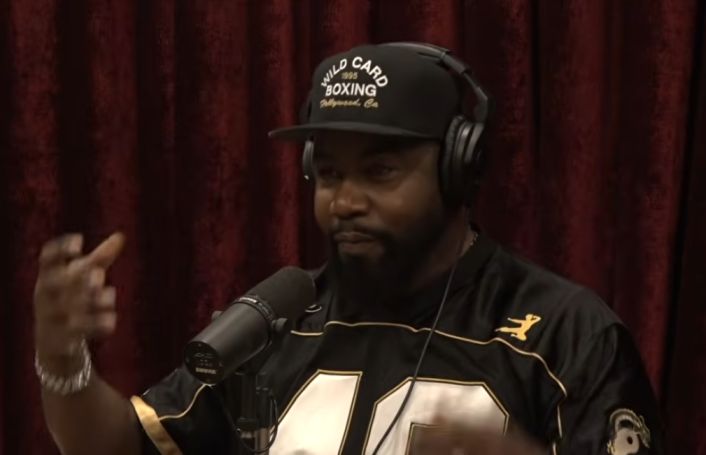
Editor’s Notes: In this episode of the Joe Rogan Experience, Joe Rogan connects with martial arts icon and actor Michael Jai White to look back at their shared roots in the early California combat sports scene and the legendary gyms that shaped them. The two discuss Michael’s unique upbringing and his deeply philosophical approach to life, which includes an appreciation for diverse influences ranging from his “hood” roots to the music of Joni Mitchell. They also dive into the future of longevity, highlighting the work of organizations like A4M and how modern health breakthroughs are helping people stay in peak physical condition as they age. (Feb 18, 2026)
TRANSCRIPT:
Welcome and Catching Up
JOE ROGAN: You’re all suited up. You got a Wild Card Boxing hat on, a Bruce Lee shirt. Come on, son.
MICHAEL JAI WHITE: Hey, we got the yellow thing going on.
JOE ROGAN: Yeah, you got it all going on. What’s happening? Great to see you.
MICHAEL JAI WHITE: Man, things are really… well, this thing is a little loud.
JOE ROGAN: Is it? There’s a little volume on that thing there.
MICHAEL JAI WHITE: Okay, knob.
JOE ROGAN: You can turn that sucker down.
MICHAEL JAI WHITE: There it is.
JOE ROGAN: Last time I saw you was at Terry Black’s Barbecue.
MICHAEL JAI WHITE: Yeah, yeah.
JOE ROGAN: Random run-in.
MICHAEL JAI WHITE: Yeah. That was crazy. Yeah, man, I was thinking about going there right after this. Terry Black’s, that place was no joke.
JOE ROGAN: That place rules.
MICHAEL JAI WHITE: Yeah, man.
Life in Los Angeles
JOE ROGAN: Are you still in LA?
MICHAEL JAI WHITE: Yeah, yeah, yeah.
JOE ROGAN: What’s it like?
MICHAEL JAI WHITE: It’s cool, man.
JOE ROGAN: Is it? You like it? You’re the only person that said that.
MICHAEL JAI WHITE: Yeah, well, I defend LA in a way where, first of all, if you got a handful of good people with you, your family, then the fact that LA has all kinds of different things is great. You could be on a hiking trail in 20 minutes.
JOE ROGAN: Well, geographically it’s amazing.
MICHAEL JAI WHITE: Yeah. And the weather, you can’t beat it. So if you got good people, good friends with you, then it’s all good.
JOE ROGAN: You just run by crooks. It’s a nice neighborhood run by the mob, run by the woke mob. But geographically, you can’t beat it. You could be at the ocean and then you could be in the mountains in two hours.
MICHAEL JAI WHITE: Yeah, yeah. So even if you don’t partake, it’s still cool. It still amps up the ante, really.
JOE ROGAN: Oh, yeah. The spot itself is magical. It is a magical place to live. Although I am deeply concerned that that motherf*er is going to get hit with a big one soon.
The Big Earthquake Fear
MICHAEL JAI WHITE: It’s about time, right?
JOE ROGAN: Yeah. I was reading this article about massive earthquakes in California and how often they’re spread out, and the possibility of one of them happening within the next decade is very high.
MICHAEL JAI WHITE: Yeah. You know, I try not to think about that.
JOE ROGAN: I try not to think about it, too.
MICHAEL JAI WHITE: Yeah. But I think they have better detection of that stuff now. It’s better.
JOE ROGAN: It doesn’t matter. They can’t detect it. Do you remember what happened in Italy? A couple of guys got arrested and went to jail. They were seismologists because the country didn’t understand the ability to detect it. They had a big earthquake and a bunch of people died. And so they blamed these geologists, or seismologists. They wound up winning in court on appeal because eventually the science was revealed. Like, “Hey, there’s no way you can really tell.” But they hung these guys out. They blamed these guys for not being able to detect it, man.
MICHAEL JAI WHITE: Well, I mean, just think about it. The last crazy ones were ’72 and then ’94. Yeah, right.
JOE ROGAN: I think it was ’93. I moved to LA right after the last big one. I saw one of the sections of the highway that had collapsed on the other one. I remember driving by, going, “F* this place.”
Michael Jai White’s 1994 Earthquake Story
MICHAEL JAI WHITE: I was right in the middle of it. I had just come into LA.
JOE ROGAN: Oh, you were there.
MICHAEL JAI WHITE: Dude, I don’t even like to tell the story about what happened during that ’94 earthquake because it sounds like bullshit. But literally, I got up, ran out of my house, my apartment at the time, jumped off the balcony, and watched it happen.
JOE ROGAN: You watched the house collapse?
MICHAEL JAI WHITE: I watched the earthquake happen from outside. It’s like, no bullshit. So I thought, “Oh, shit, I overreacted. I had a bad dream.” I lived on the first floor of this apartment building. All I know is I wake up, I’m off balance, catching my balance in the parking lot. And I’m thinking, “What? Have I lost my mind or something?”
The next thing you know, everything shakes and the lights go out. Everything gets black. So I back up, I retreat, because I’m thinking the building is going to fall on me. And then I got the story from everybody else that experienced it. They said that the first thing that happened was the building shook and the lights went out. Well, I was outside watching that. So I’m outside when it happened, like some kind of camera.
JOE ROGAN: What made you jump over the…
MICHAEL JAI WHITE: I don’t know.
JOE ROGAN: You had a feeling, dude?
MICHAEL JAI WHITE: Or did you have, like, the first rumbles?
JOE ROGAN: Was it the first rumbles?
MICHAEL JAI WHITE: I thought I reacted to some kind of aftershock or some kind of rumble. No, because the girl that was with me…
JOE ROGAN: You left her in the apartment, dude.
MICHAEL JAI WHITE: All she knows is that I jumped up and ran out of the house.
JOE ROGAN: How weird. Yeah, you got good instincts.
MICHAEL JAI WHITE: I don’t know what the hell that was.
JOE ROGAN: It has to be instinct.
MICHAEL JAI WHITE: I don’t even like telling that story because it sounds like bullshit. It really happened that way. Because then I talked to the guard. I’m like, “Hey, when did the lights go out?” He said, “Oh, it shook and the lights went out.” I’m like, “I was watching that happen.”
JOE ROGAN: So you felt it before it happened.
MICHAEL JAI WHITE: In some kind of weird way.
Animal Instincts and Human Intuition
JOE ROGAN: Well, I bet humans have that. Animals definitely have that. They talk about Thailand, how they had that tsunami, and all the animals ran up to the highest point of the island. They all just took off. It’s like they just knew instinctively.
MICHAEL JAI WHITE: Nothing like that has ever happened to me afterwards. But I’ve got to say, I’ve been lucky over the years.
JOE ROGAN: Yeah, but you’re a dude who’s tuned in. You’re tuned into your body, you’re tuned into your environment. You’re not going to get caught slipping. You probably felt something and your spidey sense went off.
MICHAEL JAI WHITE: Yeah, I kind of have been like that growing up. I’ve been on my own since I was 14. Been through crazy shit that you normally would only see in movies.
JOE ROGAN: And that’s the type of shit that gives you those kinds of instincts.
MICHAEL JAI WHITE: Yeah. And I was always the one that said, “Hey, let’s leave, let’s get out of here.” And then, “Hey, man, there was a shootout that just happened right after you left.” Or I could detect the predators. So I grew up kind of that way.
Growing Up Fast: On His Own at 14
JOE ROGAN: Nobody was looking out for you. You got to look out for yourself.
MICHAEL JAI WHITE: Yeah, I mean, I was always the junior of the group a lot of times. Like I said, I’ve been on my own since I was 14. I haven’t grown an inch since I was 13 or 14. I looked like a grown-ass man. I was fighting in tournaments at 15 against grown men, fighting heavyweight at that time. But I was always hanging with older people. I kind of got away with living as an adult early on.
JOE ROGAN: Did you work?
MICHAEL JAI WHITE: Yeah, well, I was teaching a karate class. See, I used to hang out at this community center in the hood. At this time, I had moved from Brooklyn to Bridgeport, Connecticut.
JOE ROGAN: Bridgeport’s tough.
MICHAEL JAI WHITE: Yeah, yeah, it was.
JOE ROGAN: A lot of people don’t know.
MICHAEL JAI WHITE: Yeah, we had the top murder rate per capita. Bridgeport’s rough. So I was constantly… I mean, there was a community center that was like my haven, and I would go practice with me and my other karate nuts. I’d be in the paper for winning heavyweight competitions or whatever. And so the people running the community center said, “Why don’t you teach a class?” They thought I was an adult.
JOE ROGAN: Oh, that’s hilarious.
MICHAEL JAI WHITE: So I was getting paid under the table, basically. But I had close to 200 students early on, when I was 15 or 16.
JOE ROGAN: Oh, that’s crazy.
MICHAEL JAI WHITE: Yeah, so it was kind of a trip. Which is one of the reasons why I was a father at 15, because one of my students’ older sisters had a crush on her instructor. But I was kind of living the life of a grown-up early on. And there’s a faction of people in Bridgeport who think I’m Satan, I guess, because they think I’m probably in my 70s.
JOE ROGAN: You’re a vampire, right?
MICHAEL JAI WHITE: Yeah. So there are some people I had to admit to, like, “No, I wasn’t the age you thought I was back then.”
Martial Arts as a Haven
JOE ROGAN: Oh, that’s crazy.
MICHAEL JAI WHITE: Yeah. One of the things I’m really grateful for is growing up that early and having to use my instincts. Street fighting and fighting was my favorite thing to do, actually. And so when I got into the martial arts deeper, I just really dug into it and wanted to learn style after style. I was just a martial arts nerd for it. But I also liked the realistic portion of it, even though I was doing other styles like wushu and everything else. It was actually my haven.
Training Together: A 29-Year Connection
JOE ROGAN: Eddie Bravo has to find this video. There’s a video of us working out together at Legends where we were talking about hopping sidekicks and different types of sidekicks. You threw a hopping sidekick on this bag that had a shitty chain, and the chain snapped and went flying, the bag went flying. And Eddie Bravo was like, “What the f*?” It’s a funny video, man. I know Eddie has it somewhere. I’ll probably text him after this and try to see if he can put it up on his Instagram or something.
MICHAEL JAI WHITE: If he can find it. Yeah, back then, man, we were training when it wasn’t even popular. I see you in the gym all the time. Yeah, all the time, man. And think about this — do you know it was 29 years ago the last time you interviewed me? Yeah, that’s right, 29 years ago.
JOE ROGAN: That was after the Bob Costas show. He took a week off and I guest hosted it for a week.
MICHAEL JAI WHITE: And at that time, you were already training with Maurice Smith.
JOE ROGAN: Yes, Maurice was one of the guests.
MICHAEL JAI WHITE: Right. I ended up training with Maurice Smith too. Every time I go to Seattle, we trained together. So we’re like part of this kind of karate, martial arts nerd culture.
JOE ROGAN: Yeah.
MICHAEL JAI WHITE: When it wasn’t even popular.
JOE ROGAN: No.
MICHAEL JAI WHITE: I used to see you all the time, doing jiu-jitsu, Caro Parisian, and all these guys. Legends. Where was another place? There was Legends and there was another place.
JOE ROGAN: The Bomb Squad. Yes, the Bomb Squad was the first place that Eddie taught at. And then that place closed down. Then we went to Legends and then we moved to the other Legends that was more east LA. And then Eddie started opening up his own place in downtown.
MICHAEL JAI WHITE: Yeah, and that’s where I would train with Josh Barnett at that place. Yeah, quite a bit.
JOE ROGAN: Yeah.
MICHAEL JAI WHITE: Yeah, man.
JOE ROGAN: The old days.
MICHAEL JAI WHITE: Yes, man. And who would be coming through the gym? Because I was training Bob Sapp at one time, and that’s how I got Frankie Lyles connected into that.
JOE ROGAN: Wow.
MICHAEL JAI WHITE: And so I remember Frankie.
JOE ROGAN: Frankie used to be at the Bomb Squad first, right?
MICHAEL JAI WHITE: Yeah, Frankie was like my best friend in the world. And he was super middleweight champion of the world. That’s who got me deeply into boxing. And so I would always be at his training camps, and I got to train with Tommy Hearns and all these amazing people, like Sugar Ray and all these guys, man. Frankie’s a great boxing coach.
JOE ROGAN: Yeah, he’s one of the most technical guys I’ve ever worked with. Like, he analyzes every aspect of your jab. He’s pulling in your elbow, tightening this, moving you here. He’s showing all the various basic, little, tiny details that make all the difference in the world.
MICHAEL JAI WHITE: Yeah, man. He was my personal boxing coach. I would train with him and Joe Goosen early on, but Frankie and I really kind of combined a lot of things. Because I started kind of teaching him things with the jab, like the untelegraphed type of stuff, and he started applying that. He would bring me into stuff and have me show people like Sugar Ray. Like, “Oh, Mike, explain this jab.” And I’m like, “What? I’m explaining this to Sugar Ray? This feels ridiculous.” But it was like this combination because I’m very analytical, and I love technique. And so I would just try to break things down. My whole thing was always to pressure test things. So if I could develop a tool or a skill and you can’t stop it, even if I tell you what I’m doing, then it’s a really good technique. Then it’s legit.
The Art of the Untelegraphed Strike
JOE ROGAN: The thing about no telegraph at all, it’s so much more effective than a harder strike with a telegraph.
MICHAEL JAI WHITE: Oh, God. Yeah.
JOE ROGAN: Because it lands. But it’s so difficult to teach people that. Because everybody wants to hit as hard as they can. Especially if you have power, your instinct is to f* and load up on everything. I remember I first saw you teaching that to Kimbo Slice.
MICHAEL JAI WHITE: Oh, yeah, yeah.
JOE ROGAN: You were on a movie set.
MICHAEL JAI WHITE: Yeah, yeah. Kimbo, oh, man, what a great guy, man.
JOE ROGAN: What a great guy.
MICHAEL JAI WHITE: What a wonderful guy. So that’s one thing about fighting — you can’t hide your nature. People see who you are. And he was a wonderful human being. But like a lot of people, almost like street basketball as opposed to professional, you miss out on certain techniques that you need when you’re trying to step up.
And so with Kimbo, like a lot of people, he would kind of telegraph. So when we were shooting the movie, we had a cameraman that did not really know how to shoot stuff, so I just had to do everything on screen. I just wanted to make everything very realistic. And so Kimbo had this rubber knife and I was like, “Try your best to touch me with the rubber knife.” And so he would try, but as soon as he would move, there’d be a little bit of an indication that I’d see. And then I’d throw the punch and it would go really close to him and I’d have him react to that.
But he was going, “Wait, wait a minute. How are you hitting me before I can get this knife out?” And then I told him, “I’ll show you what that is later.”
Because, not to be real nerdish about it, but why are 50 and 60-year-old trainers meeting a 20-year-old contender’s hands like this? You see the person with the pad moving just as much as the other guy, because there’s an indication there. They do this beforehand — they’re always kind of flexing and going in reverse before they go forward. So over the years, I wouldn’t do that, and I would exploit that. It’s kind of like a cheat code. And I’m like, “What the hell am I going to do with it? I’m an actor.”
So my thing is, just like yourself — when I see you with Georges St-Pierre and how we are always in the gym, we’re kind of collaborating. It’s about just getting better. No ego or anything else like that. It’s just like, “Hey, man,” we’re kind of jamming on technique and getting better.
JOE ROGAN: Well, especially someone who has a different style.
MICHAEL JAI WHITE: Yeah.
JOE ROGAN: Because there’s always something in different styles that you could take out of it.
MICHAEL JAI WHITE: Absolutely.
JOE ROGAN: There’s always something. And we’re seeing that now. There’s all these different martial artists entering into MMA that are bringing these different techniques that people haven’t seen before. And there’s a lot of them that people dismiss that you’re finding are very effective, especially if you don’t know how to do them. You don’t know what they are. You have like a database in your mind of movements. I’m sure you see when a guy’s loading up on a spin.
MICHAEL JAI WHITE: Oh, yeah. Everybody sees that.
JOE ROGAN: But if you don’t know that, you don’t see it, right?
MICHAEL JAI WHITE: And if you were loading up, then you’re not going to capitalize on it, right? Because you’re taking a millisecond because your movement is not efficient.
JOE ROGAN: There’s a move that still to this day, people aren’t doing effectively when someone loads up — because you could see the load up and it’s just a jam. It’s just lifting your foot up and putting it on the hips. And it’s super effective in Taekwondo because everybody’s fast, everybody’s trying to do that technique. But that jam of just lifting your foot up and not trying to hit them hard, just putting that foot on the hip, it f*s people up. And I don’t see anybody using that right now.
Learning From Every Discipline
MICHAEL JAI WHITE: I tell you, man, as in life, there’s always something you can gain from. People are in their own egos a lot of times. But even wushu is hard as hell for me. Doing wushu against guys half my size — it’s a performance thing, right? But if I can do all of it and go to these very hard techniques, like I’ve got to get down to the floor and have body mastery at my size, then I’m better. So if I want to kick you in the eyebrow, I can, because it’s about having my body do what my mind’s telling it to.
But of course, people want to dismiss it because, “Oh, that ain’t real. You can’t use it.” Yeah, good. Just like ballet is hard as hell — you can’t use that either. But any heavyweight who put themselves through ballet would be a better fighter, 100%.
JOE ROGAN: Look at Lomachenko. His dad taught him Ukrainian dance. His dad pulled him out of boxing for two years when he was young.
MICHAEL JAI WHITE: Yeah.
JOE ROGAN: And said, “You’re just going to do Ukrainian dance.”
MICHAEL JAI WHITE: Yeah.
JOE ROGAN: Like, “What the f* am I doing?” But look at that guy’s footwork.
MICHAEL JAI WHITE: Exactly, exactly. And so it’s just that, as in life, man, I don’t look at anything from one group and just discard everything else.
JOE ROGAN: I used to, when I was young.
MICHAEL JAI WHITE: Yeah.
JOE ROGAN: When I was young, I was pretty arrogant about certain things. I thought forms were stupid. All I wanted to do was spar and hit the bag.
MICHAEL JAI WHITE: Yeah.
JOE ROGAN: Then as I got older, I realized there’s a lot of wisdom in all this stuff.
MICHAEL JAI WHITE: Oh, absolutely. But that’s, like I say, I try to apply that to life, period. I never look at anything from one perspective. I mean, I grew up in the hood and my favorite band is the Eagles.
JOE ROGAN: Really?
MICHAEL JAI WHITE: Yeah, I mean, I’m listening to Joni Mitchell and all that, and people are like, “What are you doing?”
JOE ROGAN: Listen.
MICHAEL JAI WHITE: I’m like, “What the f? This is my life, man. F you.” You hear these lyrics — you hear Joni Mitchell’s lyrics, man. What the f*? That’s all for me, too. I mean, I’m just as passionate about Aerosmith as I am about the Isley Brothers. But I’ve never looked at life as, “I have to think within this parameter.” I’ve got to be marginalized? That’s just — man, come on. It’s such a waste of life.
JOE ROGAN: It is.
MICHAEL JAI WHITE: It’s all for you, man. So I agree with the martial arts and everything else. I look at every martial art just like everything else — everything has something to contribute. Just like all people have something to contribute. Even an idiot. You can learn from an idiot.
JOE ROGAN: You can. A lot of idiots say wise things occasionally.
MICHAEL JAI WHITE: Yeah. Because everybody’s going to have a quotient of legitimacy — maybe 20% of a thing. And they don’t see the 80%. But until you acknowledge that 20%, they’re not going to hear you. So that’s the thing.
It’s like, man, we’re on this planet. And one of the things — I don’t envy a whole lot of people, but, dude, I do envy you because you get to expand your world. You talk to so many interesting people. What a great thing to just have all these perspectives coming through.
And I’ve got to say, man, I’m super proud of you. Because I know you as Joe from the gym, and look what you’ve done, man. That’s a shot in the arm. Because seeing people that you like prosper — that’s cool as s*.
Remembering the Early Days
JOE ROGAN: Yeah, I’ve learned a lot, man. And I didn’t expect to. When we first started doing this, it was just for fun. We’d just get together with our friends.
MICHAEL JAI WHITE: You knew what you wanted to do, man. You were pretty damn clear. Because do you remember this — you remember me coming to, I think it was the Ice House in Pasadena? No, no, no. It wasn’t the Ice House. It was in Orange County. I came to see you perform and I offered you the role in Blood and Bone. Do you remember that at all?
JOE ROGAN: I do, yeah. I do now. Yeah. Okay.
Blood and Bone, UFC, and the Best Fighting Style
MICHAEL JAI WHITE: Because Blood and Bone, which is Sony’s most successful non-theatrical release, was basically a re-imagining of Hard Times with Charles Bronson and James Coburn. Great movie. That role I was offering you was essentially the James Coburn role. But you were so set on your path. You said, “I don’t want to do this acting stuff. I want to focus on what I’m interested in,” which was stand-up, and you and Eddie were doing those early podcast-type things. I mean, you really knew what you wanted to do.
JOE ROGAN: Well, the thing about acting is, I admire it, especially good acting, but it takes a lot of time.
MICHAEL JAI WHITE: Out of your day.
JOE ROGAN: It’s a 16-hour day. It’s a long day, and it will take away from other things you do.
I saw that with a lot of comics who started doing acting — it would take away from their actual craft. They really couldn’t go and do sets every night. They couldn’t polish their material. You could see stuff getting a little clunkier. You have to focus. You have to find the things you enjoy and focus on them.
MICHAEL JAI WHITE: That’s why I say I’m so proud of just being there and seeing what you did — being a part of the UFC when nothing was promised.
JOE ROGAN: Not only was it not promised, but people looked at you like you were doing snuff films or something.
MICHAEL JAI WHITE: Exactly.
JOE ROGAN: I remember the early days, man. Dana White always says this — people would talk to you like you were doing porn or something.
MICHAEL JAI WHITE: Right, right.
JOE ROGAN: I was on NewsRadio, the sitcom on NBC, and I was doing commentary and post-fight interviews for the UFC. And people were like, “Why are you doing this? Why are you flying to Alabama and doing cage fights?”
MICHAEL JAI WHITE: See, this is what movies are made of — somebody just following their spirit, doing what they want to do with no promise of anything, and then accomplishing something. Kudos, man.
JOE ROGAN: Oh, thank you.
MICHAEL JAI WHITE: Seriously, man.
What Is the Best Fighting Style?
JOE ROGAN: For me, and I’m sure for you as well, when we were young, there was always the question: what is the best style? Is it Kyokushin? Is it Judo? Is it Kung Fu? No one really knew. I mean, Benny the Jet fought in a bunch of those no-rules fights early on, but they never really took off. And Benny was obviously a very special fighter.
MICHAEL JAI WHITE: Oh, yeah. He was one of my teachers, too.
JOE ROGAN: Oh, yeah? I trained at his gym. He was on the podcast recently with Blinky Rodriguez. I told them, when I came to LA, there were two places I had to go — the Comedy Store and the Jet Center. I was there in ’94, right before it went under, because the earthquake damaged their roof.
MICHAEL JAI WHITE: Exactly.
JOE ROGAN: And when the rainy season came—
MICHAEL JAI WHITE: It was on Fire Street.
JOE ROGAN: Yep, yep, yep.
MICHAEL JAI WHITE: Right next to the Goosens.
JOE ROGAN: Yeah, right down. That was an honor, man, to be able to train in that gym. It was incredible.
MICHAEL JAI WHITE: Oh, yeah. Those were some great times. I connect with Benny because when I was in Bridgeport, my instructor, Matty Malise, went to California and started training with Benny early on. He put that on the map — coming to the Mecca.
JOE ROGAN: It was the Mecca. For kickboxing, especially in the ’90s, that was the Mecca. You had to go to the Jet Center.
MICHAEL JAI WHITE: Yeah, man.
The UFC and the Rise of Jiu-Jitsu
JOE ROGAN: We were always wondering, what is the best style? And then the UFC came along. I’m like, “Oh my God, they did it. They figured it out.” They put it all together. And for a while, it was Jiu-Jitsu, because nobody understood Jiu-Jitsu, and Royce Gracie was just running through everybody.
MICHAEL JAI WHITE: Well, you know how that was kind of set up a little bit?
JOE ROGAN: It was a little set up.
MICHAEL JAI WHITE: Yeah, yeah.
JOE ROGAN: But look, he had some real challenges. Ken Shamrock was a beast. He was facing some really good fighters — he went against Kimo. Kimo was huge.
MICHAEL JAI WHITE: He was a big dude, but he didn’t really—
JOE ROGAN: Well, it was a hundred-pound advantage. Kimo had 100 pounds over Royce.
MICHAEL JAI WHITE: The Gracies were smart. They were very smart at that time in knowing the right people to pick, because there were some killers out there.
JOE ROGAN: There were some killers out there. Yeah, they definitely set it up, especially the early ones. But it was also good for us to see a guy like Royce who wasn’t jacked — a slender guy who only weighed 175 pounds — strangling everybody and arm-barring everybody. It was wild to see when he beat Dan Severn. Dan Severn was 260 pounds, and Royce tapped him off his back with a triangle.
MICHAEL JAI WHITE: Yeah, man, what a story. That put Jiu-Jitsu on the map in a big way. But one thing that always broke my heart is that people never knew about Rickson.
JOE ROGAN: Right.
MICHAEL JAI WHITE: Oh my God, I know that dude. That cat was like — I always consider him pound for pound the best, because he had not only Jiu-Jitsu skills, but his concentration.
JOE ROGAN: Yeah.
MICHAEL JAI WHITE: He was almost hypnotic. No waste of energy.
JOE ROGAN: None.
MICHAEL JAI WHITE: Just unbelievable. What an amazing person to watch. I would encourage anybody to pull up his fights.
Rickson Gracie — A True Legend
JOE ROGAN: He did some great David versus Goliath stuff. Another great example of cross-training too, because Rickson got really into yoga and everybody was like, “What the f* are you doing? Yoga? Yoga’s for girls.” But Rickson got really into yoga, got super flexible, and got really good at controlling his breathing.
MICHAEL JAI WHITE: Oh, yeah, yeah.
JOE ROGAN: And he never got tired.
MICHAEL JAI WHITE: Yeah. You saw him in that documentary, Choke. Oh yeah, yeah. Talk about a legend.
JOE ROGAN: Oh, a real legend.
MICHAEL JAI WHITE: Yeah, man.
JOE ROGAN: There’s a video of Rickson — and he did this multiple times — where he would go to gyms, teach a long seminar, and then roll with all the black belts, tapping them one after the other. World champions, guys who just didn’t understand what was going on. Like, “How is this happening?”
Paulo Filho, when he was a WEC world champion and had won the Mundials — multiple Jiu-Jitsu championships — he trained with Rickson and said, “Man, it’s true. I can’t believe it. That guy treated me like I didn’t even belong in there.” And Rickson by that time was probably around 40.
MICHAEL JAI WHITE: Yeah.
JOE ROGAN: And he was still just dominating guys on the mat, effortlessly. It wasn’t strength — it was pure technique and basics.
MICHAEL JAI WHITE: Mastering of basics.
JOE ROGAN: Oh, yeah. None of the berimbolo, no X-guard, nothing crazy. Everything he did was Jiu-Jitsu 101, but to a masterful degree.
MICHAEL JAI WHITE: Yeah, it’s incredible. And when I tell people that, because everybody knows Royce, I’m like, “Do you guys know who his big brother is?”
JOE ROGAN: Royce would openly say that his brother is ten times better than him.
MICHAEL JAI WHITE: Right, yeah, yeah. And I love Jiu-Jitsu because it has held up the tradition that martial arts — so much karate — lost, because it became a business. People would just put their time in and pay for their black belts.
JOE ROGAN: Right.
MICHAEL JAI WHITE: It just watered it down. All these people running around saying they’re a “master” of this or a “grand” whatever, with all these made-up titles. Like, “Oh yeah, the guy’s a master in an Asian martial art” — that’s an English word.
JOE ROGAN: Right, right.
MICHAEL JAI WHITE: How did “master” sneak its way into it? But anyway — male ego, you know.
The Honesty of Grappling
JOE ROGAN: Well, the thing about martial arts other than Jiu-Jitsu is that when you’re sparring, it’s very controlled. A lot of karate sparring is very controlled. A lot of Taekwondo sparring is very controlled. But in Jiu-Jitsu, the beautiful thing about grappling is you know exactly how good everybody is, because they’re all rolling with each other — going full blast until the tap.
MICHAEL JAI WHITE: Yeah.
JOE ROGAN: There’s no hiding your skill.
MICHAEL JAI WHITE: Yeah. I love what Eddie Bravo used to say: “When I tapped you, I killed you.”
JOE ROGAN: Yeah.
MICHAEL JAI WHITE: “I just killed you.” That is a trip, because it actually works out that way.
JOE ROGAN: Oh, yeah. If he gets you in a triangle and you tap, it’s because you were about to go to sleep.
MICHAEL JAI WHITE: Yes.
JOE ROGAN: And once you’re out, he just stomps your head into a pancake.
MICHAEL JAI WHITE: Yeah, yeah. You’re done.
JOE ROGAN: Just hold on to that triangle, and you never wake up.
MICHAEL JAI WHITE: What a humbling thing.
JOE ROGAN: Very humbling. And what’s really humbling is how quickly someone can do it to you when you don’t know what you’re doing. That was shocking to me, because I had all this martial arts experience, and when I first started training, I thought, “What’s someone going to do to me? I wrestled in high school. I’m strong, I’m fast.” I just got manhandled over and over again.
MICHAEL JAI WHITE: Oh, yeah.
JOE ROGAN: It was ridiculous.
MICHAEL JAI WHITE: See, but kudos to you, because a lot of people — if you’ve got an ego going and you’re comfortable with your black belt and all that — that means nothing. Everybody I know who continues to really learn real fighting knows that moment when a boxer beats the hell out of you and you go, “Oh, wait. There’s a lot of stuff I have to toss out the window.”
I never forget times where a wrestler got to me or a boxer pieced me up early on. I’m like, “No, I have to learn this.”
JOE ROGAN: Oh, yeah, yeah. I went through several of those. One of them was in high school. I had a friend who was a wrestler, and I didn’t think anything of wrestling. I thought, “That’s not even a martial art.” And then we wrestled on the grass one day, and he just took me down at will.
MICHAEL JAI WHITE: Yeah.
JOE ROGAN: I was like, this is ridiculous. He was pinning me down. I couldn’t move. I couldn’t get up. I’m like, this is stunning.
MICHAEL JAI WHITE: Right?
JOE ROGAN: I thought I’m strong. I thought I could move. I thought I’ll be able to get out of the way. I had no chance. And he wasn’t even a great wrestler. He was just a decent wrestler. He just humbled me. Over and over and over again.
So then I started wrestling. Then when I got into taekwondo, I thought I’m really good at taekwondo. I was competing on a national level. I won the state championships four years in a row. I was f*ing people up.
And then I remember the first time I boxed with a really good amateur boxer. I was like, oh, Lord. And this kid was 18 years old, and I was at the gym. His name is Dana Rosenblatt. He went on to become New England middleweight champion. He beat Vinnie Pazienza. He beat Howard Davis Jr. As a professional, he was a really good boxer.
MICHAEL JAI WHITE: Wow. Yeah, he had to be.
JOE ROGAN: But he was kickboxing at the time, and I was going to get into kickboxing, so I was sparring with him. But when I was boxing with him, I was just getting lit up. And then also when we’re kickboxing, the moment he got close to me, I was like, oh, no. Taekwondo had too many flaws. The hand techniques. So I had gone through that.
And so then I thought, okay, well, now I understand kickboxing. Then I met a dude who went to Thailand a bunch of times and was training Muay Thai and fighting over there. And then I started learning leg kicks. I’m like, oh, good Lord. Now all they have to do is kick my legs. I didn’t even think of that.
And then I started really paying attention to WKA fights, like the old Dennis Alexio days with Don the Dragon Wilson. Leg kicks. Leg kicks are everything. Oh, my goodness.
And then I’m like, okay, well, now I got a solid foundation. I understand how to fight. And then I started getting into jiu-jitsu. Oh, no. Back to square one. I was just getting mauled on the mats. But I’d been through that so many times and restarted so many times, I was like, well, it’s time to learn this now.
The Dunning-Kruger Effect in Martial Arts
MICHAEL JAI WHITE: Yeah. That’s what I’m saying — everything has something to teach you. And even though there’s a fantasy world with martial arts, which I look at as hilarious, sometimes I would say it like this: with martial arts, it’s the Dunning-Kruger effect in the largest way possible. Because everybody out there has an opinion of martial arts, though very few people really know what it is.
They want to look at the movies and everything, and they really want to believe that this guy who kicks in the air and all that kind of stuff will be able to beat a champion. And in a way, hey, I benefit from that to some degree because they think that about me. But I’m comfortable fighting and I love to — I just love fighting against anybody.
JOE ROGAN: Well, you’ve had actual competition experience, like a lot of competition.
MICHAEL JAI WHITE: Yeah, but my best experiences were when I got a chance to train against champions at their place, when they’re at their best. And it’s not an ego thing. It’s just that I love to be able to test myself. I mean, because I’m my biggest competition. And so that whole thing about what the bow means to me is like, “Thank you for making me better by providing me an obstacle.” And the higher, the better the person —
JOE ROGAN: The better I can become. 100%.
MICHAEL JAI WHITE: And so I loved it. For years, I’m in there with Gokhan Saki, Mauricio “Shogun” Rua, you name it. I consider myself one of the luckiest martial artists on the planet because I get to train with so many people, sometimes at my house. I’ve got all these former champions training — Rampage, when he was champion, I’d go to his place.
And honestly, the things I brag about are when I get humbled, because that’s when I learn something for sure. My philosophy is I love to be wrong. Because every time I’m wrong, I learn something.
JOE ROGAN: Absolutely.
Sparring with Michael Bisping
MICHAEL JAI WHITE: Some of the best times for me — like when Michael Bisping was getting ready to fight Georges St-Pierre, and we were in Thailand. I was like, yeah, let’s mix it up.
JOE ROGAN: What were you doing in Thailand?
MICHAEL JAI WHITE: Oh, we were doing a movie out there.
JOE ROGAN: Oh, wow.
MICHAEL JAI WHITE: But he had to train. He was getting ready for the Georges St-Pierre fight. And so I was like, yeah, let’s do some rounds. And I got so winded in the second round. I’m like, dude, just whoop my ass. I feel so embarrassed.
JOE ROGAN: Bisping was a cardio machine.
MICHAEL JAI WHITE: Yes, he was.
JOE ROGAN: He was a cardio machine.
MICHAEL JAI WHITE: I didn’t expect that because we had spent all day on a yacht the day before, and he was drinking nonstop. I’m a non-drinker, right. I’m like, this guy’s going to — I’m probably going to take it easy on him today.
JOE ROGAN: He is one of the toughest motherf*ers that ever fought in the sport. I swear. No matter what you think about watching his fights, you have to understand — not only did he accomplish so much, he accomplished a lot of it with one eye. One eye. He had 11 fights in the UFC with a winning record. With one eye.
MICHAEL JAI WHITE: Yeah.
JOE ROGAN: Crazy.
MICHAEL JAI WHITE: Yes. Yeah, that’s, man.
JOE ROGAN: He would memorize the eye chart so that when they covered his eye, he could recite it like he could read it.
MICHAEL JAI WHITE: Oh, yeah, yeah.
JOE ROGAN: How crazy is that?
MICHAEL JAI WHITE: He’s got a hell of a personal story, too. I was trying to encourage him to get that made. Honestly, man, I really look at these UFC fighters and the MMA guys as our modern-day heroes. They’re our gladiators. And so whenever I have a chance, I always like to put them in movies and try to expose them to another way of getting paid, especially afterwards. Because it breaks my heart that they’re heroes and then they get discarded sometimes — not by the organization they’re with, but just by the fans. They’re so fickle sometimes.
JOE ROGAN: Yes, well, the casuals — the people that aren’t really martial artists.
MICHAEL JAI WHITE: Right. Yeah.
JOE ROGAN: They just dismiss a guy when they lose a few.
Working with MMA Fighters on Film
MICHAEL JAI WHITE: Yeah. I just did my third movie with Donald “Cowboy” Cerrone. We just finished a little over a week ago.
JOE ROGAN: Oh, that’s awesome.
MICHAEL JAI WHITE: Yeah, he’s doing really good, man.
JOE ROGAN: I love that.
MICHAEL JAI WHITE: Yeah. Yeah, me too.
JOE ROGAN: That’s a guy that could really legitimately transition to a movie star.
MICHAEL JAI WHITE: Yes, yes. And he’s got a lot more confidence. Like I said, the third movie I did with him — he did a western with me, Outlaw Johnny Black. I wrote and directed it, and I had Cowboy, I had Randy Couture in it.
JOE ROGAN: Oh, wow.
MICHAEL JAI WHITE: And then Josh Barnett.
JOE ROGAN: Randy’s done an amazing job of transitioning.
MICHAEL JAI WHITE: Oh, absolutely.
JOE ROGAN: The Expendables, and he’s great at it. He has a great personality. Just very, very calm. I remember one time he was fighting Tim Sylvia for the heavyweight title, and he came out there with a smile on his face. He looked over at me and he winked. I’m like, how is this motherf*er so relaxed before he’s fighting?
But he had an amazing perspective. He said to me, “The people who love you will love you whether you win or lose.” And he said, “What’s the worst thing that can happen? You lose.” He goes, “You’ve lost before.”
MICHAEL JAI WHITE: Yeah.
JOE ROGAN: It’s no big deal.
MICHAEL JAI WHITE: Yeah. Remember him spanking Tito?
JOE ROGAN: Yeah. He got on top and was spanking him when he had him down.
MICHAEL JAI WHITE: Yeah.
JOE ROGAN: Randy was an animal.
MICHAEL JAI WHITE: Yeah. Well, he had that heart attack while he was shooting my movie.
JOE ROGAN: That’s crazy.
MICHAEL JAI WHITE: And he came back to set like nothing happened.
JOE ROGAN: How did he have a heart attack?
MICHAEL JAI WHITE: I don’t remember exactly how it was, but I think he drove himself to the hospital. Yeah, man.
JOE ROGAN: It’s —
MICHAEL JAI WHITE: Talk about an American hero, man.
JOE ROGAN: I mean, I was there for his first fight.
MICHAEL JAI WHITE: Really?
JOE ROGAN: Yeah. 1997. I was there for his very first fight.
MICHAEL JAI WHITE: Oh, shoot.
JOE ROGAN: He fought this huge jacked dude, took him down, mounted him, beat the sh*t out of him. It was wild. That was the time where wrestlers had first started cracking this code.
MICHAEL JAI WHITE: Right, right.
JOE ROGAN: There was a lot of people that thought jiu-jitsu was the only way. And then the elite wrestlers got in there — the Mark Kerrs, the Mark Colemans — and then Randy, a bunch of these guys got in there. And they realized, like, if a guy could just take you down and beat the hell out of you from on top, there’s not a whole lot you could do about it.
MICHAEL JAI WHITE: Right, right.
JOE ROGAN: And then we realized, boy, that is the true cornerstone of martial arts. The ability to take a guy down.
The Hardest Sport in the World
MICHAEL JAI WHITE: My goodness. I mean, what’s harder than wrestling? I don’t think there’s anything.
JOE ROGAN: The hardest sport in the world. Yeah, the hardest sport in the world, and the best sport in the world to get your kids into at a young age. Because the discipline and the mental toughness that they get will carry them through for the rest of their life.
MICHAEL JAI WHITE: Yep. Tenacity. Just the stick-to-itiveness, whatever you want to call it. Yeah. That’s just like, even high school wrestling.
JOE ROGAN: I remember wrestling in high school, and I had already done martial arts, but I’d never trained that hard. I was like, I can’t believe it. And then it carried me over into my taekwondo career because I realized, oh, I’m leaving a lot on the table. I’m not training like these guys are.
MICHAEL JAI WHITE: Right.
JOE ROGAN: So I started running. I started adding all these things to my training that I wasn’t doing before. I started doing a lot more calisthenics, a lot more different things. I’m like, I’m leaving something on the table. Because we were in the gym, and we were sparring hard, doing hard rounds. You’d get tired. But it was not the same as what we were doing in wrestling. No one trains harder than wrestling.
MICHAEL JAI WHITE: That’s anaerobic stuff, man. I got the wrestling bug when I was a senior in high school. The football coach was a wrestler in college, and he challenged me. I think we did this two years in a row — my junior year and my senior year. At the end of the year, he and I would wrestle. I was big for my age.
JOE ROGAN: Were you playing football?
MICHAEL JAI WHITE: I was for a very short time, but I ended up — I wasn’t designed for team sports.
JOE ROGAN: Me neither.
MICHAEL JAI WHITE: And I ended up beating up the football coach.
JOE ROGAN: Oh, no.
Growing Up Angry and Finding Purpose
MICHAEL JAI WHITE: Yeah. I had the worst temper than anybody I’d ever seen. I mean, I used to go into fits of rage. I was so angry early on, man. It’s like the Hulk saying, “Mike, you should chill out a little bit, man.”
JOE ROGAN: It’s probably from being on your own at 14.
MICHAEL JAI WHITE: What it is, is I was growing up in a very harsh environment, and I didn’t know I was an artist. I didn’t know I was a writer, director, whatever. You didn’t see those growing up where I am. And so when you’re a sensitive kid, what you do is you build armor — like I was to play Mike Tyson later on, and I understood him quite well.
If you’re sensitive, anything that’s precious, you put it in, you lock it in a safe, and you become the safe. I grew up, my brothers were completely different. They’re engineers, so things rolled off their back. But for me, I was just volatile. And luckily, I had martial arts to kind of put my focus into.
But like I said, like when I played Mike Tyson, I understood him a great deal. Even though you take the moniker of this monster, it’s only to hide what’s really deep inside. And that’s why you would see, if anybody’s going to go into tears in front of a million people, it’s people like Mike Tyson, and you go, “How does that fit in the same person?” And so that’s what I was growing up.
From Schoolteacher to Actor
MICHAEL JAI WHITE: I don’t know if you know this, but I was a schoolteacher before I was an actor.
JOE ROGAN: Oh, really?
MICHAEL JAI WHITE: Yeah, I taught — I was a special ed teacher. So I focused on a lot of kids who were very much like me. And I still do that, in a way. I consider that my real job. Whenever I’m off from work on a movie or whatever, I go into the inner cities, I go into community centers. I devote my time, because there’s nothing that I could do — there’s no better spending of time than something like that.
Because I was luckily saved. I had, just at the right times in my life, different seeds planted. And I’m confident that if those seeds were not planted, I would not be here. Because I’ve been through some crazy stuff.
JOE ROGAN: It’s a classic story.
Reconnecting With the Past
MICHAEL JAI WHITE: Yeah, man. Just a little under two years ago, a buddy of mine — a close friend — got out of prison. He was in prison for almost 30 years. And he found me on Facebook. So when I went back east, we linked up. I know a lot of people who have businesses and everything, so I hooked him up, got him a job.
We were sitting over lunch, and in the middle of him telling me the third or fourth story about the old days, I was getting myself set to correct him. Because I refuse to lie to my friends — I won’t even lie by omission. So I was getting set to tell him, “Dude, you’ve got to stop embellishing on these stories just because you were locked up and you made them sound bigger than life. I get it, but that’s not real.”
And in the middle of me thinking that, while I’m listening to him, I go, “Holy s*.” He’s telling the truth. I started remembering what he was telling me, and I’m finishing his sentences. Not only was that story true, but the other ones were true, too.
And, dude, every time I think about this, I get these goosebumps. I realize, “Oh my God, how close I was to being where he was — or just not being on this planet.” And I thought, I better devote my time into helping kids the way I was helped.
JOE ROGAN: Yeah. Don’t pull that ladder up.
MICHAEL JAI WHITE: No. Hell no. Even if I’m taken out, I accept that. Even if I’m in some projects where I’m not supposed to be, I accept that. Because, dude, I am abundantly lucky. Like, it doesn’t even fit on the radar how lucky I am. I can remember a lot of these crazy stories, aside from the ones that he made me conjure back up, and I’m just like, “Wow.”
JOE ROGAN: Well, that speaks to your character — that you had downplayed it all in your mind so much that you thought he was exaggerating.
MICHAEL JAI WHITE: I swept it under the rug. Yeah.
JOE ROGAN: Because you’re not that person anymore.
MICHAEL JAI WHITE: No. But there were so many events — things that I just call “a Wednesday” — that I went through. I wouldn’t trade it, because I continue to be the happiest guy I know because of some of that.
JOE ROGAN: Because you can appreciate the good times.
MICHAEL JAI WHITE: Oh my God, yeah. And I should be slapped if I complain about anything. What we’re doing, even right now — we’re in the service industry, man. You’re here to serve. In my opinion, that’s what we’re all here for. And it’s great that we get to serve doing the things that inspired us.
The Responsibility of a Platform
JOE ROGAN: That’s definitely a lot of what we do. You entertain, but I feel very blessed that I’ve been able to expose people to so many different ways of thinking, so much information, so many different human beings who have led completely different paths — who can tell you about whatever discipline they’re involved in, what they’ve learned, what we’re working on, what you can learn about the human mind, the body, ancient history — fill in the blank.
MICHAEL JAI WHITE: Yeah. And I see you do that over and over with utmost honesty. I remember when you had to pull Shab aside as a friend and tell him some things that are hard for other friends to say. That was real hard.
JOE ROGAN: Yeah, that was real hard because I love that guy. He’s a great person, a great human being. And I knew the path — I’d seen it too many times. But I hadn’t seen it with someone I was that close with. I was like, “You have to stop.” Not only that, you’re in the heavyweight division, so the knockouts are brutal, and you’re going to get three or four more in the next couple of years, and then you’re not going to recover from those.
MICHAEL JAI WHITE: So many people — I hope they take a page out of that, because it’s so unmanly, I feel, to just say nothing and allow somebody you love to go down a road that might be detrimental for them.
JOE ROGAN: Right.
MICHAEL JAI WHITE: And allow somebody you love to go down the road that might be detrimental for them.
JOE ROGAN: Well, it was also that Shab had another path. He was really good at podcasting. He’s fun, he’s a funny dude. As a podcaster, he’s got a great personality. He’s silly — he’s a big, giant, silly dude. We would have so much fun. And he was doing really well, making more money doing that than he was fighting.
But his identity was so wrapped up in being a top 10 UFC heavyweight. He had beaten world-class guys like Mirko, and he was legit, man. But that time had passed. He was one foot in and one foot out. And as soon as a guy’s one foot in, one foot out, you’re going to run into some guy who has both feet in and is a f*ing samurai — and then you’re going to wake up on a stretcher.
MICHAEL JAI WHITE: Yeah.
JOE ROGAN: You’re on the way to the hospital going, “What happened?” You don’t remember the fight, you don’t remember nothing. And then you don’t know where your keys are, you forget people’s names, you tell the same story over and over again, and you struggle to put sentences together. When you start seeing guys with the slur — man, nothing’s worth that. At the time, he was only 35 years old or whatever. I said, “Man, you’ve got another 45, 55 years of life. You can’t sacrifice all these years for glory that will never be achieved anyway, because you’re not on that path anymore.”
MICHAEL JAI WHITE: Yeah. And it’s not about what strangers say about you.
JOE ROGAN: No.
MICHAEL JAI WHITE: It’s about you — your friends, your family.
JOE ROGAN: Yeah.
MICHAEL JAI WHITE: The people who really love you.
JOE ROGAN: It’s just so hard for people to abandon that identity. That’s the hardest thing with fighters — to abandon that identity. We’ve seen so many guys, even the greats, come back when they shouldn’t, and you see them get humiliated.
MICHAEL JAI WHITE: Yeah. And when it comes down to it, these people — they don’t love you, man.
The Moment Everything Changed
JOE ROGAN: They love you as the image.
MICHAEL JAI WHITE: Yeah. They live vicariously through you. I remember one time I was in a fight in Boston, and something completely changed for me.
I always loved competing — kickboxing, tournaments. I think the thing I did best in the world was fighting. I always had these cheat codes, in a way, and I enjoyed the chess match of it. Anybody who was against me — I don’t care if you were my cousin — you’re going to pay for all the angst I’ve had in my life.
But there was this one time — I swear — I ducked a technique, I caught somebody with something kind of cool, and the audience just cheered. And in that moment, I was just angry. I thought, “This guy could really be messed up right now, and you’re cheering for me — living vicariously through me like I’m a pit bull or something.” And I got angry at the audience. I f*ing hated them. Because if I was down on the ground, they’d be cheering for the person who put me down.
And something just snapped. I said, “No, this is not enough for me. This is not what I want to do.” I’d much rather be skillful, test myself in a skillful way — show I could peel your head off, as opposed to actually doing it. That triumph of dominating someone meant nothing to me anymore. Something just rubbed me the wrong way.
After that, anytime I competed, it was for me — not for an audience. I always thought at one time I’d be called out, and I’d rise to that occasion. Kind of like the thing with you and Wesley, which would have been — oh my God — that would have been terrible.
Wesley Snipes and Jean-Claude Van Damme
JOE ROGAN: I think Wesley just needed money. That was when he was —
MICHAEL JAI WHITE: I don’t think that was ever serious. But it’s very much like —
JOE ROGAN: I think we were in negotiation for quite a while, man. We had lawyers involved.
MICHAEL JAI WHITE: Yeah. It’s always easy to pull the plug on something like that. Just like Jean-Claude is talking about fighting Jake Paul.
JOE ROGAN: Is he talking about that? He’s 100 years old.
MICHAEL JAI WHITE: Yeah.
JOE ROGAN: I’m like, he’s 50 pounds —
MICHAEL JAI WHITE: I’m like, “Come on, man.”
JOE ROGAN: Is he really talking about Jake Paul?
MICHAEL JAI WHITE: I just saw something in the last couple of days.
JOE ROGAN: I think Wesley was serious, because they had hit him with that tax case and he owed a lot of money.
MICHAEL JAI WHITE: This is before that tax case?
JOE ROGAN: No, no, it was in the middle of it.
MICHAEL JAI WHITE: Really?
The Wesley Snipes Fight That Never Happened
JOE ROGAN: Yeah, 100%. It was around 2005 or 2006, right in the middle of all that. He was in serious trouble, and he obviously eventually wound up going to jail.
MICHAEL JAI WHITE: Jail. Yeah.
JOE ROGAN: So they were going to set up a fight with him and Jean-Claude Van Damme. That was the first fight. But Campbell McLaren from the UFC was like, “No one gives a f* about you fighting Jean-Claude Van Damme. You’ve got to fight someone who’s current.” And so he said, “Let me contact Joe Rogan.” He called me up and said, “Would you be willing to fight Wesley Snipes?” And I was like, “What? Come on. Really? What is this?” So I said, “Let me think about it.” I thought about it, called him the next day, and said, “Let’s do it.”
MICHAEL JAI WHITE: Really?
JOE ROGAN: I was training with Rob Cayman in the mornings, and then I was doing jiu-jitsu at night. I trained twice a day for six months.
MICHAEL JAI WHITE: Wow.
JOE ROGAN: I was always tired. That’s one thing I realized — to be like that, and I wasn’t even a professional really, but I was training like a professional. It’s like, I can’t believe how tired I am all the time. But I think Wesley had never really had a fight. I think he was an accomplished martial artist. He had good technique.
MICHAEL JAI WHITE: I trained with Wesley’s instructors — Marcus Elgato, who’s a good friend of mine, and also Lamar Thornton, who was Marcus Elgato’s instructor. I believe that’s the lineage he’s through. But I’ve known Wesley since way before he was kind of Wesley.
JOE ROGAN: I was a giant fan of Wesley too, which is also wild for me, because I love Blade. Blade was like my favorite comic book when I was a kid.
MICHAEL JAI WHITE: Yeah. I just didn’t think they were serious about it. I couldn’t imagine — why would Wesley? I always thought it wasn’t real.
JOE ROGAN: I think Wesley thought that I was just a grappler and didn’t know that I was doing jiu-jitsu. I don’t think he knew my background. So Wesley was telling them, “Oh, he thinks he’s going to be able to stop you from taking him down, and he’s going to catch you with a knee while you’re coming in to try to take him down.” And I go, “Oh, he wants to stand up.”
MICHAEL JAI WHITE: Yeah.
JOE ROGAN: I go, “I’m way better at that.”
MICHAEL JAI WHITE: Yeah. I was wondering how that even occurred. I didn’t think it was serious. I was like, okay — it was serious.
JOE ROGAN: Yeah, it was serious. It went on for a long time. There was a lot of negotiation, to the point where I even talked about it on the UFC broadcast once. I said, “Come on, Wesley, sign the contract. I’m getting bored training. Let’s do this.” I had to do it then. I was like 35 or 36. I was like, “I don’t have much time left. If we’re going to do this, we have to do this now. Come on, let’s go.” And then he decided not to. And then I’m like, that’s probably for the better.
MICHAEL JAI WHITE: Yeah. I knew Wesley for a while. I remember when he was first telling me about the Sovereign being — Sovereign citizenship.
JOE ROGAN: Yeah. That’s where they got him with that.
MICHAEL JAI WHITE: Yeah. And I was like, I wish I was friends with him closer at that point. I would have said, “Dude, they’re going to lock you up.”
I’m super protective of my friends. I’ve always been that way. And with Wesley, my thing was — he used to have people around him that I wasn’t comfortable with. We’d have little get-togethers at my house, and I’d be like, “Don’t bring any of those motherf*ers, or it’s going to be a problem,” because there were people that I felt were just hangers-on.
I was always like, “Hey man, are you good? Are you staying healthy?” I’ve always been that way because the way I look at it, he’s a big brother. If not for him, it may not have been for me. He gave me some good advice early on. He always encouraged me that if I have a movie that’s overseas, get there, show up in those overseas markets, let them know that you’re down. I took that to heart, and that helped me out in my career a great deal.
So I look at it like that. I’ve never said anything derogatory about him. I just recently tried to reach out to him, like a couple of days ago, just to check in, because I wish him the best and I want him to really start kicking ass again.
JOE ROGAN: I would love to see him return as Blade.
MICHAEL JAI WHITE: Yeah, that would be cool.
JOE ROGAN: He could do it too.
MICHAEL JAI WHITE: Yeah.
JOE ROGAN: An older Blade. He could do it.
—
Blade, Marvel, and the Superhero Movie Machine
JOE ROGAN: F*, he was good in the original Blade. That opening scene — that’s one of the best scenes in any action movie of all time. When it’s that vampire party and the sprinklers start spraying blood.
MICHAEL JAI WHITE: Yeah.
JOE ROGAN: And they’re about to kill that dude, and then Wesley shows up.
MICHAEL JAI WHITE: Yeah, man. What really gets on my nerves is that he saved Marvel, man. That movie saved Marvel.
JOE ROGAN: Oh yeah. That movie was a huge hit.
MICHAEL JAI WHITE: Even Stan Lee admits that they were in trouble until that movie.
JOE ROGAN: And now superhero movies are the biggest f*ing movies in Hollywood. When they have a big budget movie, superhero films are like the only movies where you can throw hundreds of millions of dollars and be sure it’s going to kill it at the box office.
MICHAEL JAI WHITE: Yeah.
JOE ROGAN: Whether it’s the Avengers or Spider-Man or Superman or whoever the f* it is — it’s the only kind of movie that Hollywood’s like, “Yeah, okay, we’ll throw 500 million at this one.”
MICHAEL JAI WHITE: Yeah. And I’m not a big fan of those things. I know they didn’t design it for people like me — it’s for the fan base. And to me, they tend to meld into each other.
JOE ROGAN: They do, yeah.
MICHAEL JAI WHITE: Yeah.
JOE ROGAN: There’s only so many times you can tell the stories. There’s only so much, you know.
MICHAEL JAI WHITE: Yeah.
JOE ROGAN: But I still enjoy some of them. They’re fun.
MICHAEL JAI WHITE: Yeah. I like when people are believable.
JOE ROGAN: Yeah. There’s nothing believable about those.
MICHAEL JAI WHITE: Yeah. The actors that have some quirkiness and some edge to them.
JOE ROGAN: Right.
MICHAEL JAI WHITE: Yeah. Maybe I’m being unfair because I really haven’t seen a lot of them. Maybe I owe it to myself to give some a chance.
JOE ROGAN: No, I think you’ve got it right. It’s simple entertainment. It’s a silly release and escape. That’s all it is. There’s no great film that’s a superhero film.
MICHAEL JAI WHITE: Yeah. Because sometimes I’m like, “Oh yeah, she’s 90 pounds and she just threw a guy.” Okay.
JOE ROGAN: Like Charlie’s Angels.
MICHAEL JAI WHITE: Oh my God.
JOE ROGAN: Stilettos.
MICHAEL JAI WHITE: And anytime somebody lands in a three-point stance and then looks up, I just change the channel. I’m like, “Stop. Just stop.”
JOE ROGAN: Yeah.
MICHAEL JAI WHITE: But people love those things. That’s cool.
JOE ROGAN: I don’t know why they have so much appeal, especially in the American market. That is one of the only movies you can make that’s guaranteed to be huge.
MICHAEL JAI WHITE: Yeah, it’s McDonald’s, man. It’s McDonald’s. But I remember — what was that, like 300? Nobody knew anybody in that.
JOE ROGAN: Right.
MICHAEL JAI WHITE: But that was just such a breath of fresh air because it looked like some badasses that were real.
JOE ROGAN: Yeah.
MICHAEL JAI WHITE: I’d like to see more of that kind of thing. Not the star power thing, but just some motherf*ers that you believe.
JOE ROGAN: Right.
MICHAEL JAI WHITE: That would attract me.
JOE ROGAN: Also, the style of that movie was so unique because it blended fantasy with reality.
MICHAEL JAI WHITE: History too. Yeah, yeah.
—
Spawn, New Projects, and What Hollywood Gets Wrong
MICHAEL JAI WHITE: Knock on wood, I’ve got some things in the works. I’ve been blessed, man. I’ve got some really good movies coming out and some things I’m planning on doing. I’m getting to a place where I’m really shooting the things that I want. I’ve been producing and all that stuff. So I have movies that have their body count, but also have a little something to say.
JOE ROGAN: You know what I miss?
MICHAEL JAI WHITE: What’s that?
JOE ROGAN: Spawn.
MICHAEL JAI WHITE: Oh man.
JOE ROGAN: People forgot about Spawn. You don’t hear about it anymore. Man, that was f*ing great.
MICHAEL JAI WHITE: They damn sure talk to me about it.
JOE ROGAN: It was good. What year was this?
MICHAEL JAI WHITE: ’97.
JOE ROGAN: Wow. Yeah, they were great, man.
MICHAEL JAI WHITE: Most people didn’t see the first adaptation of it. I saw a cut of the movie before it was finished — at that time it had like 71 special effects.
JOE ROGAN: And?
MICHAEL JAI WHITE: Bob Shea, who was running New Line at the time, liked that version. He just gave the director carte blanche to add whatever he wanted. And the director was a special effects guy, so he started throwing special effects in there that were really killing the story, which drove me up a wall.
Because then you didn’t even see why my character wanted to get back. You didn’t even see the life that I wanted to get back to, because there was so much special effects. Even when I saw the final version, I’m like, “What the hell is going on?” People that knew Spawn were fine with it because they understood the character. But for me, the story got all convoluted. People love it, and I think it was a thing for its time. But unfortunately, I had seen a version of it that made you really care about it.
JOE ROGAN: I understand. But I cared about the one that I saw. And I feel like I don’t understand how Spawn sort of escaped the zeitgeist. You don’t ever hear about Spawn anymore. There are all these superhero films, all these different things, but Spawn was unique — it was really good and dark.
MICHAEL JAI WHITE: Yeah. I always said if they did another one, they should do it just like the comics — make it a hard R or unrated. Because to do a Spawn PG-13 — it’s like, what do you want? Are you trying to go for a breakfast cereal like Spawn-O’s or something? Come on, man. Let’s go hard like the cartoon.
JOE ROGAN: See if you can find a clip from Spawn, because I feel like no one talks about it anymore. It’s kind of weird.
MICHAEL JAI WHITE: They damn sure talk to me about it.
JOE ROGAN: It was good.
VIDEO CLIP BEGINS:
UNIDENTIFIED SPEAKER: Now stay sharp.
UNIDENTIFIED SPEAKER: The night is young.
UNIDENTIFIED SPEAKER: Evil has a new enemy.
UNIDENTIFIED SPEAKER: Justice has a new weapon.
UNIDENTIFIED SPEAKER: And the world has a new hero.
VIDEO CLIP ENDS:
MICHAEL JAI WHITE: The memories, bro.
Spawn, Todd McFarlane, and the Challenges of Hollywood
JOE ROGAN: That was a great movie, man. New Line Cinema presents. Yeah, that was a great movie. How many did you guys do?
MICHAEL JAI WHITE: One.
JOE ROGAN: Just one.
MICHAEL JAI WHITE: Just one.
JOE ROGAN: There was nothing else. Wasn’t there something else, like a series?
MICHAEL JAI WHITE: It was a cartoon first.
JOE ROGAN: That’s right.
MICHAEL JAI WHITE: Yeah. Well, it was a comic book, then it was a cartoon on HBO.
JOE ROGAN: Oh, that’s right.
MICHAEL JAI WHITE: Yeah. Keith David was the voice of Spawn on that one. Yeah. And so…
JOE ROGAN: Yeah, but that was a big hit, I think.
MICHAEL JAI WHITE: So it made its money back. Yeah.
JOE ROGAN: I mean, I remember it was very popular. Everybody was talking about it. People got excited about it, especially people like me that like the comic books. They were very into it.
MICHAEL JAI WHITE: Right, right.
JOE ROGAN: I was always surprised, but it’s weird to me that even the comic book Spawn doesn’t get brought up anymore.
MICHAEL JAI WHITE: Right. Yeah. Every now and then, like when I’m off doing a movie or whatever, I drive by comic book stores, I go in, and I just start signing stuff. The Spawn stuff. So there’s still stuff there?
JOE ROGAN: Oh, yeah. There’s always going to be a hardcore fan base.
MICHAEL JAI WHITE: Yeah. There are people who are still hardcore about that. And then Todd McFarlane has talked about doing another Spawn for the last 25 years. It would be huge. But the weird thing is, okay, I wish you all the best of luck, bro, but you created the comic book. When he’s talking about doing another Spawn, I’m like, you haven’t done a first.
JOE ROGAN: One like the comic book?
MICHAEL JAI WHITE: No, he’s not a director. It’s just like Stan Lee hasn’t directed a Marvel movie. Todd McFarlane is talking about doing another Spawn, but I’m like, well, that would be the first time a person that created a comic book directed and produced a movie that I know of.
Because even though he talks about he’s going to do one, and he had this concept that he talked to me about — he said he wanted to use Jamie Foxx. He talked about this concept that Spawn would be… you wouldn’t see him. And it’s like Jaws. He would never be around, but people would just get f*ed up. All of a sudden a mist would come in and people are destroyed. I’m like, good luck with that.
But he’s been talking about it for a while, and people say, “Oh man, I’m sad that you’re not the next Spawn and that they’re using Jamie.” I’m like, when is it going to happen? He’s been saying that for a long time. I’m going, hey, maybe somebody is going to give him that amount of money to do a movie when he’s never directed anything before.
JOE ROGAN: Right, right.
MICHAEL JAI WHITE: He hasn’t directed anything before. He visited set a few times because he created the comic book. Directing a movie is something completely different. So I’m like, all power to you if that’s happening. But I wonder why people believe it.
JOE ROGAN: Yeah. That’s a lot to bite off, especially a movie like that, which would probably be a large budget.
MICHAEL JAI WHITE: Yeah, yeah, yeah. But…
JOE ROGAN: And then you’re going to get the executives involved and they’re going to f* with it, because they always have to have their say.
MICHAEL JAI WHITE: Yeah, man. It’s a miracle that a movie gets done the way it’s intended, period. A lot of times when a movie works, I go, “How did some executive not f* this movie up?”
JOE ROGAN: There are only a few guys that can get away with a movie where everybody just leaves them alone. There are a few Tarantinos out there where everybody just lets them go.
MICHAEL JAI WHITE: Yep. Yeah.
JOE ROGAN: If you tried to make Once Upon a Time in Hollywood and you weren’t a successful director — just some guy with an idea — someone would come along and f* that up.
MICHAEL JAI WHITE: Oh, absolutely. Luckily, people are leaving me alone. I’ve been directing and doing my own thing. They go, “Okay, you got this.” Like I said, I’ll give you the body count. But now if I could put stuff in it…
Jamie Foxx, Mike Tyson, and the Art of Transformation
JOE ROGAN: What is going on with Jamie Foxx doing Tyson? Because that’s been rumored for a decade at least.
MICHAEL JAI WHITE: Yeah. That’s another weird thing. Jamie Foxx wants to do a Tyson and a Spawn, but I don’t take it personal. He’s a very talented guy, and I think Jamie does a very good impression of Mike Tyson.
JOE ROGAN: Yeah, but you’ve got to gain like 100 pounds, right? And Jamie’s got to pack on that meat at 50.
MICHAEL JAI WHITE: But then why? I just sit there and I go, why, when Tyson’s life itself has been very transparent…
JOE ROGAN: Right.
MICHAEL JAI WHITE: You can see the real guy in documentary form and everything else. What story do you have to tell?
JOE ROGAN: That’s true.
MICHAEL JAI WHITE: I’m not trying to be a hater, but I’m just curious.
JOE ROGAN: The only thing that would be interesting is seeing Jamie do it — seeing him pull it off like he pulled off Ray Charles. That would be the appeal of it, I think.
MICHAEL JAI WHITE: Right. But in my personal opinion, I don’t think that’s enough. You’ve got to tell the story.
JOE ROGAN: I know what you’re saying.
MICHAEL JAI WHITE: Yeah. It’s got to be some compelling story. I mean, people saw Titanic. You know how it’s going to end. But he had to present a story there.
JOE ROGAN: But Jamie is so versatile.
MICHAEL JAI WHITE: He is.
JOE ROGAN: There are very few guys that can do all the different things that he can do. He can sing, he can act, he can do stand-up, and he can do all kinds of different characters. He’s so believable in so many different roles.
You know what I watched the other day, which is a great movie that I forgot was so great? Collateral.
MICHAEL JAI WHITE: Oh, hell yeah.
JOE ROGAN: Oh, my God.
MICHAEL JAI WHITE: When Jamie had Collateral and Ray — to me, you couldn’t have had a better year.
JOE ROGAN: Two completely different human beings.
MICHAEL JAI WHITE: Oh, my God. Yes. Absolutely. He became those people.
JOE ROGAN: He became Ray Charles.
MICHAEL JAI WHITE: Oh, yeah. Absolutely.
JOE ROGAN: And as good as he can sing, him singing as Ray Charles was insane.
MICHAEL JAI WHITE: It’s one of the best performances ever, ever, ever.
JOE ROGAN: But so is Collateral. He really played that dude. You believed it. And Tom Cruise — oh, my God.
MICHAEL JAI WHITE: Tom Cruise really proved something to me in that movie. Because I never thought I would ever be scared of Tom Cruise.
JOE ROGAN: Right.
MICHAEL JAI WHITE: And how convincing he was.
JOE ROGAN: He’s a bad motherfer. He’s crazy as batshit, but he’s a bad motherfer.
MICHAEL JAI WHITE: You have to be to bring it the way he does.
JOE ROGAN: You have to be that crazy to do all the stunts that guy does. He’s 60 years old, jumping off buildings and breaking his ankle.
MICHAEL JAI WHITE: Yeah. Just like Johnny Depp — when he did Black Mass, I’m like, “Oh, you had that in you.” Holy sh. And just like with Tom Cruise, having that character in him…
The Iconic Alleyway Scene in Collateral
JOE ROGAN: There’s a scene in Collateral that tactical instructors play.
MICHAEL JAI WHITE: Yes.
JOE ROGAN: The scene when they double tap.
MICHAEL JAI WHITE: Like, he whips it back.
JOE ROGAN: Yeah.
MICHAEL JAI WHITE: Double tap.
JOE ROGAN: He double knocks the guy’s gun out of the way, pulls it out — see if you can find that scene, Jamie. It’s a scene where they’re trying to take Tom Cruise’s briefcase and he’s in an alleyway.
MICHAEL JAI WHITE: Yep. Oh yeah, I played that over and over myself.
JOE ROGAN: The amount of times he must have drilled that to get it — unholster the gun, pull it out, shoot him, shoot the other dude. So smooth. And the way he did it, it looks so professional. It looks like a legit hitman.
MICHAEL JAI WHITE: Oh, absolutely. That character, from start to finish, proved a lot.
JOE ROGAN: Yeah. He embodied that guy.
MICHAEL JAI WHITE: And you know…
JOE ROGAN: My briefcase.
MICHAEL JAI WHITE: Your briefcase. Yeah.
JOE ROGAN: Is why you want it back.
MICHAEL JAI WHITE: Want your wallet? What else you got for me, huh?
JOE ROGAN: Come on, son.
MICHAEL JAI WHITE: Yeah, I actually visited that set when they were shooting that. Not that scene, but another day. And it was weird because they were shooting something behind Tom Cruise’s head, and he had eight camera angles just behind his head. I’m looking at the video village where they made sure they had a choice of whatever perfect thing they wanted. It was the craziest thing. I guess Michael Mann is known for shooting a lot, but it was like eight cameras just behind the dude.
JOE ROGAN: That’s crazy.
MICHAEL JAI WHITE: Yeah. I’m like, this is a whole other level. It was crazy.
JOE ROGAN: It’s a great movie. That movie holds up.
MICHAEL JAI WHITE: Oh, yeah. That’s prime Jamie, man.
JOE ROGAN: Yep. And the fact that he’s got that much range — he can do this nerdy dude who’s terrified, doesn’t know what the f* is going on, just driving a car, and all of a sudden he has a hitman with him and gets wrapped up in this whole thing.
MICHAEL JAI WHITE: Yeah. But as a fan, I want to see him do something else like that.
JOE ROGAN: Right, right.
MICHAEL JAI WHITE: Something like that requires what he can do. And there’s not a lot of things out there sometimes. He’s been doing things that show certain parts, but to get back to where he was going in Collateral and Ray — it’d be nice to see that stuff again.
Creating Your Own Lane in Hollywood
JOE ROGAN: It’s got to be hard to find those roles, right? And when you find those roles, there are probably like six or seven A-list dudes that they have on a board somewhere, trying to figure out who’s the guy for this — who’s going to sell the most.
MICHAEL JAI WHITE: I believe you’ve got to create your own stuff, man. Put it this way — nobody was going to write Black Dynamite.
JOE ROGAN: Right, right, right.
MICHAEL JAI WHITE: My thing is largely creating my own lane.
JOE ROGAN: That was a fun movie, by the way.
MICHAEL JAI WHITE: Oh, thanks, man.
JOE ROGAN: Really fun.
MICHAEL JAI WHITE: Thanks, man. So yeah, I luckily enjoy writing. I was always fascinated about this industry. I sold a lot of things as a writer separate from the acting thing. Putting it all together is something that I really enjoy doing.
JOE ROGAN: How do you dedicate your time when you’re writing? Do you just have an idea and say, “Okay, for the next X weeks, I’m going to sit down and dedicate myself to this?”
Black Dynamite, Blaxploitation, and the Art of Filmmaking
MICHAEL JAI WHITE: It’s all different. A lot of times I will see the entire movie. Like when I did Black Dynamite, dude, I was in China going to set, and I was in Shanghai listening to James Brown’s “Superbad.” And I just started thinking about it. I’m laughing. I’m in the back of this car and there’s a driver wondering what the hell is going on with me. I’m seeing the whole goddamn movie, including a nunchuck fight scene with Richard Nixon. And I’m laughing, and I started jotting stuff down.
It occurred to me, like, growing up, we had Shaft, Superfly, The Mack, and all that — posters that we idolized. And I’m going, those were pimps. There was something wrong with my childhood. Why am I, like, The Mack is a hero? And so it made me really think about it. I’m looking at these movies and Jim Brown and Fred Williamson are killing like 60 people, and it’s okay. Everybody’s fine with it. They have a club, they got all these women, and I’m like, this is actually hilarious. So I did a movie that depicted it exactly like it is.
One of the biggest movies of that time was Three the Hard Way. I don’t know if you remember that movie — Jim Brown, Fred Williamson, and Jim Kelly.
JOE ROGAN: Oh, yeah. Not about Jim Kelly.
MICHAEL JAI WHITE: Three the Hard Way. It had the three predominant blaxploitation stars, right? And the movie was about an evil Dr. Feather who had this liquid that he was going to put in the water systems of LA, Chicago, and New York that were going to kill all the black people. It’s not a comedy.
JOE ROGAN: That’s the movie.
MICHAEL JAI WHITE: It’s not a comedy. It was going to give sickle cell anemia to all the black people. Now, the conspiratorial thing — I’ve been a black man for a long time, and it is really funny because in the community, conspiracy is a big thing, right? So that whole conspiratorial thing, “Oh, they trying to get you” — that kind of thing. Its engine was that paranoia that this liquid was going to kill black people.
JOE ROGAN: Well, there was so much evidence that those conspiracies were real. Like Tuskegee.
MICHAEL JAI WHITE: Of course, that’s something that’s on its feet. But come on — a liquid in the water systems that was going to kill all the black people, and that’s not a comedy? That was a serious movie. But when you look at it, that’s hilarious. It’s absolutely hilarious to think that you can do a movie about that.
So I thought about doing a movie that really talked about that time period — where it was kind of this overcorrection. In the ’60s, you had butlers and maids and all that kind of stuff, but now you had these super overcorrected badasses that could just do anything. And I thought it was hilarious to look at it and treat it as if it were a lost film from that era.
Actually, Tarantino was somebody I was talking to about that whole thing when I was putting Black Dynamite together, and he had certain ideas, but I kind of went my own direction with it. But yeah, man, I’ve gotten to a place where I’m putting these things together that really interest me, and I’m finding that there’s an audience that likes it as well.
JOE ROGAN: That movie just came to you?
MICHAEL JAI WHITE: Yeah, the whole movie came to me in a ride to set.
Writing, Producing, and the Creative Process
JOE ROGAN: Is that normal for ideas? Or do you sometimes sit down and say, “I want to write an idea about blank?”
MICHAEL JAI WHITE: Sometimes. Like, the next movie I’m going to do is a sequel to a movie I did called As Good as Dead. It became one of Samuel Goldwyn’s most successful movies. I wrote the idea — it was based off my brother. My brother went from Florida into Mexico and started a family. He just fell in love with Mexico, and I kind of based my character on him. He’s basically a cop hiding out in Mexico, trying to avoid a syndicate that’s trying to kill him. That movie just came to me. I wrote it, we were in production two months later, and we actually got the movie done within a year.
JOE ROGAN: How did you get it made so quick?
MICHAEL JAI WHITE: They responded to the script. It was kind of like a grown-up Karate Kid in a way. My character — you don’t know what this black dude is doing working construction in Mexico. He’s got his wing chun dummy, he’s training in his backyard. And there’s a kid trying to avoid the gangs that he befriends, and he teaches him this unique kind of martial art. One thing leads to another — the kid gets good at it, they trace the style back to my character, and then the bad guys are trying to kill me and I have to fight back.
We’re about to do a sequel. I start that in a couple of weeks, actually.
But yeah, I feel like I’m still a fan of movies. I wouldn’t write something I wouldn’t want to see. I think I understand this industry. I understand there are a lot of stories that could be told in fresh ways — with action and martial arts that could be new and exciting.
Making Fight Scenes Look Real
MICHAEL JAI WHITE: I’m getting to a place where I’m trying to make fight scenes look very real, including choreographing mistakes. I think people have become so much more sophisticated watching UFC fights and all that. You’ve got to raise the bar to make something look real. A lot of the stuff in superhero movies — you’re seeing choreography for choreography’s sake. You’re not invested because you don’t feel like you’re looking at a real fight. So I like to use my platform to step that up a bit.
JOE ROGAN: Yeah, that’s hard — especially as a person who was a martial artist — to watch fight scenes and kind of suspend disbelief and go, “All right.”
MICHAEL JAI WHITE: Well, it’s kind of full circle, going back to the way Bruce Lee did stuff. He’s a little faster than the other person, he has a little bit more technique. If you imagine even you in a real fight, your technique’s not going anywhere, and other people are not going to have that same technique. You beat somebody to the punch, you do things that would logically give you the edge — that’s what you shoot. It’s not like you’ve got to do a lot of camera tricks if you’re moving faster and stronger than another person.
JOE ROGAN: It’s just very hard to do that. It’s very hard to make it look real. There’s a real art to that.
MICHAEL JAI WHITE: Yeah. But like with the movie you turned down — Blood and Bone — I turned—
JOE ROGAN: I turned down John Wick 4 too, though. I turned down a lot of movies.
MICHAEL JAI WHITE: You did the right thing. Because what you’re doing could not be more up your alley.
JOE ROGAN: But John Wick was hard. I’m a giant John Wick fan, especially John Wick one.
MICHAEL JAI WHITE: And eventually there’s going to be a John Wick seven, so you’d have to decide to do it.
JOE ROGAN: They got kind of crazy. They’re over the top now. But even John Wick one was totally unrealistic — totally unrealistic, but so fun. I f*ing love those movies.
MICHAEL JAI WHITE: Yeah, well, I’ve got something that’s kind of in that vein that I just finished. There’s a lot of body count, but a lot of CQB. I’ve been studying that for a while — close quarter battle. I’ve been doing a lot of tactical training and getting myself ready. I may compete at some point.
JOE ROGAN: Oh, really?
MICHAEL JAI WHITE: Yeah, yeah. I’ve gotten pretty into it.
Tactical Training and Taran Butler
JOE ROGAN: Where do you train?
MICHAEL JAI WHITE: A lot of places. I trained with a guy named Tyler Gray — he’s Delta Force. A lot of friends who are Special Forces guys.
JOE ROGAN: You ever go to Taran Tactical?
MICHAEL JAI WHITE: Oh, of course. Yeah, I go to Taran quite a bit.
JOE ROGAN: That guy’s the best.
MICHAEL JAI WHITE: Oh, yeah. Man, he’s amazing.
JOE ROGAN: You want to talk about someone who’s very technical?
MICHAEL JAI WHITE: Oh, my God. He shoots from the hip better than anybody using a laser.
JOE ROGAN: He’s preposterous. It’s always iron sights. He uses red dots, but he prefers iron sights. He’s like, “They never fail, they never go wrong.” And he’s so crazy accurate. It’s wild to watch.
MICHAEL JAI WHITE: And when you think about how fast he could just take out everybody in a room — it’s kind of—
JOE ROGAN: It’s kind of spooky.
MICHAEL JAI WHITE: Yeah, it is spooky.
JOE ROGAN: Well, it’s also that he’s so calm about it.
MICHAEL JAI WHITE: Yeah.
JOE ROGAN: It’s weird. Like, almost autistic. Like, weird brain-ish.
MICHAEL JAI WHITE: Yeah, yeah.
JOE ROGAN: Like, what the — when you watch him do it. Many times I’ve gone to his range and trained, and people will goad him into it, like, “Do a run. Do this.” And he’s like, “Okay, I’m going to do this, I’m going to do that, I’m going to do this, I’m going to do that — and then I’m going to pull this out right here.”
MICHAEL JAI WHITE: Yeah. It’s crazy.
JOE ROGAN: You’re like, “What the f* did I just watch?”
MICHAEL JAI WHITE: That’s crazy. And then you see how many times he’s won the championship.
JOE ROGAN: Oh, yeah. Ridiculous.
MICHAEL JAI WHITE: There are only a few people who’ve won consecutive years, and he’s got like seven years in a row. I’m like, this is crazy.
JOE ROGAN: Yeah, he’s a very unique talent.
MICHAEL JAI WHITE: Yeah. A buddy of mine, Tyler Gray — he’s been Delta Force, he’s been decorated. Oh, my God. His place in Vegas — he creates guns, and he’s got more in his arsenal than every gun store you can imagine. He’s something else. One of the most mellow people you ever want to meet in your life. He’s been the consultant and director on Navy SEALs for years.
I’ve got a lot of friends doing that. My brother just retired from the Secret Service. And you know Danny Hester? He was a former Mr. Olympia Classic, but he’s gotten into it. I mean, I shoot with these guys all the time. And actually Flex Wheeler — a lot of the guys are into the gun stuff, so we go set up stuff.
JOE ROGAN: But once you start training, you realize how difficult it is and how long the learning curve is. Because you think, “Oh, you point, you pull the trigger — what’s the big deal?” Then you get into it, and then you see someone like Taran or someone who’s competing, and you go, “Oh, this is just like everything else — just like karate, like jiu-jitsu. There are levels.”
MICHAEL JAI WHITE: Oh, yeah.
JOE ROGAN: Levels and levels and levels. And you see people competing and you go, “Oh, wow. Yeah, I’d like to do that someday.”
MICHAEL JAI WHITE: Yeah. You’re in a great place for it.
JOE ROGAN: Yes. Yeah. Texas is a great place for it.
MICHAEL JAI WHITE: Oh, yeah.
JOE ROGAN: There’s a Staccato range that we go to sometimes. It’s awesome. They have all these different setups out there. They have this old west town with all these different targets set up and you run from doorway to doorway. It’s pretty badass.
MICHAEL JAI WHITE: Yeah. Jon Jones, I see, is doing quite a bit —
JOE ROGAN: Scary human being.
MICHAEL JAI WHITE: Yeah.
JOE ROGAN: And if you get past him, he’s got his dog, Dutch. He brings a Belgian Malinois everywhere he goes.
MICHAEL JAI WHITE: Yeah, yeah, yeah. I know. My good friend Josh Barnett — he’s at Taran Tactical a lot, too.
JOE ROGAN: Yeah. He’s another scary human being.
MICHAEL JAI WHITE: Yeah. Yeah.
JOE ROGAN: And a very analytical, intelligent — one of the most well-read people.
Josh Barnett: The Renaissance Man of MMA
MICHAEL JAI WHITE: He is like Jeopardy-smart. It’s ridiculous. There’s not many things that he doesn’t know. He’s amazing. I watched you guys on this show. I was very flattered — he mentioned, out of nowhere, he started talking about how he was inspired by myself and my wife, and that actually got me real choked up. I was like, “What, man?”
JOE ROGAN: Josh is a great guy.
MICHAEL JAI WHITE: Yeah. Incidentally, my wife is somebody that — you met her a long time ago. You last saw her sliding down the Luxor.
JOE ROGAN: Oh, wow. That’s crazy.
MICHAEL JAI WHITE: Yep, that’s crazy.
JOE ROGAN: On Fear Factor.
MICHAEL JAI WHITE: On Fear Factor.
JOE ROGAN: Wow.
MICHAEL JAI WHITE: Yeah. She was sliding down the Luxor when you last saw her. Slid right into my arms. Yeah. We’ve done our sixth movie together.
JOE ROGAN: Oh, wow.
MICHAEL JAI WHITE: We got two teenagers still in the house, going to college now, so we’re about to be — yeah, man. It’s wild how these things kind of connect.
JOE ROGAN: It is wild. Yeah, it is wild.
JOE ROGAN: Josh is one of the best examples to me of — when people think of a martial artist or think of a cage fighter, a former UFC heavyweight champion, you think of some brute. But have a conversation with him and you realize the depth of his intellect and the depth of his knowledge. Like, how much he knows about Nietzsche — he can quote Nietzsche.
MICHAEL JAI WHITE: Oh, my God.
JOE ROGAN: He’s so well-read. He makes his own whiskey. He’s a very interesting guy, man.
MICHAEL JAI WHITE: What a Renaissance guy.
JOE ROGAN: A real Renaissance guy.
MICHAEL JAI WHITE: Yeah. We have the same birthday, so sometimes we throw parties together. When he’s in town — he’s always in Japan and just all over the place, man. He’s an amazing human being.
JOE ROGAN: He really is. And again, one of the best examples — when people have a stereotype of what they think a cage fighter is. Josh was the youngest ever UFC heavyweight champion.
MICHAEL JAI WHITE: Yeah. Man, I’ve trained more with him than so many people. What a great friendship, and what an inspirational, thinking person. And he did Never Back Down 3 with me — we shot that in Thailand.
JOE ROGAN: Oh, wow. What is it like training in Thailand? That’s got to be fun.
MICHAEL JAI WHITE: Oh, man. Kind of hot.
JOE ROGAN: Yeah. But the motherland of Muay Thai.
Muay Thai: Strengths, Weaknesses, and Toughness
MICHAEL JAI WHITE: Yeah. Again, like with every style, there are strengths and weaknesses. A lot of them — they go around, not straight. Of course, the quickest distance between two points is a straight line, so they could do with a lot more boxing technique and some of those things. But man, talk about toughness. It’s kind of tragic, though — how they beat the hell out of themselves. By the time they’re in their 30s, man, they’re just done.
JOE ROGAN: Yeah, they’re busted up. Well, they start fighting when they’re very, very young. But it’s also led to them training so intelligently. One of the things about Thai training — they don’t spar like a lot of Americans do, where they beat the hell out of each other. They play spar.
MICHAEL JAI WHITE: Yeah.
JOE ROGAN: And that play sparring allows them to not get beat up by the time they get into the ring on Saturday, because a lot of them are fighting every week. So they do touch sparring. A lot of people say, “Oh, you can’t get good at touch sparring.” Well, you certainly can.
MICHAEL JAI WHITE: Oh, yeah, absolutely.
JOE ROGAN: Especially when you’re fighting every weekend. It’s probably the best way to do it because you’re just working on timing, pattern recognition, and just getting your reps in.
MICHAEL JAI WHITE: Yeah. Just like with jiu-jitsu — when you don’t muscle things, when you let the technique do its thing, that’s so much better. And you maintain so much better as well.
JOE ROGAN: And I think one of the best examples of that is Saenchai, because Saenchai is in his 40s and he’s still fing people up. It’s crazy watching that guy fight. He’s a very unassuming guy — not ripped, an older guy — but his timing and his smoothness and the way he moves, it’s very playful. He’s just fing people up.
Tony Jaa and a Wedding in Thailand
MICHAEL JAI WHITE: Yeah, yeah, man. It makes me miss Thailand. I actually did our wedding ceremony in Thailand.
JOE ROGAN: Oh, wow.
MICHAEL JAI WHITE: Yeah. And you know who officiated part of it? Tony Jaa.
JOE ROGAN: Oh, really?
MICHAEL JAI WHITE: Tony Jaa did the Buddhist part of our wedding. He did the water blessing and he also sang at the wedding. Yeah. He’s one of the greatest martial artists.
JOE ROGAN: What a great movie that was.
MICHAEL JAI WHITE: Yeah, yeah.
JOE ROGAN: For martial arts technique, that was like one of the first times real, true Muay Thai was exhibited in a film at an absolutely super high level.
MICHAEL JAI WHITE: Yeah. Tony just — my God. He would do these incredible feats right in front of you. Just unbelievable. He could do a spin, do a somersault, hit you in the shoulder and just tap you like that with his foot — he had that much control. It’s unbelievable.
He was sick recently, but I think he’s overcoming it. I think it was — I think it was cancer, man. Yeah. I haven’t talked to him in a minute. I just found out about it a couple of weeks ago. I knew he got thinner, but I’m hoping that he’s better now.
JOE ROGAN: Yeah, he’s a legend.
MICHAEL JAI WHITE: Yeah, he’s something else.
The Evolution of Kickboxing Styles
JOE ROGAN: It’s so fascinating to me how different parts of the world develop a different style of martial arts. Thailand in particular — because of all the gambling and the sheer volume of fights, they developed this very heavy leg kick, clinch, elbow, knee style. It was just very different than a lot of the other styles, and for a long time was really dominating in kickboxing. But then you’re starting to see other styles — particularly a lot of Kyokushin guys now, specifically out of Japan. Have you ever seen this kid Yuki Yoza?
MICHAEL JAI WHITE: Is he Kyokushin?
JOE ROGAN: Yeah, a Kyokushin guy out of Japan who’s dominating people. He fights very different, man. He’s f*ing up a lot of Thai guys with calf kicks.
MICHAEL JAI WHITE: Okay, okay. No, I hadn’t heard of him. I just officiated a Kyokushin tournament — was that Sunday? Two days ago? Yeah. I’m still connected in the Kyokushin world. I’ve been doing that since I was a kid.
JOE ROGAN: Well, you did the whole thing — like where you have to fight a lot of guys in a day.
MICHAEL JAI WHITE: I’ve done a 30-man, man. I haven’t done 100.
JOE ROGAN: I’m exaggerating, but it’s like a lot of people.
The Kyokushin Challenge: Fighting Through the Pain
MICHAEL JAI WHITE: Yeah, yeah. Honestly, it’s the toughest thing I’ve ever really had to face. Because you come to a point where you want to give up, and you have to just walk the burning sands.
JOE ROGAN: What is it like walking the next day?
MICHAEL JAI WHITE: Man, I remember the first time I did a 10-man — I had several knees on my legs, put it that way. They destroy your legs so bad.
I did a 20-man one other time and made the mistake of having an energy drink beforehand, which is stupid, because now my heart is racing higher than normal, and it made it even harder. But somewhere around the 12th guy, I’m like, “What the f* are you doing? Why are you here?” But you had to dig deep.
JOE ROGAN: You’ve got 18 more to go.
MICHAEL JAI WHITE: Yeah. But honestly, it’s such a hard style. There’s something about getting to that place — you’re going to be faced with yourself. You want to quit, and you have to just dig down and get through it. And there’s nothing like it when you accomplish it, because you know where you can go. You know that most of the time when you tell yourself you’re done, you’re not. What a valuable lesson it is to know that about yourself. There’s no substitute for that.
I remember the last time I did this, we had to train out in Banff, Canada, because usually these things are in Japan. People from all over the style come and they train you — like eight hours a day, with little lunch breaks. I think the last one was about five or six years ago. I wanted to challenge myself. But I’m by myself, and most people come with family members and all that.
JOE ROGAN: So you’re by yourself — you’re a movie star.
MICHAEL JAI WHITE: Yeah, and I have a target on my back. So we’d have a training session, and then you’ve got a certain amount of time to go eat, but people want to take pictures with me, and I’m the last guy to get into the lunch line. Then it’s like, “Oh, s*, I’ve got 10 minutes to eat, and then I’ve got to get back in for the next training session.”
JOE ROGAN: And you have a full stomach.
MICHAEL JAI WHITE: Yeah. And then it kind of sucked, but I taught myself something. I said, you know, you could be three hours in. I tell myself, I just got here. I just got here, and I dig deeper and whatever. And then the last few days, you’re just fighting down to the last person.
You know, there’s people that got their eye on you. I’ve got the bullseye on me. But the great thing is, I learned a lot. I’m doing footwork with Frankie for years. I’m a boxing technique. I’ve got Benny, or Kid, as Bill Wallace was my instructor. I’ve got so many things in my arsenal, and to test myself, it’s such a great benefit.
And it was weird because I was thinking, like, am I insane? Because I had a movie that I was going to be starting like a week later. I could have just been messed up. I could have had a broken leg or whatever. A lot of times you leave with a souvenir. They call it, like, when you train in Japan, a lot of the Japanese want to give you a souvenir. That means a broken bone. But I had to try to overcome that.
So in life, especially in this kind of coddled life I’m living, I don’t get a chance to test myself that much. I had to listen to my own complaints and shut the f* up and get through it. Oh, it’s not fair because everybody’s taking pictures and you’re doing this, and I’m by myself. No, no, that’s not the point. The point is get through it.
And I’m so glad to do that. That’s why I like to train with champions and stuff, because you want to get through things. You should be tested. I mean, if I had a religion, a large part of it, if I was the head of my own religious cult, would be that men go through something. There’s a rites of passage.
JOE ROGAN: Yes.
MICHAEL JAI WHITE: You got to know how to protect yourself and your family and your loved ones. That, to me, is paramount.
JOE ROGAN: You also have to know what’s inside of you. The only way to find out is to test it.
MICHAEL JAI WHITE: Exactly.
JOE ROGAN: Because otherwise you get these dudes that have their chest pumped out and they’re talking loud. Why are they doing that? Because they want to scare people off.
MICHAEL JAI WHITE: Right.
JOE ROGAN: Because they don’t know what they’re capable of. They’re terrified.
MICHAEL JAI WHITE: Yeah. And you can’t hide from yourself. I’m not going to bullshit myself. I want to know. And there’s no substitute for going through that.
That’s why I love fighters so much. You’re basically naked to the world. You have to dig down. You have to overcome things. That’s why I love them so much, because they’re our gladiators. We live vicariously through them. And that’s why I’m a little dogged about actors receiving those accolades when they haven’t done it.
Myself included. I don’t care if somebody says, “Oh, he’s not a fighter. He’s an actor.” Fine, you should think that way. But personally, it’s something deeper for myself. And one person I think I identify with in that regard is you. Because I’ve seen you in the gyms back when it wasn’t popular. And we’re doing it for reasons that had nothing to do with glory or ego or anything like that. It’s just for self-improvement. And that’s what it’s about, man. Because it’s about overcoming obstacles. And your biggest obstacle in the world is yourself.
JOE ROGAN: Yeah. My instructor, when I was very young, told me that martial arts are a vehicle for developing your human potential.
MICHAEL JAI WHITE: Exactly, exactly.
JOE ROGAN: It’s so hard. And people need something hard.
MICHAEL JAI WHITE: Yeah. And what about Khabib? What did Khabib say about discipline?
JOE ROGAN: Oh, that.
MICHAEL JAI WHITE: That rant, man. I had to record it.
JOE ROGAN: I don’t know if that rant is real. Somebody told me that rant is AI.
MICHAEL JAI WHITE: What? Yeah.
JOE ROGAN: Is it AI?
MICHAEL JAI WHITE: Damn it. What?
JOE ROGAN: Well, who cares?
MICHAEL JAI WHITE: Yeah, it’s Khabib’s voice.
JOE ROGAN: And I bet Khabib would agree with every word it said.
MICHAEL JAI WHITE: Yes, yes. Find that rant.
JOE ROGAN: Because let’s pretend it’s not AI. It may be one of AI’s greatest contributions to martial arts.
MICHAEL JAI WHITE: Absolutely.
The Khabib Discipline Rant
JOE ROGAN: Because becoming addicted to discipline.
MICHAEL JAI WHITE: Yeah. Every man addicted to something.
JOE ROGAN: Yeah. Such a great rant. Here it is. Start from the beginning too.
VIDEO CLIP BEGINS:
KHABIB NURMAGOMEDOV: Every man addicted to something. Some smoke, some drinks, some chase girls, some waste time. But real man, he addicted to discipline. To early weeks to pray, to training, to silence. Discipline. No need motivation. Discipline. Move without feeling. Discipline. Say I go anyway. Even when tired, even when lonely. Discipline is best addiction. You want strong life, discipline builder. You want peace, discipline protected. You want respect, discipline earn it. No shortcut. Only work. Be men with control, not men with excuse. No cry, no blame. You want better life, start with better habits. Discipline every day until discipline become you.
VIDEO CLIP ENDS:
MICHAEL JAI WHITE: Yeah. I mean, I don’t give a damn if it’s AI or whatever. Kudos to the AI person that put that together.
JOE ROGAN: That’s how he lives.
MICHAEL JAI WHITE: Yeah.
JOE ROGAN: So even if it’s AI, he would go, “This is accurate.”
MICHAEL JAI WHITE: Yes.
Dagestan’s Rising Fighters
JOE ROGAN: Well, I’ll tell you what, man. That part of the world, Dagestan — you want to talk about a hard part of the world that has developed some of the baddest motherf*ers. Even in Muay Thai. There’s this cat coming out of Muay Thai, out of Dagestan right now. Azadullah Imanghazaliev, who’s like 22 years old, and he is just taking everybody out. A Dagestani Muay Thai fighter who has his own style. He’s this tall, lanky dude who’s one of the most terrifying strikers alive right now. A lot of people think he’s the best striker alive. I think he’s 22 or 23 years old. And he’s just taking everybody out. He fights for ONE FC.
Give me a highlight reel of this cat. This is just from a fight, I guess. Highlight reel didn’t pop up right away, so I just went with the first fight. Best technical striker in the world. Click on that. Just give me some of this. Just start it from the beginning.
This dude, that tall dude with the beard, Azadullah Imanghazaliev. Watch this. What a style he has. I mean, it’s just this long, tall, lanky dude, perfect timing and measurement, and he just starts piecing dudes up. I think this is like his full fight. If you scoot ahead, I think he finishes this guy pretty quick. I’ve seen this fight. This guy, he catches him with one shot.
MICHAEL JAI WHITE: Oh man.
JOE ROGAN: Yeah, that was one shot, but it keeps going. And then give me the next fight. He just starts lighting guys up, including Thai guys. And they don’t know what the f* is going on because he fights different than them. I mean, he’s a Muay Thai fighter.
MICHAEL JAI WHITE: He’s got that straight — he’s exploiting the fact that they’ve got so much round technique.
JOE ROGAN: Exactly. A lot of front kicks up the middle, especially to the face. But also his spinning attacks. He’s got wicked spinning attacks, man. And he also comes off angle a lot. His head’s never on the center line. Super technical, but just lighting dudes on fire. Always attacking, and he has the benefit of that long range.
MICHAEL JAI WHITE: Yeah. Nice.
JOE ROGAN: Dude is incredible. Incredible. And again, 22 years old. Look at that. So he’s combining Taekwondo techniques, karate techniques, and precision Muay Thai.
The problem with this style is that a lot of people aren’t seeing it. ONE FC is doing a really good job of highlighting a lot of elite Muay Thai fighters. They have Tawanchai over there and Sitthichai and all these high-level guys. But in America, for whatever reason, this has not caught on. And the only way this guy’s going to get the kind of attention that I think he deserves is if he gets into MMA.
MICHAEL JAI WHITE: Boom.
JOE ROGAN: Yeah. Axe kick. His spinning back fist.
MICHAEL JAI WHITE: Boom. His straight rights are no joke.
JOE ROGAN: He’s a laser beam.
MICHAEL JAI WHITE: Yeah.
JOE ROGAN: He’s so focused. He’s so good, man. So good.
MICHAEL JAI WHITE: Yeah, yeah.
JOE ROGAN: So the Dagestanis are now entering into Muay Thai, which is a terrible sight for all these Muay Thai guys.
MICHAEL JAI WHITE: Yeah, man. Those are hard, tough people, man.
JOE ROGAN: Hard people, starting at a very young age. And also, Dagestanis now, because of Khabib and Islam, they all know that this is the pathway to greatness.
MICHAEL JAI WHITE: Yes. Yeah.
JOE ROGAN: So there’s heroes, and they’re coming. Umar, Ankalaev — there’s all these guys that have been world champions out of Dagestan now. You’re seeing all these guys come out of there. And some of these young guys that are coming up are so good. But this is fascinating to me, that you take a guy who’s adapted this Thai style but then morphed it into something different. And like you were saying, a lot of straight techniques.
MICHAEL JAI WHITE: Oh, yeah.
JOE ROGAN: Especially when you’re a tall guy like that for the weight class. Because I think he fights at 145. And when you’re that tall at 145 and you’ve got those straight shots down the middle.
MICHAEL JAI WHITE: Yeah, his right is just like — you can’t really see it. Laser beam, right directly at him.
JOE ROGAN: But it’s also the hooks too. His hooks are coming around the guard.
MICHAEL JAI WHITE: Right, right.
JOE ROGAN: Everything is precise and his accuracy is spectacular. I’m a student, obviously. I watch every fight I can. I watch kickboxing, I watch Muay Thai, I watch jiu-jitsu matches, I watch it all. But I’m always fascinated by these cats that stand out. And this guy just stands out.
MICHAEL JAI WHITE: Yeah, yeah. It’s great when somebody knows how to use their length like that.
The Kyokushin Calf Kick Revolution
JOE ROGAN: Well, Yukio, the Kyokushin guy that I was telling you about — totally different. What this guy’s doing is shelling up and getting in tight on guys and kicking the hell out of their inner thigh, outer calf, lower leg. He’s chopping at their legs. So even Thai guys don’t know what to do because they’re not used to guys kicking their calves like this.
So he’s inside going shin to shin. And you know, as well as anybody, Kyokushin guys have some of the most conditioned shins in the world. They’re always battering shin to shin, and this dude is just getting in. And you see in the second round, a lot of these Thai guys are like, “I can’t walk. I can’t move right. My calves don’t work anymore.”
So the calf kick, which has really revolutionized MMA — it’s changed MMA because one or two hard calf kicks and you’re compromised. You’re not moving right anymore. And you’re not pivoting off that foot when you’re punching, so your punching power is diminished. This Yukio guy is just putting it on Thai guys with it.
MICHAEL JAI WHITE: That’s something, especially for a Kyokushin guy. I mean, the knock with Kyokushin — I’ve been doing it ever since I was a kid — is just not developing facial blocks. Exactly, facial blocks.
JOE ROGAN: Well, this guy has incorporated Russian-style boxing. He’s got Russian-style boxing with Kyokushin karate techniques.
MICHAEL JAI WHITE: Well, yeah. With that Russian-style boxing, they’ve really kind of mastered the non-telegraph. Because it looks like they’re not going fast.
JOE ROGAN: Yukio’s a highlight reel. There’s a bunch of fights with him and Thai guys. And the first round, Thai guys are doing their thing and it looks like a normal fight, but then Yukio just starts chopping at those cats inside. Multiple kicks to the calf from in tight and close.
MICHAEL JAI WHITE: Yeah, that’s punishing.
The Art of Fighting: Kyokushin, Leg Kicks, and the ONE Championship
JOE ROGAN: And you see guys playing along, like, “Go ahead, kick me, kick me.” And then after a while they’re like, “Don’t kick me anymore.” They try to get macho with them, pretending it’s not working.
MICHAEL JAI WHITE: But yeah, what would it take to develop — this is Yukioza — like, oh, your thighs.
JOE ROGAN: You see how he’s chopping when he’s getting tight.
MICHAEL JAI WHITE: Look at this.
JOE ROGAN: Look at how much he’s utilizing the karate techniques. But also in tight, he just destroys guys’ legs. Spinning back kicks, all that other stuff. But look at his boxing — it’s excellent too. A lot of Muay Thai stuff, dumping people. Look at that. He’s constantly kicking the inside of the leg. When they’re committing to kicks, he’s taking their legs out. This dude is one of my favorite guys to watch right now. Look, that’s a Thai guy, man. He’s just destroying their legs. Excellent movement.
MICHAEL JAI WHITE: Yeah.
JOE ROGAN: He comes out of a very high-level gym in Japan that’s produced a lot of really great fighters. Masasaki Nori is another guy who’s very similar — he beat Tawanchai recently. These guys are just destroying people’s legs. They’re utilizing a lot of the question mark kicks, a lot of the stuff that evolved in Kyokushin, but putting it into kickboxing — along with the toughness that you find in a lot of the Kyokushin fighters.
MICHAEL JAI WHITE: Yeah, I see him slip into a superman punch. Everybody’s going to be susceptible to that. If you’ve got a leg kick that legitimate, yeah, they’re going to bite on that. It’s going to be open for him.
JOE ROGAN: And then he uses a superman punch. Yeah, yeah, yeah. And he’s another very young guy. So there are people exploiting these holes in these styles, because some of these Thai guys are so hard to beat. By the time they’re competing at 25 years old, they might have 150 fights — so much experience. But this cat’s figuring them out, man. It’s really interesting to watch.
MICHAEL JAI WHITE: Yeah, I would love to see — I wish there was some kind of governing body where we get all the superstars together. Like, this guy versus that guy from wherever.
JOE ROGAN: Well, ONE Championship is doing that a lot, but unfortunately it’s not that popular in America. What I love about ONE is they’ll have grappling competitions, kickboxing, Muay Thai, and MMA — all combined on one card.
MICHAEL JAI WHITE: ONE is the one that Michael Chevell is on.
JOE ROGAN: Well, he was on that. Michael Chevell is not with ONE anymore. Michael Chevell is one of the best commentators.
MICHAEL JAI WHITE: Oh yeah, yeah, yeah.
JOE ROGAN: He’s excellent. Great guy too.
MICHAEL JAI WHITE: I’ll probably be seeing him in about three weeks.
JOE ROGAN: You going to Australia?
MICHAEL JAI WHITE: Yeah, going to Australia.
JOE ROGAN: Nice.
MICHAEL JAI WHITE: My wife and I — we did a tour. I do seminars over there, meet and greets and stuff like that. We haven’t done that in a while, but yeah, there are some really good fighters out there.
JOE ROGAN: Oh yeah.
MICHAEL JAI WHITE: John Wayne Parr. Yeah.
JOE ROGAN: Some great fighters have come out of Australia.
MICHAEL JAI WHITE: Yeah, so we’re going to have some fun out there.
JOE ROGAN: That’s awesome.
MICHAEL JAI WHITE: Yeah, and then New Zealand.
JOE ROGAN: Another hot bed. Another hot bed for fighters. Just warrior cultures, you know.
MICHAEL JAI WHITE: Absolutely. Yeah.
JOE ROGAN: Warrior history.
MICHAEL JAI WHITE: I don’t think I’ve ever met an Australian that I didn’t like.
JOE ROGAN: The nicest people. Yeah, yeah. They’re the coolest people. Friendly, easygoing.
—
Masculinity, Rites of Passage, and the Problem with “Everyone Gets a Trophy”
MICHAEL JAI WHITE: Yeah. You still have rites of passage in places like that. That’s one thing that is sad about the United States — it’s like we’re not making men anymore.
JOE ROGAN: Not a lot of them.
MICHAEL JAI WHITE: No, no.
JOE ROGAN: When they are, they stand out.
MICHAEL JAI WHITE: Yeah. That’s why, a lot of times in movies, if you have an alpha male, that American alpha male is being played by an Australian or someone from elsewhere — Chris Hemsworth, for example. It’s very rarely an American. It’s such a trip, man.
JOE ROGAN: Well, masculinity is demonized here for some strange reason. Over the last couple of decades, bro.
MICHAEL JAI WHITE: I saw the beginning of a lot of it. Like I said, I was a schoolteacher, and I was right on the front lines seeing it — everybody gets a trophy, it’s about the kids’ self-esteem, you’ve got to protect them. I’m like, “Come on.” Taking away competition — yeah, that was so bad. These kids don’t know how to deal with loss or anything. And then they end up shooting up a classroom. You know, it’s just…
JOE ROGAN: Dealing with loss is one of the most important lessons you could ever learn. If you want to get better, lose.
MICHAEL JAI WHITE: Yeah.
JOE ROGAN: Losing is the best medicine. You lose, and you think, “I don’t ever want to feel that again.” And then you start thinking about all the things you cut corners on, all the things you didn’t do. “What can I do differently to make sure that never happens again, that I never feel that feeling?” Or you quit. Those are the two options — either you get way better, or you quit.
Winning, sometimes you don’t learn as much. You go, “Well, I’m doing the right thing. I’m winning. I’m developing confidence.” That’s good. But sometimes a loss is the best medicine.
—
Gifts, Grit, and the Lessons of Track and Field
MICHAEL JAI WHITE: Yeah, man. I realized something — I was born with some gifts. The one thing that got me into college was the decathlon, and it happened as a fluke. I jumped into a race against one of the fastest guys on the track team and beat him. The track coach saw that and said, “Oh my God, you’re running for the school.” And I was like, “Oh, okay.”
I didn’t have any adult that had taken a liking to me like that before. Next thing I know, I’m on the track team. I was really good, and I wound up going to college because of it.
Incidentally, that’s the stuff that really taught me to evolve my martial arts. Nowhere is there a greater benefit to cutting fractions of seconds in movement than track. Like when I was doing the shot put — a lot of times I was competing against people who were ginormous, and all they had to do was stick their arm out and their arc was going to be better than mine. I had to generate enough power to go at a 45-degree angle, accounting for inertia and everything, just to get past them.
With running, of course, when the gun goes off, all your motion has to go forward. If you go backward, you’re a step behind everybody. So as far as efficiency of motion, all the things I had to do in track, I started applying to my martial arts — and that gave me cheat codes. Being super efficient really helped. One thing would kind of help the other.
But yeah, a lot of my track experience was a great benefit. And I did learn that I was, in a way, like a Bo Jackson or a Herschel Walker — I was gifted. So when I would fight, I was a big guy who was fast, and that was kind of rare. Fighting came easy to me.
But I learned that being the celebrated fighter actually made me less of a good martial artist, because I would kind of slack off on other things. I didn’t try as hard as other people. And that’s another thing — I don’t know if Khabib really said it, but there’s a quote about how gifted people are often not the best fighters.
JOE ROGAN: Yeah, that is a quote from him.
MICHAEL JAI WHITE: Exactly. And I took that to heart, because I realized — dude, you’re doing it wrong.
My philosophy evolved into something like this: say this kid Sean is 140 pounds, and it takes me a thousand kicks to become fatigued, but it only takes him 100 kicks to become fatigued. He pushes to 120. I push to 1,001. Who’s the better martial artist? He is — because he’s pushed past his comfort zone. He’s pushing himself further.
What if he one day gets to a thousand? For him to go from 100 to 1,000, that’s going to be a quality 900 reps that I don’t have — me being the gifted one.
I was looking at it using the comparative method, saying, “Well, I can kick a basketball rim. I had that ability.” But when I started comparing myself to other people, that was the wrong approach. So I said, “No, I’m going to be like Sean. I want to train to my own ability, not in comparison to someone else.”
That really taught me something. What martial arts really teaches you is that yeah, I had these gifts — but if I use those gifts as a crutch, I’m limited to what I can become.
JOE ROGAN: Right. You’re limiting your potential.
MICHAEL JAI WHITE: Exactly. And so oftentimes it’s too easy for the gifted guys, and so they kind of slack off.
JOE ROGAN: Right. Yeah.
MICHAEL JAI WHITE: So yeah, that’s what I realized I was doing.
JOE ROGAN: They also are not as comfortable with struggle. And being comfortable with struggle is a very important part of growth.
MICHAEL JAI WHITE: Absolutely.
—
Responsibility to Your Gifts: From the Gifted to the Greats
JOE ROGAN: And being comfortable with struggle is a very important part of growth.
MICHAEL JAI WHITE: Yeah, yeah. It’s a mixed message because we start to admire the freak. Sometimes as men, we celebrate the pugilist a lot. And that kind of came full circle for me — okay, yeah, I’m able to do these things, but is that really me? Is that the limit of what I can be, just because someone else says, “Oh yeah, you can do this or that”? That’s not really the crux of it.
There are going to be people who praise what you can do physically, but I realized there was a point where I had to think about where I could be mentally and what I could really, truly become.
JOE ROGAN: You also have a responsibility to those gifts. Because if you are gifted athletically, you have a responsibility to achieve your full potential. You’ve been given this thing — by genetics, by life, by God — where you are faster, you move quicker, you have more explosive power. But are you going to harness that gift and allow it to reach its full potential?
When you do that, then you get a Mike Tyson. When you do that, then you get a Michael Jordan. You get an elite of the elite. You get what David Goggins always likes to call “uncommon amongst uncommon men.”
MICHAEL JAI WHITE: Right, right.
JOE ROGAN: And that’s the real hard thing to do. Because so many of these really gifted guys in the gym kind of peter off and disappear. And when they’re in a fight against another gifted guy who maybe trained a little harder and has a little more experience, they realize — “Man, I don’t want to struggle like that.”
MICHAEL JAI WHITE: Right.
JOE ROGAN: “I don’t like that feeling. I like beating up guys in the gym who are below me.”
MICHAEL JAI WHITE: Yeah. And then you’ve got to deal with that person in the mirror.
JOE ROGAN: Yeah.
MICHAEL JAI WHITE: And that’s not easy for guys when they face that.
Mike Tyson: Pressure, Psychology, and the Holyfield Fights
JOE ROGAN: They’re the hammer their whole life and then one day the nail.
MICHAEL JAI WHITE: Yeah.
JOE ROGAN: And you see guys that are really elite, that are dominating, and then one day they get fed up, and then you never see them again, oftentimes. But then you’ll see the guy who gets fed up a bunch of times and keeps showing up. Keeps learning, and then it’s like, oh, this guy is now elite.
MICHAEL JAI WHITE: Yeah. And those are the true heroes to me.
JOE ROGAN: Right.
MICHAEL JAI WHITE: There are people — sometimes you get in trouble pointing out people. I don’t want to say somebody like Izzy or whatever, but you see the people who are used to having that ability over other people, and when it gets hard… And then sometimes there’s talk about even Tyson — just as spectators — when you go, “Oh man, there was this guy so gifted.” Now, some of the knock has been that when it became hard, you hadn’t seen him dig down and overcome that thing.
JOE ROGAN: Right, right.
MICHAEL JAI WHITE: Because a lot of times when it got hard, it was like he just kind of tapped out.
JOE ROGAN: Yeah.
MICHAEL JAI WHITE: And so that’s something that — not to disparage him — but just as people looking at life, we look at those things and we can take a lot of meaning from that and apply it and say, “Wow, was that the case?” I mean, that’s on him to say whether it was or not. I don’t know.
JOE ROGAN: I think with Mike, it’s a very special case because I think he had the elite coaching in the beginning with Cus D’Amato and training. And then when Cus died, he was kind of left with all this amazing ability that he had developed when he was young, but without the elite coaching.
If Mike had left when Cus D’Amato died and then went to Emmanuel Steward — or if he had gone to an elite boxing coach who could analyze his style and someone he really respected…
MICHAEL JAI WHITE: Yes, absolutely.
JOE ROGAN: …he could have maintained that same level of discipline when he was the 21-year-old dominating the world.
MICHAEL JAI WHITE: Oh my God. But he had so much pressure on him. So much. Because I had to play him, so I had to study everything he did. And it’s interesting — I always viewed him as somebody who was always looking for a father figure.
JOE ROGAN: Yes.
MICHAEL JAI WHITE: I would study him, and with Cus D’Amato, he would dress like Cus D’Amato. He was a young Black guy from Brooklyn with suspenders and a cabbie hat. And then when Cus D’Amato was gone, he was around Kevin Rooney, and Kevin Rooney had this really fast way of talking, and it seemed like he adapted that.
Then — why am I blanking? — the other manager, Jim Jacobs. Jim Jacobs was married, and I think marriage became important to him at that point because he was really under the umbrella of Jim Jacobs. And then when he was with Robin Givens, with Don King — the N-word was every third word out of his mouth, very much like Don King.
He goes to prison, and he’s got two father figures on him — Mao Zedong on one shoulder and Arthur Ashe on the other. I would just notice that even his speech patterns would change. I looked at him and thought, “Wow, here’s a guy I identified with a great deal,” coming from the same kind of place.
But yeah, it’s interesting because I think a lot of people don’t know how much struggle he had to deal with. People think that Kevin Rooney was kind of a savior in that situation, but he wasn’t. Kevin Rooney explained to me directly — he said, “If you ever see Mike, please apologize for me.” Because when Mike was married to Robin Givens, he didn’t want to do this interview, and then Kevin Rooney turned around and did the interview anyway. Kevin Rooney told me, “I really messed up when I did that.”
Kevin Rooney even told me that at the Spinks fight alone, Kevin made over a million dollars — and he left that casino owing. Mike had to bail him out so many times. People thought, “Oh, Kevin Rooney is in control.” No, Mike was. He had so much pressure on him. And I think with Don King trying to hire Mike’s cohorts — this dude had so much pressure on him, it’s unbelievable.
JOE ROGAN: And Don King definitely took advantage of that.
MICHAEL JAI WHITE: Yeah, I believe so. I knew Don because I was always in the fight camps with Frankie La. In fact, that’s how I first met Mike Tyson. When Mike was in prison, Frankie put Mike and I on the phone together. So I would do my little kind of interviewing of Mike while he was in prison, because I was going to be playing him. I wanted the whole story.
I went to Catskills on my own, knocked on that door, and spent time with the people he grew up with in that house. I learned a lot. There’s a lot that the public doesn’t know, and I think he was concerned about it coming out. So it was really interesting — I was front and center on how much pressure this guy had to deal with. He had to kind of develop with the whole world looking over his shoulder.
JOE ROGAN: And he was 20, which is crazy. The youngest ever heavyweight champion in the world. He went from being a 13-year-old kid with no family to being adopted by this guy who’s not just training him, but also hypnotizing him. And then he’s got Jim Jacobs, who exposes him to this library of all the greatest fighters of all time — he’s watching video footage of all of it.
MICHAEL JAI WHITE: Bill Cayton.
JOE ROGAN: Yeah. It’s an extraordinary story because it’s unlike anyone else’s. The environment he was exposed to and the way it produced this guy who was unlike any heavyweight before — I mean, in his prime. I always point to the Marvis Frazier fight. I always tell people, “You want to see the scariest man that ever stepped into the ring? Mike Tyson versus Marvis Frazier.” He was just undeniable.
But that pressure — the kind of pressure that no one could explain. There’s no Internet back then, so there aren’t as many famous people. Who is he going to relate to? Who’s going to tell him what this is like? There’s no one like him. You had Muhammad Ali, you had a few other guys that could maybe tell him what it was like, but for the most part, he’s got no roadmap. He’s out there in this world of superstardom, he can do whatever the f* he wants, everywhere he goes people are screaming and cheering, and he’s knocking everybody out in the first round.
The Holyfield Fights: Psychology and Pressure
MICHAEL JAI WHITE: Yeah, yeah. The pressure on that man. And then he has to fight Holyfield — a guy who was really kind of more like a big brother to him throughout his professional life. Because Holyfield was a cruiserweight, and he was the type of guy who’d say, “How you doing, Mike?” — checking on him and all that. Then he has to fight this guy.
And deep down, he’s got to fight someone with this reputation as a holy man. I remember being at that fight and at the press conference, and Mike was really manufacturing this hatred. I was like, “That’s not real.” He’s trying to dig down to really get that edge, to really hate Holyfield. I thought that was a mistake. I don’t think psychologically he was in his game.
JOE ROGAN: Holyfield had an edge on him.
MICHAEL JAI WHITE: Yes.
JOE ROGAN: I think it was also the “Holy man” thing — that was a big deal. Holyfield had this incredible belief in God, and he really believed that God was looking out for him going into that fight.
MICHAEL JAI WHITE: Yeah. And then —
JOE ROGAN: Couldn’t be deterred.
MICHAEL JAI WHITE: Dude. The third round — of course I studied all this stuff on Mike Tyson — the third round of that first fight gave me chills. Because think about it: he heard something he had never heard his entire career. Everybody started chanting for the other guy.
JOE ROGAN: “Holy!”
MICHAEL JAI WHITE: And I swear to you, I saw just the air come out of this guy. It was like, “I’ve done all of this, and they’re chanting for this man.” And how gracious Tyson was at the end — I felt like that’s not a new thought. He kind of had that opinion of Holyfield going into it.
JOE ROGAN: Well, Holyfield had been through the wars, right? He had those wars with Riddick Bowe. He had the first war with Dwight Muhammad Qawi at cruiserweight — oh my God, go back and watch that fight.
MICHAEL JAI WHITE: That fight.
JOE ROGAN: He had the war with Bert Cooper. He had wars.
MICHAEL JAI WHITE: And Holyfield was unflappable. He’s like, “I don’t know why Mike is saying this about me.” He was just…
JOE ROGAN: He never got angry.
MICHAEL JAI WHITE: Yeah, yeah. It’s like, “How you doing?” It’s hard to maintain anger for that dude.
JOE ROGAN: That’s also terrifying, because you’re trying to get in that head and you’re just not getting in there. God’s in there.
MICHAEL JAI WHITE: Yeah. And then if you look at it — Mike Tyson was committing to every first blow.
JOE ROGAN: Yep.
MICHAEL JAI WHITE: Holyfield is a counter fighter. Fake him, let him throw, take that counter, and you’ve got him.
JOE ROGAN: Yeah.
MICHAEL JAI WHITE: And I think normally Mike knows that Holyfield’s center of gravity is so different — he’s thin-legged, big up top. Mike should have been able to push him easily. I didn’t see the things I normally saw from Mike Tyson in that fight, which made me feel like there was a psychological component.
JOE ROGAN: It’s a psychological component, but it’s also a training component. Because again, he wasn’t with an elite trainer at that time. It wasn’t the same as being trained by Cus. It wasn’t the same.
MICHAEL JAI WHITE: Yeah.
JOE ROGAN: He didn’t have the bobbing and weaving style that he used to have.
MICHAEL JAI WHITE: Do you remember he caught Holyfield with the body shot and the uppercut?
JOE ROGAN: Yeah.
MICHAEL JAI WHITE: You almost thought you saw him finish him, but Holyfield just chilled. Do you remember that moment?
JOE ROGAN: I don’t specifically.
MICHAEL JAI WHITE: Yeah. There’s a moment like that where he hurt him. Holyfield looked hurt, and then…
JOE ROGAN: But Holyfield would rebound. I mean, the Riddick Bowe fights —
MICHAEL JAI WHITE: But you look at Tyson — you look at almost everything he’s done — I thought I was about to see the beginning of the end. I remember being there going, “Why isn’t he jumping on him?” Maybe I’m wrong, but I swear I saw that moment and I remember thinking, “What’s going on? Why is he not jumping on him?” It’s interesting.
JOE ROGAN: Psychology plays a big role in how you feel about the opponent. The opponent essentially holds up a mirror and allows you to look at yourself.
MICHAEL JAI WHITE: Yeah.
JOE ROGAN: And when he’s comparing himself to this holy man, he probably didn’t like what he saw.
MICHAEL JAI WHITE: Joe, I think that’s exactly the way I thought about it. And of course, who am I? But that’s my opinion.
JOE ROGAN: Those dudes with that kind of character — like Holyfield had at the time — those are scary guys, because they can’t be broken mentally.
MICHAEL JAI WHITE: Right, right.
Cain Velasquez, Fedor, and the Art of the Stoic Fighter
JOE ROGAN: They’re always good. And if you try to break them physically and he rebounds, like, oh, God, how much do I have left in the tank?
MICHAEL JAI WHITE: Yeah, yeah, yeah.
JOE ROGAN: How many more of these shots can I take?
MICHAEL JAI WHITE: Yeah, like, it’s different if somebody taunted you. Now you can manufacture something. But when a guy’s just like, okay, I’m just doing my thing, you start going, oh, is it me? That’s when you have someone like Fedor — it’s like you drown yourself.
JOE ROGAN: Stoic.
MICHAEL JAI WHITE: Because I can’t derive anything from him.
JOE ROGAN: He was the best at it. Yeah, Fedor was the best at it. Fedor would be in the middle of the most chaotic war and it looked like he was just sipping a cup of coffee.
MICHAEL JAI WHITE: Yeah. It’s crazy.
JOE ROGAN: There was no one like that guy. He’s one of the most unique characters. I think we were robbed of one of the greatest heavyweight matchups of all time when they never figured out how to put Cain Velasquez versus Fedor together when they were both in their primes.
MICHAEL JAI WHITE: My man, Cain Velasquez is the scariest person I’ve ever seen, as far as I’m concerned. Like, if there was one guy — because I pride myself, I get in the ring with anybody — that guy, man, he never got tired. His cardio was unreal.
JOE ROGAN: He had cardio for a heavyweight that was like a marathon runner. It didn’t make any sense. He was a 240-pound guy who never got tired.
MICHAEL JAI WHITE: Yeah.
JOE ROGAN: And the technique.
MICHAEL JAI WHITE: Yeah. And I think the fights with Junior Dos Santos — I feel like they ruined each other.
JOE ROGAN: Yes.
MICHAEL JAI WHITE: I feel like they ruined each other.
JOE ROGAN: Well, I think they certainly ruined Junior, especially the second fight. The first fight — Junior caught him in the first fight. Cain should have never taken that fight. Cain had to take it because it was on Fox. It was a big deal. It was the main event of the first Fox card. And Cain blew his knee out. So if you look at that fight, Cain’s wearing a knee brace. His knee was f*ed up — his meniscus was torn. He couldn’t anchor on it, couldn’t really post on it. He couldn’t get out of the way. And then Junior caught him with a big right hand, cracked him, dropped him, stopped him.
—
Tyson vs. Holyfield and the Decline of Mike Tyson
VIDEO CLIP BEGINS:
JOE ROGAN: And then he comes back. Here it is. Here’s Tyson versus Holyfield.
MICHAEL JAI WHITE: Boom. Yep, yep, yep.
JOE ROGAN: Yeah, but Holyfield’s still there. He’s still there. If ever he has a chance—
MICHAEL JAI WHITE: He has a chance right now. Evander’s hurt.
JOE ROGAN: That right hand to the—
MICHAEL JAI WHITE: You heard what he said, right?
JOE ROGAN: But that took some wind out of Evander right away. Biggest round for Mike yet. But the thing about Evander is Evander was always there. He had been through these kinds of fights before, but I don’t know where—
MICHAEL JAI WHITE: I was there. And something about seeing that, I felt like, oh, he’s about to take him out.
JOE ROGAN: But I think because Evander rebounded, and Evander had a history of rebounding—
MICHAEL JAI WHITE: Oh, sure, absolutely.
JOE ROGAN: Of wars.
MICHAEL JAI WHITE: Absolutely. But it still doesn’t change the fact that there was an opportunity there. And that was a very un-Tyson-like situation.
VIDEO CLIP ENDS:
JOE ROGAN: I just don’t think Tyson was Tyson anymore by this time. I mean, I think he was a one-punch guy by this time. He wasn’t cutting those crazy angles, sliding off to the side, ripping the body. He was standing right in front of guys. He lost a lot of what made him special, which was the speed of combinations and the movement.
MICHAEL JAI WHITE: The movement, primarily. Because he could have never gotten that far if he didn’t have that.
—
The Marvis Frazier Fight: Tyson at His Best
JOE ROGAN: Show that Marvis Frazier fight. Tyson vs. Marvis Frazier is my favorite Tyson performance because Marvis Frazier looked like he was going to a funeral at the beginning of the fight. Look at him. You can feel the energy from his face.
MICHAEL JAI WHITE: And he didn’t play the covenant right after this — with the grizzly bear just mauling. It’s the same thing.
VIDEO CLIP BEGINS:
JOE ROGAN: Here it is. He’s just all over Marvis from the beginning. This was on ABC Wide World of Sports. I remember watching this at home. But look at the bobbing and the weaving. It’s not just right in front of him — it’s angles. Like right here. Boom.
MICHAEL JAI WHITE: Oh, man. Oh, man. Man.
VIDEO CLIP ENDS:
JOE ROGAN: That was when he was the champ. I mean, he wasn’t the champ yet, but he was the champ. He was about to fight Trevor Berbick. But everybody was like, oh my God, he’s real.
—
Muhammad Ali vs. Mike Tyson: The Greatest Debate
MICHAEL JAI WHITE: Yeah. Here’s the thing that sparked some controversy — Mike Tyson versus Muhammad Ali.
JOE ROGAN: It depends on which Tyson and which Muhammad Ali.
MICHAEL JAI WHITE: Well, the best of both. Of course you take the best.
JOE ROGAN: Muhammad Ali at his best — I think it was Cassius Clay. I think the best was when he fought Cleveland “Big Cat” Williams. I always tell people, if you want to know Ali before they took his title away, before they put him on the shelf for three years because he wouldn’t fight in Vietnam, watch the Cleveland Big Cat Williams fight. Because Cleveland was a big, scary power puncher, and Muhammad Ali was just dancing around him.
MICHAEL JAI WHITE: But was Cleveland bigger than Muhammad Ali? That’s the thing people don’t realize about Muhammad Ali — he was like the biggest guy in the ring. He was only four pounds different than Foreman. People don’t realize that because of the way he moved back then.
JOE ROGAN: But in the Cleveland Big Cat Williams days, he was lighter.
MICHAEL JAI WHITE: He was only—
JOE ROGAN: He was only like 215 or 220.
MICHAEL JAI WHITE: And Cleveland Williams was what?
VIDEO CLIP BEGINS:
JOE ROGAN: Big. Look at the size of Cleveland. Look at his back.
MICHAEL JAI WHITE: Look at the legs, though.
JOE ROGAN: Yeah, but he was a power puncher, man. Cleveland was a scary dude, man.
MICHAEL JAI WHITE: He might be lean, but Muhammad Ali is a big dude.
JOE ROGAN: Oh, he’s definitely a big dude.
MICHAEL JAI WHITE: I think Muhammad Ali’s bigger than that guy.
JOE ROGAN: Maybe. But look at the movement, man.
MICHAEL JAI WHITE: Oh, absolutely, absolutely.
JOE ROGAN: So this movement was absent when he came back three years later. He never fought like this again. And when he fought Cleveland Big Cat Williams, Cleveland just did not know where he was. 212 — Williams was 210 at weigh-in. Well, dudes were smaller back then. Think about Rocky Marciano — he was only 185.
MICHAEL JAI WHITE: But the thing is, people don’t realize because he’s fighting like a lighter guy. You’ve got a bigger guy hitting guys, and that magnifies everything.
JOE ROGAN: Yeah, sort of. But they’re basically the same size. 212 is fairly small — smaller than Mike was in his prime. And Mike was only like 215 to 220.
MICHAEL JAI WHITE: 220. Yeah, 221. See, that’s why it’s interesting, because Mike moved his head. And the people who did the best against Muhammad Ali were Joe Frazier and Ken Norton, who moved their heads.
JOE ROGAN: Yes. But again, these are the guys after that three-year break. During those three years, Muhammad Ali didn’t train at all. When you watch him come back after that — the speed. And Cleveland’s like, “What the f* is going on?”
VIDEO CLIP ENDS:
MICHAEL JAI WHITE: But speed and a bigger guy — that’s the thing. Because you thought when we were going into this clip that Cleveland was bigger than Muhammad Ali.
JOE ROGAN: I did, yeah.
MICHAEL JAI WHITE: So the thing is, people don’t realize how big Muhammad Ali actually was. Because George Foreman, you know, was a monster.
VIDEO CLIP BEGINS:
JOE ROGAN: Look at these combinations.
MICHAEL JAI WHITE: And Muhammad Ali’s legs are bigger than George Foreman’s. And we know where the power is.
JOE ROGAN: Well, what did George Foreman weigh when they fought?
MICHAEL JAI WHITE: 218. And I think Muhammad Ali was 214. They were right there. So on actual fight day, who knows who was heavier?
JOE ROGAN: Right.
MICHAEL JAI WHITE: But I’m just saying it’s interesting — you’ve got a guy the same size as Foreman moving faster.
JOE ROGAN: Yeah, but in that fight, he mostly laid on the ropes, remember?
MICHAEL JAI WHITE: I mean, he did the rope-a-dope. But I’m saying he’s still a big 220.
JOE ROGAN: 212 to 220 — pretty close.
MICHAEL JAI WHITE: Yeah, I’ve seen it different.
VIDEO CLIP ENDS:
—
The Three Years That Changed Ali Forever
JOE ROGAN: If George Foreman of that era had fought the Muhammad Ali who fought Cleveland Big Cat Williams, it’s a completely different fight. Foreman’s getting pieced up from the outside. Ali was just picking him apart, moving, and Foreman’s swinging at air. He was like nobody else before him, man. He was so different.
But those three years — Muhammad Ali didn’t train at all. And then he came back at 30, with no strength and conditioning for three years, no running, no boxing. His body looked different.
MICHAEL JAI WHITE: Yeah.
JOE ROGAN: Who did he fight when he came back? He fought—
MICHAEL JAI WHITE: Lyle.
JOE ROGAN: No, that white dude. The one who had horrible brain damage towards the end.
MICHAEL JAI WHITE: Cobb.
JOE ROGAN: Jerry Cooney.
MICHAEL JAI WHITE: Oh, Jerry—
JOE ROGAN: No, no, no. Jerry Quarry.
MICHAEL JAI WHITE: Quarry. Okay.
VIDEO CLIP BEGINS:
JOE ROGAN: Yeah. When he fought Jerry Quarry — look at his body when you see it. His body’s smooth. His footwork doesn’t look the same. His timing is off. He had a ton of ring rust. He just didn’t look the same. And I think those three years they stole from him, man. They f*ed him.
And I mean, look, it made him a cultural hero because he wasn’t willing to fight in Vietnam. He famously — look at his body. It’s different, man. He’s just not the same guy anymore. He’s not moving as fast. And Jerry Quarry was just a really tough guy who was famous for being able to take a big beating.
MICHAEL JAI WHITE: Yeah.
JOE ROGAN: Ali didn’t have the endurance anymore. Look at him. He’s just not the same guy anymore, man.
VIDEO CLIP ENDS:
MICHAEL JAI WHITE: Yeah, it was.
JOE ROGAN: He was a shadow of what he was before. He still went on to win the title. He still went on. But I always wonder what he would have been if those three years were not stolen from him in his peak, in his prime.
—
Ali’s Legacy Beyond the Ring
MICHAEL JAI WHITE: Yeah, yeah, yeah. That would have been something else. You know, there’s one interesting thing about Ali — try to find him throwing a body shot.
JOE ROGAN: Not a lot of those.
MICHAEL JAI WHITE: No. He almost never did. Maybe a jab or two to the body.
JOE ROGAN: It’s true.
MICHAEL JAI WHITE: It’d be interesting to count up all the body shots throughout his whole career. You might get 10.
JOE ROGAN: That’s true.
MICHAEL JAI WHITE: Yeah, it’s interesting.
JOE ROGAN: Yeah, it is.
MICHAEL JAI WHITE: That’s why, when people talk about the greatest boxer — of course, he’s one of the greatest human beings, greatest Americans ever.
JOE ROGAN: Right.
MICHAEL JAI WHITE: Just — man, the stuff he put himself through. Talk about putting yourself out there as a servant to something greater.
Muhammad Ali’s Legacy
JOE ROGAN: Yes.
MICHAEL JAI WHITE: Of the world. There’s nobody. I don’t know anybody who compares to him.
JOE ROGAN: Also, the personality when he would go on talk shows, and he was just so fun.
MICHAEL JAI WHITE: How sharp was he?
JOE ROGAN: Oh, so sharp.
MICHAEL JAI WHITE: All those things were memorized.
JOE ROGAN: One of my favorite ones was Howard Cosell said, “You’re very truculent, champ.” And he goes, “Whatever truck means, if it’s good, I’m that.”
MICHAEL JAI WHITE: Oh, yeah. Oh, yeah.
JOE ROGAN: I mean, he was just a different human being.
MICHAEL JAI WHITE: He was not scared of anything, man. There’s some stuff, some interviews where he’s being really controversial. He would actually talk shit to people and talk about whooping their ass. Just recently, I’ve seen some stuff that I was like, wow, I hadn’t seen this one.
JOE ROGAN: Oh, yeah. If anybody disrespected him, if anybody wouldn’t call him Muhammad Ali, if they were calling him Cassius Clay, he would f* them up. “What’s my name?” Pop. “What’s my name?”
MICHAEL JAI WHITE: Pop. Yeah. Yeah.
JOE ROGAN: He was a special person. And just culturally, one of the most significant figures ever in the history of America. Because at a time where the world was torn, like, “Why the f* are we in Vietnam?” — this one guy says, “I’m not doing this.”
MICHAEL JAI WHITE: Yeah.
JOE ROGAN: And then they’re like, “Okay, we’re going to strip your title away from you.” And then for three years, he was persecuted, and the whole world was watching. And they eventually let him fight again.
MICHAEL JAI WHITE: Yeah.
JOE ROGAN: But by then we had realized that Vietnam was not a just war. And this guy, they had taken three years of his life away from him because he wasn’t willing to participate.
MICHAEL JAI WHITE: Yeah, man. What a hero, man.
JOE ROGAN: A real hero.
MICHAEL JAI WHITE: A real hero.
JOE ROGAN: And, again, a cultural icon. Just a different kind of human being that inspired so many people outside of fighting. My parents were hippies, and my parents wanted to watch the Leon Spinks rematch. When he fought Leon Spinks, everybody was excited, sitting around. I remember being a little kid going, “I can’t believe they want to watch this fight. This is so weird to me.” They want to watch a fight because that’s who Muhammad Ali was. He was just different. He meant something to America in a way that no other fighter before or since has.
MICHAEL JAI WHITE: Yeah, man. There’s so many, man. Just even for equal rights and just for everything. So much that I really can’t think of many people that have been more significant.
JOE ROGAN: No. And he made people think. Made people think about, “What do you stand for?” I mean, this guy could have easily just taken some stupid f*ing desk job with the army or something.
Ali’s Grave and Larry Holmes
MICHAEL JAI WHITE: Yeah. I mean, I did a movie last year in Louisville, Kentucky, and while I was there, I went and visited Muhammad Ali’s grave site. And dude, man, I didn’t expect it. I just thought, “Let me see it.” And I couldn’t talk for two hours afterwards. I just sat in my car. It just all got overwhelming, just to think what this man really meant. It just jacked me up. I didn’t expect that.
JOE ROGAN: Yeah. I can’t think of another fighter that meant more, in terms of a cultural icon. Can’t think of another one.
MICHAEL JAI WHITE: Yeah. And put his life on the line and was so, you know.
JOE ROGAN: And gave us a cautionary tale to fighters, too, about the end. About fighting too long. Look, no one ever forgave Larry Holmes for beating him up. Larry Holmes, one of the greatest heavyweight champions of all time, never got his just due.
MICHAEL JAI WHITE: Right.
JOE ROGAN: Because people never forgave him for beating up Ali.
MICHAEL JAI WHITE: Yeah. Yeah. Honestly.
JOE ROGAN: Which is crazy. It’s not fair. Didn’t make any sense. I mean, Muhammad Ali was trying to beat him up, but everybody knew, even though Ali was fighting, everybody knew it was over. He wasn’t the Muhammad Ali of old.
MICHAEL JAI WHITE: Yeah. And Holmes wanted to call it in the fight, man. He was like, “Why am I doing this?”
JOE ROGAN: Yeah.
MICHAEL JAI WHITE: Yeah. That was sad. And Holmes was never that much of a likable presence, and it’s hard to come behind Muhammad Ali.
JOE ROGAN: Right. He was never that kind of a person. But damn, did he have a jab?
MICHAEL JAI WHITE: That’s the best jab around, Larry.
JOE ROGAN: Even when he fought Tyson, when he was popping him with that jab, it made you wonder, “God, I wonder what Larry would have done in his prime.” That would have been an exciting fight to see.
MICHAEL JAI WHITE: The two of them.
JOE ROGAN: Yeah. I still don’t think he would have been able to beat prime Tyson.
MICHAEL JAI WHITE: No. But it was wild to see. Tyson made his bones fighting bigger guys and making them miss and pay for it.
JOE ROGAN: Yeah, yeah.
MICHAEL JAI WHITE: He would load up on his legs. And a lot of times when he’s landing, he’s in the air. He’s in the air, man.
JOE ROGAN: It was the speed, too. Middleweight speed in a heavyweight body. He’s the fastest.
Usyk, Lomachenko, and the Art of Boxing
MICHAEL JAI WHITE: Well, he was one of the fastest heavyweights, I think. There’s one guy I forget.
JOE ROGAN: Usyk’s pretty damn fast.
MICHAEL JAI WHITE: Oh, Usyk’s nice.
JOE ROGAN: Yeah.
MICHAEL JAI WHITE: Oh, man. Talk about personality. He’s funny. That’s a funny dude.
JOE ROGAN: Oh, he’s a character.
MICHAEL JAI WHITE: Yeah. Yeah.
JOE ROGAN: And want to talk about technique, too. He was trained by the same guy as Lomachenko. Lomachenko’s father trained Usyk.
MICHAEL JAI WHITE: Oh, cool.
JOE ROGAN: Which is also why he fights like a heavyweight version of Lomachenko.
MICHAEL JAI WHITE: Lomachenko. Yeah, yeah.
JOE ROGAN: He’s got that footwork and movement and that Ukrainian style. Those guys figured out movement and footwork. Bivol has it, too.
MICHAEL JAI WHITE: Yeah, yeah, yeah.
JOE ROGAN: We’re very fortunate that we can see all of these incredible human beings who have risked their life and their health and put it on the line, so we could see true lessons about character and technique.
MICHAEL JAI WHITE: Yeah. I just wish heavyweights would concentrate on technique a little bit more. I mean, we’re —
JOE ROGAN: Well, maybe Usyk’s changing people’s perspective on that. Maybe they’re realizing, “Wow, you can’t just one-two everybody.”
MICHAEL JAI WHITE: Yeah. I think what happened — there’s another thing in this country — people aren’t following boxing. They’re not getting into boxing. A lot of these guys are going for the money. They’ll try to play football or whatever.
JOE ROGAN: Well, since Deontay, we haven’t really had a heavyweight boxing champion in America. Deontay Wilder was our last heavyweight boxing champion.
MICHAEL JAI WHITE: Yeah. And talk about technique — he’s not the best.
JOE ROGAN: But he had what Teddy Atlas likes to call “the eraser,” right?
MICHAEL JAI WHITE: Yeah, true.
JOE ROGAN: He can make all the mistakes in the world. He had that one eraser. Blam.
MICHAEL JAI WHITE: Yeah. Yeah.
JOE ROGAN: Deontay was the craziest knockout punch that’s ever existed. It was nuts. He’d hit you moving backwards — flatline.
MICHAEL JAI WHITE: Weighed like 212.
JOE ROGAN: 209 when he fought Tyson Fury the first time. 209.
MICHAEL JAI WHITE: Yeah. He and I went shooting before. We’ve done some tactical stuff together.
JOE ROGAN: Really nice guy.
MICHAEL JAI WHITE: Yeah.
JOE ROGAN: I love talking to him on the podcast.
MICHAEL JAI WHITE: Oh, yeah, he’s great. I don’t know, like, just work on the technique. It’s like, geez, I don’t know, man.
JOE ROGAN: It’s too late.
MICHAEL JAI WHITE: That’s what you do for a living.
JOE ROGAN: I think he relied on that gift for so long because, I mean, look at the gift. At one point in time, he was like 39 knockouts out of 40 fights.
MICHAEL JAI WHITE: Yeah.
JOE ROGAN: Nuts. But it didn’t matter when it landed. When it landed, you couldn’t do anything about all that sloppiness.
MICHAEL JAI WHITE: I still wouldn’t mind seeing AJ versus him.
JOE ROGAN: I still wouldn’t mind that either.
MICHAEL JAI WHITE: That’d be interesting.
Anthony Joshua’s Car Accident
JOE ROGAN: I think after the car accident, AJ might be done though. He was knocked unconscious in that car accident. I heard it was really bad. I heard he was out for like 10 minutes.
MICHAEL JAI WHITE: Really?
JOE ROGAN: Yeah. And his two friends died. I mean, after all his fights, the last thing he needed was some extracurricular brain damage like that.
MICHAEL JAI WHITE: True, true.
JOE ROGAN: And then also losing his two great friends like that. That’s just crazy.
MICHAEL JAI WHITE: Yeah, that’s a sad thing. But if he’s my brother or my cousin, I’d be like, “He’s got to go through this. You can’t let — what would your friends want you to do?”
JOE ROGAN: Well, we’ll see.
MICHAEL JAI WHITE: Yeah, yeah. I’m hoping the best because, look, he’s another one of our warriors, man. He puts his body and his life on the line for us, man. It’s like, that’s our modern day gladiator.
JOE ROGAN: There’s nothing like a fight. It’s different than any kind of sporting event. It’s very different. And the losses are way harder to deal with, and the victories are way greater.
The Hard Life of a Fighter
MICHAEL JAI WHITE: Yeah. One of my best friends being Frankie, man, I got a front seat to all of that. Frankie knocked out Roy Jones back in the amateurs, and I wanted to see him get his due. I mean, he was WBA super middleweight champ for five years straight. But it was a front seat to the boxing life and the fighting life, and it’s a hard world. It is.
JOE ROGAN: It’s a hard world. In the end, it’s not pretty. And there’s no one there for you in the end. I was watching this piece on Bobby Chacon, who was a great fighter in the 80s, and oh my God, in the end it was horrible. Just horrible watching the deterioration and the brain damage, and no one there for you. And that’s a lot of guys.
MICHAEL JAI WHITE: Yeah, yeah. And your brain doesn’t regenerate.
JOE ROGAN: No, it only gets worse.
MICHAEL JAI WHITE: Yeah.
JOE ROGAN: And if you’re experiencing brain damage now, without treatment — there are some treatments now that they’re able to use to help regenerate some neural tissue. But there’s a certain amount you never come back from.
MICHAEL JAI WHITE: Yeah, yeah. One of my sons has been going through — what do they call it? It’s like a stimulation thing, the magnetic stuff. I forget the name. But it’s actually helped him out a great deal. I mean, he kind of went an interesting route, experimented with some stuff before, but now he’s kind of come back. It’s turned him around.
JOE ROGAN: What happened to him?
Aging, Anti-Aging Medicine & Wrapping Up
MICHAEL JAI WHITE: Yeah, he kind of was getting high, kind of went that route for a minute. But he’s gotten better. I’ve just actually seen things turn around with this brain stimulation thing, and it kind of rewires you. I think I heard you talk about the ibogaine, Ned, and those types of things. So yeah, there are things that are going in the right direction.
JOE ROGAN: There are things that can help, but you got to be very vigilant about it.
MICHAEL JAI WHITE: Yeah. So I’ve been connected to a lot of the anti-aging type of stuff. We’re getting up there, brother. It’s fascinating. A good friend of mine, Dr. Bob Goldman — I don’t know if you know him — you should have him on the show. He’s an interesting guy. He runs A4M. I don’t know if you’ve ever heard of it, but it’s this conglomerate of doctors all around the world dedicated to fixing the causes of diseases, not just chasing around the symptoms. It’s very much in the face of the pharmaceutical companies. They are really dedicated to taking care of things from the source.
JOE ROGAN: Okay.
MICHAEL JAI WHITE: And it’s been going on for a while, man. They have about six of these events a year, one of the biggest ones in Vegas. You look it up — A4M. Sylvester Stallone, Arnold Schwarzenegger — they’ve been involved with them. I’ve actually tried to hook Nick Diaz up with them to help him, because they’re on the forefront of the new medicine type of stuff. A4M has a lot of doctors giving lectures on all the most innovative developments, and they have all the newest equipment — just huge rooms full of the most collaborative, cutting-edge technology.
JOE ROGAN: Yeah, it’s a good time to be an older person. There’s a lot of science behind it.
MICHAEL JAI WHITE: They have the belief that you should be living to 100 — but healthily. They really believe that.
JOE ROGAN: And if it’s ever been possible, now’s the time.
MICHAEL JAI WHITE: Oh yeah, I think so too. My doctor, Dr. Alevito — he’s 63 and he looks like a freaking superhero.
JOE ROGAN: That’s awesome.
MICHAEL JAI WHITE: Yeah.
JOE ROGAN: 63-year-old guys when we were kids were basically dead.
MICHAEL JAI WHITE: Yeah.
JOE ROGAN: They were just old men. Frail, feeble.
MICHAEL JAI WHITE: Yeah, it’s interesting, man. And yeah, we’re getting older, but knock on wood — I’ve been very fortunate. I’ve been very lucky.
JOE ROGAN: Yeah, me too. It’s a good time to be an older person.
MICHAEL JAI WHITE: Yeah, man. You look good, man.
JOE ROGAN: You too.
MICHAEL JAI WHITE: Yeah, I think I’m a little older than you, though.
JOE ROGAN: How old are you? I’m 58.
MICHAEL JAI WHITE: Oh yeah, I’m a little older than you.
JOE ROGAN: Well, you look great.
MICHAEL JAI WHITE: Well, thank you.
JOE ROGAN: You look great. If you’re older than me, I feel good about myself.
MICHAEL JAI WHITE: I feel good. I feel very good.
JOE ROGAN: There’s so much information now on how to maintain your body and your health as you get older.
MICHAEL JAI WHITE: Yeah, absolutely.
JOE ROGAN: Hey, brother, it’s been great. I’m glad we got together.
MICHAEL JAI WHITE: Me too, man. I got to tell you how proud I am. Joe from the gym is doing his thing in a big way.
JOE ROGAN: I feel the same about you.
MICHAEL JAI WHITE: Thank you, man.
JOE ROGAN: This was a lot of fun.
MICHAEL JAI WHITE: Yeah, man. Thanks for having me.
JOE ROGAN: We’ll do it again sometime.
MICHAEL JAI WHITE: Yeah, we got to. All right.
JOE ROGAN: Definitely. Thank you.
MICHAEL JAI WHITE: All right, bye everybody.
Related Posts
- Seyed M. Marandi: Israel & U.S. Launch Surprise Attack on Iran (Transcript)
- Joe Rogan Podcast: #2461 w/ Robert F. Kennedy, Jr. (Transcript)
- Tucker Carlson Show: w/ Catherine Fitts on Control Grid, Banks’ Role in War (Transcript)
- Megyn Kelly Show: w/ Tucker Carlson on Epstein, Iran, America’s Gender Divide (Transcript)
- This Past Weekend: #642 with James Li (Transcript)