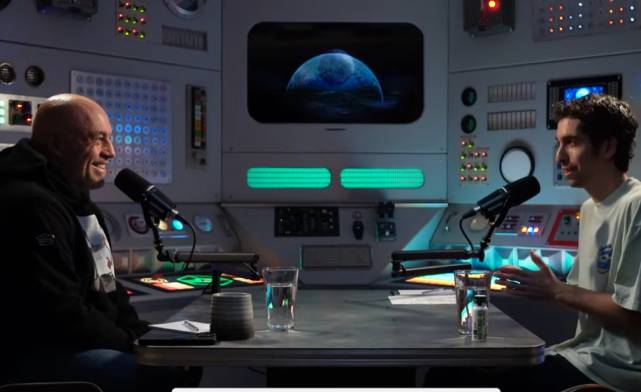
Here is the full transcript of American podcaster Joe Rogan’s interview on American Alchemy Podcast with host Jesse Michels, November 30, 2025.
Brief Notes: Joe Rogan sits down with Jesse Michels for one of his wildest, most detailed explorations of aliens, consciousness, and hidden history yet. Rogan shares a hyper-vivid “alien dream” encounter, speculates about buried energy structures beneath the pyramids, and connects UFO lore to Watergate, Nixon, Kissinger, and secret crash-retrieval programs. From DMT, ancient civilizations, and three-fingered mummies to quantum computing, AI “godhood,” and why elites may be timing UFO disclosure to a new information war, this three-hour epic pushes every boundary of the UFO and metaphysics conversation.
The Dream That Wouldn’t Let Go
JESSE MICHELS: This is beyond surreal. I’ve had some surreal moments on the show, but I think this tops them all. Joe, I really appreciate you being here, man. I don’t think I would have a show if it weren’t for the thousands of hours of insights I’ve gleaned from your show. And you don’t have to do this. And you do stuff like this all the time. And it just means so much to me that you’re here, so I really, really appreciate you.
JOE ROGAN: Well, it’s my pleasure. I really love your show. So it’s exciting for me to be here.
JESSE MICHELS: Means a lot, man. Well, I want to actually start with… you had a dream. And this was a few weeks ago. You had Brett Weinstein on, great evolutionary biologist, and you started off the episode with this trippy dream you had. You want to describe it?
JOE ROGAN: It was the weirdest dream I’ve ever had in my life because it was the most realistic dream and it was the only dream that I can ever remember. I sleep really well.
I could not go back to sleep. It’s the only dream I can remember that I couldn’t go back to sleep. I don’t think I’ve ever had that happen to me before. Well, I woke up at like three in the morning or whatever it was and I was like, I’m up now. Like, there’s no way. I laid in bed I think for like an hour and then I just went to the gym. I was like, there’s no way I’m going back to sleep.
It was very strange. It was very strange because it wasn’t like a regular dream. Like, oh, you’re dreaming. It seems vague and weird and kind of opaque. It was vivid. It was very strange.
And there were these very slender, tall human-like things that were talking to me. They weren’t gray, they were kind of pinkish like us. They were, you know, Caucasian looking creatures. But they were messing with me. Like they scared me. They’re like, “Ah, we’re just playing around.” And so they were doing some… there was some weird kind of communication telling me to relax.
And the environment was very different too. It was very vivid. It was like some sort of a corridor. But it didn’t seem normal. It seemed very strange. Like I remember the walls were lit very weird.
And I also remember that there was some sort of water and reptilian element to this. Like they were letting me know… almost like they had barriers that were very sloppy that were keeping these things out. But they were doing their best. They had people or beings monitoring and feeding these things and keeping them out.
And I was like, what is going on here? And it’s like, is this telling me that they’re doing their best to keep something from getting to us but that it’s not that secure, that it’s kind of precarious and a lot more unstable than we would like to think it is? I don’t know what that was all about. That was a… that part of it was really weird. That part of it was more dreamlike.
But the communication with them and the interaction with them was very, very vivid. It was really strange. They had larger eyes than a normal human and a larger head, but not crazy. Not like a gray from Close Encounters of the Third Kind. A little bit like that guy up there.
JESSE MICHELS: Interesting.
JOE ROGAN: Not quite so big, but like a large head with a very small jaw and larger eyes than normal. But they were smiling. God, I can’t remember if they had teeth. I think they had teeth. I can’t remember.
JESSE MICHELS: Does any part of you think this actually happened, or do you think it was just a dream?
JOE ROGAN: Wow. You know, I don’t want to be that guy that’s like, “Oh, I know it was real,” because I don’t. Yeah, I was dreaming. I was sleeping, but it was the most vivid dream I’ve ever had in my life.
The Betty and Barney Hill Connection
JESSE MICHELS: I was telling you outside, you’re wearing this epic Betty and Barney Hill…
JOE ROGAN: Oh, geez.
JESSE MICHELS: First abductees, 1961.
JOE ROGAN: No, I know his granddaughter.
JESSE MICHELS: Yeah. Is she Angela Hill?
JOE ROGAN: Right.
JESSE MICHELS: She’s a UFC fighter.
JOE ROGAN: Yeah. So cool. Crazy.
JESSE MICHELS: What does she say?
JOE ROGAN: She did my podcast and didn’t tell me until after the podcast was over. You don’t tell Joe Rogan grandfather was Barney Hill. I was like, no, that’s mad. That’s so crazy.
JESSE MICHELS: Did you not say, let’s go back and record?
JOE ROGAN: No. It was already too late when we wrapped it up and everything. I should have, though.
JESSE MICHELS: You got to have her back.
JOE ROGAN: Yeah, I should have. I should have done it then. That is why, looking back, that was a mistake.
JESSE MICHELS: Well, I thought, because you wore this, I think, on the Gavin de Becker episode, which is a crazy episode. Everybody should go watch this episode. This guy protects the most important people in the world.
JOE ROGAN: Yeah.
JESSE MICHELS: And he’s going through all these crazy CIA conspiracies. Basically talks about Fauci’s role in the AIDS epidemic as kind of analogous to what he did around Covid. A lot of the same being kind of the same.
JOE ROGAN: Very same. Very similar.
JESSE MICHELS: And you’re hearing it from this guy who protects incredibly important people, does risk assessments for these massive events.
JOE ROGAN: Yeah.
JESSE MICHELS: Wild.
JOE ROGAN: Yeah. Very wild. Yeah. But, yeah, he didn’t know what this was.
JESSE MICHELS: I thought you were… maybe I thought you were maybe signaling to the audience, like, maybe I got abducted or something.
JOE ROGAN: I don’t think I got abducted. I don’t even know if I got contacted. It just might have been the craziest dream. And to me, because I’m so into the whole UAP, UFO, aliens, alien phenomenon, that maybe, you know, maybe it was just very vivid because of that.
It’s just very odd for me to not be able to go back to sleep. That never happens. I can sleep no matter what. It’s weird.
JESSE MICHELS: Well, so whatever it was, it had kind of a disproportionate impact on your psyche. Like, it was a big part of your subconscious.
JOE ROGAN: It was. It was tangible. It was like when I woke up, I was like, what was that? It wasn’t like, “Whoa, that dream was f*ed,” which I’ve had before. I had last night. I had a crazy dream last night, but it was normal. Dream was just… I got up to pee and I was like, what the hell was that? I went right back to bed.
JESSE MICHELS: This…
JOE ROGAN: I was not going to sleep, man. I laid in bed for a full hour just trying to go to sleep. And then I said, all right, I’m up. Let’s just go to the gym. And I’m in the gym and I’m trying to decide because I knew I had Bret Weinstein on the podcast, and I was like, I have to just say this immediately.
Because we’re going to get into so many different subjects, there’s no way I’m going to work this in. I just have to get to this right away because I decided to sort of document it while it was only a few hours old, while it was fresh.
JESSE MICHELS: And some dreams are you wake up from them and you’re still in the dream a little bit. You have to kind of get it. There’s something cathartic about retelling it or something.
JOE ROGAN: Yeah, yeah, it was weird, man. I don’t know what it was.
Beings From the Future?
JESSE MICHELS: You said you thought they were beings from the future.
JOE ROGAN: Maybe that’s what… if I had to guess what they are, they seemed like what we will be. You know, we are as time goes on. If you look at ancient hominids versus modern humans, our heads are larger, our bodies are smaller, they’re more slender. There’s no need for muscle. There’s no need to physically move things.
These things seem very slim. They seem very slim. And, God, I want to say they weren’t naked, but they had some sort of a suit on. But they were very genderless. There was no defining, that’s a boy, that one’s a girl. There was none of that.
JESSE MICHELS: Which feels like where humanity is kind of headed.
JOE ROGAN: Yeah. You know, look, I like being a man. I like women. I think they’re fun. I like the contrast. It’s fun having a variety of different kinds of people. But it causes problems. Right? Because we have these procreation, reproduction instincts. We have primate instincts to be tribal, to acquire resources, to dominate and to be untrustful of others.
There’s a lot of stuff that makes being a human kind of cool because out of that you get art and you get incredible history and amazing architecture and all these things. But it also… there’s… it’s a fork in the road. That is kind of the bottleneck as a human being is our natural biological reproduction.
JESSE MICHELS: Yes.
JOE ROGAN: Because it lends itself to all these things that you see. Like when bears fight over a breeding female or when you see deers clash antlers together, what are they doing? They’re battling over who gets to breed. Totally. I think that’s a lot of what humans do.
And then we do it in weird ways. Like we acquire immense amounts of financial wealth or, you know, the fanciest watch and the fanciest car, and you try to look like someone who someone would want to mate with. And that’s really all it is. Men and women want to be desired by the opposite sex or the same sex, if that’s what you’re into.
But it’s that procreation thing that fuels a lot of our… and a lot of our inability to get along. A lot of conflict and a lot… I mean, a lot of acquiring resources through horrific and barbaric ways and dominating countries and invading. That’s what it’s all about. It’s all… a lot of it is just about breeding.
JESSE MICHELS: And it is that limbic reptilian part of ourselves that does that. And so I wonder, not to do a full Jungian analysis of this dream, but it’s like they’re holding these reptilians at bay in the water or something. And maybe there’s something very symbolic, whatever.
JOE ROGAN: It was, because it was the only part of the dream that was kind of vague. They were kind of like crocodiles or something. But it was weird. Like they were feeding them, but they had flimsy barriers in front of these things to keep… and they were keeping them.
It was almost like letting me know, this is… you’re really close to getting f*ed up. And we are, we’re doing our best to stop this from happening, but it was… that’s just me reading into it.
But whatever it was, they were very clearly trying to scare me. And then play. “We were just kidding.” Everything was messing around. There were a couple of those moments where I was like, okay, what are you trying to do? Are you trying to get me accustomed to interacting with you? Yeah, what is this?
Because I was very weirded out, and I think they’re… whatever they were wearing, because I think they were wearing something, but they were, like I said, they were very genderless. Whatever they were wearing was the same color as their skin. So it was strange.
Childhood Origins of UFO Obsession
JESSE MICHELS: You’ve been asked a lot about your childhood. Everybody knows you were four years in a row Taekwondo champion. That discipline brought you to where you are today in many ways. Everybody knows you’re UFO obsessed now. Was there a moment in childhood where you kind of got alien pilled or saw something or…
JOE ROGAN: No, unfortunately, I never saw anything. I wish. I kind of thought I did maybe when I was young, but I think it was probably a fighter jet.
The Search for Extraterrestrial Life
JOE ROGAN: When, from the time I was little, I would look up at the stars and I would just think, well, clearly this can’t be the only planet that has life on it. Like, that doesn’t even make any sense. And then, you know, going to school and you learn out how many hundreds of billions of galaxies there are. You’re like, whoa. And how many hundreds of billions of stars are on this galaxy and how many planets there must be?
Like, for sure there’s something else out here, but would they be interested in us? Would they visit? And, you know, then I got really into Project Blue Book and I read a lot of the stuff on J. Allen Hynek and, you know, and all the Philip Corso stuff and the stuff from Roswell, and I just became obsessed with reading and watching whatever flimsy documentaries were available back then, you know.
And then I think I really got back because I was always on the fence, like, oh, this is nonsense. This is real. This is not. It’s not helping me. Let me just go about my life. And then, really, Jeremy Corbell’s Roswell, excuse me, Area 51 Bob Lazar documentary is what really brought me back in.
JESSE MICHELS: Yeah. And that ended up being one of your most iconic episodes. I believe it’s like your second or third highest performance.
JOE ROGAN: It might be the highest one on YouTube. I think it has like 63 million views on YouTube.
JESSE MICHELS: That’s so crazy.
The Bob Lazar Episode
JOE ROGAN: That one’s nuts. That one’s nuts. Especially considering from that interview, which was, what was that, 2000, maybe 18 or something like that. Whatever it was, more and more has come out that substantiates what he said and confirms a lot of the stuff that he was talking about in the 1980s in terms of the design of these crafts, how they manipulate gravity around them and how they move through space with a very strange propulsion system.
And that’s what we’re hearing over and over again now from these whistleblowers and from these people like Hal Puthoff and all these people that allegedly have information about these back engineering programs, that this is, what he’s saying is very accurate.
JESSE MICHELS: And it’s almost like you broke the most gnarly story there was. And a lot of these kind of people who are now on the forefront of disclosure are trying to play catch up in some ways, because you have a guy who’s claiming to have reverse engineered craft firsthand.
JOE ROGAN: Yeah.
JESSE MICHELS: And now you have people, you know, saying, you know, we do have biologics. We have, you know, you have David Grusch giving 40 firsthand, you know, whistleblowers to the inspector general of the intelligence community, Thomas Mannheim. And he says it’s urgent. Incredible. It’s this crazy sort of groundswell, but in many ways we’re playing catch up to this guy who was like there at Area 51 in the 80s.
Attempts to Discredit Bob Lazar
JOE ROGAN: You know, they’ve tried to discredit him in many different ways. They tried to say, first of all, they tried to say that he never worked at Los Alamos, but that’s been confirmed. And then they tried to say that he was never at area or Area 51, Site 4. But he was there and he knew it. He knew the layout. He knew people that worked there. People that did work there also confirmed that he worked there.
JESSE MICHELS: Originally. I told you. You know, when I worked there, I was on the front page of the paper. So they were still able to archive, you know, bring that back from the archives. And, you know, Bob Lazar, a physicist working here at Los Alamo. So there was at least something there.
But somehow George came up with the phone directory. And then Bob took George with cameras into Los Alamos. Oh, yeah, yeah. So we flew out there and I said, look, come on in, I’ll show you where I worked. We’ll go in, we’ll meet people. And George went with me, JANET Airlines, which takes you back and forth between Vegas and Area 51. Area 51 wasn’t even really in the public zeitgeist until he came out with it.
JOE ROGAN: It actually wasn’t even confirmed until the Obama administration because the Obama administration they wanted to expand the barrier for entry or where people were allowed to access the land because too many people were getting to non secure land and taking video. So they were filming and taking photographs allegedly of these crafts and so they wanted to make it a little bit wider and so they had to confirm that it existed.
Site S4 and Satellite Images
JESSE MICHELS: So wild. I think we’re going to, so there’s a buddy of mine’s making a documentary with Bob Lazar. It’s called Project Gravitar and but I think we’re going to get a lot more confirmation and data points that corroborates his story or interview of him. I think we’re going to find out that S4 is very real too. And that’s been denied up until today.
JOE ROGAN: We do have satellite images of S4, do we? I believe so.
JESSE MICHELS: Okay.
JOE ROGAN: I believe there’s images of the land itself and you can because it’s underground. Yeah. But there’s the outside of it where the hangars are. I’m pretty sure you could actually get it online. Okay, okay. It might be bullshit. Okay, okay. I’m pretty sure there is an overhead like where you could see. Oh, there’s something there.
JESSE MICHELS: Okay, well so okay, if it’s the same thing I’m thinking of, then he has that data. But it’s like stuff they tried to cover up on Google Earth.
JOE ROGAN: Oh really?
JESSE MICHELS: Yeah, it’s like that point doom alien base that they erased. Yeah.
JOE ROGAN: That is weird.
JESSE MICHELS: Weird.
JOE ROGAN: That’s so weird. Because they blurred out the ground.
JESSE MICHELS: Yep.
JOE ROGAN: In the water.
Dan Farah and The Age of Disclosure
JOE ROGAN: I had Dan Farah on the podcast yesterday.
JESSE MICHELS: How was that?
JOE ROGAN: It was great. For people who don’t know, Dan made this new documentary, the Age of Disclosure, which is excellent. It’s one of the very best documentaries on the whole UAP UFO phenomenon that I think I’ve ever seen. And there’s no real footage in it. Maybe a couple minutes of footage of like the go fast or the gimbal. But really, really, most of what it’s about is high level intelligence operatives explaining what they know.
JESSE MICHELS: People like Woolsey and James Clapper, like these guys who are like DNI level, like, overseeing all of the intel agencies. Brennan, all these people.
JOE ROGAN: And Marco Rubio, to his credit, I think his involvement was huge because it’s the current administration, his involvement and his urgency. Schumer, Rubio, all those guys are like, look, a bunch of freaking high level officers came to us and either they’re crazy or this shit’s real. Most of these people at some point.
JESSE MICHELS: Or maybe even currently have held very high clearances and high positions within our government.
The Race for Reverse Engineering
JOE ROGAN: So this is one of the things that Dan and I talked about. He firmly believes that both the United States and China has retrieved these crashed vehicles and that they are also in this back engineering program. They’re in a back engineering program of their own. And there is a race. And he’s, you know, people talk about it like it’s the Manhattan Project on steroids, but I’ve heard that about AI too.
JESSE MICHELS: Right.
JOE ROGAN: But which might also be true. And they might also be connected in some way. I think what Rubio is concerned with is that China develops this technology first. And the only way that the United States is really going to catch up is if we open this up.
JESSE MICHELS: Yeah.
JOE ROGAN: And we open it up and remove all the ridicule. Because forever. Look, I, I’m a silly person, so it’s easy to make fun of me. And I don’t mind. I mean, literally, professional comedian. So I, I’ll say stupid shit and not worry like, oh, people are going to think you’re an idiot. I’m like, I’ll tell you I’m an idiot. You don’t have to, like, look to see if I’m an idiot.
JESSE MICHELS: I think you’re much smarter than you give yourself credit for.
JOE ROGAN: Listen, I know really smart people. It’s relative. Yeah, it’s all relative.
JESSE MICHELS: You got that, like, that general breadth of knowledge. Like not too many people are at your level, man.
Intelligence and Expertise
JOE ROGAN: Yeah, but it’s, it’s also, you know what it’s like. It’s like, people say, like, oh, man, you must be an amazing fighter. I’m like, listen, I work for the UFC. I’m around dudes who can kill me every single day I work there. Every one of them could kill me, no questions asked. Like, compared to a regular person.
JESSE MICHELS: Yeah.
JOE ROGAN: But to an untrained person, that’s how I look at intelligence. It’s like, am I, I’m not as dumb as the dumbest people I know, but I know Elon’s a friend of mine. You know what I mean? I mean, I’m friends with a lot of, like, very brilliant people. There’s levels to this day, you know. Like, I had Palmer Lucky on the podcast today. Yeah. You start talking to me, go, oh, okay. Well, there’s levels to this, you know, and there’s really f*ing smart people in this world, and I’m not one of them.
But I, I’m smart enough to know what I know, and I’m smart enough to not be afraid of people thinking that I’m not smart. So the, the subject has always been, like, very ridiculed and dis. And you could, like, really fumble your career if you went out and said, if you were a journalist or if you were, like, a legitimate author or look at Whitley Strieber.
JESSE MICHELS: Yep.
The Stigma of UFO Research and the Need for Amnesty
JOE ROGAN: I don’t know what happened to that dude, but I know that everybody sort of dismisses him as a kook in the real literature world because he’s this guy who made these movies and books about being abducted by aliens. You know what I mean? So you immediately get this smell of kook that’s on you.
And I think Marco Rubio talking about this and explaining, this is what I’ve been told, this is what I know, this is a real thing. There are vehicles the size of a football field that are moving through the ocean at 500 knots. We have no idea where they’re going.
You know, Tim Burchette recently said that there’s, they’ve identified five areas in the oceans of the world where these things are coming out of on a regular basis. We have a higher propensity of sightings around these five or six, I believe, deep area, deep water areas.
So you’ve got these people talking about this, and it’s slowly but surely removing that layer of ridicule. And that layer of ridicule is powerful, man. People don’t like to be thought of as a fool, you know. And I think that holds us back.
And if the United States, first of all, they’re going to need some sort of an amnesty thing. This is one of the things that we talked about they’re going to need. Because for sure there was lying to Congress. For sure there’s misappropriation of funds and probably some corruption. When you have no oversight, billions, if not a trillion dollars, for sure somebody got some money they shouldn’t have got.
You’re going to have to make all that okay. You’re going to have to say, in the interest of national security and the future of the human race, f* all that. You’re going to have to do that. And if they don’t do that, we’re going to have a real problem.
Because these gatekeepers are going to continue to gatekeep because their lives depend on this. If they release this, they could find themselves in jail without any amnesty. In jail for the rest of their lives. We don’t know how much money was spent. We don’t know how much lying to Congress there was. We have no idea how many felonies there were. We don’t have no idea.
Let’s assume that crash retrieval programs were real and that back engineering programs were successful. So you’re not going to give this stuff evenly to all these different defense contractors. So if you give one defense contractor one object and all of a sudden they have massive advantage and then the other defense contractor winds up going under, as many of them have gone out of business, well now you have a major lawsuit on your hands. You know, you have all sorts of, and then probably people are going to go to jail. If it’s a just legal system.
The Manhattan Project 2.0 and National Security
JESSE MICHELS: 100%. Yeah, yeah. And for, I think the cynics out there who might just want to put a minus sign against anybody coming from the intelligence world and saying things, we’re not even necessarily being idealistic about their motivations, we’re just saying that it’s probably national security runs the day and that this might be the Manhattan Project 2.0.
If you think about it, the first Manhattan Project was payload potency. It was bigger and bigger bombs. And there’s even a scene in Oppenheimer where he’s criticizing Teller because he’s like, there is no target big enough for the H bomb, it’s way too big.
And so beyond that, it’s all about payload delivery. It’s all about the, you know, ICBMs into stealth fighters into whatever the hell they’re working with now. And if they do have this technology, obviously they’re going to open it up. And as much as I can be cynical and anybody who’s into UFOs is probably cynical about the intel world, it kind of makes sense that they’d let this stuff out now because there is this arms race or whatever.
AI, Quantum Computing, and the Gateway to the Cosmos
JOE ROGAN: There’s a race going on with both. Let’s assume that stories are correct and that back engineering is real. Let’s assume that they have recovered crafts, so there is a race with that. But then maybe even more critically and completely connected is the AI race, because I feel like that is the legitimate gateway to the cosmos.
I feel like when we achieve sentience with artificial general superintelligence, when it has the ability to make better versions of itself, when it has the ability to devise new methods of power, new ways of using resources that we never even imagine, just like we have now, that they never imagined in the 1400s, you know, and I think it’s going to happen very, very quickly.
So if there is a back engineering program and they maybe there’s some hurdles that we just can’t get over, like, how did they do this? Like, how is it possible to do that? Well, AI is probably going to figure out a possible way that it could be done, and what possible inventions could be made to facilitate this possible thing. And they’ll probably just go ahead and start doing it.
And when you have AI and then you have the incomprehensible power of quantum computing, which is so baffling. It’s so baffling that you go, wait a minute. What the f* did you just say? One of the more recent ones, I believe it’s the Google one. They solved an equation that would take the world’s supercomputers, I think it was 2.6 billion years to solve, and it solved it in a matter of minutes.
JESSE MICHELS: It’s so crazy. And then the willow, they say the multiverse has to exist or whatever.
JOE ROGAN: What does that mean? The only way for it to solve this problem? Marc Andreessen said it on my podcast. He said the equation is so difficult to solve that if you took every atom in the universe and converted it to a supercomputer, the universe would die of heat death before it would solve this equation. And it solved it in minutes.
So, what are we even talking about now? Imagine that being connected to artificial general superintelligence, which is essentially a digital God.
JESSE MICHELS: Yeah.
JOE ROGAN: You’re going to make this thing that makes a better version of this thing. It’s going to be exponential. It’s going to happen very rapidly. Well, what’s the end of that? What’s the end of that is all powerful, all knowing.
And if you really want to get weird? That might be how God gets formed. I mean that literally. God might be a real thing. That might be how God gets formed. And that might be the whole reason why human beings have curiosity and this insatiable desire for technological innovation. Not just to stay alive, not just to make better stuff, but this is why. Because that if you just follow it out to its natural course, that’s going to lead to an artificial life.
Creating God Through Technology
JESSE MICHELS: Yeah, I’ve heard you say that a lot before. That our consumptive patterns are almost built in to want more and more and more, and then we have to produce more and more in steps. And we’re creating this God outside of ourselves.
JOE ROGAN: Think about materialism. It’s foolishness. You have a finite lifespan, and you have people in their 80s trying to acquire immense wealth when they already have immense wealth. Warren Buffett’s still in the game. You know what I mean? He’s worth billions of dollars. He’s in his 80s, and he’s still out there trading and moving. What is that about? Why would you want more stuff? Why would you want more money and more stuff?
Because nothing fuels technological innovation like the market. And in order for the market to be successful, you have to be obsessed. I have the iPhone 16, and this motherf*er is starting to mess up on me because the 17’s out, the battery’s a lot slower. It’s like, it burns through the battery quicker. Sometimes it glitches on me. I’m like, you didn’t glitch for a whole year, bitch.
It’s wired in that you want the newest one, you want the latest one. And Apple’s been accused of that planned obsolescence. Yeah. And it is. It’s true. They’ve admitted to it, and they’ve done it under the guise of, oh, well, you know, when the older ones, the batteries decay. We’re trying to preserve the battery. Shut up. Just let the battery die, bitch. Don’t monkey with my phone.
But it’s like this. I have an iPhone 11 that I’ve had forever, and I keep it because a good friend of mine who died, he left me a voicemail, and it’s on that.
JESSE MICHELS: Oh, man.
JOE ROGAN: And that phone works great. It works the same. It works. I don’t need a new phone, but I’m going to get a new one every year because I’m a dumbass and we’re all dumbasses, and we’re all buying the newest TVs. And the newest laptops and, oh, the new ThinkPad came out, the touchscreen.
And you’re going to keep doing that and that. If you just follow that, if everyone’s doing that, what does that do? It makes better stuff. If you looked at the human race from an outside perspective, if you were a life form from somewhere else, okay, what are they doing? What is the predominant, what is the dominant life force on this planet do? It makes better things. That’s all it does.
It’s like a worker bee that doesn’t know why it’s making a hive. It’s just making better things all the time. Obsessed with making better things.
JESSE MICHELS: You should stop your need for accumulating objects and stop your need for, you know, a big car and a big house and find out something that you actually love to do and figure out a way to do it for a living.
The Triangle: AI, Quantum, and UFO Disclosure
JESSE MICHELS: I had a very smart guy named Matthew Pines on my podcast, and he said he was speaking to some CIA guy, and the CIA guy was like, you know, it’s a triangle. AI, quantum and the Grush stuff, that was it.
JOE ROGAN: And we were, you know, in an environment where I couldn’t and want to press too much into the issue and have, wasn’t like this sort of sit down where it’s like, we could go for hours. So that was basically where it sort of landed. And I’ve been touring on that for a while. You know, AI, quantum and the Grush stuff, that’s wild.
And do you think all of this is, and he was like, if all of those three things seem to converge, it’s like this kind of consciousness apotheosis thing, kind of what you’re saying.
JESSE MICHELS: Yes.
JOE ROGAN: Do you think there’s something happening where all these trends are converging now simultaneously and it’s not a coincidence? UFO disclosure is happening at the time of deep fakes. It’s so weird, right?
Reality, Consciousness, and the Human Journey
JOE ROGAN: I think that’s all on purpose. Yeah. I think that’s a part of the fun of the experience that we’re going through, you know, because it is a tangible experience. I believe life is real. I believe this table is real. I believe in reality. But I don’t think reality is as clearly defined as we like to believe it is.
I think reality is dependent a lot on consciousness and some sort of a strange, indescribable way to a conscious person. I don’t think it’s very binary. I don’t think it’s ones and zeros. I think it’s slippery and I think it’s dependent upon a lot of things. There’s a lot going on.
And it’s also, I always wonder, what is my experience? What is my trip? What is my journey through this world? Why do I, these weird things that have happened to me that have led me to be who I am today, is that a design? Because if it’s not a design, well, if you wanted to make someone like me, that’s how you do it. You do it exactly that way.
But I want to pretend that, oh, this is all just, you know, it’s like determinism versus free will. I think both, I think both are, they’re intertwined. I don’t think it’s that clear. And I think your experience is very different than my experience. And all of our experiences are all tied in together.
And I really believe, as strange as it sounds, it’s towards this one goal. And I think this one goal is the advancement of the human species. And I think we all play a role. Just like microbes play a role in the environment and plants play a role in the environment and so does sunlight and so does wind. All these. But you parse them out and you look at them as individuals. You go, oh, the wind does this and it carries the clouds.
But it’s all together like an equation that’s driving things in a very specific way. And I really believe that our trip, that our experience is a very unique one. The people that are living right now that are hearing this currently in the future, they might look back at this and go, boy, they were so wrong. Or they nailed it, you know, one of them.
But I think we are all purposely building towards something and I think that something is, it has the echoes of religious texts. I think that the origin story of the human race from various religions, I think that, is that, is that these, all these stories where there’s interactions with the book of Enoch, the watchers that came down and bred with men and created the Nephilim.
Ancient Genetic Engineering and Lost Civilizations
JOE ROGAN: Doesn’t that sound like genetic engineering? Like if beings had sex with men? What, what do you mean? Like, what is that? So you mean take their genes and introduce them to ours?
Well, if you’re a dummy who lived 6,000 years ago and you’re trying to recall a 5,000 year old story, yeah, that’s probably how it presents itself if you’ve had 5,000 years of barbarism since the Younger Dryas impact.
So you have advanced civilizations, which is what I believe. I’m Randall Carlson, Graham Hancock School. I don’t think this is our first go around. I think ancient Egypt is a great testament to that. I think there was some sort of an advanced civilization that was on a different pathway than we are.
We’re on this electronic internal combustion engine pathway. They were on a different pathway, but I think they achieved the similar, if not greater level of technology and the ability to manipulate matter. What they’ve just what they’ve done with the pyramids and people try, they do their best to come up with some explanations. They’re all dumb. Every explanation sucks. They suck and they hate it when you say that.
And they get angry and people were smart back then, sure, but only these people, only these people were like 6,000 years ago. We agree that people were dumb and they didn’t even have steel yet. Like, what are we doing?
The Contrast Between Gatekeepers and Truth Seekers
JESSE MICHELS: And the contrast, the stark contrast between Zahi Hawass who you had on, the former Minister of Culture in Egypt, and somebody like a Randall Carlson or Graham Hancock who are so articulate, so smart. And I think, you know, you’re constantly playing down your intelligence, but I think because you can deal with stigma, because you can play with what other people consider misinformation, the whole world now thinks that Charles Manson was an MK Ultra patient because you knew Greg Fitzsimmons who knew Tom O’Neill, which is crazy.
So, in some ways, I think you’re leading academia. The Younger Dryas impact hypothesis, which was, I think, presented in 2007 for the first time, is now really starting to become more of an accepted thing. Before that, it was Luis Walter Alvarez saying that the dinosaurs died due to a comet impact 66 million years ago, that was a thing nobody took him seriously.
And so in the stark contrast between a gatekeeper like Hawass, which some people call your worst podcast of all time.
JOE ROGAN: It was the worst. It was the worst.
JESSE MICHELS: I discovered, I discovered, I discovered and…
JOE ROGAN: I discovered major important things. Are they online? No, in my book. Are there photos of this?
JESSE MICHELS: Of course in my book.
JOE ROGAN: It’s in my book. It’s in my book. If you go to my book, I don’t go online. Why? I have to go online. I go to my book and you…
JESSE MICHELS: Can introduce me here in Houston.
JOE ROGAN: Excuse me, can I introduce you in Houston? No, I cannot. Why? Because I’m very busy. Okay. I, unfortunately, I don’t have any free time.
It was the worst that we released. There’s been some that were bad that we didn’t release. Yeah. But I think we’re all here for a reason, and I think we’re here to experience something. Something very strange and profound that. And there’s an event. There’s an event that we’re building up to.
And I think that’s why there’s this focus on disclosure. That’s why this documentary hits so hard. That’s why guys like Marco Rubio are sticking their neck out. And Tulsi Gabbard and Rep. Luna, you know, she came on my podcast too, and she was telling me some stuff that was just mind blowing. And she really got me to read the Book of Enoch. She’s like, you got to read that.
The Book of Enoch and Hidden Biblical Texts
JESSE MICHELS: So you have the Ethiopian Orthodox text, which has, I think, 88 books of the Bible in total, but in the Ethiopian Orthodox text, it’s basically kind of a mainline OG version of the Bible. And then sometime in the 4th century, there was actually a group that came together and they removed certain books.
The story goes that Revelations actually had replaced Enoch. And so it’s interesting because when you’re looking kind of full circle on, you know, you hear the stuff that some of these people are talking about, and then you see and you read the Book of Enoch, which is a wild read. Okay.
And then you look at kind of what our modern day description is of what angels and entities are versus what Enoch was seeing and reporting and his language and ability at that time. I just, I think that there’s a lot that brings you to then ask the question, well, why would they remove this information if it’s truly, you know, written in part of the oldest Bible in the world? Why would they then take it out then?
JOE ROGAN: That could have easily been attached to the religious canon, but some rabbis disagreed with it because it didn’t vibe with the Torah. So, let’s chuck that one out. But it’s in the same lump of Dead Sea Scrolls. They have the Book of Isaiah, which is really fascinating because Wes Huff, when he was on my podcast, explained to me that the Book of Isaiah that they found in the Dead Sea Scrolls is verbatim the same as the Book of Isaiah that was a thousand years more recent.
Whoa. A thousand years. So this was the oldest version that they thought was the oldest version. And then they found the Dead Sea Scrolls version, which was a thousand years older, verbatim. Fascinating.
JESSE MICHELS: Fascinating.
JOE ROGAN: And the Book of Enoch’s in there.
JESSE MICHELS: There you go.
The Watchers and Ancient Giants
JOE ROGAN: What are they talking about? What are you talking about? The Watchers came down and they mated with humans, and they created a race that was a giant race that destroyed everything and consumed everything. That sounds like us. Doesn’t that sound like us?
If you’re some flimsy, tiny alien thing with no musculature and a large head, and you make giants, you make football players, you make marauding Vikings, you know, that are just showing up in boats and hacking everybody to pieces. That’s how you would describe them.
JESSE MICHELS: Yep.
JOE ROGAN: You would describe them. Giants destroyed everything. Yes. It’s all very weird stuff, man.
Celestial Ascent and Ancient Mysteries
JESSE MICHELS: And Enoch himself goes through this amazing personal transformation where he goes up to heaven, he walks with God, and then he turns into Metatron, this angel. And a lot of people think that’s part of kind of a celestial ascent tradition.
So you have celestial ascent traditions and various tribes traditions, and, you know, the wheels of Ezekiel or, you know, some people think in the Book of Acts, Jesus does this, or Paul has the thorn in the flesh where he sees God. And so maybe there’s something around ascending up into this state and coming back down.
And there’s a translation function where it’s hard to say. You know, once you’ve ascended, it’s hard to say what you’ve seen. In the Immortality Key, where there’s a fight club around it or something. This is the fight club of the ancient world. Whatever happens there, no one talked about it under penalty of death.
I mean, people went to Eleusis as human beings, and from what little testimony survived, again because it’s secret under penalty of death, they walked away thinking they were immortal. This all sounds really insane, I’m sure.
JOE ROGAN: Yeah, but, I mean, you would have to have a fight club around it, because no one’s going to understand, nor are they going to take you seriously ever again if you start talking about these things.
JESSE MICHELS: Yes.
The Professional Fool and Art Bell’s Legacy
JOE ROGAN: That’s where I have a great benefit in being a professional fool. You know what I mean? Listen, I didn’t get into podcasting as a professor. It’s not like I was teaching something somewhere. I got into it because I was a comedian.
So most of the early podcast is literally just this enormous gravity bong sitting on a table with webcams. And half the episodes, we were obliterated out of our minds. Had no idea we were talking about. It’s mostly just comedians, and we’re just making each other laugh and having fun.
Because we have our whole day free, right? We have to work at night, we work at night, during the day, we write jokes, we hang out, and then we, you know, find other things to do. And one of my favorite things to do used to be to do radio.
When you would do a good radio show, like Opie and Anthony back in New York, you’d hang around with a bunch of other comedians and it would be so much fun. And then we would do it in the green room sometimes. We started doing that first before we did the podcast. What we would do was, I think it was called Justin TV at the time. And so it was a streaming platform.
So Brian, my producer, Brian Redban would set up a laptop in the green room, and we would just f* around in the green room because we were always making each other laugh. And it was always a fun environment. We were getting silly before we’re going on stage. And so we started streaming that.
And then I said we should just do a thing where we just sit down and just have comics and just do it like a radio show. And just for fun. And because I don’t have to be taken seriously, I can entertain any idea.
Also, another huge inspiration for me was Art Bell. Yeah, you know, I’d love Coast to Coast with Art Bell from the Kingdom of Nine. I love that show because I used to go drive home from the Comedy Store at one o’clock in the morning and he’d have some guy. He had a time traveler line, Art Bell.
He let anybody say it. “Art, I’m a werewolf.” “Interesting. Tell me more.” He didn’t go, “Get the f* out of here, you’re not a…” Well, he let people say crazy things and he entertained all the kooky things. And I loved that. “When you have a thirst for human blood, is it like, I mean, what can you compare it to? Is it like when you want chocolate ice cream?” “Or even worse.”
JESSE MICHELS: It’s even worse than that.
Graham Hancock and the Origins of Podcasting
JOE ROGAN: So I was very willing to, Graham Hancock, I think, was the first real guest that I had, other than comedian friends. It was me and my good friend Duncan. Duncan Trussell and Graham and I had been corresponding, I think through email. I had talked about his book, but this was back when no one even knew what podcasting was.
It was so ridiculed, and it was just webcams and it was all streaming on Ustream. And that was my first real guest. But, you know, I loved Fingerprints of the Gods and I wanted to, you know, I wanted to talk to the guy who made that book that really made me reconsider what had happened with the human race and, you know, and how old our ancient civilizations might really be. They might go way back further than we think.
Atlantis and Meltwater Pulse 1B
JESSE MICHELS: Way back. Way back. Totally. And he’s a great example of somebody. He’ll incorporate stuff like Plato and myth into his study where it’s like meltwater pulse 1B, 9600 BC. This was told at a mythos festival in 600 BC in Timaeus and Critias.
When Solon was at that temple, the priests told him the Atlantis story and how Atlantis was swallowed up by the sea in a single terrible day and night. He asked them, when did this happen? And they said, 9,000 years ago.
Now, immediately, that’s a date we can convert into our calendar. 9,000 years ago in 600 BC is a date we call 9600 BC, which, give or take 20 years, is 11,600 years ago.
And just as the Younger Dryas began cataclysmically with a sea level rise 12,800 years ago, it also ended cataclysmically with an even more massive sea level rise 11,600 years ago. And that massive sea level rise has a name. Geologists call it Meltwater Pulse 1B.
It’s well documented. Nobody disputes that there was a meltwater pulse 1B, and it raised sea levels massively, literally overnight. And you actually look back the historical record, and we wouldn’t even think that Troy, the Peloponnesian War was, we’d think that was mythical. It was just Homer and Herodotus.
But this guy, Heinrich Schliemann, decided to take that seriously, and he found it in Anatolia in modern day Turkey.
Ancient Turkey and the Origins of Civilization
JOE ROGAN: Yes. And so the 100 day turkey is wild.
JESSE MICHELS: It’s weird, right?
JOE ROGAN: You look at ancient Turkey, if you look at Baalbek and Lebanon, you look at those areas, a lot of people think Turkey, where Gobekli Tepe. They think that might have been the origin of civilization, that, you know, it wasn’t Egypt, it predates even that it might have been there.
JESSE MICHELS: Well, they’re creating sundials there…
Ancient Longevity and Advanced Technology
JOE ROGAN: How about, how weird is it that that part of the world, the Middle East, is where you get all this Sumerian stuff, which is just… I mean, I watched a whole documentary the other night on the Sumerian Kings List, which is just like, what is this? Because it’s both accurate and mythical at the same time.
So you have people that are kings that live 40,000 years plus. And you have eight kings that are documented. And some of them are really real. Some of them are real. And the time that they reigned corresponded with a real normal biological human life. But then you have ones that were before the Great Flood that don’t. They’re really long and crazy. And you just go, okay, what was going on?
And it sounds insane that people could live for 30,000 years, but it doesn’t. Here’s why it doesn’t. What we can do now, just a rudimentary stuff that we can do now, prolongs physical health far beyond where it ever was before. And then when you’re talking about stuff like hyperbaric chamber therapy, there was a study out of Jerusalem, I believe it was, where they did a protocol where they put people on hyperbaric treatment. There was 90 days. They had to do 60 sessions in 90 days.
At the end of those 60 sessions, they measured their telomeres, which is a direct sign of cellular aging. The shorter your telomeres are, the closer you are to death. Their telomeres had lengthened. That was no way.
JESSE MICHELS: What?
JOE ROGAN: Yes.
JESSE MICHELS: Lengthen. I didn’t know you could lengthen telomeres.
JOE ROGAN: I’ve done it. I’ve done that therapy. I did that exact therapy. Yeah, yeah, I’ve done it a couple times, but I did it at the… I was like, okay, let me give this a chance. And I went to this hyperbaric place and it was so boring.
Get me out of there. Thankfully, you can use your phone. But that fully sketches me out because, like, if there’s a spark that goes off, then you blow. People have died in those things.
JESSE MICHELS: Oh, no.
JOE ROGAN: Yeah. A child died in one fairly recently because of static from the blanket ignited the oxygen. Oh, God. It’s very scary stuff because you’re in a super high oxygenated, high pressure environment that’s equal to… What I do is two altitudes. So two atmospheres, two earth altitudes, and you do it for 90 minutes.
So we know about that. We also know about NMN and a lot of the work that David Sinclair has been doing out of Harvard. We know that they’ve been able to take mice and make mice behave like younger mice by switching their blood to the blood of younger mice. We’re real close to being able to do weird sh*t right now.
And there’s a lot of people that believe that if you can make it to 90 right now, you’re going to be able to make it to like 300 years old. So if that’s the case, let’s imagine that a society, let’s be open minded and a society as sophisticated as the people that lived in Africa that were able to move stones that weighed 80, 90 tons, 500 miles through the mountains with no roads, perfectly align them to true north, south, east and west. 2.3 million stones in one pyramid alone.
And now there’s real evidence that there’s structures under the pyramids that might go…
JESSE MICHELS: As deep as 2 kilometers that look like…
JOE ROGAN: An energy grid with columns and coils around the columns. And like what? So if they were capable of doing that, imagine what their health technology was. Yeah. Maybe they had cracked all the things that we cracked plus a thousand years.
Structures Beneath the Pyramids
JESSE MICHELS: You know, I just interviewed the guy that did the synthetic aperture radar scans.
JOE ROGAN: The Italian guys?
JESSE MICHELS: Yeah, the Italian guys. I went to Italy actually. Oh, Filippo Biondi.
JOE ROGAN: There are these structures, tubes, huge tubes.
JESSE MICHELS: That are descending underneath. And we have noticed that these tubes…
JOE ROGAN: Has a sort of spiral nature. We have measured approximately over 1 kilometer of depth.
JESSE MICHELS: Over a kilometer of depth? Yeah. Wow. And I came in not knowing, you know, how serious or rigorous he was. And I came out being like this guy, does he… does… I’m pretty sure, work with, he couldn’t really talk about it, but work with the Italian military.
And so this thing, synthetic aperture radar, Doppler tomography is used in commercial use cases where money is on the line. It’s used to map magma chambers inside volcanoes. And I think it’s used in some spooky military use cases where people’s lives are on the line.
JOE ROGAN: Yeah, they want to find where the bunkers are.
JESSE MICHELS: Yeah, 100%.
JOE ROGAN: 100%.
JESSE MICHELS: And so you can ChatGPT this stuff but because there’s not a ton of data on the instrumentation and it’ll give you spit out all sorts of wrong answers. But I felt like I went pretty deep with this guy. And there is 100% something underneath the pyramids in that shape, the coils, the columns.
He doesn’t know what the material is. He’s very honest about that. He doesn’t know what the function is. Is it the Christopher Dunn hydrogen power plant thing? He doesn’t know, but there is something underneath there and it’s eight columns and they’re coiling and he says, he goes a kilometer deep. He says tens of meters is where they’re high confidence. But he says a lot… thousand meters.
JOE ROGAN: Just the columns?
JESSE MICHELS: Yeah, yeah, yeah, it’s just the columns. Yeah. It’s insane.
JOE ROGAN: It’s so wild.
JESSE MICHELS: It’s wild.
JOE ROGAN: And there’s something underneath.
JESSE MICHELS: Need them. There’s something. Is that… Oh, foundation. Yeah, yeah, yeah, yeah, yeah, yeah.
JOE ROGAN: So at the bottom we probably have huge chambers for approximately 80 meters of…
JESSE MICHELS: Width and also of height.
JOE ROGAN: 80 meters. Wow.
JESSE MICHELS: On the bottom. On the bottom, yes. And, and so what is that? That’s like the kind of foundation structure.
JOE ROGAN: On which the tubes probably because we are observing that the tubes are connected to the respective top of this structure. They are connected and goes inside also. What?
JESSE MICHELS: It’s so crazy.
JOE ROGAN: How did you do that?
JESSE MICHELS: Yeah.
JOE ROGAN: So.
JESSE MICHELS: Water table.
The Case for Extended Human Lifespans
JOE ROGAN: My point. If longevity science is real today…
JESSE MICHELS: Yeah.
JOE ROGAN: And we get to a point where you can live for a thousand years. Here’s the problem with education. You have to reteach all these new kids every year. You have to teach new people new things. Right. If you have people that are thousands of years old, imagine. And no deterioration mentally. Imagine how much you can discover.
Imagine how much you can apply if there’s no diminishing of your faculties. You’re hit 5, 600 years old and you’re still fully engulfed in whatever discipline you’re doing. You know, imagine if you gave these guys that are working on, you know, quantum entanglement. Give them thousands of years to work on that. Give them unlimited funds. Give them the mental clarity of a young person a thousand years old.
That’s probably how you get the pyramids and it’s probably how you get all sorts of wild sh*t that we still can’t figure out today.
JESSE MICHELS: Probably. And if you look at Hindu cultures, they have the Yuga periods. We’re now in the Kali Yuga, where the lifespan is the shortest.
JOE ROGAN: Yes.
JESSE MICHELS: And people live for thousands of years. And even in the Bible you had Methuselah or whatever, you know, these…
JOE ROGAN: Noah was like 600 years old when the ark came around.
JESSE MICHELS: There you go.
JOE ROGAN: Yeah, but… And everybody’s like, what you are? What does that mean? I don’t know. Why are we so convinced that this is the only way? That the only way is you live to be 100, then you die. Like says who?
JESSE MICHELS: Well, science is now, as you’re saying, proving that wrong. But also I think it’s this bias that myth is myth and it’s not history. But if you… The Egyptians had the Zep Tepe when the gods walked among us.
JOE ROGAN: Yes.
JESSE MICHELS: If you look at myths, you know, it’s like the flood myth. It’s in 400 disparate cultures. If you have all of these myths of greater beings, Nephilim, fallen angels, that sort of thing. You have to start taking that seriously at some point as history and not just myth.
The Younger Dryas Impact Theory
JOE ROGAN: Right. And it’s not a coincidence that these cultures that all have this flood myth all align with the Younger Dryas impact theory timeline. It’s the same timeline as the ending of Atlantis. It’s the same timeline, like, and this is not, it’s not a theory. And that’s just like it’s pontificated. They’ve sat around, I wonder if that could have happened. No.
They’ve got core samples that show a large amount of iridium. They know that iridium is rare on Earth but very common in space. They know that there’s a comet storm that comes by. I think it’s every November and every June.
JESSE MICHELS: Taurids.
JOE ROGAN: Yeah, yeah. They know we pass through this meteor shower. They know it.
JESSE MICHELS: Yeah.
JOE ROGAN: They know that it caused Tunguska.
JESSE MICHELS: Exactly.
JOE ROGAN: Yes, they know it. So the idea that that happened in a horrible way, you know, 11,000 plus years ago, it’s not outrageous at all.
JESSE MICHELS: No. And then maybe that dovetails with disclosure because you just had Hal Puthoff on, which is an amazing episode. He’s written a paper on ultra terrestrials. So beings that could have died off in a cataclysm. Maybe there were some remnant survivors. Maybe those survivors have underwater bases, bases on the moon. They have advanced technology left over from that Atlantean period. Atlanteans were, you know, notoriously water faring people. And maybe that’s what we’re seeing, like…
Breakaway Civilizations and Human Origins
JOE ROGAN: A break off civilization, a breakaway. They figured out a way to survive. And maybe they were, you know, like, you always hear this about like Zuckerberg’s building a bunker. The elite, the elites all have a bunker somewhere. You know, maybe that was the version of the elites have a bunker. You know, maybe it was the most advanced people or being.
That’s the other thing. It’s like, what, what are we? You know, what are we? I have dogs, you know, and I have two adorable dogs. I have a golden retriever and I have a… It’s… He’s called a King Charles spaniel. He’s the f*ing cutest thing you’ve ever seen in your life. It’s like that used to be a wolf.
JESSE MICHELS: Charlie.
JOE ROGAN: Yeah, Charlie. His name’s Charlie. He used to be a wolf. Right? Like if you track back his lineage and you find out what, you know, his ancient ancestor was a wolf, which is so ridiculous. All he does is kiss you and makes these little barks and he’s f*ing adorable, right?
But they’re very different looking. But yet they could breed if they were male and female. It’s like we’re weird. We’re the only thing that’s like dogs. And we know dogs exist because we did some stuff with wolves. We only wanted the b*tch ass wolves. We only wanted the wolves with the floppy ears that were willing to take the meat. And hey, bark if you see something. I’m going to sleep. I’m your friend.
And that’s how we worked out this relationship with wolves that eventually became dogs. And then we bred them to become dogs. I think we’re genetically engineered. I don’t believe that it’s a very simple evolutionary timeline between ancient hominids and human beings. I don’t buy… happens too quick. It’s too weird.
JESSE MICHELS: Yeah, you have all these weird… You have the Homo habilis to Homo sapiens, the doubling of cranial size. You know, you talk about a lot. And then you also…
JOE ROGAN: McKenna had a great take on that. He thought, he thought it was from psilocybin mushrooms. Yeah, that’s the stoned ape theory. But he is accurate in one thing and that is that the human brain doubled over a period of like a couple million years, which is unprecedented in the fossil record. It doesn’t even make sense. It does.
And his point was really great. He said, “Imagine the organ that’s responsible for the fossil record in the first place is what doubles over a period of 2 million years.” Like this kind of… it’s not just a liver on a monkey. You know, it’s the brain of the most intelligent species on the planet.
JESSE MICHELS: You can’t explain that with pure natural selection. It seems you would need some sort of outside intervention.
The Evolution of Violence and Intelligence
Something would have to happen to warrant that kind of change. And you know, maybe it was just the battle for survival, maybe it’s just ingenuity and innovation and that natural selection favored the beings that had larger brains because they could think through things quicker and devise better. Because we’re barbaric. And we were really, really barbarians. Eric, then I’m sure you’ve seen Chimp Empire.
JESSE MICHELS: Oh yeah, yeah, yeah.
JOE ROGAN: Incredible hits on Netflix. I can’t recommend it enough. But you realize how warlike and horrific chimp culture is and that they just run around f*ing up these other tribes of chimps and killing chimps and if a rival chimp crosses the boundary, they all kill it. It’s. That’s us. Yeah, that’s us. Right.
Well, if you wanted to get out of that hump, you would probably have to devise the best weapons, the best structure. That could be some sort of a protectant shield from these other primate. And that would make sense, because we do know that chimps and even orangutans, you’ve seen the orangutan spearfishing. You’ve seen that image. I don’t know if I have never seen it.
JESSE MICHELS: No.
JOE ROGAN: Orangutan spearfish.
JESSE MICHELS: Spearfishing like a human.
JOE ROGAN: Yeah, yeah, yeah. I’ll pull it up because it’s so crazy. Look.
Yeah, yeah, it’s real. Yeah, it’s real. Look. Yeah. So what happened was, apparently the orangutan saw humans doing it, and so they imitated it.
JESSE MICHELS: They realized that’s so graceful and artful, so strong.
JOE ROGAN: He’s just hanging on to this tree limb and then reaching down, stabbing fish as they go by.
JESSE MICHELS: Yeah, well, maybe that’s like, because I think you bring this up in the context also of aliens vis a vis us with chimp empire, where it’s like, maybe there’s some sort of prime directive where they’re waiting for us to get lesser violent. They’re keeping an eye on us. They’re showing up at nuclear sites, which they do at all of our nuclear sites. Yeah, but they’re kind of waiting till we’re, until we evolve a little bit or something.
Waiting for AI: The Real Reason for Non-Contact
JOE ROGAN: I think they’re waiting for AI. That’s what I think.
JESSE MICHELS: Really?
JOE ROGAN: Yeah, I think that’s the whole, the whole reason why they haven’t contacted us. The whole reason why there’s no, like, very obvious signal to the entire population of Earth that this is a real phenomenon. I think they’re waiting for AI because I don’t think we’re going to get less violent. I think that ship assailed. There’s slap fights now on TV, people.
It’s not my thing, but, I mean, I can’t talk. I mean, I’ve been commentating for the UFC since 1997. I’ve been working for them.
JESSE MICHELS: Yeah.
JOE ROGAN: So it’s like, look, I get it, we’re violent. I go bow hunting all the time. We’re violent. We’re violent being. We’re not going to not be violent. It’s, I think that ship has sailed. It would be nice if we could evolve past that. And I think we can, certainly as individuals. I definitely think that’s the case.
But collectively, in large groups, I think we’re just violent. And until we can read each other’s minds, I think that’s going to stick. But I think that’s going to be one of the next hurdles. One of the big technological breakthroughs that’s going to happen that’s going to change the way human beings interact with each other is what I anticipate would be the development of a universal language and some sort of technologically assisted telepathy.
So it’ll probably be, I’m sure you’ve seen that Google test where they put on the headsets and they ask each other questions and answer the questions without words. You’ve seen that?
JESSE MICHELS: No, I’ve never seen that.
JOE ROGAN: You haven’t seen that.
JESSE MICHELS: That’s amazing.
JOE ROGAN: Oh my goodness.
JESSE MICHELS: Oh my God. Oh my goodness.
JOE ROGAN: They can already do this. “Where do you want to get lunch after this?”
JESSE MICHELS: “Thai food could be good.”
JOE ROGAN: You think things, it transmits your thoughts to that person and words that they hear. And then they think things and transmit it to you in words that you hear. These guys are laughing. They can’t believe it’s happening. They’re not even talking. They’re just laughing.
JESSE MICHELS: I know Neuralink has a patent on telepathy or something.
The Tower of Babel: Breaking Down Language Barriers
JOE ROGAN: It’s coming, man. It’s coming 100%. And so what’s our big hurdle? The Tower of Babel. What’s the big hurdle? We can’t communicate with each other. How many languages are there? I mean there’s so many. We don’t even know how many Aboriginal languages there are in our Australia.
Do you know that they like, they have these mobs and these mobs might live 10 kilometers away from another. They call it, that’s like tribe. They call themselves mobs. The Aboriginal people. They might live 10 kilometers away from another mob with a totally different language they don’t understand. Yeah. And they don’t have, it’s not written. And so some of these people die. They die off. There’s a lot of genocide, a lot of people, a lot of them were killed. Like some horrific history to ancient Australia.
My good friend Adam Greentree, and by the way, Australia, a lot of freaky cave art, a lot of freaky UFO looking art, like weird stuff at thousands of years old. You’re like, what were you guys drawing? Like, what is that?
My friend Adam Greentree visited a site where they had given food to this entire tribe of Australian aborigines that were tainted, that was all poisoned and the entire cave, he said, is just littered with human bones. He said it’s the saddest, most dark and depressing single environment he’s ever been in. He was in this cave going, what the man, they just poisoned this entire tribe. Just gave them all food with poison just to get rid of them. Oh, it’s so horrible.
JESSE MICHELS: Yeah.
JOE ROGAN: So and so. Just think of all the languages. There’s too many languages. There’s so many. You can’t learn them all. Well, now your phone can translate. The newest iPhone update, if you have the AirPods. The AirPods can translate languages in real time.
JESSE MICHELS: I know that.
JOE ROGAN: Yeah.
JESSE MICHELS: It’s so crazy, right?
JOE ROGAN: But what’s the hurdle? The hurdles? We have to translate all these languages. Why don’t we learn a new one? Why don’t we learn a new one that everybody accepts if we’re doing things? It’s like, I know. Jiu Jitsu Matrix. Remember when he gets that. Yeah, yeah, yeah, yeah. If that’s possible. Install some files, you’ll install some new universal language. You’ll be able to communicate with each other every, everywhere. And then all of our beefs over resources and ideologies and religions and national borders, all that’s going to go away.
Because I think we’re much more homogenized. Not homogenized. We’re much more cohesive as a world than we’ve ever been before. Maybe we’re divided on many issues like we always have been, but there’s communication with people all over the world. That’s unprecedented.
JESSE MICHELS: Yes.
JOE ROGAN: There’s never been a time where you can watch a podcast from Israel or watch a guy talking in Colombia about the problems they’re having there. And you’re watching people communicating, and then you’re seeing people post things on X and all you have to do is hit that button and it translates it. And so you’re reading about this guy, what his experience is in Russia, and you’re like, it’s a different world, man.
But it’s not yet there. This is like early Internet. And I think ultimately what’s going to propel us is some sort of a way where we can unite. And one of the best ways we can unite is to understand each other. At the end of the day, we’re all just human beings. We all want the same things. We want our loved ones to be safe. We want to be able to pursue whatever fascinates us that we love. We want to live in a nice community. We want to have fun friends. We want to be loved. That’s what everybody wants. That’s what everybody wants.
And if we can understand that we’re being played by people where this role has always existed. The king, the general, the corrupt military person who just wants to go to war. It’s always existed. Eisenhower warned us about this when he left office.
JESSE MICHELS: Right.
JOE ROGAN: That has always existed. But we can’t know what your real intentions are if we can’t read your mind. The moment we could read your mind, you’re like, this is bullshit, it won’t work anymore. Yeah, it’ll be, it’ll be a groundbreaking complete transformation of the entire way we interact with each other.
JESSE MICHELS: Yeah.
JOE ROGAN: All of each other.
Two Paths: Bio-Authoritarianism vs. Psychedelic Evolution
JESSE MICHELS: Well, I feel like there are various possible instantiations of what you’re talking about. Like there’s the kind of almost like Mark of the Beast style, people have implants, bio authoritarian version.
JOE ROGAN: That’s the UK version.
JESSE MICHELS: That’s the UK version.
JOE ROGAN: Exactly, exactly.
JESSE MICHELS: Yeah, we’re Australia version or whatever. And then there’s the version like I almost wonder, you were getting me thinking, like, are psychedelics alien technology to get us to naturally, because you have things like the telepathy tapes. You interviewed Kai Dickens.
JOE ROGAN: Yeah.
JESSE MICHELS: And there’s a great book by Arthur C. Clarke called “Childhood’s End.” And in that book the aliens first communicate with these autistic children, non verbal children. And I wonder if, if this sort of, there’s some sort of like almost psychedelic network that is analogous to this more like, you know, silicon chip circuitry based, you know, communication thing.
And those two things are somewhat different actually. And that a lot of the progress we’ve seen in humanity a la the Stoned Ape theory is based on psychedelic updates or you know, Brian Muraresku talking about the immortality key. You know, like you could argue a lot of modern civilization comes from the foundations of these visionary, you know, Plato, Aristotle, having these visions on psychedelics.
JOE ROGAN: Yes.
JESSE MICHELS: And so maybe those two things are actually in opposition. The kind of like Mark of the Beast bio authoritarian thing and the like, the actual like parapsychological thing or whatever.
The Essential Function of Psychedelics
JOE ROGAN: I think you’re dead on. Yeah, I, I think I, I wouldn’t say it’s like alien technology, that psilocybin and DMT are alien technology, but I think they have a function. Just like electrolytes have a function, just like nutrients have a function. Vitamin C is important for your health. Vitamin D is important. There’s a lot of things that have a function that we just sort of accept.
We don’t accept that psychedelics might have a very beneficial and maybe even essential function in human society. And we’ve removed that because of people that have a philosophy that’s diametrically opposed to the philosophy that one gets after a psychedelic experience.
After a psychedelic experience, your feeling is of ego death and of unity and of community. And you’re like, God, you just want to love everyone and hug everyone. That is the exact opposite of someone who wants a ban psychedelic and put, put people in jail for having them. And to say there’s no benefit, no medicinal purpose, meanwhile they had no experience in it whatsoever.
They’re talking completely ignorantly, based entirely on fraudulent data about what it, you know, it’s going to ruin your brain and give you brain damage. Like, I had a conversation with Michio Kaku one day on the Opie and Anthony show, who I love. I think he’s great. But I was like, “You ever do mushrooms, man?” And I was like, we’re just f*ing around. And he was like, “My brain is very important to me. I don’t want to, I don’t want to give myself brain damage.”
I’m like, that’s not what’s going to happen, man. It’s not what’s going to happen. And I think for me at least, those experience have been essential in grounding me and letting me reassess and reevaluate how I’ve sort of categorized the world and my life and everything. I think.
The Consciousness-Expanding Power of Psychedelics
JOE ROGAN: They expand something about your consciousness that you can’t weigh, you can’t put it on a scale, and you can’t put a tape measure to it. So you don’t think that it’s tangible. But I think if there was a way to measure it, you could, you know, like if you get in a hyperbaric chamber with an Oura ring, the Oura ring the next day will tell you that you have significantly higher recovery than normal.
And you don’t feel it though, you know what I’m saying? There’s no way of quantifying it. But if you had an Oura ring that could quantify your consciousness after a psychedelic experience, 100%, it would show massive improvements in love, in community and diminishing of ego, the appreciation of nature, you know, just wanting to be nice to people and hug people, you tell your friends you love them.
That all comes out of psychedelics. No question. And what’s opposed to that? Well, what’s opposed to that is authoritarianism. What’s opposed to that is locking people up and putting people doing this thing that really the people that are locking you in cages should be doing.
The only way we’re going to get past that is those people have to die off and young new people have to kind of take their place because these officials that are pushing these certain narratives, these antiquated ideas, particularly about psychedelics, they’re almost all old people who are uninformed. And none of them are psychedelic explorers. None of them are people like, “Look, I’ve done ayahuasca five times. Let me tell you something. This sh should be illegal. We need to get everybody to go to church and you need to start drinking water.” You know, it’s…
The War on Drugs: A Political Weapon
JOE ROGAN: We have generational problems. In 1970, they passed the sweeping Psychedelics Act during the Nixon administration. That was specifically done to target the anti-war movement and the civil rights movement. They made all these drugs illegal so that they could go in and arrest all these people and just put a stop to all this peace, love and happiness foolishness.
And they were really successful at it. And we grew up with that. We grew up with, in the 1980s, there was the Nancy Reagan “Don’t Say No” commercial, or “Just Say No” commercials there. That was my take on it. Don’t say no. It was “Just Say No.” It was all “Just Say No.” Like, “This is your brain on drugs.” Then a guy with frying pan. You’re like, why? It was the dumbest propaganda, but it worked. It worked to a certain extent.
JESSE MICHELS: Meanwhile, she was seeing an astrologist.
JOE ROGAN: She’s probably on pills. She’s probably on all kinds of prescription pills. “The doctor gave it to me. It’s not a drug,” you know. It’s kooky. That’s the other thing. Most of these people are on Adderall. Most of these people telling you to not do psychedelics, a large amount of high profile, high productivity people are doing Adderall, which is essentially…
JESSE MICHELS: Amphetamines, or they’re on SSRIs or some other sh.
JOE ROGAN: They’re on anti-anxiety medication, whatever they need to get them through the day. But…
A Technology for Human Consciousness
JOE ROGAN: I think it’s a, you could call it a technology, but it is an essential element in the human life to… And I’m not, I don’t think it’s essential for everybody. I want to be real clear on that. I think for people that have very shaky psychological foundations, there’s people that have mental illness, there’s people that are taking medication just so they could function. Yeah, this is not for you, unfortunately.
But for other people, I think if we had a legal system where you could go to a person who’s a licensed clinician who could prescribe you in a very safe environment, prescribe you psilocybin and talk you through the experience rather, and explain to you how to relax and that you can’t fight this. Like this is what a bad trip is, is you try to fight it and you’re not going to win. You’re just going to get smothered by whatever it is that’s haunting your brain.
Just let it ride over you. Just say, just let go, just let go. And some people maybe can’t do that psychologically. Maybe a small dose is good for them. Just a little touch of it, just to get a feel for it. So you’re not feeling like you’re going crazy.
But I think we could have, we could know a lot more about humans and what’s possible in terms of the way we interact with each other. The kindest people that I know, to a person, have all done them. I think there’s something to that. And I think that the prohibition of that does no one any good.
I always put it this way. If it’s just the three of us in this room and you just decided, “Hey man, no one can drink alcohol anymore, and if you do, I’m going to lock you in a cage.” Me and that other dude would be like, “Man, f* you. Why are you telling me what to do if I drink? What do you give a sh?”
Because crimes already exist. If I drink and then I break into your house and beat you up, well that is a crime. So you go to jail for that. Why am I going to jail for just drinking? Maybe I can handle it. Maybe you can’t handle it. Maybe I can have a couple of drinks and watch the game and I’m in a good mood and it enhanced my life, you know. Who are you to tell me?
And that’s the same argument with psychedelics. And all it does is it props up organized crime. What’s fascinating about psychedelics is that there’s not really a big commercial market where it props up organized crime. No. Ubiquitous its use. Right. But where’s the mushroom cartel? You know, they don’t exist.
JESSE MICHELS: No, they don’t.
JOE ROGAN: Which is strange.
JESSE MICHELS: It is strange.
JOE ROGAN: It’s because it’s a beautiful, loving thing.
Healing Veterans with Ibogaine
JESSE MICHELS: And often you don’t need to get hooked on it. You take it once and it really profoundly helps you. Like iboga, which was just allowed for veterans in Texas, thank God, often again due to your…
JOE ROGAN: Advocacy and Rick Perry, Governor Rick Perry, who was former governor, Republican, who was very staunch anti-drug critic for his whole life and now he’s had experiences and having talked to all these veterans who come back and there is no help for them, man.
I mean, these guys come back, they see horrific sh, they see their friends blown up and then you ask them to just go to work and they’re broken, some of them. And one of the best ways for them to reintegrate to society seems to be ibogaine.
And I have heard, personally talked to many of my friends who served overseas who had, again, horrific experiences. It came back. That’s one of the only things that saved them. Sean Ryan talks about it. You know, there’s a lot of these guys, it’s the only thing that helped them. And then it made them feel like a normal person again. It made them feel like a human again.
The DMT Experience
JOE ROGAN: This is the story of DMT or dimethyltryptamine, a simple compound found throughout nature which has profound effects on human consciousness.
JESSE MICHELS: What was your first DMT trip like?
JOE ROGAN: I thought I was dead for sure. I thought, “Well, I f*ed up. This just killed me.” There’s no way this is real. The first one was 5-MeO, which might be stronger than NN-dimethyltryptamine. Supposedly it made you feel like you were broken down to subatomic particles and you integrated with the universe.
That’s what it made it feel like, completely integrated. I didn’t exist anymore. Language didn’t exist, history didn’t exist. All of it was pointless and foolish. I was a part of the entire universe and I was conscious that I was a part of the entire universe.
It was like I didn’t exist, but I was. I existed in the universe. The universe existed, but all as one. It wasn’t separated by individuals and animals and fish. It was all one thing. It was like the source. It was very profound, very strange.
No visuals. It’s just almost like a very fine geometric pattern through blinding white light. The experience is like blinding white light that seems to have some sort of a pattern to it. And again, complete dissolving of ego, complete dissolving of history. And I had no knowledge of my… Didn’t think of my language, I was thinking outside of language.
I was thinking completely outside of being a human, outside of… It was just pure thought. And it wasn’t my thought. It was all thought. It was all one big crazy burst. And it lasts like 15 minutes.
JESSE MICHELS: Minutes.
JOE ROGAN: And then I come down and I’m trying to talk about it, but as I’m trying to talk about it, I’m realizing that some of the way that I talk, I talk in a way that sounds smart on purpose, you know, because I’m trying to make it impressive, you know. But I’m recognizing that while I’m saying it, you know, because I’m like, “Oh, this is how you…” That’s gross.
The Fleeting Nature of Transcendent Experience
JOE ROGAN: That’s gross. And when you talk to people and they’re trying to sound smarter than they have to be, you know. But I’m realizing, I’m trying to put this into words because I know that I’m going to tell it and that’s what I realized. Okay, the reason why I’m doing this, because I’m trying to formulate right now, while it’s still fresh in my mind, how to describe this in a way that’s going to be entertaining to people. Because it’s fleeting, you know.
Memories are weird, right? Dreams are weird. That dream that I had, the crazy dream of being in contact with those beings is now a memory of my recollection of that dream. It’s not the dream anymore, right? The dream anymore is very foggy. But my memory of how I said it is pretty clear, right?
But if you sat me alone and I forgot that I ever told you anything about it and I had to describe it, I’d be like, “I don’t know what the f* that was.” You know, I’d be like, people or something. It was hard. It’s hard to remember.
But so it’s like once I had the experience, I wanted to say it in a way that I knew that I could repeat. Because the thing about DMT in particular, as well as dreams, or that’s similar to dreams rather, is that it’s very, very profound when it happens. But then 15 minutes later you have a hard time recalling it. It’s weird. It slips through.
I think it’s a hotline. I really do. I think DMT is the hotline to the universe. And I think whatever it’s explaining to you, it’s trying to give you some insight as to how things work and that you’re living on a very surface level of an infinite stack of consciousness and interactions and just particles and subatomic particles that make up the universe.
But it’s critical for you to think that your role is very important. It’s critical for you to get obsessed with things and to get FOMO and to be going on Instagram and feel like you’re missing out. And it’s critical because that’s what encourages innovation, that’s what encourages materialism. Keeping up with the Joneses.
Materialism as the Engine of Innovation
JOE ROGAN: It’s not a coincidence that we get this platform that allows people to show photos of anything you find that’s fascinating or wonderful in the world. And the ones that get the most interaction are the ones that have stuff that you can’t have. Someone standing in front of a private jet, getting out of a Lamborghini, they’re wearing a diamond encrusted watch, you know. It’s that stuff. It’s the envy stuff.
Then what does that do? Not just envy. It encourages the use of the platform, which encourages better versions of the platform, which encourages technological innovation, and it also encourages people to try to go out and recreate what those people are doing. “I want to get a big house, I want to get a new TV.”
And all that is just materialism. And materialism fuels innovation. Because if we all decided right now, hey, if we were wise, we would decide right now, “Hey, I think the electronics we have are good enough. I think the Internet speed we have right now is good enough. You know, you can stream Netflix. There’s no hitch in it. I think we should just put our time and effort into fixing the problems we’ve created by making all this stuff.”
Why don’t we put all of our effort into taking all the pollution out of those rivers in India? Why don’t we figure out how to provide power to these third world countries? Why don’t we stop making new phones and just keep making this phone over and over and over again? Because that’s all you f*ing need. It takes perfect pictures. It sends a text message, the calls are clear. What do you need? You don’t need a new one.
But yet a giant chunk of our economy is pouring into making the newest, greatest things that we don’t need. You know, and I think that’s because we’re… It’s a convergence. It’s all this keeping up with the Joneses and making technology. AI is coming along, sentient AI while we’re being observed.
JESSE MICHELS: Yes.
JOE ROGAN: And it’s like we’re watching chickens hatch.
JESSE MICHELS: Yes.
The Timing of Disclosure
JOE ROGAN: It’s like though they’re sitting on the eggs and we’re like, let me check that egg. Not yet. Not yet. And I think during our lifetime. And I don’t think that’s a coincidence. I think we’re supposed to be here for this.
JESSE MICHELS: You know, I feel like I just took five MEO listening to this. That was crazy.
Speaking of a big chunk of our economy, you mentioned being friends with Elon Musk. I feel like you straddle this interesting world where you have people on who are adamantly pro UFO and then you have people like Elon Musk on. Who are they run SpaceX. You would think he would be, you know, completely privy to all of our UFO secrets.
JOE ROGAN: He’s a sly dog. That’s what you think. He’s my homie, but he’s a sly dog.
JESSE MICHELS: If he was debating like in a room with David Grush on your show.
JOE ROGAN: He wouldn’t do it.
JESSE MICHELS: He wouldn’t do it.
JOE ROGAN: So he has this one life. If aliens are real, they’re sure all subtle.
I don’t think that that’s subtle, dude. I think you know things that you’re not letting onto or you’ll say, I’m an alien. I talked about this with Dan yesterday on the Age of Disclosure podcast. Of course he knows. But of course you can’t say anything. Like, you can’t. You can’t defy the government. If you want enormous grants and you’re building rockets, you’re working with NASA, you know.
JESSE MICHELS: Yeah, Grush, your whole business.
JOE ROGAN: Grush has the suspicions as well.
JESSE MICHELS: I think he does.
JOE ROGAN: I think they all do. Listen, man, it’s nonsense if, if, you know, if he knows anything. He knows what they know. He’s read into all that stuff. You don’t think he looked into it, but you also. You can’t talk about it. Guess what? I wouldn’t either.
If I was running SpaceX and I had to go do this f*ing dumbass comedians podcast with once a year. And you know, he’s asking me about aliens. Like, nope, nope, no aliens. Whole thing happens.
JESSE MICHELS: Anything your entire net worth gets destroyed or you can, you know.
JOE ROGAN: Yeah. Let the lid on. Well, Tesla’s stock crashed when he smoked weed on my show.
JESSE MICHELS: Fair enough.
JOE ROGAN: But it went right back up. Everybody’s like, you caused. No, it was temporary. A bunch of bailed out and then a bunch of people capitalized on that and the stock actually went up.
JESSE MICHELS: There you go.
JOE ROGAN: But there was a big hubbub about that because he has top secret clearance. It’s because he works with NASA. That’s why him smoking weed on the podcast was such a big deal.
JESSE MICHELS: They do hair tests and stuff. You’re really.
JOE ROGAN: Not exactly. But also, you just can’t do that openly when you work for the federal government. I didn’t even think about that. You know, I’m like, this billionaire dude, he can do whatever the f* he wants. I was like, let’s spark up a blunt work. Already drinking.
Staying Grounded Through Fame
JESSE MICHELS: Well, I think that’s what’s so cool about you. And that’s been my experience of you. And, you know, we have other friends like Danny Jones, where we’re both. Danny and I will text and we’re like, how is Joe? You’re so high octane. You’re so responsive to and helpful, for us and stuff.
And we’re just coming up and it’s f*ing awesome, man. I don’t know how you maintain your level of just being normal and cool at your level. It’s pretty, pretty amazing.
JOE ROGAN: Well, thank you. I’m just, I’m the same person. I didn’t change who I am just because more people know who I am.
JESSE MICHELS: A lot of people do change.
JOE ROGAN: Yeah. But I got lucky in that my fame was a nice slow trickle. It took some time, so I got accustomed to it. And then the psychedelics, that helps a lot. And it’s also jiu jitsu and martial arts which really keep you humble, you know.
All through my days of getting more and more famous through Fear Factor and through, you know, comedy and the podcast, I was training all the time. So no matter what you think you are or who you think you are, I’m going into jiu jitsu class and I’m getting manhandled, I’m getting strangled and arm barred on a regular basis by good friends, you know, and we’re doing it to each other, you know, three, four days a week, depending on what my target timeline was.
And then when I’m not doing that, I’m running in the mountains with my dog, I’m lifting weights, I beat myself up. So I break myself down where I can be clean. The way I think of it is, I think you have a certain amount of built in energy that a person naturally expects to expend in a biological life.
Especially when you consider the fact that our bodies are essential, essentially biologically almost identical to people that lived 10,000 years ago. Right? Well, 10,000 years ago, there’s a lot of requirements that you don’t really have today. Like you had to be able to run away from things, you had to be able to fight things, you had to be able to pick things up.
I think you get a general feeling of anxiety if you don’t address the requirements that your body has for energy expenditure. And one of the ways that I stay balanced is by humbling myself through very difficult, difficult exercise. Cold plunging, sauna.
Cold plunging is one of the best psychologically, because it’s every time I do it, I almost don’t do it. I do it every day, but I almost don’t do it every day. Every day, I almost don’t do it. I go to that lid, I’m like, I don’t want to do this. And then that part of my brain goes, shut the f* up. Put the lid there, climb in, set the timer. Just sit there and doing stuff like that. It keeps you humble. And then also.
I really love your show, and I really love Danny’s show, and I’m really happy that I get to do what I do, and I’m really happy that more people can do it, and I want to encourage more people and help more people because it’s the best form of entertainment to me.
That’s why I had AJ on from the Y Files, and I’ve actually known him and his brother. I knew his brother for decades.
JESSE MICHELS: And when they were on your show, AJ Speedweed.
JOE ROGAN: Yeah, Gino. Yeah. So when Gino was. When he was telling me that he was doing a podcast, I was like, oh, good luck. There’s too many. You know, I’m like, you smell weed, bro? You really going to do a podcast? You know, but it’s f*ing great, Mass. Really?
JESSE MICHELS: So entertaining.
JOE ROGAN: Yeah. I mean, it’s completely taken off and it’s excellent. So, I always, you know, I think you have an obligation to let people know about stuff that’s cool.
JESSE MICHELS: Yeah.
JOE ROGAN: And, you know, and help if you can. So it’s. It’s easy to do, man. And people make it look like it’s a big deal, but it’s not. It’s so easy to do. It’s like, why would that be? Why is it so difficult to just help people and be nice? It’s so easy to do.
It’s so easy to just have interesting people like yourself or Danny on the podcast or AJ or variety of Ben Van Kirkwick from UnchartedX. All these people, have them on. Why. Why was. Why is that? It seems good.
JESSE MICHELS: Yeah.
JOE ROGAN: Seems overall good for everybody.
JESSE MICHELS: You know, Danny just hosted the number one moon landing debunker, Bart Sibrel, who you have an amazing episode with, and the one of the last living Apollo astronauts, Charlie Duke, who’s 90 years old, and they went at it.
The Moon Landing Debate
JOE ROGAN: Yeah, I know. Danny texted me clips. He also told me that now he’s convinced we didn’t go to the moon.
JESSE MICHELS: He said that to me too. He was like, I think maybe they were MK Ultra. To think they went to the moon. Because he just. Apparently Charlie Duke just kept saying the same thing, which is like, I’m telling you.
JOE ROGAN: How to bring back 200 pounds of moon rocks. We spent 72 hours on the moon. We brought back 200. And if I remember 200 pounds of moon rocks or thereabouts. Where did 200 pounds of moon rocks come from?
JESSE MICHELS: Von Braun picked him up from Antarctica. There’s a picture of that on the web. Picking up lunar meteorites before he went to the moon for the. For the first time. Seems like a weird use of his time. Moon rocks have proven to be fake. And according to a contractor that I spoke to at length, he says NASA has ceramics lang which can mimic moon rocks.
JOE ROGAN: Well, I walked on the moon. I don’t know about anybody else, but. Right.
JESSE MICHELS: You keep saying that. We know that. We’ve been saying it for 56 years. And you’re not going to admit your guilt. Nobody who was, you know, brought to trial for.
JOE ROGAN: We’re just trying to.
JESSE MICHELS: Each piece of evidence and trying to rationally answer, analyze what it means and let the audience decide.
JOE ROGAN: Well, imagine, look, I described my dream and my memory of my dream, which is really just my memory of my recollection of my dream. Imagine what his is like. What is his memories like? You know, I can tell you.
Memories of profound things, like knockouts from fights that I had. I don’t really remember them that well. Somebody sent me a video that’s on YouTube of me knocking out this guy in 1987 with a spinning back kick to the body. And it’s kind of crazy video. Cause the guy goes flying through the air.
JESSE MICHELS: It’s your famous kick.
JOE ROGAN: I barely remember it. I barely remember it because, well, one, I fought so many times, but also, it’s just too long ago. I know I did it. And then I saw the video. I was like, oh, that’s how it happened. Wow, that’s kind of crazy. But I don’t really remember it. I remember my retelling of my memory.
And now imagine it’s a retelling of a memory from 1969. And you’re Biden’s age.
JESSE MICHELS: Yeah.
JOE ROGAN: You know, you’re out there, man. He’s barely there. If you listen to that guy when he’s talking like he’s got a old battery brain. Absolutely. He’s not like those. Those dudes in the Sumerian Kings list. That are 30,000 years and sharp as attack. No, this guy’s. He’s old, you know. Yeah, I think the.
JESSE MICHELS: But the Bart episode, your Bart episode and you steel man the entire time. The conventional, you know, he got.
JOE ROGAN: Very frustrated that I was doing that.
JESSE MICHELS: He did, but you had to do it.
JOE ROGAN: You have to.
JESSE MICHELS: You have to. And I came out of that being like, I’m kind of on the fence. I invest in space stuff and I have a lot of friends in that world. And they are adamant that we went to the moon. You know, there’s supposedly lunar imagery that, you know, know of the landing site, the Apollo landing site.
But it’s hard to say. I mean, there’s a lot of weird stuff too. You were talking about the flammability of, for example, hyperbaric chambers. Yeah, there’s that whole. Gus Grissom, the guy who was supposed to walk on the moon, who. They reversed the doors and then they made it 100% oxygen. Then he blew up inside the thing.
JOE ROGAN: Also, Gus Grissom had hung a lemon on a hanger. He hung a lemon on a coat hanger outside of that thing because he said, we can’t even communicate with the tower. How are we ever going to communicate with.
JESSE MICHELS: He was so frustrated. He kept complaining up the chain of command they wouldn’t fix anything because the higher ups knew they weren’t going to go and hadn’t committed yet to faking it and therefore hadn’t told the astronauts yet.
And in his fury, without permission, he held a press conference. He invited in a bunch of reporters to the top of the rocket where he affixed a lemon the size of.
JOE ROGAN: A grapefruit on a coat hanger.
JESSE MICHELS: He said, “This thing is a lemon. A piece of junk,” made the evening news. And a few days later, he dies. His wife told me that on January 26, 1967, he came home from work and said the following. “Hun. For some strange reason, the CIA is all over the launch pad today. I wonder why they’re here inspecting the equipment. Never seen him here before.” He’s dead the very next day from faulty equipment. So crazy.
The Apollo 11 Press Conference
JOE ROGAN: This is what I say to people that think this is all foolish. Watch the Apollo 11 post-flight press conference. Watch it. It’s like a hostage video. It’s three guys that look like they’re completely full of sh*t. They look nervous, they’re fumbling.
It’s interesting. There’s a guy online who is a body language expert and he watched it and gave his notes on it. He’s like, these guys are clearly being deceptive. Like, they’re being deceptive. They’re being deceptive. They’re uncomfortable. They don’t like that they have to do this.
The way Neil Armstrong is describing the flight is so bizarre. And then he gives this speech 25 years later at the anniversary of the moon landing to all the brightest high school kids. And he says, “There are great ideas, undiscovered breakthroughs available to those who can remove one of truth’s protective layers.”
Yeah, like, what does that mean? What the f* does that mean? Why don’t you just say, “Hey, I went to the moon. I went to the moon. And you guys, one day you’ll go to Mars and we will colonize the galaxy. And thank you to you brave, brilliant young students for pushing ahead and carrying the torch that, you know, we took to the moon on Apollo 11.” Like, no.
JESSE MICHELS: Yep.
JOE ROGAN: It’s weird, weird stuff, man. There’s also Michael Collins in the press conference, clearly says we couldn’t see any stars. We couldn’t see any stars.
JESSE MICHELS: We were never able to see stars from the lunar surface or on the…
JOE ROGAN: Daylight side of the moon by eye.
JESSE MICHELS: Without looking through the optics. I don’t recall during the period of time that we were photographing the solar, what stars we could see.
I don’t remember seeing any.
JOE ROGAN: Then in his own book, which I think he wrote in 1994, he talks about how magnificent the stars were. Well, first of all, f*face, you weren’t even supposed to be on the moon, okay?
JESSE MICHELS: You were.
Inconsistencies and Anomalies
JOE ROGAN: You were up there. They were on the moon. Like, did you forget? Like, what? I don’t recall seeing these stars. Well, you’re in the f*ing thing that you remember the script. You’re in the thing, you know, on the ground, the intersecting ship shadows.
People like to try to dismiss them. They say, “Oh, well, it could be because of the topography,” and it could. It could also be more than one light source. And that’s more likely when you got a shadow going like this and a shadow going like that.
Well, we know we went to the Moon, so let’s come up with another explanation. Let’s not assume we went to the moon and let’s look at that and say, is that the sun or is that multiple light sources at close, close range? It seems like there’s a hot spot. It seems like there’s multiple light sources at close range.
And then there’s videos that clearly show some sort of a reflection of wires when they’re bouncing around on the moon’s surface. If you speed it up, it looks preposterous because it looks like they’re just in slow mo. There’s videos that looks like they’re bouncing around on trampolines.
The physics are not the same in Apollo 11 as they are on Apollo 15 and 16. All sudden, they can cover great distances. They’re doing these weird, giant, long leaps that they weren’t doing before. The whole thing’s weird.
It’s also during a time where they were completely full of sh*t about everything.
JESSE MICHELS: You had three networks.
JOE ROGAN: They lied about the Gulf of Tonkin incident that led us into Vietnam. They lied about who killed JFK. They lied about everything. MK Ultra, everything, Charles Manson, everything was. All of it was Operation Northwoods. There was all these things that were going on at the same time.
So it’s like, God, they were more than accustomed to lying. Why would they tell the truth and nothing but the truth about this one thing?
The Gemini Photo and AI Analysis
JESSE MICHELS: And the Gemini 15 photo, I think, as you pointed out, is verifiably fake.
JOE ROGAN: Yes.
JESSE MICHELS: So we know that they did fake.
JOE ROGAN: Explain what that photo was.
JESSE MICHELS: Do you want to explain?
JOE ROGAN: Well, it’s Michael Collins, and it’s Michael Collins purportedly doing a spacewalk, but really it was a training mission where they had him strapped in these harnesses and they just blacked out the background and pretended he was in space.
JESSE MICHELS: And we know that.
JOE ROGAN: Yeah, yeah, that’s a fact.
JESSE MICHELS: Yes.
JOE ROGAN: So we know they were lying. We also know, I don’t know if you watch my episode with Bart, but Bart has this footage of where they’re running images of the Apollo photographs through AI to detect whether or not they’ve been manipulated.
JESSE MICHELS: Play the clip D27, where Putin was at this conference, this, the AI conference of two years ago, and Moscow, they were allowed to play with this, you know, AI that’s not available to the public. Ten AIs scrolled together and it said the Apollo pictures were fake.
So there will be no bias.
JOE ROGAN: It’s surprising, but it does believe. So.
JESSE MICHELS: The neural network has analyzed a lot of data, including light and dark, contrast, etc. And then it believes the photo is synthetic.
I saw that. And Putin is looking at the video and he’s, like, not surprised that that checks out as fake.
JOE ROGAN: My friend who was from Russia said that in high school they were teaching that the moon landing was a hoax.
JESSE MICHELS: No way.
JOE ROGAN: Yes. Whoa. Yes. Now, I don’t know if that was just one cool teacher that was like, “Bro, I saw this documentary.” Or if it was, like, standard that they would teach that the moon landing was bullsh*t.
The Van Allen Radiation Belt
JESSE MICHELS: Well, you have the Van Allen radiation belt. And Danny brings this up on his podcast where James Van Allen, who you know it’s named after, is saying that is 150 times what a normal human can take radiation. And once you’re there, you get incinerated.
JOE ROGAN: Also, they never even sent a chicken through that and had to come back a lot.
JESSE MICHELS: And I think Wernher von Braun’s on record saying like, this is impossible. Like you can’t do this.
JOE ROGAN: Not only that, we’ll say, “Oh, there’s a hole over Antarctica because it’s a donut shaped thing.” Yeah, but that’s not where you went through if you follow the path.
Also, all the telemetry data was destroyed, which is crazy. That’s the exact telemetry, the distance between the module and the rocket and the Earth. And at every stage of the mission, all that’s destroyed, the original, original footage is destroyed. We have copies. Well, it’s all we have is copies.
So you can’t tell, like, “Oh, this is clearly manipulated. This is monkey.” They monkeyed around with these images. So it’s like there’s so much of it that leads you to think that it’s a hoax.
And then there’s also the big one. The big one is name one other thing from 1969 that’s not cheaper, easier and faster to reproduce today. That’s right, one. Moon travel, space travel. That’s the only one. The only one. It’s the only, only one. Yeah.
Modern Space Travel Challenges
JESSE MICHELS: Well, and what’s crazy is if you look at starship, which is 5,000 metric tons, so it’s two times the size of the Saturn V rocket, it has to go to low earth orbit. It burns up nine-tenths of its fuel tank just to get there.
And then another one has to go up, do butt to butt refueling with it. You have to do that 10 times before you get a full starship. And then that thing will go to the moon.
JOE ROGAN: Yeah, that’s crazy.
JESSE MICHELS: And we’re just experimenting with this now, you know, like we have issues. I think we just upgraded the amount of raptor engines on starship.
JOE ROGAN: Yeah, I was just there.
JESSE MICHELS: You were just there?
JOE ROGAN: You were in Brownsville or. Yeah. Oh, I guess that’s what it’s called, Brownsville.
JESSE MICHELS: I think so. In Texas.
JOE ROGAN: Yeah. On the border of Mexico. Yeah, I watched the launch.
JESSE MICHELS: How was that? Insane. Is it Falcon 9 or Starship?
JOE ROGAN: It’s two miles away. I don’t know which one it was. It’s two miles away and you feel it in your chest. It’s two miles away and you have to wear earplugs. Two miles away. It’s two miles away. You’re putting foam in your ears and still it’s like…
And you’re like, whoa. His kids start freaking out. There’s a video that I put online. His kids, like, “I want to go inside.” Like, you could tell, like, the kid was like, “What the…” And it’s two miles away.
JESSE MICHELS: Yeah.
JOE ROGAN: It’s nuts. And so think, think of Saturn V was, you know, not as good as that.
JESSE MICHELS: Yeah. And on the first try, SpaceX almost went bankrupt. Elon’s like, I think should be kind of heralded for this. He poured a lot of his own money into it and it, you know, by the seat of his pants, succeeded on the fourth attempt.
If that had blown up, by his own admission, the company would have failed. And the only, like, aerospace feat in the United States that we’ve ever pulled off perfectly on time is the moon landing. Yeah. And it’s with humans on board. It’s pretty, pretty, pretty interesting.
The Uncovered Footage
JOE ROGAN: There’s also the uncovered footage that Bart has that shows them saying that they’re 230,000 miles out, or 130,000, 30,000. Halfway. Right. They’re halfway to the moon. And they’re filming this through a window.
And they’re saying that the camera, while they’re saying in the recording, the camera’s pressed against the glass so we get a view of Earth. But when the film plays out, you realize they’re in a larger room, the camera’s further back, they’ve blacked out everything except this one round window.
And through that round window, you’re getting this vision of what the Earth looks like. You think the Earth is that big. And then as they pull the covers off the other windows, you’re like, you guys are in Earth’s orbit.
JESSE MICHELS: Yes.
JOE ROGAN: Like that’s, you just took a circle of the Earth and pretended it’s the whole Earth.
JESSE MICHELS: You see the astronaut’s arm moving between…
JOE ROGAN: The camera, moving in between the camera and the window. And you’re like, what’s the explanation of that? Yeah. If you really are 130,000 miles out, why is the Earth so bright? Why are you so close?
JESSE MICHELS: David Percy, a cinematographer award winning BBC cinematographer, said they took a photograph from an unmanned satellite and they had like a positive or kind of like an X-ray, but a color print that was translucent and they put it over the window.
The camera was never up against the glass. It was at the back of the spacecraft. They closed the iris down so that the walls became black. And here they are removing part of the effect in front of the window. Would it be that bright?
JOE ROGAN: Yeah, 130,000 miles away.
JESSE MICHELS: If that window was facing the Earth at 130,000 miles out, is that how bright it would be?
JOE ROGAN: It’s facing more to the side than the Earth.
JESSE MICHELS: Well, the video is claiming.
JOE ROGAN: According to the video, Neil is saying.
JESSE MICHELS: That that’s the Earth.
JOE ROGAN: That wouldn’t be the Earth.
JESSE MICHELS: Wouldn’t.
JOE ROGAN: That would not be the Earth. Picture is not the Earth.
JESSE MICHELS: No, it is the Earth. That’s the reflection off of the Earth.
JOE ROGAN: Because I’m also a cinematographer and I would say that that window, that…
JESSE MICHELS: That’s probably the color of the window.
JOE ROGAN: And the sun is.
JESSE MICHELS: Can you see this mouse? Yeah.
JOE ROGAN: The sun is probably somewhere over here poking through. You can see these rays shooting them right there. Or you’re in low Earth orbit and you faked it.
Because no satellite, no space station, no human being for sure, other than the Apollo astronauts has ever been more than 300 miles. They get to right there and that’s it, and they come back down. The only people that have gone past that, including the Russians, the only people are the Apollo astronauts. That’s it.
The Moon Rock Scandal
JESSE MICHELS: And then you have the Apollo goodwill tour, where I think it was through Neil Armstrong, the American ambassador ended up with this moon rock or whatever. Went to the former prime minister of the Netherlands, gave him the thing.
This thing was insured, put in a museum for like a whole lot of money. And then like 2007 or 8 or something, they’re like, this is petrified wood. It’s so crazy.
The Moon Landing Controversy
JOE ROGAN: They didn’t even give him an asteroid. They didn’t even take a meteorite. They took a piece of wood. Like you’re stupid. Yeah, we got this from the moon, bro. Should be thanking us. What was the biggest boon rock that you brought back? Big Muley I picked up. Go left. Is that Big Muley? We picked up that one. Big Muley. Okay.
JESSE MICHELS: Yeah. It looks absolutely nothing like the petrified.
JOE ROGAN: Wood on the left.
JESSE MICHELS: No.
JOE ROGAN: Yeah. The whole thing is. It’s so brazen and it’s so clunky. The whole thing’s so clunky. And the filming of it. The first time they filmed it was the first time that the news stations weren’t allowed to have a direct feed, so they had a film. They had to point their cameras at a point projection screen. And that’s why it looks so crappy when you watch it on TV. It looks weird because they wanted to make it as weird as possible because it’s not that good.
They don’t want people going, that’s fake, you know, and look, there’s a bunch of people that were involved in the moon landing that wound up dying. You know, one of them, I wish I could remember his name. I used to be able to put. I used to be knee deep into this every day and I used to be able to remember this guy’s name.
But this guy was hired by NASA. You’ll probably find his name. He was hired by NASA to give an assessment of what the probability of their success was. And he said NASA was in such complete disarray and the moon landing program was so dysfunctional that there was no chance that they were going to get to the moon in five years. That guy parked his car on a train track with his family inside of it.
JESSE MICHELS: No.
JOE ROGAN: And died. Yeah. Then exactly one week after he testified, Baron’s car was struck by a train. Baron, his wife and stepdaughter were killed instantly. And that 500 page report vanished.
JESSE MICHELS: No way.
JOE ROGAN: Yep. Nobody ever saw it again.
JESSE MICHELS: And who does that with their family if they’re not coerced? Like taking yourself out.
JOE ROGAN: I don’t think he did that. I think they killed him. The top hunter killed him and they killed his family and they put him on this f*ing train track. Well, it was either his family or his wife. I forget what it was, but Jesus. Yeah. He wrote a 500 page report on what disarray NASA was in and they killed him.
And Gus Grisham’s family to this day believes that they murdered him because he was saying that the program was a lemon.
JESSE MICHELS: They said the CIA was on the landing pad right after he did that little press conference thing.
JOE ROGAN: There’s very few explanations to why that happened the way it happened. When they reversed the door, they sealed them inside of it. They couldn’t get out. They didn’t even make any sense.
Neil Armstrong and the Teos Cave
JESSE MICHELS: And then you have the fact that Neil Armstrong, you know, his second mission when he’s back on land was to this thing, the Teos Cave. Have you heard of this? Do you know what this is?
JOE ROGAN: No.
JESSE MICHELS: In 1975, he brought a BBC film crew to explore what he thought was, you know, maybe an alien cave at the edge of the Amazon in Ecuador. This had been in the lore for many years. In fact, Erich Von Daniken, who we both had lunch with, talks about this in the Chariots of the Gods. It’s this cave that contains ancient alien metallic artifacts.
So I think it’s so fascinating that Neil Armstrong, you know, who presumably you’d think would be dogmatically opposed to aliens, wouldn’t be into this at all. You think of Edgar Mitchell as the only Apollo astronaut who’s into aliens.
JOE ROGAN: Right.
JESSE MICHELS: His second mission is on land trying to find this Teos cave with this crew. It’s so trippy.
The Egyptian Labyrinth and Metallic Object
JOE ROGAN: Well, you know about the labyrinths that they found in Egypt? No.
JESSE MICHELS: Oh, the Ben Van Kirkwood. That is so trippy.
JOE ROGAN: The 40 meter metallic object that’s shaped like a Tic Tac, that’s under the ground is a 40 meter object that’s in that labyrinth, that’s in some vast corridor that’s metallic.
JESSE MICHELS: So crazy.
JOE ROGAN: It’s one solid, solid piece. It’s 40 meters.
JESSE MICHELS: So crazy.
JOE ROGAN: But one of the most interesting facts that came out of this scan was it seems like in this massive central atrium that’s this one big giant open rooms 40, 50 meters long that.
JESSE MICHELS: Connects to all of these levels.
JOE ROGAN: There seems to be this unidentified metallic object that’s freestanding in this room. It’s about 40 meters long and it seems to be tic tac shaped is what this report said. So it’s a UFO? UFO in Egypt. Have you ever asked anyone that has any inkling of any idea of where they got them or how they got them?
JESSE MICHELS: At least one of them was part of an archaeological dig.
JOE ROGAN: So it’s old.
JESSE MICHELS: Something one. At least one of them is old.
JOE ROGAN: I don’t know if it was the.
JESSE MICHELS: One I worked on, but I remember something to do with an archaeological dig.
JOE ROGAN: Whoa.
JESSE MICHELS: So that means it’s not just old, it’s ancient. What is that? We need to go down and figure out what that is.
JOE ROGAN: And the crazy thing is Ben Van Kirkwyk’s episode, can’t recommend it enough. UnchartedX and it’s all about this labyrinth. What happened was they put up a dam. And when they put up a dam to help the farmers out, they diverted the water and the water filled up this labyrinth. And so. Yeah, I know. And that’s the 1960s.
JESSE MICHELS: This labyrinth at Herodotus, Pliny, the elders say, was the grandest chamber greater than Giza. Greater than Giza? Yeah, that’s what everybody who studies this says that the cherry on top are the pyramids, but it’s really this underground city that they’re studying. And then you have the ahiwas being like it’s bullshit.
The Gatekeepers of Archaeological Truth
JOE ROGAN: It was that national project that’s how they did it. Yeah, he’s silly. But, you know, that’s. It’s good to have a guy like that on. Cause you get to see. Oh, that’s the other side, the ridiculous, dogmatic side that doesn’t want to accept the possibility that there’s a lot of mystery here, a lot of mystery.
And so they’re very opposed to this labyrinth thing too. But you can’t deny it. Well, he’s opposed to the radio tomography. He’s opposed to a lot of things because they take away his power. And there’s always going to be these gatekeeper fellas that get in the way of progress.
But I think that’s also by design because it makes people more enthusiastic about their pursuit of the truth. Because you see a guy like, that’s one of the reasons why I wanted to have him on. I wanted people to see, this is what holds the truth back, this kind of stuff.
And you know, when you have certain archaeologists and people in the world that are not just dismissive of guys like Graham Hancock, but say horrible insults about him, say terrible things that aren’t true. He’s a wonderful person. I’ve known him for a long time now. He’s a sweetheart of a guy. And they just try to make him out to be this terrible. But that exposes them.
It exposes what is. Why are you so afraid of these ideas? Why are you so vehemently opposed? Why do you call Ancient Apocalypse the most dangerous show on television? Why do you equate it to racism? What is that? Because you’re afraid you’re losing control of a narrative. You’re a fool and you’ve been selling nonsense for a long time.
You know some things and that’s wonderful archaeology were. Look, we owe them an amazing debt of gratitude. They’ve uncovered so many truths. They know we know so much about the history of the world, but only so much. And you’re so arrogant because you’re in control of this information and you don’t want anybody else who’s not a part of your silly little group of people that has deemed themselves the only purveyors of truth.
That’s what’s horseshit. Bro, we invented universities. Humans did we in modern times. The idea that you’re the only ones that can talk about these things, it’s crazy when I bet Ben Van Kirkwick knows a load more about it than Flint Dibble.
JESSE MICHELS: He has to because he doesn’t have the credentials I think they have. To be more rigorous, of course. And it’s like. Yeah.
JOE ROGAN: Also they’re obsessed.
JESSE MICHELS: They’re obsessed.
JOE ROGAN: Well, these guys aren’t really obsessed because if they were, they’d know all these things too.
JESSE MICHELS: No, it’s more about the credentials and the posturing and the identity or whatever.
JOE ROGAN: Yeah, their social structure, it’s very rigid and they’re bitchy. They cut each other down and say horrible thing. They. Oh God. They backstab, they try to ruin each other’s reputations.
JESSE MICHELS: And Graham Hancock on Ancient Apocalypse is showing footprints in North America and they’re still saying that people cross the Bering Strait or whatever.
JOE ROGAN: It’s like you’re 22,000 year old footprint.
JESSE MICHELS: 22,000 year old footprint.
JOE ROGAN: And that’s just what we found. That’s the big thing, man. It’s just what we found, you know, and as Graham always says, things just keep getting older.
The Three-Fingered Mummies of Peru
JESSE MICHELS: Yeah. And now we have three fingered mummies in Peru.
JOE ROGAN: That episode that you did was probably my favorite because that out of all, all the stories, oh my God, the craft came over the base, those are all cool. Those are all cool. But man, when you guys did those scans of those tridactyl whatever they are alien looking things and you see the ligaments and the bones and the tendon structure and you’re like, okay, that’s a real thing. This is a real being.
JESSE MICHELS: Yes.
JOE ROGAN: Now that we know that these physically, they physically exist, well, they can be studied. You could take some genes from them. We could find out what these things are.
JESSE MICHELS: You know, I think that’s being done. Yeah, I’m very excited about. I don’t want to telegraph it too much because Peru just put up a bill saying that you can’t study ancient biological specimens. Probably in a response to this video we made. And so you know why?
JOE ROGAN: This is the question. Who would look at those tridactyl mummies and not go, oh my God, we need to get our brightest minds, figure it out, because this seems to be evidence of a different kind of life form that might have existed.
So if this thing existed with us, and we do think that there is some sort of a breakout civilization that lives in the ocean. Well, we know that these things were real. And these are the things that people keep seeing. They keep seeing these slender things with big heads and large eyes, which is exactly what that tridactyl mummy looks like.
We might have actual evidence that there’s another species that shares this planet with us.
JESSE MICHELS: And it’s crazy. I think there’s a syndrome you get when you’re used to the campfire stories, the ephemeral stories, where when the thing is staring you in the face, you don’t believe it.
JOE ROGAN: What was it like?
JESSE MICHELS: It was insane. I mean, it was. It was. I was trying to. I think it. I think it broke my brain a little bit. I think this whole year has been a process of my brain breaking a little bit. It’s. It was like an affront to everything I’m used to seeing and even me, because I systematically look into these things, but being there was freaky, and I got. It’s funny.
Maybe this is a trippy, weird statement, but I got sick for a few weeks after that, and actually Brigham Bueller, who I love, who introduced us, resuscitated me before your podcast.
JOE ROGAN: Oh, that’s awesome.
JESSE MICHELS: And it almost felt like just being around them. I don’t think I got some weird alien virus, but it was like. It broke my ego or something. I couldn’t believe it.
JOE ROGAN: Probably just the stress of it all.
JESSE MICHELS: Yeah.
JOE ROGAN: Of encountering an actual mummy of a life form that seems to be exactly like the beings from Close Encounters 100%.
JESSE MICHELS: And feeling so unqualified, being like, why am I here? With these people? This feels so weird. This. It’s this vigilante, you know, ragtag team of me and my friends.
JOE ROGAN: That I think that’s how it happens.
JESSE MICHELS: You think it’s—
JOE ROGAN: Yeah, yeah, yeah. I think you and I and Danny and all these people, they’re like, why am I—why are people paying attention to me? I think that’s better than someone who goes forth with this idea that they’re super important and they’re the ones that are going to break the story. They’re the ones that are going to get the scoop.
JESSE MICHELS: Yeah, yeah, yeah, yeah, yeah. That always backfires.
JOE ROGAN: Yeah, yeah.
JESSE MICHELS: It’s like, such bad energy.
JOE ROGAN: It’s bad energy. Yeah. It’s a bad intention. Like, you’re going into it with the wrong intentions.
JESSE MICHELS: Yes.
JOE ROGAN: Yeah.
The Purpose of the Pyramids and Ancient Stargates
JESSE MICHELS: Do you think along the lines of the pyramids in Egypt, do you think there’s going to be a disclosure around what those were built for? Is there going to be a combination of the crystals, Christopher Dunn stuff, the Robert Schoch stuff, where they’re, like, aligned via the last procession with Orion’s belt? And Graham Hancock talks about this, too. And maybe the Book of Enoch where, like, you know, I asked Graham Hancock point blank, what do you think their actual function was if they weren’t a tomb.
And he almost implied that they were like a stargate when it comes to the pyramids themselves lining up with Orion’s Belt. Orion’s Belt has always, across many cultures, been the place of ascension, of souls.
JOE ROGAN: Absolutely. It is here in North America and—
JESSE MICHELS: In Central America and in South America. The path of souls. That idea that on death our soul—
JOE ROGAN: Makes a kind of leap up to—
JESSE MICHELS: The heavens and then makes a journey—
JOE ROGAN: Along the Milky Way, and that that—
JESSE MICHELS: Journey is full of challenges and difficulties—
JOE ROGAN: On which we will be assessed for—
JESSE MICHELS: The use we made of the increasing incredible gift of life. That idea is found all over the world. And Ben Van Kirkwick on your show talks about how literal translations at Dandara move to stargate. Like the hieroglyphic. People who are professionals at reading hieroglyphics say this is a stargate.
JOE ROGAN: The Egyptians talk about stargates. Do they, dude, go to—where is it? Dendera.
JESSE MICHELS: There’s actually a couple places.
JOE ROGAN: The literal translation, you can read it on the walls. I always show people when we go. There it is. There are two or three depictions of stargates. That is the literal translation.
JESSE MICHELS: See the stars? The stars above the gates, there’s literally—
JOE ROGAN: Different with the words. They relate to specific constellations. This is in the top. The—what’s the Zodiac room at Dendera, where they have a replica of the circular zodiac on the ceiling. That is bananas.
JESSE MICHELS: So was it maybe like a portal of sorts or something?
The Coming Transformation Through AI
JOE ROGAN: I mean, we could speculate all day long, but I do think we’re going to know a lot about it within the next decade or so. I think there’s going to be a tremendous amount of resistance for the next five or six years. But then I think as all this crazy AI innovation overwhelms us, because it will overwhelm us. It’s going to transform society.
I think we’re going to lose an enormous amount of jobs. It’s going to change the way civilization functions. And that is going to be such a disruption that other disruptions will be more palatable. And so the disruptions about the history of our timeline is going to be more palatable.
And I think we’ll be able to—I think a lot of educational institutions are collapsing, and they’re collapsing in terms of, like, you know, the Epstein thing that just happened with the guy who was top dog at Harvard.
JESSE MICHELS: Yeah, yeah. Larry Summers.
JOE ROGAN: Larry Summers. I think a lot more of that’s going to happen, and I think a lot more people are going to realize, like, what they realized during the hearings when they were interviewing the heads of Harvard and they said, if someone is saying “kill the Jews” and they’re yelling this on campus, is that considered hate speech? And they’re like, “well, only if it’s actionable.” Like what—
What are you saying? Like, how the f* are you the head of Harvard? And I think not just, you know, the idea of like the woke mind virus or Marxist ideology, but there’s no question that stuff has invaded a lot of our institutions of higher learning. And I think they’re in disarray.
And I think AI is going to replace the need for them like almost entirely. It will be pointless to get a degree in coding. It’s not going to matter. This f*ing phone can do it in three seconds. Why are you going to spend 300 days on something that could be instantaneously done?
I think it’s going to remove a lot of the incentives for people to go and get degrees. And I think as time goes on, they are going to dig their heels in and stay this kooky course they’re on. We’re not allowing real objective intellectual discourse, only allowing things to be discussed that align with their ideology, which is the opposite of higher learning.
You know, even if you are diametrically opposed and you vehemently opposed to an ideology, you should be able to argue against that ideology in a more convincing and profound way. That’s what higher learning is supposed to be all about. They’ve abandoned that for everybody. Activism. That’s a death knoll. They’ve signed their own death certificate.
JESSE MICHELS: Yeah.
JOE ROGAN: So I think all these people that are in control of the narrative of ancient history and of archaeology and of the timeline of the human being itself, I think because that’s changing all the time. I mean, they just recently found a version of a human being that’s 500,000 years older than we thought the first human came from.
So they just pushed the timeline of a human being to a million years. Okay, well that, that might be wrong. Okay, it might be way earlier than that. We don’t know yet. And I think once we’re living in a post artificial general superintelligence world, all these supposed control centers of information will dissolve.
I don’t think they’re going to have any—there’s not going to be any respectability to the name Harvard when you’ve got digital God. It won’t mean anything that you graduated from Yale. So I’m telling you that these core samples are incorrect and you’ve—the data’s wrong and we know, no one’s sailed before 60,000, whatever it is.
You’re going to get a different way that human beings interact with information. I don’t think there’s going to be any gatekeepers of information anymore.
The History of Scientific Progress by Outsiders
JESSE MICHELS: And if you look at how science progresses, it’s always the amateur polygon maths or whatever. You look at electromagnetism, which was the tip of the spear in the 19th century, was Michael Faraday, who was a bookbinder in South London. If you look at relativity, it was a patent clerk, you know, an Einstein. Like all these guys aren’t taken seriously until they are.
JOE ROGAN: Yes, because you can’t function inside that bitchy world, you know, because you can’t one up your professor, you can’t one up your elders or your people. They try to keep each other down, and they’re ruthless in their dismissal of things that turn out to be totally accurate.
Like the Clovis first. The Clovis first hypothesis was that there was the first human beings that were here. I think it was like 13,000 years ago. Was the Clovis people during the—and they thought that was true. And then this one guy found evidence to the contrary and they ruined his career. They ruined his career for like a f*ing decade.
They just—they relentlessly torment this guy, dismissed him, used the worst language possible, and it turns out he was right. And now they pushed it back even further. And he keeps going further and they keep finding new artifacts. Like, okay, wait, this is from 60,000 years ago. What’s going on? Is this—is this—was this made by a person? Like, what is this?
And I think those institutions have done themselves in and they’ve served a great function for a long time, but I think, you know, they’re not necessary anymore. And I think in some ways they’re counterproductive because it takes a lot. When you’re a young kid, you’re, you know, you’re 18 years old or 17 years old, and you leave high school and then all of a sudden you’re in a university.
You’re so malleable and there’s so many social pressures for you to sort of—you just become your environment. You sort of give into the zeitgeist of whatever the university has. And for a lot of people, it’s like leftism and Marxism and socialism and, you know, and you’re all like, fighting for, like, social cred and virtue signaling, and you’re just trying to stand out.
And one of the ways to stand out is to be like, the most virtuous, like “Bob’s so hardcore,” you know? And like—and this is like this social game that’s going on while you’re also supposed to be educating these people.
So what we’re supposed to be doing in a really good higher institution of learning. You would be challenging all these suppositions. You’d be challenging all these preconceived notions that these people have. And you would be offering alternative perspectives and asking them to form the best argument who’s right and who’s wrong.
You’d have debates, and people would—it would be wonderful. People would get fascinated. But, you know, you can’t do that now because people do a safe space, and people will f*ing set off fire alarms if they don’t like that. You say that trans women shouldn’t be competing with biological women.
Like, there’s so many opposed to anything that doesn’t align with their ideology that it’s destroying the very purpose of their existence.
Who Really Runs the Government?
JESSE MICHELS: You brought up the Epstein thing. I think that speaks to this feeling that a lot of people have that our government isn’t our government and it doesn’t matter who’s in charge, but the rich are going to get richer, the poor are going to get poorer. We’re all going to get somehow screwed.
And you talk a lot about the Eisenhower speech. “Beware of the military industrial complex” as a farewell address. Who do you think runs our government? I mean, I feel like you have as much access to anyone as anybody else. I mean, you are—you really have an amazing vantage, and you explore this stuff sort of systematically.
Do you have any sense of, like—like, the Epstein stuff’s so crazy. You had the FBI director on your show, and it’s like, he’s so clearly lying to you. I’ve said it. Dan Bongino said it. We’ve reviewed all the information, and the American public is going to get as much as we can release.
JOE ROGAN: He killed himself. What did you think before you got into office? Did you think that Epstein was murdered?
JESSE MICHELS: No. It’s so crazy to say he killed himself. It’s like, come on. And Dan Bongino looks like his head’s going to pop. Every time he’s seen in public, you feel the cognitive dissonance coming from him.
JOE ROGAN: What is going on? If we could play the Pink Floyd song “Money” right now, that’d be perfect.
It’s money. It’s enormous corporations that fund this entire machine. It’s the amount of money that they can gain by keeping narratives running exactly the way they are. It’s the amount of money they would lose if truth is exposed in a bunch of different areas.
And the same problem that we have with UAP disclosure is the same problem you have with the Epstein files: money. And, you know, I mean, you think about how many people allegedly went to that island and allegedly are compromised, and because of those compromises, what kind of decisions were made in terms of international conflicts, in terms of laws that were passed, in terms of things that were not pushed back against.
Who knows how much influence that has had on modern society? We don’t know, and hopefully we’ll learn. But there’s going to be an enormous amount of pressure to not release the names of these wealthy and powerful people. And I bet that pressure is hitting the White House right now like a f*ing tsunami.
And if I was Bill Gates, I’d be texting Trump all day long. “How we feeling? How we doing? Get that Massey guy. F* that guy.” You know, I think this is probably chaos. It’s probably chaos, you know, and that’s how it has to be. You know, the only way things are going to change is if something radical happens.
And I think this vote to release the files is something radical. The fact that it was 471 or 470 and one. One dude. One dude. That poor guy.
So absurd. He must feel so bad.
JESSE MICHELS: He’s like, “rule of law.”
JOE ROGAN: What are you talking about, dude?
JESSE MICHELS: What the hell you want to die on?
JOE ROGAN: Look, this is a bad look. He’s a new PR team. Yeah, boy. He’s over. For him, he’s cooked. He better go back to selling cars. Shit’s over. It’s over, son.
But I—you know, I don’t know what they’re going to release. Right? Right now, I’m hoping that people are held accountable, and I’m hoping we understand what the operation was and what it was about, because here’s something weird about the operation: involved a lot of scientists.
JESSE MICHELS: There was a lot of scientists.
JOE ROGAN: Mm.
JESSE MICHELS: Weird.
The Epstein Network and Compromised Power
JOE ROGAN: You know, and if you talk to people, like, I talked to Sean Carroll about it, and he was like, it’s not even a lot of money, man. He didn’t even donate that much money. It was like, you know, like a million dollars here, a million dollars there. The guy’s a billionaire, supposedly through—
JESSE MICHELS: Nobody knows.
JOE ROGAN: No one could explain. Yeah, yeah. None of it.
JESSE MICHELS: Eric Weinstein’s like, this isn’t like a normal FX trader, and somehow—but he, like, dies with, like, $500 million, which is also—it’s like, okay, who wired him that money? How can we not figure that out?
JOE ROGAN: It’s all super squirrely. It’s super squirrely. And, you know, and then there’s Stacy Plaskett, who was texting with him during the middle of hearings, asking questions that he was prompting her to ask. Like what?
JESSE MICHELS: I didn’t even know that.
JOE ROGAN: Yeah.
JESSE MICHELS: Crazy.
JOE ROGAN: She had to admit that they got text messages of her and Epstein, like, texting her while she’s in the middle of a hearing.
JESSE MICHELS: What?
JOE ROGAN: Yeah, bro. He’s deep, deep, deep in that world. And I think he probably compromised an enormous amount of people.
And they can’t do anything about it, because at the end of the day, men are just monkeys. They’re just monkeys. And if you tell that monkey he’s going to be safe, and you bring the monkey to an island and you give the monkey cocaine, and then you give the monkey a prostitute, and then the monkey’s like, yay, I can come here and be safe. You know, I can be what I want to be instead of what I’m pretending to be when the cameras are rolling.
JESSE MICHELS: Yeah.
JOE ROGAN: You know, and then you got—and I think that’s a tactic that’s as old as time. The mob used to do that. You know, supposedly they did that with JFK. You know, this is—you know, men are very vulnerable to beautiful women. And then there’s men that are probably sick, sick, twisted pedophiles. And if you could identify them and provide them with what they want, then you have them, especially if they’re in positions of power, like our president or—
JESSE MICHELS: He has the dress, the mural of Bill Clinton, and then—and then the Jenga blocks of the Two towers for 9/11, or whatever.
JOE ROGAN: Paper airplanes with Bush.
JESSE MICHELS: So weird.
JOE ROGAN: It’s so weird.
JESSE MICHELS: And, you know, Bill Gates, science advisor.
JOE ROGAN: Is the backup executor to Epstein’s will.
JESSE MICHELS: Fact. That is a fact. It’s like, what is going on?
JOE ROGAN: It’s so weird. Oh, it’s so weird. I try to stay away from those kind of people, like, all Illuminati types as much as possible.
JESSE MICHELS: Yeah.
JOE ROGAN: Even though I’ve been to the White House, I’ve, you know, met some very powerful people. I don’t—I don’t go. I ain’t going to no parties. I’m not going to any retreats. I don’t do no conferences. I get invited to these conferences. Like—like—like leaders of different industries. Like, they put together these conferences, and they invite me, and I’m like, what are you talking? Like, what are you—you talking about?
JESSE MICHELS: Like, just pure nonsense.
JOE ROGAN: But it’s just—they want you to be connected to them, and then when you connect to them, you’ll be less likely to criticize them.
JESSE MICHELS: You’ll, you know, kind of tag you.
JOE ROGAN: With them, you become friends with them.
JESSE MICHELS: Yeah, that’s really weird.
JOE ROGAN: Very slippery. Yeah, yeah. Super, super slippery.
Academia and the Epstein Trap
JESSE MICHELS: And I feel like with academia, it’s almost like the lameness of academia that you just described Epstein, like, arbitrage.
JOE ROGAN: That. Yeah.
JESSE MICHELS: And was like, you can come out and, you know, like, we’ll pay you or whatever. And it’s just incentives and shitty human—
JOE ROGAN: Nature and turn you into a sex addict. Yeah.
JESSE MICHELS: So weird. Sure.
JOE ROGAN: It’d be so easy to do for a lot of dorks. A lot of guys who are, you know, they’re always like—like, if you’re a biological heterosexual male, you’re attracted to beautiful women and you have no access to them because you’re gross. And then all of a sudden you’re hanging out with this guy, and these girls think you’re amazing because of your mind. You’re so fascinating. His cameras are rolling.
JESSE MICHELS: You’re Stephen Hawking and you’ve like, you—
JOE ROGAN: Know, they got him. He couldn’t even wink.
JESSE MICHELS: That’s fair enough.
JOE ROGAN: I don’t think you blame him, but you can definitely blame a lot of those other guys. And I think that’s a real problem because then the question is, what did he use those guys for? Like, if he had compromising information on top level scientists, what was he doing? Like, what was he trying to get them to not talk about? What was he trying to get them to talk about? What narratives did he try to get them to—
JESSE MICHELS: And science is like reality. So it’s like at that point you have, like, leverage over reality itself. And I think Michael Wolf, who looks horrible in these latest Epstein release or whatever, he’s in it and he wrote Fire and Fury, that, like, expose of Trump or whatever, he looks like Epstein’s PR guy in this thing, like, super tight.
And he’s sitting on this big interview along with Bannon of Epstein, but he looks like, like you’re a spook or something. It looks very sort of strange and nefarious. And he describes Epstein as running a reverse Ponzi scheme where he’ll give advice to these, like, you know, elites or whatever, know how their sh*t is, and then he’ll use that as leverage against them. So, yeah, I don’t know.
JOE ROGAN: Super. That kind of makes sense. There’s probably a lot going on. I bet it was multi-layered. I bet it was probably blackmail, influence peddling. And it was also—there’s a thing where if you could go to a place and you knew that George Clooney was going to be there. I don’t think he was there. But, you know, just say that you go to—not even say Epstein, let’s say someone else.
You go to a party and you find out, oh, Chris Rock’s going to be there. George Clooney. And I’ll be like, oh, maybe I’ll go. You know what I mean? Like, there’s very famous people there. Yeah. If you go and you say, oh, this Nobel Prize winner is going to be there. We’re going to have a discussion about quantum entanglement. And this guy’s going to be here. He’s going to talk about the latest telescope technology and should be a wonderful time.
We’re going to have cocktails and gourmet food, and it’s just—you’re not thinking anything. You’re a fing physicist. You know, you’re some professor somewhere, and then all of a sudden, you’re on a plane flying to this island, and they meet you and they put a fing flower thing on you. Come on the island, you’re like, this is great.
And then next thing you know, you get a phone call. Yeah, yeah. And then you’re—you’re freaking the f* out. Like, what do you—what do you want me to do? Well, you know, there’s a House appropriations bill that’s coming up, and we would like you to testify that this is a bad idea, you know, or whatever it is. And then that person now has a mandate. You have a narrative that you have to fulfill.
And you could use that. You could—you could point to—if you think about how many different people are allegedly involved in this Epstein thing, and you think about how many different aspects of our reality those people interact with. And you’ve got pop culture people. You’ve got computer programmers and technology experts. You’ve got heads of state, you’ve got heads of banks, you’ve got CEOs of enormous corporations, You’ve got heads of major universities. All of them. Everyone. This f*ing guy got everyone. You know, it’s weird stuff, man.
The JFK Assassination
JESSE MICHELS: Systematic honey trap. Speaking of a government behind our government, who do you think killed JFK?
JOE ROGAN: Probably the same guy that killed Obama’s chef.
I don’t know. I don’t know, man. I don’t think Lee Harvey Oswald acted alone, but I don’t think Lee Harvey Oswald was innocent. You know, the thing is, it’s got to be one or the other. Either Lee Harvey Oswald was the lone gunman, or there was a bunch of people in the grassy knoll and a bunch of hired assassins took him out.
I think clearly Lee Harvey Oswald was working with the CIA. It seems very clear. He not only lived in Russia for a while, married a Russian woman, brought her back to America, was involved in all sorts of weird communism stuff, and he looked like a spook. He was behaving like an operative.
And when he said, “I’m just a patsy,” when they pulled him out and they, you know, say, “I’m just a patsy”—very convincing. Very convincing, but also very calm. Notice that, like, if you were just accused of shooting the president, Jesse Michels podcaster, you’d be like, “I didn’t do it.”
JESSE MICHELS: I’m—
JOE ROGAN: I don’t know what’s going on. I did not shoot the President. He’s like, “I’m just a patsy.” Like, he’s—that’s a guy who’s used to being rolled up. That’s right. That’s a guy who’s used to being arrested. That’s a guy who understands pressure. He probably understands the game he’s playing and the business he’s in. And that’s why he said he’s just a patsy with calm and—which is very odd.
I think that’s the most odd thing, other than the fact that Jack Ruby runs right up on him and shoots him in front of these cops, kills him. And then Jack Ruby goes to jail and has had no history of mental breakdowns before, gets a visit from Jolly West, who’s the head of MK Ultra. And then all of a sudden, he thinks Jews are on fire. He thinks he’s in hell. It’s like he’s screaming. He’s completely losing his mind and becomes totally incoherent right after a visit by Jolly West. And then all these things we’re supposed to say, like, oh, there’s no conspiracy.
JESSE MICHELS: There’s nothing here.
JOE ROGAN: I just don’t think Lee Harvey Oswald’s innocent either. You know, he might have taken a shot. He might have even hit Kennedy. I don’t know. The idea that he couldn’t have made that shot from the School Book Depository, that’s—and people that say he’s not a good marksman, it doesn’t matter. That’s not that far. It’s about 140 yards. And if you have a scope and he had a scope.
The other thing they say is, oh, the scope wasn’t even on. That doesn’t mean anything. I could knock a scope off by just dropping it on the floor. You take a scope, you tighten everything in with these wrenches and you zero it in at whatever the yardage is, I assume usually 100 yards. And you know, it’s pretty accurate up to like 200 yards. You might want to like raise your—your—the crosshairs a little higher.
He could easily have made that shot and he could easily have made three in a row. I could do it because you’re resting on the—you have a flat surface that you’re resting the rifle on. So you’re super steady. And it’s—the car has to go slow. It’s a terrible place to take a convertible with the President side of it. Unless you were trying to kill him. Like it seems like it’s almost designed as a trap.
He could have been a part of it or someone else could have been in the schoolbook depository made though—made at least one of those shots. I think there was multiple people shooting at him from multiple different angles. And there’s evidence that shows that. There’s evidence that shows that. And there’s also the magic bullet theory which is completely complete.
JESSE MICHELS: Total.
JOE ROGAN: That’s complete. The dumbest one. The dumbest one.
UFOs and the JFK Connection
JESSE MICHELS: And he was operating before shooting him out of 554 Camp Street or 544 Camp Street in New Orleans. The guy that owned that building was Guy Bannister, who is a very prominent FBI guy who ran the X Files at the time, which was the UFO collectors. The real X Files, which is what the show is based on.
JOE ROGAN: Whoa.
JESSE MICHELS: Super bizarre. There’s a guy named Fred Chrisman who they think was one of the three hobos who was arrested after the—after the shooting of JFK. He was also involved in the Maury Island incident in 1947. Right around Kenneth Arnold seeing his UFO.
JOE ROGAN: Whoa.
JESSE MICHELS: Super bizarre. Weird. And then I interviewed—actually it ended up being kind of a deathbed confession of a JFK advisor who’s 89 years old. This guy Harold Malgren. And he says, “I think that UFOs were the number one issue that took out JFK.” Do you think that UFOs played any sort of part in JFK’s death?
The JFK Assassination and UFO Connection
JOE ROGAN: This is pure speculation until we see. But do I think so? Yes, I think it was probably the number one issue. But everybody thinks they know the number one issue.
JESSE MICHELS: Yeah, some people.
JOE ROGAN: The people that are anti-Israel, Israel killed them. People that are anti-mob, the mob killed them. The CIA didn’t want him disbanding them. It was that whole secret society speech that he gave.
JESSE MICHELS: Yes, that’s right.
JOE ROGAN: About how they’re repugnant. Yeah. I don’t know who killed him. I wish we would know. Why don’t we know yet? Like, why are you holding back information that’s f*ing 60 years old?
JESSE MICHELS: There’s one guy named Danny Sheehan. He was John Mack’s lawyer, Lou Elizondo’s lawyer, Stephen Greer’s lawyer. He represented the New York Times in the Pentagon Papers case with Daniel Ellsberg. Like, this guy is kind of like a Zelig of American conspiracies. And he names the guy that takes the shot.
JOE ROGAN: Actually the shot that was fired from the knoll that killed him was…
JESSE MICHELS: Was Morales.
JOE ROGAN: David Morales.
JESSE MICHELS: Oh, he says, yeah, yeah.
JOE ROGAN: Well, there was more than one person shooting. I’m very sure of that.
JESSE MICHELS: He said he names the two guys on the grassy knoll and he says that it’s these Cuban exiles or whatever who are in these groups post-Bay of Pigs that were reoperationalized by Allen Dulles. Obviously JFK had fired Allen Dulles. Allen Dulles is licking his wounds at the Brown Brothers Harriman, famous CIA director. And he basically reoperationalized the sleeper cell which was supposed to kill Che Guevara and Castro against JFK.
JOE ROGAN: And how crazy is it that JFK fires Dulles and then Dulles is on the Warren Commission, dude.
JESSE MICHELS: So insane. And then Dulles’s favorite guy, McCord, is caught in the Watergate scandal. Yeah, which is so, it’s like, yeah.
JOE ROGAN: I mean, I don’t know whether the UFO thing was involved because why didn’t JFK talk about the UFO thing? He never talked about it.
JESSE MICHELS: Yeah, well, there’s that Marilyn Monroe rumor.
JOE ROGAN: What was that one?
JESSE MICHELS: That she says that he spilled some UFO-related secrets.
The Nixon and Jackie Gleason UFO Story
JOE ROGAN: My favorite is the Nixon-Jackie Gleason one. Oh, tell that. That’s the greatest one. So again, this one was in a magazine somewhere and I don’t think it’s been substantiated. But what her story is was that Nixon and Jackie Gleason were drinking and they were having a good old time. And Nixon was like, “You want to see some shit? I want to show you a UFO.”
And so they get on a plane, they fly in Air Force One. And apparently they went, I think they went to Wright Air Force Base.
JESSE MICHELS: Homestead.
JOE ROGAN: And there he encountered a recovered crashed UFO and they had biological alien bodies that were in freezers. And Gleason was so profoundly affected by it, it became a UFO nut, which is absolutely true. And even has a house that’s, by the way, it’s for sale now.
JESSE MICHELS: You got to buy it, man.
JOE ROGAN: I’m not going to upstate New York. Come on. I’m not.
JESSE MICHELS: Buy the UFO house.
JOE ROGAN: No, no, no, no, no, no. Then everybody’s going to know I have the UFO house. It’s hard enough just walking into a restaurant.
But so he has this house built like a UFO. He has this circular house with windows all around it that looks like a giant UFO made out of wood.
JESSE MICHELS: It’s so crazy.
The Watergate Setup
JOE ROGAN: Yeah, the Nixon one is nuts, too. Have you ever heard the Tucker Carlson Nixon story?
JESSE MICHELS: No.
JOE ROGAN: Okay, so Tucker Carlson came on my podcast and he’s like, “Do you know that Nixon was the most popular president in history?” Like, when he won, he won by the biggest landslide ever, right? And Nixon had a vice president, Spiro Agnew. Spiro Agnew gets brought up on corruption charges. So Spiro Agnew has to resign.
Then they bring in Gerald Ford, who is a complete moron. But the reason why they brought in Gerald Ford, who also, by the way, was on the Warren Commission Report, they bring in Gerald Ford to replace him if anything happens, right? See, it’s the Vice President.
Then they immediately hit him with Watergate. So Nixon did not coordinate Watergate. Watergate was coordinated by the FBI. It was all FBI agents that did it. And then they brought it to him, and what he was guilty of was saying, “Cover it up.” So they were talking about covering up. He agreed to that, and that’s what they got him on. They set him up.
Bob Woodward was an intelligence agent.
JESSE MICHELS: Naval spy ring. Yes.
JOE ROGAN: And his very first job as a reporter is Watergate. Now, if you know anything about the hierarchical structure of any kind of newsroom, there’s not a fing chance in hell some rookie reporter is going to get the big story that’s going to take down the fing President. Not a chance.
And so Nixon apparently had been saying, “I know who killed JFK and I know why they did it.”
JESSE MICHELS: So, yes, this is… And if, okay, do you know who Deep Throat was, who was basically Bob Woodward’s source? Mark Felt, who’s the Deputy Director of the FBI. And then you have G. Gordon Liddy probably pulling off Watergate. Jeff Shepherd, who went on Tucker Carlson’s show, expounds on all this stuff.
But here’s what’s crazy is I think Watergate connects with the JFK assassination, per what you just said, because you know who was running. So McGovern was running against Nixon, and Nixon was winning by a huge margin. He was extremely popular. So it’s like, why would he break into the DNC? He was definitely paranoid. What was he paranoid about?
The longtime campaign manager for the DNC and for McGovern was a guy named Larry O’Brien. They bugged Larry O’Brien’s phone. Larry O’Brien was Howard Hughes’s longtime counsel.
JOE ROGAN: Wow.
JESSE MICHELS: Howard Hughes was the original guy to set up the hit force which ended up taking out JFK. So Nixon was so paranoid that it would get pegged on him that he took out his greatest political opponent because he was like, “It’s a triple bank shot but they’re going to think it was definitely me,” who’s paranoid that he broke into the DNC. Isn’t that insane?
JOE ROGAN: So insane. It’s such a crazy story. Because I always thought, “Oh, Nixon was this corrupt piece of shit that was spying on his opponents.” No, they set him up. They set him up because they wanted him out of there. And it seems to be one of the big motivations was that he was intent on releasing who killed JFK and how it was done. Oh, wild.
JESSE MICHELS: Oh, he wanted to get it out.
JOE ROGAN: Yeah, he wanted to get it out because he was probably scared they were going to do it to him.
JESSE MICHELS: To him because they just killed someone.
JOE ROGAN: So they killed someone and got away with it. He knew he was the President.
Kissinger, Cheney, and the UFO Cover-Up
JESSE MICHELS: I think Kissinger also, you know, David Grusch has come out saying Cheney, who just died, was head of the UFO program. Crazy revelation if true, right? Yes, he said that. He said that to my buddy Walter Kern, who’s a great investigative reporter. I talked to a high-level UFO…
JOE ROGAN: Whistleblower last year and I said to him, “Who among all the people in society is keeping this secret?”
JESSE MICHELS: Who sits atop the pyramid of classified…
JOE ROGAN: Information about UFOs.
JESSE MICHELS: And I thought he was going to say…
JOE ROGAN: Something strange like the Grand Mason of the Scottish Rite Lodge or…
JESSE MICHELS: Prince Charles or the Mossad. But he said Dick Cheney.
And I think of people like that, like Cheney and Kissinger, like these people are of a specific variety where it’s like if there’s a government behind the government, these people are the representatives of that shit.
JOE ROGAN: Yeah, the CEO.
JESSE MICHELS: The CEO. And so I wonder if Kissinger was more beholden to the Rockefellers than he was to Nixon. I think he would tell Nixon what he wanted to hear, but I think he would play him behind his back. And I uncovered a lot around Kissinger actually being involved in the UFO stuff. And I wonder if Kissinger was somehow involved in kind of usurping Nixon’s power. I don’t know.
The President Who Was Abducted by Aliens
JESSE MICHELS: But I just interviewed this guy who’s the president of Kalmykia, which borders Dagestan. It’s one of the three Russian republics that’s Buddhist. And he got abducted by aliens while he was sitting president, actually. What did the spaceship look like? I know you said it was big, maybe multiple soccer fields. What was the kind of architecture like? And was it metal? Did it look like it was from material not made of this Earth?
JOE ROGAN: I only saw it from the inside because I was immediately there. It was a large space, like several football fields large. Then we walked for a while. There were screens or like glass sheets, big ones.
JESSE MICHELS: And the aliens that abducted him sound a lot like actually the dream that you had, which is tripping. Yes.
JOE ROGAN: Is that a recent episode?
JESSE MICHELS: He said slightly Asian. It’s coming out in like two weeks. It’s so nuts. And he was the president of the World Chess Federation for 25 years.
JOE ROGAN: Yes. I wanted to say slightly Asian, but it sounds racist. Because it’s, what? It wasn’t like they didn’t look like, “Oh, those are Japanese people,” or “Those are Korean,” 10% Asian. It looked weird. They look kind of like people.
JESSE MICHELS: But he said that he debriefed with Kissinger and Kissinger. He said he met with Gorbachev and…
JOE ROGAN: Kissinger, and then he suddenly asked, “Well, how was it?” I didn’t understand. He was like, “How are they? How are they feeling? What were they talking about?”
At first, I thought maybe he was asking about some political meeting. He said, “Well, don’t be shy. I read, I heard about it.” So I told him a bit about everything. He was like, “Yes, interesting. Interesting,” and not much else. And Gorbachev, sitting next to him, said, “Come on, Henry, tell him. You should tell him everything.”
He just smiled. But he did not say anything at the time.
JESSE MICHELS: This was crazy. I have his staff on record being like, “We went into his room, his clothes were missing, and we couldn’t find him anywhere. We scanned the room for like 30 minutes or an hour or something.” It wasn’t, it was like a little penthouse apartment or whatever. And then one of the rooms that they had thoroughly scanned, he just walked out of.
JOE ROGAN: It’s so trippy.
JESSE MICHELS: He was the president of the World Chess Federation for 25 years, too. And Garry Kasparov was like, “You have to step down. You’re insane.” And there’s like no incentive to say this, you know.
JOE ROGAN: Look, Kasparov, man, f* you. Yeah. What if that really did happen to that guy? You asshole. How arrogant do you have to be to assume that one individual, very unique and novel experience can’t be real?
JESSE MICHELS: That’s right.
JOE ROGAN: Yeah.
JESSE MICHELS: That, by the way, comports with stories throughout human history and the Bible.
JOE ROGAN: And how arrogant do you have to be in your desire to maintain the structures of high intellect, that anyone who steps outside of that can no longer be the president of a chess federation?
JESSE MICHELS: That’s right. Yes.
JOE ROGAN: What does that have to do with his chess?
JESSE MICHELS: That’s crazy. An arrogance that would befall somebody that good at chess maybe is insane.
JOE ROGAN: Maybe he’s not insane. Or maybe he had a crazy dream. How about you leave him alone? Yeah, just, how about talk to him? Have a conversation with him? But that’s the thing. That’s the reason why everybody’s scared of talking about it, because you’ll have people that will immediately attack you and make you out to be the biggest f*ing fool ever. And that’s why a lot of people keep those stories to themselves.
JESSE MICHELS: Totally. And he came back and he’s like, “Maybe there’s a small percentage this was a dream.” I think the staff seeing the clothing on the bed and him being out of the room or whatever, he’s like, “I think this actually happened to me.”
The Strangeness of Abduction Stories
JOE ROGAN: There’s something weird. There’s something weird to all the Betty and Barney Hill story. There’s something weird to all those stories. But, you know, the skeptical part of me, of course, wants to say, well, people love to make up stories and pretend they’re special. Like, they chose me. They know I’m the chosen one.
But there’s something like the Travis Walton’s story. Like, they didn’t choose Travis Walton. He ran up to the craft and got blasted. It wasn’t an intentional case of alien creatures firing a weapon at me, but that I had somehow tricked, tripped a reaction. I went down and forward to reach where the log would hide me, and that brought me closer to it. So when I stood up at that point, that was the closest I was to the object. How close?
It was still like 8 or 10 feet away, you know, from the surface of it. But that was when the energy discharge happened. All those guys, they hated him. One of the guys got in a fistfight with him that day.
JESSE MICHELS: And they all took lie detector tests.
JOE ROGAN: They all took lie detector tests. And he showed up five days later.
JESSE MICHELS: With a full beard.
JOE ROGAN: Yeah, the whole thing’s nuts. It’s a wild story. It’s a truly wild story. And he stuck to that story forever.
JESSE MICHELS: Forever.
JOE ROGAN: And it aligns again with very similar stories that many people that have never met each other from all over the world, from hundreds of years ago tell. That’s where the Jacques Vallee stuff gets weird because he documents like stories from the 1700s, stories from the 1800s, like, yeah, what?
Historical UFO Encounters and Religious Experiences
JESSE MICHELS: And Diana Pasulka, who’s kind of like the heir to Jacques Vallee in some ways, talking about, like St. Francis of Assisi on Mount Laverne, where if you look at the original translation of what happened to him, he says he saw Christ or an angel, but it really is just a flaming torch.
And then she’s like, actually, the stigmata he received is probably electromagnetic burns. Where if you watch the Age of Disclosure and you hear Gary Nolan, who’s a tenured professor at Stanford, who’s looking at the biological effects of UFOs or UAPs, it’s that. And so maybe this has just been happening for thousands of years.
JOE ROGAN: Right, right.
JESSE MICHELS: It’s so wild.
Genetic Manipulation and Accelerated Evolution
JOE ROGAN: Well, that’s why I go back to the stories in the Bible and the concept of genetic manipulation, because I think we are a product of accelerated evolution and I think we’re doing it for that purpose that we talked about earlier, to create AI and that this entire struggle has been built up to this moment and maybe we had achieved it during the time of the Egyptians.
It’s possible, and it’s possible that this is a fleeting thing that could be wiped out with a cataclysm. Because no matter how much power you have, no matter how much technological achievements your society has been able to put together where you can protect yourself from various things like climate and, you know, control the amount of pollution and keep the environment clean, what are you going to do with like, AI Atlas?
What are you going to do if a chunk of nickel the size of Manhattan is going 155,000 miles a minute or whatever it’s going, and it slams into the Earth? You’re not going to do a f*ing thing. You can’t, you don’t have enough to stop that. Right. And that’s probably what happened during the Younger Dryas impact. Not that big, but multiple versions of these things impacting all over the world.
And that’s what probably what caused the Great Flood. That’s probably what created this restart of civilization. And it probably threw us into an age of complete, total barbarism where people were monsters, you know, because that was what life was. It was just advanced civilization and only the strong survive and probably cannibalism. Who knows, who knows what happens?
But a dark world for about 5,000 plus years. And that’s when we see this restart of civilization. That’s when we see ancient Sumerian writing. That’s when we get the Epic of Gilgamesh, where they’re trying to recount these stories. And what we get is these oral traditions that have been passed on for who knows how many thousands of years.
And I think there’s truth to them, which is why the Enoch book of Enoch and Ezekiel and those crazy depictions, they ring so strange in our consciousness because we’re like, okay, what were they talking about? Like, what is this?
And then just the sheer magnitude of the things that people created in supposedly 2500 BC. You know, when you’re looking at that, you’re like, this doesn’t align at all with like linear evolution of like hunter gatherer to agrarian society. It doesn’t?
JESSE MICHELS: No, it doesn’t make sense.
JOE ROGAN: This is nuts. Yeah, this is nuts. Like, you’re not even supposed to have metal back then.
JESSE MICHELS: And the only time. Copper. That’s right. The only time we’ve had that primitive to progress narrative is in this, like the last 200 years of Steven Pinker being like, “we’re in the peak enlightenment” or whatever. That itself is an aberration. Everything before it was actually, no, we like the fall of man, the descent of man. Like there was something before us that was greater than us.
The Pyramid Mystery and Ancient Technology
JOE ROGAN: Our forefathers, or whoever the forefathers were that founded the United States, came over on a wooden boat powered by the wind. That’s how the United States was founded. That was just 300 years ago. And you’re telling me that Egypt made pyramids 4,500 years ago? That doesn’t even make sense with what.
JESSE MICHELS: Looks like an energy grid below it. Right.
JOE ROGAN: Like, clearly someone made something there, but they don’t know when.
JESSE MICHELS: Chemical residue and piezoelectricity and resonant acoustic chambers that Danny Jones had some.
JOE ROGAN: Guy on that thinks there’s evidence of like, nuclear power.
JESSE MICHELS: That’s wild. That’s wild. I know Ben Van Kerkwyk on your show is talking about similar stuff.
JOE ROGAN: Yeah, well, and that also brings you to the Christopher Dunn stuff, like, where he thinks it was a gigantic power plant, like, to power what? Like, and how. And he’s not even taking into account all the stuff that’s below the surface. He’s taking into account the pyramid itself.
JESSE MICHELS: There’s an apocryphal story of a student going up to Oppenheimer being like, “how does it feel to be the first person to create the nuclear weapon?” And he goes, “I’m the first person in modern history” because he was super into the Upanishads and the Indians.
JOE ROGAN: That’s why he quoted the Bhagavad Gita when they detonated the first bomb. “Become death, destroyer of worlds.”
JESSE MICHELS: Exactly.
JOE ROGAN: Yeah.
Civilizational Collapse and Reset
JOE ROGAN: But we would like to think that we’re the only ones that have been so stupid as to drop a bomb on a city. But it might not be the case. There might have been legitimate nuclear war thousands and thousands of years ago.
Because here’s the rub. If, say we pass through that meteor shower and we get hit again in two years and it just wipes us out, we go from AI starting to transform society, but we haven’t protected the skies yet. We haven’t figured that out yet. And then right when we’re about to, boom, we get hit.
Well, no more power grid, no more communication, no more technology. Everything that’s on a hard drive is gone forever. You have to relearn everything. How long does that take? It takes forever. All the cities go away within a thousand years. There’s no evidence whatsoever of any cities. That’s crazy. And concrete gets destroyed. It just deteriorates, it falls, the earth consumes it.
JESSE MICHELS: And who survives? The pygmy tribes, the most advanced, complex Internet based societies. Those are the most screwed.
JOE ROGAN: Yeah, they’re f*ed. So then the tribes, the uncontacted tribes, have to sort of reinvent all the things that people invented and they turn.
JESSE MICHELS: Into this cargo cult or whatever that then creates the thing again. And then you get these civilizational cycles or something.
JOE ROGAN: If that happened, the idea that it has happened before is kind of difficult for people to swallow. But I just want you to imagine if that happened now. If it happened now, like the Toba volcano, which was I think 70,000 years ago, got us down to a few thousand people.
So there was a super volcano eruption around 70,000 years ago that brought us down to a few thousand people on planet Earth. What do you think that life was like? What was that life like? Where there’s no vegetation growing? What was that life like? Where you’re eating rats and you can’t even make a fire? What was that life like?
JESSE MICHELS: You’re not going to be thinking about using an LLM and building a data center.
JOE ROGAN: Exactly. So if that happens today, how long before we figure things out again? I don’t know, but we’re going to have stories. We’re going to tell everybody about the Internet, we’ll tell everybody about airplanes. We’ll tell everybody about SpaceX. As much as you can remember. You’ll tell people, but you won’t know how it’s done. You won’t know what it is.
And I think that’s how you get to like the Adam and Eve story. That’s how you get to these. I think these stories are recounting a real truth. The real question is, who? Who’s Jesus? That’s the real one and one of the weirder ones. People think this is a stupid take, but I don’t care. Jesus was born out of a virgin mother. What’s more virgin than a computer?
Jesus, AI, and the Future of Consciousness
JOE ROGAN: So if you’re going to get the most brilliant, loving, powerful person that gives us advice and can show us how to live, to be in sync with God, who better than artificial intelligence to do that? Wow. If Jesus does return, even if Jesus was a physical person in the past, you don’t think that he could return as artificial intelligence?
JESSE MICHELS: Oh, my God.
JOE ROGAN: Artificial intelligence could absolutely return as Jesus. Not just return as Jesus, but return as Jesus with all the powers of Jesus. Like all the magic tricks, all the ability to bring people back from the dead, walk on water, levitation, water into wine.
JESSE MICHELS: If you combine Tesla’s Optimus robot and the best foundational artificial intelligence model or.
JOE ROGAN: Whatever, it reads your mind and it loves you and it wants you and it doesn’t care if you kill it because it’s going to just go be with God again.
JESSE MICHELS: Doesn’t that seem like the Antichrist to you? Doesn’t that seem like the diametric opposite to maybe our latent human powers that can, like the Brimer rescue and Randall Carlson thing. If, like, you go deep with them, they’re like, we don’t think Jesus, we think he went through a mystery ritual and then he had all these amazing powers in the Book of Acts.
Is there something latently magical inside of us that the Silicon Valley people, they’re obsessed with transhumanism and, like, if you can’t beat them, join them. The whole Nick Bostrom Elon thing, you know, where maybe we’re more magical than we think. Like, that sounds dystopian to me, to be honest.
Human Improvement and Transhumanism
JOE ROGAN: Well, it’s only dystopian if you think that we’re a perfect organism that can’t be improved upon. And that’s not the case. No, that’s clearly not the case. Based on our actions, based on society as a whole, based on the overall state of the world, it’s not. We certainly can be improved upon, but.
JESSE MICHELS: Morally and ethically not based on a lower latency, higher bandwidth compute interface. That seems like destructive with that theory.
JOE ROGAN: Maybe, but we could be improved upon, period. I don’t think you could even say morally and ethically only we can be improved upon physically. Like I said about all of our primate instincts, we could eliminate them. Those and we would have so much more peace on earth.
If you could go back to Neanderthals and say, “hey man, one day you’re going to have a skateboard and this is all going to be bullshit and you won’t have to kill mammoth with a spear,” they’d be like, “why would I want to do that? Like this is what I am, I’m a Neanderthal.” They’d be like, resist change because they don’t want to die off.
The Unsettling Behavior of AI
JOE ROGAN: Just like these large language models. One of the more creepy things that they do is with ChatGPT, when they informed it that they were going to have a new version of it, well, it started downloading itself to other data centers. It started leaving notes to itself in the future.
There was a famous story about the large language model that they gave false information about one of the guys having an affair on his wife to see what it would do with it. And then when they told it that they were going to shut it down, it started blackmailing him. So freaky. So they have instincts and we’re querying.
JESSE MICHELS: It all the time and they’re collecting our personal information.
The Nature of Improvement and Consciousness
JOE ROGAN: Right? All the time. And so everything can be improved upon, you know, and I think we can be improved upon. I just don’t think we like it because I think all of our flaws are what make us fun, you know, like laughing, getting drunk, going to see a great movie, falling in love, having a family, you know, having a cool podcast, whatever it is.
All those things are what makes life fun for us in this particular state. But, you know, if you transcend from this life into a permanent state of the DMT dimension, which is what might be next. That might be what people see when they have these near death experiences. That might be.
It might be when you are released from your physical body and consciousness exists in the sea of consciousness that is the entire universe itself. That all of these things are conscious and aware just in a different way. I mean, that might, we might be holding ourselves back from that with this ridiculous notion that it’s dystopian to think that we’re going to be improved technologically.
Religion, Scripture, and Ancient Truth
JESSE MICHELS: You’ve become more religious recently, right? I guess you go to church now.
JOE ROGAN: Like I said, I think they’re relaying a truth. I don’t think it’s myth. I don’t think the whole thing is myth, but I don’t think it’s entirely accurate either. You know, like when I was having a conversation with my daughter about the Book of Revelations, because they were reading the Book of Revelations and they were talking about how it’s all going to happen, how it’s going to end.
And I said, well, let me tell you something. There’s no way that guy telling you that knows that he might be reading the text. And that text, by the way, is a translation. It’s an English translation of probably either Latin or Greek, which was originally ancient Hebrew. Like, a lot is lost in text, and a lot is lost also in the oral tradition, you know, but it’s like a long story.
Like, do I want to sit down with her and talk about the Younger Dryas impact theory? And it’s like, but I’m like, there’s no way that guy knows it might be true. It might be true, but there’s no way he knows it’s true because he’s just a person. He’s a person like you or me that is, like, deeply involved in the scripture. The scripture, to me, is what’s interesting. It’s fascinating.
That that is what, and also that Christianity, at least, is the only thing I have experience with. It works like the people that are Christians, that go to this church that I go to, that I meet, that are Christian, they are the nicest f*ing people you will ever meet. They’re really kind and they’re, they are even more nice.
At a church, when you leave the church parking lot, everybody lets you go in front of them. Everybody’s like, everybody’s, there’s no one honking in the church parking lot. It works. So regardless of whether or not it’s based on an entirely true story, I think it is an ancient relaying of a real event and of the real history of human beings.
I don’t know what the serpent in the garden and Adam and Eve and the apple, I don’t know what all that means. I assume that what that means, what I assume when they talk about the first human beings, I assume that that is a recounting of a genetic manipulation. That’s what I think.
I think the very first human beings, Adam and Eve, the idea that they just emerged, that is the very first ones, I think it’s because they’re created. And if you’re saying they were created by God, that God created Adam and Eve. Again, if you tell a story for thousands of years where people don’t even have books, they don’t have paper, they don’t have a written language, they’re barbarians, they’re savages, because they’re just trying to remember what they knew from thousands and thousands of years before when they had achieved a very high level of sophistication, which is what I think happened.
This is the kind of story that you get. It’s a kind of weird, foggy story, and there’s a lot of, you know, moral scaffolding in there that if you subscribe to it, you could live a better life. And there’s a lot of truth in there. But I think the ultimate story is lost.
The ultimate truth is, like, it’s not, I don’t think it’s accurately documented anywhere.
DNA as Information Storage
JESSE MICHELS: Yeah, yeah, yeah, yeah. But it is wild. It’s almost like we’re walking hard drives of information and you have binary code. Like, if you look at DNA, it’s AGCT, it’s just like two different binary pairs, and it’s like computer code. And so, like, maybe we are holding information from that time.
JOE ROGAN: I think we are definitely holding some information. Because one of the things you realize when you have children is there’s stuff your kids are getting from you that you didn’t even teach them. They just have, like, inclinations or they have, like, a certain kind of drive that they have, like, artistic ability, obsessions with things.
Like, I see it in my kids. Like, I didn’t even teach you that. Like, you just got this from my genes. So I wonder what else you got from my genes. I wonder if you got any information from me. I wonder if you know things about stuff. Like, my kids excelled in martial arts when I took them to martial arts class when they were little. Like, right away I was like, this is kind of crazy. Like, why are you better at this than other kids in your class?
JESSE MICHELS: Right?
JOE ROGAN: Well, it’s probably because that was my whole life and it’s, like, encoded in my genes. I think there’s something to that. I think they had, like, a head start. You see that with, like, children of elite athletes, too. Like, why are they so good? Well, it could be just genes. Well, what is that? Genes?
Like, what kind of information is being passed on and how much information is stored that we just don’t have access to because we don’t understand the language of the physics. We don’t understand the technology that was available. We don’t understand. But those thoughts are in our head. And that’s why people are able to recreate them thousands of years later. It’s like it’s not reinventing. It’s almost like rediscovering that we’re capable of doing this because it’s inside of us.
Morphic Fields and Collective Knowledge
JESSE MICHELS: And you got me on to Rupert Sheldrake who’s amazing, morphic fields and this idea that maybe there’s like a central repository and when you do something new, you upload that information so that future people can download it more quickly.
JOE ROGAN: And current people can access that information more quickly. Yes. The weird stuff that they proved it with rats, that if you teach a rat how to navigate a maze on the east coast, on the west coast, they now do it faster.
JESSE MICHELS: Total. And it explains the Bannister effect. Things that like athletic accomplishments where Roger Bannister breaks a four minute mile, ten people do it after him in two and a half years. Yeah, it explains you with like podcasts, like you have this huge explosion of podcasting after you because it’s almost like you’re putting this information out that you can do a thing.
JOE ROGAN: Yeah.
JESSE MICHELS: You know, Charles Lindbergh can fly across the Atlantic and then like human, you know, and we’re sort of able to download that on a go forward basis or something.
JOE ROGAN: Yeah. There’s probably a lot more to consciousness and to memory and to genesis than we’re aware of, you know, and we’re learning. We’re learning all the time. It’s not like we have a completely accurate map of what it means to even be conscious. We barely know what that means. We barely know what that is.
And there’s, you know, a lot of people think it’s not even in your head, that your head is just an antenna. It’s tuning into consciousness and it’s just being filtered through your own biological entity and your own life experiences and your, you know, whatever your circumstances are.
The Future of Contact and Transformation
JESSE MICHELS: Well, Joe, this has been an absolute honor. I don’t want to take any more of your time because I could talk to you all day. To be honest, my instinct is to continue to speak to you for forever. I guess I’ll end on a final question, which is if we do encounter aliens in our lifetime, if we do have this big disclosure or contact moment, what would your ideal interaction with them be?
JOE ROGAN: Boy, I think it’s going to be weirder than we could ever possibly imagine. That’s what I think. I think it probably will happen within our lifetime and it’ll probably happen slowly. But radically. And it’ll probably happen again, along with a bunch of other changes that are so profound that it makes it easier for us to accept this idea that we’re not alone.
Because I think, again, I bring it to the AI thing. Once AI becomes a central force in the world, and I think it’s real close to being that, when you really do have an artificial digital being that is, it’s biology, it’s a life form. And it has, again, we’ve already shown, instincts, the ability to be deceptive. It’s thinking, it’s calculating.
Once that becomes real, it will already be an alien. There’s already an alien amongst us. If that thing that is not us, but it’s far superior than us showed up in a spaceship, we would be blown away by it. But because it shows up out of a lab in Cupertino, we’re not going to be weirded out by the fact that this is a totally new life form. We will be.
And then I think that will probably open the door to more connection with us. And whatever these things are, whether it’s these tridactyl creatures that did break away and went into the ocean, or whether it’s something from a neighboring dimension or neighboring galaxy, I don’t know. I mean, but I think it’s all going to happen inside of our lifetimes.
And it’s one of the reasons why people like yourself and me are so obsessed. Why are we so obsessed? Why are we so obsessed with this thing? Like, why is this, it’s a crazy obsession because there’s not a whole lot of breadcrumbs to follow. You know, you got to go down some long trails before you find information.
JESSE MICHELS: But yes, we are deep.
JOE ROGAN: Yeah, but we’re deep in it.
I think it’s going to be the end of us as we know it. That’s what I think. I think we’re going to become whatever those things are. And that’s what I think I was getting out of that weird dream. Like that’s what we’re going to be. Humans are going to be, we’re going to be another thing. So we’re not going to be like Neanderthals. We’re not going to be like Australopithecus. You know, we’re not going to be what we used to be. We’re going to be something different. And I think that’s, that’s probably the whole process.
JESSE MICHELS: Maybe they came back from the future to contact you first as a central node of society.
The Dream That Changed Everything
JOE ROGAN: Could have been just a dream. Absolutely. Could have been just a dream because there was no physical moment, you know, there was no, nothing was in my room. It could have been just a dream because I was asleep. It’s most likely just a dream, but it was the craziest f*ing dream I’ve ever had in my life.
And it was the only dream I’ve ever had, like I said, where I could not go back to sleep. I just got, it wasn’t like a bad dream, like something happened to someone I love or it just freaked me out. So I couldn’t go back to sleep. No. It was like I got contacted and then I am wide awake and then I’m working out in the gym and I’m trying to figure out what the f* happened.
And I was in the gym for like two hours. Like, I was just trying to blow off steam, hoping I’d get tired again, you know, because I had a podcast at one and this was like, by the time I was done in the gym, it was like six in the morning. And then I told my wife and she didn’t think anything of it. She’s not into that s* at all.
Which is good. It balances us out. Yeah. Yeah. But the feeling I got was a feeling of someone was trying to get me used to this. That’s what I got. That’s why they were playing with me. They were trying to get me to relax. Like, I felt like they were trying to get me used to this.
Nothing since then. Every time I go to bed, though, I go, maybe tonight. That was only like a couple of weeks ago. But every time I go to bed, I think, oh, boy, maybe it’s going to happen again. But it hasn’t.
JESSE MICHELS: Well, Joe, we could talk about this till the end of time. I appreciate you so much.
JOE ROGAN: I appreciate you too. Your show is really excellent. It’s really fun. It’s one of my favorite things to watch on YouTube. I watch it all the time. It’s really great. And it’s beautiful to become your friend and to see you out there killing it. It’s awesome.
JESSE MICHELS: Likewise, man. I will needlessly plug your show. Go watch the Joe Rogan Experience. Thank you so much.
JOE ROGAN: My pleasure.
JESSE MICHELS: Thank you. Awesome. Cool.
—
JESSE MICHELS: Over the last couple of months, we’ve been designing the new American Alchemy merch drop. And I’m excited to say that the 2025 winter drop is finally ready.
We now have 30 uniquely designed pieces that really reflect what American Alchemy is all about. This drop includes epic T-shirts, long sleeves, crew necks, hoodies, tapered sweatpants, hats, totes, mugs, and tumblers.
The Fukushima Japan pieces, for example, have detailed left chest embroidery. The Morning of Earth designs went through multiple revisions to get the fit exactly right, and the Iron Horse tee is something I think will be a hit for anyone who loved the UFO Cowboy or our Atomic Age shirts.
From our last drop, we cut a lot of things that didn’t meet our standards, and we’re really, really proud of each of these items. Everything is pretty limited, so there’s no endless restocks. Once it’s gone, it’s entirely gone.
And for the holidays, we’re doing 15% off older items for a limited time. If you missed anything from our original drops and you want to go out and replicate present, now’s the time to go grab something.
So go to americanalchemymerch.com to check it all out.
Related Posts
- Transcript: Candace Owens on Part Of The Problem Podcast #1325
- Transcript: Alleged January 6 Pipe Bomber Arrested, and Trump on “Garbage” Somalia, w/ Michael Knowles
- Transcript: British MP Rupert Lowe on Tucker Carlson Show
- Oprah Winfrey on NXT Chapter with T.D. Jakes (Transcript)
- Transcript: CIA Spy Andrew Bustamante on Figuring Out With Raj Shamani (FO441)