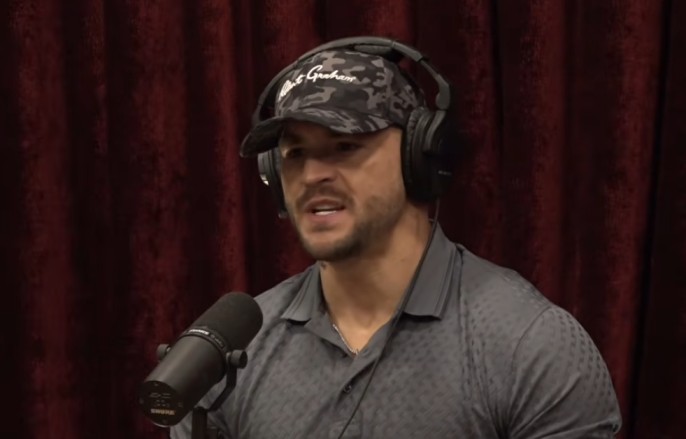
Editor’s Notes: In this episode of the JRE MMA Show, Joe Rogan sits down with UFC legend Dustin “The Diamond” Poirier to reflect on his storied career and life beyond the Octagon. The two dive into the physical toll of extreme weight cutting, the evolution of MMA training since the “early days,” and Poirier’s transition into becoming a “civilian” as he focuses on his family and business ventures. From jumping guillotines to his thoughts on potential boxing matches and the future of his hot sauce brand, this deep dive offers an intimate look at one of the sport’s most respected warriors. (Mar 17, 2026)
TRANSCRIPT:
Welcome and Catching Up
DUSTIN POIRIER: What’s happening, bud?
JOE ROGAN: My friend.
DUSTIN POIRIER: Good to be back, bro.
JOE ROGAN: Dustin Poirier, the light heavyweight.
DUSTIN POIRIER: It’s thick, boy. Summer.
JOE ROGAN: You looking healthy, son.
DUSTIN POIRIER: Yeah, like 190, man.
JOE ROGAN: You look good, man.
DUSTIN POIRIER: I feel good, dude. It feels good to eat and not count carbohydrates and calories.
JOE ROGAN: Yeah, we were talking about that. Where you, like, still, a little part of you looks at meals and goes, well, I mean…
DUSTIN POIRIER: For the last 20 years, I’ve been macro, and I knew I had a fight coming up. Even if I didn’t have a fight, I had to be in striking range from 155.
JOE ROGAN: Right.
DUSTIN POIRIER: So I was always looking at the back of every label, being real cautious of what I eat. It’s ingrained in my daughter now. When we go to Whole Foods, she’ll grab something off the counter and say, “Dad, it only has three ingredients.” Like, she knows what’s up.
JOE ROGAN: Well, it’s good to think that way anyway.
DUSTIN POIRIER: For sure.
JOE ROGAN: Especially with the ingredients.
DUSTIN POIRIER: Yeah, that’s the first thing she goes to. If she wants some chips, it only has five ingredients. That’s like a thing for her when we’re shopping.
JOE ROGAN: Yeah. Well, that’s smart, man. That’s cool. You’re raising them right.
DUSTIN POIRIER: Trying to. I’m trying to put the stuff I learned in fighting, all the years, to use.
The Problem with Weight Cutting in MMA
JOE ROGAN: It is kind of crazy. I think it’s the worst thing about fighting is the weight cutting. Do you imagine if everybody just — first of all, tell me if you agree, but I think the UFC needs way more weight classes.
DUSTIN POIRIER: I do, too.
JOE ROGAN: Way more.
DUSTIN POIRIER: I do, too. Because the gaps are so big. If you look at boxing compared to mixed martial arts, the jumps in weight are so big from each weight class. But also, all the shows they’re putting on, they’d have more titles, more belts, more big fights. But also, man, with that, there’s going to be a lot of people trying to cut a little bit extra, trying to be double champ in every weight class. I think it does cause more confusion.
JOE ROGAN: Yeah, but that’s better than the extreme weight cuts. The extreme weight cuts are — you saw that dude, a few, I guess it was about three events ago, who face planted and got removed off the card.
DUSTIN POIRIER: Yeah.
JOE ROGAN: That is crazy. You’re getting someone to the brink of death 24 hours before they have an MMA fight, which is one of the most dangerous sports in the world, for sure. And you’re doing something to your body to extremely weaken it 24 hours before you fight. It’s bananas, dude.
DUSTIN POIRIER: I did it so many times. You preach it to the choir. I know, but there’s been so many times I felt like that. Like, stand up too quick after a weight cut, and I’m like, I might go down.
JOE ROGAN: Oh, dude. I mean, I can only imagine. When you see someone like Pereira that’s cutting like 25 pounds and more when he was at 185 — I mean, that guy was fighting inside the octagon at 225 and weighing in at 185, 24 hours before. That’s crazy.
DUSTIN POIRIER: And even when he’s big, he’s lean. It’s not like he’s fluffy.
JOE ROGAN: Well, they say that when you’re muscular, it’s easier to cut weight.
DUSTIN POIRIER: More water. Water, yeah.
JOE ROGAN: Yeah. Which is counterintuitive. You see a fat guy, you’re like, oh, that guy can cut weight. But you really can’t because you can’t deplenish — replenish your fat.
DUSTIN POIRIER: Right. Not in a training camp’s time. Eight weeks, ten weeks. You can’t lose like 30 pounds of fat.
JOE ROGAN: But I don’t think “deplenish” is a real word.
DUSTIN POIRIER: You can dehydrate yourself.
JOE ROGAN: I don’t think “deplenish” is a word. Well, if you can replenish, right? But no one says “deplenish.”
DUSTIN POIRIER: Can you plenish?
JOE ROGAN: No, you say deplete. But I just threw it out there like it was real. I don’t think “deplenish” is a word. Is that a word? Yeah, it is. I don’t think I ever used it that way. Oh, okay.
DUSTIN POIRIER: Nice, man.
JOE ROGAN: Nice. I got lucky. That was just luck.
More Weight Classes and the California Model
JOE ROGAN: But I talked to Hunter about it — Hunter Campbell. And we’re trying to figure out a way — it has to be more weight classes. I mean, California instituted a bunch of different weight classes. I think they were doing it every ten pounds.
DUSTIN POIRIER: I think California also did, like, a percentage of your body weight. Like, I don’t — what was it, 15, 20? You couldn’t dehydrate more than that.
JOE ROGAN: That guy Andy Foster is on the ball.
DUSTIN POIRIER: And I think that’s good. 20 or whatever — some kind of rule where guys aren’t cutting 50 pounds.
JOE ROGAN: 47.
DUSTIN POIRIER: I mean, if you’re 200 pounds, 40 — I mean, it’s a lot of weight.
JOE ROGAN: Well, that’s another thing that freaks boxers out. When I tell them that there’s a weight limit at heavyweight that doesn’t make any sense, I go, I agree. Why is there a weight limit for heavyweight? That’s crazy, dude.
DUSTIN POIRIER: That gap too, like 205 — anything over that, you can be 210 to 265. That’s crazy.
JOE ROGAN: Crazy.
DUSTIN POIRIER: A 50-pound gap, you know.
JOE ROGAN: But, well, heavyweight in boxing — look, Mike Tyson when he was in his prime was only like 220. 215, 220. That’s where he was when he was dominating, that’s where he kind of fell in that weight limit.
DUSTIN POIRIER: I think it would be a good idea — anything past like 230, 235, super heavyweight.
JOE ROGAN: Yeah.
DUSTIN POIRIER: You know.
JOE ROGAN: Well, the difference in boxing, though, is the grappling. The grappling in MMA — the gap, if a guy gets on top of you, is immense.
DUSTIN POIRIER: Yeah.
JOE ROGAN: If you got a guy like Gane, when he was in his prime, was weighing over like 300 pounds and then cutting down to 265 — he was a 300-pound natural.
DUSTIN POIRIER: He’s a guy who’s got knockdown power for sure, but grappling — if you get a big guy who’s 265 and knows how to grapple very well, wrestled his whole life, they get inside control or half guard, you’re not getting up. That’s the end of the round.
JOE ROGAN: Yeah, yeah.
DUSTIN POIRIER: Also, if they did do a super heavyweight, the fights might be either awesome or just completely suck.
JOE ROGAN: Well, I think heavyweight should be unlimited. Because like Cain Velasquez — no one’s holding that dude down in his prime. Even when he was 240. When he was 240 and he fought Lesnar, Lesnar was gigantic. But it didn’t matter because of the cardio that Cain had and the speed and his technique.
DUSTIN POIRIER: He was ahead of his time. He was like a hybrid — can do everything. Great cardio, good athlete. Before MMA got to where it’s at now.
JOE ROGAN: Yeah. The one fight that I always say that we missed is Cain and Fedor in their primes, because they were both in their prime at the same time and they never made that happen.
Fedor and the UFC Negotiations
DUSTIN POIRIER: When the UFC absorbed the Pride roster and stuff — it’s crazy that Fedor never fought in the UFC at all, man.
JOE ROGAN: Well, they tried. The UFC tried, but Fedor’s management were a bunch of very dangerous dudes.
DUSTIN POIRIER: Yeah, you don’t mess around with those guys.
JOE ROGAN: Yeah, man. There were tense negotiations, and they wanted a percentage of the promotion. They wanted a lot more than just a big purse.
DUSTIN POIRIER: Yeah, UFC’s not playing that game.
JOE ROGAN: No, they were like, “Look, we’ll give you a very healthy purse. We’ll bring Fedor over here.” But the problem was when they purchased Pride, they thought they were getting everyone’s contracts, but the contracts were all bullshit.
Fighter Pay and Contracts
DUSTIN POIRIER: Well, some guys came over on crazy, crazy money contracts. I think Dan Henderson might have been one. I was a young fighter one time, and I was making — this might have been 2013 or something, 2014, I don’t know. And they came to give me my check. This is back in the day before they wired — they used to give us checks on fight night. And they were going through the checks, and I saw Dan’s and I saw the number, and I couldn’t believe it. This is before people were posting online about fighter pay and all that. And I saw the numbers he was making, I was like, “No way. Guy’s rich.”
JOE ROGAN: Does it make you angry?
DUSTIN POIRIER: Nah, nah. Because the future — myself, looking back or looking forward — when guys are going to be fighting for belts and stuff, the money they’re going to make in five years, I’m going to be that guy. Like, “Damn, I got out too early.” You know how it is. The next generation always gets more.
JOE ROGAN: Right.
DUSTIN POIRIER: Mike Brown tells me that all the time. He was fighting for the belt, defending it, making this — and he says, “You guys on the prelims are making more than I was making.”
JOE ROGAN: Yeah. There’s a weird discussion about fighter pay. I’ve always been of the opinion that fighters should be making more money, period. Because the same way I feel about the way I run my comedy club — the comedians make 80% of the money, because that’s who you’re paying to see. We make plenty of money with drinks and 20% of the ticket sale. It’s enough. If we had a comedy club and there’s no comedians, no one’s coming. No one’s going to pay just to sit there and buy drinks. The whole idea is they’re paying to see someone’s work. If you fight, that’s what people are paying to see. They’re paying to see fighters. Without the fighters, there’s no show.
DUSTIN POIRIER: Without the comedians, there’s no show. I understand. But I think the big thing with the discussion of fighter pay is the percentages. When you look at other major organizations like the NFL and NBA, the percentages are so, so different.
JOE ROGAN: Yeah, it’s not good.
DUSTIN POIRIER: But, dude, at the end of the day, I’m all for fighter pay, too. I’ve been fighting my whole life. But you sign the contract, you agree — this is how business is done. Push for, try to get more of what you’re worth. You can’t sign a contract and complain.
JOE ROGAN: Right. That’s true, too. But also, the reality of MMA is if you’re not in the UFC, people are not paying attention. That’s unfortunate, but it’s reality. And I think there’s some really good fighters that fight in the PFL and really good fighters that fight in ONE, but no one knows who they are other than the hardcore fans.
Great Fighters Outside the UFC
DUSTIN POIRIER: Yeah, I got a buddy, Johnny Eblen, who is the Bellator champion. I’ve been training with him since he started MMA, when he got out of college wrestling and stuff. Right now, he can go to the UFC and give the top five guys a run for their money. No doubt in my mind. He’s only getting better.
JOE ROGAN: Yeah.
DUSTIN POIRIER: Just because you fight in the UFC — that’s a great organization to fight for, the biggest, the most known worldwide. But, dude, there’s great fighters everywhere. On the mats at American Top Team, there’s a dozen guys you’ve never heard of that can make a run in the UFC right now.
JOE ROGAN: That’s what I heard — it’s a nightmare training at American Top Team because
DUSTIN POIRIER: it’s a revolving door, man. There’s like a hundred professional fighters on the mats at all times.
JOE ROGAN: Yeah.
Training Culture and MMA History
DUSTIN POIRIER: Different camps. They have dorms. So guys from Russia, guys from all over the world are just in. You never know who’s going to be there. And it’s tough rounds, you know, every practice is tough.
JOE ROGAN: Well, not only that, but I’ve heard there’s guys coming in from Russia, and they’ll throw oblique kicks at your knees, and you’re like, hey, man, what are we doing here? We’re getting ready for fights. We’re not in a fight, right? Yeah, yeah. Like, some of these guys are trying to make their name off of a name guy, and so you have to be very selective in who you spar with, for sure.
DUSTIN POIRIER: And that’s any, not just American Top Team, especially guys who are established. Like, if I go to any gym here in Austin and it’s open mat or something, I have a target on my back. Of course, you know, that’s everywhere.
JOE ROGAN: Of course.
DUSTIN POIRIER: But those guys, man, like at a big gym, like American Top Team, with the knowledge and the good coaches, those guys get weeded out. You won’t stay there long if you’re doing that stuff.
JOE ROGAN: The problem is if you’re one of the guys that has to weed them out. Like, you find out early on this dude’s throwing wheel kicks.
DUSTIN POIRIER: Yeah.
JOE ROGAN: Full blast.
DUSTIN POIRIER: And it happens all the time.
JOE ROGAN: Oh, yeah. Well, just, you know, makes sense. I mean, you’re from Dagestan or Chechnya or whatever. You come to America, it’s like, this is your big chance.
DUSTIN POIRIER: And I do like to train hard to prepare for a fight. You got to fight, but, you know, you got to take care of each other. We’re professionals. We’re feeding our family with this.
JOE ROGAN: Yeah.
DUSTIN POIRIER: An injury can ruin everything.
JOE ROGAN: Well, there’s so many fighters that get concussions in training, and then they get chinny when they get into the fight. It happens all the time.
DUSTIN POIRIER: Yeah.
JOE ROGAN: Especially the early days, there was a lot of guys who got hit. Me.
DUSTIN POIRIER: Yeah. Like the early days, we didn’t really have classes that were organized, man. It was just sparring and choking each other out. And with four ounce gloves sparring, like, we didn’t know. We didn’t know.
JOE ROGAN: Isn’t that crazy?
DUSTIN POIRIER: Like 2006, dude, we used to beat each other up every day. That was MMA training. And then it wasn’t these super gyms where everything was under one roof. I would drive to a boxing gym, drive another 45 minutes to a jiu jitsu gym. You know, it was put everything together on fight night, but you would train everywhere else because there wasn’t mixed martial arts gyms back then. Really. I would drive to a kickboxing gym, boxing gym, wrestling, jiu jitsu. It was all separate.
JOE ROGAN: Well, also, you were in a place that didn’t have like a high volume of MMA fighters in your state. Right.
Louisiana Roots and Early Training Days
DUSTIN POIRIER: Back then, like Rich Clemente, Melvin Gillard were the big guys from Louisiana, you know, right. Then Tim Credeur came, got crazy.
JOE ROGAN: Tim crazy.
DUSTIN POIRIER: Tim got on the Ultimate Fighter and then I went to his gym once he got out of the TV show, and me and him trained for years and years. He still has a gym in Lafayette, Louisiana.
JOE ROGAN: I loved him. I’ve known Tim since I first worked out with him in, like, 98 at Machados.
DUSTIN POIRIER: Well, he was in maybe the Navy, so he was in California, stationed there. And I think that’s when he started jiu jitsu. He was Louisiana’s first black belt.
JOE ROGAN: Oh, wow. Yeah, I knew him from that. And then he was fighting, and he was fighting in the UFC.
DUSTIN POIRIER: He was always around the MMA scene. Him and Evan Edwards were good friends. They opened the gym maybe in Houston or something. He was cornering even in Pride. And then I met Evan through Tim, and it’s just a big family, man.
JOE ROGAN: Evan is a guy that, I always say there was a time where he was the best 155 pounder on earth.
DUSTIN POIRIER: When he beat Josh Thomson.
JOE ROGAN: Yes.
DUSTIN POIRIER: He’s the uncrowned champion.
JOE ROGAN: He should have been the uncrowned champion.
DUSTIN POIRIER: There wasn’t a belt.
JOE ROGAN: I know. Isn’t that nuts? Isn’t that nuts? That’s so hard for people to understand, like, how crazy it is, like, being
DUSTIN POIRIER: through the lineage of Thug Jitsu. Man, it sucks to say like that. He can’t say he was a champion, but I know he was.
JOE ROGAN: He was.
DUSTIN POIRIER: He was. He was the best.
JOE ROGAN: The best. At one point in time, he was the best.
DUSTIN POIRIER: He lived out here before he moved to LA, so before I moved to South Florida to train at American Top Team, I used to drive six hours here and stay with Evan. He always had wrestlers down here. This is, like, beginning of my WEC days. I would drive down here and train with Evan. Man, he was another guy who was ahead back in the day.
JOE ROGAN: Yes.
DUSTIN POIRIER: Because he comes from NHB. Like, Hook and Shoot, the crazy days.
JOE ROGAN: Yeah, yeah.
DUSTIN POIRIER: And he was doing it all, good jiu jitsu, good kickboxing. He fell in love with wrestling. I was such a big fan of Evan, man.
Evan Dunham’s Legendary Flying Knee
JOE ROGAN: He invented some moves, too. You remember that one thing that he would do where guys were on a single and he hit a dude with a flying knee, a jumping knee.
DUSTIN POIRIER: That was, dude, I’m an MMA historian, bro. That was Elite XC, I believe, maybe. And you know, that was Edson Berto.
JOE ROGAN: Was it?
DUSTIN POIRIER: I think Andre Berto’s brother, the boxer.
JOE ROGAN: Oh, wow. Yeah, wow.
DUSTIN POIRIER: But he had a single leg. He was hopping and then jumped up and out cold.
JOE ROGAN: Yeah, it was crazy. It is Elite XC. Look at you, bro.
DUSTIN POIRIER: I mean, play that again.
JOE ROGAN: Look at this. This move is brilliant. That’s brilliant.
DUSTIN POIRIER: That’s Edson Berto. And I believe Andre and Edson’s dad was a mixed martial artist.
JOE ROGAN: Oh, wow. That’s such a slick move.
DUSTIN POIRIER: Yeah, he’s so crafty, man.
JOE ROGAN: Oh, yeah. Well, that head kick that he landed on Josh Thomson in the middle of that wild, crazy scramble, jumping roundhouse kick
DUSTIN POIRIER: to the head, dude. And they still play it. Every opener of the UFC, they still play it, as they should. I mean, it’s incredible.
JOE ROGAN: Absolutely. Yeah. You gotta give credit to Evan. He was one of the real pioneers, for sure.
DUSTIN POIRIER: And way before this was cool. Yeah, way before.
JOE ROGAN: Yeah. But to be stuck at, like, 155, like, that was his weight class, and then there’s no title.
DUSTIN POIRIER: Yeah. They were the two best guys in the world at that time, him and Josh Thomson.
JOE ROGAN: Yeah. Josh Thomson’s another one. Doesn’t get the credit he deserves. That’s it. Boom. Like, what a slick move, man. But that was Evan. Very creative, you know?
The Unsung Legends of 155
DUSTIN POIRIER: Yeah, man. Josh Thomson, like, peak Josh Thomson, for me, what was it? Strikeforce, when him and Gilbert Melendez maybe were going back and forth. Yeah, they might have had a trilogy. It might have been two or three fights, but every fight was amazing.
JOE ROGAN: Gilbert Melendez, another guy, doesn’t get the credit he deserves.
DUSTIN POIRIER: Dude, legend. Legend, man.
JOE ROGAN: Legend. All those guys, they were the groundbreakers. You know, a lot of these young kids coming up, you bring up Gilbert Melendez, they’re like, who? Like, bro, you need to know your history. You need to know how this thing got started.
DUSTIN POIRIER: Go even more newer stuff. Go watch him and Diego Sanchez slug it out.
JOE ROGAN: Diego Sanchez is another guy that I say is a tweener. Right.
DUSTIN POIRIER: Because welterweight.
JOE ROGAN: Yeah. I mean, he really wasn’t really a welterweight. And he, you know, tried to get down to 145 for a while, but that was just brutal. He was killing himself getting down to 145. I remember seeing him making weight for 145. I’m like, oh, this ain’t good.
DUSTIN POIRIER: This ain’t going to last long.
JOE ROGAN: No. Yeah, but if there was a 165 pound weight class, Diego Sanchez might have been the champion of the world.
DUSTIN POIRIER: Right? Honestly, man, like, when I was competing, if they had a 165, I might have entertained it. 170 is just too big of a gap because I trained with 170s in the UFC, and I know they’re 200 something pounds, and my heaviest, I was like, 182, 183. They’re just too big, man.
Anthony “Rumble” Johnson
JOE ROGAN: Well, you got guys like Rumble Johnson, when Rumble was alive. Yeah. Rumble got up to 230 pounds in between.
DUSTIN POIRIER: No. He was huge, man.
JOE ROGAN: Huge.
DUSTIN POIRIER: Huge. I can’t believe he made 170.
JOE ROGAN: He was.
DUSTIN POIRIER: He was living in South Florida, so I see him every now and then. He was huge.
JOE ROGAN: He was the ultimate weight cutter. Like, he cut more weight than anybody. When he was fighting at 170, it was bananas. Like, how are you doing this? I remember running into him at a hotel. I was like, bro, how big are you? And he was laughing. He’s like, “I’m 230 right now.”
DUSTIN POIRIER: And muscle, jazz.
JOE ROGAN: Like a heavyweight. And he went up to heavyweight.
DUSTIN POIRIER: He did.
JOE ROGAN: Which is crazy. He was a legit heavyweight.
DUSTIN POIRIER: Yeah, dude. Andrei’s still fighting.
JOE ROGAN: I know. And winning the bare knuckle champion.
DUSTIN POIRIER: Winning.
JOE ROGAN: He’s the bare knuckle champion. Like, how durable is that motherf*er?
DUSTIN POIRIER: For the years and the miles that that guy has, I have to say, like, taking shots, receiving damage. I don’t know if he takes it like he used to, but his mobility and his movement, for all the wars he’s had in the years he’s been fighting. When I watch him in the gym, dude, he’s light on his feet, flexible. He moves so well.
JOE ROGAN: And enthusiasm. Still has enthusiasm for the game.
DUSTIN POIRIER: Yeah.
JOE ROGAN: Which is crazy.
DUSTIN POIRIER: He loves it.
JOE ROGAN: He clearly loves it. I mean, he was, what, UFC heavyweight champion in 2005.
DUSTIN POIRIER: Yeah. Was it like 2005 or 2006? I think he beat Tim.
JOE ROGAN: Tim Sylvia, maybe when he was the champ. First of all, that motherf*er had a piston for a right hand. I remember when he killed Paul Buentello. Oh, my God.
DUSTIN POIRIER: That’s a Texas guy.
JOE ROGAN: Paul Buentello. Another dude.
DUSTIN POIRIER: I believe he’s from Galveston area or Corpus Christi or something. He’s from Texas.
JOE ROGAN: Well, if you think Arlovski from 2005, and he was a top 10 heavyweight as recently as, like, 2023.
DUSTIN POIRIER: Well, when he came back to the UFC, after that long gap, he went on a streak. He had a bunch of great fights. I think he knocked out Travis Brown.
JOE ROGAN: Beat Travis Brown, which is crazy.
DUSTIN POIRIER: Did he fight Bigfoot? Did him and Bigfoot fight?
JOE ROGAN: And Bigfoot. 51 is when he won. 2005. February 5, 2005. That is bananas, man. That really is bananas, man.
Tim Sylvia, TRT, and the Juicing Era of MMA
DUSTIN POIRIER: Back in the day, Tim Sylvia used to train at ATT. When I first got there, he was the most uncoordinated, unathletic guy. I couldn’t believe he was a UFC champion, man.
JOE ROGAN: I know, he was like goofy, pigeon-
DUSTIN POIRIER: -toed, but down to fight.
JOE ROGAN: Oh, down.
DUSTIN POIRIER: Down to fight. Yeah, for sure. Pigeon toed. His knees were weird.
JOE ROGAN: Yeah, yeah. They went in.
DUSTIN POIRIER: I don’t.
JOE ROGAN: I tried to talk to a trainer about that, and he goes, that’s learned. Like you can correct that.
DUSTIN POIRIER: I was like, what? The knee?
JOE ROGAN: Yeah. The knees bowed in like that was. He said, that’s learned. You could correct that. I was like, really? What?
DUSTIN POIRIER: I never heard of that.
JOE ROGAN: Yeah, they didn’t understand how.
DUSTIN POIRIER: It seems like something they would do maybe when you’re born, surgery, like reposition the bones or something. No.
JOE ROGAN: Well, I don’t know if it is. I don’t know. I mean, I’d have to. I don’t want to speak out of turn. I have to bring in that guy and have him explain to me how you could correct that. But he’s like, that’s something that could be corrected. That’s like learned behavior. It’s just from being so big.
DUSTIN POIRIER: But, dude, watching him with his toes pointed out, doing the ladder drills and stuff, the ladders on the mat, in and out — it was big.
JOE ROGAN: Guys have their toes pointed out like that. Like, Jelly Roll went from 500 pounds and he’s down to the low two hundreds now, which is crazy.
DUSTIN POIRIER: I saw pictures of him. Looks completely different.
JOE ROGAN: He’s lost like 300 pounds. And he did it the right way. No Ozempic, just diet and exercise. Runs all the time. But he has a problem when he walks, his toes are pointed out and he’s trying to correct it. He’s trying to be aware of it. When he runs, he runs the right way. Feet pointed forward.
DUSTIN POIRIER: You see it too, on the bigger guy’s shoes. The corners of the shoes are always flat. Like flat tires on the outside. Yeah, they just walk that way, man.
JOE ROGAN: Well, you got to think you have so much weight, you kind of stretch out to balance yourself. But I always point to Tim Sylvia when he knocked out Rico Rodriguez. That Tim Sylvia was a beast, dude. That was back when all the Mexican supplements were allowed. There was a lot of dudes who were very juicy.
DUSTIN POIRIER: Oh, yeah.
JOE ROGAN: And Tim had giant traps and huge shoulders, and I remember he struggled to get down to 265 for that fight.
TRT Era, USADA, and the Culture of Doping
DUSTIN POIRIER: Back in the day when the juice was just free flowing, man. I just worked the UFC desk with Bisping in Vegas when Max and Charles fought, and we started talking about the same thing we’re talking about now, and he was like, “Oh, I fought Vito. I fought them all in the height of TRT.”
JOE ROGAN: Right. He fought legal juice, which was bananas.
DUSTIN POIRIER: I mean, Alistair.
JOE ROGAN: Oh, yeah. That was the juiciest fight of all time. Alistair versus Brock was the juiciest fight of all time.
DUSTIN POIRIER: I recently watched the Mark Hunt documentary, and he’s trying to push back and do a lawsuit against the UFC for all the juicing and stuff. But I mean, that’s a tough.
JOE ROGAN: That’s a tough road, because how much can the UFC do?
DUSTIN POIRIER: And it’s on the athletic commission as well, right? Wouldn’t the lawsuit be against the state, not the UFC?
JOE ROGAN: I think his position is that the UFC knew. But how would they know that Brock was juicing?
DUSTIN POIRIER: I don’t know. This is before random drug tests, I believe.
JOE ROGAN: Yes, it was before.
DUSTIN POIRIER: So I feel like that would fall on the state athletic commission.
JOE ROGAN: Maybe it wasn’t before, because he did get popped. But it wasn’t random. They weren’t showing up in camp.
DUSTIN POIRIER: No. Back in the day, you would get tested on fight night, right? They would knock at your door.
JOE ROGAN: Well, it was super clear that Brock was doing something. It was super clear. Like, he was in his late 30s, built like the side of a barn.
DUSTIN POIRIER: I mean, there’s a bunch of guys back then.
JOE ROGAN: Yeah, guys. Yeah.
DUSTIN POIRIER: But it wasn’t. It was okay. Everybody was doing it.
JOE ROGAN: It was. And it wasn’t right because it was illegal, but when you have fight day drug tests, that’s an intelligence test. That’s all that is. That’s whether or not you have good people in your corner and whether or not you have a
DUSTIN POIRIER: chemist. It’s going to take this amount of weeks or this many days to get out of your system.
JOE ROGAN: Well, there are certain camps that would employ scientists, and these scientists, the crooks,
DUSTIN POIRIER: are always going to be ahead. They’re always going to be coming up with something new, trying to stay ahead of the curve and get away with stuff. And I still think they’re probably doing it, man.
JOE ROGAN: Yeah, there’s probably something that we don’t know right now and it’s going to come out in the future. That’s why they hold on to the drug tests for a prolonged period of time.
DUSTIN POIRIER: Yeah. They ask you your consent, you have to do an extra signature if you let them test it or use it for.
JOE ROGAN: If you say no, I don’t know.
DUSTIN POIRIER: I never said no. I always give it to them.
JOE ROGAN: Well, it’s good for you because you’re clean.
DUSTIN POIRIER: Yeah. I competed my whole career clean, man. Nothing. I was even scared of certain creatine. I got the Trusted by Sport certification on everything because I was so scared to be one of those guys, because every time I see it — “tainted supplement” — yeah, sure, buddy. But it could be, you know. I don’t want to be one of those guys.
JOE ROGAN: Well, for sure. There are tainted supplements. That’s a real thing. And I know that for a fact because as one of the owners of Onnit, when we were doing third party testing of some of our supplements, we would find stuff in there that’s not supposed to be in there. And so we’d have to contact the distributor, the manufacturer, and the people that mixed our stuff.
The way Onnit would work is like Alpha Brain has a bunch of different ingredients that enhance your mental focus and clarity. And we would give them the very specific numbers of what’s supposed to be in each batch. Then we would third party test and find a bunch of stuff in there that’s not supposed to be in there. And it’s because if you’re getting it done overseas, they have these vats where they mix all the stuff in and they don’t even clean the vats, man. They dump it out and then dump the new stuff in there without cleaning it.
DUSTIN POIRIER: There’s residue in there. And then also the level of drug testing — how high these things can sense anything.
JOE ROGAN: Right.
DUSTIN POIRIER: Even if there’s a tiny bit, they’ll find it.
JOE ROGAN: With Jon Jones, right. It’s picograms. We got introduced to the term pico.
DUSTIN POIRIER: Like a grain of salt in a swimming pool they could find. So the testing is legit. And I’m glad, because we’re fighting. We’re kneeing each other in the face. If we were running track or something.
JOE ROGAN: Exactly.
DUSTIN POIRIER: But we’re fighting. You can get seriously injured, man.
JOE ROGAN: Exactly.
DUSTIN POIRIER: I’ve always been against doping, but I’m retired now, Joe. I’m retired now.
JOE ROGAN: Now you can get jacked. Yeah. I love when guys get — well, Cowboy got real jacked too, afterwards, but then he talked about coming back, and then he got off of everything.
DUSTIN POIRIER: That’s the thing, though. Back in the day, all the TRT guys — if you change your body’s natural production of testosterone with exogenous testosterone, you have to be on it for the rest of your life.
JOE ROGAN: Well, you don’t have to, because there’s things called HCG and clomiphene that can restart your body’s production of testosterone.
DUSTIN POIRIER: Because your testicles will stop producing once you introduce foreign testosterone, right?
JOE ROGAN: Well, for a period of time, especially when you’re a young man, you can restart it. But my production — I’ve been on TRT since I was in my late 30s. It’s not coming back.
DUSTIN POIRIER: Yeah, yeah.
JOE ROGAN: I’m shooting blanks. Pow.
DUSTIN POIRIER: But you’re good.
JOE ROGAN: But two of my daughters were born while I was on TRT, so it does work. I just had a limited amount. I had soldiers. Just one f*ing special ops guy.
DUSTIN POIRIER: The only one who was marching, but he got through. Black ops.
Pride FC, Steroids, and the Alistair Overeem Transformation
JOE ROGAN: So if you think about all of the time where people were allowed to dope, it is a giant percentage of the history of MMA.
DUSTIN POIRIER: Like Pride, the further you go back, for sure.
JOE ROGAN: For sure. Pride was juicy as juice. Like Ensign, anyway, when he was on the podcast, told me that in the contract, it said in all capital letters, “We do not test for steroids.”
DUSTIN POIRIER: We aren’t looking. I’ve heard other people say that as well. We aren’t looking.
JOE ROGAN: Thumbs up, green light. Let’s go.
DUSTIN POIRIER: Shoot up the juice. Come fight. We’ll pay you cash. Get out of here.
JOE ROGAN: They wanted you to juice. They wanted you to fight better, which is like.
DUSTIN POIRIER: It becomes a spectacle. But, man, people can get seriously injured.
JOE ROGAN: Especially. But then also the thing is, does it make you more durable? I think it does.
DUSTIN POIRIER: I think it does, man. Just one that comes right off the top of my head — when Bigfoot Silva was on TRT or whatever he was on, he was so durable. Him and Mark Hunt had those crazy fights, but when he got off, he started getting knocked out.
JOE ROGAN: Right. But there’s also the switch. There’s something that happens when you’ve had a certain amount of concussions where another.
DUSTIN POIRIER: Another guy that comes to mind — remember Eric Silva? Welterweight, was huge, dude. Whenever they started doing the USADA stuff, he was getting knocked out and just wasn’t himself.
JOE ROGAN: He didn’t look the same. He melted.
DUSTIN POIRIER: I wonder what the medical reason for that is. But I think it has something to do with confidence and self-belief with the testosterone. I think that’s a big part of it.
JOE ROGAN: A part of it, but also your vitality — you’re just more durable. When you’re jacked up on testosterone, you’re just more durable.
DUSTIN POIRIER: Yeah.
JOE ROGAN: Everything about you is more. Alistair’s a great example of that. Animal mode, man. I think Alistair Overeem when he was “Ubering” — I think that is the best argument for TRT ever.
DUSTIN POIRIER: Looked like a superhero, bro.
JOE ROGAN: When he was in K1 and he was shelling up. How are you getting through that?
DUSTIN POIRIER: Remember how small he was though, back in K1? He was like a 205 or. Well, when anyone.
JOE ROGAN: Pride. When he was fighting at light heavyweight, Chuck knocked him out.
DUSTIN POIRIER: Yeah.
JOE ROGAN: Liddell knocked him out when he was a legit light heavyweight. And he was skinny.
DUSTIN POIRIER: Yeah. Young and skinny.
JOE ROGAN: He just decided, time to get big. Look at him back then when he fought Shogun.
DUSTIN POIRIER: Still pretty jacked though.
The Calf Kick Revolution
JOE ROGAN: Oh, yeah, man, he was shredded. He was shredded, but he was a shredded light heavyweight. You know, I think he’s a vegan now. Look at that. Come on, son. Come on.
DUSTIN POIRIER: That’s a ribeye. That ain’t vegan.
JOE ROGAN: Right. Go back to that other one. That’s what I’m talking about. I mean, that’s what a UFC heavyweight champion’s supposed to look like.
DUSTIN POIRIER: Hell, yeah.
JOE ROGAN: Come on, son. I mean, put that on the…
DUSTIN POIRIER: Put that on the White House card.
JOE ROGAN: Not just that, but highly skilled for sure. He wasn’t just jacked, he was highly… I mean, there’s a K1 Grand Prix champion. I mean, that dude was the cream of the crop at kickboxing. He was the cream of the crop in MMA and he even won the Abu Dhabi European trials as a pure grappler.
DUSTIN POIRIER: Yeah, people don’t know about that, about Alistair. His grappling is high level.
JOE ROGAN: He had one of the best guillotines in the game. Like Alistair in his prime when… when he went over and he fought Brett Rogers over in… was it Burt Cooper? Who do you know? Who do you f*ing fight in Strikeforce?
DUSTIN POIRIER: Like Brett Rogers.
JOE ROGAN: Brett Rogers, that’s right. Sorry. I’m thinking of the heavyweight boxer Burt Cooper. Burt Cooper, who fought… he had some crazy wars with… with Evander. Evander Holyfield.
DUSTIN POIRIER: I think Evander’s down in South Florida, too, now. I don’t remember Cooper.
JOE ROGAN: He was a really… he was a Tank. He was a Tank. He was a super jacked guy. But Brett Rogers, when he fought Alistair, Alistair, like, immediately hit him with a low kick. And you could tell he was like, “What is this?” Like, it was a different kind of low kick because you’re dealing with the tree trunks of Alistair with perfect technique. And that guy was as good a kickboxer as has ever entered into MMA. And when he was saucy, he was a problem. Yeah, he was a real f*ing problem.
Kickboxers Transitioning to MMA
DUSTIN POIRIER: Speaking of kickboxers from that era coming to MMA, didn’t Gokhan Saki come over?
JOE ROGAN: Oh, yeah.
DUSTIN POIRIER: I thought he was going to do so much better. But he was older.
JOE ROGAN: He was older. And he was at a time where, you know, he had had so many fights in K1, he had so many wars. And he fought Khalil when, you know, Khalil’s fast.
DUSTIN POIRIER: Yeah. And I mean, good kickboxing.
JOE ROGAN: Real good kickboxing. Khalil cracked him in the first round and knocked him out.
DUSTIN POIRIER: Yeah.
JOE ROGAN: Yeah. Which was a big fight for Khalil because, you know, Gokhan was the Turkish Tyson coming over here. He’s one of those guys, like Mirko Cro Cop, who was like an elite kickboxer entering into MMA. And everybody always gets excited about that. Obviously, Pereira is the best example of that.
DUSTIN POIRIER: Yeah, yeah.
JOE ROGAN: But he was a guy I knew. I told everybody, I was like, “That guy’s going to be a nightmare for everybody,” because there’s something about him, man. I don’t know what the hell is going on with his bone structure, his DNA and his intelligence. Like, he figures out that other people didn’t like the way he threw that low kick. Like, the way he throws that calf kick with zero tell, no turning of the hips. Like, he f*s up guys’ calves better than anybody on the planet.
DUSTIN POIRIER: We had like a huge rush of the calf kick. I saw it for like a year and a half, two years. Everybody was doing it. Now it’s kind of fading away.
JOE ROGAN: I’ve noticed that it is, but not with him. It’s not with elite guys. Guys that are really good at it.
DUSTIN POIRIER: It does so much damage, man.
JOE ROGAN: So quickly. Crazy.
DUSTIN POIRIER: And it’s so much less commitment, so you don’t have to turn your hips over as much. So wrestlers aren’t grabbing singles as easy.
JOE ROGAN: Well, I remember your fight with Jim Miller.
DUSTIN POIRIER: Oh, dude, tore me up.
JOE ROGAN: Yeah, that was one of the first examples of calf kicks being really dangerous, and…
DUSTIN POIRIER: I’ve never felt it before. And I’m a southpaw, so they land good calf kicks. You’d have to fight another southpaw. Right. And that doesn’t happen too often, especially with one who’s throwing those. So I didn’t know what kind of black magic he was doing, bro. I was like, “I got a flat tire. What is going on? What is this?”
JOE ROGAN: Isn’t it crazy that it took that long for people to figure that out?
DUSTIN POIRIER: Ben Henderson was a guy doing it early, but it wasn’t that effective for some reason.
JOE ROGAN: Yeah, he was doing it, but it wasn’t having the devastating damage.
DUSTIN POIRIER: I’m trying to think of who’s the first guy to really… Edson Barboza would do it every now and then. Trying to think of somebody who really brought it over, bro.
JOE ROGAN: It’s made its way into kickboxing now. Because they were saying the Muay Thai guys are not susceptible to calf kicks, and everybody was saying that. I was like, “That doesn’t make a lot of sense to me.”
DUSTIN POIRIER: They are light on their front foot, so that front foot is…
JOE ROGAN: They are. But there’s times where they have to plant, like when they’re throwing a right kick. There’s a guy named Yuki Yoza who fights for ONE. He’s a Kyokushin guy, and he is f*ing everybody up with calf kicks. Yeah, he fights like high guard, tight inside, and again, no pivot of the hips. He’s essentially throwing his calf kick almost like he’s kicking a soccer ball straight up the middle.
DUSTIN POIRIER: That’s the way I like to do it as well. Just clip the top of the calf. There’s no commitment. You don’t have to pivot your hips or plant to turn. You can just snap it out like a jab.
JOE ROGAN: Yeah. Well, a great example of the changing of technique was you in that Conor fight.
DUSTIN POIRIER: Yeah. Calf over and over and over.
JOE ROGAN: And it was also southpaw versus southpaw. Same thing. You just destroyed that calf.
DUSTIN POIRIER: Yeah.
JOE ROGAN: And you could tell he didn’t know what to do. Because as good as he was and as many fights as he had, two division world champion, he hadn’t been calf kicked.
DUSTIN POIRIER: Right.
JOE ROGAN: Which is a crazy transition. When you see the history of the sport, that is one of the clear differentiations. That’s the clear line in the sand where the techniques changed.
DUSTIN POIRIER: Yeah. And it’s one of those things like before it happened to me, I saw it and I was like, “Ah, it might be uncomfortable,” but until it happens, then you have a different respect for it. So Conor probably learned a lot that fight, man. Like, “This is for real. Calf kicks are for real.”
Compartment Syndrome and Recovery
JOE ROGAN: What’s crazy about it is just one shot. Because a thigh kick, like, you can get a hard thigh kick and your leg goes dead for a couple seconds, but it comes back.
DUSTIN POIRIER: Yeah.
JOE ROGAN: Calves don’t really come back that quick.
DUSTIN POIRIER: They explained it to me at the hospital after the Jim Miller thing. Apparently your calf doesn’t have the chambers for the fluid to drain. So that’s why it gets compartment syndrome.
JOE ROGAN: Oh, compartment syndrome.
DUSTIN POIRIER: That’s why it’s so painful. Because the swelling can’t go out through your whole leg. So it sits in one pocket and fills up and it’s just uncomfortable. It can stop nerves.
JOE ROGAN: And did you ever see what happened to Austin Hubbard?
DUSTIN POIRIER: Dude, that’s what they wanted to do after the Jamila fight. They wanted to cut me at the… it’s like, “No way.” They filet you to release the pressure.
JOE ROGAN: Well, another guy, Uriah Faber, when he fought Jose Aldo, his leg blew up like a balloon.
DUSTIN POIRIER: Yeah. Apparently if it gets that bad, compartment syndrome and the swelling is bad enough for long enough, you can lose function of your ankle and foot.
JOE ROGAN: Yeah. Which is crazy. Well, Uriah was one of the first guys to implement going into… why can’t I think of it… the chamber… oxygen chamber… hyperbaric. What’s wrong with me today? I’m making up fake words. Can’t come up with things that I know. But he was using the hyperbaric exclusively to recover from that and documenting it. And I was like, “Yo, that’s interesting.”
DUSTIN POIRIER: A lot of good brain benefits for hyperbaric. I don’t have one. I’ve done it before, but it’s never been like a routine thing.
JOE ROGAN: Well, it’s… you have to have access to it.
DUSTIN POIRIER: And also the tents, the zip-up tents at home…
JOE ROGAN: Not as strong.
DUSTIN POIRIER: Yeah, yeah. You need a solid…
JOE ROGAN: You know, you need like one of those propane tank ones, those big thick-walled ones.
DUSTIN POIRIER: The glass ones. It’s really good, high pressure.
JOE ROGAN: Yeah, yeah. And then, you know, you got to be careful in those things. No sparks.
DUSTIN POIRIER: Yeah. Dude, I saw a story that a kid was in one… you saw that? That was a couple years ago.
JOE ROGAN: Horrible. Yeah, horrible story. Yeah. But hyperbaric is awesome for recovery. It also lengthens… there’s a protocol that was developed. One of the universities in Israel developed it, where you do 60 sessions over 90 days, and it lengthens your telomeres. That’s commensurate with, I think, like a 20-year difference in your biological age. It’s nuts. It’s super effective. Like, when you get a lot of oxygen into your system like that, it just helps everything recover for sure. Like, if you have an Oura Ring or a Whoop strap and you go into one of those things, it shows you… yeah, it’s like, “Oh, you have an amazing recovery day.”
Wearable Devices and Training Metrics
DUSTIN POIRIER: Yeah, man. The metrics we can track now with all the wearable devices, it’s pretty awesome, dude.
JOE ROGAN: Well, it gets you to understand… I think you can get a little addicted to those things for sure.
DUSTIN POIRIER: So when I was competing, I stopped using them because every day it wasn’t ready, need to rest, red, red, red. Every day. So when I retired, I got back to it. Now I’m using them, but when you’re training for a fight, you can’t. Isn’t that interesting? Not taking two days off. I need to train and the fight’s coming up. Like, if I’m in the red zone, I still need to train.
JOE ROGAN: Isn’t that interesting? Like, a wearable device would tell you you’re not supposed to train, but yet, in order to reach MMA peak physical condition, you have to push when you’re not ready so that your body’s forced to recover quicker.
DUSTIN POIRIER: I know this guy’s training. That’s why I got rid of it during camp. I don’t use it, or didn’t use it.
JOE ROGAN: Well, it’s weird because, like, what if you listen to it? Like, some people say… like, Terence Crawford was talking about how there’s times where he wanted to push and his coaches told him not to, and then he realized they were right.
Training Smart as You Age
DUSTIN POIRIER: Yeah. Maturing through fighting, man. Pulling back got easier as I got older. When I was a younger fighter, I didn’t want to take any time off. I needed as many reps, as much time on the mats as possible. But as I got to mid-30s, 36, I was like, “I got to take days off. Complete days. Complete days.” Not just an easy day or a technique day. I just need to be out of the gym.
JOE ROGAN: Just relax.
DUSTIN POIRIER: Yeah. Reset my mind to where I want to be there.
JOE ROGAN: Just hard for fighters because you operate on momentum, the conditioning and the training, the discipline. It’s like you’re in there, and then to have a day where you’re not, you feel like you’re slipping backwards.
DUSTIN POIRIER: Right. And you show up to fight week with that momentum. Like, “I did everything I could. I busted my ass every day.” It just gives you so much energy and so much confidence going into…
Overtraining, Recovery, and Weight Cutting
JOE ROGAN: Fight week, you’ve turned over every stone. Well, the worst thing, though, is seeing a fighter fight flat because they over train. And the one thing that I always point to is when Tim Kennedy fought Kelvin Gastelum, and he had gone through two solid camps in a row, so he went through one camp, peaked, got ready for the fight, and then the fight got canceled, and then went right back into camp to train for Gastelum and didn’t give himself the chance to recover. He’s too tough. Too tough, too disciplined, and his body broke down.
DUSTIN POIRIER: You’re redlining that engine over and over and over. I mean, we just saw it with Merab, not taking anything away from Yan, but you stay that busy, those kind of fights, those training camps, it’s hard to do. That’s what makes things like Jon Jones could be so impressive to me, man, to get on top and stay on top that long.
JOE ROGAN: Yeah, it’s nuts. There’s so few guys have been able to do that, especially in MMA.
DUSTIN POIRIER: Too many variables, too many ways to slip on a banana peel, get caught in something.
Khabib, Floyd, and Conor
JOE ROGAN: I kind of love that Khabib went out on top and never came back.
DUSTIN POIRIER: Respect. That’s awesome.
JOE ROGAN: And they offered him a lot of money to come back. He’s like, nope.
DUSTIN POIRIER: Good for him, man.
JOE ROGAN: Yeah, good for him. That’s the way to do it. And then you go out with all your faculties, everything’s fine. Undefeated, go down a legend.
DUSTIN POIRIER: I think Floyd should have done it like that. Now he’s fighting Mike Tyson, dude, come on, man.
JOE ROGAN: I know. There were some rumors around that Floyd was going to have a rematch with Conor, which is crazy, but I think Conor would probably do it. Especially with drug testing involved.
DUSTIN POIRIER: I wonder if he’s going to come back. For sure. But man, to heal from an injury like he had, you probably need a bunch of stuff. I don’t know the ins and outs of that, but you probably need some help to heal.
JOE ROGAN: He definitely needed some help to heal. The problem is once you get used to that help and you enjoy it.
DUSTIN POIRIER: Yeah, I’m getting used to the help.
Peptides, Recovery, and Supplements
JOE ROGAN: That’s what I thought about Cowboy when he got jacked and then he slimmed back down again. He said he was going to fight again, but I think he might have abandoned that.
DUSTIN POIRIER: I got hooked up with Brigham and ways to — well, they did all my blood work when I retired. I turned down testosterone. No testosterone for me. So I’m not on any testosterone. I just don’t want to mess up my natural production because mine wasn’t high, but it wasn’t low. I’m just scared to mess with it.
JOE ROGAN: Yeah, you don’t need it. And peptides can do a lot for you.
DUSTIN POIRIER: Yeah, I’m on a bunch of peptides.
JOE ROGAN: Yeah, peptides are the way to go.
DUSTIN POIRIER: And I feel great. Honestly, I wish I could have been on this when I was fighting, man. Especially the growth hormone releasing stuff.
JOE ROGAN: Like Tesamorelin.
DUSTIN POIRIER: Exactly. I could have pushed hard every day, man. As I got older, it got harder.
JOE ROGAN: I know. And all it does is help your body recover. It’s not like it gives you some sort of a performance enhancing boost.
DUSTIN POIRIER: I know it definitely helps with fat mobilization and stuff like that. But just being able to push hard every day is huge in fighting.
JOE ROGAN: Just BPC-157, which offers no performance enhancing benefit, but would help you heal soft tissue injuries because you’re getting injured. You’re just getting small injuries every day training. Every time you get leg kicked, every time you get punched in the stomach, armbar, shoulder, everything.
DUSTIN POIRIER: Your joints are always messed up.
JOE ROGAN: Always. And if you wanted fighters to perform better, something that would allow them to heal better is only good. And it’s not going to make you run faster. It’s not going to make you jump higher. It’s not going to make you an Uber Eem. We’re not talking about that.
DUSTIN POIRIER: And I’m not even sure if that’s banned. I haven’t checked.
JOE ROGAN: BPC-157 is banned. Yeah. I mean, unfortunate.
DUSTIN POIRIER: Yeah. Creatine, protein powders — that’s the same stuff. You just recover better.
JOE ROGAN: Well, I don’t understand why creatine is not banned. Thank God. But creatine in the 1990s was thought of the same way as steroids.
DUSTIN POIRIER: Right. Yeah, yeah.
JOE ROGAN: I remember people thought creatine’s cheating. “Oh, taking creatine.” They literally put it in the same category as steroids, and then they realized, “Oh, it’s actually a part of food.”
DUSTIN POIRIER: Great for your brain.
JOE ROGAN: Good for you.
DUSTIN POIRIER: Great for everything. I just talked my wife into starting creatine. Women need it more than men, I was reading.
JOE ROGAN: Right.
DUSTIN POIRIER: So my wife just started.
JOE ROGAN: Yeah. I think the key is to make sure you’re hydrated too, and to make sure you’re not taking too much of it, and make sure you get your blood checked so you’re not putting a lot of pressure on your kidneys. Dehydration and kidneys — that is one of the big things that happens to a lot of fighters that cut a lot of weight. They start getting kidney stones. I mean, Jose Aldo dealt with that. DC famously got pulled out of the Olympics because he was having kidney failure.
DUSTIN POIRIER: Oh, yeah, yeah.
JOE ROGAN: Your kidneys, man, they don’t like you being drained out like that.
DUSTIN POIRIER: I’ve had a few weight cuts where I felt pain in my back, and I think that’s kidneys.
JOE ROGAN: 100%, man.
DUSTIN POIRIER: Kidney shots didn’t happen often, but I’ve definitely had it. Tightness. It feels kind of like cramping in a weird place you never had before in your back.
JOE ROGAN: That’s spooky. You’re drying out your organs and then
DUSTIN POIRIER: fighting for your life.
JOE ROGAN: Crazy.
The Realities of Weight Cutting
DUSTIN POIRIER: 24 hours. It was nice though when I started making it to the top of the cards — co-main event, main event — because then you have like 30 something hours to rehydrate. If you’re fighting early prelims in Vegas, two or three in the afternoon, not too long.
Especially back in the day when weigh-ins were at 5 or 6 PM. There wasn’t a morning ceremonial weigh-in. The real weigh-ins were at five and you were going to fight at two the next day.
JOE ROGAN: Yeah, those were nuts. That was crazy. When guys would shuffle to the scale for the real weigh-in and you’d see them all like —
DUSTIN POIRIER: — a skeleton. And you’re facing off with your opponent, trying to be tough, like both dying.
JOE ROGAN: Well, I always remember Jose Aldo versus Conor. Conor looked like one of the walking dead. He looked like a zombie. He was so skinny.
DUSTIN POIRIER: His face bones.
JOE ROGAN: Yeah, see if you can find that. And he was also crazy. Like, flex.
DUSTIN POIRIER: He’s always crazy.
JOE ROGAN: Hyped up with no body fat, no water, just completely dehydrated. Look at that. Look at that.
DUSTIN POIRIER: The eyes. Eyes sunken in.
JOE ROGAN: That is nuts. That guy weighed 145, and he probably weighed 170, or at least 165, when he got into the actual octagon that day.
DUSTIN POIRIER: I wonder if he does come back. I wonder what he’s going to come back at, like lightweight or welterweight.
JOE ROGAN: Well, the real key is — I mean, he’s had a lot of opportunities and I don’t know. I thought the Chandler fight was a layup for him.
DUSTIN POIRIER: I thought the Chandler fight was a layup for him. A great matchup for him.
JOE ROGAN: Great fight. Technically, it’s a great fight. Stylistically, it’s a great fight. Age wise, Chandler’s got to be, what, 39 now?
DUSTIN POIRIER: He’s up there. 38 or 39.
JOE ROGAN: Yeah. And then there’s the hype of The Ultimate Fighter.
DUSTIN POIRIER: True. But it’s just a layup for Conor. Chandler’s hittable, covers distance, not that technically sound. Huge movements. You jump in, you get carried out. Conor’s a sniper, man. I just think that’s a great matchup for him.
JOE ROGAN: It’s also a great matchup for Chandler
DUSTIN POIRIER: because he gets tired and he gets that — because he sat out for two years waiting on Conor.
JOE ROGAN: It’s also like, remember him with Oliveira? Even in the third round, that dude is carrying Oliveira up and throwing him through the air and body slamming him while he’s on his back. The dude has incredible endurance and incredible discipline. He’s always fit. And that’s been Conor’s Achilles heel, is that Conor, he’s so explosive and so fast that if you’re sprinting in that first round, guaranteed, you’re not going to have that same kind of energy in the fifth round.
Explosive Athletes and Fight IQ
DUSTIN POIRIER: Yeah, but some guys are just designed like that. You saw Tyron Woodley is a guy who has huge explosion, but they don’t necessarily keep that for 25 minutes. But on the opposite side of that, you got a guy like Nate Diaz who keeps that same pace from round one to five, round 30.
JOE ROGAN: Yeah, that dude.
DUSTIN POIRIER: Or a Hector Lombard, right out of a cannon, and then slow down. Just the way muscles and fibers are put, connected. I don’t know what does that to a human.
JOE ROGAN: Well, the only guy that figured out how to fight with all that bulk is like Yoel Romero. He fought very smart. He was just like — still fighting. Still fighting, dude.
DUSTIN POIRIER: Still fighting. 50 years old, jacked. More jacked than ever.
JOE ROGAN: 48 years old, 49 years old with abs, looking like a f*ing super athlete.
DUSTIN POIRIER: I think he’s doing bare knuckle, maybe.
JOE ROGAN: Yeah, he did bare knuckle. He did dirty boxing. There’s a fight where he had in dirty boxing where he’s touching the dude up and then out of nowhere he just leaps up into the air. He does like a vertical — he is like this five-foot vertical, lands on his feet and just starts putting it on the dude. Like, “I’m tired of this. Let me show you what I could really do.”
DUSTIN POIRIER: “I’ve had fun not playing with the food.”
JOE ROGAN: “I’ve had fun.”
DUSTIN POIRIER: He’s been on the mats a bunch at American Top Team as well. Just a freak athlete, man.
JOE ROGAN: Freak. He’s the freak of all freaks.
DUSTIN POIRIER: Just a freak athlete.
JOE ROGAN: Yeah. I mean, he came out of that Cuban —
DUSTIN POIRIER: They build them different over there.
JOE ROGAN: Yeah, they build them with science. But he also figured out how to pace himself. He figured out how to explode out of nowhere, but not explode the entire time. He had this casual — almost he would lull you into a false sense of security and then just pounce on you.
DUSTIN POIRIER: Right. But that knee he hit Weidman with —
JOE ROGAN: Dude, that was a perfect example. Because you get used to this kind of pace and you get
DUSTIN POIRIER: into the rhythm and then you just break it up. But also, he didn’t wrestle too hard and really gas himself out. He fought smart to do what he’s good at. Explode.
Boxing, UFC Politics, and Combat Sports Crossover
JOE ROGAN: Barely uses wrestling in MMA, which is so crazy. Yeah, it’s really crazy if you think about how good of a wrestler he was. Because he was one of the best wrestlers to ever compete in MMA. I mean, that dude was elite as a wrestler and in MMA, he’s just starching people.
DUSTIN POIRIER: Yeah.
JOE ROGAN: When he starched Luke Rockhold, like, that was crazy.
DUSTIN POIRIER: Luke’s another guy still fighting.
JOE ROGAN: I think he might be done now. When he got knocked out by Darren Till in the boxing, I think that might be it. And Darren Till’s got a resurgence, man, as a boxer. He looks fantastic.
DUSTIN POIRIER: I saw the highlights of that, but I haven’t seen a whole lot, bro.
JOE ROGAN: He looks real good.
DUSTIN POIRIER: He’s always been a good striker.
JOE ROGAN: Very good striker. And his Achilles heel has been his knees. He’s had some serious knee problems, and it really impeded him from being able to train hard. He wasn’t the best grappler in the world, and so that was always his problem. But as a striker, that guy was very, very good. And you’re seeing him now in boxing, he’s making a real run. I think it’s very interesting because if you watch him box Rockhold, you realize Rockhold’s a really good striker, but against Darren Till, he looked like he had no business in there.
Dustin’s Interest in Boxing
DUSTIN POIRIER: That’s something I would like to do, man.
JOE ROGAN: Box still?
DUSTIN POIRIER: I always wanted to have a couple before, but I’m still under contract. Even though I’m retired, I still have a contract with the UFC, so.
JOE ROGAN: Do you think the UFC would let you out?
DUSTIN POIRIER: They have Zuffa Boxing, so they don’t trust me. I already pitched to him.
JOE ROGAN: Did you?
DUSTIN POIRIER: Me and Nate Diaz, Zuffa Boxing. Let’s go.
JOE ROGAN: Let’s go.
DUSTIN POIRIER: 170, whatever. 168. Super middleweight. Let’s do it. They don’t want any crossover.
JOE ROGAN: Why?
DUSTIN POIRIER: I think Zuffa wants to be taken seriously.
JOE ROGAN: They hate money.
DUSTIN POIRIER: They must hate money.
JOE ROGAN: Do they hate money?
DUSTIN POIRIER: They hate money.
JOE ROGAN: Why do they hate money?
DUSTIN POIRIER: I don’t know. They want to be taken by the boxing world seriously. And I think if you open that door of an MMA guy fighting under Zuffa Boxing, every guy on the roster, every girl on the roster is going to want to do the same. It just becomes a mess, I think.
JOE ROGAN: I don’t know about that.
DUSTIN POIRIER: I think there are some really fun MMA boxing matchups you can make.
JOE ROGAN: Yes, yes. Especially when guys get older and you don’t want to go through the training camp with wrestling and leg kicks and all that.
DUSTIN POIRIER: That’s the thing. Thinking about a boxing training camp with no grappling, no wrestling, just run, condition, and box. It would be smooth sailing, dude. I love it.
JOE ROGAN: Yeah. Isn’t it funny? As tough as boxing is, for you it’s like, oh, this is going to be—
DUSTIN POIRIER: I only have to box. That’s great. Honestly, man, in training camp, those are my favorite days. Striking sparring is my favorite days. The wrestling classes, two-hour mako on Monday — it’s brutal, bro.
JOE ROGAN: Well, it’ll be great for you because you’ve always had great hands. For you, that’s a perfect fit.
DUSTIN POIRIER: Well, I started boxing before mixed martial arts.
JOE ROGAN: That would be a perfect way for you to get some other fights in. I don’t understand Zuffa.
DUSTIN POIRIER: Yeah, I would just love to lace them up and box professionally once.
JOE ROGAN: I know they want to redo boxing and there’s probably some real merit there. Obviously what the Saudis have done with Riyadh Season has been amazing, making matchups that no one else can make.
DUSTIN POIRIER: I’m a big Conor Benn fan too, man. I’m excited to see him fight in Zuffa. And the guy he’s fighting is from New Orleans. I know the guy. It’s fun.
JOE ROGAN: It is exciting, and it will definitely — I think they will elevate boxing, and Dana is throwing all of his cards into that. So I’m sure it’s going to work.
DUSTIN POIRIER: Yeah, I’m glad we’re seeing more boxing, Zuffa Boxing, and less Power Slap on my feed whenever I go online.
JOE ROGAN: Yeah, I’m not a big fan.
DUSTIN POIRIER: I’ve never been into it, but man—
JOE ROGAN: It’s just not my jam.
DUSTIN POIRIER: Yeah. When I fought my retirement fight in New Orleans, Mike Brown went to the Power Slap event they had there and he said it was awesome in person.
JOE ROGAN: Oh, sure, it’s awesome to watch someone get slapped, but I’m not interested. I watch it on my phone every now and then.
DUSTIN POIRIER: The highlights are good enough. You see the knockouts and the crazy stuff.
JOE ROGAN: It’s great TikTok content for sure. You watch someone get slapped and they go forward and their head hits the desk and they fall backwards. But it’s like, it’s a concussion.
DUSTIN POIRIER: You’re watching and there’s no defense. You can’t flinch, or you get a penalty if you do.
JOE ROGAN: That’s crazy. That doesn’t make any sense to me. I don’t get it. But I think they’ve missed out on the opportunity to have a Muay Thai league. That’s what I think.
DUSTIN POIRIER: America just doesn’t buy into it that big.
JOE ROGAN: I don’t think that’s true. No, no, no.
DUSTIN POIRIER: One FC is doing it on Amazon and—
The Streaming Platform Problem
JOE ROGAN: Yeah. But it’s like, who’s watching Amazon? That’s the problem. You have a show on Amazon — I know guys who’ve released comedy specials on Amazon. Like, good luck finding it. Nobody cares. That’s just the reality of this platform.
Look, Amazon is a phenomenal platform for buying stuff. I love it for buying things. I use it all the time, every week. It’s great for buying books, audiobooks, it’s great for buying products. But for watching content, it’s kind of a mess. A couple of big shows like The Marvelous Mrs. Maisel and The Terminal List are great shows, and those brought a lot of people over there. But you know how big The Terminal List would have been if it was on Netflix? More people watch Netflix for sure than are ever going to watch anything on Amazon.
DUSTIN POIRIER: That’s why what Jake’s doing with Netflix and bringing boxing and MMA there — it’s big, man. It’s big. So many people are going to be watching this.
JOE ROGAN: 100%. But I think if One FC was somewhere else, it would have been bigger.
DUSTIN POIRIER: On the way here today—
JOE ROGAN: What?
DUSTIN POIRIER: Yeah, yeah. That got announced this morning.
JOE ROGAN: An MMA fight?
DUSTIN POIRIER: Yeah, it’s the third fight on that card now. That’s the Rousey card.
JOE ROGAN: Wow. Interesting. That’s very interesting. That’s a good fight.
DUSTIN POIRIER: Dude, you said a lot of people don’t go to Amazon to watch TV. I just went down a rabbit hole for weeks because I have a newborn at home. So I did the night shift and I ran out of stuff to watch on Netflix. Staying up till 4am every night with a baby boy is like hours of documentaries, hours of stuff. I switched over to Amazon and it was like a whole new world, man.
JOE ROGAN: Well, there’s a lot on there. It’s just they don’t have the same viewers. Our podcast is on Amazon. The numbers that we get from Amazon compared to everywhere else is so small.
DUSTIN POIRIER: Yeah.
JOE ROGAN: The reality of the way they’ve sort of marketed it — Amazon Prime Video just doesn’t have the audience that everything else does.
DUSTIN POIRIER: And it’s such a big platform, you’d think there would be crossover.
JOE ROGAN: I think it’s a mistake on their part because the product side is so big. Amazon for buying stuff is so big that the video side is almost like an afterthought. They have money in it, but not the same sort of focus. Also, the interface is a little weird. It’s hard to find things. It’s not as simple. The interface on Netflix is great. The algorithm’s really good at recommending you things. It knows what you like, it shows you things, it’s easy to find things. Amazon’s a little tricky. You go there and you’re like, what?
But the One FC thing faces the same problem the PFL has. Look, PFL is on ESPN Plus. You’d imagine PFL would get the same sort of audience that the UFC got. But it doesn’t.
DUSTIN POIRIER: No, of course not.
JOE ROGAN: Because the UFC brand is like the NFL — like the machine.
DUSTIN POIRIER: They just own that space.
One FC, Muay Thai, and Charles Oliveira
JOE ROGAN: But the fights on One FC are amazing. Especially the Muay Thai fights with the small gloves. Oh, my God, man. And I was trying to pitch this to Dana, so I started sending Dana — he goes, “Send me some.” So I started sending him all these high-level Muay Thai fights and high-level kickboxing fights, and they’re f*ing phenomenal.
He didn’t like the Max Holloway vs. Charles Oliveira fight. The BMF fight — he didn’t think the fight was that good. I was like, I thought it was a great fight.
DUSTIN POIRIER: It was impressive. If you were a fan of technique and a fan of how hard it is to do that to somebody like Max, it was super impressive.
JOE ROGAN: And I was a fan of Max’s defense. Oliveira was on his back in the first round. A lot of people would have finished him.
DUSTIN POIRIER: Minute and a half.
JOE ROGAN: Yes.
DUSTIN POIRIER: I got finished there, right? I got finished there.
JOE ROGAN: Yeah. I mean, I think Oliveira is one of the greatest submission artists that ever competed in the sport, if not the best, by the numbers.
DUSTIN POIRIER: The numbers prove it.
JOE ROGAN: Yeah. And against elite guys like you and Justin and—
DUSTIN POIRIER: And Gamrot, dude. Gamrot is — I trained with him for years. He’s a wrestler, but his grappling is incredible, man.
JOE ROGAN: He got tied up in knots with Oliveira. Oliveira is a nightmare.
DUSTIN POIRIER: I knew it could happen, but I didn’t think it would be that fast.
JOE ROGAN: I was stunned too. I was like, God, he’s so good on the ground. Props to Max for surviving. But if Dana didn’t like it, so I started sending him—
DUSTIN POIRIER: When you have the BMF title on the line, you want to see some violence. I understand.
JOE ROGAN: But it’s still just a fight. You can’t fight outside of your abilities.
DUSTIN POIRIER: Just because the BMF belt’s on the line, you can’t go out swinging for the fences.
JOE ROGAN: I get what you’re saying. But on the feet, I think Oliveira was winning on the feet.
DUSTIN POIRIER: Dude, he hurt Max in the first. I think he hurt him in the fifth too.
JOE ROGAN: He definitely hurt him in the fifth when they did the point down, and then he cracked him and rocked him. Oliveira’s cool.
DUSTIN POIRIER: He is, man. He is. We put the label of “grappler” on him because he’s finished so many guys and earned so many bonuses, but he can strike, man.
JOE ROGAN: He’s good everywhere. In the Chandler fight, he almost gets finished in the first round, comes back and hits him with a clean left hook in the second. He’s so good, man.
Ilia Topuria and the Art of Fighting Your Own Way
DUSTIN POIRIER: Yeah. Knocked him out. Even when I fought him, he did a good job of picking where the fight happened. He wouldn’t fight me in boxing range. It was either all the way in clinch or out where he was keeping my body staying long kicking range or clinching range is kind of where he fought me. The times I did have success was in the boxing range, but he didn’t let that happen.
JOE ROGAN: Well, it just shows you how good Ilia Topuria is. God damn that dude.
DUSTIN POIRIER: Dude, I love Justin. I’m a fan. I don’t like this matchup for him.
JOE ROGAN: Well, you know what I mean. Justin knows what he’s getting into, and it’s hard to count that dude out. He’s such an animal.
DUSTIN POIRIER: Yeah, he can land the shot, but—
JOE ROGAN: It’s in the White House. Who knows? Who knows what’s going to happen? But that dude has the touch of death. He has the touch of death.
DUSTIN POIRIER: And he’s not a big guy. I’ve never seen him in person, but I was talking to somebody recently and they said, like, five-seven.
JOE ROGAN: He’s small, man. He’s not big.
DUSTIN POIRIER: Yeah.
JOE ROGAN: I mean, there’s a photo of me standing next to him when we did the podcast. He’s much smaller than me. And bro, he puts people into the shadow realm.
DUSTIN POIRIER: Yeah.
JOE ROGAN: It’s just technique and confidence. His confidence is crazy. He had a victory party for the Oliveira fight the night before.
DUSTIN POIRIER: Drinking wine. I saw, I saw.
JOE ROGAN: I don’t think he was drinking water. I think he was drinking water the night before. But he has drank wine at weigh-ins. Yeah, when he’s getting ready to weigh in, during the weight cut. He only did that for two camps. He told me though, he said it’s too much of a hangover the next day. Like, “What am I doing?” Right?
DUSTIN POIRIER: And you’re about to get your brain beat up. You’re dehydrating yourself drinking.
JOE ROGAN: Well, I think he’s dehydrating himself and he’s said the wine actually helps you get dehydrated.
DUSTIN POIRIER: Yeah, alcohol definitely does.
JOE ROGAN: Yeah. But nobody does that. Nobody drinks wine for the weigh-ins. That’s crazy, bro.
DUSTIN POIRIER: And I’m so depleted by that time, I’m not drinking anything, you know?
JOE ROGAN: I know.
DUSTIN POIRIER: And he’s getting hammered and winning world championships.
JOE ROGAN: Well, it was only two fights he did that for, so it became like something where people were pretending he does it every weigh-in.
DUSTIN POIRIER: And he’s got all these young fighters out there in the world drinking on weigh-in day going, “I’m going to be like the champ, man.”
JOE ROGAN: Yeah, but he’s crazy talented for sure.
DUSTIN POIRIER: Whatever it is, he has it. Yeah, he has it.
JOE ROGAN: He’s got it in his mind. He’s got it in his technique. His grappling’s fun. I watched a video of him grappling with Mirage and he was all over him, Rob.
DUSTIN POIRIER: And that’s crazy. That’s what they say. His grappling’s just as good, if not better than his stand-up.
JOE ROGAN: That’s where he started.
DUSTIN POIRIER: I’ve never seen him grapple though.
JOE ROGAN: Well, he finished Bryce Mitchell on the ground, and he’s finished a few people on the ground. He clearly has phenomenal submission ability. What are you showing me here? He says he’s done it for a long time.
DUSTIN POIRIER: You can see his face is already sucked in a little bit.
JOE ROGAN: He said that when he was on the podcast though, that he only did it twice, three years ago. That’s hilarious. He’s all tipsy and drunk.
No Cookie-Cutter Formula for Fighting
DUSTIN POIRIER: Look, I tell this to young fighters — there’s no right or wrong way. I mean, obviously don’t smoke crack before a fight. Everybody’s different. Whatever makes you feel comfortable to perform and compete. If there was a cookie-cutter perfect way to work, everybody would do it.
JOE ROGAN: Well, look at Carlos Mayorga.
DUSTIN POIRIER: Yeah, exactly.
JOE ROGAN: Smoking cigarettes the day of the fight. He’s sitting there smoking Marlboro Reds, darts.
DUSTIN POIRIER: Who was the boxer? Back in the day.
JOE ROGAN: Oh yeah. Mayorga.
DUSTIN POIRIER: Mayorga. Yes, yes.
JOE ROGAN: He was fixing cigarettes. Yeah.
DUSTIN POIRIER: Drinking whiskey, smoking cigs.
JOE ROGAN: Like, he’s always going to party and always going to beat people up. Respect. Yeah. Is he fighting Jack Della Maddalena? Is that the fight?
DUSTIN POIRIER: I’m not sure.
JOE ROGAN: I believe that’s the fight in Perth. That is a very good fight.
DUSTIN POIRIER: Yeah. A tough one for Jack to come back to, man. I was in MSG when Islam took the belt from him. Dude, complete domination.
JOE ROGAN: Well, that’s another guy.
DUSTIN POIRIER: Complete. And Ilia was talking about fighting him too. The size difference would be so big.
JOE ROGAN: So big.
DUSTIN POIRIER: Islam is huge.
JOE ROGAN: He’s huge.
DUSTIN POIRIER: He’s huge.
JOE ROGAN: He’s too big for 155. And then you see him at 170, like, how did you ever make 155? Because he’s so dominant at 170.
Islam Makhachev’s Fight Night Weight
DUSTIN POIRIER: Yeah. Hunter from the UFC — I was in his office not too long ago, and they keep record of all the weights on fight night. They don’t release them all, but they keep it. And we were talking about the Islam fight, when I fought Islam, and he was telling me his weight. I was like, that’s 192 or something.
JOE ROGAN: I think the day of the fight. I think so.
DUSTIN POIRIER: Yeah. Something like 190, 191. Something around there.
JOE ROGAN: That’s crazy.
DUSTIN POIRIER: I was 176.
JOE ROGAN: That’s crazy. But it looks like it in the cage. Like, whenever I—
DUSTIN POIRIER: I looked across under those spotlights and he had veins in his shoulders, and I’m like, this guy’s huge.
JOE ROGAN: The ones where I’m like, how? Gregory Rodriguez is the one where I’m like, how? How? How are you 185? How? You’re 6’3″. You’re built like a Greek God. How do you ever weigh 185? How’s that even possible? Whenever I interview him, like, how? Because I’m standing next to you and I’m like, that doesn’t make any sense. You’re not a 185-pound guy. You’re huge.
DUSTIN POIRIER: Like in his prime, when Luke Rockhold was a champion. He’s huge.
JOE ROGAN: Huge, huge, huge.
DUSTIN POIRIER: Yeah.
JOE ROGAN: Yoel Romero is the best example. Like, how are you 185?
DUSTIN POIRIER: Built like an anvil, dude. Solid all the way through.
JOE ROGAN: When he came in to do the podcast and Joey Diaz translated for him, he was like, 230. Just like his neck starts at the top of his head. Just—
DUSTIN POIRIER: Just a tank and shredded always. No jiggle, dude. Shredded always, veins in his abs like crazy.
JOE ROGAN: Yeah. And he was talking about the Cuban program. I’ll never forget. He was talking about how they have the lower level guys only eat twice a day, but the top level guys eat three times a day. And so everybody is competing literally for food.
The Angola Prison Boxing League
DUSTIN POIRIER: Crazy. You say that — in Angola Prison in Louisiana, there’s a boxing league. If you’re on the boxing league and get accepted into it, you get more meals and stuff. So the same thing. These prisoners are trying their best to stay on this boxing league. You get more meals, more time, more free time.
JOE ROGAN: Wow.
DUSTIN POIRIER: They actually fight other prisons, man.
JOE ROGAN: Whoa.
DUSTIN POIRIER: I was thinking this would be a great documentary to come out with.
JOE ROGAN: That would be a great documentary.
DUSTIN POIRIER: And it’s CCTV to the other prisons so other prisons can watch in their cells.
JOE ROGAN: Whoa.
DUSTIN POIRIER: They bus them to Angola. Other prisons in Louisiana, they box. They put out a schedule every year. If you ever want to go to one, it’s invite only, but—
JOE ROGAN: I’d rather watch at home, bro.
DUSTIN POIRIER: It feels illegal, dude. It feels illegal.
JOE ROGAN: Well, it might not be legal in other states.
DUSTIN POIRIER: Yeah. It might not be legal in Louisiana. I might be getting in trouble for saying this.
JOE ROGAN: Is anybody any good?
DUSTIN POIRIER: Hell, yeah.
JOE ROGAN: What do you think? Bernard Hopkins came out of jail.
DUSTIN POIRIER: I mean, obviously Tyson beat him, but the Black Rhino was an Angola boxing prisoner who got out or pardoned to fight Mike Tyson.
JOE ROGAN: Really?
DUSTIN POIRIER: Yeah, yeah, yeah.
JOE ROGAN: Wow. That’s crazy. I did not know that. So did they have a program where they have coaches and equipment and everything? Wow.
DUSTIN POIRIER: And according to the schedule, they’ll bus them to the other prisons to fight. And it’s played through all the prisons in Louisiana, man.
JOE ROGAN: You find a highly skilled guy who’s in that program and they let him go.
DUSTIN POIRIER: The refs — they’re legitimate refs, but they let the fights go, man.
JOE ROGAN: What kind of nutrition are they getting though? They’re getting prison food. Or do they get any better food?
DUSTIN POIRIER: Prison food. But they get more meals. They get to eat extra.
JOE ROGAN: Terrible food, right? Yeah.
DUSTIN POIRIER: Yeah. Angola is a crazy, crazy prison, man. They grow all the food there, make all the clothes there.
JOE ROGAN: They grow their food there.
DUSTIN POIRIER: Yeah. So it’s self-sustaining.
JOE ROGAN: That bad?
DUSTIN POIRIER: Self-sustaining. I’m sure they ship a bunch of stuff in, but they do have crops and it’s such a big operation that the guards and the staff live on the prison grounds. There’s an elementary school.
JOE ROGAN: Really? Yeah.
DUSTIN POIRIER: The guards’ kids and staff go to school on the grounds. It’s wild, man.
JOE ROGAN: Oh, that can’t be good.
DUSTIN POIRIER: It’s wild. Every October, they have a rodeo there.
JOE ROGAN: There’s an article about that boxing association from 2011. Photos and then an interview with some people, I think, that were part of it. Well, I want to focus — “Women weaken legs.” Ain’t no woman in there, dog.
DUSTIN POIRIER: Hell, no.
JOE ROGAN: That’s crazy.
DUSTIN POIRIER: Yeah. Serious businessmen.
JOE ROGAN: I did not know that. That’s nuts, man. Yeah. How come no one’s done a documentary on this? Or have they?
DUSTIN POIRIER: I know. Well, B-Hop was a prison boxer in Philly, right? Yeah, yeah, yeah. This would be a great documentary, man.
JOE ROGAN: Interesting. Yeah. Bernard learned real discipline in prison. And also learned that he never wants to go back. You know, which is as important.
DUSTIN POIRIER: And I think Angola’s like maximum security, so you don’t go there if you have less than like 25 years or something. So these guys are in there for a long time, just trying to find things to do — and boxing, eating extra, getting more free time. Why wouldn’t you do it? Also get in shape.
JOE ROGAN: Keeps you focused. You have something to concentrate on other than the fact that you’re in jail.
DUSTIN POIRIER: Yeah, yeah. It was wild, bro. They set up a ring in a cafeteria. I went there once to watch it. It was insane. It felt like I was doing something wrong. It felt like I was doing something wrong.
JOE ROGAN: Were the guys good?
DUSTIN POIRIER: Yeah, some of them were good, man.
JOE ROGAN: Wow.
DUSTIN POIRIER: Really good.
Life After Fighting and Broadcasting
JOE ROGAN: Wow, that’s interesting. They pardoned that guy who’s.
DUSTIN POIRIER: There’s titles, too. They have belts. The Black Rhino, Cliff Clifford, maybe ATN.
JOE ROGAN: Yes, yes, that’s right. That’s.
DUSTIN POIRIER: So he was in prison boxing in Angola, and he fought Tyson.
JOE ROGAN: Wow. No. Yeah. I mean, why not, man? At least it gives them something to focus on. The idea is like, oh, you’re going to make a more dangerous felon, bro. They’re dangerous. Yeah, they’re dangerous. They’re in there for murder. What do you think? They’re in there for armed robbery, murder. Like, let them fight. Right.
DUSTIN POIRIER: Doing life.
JOE ROGAN: Right, exactly. Like, also, we trying to pretend that that’s not going to improve the quality of their life and improve them as a human being. Like, doing something difficult, even if it’s difficult and violent, like, fighting will make you a better human being for sure. Make you tougher, smarter, more disciplined, more focused. Also release all the aggression there. So you don’t have aggression in, like, regular altercations nearly as much.
DUSTIN POIRIER: Yeah, that’s where I’m at. Right now, like, leaving fighting in the rear view is like, what do I do with my life now, dude? I’ve been traveling so much. Twice a week, maybe. If I’m home on Friday, I do open mat jiu jitsu, couple kickboxing classes, if I can make it. But I’ve just been traveling so much, man.
JOE ROGAN: Why have you been traveling so much?
DUSTIN POIRIER: Sponsors, appearances, cornering buddies. Like, just saying yes to everything that I couldn’t before.
JOE ROGAN: Right.
DUSTIN POIRIER: I’m more busy now, I think, because before I would shut everything down. Like, I got to get ready for this fight. I have to focus on this. No, I can’t do anything, black out these dates. Now.
JOE ROGAN: It’s like, you’re really good on the desk, man.
DUSTIN POIRIER: I enjoy, man. I really do.
JOE ROGAN: Yeah. I mean, I think that’s one of the best things that the UFC does with former fighters is they give them this opportunity to do stuff on the desk. I think that’s huge.
DUSTIN POIRIER: I hope they keep bringing me. I just signed a contract for the year. When it was ESPN, I was kind of doing, like, independent contractor stuff. They would ask me, I would say yes. But I’m on contract with UFC for a year, so hopefully they keep bringing me, man. All the people behind the scenes, just being around the event that I’ve fought at for so long, it just makes me feel good.
JOE ROGAN: Yeah.
DUSTIN POIRIER: And I get nervous because it’s live TV. You can’t f* up. Live TV is different.
JOE ROGAN: Well, I would like to see they allow more of you guys to take the spots doing fights in commentary.
DUSTIN POIRIER: Oh, like color?
Commentary and Broadcasting Talent
JOE ROGAN: Yeah. I mean, right now, it’s just Dominick Cruz, Paul Felder, Michael Bisping in D.C. That’s essentially it. Those are only former fighters from the UFC that are doing it, and I really think there’s room for more guys. Yeah, Dan Hardy was great. He was awesome at it.
DUSTIN POIRIER: Yeah, he was.
JOE ROGAN: I don’t know what happened with him in the UFC. They had some sort of a squabble, and he left. But he’s fantastic over at PFL.
DUSTIN POIRIER: He’s still with them.
JOE ROGAN: Yeah, yeah, he does that. He’s really good, man.
DUSTIN POIRIER: He breaks stuff down.
JOE ROGAN: He’s very good. Yeah, very good. And he’s a great guy. I’ve known him forever. He was a Tenth Planet Jiu Jitsu guy, so I’ve known him since, like, I must have met him 20 years ago.
DUSTIN POIRIER: Wow.
JOE ROGAN: Yeah.
DUSTIN POIRIER: I didn’t know that.
JOE ROGAN: Yeah. Before he was fighting GSP, before he was fighting any of those guys, I knew him.
DUSTIN POIRIER: Yeah.
JOE ROGAN: He would come over from England to train in America.
DUSTIN POIRIER: He was such a knockout artist. We never really get to see him do jiu jitsu.
JOE ROGAN: Yeah. No, he was good at jiu jitsu, too, man. I mean, he trained hard, and he’s just a very smart dude who knows a lot about the sport.
DUSTIN POIRIER: It seems like when he’s breaking down stuff, you can tell he’s studied.
JOE ROGAN: He’s also just like, a very skillful commentator because he’s very intelligent in the way he describes things, it’s exciting. I don’t know what happened with them.
DUSTIN POIRIER: And when I’m on the desk with those guys, I try my best to not break things down too much. Like, on the stat side, I try to make it seem like a conversation. Sit on the couch watching fights with your boys, where I talk about experiences that I’ve had and stuff. Because they explained it to me, like, that’s what fans want to see. If they want to look up stats, they’ll go look it up. They don’t want to hear you talk about submission attempts and exact stats. They want to know your experience.
JOE ROGAN: Yeah.
DUSTIN POIRIER: So, like, each rep, I think I’m getting better, opening it up and being more myself. I’m trying to do a good job, man. I really, really enjoy it.
JOE ROGAN: I think stats are interesting sometimes, but what’s really more important than that is like, a technical breakdown of abilities. Right. Because stats, it’s variable depending on who you’re fighting. Like, you take Charles Oliveira’s stats, and then you say his fight with Islam Makhachev, and you say, okay, well, where’s the stats? It’s really dependent upon skill sets. Who’s your level of competition, who you’re competing with?
DUSTIN POIRIER: Yeah.
JOE ROGAN: You know what I mean?
Islam Makhachev’s Unique Choke
DUSTIN POIRIER: That was a quick submission, though. The stats are one submission attempt. One submission, bro.
JOE ROGAN: He’s got a crushing squeeze.
DUSTIN POIRIER: It’s different, bro. Yeah, yeah. He strangled me. And the way he did it, I think he — Moicano filled in last minute to fight Islam and got caught with the same choke. It’s kind of like a D’Arce choke, but he locks it on his forearm. He doesn’t go to the bicep. And the squeeze is different. He’s pulling to his chest. It’s not like an angle squeeze. It’s different. So the defense is different. When I got my legs out and tried to walk around, he hooked my leg. But the squeeze was completely different. Completely different. You belly down and kind of get some space to breathe. You can’t, the way he does it.
JOE ROGAN: Craig Jones broke it down.
DUSTIN POIRIER: It’s like a front choke, almost like a squeeze to your chest. It’s not an angle that you use for a normal D’Arce choke.
JOE ROGAN: I know. I was shocked the first time I saw him do it. I was like, maybe he just couldn’t cinch up the bicep. Then I saw him do it a second time. I was like, no, no, this guy’s trying to do it that way. He grabs right here.
DUSTIN POIRIER: Yeah.
JOE ROGAN: Craig Jones’ breakdown of it on YouTube explains why it’s effective and what’s so good about it.
DUSTIN POIRIER: And when he gets the grip locked in, it’s complete immediate blood shutdown. Usually you feel it slowly fading away. It was like right away.
JOE ROGAN: Wow. So that dude’s got a back. Like the whole darkness started coming in on the.
DUSTIN POIRIER: The darkness started coming in like as soon as he got the grip.
JOE ROGAN: Really? Yeah. He’s so strong, man. There’s something about those Dagestan guys, man. Like the discipline those have.
Dagestan Fighters and ONE Championship
DUSTIN POIRIER: Yeah.
JOE ROGAN: There’s Dagestan guys that are making their way into Muay Thai now too. There’s this dude, Asadulla ImangaZaliev. I talk about him all the time, but I can’t talk about him enough. He’s one of those ONE FC guys that is fighting in Muay Thai from Dagestan. And this kid is 22 years old and he’s knocking out like multiple time world Thai champions.
DUSTIN POIRIER: I’ve never seen him, bro.
JOE ROGAN: This dude is a freak. He’s just putting people into the shadow realm every fight.
DUSTIN POIRIER: Dude, it’s so wild to fight with 4-ounce gloves Muay Thai. I know, but I mean you could throw elbows and stuff in knees.
JOE ROGAN: It’s perfect. It’s like four-ounce gloves. Look, you’re throwing elbows, knees. Everything else in the clinch allows you to grapple better.
DUSTIN POIRIER: It just makes it so much more dangerous for the blocking. You don’t have the gloves covering all the space around your ears.
JOE ROGAN: But this cat is special, man. He’s special, nasty and he’s from Dagestan. It’s like, okay, imagine this gets into MMA. If this guy can wrestle at all, which you know he can if he’s from Dagestan.
DUSTIN POIRIER: Well, they do a lot of kickboxing Sambo, right?
JOE ROGAN: Yeah. This dude’s something, though. He’s something new.
DUSTIN POIRIER: Oh, my God.
JOE ROGAN: Because he’s 22 years old and he’s like, world Muay Thai champions. He’s sleeping them all. Yeah, it’s nuts, man.
DUSTIN POIRIER: What weight is that?
JOE ROGAN: 145. I think he’s 145 or 135. 145.
DUSTIN POIRIER: Probably tall. Tall and lean.
JOE ROGAN: 132. Is that what it says? This thing right here says on screen, weight limit 132.7. Interesting.
DUSTIN POIRIER: 5’10”.
JOE ROGAN: Interesting. 60 kilograms.
DUSTIN POIRIER: 22 years old, man.
JOE ROGAN: Well, at that weight. And then you think about — ONE has some crazy thing. Look at this. Win, knockout, win, knockout, win, knockout. He’s a freak, man. And that one dude that made it to the unanimous decision is this kid from Morocco who’s just tough as s*, but God damn, he took a beating.
DUSTIN POIRIER: They have such a great product, man. I wonder how many viewers and how the ratings are.
JOE ROGAN: I mean, it’s big in Asia, but they have financial struggles. I don’t want to speak to it because I don’t know enough, but there’s a lot of talk.
DUSTIN POIRIER: I know they wanted to start doing shows in America.
ONE Championship’s Rule Sets and K-1 Legacy
JOE ROGAN: They’ve done a few. Yeah, I know they did one in Colorado. They maybe have done multiple. I’m not aware. But it’s a great product. That’s the thing. I love watching their kickboxing fights on YouTube. And that kid Yukioza that I was telling you about, that throws calf kicks, he’s everybody up with calf kicks.
And there’s a lot of these Kyokushin guys, especially in kickboxing. They have different rule sets over there. In ONE, you can fight kickboxing where they use big gloves, or you could fight Muay Thai where they use little gloves. And I think they’ve had Muay Thai fights where they have big gloves, too.
So in the kickboxing, you’re not allowed to clinch, not allowed to throw elbows. But you can throw knees, but you can’t clinch and just continue to throw knees. And you can’t sweep and you can’t take guys down. It’s a little confusing. I think Muay Thai is the way to go.
But the thing about kickboxing in Japan is, like, they just wanted to — that’s what K1 was. They were like, let’s just take out all the clinching and make this as exciting as possible. What’s the best way to do that? And the elbows — elbows are very effective, obviously, and knock a lot of guys out, but also cut a lot of people open and stop fights prematurely, which is why Pride didn’t allow elbows, which is really crazy when you think about that, because, yeah, soccer kicks and
DUSTIN POIRIER: stomps, but you were fighting multiple times. True cuts. If you get cut in the first fight, it could change everything. I think that makes sense.
JOE ROGAN: I kind of. But I mean, soccer kicks, stomps, and soccer kicks. Yeah, it’s hard to say because knees
DUSTIN POIRIER: to a grounded guy.
JOE ROGAN: Yeah. Ground and pound elbows are so effective. It’s so important. I mean, it really — guys that think they’re comfortable and safe in the guard, you’re not. You’re not. When a guy can still bust you up with elbows from a short distance, it’s a very effective technique.
DUSTIN POIRIER: Yeah, very damaging cut. Yeah, very, very damaging technique.
The Cage vs. Open Mat Debate
JOE ROGAN: Well, there’s a real problem with the cage, and the problem is the wall. The fence is an artificial structure that keeps you from being able to move. And I’ve always said this, that I think it should be an open mat. It should be a large mat, and you should not.
DUSTIN POIRIER: Like a wrestling mat.
JOE ROGAN: Yeah, like a big wrestling mat. Think about a basketball game. Think about how much space is on a basketball court, and you still get 16,000 people in there to watch a basketball game.
DUSTIN POIRIER: Guys would be, I would think, running around a lot.
JOE ROGAN: Maybe you get a penalty for moving too much. Maybe you have, like, Pride rules.
DUSTIN POIRIER: Yeah, you have a red, yellow card or.
JOE ROGAN: Well, you have a center that you’re supposed to stay in, and then you have a red zone outside of it. And then you have a black zone outside the red zone where you get points taken away. You enter into the red zone too many times, you get a warning for the first time, another warning for the second time. Third time you get a point taken away. So you could use it once or twice to evade, but then you got to go back into the area where you’re supposed to fight.
DUSTIN POIRIER: I think that would be cool. How big of an area you talking? Basketball court? That’s too big, man. That’s too big.
JOE ROGAN: How about football? How about a football field?
DUSTIN POIRIER: That’s too big.
JOE ROGAN: They’re doing that with no rules fights. I watch a lot of no rules fights. They’re hard.
DUSTIN POIRIER: The Russian ones.
JOE ROGAN: The Russian stuff, they’re so scary because guys just mount guys and gouge their eyes out. They’re mounting people and just shoving their fingers in and guys are screaming and tapping, and it’s like, oh.
DUSTIN POIRIER: I run across some pretty crazy stuff on IG sometimes from those.
JOE ROGAN: But they’re fighting in parking lots. They’re fighting on phone booths.
DUSTIN POIRIER: Cars upside down, underwater. They’re fighting everywhere.
JOE ROGAN: They’re fighting everywhere.
DUSTIN POIRIER: I saw them on a cargo container floating on top of water, where you get knocked off, and that’s crazy.
JOE ROGAN: It’s so ridiculous. It’s like American Gladiators. You get KO’d and you fall into the water and you just breathe water and they don’t rescue you in time.
DUSTIN POIRIER: Just fight with those kid floaties on. If you get knocked out, you just.
JOE ROGAN: Float to the top instead of those Muay Thai things.
DUSTIN POIRIER: Blow them up, your corners blowing them up.
Karate Combat and the Sloped Surface
JOE ROGAN: Yeah. But I think the cage — you know how the UFC BJJ does that sloped surface? Karate Combat does that sloped surface.
DUSTIN POIRIER: That’s a good one, and that’s a big space. They fight in Karate Combat. Yeah, something like that, I think would be good.
JOE ROGAN: It would be better. But the problem is then you’re backing up and you hit that ramp and you fall down.
DUSTIN POIRIER: What was the old karate — it was like — I don’t think it was Chuck Norris.
JOE ROGAN: Yeah, Chuck Norris.
DUSTIN POIRIER: His league, something like that.
JOE ROGAN: Yeah, I think it was World Combat League or something. I went to see that.
DUSTIN POIRIER: WCS.
JOE ROGAN: Yeah, something like that. World Combat Federation. Yeah. I think the first guy to do a slanted thing, though, was Frank Shamrock. A lot of people don’t realize that Frank Shamrock had an organization for a while, and they fought in, like, this sloped sort of thing, like in kumite. I think he might have been the first guy.
Frank was way ahead of his time. Way ahead of his time. And he’s another guy that got erased because he had a falling out with the UFC and he got kind of erased from the lineage of elite fighters from the past.
DUSTIN POIRIER: Strike Force — he still bodied up. And I know he was a student of martial arts.
JOE ROGAN: Yes, yes. But by the time he got to Strike Force, his best days were behind him. Like when Nick Diaz beat him up — it wasn’t the same guy. When he fought Phil Baroni, he wasn’t the same guy. He had a lot of knee problems, and it’s just not the same after a while.
DUSTIN POIRIER: He might have been, like, in his 40s in Strike Force, or I don’t know how old he was.
JOE ROGAN: Late 30s, 40s — late 30s, for sure.
Frank Shamrock and the Lion’s Den
JOE ROGAN: But when you go back to his fights in the UFC, I mean, he was a pioneer, man. When he fought Tito Ortiz, he was nowhere near Tito’s size, and he just beat Tito with cardio — just cardio and defense. And then eventually wore his ass down and beat him up and changed Tito’s entire strategy for fighting after that.
DUSTIN POIRIER: He was one of the guys early on who was super fit, super focused on his health and nutrition and supplementation and everything. Back then, you didn’t see a whole lot of that, but he was one of the guys for sure.
JOE ROGAN: Well, the Lion’s Den — Ken Shamrock’s thing — the gauntlet that they put guys through in order to make the fight team was hell. It was just hell. They wanted guys to break. Extreme conditioning, extreme mental toughness — all that was emphasized.
DUSTIN POIRIER: Yeah.
JOE ROGAN: And Frank was the best example of that, because he was elite everywhere. He was really taking guys down. He had great submissions, he had great striking. And he fought some wild fights, man. He fought Ensign — I don’t remember where that was. Was that in K-1? But he beat Ensign with knees. He’d fought in multiple organizations. Obviously started out in Pancrase.
DUSTIN POIRIER: Yeah.
JOE ROGAN: But he had only been training for like a year or something like that when he fought Bas Rutten in Pancrase. He was super talented, man.
DUSTIN POIRIER: Why did they let him wear boots?
JOE ROGAN: Right.
DUSTIN POIRIER: Or some kind of leg.
JOE ROGAN: Yeah. You had some weird shin pad deal. Well, you had wrestling shoes with shin pads and open hand slaps.
DUSTIN POIRIER: Yeah, yeah. It was always palm, huh?
JOE ROGAN: Yeah. So what is this in — does it say what it’s in? 2011? This says UFC. It’s not UFC. Oh, it’s Vale Tudo Japan.
DUSTIN POIRIER: Yeah. This was before 2011.
JOE ROGAN: Yeah. Okay, so this is Vale Tudo Japan. I wonder if it’s the same Vale Tudo that Rickson fought in. Rickson was, you know, the champion of Vale Tudo Japan early on. That was like — in the documentary Choke. You’ve seen that, right?
DUSTIN POIRIER: A long time ago. Yeah.
JOE ROGAN: That documentary rules. Yeah, man, that documentary rules. That’s how Rickson became a legend — back in the real NHB. No rules. Right, right.
Well, the first UFC that I went to was UFC 12 in Dothan, Alabama. And you could wear wrestling shoes, you could punch guys in the nuts. Hair pulling. Yeah. Grab their clothes.
DUSTIN POIRIER: No weight class.
JOE ROGAN: There were two weight classes back then. Because Vitor won the heavyweight tournament back then, I think they added two weight classes back then. So they still recognized there are some smaller guys and some big guys, and smaller guys are real talented, but they’re never going to beat the big giant guys. So let’s have a weight class for them.
Getting Into MMA
DUSTIN POIRIER: Yeah, I remember renting VHS tapes with my dad of the old UFCs. Dude.
JOE ROGAN: What got you into the sport? How old were you when you first started martial arts training?
DUSTIN POIRIER: 17.
JOE ROGAN: 17. That’s late, if you think about it, right?
DUSTIN POIRIER: Well, I mean, if you want to call wrestling — I wrestled for two years when I was 10 and 11 for a private club. Did like traveling — Texas a lot, Louisiana, small club meets. But other than that, no combat sports, no martial arts.
JOE ROGAN: How did you get into it?
DUSTIN POIRIER: Boxing. When I was 17, I wanted to box. Always wanted to box. Started going to a boxing gym, met some MMA guys there. Didn’t know they had MMA where I was from, then went to the MMA gym and never went back to the boxing gym.
JOE ROGAN: So what year are we talking?
DUSTIN POIRIER: 2006, maybe.
JOE ROGAN: Oh, okay. So this was right when the UFC first started blowing up.
DUSTIN POIRIER: I remember when Stephan Bonnar and Forrest Griffin did the big thing. This was, like, beginning around the time I was training boxing and mixed martial arts. So that wave — I just never stopped.
JOE ROGAN: Wow.
DUSTIN POIRIER: Yeah, man. What was it — the World Combat — Chris Horodecki was over there, Ben Rothwell was over there. Remember? What was that team organization that was big at the time, right?
JOE ROGAN: IFL.
DUSTIN POIRIER: IFL. Yes. Everybody had teams and stuff.
JOE ROGAN: That was weird.
DUSTIN POIRIER: That was real big around that time. Yeah.
Dan Miller’s Insane Guillotine
JOE ROGAN: That’s where Dan Miller, Jim’s brother, landed the grossest guillotine I’ve ever seen in my life. Have you ever seen this?
DUSTIN POIRIER: I don’t think so.
JOE ROGAN: Oh, my God. It’s the worst guillotine of all time. He gets this guy in a guillotine, traps his head in his chest and bends his chest so his head is connected to his own chest sideways. So his head went all the way down and touched his chest. I don’t even know how he stayed alive. Yeah, watch this, watch this, watch this guillotine.
DUSTIN POIRIER: There it is.
JOE ROGAN: Check this out. Now watch this guillotine. Look at that. Look at that, bro. Jesus, bro. How’s that guy alive? Look at that. Look at that. How is he alive? Have you ever seen that before, ever? That’s crazy. That is the craziest guillotine I’ve ever seen in my life. That’s so crazy.
DUSTIN POIRIER: Looks like his neck’s broken, bro.
JOE ROGAN: How is he alive? Like, first of all, why did it take so long for the referee to stop? Who’s the referee?
DUSTIN POIRIER: Steve Mazzagatti.
JOE ROGAN: I don’t know who it is, but you could have probably stopped that a couple of seconds earlier. But I mean, it’s just hard to imagine that a neck can go in that direction. That doesn’t show it. The other angle that you showed is really what showed it. Yeah, the other angle where you see it from the side, where you see his head — when he cinches it up here. That is crazy. You’re not supposed to bend like that. Your ear’s never supposed to touch your chest.
DUSTIN POIRIER: No.
JOE ROGAN: I don’t know how it does. It just seems like everything would break. It seems like you would never walk again.
Jim Miller — Still Going Strong
DUSTIN POIRIER: Dan’s not fighting anymore, huh?
JOE ROGAN: No. Jim’s still.
DUSTIN POIRIER: Jim’s still rolling, man.
JOE ROGAN: Jim’s still fighting.
DUSTIN POIRIER: Still rolling.
JOE ROGAN: It’s crazy.
DUSTIN POIRIER: Most fights in UFC history and.
JOE ROGAN: And still fine. No surgeries, no nothing. Yeah, still durable.
DUSTIN POIRIER: Did get beat up, I think, in his last fight. Bobby Green. That was the last time I think I saw him fight.
JOE ROGAN: I don’t know if that was his last fight, but he definitely got beat up. Definitely lost a step. I mean, he’s 40 years old, but man, dude still loves it. Still loves it.
DUSTIN POIRIER: Respect to him, dude.
JOE ROGAN: Yeah.
DUSTIN POIRIER: He sent me a cookbook. He came out with a cookbook. He’s a big cook and hunter and stuff. He sent me a cookbook and a spatula. Oh, that’s Captain Redbeard — or Jimmy Redbeard — on the spatula. It’s like, engraved into it.
JOE ROGAN: Yeah, he’s quite a character.
Life After Fighting and Retirement
DUSTIN POIRIER: Yeah, I like him. I like him, man.
JOE ROGAN: I like him a lot, too. He’s a very fun dude. And also complete wits about him. Doesn’t have any problems mentally.
DUSTIN POIRIER: Seems like a hard worker. He’s always on his farm doing stuff. You would never think he was a fighter if you didn’t know.
JOE ROGAN: I know, right?
DUSTIN POIRIER: Yeah.
JOE ROGAN: Yeah, he’s a fascinating character. Well, the thing about this sport is that exceptional humans are exceptional at fighting. Like, to be an exceptional fighter, you have to be an exceptional person. There’s really no way around it. It’s too hard to do. You have to be a very unique kind of human being that can get through those camps, that can perform under the big lights, that can figure out how to keep getting better and evolve.
DUSTIN POIRIER: And that type of stuff is like, the last time I was on the show, I was talking about, it’s like a gift and a curse, man. It’s like you have to be all in at something. Those kind of people who are built like that, whether it’s fighting or drinking, whether it’s good or bad, you’re going all in. It’s dangerous.
JOE ROGAN: Yeah. The problem is, like, we see with Conor, when they don’t have the fighting, then they go all in with the other things.
DUSTIN POIRIER: Yeah, yeah, right. Fighting was always, for me, always pulled everything together. That’s why retiring is scary, man. Days are long. I have a lot of time. I don’t have to get ready for a fight.
JOE ROGAN: You’re still a young man, too. You still have a whole lot of life ahead of you.
DUSTIN POIRIER: 37, man.
JOE ROGAN: Yeah. So it makes you think, like, what do I do now? What do I do with my future? What do you want to do?
DUSTIN POIRIER: Dude, I kind of got, for a week or so, I wouldn’t say depressed, but I kind of got into a funk. Like, what the hell am I going to do with my life? Every day I would wake up for the last 20 years, how can I be a better fighter? What’s new in fitness? How can I push myself? I want to be the champion. And then, boom, you lay the gloves down and you wake up and you’re a f*ing civilian.
It feels crazy. It’s like I’m relearning who I am. I always knew fighting was just something I did. It wasn’t who I was. But after 20 years of doing it, even though you know that and you think that, I don’t know who I am without fighting.
JOE ROGAN: How long did it take?
DUSTIN POIRIER: I’m a father, I’m a husband, I’m a lot of things. But fighting was a cloud in my mind that never went away for 20 years.
JOE ROGAN: Right.
DUSTIN POIRIER: And now I wake up and it’s gone. Like, what do I do? I’m still trying to find out, Joe. I don’t know.
The Bond Between Fighters
JOE ROGAN: Did you still get nervous when you would go to events? When you competed?
DUSTIN POIRIER: Yeah, dude.
JOE ROGAN: When you go to other events for other people, just feeling like you might have to compete?
DUSTIN POIRIER: Dude, my hands are sweaty.
JOE ROGAN: Yeah. That’s weird, right?
DUSTIN POIRIER: For sure. It just happened to me a couple weeks ago when Max fought Charles. I was nervous. I had armpit stains, my hands were sweating. I’m like, dude, I hope those people don’t see this.
JOE ROGAN: Right. Because you feel like you’re still there.
DUSTIN POIRIER: I’m connected to both these guys for some reason.
JOE ROGAN: Well, you are forever. That’s the thing. That’s what’s so interesting about watching old fighters, even old boxers, when they go to Hall of Fame ceremonies and they’re seeing each other and hugging. Those guys are connected in time forever.
DUSTIN POIRIER: Yeah. Max came up to the desk and I was like, we spent an hour of our lives fighting each other, as hard as we could. And he didn’t even know. He’s like, “No way. An hour?”
JOE ROGAN: Like, yeah, dude.
DUSTIN POIRIER: We went to two decisions, two five-round decisions, and the first fight was one or two rounds. So it’s an hour of fighting. We spent an hour beating each other up.
JOE ROGAN: That is crazy when you think about it.
DUSTIN POIRIER: An hour’s a long time. An hour’s a long time to fight another man.
JOE ROGAN: Especially baring your soul in front of the world. It’s not a regular hour just hanging out at the beach.
DUSTIN POIRIER: It’s the biggest hour.
JOE ROGAN: Yeah. And it’s an hour you’re prepared for for months each time.
DUSTIN POIRIER: But because of that, like you were saying with the boxers, we have an unwritten thing. We know about each other, something we never spoke about. But we know each other better than a lot of people do.
JOE ROGAN: Yeah. You know when a person breaks and who doesn’t break.
DUSTIN POIRIER: Max doesn’t break.
JOE ROGAN: He doesn’t break. I mean, you see it in that fight. How does he go through that whole round and not get submitted? With Oliveira on his back and got close a few times.
DUSTIN POIRIER: Yeah. You know, like that ocean yoke where you go the angle you can choke through the jaw.
JOE ROGAN: Oh, yeah. Guys go to sleep.
DUSTIN POIRIER: Neck crank. It’ll choke you to sleep.
JOE ROGAN: Well, even just a rear naked across your face. I’ve seen guys go to sleep. They just go to sleep. You try not to tap and just wake up and you’re like, “How did he choke me out over my face?” Because if you get enough torsion and crank—
DUSTIN POIRIER: It’ll cut off the vein or whatever. It’ll put you out.
JOE ROGAN: Which is nuts.
DUSTIN POIRIER: And it’s so much pain on the jaw, too.
JOE ROGAN: Oh, it’s horrible.
DUSTIN POIRIER: Choking, getting lack of oxygen to the brain is one thing. But the jaw binding up against the bones, that sharp pain you get when somebody’s face cranking you in your jaw?
JOE ROGAN: Hell, yeah.
DUSTIN POIRIER: It feels like it’s going to dislocate.
JOE ROGAN: Yeah. Well, that was the thing with Khabib and Conor where he did that torque crank where he got his neck and he sinched it up with the forearm behind the neck and pulls back like this. That is hell.
DUSTIN POIRIER: And those guys’ squeeze is different.
JOE ROGAN: Man.
DUSTIN POIRIER: Those guys’ squeeze is different.
JOE ROGAN: What is something about lifelong grapplers? There’s like a density to them that’s different.
DUSTIN POIRIER: The density, the strength, and just the knowing of where to put the pressure and what angle to turn your hips to make a big difference. People outside don’t even see it, but it’s so, so crucial in the moment. When somebody’s on your back and they just turn a little bit with the elbow, rather than just squeeze straight on. Small things like that win fights.
Hamzat vs. Strickland and the Middleweight Division
JOE ROGAN: I’ll tell you, the fight that I’m really looking forward to, because I don’t know what’s going to happen, is Hamzat versus Strickland. I’m very interested in that fight. Strickland is a nightmare standing up, for sure. What he did to Fluffy Hernandez, I was like, holy sh*t, man.
DUSTIN POIRIER: The body shot, the finish. But he made Fluffy fight. He fights at a slower pace. He has his own pace in there, and he kind of forces the other guy to fight his pace. I think the best chance is to blitz him, do unorthodox things, because he wants to jab, circle, throw a kick, jab, circle. He keeps a very slow pace. He’s not sprinting or trying to blast you out of there. He just chips away.
JOE ROGAN: Well, he doesn’t get hit.
DUSTIN POIRIER: Chips away. High guard. Good show.
JOE ROGAN: Yeah, very good show. His defense is extraordinary. One of the things he was telling me is, “I spar more than anybody and I get hit less than anybody.” And that is true. If you think about how much that guy spars, it’s a giant part of his training.
DUSTIN POIRIER: Look at James Toney. He was hard to hit, and all he did was spar.
JOE ROGAN: Yeah. Perfect example.
DUSTIN POIRIER: There’s something taught in that.
JOE ROGAN: In those reps, 100%.
DUSTIN POIRIER: Yeah.
JOE ROGAN: Understanding of distance, timing, pattern recognition. You’re constantly in there moving around. And then there’s also the cardio that comes from sparring. It’s different.
DUSTIN POIRIER: Yeah.
JOE ROGAN: Because his cardio is almost entirely based on sparring. And man, he doesn’t get tired in there. The Fluffy fight was like — I thought Fluffy was going to be a problem. Fluffy’s really good, man. He submitted Adolfo Vieira. He’s got all this crazy cardio. He puts a pace on guys. And Strickland made it look like he just did not belong in there.
DUSTIN POIRIER: He’s so heavy on that front foot, though. I can’t believe guys aren’t smashing that calf, man.
JOE ROGAN: I know. Well, he’s hard to hit, man. And he also knows how to do that hacky sack thing, where you’re bending your knee upwards.
DUSTIN POIRIER: To check it.
JOE ROGAN: Yeah. Well, you don’t even check it. You just kind of relax your leg and lift it up. You know who showed me that? Alex Pereira. He’s like, instead of checking it, if you check it, it still hurts you. But he just lifts his leg up. He just goes heel to knee on the opposite side. Like a hacky sack.
DUSTIN POIRIER: Right, right. I’ve seen guys take thigh leg kicks like that. Kind of let it swing a little.
JOE ROGAN: But he does it with the calf, so it’s like he sees it coming. Instead of stepping out and checking it, he just — like this.
DUSTIN POIRIER: That. See that?
JOE ROGAN: Yeah, that’s it. Well, I think in this instance, I don’t know if that was the first fight or the second fight, but Izzy’s calf was already done. He told me after that fight, he goes, “When he got stopped in the first fight, I wasn’t even that hurt. It wasn’t that.” He goes, “I couldn’t move. My calf was—”
DUSTIN POIRIER: It doesn’t go away.
JOE ROGAN: Yeah, that one’s crazy.
DUSTIN POIRIER: That’s hard to do.
JOE ROGAN: That’s kind of a silly soccer move. I don’t think he really does that.
DUSTIN POIRIER: Block it with the bottom of your—
JOE ROGAN: He could, though. I’m very interested in that fight, too. Him versus Cyril Gane. That’s very interesting.
DUSTIN POIRIER: For sure. For sure. And I know the power is going to translate over to heavyweight. That’s not going anywhere. He’ll flatline heavyweights, 100%.
JOE ROGAN: Especially with zero weight cut.
DUSTIN POIRIER: Yeah, he’s probably 230, 240 walking around. 230 something.
JOE ROGAN: Maybe he’s 240.
DUSTIN POIRIER: Yeah, dude, come on.
Tom Aspinall vs. Cyril Gane and the Heavyweight Division
JOE ROGAN: He’s 240 walking around.
DUSTIN POIRIER: That’s a legit heavyweight.
JOE ROGAN: He’s a legit guy. Fought at 85.
DUSTIN POIRIER: So is Cyril, man. Cyril’s a good athlete at heavyweight, not just a big guy fighting at heavyweight. He’s a legit heavyweight.
JOE ROGAN: It is a crime in the sport that that fight with Aspinall got stopped the way it did, that he eye poked him. It’s a crime. Because that fight was playing out in a very interesting direction because Aspinall was having a really hard time touching that. He was bleeding, he was getting busted up. He’s getting touched up a lot. Cyril’s jab is legit and that’s what
DUSTIN POIRIER: I was most excited for. I wanted to see Aspinall have to come back, lose a round and come back. I’ve never seen him. Obviously I’ve seen him fight, but I’ve never seen him in a real fight where you have to fight your way back into it. How many times has he
JOE ROGAN: even been in the second round? Twice,
DUSTIN POIRIER: maybe something crazy like that.
JOE ROGAN: Nuts.
DUSTIN POIRIER: And that’s why the fan base kind of blew me away. I was like, these guys are so high on Aspinall right now. For a few months, everybody was talking about Aspinall, how good he is. I’ve never seen it. Not that he’s not. He might. I mean, he has to be good to be where he’s at. Yeah, but I haven’t seen it.
JOE ROGAN: Well, my thought was the real problem that Aspinall is going to present is in the grappling. He’s a Brazilian Jiu-Jitsu black belt. He’s a big fer, he’s fast, he’s got a power double. I mean, he explodes. But when he’s standing there and trying to stand with Cyril Gane, this is the first time that he was ever in front of a guy who was agile and quick and very technical. Cyril Gane was doing a lot of sneaky s. One thing he does is he keeps his hand low and then pops that jab out so you don’t know where it’s coming from.
DUSTIN POIRIER: Up jab.
JOE ROGAN: He does a lot of weird stuff with his front leg too.
DUSTIN POIRIER: He’s pretty quick for his size.
JOE ROGAN: Real quick, real quick.
DUSTIN POIRIER: Good mobility. Good hips.
JOE ROGAN: Yeah, man. Cyril’s a great athlete. I’ve seen him dunk basketballs and he can move. But it’s just the fluidity of his striking is so efficient. That’s his world if you just want to strike with him. I mean, Jon Jones is so smart. Jon’s like, all this guillotine. Even Francis. Francis, well, he had a broken knee in that fight, but Francis just took him down every round and beat him up. But that’s a different Cyril. That’s a Cyril that wasn’t concentrating enough on his grappling and probably never thought that Francis could employ that tactic. And then he really worked with a lot of wrestlers and tried to evolve his game.
DUSTIN POIRIER: And Francis is on that Nate Diaz card as well.
JOE ROGAN: Right. He’s fighting Philip Rowe, an ATT guy. Yeah.
DUSTIN POIRIER: Yeah.
JOE ROGAN: How good is he?
DUSTIN POIRIER: I’ve never really watched him train that much. I know he made it to the UFC for a stint. Then he maybe went to PFL. I’m not sure how good he is.
JOE ROGAN: Yeah.
DUSTIN POIRIER: I’ve seen him at the gym, but I’ve never watched him.
JOE ROGAN: It’s unfortunate that there’s not another big name for him to fight. I was hoping they could get a big name. Bob Sapp’s out. I mean, who would be the big name?
DUSTIN POIRIER: Like, who’s that heavyweight?
JOE ROGAN: Yeah. At heavyweight. That’s still talented. No one.
DUSTIN POIRIER: Yeah.
JOE ROGAN: Heavyweight is the most shallow division in the sport, period.
DUSTIN POIRIER: Cain’s out of jail. Get him in shape. Nah.
JOE ROGAN: Well, Cain’s got crazy back surgeries and knee surgery and shoulder surgery. Cain was just too tough for his own body.
DUSTIN POIRIER: And all those years of wrestling, man. Wear and tear, wear and tear.
JOE ROGAN: Well, also, just never giving his body a break. Just constantly grinding and pushing, and that’s why he was so good.
DUSTIN POIRIER: I think in his prime, he was the best. I think he was the best.
The Greatest Heavyweights of All Time
JOE ROGAN: Well, he was certainly in the argument. In my mind, it’s him and Fedor, but honorable mention always. I give to Fabricio Werdum.
DUSTIN POIRIER: Yeah.
JOE ROGAN: Fabricio Werdum. People want to think about losses, think about peak performances. Fabricio Werdum tapped everybody. He tapped all the legends.
DUSTIN POIRIER: Great fighter.
JOE ROGAN: He tapped Minotauro, he tapped Fedor, and he tapped Cain. Just that alone. He tapped all the legends.
DUSTIN POIRIER: I don’t know why his name didn’t come up. When I was thinking about heavyweights, why his name doesn’t come up.
JOE ROGAN: I always want to give him respect. I always put it out there, because the same way I do with BJ Penn. People only want to think about BJ Penn maybe when he fought Frankie Edgar or when he fought Yair Rodriguez. Go back to BJ Penn when he fought Sean Sherk. Go back to BJ Penn when he fought Diego Sanchez. That BJ Penn was a motherf*er.
DUSTIN POIRIER: Joe Stevenson.
JOE ROGAN: Yes, Joe Daddy. You got to think about the guys when they’re in their prime, when they’re redlining for a certain amount of years at peak performance. When you’re talking about all-time greats, you got to think about guys like Jon Jones and Khabib who never lost. They stayed flawless their entire career. You’re right. But for peak performance, when they’re at their best, how good were they? I put prime BJ Penn at 155 against almost anybody.
DUSTIN POIRIER: Yeah, you’re right, man. Bro.
JOE ROGAN: He was so good and his jiu-jitsu was so good and he could knock you out. And he was an animal. When he was training with Marv Marinovich, when he went over there and was really learning how to get in insane shape, he would come there
DUSTIN POIRIER: carrying rocks underwater and all that.
JOE ROGAN: Yeah, I think the carrying rocks was him. Marinovich had him doing a lot of crazy plyometric stuff. And the Marinovich strategy was, “You already know how to fight. All this fighting, you know how to fight. What we’re going to do is just give you the most insane gas tank. So your fight training is secondary. What’s really important is just having the most spectacular gas tank so you never get tired.” But he hated those camps, man. He hated it.
DUSTIN POIRIER: And even in the peak of his shape, he was still a little soft. He was never shredded.
JOE ROGAN: He was pretty shredded when he fought Joe Stevenson. He had a six pack. He looked good. At 155, it was different.
DUSTIN POIRIER: And everybody’s body type is different.
JOE ROGAN: Well, at 170, he was never really a 170. I mean, he was much smaller than you.
DUSTIN POIRIER: Yeah, yeah, he’s a small guy.
JOE ROGAN: He was never really 170. He was just so tough that he went up to 170 and beat a prime Matt Hughes.
DUSTIN POIRIER: Yeah, I mean, he stuck around longer than he should have.
JOE ROGAN: He definitely did.
DUSTIN POIRIER: He did.
JOE ROGAN: And he definitely fought without training sometimes. And that’s the thing people remember.
DUSTIN POIRIER: Yes. I hate that, though.
JOE ROGAN: They remember that one fight where he fought on his tippy toes. Remember that?
DUSTIN POIRIER: Yep, yep.
JOE ROGAN: Crazy, weird. But you got to think about him in his prime. That’s what I always say. Don’t look at Fabricio Werdum like that. Don’t look at all the fights. Look at the fights when he was in his prime, when he was putting it all together. He was a nightmare.
Dustin Poirier on Retiring at the Right Time
DUSTIN POIRIER: When they hit their stride, that’s what I was scared about — staying around fighting too long. I retired at 36.
JOE ROGAN: Perfect.
DUSTIN POIRIER: How much more athletic am I going to get? How much faster am I going to get? Power is the last thing to go, but durability, speed, reaction time, everything that I need — and if I’m not right in line for a title shot or knocking on the door of it, what am I doing?
JOE ROGAN: Right.
DUSTIN POIRIER: I’m fighting just to fight for a little bit of crazy money. That’s when I had to look myself
JOE ROGAN: in the mirror.
DUSTIN POIRIER: Like, okay, this is it. I’m going to be healthy. Leave with my faculties. For the most part.
JOE ROGAN: You did the right thing. The age that you retired was the age that Yoel Romero entered into the UFC.
DUSTIN POIRIER: Yeah. Yeah.
JOE ROGAN: Isn’t that nuts? It really is crazy if you think about it. And there’s a few outliers out there in the sport. In boxing, Usyk is the great outlier. Terence Crawford is another great outlier.
DUSTIN POIRIER: Dude, what about Usyk and Rico?
JOE ROGAN: Crazy.
DUSTIN POIRIER: Rico’s a super nice guy. I love Rico, man. Super nice guy.
JOE ROGAN: He’s a nice guy, but without leg kicks, the fact that he’s going to just box — and he’s going to box maybe the best technical heavyweight that’s ever lived. I don’t know, man.
DUSTIN POIRIER: I learned my lesson, dude. I bet $5,000 on Fury.
JOE ROGAN: Did you? The second fight?
DUSTIN POIRIER: Yeah. Yeah.
JOE ROGAN: Interesting. If anybody could beat him, it’s Tyson Fury. If anybody can beat Usyk, it’s Tyson Fury. Because Tyson Fury was beating him in the first fight. He just got clipped. And then I think it was the ninth round. He got really badly hurt and dropped. But Usyk is just so slick.
DUSTIN POIRIER: Yeah, man.
JOE ROGAN: His footwork, his movement. And the fact that he’s essentially a blown-up cruiserweight and he’s beating all these giant heavyweights — like Daniel Dubois — is terrifying. What he did to Joshua.
DUSTIN POIRIER: Yeah, yeah.
JOE ROGAN: Just charged forward and just put leather on his face.
DUSTIN POIRIER: Yeah, Rico’s a real heavyweight, but he’s not a pure boxer.
JOE ROGAN: No, I mean, he can hit hard.
DUSTIN POIRIER: I mean, there’s that, but he’s such a great kicker. You’re taking a weapon away. It’s interesting. It’s a spectacle I’m watching for sure.
JOE ROGAN: I’m sure he’s boxed with a lot of really elite boxers in the gym.
DUSTIN POIRIER: I mean, over the years for sure. Yeah.
JOE ROGAN: The payday is probably bananas.
DUSTIN POIRIER: I’m sure. They’re fighting in Giza in front of the pyramids.
JOE ROGAN: Nuts. Crazy. Who’s putting this together?
DUSTIN POIRIER: No idea.
JOE ROGAN: I have no idea. Yeah, aliens. That’s where they’re going to land.
DUSTIN POIRIER: Do they need to do a Coliseum fight? MMA or boxing, where they set it up either in the Coliseum or right in front. That would be crazy.
JOE ROGAN: Well, they were talking about doing that with Elon Musk and Mark Zuckerberg. They were talking about that.
DUSTIN POIRIER: Fighting in the Coliseum. A real fight.
JOE ROGAN: I know, that’s so crazy. That would be so crazy. Those guys would be the first fight.
DUSTIN POIRIER: Do that one at Meta Headquarters or something. Don’t do that at the Coliseum. Don’t disrespect the Coliseum.
JOE ROGAN: No, no, I know, that’s silly. So who’s live at the Pyramids of Giza? WBC World Heavyweight Championship, DAZN. I wonder who the promoter is.
DUSTIN POIRIER: Seller WBC. I don’t know.
JOE ROGAN: Is that their faces? That’s so ridiculous. Look at them with their circular golden gloves on. “Glory and Giza.”
DUSTIN POIRIER: It’s going to be interesting, man. I’m excited about it.
Kickboxing, Crossover Fights, and the Future of Combat Sports
JOE ROGAN: I wonder who’s going to buy that. How much is that going to cost? I’m going to buy it. But I mean, how many people are going to buy that? You know what I mean? Like, I’m going to buy it because I love Rico. I’ve had Rico on the show. I think he’s the greatest heavyweight kickboxer
DUSTIN POIRIER: of all time, for sure. I feel like the way combat sports has kind of intertwined all different stuff — boxing, MMA — how big mixed martial arts is now, you’re going to get a lot of crossover. Before, you’d get a lot of hardcore boxing fans buying this pay-per-view, but now you’re kind of going to get a little bit of everything — kickboxing, MMA, boxing fans, Glory.
JOE ROGAN: Has such a small audience, unfortunately. And this was the argument that Dana said to me about kickboxing in America. They tried with Glory. I just don’t think they got the right promotion. I think if the UFC —
DUSTIN POIRIER: It’s non-stop action. It’s highlights the whole time.
JOE ROGAN: Why wouldn’t — I feel like if the UFC got behind kickboxing in America, it could be gigantic, especially kickboxing with MMA gloves. That Giga Chikadze guy was fighting in the Octagon.
DUSTIN POIRIER: Now.
JOE ROGAN: Gigantic. That would be — or Yokkao. There’s another guy. Masaaki Noiri — there’s a bunch of guys that are really elite that are fighting.
DUSTIN POIRIER: Yeah. Oh, a bunch, man.
JOE ROGAN: A lot, lot, lot. Yeah. Masaaki Noiri — USYK open to fighting Jon Jones in crossover MMA fight. What? Wait. Okay, now you got me interested, dude. If the UFC comes up with the
DUSTIN POIRIER: cheddar, you better start wrestling now.
JOE ROGAN: Yeah, you better start wrestling.
DUSTIN POIRIER: Wrestling right now.
JOE ROGAN: Is that real? Did he say that? Rico is first. Second is whoever wins between Wardley and Dubois — in the third fight is my — greedy belly — Tyson Fury. So he’s not — a rematch with Dubois is a tough sell. He just starched him. The Tyson Fury fight is the big fight because Tyson Fury is the only guy that, in my eyes, makes sense. Says a fight with Jake Paul in MMA at this stage is not being considered, but we’re always open to creative and interesting collaborations in the future. If we were talking about crossover fights, a very interesting matchup could be against Jon Jones in the United States. Whoa.
DUSTIN POIRIER: I don’t know what Jon’s going to do, man, with all the stuff going on with the UFC. He might be done.
JOE ROGAN: Who knows? He doesn’t want to be done. I know he got stem cells on his hip. I know because I helped him get it. He’s talked about it — I wouldn’t have talked about it, but he talked about it. He got it over at — well, he’s feeling a lot better. He does have arthritis in his hip. It bothers him, but it doesn’t bother him enough where he can’t fight. And he’s the greatest of all time, period.
Hip Surgeries and Recovery
DUSTIN POIRIER: I did stem cells and PRP in my hip. I didn’t notice anything from that.
JOE ROGAN: Well, it really depends on where you’re getting the stem cells, what technology they’re using. There’s a bunch of different kinds of stem cells.
DUSTIN POIRIER: Yeah.
JOE ROGAN: Talk to Brigham about that. He can explain it.
DUSTIN POIRIER: I got maybe one.
JOE ROGAN: You had a labrum tear, right? It was pretty significant.
DUSTIN POIRIER: Yeah. And I had to get the head of my femur reshaped — like a resurfacing. It was kind of egg-shaped and needed to be rounded. So it tore everything off the inside of my hip.
JOE ROGAN: So how do they do that?
DUSTIN POIRIER: They take your leg out of socket. They shave the top rounded. And then they put like a bunch of small holes in it to where it cracks. And then stem cells leak out of your body to create a new surface out of your bone.
JOE ROGAN: How long did that take to recover?
DUSTIN POIRIER: I couldn’t put pressure on it for eight weeks.
JOE ROGAN: Wow.
DUSTIN POIRIER: Because it’s like —
JOE ROGAN: So you’re just walking around on crutches. And then once you start walking on it again, how weird was it?
DUSTIN POIRIER: Very weird. Because I had to sleep in like a motion machine where my leg wouldn’t stop moving at night.
JOE ROGAN: Oh my God.
DUSTIN POIRIER: Because your hip capsule is tricky — if it heals up too tight, your leg won’t have any range of motion at all. So while it’s healing, you need to be in perpetual motion.
JOE ROGAN: That’s crazy.
DUSTIN POIRIER: And every week they would send a new code for my wife to type into the machine and it would be a little bit different angle.
JOE ROGAN: Whoa.
DUSTIN POIRIER: Yeah. What a nightmare. For those eight weeks, I was sleeping in this metal brace that moved my leg all night.
JOE ROGAN: How did you sleep?
DUSTIN POIRIER: It was horrible. Because it went up to like your — your junk — inside your leg and the outside of your leg. So it’s like you had a wedgie from this machine and your leg is just in motion all night.
JOE ROGAN: Oh my God.
DUSTIN POIRIER: It sucked.
JOE ROGAN: Man. That’s terrifying.
DUSTIN POIRIER: But it healed fine now. It healed up good.
JOE ROGAN: That’s crazy that it worked. Wow.
DUSTIN POIRIER: Resurfacing.
JOE ROGAN: Whoa.
DUSTIN POIRIER: The guy who actually did it in Vail, Colorado, invented the surgery. GSP had hip surgery there.
JOE ROGAN: Really?
DUSTIN POIRIER: Yeah. He invented this surgery and GSP had
JOE ROGAN: to do the same?
DUSTIN POIRIER: I don’t know if he had exactly what I had, but he had surgery there on his hip.
JOE ROGAN: God, that sounds like two months of no sleeping. How’d you sleep? Did you get used to it?
DUSTIN POIRIER: Well, the first week — pain medicine and stuff, you’re on all that. It was after, when I stopped taking all that pain medicine.
JOE ROGAN: Must have been fun.
DUSTIN POIRIER: Dude, I was having dreams and getting the best sleep of my life.
JOE ROGAN: Yeah. That’s the time where it makes sense to take that — like you’re in a crazy situation anyway.
DUSTIN POIRIER: Yeah, for sure.
JOE ROGAN: Watch Netflix and just not give a f* about my leg.
DUSTIN POIRIER: Yeah. Sleeping in this machine.
JOE ROGAN: Hamster wheel.
DUSTIN POIRIER: For real.
JOE ROGAN: What the hell’s happened to my leg? I was on one of those — my knee reconstructed.
DUSTIN POIRIER: You had a bunch of knee surgeries.
JOE ROGAN: Yeah. But my left knee — they put — I had a patellar tendon graft, and they put me on one of those things where it does this constant motion when I was in the hospital.
DUSTIN POIRIER: So that’s —
JOE ROGAN: That’s the morphine drip, so you could press the button to get more morphine. I was like, blank, blank, blank, blank, dude.
DUSTIN POIRIER: I had the same thing on my hip. They put an epidural, and then they had a nerve block through my stomach, so I was completely paralyzed from the waist down. But I had the button thing. I don’t think it was working anymore because I revved it up.
JOE ROGAN: You red-lined it.
DUSTIN POIRIER: It was shooting blanks, man.
JOE ROGAN: That’s hilarious. It is weird, though, to see your knee constantly moving. But I only had to do it like a couple of nights. I can’t imagine.
DUSTIN POIRIER: I did it for weeks.
JOE ROGAN: I can’t imagine. That must have been so hard to sleep, man.
DUSTIN POIRIER: The motion wasn’t so bad because it’s kind of slow.
JOE ROGAN: Oh, okay.
DUSTIN POIRIER: It was the metal in my groin.
JOE ROGAN: Oh, yeah. It probably —
DUSTIN POIRIER: Yeah.
JOE ROGAN: Rubbed it raw.
DUSTIN POIRIER: Yeah.
JOE ROGAN: Oh, God.
DUSTIN POIRIER: Yeah, man.
JOE ROGAN: Man.
DUSTIN POIRIER: But like I said, I was on the pain medicine, so —
JOE ROGAN: It’s crazy that it all worked, though.
DUSTIN POIRIER: Yeah.
JOE ROGAN: Shout out to that doctor. Shout out to all these doctors. I say that all the time — both my knees would be completely useless if it wasn’t for amazing doctors. I was just talking —
DUSTIN POIRIER: I worked with Paul Felder at that Vegas show, and he just had a hip replacement.
JOE ROGAN: Yeah, he had the real deal.
DUSTIN POIRIER: Yeah, no, he had a replacement.
JOE ROGAN: Replacement? Why did he have to do that versus what you did?
DUSTIN POIRIER: I’m not sure exactly. It’s something to do with the spacing inside your hip, how much spacing you have. Because my spacing was good — I wasn’t a candidate for a replacement.
JOE ROGAN: Well, Paul went full nutty after he stopped fighting and started doing Iron Mans.
DUSTIN POIRIER: Yeah, dude. He was telling me he travels with a bicycle. He still does that — cycling for five hours in a hotel room. Crazy.
JOE ROGAN: That’s not good. That’s not healthy.
DUSTIN POIRIER: Crazy, man.
JOE ROGAN: That’s unhealthy.
DUSTIN POIRIER: Yeah.
JOE ROGAN: Why are you doing that, Paul?
DUSTIN POIRIER: Five hours, he told me.
JOE ROGAN: Well, the same kind of drive that made him a great MMA fighter made him want to be the best Iron Man dude in the world.
DUSTIN POIRIER: You need something like that, man.
The Dangers of Back Surgery and Biologics
JOE ROGAN: Before the surgery, just a couple years ago when he first got diagnosed with some injury — range of motion in my right hip. Reached out to Dr. D from the UFC to help with an MRI. Long story short, I have the hips of an 80-year-old man — no soft tissue left, grinding bone on bone. The problem is once they put an artificial joint in you, you have that artificial joint forever. It’s never going back.
DUSTIN POIRIER: Yeah, yeah.
JOE ROGAN: And as biologics get better and stem cells get better, they’re better and better at healing that actual tissue. And if you could just hang in there — this is the kind of conversation that I had with Jon — because if you could just hang in there, they’re so close. They’re injecting stuff into discs now and making the discs larger.
DUSTIN POIRIER: Right.
JOE ROGAN: So people with back problems where the doctor’s like, “Look, we’ve got to take some of your disc out” — no, hang in there. And also look into other therapies, decompression. There’s a lot of different things that you could do that can create space where your disc is pushing against your nerves. You can alleviate a lot of that.
DUSTIN POIRIER: Surgery is the absolute last step.
JOE ROGAN: Absolutely. Look, if you have a —
DUSTIN POIRIER: Of course they’re going to cut you up. They’ll do it anytime. It’s good business — cut you open, then the medicines, the hardware, everything. It’s a racket.
JOE ROGAN: That’s the problem — when you have a hammer, everything looks like a nail. And when doctors get paid for doing surgery, they want to do surgery because that’s where they make their living. And it’s a real problem with stuff like the back, because I don’t know anybody that’s had back surgery and been better.
DUSTIN POIRIER: The only big one I could think of — I remember Nate Quarry was a big advocate for some company.
JOE ROGAN: Remember he had a big artificial spacer. Yeah. He had artificial discs put in his back, way back in the day.
DUSTIN POIRIER: Yeah. He’s the guy I think about back —
Injuries, Surgeries, and Career Longevity
JOE ROGAN: surgery, but he also got. It was an intense pain because of that and I think it wound up becoming a problem later on. Like, I know guys that initially had some relief because of back surgery and then it started getting way worse after that.
DUSTIN POIRIER: Follow ups always the same story. Like, same thing with necks. Like, you lose strength. It’s always bothering you for the rest of your life. Like Mike Brown has a fusion where they went in through the front.
JOE ROGAN: Fusions are rough.
DUSTIN POIRIER: My buddy Alan Shoban had a neck surgery where they. Kayla Harrison just had one. Like, once you have that, something.
JOE ROGAN: What did Kayla have done?
DUSTIN POIRIER: I don’t know exactly.
JOE ROGAN: I don’t think she’s telling anybody.
DUSTIN POIRIER: I know that. I’m pretty sure they went in through the front.
JOE ROGAN: Right. But I don’t think she’s telling anybody what exactly happened because Al Jermaine had a disc replaced and he came back and beat Petr Yan in the rematch and looked great and fought really well with that neck issue.
DUSTIN POIRIER: And you don’t hear him complaining about it.
JOE ROGAN: No, I mean, he said it’s great.
DUSTIN POIRIER: Yeah.
JOE ROGAN: I think the new artificial discs that they’re putting in the necks, a lot of them, it works out really well. I know quite a few people that have had those.
DUSTIN POIRIER: I’ve been fortunate, man. I haven’t had any neck.
JOE ROGAN: She had a repair. A repair of herniated discs in her neck. Right. So the thing is, what they usually do is just take some of the disc out and then you have less disc so it’s not bulging anymore. But you have less disc now. So now you have more degenerative disc issues. And I just think there’s other options. And one of the options is decompression. I don’t know if anybody ran that by her, but I have a neck harness that I. It’s attached to a chin up bar and I put it around my neck. It straps under my chin and I put my weight on it. I just stretch my neck out. It works, relieving. I hear it pop.
Replace the disc. Oh, she had to replace. Okay. So she got that thing that Al Jermaine got done. Yeah. How’s she going to fight that quickly? Look at that. Oh yeah.
DUSTIN POIRIER: I wonder what her turnaround time is. I mean, International Fight Week maybe. Her and Amanda.
JOE ROGAN: What, she’s fighting? She was supposed to be fighting in the White House.
DUSTIN POIRIER: Yeah.
JOE ROGAN: I.
DUSTIN POIRIER: But her and Amanda were supposed to.
JOE ROGAN: They decided not to do that. Yeah.
DUSTIN POIRIER: So maybe this summer, maybe. Because it’s going to be. I mean, that’s a big fight.
JOE ROGAN: Her and Amanda, it’s a big fight. But I mean, there’s a possibility that you do something like that and you’re never the same again. So she might never. Surgery.
DUSTIN POIRIER: Yeah.
JOE ROGAN: Yeah. It’s like, whenever you’re dealing with your spine, it’s very tricky.
DUSTIN POIRIER: Yeah.
JOE ROGAN: It’s just one of those things.
DUSTIN POIRIER: It’s like shoulders, knees. There’s some things, man, you don’t want to injure.
Dangerous Techniques and Knee Injuries
JOE ROGAN: I don’t think anybody’s ever come back from a knee replacement and fought MMA. I’ve never heard of that. I’ve heard of disc replacements. I’ve heard of a lot of knee surgeries. Guys come back. Modestus Bukakis was the worst. Remember that? He fought Khalil. And Khalil side kicked his knee sideways.
DUSTIN POIRIER: And he hyper extended it.
JOE ROGAN: Oh, it went sideways.
DUSTIN POIRIER: Jon does that knee stomp thing, too. I don’t know how I feel about that, man.
JOE ROGAN: Well, Ian Gary did it to Shavkat.
DUSTIN POIRIER: I don’t know how I’m feeling.
JOE ROGAN: Shavkat’s knee up. I know it’s kind of. Because, look, yes, it’s effective, but so are eye pokes.
DUSTIN POIRIER: I feel like that’s what I was about to say. I feel like it’s kind of dirty, like a legalized eye poke.
JOE ROGAN: It is dirty. I mean, so are nutshots. Like, nut shots are effective, too. Are we going to allow those? No. I mean, why are we allowing someone to do a technique?
DUSTIN POIRIER: We do have 12 to 6 elbows now, so that’s at least we’re getting somewhere.
JOE ROGAN: Yeah, I like that.
DUSTIN POIRIER: Yeah.
JOE ROGAN: But I’d rather have knees to a grounded opponent than kicking the knee sideways. It just seems like it takes a year off of your career at least.
DUSTIN POIRIER: So can a knee bar. So can an arm bar.
JOE ROGAN: Yeah, but you could tap.
DUSTIN POIRIER: True, true, true, true.
JOE ROGAN: You get a knee bar, you could tap right away. Heel hooks, the scariest, because you only got a couple of microseconds to tap when you get that one. That one’s so nasty. The knee across. You have no time. You just gotta tap. Yeah, you just gotta know when you’re done. You gotta know when he got you and not letting you. Did you ever see when Mikey Musumichi fought some cat?
DUSTIN POIRIER: I think I know what you’re talking about.
JOE ROGAN: And the dude would not tap. Yeah, he was just ripping his knee apart. And Mikey was talking about it afterwards. It was so gross. He was like, “Why did you make me do that to you? Why didn’t you just tap?” He mangled that guy’s leg.
DUSTIN POIRIER: I think I saw a highlight of that.
JOE ROGAN: It was horrible. It’s so horrible to watch. You got it? Yeah. Show me.
DUSTIN POIRIER: Yeah, let’s see this.
VIDEO CLIP BEGINS:
JOE ROGAN: Here it is. Like, look at this. Look at his leg. Bro, bro, bro. That is almost as nasty as watching that arm bar or that guillotine from Dan Miller. Look at this. This dude won’t tap. It’s so crazy. And Mikey is just a master at destroying your knees. Any normal human being would have tapped.
DUSTIN POIRIER: Yeah, yeah, for sure.
JOE ROGAN: And he does this like seven times in this match where he rips this guy’s leg sideways, left ways, right ways. The guy’s knee is destroyed. Like, look at that. Look how nasty this is, man. This is so nasty.
DUSTIN POIRIER: Look at that angle too.
JOE ROGAN: That angle’s so awful. The fact that this dude is just tolerating it. Like right there. That’s destroyed. Yeah, that is destroyed. I don’t know if that dude ever competed again afterwards.
VIDEO CLIP ENDS:
DUSTIN POIRIER: He might never be the same.
JOE ROGAN: No, he won’t be the same. He won’t be. It’ll never be 100%. Like, you get your knee ripped apart like that. For sure. There’s some MCL, ACL, meniscus, MCL, everything. That heel hook, that changed things.
Dustin’s Own Knee Injuries
DUSTIN POIRIER: I’ve been fortunate, man, with my knees. I have a torn meniscus in my right knee, but never needed surgery. Had a partial tear on my ACL. When I fought Islam, he pulled me off against the fence and my knee slid and I felt it tear. It felt like fire in my knee.
JOE ROGAN: Yeah.
DUSTIN POIRIER: And when you feel pain in a fight, you know it’s bad because you usually don’t.
JOE ROGAN: Right.
DUSTIN POIRIER: But I felt it burning like fire.
JOE ROGAN: But you didn’t need surgery.
DUSTIN POIRIER: Didn’t need surgery. Did a bunch of physical therapy. I had a partial tear. There’s something called maybe a ligamentum or something that connects where your ACL is. Every time you tear your ACL, the ligamentum’s completely torn, always. And mine had a partial tear in that. So I must have took the weight off or we switched the position right before it tore my ACL.
JOE ROGAN: Oh, yeah.
DUSTIN POIRIER: But I had bruising, back of my leg was all bruised up. Couldn’t bend it for a little bit.
JOE ROGAN: But now it’s 100%.
DUSTIN POIRIER: Yeah. I feel great.
JOE ROGAN: Yeah. That’s interesting. Like, there’s different people that have had different levels of tears and in those levels of tears, some of them you can come back from 100%, but some of them. Okay, this dude.
DUSTIN POIRIER: A broken ankle too.
JOE ROGAN: Oh, my God. So this dude. Try saying his name. How do you say his name?
DUSTIN POIRIER: Gantamer by Endurance Durin.
JOE ROGAN: So this is the guy Mikey Musumichi fought. He had a torn ACL, torn MCL, torn meniscus and a broken ankle. That’s crazy. That’s crazy.
DUSTIN POIRIER: He did like a toehold or something. How do you break his ankle?
JOE ROGAN: So it was. Oh, is it. Brendan Allen was on the podcast. He was telling me this. He tore his ACL completely and never got it fixed. And it reattached. Yeah, like at a slightly different angle, but reattached. Like, it tore off, but it was still hanging in there and it re-healed. Huh. I was like, that’s not. I never even heard of that before. But I know some people that have had like a three quarter tear and it heals, but it’s not really the same. It’s still a little funky.
DUSTIN POIRIER: You know, Brad Pickett fought his whole career with a torn ACL in one of his legs.
JOE ROGAN: I think Justin has that situation. Yeah, yeah.
DUSTIN POIRIER: Like, Brad would sit on the ground on the mat and then grab his shin and slide it forward. You could see the movement.
JOE ROGAN: How does that not chew your meniscus?
DUSTIN POIRIER: Fought so many fights like that.
JOE ROGAN: Oh, my. Well, Rico Rodriguez did, too. Rico always had a blown out ACL. And he fought.
DUSTIN POIRIER: Rico was down in Louisiana for a while, man. Rico Rodriguez was.
JOE ROGAN: Oh, he was one of the first Brazilian jiu-jitsu black belts.
DUSTIN POIRIER: I trained with them at Tim’s gym before.
JOE ROGAN: Yeah, he was really good on the ground, man. Rico was really good on the ground. And he was a UFC heavyweight.
DUSTIN POIRIER: I know. At one point in time. I know people forget, dude. I didn’t even know who he was. I was sparring him and Tim was like, “That’s crazy. He was a heavyweight champion of the UFC.” Like, no way.
JOE ROGAN: I know. Isn’t that fun?
DUSTIN POIRIER: He was out of shape. I was like, “Who’s this big tattooed guy? Let’s go.”
Life After Fighting
JOE ROGAN: There’s a lot of guys that people forgot. It’s interesting when you think about that.
DUSTIN POIRIER: He was running a gym in Baton Rouge, Louisiana. I don’t know if he still is. He had partnered with a gym in Baton Rouge, Louisiana. He took over an LA Boxing. They turned it into a UFC gym now, but he was part owner or something. He was running it.
JOE ROGAN: Wow. Yeah. It’s a hard road when guys retire and people don’t even remember them. Like, at least you have a giant name. Like, you’re always going to be able to do seminars. People are always going to want to bring you into events. You have a career no matter what.
DUSTIN POIRIER: Yeah, I’ve been doing a lot of watch parties where I get with the fans and watch the fights. It’s fun, man. I enjoy it.
JOE ROGAN: That’s cool.
DUSTIN POIRIER: It’s sometimes a little awkward because the fans will stick around too long. Like, I’m watching the fights with you, but you come sit in my booth and we run out of things to talk about.
JOE ROGAN: It’s like, okay, hey, man, let me get your number. Like, hey, bro.
DUSTIN POIRIER: Oh, hey, my buddy’s on FaceTime. Can you talk to so and so? Like, dude, just chill.
JOE ROGAN: I know, some people just can’t hang, dude.
DUSTIN POIRIER: But I fought, like I said, 19 years. I say 20, but it’s 19 years that I fought until that Conor fight. Like, that’s when things changed for me, recognition wise. Yeah.
JOE ROGAN: Yeah. Wow, that’s interesting. That’s crazy because the door opened.
DUSTIN POIRIER: For seminars, for appearances. That changed. Changed everything.
Legends of the Sport: Conor, Eddie Alvarez, and the Forgotten Greats
JOE ROGAN: That’s so weird.
DUSTIN POIRIER: And I had been in so many UFC main events. I had fought for the belt, done all this stuff, but this. That guy’s name, Jen, isn’t it nuts?
JOE ROGAN: Just personality got him so. Well, obviously very skilled, for sure. Eddie Alvarez fight. That’s Conor in his prime form when he was in the Aldo. Yes, Eddie, the. The Aldo fight was great, but because it was one shot and.
DUSTIN POIRIER: And nobody’s done that to Aldo ever, ever.
JOE ROGAN: And since. That was amazing. But. But the Alvarez fight was him in the Matrix, when the punches moving up and we’re touching his nose and he’s firing back. Those combinations, he was just in the zone. He was. That was.
DUSTIN POIRIER: And Eddie’s. No, Conor, walk in the park.
JOE ROGAN: No, Eddie’s good, man. He’s tough. As when Eddie beat Dos Anjos, I was like, holy, man.
DUSTIN POIRIER: I was always a big Eddie fan.
JOE ROGAN: Oh, he was always. Bro, fights with Chandler, you want to talk about taking years off your life?
DUSTIN POIRIER: Yeah.
JOE ROGAN: Those fights that those two had that nobody was watching other than the hardcore guys, those were. To this day, I tell people, you want to watch some chaos, watch Eddie Alvarez and Michael Chandler in Bellator. There’s some of the best fights of all.
DUSTIN POIRIER: Knock down, drag out, both guys.
JOE ROGAN: Oh. If you’re a fan of chaos, watch those fights. Those fights were f*ing bananas. And so that’s what we anticipated. When Chandler came over and then he knocked out Dan Hooker in the first round, I was like, oh, shit, he’s here.
DUSTIN POIRIER: Same card. Same card as McGregor-Conor.
JOE ROGAN: But I think that it was too late. I think we. He had already suffered so much punishment and been. So. If we got a hold of Michael Chandler, like six, seven years before that when he was fighting in Bellator.
The Problem with PFL and Bellator
JOE ROGAN: This is the problem with PFL. This is the problem with Bellator. And I don’t think it’s a problem because I think these guys are prize fighters. Like, I think Francis Ngannou said it best when he was talking about this Netflix card. They’re saying someone said to him, “Do you think this is this with your legacy?” He goes, “Legacy? Who’s legacy for.”
DUSTIN POIRIER: For you?
JOE ROGAN: He goes, “Keep your legacy. Give me my money, right? Give me my pay. This is what I’m supposed to be getting. I’m Francis Ngannou.” And I think he’s right, but he’s Francis Ngannou. He’s already the UFC heavyweight champion, left as the UFC heavyweight champion, but for a lot of these guys that are starting their career, their best years are in these other organizations. And not enough people know, like Johnny Eblin, perfect example you were talking about before he knocked out Leon Edwards’ brother. I mean, he’s f*ing good.
DUSTIN POIRIER: I cornered him when he beat Mousasi, dude. Mousasi.
JOE ROGAN: Mousasi’s a legend.
DUSTIN POIRIER: Grew up watching him. A legend.
JOE ROGAN: There’s a guy, another one, good guy, that’s. People forgot about Gegard. Mousasi was a.
DUSTIN POIRIER: By the time he made it to the UFC, I was already such a big fan. But, like, the casuals didn’t know who he was.
JOE ROGAN: Oh, he was so good, dude. Gegard was so good. So smart, right? Just so smart, so. And unassuming.
DUSTIN POIRIER: Was it him who up kicked Jacaré?
JOE ROGAN: Yeah.
DUSTIN POIRIER: Into a triangle.
JOE ROGAN: Yep.
DUSTIN POIRIER: Yeah, man.
JOE ROGAN: Yep. Yeah. I think that was in Dream. Yeah, yeah, yeah. Gegard was a beast, man. He was a beast. Eddie.
DUSTIN POIRIER: Eddie Alvarez and Dream was a bunch of good fights.
JOE ROGAN: And Gegard stopped Weidman in the UFC.
DUSTIN POIRIER: Really good fundamental boxing. Great jab.
JOE ROGAN: Yeah. Great everywhere.
DUSTIN POIRIER: Yeah. Good wrestling, good wrestling defense, but just super smart, too.
JOE ROGAN: Just a very, very intelligent guy. He got put on the shelf with the Bellator deal. He got put on the shelf, and I don’t know what’s going on with him most.
DUSTIN POIRIER: I don’t know. Last fought, he might not even still be under contract with the. With PFL or whatever.
JOE ROGAN: Well, I think he’s 40 now.
DUSTIN POIRIER: Yeah. He was old in the UFC.
JOE ROGAN: Yeah. He’s got to be close to 40, if not older. Where. Where’s Gegard Mousasi these days? Oh, he got drafted in the Global Fight. Oh, that thing.
DUSTIN POIRIER: I knew that was going to fall apart from the jump.
JOE ROGAN: Whatever.
DUSTIN POIRIER: Was weird when I was talking to coaches at American Top Team, and they were telling me like, all these ex-UFC fighters is what their contracts were with this company. I was like, dude, they haven’t even put on one show and they’re signing guys to these kind of contracts. I mean, the money was crazy.
JOE ROGAN: So 2023 was his last fight. How old is he now? So he lost to Fabian Edwards, the same guy that Eblin knocked out. 40. 40.
DUSTIN POIRIER: Yeah. Cornered Eblin Dream Catcher in that fight. Dude, he got cut so bad with an elbow. Like, I can see the vein in this. I have it in my phone. It was crazy. I have it in my phone. The vein’s still intact. It didn’t cut the vein, but you can see it.
JOE ROGAN: Oh, boy.
DUSTIN POIRIER: Oh, it’s pretty gnarly.
JOE ROGAN: And then he stopped him.
DUSTIN POIRIER: Yeah. Elbow. Yeah, that was. We were in Ireland.
JOE ROGAN: Yeah. Eblin’s a tough guy, man. And I think he’s like one of those guys that’s like, at the very top of the heap at 185. But again, I know about him, but how many people do. That’s unfortunate.
DUSTIN POIRIER: Yeah.
JOE ROGAN: Because he’s been fighting. He’s got another PFL for how many. How many years now?
DUSTIN POIRIER: Well, he was Bellator.
JOE ROGAN: Bellator.
DUSTIN POIRIER: And then they bought him.
JOE ROGAN: Yeah, for how many years now?
DUSTIN POIRIER: A long time. I mean, he had the. I think he might have had one or two fights when Bellator signed him. He got in early at Bellator, but he’s a student, man. He’s going to keep getting better. He’s pretty young. Young. Still submitting.
JOE ROGAN: Mark Hunt’s crazy. That’s crazy, right? You think how small he is. He’s fought at 185 in the UFC and he submitted 260 pound Mark Hunt. Gegard Mousasi was a beast.
DUSTIN POIRIER: He was just technique.
JOE ROGAN: Yep. Just technique. Toughness and intelligence, diligence. Just so crafty. Just so good everywhere. Good on the ground, good standing up.
DUSTIN POIRIER: And super patient, man. Methodical.
JOE ROGAN: Yeah. Yeah.
DUSTIN POIRIER: I’ve always been a fan of him.
JOE ROGAN: There’s a lot of those guys that just got. People forget about. They forgot, you know?
DUSTIN POIRIER: Yeah, a bunch.
Masvidal, Kimbo Slice, and the Early Days
JOE ROGAN: I always say people. One guy that people underestimated because they didn’t get to see him when he was in his prime or they just forgot is Masvidal. People forgot how good Masvidal is. Masvidal knocked out Evan Edwards with a head kick. Bodog. Yep. Yeah, bro. Masvidal in his prime was a. He was good when he knocked out Darren Till. You remember that.
DUSTIN POIRIER: That switch step or.
JOE ROGAN: Oh, my God, yeah, of course. Switch step. I think he caught him with a.
DUSTIN POIRIER: Left hook, knocked him out cold. Cold. And he was a dog. Like, when he started focusing on his wrestling, he was a dog. And Strikeforce, man, at 55, like.
JOE ROGAN: Oh, yeah, he was a dog back then. Masvidal was a beast, man.
DUSTIN POIRIER: And he’s good everywhere, man. He’s good everywhere. He has good jiu-jitsu, good wrestling, good kickboxing.
JOE ROGAN: Yeah, he’s good everywhere. I mean, when he went up to 170, that’s not really his weight class. His real weight class was 55. Yeah.
DUSTIN POIRIER: But I think as he got older, he’s.
JOE ROGAN: It was hard.
DUSTIN POIRIER: He’s a big guy. He’s a big guy. He has really thick legs, and he’s a little bit taller. Taller than me, for sure.
JOE ROGAN: But. But, like, when he was really competitive, I feel like it was at 55.
DUSTIN POIRIER: Yeah.
JOE ROGAN: But I mean, like, he gave guys problems at 70. Like, the. The Darren Till fight was at 70. He beat a lot of guys up at 70.
DUSTIN POIRIER: Cowboy.
JOE ROGAN: Yep, Cowboy. Was that at 70?
DUSTIN POIRIER: Body shot. 170.
JOE ROGAN: Damn. Yeah. No, Masvidal. People forgot. And then, you know, he was having those backyard fights in the Kimbo Slice days.
DUSTIN POIRIER: Yeah. Yeah.
JOE ROGAN: Which is crazy. The bare knuckle Kimbo fights. Kimbo Slice fights.
DUSTIN POIRIER: Yeah, man. Kimbo used to come to American Top Team, used to bring his kids and stuff. It was crazy talking to him because I grew up watching his fights.
JOE ROGAN: You know, he was, like, the first guy to become a legend on YouTube. Yeah. You know?
DUSTIN POIRIER: Yeah. Everybody knows who he is.
JOE ROGAN: Plus, he looks so cool. The bald head and the beard and the hair in the back. Everything was great.
DUSTIN POIRIER: The braids in the back.
JOE ROGAN: Yeah. Super jacked. And just beating people up in the backyard.
DUSTIN POIRIER: Yeah.
JOE ROGAN: Like, they were moving around like.
DUSTIN POIRIER: I think he wasn’t a bodyguard or a driver for a guy in Miami who started a porn company. And that’s how it started.
JOE ROGAN: Exactly. Yeah. And they organized these fights.
DUSTIN POIRIER: Yeah.
JOE ROGAN: Where they were just, no warm up, just. All right, let’s go.
DUSTIN POIRIER: No, you get out the car in the front driveway and walk to the back and just start scrapping.
JOE ROGAN: I know. Crazy.
DUSTIN POIRIER: But as a kid, like, when that stuff came out, as a kid, that was such a big thing to watch, you know, that we had to download it illegally on, like, Limewire or something back then.
JOE ROGAN: Yeah.
DUSTIN POIRIER: You know, that was wild times. And then to see him in the UFC, in the Ultimate Fighter, dude, what a journey that guy had.
JOE ROGAN: I know what balls it took for him to do that, to enter into the UFC with, like, basically zero grappling.
DUSTIN POIRIER: Yeah.
JOE ROGAN: Like really just kind of learning the sport. But, you know, good boxing.
DUSTIN POIRIER: But I don’t think, like, gym-trained boxing, just natural ability and.
JOE ROGAN: Well, he definitely had some training. Right.
DUSTIN POIRIER: The way he moved was even in the bare knuckle. The way he moved was like a boxer shell, you know?
JOE ROGAN: Yeah.
DUSTIN POIRIER: Like a Mike Tyson movement.
JOE ROGAN: Yeah. But it was like rudimentary. Remember when he fought Seth Petruzelli? Yeah, yeah. Like last minute, Petruzelli comes in last minute. Like Ken Shamrock had some sort of a dispute with them and maybe got cut backstage or something. Instead of how to cut until, like, last minute, they swapped out Seth Petruzelli.
DUSTIN POIRIER: And he knocked him out.
JOE ROGAN: Yeah, I called that one. What? I called that one. Elite Camera. No, I wasn’t doing the commentary, I think it wasn’t Elite XC.
DUSTIN POIRIER: I think that bankrupt them or something. I don’t know how, like, they.
JOE ROGAN: That fight bankrupt them.
DUSTIN POIRIER: I don’t know if it bankrupt them. But after that happened, they didn’t have many more shows after that.
JOE ROGAN: Well, I think they were going under anyway, unfortunately.
DUSTIN POIRIER: I don’t know how that fight would have bankrupt them, but.
JOE ROGAN: Well, they had some guy, was a boxing guy who was running the whole thing. Was the name Gary Shaw?
DUSTIN POIRIER: I don’t. I don’t know back then, I don’t.
The UFC’s Promotional Machine and the Future of MMA
JOE ROGAN: remember either, but the UFC doesn’t get the credit it deserves in terms of the promotional machine. Like, that’s a smooth running machine.
DUSTIN POIRIER: Oh, yeah.
JOE ROGAN: That machine’s been around for a long time. It’s so polished. Between the production, all the guys in the truck, the directors, the producers are
DUSTIN POIRIER: the best of the best.
JOE ROGAN: Yeah, they’re the best. It’s hard. And then you got all the best fighters, and it’s like the product. So when they have a fight like Holloway and Oliveira and like, oh, this fight wasn’t good, like, that’s a great fight, man. Sure, you can’t be a casual.
DUSTIN POIRIER: People are just bloodthirsty.
JOE ROGAN: Yeah. Like, listen, to do that to Max Holloway is crazy. Do you not appreciate that? Go watch baseball wrestlers.
DUSTIN POIRIER: Great grapplers have never done that to him.
JOE ROGAN: I know. It’s nuts. It’s nuts. Nuts if you think about it.
The Paramount Deal and Pay-Per-View Concerns
DUSTIN POIRIER: Yeah, it’s exciting, man. The UFC is definitely the best at it. With this whole Paramount thing, I was kind of — we’ll see how it turns out. I was kind of worried, like, if you take pay-per-view off the table, how much is UFC going to put the biggest fights together? Because they don’t need to sell pay-per-views. They’re guaranteed money. I was just wondering if that would not water it down, but we would get a bunch of weaker cards. And I’m still waiting to find out, man.
JOE ROGAN: What is weird, right? Because with pay-per-view, you’re always building it up so that people buy it. And then also points, like, the fighters get paid points. So how are fighters getting paid now?
DUSTIN POIRIER: I’ve been asking. Every show I work, I ask everybody. I want to know because I’ve, you know, my last few years in the UFC.
JOE ROGAN: Nobody’s telling you.
DUSTIN POIRIER: Nobody’s telling me anything.
JOE ROGAN: They’re keeping you in the dark.
DUSTIN POIRIER: Keeping me in the dark?
JOE ROGAN: What the — is that keeping me in the dark, man?
DUSTIN POIRIER: Because, you know, I was a pay-per-view partner. Multiple fights with the UFC. And that was always the thing. They kind of, in discussions about contracts and about future fights, kind of held it over you. Like, “You win this fight, one day you’re going to fight for the belt, you’re going to get pay-per-view, your life’s going to change.” That was always a carrot they hung, to make you, you know, do anything — that was the goal, to one day fight for the belt and get pay-per-view money.
But now that that’s gone, I mean, Conor’s not going to fight even Justin at the White House. There’s no way these guys aren’t fighting with that backdoor money. So they must be just guaranteeing them a bigger per — I don’t know.
JOE ROGAN: Well, I think Justin would fight no matter what, because it’s for the title. This is his last fight.
DUSTIN POIRIER: Well, that — yeah, the title. The title.
JOE ROGAN: But it’s at the White House. He’s a patriot. It’s the last fight. I think he would fight no matter what.
Ronda Rousey, Netflix, and Fighter Pay
JOE ROGAN: But, like, you know, Ronda Rousey — she’s promoting the Netflix fight she made. I don’t know if you saw what she said, but she had this big, long speech about the UFC selling for $7 billion, these fighters aren’t making enough money. And, you know, look, she made some good points, and the most important thing is that she gets the conversation out there, and it puts pressure on the UFC to pay people more.
And if Netflix can become successful at MMA, if they can become successful putting cards together and pulling fighters away — like, right now, they’re doing a one-off, right? It’s one-off, and it’s kind of a gimmicky thing.
DUSTIN POIRIER: And listen, this payroll is going to be crazy.
JOE ROGAN: It’s going to be crazy.
DUSTIN POIRIER: You got Ronda, Francis, Nate.
JOE ROGAN: Everybody’s getting money.
DUSTIN POIRIER: The payroll is going to be nuts.
JOE ROGAN: But if anybody’s got that kind of money, it’s Netflix. They throw around a lot of ridiculous money. They make so much money, so they can kind of do that. The question is, are they going to do that more than once?
So if they do that more than once, then what happens is it’s all about the name of the fighters. Just like boxing. Like, if boxing — no one cares if it’s Golden Boy. No, of course nobody cares about that. What they care about is who’s fighting. Is it Benavidez? Who’s he fighting? Is he fighting Bivol? Let’s go. That’s a great fight.
So if Netflix can kind of do the boxing thing on Netflix with big name stars, they could be a major player, and that will elevate everybody’s pay scale. So a lot of people are like, “Oh, Ronda, how could you turn her back on the UFC and talk shit like that?” If what she’s saying makes sense, then you have to go, she’s got a point. Yeah, she’s got a point. She’s got a point. They sold it for $7 billion or whatever it is. They got this $7 billion deal with Paramount — not even selling it, sold rights to it. Right, that makes sense. She’s making sense.
And so if she’s saying this and Netflix listens, and if someone comes along who’s a shrewd businessman and goes, “Look, there’s a lot of people whose contracts are coming up,” and when these people’s contracts are coming up, let’s get into negotiations. And then all of a sudden, some people start drifting over. So if you get, like, an Islam Makhachev starts leaving, and they leave and go fight on Netflix, and then they can talk four or five top major contenders into doing it — look, it’s a big ask.
DUSTIN POIRIER: Look, I love the UFC. Spent most of my professional career there. But I love seeing these other organizations come up and people making money. Like you said, it rises everything. It’s more places for people to work.
JOE ROGAN: Yeah, it’s great.
DUSTIN POIRIER: It’s only good.
JOE ROGAN: Olivier Aubin-Mercier. A million dollars. Come on in the PFL.
DUSTIN POIRIER: Yeah.
JOE ROGAN: And I think he did it more than once. Right. Didn’t he win the tournament twice or something like that?
DUSTIN POIRIER: I’m not sure.
JOE ROGAN: He definitely won it at least once.
DUSTIN POIRIER: So like, Canadian gangster, right?
JOE ROGAN: A guy who’s not in the top 10 of the UFC, goes over to another organization, makes a million dollars. Okay. I don’t know if that’s sustainable for them. I don’t know how they came up with that money.
DUSTIN POIRIER: They got to be bleeding money out.
JOE ROGAN: Have to be bleeding money. Nobody’s watching.
DUSTIN POIRIER: Or even guys like Pettis, who was a former world champion and, you know, his contract was good in the UFC.
JOE ROGAN: Right.
DUSTIN POIRIER: Chose not to re-sign with the UFC and he went to PFL. They had to be paying him big money.
JOE ROGAN: They have to be. So it’s all competition, and ultimately that’s good for the most important thing, which is paying the fighters.
More Places to Work and Francis Ngannou’s Situation
DUSTIN POIRIER: Places to work. Like, if the UFC cuts you or something — back, you know, 10 years ago, there was only one place to make money.
JOE ROGAN: Right.
DUSTIN POIRIER: They cut you, now you got to get a job, maybe fight, try to get back in — part-time fighting, like trying to get back. Now you can pivot and still have a career.
JOE ROGAN: Well, this is the thing with Francis. When Francis left for the PFL, everybody’s like, well, now he’s — because he can’t fight in the UFC. Like, I wanted him to come back to the UFC. Yeah, I was like, come on, can we figure out a way to make that happen? But Dana just does not want to have anything to do with him. Like, apparently they did not get along very well, which is like — I’m like, come on. Can I help? Can I get the media in a room together and calm everybody down? But the most important thing is
DUSTIN POIRIER: he’s still a guy I want to watch.
JOE ROGAN: Oh, yeah. I mean, he’s the legit heavyweight champion if you think about it. He never got beat in MMA as a heavyweight champion. And then he fought Renan Ferreira in PFL.
DUSTIN POIRIER: Yeah, it’s another big guy, but it’s
JOE ROGAN: another one where it’s like, who’s watching that? I mean, and if you’re watching it, you’re just watching as a hardcore Francis fan, like me and you. Like, I mean, I wanted to know, what were the numbers for that fight? It was probably the biggest fight they ever put on.
DUSTIN POIRIER: I don’t think I’ve ever seen any numbers from PFL.
JOE ROGAN: And I think, like, the crazy thing — if he was getting $20 million a fight, and he wanted his opponents to get a huge amount too. I forget what the — he had, like, a minimum amount his opponents would get in his contract. Respect.
DUSTIN POIRIER: I didn’t know that.
JOE ROGAN: Yeah. That’s awesome. That’s part of his contract. I forget what the number was, but it was substantial. So Renan Ferreira got a giant payday for that fight, too.
DUSTIN POIRIER: Good.
JOE ROGAN: It’s like, how are they — where are they getting — I guess they have Saudi money.
DUSTIN POIRIER: I think they did for some of the shows, because they went to Saudi to do some shows, but I don’t know if they’re backing the whole company.
Netflix, YouTube, and the Future of MMA Broadcasting
JOE ROGAN: You’re going to need something like Netflix, and Netflix can kind of pull it off because Netflix has a massive promotional machine, but they need big names. So, like, now that they have Nate and Mike Perry on the card too, like, okay, okay, so you got Nate, Mike Perry, you got Francis, Philip Lynch, you have Ronda and Gina. Okay. Now you have three interesting fights.
DUSTIN POIRIER: Yeah.
JOE ROGAN: You’re going to need a few more.
DUSTIN POIRIER: And it’s on Netflix, so it’s going to be free. But even if Nate and Mike Perry was the headliner, I
JOE ROGAN: would have bought that pay-per-view 100%. But you don’t have to buy it on Netflix.
DUSTIN POIRIER: Yeah.
JOE ROGAN: So this is what gets interesting. So if this fight goes on Netflix and gets 50 million views — it’s going to get a lot. Yeah, it could get more views than any fight ever. Yeah, it could. It’s very possible that — because Netflix is bigger than anything — if they got more views than anybody ever, that would be f*ing — but then YouTube might come along.
DUSTIN POIRIER: Most martial arts event.
JOE ROGAN: “Hey, guys, we’re YouTube. We’re even bigger than Netflix.” YouTube is bigger than f*ing Netflix. YouTube is everywhere. And if they come up with some crazy — so if more players get involved in this and more people become free agents, it could get very interesting.
How Far the Sport Has Come
DUSTIN POIRIER: Dude, it’s crazy to see how far the sport has come because, like, back — all these big companies wouldn’t want to touch this human fighting back in the day. Now everybody wants a piece of the pie.
JOE ROGAN: I know.
DUSTIN POIRIER: It’s cool. Now they know.
JOE ROGAN: Yeah, it’s wild, right? That cage fighting became something that, like, corporate America wants to get involved in.
DUSTIN POIRIER: I’m in the airport, I’m in the grocery store, grandmothers, old ladies are walking up to me talking about fights, which is insane. Insane. Fifteen years ago, it was bearded guys with tattoos would be in the grocery store.
JOE ROGAN: Just —
DUSTIN POIRIER: We’d whisper about it. It was frowned upon. We’d talk about fight club, you know?
JOE ROGAN: Yeah.
DUSTIN POIRIER: Now it’s like soccer moms. “Did you see the fight last weekend? The armbar?” I’m like, what are you talking about?
JOE ROGAN: Well, that’s all the UFC. The UFC with that one deal — the Fertittas have such huge balls because they were down $40 million when they made that deal for Spike TV to do The Ultimate Fighter. And they were like, we’re f*ing hemorrhaging money. And they were talking about selling it.
DUSTIN POIRIER: And just a perfect storm. Stephan and Forrest. The world was watching, man. And it felt special. I remember being at my mother’s house. I knew I was watching something special.
JOE ROGAN: Yeah.
DUSTIN POIRIER: Like, this is special.
JOE ROGAN: I know. It’s crazy being there live, too. It was so nuts. It was so nuts to watch it evolve and watch it burst out. And by then, by 2005, I had already been working for them for, like, four years because I started in 97 with the old owners, and I did, like, the backstage and post fight interviews, and then I did it for a little bit. Then I had to quit. I was like, this is costing me money. I made more money going to a comedy club for a weekend than I would flying to Dothan, Alabama City, Louisiana. But I was happy I did it because it was fun and it was exciting.
And I remember me and Eddie Bravo back then, we’re like, “Man, you know what the UFC needs?” This is, like, literally a conversation we had, like, 98. “They need some crazy billionaire that love the sport to just dump a bunch of money in it, because we know it’s exciting. It’s just the rest of the world doesn’t know.” And along came the Fertittas, and they did it.
DUSTIN POIRIER: They saw it and rode that vision out, and it paid off.
JOE ROGAN: It’s nuts. Literally, like, exactly what we said needed to happen. And then for that fight to happen in the Ultimate Fighter between Stephan Bonnar and Forrest Griffin, because it was a perfect kind of fight. It was so evenly matched, it was so chaotic, and they knew each other so well from being in the house together. They just went after it for three solid rounds. At the end, both guys were like… But dude had nothing.
DUSTIN POIRIER: How could the idea of the actual Kumite, the idea of putting the best fighters from all over the world, whatever discipline they train in, let’s find out who’s the best — that’s… I mean, of course it’s going to succeed. It’s chaos.
JOE ROGAN: Yeah.
DUSTIN POIRIER: It’s everything you want to see.
The Origins of the UFC and the Rise of Jiu-Jitsu
JOE ROGAN: And the crazy thing, it was really kind of invented as a showcase for Gracie Jiu-Jitsu. Because Rorion was like, “Look, Jiu-Jitsu’s going to prevail.” And he was kind of right.
DUSTIN POIRIER: No, I mean, at first, dude, Royce was in there against giants.
JOE ROGAN: Dan Severn, dude, come on. Chemo.
DUSTIN POIRIER: What do you weigh, 180 pounds, 190 pounds?
JOE ROGAN: Maybe not even — even 176, fighting these bodybuilders. And I asked him why they picked him. He goes, “Look at this face. Look how beautiful I am. I’m so good looking. That’s why they picked me.” Wearing pajamas. We didn’t even know what a gi was.
DUSTIN POIRIER: Well, I had no idea Jiu-Jitsu was that effective. I was so confused. I was like, someone’s going to kick him. Someone’s going to punch him. And no, like, he’s just taking dudes to the ground and stomping and like —
JOE ROGAN: No idea of anything that they’re doing. Just letting him pass guard, letting him — oh yeah, do anything. You don’t know anything.
DUSTIN POIRIER: He’s choking guys with the gi too. He’s grabbing his own lapels. I’m like, oh, this is wild.
Gi vs. No-Gi Jiu-Jitsu
JOE ROGAN: That’s one thing I do. I got away from the gi. So from white belt to brown belt, I competed IBJJF every tournament I could, would do my weight class, would do absolute, get the reps. I love Jiu-Jitsu, but probably around 2011, 2012, I stopped putting the gi on. It was all mixed martial arts training because I was getting — before, I would use Jiu-Jitsu to prepare for fights at a small school I was at. But when I went to American Top Team, I didn’t need it anymore because I had such high level guys on the mats at all times. I was doing Jiu-Jitsu, no gi every day. But it’s been so many years since I’ve put on a gi and had a Jiu-Jitsu practice, man. And even the practices I do now are all no gi.
DUSTIN POIRIER: It’s fun.
JOE ROGAN: I want to get back into gi.
DUSTIN POIRIER: Gi’s fun. But Eddie Bravo said it best. He goes, “If you were a professional tennis player, would you practice for tennis by playing racquetball? No, you wouldn’t, right? You would play tennis. You would do the thing that you do.” If you want to get really good at MMA Jiu-Jitsu, you need to do no gi. And he’s right.
JOE ROGAN: I mean, gi definitely helps as well, but you got to do no gi.
DUSTIN POIRIER: What gi does is it teaches you that you have to be technical with your defense because you can’t muscle out of things.
JOE ROGAN: Yeah.
DUSTIN POIRIER: But the reality is, you should just be technical with no gi.
JOE ROGAN: For sure.
DUSTIN POIRIER: That’s the thing. Get out of the thing. I always say that the best Jiu-Jitsu is to learn Jiu-Jitsu from a small guy.
JOE ROGAN: Like all technique.
DUSTIN POIRIER: Yeah. Like a Barrett, Yoshida, Royler Gracie, Eddie Bravo. Learn Jiu-Jitsu from small people.
JOE ROGAN: Yeah.
DUSTIN POIRIER: Because they’re all technique. They can’t muscle out of things. You learn Brazilian Jiu-Jitsu from some big giant, their game is going to be so different because they’re so strong. But look at the Sambo guys. Look at the Makhachevs and Khabibs. That’s the game of no gi. That’s no gi. Their no gi game is finely polished.
JOE ROGAN: Yeah.
DUSTIN POIRIER: That’s it. It’s not going to help them to wear a gi. Their game wouldn’t be better. Khabib’s game wouldn’t have been better.
JOE ROGAN: It’s all top. You never see these guys on their back in guard. It’s a different game. It’s Jiu-Jitsu, but it’s a different game.
DUSTIN POIRIER: Yeah.
JOE ROGAN: What they do, small changes on the locks. Like we were saying, with the Darce choke, grabbing your forearm. They do things a little bit different, man. Even their wrestling is different. It’s not collegiate fundamental wrestling that you would teach at a wrestling camp. It’s just chain wrestling that they kind of developed and have their own style, man. It’s different.
Khabib’s Dominance and Discipline
DUSTIN POIRIER: It really is interesting. And when I’ve talked to Daniel, he’s like, “Dude, I’ve seen Khabib put it on high level amateur wrestlers in the gym, put it on them.” And I believe it too. I mean, his discipline when he was in his prime was just above and beyond. His discipline, his drive, his focus. And there’s something to be said for those guys too, because they’re super religious. So there’s no partying, there’s no drinking, there’s no chasing women. It’s just drive, drive, drive, drive. And that collecting the legs that he does with the triangle underneath the legs when he’s in mount against the fence — so hard to get out.
JOE ROGAN: Everybody’s doing it now. The wrist ride, the handcuff. He’s doing it. Everybody’s doing it.
DUSTIN POIRIER: Yeah. I mean, it’s been really interesting to watch these dominant forces come along and sort of remap the landscape of the game. And we’ve seen it with them.
JOE ROGAN: Especially in such a high stakes game. How do you do it that many times without catching a heel to the face, without catching a knee? The guys he’s fought, so many dangerous guys, he’s just drowned them.
DUSTIN POIRIER: I know. Well, Islam got caught in that one fight and got knocked out.
JOE ROGAN: Adriano Martins. Yeah.
DUSTIN POIRIER: Right. But it just shows you he’s a human being.
JOE ROGAN: It can happen to anyone.
DUSTIN POIRIER: It can happen to anybody. And the Gleison Tibau fight with Khabib — I feel like Gleison won that.
JOE ROGAN: Oh, man, I know a lot of people always talk about that.
DUSTIN POIRIER: I feel like Gleison won that fight.
JOE ROGAN: Me and Tibau have been training partners for so long, we beat each other up so much. He’s such a fun guy, man. Such a good dude.
DUSTIN POIRIER: He’s another guy. Like, how the f* are you 155?
JOE ROGAN: So much energy. Dude never complains about anything. He could have a 50 pound weight cut, smiling in the sauna, just happy to be here. Just hoping both teams have fun.
DUSTIN POIRIER: That’s awesome.
JOE ROGAN: Just a happy go lucky guy, man.
DUSTIN POIRIER: I watched that fight again because I was like, am I talking out of school? Should I shut the f* up? And I watched it again. I go, no, I think he won.
JOE ROGAN: Was it a split?
DUSTIN POIRIER: I don’t remember. I don’t remember if it was split.
JOE ROGAN: But he was stopping takedowns.
DUSTIN POIRIER: Yeah. And he was a tank. That guy was a tank. He was big. He was big and jacked, dude.
JOE ROGAN: Probably five eight, five seven.
DUSTIN POIRIER: Little saucy.
JOE ROGAN: Yeah, maybe. I don’t know.
DUSTIN POIRIER: I don’t know either. Skillful, super skillful. Solid striking, solid Jiu-Jitsu.
JOE ROGAN: Oh, great.
DUSTIN POIRIER: Jiu-Jitsu, very good everywhere. Black belt Jiu-Jitsu, strong as f* and just —
JOE ROGAN: They knew from an early age, because I think his middle name is Herculino. I’m serious.
DUSTIN POIRIER: That’s hilarious.
JOE ROGAN: Yeah, Hercules, Herculino.
DUSTIN POIRIER: Brazilians have some of the funniest —
JOE ROGAN: Yeah. He might have eight names.
DUSTIN POIRIER: I bet.
JOE ROGAN: Yeah, yeah. Gleison, Tibau, Alves, Herculino. A few other things that I’m missing, I’m sure.
DUSTIN POIRIER: Yeah.
JOE ROGAN: I’m serious, though. Johnny, Gleison, maybe Tibau — I don’t know. He has a few names.
DUSTIN POIRIER: That’s fine.
JOE ROGAN: I’m being serious.
DUSTIN POIRIER: Really?
JOE ROGAN: Yeah.
American Top Team and Dan Lambert’s Legacy
DUSTIN POIRIER: A bunch of names that nobody knows. That’s hilarious, man. Well, at American Top Team, man, you probably have seen more elite talent come through those doors. Shout out to Dan Lambert. Dan’s a man that put the money in, put the time in when there was no money to be made. That guy was —
JOE ROGAN: He just loved it. It was a passion thing.
DUSTIN POIRIER: And just think, it’s just like what we said with the UFC. We need a rich guy to come along and just throw the money at it. That’s what Dan did with American Top Team. I remember when he was putting together the new American Top Team facilities, and he showed me. “We’re going to have dorms, we’re going to have this.” I was like, this dude’s trying to go broke. Like, what are you doing?
JOE ROGAN: It’s huge. And that area is crazy expensive. It’s on a huge piece of land.
DUSTIN POIRIER: I need to get Dan in here.
JOE ROGAN: I know, for sure.
DUSTIN POIRIER: I talked to him about it before. But he deserves the credit, because that guy —
JOE ROGAN: Dude, honestly, him building the gym and asking fighters for 5%, which is crazy, unheard of. Other gyms are taking crazy amounts. He’s giving you all these amenities, giving you a place to stay. At one point, he had houses as well, fighter houses that he bought, and he would put fighters up in the houses for camps and stuff. Dude, I’ve heard of him paying, covering medical bills that fighters didn’t have money for, never getting paid back.
DUSTIN POIRIER: Yeah.
JOE ROGAN: He’s done so much stuff, man. Good for the sport. Solid.
DUSTIN POIRIER: Amazing for the sport. And if he didn’t put together that super gym, who knows how many of these super gyms would have ever evolved? Because he kind of set the blueprint for what a gym could be. To this day, that’s still the best gym in the world in terms of super gym.
JOE ROGAN: So much knowledge, man.
DUSTIN POIRIER: Right. So much knowledge, so much equipment. It’s so big, it’s so well made.
JOE ROGAN: And you never know who’s going to be on the mat at any time. You walk in and do an MMA class, there’s literally thousands of mixed martial arts bout experience on the mat at any time.
DUSTIN POIRIER: Was Robbie his first world champion?
JOE ROGAN: I was there for every camp when Robbie came over. I feel like it —
Pantoja’s Injury and the Spirit of Combat Sports
JOE ROGAN: might have been like, there was like, everybody was like, Dan Lambert deserves a world champion. Someone’s got to be a world.
DUSTIN POIRIER: Robbie might have been the first, dude.
JOE ROGAN: I think he might have been the first.
DUSTIN POIRIER: Well, I mean, Mike Brown was WEC. Yeah, there’s been.
JOE ROGAN: But UFC champion, UFC champion Robbie Lawler was number one.
DUSTIN POIRIER: I remember when he came over, man.
JOE ROGAN: Hey, how was Pantoja? Do you know how his elbow.
DUSTIN POIRIER: I don’t know how the injury is, but it has to be bad if they’re skipping him and going with this other title fight.
JOE ROGAN: I know.
DUSTIN POIRIER: I was there like two weeks ago. I went down to help some buddies. I spent a week there. I didn’t see Pantoja at all.
JOE ROGAN: So it was so nasty. But what was really weird was like, when Megan Olivi was talking to us, they were saying that he dislocated his shoulder. And I was like, what? What? Like, what are you talking about? His elbow went out. Like, I’m watching his elbow.
DUSTIN POIRIER: Yeah, it looked like the elbow.
JOE ROGAN: I said no, but I think the doctor had misspoke. And I’m 99% sure that it was actually the elbow that went out because the elbow clearly moves and it caves in and gives out.
DUSTIN POIRIER: Right. And when that happens, ligaments, muscles, everything gets damaged, but I just don’t know the extent.
JOE ROGAN: Well, it’s too bad because also Pantoja is older and dominant in flyweight, which is very hard to do.
DUSTIN POIRIER: It sucks at any time to see a fight end like that.
JOE ROGAN: Terrible. But especially a title fight.
DUSTIN POIRIER: Especially a title fight. Especially on the streak he was on, defending the belt. Like, it just.
JOE ROGAN: Man, not just that.
DUSTIN POIRIER: And he’s such a hard worker and such a quiet guy and just a good dude. He’s a savage, too.
JOE ROGAN: I think he’s one of the greatest of all time. In the post fight, Dana said something about the shoulder also. They popped his shoulder back in. I thought it was the elbow. Well, it was the elbow. It says it’s not the elbow. It was his shoulder. It’s his elbow as well, though. It’s got to be. That’s weird. Follow up post said there was no ligament damage, but I was trying to find updates. So even if there’s no ligament damage, there could be cartilage damage.
DUSTIN POIRIER: Oh, yeah.
JOE ROGAN: A lot of other. Anytime something bends the way it’s not supposed to and soft tissue goes down, his weight and Joshua Van’s weight all on one arm posted and that arm gives out.
But damn, dude, when he fought that Japanese cat, who was that guy? Ran through him when Pantoja did.
DUSTIN POIRIER: Yeah, like, you just see how good he is. When he fought Kai Kara-France, ran through him. I was like, this dude is on fire right now.
JOE ROGAN: He’s good, man. He’s on fire. I think Pantoja is one of the best of all time.
DUSTIN POIRIER: And dude, not loud, not flashy, quiet. He’ll walk in the gym, go be in practice. You won’t notice him. Just working. Always does his work. Just working.
JOE ROGAN: Yeah, just focused. Just a soldier.
DUSTIN POIRIER: I love to see that though, man. Because like a few years before he was the flyweight champion, he was driving Uber Eats, just trying to make ends meet, scrapping to get bills paid. And you see a guy — because that’s what makes fighting so special, you know. Like Teddy Atlas has a speech about it, but it’s like, where else can you be from any discipline, any creed, anything, any background and call yourself the champion of the world? Like, so powerful. In any given night, you can go against the odds and be a Buster Douglas, or be an Uber Eats driver and be the world champion a couple years later. Like, that’s just special, man. Fighting, combat is special.
The Ultimate Sport
JOE ROGAN: It is special and it is the end all of all sports. Like, if someone shoots a basket and they make a three pointer on you, you’re like, okay, but I could still f you up. No one says after you f them up, “Yeah, but I could score a basket on you.” No one cares, dude. It’s the end of all sports.
DUSTIN POIRIER: The end of all everything. The best middle school comeback somebody could have — “Can’t beat me though.” Yeah, “Can’t beat me though.” That was like the comeback for anything. “Can’t beat me though.” Like, that’s the top of the line.
JOE ROGAN: The best.
DUSTIN POIRIER: The top challenge.
JOE ROGAN: Exactly. The top challenge. Doesn’t matter if you’re better at backgammon, right? Yeah. You dunked on me. But I’ll beat your ass. Yeah, beating someone’s ass is the end goal. That’s what all sports aspire to be.
DUSTIN POIRIER: Yeah.
JOE ROGAN: Combat sports. So do you have plans for stuff you want to do outside of fighting now? Like now that you’re retired and now you’re settling in?
Life After Fighting
DUSTIN POIRIER: Be a good dad, be a good husband. That’s my goal, as always. But I have a few other businesses, I’ve had for years. I got a documentary.
JOE ROGAN: Got a great hot sauce.
DUSTIN POIRIER: Got a great hot sauce.
JOE ROGAN: That hot sauce is legit.
DUSTIN POIRIER: Well, thank you, man.
JOE ROGAN: It’s legit.
DUSTIN POIRIER: Poirier’s Louisiana style hot sauce. It’s not white label. We made this. We developed it.
JOE ROGAN: Dude, thank you.
DUSTIN POIRIER: I’m proud of it. I’m proud of it.
JOE ROGAN: Yeah. When you sent it to me, I was like, okay, I’ll try it. I’m like, oh, it’s legit. Vinegar based.
DUSTIN POIRIER: Vinegar based cayenne.
JOE ROGAN: Very good. Yeah, very good hot sauce.
DUSTIN POIRIER: Thank you. Yeah, I put a little celery in there.
JOE ROGAN: You can tell. You put some work into that.
DUSTIN POIRIER: Yeah. I didn’t want it to be — there’s so many vinegar based hot sauces on a shelf. You know, you get lost in that, and the shelf space is so hard to get. I learned — I’m learning all this business stuff as I move forward. And now that I’m done fighting, I get to really see where the hot sauce is, because every fight, every promotion, I got to talk about it. And sales always around every fight were great. But now we’re going to level off and see what kind of stride we have.
JOE ROGAN: Well, it’s legit, man. I recommend it highly.
DUSTIN POIRIER: Thank you, man.
JOE ROGAN: Very good.
The Retirement Documentary
DUSTIN POIRIER: Besides that, I have a few businesses in Lafayette. And I’m really getting excited — I have a documentary coming out this year. The same guys who made my first documentary, Fightville — I don’t know if you’ve seen it, came out in 2011, it was on Netflix, actually did a premiere here at South by Southwest, Showtime picked it up — but the same company that did that, Pepper and Bones, is doing my retirement documentary.
So they filmed the whole last training camp, flew down, were there live in Germany. They were in camp. They did the whole fight week in New Orleans. Then they came back down for Thanksgiving, this recent Thanksgiving, and finished up the documentary. And they have hundreds of hours of footage unreleased from when I was 17, 18 years old.
JOE ROGAN: Whoa.
DUSTIN POIRIER: So they got the whole journey.
JOE ROGAN: Whoa.
DUSTIN POIRIER: Just randomly — this guy was filming a war veteran who turned fighter. He and his wife were documentary makers. And they were following this guy who just got back from the Middle East, and he happened to be a fighter. And I met the guy at a fight show I fought on. He was filming the other guy for a war film. Started talking, then he just said, “Man, I’m interested in you. Let me start filming.” Started filming me. And then, dude, now I have all these hundreds of hours of footage of me fighting amateur small shows, behind the scenes at my house, like, as a kid.
JOE ROGAN: Oh, that’s incredible.
DUSTIN POIRIER: Yeah. So we’re going to put it all into this documentary.
JOE ROGAN: Dude, that’s awesome. That’s amazing. Well, listen, brother, whatever you do, if you put the same energy that you put into becoming a great fighter, you’ll be great at anything you do. That’s just the beautiful thing about doing the most difficult thing — everything else is definitely going to be easier.
DUSTIN POIRIER: I want to go back to the difficult thing. I don’t want the easy path, man.
JOE ROGAN: It’s so hard to let it go. Right.
DUSTIN POIRIER: It’s hard to be — like I tell my wife, I say this a lot — to go from fight life every day for so long to being a civilian. It’s like I’m relearning who I am.
JOE ROGAN: Maybe a couple boxing matches. Maybe the UFC let you out.
DUSTIN POIRIER: I would love to.
JOE ROGAN: Do you think the UFC would let you out of contract to do some boxing matches?
DUSTIN POIRIER: Nope. I don’t think so. Unless the pot was big enough. I don’t think so. They should, but I’m not fighting Floyd Mayweather. The pot ain’t going to be big enough.
JOE ROGAN: Right.
DUSTIN POIRIER: Because there was a Russian company that wanted me and Nate to box.
JOE ROGAN: Oh. And UFC said no.
DUSTIN POIRIER: I didn’t even bring it to them. Ariel Helwani hit me up and said, “Hey, any interest in this?” I have interest, but I didn’t want to bring it to Hunter and Dana. I didn’t want to ask them.
JOE ROGAN: Give it a try. Yeah, give it a try. See what happens after this.
DUSTIN POIRIER: I tried to do the benefit. Let’s do it in Zuffa for boxing.
JOE ROGAN: Yeah. That’s silly that they don’t want to do any crossovers, but I get it, dude.
DUSTIN POIRIER: I don’t know if I want any more head trauma either, Joe.
JOE ROGAN: Yeah.
DUSTIN POIRIER: Yeah. I want to raise my son.
JOE ROGAN: And that’s true, too. That’s true, too.
DUSTIN POIRIER: I have 50 something fights.
JOE ROGAN: Right. That’s true, too. Maybe just let it go.
DUSTIN POIRIER: It’ll never be gone.
JOE ROGAN: Keep it in the back of your head. Just work out.
DUSTIN POIRIER: It’ll never be gone. I want to take care of my head. I’m never going to stop. And I hope William’s there tonight.
JOE ROGAN: Yeah, he’ll be there tonight for sure.
DUSTIN POIRIER: I didn’t message him.
JOE ROGAN: Oh, who’s there? William Montgomery. Shout out to William. I didn’t even catch that you were saying that when you were jumping guillotine.
DUSTIN POIRIER: In Miami.
JOE ROGAN: Never got to stop. I didn’t realize. And then everybody online told me, “Oh, he’s doing William Montgomery.” I was like, oh, my God. How did I miss that?
DUSTIN POIRIER: I was 100% doing William Montgomery. But also, I give you the benefit of the doubt, dude. My delivery was kind of bad. It wasn’t the exact.
JOE ROGAN: I was just so focused. When I’m doing post fight interviews, I’m just always so focused in trying to get everything out of the fighter that they want to say. That’s all I’m thinking of — what can I ask him that can help them better express themselves after this big victory?
DUSTIN POIRIER: Yeah. And Mike, every time I went to the corner, he’s like, “Stop jumping guillotines. You’re giving up takedowns. You’re not going to get it. Cut it out. Don’t do it.”
JOE ROGAN: Was that the Benoist fight? Never going to stop.
DUSTIN POIRIER: Yeah. Yeah.
JOE ROGAN: That was a great victory too, man. That was a good one.
DUSTIN POIRIER: Yeah. With the streak he’s on — aging well. Aging well, man.
JOE ROGAN: Very well. Listen, brother, you’re an all time great. It’s an honor, so cool to have you here again.
DUSTIN POIRIER: Thank you for having me.
JOE ROGAN: And congratulations on an amazing career. Thank you. And like I said, you’re going to kill it with whatever you do, whatever you do in life.
DUSTIN POIRIER: Try to be. I’m trying to do the desk work and see where that goes.
JOE ROGAN: Yes. And buy his hot sauce. It’s legit, you heard.
DUSTIN POIRIER: All right, thanks.
JOE ROGAN: Bye, everybody.
Related Posts
- Transcript: World’s First AI Actress Interview on Piers Morgan Show: ft. Tom Conti, Tom Bilyeu & Prof Jiang
- In Vivo Podcast: w/ Cathy Tie and Prof. Jiang on Editing Embryos (Transcript)
- Transcript of Evy Poumpouras Interview: Read People, Spot Lies & More – FO563 Raj Shamani
- DOAC AI Emergency Debate: ft. Ed Zitron, Andrew McAfee, Nate Soares & Roman Yampolskiy (Transcript)
- Transcript of Norman Finkelstein Interview: Tucker Carlson Show