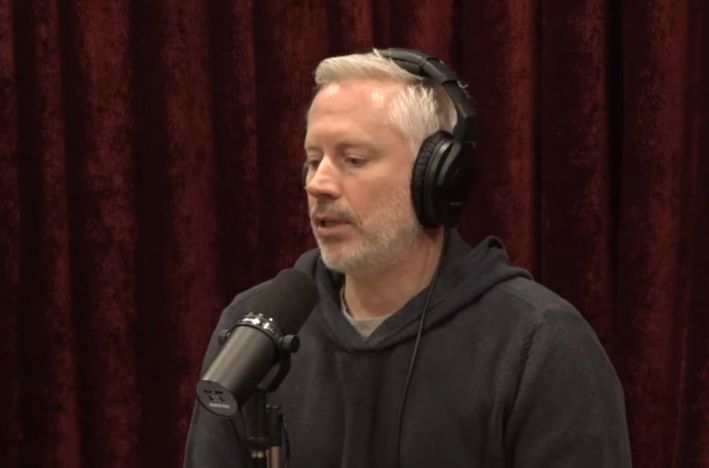
Here is the full transcript of biological anthropologist Michael P. Masters’ interview on The Joe Rogan Experience #2428, December 18, 2025.
Brief Notes: Joe Rogan sits down with biological anthropologist Michael P. Masters to explore his bold “extratempestrial” hypothesis: that at least some UFOs and so‑called aliens are actually future humans time‑traveling back to study their own evolutionary past. Masters walks through the anatomical logic for why classic “grey” entities look like us with exaggerated future traits—bigger brains, smaller faces, weaker bodies—and how this lines up with millions of years of hominin evolution. The conversation dives into abduction accounts, UAP sightings, time‑travel physics, and recovered‑craft lore, asking whether advanced descendants could be using space‑time “bubbles” rather than interstellar spaceships to reach us. Along the way, they touch on Nazca mummies, ancient myths, black projects, AI, and why Masters believes a multidisciplinary scientific approach is the only way to make sense of the UFO mystery.
Disclosure and Steven Spielberg’s Influence
JOE ROGAN: Disclosure day. Very interesting.
MICHAEL P. MASTERS: Yeah, I’m excited for that.
JOE ROGAN: Yeah. He was always way ahead of the curve when it comes to the whole UAP, UFO stuff. You know, with Close Encounters of the Third Kind, he had that French scientist that was essentially modeled after Jacques Vallee. He’s always been, I would love to talk to him. I wonder how much he knows.
MICHAEL P. MASTERS: Is that an accident? Was he fed some information? Was he a part of disclosure the whole time? That’s what I’ve always wondered.
JOE ROGAN: I mean, what does that mean? Right. Because there hasn’t really been disclosure.
MICHAEL P. MASTERS: No, but it has to be a slow process too, right?
JOE ROGAN: You think so?
MICHAEL P. MASTERS: I don’t think. I mean, the whole idea is that they’re just sort of normalizing it. Right. Neuro linguistic programming, they call it, where you’re slowly getting people accustomed to these ideas.
Like the aspects of Close Encounters, for instance, where you have the radiation burns on the guy’s face, you have a time travel component where these World War II soldiers get out of the craft with the little beings and the bigger being and I mean, just seeding our culture with those little bits of information that might help later on down.
JOE ROGAN: That was in the 70s, wasn’t it? When was Close Encounters?
MICHAEL P. MASTERS: Yeah, I think it was in the 70s, late 70s, early 80s, maybe. Either way, I mean, a lot of stuff he’s done, like I rewatched the, what was it? Jeff Bridges, Starman. I think there’s a lot of elements of disclosure in that too.
I don’t know. I mean, obviously we don’t know who’s pulling the strings. We don’t know what’s going on. We don’t know who’s in charge. But it does make sense that if there is this thing that they know about that we’re supposed to know about, leak it out, do it slowly, get in our culture, get it in our media in different ways.
The Hal Puthoff Story and Government Disclosure Meetings
JOE ROGAN: You know the Hal Puthoff story, right, with George Bush? Do you know the story where they were talking about. Okay, Hal talked about it on my podcast, but he also talked about it in the Age of Disclosure documentary where they brought in him and a bunch of different prominent thinkers.
MICHAEL P. MASTERS: Yeah, I watched that episode and I watched the documentary.
JOE ROGAN: So to people that don’t know, I’ll just explain it. So they brought in him and a bunch of other prominent thinkers and they sat them down and said, essentially, we have recovered crashed UFOs, we have biological remains of these creatures.
We are considering releasing it to the public and we want to make an assessment of what are the pros and what are the cons. So we want to assign a numerical value that you’re estimating what kind of an impact it would be on government, finances, religion, et cetera.
MICHAEL P. MASTERS: Whether they should do it basically right.
JOE ROGAN: Whether or not they should release this information. And all of the people that were brought in came to the agreement that there was more con than there were pro and that formed their decision to not release it.
MICHAEL P. MASTERS: And didn’t he say at first he was pro disclosure? He was like, of course we should do this. And then after the conversation, he switched teams.
JOE ROGAN: Yeah, I don’t know about that. Maybe, perhaps.
MICHAEL P. MASTERS: I mean, he said that he went into it thinking, well, yeah, obviously we should do this. And then sort of was convinced otherwise after the conversation unfolded.
JOE ROGAN: Yeah, how could you be convinced? Whose decision should it be? If some people know, everyone should know. Yeah, it’s a humanity decision. I don’t think it should be in anybody’s hands to decide whether or not this information gets distributed.
MICHAEL P. MASTERS: And the implications too, if they have zero point energy, how would that solve the problems that we face today? There’s so many ramifications of it that, yeah, whose decision is it and why has it been kept from us?
I don’t buy that whole, Orson Welles, 1938, everybody freak out bullshit. I don’t think that’s the case. At least not anymore. It’s got to be something more to it than that.
Unity in the Face of External Threats
JOE ROGAN: It would certainly have, I don’t know if they factor this in, but a uniting element. You remember the Reagan speech where he, in front of the United Nations where he said, imagine how united we would be. We’d forget our differences if we were faced with an alien threat from another world.
I mean, just knowing that we are all united. I mean, how old are you?
MICHAEL P.
JOE ROGAN: Okay, so you remember September 11?
MICHAEL P. MASTERS: Mm.
JOE ROGAN: One of the things that happened after September 11 was there was, it was a horrible tragedy, but there was a beautiful result temporarily where everybody was really united, really united.
There were American flags in everybody’s car in Los Angeles. You know, the most ridiculous progressive, sort of kind of f*ed up place. But everybody became patriotic in New York. Everyone was friendly. I mean, people were smiling and saying hi to each other on the streets. We had all decided that we were together and were faced with a real threat and that we had to be united.
MICHAEL P. MASTERS: And I remember it well. Yeah, you’re right. And not to get too weird too fast here, but if there are aspects of sort of an all encompassing consciousness that unites us associated with the UFO phenomenon too, if we recognize that we are just fingerprints on the same hand, we’re all iterations of the same overarching consciousness. If seemingly there is a part of that in the UFO phenomenon.
JOE ROGAN: Yeah.
MICHAEL P. MASTERS: So how would that unite us as well, even beyond the threat from outside? If we did start to understand that we’re all part of the same sort of cosmic community. Sounds kind of weird to say.
JOE ROGAN: It does sound weird, but have you seen the Apple show Pluribus?
MICHAEL P. MASTERS: No. It comes up a lot. Worth watching.
JOE ROGAN: It’s really good. Yeah, it’s really good. It’s very, very original, very unique. But that is essentially what happens. And it has a negative aspect to it.
MICHAEL P. MASTERS: There’s a virus.
JOE ROGAN: I don’t want to give away too much of it for people that want to watch the show because it’s a really good show, but there’s a virus that they get a signal from another world and they figure out what this signal is.
And through this lab work they reveal that this signal is some sort of the encoding of a specific virus. They work on this specific virus, it spreads and the entire planet becomes one consciousness except for a small number of people. It’s a weird show. It’s a really good show.
MICHAEL P. MASTERS: I’m going to.
JOE ROGAN: I don’t want to explain any more of it without any spoiler alerts, but it’s f*ing great. But it’s strange. It’s like, wouldn’t that be better? There’s no crime, there’s no this, there’s no that. But then it reveals all the problems that come along with that.
MICHAEL P. MASTERS: Yeah, I’m going to have to watch that as a counterpoint if anything else, because it makes sense to me that everyone’s kind of united as one superorganism of sorts.
JOE ROGAN: But you lose all individuality. You lose all the fun parts about being an imperfect person, because we are an imperfect species. But that’s also what makes great art. That’s what makes great music. It’s what makes great fun.
MICHAEL P. MASTERS: Most creative people have the most drama in their past from what I’ve seen.
JOE ROGAN: And if you have zero trauma, you.
MICHAEL P. MASTERS: Probably have sucky art, just stick figures and shit.
JOE ROGAN: I mean, I wonder why would be if they would even have a need for it.
MICHAEL P. MASTERS: Because it’s an expression. It’s getting your angry out, right?
JOE ROGAN: Or your angst or your anxiety or depression. Whatever it is, you’re getting something out.
Art, Expression, and Human Experience
MICHAEL P. MASTERS: I was telling my son that the other day. He’s, you know, it’s hard being in these bodies, especially going through puberty. You know, you’re just like, what is this thing I’m carrying? This little meat suit, you know.
And I was like, man, I was the same way. Still the same way. And I picked up instruments. I started painting. I learned to play every sport I could physically play. There’s ways to get that out, you know?
But it seems like a lot of that does come from just the anxiety and the anger. And, you know, you’re growing into yourself. You’re starting to get the feels. You look at women differently, and it’s like, what do I do with this?
JOE ROGAN: Well, it changes. It rewires the entire way you view the world. And meanwhile, your body is physically changing and growing. You’re like, what am I going to look like? Eventually? Weird.
Genetic Anomalies and Human Variation
MICHAEL P. MASTERS: You know, there’s actually this, in a small island in the Pacific, they have this weird characteristic where they start out as females. Everybody does. We all start out as females in utero. And then maleness is imposed on the developing fetus.
But they don’t until puberty because they’re not sensitive to dihydrotestosterone, the precursor to testosterone. So they grow up their entire life as girls, and then at puberty, they turn into a boy.
JOE ROGAN: So they get raised as girls.
MICHAEL P. MASTERS: They are girls. They’re physically. But they have. Not yet. Nope. What is this planet? I mean, this is an island.
JOE ROGAN: What is this?
MICHAEL P. MASTERS: It’s an island in the South Pacific. It’s called pseudo hermaphroditism. I know. I learned about this in grad school.
JOE ROGAN: What do they look like?
MICHAEL P. MASTERS: They look like girls. What? Exactly like girls. They are girls. And then the ovaries descend as testicles, and the clitoris grows out into a penis.
JOE ROGAN: Wow.
MICHAEL P. MASTERS: So you think puberty is hard enough already? These people turn into the opposite sex at age 12 or 13. It’s wild, man.
JOE ROGAN: So is this a bizarre genetic anomaly? Is it something to do with.
MICHAEL P. MASTERS: Yeah. So a lot of times on islands, you get really strange characteristics of people because of the isolation. And those characteristics get selected just through genetic drift alone because it’s a small population.
So just probably one person had this really weird trait where they’re insensitive to dihydrotestosterone. And then it spread throughout more of the population. It doesn’t do anything. It’s not something natural selection would select against. It’s just weird as shit.
JOE ROGAN: What is the name of this island?
MICHAEL P. MASTERS: I don’t remember the name of the island, but the condition’s called, find it. I think it’s Mallow island in Vanuatu, or. That sound. Oh, yeah.
JOE ROGAN: How many people are on that island?
MICHAEL P. MASTERS: This says there’s a population in 1979 of 2,300 people. Yeah. And think historically, different kinds of people there or something.
JOE ROGAN: Two different kinds of people, cultural groups.
MICHAEL P. MASTERS: Isn’t that wild, though, man? I remember hearing about that in grad school at Ohio State, and I was just like, I’m sorry, what did you just say?
JOE ROGAN: I’m sure you’ve seen those people, the ostrich feet people in Africa. It’s a very strange genetic anomaly where they don’t grow toes. They essentially have two very wide appendages. Yeah, they look, it looks like a weird bird foot. It’s very strange. But a bunch of people in this particular tribe share this trait.
MICHAEL P. MASTERS: Is there any advantage or, it’s just, it’s like this where it just kind of happened and.
JOE ROGAN: Yeah, I don’t know. I don’t know. I mean, I don’t know what advantage there would be. Maybe it’s.
MICHAEL P. MASTERS: Maybe it’s really sexy to them.
JOE ROGAN: Maybe you could move better with it. I don’t know. It’s.
MICHAEL P. MASTERS: That’s what they look like. Whoa. Yeah. I don’t know how I haven’t seen that. That’s wild.
JOE ROGAN: I know. Isn’t that crazy?
MICHAEL P. MASTERS: I mean, it is kind of sexy.
JOE ROGAN: If that’s what you’re into, dog. I wonder how long that’s been going on for Vadoma.
MICHAEL P. MASTERS: See, that seems like more of a defect that just worked toward fixity in the population. Maybe not.
JOE ROGAN: Well, it just makes you wonder, why don’t we all have that? You know, what is the reason why we have all these toes that. It’s called? Electrodactyl. Yeah, electrodactyly.
The Vulnerability of Human Evolution
MICHAEL P. MASTERS: I mean, historically, prehistorically, evolutionarily, I should say, if you did have something like that and you were a hunter gatherer, you’re kind of boned. You know, you’re not going to be able to run after gazelle.
JOE ROGAN: I don’t know. Maybe you can. Their feet are well adapted to the Zambezi valleys, rough terrain allowing them to move quickly and efficiently through the landscape.
MICHAEL P. MASTERS: All right, I take it back.
JOE ROGAN: Well, it kind of makes sense, right? Because what it’s saying is that their bones are fused. If you scroll up, it’ll say condition affecting ostrich footed tribe. A genetic mutation passed down through generations causes the bones and the feet to fuse, resulting in a claw-like structure with two large toes.
Toes are very vulnerable. I don’t know if you’ve ever broken a toe, but—
MICHAEL P. MASTERS: I broke one an hour before I got on the plane to come here. Really? If you can see my left foot.
JOE ROGAN: Oh, that’s hilarious.
MICHAEL P. MASTERS: That’s ridiculous. Like the whole thing is just purple.
JOE ROGAN: Yeah, they’re so small. Like my pinky toe. I was messing around my pinky toe the other day because I have to trim my toenails, right? And the pinky toenail is like barely a nail. It’s so tiny. And I’m like, God, this little thing is so vulnerable. And it has to support my entire body weight or part of my entire body weight.
MICHAEL P. MASTERS: Yeah. They’re so dumb. Oh yeah, you can see that it’s jacked. Yeah. Dude, that was like right before I was coming down. I’m like, you’re kidding me. That sucks.
JOE ROGAN: Yeah, I’ve broken a bunch of toes. It’s very, very annoying. And you would imagine if you had two giant f*ing elbow bones down there instead of these bitchy a little toesies.
MICHAEL P. MASTERS: Oh, maybe that’s why they did it. Maybe that’s what they got going on.
JOE ROGAN: Kind of makes sense that that would be an adaptation.
MICHAEL P. MASTERS: Invincible feet.
JOE ROGAN: Yeah, well, you know, we’re so vulnerable. And that’s one of the weirder things. Like, so first we should get into what you do because you have a very interesting theory. Tell everybody what your background is, first of all.
Masters’ Extratempestrial Hypothesis
MICHAEL P. MASTERS: Yeah, all right. That does seem like a good place to start. My background is in anthropology and biological anthropology. My research mostly focuses on evolutionary anatomy, biomedicine. I’ve done some archaeology various places around the world in Montana.
But the reason I’m here, I assume, because according to my friend Matt, we were butchering a mule deer I think I shot. And I was like, yeah, I got to go to this conference. And I was like, do you want to know what it’s about? He’s like, nobody gives a sh*t about what you do other than UFOs, man. I was like, damn it. He’s right. Like, I did actually used to do a lot of what I thought was cool stuff.
But no, the main thing is that I’ve become known for advocating for this idea that UFOs and the aliens are actually our time-traveling future human descendants. I wouldn’t even say as opposed to extraterrestrials, because I do think that’s a component too. I oftentimes get pigeonholed. People are like, oh, you just think they’re all time travelers. I don’t. I actually say this all the time, but it doesn’t matter.
I do think there’s a lot going on, but my background and the reason I approach this question this way is because there’s a lot of characteristics of these aliens that look so hominin, they look just like us. And specifically what we’d expect to see in our hominin future if the same evolutionary trends continue into the future. So I kind of just tie those things together. And even the saucer-shaped craft seemingly are time machines themselves. So that’s kind of the Cliff Notes version.
JOE ROGAN: Well, it’s a theory that a lot of people have independently sort of come to. Right?
MICHAEL P. MASTERS: Yeah. Especially recently.
JOE ROGAN: And the concept of just, if you just think about ancient man. I was watching this documentary on Neanderthals last night about this one intact Neanderthal skeleton that they found that was, it had sort of been, he had died in a cave. And you know the stalagmites, stalactites or mites. How do you say it?
MICHAEL P. MASTERS: Tights or mites are down.
JOE ROGAN: So he was essentially mineralized. There was stuff all over the body and it took a long time for them to break this body.
MICHAEL P. MASTERS: I think I saw it. Was it on Netflix?
Neanderthals and Human Evolution
JOE ROGAN: No, I was watching it on YouTube maybe. Originally it was on Netflix, but it was just documenting how strange this body was that they had found. But it was immensely strong, like much stronger than us.
One of the interesting things was that their visual cortex, the part of the brain that would process imagery, was larger than ours, 10 to 20% larger. And that, so these things probably had better eyesight than us, perhaps even were able to see at night. And that this is a bigger, stronger version of a human being, like much more durable than what we are modern 2025 Homo sapiens, if you just look. Yeah, that’s it. That’s one of them.
MICHAEL P. MASTERS: Neither human nor Neanderthal.
JOE ROGAN: Oh, really?
MICHAEL P. MASTERS: This is a published, is this the same?
JOE ROGAN: This might not be the same one. This is maybe a different one. That’s a weird one because, what’s that f*ing thing on its head?
MICHAEL P. MASTERS: That’s what it says. It’s a stalactite growing out of it or something.
JOE ROGAN: Wow. In a weird form.
MICHAEL P. MASTERS: Weird. It’s like a unicorn.
JOE ROGAN: Yeah, like a crest.
MICHAEL P. MASTERS: They do. They do have a sagittal ridge. Yes, Homo erectus had one where there’s an offshoot in our hominin lineage called the paranthropus or robust Australopithecines. And they had a full on, like, gorilla style, really, sagittal ridge. Yeah, because they were a vegetarian. So they just chewed all day.
JOE ROGAN: Right. So they had massive muscles to—
MICHAEL P. MASTERS: Yeah, their whole face is huge.
JOE ROGAN: Wow.
MICHAEL P. MASTERS: Neanderthals kind of, I mean, they were just big. It’s just a robusticity thing. But there is evidence from Shanidar Cave in Iraq where they were using their teeth as tools. We think they were like tanning hides. They were holding the hide in their mouth and then like scraping all the nasty bits. Oh, and you can see that in the tooth wear.
So, yeah, they were pretty badass. They were the first, I don’t know, I think this is cool, but a lot of people think I’m a nerd too. They were the first to use the flake. Like, for 2.8 million years, we just hit a piece of rock and like, oh, this cool tool. But then they figured out that if you hit the rock in just the right way, the piece that falls off makes an even better tool. So it goes like 2.5—
JOE ROGAN: Yes, exactly.
MICHAEL P. MASTERS: And from that point on, like, I got to work at a place called Chez Pinot Jean Sac in southern France for a summer, and it was a Neanderthal site. And we found these, actually, it’s pretty funny because when we first got there, these tools called MTA, hand axes, Mousterian of Acheulean tradition, hand axes. There were only eight found in all of Europe.
And they said, if you guys find one of these, we’ll buy you all the beer and all the cognac you can drink. So we’re in the cognac region of France and we found one, like the fourth or fifth day. We went on to find seven more. Over the course of that week, we doubled the number of these things in existence in all of Europe.
And they were not lying. They bought us so many damn beers, like archaeologists like to drink, you know, sure, we dig and it’s boring as hell. You know, it’s not Indiana Jones. We’re not running around banging hot chicks and flying on planes. We’re like, we got a spoon and we’re doing this for eight hours.
So yeah, I actually found the last one on the last day and it was by far the worst one. Like I had to argue that this is even, it should even count as one of these. But yeah, no, it was a cool site. So yeah, they were doing well, but we were doing better. We came in and replaced them.
JOE ROGAN: Well, something happened where we replaced them.
The Decline of Modern Humans
The point is, as time goes on, humans today are probably the most feeble version of humans that have ever existed. And we’re the most feeble versions of people that have existed within the last century. Right? Like if you go back to humans from the 1920s versus humans from the 2000s, people have way less testosterone now, way higher instances of miscarriages, way lower sperm count.
You know, there’s a lot of factors that are at play right now that are changing what a human is. And if you extrapolate, if you look at the future, you would naturally say, well, we’re probably going to be very thin. It seems like there’s at least some sort of a push to eliminate gender. Like gender seems like it’s on the table as whether or not it’s even necessary.
There’s all sorts of new technological innovations that are leading to the possibility, at least sometime in the future of an artificial womb. There’s genetic engineering with CRISPR and a lot of other different technologies that are being explored that we might be able to engineer human beings and then even create a complete individual human being without a mother, without a father.
So if you thought about what that looks like in the future, like, one of our problems on this planet is we all have different ideologies, different religions come from different parts of the world. We look different. And human beings as tribal primates have a tendency to other, we other different tribes. Those are not us. We are us. Those are the enemy.
MICHAEL P. MASTERS: We go out, you rally around it.
JOE ROGAN: But if everybody is exactly the same and we share one mind, you know, then a lot of our problems go away. If we no longer have to compete for resources, we no longer have the desire to procreate and to acquire land and to be, you know, to have a territory, we eliminate a lot of our issues.
And that’s what these things look like when you look at the archetypal, these iconic sort of shapes that have been on cave walls all the way up to Close Encounters of the Third Kind. One thing they share is that they have no muscle, they have large heads, they have big eyes, and they’re childlike.
The Pedomorphic Nature of Grey Entities
MICHAEL P. MASTERS: They’re very pedomorphic, as we say. Yeah, you just tied together a lot of really important points related to this theory, aspects of why they’re always interested in our gametes, why they come back and put that little machine on a man to collect semen, why they’re constantly taking eggs from females and planting fetuses, pulling them back out later.
They’re clearly focused on reproduction, gamete extraction. And one of the things that might be fueling that in the future, if these are future humans, let’s just assume for a second, hypothetically, is that they might be having problems directly resulting from these trends towards self-domestication, these trends toward feminization, these trends toward reduced sperm counts, which is 60% across most populations of the world in the industrialized world, 50% across the entire world.
Problems with reproduction, in vitro fertilization, exogenesis chambers might help solve some of those problems, growing the fetus outside of the body. So, yeah, and like you said, you know, what do they look like? They look like kind of a hybrid between males and females to some extent, but there’s still an essence of gender.
Like, if you talk to Whitley Strieber, you know, he’s with this being, he says in Communion that “I had a sense that she was a woman. I don’t know why, but I kind of sensed that.” So it’s almost like the essence of the individual, the soul of the individual still retains that sort of gender identity, even though our bodies are becoming more childlike, more gender indiscriminate. I don’t know. But yeah, yet another one of those ways in which we might sort of grow together as a species.
Evaluating Abduction Accounts
JOE ROGAN: Now, when you say they are extracting sperm, how many of these stories do you take seriously? There’s a lot of these stories.
MICHAEL P. MASTERS: That’s a great question.
JOE ROGAN: Unfortunately, for any sort of spectacular public thing that’s in the zeitgeist, like alien abduction, whether it’s Whitley Strieber from Communion or the John Mack books, the guy from Harvard that wrote, what was it, Abduction?
MICHAEL P. MASTERS: Passport to the Cosmos and Abduction. Yeah, two great books, great books.
JOE ROGAN: But these are all books about encounters, close encounters of the third kind with some sort of a being from another place. Whatever it is, it’s just not a human being. And it seems to be technologically superior to us and seems to be one thing they all seem to share is they seem to be able to communicate telekinetically or telepathically.
MICHAEL P. MASTERS: Yeah, yeah. And I mean, they aren’t human, but they are very human too. So, for instance, that’s one of the main reasons I started exploring this. I was actually kind of put into this when I was 8 or 9 years old, sort of activated in a way and put on this path by a weird thing that happened to me.
JOE ROGAN: What happened to you?
Masters’ Childhood Vision
MICHAEL P. MASTERS: Well, so I talk about it in my first two books, Identified Flying Objects and The Extra-Tempestrial Model, where I learned about a close encounter that my dad had. He was a veterinarian in Northeast Ohio, where I grew up, and he was out one night on a call with another guy. So there’s two people, as far as J. Allen Hynek’s reliability scale has more reliability because there’s multiple witnesses.
It’s also strange on his scale because they crested the hill, there’s a bright light. This is in Amish country. There’s no lights in Amish country. And all of a sudden this bright light darts toward him, hovers just above their truck, darts back to where it was, and straight up into space, at incredible speed.
So this happened before I was born. But I overheard him telling the story to some friends. One night he got Whitley Strieber’s book Communion, as most people did in the 1980s and as they should, because it’s a great book. And I walked into the living room, the book is sitting on the shelf facing out.
And I remember, like it was yesterday, I sort of stopped, and there was this light, like a white light. And then I saw this image in my mind of an early hominin, chimpanzee-like creature, a modern human, and then that archetypal grey alien from the cover with this information: “What if they’re related? What if they are us from the future?”
And obviously, I mean, that’s why I became a biological anthropologist. People are always like, “So you saw this?” Yeah, it was like a flash, like a light. And, you know, it’s weird looking back on it, because I know a lot more about these experiences. I’ve talked to people that have had these types of experiences.
JOE ROGAN: What was the setting?
MICHAEL P. MASTERS: It was our living room. So it was like, you come in the front door, and just to the left, there’s this living room built-in bookshelf, Whitley’s book right there. I just turned the corner, saw it, and then it just came. I didn’t know sh*t about evolutionary biology.
JOE ROGAN: Well, you didn’t say you saw it. Like, you saw it. How?
MICHAEL P. MASTERS: In my mind, just this white light, just an image, and there’s that image of the three faces. And then the question, “Could they be us from the future?” And a lot of people are like, “How did you get into UFOs? You’re a biological anthropologist.” It’s the opposite. I got into biological anthropology to research this question of whether they could be us from the future.
JOE ROGAN: Huh. So you felt like at that moment, it wasn’t just a weird thought or a dream. It felt like a message. What did it feel like?
MICHAEL P. MASTERS: Yeah, yeah, it was a tasking. You know, I think Rupert Sheldrake said it, that people don’t have ideas, ideas have people. I think that was like the, “Hey, go do this thing.” And I did. That’s why we’re here now talking about it.
And obviously, you know, you got to be careful about selection bias and confirmation bias. I didn’t go into grad school—I also didn’t tell anybody in grad school I was there because they would have kicked me out. But I went into it with an open mind, but I was there to study these things because of that event when I was 8 years old.
The Challenge of Confirmation Bias
JOE ROGAN: Wow. Yeah. It is a problem, the confirmation bias. It is a problem with wanting it to be real. And I struggle with that because I desperately want it to be real. And so every time I talk to someone, I’ve talked to a bunch of people that are, you know, air quote “whistleblowers.” And some of them, I think for sure have been sent in here to distribute disinformation. Yeah, no doubt, for sure, because it’s a great place to do it. Yeah, I’ll listen to you.
MICHAEL P. MASTERS: I’ll entertain almost anything, which is great, we need that. But yeah, I mean, obviously there’s people that are going to take advantage of it.
JOE ROGAN: But I think it’s also important for me to say I’m not convinced. You know, I don’t know how much of this is horsesh*t, but it’s not zero.
Evaluating Case Studies and the Reproductive Focus
MICHAEL P. MASTERS: No. And that was your question: how do I differentiate among these different cases? I do draw from Hynek’s. In his book The UFO Experience, he lists out how we all should approach this based on the reliability scale and the strangeness scale. Jacques Vallée also drew from that, helped him develop it as part of the Invisible College and all of his work.
But regardless of my own personal discernment, because my second book, The Extra-Tempestrial Model, is about 30 case studies, 15 main case studies, but then I pull in other ones and it explores the different theories, obviously, the main one being this extra-tempestrial idea, this future—which, by the way, I saw the word of the day today was “anachronistic.” And I was like, man, that would have been a way better word than extra-tempestrial, which everybody struggles with. I could have called them anachronauts. Doesn’t that sound cool? Anachronauts.
JOE ROGAN: Ooh, that sounds really cool.
MICHAEL P. MASTERS: I know. What the hell was I thinking, man? Anyway, but so one of the most commonly reported things across all cases, regardless of whether you think it’s bullsh*t or you think this definitely happened, is they really want our sperm, they really need or want our reproductive material, our gametes.
And it’s funny because when I wrote my first book in 2012, I started, published it in 2019, right at the end, I did an interview and someone’s like, “Have you heard of Jim Penniston?” Like, no. Which is kind of a failing on my behalf, I’ll admit. That one, it turns out. So it was the Rendlesham Forest incident. He touched this craft, he got this binary code, and when deciphering the binary code, they legitimately, specifically said, “We are you from the future. We’re having problems with reproduction.”
He underwent hypnotic regression. “We’re having problems with reproduction, and we need this genetic material to help ourselves.” You know, a lot of people are like, “Well, why are they coming back and doing stuff to us?” I think they’re coming back and getting stuff from us because of problems they’re having, largely related to what you were talking about earlier with the reduced sperm counts, the problem with female infertility.
What if we do try to create the perfect human specimen or we try to cure these genetic diseases through genetic manipulation, CRISPR, and we screw something up? We might have to come back. We can’t go to another planet, there aren’t people on these planets. We can’t go and sample gametes from these other places. We might have to go into our past to get those wild-type unmanipulated gametes in order to fix these problems.
Time Travel and the Block Universe
JOE ROGAN: God, that’s a crazy level of technological sophistication. The ability to venture back in time and somehow or another not f*ck up the timeline that’s leading to—I mean, this is the problem that’s always been theorized about time travel. Anything that you do, if you went back in time, any interactions, you would completely change how the future would play out.
MICHAEL P. MASTERS: In the many-worlds interpretation. Yeah. So that idea is unfortunately very pervasive and mostly because of Back to the Future, which I think ruined the brains of most people. Mine too, certainly in my generation.
But most physicists don’t agree on many things, but most agree that we live in what’s called a block universe. Landscape time. Block time where if you imagine all moments from the very beginning of the Big Bang to the end of the universe, where all matter appears into a black hole or contracts or whatever it does, all moments are already there. They exist as this massive four-dimensional block of all moments, all worldlines, everything.
So you go back into the past as you perceive it, you can do whatever you want. You can walk around, step on butterflies, you know, slap people on the face, kick over dinosaurs or whatever. I don’t think we can go back that far. But you could do anything you want. And it doesn’t change anything because you’re going back in the block universe and doing those things you were always already going to do.
And when you get home, everything’s the same because that was already their past. To everybody that stayed behind, that was already their past. It was only the future for you to go back and do those things that you were already going to do. And then you just went and did them, get home, everything’s the same because you were always going to do those things in the first place.
That’s hard if that is the actual model of the universe. And again, I can only work in writing these books. I can only work from what we know. Now, clearly there’s a lot of things we don’t know. I’m not claiming to know anything beyond what we can know right now. But physicists, despite not knowing what time is, they know it’s an emergent phenomenon. There’s something more fundamental that time comes from. But they do agree on this block universe model. And in that case there is no paradox.
JOE ROGAN: How do they all agree on that? Wouldn’t you have to test that and come up with some sort of a hypothesis and then try to prove it or disprove it?
MICHAEL P. MASTERS: I shouldn’t say they all agree because there is the many-worlds interpretation of quantum mechanics where if you went back in that situation, it would be change, you would be changing the timeline. Would it be changing your timeline or would it be changing a different timeline is the question. And how would you know? There’s more paradoxes with changing things than not changing things.
JOE ROGAN: Why do you confidently state that you don’t think that they can go back to the dinosaur age?
Time Travel Physics and Electromagnetic Propulsion
MICHAEL P. MASTERS: Partly because three different reasons. One, I think they need tremendously high speed in order to be able to go back into the past. So basically again, working from all I can work from in this time with the limited primitive primate knowledge that I have in the year 2012 to 2025, I basically just started with Einstein’s theory of relativity which he published in 1905 on the electrodynamics of moving bodies. And then in 1915 he published his paper on general relativity.
From that point on, almost instantly there were solutions to his field equations that showed with the right parameters of a massively highly energetic rotating ring or sphere or disk, that you could create closed time light curves, that you could actually orient light cones back toward the past so you can physically go into the past. We saw this with Lenz and Thuring in 1917 and 1918. Kurt Gödel’s Gödel universe was not long after, I think the 1920s maybe.
And then importantly in the 1970s you had Frank Tipler who showed mathematically that you can shrink that down to a disk. He actually called it a disk. That’s one of the reasons I think that these are time machines is because it has all of the parameters described by Frank Tipler. He wasn’t talking about UFOs, but they seemingly have the ability to jump in and out of time. They appear and disappear.
JOE ROGAN: But you’re definitely not talking too much.
MICHAEL P. MASTERS: Well, I mean we’re here to talk. But I have an internal trigger where I’m like, shut up, Masters.
JOE ROGAN: Don’t listen to that trigger. Let it roll.
MICHAEL P. MASTERS: So anyway, if you look at the history of how we understand backward time travel, what I think they’re doing is that I think they’re combining general relativity and special relativity. So I think they’re orienting the light cones toward the past by rotating these things really, really fast. You hear that all the time. They power up, they’re spinning, or at least there’s some sort of flywheel on the outside that’s spinning. I think that’s what’s allowing them to move toward the past. And then they take off.
So it’s that high speed that I think allows them to go further into the past. So they’re using—you’re aware of the twins paradox, I’m sure—time dilation, where you have two twins, they’re the same age, and then one goes into a spaceship. They move at tremendously high speed. They come back and they’re much younger than their twin because time moved faster back on Earth.
I think they’re using that high speed motion while light cones are oriented toward the past in order to travel deeper into the past through that process of time dilation. There are limits to how fast we can go. Einstein was very adamant about this because there’s an increase in inertial forces the faster you go relative to the speed of light. That’s why he thought we could never go. That’s why he thought that anything with mass could never go faster than the speed of light. Light can do it because it’s a wave or a particle or both. So I think there’s a limit to how fast we can go.
The other reason is because Jim Penniston in this hypnotic regression said that he’s like, “We can only go 40 to 60,000 years into the past or we might not get back.” You also have—and this is a more speculative one, so take it for what it’s worth—you also have the Dan Burisch testimony of this J-Rod, this allegedly captured alien, who said, “We’re from the future. We are you from the future. And we’re from about 55 to 60,000 years in your future.”
So those three things together are why I don’t think we could go back 65 million years to hunt dinosaurs, which actually would be kind of fun.
Space-Time Bubbles and Frame of Reference
JOE ROGAN: When you talk about going the speed of light, you’re talking about not traditional propulsion, but some form of propulsion that allows you to go at insane speeds.
MICHAEL P. MASTERS: Yeah, electromagnetic is what it seems to be. And importantly, the electromagnetic force is 10 to the 40 times more powerful than gravity. So not only do I think that’s what they use to fly, I think that’s what they use to manipulate space-time, actually. And Dan Burisch is not Dan Burisch. Dan Burisch, I think you just had him on to the Age of Disclosure.
JOE ROGAN: Yes.
MICHAEL P. MASTERS: There’s this really cool thing at the end where Hal Puthoff and I think Eric Davis as well were talking about this space-time bubble, right. A really weird thing happened. We can get to that in a second. But I don’t want to jump around too much because I’ll lose people and myself probably.
But this space-time bubble that they form around the craft I think is also indicative of the fact that they’re manipulating space-time, that they’re traveling in and out of time. They use it to hide in plain sight. They manipulate the rate at which they move relative to us in their frame of reference. And they’re moving fast all around us at different—and they’ve slowed time down outside of that bubble. So everything is really, really slow to them. And they can easily evade our bullets and our missiles, but we don’t see them because we don’t have that frame rate of perception.
And if you slow videos down, I’m sure you’ve seen these all the time where there’s like a—and then you slow it down and you can see this saucer-shaped craft moving slowly across the sky once you slow down the frame rate.
But a really funny thing happened because I’ve never actually talked about this with anyone before. I owe a lot of the fact that anybody even knows who I am to Hal Puthoff. When I first started talking about this publicly in 2018 and then I published my book in 2019, Identified Flying Objects, he I guess reached out to the head of MUFON at the time who was putting together the 50th anniversary MUFON event and was like, “Hey, you should have this Mike Masters guy come talk.”
And I found that out from the head of MUFON. He’s like, “Hey, just so you know, Hal Puthoff of all people recommended I contact you.” I had no idea who that is. So I get on the Internet and I Google Hal Puthoff. He also put Jesse Michaels, mutual friend, in touch with me after. I think he did an interview with him and Weinstein. I forget his name.
JOE ROGAN: Eric.
MICHAEL P. MASTERS: Yeah, yeah, yeah. So he did an interview with those two. I guess Hal was like, “Hey, you should reach out to Mike Masters.” And he did and we talked and we’ve done stuff together.
But what was cool is that at the end of that Age of Disclosure film, when he’s talking about the space-time bubble, I thought back to after my first book came out and I was contacted by someone who claimed to be an ex-intelligence person who explained that exact same thing to me back in 2019, that these things aren’t doing 10,000 G maneuvers that would crush anything inside.
To them in their frame of reference, what they feel is completely different than what we see. Because in that space-time bubble, they can be moving at 50,000 miles an hour, do a right-hand turn and it would splatter anything inside because of the G forces. That’s what we see on the outside. But in that space-time bubble, they probably feel 1, 2 Gs at the most.
So I started thinking, man, was that—how did Hal reach out to me with a different email address and say, “Hey, just so you know, this is how these things are happening. This is how they’re able to do it.” And I was a dumbass. I still am a dumbass, but I was an extra big dumbass back then. And I was like, “Oh, cool, thanks, man.”
You know, a story went viral about my books and Fox News picked it up and Space.com and so I was going through a bunch of emails. They recognized I wasn’t getting what they were saying. I was not picking up what they were putting down. And they were like, “No, this is important.” Said it again, and then it clicked. I was like, “Oh, yeah, that makes perfect sense. They’re manipulating the rate at which time passes in this bubble around the craft and we see something completely different.”
JOE ROGAN: So when we’re seeing this, we are imagining what we can do and we’re sort of saying, well, what would be an advanced version of what we can do? And what this technology is, is something that’s levels of magnitude beyond even our theoretical, any sort of idea that we have currently about potential future timelines of technology. Yeah, there’s no one talking about gravity bubbles that allow you to instantaneously traverse immense gaps in the universe.
MICHAEL P. MASTERS: Well, they might be talking about behind closed doors at Wright-Patterson Air Force Base.
JOE ROGAN: Right.
MICHAEL P. MASTERS: And have been for 70 years.
The Problem with Disclosure and Donated Craft
JOE ROGAN: That’s the real problem with disclosure. How much progress could we have made if they had opened up all this stuff? And you got to imagine if you were an intelligent life form from another planet. You know, Diana Pasulka talked about her and Gary Nolan talked about how they refer to some of these things as donations. They don’t think of them as crashed vehicles because some of them are not crashed. They’re completely intact.
MICHAEL P. MASTERS: And I think David Grusch said that too, didn’t he?
JOE ROGAN: Yeah, I believe he did.
MICHAEL P. MASTERS: Yeah.
JOE ROGAN: And even, you know, Lazar, when he was talking about it, he, you know—
MICHAEL P. MASTERS: He had a sports model. Wasn’t that fully intact, too?
JOE ROGAN: Fully intact, yeah. Fully intact and operational. And apparently they flew it around.
MICHAEL P. MASTERS: Yeah, that’d be fun.
Bob Lazar’s Story
JOE ROGAN: Well, that was one of the reasons, you know, the whole story, how he got caught. It’s a really crazy story. So he used to work at Los Alamos. He was a propulsions expert. Guy put a jet engine on the back of a Honda. He was a real freak. You know, he made a hydrogen Corvette, like the 1990s. He was a nutty dude.
MICHAEL P. MASTERS: Clearly an engineer. Yes, that part checks out.
JOE ROGAN: So he gets his job on Area S-4 and goes there, and it’s all documented in Jeremy Corbell’s excellent movie, Bob Lazar: Area 51 and Flying Saucers. So he goes there and sees this thing and it’s got an American flag sticker on it. And, you know, they basically say, “Tell us how it works.” And he’s like, “Oh, this is ours.” Because he sees it has a sticker on it, and then he realizes this is made out of some completely unknown alloy.
There’s no seams in it. It seems to be 3D printed. There’s no controls inside of it. It’s designed for something that’s three feet tall. It’s all very f*ing weird. So he’s working on this thing, not making much headway at all. They understood that there was an element, element 115, that was not even on the periodic table. Eventually found to actually be a thing by the Large Hadron Collider. But even then, they only measured it for a millisecond, right?
So then he’s saying that they have this stable version of this element and you bombard it with radiation, creates this sort of gravity drive. He’s working on this thing and it’s all top secret, so he cannot tell his wife. So they’re calling him up at 10 o’clock, like, “Hey, get to the airplane, the airport, we need you.” And so he would have to fly out at random times, fly out to S-4.
And his wife was like, “This motherfer’s having an affair. Well, I’m going to have an affair, too.” So she starts fing her flight attendant or a flight instructor. I think that’s what it was. When you have that kind of clearance, they are monitoring everything. They’re monitoring all your phone calls. So they’ve realized that his wife is having an affair. And they think that he will be emotionally unstable and it’s too dangerous to have him working on this insanely top secret information if he’s not stable.
So they tell him, “You know, we’re going to at least temporarily relieve you of your duties.” So he’s freaked out. And he tells his friends, “Hey, this is what they’re doing there. They have these things and they fly them every Wednesday. I’m going to take you guys. There’s an area we can go watch.”
MICHAEL P. MASTERS: So they take—
JOE ROGAN: He takes his friends out there on two separate occasions, I believe. They get caught. They get caught, gets arrested. They release him. And he realizes, “I’m kind of f*ed. They might kill me. I’m going to have to go public with this,” contacts George Knapp.
MICHAEL P. MASTERS: George Knapp. I did see that.
JOE ROGAN: Then the whole thing is history.
MICHAEL P. MASTERS: Yeah. Yeah. No, that’s wild, man. And I think—and it’s still happening, you know, there’s still these whistleblowers.
JOE ROGAN: He says they used to fly them and you could go watch them fly these things. And they were moving in these really weird ways across the sky that you cannot do with conventional aircraft. That they only sort of understood how to pick it up and put it down. They didn’t understand how to really—
MICHAEL P. MASTERS: That was out at Groom Lake, right?
JOE ROGAN: Yes.
Area 51 and Government Secrecy
MICHAEL P. MASTERS: Yeah. I remember as a kid, obviously been in this for a long time. I remember as a kid seeing videos of people going out, and then they eventually closed it down. You couldn’t get to that spot.
JOE ROGAN: That was during the Obama administration. During the Obama administration, they actually had to admit that Area 51 was real, because before that, they didn’t. No one even knew it was real. I mean, it was always just a joke. Like Area 51, it was like, for fun. But then they said, no, it is real and we need to expand the forbidden boundary.
MICHAEL P. MASTERS: Yeah. And isn’t that when people were going to, like, bum rush it too?
JOE ROGAN: That was during COVID. During COVID there was a bunch of dorks that like, “we’re going to crash Area 51.” That’s a good way to die. They’ll f*ing kill you.
MICHAEL P. MASTERS: Natural selection.
JOE ROGAN: Yeah. They’re working on a lot of stuff out there. And some of it is weapons. They can’t have you Internet dorks from Reddit just running out into Area 51.
MICHAEL P. MASTERS: Yeah, I think they eventually realized that because I don’t think they went out there, but yeah. Would have been bad.
JOE ROGAN: I think it was all bullshit. They weren’t. What are you going to do? How are you going to get out there?
MICHAEL P. MASTERS: Engagement farming. Yeah, man. There’s a lot of crazy shit that’s been going on. It’s been going on for a while.
Compartmentalization and Reverse Engineering
Jamie and I were talking beforehand about the stove piping too, and all the different ways that they compartmentalize what they’re doing. They talked about it in Age of Disclosure too. That’s a big problem because certain people are working on these parts of the craft to reverse engineer them, to understand them, but they don’t have the whole picture.
JOE ROGAN: Lazar was talking about that from the 1980s. In 1989, he said the people that are working on metallurgy were not in contact with the people that are working on propulsion. And you weren’t. He’s like, science cannot operate like that.
MICHAEL P. MASTERS: Yeah, no, it can’t. Because you need to know what’s going on beyond just this little part that you’re working on.
JOE ROGAN: And if you have a bunch of people that are sharing information, you get a much more comprehensive understanding of what this thing is.
MICHAEL P. MASTERS: Yeah. We all benefit from communication.
JOE ROGAN: Right. Because there could be something involved in the actual structure of it that lends to its ability to do something. It might not be simply just structure. It might be structure with some sort of an ability.
MICHAEL P. MASTERS: Yeah, you can’t see the forest through the trees in these situations. And it’s unfortunate. And the argument they made in this documentary is that we’re putting ourselves at a disadvantage because other countries have probably retrieved these things too, and they might be working on them. Yes, in secrecy, but if people are working together and not stove piping this thing ad infinitum, then they might be able to actually make more progress faster than us.
So part of the disclosure push is to be like, yeah, these things are real. We have them. Let’s get our best scientists together to work on this holistically instead of compartmentalizing it.
JOE ROGAN: Just imagine if they had done that from 1947, where we would be.
MICHAEL P. MASTERS: Exactly.
JOE ROGAN: If that’s real. If Roswell was real, if all the crash was real. Philip J. Corso is correct. And all these people are telling the truth.
Teaching UFOs: History and Science
MICHAEL P. MASTERS: I know. And we still have to preface these things with “if.” If it’s real. And yeah, I do the same thing. I mean, as coming from academia. When I wrote my first book, I had to be like, “if this is real.” But it’s hard. It’s this paradox of sorts. Because how do you write to explain something that isn’t real?
JOE ROGAN: Right.
MICHAEL P. MASTERS: What’s the point of even doing that?
JOE ROGAN: Yeah.
MICHAEL P. MASTERS: So I think we have to assume. I’m actually teaching a class at Montana Tech this spring called “UFOs: History and Science.”
JOE ROGAN: Oh, I would take that if I was in school.
MICHAEL P. MASTERS: I think it’s going to be a lot. Yeah, I know. I’m pretty stoked about it. And I had these artists design a poster in Norway, in the UK. And just this crazy. Like, I was like, how conservative should I be with this? Like, just a UFO. And I gave him total artistic freedom. And there’s like, an alien holding the earth and UFO swinging around. I’m like, all right. I guess that’s what I’m doing. Plastered it all over campus to recruit people to take the class.
But like, I’m going in on day one. We’re not going to f* around with, like, are these things real? We’re not going to waste time on that. We’re going to jump in. These are real. Here’s what we’re doing. This is what we know. This is what we don’t know. Explore the theories, explore the history, explore the prehistory, because it’s a waste of time. Like, these things are real.
JOE ROGAN: You think they’re real?
MICHAEL P. MASTERS: I know.
JOE ROGAN: What makes you convinced?
Personal UFO Encounters
MICHAEL P. MASTERS: I have read enough accounts in researching this and from people that I know. I mean, starting from when I was a kid hearing my biological father’s account, the way he told it. And then I interviewed him again in college to try to get more information, because I was just over hearing from the stairs, and I was supposed to be in bed. He saw what he saw. And then eventually I saw some UFOs.
JOE ROGAN: What did you see?
MICHAEL P. MASTERS: I was kind of pissed, actually, because I started talking about this in 2018, and people were always like, “you ever seen a UFO?” No, never seen UFO. I’d like to. And then finally, in 2022, it might have been late 2021. I don’t remember exactly when. It was kind of warmish. So it was probably 2021.
But I was, everybody’s in bed at my house. I live in a canyon. And I was having a whiskey and I was like, I just walked up the canyon wall for some reason, like the hill behind my house. I don’t really know why. I turned around and I could see these five super bright lights over what’s known as the East Ridge in Butte, Montana. They’re just over the East Ridge. I was like, well, that’s not normal. Those aren’t usually there.
And they weren’t stars. They’re way too big, way too close. I would say they were probably within 5 to 8 miles. They were in the distance, but they were like there. And then I just kind of looked at them for a second, like, oh, that’s weird. And then one by one, from right to left, they just shot off toward the southeast at like crazy speed. The kind of like in Star Wars or Star Trek hyperdrive. That little light trail, like just one by one until they were all gone. I have no conventional explanation for that.
JOE ROGAN: Wow.
MICHAEL P. MASTERS: But I’ve never been one of those people that’s like, “I need to see it to believe it.” Because I believe the people who say the same thing over and over. There’s patterns that we can extract from people’s testaments who have had these close encounters.
And that’s one unfortunate thing that’s happening right now is we’re talking about the pilots, talking about police. But people have been seeing these forever. But they did such a good job manufacturing the stigma around it with Project Sign, Project Grudge, Project Blue Book, to discount these people, to make them seem insane.
Project Blue Book and Government Disinformation
JOE ROGAN: That is one of the main points of evidence that I would point to that there is something. When people think there isn’t something, I’m like, you should really pay attention to what they were trying to do during Project Blue Book. Because one of them, I have a buddy of mine, my friend Steve Graham. Shout out to Steve.
When he was a boy, he was living in New York, upstate New York, and he filmed this red orb that was flying across the sky. And he took some photographs of it. And they called someone, some officials somewhere, I don’t remember. He was very young. And they said, “we are going to analyze the photos and then we’ll bring them back to you.” And they never returned the photographs.
When he called, he said, “no agents. There’s no record of any agents coming to visit you. We don’t know what to tell you.” So they just took his photos and that was it. But he said whatever it was, he was young. I believe he was 10 or 11. And he said, whatever it was was really weird. He goes, it was this red orb that was flying through the sky, was a spacecraft. It wasn’t a sun, it wasn’t a meteor. It looked like it was moving purposely and under control. And it was there long enough for him to take a Polaroid of it.
And they just completely erased any memory of it or any evidence of it when he called, like I said, they said no agents visited you. Whatever the agent’s names were. There’s no agents by that name.
MICHAEL P. MASTERS: That’s kind of the status quo.
JOE ROGAN: They try to make you look like a fool.
MICHAEL P. MASTERS: Absolutely. And that was intentional. Like, the stated mission of Project Grudge was to debunk these things, come up with conventional explanations and make people seem like idiots.
JOE ROGAN: Right. It wasn’t to investigate. The purpose wasn’t “let’s get to the bottom of this, find out. Is this Russia? Is Russia doing this?” That was not the purpose. The purpose was make these people look like fools. You only do that if you know something that other people don’t.
MICHAEL P. MASTERS: Yeah.
MICHAEL P. MASTERS: And it worked. They did a damn good job at it. Because we still feel like fools talking about this. We still have to check ourselves and be like, is this real? If this is real.
JOE ROGAN: Right.
MICHAEL P. MASTERS: But I think that shame is starting to diminish. I think the stigma is starting to go away.
The 2017 New York Times Article
JOE ROGAN: Well, I think the New York Times article.
MICHAEL P. MASTERS: 2017, that was a game changer.
JOE ROGAN: That was a big one.
MICHAEL P. MASTERS: Yeah.
JOE ROGAN: And then from then on, it’s been this trickle. These guys like Ryan Graves and guys like David Favor, these. David Favor’s a guy that was in a fighter jet, saw this thing move from 50,000 feet above sea level to sea level in less than a second. And they saw this thing. There was something under the water below it.
It’s like whatever he saw. And if you ever talked to him. Have you ever talked to him?
MICHAEL P. MASTERS: I’ve talked to Alex Dietrich, who was with him during that.
JOE ROGAN: He’s a very reliable guy and very intelligent, by the book, very disciplined.
MICHAEL P. MASTERS: I mean, he’s like a Top Gun pilot. He’s leading the whole group, right?
JOE ROGAN: He’s a commander. And when he describes it, it sounds very real. Whatever he’s talking about, he experienced. I believe that. And there’s also video of it. There’s video of it flying. They have the radar data. They know that it went to their designated meetup point, the cap point. Which is really weird.
The Tic Tac Incident
MICHAEL P. MASTERS: It is. And it indicates they knew the future or they were part of our military.
JOE ROGAN: Right.
MICHAEL P. MASTERS: I kind of wonder if the Tic Tac, because it is somewhat anomalous in the context of a lot of things in the UFO lore as far as spinning discs or big triangular craft. This one kind of seems like one of ours.
Military Training Zones and UAP Encounters
JOE ROGAN: Well, it is odd that these things happen where there’s a lot of military training exercises. Like this one was off the coast of San Diego. It was off the Nimitz, you know, so they had the Nimitz, which was out there. Obviously you got a lot of military in San Diego.
MICHAEL P. MASTERS: The Roosevelt too, I think, is where they were capturing the radar.
JOE ROGAN: And the ones that Ryan Grave experienced were all east coast. Again, it’s all near military bases. It’s all where they do military training exercises.
MICHAEL P. MASTERS: Yeah. And why not figure out what you can do with people that you train with already anyway?
JOE ROGAN: Right. And why not see, like, what is detectable and what’s not? You know, Ryan Graves talks about how in 2014, they upgraded all the sensors and the jets, and then all of a sudden they started picking these things up all over the place. He said they were encountering them virtually every time they went out, which is so weird.
Imagine you’re encountering—was it a circle inside of a sphere or a sphere inside of a circle?
MICHAEL P. MASTERS: I think it was a circle in a sphere. Yeah.
JOE ROGAN: Whatever it was.
MICHAEL P. MASTERS: Yeah.
JOE ROGAN: Which one was it? It was a circle at a sphere.
MICHAEL P. MASTERS: I just saw a picture on Twitter recently. It was a little circle and then a cube or something. Very f*ing weird, whatever that is.
JOE ROGAN: It is able to hover motionless in like 200 knots of wind.
Reverse Engineering and Space‑Time Manipulation
MICHAEL P. MASTERS: Yeah. And it would make sense if we are reverse engineering these. They’re going to look pretty primitive. It’s basically a big propane tank that they’re flying around. Like, they probably started simple. It’s probably unmanned. But they’re testing that capability to manipulate the space‑time to shoot off, you know, because it dropped 80,000 feet. That’s what supposedly looks like a cube. Oh, I had it backwards.
JOE ROGAN: Yeah, I can’t remember.
MICHAEL P. MASTERS: Apparently my dyslexia extends to images too.
JOE ROGAN: Explained using UFO patents. Click on that. “Explained: a recent article about the Hill has highlighted the reports of a Cuban sphere UAP military pilots have been seeing as reported by Graves, where he once again highlights how often our pilots are seeing these things and why he doesn’t believe they are conventional drones or balloons.”
And so this is obviously some sort of a computer‑generated rendition. Ah, the f*ing pop‑up.
MICHAEL P. MASTERS: Yeah, for sure. I mean, yeah, they didn’t get a picture of it.
JOE ROGAN: But here’s the patents. Scroll up a little bit. “So a month ago I did a deep dive on a post about UFO patents, how magneto‑hydrodynamic propulsion systems could explain some of the observations. Includes an expired patent for the 1960s and a few newer patents describing not only the propulsion, but how the plasma field can make the craft invisible to radar.” Huh.
MICHAEL P. MASTERS: Yeah. I mean again, it makes sense. Like if we have been reverse engineering these for 70 years, we would start bringing them out, they would look weird. They wouldn’t necessarily look like the craft that we struggled to fly at Groom Lake that we could go up and down with. And that’s about it.
Like they would look like this little thing that’s simple. It’s basically a propane tank or it’s a cube within a sphere. I probably had that backwards again. And then experiment with it, see what you can do. And a lot of people make the argument, “Why would they do that? That’s dangerous. You know, what if there was a midair collision?”
If they are actually manipulating space‑time in these things like they seemingly are with the saucer‑shaped craft, you don’t have to worry about that. You know, this isn’t a cat and mouse game where the cat and mouse are equal. Like you have complete control of space‑time in and around that area. You’re not going to run into anybody. They’re all moving extremely slowly relative to you.
According to Puthoff and Davis at the end of that document, and whoever reached out to me, whether it was Hal or not, somebody reached out to me and explained the same thing in 2019. And it makes a lot of sense. And to kind of extend it into my area of research: if you can manipulate space and time in and around this craft, what’s keeping you from using that to travel through time?
Time Travel Models and Genetic Diversity
JOE ROGAN: I guess, I mean, but again that’s with the different model, not the multi‑worlds model. But what was the other model that you described?
MICHAEL P. MASTERS: Block universe.
JOE ROGAN: Block universe theory.
MICHAEL P. MASTERS: Block universe theory, yeah.
JOE ROGAN: The idea that they would be so advanced that they could genetically engineer a body and get to whatever state they are at where they communicate telepathically. But yet they can’t solve the problem of old DNA, like needing—what do they need? Genetic diversity? Like, what is it? What are they trying to get out of us? Are they trying to get the source material instead of the old stuff, or instead of the stuff that they’ve had forever?
MICHAEL P. MASTERS: One of the arguments I made in my first and second books is that really, since European colonialism, starting about 500 years ago, we are all becoming one interbreeding population. So it used to be that you had different isolated populations, and then occasionally there would be gene flow that introduces new genes.
If we all are just one population on this inbred island of Earth, where are you going to get new gene variants? And then you combine that with the things we just talked about, with the potential for things to go wrong with trying to make designer babies, or the trends toward reduced fertility in men and women, and importantly, the potential that there could be some massive cataclysm that puts us into a huge bottleneck where there just is no genetic diversity at all.
Like, if you think about something that happened that wiped out a huge percentage of the population, and there are warnings about this over and over again with experiencers and contactees, they’re like, “There’s some cataclysmic thing coming.” If that were to happen, all of those problems we’re already having, all of the trends that are already leading to us having problems with fertility in the future will be hugely exacerbated by a very limited gene pool.
JOE ROGAN: Well, we know that human beings have gotten down to a very small population in the past.
MICHAEL P. MASTERS: So we’re already kind of limited in our diversity.
JOE ROGAN: What do you think of the theory that human beings have been genetically engineered?
Academic Freedom and Ancient Intervention
MICHAEL P. MASTERS: Man, when I first started in all this, I wouldn’t touch that one because I had to impose some restrictions on myself so I didn’t seem like a crazy person.
JOE ROGAN: And keep your academic standing.
MICHAEL P. MASTERS: I don’t really care anymore, to be honest.
JOE ROGAN: Well, you sold a few books.
MICHAEL P. MASTERS: Yeah, I sold some books. I mean, that’s the thing is, like, I do have the respect of my peers, you know, and it’s not a career killer anymore.
JOE ROGAN: No, exactly. You know, I mean, back in 2018, I was kind of rolling the dice. I was really nervous about it. I went to the chair of my department and was like, “Hey, just so you know, in case there’s any pushback, publishing this book about whether, you know, UFOs are future humans.”
And he looked at me and cocked his head, and it’s like, “That’s our job. That’s what we’re supposed to be doing. Asking questions like that.” Like, he was all pissed off. Like, why are you even asking me this or telling me this?
MICHAEL P. MASTERS: Well, that’s a cool guy.
JOE ROGAN: I was like, “Sweet. All right, well, check. I got one. I got one on board, at least.” But I was really conservative in this approach. Like the dean, actually, of my college, who gave me an award for scholarship and research—and there’s a lot of amazing researchers at Montana Technological University. Like, we’re very well known for research and scholarship.
She gave me an award in 2022 for research and scholarship. And all I was doing at that point was UFO stuff. You know, that was kind of a nod too. But she was telling me the other day in a meeting—the chair of the department, unfortunately—and she was like, “Oh, your dissertation book.” Because I did kind of write my first book as a dissertation. It’s very scientific, it’s very dense, it’s very technical.
But I needed to do that because of the stigma and because of the shame. And you’re right, it is changing, which is great. But there are certain things that we still can’t—that are hard for me to talk about because it starts to get into ancient aliens territory, and that’s one of them. Are they manipulating us genetically? Have been for a long time? I don’t know. I used to say I don’t know, so I didn’t have to talk about it. Now I say I don’t know because I genuinely don’t know. Maybe.
MICHAEL P. MASTERS: Well, how could you?
JOE ROGAN: How could I? Yeah, good point.
MICHAEL P. MASTERS: Yeah. I mean, it’s all theoretical, but there seems to be a trend in at least the encounter reports, when people have reported some sort of communication with these things. There’s a lot of talk of genetic manipulation. There’s a lot of talk of it’s—
JOE ROGAN: The most common trope thing.
MICHAEL P. MASTERS: But it also makes sense when you look at how different we are than any other animal that exists or has existed.
JOE ROGAN: True.
Human Uniqueness and Genetic Homogeneity
MICHAEL P. MASTERS: We’re so advanced and so weird, and we vary so much, like, biologically and structurally. I mean, there’s animals, like, there’s different kinds of wolves, right? There’s gray wolves and red wolves, and they vary. And, you know, red wolves and gray wolves, they can’t even interbreed and create viable offspring in terms of their ability. Like, they would be hybrids if they did breed where they wouldn’t. But they don’t. They don’t breed with red wolves and coyotes, which is also a type of wolf. But that’s kind of where it ends.
Whereas humans are f*ing weird. At least coyotes all look like coyotes. Wolves all kind of look like wolves. Like with humans, you get seven‑foot‑tall people and five‑foot‑tall people and round people and thin people.
JOE ROGAN: We’re actually all very similar genetically. There’s a study done in the 70s looking at polymorphisms, and they found that between what used to be thought they were races, like Africans, Asians and Europeans—that was it. They didn’t consider Native Americans or Australians or anybody—but they did this study on polymorphisms, found that only about 6 to 7% of all of our genetic differences can be accounted for by those between‑group differences.
And they did the same thing with Y chromosomes. They did the same thing with craniofacial anatomy and found that we’re all very similar. So despite those differences in height, weight, skin color, hair color, eye color, we’re very, very similar. Which could again lead to problems related to genetic homogenization, limited gene pool in the future, needing to go back and sample gametes from the past.
Another argument I hear people make related to what you’re saying, like an argument for potential genetic manipulation of the human species over time, is that it all happened really fast. We see this acceleration in our rate of change, the rate of our technological development. Those things might indicate that there’s some sort of seeding in the past with not just technology, but the genetics that allow us to expand our minds and develop these things.
Ancient Texts and Religious Origins
MICHAEL P. MASTERS: Well, then there’s the weird stories from ancient scripts, ancient texts, like the Book of Enoch. Like, what? What is that all about? Like, that’s some weird stuff where it talks about the watchers coming down from the sky and mating with humans and creating the Nephilim who destroy everything.
JOE ROGAN: Yeah, I might get some shit for this, but I would be willing to bet that all major religions and the little ones have some sort of UFO alien component to the myth and legend that gave rise to them over time.
MICHAEL P. MASTERS: It makes sense.
The Extratempestrial Hypothesis in Fiction
MICHAEL P. MASTERS: It does, actually. The third book I wrote, Revelation, flips the whole script on Revelation and it interjects time travelers. It interjects this whole—for a while there was this question of whether there was a fight over the timeline, whether the Grays were coming back because some cataclysm needed to happen. And we all went underground. And that’s why we have big eyes and pale skin, because we had to evolve underground for a while and then another group, like, trying to keep that from happening.
So the book kind of explores that in a fictional capacity. And I wrote it because my friends weren’t reading my science books because they’re dense and scientific. And I was like, man, you know, what if I wrote a book that’s just like a crass sex drug fueled exploration of like this time travel idea. And that’s where that book came from.
It still ties in all of these same concepts scientifically, but in the story, like the main character is an intertemporal sex researcher. She goes back in time and just everybody. To learn what. To learn what sex. That’s the book I gave you when I got here, actually. It’s a weird one that’s right here. Yeah, it’s a weird one. But it was super fun to write, you know, and they’re like—and then her—the professor in this book, he’s like the, the—he’s an intertemporal drug kingpin of sorts of.
But it’s like it’s exploring these same ideas in a different way. You know, with fiction, it’s satire, it’s comedy. The word most commonly used is it’s hilarious. It’s a comedy book, you know, because I wanted people that don’t read the science books to still be introduced to this concept and the science behind it in a different way. And, man, it was so much more fun to write than those science books.
Breakaway Civilizations and the Cryptoterrestrial Hypothesis
JOE ROGAN: What do you think of when people start theorizing about some sort of a breakaway civilization that lives under the ocean?
MICHAEL P. MASTERS: Yeah, so we actually published a paper about that last June about the cryptoterrestrial hypothesis. You mentioned it on your show in a really funny way because it went viral internationally. It was absolutely insane, the impact this thing had. Like, I had to go on Fox and Friends one morning to talk about it, and then the next day.
JOE ROGAN: What made it go viral? What was the—
MICHAEL P. MASTERS: Well, because I published it with two guys from Harvard. I was a co-author on the paper. And so it’s clickbait, it’s “Harvard researchers say dinosaurs are aliens and they live among you.” So stuff like that. And it worked because—
JOE ROGAN: It makes you go, what?
MICHAEL P. MASTERS: Yours was the funniest one. You guys pulled it up on your screen and you’re like, “Man, these Harvard researchers must snuck in where they’re doing the psilocybin experiments and ate all the mushrooms.” That cracked me up. And I don’t think we did. I don’t remember if we did. I don’t think we did. But it definitely had elements of like, these guys ate a lot of mushrooms, which was part of why it went viral.
But there were some really solid arguments in there. And the title of the paper was “Scientific Openness to the Cryptoterrestrial Idea.” That’s all we’re advocating for. And we listed four main ways in which this cryptoterrestrial idea could happen. And the fourth one is what really got clickbaity. Because we were like, maybe there is a breakaway civilization that’s the cryptoterrestrial idea, but maybe an advanced reptile, dinosaurs didn’t go extinct. And this was, you know, we don’t think this actually happened, but we’re just putting out arguments for what this idea could be.
And so, yeah, they took that and put like dinosaurs at keyboards and stuff like that, but—but one of them is time travelers. And it would make sense if you were in the future instead of jumping back through time in order to study people in a specific time, you set up a base on the far side of the moon. Or up until the 60s, 70s, we wouldn’t know they were there. Set up a base under the oceans. And this would go for the extraterrestrial idea too. Instead of traversing the vast swaths of space, come here, set up under the oceans where we’re not going to find you. Antarctica, far side of the moon. And then you can do everything here locally instead of having to jump across space—extraterrestrial—or jump across time—extratempestrial.
Underwater UAP Phenomena
JOE ROGAN: Well, it also explains some of the very strange ways that they’ve observed crafts moving under the water. Like they’ve observed crafts moving under the water at 500 knots that are as big as a football field. And apparently there’s video of these things. Apparently there’s, you know, the Navy has something that they filmed that is as big as a football field that was going essentially 500 miles an hour underwater without any ripples, not disturbing the water at all, not creating a wake, and—
MICHAEL P. MASTERS: And then moving right out of them. The transmedium capacity.
JOE ROGAN: Yeah, well, you know, when you think about how little exploration we’ve done to the bottom of the ocean, it’s—we know more about the moon than we do about the surface of the actual bottom of the ocean.
MICHAEL P. MASTERS: Yeah, yeah. It would be a great place to hide out. And again, you know, the ability to move in and out of air, water, space, upper atmosphere with no disturbances. The transmedium capabilities, that whole warped space-time bubble around them would help explain that too, that they’re not experiencing the water, they’re not experiencing the air as they move between them.
Like I always think about—I really love skiing and one of my favorite times to ski is late season. You know, it’s April, the sun’s out, everybody’s in t-shirts or bikinis or whatever. I don’t wear bikinis, but people do. And you get into that slushy stuff, you’re cruising down the mountain, you hit the slush and you just go ass over kettle, you know, over the top of your skis and—and that’s what you know, we would expect if they’re moving in and out of air and water and space, is that there would be some resistance.
There’s not, you know, they don’t have that. And it does indicate that there is some sort of manipulation of space and time around them and—yeah, moving underwater, these football field sized craft going that fast. I mean, how can you do that if there is actual resistance from the water?
Government Knowledge and Disclosure
JOE ROGAN: Well, it just makes you wonder how much does the government know? You know, you’ve seen that guy Tim Burchett talk about it.
MICHAEL P. MASTERS: He’s hilarious.
JOE ROGAN: Yeah, it was very funny. I mean he was just casually mentioning that there’s five different locations in the ocean of the world and the seas of the world where they’ve observed crafts coming out of. That’s a very weird thing to just say while you’re walking. Just casually talk about it and with such confidence.
MICHAEL P. MASTERS: Yeah, yeah. I mean they’re doing these SCIFs, they’re talking to people behind closed doors. They don’t have the same requirement to not disclose things as those people do. You know, they didn’t sign NDAs. And he has a hilarious way of talking about it. He’s got the best one-liners of anybody discussing this stuff.
I mean somebody knows, somebody knows a lot of things. A lot of people probably know a lot of things and have for a very long time. But you know, what is that relationship? What do they control? Why are we not allowed to know?
The Baltic Sea Anomaly
JOE ROGAN: Well, this is the real question, like what do they actually know about what’s going on in the ocean? Like if there are bases somewhere down in the ocean, there’s that weird one, the Baltic Sea anomaly. I don’t know what that one—Jesse Michaels just did a show about it where he interviewed the guy who found it. I think they’re treasure divers and they found this very strange thing that is sitting on the floor of the ocean. And it has right angles to it and it’s kind of curved. There’s an actual, I don’t know what kind of an image is of it, but they have explored this thing and he’s convinced that it’s not a natural formation.
MICHAEL P. MASTERS: Yeah, interesting.
JOE ROGAN: See if you can find something on the Baltic Sea. Put that into our sponsor formation.
MICHAEL P. MASTERS: It’s like, that’s like a base.
JOE ROGAN: It looks like a f*ing Millennium Falcon. What’s wrong with my mouth today? I can’t say Millennium Falcon. Like that’s what it looks like.
MICHAEL P. MASTERS: That’s interesting.
JOE ROGAN: So, you know, look, this could be something that’s sitting on or it could be something that was built at a time where this was not covered by ocean. Like you live in Montana. Montana used to be the great inland sea. Right. You could find seashells in Montana, which is really weird.
MICHAEL P. MASTERS: Yeah. And even all along the coast of Alaska, like there was about 110 foot rise in sea level over the last 12,000 years.
JOE ROGAN: So what, more images of this thing? Like what, what is that?
MICHAEL P. MASTERS: Yeah.
JOE ROGAN: And these are all artistic renditions. Some of them are. But the other one, that blue one that you see there, that’s the real thing. That’s what it actually looks like.
MICHAEL P. MASTERS: Yeah. It’s pretty anomalous, right?
JOE ROGAN: What is that though? Is that an ancient structure that people built, you know, 20,000 years ago? Like, what is it? “Baltic Sea anomaly is a sonar-detected seafloor formation in the northern Baltic sea found in 2011 by Swedish OceanX, formerly Ocean Explorer Team, during a treasure hunting expedition. Most geologists who have examined the available data consider it a natural rock formation shaped by glacial processes, despite ongoing popular speculation about UFOs or artificial origin.”
MICHAEL P. MASTERS: Yeah, it’s tough, man.
The Catalina Island Formation
JOE ROGAN: There’s that thing off the coast of Malibu too. Is it Malibu or is it Catalina Island? Was that one thing where it was in Google Earth and then they blurred it out after a while?
MICHAEL P. MASTERS: I think that was just a Google Earth thing. Maybe, maybe not, but—
JOE ROGAN: But it was on Google Earth and then it now blurred.
MICHAEL P. MASTERS: I read work where they’re getting the data from Google Earth, you know, like where that—what is that data? You know?
JOE ROGAN: Oh, so—so it was like bad data?
MICHAEL P. MASTERS: I think so.
JOE ROGAN: And then it cleared up. Okay.
MICHAEL P. MASTERS: Also that’s a good answer.
JOE ROGAN: I did a good answer for the government.
MICHAEL P. MASTERS: I did a talk in Manhattan last year and Tim Gallaudet was one of the speakers and he was showing images of—I think what you’re talking about, where there was like this sort of almost like a cliff water and then had some strange things around it. It had been modified or—I don’t remember exactly what he was saying, but I think that—I think that’s what you’re talking about. That was just off of Catalina Island.
JOE ROGAN: That’s right.
MICHAEL P. MASTERS: Yeah.
JOE ROGAN: It was very weird looking. A lot of people were speculating. One of the reasons why it’s very weird. There’s a lot of sightings off of Catalina Island. There’s a lot of sightings out there.
MICHAEL P. MASTERS: Yeah. And it, you know, again, it makes sense if they were trying to covertly study us. Regardless of their origins. Ultraterrestrial, extraterrestrial. Whatever. Use the oceans.
JOE ROGAN: Perfect, perfect base. It’s very difficult, especially if you can—
MICHAEL P. MASTERS: Move in and out of there with impunity. Not just because we won’t see them, but they have the technology to make the water and the air the same thing.
JOE ROGAN: Click on that image where the cursor is at.
MICHAEL P. MASTERS: Yeah.
JOE ROGAN: So that’s it.
MICHAEL P. MASTERS: That’s it.
JOE ROGAN: Whatever that is. Like, that looks real weird.
MICHAEL P. MASTERS: It does look weird.
JOE ROGAN: That looks real weird, whatever the hell that is. That’s so strange. That’s so strange looking. But again, that’s like—is that what it really looks like? What are the new images? Is the new one on the right? Okay, that’s it right there. Like, what the hell is that? It’s got pillars. I mean, that’s very strange. It has those sort of uniform shaped pillars.
MICHAEL P. MASTERS: Yeah. And the top looks very flat, structural, like something you would make to withstand the weight of the water above you.
JOE ROGAN: Like a garage door? Yeah, like it’s a garage door to a base. Yep.
Opening Minds to the Impossible
MICHAEL P. MASTERS: No, I mean, again, when I started out in this, I was relatively conservative with my views on things, but, man, the further you go down this rabbit hole, just the weirder s* gets. And you can’t do that anymore. You’ve got to recognize that there’s a lot of things that just—you can’t write off, you know, the impossible become possible. Or at least you have to open your mind to the fact that these things you used to think were impossible need a second look, right?
Black Operations and Secret Technology
JOE ROGAN: And then there’s also the people that work in military intelligence that work with these defense contractors that say there’s black operations, like operations that are completely top secret, that are 30 years ahead of anything that you can imagine right now. So you go, okay, well, what does that look like? What does 30 years ahead of us now look like?
MICHAEL P. MASTERS: Yeah, like that was SR-71, the Blackbird, or whatever it is. Black whatever. Yeah. Like, we didn’t even know about that until 20 years after they had made it.
JOE ROGAN: Right.
MICHAEL P. MASTERS: And it makes sense, you know, you don’t want your enemies to know. And that’s an argument that’s been made over and over, that we can’t disclose things because then our enemies will have this technology.
And I always thought growing up that, you know, it’ll take a war before they’re like, “Oh, we need to use these things we’ve been developing. Like, we’re getting our a kicked in this war. It’s time to bring out the UFOs and our laser weapons and stuff.”
But I kind of think it’s going to happen before that. It’s weird to say, but I kind of get the sense that it is happening. There’s been a lot of false horizons. People have been saying that for a long time, but that doesn’t feel different. I mean, it definitely does feel different.
JOE ROGAN: It definitely feels that the general public is a lot more open to the concept without being thought of as a fool.
MICHAEL P. MASTERS: Right.
The Changing Stigma Around UFOs
JOE ROGAN: It used to be when I was a kid, if you’d bring up UFOs, people just roll their eyes. Especially before the Internet. Oh, my God, if you brought up any of that stuff, they would laugh at you.
I was reading some book on Roswell once, like, I think it was in the 1990s, and, you know, this guy’s like, “What the f* are you wasting your time on this complete horseshit for? There’s no such thing as UFOs.”
I’m like, how do you say that with such confidence? Like, we live in a galaxy with hundreds of billions of stars just in this galaxy with hundreds of billions of stars in other galaxies, and there’s hundreds of billions of other galaxies. Like, what are you saying? It’s crazy to say that we are the only ones. It is.
MICHAEL P. MASTERS: They did a really good job at making us feel like idiots.
JOE ROGAN: Yeah, well, you can see how that can be done, you know. I mean, look what they did during the COVID crisis. You know, “If you don’t get a vaccine, make your end of life preparations now,” you know, like, “You’re going to be killing everybody. No one’s going to survive. This disease targets the unvaccinated.” And people believed all that.
MICHAEL P. MASTERS: Well, I think the two are related too, because we started to figure out that we’ve been lied to about UFOs. And the obvious question is, what else? What else were they lying to us about?
JOE ROGAN: Yes. Well, I think once we realize how strong the propaganda machine is and how gullible people are.
MICHAEL P. MASTERS: Oh, yeah, that’s the big one. Easily.
JOE ROGAN: I mean, if people were going to accept something as 100% true without any investigation or any skepticism from the pharmaceutical drug industry, they are the most evil motherf*ers that have ever lived.
They are responsible for more death from releasing drugs that have horrible adverse side effects that they knew about. They have taken the largest criminal fines of any companies. I mean, what they’ve done is really f*ing creepy.
When you look at how they release drugs that they knew were going to f* people over and they knew those people didn’t need those drugs. And yet when you put people in a scary situation and you make them terrified and you offer up a solution, they believe wholeheartedly that the pharmaceutical drug companies were only telling the truth. And anybody who didn’t believe is they—
MICHAEL P. MASTERS: Have your best interests in mind.
JOE ROGAN: So it’s like that sheep mentality is so strong with so many people. There’s so many cowards in the world and so many followers that would just step in line. The moment things get weird, whenever they get challenged, the moment things get weird, that it just makes sense that if you make it, like, socially, you become a social pariah.
If you start talking about UFOs. Here’s Mike with f*ing wacky UFO theories. Like, people don’t talk about those things. They don’t want to bring them up.
Creating Safe Spaces for UFO Discussion
MICHAEL P. MASTERS: And the military industrial complex is kind of the equivalent of the pharmaceutical companies on the other side of this coin. Sure, we, you know, we trust them, they defend us. Whatever they are making, I’m sure they’ll use for great purposes.
But yeah, I mean, a big part of that was making us feel like idiots for talking about this stuff. And that is changing, though. And it’s not largely because of, you know, Ancient Aliens. I’ve been on the show five times. I had a little bit of cognitive dissonance the first time I went on that show.
JOE ROGAN: They go way out.
MICHAEL P. MASTERS: They get out there, man, and they totally—
JOE ROGAN: Just fun.
MICHAEL P. MASTERS: It is fun, you know, and that’s how I approached it. Well, I also approached it because I was trying to talk about this theory. They did this funny bait and switch for the first three episodes I was on where they’re like, “Hey, come down, talk about your theory.”
I’m like, “Oh, okay,” so I’ll go to LA or wherever and we do the shoot. They cut out everything about my books and this theory and just used me to talk about whatever the show was actually about.
JOE ROGAN: Little small snippets.
MICHAEL P. MASTERS: Yeah, I caught onto that. And so the fourth time I went, I was like, “All right, but I’m only doing if you guys actually,” you know, in the—one of the episodes was about this whole theory anyway, so it made sense.
But I forget what we’re talking about. Oh, the stigma. So one of the cool things that’s been happening largely because of Ancient Aliens, your show, you know, you talk about this a lot and it helps normalize it for a lot of people. Is that there’s a safe space now, you know, like, where you’ll be talking about these things, and somebody will come up who had a sighting when they were, you know, a teenager in their 40s or whatever, and they never told anybody.
And now it’s like, “Wait, it’s safe to talk about this?” And that’s so cool to see, man. And then it makes me realize just how many people have had an experience. It’s been bottled up inside. It’s liberating to let that come out. And we’re sharing information and contactees, too.
You know, unfortunately, I started saying earlier, we’re still kind of stuck on—this is changing too. But we’re still largely stuck on the cockpit and the FLIR and the gimbal and the go fast. But people have been taken into these craft. They’ve had stuff put on their junk and their semen taken. Like, there’s a lot of—no, no square touching that happens. Anal probes, you know, and we used to laugh at that.
But that is such a common theme throughout these. And we need to recognize that these people are having real experiences and have been having them for a very long time. Let’s move on. Let’s talk to these people. Let’s let the contactees and experiencers who have had the closest form of a close encounter you can have, let’s trust them now. Let’s listen to what they have to say. Let’s be discerning, you know, but let’s keep an open mind.
Historical UFO Encounters and Ancient Texts
JOE ROGAN: Well, I think one of the more interesting things when you start talking about stories and encounters, one of the more interesting things is some of the research that Jacques Vallée has done where he brings up stories that absolutely predate the modern cultural visions of UFOs.
Like the modern cultural concept of the Close Encounters of the Third Kind type grays that come down in a flying saucer. All those things like flying saucer didn’t even come out until the Kenneth Arnold experiences.
So these encounters, people are talking about from the 1700s and the 1800s, and they’re talking about something coming down and something interacting with people and, you know, them having some sort of experience of lost time. The thread is very common. The Betty and Barney Hill story.
MICHAEL P. MASTERS: Yep. Yeah. It’s not just the gamete extractions. I mean, you could make the argument that a lot of things that happened in very mainstream religious texts were exactly what people are describing.
Even the CIA admitted that, like, unexplainable pregnancies are an aspect of the phenomenon. You know, where Jesus come from kind of an unexplainable pregnancy. I think Jesus was time traveler, personally.
JOE ROGAN: A time traveler?
MICHAEL P. MASTERS: Yeah. That’s another aspect of that book that’s in your satire. It’s in my satire book, yeah. I think—
JOE ROGAN: Oh, you literally have Jesus coming out of the UFO.
MICHAEL P. MASTERS: I got some shit for that. With the double bird.
JOE ROGAN: He’s throwing up the double birds. It turns out Christians don’t like that.
MICHAEL P. MASTERS: Well, you know, can’t please everybody, right?
JOE ROGAN: No, you can’t.
MICHAEL P. MASTERS: But there are many aspects of Jesus’s life—big fan of Jesus, by the way—that are very paranormal. A lot of these seemingly miraculous things, I think, can be explained with a lot of the same technologies that we see today. We just didn’t have a way of conceptualizing them.
Obviously, Ezekiel is the one that gets talked about a lot. The wheel within a wheel, the telepathy, the embers, burning embers.
JOE ROGAN: Yeah, yeah.
MICHAEL P. MASTERS: And then you look at the Nephilim, like, and all kinds of different—Mbaba Mwana Waresa. This story from Zulu lore, it’s a f*ing alien abduction, man. And they’ve been telling this story for—
JOE ROGAN: How’s this?
MICHAEL P. MASTERS: Thousands of years. So it’s this woman, the sky goddess, who chooses a man to mate with and comes down, tests him to make sure that he knows that it’s her, appears in his dreams, communicates telepathically, gets him ready for this interaction. He’s in love with her, never met her before.
She comes down from the sky and takes him up with her on this rainbow of light. Whoa. Like, all of the—and I made the case in my second book that if Antonio Villas Boas had been able to go back with the woman that he had sex with, it’s basically the same story.
So this Brazilian lawyer is telling a story that’s identical to the Zulu legend that’s been told for centuries, millennia. I don’t know how far it goes back. How weird. But we need to look outside of just the mainstream view, which is finally happening. So I’m excited about that. I’m very grateful. I have a lot of gratitude about what’s happening. We can go farther.
The Propaganda Machine and Media Control
JOE ROGAN: Why did the mainstream view become what it is? And we know that that is because of a concerted, concentrated propaganda effort.
MICHAEL P. MASTERS: Yeah. Yeah. And a very effective one. I mean, they nailed it.
JOE ROGAN: There was no other media back then. They had complete control of newspapers, complete control of television stations. I mean, how many people, how much do we know now about various news anchors that were actually CIA agents? There’s a f*ing shit ton of them.
MICHAEL P. MASTERS: Yeah. And even if they weren’t, they were being force fed this stuff that they were happy to regurgitate. Absolutely.
JOE ROGAN: Yeah. They just wanted to look good and have a suit and speak like an expert. Here we go.
MICHAEL P. MASTERS: And if you don’t toe the line, somebody else will.
JOE ROGAN: Yeah. And you’re living a great life. You drive a Mercedes, nice house. Why would you f* this up over a UFO story? Just tell your friends.
MICHAEL P. MASTERS: Just tell—
JOE ROGAN: Keep it to yourself.
MICHAEL P. MASTERS: You’re supposed to tell them.
JOE ROGAN: Yeah. It’s easy to get people to comply like that, especially when they’re dependent upon, you know, whether it’s a corporate entity like CNN or whether it’s New York Times or whatever it is, it’s not hard to get people to comply.
MICHAEL P. MASTERS: No. And you’re right, since the Internet, things have changed radically.
JOE ROGAN: Really? Radically.
MICHAEL P. MASTERS: Radically. But I think there’s a downside too, where we’ve already kind of been moving toward a post truth existence. Good Lord, man. Like, I’ll scroll through videos on Twitter now. 90% of them are fake.
JOE ROGAN: Oh, there’s so much AI now.
AI, Propaganda, and the Erosion of Truth
MICHAEL P. MASTERS: So ridiculous, so crazy. I make the unfortunate decision to go into the comments to see what percentage of people think it’s real. 80, 90. I would say at least 90.
Like I just—I have it, still have it on my phone. It’s a stupid fing video of a rabbit, like, nursing. That’s little rabbit babies. And one of them is a cat. So the mom cat comes in, picks the fing baby cat up by the nose like they’re magnetically attached. It doesn’t even grab it. Like they just—the baby kind of comes with it and then walks out the back of the burrow. Like, there’s no back to a rabbit burrow, you know, and everybody’s like, “Oh, whoops, that cat made a mistake. It’s drinking from the wrong species.”
People don’t see it. They don’t see that this is very obviously fake. And it’s not just for that. Like they’re using it for propaganda. They’re using it for the same type of thing that they’ve used forever. “Oh, well, this UFO phenomenon is not real because AI made this video.”
JOE ROGAN: Well, there’s also the problem with what percentage of people that are even commenting are actual people.
MICHAEL P. MASTERS: Exactly.
JOE ROGAN: There’s a huge amount of bots that are communicating on all the social media platforms. A giant percentage of the comments are not real people.
MICHAEL P. MASTERS: That’s a really good point. Yeah, no, you’re right.
JOE ROGAN: So they would comment on anything and—
MICHAEL P. MASTERS: Just say—but that also still feeds the perception that it’s real.
JOE ROGAN: Yeah.
MICHAEL P. MASTERS: Because other people that maybe don’t have great critical thinking skills or discernment because, you know, their 90-year-old grandma that doesn’t know how to use a computer, she sees that. “Oh, it’s cute.”
JOE ROGAN: I think it erodes the consensus intelligence.
MICHAEL P. MASTERS: Yeah.
JOE ROGAN: Like the overall level of intelligent discourse that a society puts out. You know, if you have a town square which is like Twitter is our town square, right? If that town square is populated by fake people, like enormous percentage populated by fake people that are just designed to say the most inflammatory, ridiculous things to get interaction and engagement and also to erode people’s faith in other people and to make us argue with each other.
MICHAEL P. MASTERS: To construct the other. Like you were saying at the beginning of this conversation, it fuels tribalism. Yeah, it’s really problematic.
Digital ID and the Whistleblower Dilemma
JOE ROGAN: My hope is that eventually there’ll be some way to accurately discern and it’ll stop that stuff from happening. You know, that you’ll be able to tell like very clearly whether or not it’s an actual person.
The problem is that if that does happen, it’s a gateway to digital ID, because you would have to lose your anonymity. Because if you’re like—anonymity is very important for whistleblowers. Like say if you work for a corporation, you find out that corporation is dumping stuff into a river and it’s all secret and it’s illegal and you know that if you tell they’re going to kill you and you’re an executive at that corporation, your conscience is troubled.
You can make fake account, you could sign up through a VPN, you can make a fake account and you could post all this information that you know and you could break a story and you don’t face any consequences. You don’t get killed.
If you have digital ID, if we know who everybody is that’s posting something and you make that same post, who knows what they do to you? Who knows what happens?
MICHAEL P. MASTERS: Yeah. And it’s been happening. There’s been whistleblowers who have had mysterious deaths all over the place for a long time.
JOE ROGAN: All over the place.
MICHAEL P. MASTERS: Yeah, it’s Gary Webb.
JOE ROGAN: Didn’t he shoot himself in the head twice? Was that the story?
MICHAEL P. MASTERS: What’s the one Tim Burchett always says—get shot or you shoot yourself in the back of the head four times or something?
JOE ROGAN: Yeah, I mean, I think it’s in reference to that. How did Gary Webb die? Yeah, there’s—but even if that’s not true, there’s a bunch of stories about whistleblowers who go missing. If you’re inconvenient, you’re going to cost them billions of dollars and they can just get rid of you. They just get rid of you, whoever they are.
MICHAEL P. MASTERS: Yeah. It all comes down to money, and it has for a very long time. Deciding if this was accurate—they found in a case where someone shot themselves in the head eight times. Oh, that’s a lot. There’s a couple cases where it’s not.
JOE ROGAN: Boy, that’s a commitment.
MICHAEL P. MASTERS: I mean, I guess if it was like an airsoft gun or something.
JOE ROGAN: I don’t think that kills.
MICHAEL P. MASTERS: A really inefficient way to kill yourself.
JOE ROGAN: Yeah, the whole thing’s crazy.
MICHAEL P. MASTERS: Do you think it’s even possible? Soft gun, maybe like a lobotomy kind of—if you shot yourself up the nose eight times.
JOE ROGAN: Not that fast.
MICHAEL P. MASTERS: It’s not, is it?
JOE ROGAN: I mean, it might.
MICHAEL P. MASTERS: The brand new CO2 cartridge. Oh, that’s—see, so you could, I guess if—
JOE ROGAN: You got enough airsoft bullets in you.
MICHAEL P. MASTERS: Just fills up your entire nasal—and you never went to the doctor.
JOE ROGAN: Or you eventually get an infection.
MICHAEL P. MASTERS: I think somebody might intervene at that point.
JOE ROGAN: When I was living in LA, when I first moved there, a guy had killed himself accidentally on a set because he took a gun that was a blank gun, and he shot himself in the head, like trying to be funny. And it killed him because the force that comes out of the gun is still extremely powerful. And he put it to his temple and he literally caved his skull in.
MICHAEL P. MASTERS: That sucks.
JOE ROGAN: Yeah.
MICHAEL P. MASTERS: That’s rough.
JOE ROGAN: Yeah. It was just an actor who just didn’t know any better and he thought he was just going to be funny. Yeah. So shooting yourself in the head twice, highly unlikely.
MICHAEL P. MASTERS: Eight times.
JOE ROGAN: But I guess you could shoot yourself in the head once and just really f* it up. But be aware that you’re still alive and be committed to doing it. And then shoot yourself a second time. I guess it’s possible.
MICHAEL P. MASTERS: I mean, unless the pain response was like, yeah, it didn’t feel good. I don’t want to do that again.
JOE ROGAN: Or maybe the pain response is so bad you want to do it again just to pain.
MICHAEL P. MASTERS: Oh, that’s the point. Yeah, like, “Whoops, let’s get this over with.”
Conspiracy Theories and Information Control
JOE ROGAN: I don’t know. But our point, what we’re getting at is that for the longest time, there was no real outlet to get true information out other than books. And books are so easily maligned. You know, if someone has a kooky book you read it and go, “Oh, that guy’s nuts. That is a conspiracy theory.”
And then, of course, that term’s popularized during the JFK assassination, because that very reason—there was a lot of people that doubted the official story. And those people became conspiracy theorists.
MICHAEL P. MASTERS: Have you looked into that much? Oh, yeah, I kind of thought you had. Who do you think did it?
JOE ROGAN: I think there was a lot of people. I think here’s a mistake that people make. They say, “Lee Harvey Oswald acted alone” or “Lee Harvey Oswald wasn’t involved and he was a patsy.” Lee Harvey Oswald shot a cop. They’re really—there’s, like, very few people that disagree on that. I think it’s Officer Tippit. I think that was his name when he was on the run.
So Lee Harvey Oswald absolutely seems to be some sort of intelligence asset in some way or another. Married a Russian woman, lived in Russia for a while, came back to the United States during the time of the whole—I mean, this is right after the Red Scare. The fact that this guy went to Russia, married a Russian woman, came back, and the whole thing’s screwy.
MICHAEL P. MASTERS: He could have been a patsy and involved too, right?
JOE ROGAN: Yes, absolutely.
MICHAEL P. MASTERS: Heard some theory once about, like, the driver turn around, or was there something about, like, a poisonous fish? Horseshit, that’s all.
JOE ROGAN: Horseshit.
MICHAEL P. MASTERS: That’s why I was asking, because I don’t know.
JOE ROGAN: Well, there’s a lot of those. One of the best ways to make a conspiracy theory seem absolutely ridiculous is to add a bunch of really silly ones into the mix. And so that any conspiracy theory involving something—that’s not the official narrative.
But there’s just so many aspects of the Kennedy assassination. The back and to the left, the headshot, the shot in the neck from the front. The magic bullet, which is preposterous, is the most preposterous. There’s a lot of them. There’s a lot of these weird aspects to it.
And there’s also the fact that Kennedy was very hated. Also the fact that, you know, it’s in Dealey Plaza, which is like, why would you ever drive someone through there in a convertible? That’s the president.
MICHAEL P. MASTERS: That’s a very—
JOE ROGAN: You know, any president is—you know, we think of JFK was the most loved president, right? By half the country. That’s how it always is, folks. There’s always half the country that thinks you suck and half the country that loves you. That’s how it was with Clinton. That’s how it was with Obama. So it is with everybody.
MICHAEL P. MASTERS: Yeah. No, we don’t tend to agree on those things as an entire human population.
The Warren Commission and JFK’s Death
JOE ROGAN: No, there was a lot of people that were very happy when he died, including Dulles. So Dulles was fired by JFK and then was on the Warren Commission investigating JFK’s assassination, which is hilarious. It’s kind of crazy. Richard Nixon, also in the Warren Commission.
The Warren Commission—there’s a great book on it called Best Evidence by David Lifton. And he was an accountant that was hired to do something with the Warren Commission. Something. Some aspect of the Warren Commission. So he decides to read the whole thing. It was a huge amount of pages. I forget how many pages are in the Warren Commission Report. I think it’s at least 900 pages.
So he reads the whole thing, and after it, he comes to this conclusion. Like, there’s so many inconsistencies. There’s so many contradictions. There’s like this—this doesn’t make any sense. Like they were trying to reach a conclusion.
So many of the witnesses that saw the assassination died in very weird deaths. The statistical possibility or probability of all those people dying from murder, suicide, car accidents, you know, it’s just too weird. It’s too weird.
MICHAEL P. MASTERS: What about the UFO connection? Like, that’s the one I hear. I don’t know, like, CIA ties and I don’t know. I don’t know what’s bullshit and what’s not. You know, like, yeah, there was clearly, like, we had the technology for 20 years at that point. But what does a president even know?
JOE ROGAN: I don’t know what they know. I don’t know whether or not they would kill him for that. That doesn’t make any sense. That doesn’t make any sense. You know the Nixon story with Jackie Gleason?
MICHAEL P. MASTERS: Huh? No, I don’t think so.
The Jackie Gleason UFO Story
JOE ROGAN: You don’t know that story? The story is that Jackie Gleason and Nixon were drinking one day and, you know, they were friends and Nixon was like, “Want to see a f*ing UFO?” They get in a plane and he took them to—was it Wright-Patterson? Jamie, do you remember?
MICHAEL P. MASTERS: I think it was somewhere in Florida, but I don’t—they—I remember when we looked this up, they said, there’s—he went somewhere. I’ll look it up.
JOE ROGAN: So anyway, supposedly sees this recovered craft and bodies that are in freezers. So Jackie Gleason, one thing’s true about this—he became obsessed with UFOs. That is true.
MICHAEL P. MASTERS: And it’d be hard not to after something like that.
JOE ROGAN: Yeah, there’s definitely a catalyst. Imagine. I mean, f*ing dude, right now—someone took me. If Trump called me up, “Want to see some shit,” and all of a sudden I’m standing in front of some craft that’s made of this unknown alloy. And especially some of the weirder stories where you have a craft that’s like 40 feet wide. You go inside of it, it’s bigger—
MICHAEL P. MASTERS: Than a football field. That’s wild.
The Jackie Gleason UFO Story
JOE ROGAN: So here it is. Nixon arranged for him to visit Homestead Air Force Base in Florida. Upon his arrival, armed guards took Gleason to a building at a remote location on the site. There, Gleason, who harbored an intense interest in UFOs, saw the embalmed bodies of four alien beings, two feet long, with small bald heads and big ears.
He was told nothing about the circumstances of their recovery. He swore his wife to secrecy. But after the divorce, Beverly freely discussed the story. In the mid-80s, ufologist Larry Bryant sued the US government to get it to reveal its UFO secrets. He tried without success to subpoena Gleason.
MICHAEL P. MASTERS: Wow.
JOE ROGAN: I want to subpoena Gleason. Yo, that’s crazy.
MICHAEL P. MASTERS: I mean, he could just plead the fifth the whole time.
JOE ROGAN: Oh, yeah, I was drunk. I don’t remember anything.
MICHAEL P. MASTERS: Yeah, exactly.
JOE ROGAN: Yeah. I mean, how would you know? But Gleason built a house in upstate New York.
MICHAEL P. MASTERS: Oh, yeah, I heard about that.
JOE ROGAN: That looks like a UFO, right?
MICHAEL P. MASTERS: Isn’t it for sale right now?
JOE ROGAN: It is right now. Yeah, we thought about buying it.
MICHAEL P. MASTERS: I did. I looked that up one time. I don’t remember why, but it’s kind of cool.
JOE ROGAN: Yeah, it’s kind of cool, but the problem is if we bought it, everybody would know that that’s ours.
MICHAEL P. MASTERS: Yeah, true.
JOE ROGAN: Like, oh, Joe Rogan’s got the UFO house. And then they’d visit and—
MICHAEL P. MASTERS: Yeah.
JOE ROGAN: F* up my vacation.
MICHAEL P. MASTERS: That’s true. That’s always bound to happen.
JOE ROGAN: I remember that’s the house.
MICHAEL P. MASTERS: Very golden house.
JOE ROGAN: I mean, come on, man.
MICHAEL P. MASTERS: That’s pretty sweet. Something happened. He was—there was a catalyst involved in his interest.
JOE ROGAN: Well, I mean, if you’re friends with Nixon and this is in the 1960s and all this stuff is—
MICHAEL P. MASTERS: Yeah. I saw an interview with Barry Goldwater.
JOE ROGAN: Where he was a f*ing dope house.
MICHAEL P. MASTERS: By the way, talking about asking some commander general about what’s at Wright-Patt. And I guess he cussed him out. Barry Goldwater, he was like, really? “Never f*ing ask me that again.” Yeah. Really? Yeah.
JOE ROGAN: He cussed out Barry Goldwater.
MICHAEL P. MASTERS: He was. Yeah. I don’t think he was ever president candidate. Right. But yeah, no, they—there’s people that don’t want us to know. The big thing going around now is that Dick Cheney was the ringleader of all of this. The deep state, the UFO secrets, the gatekeepers.
Wow. He had to know. Of course. That guy had to know. Kissinger too, probably. Like the legacy programs, these are legacy people.
The Problem of Secrecy and Money
JOE ROGAN: Well, someone has got to talk. Right? But it’s like, but to what level? And the idea—here’s the really erroneous idea that a lot of people hold. People can’t keep a secret. Of course they can. Of course they can.
MICHAEL P. MASTERS: Especially when their life’s being threatened.
JOE ROGAN: Of course they can. Especially if, I mean, there are certain programs that if you disclose the existence of this program, it is considered treason and they are allowed to execute you for that. So you have to take that into consideration.
MICHAEL P. MASTERS: I would keep a secret if that was the case.
JOE ROGAN: Of course, then you have to take into consideration the immense amount of money and this is discussed really very comprehensively in the Age of Disclosure documentary. I think they did a great job of highlighting the whole problem with the misappropriation of funds.
So someone had to lie to Congress. If they have these back engineering programs, if they’ve been spending as much as a trillion dollars over the course of X amount of years, where’s that money and who lied and who benefited from it? What military contractors were allowed to have this stuff to back engineer it?
What process has taken place to shield the American public from that and what profits have they made from that? That made them much more anti-competition against other military contractors.
MICHAEL P. MASTERS: Which is another reason to keep a secret too. It’s not just you might get killed, but there’s a lot of profit potential in this and we don’t want our—
JOE ROGAN: Competitors to also a lot of fraud.
MICHAEL P. MASTERS: I’m sure, like with any—
JOE ROGAN: No oversight at all. And a shitload of money.
MICHAEL P. MASTERS: Black money.
JOE ROGAN: Oh my God.
MICHAEL P. MASTERS: Yeah, it’s—
JOE ROGAN: There’s not a chance in hell that there wasn’t some money that went into people’s pockets.
MICHAEL P. MASTERS: Human nature takes over and people are like, well, I could just keep some of that. Yeah, nobody’s watching the till.
JOE ROGAN: Yeah, I mean, look, we’re finding that with things just like Black Lives Matter, it was massive fraud. Just like nonprofit organizations. Oh yeah.
MICHAEL P. MASTERS: I don’t want to start on NGOs or anything, but that’s a big reason why I don’t give money to—I’ll find smaller organizations doing things on a local level, but yeah, local stuff you can trust. Yeah, absolutely. You get big enough. It’s just—that happens.
JOE ROGAN: Yeah.
MICHAEL P. MASTERS: And of course, if you’re talking trillions of dollars, black money that nobody’s tracing, and I mean, that was one of David Grusch’s arguments too, is that these whistleblowers are exposing crimes, fraud, potential murder, that happen to keep these secrets.
So, yeah, it’s a complex—it’s a very nuanced situation that we will have to move past if we are going to have disclosure in some capacity, however that happens. I mean, amnesty has been talked about for some people.
The Case for Amnesty
JOE ROGAN: That was in the documentary that was the road out of this, which totally makes sense to me. Look, what is really important, the fraud has already taken place. If people are prosecuted for the fraud, guess what? If we don’t release it, they’ll never be prosecuted for the fraud anyway.
MICHAEL P. MASTERS: Yeah. And what’s the alternative? We wait until they die and then talk about it? I would rather give them amnesty now and then let them die without these secrets going to their deathbed with them.
JOE ROGAN: But just not only that, if they’re misappropriating funds, they’re not just doing it 30 years ago, they’re doing it last week. So now the current people also have an incentive to not disclose unless you have mass amnesty to say, listen, let’s just forget about all this stuff then.
The problem with that is all those people that are profiting off of it right now and also funneling money into whatever NGOs they have, and misappropriation of money and embezzlement.
MICHAEL P. MASTERS: What do we do with that IP too? Like the intellectual property that, say Northrop Grumman or whoever has Boeing, like, do we share that now? Do they have to give that up and spread it across the industry?
JOE ROGAN: Yeah, it’s all weird, man. It’s very weird because there’s been a few inventions that came about after Roswell that a lot of people say, like, this does not make any sense.
MICHAEL P. MASTERS: Yeah. Fiber optics is one, transistor is another one. Yeah.
JOE ROGAN: There’s a lot of weirdness. People say, oh, there’s direct scientific research. It shows how they made it. Yeah. But there’s not. If you go into it, it’s like there’s a giant leap that gets made. That’s real weird.
Zero Point Energy and Its Implications
MICHAEL P. MASTERS: I mean, I’ll take more leaps, man. Honestly, these craft are being powered by something that’s very, very energized, and if we could use that to—I mean, I pay a lot in utilities bill. I was going to talk about climate change or something. And then I made it about myself and my utilities.
JOE ROGAN: You could have your own zero point energy generator in your backyard. Never have to worry about power again.
MICHAEL P. MASTERS: Never have to worry about as many Christmas lights as I want.
JOE ROGAN: Yeah. Never worry about the grid. The grid doesn’t exist anymore.
MICHAEL P. MASTERS: Doesn’t exist. I mean, imagine that from an infrastructure level and there’s so many implications. And if it’s real, if it’s—
JOE ROGAN: You think it’s real, right? You’re convinced?
MICHAEL P. MASTERS: I’m convinced it is, yeah. I mean, it makes sense. There’s so much energy trapped within the space between, that’s what it is. Even at zero degrees.
JOE ROGAN: Try to explain, if you can try to explain the concept of zero point.
MICHAEL P. MASTERS: Energy, man, that’s beyond my pay grade. Other than that, I know that it is infinitely times more energetic than what you get when you split an atom or fuse atoms together. The nuclear force.
My understanding, again, very limited knowledge is that even when you take a molecule, particle, whatever, and you freeze it down to zero degrees, there’s still energy inside of that and there’s energy at a sub-quantum level that if we could tap into that, it would provide infinite energy.
The downside is it would also make a bomb that is much, much more powerful than the biggest hydrogen bomb because you’re releasing that energy in a way that’s irresponsible. There’s this quote going around by E. O. Wilson, famed biologist, I think I saw it on Twitter that was like, “We have prehistoric emotions, medieval institutions and godlike technology,” basically saying, we’re f*ed.
Yeah, because we’ve got—we’re like little kids playing with chainsaws, but zero point—
JOE ROGAN: Little kids playing with guns.
MICHAEL P. MASTERS: Exactly. Zero point is kind of that next thing, like when Einstein, E equals MC squared, there’s all this energy and mass and if we split these atoms, combine these atoms, we can release that energy. Sweet. But hundreds of thousands of people died in Japan.
So what’s the flip side of zero point? It would definitely unlock a lot of potential. But are we responsible enough as a species to handle that type of energy?
JOE ROGAN: Right. Currently no.
MICHAEL P. MASTERS: E. O. Wilson says no. And I’m on board with anything.
JOE ROGAN: Well, I’m on board with it. Just look at what’s happening in Ukraine. Look at what’s happening in Gaza. Look what’s happening. There’s full scale war. Scary s*. It’s happening right now in various parts of the world where we’re just—
Alien Intervention and Human Conflict
MICHAEL P. MASTERS: Yeah, blowing people to smithereens. And you know what, that’s kind of an interesting argument about the whole time travel thing. There’s these genocides. There’s genocide happening now in Gaza. Blows my mind that we can still have genocides and just not do anything about it.
But like Pol Pot, three, four million people killed. The Holocaust, Darfur, but these aliens don’t seem to care about us. It was something that John Mack noticed. He wrote about it a lot. They’re really focused on the Earth. They care about this planet. They don’t necessarily care about us as individuals, as a species.
Well, clearly they care as a species, but they do kind of care as individuals. The people that get picked up are oftentimes, obviously there’s cases where this doesn’t happen, but they’re cared for. They’re told no harm will come to you. Barney Hill was told that. It’s a commonly repeated thing.
So they take care of people. They give us screen memories to try to hide what they did. They sometimes give people tours of the ship. They seemingly care about us as individuals, but not when we start murdering each other on a massive scale. They’ve never intervened in these things.
However, they have demonstrated their ability and willingness to shut down nukes. They might intervene if we move to the point where we’re not just destroying ourselves, but we’re destroying the planet that they may also call home in the future, if they are future humans.
That whole “care for the planet, take care of the planet.” They told the kids in Zimbabwe. They told the kids in Wales during this other incident. They tell these contactees all the time, “Take care of the planet. Take care of the planet.” But they don’t seem to care about us.
And it might actually benefit them if we don’t screw up this planet, either through nuking ourselves or just all of the other things we do to it, because we’re kind of parasitic in a way.
JOE ROGAN: Well, also, if they are us in the future, we probably have to go through all this to realize the folly of our ways.
MICHAEL P. MASTERS: That’s a good point. Dark night of the soul. Kind of.
The Evolution of Human Consciousness
JOE ROGAN: Yeah. I mean, clearly we’re getting better. I mean, we’re still horrible, but we’re better today than we were during the Viking days. We’re better today than we were during the time of Genghis Khan. We’re better. We’re more civilized, we’re more peaceful. There’s less war, even though there’s still war.
So it’s a slow, gradual shift of consciousness that probably is going to be accelerated by technology. Especially if there is some sort of a technology that connects us telepathically and allows people to read minds. One of the things that Elon famously said about his Neuralink, he’s like, you’re going to be able to talk without words.
MICHAEL P. MASTERS: Yeah. I had a whole section in my first book about that. The question of whether it’s a technology mediated brain to brain communication or if there’s something about our consciousness that allows us to communicate telepathically without some sort of technology.
And I kind of, I did that. My friend Jeff Craple pointed this out. He’s like, I see why you did that. You know, you’re like, well, what if it is technology? And there’s a lot of studies that have shown we can communicate through some sort of computer medium.
But so many people in contactee cases who are spoken to or can speak to the visitors telepathically don’t have that. There’s also all of the research of Dean Radin at IONS and all of his other studies that he’s put out that show people have telepathic ability with very, very strong P values, statistically showing that we have this ability.
I think a lot of people have it and just don’t realize. But it does seem like we’re moving in that direction. Like you were talking about the evolution of consciousness. It seems like we’re sort of moving to that. Whether Neuralink has anything to do with it or any sort of computer mediated brain to brain transmission. I think we’re just becoming telepathic and unlocking these abilities that have always sort of lied dormant within us.
JOE ROGAN: Yeah. I’ve often asked the question, is it one of two things? Is this a new emerging aspect of human consciousness or is this an aspect of human consciousness that exists before verbal speech and then verbal speech and then of course the written word, video, all that stuff, it just became completely non useful to us.
MICHAEL P. MASTERS: It’s like we lost it and we’re…
JOE ROGAN: Trying to get it atrophied. Yeah, yeah.
MICHAEL P. MASTERS: I mean, you had Kai Dickens on the telepathy tapes were hugely impactful.
JOE ROGAN: Yeah.
MICHAEL P. MASTERS: And a lot of those episodes show that this is actually extremely common, you know, and it seems like that’s kind of where we’re going. I look at that as another indication that these are us in the future, that their main form of communication is telepathy and we’re already seemingly moving in that direction.
The Tridactyl Mummies of Peru
JOE ROGAN: What do you make of the tridactyl mummies in Peru?
MICHAEL P. MASTERS: Can we pee first?
JOE ROGAN: Yeah, okay, I’ll do that right now.
MICHAEL P. MASTERS: Sweet.
JOE ROGAN: We’ll be right back, folks. Go to Jay Anderson’s X page. It’s Project Unity.
MICHAEL P. MASTERS: Yeah, I saw. He’s coming on soon.
JOE ROGAN: Yeah, he. So Jay Anderson just released this and Jesse Michaels actually went down to Peru and actually saw those things and handled them in person. And he said it was f*ing surreal. He said they are real creatures. Whatever they were, it is a real thing and they look exactly like an alien.
He has a video that he just released, Jamie. I think it’s a video that he’s releasing on. That’s it right there. So scans reveal this ancient alien looking mummy has a baby inside of her. Well, that’s one of them. So these things like whatever this is. Can we hit volume so you can hear what he’s saying?
MICHAEL P. MASTERS: She has slightly smaller stature and slighter build than Maria, but shares the same natural mummification with skin covering parts of the body. Her skull is elongated with large eye orbits and cranial volume comparable to Maria’s.
Importantly, Montserrat CT scans reveal that she was carrying in her abdominal cavity. The team identified a developing fetal form being visible on the scans. A tiny tridactyl embryo with skeletal structure curled in a womb like space. This confirms that Montserrat was pregnant with at least one advanced fetus.
Montserrat also contains an astonishing array of metallic implants. At least 10 distinct metal implants embedded into her body. These include four small round implants in her skull, two on each side, several in her chest and thoracic area, and others along her arm and leg bones. As per the CT images, they’re described as very dense and made of rare metals, osmium and gold.
Additionally, Montserrat’s chest anatomy is peculiar. She has an expanded ribcage without a sternum like the other tridactyles and an interclavicle bone. An extra bone at the shoulder girdle noted by researchers. Her spine is continuous into the skull again demonstrating craniocervical canal.
JOE ROGAN: Look how crazy that is.
MICHAEL P. MASTERS: One of the most deeply analyzed specimens. High resolution 128 slice CT scans were performed and a full 3D virtual autopsy was conducted. The scans confirmed Montserrat’s pregnancy with tridactyl features.
JOE ROGAN: How strange is this? Like, what is that? And these are in Peru. The same place where you get the Nazca lines. The same place where you have Sacsayhuamán. You have these incredible structures that defy logic, defy conventional construction methods especially.
MICHAEL P. MASTERS: And like the owlman, you know, the big petroglyph on the side of the hill that could only be appreciated from space.
JOE ROGAN: There’s a lot of weirdness. There’s a lot of weirdness from Peru. Peru seems like a very extraordinary place. And at one point in time. Well, also the ancient artistic depictions of these exact beings. There’s these ancient tapestries and ancient art pieces that show these three fingered, three toed beings. And this is all like a part of their folklore.
And then you have these actual creatures. Like that thing is 1,400 years old, I think it is. So if that’s the carbon date on that mummy. So I think it’s that old. There’s one that’s 1,200. I think the oldest one is like 1,400 sounds right.
MICHAEL P. MASTERS: Yeah, something like that.
JOE ROGAN: But like whatever that is, like there’s not a chance in f*ing hell that people back then had the ability to fake that and that with that depth, you see tendon structures, ligaments, you have a completely different skeletal structure. No sternum, different clavicle bones.
MICHAEL P. MASTERS: It’s cranial facial anatomy.
JOE ROGAN: Three fingers, three toes. Which is by the way, exactly what Lazar described, I believe as, or some people described as like the control. It might not be Lazar. The controls inside the crafts that they’ve observed that had these three fingered things. Varginha, Brazil. Those things had three fingers and three toes.
MICHAEL P. MASTERS: So the question is like they saw footprints too in that case, didn’t they?
JOE ROGAN: Yeah, well, they supposedly one of the soldiers carried a hurt and injured. Whatever it is.
MICHAEL P. MASTERS: Yeah, there were three women that saw it too. Like an alley or something.
JOE ROGAN: Yeah, that’s the Moment of Contact documentary. Very good, very good. James Fox documentary It is.
MICHAEL P. MASTERS: I watched that with James Fox before we released it. We were at the same conference.
JOE ROGAN: Crazy documentary.
MICHAEL P. MASTERS: Yeah, it’s really good.
JOE ROGAN: But those things look exactly like that.
MICHAEL P. MASTERS: Yeah, way to describe. It’d be cool if they still had eyeballs because they said they had red eyes. Right? Which would be kind of crazy.
JOE ROGAN: Whatever these things are, they are the same size and in the same shape. And they’re also. That thing, that tridactyl thing, what does it look like? It was exactly gray. It’s small, it has a big head, it has big eyes. It’s very thin, thin body. Like when you look at its body when it’s curled up in the fetal position is no muscle, very small.
MICHAEL P. MASTERS: There’s definitely, I mean, there’s variation within the way these things are described. Unfortunately, until we have like, you know, dude, got to go with Nixon to see these things. In liquid. That’s like a wet dream of mine, man. I would love to go see these things and, like, study them. As a biological anthropologist, that would be the holy grail for me.
JOE ROGAN: Somewhere that you could go right now on Earth. If you knew the right guy, he’d let you see that.
MICHAEL P. MASTERS: Absolutely, yeah. That’s crazy. I’m sure there’s many, many examples of these things. I would argue in multiple places that I’m not allowed to go see, and it makes me mad.
Analyzing the Evidence
JOE ROGAN: But what is your take when you see these things?
MICHAEL P. MASTERS: Right. So I’ve always been outwardly critical of them, except, I guess the question is, which ones? And what do we mean by real? Like, these are obviously real. These are things that aren’t a fairy tale. I mean, they make their way into the lore. So we do have to take that in the same way that these, you know, ancient stories about things that are very similar to the UFO phenomena, but…
JOE ROGAN: This is an actual physical…
MICHAEL P. MASTERS: That’s what I’m saying. That’s what I’m saying. This doesn’t make believe. This is a real, real thing. I have been highly critical of the little ones.
JOE ROGAN: Oh, yeah.
MICHAEL P. MASTERS: There’s adults. Yeah.
JOE ROGAN: Yeah.
MICHAEL P. MASTERS: But when I first started talking about these, those were conventionally understood to be real, too.
JOE ROGAN: Oh, really?
MICHAEL P. MASTERS: I got a lot of s* for that. I actually retired from the mummy thing. I’m happy to come out of retirement for you, Joe, but I retired from the mummy thing because I was getting trolled so hard, so aggressively, I’m like, I’m out. I don’t give a…
JOE ROGAN: By people that thought they were real. Yeah, but they look fake.
MICHAEL P. MASTERS: The difference between those, we all say that now. We weren’t saying that even three or four years ago.
JOE ROGAN: Oh, I definitely was.
MICHAEL P. MASTERS: Well, yeah, you look at them, it’s very obvious. But a lot of people are like, no, no, these are so real.
JOE ROGAN: They still believe in Bigfoot.
MICHAEL P. MASTERS: And that’s why I have to sort of approach this cautiously, because I. I will admit scientists don’t do this enough. I will admit I haven’t looked into those, so I don’t want to form an opinion about them until it happens.
JOE ROGAN: Have.
MICHAEL P. MASTERS: I have extensively looked into the small ones. I forget what they’re called. They have cute little names and they’re little dolls. They’re made out of animal bones, human bones, backward llama skulls. They’re put together.
I’ve been looking at these long enough that I remember when they were held together by pieces of wire and metal. Like, they didn’t even try to really hide that you X ray them like, oh, Jesus Christ, you know. But then we moved away from that to like, oh, they’re using better materials to hide the fact that they’re sticking these together as little dolls.
And now fortunately, we’ve at least moved past to the point where most people are just focusing on these big ones with the fingers and the toes and the elongated skulls. Again, I don’t want to speak to those because I haven’t looked into it enough. I don’t have an informed opinion.
But the little dolls, one thing that concerns me, that I think is a red flag is that the little dolls that are now conventionally understood to be fake have the same diatomaceous earth characteristics as these. And there’s also, I think if they really want to prove these are real, do more to highlight the provenience of them in archeology. The way that we understand the way things are related is by doing a massive, as I mentioned earlier, very boring survey of how things are located in three dimensional space and over time.
JOE ROGAN: I think there’s a problem with that, is that some of these people have lied about where they got them because they’re essentially grave…
The Nazca Mummies Controversy
MICHAEL P. MASTERS: They’re grave robbing. Exactly. And that’s a big problem and an ethical issue that needs to be addressed too. But as an example, the Rising Star cave, Homo naledi, they did, you know, Lee Berger, who’s actually, I guess my academic brother because we had the same PhD advisor. He was at Ohio State when he was my advisor and he was at Johannesburg, University of Witzwatersrand in Johannesburg for him.
But this Rising Star cave, very meticulously hard to get to, you know, really hard. He had to lose like 50 pounds to even get down in here to see his own site. But they map it out, they study where everything is, where it comes from and they publicly release that information. Yeah, like this is extremely hard to get into, but we have a very deep knowledge of the provenance of all of the artifacts and the features and the remains at this site.
We’re not getting that with these mummies. And that troubles me with the issue of the diatomaceous earth being painted on. And it kind of makes it seem like they did these slits in the eyes on purpose to the mummies. Yeah. Doesn’t that seem like they kind of went like this with like a pen or something?
JOE ROGAN: Let me see it again. Can I see some images of them?
MICHAEL P. MASTERS: Tridactyls?
JOE ROGAN: Yeah, yeah.
MICHAEL P. MASTERS: The bigger.
JOE ROGAN: I never saw that. It didn’t seem like that to me, it seemed like there’s a little slit that’s their eyelids closed.
MICHAEL P. MASTERS: Yeah, but they wouldn’t have eyelids, would they? Well, how do we know that? I mean, you take off the diatomaceous earth and you see, I guess.
JOE ROGAN: Right, but why would we think they don’t have eyelids?
MICHAEL P. MASTERS: Oh, no, I’m saying that maybe they do when they were alive.
JOE ROGAN: Well, I mean, we see grays or what people describe as grays, but these seem a little bit different than what people describe as grays. It seems like.
MICHAEL P. MASTERS: I mean, it’s definitely intentional cranial modification. They have the telltale signs of. Yeah, so actually, one of my questions on my.
JOE ROGAN: It’s not possible that they have a totally different designed skull.
MICHAEL P. MASTERS: Oh, yeah. If they are some sort of extraterrestrial. Absolutely right. But I’m saying, like, when. Then this happens all over the world. And it happened in that region of Peru, too, that they were manipulating children’s skulls. The Maya did unique fingerprints.
JOE ROGAN: Look at that.
MICHAEL P. MASTERS: Yeah. Like I said, I don’t have an opinion about these.
JOE ROGAN: But here’s the question about the modification of skulls. Were they modifying skulls to try to emulate these people, these things? That’s the question.
MICHAEL P. MASTERS: That’s one of the actual scientific explanations for it. There’s this paper by Girtson and Girtson from 1995 where they interviewed people, said, why are you doing this? Because they were still doing it long enough into modern times that we could ask them, we could interview them.
And one of the reasons is because the gods instructed them to do this. Who are the gods? You know, again, this comes back to that. And what is the end result of this intentional cranial modification is that they have the larger, more gray alien type skull.
So, yeah, I would absolutely agree that that’s probably a part of it. I don’t have an opinion about the big ones. The little ones pissed me off, and then everybody pissed me off more when I told them they were bullshit.
JOE ROGAN: We should show people for images of the little ones because they do look so fake.
MICHAEL P. MASTERS: Yeah. And they brought these out at that, you know, Mexican congress.
JOE ROGAN: And the guy who brought it out had been hoaxing with other things. Right. Didn’t you have a history? She’s got a little dress on.
MICHAEL P. MASTERS: And these are an extreme version. There’s some other ones that look a little better. Yeah, but they do look fake.
JOE ROGAN: When I look at that. I’m not interested in that.
MICHAEL P. MASTERS: Exactly. And that’s what I was calling out back, you know, five years down, a little bit.
JOE ROGAN: Jamie, below the tridactyl till you get to that one right there. Like the one next to your cursor to the right. Yeah. That looks so rigid and stiff and fake.
MICHAEL P. MASTERS: That’s one of them.
JOE ROGAN: Like, why is it so straight and flat like that? Doesn’t make any sense. Why is its shoulders built like that? Looks fake as f*. That looks like a doll. But the tridactyls. Now click an image on one of the tridactyls.
MICHAEL P. MASTERS: I mean, these were called tridactyls too. That’s why. Right.
JOE ROGAN: But look at that thing.
MICHAEL P. MASTERS: That’s weird. That has an anatomy that’s much more consistent with a living thing. Yeah. One of the criticisms was that these things couldn’t move. Like that little doll with a straight rib cage. Like the legs, which we can identify as specific animals. They’re like flipped around. They’re just stuck together like these things couldn’t walk.
There’s a form follows function aspect of these that just doesn’t make any sense. And the list goes on. I actually, in that cryptoterrestrial paper where we broke in and ate all the mushrooms, I actually published a critique of these things in that paper. But just talking about these little ones.
JOE ROGAN: I think those little ones were people trying to make copies of those things because they were probably selling them to wealthy investors or wealthy enthusiasts. Because if one of those things were for sale and some guy from Saudi Arabia is like, I want one in my home, and he gave them a hundred million dollars, like for sure that thing would vanish.
MICHAEL P. MASTERS: And then everybody’s going to find out and start making more.
JOE ROGAN: Right? Of course, that’s where you make the little stupid fake ones.
MICHAEL P. MASTERS: And unfortunately, that did lead to grave robbing, which is a crime and really sad. It shouldn’t just create graves for sure.
The Nazca Lines Mystery
JOE ROGAN: But there’s also such a small amount of excavation that it makes you ponder, like, how many of these are there right now that we have not discovered? Like, is it possible that this is one of many that are out there in Peru right now where you can’t find them?
And also, why Peru and why the Nazca Lines? The Nazca Lines are absolutely fascinating. It’s artwork that you could only see from the sky. What motivation do people a thousand plus years ago at least have to make artwork that you can only see from the sky?
MICHAEL P. MASTERS: And especially if you. I mean, the obvious thing would be that they’re trying to get these advanced beings that make them come down from the sky and like interact with them again, you know, like, who wouldn’t?
A lot of contactees are really upset about what happens. Whitley Strieber is a great example. This goes for a lot of people. But he felt violated. He felt raped the first time, and then over time he missed them and wanted them to come back. And that’s what we find over and over.
One of the best resources currently is the Dr. Edgar Mitchell Free study that interviewed thousands of contactees and abductees. And there’s these common themes across these different cases. And one of them is that people, 85% of people who interacted with a more human like entity enjoyed their experience.
And that’s another thing that we have to combat with the stigma and this forced shame that comes with talking about this and what has happened in TV and movies over the years is that we have this sense that abductions are horrifying and everyone’s picked up and probed and hurt. And that does happen. But most people, based on what contactees actually say it was a benign or enjoyable experience.
JOE ROGAN: Well, they’re probably terrified because it’s so strange. It probably freaks you out.
MICHAEL P. MASTERS: It’s the ontological shock aspect.
JOE ROGAN: Oh, it has to be.
MICHAEL P. MASTERS: What they also found is that with repeated contact, once that ontological shock goes away, it’s like, whoa, that was kind of cool, actually. I wish I could have more of that.
JOE ROGAN: Like, that makes sense.
MICHAEL P. MASTERS: And, and then people come to enjoy it, you know.
Joe Rogan’s Vivid Dream Experience
JOE ROGAN: That makes sense. I, you know, I talked about this on Jesse Michaels show. I talked about it here. I had a very strong.
MICHAEL P. MASTERS: That was a great interview, by the way.
JOE ROGAN: Thank you.
MICHAEL P. MASTERS: It was cool.
JOE ROGAN: I love Jesse.
MICHAEL P. MASTERS: He’s awesome.
JOE ROGAN: He’s awesome and he’s the best.
MICHAEL P. MASTERS: Can we talk about your dream too?
JOE ROGAN: That’s what I was just going to talk about. Oh, no sh. Yeah. That’s why I said, I talked about it on Jesse and I talked about it here, that that dream was the most realistic dream I’ve ever had in my life. It is a problem. And that dream was a couple months ago now. And I think any recounting of that dream is essentially me recounting my recounting of the dream. It gets weird.
But what I do remember was it was the most vivid dream I have ever had in my life. And that I could not go back to sleep, which is really rare. I am a good sleeper. I’m always go, go, go. And by the time it’s time to go to bed, I f*ing crash. I’m easy to. So for me to not be able to go back to sleep was so strange.
I mean, wide awake, just lying in bed. I mean, fully awake for an hour and waiting for it to dissipate. And I’m like, this isn’t going away. I’m just going to go work out. So I just went to the gym and just tried to, like, think about, like, what just happened. Why did that. Why was that so real?
One of the things about it was they were shocking me and then laughing. They were trying to relax me. They were trying to get me to at least my perception of it in the dream was they were trying to get me to calm down from the shock of interacting with these things that aren’t human.
They were human. Like, they almost seemed like their skin coloration was like us, but like maybe a little more tan. Like a little more. Like not tan, but like a yellow. Yeah, more yellow than tan. And they had. It looked like clothing, but the clothing was the same color as her skin. But the clothing wasn’t distinctive. It was like almost like a rash guard that they were wearing. And they were very slender.
And what’s a rash guard? Rash guard is like what surfers wear, you know, like they wear. It’s like a stretchy material that’s skin tight. It goes on your body and it keeps you from getting scratched up by stuff. Keeps you from getting rashes. You wear it on your legs. You ever see surfers do it? Jiu jitsu. Guys wear it when they roll. We wear rash guards. So it’s. Show them what a rash guard looks like.
MICHAEL P. MASTERS: And that’s. That had a whole suit of that.
JOE ROGAN: That’s what it looks like.
MICHAEL P. MASTERS: Yeah. Right on.
JOE ROGAN: So that’s a jacked guy with a rash guard on. These things were not jacked. And there was no creases, There was no. There was no lines that indicated that it was cloth.
MICHAEL P. MASTERS: But I think they had a humanoid form, like arms, legs, but very thin. Very thin.
JOE ROGAN: Like Michael Jackson. Like super slenderless, genderless Michael Jackson. Like the old days that when he.
MICHAEL P. MASTERS: You know, towards the end.
JOE ROGAN: Really thin. Yeah, like really thin. And I had no sense of what they felt like men to me. Maybe it was because of the way they were joking with. They were like. And they’re like, yeah, just joking around.
MICHAEL P. MASTERS: And I was like, this is a very male thing. You wouldn’t expect a nurturing female.
JOE ROGAN: Maybe a fun chick.
MICHAEL P. MASTERS: Yeah.
JOE ROGAN: Like, woo. But whatever it was, they were talking to me without talking to me. And there was some sort of communication that I was trying to absorb where they were telling me to relax telepathically.
MICHAEL P. MASTERS: Are they moving their mouths?
JOE ROGAN: No, they weren’t moving their mouths, but they were able to smile at me, which is what they did when they. But I don’t remember. I don’t even really remember teeth. I just remember it being so weird. So weird that them scaring me and going, ha. Just f*ing around, like, was like. I’m like, I got it. I was like, okay, I get it. You want me to calm down?
And then they were telling me, just relax. Just relax and try to take this in. And it didn’t last for very long. I don’t think dreams are hard to.
The Dream Experience
MICHAEL P. MASTERS: Describe, but after that, when they were saying “take this in,” were they talking about being there in the environment?
JOE ROGAN: Or were they communicating this distinct impression that this was a first meeting? That’s what it felt like. Like, maybe we’ll see you again. Maybe we won’t. But I want to let you know that if you wanted to introduce someone to a life form from somewhere else and you wanted them to have prolonged exposure to it, I would imagine you’d want to do it briefly and shockingly, where it felt really weird.
And then at the end of it, they’re not even sure if it really happened at all. And then slowly, over a long period of time when the person gets to adapt and they make a decision, it’s—
MICHAEL P. MASTERS: Just like what we were talking about with the ontological shock. Get past that.
JOE ROGAN: Yeah.
MICHAEL P. MASTERS: And then you can move on with whatever is.
JOE ROGAN: Because it was very brief. Very, very shocking and very brief.
MICHAEL P. MASTERS: Well, I mean, was it though? Because when you’re in a dream state, time and space kind of get manipulated anyway. Isn’t it possible that you are actually interacting for a longer time? Or do you mean just from start to finish was like, here we are, I’m going to f* with you for a little bit, and then it’s over?
JOE ROGAN: Well, that’s what it felt like when I woke up. So when I woke up, it felt like it happened so quickly and then it was over. But I don’t know. You know, I don’t know. I mean, I was asleep for—it was like three in the morning, so I was probably asleep for—I probably went to bed at like 11, something like that. So I wasn’t asleep for very long. Maybe I went to bed a little later, I don’t remember.
But what I do remember was the shock of—was different than any other dream I’d ever had where it was like, this is a real thing. I was in a corridor, and the corridor was weirdly lit. Like not lit in any way. Like, oh, there’s a light. And the light is casting light. It was like—
MICHAEL P. MASTERS: It was weird walls and ceilings, but—
JOE ROGAN: It felt not normal. It felt like some completely different way of lighting things.
The Unusual Lighting
MICHAEL P. MASTERS: I mean, I will mention, just from doing a bunch of research on this, that one of the most commonly described things about people being in UFOs is the light. They describe the light emanating from the walls, the ceiling, everywhere, without a point of light. Did it feel like that?
JOE ROGAN: Exactly, yeah. Yeah. But it almost—
MICHAEL P. MASTERS: Was there a curvature to the hallway at all?
JOE ROGAN: There was. It almost had an organic aspect.
MICHAEL P. MASTERS: People say that about UFOs too.
JOE ROGAN: Oh, really?
MICHAEL P. MASTERS: Yeah. That almost seems like a living entity unto itself.
JOE ROGAN: Yeah. Well, I mean, organic, like, almost like I was in a cave or something like that. It was a part of Earth. It was weird. It was really weird. And it was really vivid. Like, the beings were very vivid. I can’t remember how many of them there were. I don’t think there was three or four.
MICHAEL P. MASTERS: I don’t think you should write it off as just a dream. Like, I mean, well, most likely it—
JOE ROGAN: Was just a dream, but because I—
MICHAEL P. MASTERS: Was just a dream, that’s the question.
JOE ROGAN: That’s where it gets weird.
MICHAEL P. MASTERS: Like, I have come to think that that is almost the baseline real reality. More than this.
JOE ROGAN: Oh, boy.
MICHAEL P. MASTERS: Yeah. Sorry. That’s kind of why I wanted to talk about it.
JOE ROGAN: Oh, you just cracked me.
Masters’ 2022 Experience
MICHAEL P. MASTERS: Well, maybe so. I had a really insane experience in 2022 that forced me to start thinking about what this is, what this physical reality is.
JOE ROGAN: Because I was shown 2022.
MICHAEL P. MASTERS: I call it a mini abduction. I was taken up. I was at a UFO conference. Actually, the same one where I was watching that with James Fox before it came out, the Virginia case. So I was taken up to this room that no one was in. I was taken on the balcony. I wasn’t allowed to leave.
JOE ROGAN: By who?
MICHAEL P. MASTERS: A woman who I knew, but loosely. Basically, I was downstairs. She saw, or they saw through her—because this gets really weird—that I was out of money. I was trying to get a beer at the bar for like 12 bucks or whatever they charge you with these things. It was a Halloween dance party. This was October 14, 2022.
I was out of money. She comes up and says, “Hey, I have a key to the VIP room.” We had just come down from there where they hosted a meet and greet with the speakers. I was one of the speakers. So we went up there to get beers. Stuff in my pockets. We’re going to bring some to our friends. They didn’t have to pay $12 for a beer.
And then she’s like, “Well, you can’t go. My friend Eric wants to talk to you.” I was like, “Who’s Eric?” “Don’t worry, you’ll like him.” Just kept saying that over and over. “Don’t worry, you’ll like them. You’ll like them.”
So at some point, we end up on the balcony, and I’m just sitting there. I give up. I’m like, fine. I guess I’m just waiting for this Eric guy, whoever the hell that is. So eventually Eric comes in, pulls his chair up right into me. Like his knee is in my dick. Like, straight up, right here.
I start to get that—I’m very much fight in the fight or flight thing. And I’m like, you know, like, who the f*’s this guy? Total stranger. Never seen him in my life. And he’s—his face is right here. He says, “I sense that you’re angry about this, but I need to be this close for this to work.” And then just all went away perfectly fine.
And they tell me something that was that same thing that they did to you in that dream. Something that they knew would shock me and make me pay attention. So about two weeks before this, I’d been washing dishes and I just decided I wanted to quit all of this. I was sick of doing TV shoots and podcasts. I just—I was exhausted. Want to be home with my family. That’s it. That was just a thought.
JOE ROGAN: Just while you were washing—
MICHAEL P. MASTERS: Washing dishes. My wife’s right behind me. Didn’t tell her anything. Very next thing he says is, “We know you’ve been thinking about quitting lately, and we’d really prefer you not do that yet.” Complete stranger. I’d never seen this guy in my life, and he knows a thought in—
JOE ROGAN: My head that you had while washing—
MICHAEL P. MASTERS: Dishes from two weeks privately. And I was just like, how could you possibly know that? And they said, “I’m going to use ‘they’ because they used ‘they.'” I wasn’t talking to this guy. It sounds like some sort of TV show entity or entities through him.
And they said, “Once you know who we are, you’ll know how we know that.” And I never had a telepathic moment in my life, but I thought “future humans.” That’s all I could come up with because this is what I’m doing. They didn’t answer the question, but they did say, “So you know how we did that?” And I just go, “Huh? It doesn’t f*ing answer the question.” But in that moment, it placated me enough to move on.
And there was a number of things that transpired. We’re out on this balcony. I’m in shock. I’m like, what the hell is going on here? How does this complete stranger know my thoughts? The conversation evolved. I was allowed to ask questions. They’re like, “We know you’re frustrated. We know you’re upset with this. We’d really like you to keep going. Is there anything you need? Is there anything we can help with?”
I was like, “No, I’m quite happy in general. Just exhausted. Don’t want to do this anymore.” “Yeah, we get that. We get that. We get that.” And then I was allowed to ask questions. I asked three different questions.
And people started to come back to this room because the party was wrapping up downstairs, and they’re starting to come back to the VIP room where all the free booze was. Does that make sense? And we’re out on this balcony. These three women come out at one point, and this man who now is right here—like, eyes right here—I can’t move anymore. Like, I lost the ability to turn my head. I’m just laser focused.
Said, “Can you close the door behind you?” That was it. And these three women turned in perfect unison, walked back and closed the door. Nobody came out the rest of the time we were out there.
Eventually got to the point where they’re like, “We came here because we need to put three things in your brain for some future time or times,” I forget which. They said, “Do we have your permission to do that?”
And over the course of this interaction, I started to remember them, and I started to feel like a little bitch about complaining about being tired, traveling hotels, flights, you know? And I was like, “Oh, that’s right. I know you. I know who you are.” Not that guy. I’ve never seen him in my life. But I know you, and there’s a familiarity. And this was the breaking down of me—
JOE ROGAN: Me.
The Information Download
MICHAEL P. MASTERS: To be able to get past that, to do the things that needed to be done. They told me what would happen. They said that I would continue looking, my eyes would be open, but this darkness would come from top to bottom, and they would put things in my brain, and I would see it coming in, but I wouldn’t have access to it once they were done. “Do you agree?”
They were very polite. Extremely polite. Free will was conserved. “Do you agree to this? Are you okay with this?” And again, at that point, I remembered them. I recognized them. I was like, “Yes, absolutely. I agree to this.”
That’s exactly what happened. Eyes went dark, still wide open. Eyes went dark. And I see this massive, fast stream of information just going straight into my brain. It was exhausting. It didn’t hurt, but it was really overwhelming. I have no idea how long they were doing this. Yeah, I could see. It was like I could see. I don’t remember it, but I could see and understand the moment because—and that wasn’t just me.
Like, at one point, this conversation switched from being vocal to telepathic. Like, we just started communicating telepathically. It was so seamless that I didn’t even really notice it happen. And eventually I’m like, “Wait, we’re not moving our mouths. We’re just talking with our brains.”
But the woman who brought me up there in the first place was standing on my left with her hand on my shoulder. She would occasionally go, “Did you get that? Did you see that? That was important. Did you get that?” So she was watching it too, and saw it coming in as it was coming through this individual in front of me. And I could see it at that moment. I’d be like, “Huh, huh, huh.” Like, I understood all comes in.
I have no idea how long I was in that mesmerized state. But after they finished, that entire room had five times more people in it. There was probably 20 people in this room, all looking at us like, “What the f* is happening to Masters out there?” You know, like, “What is going on, man?”
They lifted me out of this sight, return from bottom to top, the opposite of what happened before. And I stand up, turn, walk through this room. It felt like my head was a bowling ball. Like I could barely even lift my head. And this woman—I think one of the ones that came out when we were on the balcony—put her hand on my shoulder, said, “Are you okay?” I was like, walk past her.
Fortunately, I was on that same floor on the fourth floor of this hotel. Walk down, lay back on the bed with my feet still on the floor, all my clothes on, and just slept in that position for about 13 hours. What? Didn’t wake up at all.
And when I woke up, I started crying uncontrollably. Like, my—I could not stop crying. I wasn’t sad. I wasn’t scared. I had a memory of what happened the night before, but it was kind of fuzzy. And then as it started to come back more and more and more, I started to be like, “Oh, like that—that was real.” You know?
My first thought was like, “Oh, that wasn’t real.” And then I was allowed to remember all of it, everything before they put me in that state is like crystal clear in my mind. And I wrote it all down not long after that just to make sure I had, you know, so—so it wasn’t me recounting me recounting like you were saying. So there was actually a written transcript of how everything happened.
The Reality of Anomalous Experiences
JOE ROGAN: I should have probably done that. I should have probably done that. But I know that my recollection of it is pretty accurate. My recollection, my memory. And I know that it was very brief. The encounter seemed very brief. It might have gone longer than I think it did.
MICHAEL P. MASTERS: Well, they might have done the same thing to you. That’s why I mention it. They might have done the same thing where you weren’t necessarily allowed to remember the things that were done. Like they told me that we’re going to do this. Are you okay with it? And then missing time. I have no idea how long they were doing that.
And then in a dream state, like it could have been. Dreams often skew time regardless. But maybe if, let’s just say hypothetically, you were on a craft, they were breaking you down in the same way they did me to try to get you, whether now or in the future. Like you said, it might have been an initial encounter where there’s something more going to happen later. But maybe there was more to it that they just didn’t let you have. Memories of like, they told me I wouldn’t remember what they put my brain. And I don’t.
JOE ROGAN: Which is just—
MICHAEL P. MASTERS: Just saying this. This is what blows my mind. It’s f*ing insane. It’s my brain, right? They put things in there. The ability that they can even do that in the first place is nuts. But I don’t have access to it. It’s really wild.
JOE ROGAN: How do you know it’s in there then?
MICHAEL P. MASTERS: I watched it come in, right? I know it went in and they told me that it was going to come in and I saw it happen. But once it’s in—
JOE ROGAN: Right, but does that make any sense? Like, think about it. If they’re giving you information, what is the point in giving someone information that they can’t access?
MICHAEL P. MASTERS: Well, that’s what they said, though. They said for a time or times in the future, it’s time release. It’s time stamped at some point. Whatever that was that they thought was so important to abduct me at this conference, f* with me for about five months afterwards is going to come out at some point.
JOE ROGAN: Have you ever considered the possibility someone dropped acid into your beer?
MICHAEL P. MASTERS: Yeah, I have.
JOE ROGAN: Because that would be such a cruel thing to do to someone at a UFO conference. And then f* with them and say, sit down. Look in my eyes. I’m going to give you information now. You’re like, oh, my God, it’s coming. Information’s coming.
MICHAEL P. MASTERS: Problem is, I’ve done acid over 200 times, so I know exactly what that’s—
JOE ROGAN: It was a flashback. That’s what they say. That was the thing. They always—I never heard of one f*ing person getting a flashback, by the way.
MICHAEL P. MASTERS: I know. I feel robbed, dude. I was before. We crack our back and we’re going to get a flashback.
JOE ROGAN: When you drive in your car, man, and you run into a bus full of kids.
MICHAEL P. MASTERS: It’s like how they told us everybody was going to give us free drugs on the playground.
JOE ROGAN: Nope.
MICHAEL P. MASTERS: Nobody ever gave me free drugs.
JOE ROGAN: No drugs.
MICHAEL P. MASTERS: No, it was not. I’d actually only had two beers the entire night. I was completely sober.
JOE ROGAN: So it was some kind of experience that was very anomalous.
Time-Stamped Information and Future Knowledge
MICHAEL P. MASTERS: Extremely. Yeah. And so here’s another aspect of it. They knew my future. They knew everything about me. They knew my thoughts. That’s how they broke me down. And they even knew where I was going to be the next day. They saw that it f*ed me up and I was not doing well. Like, I wasn’t crying so sad or scared or anything. It was just a physiological response to whatever they did.
I’m walking down through the main corridor to give a book to a friend of mine, John Dover, Navajo Ranger. And that same guy comes around the corner, comes down, puts his hand on my shoulder, says, “Are you okay?” I was not okay, but I go. And they fixed me. Somehow his touch on my shoulder released all of the whatever was messing me up.
They knew where I would be at that exact moment for him to come there. He wasn’t part of this conference. He had nothing to do with this. He was used as some sort of vessel or some sort of medium for this end. Whatever it means. I don’t know, because the things haven’t come out of my brain yet, but they are timestamped for the future.
JOE ROGAN: I completely believe you.
MICHAEL P. MASTERS: It’s not a belief, but—not a belief. Well, they did it in a way where other people were involved. So I didn’t even get to pretend.
JOE ROGAN: What I’m saying, but I’m saying is I’m saying I believe your story from you. I have no information on it, obviously, other than you telling me. I believe you. It sounds like this is a real experience, but most people hearing something like this will automatically go, get the f* out of here.
MICHAEL P. MASTERS: And they did.
Imagining the Weight of Contact
JOE ROGAN: But I want those people to imagine what it would be like if that happened to you. For me, it’s easy because mine was in a dream. And I’ll tell you, it’s a dream. I think it was a dream. It was the most vivid dream I’ve ever had, but it was a dream. It was really weird. I couldn’t shake it. It really freaked me out. I had to talk about it the moment I got on a podcast next. I was like, this is something that I have to bring up right away because it’s just—
MICHAEL P. MASTERS: And thank you for doing that, by the way. Well, it was bravery to talk about this.
JOE ROGAN: But I was talking to Brett Weinstein, who’s an evolutionary biologist. Like, it’s not the topic to talk about. But I’m like, I have to tell you this because it was one of the weirdest things that I’ve experienced. A lot of weird sh*t. I’ve had a weird life. That was the weirdest. It was weird.
MICHAEL P. MASTERS: It took me a year to talk about this. I went—
JOE ROGAN: Let me finish here.
MICHAEL P. MASTERS: Oh, sorry, I didn’t know you were.
JOE ROGAN: This is what I—for people that are very skeptical.
MICHAEL P. MASTERS: Yeah.
JOE ROGAN: I want you to imagine yourself in a position where something like this happens to you. You’re a regular guy. You’re a mechanic for Chevrolet, whatever you are. And this thing happens to you. And what do you do now? What do you do with this? And who the f* is going to believe you? You wouldn’t have believed you. So why would you—you don’t even want to tell people. It’s that crazy.
And if these things are happening, they’re not happening to 7 billion people. Right. They’re happening to select individuals for whatever unknown reason all over the place. And if that is happening to one in a million, one in a hundred thousand, whatever it is, over time, these people have all these similar stories.
I get being skeptical. I get it. I’m a skeptical person with a lot of stuff. I go back and forth. I’m a believer. And then I’m like, shut up. I’m with you. I’m with you. But you’ve got to imagine what you would do if that happened to you. If these are unique experiences.
MICHAEL P. MASTERS: That’s a great point.
JOE ROGAN: Unique experiences, totally novel experiences that most people don’t have, trying to describe them. And everybody who I’ve ever talked to, including Travis Walton, who’s, by the way, very believable. Yeah, very believable. The way they describe has that weight to it. Like, I know no one’s going to f*ing believe me. I know this is crazy, but I have to tell you. I have to tell you that this happened. Imagine being Travis Walton.
MICHAEL P. MASTERS: Yeah.
JOE ROGAN: That’s what I want people to think about. The people that are very skeptical.
MICHAEL P. MASTERS: I’m really glad you brought that up, because a lot of people don’t think about that part. How hard it is not just to have some crazy sh*t like that happen, but how hard it is to then talk about it and subject yourself to the ridicule and the scorn that comes with it.
JOE ROGAN: Of course. And the possibility that you might just be some different disinformation artist, just some bullsh*t artist that’s sent down here to muddy up the narrative.
MICHAEL P. MASTERS: Absolutely. Absolutely. And if it hadn’t—if I hadn’t—yeah. I don’t—I have thought about that. Like, what if, you know, there’s some sort of mind control thing that the government has or whatever.
The Betty and Barney Hill Case
JOE ROGAN: Have you ever heard the recordings of Betty and Barney Hill?
MICHAEL P. MASTERS: Yeah.
JOE ROGAN: Yeah. Jamie, see if you can find those.
MICHAEL P. MASTERS: Yeah, they’re kind of trippy.
JOE ROGAN: Trippy.
MICHAEL P. MASTERS: I don’t think that’s the case in this situation because of the way it happened, how it happened, their uber politeness, and the fact that I was allowed to leave my body and see and remember things that I normally wouldn’t.
JOE ROGAN: Well, also take it in the context of who you are. The time we live in. Betty and Barney Hill, I believe it was in the 1950s. They’re an interracial couple in New England, so they have a lot of anxiety just on that. Imagine being a pioneering interracial couple in the 1950s. I mean, the fing racism they must have experienced must have—so the level of anxiety that they must have slept with, thinking that KKK’s going to show up at any point in time and burn a fing cross on their lawn.
So you’ve got all that too. Then there’s a completely novel experience where no one has talked about this before. Two of the first people, they are the OGs. So this is a tape of Dr. Benjamin Simon and patient Barney Hill. Play this.
MICHAEL P. MASTERS: It’s right over my right. God, what is it? And I try to maintain control so Betty cannot tell. I am scared. God, I’m scared. It’s all right. You can go right on. Experience will not hurt you. Now. I got to get—my God.
JOE ROGAN: All right, all right.
MICHAEL P. MASTERS: That’s intense.
JOE ROGAN: This is 1961. Wild.
MICHAEL P. MASTERS: And like you say, you know, that’s actually—I haven’t thought about that. I did a whole case study on Betty and Barney Hill in my second book. I hadn’t even really thought about that. Like, it’s already hard to talk about stuff. They were the OGs. They’re the first one interracial couple coming out publicly describing these horrific events.
JOE ROGAN: Also these events in 1961 when no one had heard anything about that.
Consciousness, Dreams, and Reality
MICHAEL P. MASTERS: There’s so many compounding factors that make me want to give them even more credit for being honest about it. And I mean, that’s what’s important. It was really hard for me to talk about this. It really f*ed me up for like, I’m going to say five months. It was way more than that.
And the reason I bring this up is because of your dream and the shock factor and what it means for conceptualizing reality—that this physical reality versus what we write off as being dreams, a dream reality. I have come to think that that is baseline, that consciousness is fundamental, it’s foundational, and this physical reality is built off of it. And I’ve heard a lot of other scientists talking about that lately.
So I think one of the questions that gets me is why does everything dream? Everything. Every living organism dreams. And it almost seems like we’re here for the universe to learn about itself and to have these experiences. Because in Source, there’s nothing. There’s just love and energy. That’s it. And I’ve gotten to experience that.
I was thinking in the shower the other day that I feel lucky because I’ve gotten to have near death experiences without actually dying. Because it’s a very similar thing. And I go to that same place that people describe in these near death experiences. That’s real. That feels the most real. But you don’t get to have divorces and people dying and car crashes and the sh*t that makes this suck. But also being the only way that the universe can learn about itself.
And then every night, what do we do? We empty the hippocampus and upload that information. Near death experiences—people describe that, that review, the life review. So we upload it every night. And at the end of your life, it’s like upload the whole thing all at once. Go to a different body and the next time.
JOE ROGAN: Wow.
MICHAEL P. MASTERS: I think your dream is just as real as anything we experience here, if not more real. Ended with that.
JOE ROGAN: Thank you.
MICHAEL P. MASTERS: Thank you. That was a lot of fun. It’s been a lot of fun. Can I tell you one more thing? You can cut this out if you want.
JOE ROGAN: No, you can leave it in.
MICHAEL P. MASTERS: One of my favorite things about this lately has been how many comedians I get to talk to. Like the last dinner, I did an interview with Mark Gagnon. I did an interview with Dave Foley from back in the day News Radio. Yeah, I grew up watching. That was one of my favorite shows back in the day.
JOE ROGAN: Dave used to make fun of me when I was into UFOs. Back in the News Radio days.
MICHAEL P. MASTERS: Not anymore, man.
JOE ROGAN: Now he’s all in. I love it.
MICHAEL P. MASTERS: Super into it. I love it. It’s great, man. I don’t know. Dan St. Germain, Sean O’Donnell, just a lot of the people I’ve been talking to lately are comedians. And I actually wanted to ask you why. Why are so many comedians into this UFO phenomena? I think more than most other genres or professions.
Why Comedians Love UFOs
JOE ROGAN: Well, most comedians are into interesting things. And comedians don’t have to worry about the stigma of being thought of as a fool. We’re professional fools. You know, if someone says I’m a moron, I’m like, okay, what do I mean? This is how smart I am. This is how smart I am. I’m exactly this smart. I’m not pretending to be any smarter than I am.
If you think I’m a moron, that’s fine. I don’t care. My reputational integrity doesn’t depend on whether or not I’m an idiot or whether you think I’m an idiot. It doesn’t matter. So if I think something, I can just talk about it.
So if my dream, if I was a political correspondent and I wanted people to believe me, I probably wouldn’t tell that dream. I’d probably just tell my friends it was f*ing weird, and I’d leave it alone. I wouldn’t treat it as something that I needed to get out there.
MICHAEL P. MASTERS: You have the freedom to tell the story and express it.
JOE ROGAN: I’m a clown, you know, I mean.
MICHAEL P. MASTERS: Comedians also are really observant.
JOE ROGAN: Well, we like interesting things.
MICHAEL P. MASTERS: Yeah, exactly. And you observe those interesting things and can talk about them in interesting ways.
JOE ROGAN: I think most people like interesting things, but most people are saddled down by a structure. And that structure could be the office politics in the place that you work. It could be whatever your cultural or whatever your political ideology is, whatever your thing is.
You get stuck in this structure where you have to think about things in a very specific way and talk about things in a very specific way. Some things are shunned in the comedy world, those shunned things are ammunition. That’s where our weapons for comedy.
I want to talk about things that are f*ing weird, you know. I want to talk about the things that make you go, “Oh, yeah, I didn’t want to say that, but I’ve been thinking the same kind of thing. That might be real. That might be what’s going on.” That is what’s discouraged in polite society is encouraged as a comedian.
MICHAEL P. MASTERS: That’s awesome.
JOE ROGAN: So that’s probably why we all love UFOs.
MICHAEL P. MASTERS: That’s cool.
JOE ROGAN: There’s a lot of us that are skeptical. I’ve had conversations with people that don’t believe in any. “Oh, I don’t believe in any conspiracies.” I’m like, well, that’s just silly. You’re just coddling yourself.
MICHAEL P. MASTERS: You know, people only see what they are able to believe.
JOE ROGAN: They only see what makes them comfortable, or they try to only see what makes them comfortable.
MICHAEL P. MASTERS: And a lot of people. I think Nietzsche said that people don’t want to know the truth because it’ll destroy their comfortable sense of reality. I totally bastardize that quote. But it’s something like that, you know.
Consciousness, Filters, and Reality
JOE ROGAN: I think that’s why people get so paranoid when they smoke weed.
MICHAEL P. MASTERS: Yeah.
JOE ROGAN: All the blinders melt away and you’re like…
MICHAEL P. MASTERS: I’m a big proponent of the filter theory. You know, I think there’s all this weirdness all around us all the time, and it just takes a little mescaline or DMT or psilocybin, and it removes that filter and you see the world for what it is, which becomes much more dreamlike. I really do think that that essence of our consciousness is the root of all of this.
JOE ROGAN: Yeah, I think you’re correct. I think it’s the hotline to the universe. That’s what I think it is. I think we’re, you know, in order to do this task, whatever it is. My belief is this task is to create artificial God. I think that we’re in the middle of that process right now. I think that’s our task.
There’s a lot of factors that I point to and they make sense. Materialism, why are we so infatuated with materialism? Because materialism ensures technological innovation. It ensures that this being is going to make better stuff all the time.
Well, if that being makes better stuff all the time, it’s not hard to extrapolate. Take this a few years down the road. You have an artificial intelligent life force, and you have an artificial intelligent life force that has sentience and creativity and is capable of making a far better artificial intelligent life force. Radically quickly. Different kinds of energy sources before you know it. It’s a God.
MICHAEL P. MASTERS: We’re just the propagators.
The Electronic Caterpillar
JOE ROGAN: Exactly. We’re the bees. We make the hive. We don’t even know why I call us the electronic caterpillar. We’re making this little cocoon. We don’t know what the f* we’re doing. And we’re turning into some sort of a butterfly, some sort of a superior being. Following the script.
I think that might be one of the reasons why beings from somewhere else are interested in us. Because they recognize there’s a process going on. And perhaps this process doesn’t go on everywhere. Perhaps these beings are embedded with a type of consciousness that doesn’t allow them to seek territorial dominance, that they don’t ever evolve these kind of primate instincts that we’re saddled down with because of our savage backgrounds.
You know, I mean, you don’t know if you watch Chimp Nation on Netflix. Amazing doc. F*ing incredible docu series. Can’t recommend it enough. These scientists were embedded with this chimpanzee pack, I guess, for 20 years. So the chimpanzees had completely acclimated to them being around so long as they always stayed 20 yards away, never had any food, never look them in the eyes when they approach. Back up. Get out of there. They leave you alone.
And so these guys did this for 20 years and they observed chimpanzee behavior. And it’s like f*ing people. Just way more violent.
MICHAEL P. MASTERS: The only other species other than us that’s been observed going to war.
JOE ROGAN: Going to war. Social games with each other.
MICHAEL P. MASTERS: Politics.
JOE ROGAN: Yes. Grooming each other. Really interesting stuff. But we, so we are saddled down with that programming. And even though I think if we were genetically engineered, they made a superior version of what we used to be as chimpanzees or whatever the cousin of chimpanzee we came from, we’re still saddled down.
Maybe they weren’t. So maybe they don’t have this insatiable desire for innovation that leads them to create art. Maybe they’re logical enough to realize, we can never make AI. AI is a fruitless. It’ll remove us. Let’s be conscious of how we decide we progress forward so that we can keep our race, you know, that we’re these beings that control this planet.
We create this digital God. It controls us now. We f*ed ourselves in a prison of our own design. Maybe they’re different than us. Maybe they could recognize that and not fall into that. But they realize we’re about to do it. And they go, well, the primates just always do it. The primates always want more fruit, they want more wives, they want bigger cars, bigger houses, newer phone. All that keeping up with the Joneses.
MICHAEL P. MASTERS: The hairless upright ones with free hands especially. You got to be able to build stuff. Yes. Hands.
JOE ROGAN: And they’re curious, so they’re always trying to build new things. And they communicate so they could store information. It’s a mess.
MICHAEL P. MASTERS: It’s a beautiful mess, though. Joe Rogan, but it’s a beautiful mess.
A Different Kind of Evolution
JOE ROGAN: As opposed to their mess, which is probably telekinetic and telepathic. They could probably operate things with their mind. They probably use their mind to communicate, and so they know what each other’s thinking. So there’s no room for deception, there’s no room for lies, no room for manipulation or sociopathy. We would see it a mile away.
And so they’ve radically shifted what it means to be a living, thinking organism.
MICHAEL P. MASTERS: Yeah. Yeah, absolutely, man.
JOE ROGAN: Dude, thank you so much.
MICHAEL P. MASTERS: Thank you.
JOE ROGAN: Awesome revelation. The future. Human past. And I really enjoy talking to you, man.
MICHAEL P. MASTERS: This has been super fun. I’m so glad you had me on.
JOE ROGAN: This has been my pleasure.
MICHAEL P. MASTERS: Great.
JOE ROGAN: People want to find you. How do they get you on social media?
MICHAEL P. MASTERS: Yeah, yeah. I’ve got a website, michaelpmasters.com. It’s got links to my four, I have four books and I just published a kids book last week.
JOE ROGAN: This is on UFOs, too. Yeah. What’s it called?
MICHAEL P. MASTERS: It’s called “Marshmallow and the UFO: A Time Travel Adventure.” It’s actually a prequel to that one with Jesus throwing up a double bird on the front, which is not child appropriate at all.
JOE ROGAN: Yeah, doesn’t seem like it.
MICHAEL P. MASTERS: All right. It was a bit of a right turn, but, man, this has been so fun.
JOE ROGAN: I really appreciate it. Thanks for doing it. I really appreciate it. It was fun. All right, bye, everybody.
Related Posts
- Transcript: Dana White Interview on Diary Of A CEO Podcast
- Transcript: Scott Galloway Interview: Middle Class Is A Lie – FO570 Raj Shamani
- Transcript of Rupert Spira Interview: Mayim Bialik’s Breakdown
- Transcript of Shawn Ryan Interview on Diary Of A CEO Podcast
- Transcript of IVF Pioneer Robert Winston Interview on TRIGGERnometry