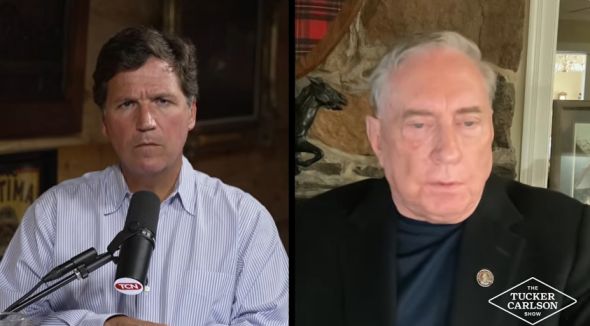
Editor’s Notes: In this episode, Tucker Carlson is joined by Colonel Douglas McGregor to analyze the rapidly evolving war in Iran and its profound implications for the global order. They delve into disturbing reports regarding autonomous AI weaponry and the unprecedented levels of media censorship surrounding the conflict. McGregor offers critical advice for President Trump and explores the potential for a nuclear escalation that could fundamentally “reset” the world. This sobering discussion provides a necessary look at the strategic, moral, and economic stakes of a war that lacks a clear exit strategy. (Mar 10, 2026)
TRANSCRIPT:
Introduction: The War in Iran and Its Global Implications
TUCKER CARLSON: In a moment, we’re going to speak to former Colonel Douglas MacGregor about what is happening around the world in the wake of the war in Iran that began a little over a week ago. And so much is happening, and it’s not exactly clear how it’s all connected.
All of a sudden, you read that Israel is occupying parts of southern Lebanon. Killed a priest last night. Really? What is that? Is that true? You read that there are power outages in Bangladesh. Bangladesh, yes. Asia is suffering. The world is suffering due to the choke point of Hormuz, the Straits of Hormuz, that are closed or semi-closed by Iran and have been since this began. And that’s causing massive downstream effects in markets, in manufacturing and the global economy. How long is that going to last? What’s the end game there?
And then, of course, the war itself, which is playing out in Iran and Israel and throughout the Arab world, really primarily in the Gulf states, but not just the Gulf states. What’s the damage?
The Censorship of War
Well, the truth is, in a lot of cases, we don’t really know because the censorship of this war on social media, and of course, the big mainstream outlets are censored, always have been. But the promise of social media was you could get unmediated information, you could get videos live from the scene, and now suddenly you can’t. That lasted about 24 hours before the clampdown.
And in part, that was by governments. The Gulf states, they don’t want physical destruction of their countries broadcast to the world. The government of Israel has clamped down completely. They don’t want videos of Tel Aviv or Haifa burning. You can, in fact, in some of these countries go to jail for posting that stuff online.
But it’s not just the governments of those countries that are imposing censorship. It’s the social media companies here that are imposing censorship on the American people who are paying for all of this. So they can’t know.
And then there does seem to be a kind of censorship practiced by the US Government around casualties and deaths. How many people have died so far in this conflict? How many? How many have been injured? Where and under what circumstances?
Now, these are sensitive questions in any conflict. And of course, you don’t in any way want to degrade the effectiveness of the US Military. You don’t want to dispirit the troops whom we are rooting for, sincerely, always and everywhere rooting for Americans in whatever theater, in whatever war. It wasn’t of their choosing. In some cases, they are just the people who suffer first and most due to the decisions of politicians, so we’re always on their side and you don’t want to make things worse for them.
On the other hand, Americans do have on a fundamental level a right to know the effects of this war on their countrymen. If Americans are killed, we have a right to know that. And yet there’s some indication that we really don’t.
So as you try to figure out what’s going on, keep in mind you can’t really get the full picture because of the clampdown on information. And so in the conversation that we’re about to have, we’re going to go through what we think we know. In some cases we might be wrong. Just want to be honest about that up front. Very hard to know what the truth is at this stage, really at any stage, but particularly in the face of this kind of censorship. But we’re going to try to be as honest as we possibly can and provide as much information as we possibly can, given the limitations, because this war matters maybe more than most wars.
The Nature of This War
This war hasn’t been settled. Clearly there are parties who would like to settle it, but no one person is in charge of whether it gets settled. Israel is a partner in this war, probably the first war the United States has ever fought with a true partner with decision making authority. It’s very different from going into Afghanistan with a NATO coalition. Norway didn’t have veto power over anything, but Israel does. And so it’s complex, very complex. And the Iranians have their own, of course, completely different agenda. So it may not be settled anytime soon. We’re praying that it is.
But more fundamentally, this is a different kind of war. So over the course of our lifetimes, most wars the United States has fought, all of them really on some level, wars of choice. The US hasn’t been invaded really since 1812. So all these are wars that the US government decided to become involved in or start. And pretty much all of them were initiated on the same pretext, which is we are preserving the order of the world, the international order, the rules-based order, whatever you want to call it. We’re preserving the way things are and this country we’re going to war with violated the rules. Therefore we’re going to war to restore the rules.
That is not what we’re watching.
Nuclear Proliferation and the Real Stakes
Now there’s some evidence that the President of the United States, Donald Trump, thought that’s what this was about.
Of course, the effect of this will be to radically accelerate proliferation around the world. Because what’s the lesson of what we’re doing right now? You better have nukes or else you’re going to get regime changed. No one’s trying to regime change North Korea because they have nukes. So the incentive for every small but reasonably wealthy country as of right now is get nukes as quickly as you can, because you’re going to get regime changed if you don’t, potentially.
And if you’re a bystander to a war and happen to get caught up in it like the Gulf states are right now, no one is going to protect you. These security guarantees, formal and informal, are not real. Downtown Dubai can still get destroyed and your economy destroyed for a generation, because who’s going to stop it? You’re on your own. So countries that feel they’re sincerely on their own have every incentive to have the most effective deterrence possible. And that would at this point be nuclear weapons. So you’re going to see a lot more nuclear-armed states in the next few years, without question.
So if the point of this was to preserve the status quo on nukes, it had the opposite effect. But the point of this was not to preserve the status quo at all. It was to overturn the status quo, to usher in a new age. That’s the point of this war. This is a pivot in history. And a lot of the people supporting it know that.
The Two Groups Behind This War
Now they’re really in two groups. One are people motivated by religious impulse. That would include some Israelis, some religious Jews, not all, but some. And that would include some Christians, Christian Zionists. And both groups believe that they’re helping to accelerate the end of history. Armageddon, the end of time, the return of the Messiah, however you want to describe it. But both groups believe that history is linear. It began in one place and arrives at another with the return of God to earth. And then history ends and we are redeemed or damned, depending. So that’s the basic idea.
And both of these groups seem under the impression that they can force God’s hand, that they can bring this about through an act of will or violence. Which is to say both groups believe on some level that they are God, which they are not. They’re not in charge of history. And you can’t force God’s hand. He’s in charge, you are not. But both groups have lost sight of that.
So that’s their motive. And then there are secular boosters of the war, promoters of the war, planners of the war. And their vision, while not strictly speaking religious, is not really so different. They would like to usher in rule by technology, whether that’s mass surveillance, whether it’s transhumanism, the merging of man and machine, but the rule of the earth by technology. And there are a lot of people who want this and a lot of people who think it’s inevitable. And this is the moment where that age of history begins with this war.
So again, this is not a war that is confined to the region. This is not a war between the United States and Israel and Iran. This is not a war designed to prevent a rogue state from getting nukes. It was never that. This is a war designed to usher in a new age of man, a new period in history, a new world. And so wars like that are fundamentally theological in nature. That’s theology. Whether it’s secular or religious, it’s still theology. These are articles of faith. This is an eschatology. And wars like that aren’t resolved quickly because we’re talking not just about disarming a madman. We’re talking about changing the nature of life on this planet forever.
So big stakes in the minds of the people pushing this. And that means this is going to go on for a while, declared or not.
How Should Americans Respond?
And as it does, how do we respond? Well, we pray. Number one, the most effective thing you can do is to say prayers for peace. Number one. Most effective thing you can do. But two, keep an eye on the effect of this war on us here in the United States. We’re prosecuting this war. We’re the main combatant here. We’re spending the most money, dropping the most bombs.
And how do we do that? So the key really, whether you think this is insane, as a lot of people do, probably the majority of the country believes that, or you think it’s necessary. Some people do believe that. Fox News viewers believe that. Democratic leaders believe that in the House and Senate. But no matter what side you’re on, the United States needs to behave with honor.
Now, why is that? Because that’s the whole point of being the United States. You can’t have wars in a democratic republic, or in a country where the people supposedly rule, where their consent is necessary, whether it is or not. That’s what we tell ourselves. You can’t have wars unless you believe that you are, on the deepest level, better than the people you’re fighting. “We’re not savages. They are. Therefore, we get to kill them.” And we’ve always told ourselves that, and in some cases it has been absolutely true. Whether we can kill them or not is another question. It’s a moral question. But as a sort of matter of civic engagement, the population has to believe they’re better than the people they’re fighting, or else you can’t have the war. And you’re really sort of flirting with revolution at that point, and we don’t want that.
The Bombing of the Girls’ School
So in order to believe you’re better than your opponent, you have to be, you have to behave with honor. And so, for example, if innocents are killed, girls at a school, to name a current example, you have to believe that it was accidental and you have to say out loud that was wrong.
And in this specific case, the bombing of a girls’ school next to an Iranian naval base that was apparently the school of choice for officers at the naval base — these were the children, the daughters of the people we’re fighting. You have to believe that was accidental, despite the fact it was hit twice, 40 minutes apart. Looks very much like a double tap, which is to say a bombing and then an attack on the people coming to rescue the injured. That’s what it looks like.
But as an American, you have to believe this was a tragic mistake. But we have to verify that. We have to know for certain that it was, in order to keep our honor. Because if you wake up in the morning and you’re living in the kind of country that thinks it’s okay to kill not simply military officers, but their daughters, that country is not worth fighting for.
Now, speaking for myself, I am assuming that was a tragic mistake, but it’s important to get to the bottom of it. How did this happen? Were these autonomous weapons that made the decision? Was there an AI program that targeted this school that thought it was something else, or thought it was within bounds, and targeted it, bombed it, and then bombed it again 40 minutes later?
If that’s the case, no more autonomous weapons for us. Should we really be making life or death decisions with a machine, with no human interaction, no human sign-off on that? Of course not. That’s grotesque. To hand the power of life and death over to a machine, that’s just transparently insane. Of course, you would never do that if you were a civilized country. And we can’t do that. Did we do that? We need to find out. And if we did, we can’t do that again. We have to apologize for it.
Honor, Collective Punishment, and Western Values
You can’t kill the children of your enemies. In fact, you can’t kill innocents, period. Because we’re the West and we believe that people are responsible for the sins they commit, not for the sins their relatives committed or their ancestors or their future descendants or people who look like them. We don’t believe that because we believe in the individual soul, each person individually accountable to God and to the US Military for the things he does right and wrong, period.
Collective punishment is the opposite of what we believe. That’s what Israel believes. And that’s why, on a basic level, Israel does not have a Western outlook, because the Israeli government believes it is okay to kill people on the basis of their bloodline. “They are Amalek,” as the prime minister often says again and again and again. “This is Amalek. Kill not just the perpetrator, but his wife, his children, their children, his pets.” This is a theological concept that Christians and the West reject as grotesque and evil. We cannot participate in that ever, because the moment we do, we are not better than the people we’re fighting at all. And we can’t have that. It’s a stain on all of us.
So we need to find out what happened there.
The Question of American Diplomacy
And the second thing we need to do is make certain that the diplomatic efforts the United States made to get to a political agreement before the war were legitimate, that they weren’t a ruse designed to distract and trap the Iranians. Why? Because an honorable nation does not engage in that kind of deceit and trickery. An honorable nation states its objectives out loud, attempts in good faith a political, nonviolent solution, and then if that fails, resorts to force. That’s the American tradition. That’s the Western tradition. That’s not the Eastern tradition. But it’s our tradition, and we have to uphold it.
And as of right now, we have to believe that’s what we did and that it just didn’t work, couldn’t come to terms. And so President Trump was effectively forced by the Israeli government into this decision to go to war.
But if it ever emerges that our diplomatic efforts with Iran, both in February of this year and in June of last year, were fake and they were designed to lull the Iranians into a false sense of security so we could launch a sneak attack on them, how is that better than Pearl Harbor? How is that better than any dishonorable sneak attack in history? Of course it’s not. It’s low. It’s beneath the United States. It’s beneath us as American citizens. And anyone who participated in that needs to be punished for it right away.
And as a practical matter, it makes diplomacy of all kinds impossible. How do we settle the conflict between the United States and Russia, using Ukraine, poor Ukraine as a proxy? We fight the war, Ukrainians die. How do we settle that conflict? By the way, a lot of us wish it had been settled before launching a war on Iran. Because now the Russians are, of course, giving targeting information to the Iranians. Why wouldn’t they? We’ve done the same with Ukrainians, but for the last four years. That should have been settled. But it’s going to be hard to settle it now because the message to the rest of the world is American diplomacy is fake. It’s not real. You send negotiators in, they distract us, and then you prepare a sneak attack on us.
Now, we don’t know that’s what happened. There’s no proof that’s what happened. But we need to find out what exactly did happen. Because you can’t behave that way. That’s a disservice to American citizens if you behave that way. And it makes our future much, much tougher.
Turning to Colonel Douglas MacGregor
So giving the full benefit of the doubt to the United States as a default position as Americans — and we are — we need to get to the truth of that and everything else that’s happening in this war. So with that, we turn to a man who is highly informed on this. Again, we’re feeling in the dark. But we’re going to tell you what we think we know because you need to know.
Colonel Douglas MacGregor. Doug, thanks so much for doing this. So energy markets spiked. Futures spiked last night. Today they’ve come down quite a bit. They appear to be pricing in a shorter war, of the belief that the President of the United States will find what they’re calling an off-ramp and that things will cool down quickly. Is that a good bet, do you think? What’s likely to happen, do you believe?
The Challenge of Justifying Military Action
COL. DOUGLAS MACGREGOR: Well, I think that’s a call that we can’t make at this point. I think it’s going to be very difficult for the President to retreat from some of the more strident remarks that he’s made, not the least of which is his recent demand for unconditional surrender. And we have to remember that from the standpoint of Iran and everyone in the region looking at this, he’s demanding unconditional surrender to Israel and Israel’s demands. So I don’t think that’s likely to happen. And I don’t know how he gets out of that particular box.
You have to add to that lots of what I would call toxic, inflammatory rhetoric about chopping the heads off of babies, which Iranians have not done and have nothing to do with. And I think some statements about deliberately killing children, insisting that the children at the school that was bombed in Iran were deliberately killed by Iran. There’s no evidence for that. And that’s the sort of thing that if you’re looking for an off ramp, that’s not how you find one.
TUCKER CARLSON: So I just, in the intro, said that I don’t think there’s ever been a war led by the United States in which we’ve had a partner with decision making authority, as Israel obviously has done this.
COL. DOUGLAS MACGREGOR: No, I think the British had considerable influence over us during the Second World War. Not because we liked it, we didn’t. We had Britain as a staging base. The island offshore was invaluable to us or we couldn’t have landed on the continent.
I would say something else about your introduction, by the way. After I heard that, if I were a drinking man, I would have had a stiff shot of single malt Scotch because it’s a very sobering introduction. I hope everybody listened to you. We live in a world today that is so remote from the world that I grew up in, it’s almost impossible to recognize.
And one of the things that historically presidents have tried to do — if you go back to Abraham Lincoln — he made a number of statements, and one of them was paraphrased by Reinhold Niebuhr. I’m sure you’ve heard of Niebuhr.
TUCKER CARLSON: Yep.
Linking Power with Justice: A Forgotten Principle
COL. DOUGLAS MACGREGOR: Today nobody studies him anymore, but he was a very thoughtful man, a theologian, a philosopher, and someone who studied international relations. And he quoted Lincoln by saying that the challenge in American foreign policy is to link the contingencies of power with the principles of justice. He said, “You’ve got to do both. You can’t simply justify armed action on the basis of, well, we’re a great power and we’ve decided to do it.” That was unacceptable to him. Now, this was spoken in the 50s, in the aftermath of World War II.
We did a lot of things during the Second World War that we subsequently viewed as having been very wrong. Curtis LeMay famously told his staff, while the war was going on against Japan, “If we don’t win this war, after the war, we will all be executed as war criminals,” because they were firebombing Japanese cities and killing tens of thousands of people. So we do know the difference. We know what’s right and what’s wrong. And I think we have tried to be on the right side of that equation.
The problem is that we haven’t always linked our actions in the way that Lincoln said. In other words, we don’t always link the contingencies of power with the principles of justice. And I don’t think that our attack on Iran is justified. It’s not something that if you put it to a referendum in the United States, people would overwhelmingly support. I think people would reject it. But we’re doing it nonetheless. And each day that it continues, we look less and less justified, less and less legitimate, and less and less moral.
I don’t think that’s something Americans want. And I don’t think a lot of Americans are really paying attention at this point, sadly, because these are things that always happen on other people’s soil, remote from the United States. And so the average American says, “Well, that’s too bad, I’m going to go down to the 7-Eleven and buy a six pack.” That’s part of our problem. We’re a big country and there are a lot of people that have decided, “Well, I don’t have any influence. Doesn’t make any difference who you elect, you still get the same outcome.”
What’s the difference between Tony Blinken and Marco Rubio? I mean, there really isn’t. What happened with Biden? Well, Biden was viewed as this very corrupt and not terribly smart man who was then manipulated by people. Now we have President Trump, and many people are beginning to wonder whether or not that’s also happening to him. So it seems as though we haven’t seen dramatic change from one administration to the next. That’s another serious problem.
But I think your introduction hits something very, very hard that we need to focus on. We need to be concerned about injustice. We need to be concerned about human life. We can’t afford to surrender to the impulse to murder anything that stands in our way. And that’s effectively what Prime Minister Netanyahu and the Israeli state is engaged in.
The Moral Cost of War and the Importance of Decency
TUCKER CARLSON: Well, I mean, anyone who does that will be punished for it. Not just in the next life, but in this life. I mean, that’s just a fact, right, that when you murder people, you are punished. And so you can’t engage in that. And it also saps, sort of, the reason for having your country and being proud of it. As you said, you’ve led troops in battle, you’ve seen war, and you know that for all the ugly things that happen, the United States has made, in general, a good faith effort to remain decent. You know, at the level of like, shooting people — try to shoot the right people. And if we give that up, then you sort of wonder what we’re left with.
COL. DOUGLAS MACGREGOR: Well, I think we need to keep something in mind. Having worked with the Air Force and knowing people who are targeteers — back in 1999, we had six layers of targeteers. In other words, there were like 24, 25, 26 people, all professional targeteers who studied maps, who studied photographs, studied intelligence, and after your targeting had gone through all of these tiers, that’s when the target became valid. In other words, two people didn’t walk in the room, put a picture up on the wall and say, “Okay, let’s blow that up.” No, not at all.
I’m absolutely certain that whatever we did in Iran was an accident. Absolutely. Just as our striking of the Chinese Embassy was an accident.
TUCKER CARLSON: Yes.
Targeting Errors and the Danger of Lying
COL. DOUGLAS MACGREGOR: And that’s not necessarily because the targeteers weren’t doing their jobs. Frequently the photographs don’t tell you everything. Frequently you don’t have the best maps. You know, you should, but they’re not always perfect. You would think at this point, having planned for decades to bomb Iran — let’s face it, this has been on the shelf for a long time in the Department of Defense, excuse me, now the Department of War. So we’ve looked at lots of targets, but this may have been something else earlier or mistaken for something.
But I know absolutely, without question, this was not deliberate. What I don’t like is — if it becomes clear, and I think it will, that what we did was a Tomahawk missile or some standoff munition — we shouldn’t lie about it. This is a big problem. Everybody’s impulse at the top is to lie. And if you do that, you destroy your credibility, not just overseas, but here in the United States.
TUCKER CARLSON: Yes.
COL. DOUGLAS MACGREGOR: So it’s always best just to tell the truth, but that seems to be the last thing anybody wants to tell.
Autonomous Weapons and the Ethics of Machine-Made Targeting Decisions
TUCKER CARLSON: I’m sympathetic to the impulse to lie during war because, even now, I think certain things are true. I don’t know that they are, but I probably wouldn’t say it because there are consequences. So I understand that. I think it’s wrong, but I get it. And I agree with you. It’s impossible for me to imagine that an American would press go on a Tomahawk headed for a girls school. I just can’t believe that. And I don’t believe it.
But I do believe that we have autonomous weapons at work and that some of these targeting decisions are being made by machines, not people. There’s a park called Police Park in Tehran that apparently was blown up because — and you can understand if it was an AI program making these decisions — it says “police” and that’s enough. I’m just guessing. I don’t know why it was blown up, but it was a park. No reason to target it. That suggests that autonomous weapons, that machines are making these decisions. And that strikes me as totally wrong. Tempting, I get it. But is that acceptable to you?
The Danger of an Endless Air Campaign
COL. DOUGLAS MACGREGOR: No, but I think you have something else at work. And I also saw this in the past in another air campaign that is enormous pressure from the top. Give us more targets. We need them now. We have all this equipment, we have all this aircraft, all these ships. They need more targets. Where are the targets?
And at the time we were engaged, we couldn’t find very many valid, legitimate military targets in Yugoslavia. Yugoslavia is not a very developed country. It’s quite backward. And so that’s when you begin to say, well, look, we’ll hit the, you know, this VW Golf factory. Why? Well, it could have military use. How? Well, you know, they could take the automotive parts and it could be put into the army. And this is the sort of mentality that you get and you blow it up. You blow it up because you can find it.
You have multiple bridges across the river. And somebody comes and says, we’re only two bridges there with any military utility. So you get those, then you come back later on and say, well, we got to get, we need more targets. Well, what about these bridges? Well, they don’t really have any. Could it be used? Could soldiers cross that bridge? Well, I suppose so. Blow it up.
And I think that’s what happens over time with air and missile campaigns. You go into something where you don’t have a ground force. There is no long term strategic outcome that forces you to include all the elements of power and to think through carefully your objectives. You’re being told, our job is to go in there and bomb the Iranian government into submission. And that means its 93 million person population is going to be made to suffer until the government relents and surrenders and says, “Okay, we’ll do what the Israelis want.”
I don’t think that’s plausible. I don’t think it’s militarily useful. I don’t think it’s strategically attainable. But it looks to me as though Mr. Netanyahu’s delusions — and you were talking a little bit about this when you touched on the issue of Greater Israel — have now become President Trump’s reality. I think he is fully absorbed, assimilated into the Israeli mentality that this state, these people must be destroyed or bent to Israel’s will, because if they’re not, then Israel will never be safe. And if Israel’s not safe, then potentially we’re not safe.
Well, you and I know that’s wrong. Israel’s safety is one thing, our safety is another. Their interests are one set of things, one set of goals, but not necessarily our interests. Do we have an interest in destroying Iran?
The Lesson of World War II: Thinking Beyond Destruction
During the war, Admiral Leahy, who was FDR’s effectively Chairman of the Joint Chiefs — he was a senior military advisor, he’d been CNO of the Navy, a very, very brilliant man and very experienced — he brought in Arnold, who was Chief of Staff of the Air Force at the time, de facto under Marshall, and General Marshall was Chief of Staff of the Army. And he sat them down and he said, “Do you understand that when this war ends, we actually want to be friends with the Germans and the Japanese?”
And they both sat there with blank faces. And it was obvious to him they didn’t understand. He said, “This war is going to end. You are destroying everything in these countries. This is a catastrophe.”
Well, Leahy was thinking into the future. Is it really in the interest of the United States and our lives to flatten Germany, to turn it into rubble? And of course, you always have people that are eager to hate in the plural and internalize hatred and say, “Oh yeah, let’s get those people. They’re terrible,” and so forth. Same thing. The Japanese attacked us in December 1941. They deserve it, really. We destroyed both countries for all intents and purposes, and then we spent 50 years paying for it. It was called the Cold War because we turned half the world over to communism.
Now we are apparently on the road to destroying Iran. And make no mistake about it, we have the capacity to destroy Iran.
Netanyahu, Nuclear Weapons, and the Limits of Partnership
Now, if this doesn’t come fast enough or we begin to back away from it, what does Mr. Netanyahu do? And I think that’s a question that we need to answer, because he is not clearly under the authority of the President of the United States.
The President is the Commander in Chief of NATO. If NATO goes to war, they look to us — our C4ISR, our command structures and everything — and the President to make final decisions. The British and the French would never launch a nuclear weapon without consulting with us. Is that the case with Mr. Netanyahu, who leads a country that refuses to admit that it has any nuclear weapons? And I would argue no.
So while we may be partnered, this relationship is not an easy one. And we should not delude ourselves into believing that under the worst case scenario, if they’re not satisfied or they think that their country is being finished off — and quite frankly, right now, even though we’re not seeing a lot of footage from Israel, Israel is being subjected to pulverization. The large missiles, the Khoramshahr-2, that landed on top of Haifa and destroyed the refinery, the oil infrastructure. I’m sure the docks have taken a beating. That’s a very important port for Israel. And if we were going to bring troops into the region, we would probably have to come through that port right now. It’s in bad shape. It may get worse.
So is this going to go on and on and on? I think right now there’s no end in sight, because there’s really no strategy other than “we’re going to bomb you into submission.” And a war with no strategy tends to be a war effectively without end. And then if you pour oil onto the fire and say, “Either you surrender unconditionally or we destroy you,” what does the enemy do? What is the incentive for him to surrender to someone who is demanding, effectively, the submission of his country, his people, to a state like Israel that hates them? And they’re well aware of that.
TUCKER CARLSON: Why would the US Government ever yoke itself in a war to a country with different aims, with different objectives? And this is not an attack on Israel, but any country that had a different goal — why would you ever be a co-equal partner with that country?
The Financial and Political Roots of American Entanglement
COL. DOUGLAS MACGREGOR: Well, we concluded in the aftermath of World War I that the Bank of England and the British Empire had enormous influence over us, had misinformed us, misled us — yes, unfortunately, with the assistance of President Wilson. And of course, the man who was his, quote, “Chief of Staff” and National Security Advisor was not even an American citizen. He was a British subject. His name was Colonel House. And that led to conclusions after the war that this should never happen again.
One of the reasons there was so much opposition to going to war in Europe again was because of the experience during World War I. We took terrible casualties — that’s another story — awful, worse, frankly, in a shorter period of time than World War II.
And I think what we have now is a similar situation. We have large numbers of people who are dual citizens, and we have large numbers of people — they call them Zionist billionaires, pick whatever name you want — they have spent enormous quantities of money over many years to reach the condition that exists today, a condition under which Israel’s demands… And you have to link Israel to the larger financial picture, because these billionaires control more than just a fraction of finance. They control the financial system in our country, have a huge impact on it globally, certainly in the West. And they have interests in expanding that power and influence. Israel is a way to do that.
And the Israelis, of course, they see themselves in a position of either “we expand or eventually we die,” because they don’t have enough people, their birth rate isn’t high enough. So they have to annihilate the people that are close to them in their country and eventually on their borders and expand. That means you march into Lebanon. It means you march into the Sinai and into Egypt. It means you go south into Jordan and Saudi Arabia. All you have to do is look at the map. From their standpoint, this is a rational calculus. I just don’t think it’s attainable by them. And that’s why we’re involved, because the only way to attain these goals and objectives is with the enormous power and influence of the United States. And we have committed ourselves heart and soul to this project. It’s as simple as that.
Iran, Nuclear Weapons, and the State of the Union
All you had to do was listen to the State of the Union speech by President Trump. And the one time everybody stood up — left and right, Democrats, Republicans — was when he talked about depriving Iran permanently of any nuclear weapon. And everybody stood up and applauded. And, “I will not allow that. I will prevent that.”
Well, first of all, there’s no evidence that they’ve got a nuclear weapon. We haven’t had any evidence for that for a long time. So is that really what this is about? No, I don’t think so. I think it’s about more than that. It’s also about the missile arsenal that they want to eradicate. In other words, Iran has to live in a state of permanent vulnerability to Israeli attack and destruction. Otherwise Israel is not safe.
Now, many of these corrupt Arab states have accepted that bargain, and they are, in the view of many of the people that live in the region, in Arab countries, as members of the Arab version of the Epstein class. And they’re hated. So when you go to the Emirates, for instance, there are plenty of people living in these countries who privately are very happy to see these people removed from power. These family dictatorships, which are hopelessly corrupt — they’re sick of it.
Global Implications: Witkoff, Kushner, and Russia
So we’re involved in much more than just Iran. This has global implications for power and influence. And it’s no accident that you have Mr. Witkoff and Mr. Kushner as the principal diplomats.
And in Russia, the Russians have sort of looked at this and said, “Okay, fine, we understand you want your son-in-law and you want your friend to negotiate, and they want to enrich themselves in the process — fine, we’ll help them do that. But please, can’t you find your way to an agreement with us? Can’t we hammer out something concrete that serves our interests as well as yours?” And of course, the answer to that thus far has been no. And I think you’re dealing with the same people vis-à-vis Iran.
TUCKER CARLSON: Why would the United States ever allow its own citizens to be killed in order to expand the Israeli empire?
Iran: History, Civilization, and the Path to De-escalation
COL. DOUGLAS MACGREGOR: Well, it’s not an empire. Let’s face it. It’s a relatively small country the size of New Jersey. So I guess if you live in Jersey, that’s an empire. I’ve got some friends who were in the army with me, and they were Italian, and it was an empire. But that’s another story.
I think Americans don’t completely grasp what’s happening, and they have been force-fed for decades a narrative that is designed to depict the Iranian state and its people as the sworn enemies of mankind. And most of all of us, of course, people that have been there, spent any time there, especially over the last 20 years, have come back and said, look, Iran today bears very little resemblance to Iran of 47 years ago. Iran has changed a great deal.
In fact, I think you can make a good case that had we not bombed anybody and stayed out of this, that within the next six months to eight months, the Islamic government would be gone. Because I think the country itself sees it not as this Islamic state at all. It sees itself as a Persian state with a Persian history and culture. Many, many people in that country view Islam itself as an unwanted import from the Arab world.
Now, there are plenty of people who are very religious. There’s no question about it. Most of them live in the rural areas. Very few of them live in the large urban areas. And here’s another interesting insight. I received this lengthy note from someone in the region who explained that when we bombed and the Israelis bombed Tehran, they killed large numbers of people in these, what they called middle class, upper class neighborhoods, who are actually very much in agreement with us that the Islamic government should go away.
I think if left alone, it’ll go that way, one way or the other. But Iran is a nation state. They’re not prepared to sacrifice their sovereignty, put their citizenry at permanent risk, essentially to live under the control of what they see as the Epstein class and on a plantation run by the Epstein class. And that’s the way they look at it. And we don’t see it that way because we’re not thinking in those terms.
The Beirut Barracks Bombing: A Cautionary Tale
All we can do is go back to 1982, talk about these Marines in that barracks that were killed, but nobody knows the whole story behind that business. And I stumbled on this because Cap Weinberger, former Secretary of Defense, his office called, asked me to fly to Washington. He wanted to talk to me about this book I’d written called Breaking the Phalanx, which he liked. And so I said, sure.
I flew back there and I ended up spending instead of the expected hour, I was there for almost two and a half. It was a wonderful meeting. And one of the things that came up was Beirut, because one of the arguments I was making is that if we followed this plan, went to a very small but potent presence in Kuwait and just kept that there, we might avoid any future war in the Middle East. He said, of course. Absolutely. No question about it. Makes perfect sense.
And I said, well, what happened in Beirut? And he said, “You know, that’s an interesting story. I was sitting in my office watching television, and suddenly it was announced that President Reagan had approved the commitment of US Marines in and around Beirut as part of some sort of peacekeeping operation to separate the PLO from the Israelis and so forth.” And he said, “No one called me. Ronald Reagan didn’t call me, didn’t say anything.”
So I picked up the phone and I called the office and I said, can I see the President? And the secretary said, of course, Mr. Weinberger, come over. I’m sure he’d be delighted to see you. He and Reagan got along very well. So he showed up and he walked in the office and he said, “Sit down, Cap. What’s going on?”
He said, “Well, you just announced this. What are you doing?” And he said, “Well, you know, George Shultz was here. He spent a couple of hours, and he convinced me that we had a moral obligation to participate in this peacekeeping force, multinational, that’s going to bring peace to Lebanon and Beirut and keep the Israelis and the PLO apart.”
And he said, “Sir, you’re not going to get that in that part of the world. All we’re going to be are targets. This is a waste of time. It’s worse than that. It’s dangerous. Can’t you rescind the order?” He said, “Well, Cap, I made a public speech. I committed myself and my administration to this. How would I look if I suddenly, within a few hours, announced that, no, I’ve reconsidered it. We’re not going to participate in what this is being billed as a moral mission?”
So he said, “All right.” He said, “Well, I’m sorry, Cap, I should have called you, but, you know, George was here and so forth.” Well, you know, George Shultz, as Secretary of State, was considered on the very liberal side. And Cap Weinberger was furious.
He said, fast forward several months, and I get a call in the middle of the night, and it’s the Secretary. Reagan. He says, the President wants to see you immediately. So he gets up and he finds out about this bombing. He finds it’s coming through CNN and everything else. This time when he gets to the White House, he walks to the door, the door opens, and Ronald Reagan is standing right in front of him. And he walks in, and he grabs Weinberger’s hand. He said, “You know, Cap, you were right, I was wrong. Now we need to get our men out of there immediately.”
TUCKER CARLSON: Yes.
COL. DOUGLAS MACGREGOR: And the rest is history. He did. Now, there were lots of statements about, will track down whoever did this, everything else. But he understood we were blown up because we were there.
Most of the people that we lost in Iraq, and I would argue Afghanistan, have been killed because we were there. And the real question is, why were we there? And I’ve never been satisfied with the explanations. Because if you wanted to remove somebody from power in a place like Iraq, that’s a fairly straightforward operation. You don’t have to kill a lot of people and the army will help you.
Look what was demonstrated in Venezuela. I mean, I think that was a bad decision. But nevertheless, what did we demonstrate? That we could pay everybody off and we could shut everything down, go in and bring out the president and his wife. Fine. Well, those kinds of things can be done in certain countries under certain circumstances. I don’t think it was a good thing. I wouldn’t have done it. But that’s water under the bridge.
Persia as a Civilizational State
Now you’re dealing with a civilizational state. Persia represents much, much more than people in the United States realize. They owe some of their culture and language to Sanskrit and Indian civilization, which is another civilizational state. Russia is a civilizational state. China is a civilizational state. These are foundation stones in the edifice of humanity and world civilization.
Now you want to destroy Persia, which has been around for 2,700 years. Well, good luck. I don’t see it happening. And I don’t think if it even gets close, that the Russians and the Chinese are going to sit there and do nothing.
TUCKER CARLSON: How do we get out?
Finding a Mediator: The Case for India
COL. DOUGLAS MACGREGOR: I think you have to find an intermediary, first of all, someone who is not part of the problem. My personal preference, if I were advising the president, is to call Prime Minister Modi in India. Now you can say, well, he was just in Israel. Well, that’s fine. He has good relations with Israel. That’s not a bad thing. He also has good relations with Iran. He’s never been an enemy of the Iranian people. Neither are the Shiite Iranians his enemy. He knows that. And he has reasonable relations with the Chinese.
They have their differences up in the mountains, in the Himalayas, the Hindu Kush, and that is a legacy of British colonialism. But my point is that he’s historically leading a neutral state, and a neutral state that is growing in stature, in power, in influence and importance. We should recognize that and welcome it, not treat it as a problem.
And I think if President Trump talked to him and said, look, we need to end this. And somebody will say, well, why do you need to end it? Because if we don’t, we’re going to hit $300 per barrel of oil. We’re going to watch 60 to 80% of the stock value crash. People are going to lose trillions in wealth. It will be a disaster. And it’s not something we’ll recover from.
The Economic Catastrophe Already Unfolding
We’ve already seen that. The Israelis hit a refinery on the outskirts of Tehran and what did Iran do? They destroyed the refinery and its supporting infrastructure in Haifa. How does this help us? How does this help anybody? The damage that’s being done is going to be semi-permanent. And by that I mean it’s going to take years to recover from this.
The Qatari government has said we’re shutting down. We can’t store anymore, we can’t drill anymore, we can’t refine anymore. I mean, this is a catastrophe. We look at this and say, well, only 3% of our oil comes from the Gulf. Well, I’ve got news for you. 50% of it goes to India, 50% goes to China. 70 plus percent goes to Japan. Mid 60%, or so, 64, 65% goes to South Korea.
Now, did we call the President or the Prime Minister of Japan? Did we call the President of Korea and say, by the way, we’re considering action against Iran, and we want to know what you think the impact will be on your country, because you are friends of ours, you are our allies? Did we do that? I don’t think so.
I think we are acting like the biggest bully in the schoolyard. To hell with everybody else. This is what I want and I’m going to pound your face into the dust. I mean, we’ve all seen those people. They exist. I grew up with some of them, had the crap kicked out of me once or twice at recess. I know exactly what that is. Well, you can’t do that in international relations for very long before people gang up against you.
BRICS, the Petrodollar, and the Consequences of Recklessness
We already have this thing called BRICS, and we seem to be determined to destroy that because we see BRICS — and right now it has what, 10 members, something like that — and there are 50, 60 standing in line ready to join. We don’t like it because they’re looking at potentially a gold-backed currency. What a novel idea. And if it’s not gold, it’ll be gold, plus maybe platinum, silver, who knows, other precious metals.
And we’re saying, well, this is a threat to us, it’s a threat to our petrodollar. Tucker, we’re killing the petrodollar right now. The Gulf — this is going to end this very lucrative cycle where we buy oil, they take the dollars that they get from us and they reinvest it in our country in a place called the bond market. Not anymore. And that’s one of the engines that drives our economy.
We’ve thrown all caution to the wind. Think of any number of worst case scenarios and they are on the horizon. President Trump is still President of the United States, not President of Israel. And he has to think about the consequences here at home for us, for the average man, not for the billionaire class, the Epstein class, for the rest of us.
I don’t see that we’re thinking this through. And I don’t just blame him, because he’s had wholehearted support from everybody on the Hill. Don’t believe any of those Democrats, from Chuck Schumer to Slotkin, any number of them. “Oh, I was always against it.” Really? Well, you sure as hell aren’t on record.
What Happens Next?
And things are getting very bad. Eventually I think members of his own party will desert him if he doesn’t find an off-ramp. So back to your question. Step number one, find a mediator, somebody that they will listen to, because no one is going to listen to us. If you’re an Iranian, would you pay any attention to what we say? How many times have they been attacked in the midst of negotiations now, twice. Why would the Russians pay any attention to us? This is a catastrophe.
And if we do nothing, eventually we will wake up and discover there are some aircraft in the airspace over Iran. They’re probably Russian, and they probably will put up something similar to AWACS. And if that shows up, then the message is: stop. And the question is, what do you do?
You know, we used to have this thing in the Ranger course. It’s three o’clock in the morning, it’s below zero outside, you’re in the mountains with snow up to your rear end, and somebody walks in and says, you’re now the patrol commander, you’re now the platoon leader. Where are you on the map? What are you going to do now, Ranger? I mean, that’s kind of where Donald Trump is headed. What’s he going to do then?
Israel’s Dilemma: The Nuclear Question
TUCKER CARLSON: I mean, clearly the wise course at this point, since there doesn’t appear to be a way to open the straits using the US Military, is to try and decelerate, to find that mediator. But the hitch, or one of them, is Israel. I mean, if Iran remains intact with a functioning government that is a direct descendant of the previous government that we tried to overthrow — we wound up killing the wife and the child of the current ayatollah — apparently that government will acquire nuclear weapons. Why wouldn’t they? And will dedicate itself even more resolutely to the destruction of Israel.
So I think, why wouldn’t they? They’ve said they will. So if you’re Israel, you cannot allow that. You can’t have a ceasefire and leave this government intact, and that leaves you no recourse but weapons of mass destruction, does it?
The Nuclear Question and Israel’s Desperation
COL. DOUGLAS MACGREGOR: Well, it could. There is also the other possibility, and that is that, as the Pakistani government has said, they will provide a nuclear weapon to the Iranians. Now, the Pakistanis have always had a very close relationship with the Turks, and that’s one of the reasons that Erdogan, who’s the ultimate fence sitter, never quite aligns with anybody. And it’s worked well for him, by the way.
TUCKER CARLSON: Yes, smart.
COL. DOUGLAS MACGREGOR: I don’t think he can do that much longer. Has always said, we’re not afraid of you, because the Pakistanis have made it clear they will have a nuclear weapon if they need it. In fact, the exact conversation was held back under the Obama administration. And I think it was the Deputy Secretary of State who was there, and he said, what do you do if Iran gets a nuclear weapon? And he asked the Chief of Staff of the Turkish Armed Forces, and he said, well, that’s not a problem. He said, why not? Because Pakistan has said they’ll provide us with a nuclear weapon if that happens. Yes.
TUCKER CARLSON: This is your logic, Saudi Arabia as well.
COL. DOUGLAS MACGREGOR: Yeah. And this is your logic playing out exactly what you described. So you really want to stop this train now that’s headed down the side of a mountain and doesn’t seem to have any brakes. So you’ve got to go to someone who can stand in there.
Now, you’ve got to tell this man, what are you prepared to do? Are you prepared to cease fire immediately? Which is not difficult to do because we’re talking about air and naval forces. If you had 7,800,000 men under arms on the ground in a massive army, stopping everything is very difficult. But air and naval forces could immediately disengage, pull back. That can be done. Are you willing to do that? And if you are willing to do that, what should I ask the Iranians to do?
The first step is to get this fighting to stop because of exactly what we’re discussing. It’s going to run out of control. And I have worried from the beginning because I have people in Israel that I cared about very much, some friends, and they’re all angry with me because I’m not unconditionally supporting what they’re doing. And I told them from the beginning, I don’t think this will work. And I do not think this is in the interest of the Israeli state. And I have said, if this goes to the inevitable conclusion, Israel may not survive this.
And I think the hatred, the hostility that is growing in the region, not just against us, but especially against Israel, is just earth shattering beyond anything anybody has ever seen. It needs to stop now. I hear all these people worrying about anti-Semitism. Well, if you’re worried about that, then stop doing what’s going on. That’s the quickest and easiest way to try and bring this under control. No, their thinking is if we kill everybody who doesn’t like us, we’ll be fine.
TUCKER CARLSON: Yeah, that attitude doesn’t have a good track record. That’s self-defeating, I would say. And I agree.
Churchill, Stalin, and Knowing When to Stop
COL. DOUGLAS MACGREGOR: You know, there’s one other thing I’d like to mention real quick. And this was a conversation, believe it or not, that Churchill allegedly had with Stalin. Through an interpreter, I have to understand. Churchill knew Stalin was a criminal and a murderer, no doubt about it. And he certainly did not see him as morally superior to Hitler. In fact, he probably thought he was worse. And Stalin knew that. And he used to sort of jab at him because FDR was Stalin’s poodle. Anything Stalin did was good. And Stalin was morally superior to the British Empire anyhow.
Stalin said to Churchill, “You know what the difference between me and Hitler is?” And Churchill said, “No.” He said, “I know when to stop.” Yeah, he was right.
TUCKER CARLSON: He was right.
COL. DOUGLAS MACGREGOR: Hitler never figured that out. And he vanished. Stalin survived.
TUCKER CARLSON: Yep, until he went too far domestically and his own guys killed him. But yeah, I mean, he lived another eight years. May I ask, what do you think the likelihood of the US committing ground troops is?
The US Military Is Not Ready for Ground War
COL. DOUGLAS MACGREGOR: I think it’s zero. I don’t even know why they maintain the pretense. First of all, the army today is a shadow of what it was 30 years ago. And I hear all this, “Well, I’ve rebuilt the military during my first term.” That’s just silly. Armies take about 10 years to build. That’s what it took us after the Vietnam War. It took us 10 years to build an army. It probably takes 20 plus years to build a navy because building ships and submarines is time consuming, resource consuming, very expensive. Takes a long time to train people.
One of the reasons that Yamamoto attacked Pearl Harbor, he said, was, “If we’re going to fight the Americans, we have to kill all the officers in the United States Navy. So we need to kill them in the harbor, in Pearl Harbor. If we can kill them, it’ll take the United States years to recover from the loss of all those trained officers.” He was right. Didn’t work, thank God. But I don’t think people understand. Civilians have no idea what it takes to build effective military power.
The second thing is a draft. Privately, I would like to have a selective draft, because I think the average young man, not woman, but the average American male who’s got an IQ of 100 or above and is physically fit, should spend a couple of years in the military. I think it’s a healthy thing, but that’s not widely accepted in our country. We don’t like it. The British never liked it. So the idea of this being something good is impossible to convince people to support.
And if you go back, you lived through the Vietnam period, at least some of it. As soon as Nixon ended the draft, suddenly all the demonstrations against the war went away. Now, there were some very sincere people who were against the war for all the right reasons. My point is, the vast majority just didn’t want to go.
TUCKER CARLSON: Yeah.
COL. DOUGLAS MACGREGOR: What’s it going to be like now? Why are we going to Iran? Where is this place? How long is it going to take us to get there? And then we have to look at what’s happened in Eastern Ukraine. Warfare has changed. It’s changed dramatically. We have persistent surveillance above. We can see everything everywhere, all the time. We can target everything everywhere, all the time.
So where are you going to concentrate two or three hundred thousand men? How many ports are you going to get into? How soon are you going to be taken under effective ballistic missile attack? And we already know that however much money you spend on air and missile defense, it’s not going to be good enough to deal with modern hypersonic missiles. Can’t be done. So it’s an accident and a disaster waiting to happen.
We’re not prepared for that. And the nation psychologically is not prepared for it because no one has sold anything to them. We haven’t had any fireside chats from Donald Trump saying, “I just want to spend a few minutes and explain to you why I’m doing what I’m doing.” Have you ever heard that? No. So why would anybody go?
Could Nuclear Weapons Be Used?
TUCKER CARLSON: Do you think it’s possible, since you’re describing a cul-de-sac, a box canyon here. Once again, do you think it’s possible that nuclear weapons are used?
COL. DOUGLAS MACGREGOR: If a nuclear weapon is used, it will be by Netanyahu and his government, not us.
TUCKER CARLSON: Yes. Good.
COL. DOUGLAS MACGREGOR: I’ve met and talked with President Trump. I like President Trump personally, and you can say what you will about the man, but I see no evidence that he would be talked into that by Mr. Netanyahu. I just don’t. I hope I’m not wrong, but I just don’t see that happening. I also see little evidence that people at the top of the military establishment collectively would sign on for that. You might get a few. Unfortunately, most of them are airmen or in the Navy. But I don’t think they would be very supportive. I think they’d say, “Is this really the right place, time and reason?”
Yes, because increasingly we view nuclear weapons as something that protects your territorial integrity. Everybody knows that if you try to invade the United States from Canada or Mexico, we’ll nuke you. No question about it. But why would we do that with Iran?
But Israel is different, as we discussed, and the more desperate they become, if Iran does not submit, and I see no evidence that they will submit, the more likely that option could be embraced and employed. And that’s why we started this, because you asked specifically about who has the authority. I hope President Trump does, but I don’t think so. I think Mr. Netanyahu is going to do whatever Mr. Netanyahu wants to do.
Why Won’t We Bring Netanyahu to Heel?
TUCKER CARLSON: I mean, because we’re implicated in that and because the million odd Americans who live in the region and the energy interest there and just like the fate of the world are all part of this calculation, why wouldn’t we bring him to heel and prevent that?
COL. DOUGLAS MACGREGOR: How do you do that? How do you do that? I mean, you’re going to have all the people that put you into the White House, that spent billions on your campaigns, who gave you the power, and the Congress that is essentially being purchased by the lobby, not by the lobby directly, but by the Zionist billionaires that pour money into the process to get people elected. You know how that works. What are they going to do? Are any of them going to sober up and go to Trump and say, “Look, this has gone too far?” I don’t see any evidence for that.
Military Advisers Who Knew — But Didn’t Resign
TUCKER CARLSON: Before this started, we are now learning, and I think these are accurate reports, that members of the uniformed military understood, advisers to the president understood that the things we were promising we would achieve were not actually achievable, and that this was a very unwise course. They knew that. But apparently none of them threatened to resign if the President went forward. What do you think of that?
COL. DOUGLAS MACGREGOR: Well, we have to understand something about the people in uniform, and I don’t think we’ve ever had anybody that resigned in protest. The only one that I can think of who made his views on Vietnam heard was General Decker. He only served two years as Chief of Staff of the Army because McNamara went to Kennedy and said, “He doesn’t support our policy in Southeast Asia, he won’t put any troops in.” So Kennedy said, “Get rid of him.” So he simply retired at the end of the first two years of his service as Chief of Staff.
But we say in theory, and this is something that goes back to Frederick the Great of Prussia, any officer whose conscience will not permit him to execute an order always has the right to refuse that order and resign his commission without prejudice.
TUCKER CARLSON: Yes.
The Limits of Power and the Path Forward
COL. DOUGLAS MACGREGOR: The problem is we don’t let people go like that. If General Kane were to go in and say, “This is it, can’t do this. I’m tendering my resignation,” he loses his retirement benefits and his pension. So if you’re in the military and you do that, you lose your — whether you’re a sergeant or whomever you are, the law says if you resign in protest over something, you don’t get to keep your pension and you don’t get to keep your benefits.
So it’s really not true. Now, when you move to the civilian side, the cabinet members, what’s to stop them? Nothing. And that’s where the resignations should take place. But that’s the last place I would expect to see any. Even though you and I know a couple of them and consider them friends, I don’t see any evidence for that.
And the theory is, interestingly enough, “If I do this, I poison the waters against me for the rest of my life. If you’re in the military, I’ll never get a job after I leave. No one will hire me in the defense establishment. No one will hire me anywhere.” And the civilian says, “Well, I won’t get any cushy jobs, no bank boards, no industrial concerns. Nobody will have me around.”
It’s a terrible thing because the ones who really have the flexibility to simply stand up and say, “Thank you very much, here’s my resignation. I’m handing it to you right now. As of this moment, I resign.” And you could walk out of the Oval Office and that’s just fine.
Instead, what will happen — if we’re going to project into the future — is if we don’t change course, we’re going to escalate, we’re going to double down. In other words, “Well, if the last 2,000 bombs and 800 missiles didn’t do it, we’ll drop 500,000 bombs and 200 more missiles.” You understand? That’s where we’re headed. Double down, escalate, escalate, escalate.
And then at some point, it’s going to dawn on everybody, this has gone too far. This is dangerous. Either because the Russians make it clear they won’t tolerate it, or the Chinese, or both. Or because they suddenly look at the United States and people have said, “Wait a minute, I can’t put gas into my car. I don’t have a job anymore.” I mean, you just go down the list. Economic catastrophe will visit us. Then all the heroic figures in the cabinet will say, “I resign.”
You know, I never saw a more empty place than the West Wing of the White House and the Executive Office Building right after the election in 2020. That’s what you’d see. Everybody says, “Oh, I’m out of here.”
A System That No Longer Serves the Country
TUCKER CARLSON: Do you think — I mean, you’re describing a system that doesn’t serve the country it governs, and that, moreover, has been revealed as useless, in fact, counterproductive. Everyone knows this isn’t working now. You can’t lie about it anymore. So does that mean we get a new system? After this war, however it’s resolved, however it ends, do you think that there will be structural changes to the country?
COL. DOUGLAS MACGREGOR: I think we have to anticipate something like that happening because government — federal government — is a big part of our lives. I listen to people all the time say, “Well, I want a smaller government.” Well, check your mailbox. What are you getting in the mail? What’s coming into your bank account? How much of it is government? How much of it is federal? People don’t realize that.
What is the percentage of gross domestic product now for the government? Somewhere in the 30 plus percent. Back in 1900, it was what, 2%? You go back before the Civil War, less than 1%. The government was there, but it wasn’t a big feature of the economy and involved in our lives.
You know, General Sherman — and everybody’s heard of Sherman and his Civil War service — he became Commander of the United States Army. In those days, we didn’t have a staff system, so he just was designated Commander in Chief, U.S. Army. And he was so frustrated with the corruption in Washington that without telling Grant, who was then president, he packed everybody in the War Department up and he went to St. Louis. He said, “I’m getting out of Washington.”
And when Grant found out, he said, “Oh, my God. Why did you do this?” He said, “This is a cesspool. It is full of corruption. I hate those people.” And finally Grant persuaded his old friend, “You’ve got to come back to Washington.” And eventually he did.
So this is not an entirely new problem. But in those days the government was not what it is today. It’s very intrusive. It’s a source of wealth. Everybody that is sitting in the various cabinet departments over there, a lot of them have their eyes on money — what comes down the pike, what sort of new generous program, grant or opportunity is presented. And they’re involved, they’re part of this process.
A friend of mine said the other day, “These people are parasitic. They’re like crustaceans, you know, or remora on the body of a shark.” I said, “Well, that’s pretty rough.” But as I said, this is a huge problem. And the American people, when things go very badly for us in the financial system and the economy, they’re going to want answers and it’s not going to be pretty. And this, unfortunately, what we’re doing right now is put us on an accelerated path into disaster, I think.
Was Weakening America the Point?
TUCKER CARLSON: It was so obviously going to happen. It just couldn’t be clearer that there was no compelling national security related reason to do this. That the aims, even the extent they were articulated, were going to be hard to achieve, if not impossible. And that we were dragged into this by a foreign government, which is what happened. That was all so obvious that you have to kind of think maybe destroying or weakening the United States was, was the point.
COL. DOUGLAS MACGREGOR: I don’t think so. But now you’re up against a different problem. There are a lot of people in Washington that do not understand what Stalin talked about — limits. They don’t understand the limits of power. They don’t understand the financial limits of expense. They don’t appreciate debt. Remember, “Oh, this is the new economy. Debt no longer matters.” I mean, I don’t know how many times I’ve had people tell me that for the last 10 years.
You know, after World War II, when Eisenhower was president, what does he do? He shrinks the defense budget. He cuts back on the size of the army, he invests in nuclear weapons. He sees this as a relatively inexpensive way to maintain deterrence. Tries to keep the Navy and the Air Force within bounds, which is why everybody in the services at the time hated him as president. Now why? Well, he understood that investment in military power — there’s no salvage value to what you produce.
TUCKER CARLSON: Right.
COL. DOUGLAS MACGREGOR: In other words, the sunken cost is enormous. He also understood something else. He didn’t want to be involved in wars. Why not? Why would the man that was at the top of the military establishment in Europe not want to be involved in a war?
Well, in January of 1945, he had sent a letter to Marshall and said, “Oh, my God, this bulge is terrible. The Germans have done something we didn’t think they could do. I need more men.” And Marshall wrote back, “You’re not getting anymore. You’ve got all the forces that you’re going to get. You better get out there and win the war.” So Eisenhower learned there were limits to what we could produce.
TUCKER CARLSON: That’s right.
COL. DOUGLAS MACGREGOR: Limits to how much we could invest. And we were not Stalin. We could not pave the road to Berlin with millions and millions of dead troops, dead soldiers and destroyed lives and civilians. So he kept us out.
Now, then you get Jack Kennedy, and later on you get LBJ and Nixon. And these three people were at a very low level during the Second World War, and they were in the Pacific, and they saw these vast fleets on the ocean and aircraft in the sky, and they said, “We’re the greatest country in the world. My God, no one can do what we can do. Our power is limitless.” And Eisenhower always said, “That’s a mirage. Our power is limited. Always.”
TUCKER CARLSON: Yes.
COL. DOUGLAS MACGREGOR: And we have to operate within limits. I don’t see anyone with a sense of that in Washington. No one. Not in the White House. Not anywhere.
Closing Remarks
TUCKER CARLSON: It’s called hubris, and it’s the death of men and empires. Colonel Douglas MacGregor, thank you for that wise summation of everything that’s happening, and I hope —
COL. DOUGLAS MACGREGOR: Thank you, Tucker. God bless.
TUCKER CARLSON: God bless.
COL. DOUGLAS MACGREGOR: Thank you.
Related Posts
- Transcript of Elizabeth Lane Interview on Propaganda Network: Tucker Carlson Show
- Transcript of Justice Ketanji Brown Jackson Interview: IMO Podcast
- Transcript: Mary Talley Bowden Interview on Tony Fauci’s Diary @ Tucker Carlson Show
- Transcript of CIA Whistleblower Jim Erdman Interview: Tucker Carlson Show
- Transcript of Shawn Ryan Interview: Trump’s Betrayal – Tucker Carlson Show