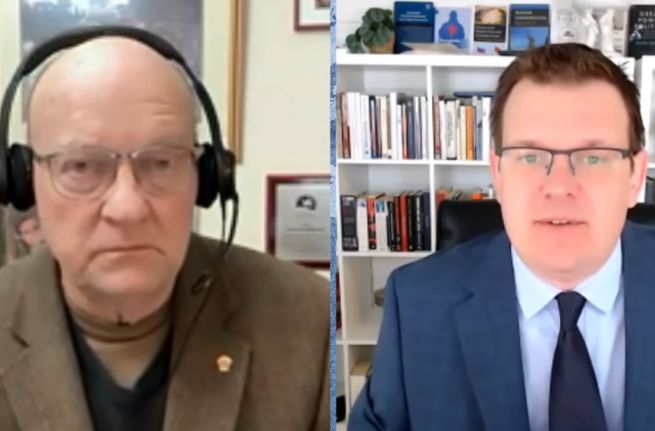
Editor’s Notes: In this episode, Glenn Diesen is joined by Colonel Lawrence Wilkerson, former Chief of Staff to the U.S. Secretary of State, to analyze the fragile state of global geopolitics amid a failing Iran-Israel ceasefire. Wilkerson provides a sobering assessment of the “death” of NATO and the potential for a full U.S. withdrawal from West Asia as the global framework established after WWII continues to unravel. The discussion also delves into the internal decay of the American empire, exploring how domestic polarization and the rise of Christian nationalism within the military could lead the United States toward a civil war. (April 10, 2026)
TRANSCRIPT:
Welcome and Ceasefire Assessment
GLENN DIESEN: Welcome back. We are joined today by Colonel Lawrence Wilkerson, the former Chief of Staff to the US Secretary of State. Thank you very much for coming back on the program.
LAWRENCE WILKERSON: Good to be with you, Glenn. I always like coming to— where is it again? Norway? Sweden?
GLENN DIESEN: Same, same. Well, we have a ceasefire now, at least so we’re told. And it appears to be already falling apart. I don’t want to be overly pessimistic. It could just be a rough start. But given the dispute over whether or not Lebanon should be a part of the ceasefire, it appears that a key component is being challenged. How are you assessing the situation, the possibility of actually arriving at a peace here?
LAWRENCE WILKERSON: First, as a military professional, I have to offer the opinion that I’ve been around a few ceasefires. Both Chapter 6 and Chapter 7 and other things. And it’s difficult. It’s extremely difficult. You’ve got to give the first week or two even to establishing it. That’s the first point.
Second point is with Iran, it might be even longer because they have had a lot of their communications to outlying forces, if you will, destroyed. And so it has to be runner, motorcycle, car, whatever that they deliver the messages. So that’s the first thing about ceasefires that is demonstrating itself here, possibly.
But the second thing, and you insinuated it and it’s more important, there’s no inclination whatsoever of Bibi Netanyahu to stop in Lebanon. Now he is murdering at the rate of 100 or so a day civilians, not Hezbollah fighters, civilians. And it’s kind of a mystery as to why he’s doing it other than Hezbollah itself is handing him another defeat. Just like it did in 2006. Even his own IDF captains are telling him, this is not good. We’re not winning this.
So he usually reacts to that sort of message by bombing the bejesus out of everything he can find. In this case, buildings, hotels, dry cleaners, you name it, all over Beirut and the rest of Lebanon. And so you put your finger on what I think is the greatest impediment, and Iran has made that clear. If it’s not a ceasefire in Lebanon as well as elsewhere, then the deal’s off.
NATO Is Dead and the US-Israel Relationship
GLENN DIESEN: Well, I saw that Joe Kent, he reacted to Trump’s outburst that perhaps it’s time to— well, he didn’t say leave NATO, but that’s kind of the direction it’s going. And Joe Kent tweeted something along the lines that we will leave NATO so we can take the side of Israel when Turkey and Israel eventually clash in Syria. Well, I guess I have a twofold question. Do you see the United States leaving NATO? And I mean, I think NATO now has the most obedient Secretary General ever. But will the US leave NATO, you think? And do you think such a clash is possible in which the US would actually, well, if not fighting the Turks directly, at least push heavy on the side of Israel?
LAWRENCE WILKERSON: I think NATO’s dead. I’ve said that before, I’ll say it again. I think NATO’s defunct. It may take a few months, even a couple of years to die completely so that everyone pronounces it dead and says a prayer over its grave, but it’s dead.
And Trump might not make any formal declaration of that, any formal declaration of the United States leaving NATO. He’s not that kind of guy. He’s not definitive. He’s mercurial and he’s wishy-washy. And it’s very difficult to get a really cogent statement out of him, even more difficult today than it was in the past. So I don’t think that’ll be formal in that sense, but it’ll certainly happen. It’s a fait accompli, I think, already.
Ukraine has put the dagger in its heart, but the dagger was already there when we stiffed Russia after George H.W. Bush and didn’t follow up on our promises to essentially allow Russia into Europe. Every president after that, in his own way, starting with Bill Clinton and 78 days of bombing, paid to that promise. So that’s that.
The other aspect is Erdogan or whomever might take over for him, Fidan or whomever in Turkey, is not stupid enough to make an enemy in your face of the United States at this particular juncture. Were he to be antagonistic to Washington from a distance, as it were, I could buy that on certain issues like the Kurds and Syria and Israel eventually, but I don’t see any burgeoning relationship between Israel other than an antagonistic one.
And if we come off of Israel, which I think we are going to do— remember, I think Israel’s our tool, not the other way around— in the very near future, possibly within the next 18 to 24 months, either as a force majeure move away or a pronounced and solid we’re-through-with-you move away. I think we’re going to. And that’s going to really disturb a lot of these billionaires who’ve been placing their bets on this relationship and pumping money into the Congress and the presidency and elsewhere in the country, trying to persuade everyone that they can, that Israel is essential to the US’s defense in Southwest Asia.
At one point it was, but now we’re leaving.
Take our carriers, for example, which have shown their vulnerability in this conflict. They will not get any closer than that, what we call in the Pacific, the 1,000-mile line. That’s the reality of carriers in this world of drones and high-speed missiles.
The Unraveling of the Post-WWII Global Framework
So we’re seeing a transformation that’s taking place in a number of stages on a number of levels now with this war. In Southwest Asia, which incidentally is what a lot of people like General VanRiper, who did the Millennium Challenge war game in 2002, maybe ’03, and others who have studied this situation have predicted, that this essentially would be one, the end of the US presence on the ground anyway, in any significant way in Southwest Asia, in the Levant even, in North Africa even, and it would be the end of eventually Israel as a Jewish state in the Levant. It could prosper as a democracy were it to be able to achieve that.
And it will probably be the end of even maritime interests in the region since we are now exclusively only dependent on ourselves for both LNG and oil. And the only country that we have that ties us, really ties us strongly to the Strait of Hormuz, other than the global impact on the economy and so forth, were it to be closed for an extended period of time, is Japan. Because Japan still gets much of its product through the Strait of Hormuz from Southwest Asia. That really has been the strategic interest of the United States for some time, not its own petroleum, but Japan’s petroleum.
And that relationship is getting very dicey too at the same time for many of the same reasons colored a bit differently. Korea, the other countries in the region that are beginning to see what we really are, most staggeringly Korea, because I think what I’m hearing from the peninsula is get out of here, leave, the faster the better. But they just don’t have the politicians yet to take that on and do it. Maybe Kim Jong-un might help him a little bit.
So it’s all unraveling. The entire global framework that we crafted after World War II, mostly at our immediate behest, it’s unraveling. Or mistakes, you might say. But it was inevitable. It was inevitable.
As Colin Powell said to me in 1989 at Fort McPherson, Georgia, “They’re all gone, Larry. The Thatchers, the Mitterrands, the Kohls, the Majors, they’re all gone. When they are all gone, and when people who don’t have their feet in the war, even as 12-year-olds, are in charge, the world is going to change majorly, and you’re not going to like it, Larry.” He was right.
The Loss of Qualified Leadership
GLENN DIESEN: Why did he say that? I know why they left. But why are there no qualified politicians replacing them?
LAWRENCE WILKERSON: He had seen, and this is my surmise because we only talked about that specific issue a couple of times over the years ensuing, 16 years, most notably when I was working for him in a private capacity between ’97, my retirement, and his assumption of the State Department along with me and 2000, December 2000, when we were doing things like going to Nigeria to oversee with Jimmy Carter and the Carter Institute the election at that time of Obasanjo, and other things like that, going to Haiti, for example, to see if we could calm things down there. And we had a chance to chat about it again.
I think his principal concern was that what H.W. Bush had started, and even he himself at the end of his term in ’93 had started to befoul the nest of, that is a rapprochement of significance with Moscow, bringing them into the political alliance as well as the military alliance, and then spreading it out into a new European security architecture, which would include Russia. When he was thinking about the possibilities of that actually happening and realizing how fragile the chances were that it would happen, then he saw chaos.
And he saw the chaos not so much because there were no Kohls or Mitterrands— that was part of it, certainly— but because the memory in the population at large, like most memories of cataclysmic events, would be so fragile, if not gone, that there’d be no force, if you will, to keep them together and no force to keep us in their midst. And I think he was right.
The US Withdrawal from West Asia
GLENN DIESEN: So across NATO, we’re fragmenting. As you said, NATO is dead. In East Asia, be it South Korea, Japan, Taiwan, they’re beginning to reconsider some of this alliance system. But how about West Asia? How do you see the United States either leaving or being kicked out of West Asia? And is this because the Gulf states decide the alliance is a vulnerability? Is it that the United States loses interest? Or is the US essentially expelled by, for example, Iran holding on to the Strait of Hormuz and putting crushing limitations?
The Shift of Power in Central Asia and the New World Order
LAWRENCE WILKERSON: That’s a huge question, and I don’t want to conflate Southwest Asia with West Asia in general. And by that, I simply mean I don’t want to conflate what’s happening in Iran and what is going to force us out of our ground positions in the Arab countries, and possibly Egypt too. I suspect Egypt, I suspect they’re going to get tired of us too. And we may get tired of giving them the $3.6 billion every year just to get them to keep the peace treaty with Israel. After all, if there’s no Israel to keep the peace treaty with, there won’t be any money for the Egyptians, no matter who’s there, Sisi or whatever.
But I think it’s different as you go north. You start with Turkey, you have to throw Afghanistan in there, Pakistan in there, of course. You have to throw Western India in there because Western India is very different from Eastern India. You have to throw the Caucasus, I think, in there. You have to look at what’s happening and what is the principal axis for this inexorable shift of power.
And it’s the same principal axis that existed when it came the other way, being to the West and made America, if you will. It’s going back the other way, and that’s the principal axis through Dushanbe, Samarkand, Tashkent, and so forth on into Xinjiang Province in China. And I think that’s going to make that area extremely important, particularly when all the pipelines that are pumping, under construction, envisioned for construction, are finished and oil is moving more or less north-south, south-north, rather than east-west, and fueling these economies to the point that they’re even greater than they are today.
If you look at the economies in Central Asia right now, they are staggeringly successful. It doesn’t matter that they have Nazarbayevs and people like that in charge of them, autocrats basically with golden statues to themselves in the town square. They are very successful. The hotels that we used to equate with Paris and with London, well, sometimes with London. The Ritz maybe would meet that criteria. And then you look at what’s in these cities now, and they don’t even compare. These hotels are magnificent, both in their grandiloquence and in the cost of their rooms and the luxury of staying there.
Central Asia is sitting on top of enough natural gas and oil at a time when the transition is going to have to take place. Otherwise, we’re going to destroy ourselves. But that’s 50 to 75 years probably. They’re sitting on top of the energy in the world that is most important, not least of which is under the Caspian Sea, if they can ever figure out how to deal with that.
So I think those relationships, per force, are going to have to be maintained. South of there is a different ballgame. And I include in the south of there the southern rim of India. And I include Southwest Asia because I think China is going to make sure we don’t come back once we’re out. And I’m confident we’re going to be out, substantially out. We’ll sail battle groups and strike groups and things through the south or through the North Arabian Sea and through the Indian Ocean in general.
And maybe our relationship with the Indian Navy will stay solid. Because though Delhi’s not all that happy with it, the Indian Navy is very happy with operating with the US Navy. They’re learning a lot from it, and the interoperability is growing. That might become so obvious to the civilian leadership in Delhi, though, that it gets curbed considerably. Not to say that India and the United States aren’t going to stay fairly close. They are, I think, just because of China, if nothing else.
But it’s going to be a different world. It’s going to be an entirely different world. And we don’t seem to recognize that, Glenn. We don’t seem to recognize it. And where we do recognize it, we’re fighting it tooth and nail.
Bombing China’s Belt and Road Initiative
LAWRENCE WILKERSON: Look at what we just started doing with the Israelis being the lion’s share of the bombing. We’re bombing the hell out of that railroad that China had finished all the way to the Persian Gulf and was going to come up into the belly of the Caucasus and be its final southern road Base Road Initiative. They’re bombing it. They’re bombing the bejesus out of it now. Every day they’re bombing that railroad.
That’s not because they want Iran to not have a railroad. That’s because they know where that railroad’s going, and that railroad will obviate almost immediately in conjunction with the other four, most of which in some way or other debouch into Europe — north, central, central-south. That railroad will take 60% of the commerce that China now generates, which is probably about 40% of the world’s commerce, off the seas where America has domain, if you will, or thinks it still does, and put it on land. We don’t want that. We don’t want that at all, any more than those Portuguese wanted it when they did it before some thousand years ago.
And drove the Portuguese off the water because they were charging too much for commercial shipping. So they built a land route and the land route was cheaper by quite a margin and it put the Portuguese out of business. We’re going to get put out of business in terms of maritime supremacy because land is going to be the essence of economic contact. And these pipelines prove it too, running north, south and east, west. They’re not over the water. They’re on land.
And I think that’s where we’re going. The Strait of Hormuz, the Strait of Bab-el-Mandeb will still be there and commerce will still be flowing, but not nearly to the extent it is today because we’re going over land because China is saying we’re going over land.
The Revenge of Halford Mackinder
GLENN DIESEN: I feel like this is the revenge of Halford Mackinder, that is the—
LAWRENCE WILKERSON: To an extent, yeah.
GLENN DIESEN: The whole concern of the British.
Russia’s Geostrategic Dilemma
LAWRENCE WILKERSON: Yeah. Look at what Putin’s got to do. He’s got to make a decision here. And I see him thinking about it. Every now and then he’ll make a remark, or Sergei Lavrov will make a remark that leads me to believe that they’re thinking about it and they have people working on it. But which way does he go?
I mean, with the Arctic doing what it’s doing right now, and I just read the latest report, man, are we getting sea ice melt. 4 or 5 times faster than we thought we would. That’s got its own negative ramifications too, but Russia’s got the longest navigable coastline. So all of a sudden, Russia, who didn’t have a warm water port, has a coastline that demands maritime power. So he’s got to make a choice here.
I mean, he’s got significant maritime power, principally in his submarine fleet, but he’s got it elsewhere too. But I suspect we’re going to see Putin building more icebreakers in particular, and he already has a horde of them and other ships that can ply the Arctic as the Arctic becomes more pliable. And he’s going to have to think about becoming, at least in that direction, a maritime power. So he’s going to be both. He’s going to be the world’s biggest outside China land power, and he’s also going to be a maritime power.
And I heard someone the other day, I think it was Doug MacGregor, I wanted to reach into the screen and shake Doug. I wanted to shake him. He said China had no maritime interest. The largest deepwater fishing fleet in the world, 6,000 ships fishing so ardently in the Antarctic that the Antarctic Council had an emergency meeting over the depletion of the krill, the basic building block of protein on the face of the Earth. And so, I mean, China has no maritime interest? Come on, Doug, wake up. You’re too much a soldier. I like Doug, so I’m just saying that because I want to hurl rockets at him.
China does have interest in the deep sea. Very, very integral interest. We get focused on the South China Sea, the Dash-9 Line, Taiwan, and all that crap. Meanwhile, they are fishing all over the world, and they just built the world’s state-of-the-art port on the west coast of Peru, and that’s maritime. So there is an interest there by that state, which is the magnet of all this change, really, because of its economic power.
But Russia’s got a decision to make. Do we go both ways? Do we look east and west? Do we look north and south? Do we just remain a major land power, 10 time zones or whatever? Or do we start courting people in the rest of the world?
And that explains, I think, why Putin seems to have this incredible affection — that’s the wrong term — attraction to Donald Trump, because he’s the present president, however faultily, of the United States. And Putin doesn’t want to destroy that relationship. He’s still looking in that direction. And he’s looking in the other direction too, and he’s looking north. So he’s got a real tapestry to deal with.
And so far I’ve seen, I think, the competence in his administration and the people in general, even in the Duma in some, that can handle this. But can we replace Putin? And can we have a leader afterwards who might be even smarter than Putin or better at dealing with all these multiple responsibilities that are falling on Russia now?
They are the key geostrategic location outside China, and now that they’re tacitly allied with China, they present the world with a tremendous challenge to Europe, in a significant way. Europe has to accommodate them, and learn to live with them and benefit from that living. It can’t fight them. It’ll be destroyed if it fights them. It’ll destroy itself if it tries to fight them. And that’s my big concern about this US approach to China that’s all bullets, bayonets, and sanctions. It’s stupid. It’s just downright stupid.
China and Russia as Both Land and Maritime Powers
GLENN DIESEN: I think unlike the 19th or 20th century, the Chinese and the Russians aren’t — even though they are land powers — they’re not willing to cede the oceans to the United States. And I think you’re right that the Chinese have both the Belt and the Road. That is, they’re going to focus on the sea as well. But the Russians as well, I think they see their territory as important to tie together the Eurasian continent as east-west, also north-south, especially with this international north-south transportation corridor, which the US and Israel is, as you said, bombing now in Iran.
But they also have the ambitions of being a maritime power. You mentioned the Arctic route, of course, but if you look at the way they are flirting with countries like Indonesia, you see that they do have some significant naval aspirations. So they’ve been a naval power, a real one, since Peter the Great at least, and they intend to remain one.
The Monroe Doctrine Is Dead
LAWRENCE WILKERSON: And when they sailed that oil tanker into, I think it made port in Matanzas, Cuba, that was in-your-face, Donald. In the Monroe Doctrine, the Trump Doctrine, whatever you want to call it, call it what you want. In your face. I’m in Matanzas offloading oil.
And also, 2 years earlier when they sent Gorshkov, the frigate, and all my military mates said, oh, that frigate, that’s nothing. That frigate had hypervelocity missiles on it that would sink a US aircraft carrier. In a heartbeat. Kirov, I think her name was. And they sent a nuclear attack sub in there too. So the Monroe Doctrine has been dead ever since they did that, if it weren’t dead beforehand.
So Putin knows what he’s doing. He does it selectively. He does it for real fundamental reasons that are positive for him, and I would argue positive for what I’m talking about. You have to accommodate this power shift, not fight it. Because if you fight it, you’ll wind up in John Mearsheimer’s sandbox with his Thucydides Trap, and you’ll get beaten. But so will a lot of the world.
Adjusting to a Multipolar World
GLENN DIESEN: Well, this is the problem though, the adjusting to the new world. For me, this was the first thing I thought about when I read the article by Krauthammer back in 1990 when he wrote about the unipolar moment, he coined the term, because he had a very rational approach saying, well, so much power is concentrated now, in the future probably the world will have a multipolar distribution of power, and then we’ll embrace that. But it doesn’t work like this because you have leaders who are ideologically committed now to having one centre of power even after realities have changed.
So it’s very difficult. But you have some, even Zbigniew Brzezinski, the national security advisor, he wrote almost a Bible on the unipolar moment with the grand chessboard. However, less focus he gets is on his book on the choice, I think it was in 2012, when he recognised that, well, actually the distribution of power is becoming multipolar. America has a choice, it can either accommodate it and carve out a position as a first among equals — that is a very favorable format for a multipolar world organized by the US — or it can resist it, but then see the rest of the world essentially create a multipolar world in opposition to the US, a balancing, something along BRICS.
And so he took at least some pragmatism with him, but at this point, we already built an ideological structure around us being the hegemony of the West as the foundation of having peace and stability in the world. So there’s no adjusting to reality. I mean, people often leave out the human aspect here, assuming — that’s also a flaw, by the way, in political realism, which both me and Mearsheimer belong to — that is, there’s often the assumption of the rational state, I think. It’s not very rational at all.
The Power of Poetry and Human Emotion
LAWRENCE WILKERSON: And they forget people. They forget people. They don’t read. They don’t read a lot of poetry. I may be mistaken. John and I have never talked about that. I’d love to talk to him about it. Do you read any poetry, John?
Anybody that reads good poetry, and I’m talking about all over the world from Persia to China to, you know, the English poets who we so tout all the time, usually dwelling in the 18th century, 19th century, 18th century mostly. But if you read poetry and you understand what poetry’s power is, then you understand that there is an element to human life that is quite significant that has nothing to do with rationality and everything to do with emotion, human emotion, which is probably one of the most unpredictable things on the face of the earth. You never know when it’s going to go up or down or do this or do that.
Look at economic crises, for example. Most economists who are worth a damn will tell you that the key to a really deep economic crisis is when the people lose confidence in the system. You can take all the statistics and put them out there and array them and say, ooh, there’s going to be a depression, there’s going to be a recession. If you still have the people’s confidence, you can work your way through it. You can just see a few of those things indicating something bad is coming, and the people latch on to that— the people being the majority— and lose confidence in the system, and it completely collapses.
That’s really what happened in ’29 to ’32 in this country when we had a Great Depression. Because if you look at the power indices and you look at what we had, you could see what we were going to do in World War II. You could see why Yamamoto looked at Pearl Harbor burning, apocryphally or not, but very accurately said, “I fear what we’ve done is awakened a sleeping tiger and filled it with a fearful resolve.” He was absolutely right, because he did— as a young captain, he’d been in America. He had seen us from New York to California, from Michigan to Texas, and he knew what we were capable of.
That’s what we’re talking about when we talk about confidence and people doing what they have to do when they have to do it, and doing it more based on emotion than on strategic calculation. Both are necessary, of course, the Mearsheimers and the poets are necessary, but if you forget the poets, you’re lost. You’re going down.
That famous poem by Matthew Arnold, which is not really touted much in the world of literature except by the real cognoscenti— he wrote at the end of the 1800s in the Romantic period. And he predicted everything that’s happening today. And the poem that’s the most emotional in that sense is Dover Beach, where he concludes with, “and we are here as on a darkling plain swept with confused alarms of struggle and flight, where ignorant armies clash by night.” That’s where we are. It’s where we are today.
Of course, he was talking about the Huxley brothers and John Henry Cardinal Newman. Religion dying in the world and science taking over. But aren’t we looking at the same thing today in different clothing? Pete Hegseth is trying to bring religion back, just like John Henry Cardinal Newman did with the Catholic Church. But Newman was a lot smarter than Pete Hegseth.
But we’re still in this same struggle, at least America is, and it’s causing it to taint its foreign policy. Where else do you get someone who calls the Pope’s emissary in and chews him out for what Leo said and essentially tells him— apparently if it’s being reported accurately, and I have sources that tell me it is being reported accurately, sources in the Vatican, that it’s accurate— that in fact we actually suggested we might want to do it. We might want to move the Catholic Church to America like the French did.
That’s how stupid and ignorant we are today. We’re playing in the past with forces that, once unleashed, are extremely dangerous and difficult to get back in check again. And we have an idiot at the top. And we’re in this period that you and I were just discussing, however briefly. This is not the period where you want an idiot leading the country that’s declining against the country that’s ascending. You just don’t, because then you get what John’s talking about— inevitability of a war, and we’re going to lose. We’re going to lose big time. My concern is the whole globe is going to lose because this is going to be nuclear.
Managing Decline and the Rise of Tribalism
GLENN DIESEN: Well, the problem is often when the social scientists put together theories, it assumes it’s the same people when we’re rising as when we’re declining. I think we need more strategies and theories on how to manage decline because when societies are rising, be it economically or whatever, they usually then begin to embrace a very cosmopolitan mindset, openness, all of this. When there’s decline, it’s in human nature, you retreat into the tribe. Then after this, you will have more vicious nationalism.
LAWRENCE WILKERSON: Retreat into paranoia.
GLENN DIESEN: Yes, very much so. So when you’re declining, it’s not just we have to plan for a weaker army, worse economy, but you also have to take into account a very tribal mindset, more angry, more vulgar, more aggressive. And more hateful of adversaries. I mean, I find it often shocking that people don’t appreciate how hateful we have become. I mean, if you open any newspaper and read about our adversaries being the Chinese, the Iranians, the Russians, forget about even discussing rationally what their interests are, but the way they are portrayed— there’s something horribly happening in our societies. We can’t even talk about it. It’s quite fascinating.
The Charlie Kirk Assassination and the Decay of Empire
LAWRENCE WILKERSON: And a manifestation of that, a recent manifestation, not that it hadn’t manifested itself before, was the assassination of Charlie Kirk, which incidentally, Glenn, I don’t know if you’re following it at all, but we still don’t know who did that. We know categorically that the person they arrested, the rifle they have in possession, did not do the assassination. So what are they doing? What is the Trump administration doing with this incident, which doesn’t rival a presidential assassination or even Dr. King’s assassination or Bobby Kennedy’s assassination, but it was an assassination of a leading figure and it associated itself directly with Israel and the US relationship with Israel in a way that many people in the intelligence community in this country think is damning of Israel and damning of its prime minister.
And yet we’re not even looking at it anymore. I can’t even find it anywhere in the press. This is terrible that we do things like this, that we just hide these crimes and push them away when we can’t find a convenient scapegoat. Lee Harvey Oswald, for example. I’m not trying to compare Charlie Kirk with John Kennedy, but it is the same kind of phenomenon. And it’s the same kind of symptom of decay of empire and decay of thinking and decay of brainpower.
You could even go back to the Vietnam War and say that’s where it started significantly for the empire. Anyway, it’s a mess. It’s a mess. And we’re not going to get out of it by fighting our way out, by sanctioning our way out, by challenging everyone in the world to a duel. That’s not going to work.
Israel’s Future and the Gulf States
GLENN DIESEN: Yeah, it contributes to further polarization as well. I mean, if at least there’s openness and investigations, and airing out the troubled problems, then a society can at least organize, find consensus around the truth. Whenever it is hidden, society will always polarize and follow convenient narratives instead.
I did want to get back to something you said before though, in terms of the consequences of the Iran war. You mentioned that if there is an Israel— and I thought, yeah, this is an interesting point because it begs the question to what extent this permanent damage has already been done during this war, which might not be over. I would bet it’s not. But do you see Israel being in danger? And can the Gulf states recover from this, essentially go back to the way things were?
LAWRENCE WILKERSON: I think not, especially your latter statement— to the way things were. I think that’s impossible now. If it’s not impossible at this moment you and I are talking, Glenn, it’s impossible because Iran is going to make it impossible. I think that’s a fatal plea. And I think MBS has already shifted the sovereign wealth fund’s plans away from Israel and towards Syria instead.
In fact, I have it on really good authority that he’s already shifted all that investment he was going to make in a pipeline that would run up through northern Saudi Arabia into Israel, eventually Haifa, and then across to Cheyenne probably. And Israel was going to benefit not only for transshipment fees, but also it was going to get its oil for, you know, now and forever, if you will, from Saudi Arabia that way. Now he’s shifted all of that over to Syria. Quite a decision if it has been made. And like I said, I have some pretty good sources that tell me it has been made. That money is going to go that way now.
Well, that’s going to dry Israel up unless the United States is prepared to fund all of its petroleum from wherever it might come. And that also includes funding them developing the oil field and gas field they stole in the Mediterranean from the Gazans. It belonged to them, but now they’re stealing it from Gaza and the one that they have in their own territorial water or their own economic zone— I forget which it is in the extreme eastern Mediterranean. And they’re stealing Lebanon’s. That’s one reason he wants to go ahead with Lebanon, because he doesn’t want Lebanon ever to recover to the point it could challenge him.
This is all going to go to hell in a handbag very shortly because of the moves that are being made by much more powerful countries in the oil and gas markets than Israel. In fact, Israel has no power in those markets at all except when it can shoot or kill for. And it showed that with Marc Rich and Glencore and all that stealing from Saddam Hussein, stealing from Syria when we had the war with Iraq— the real reason for the war with Iraq. If you’ve read Glenn Gary Vogler’s book and also Dennis Fritz’s book, Deadly Betrayal, you know that the war was fought for Israel as much as anything else, which is why Israel was pitching for it.
So I think their days are very, very numbered. If they were to suddenly shift, to find the political oomph and the political will to shift to a one-state solution that included a truly democratic state— since Likud took over, Israel has not been a democracy. That’s all a farce. But if they were to shift, and if they were to accommodate— despite the power of the wound, as Yasser Arafat used to say all the time— despite that, if they were to shift and have a real democracy that treated its citizens roughly the same across the spectrum of citizens it would then generate, then Israel could survive and Palestine could come back in a significant way. The right of return, the return to the ’67 borders, all the UN resolutions could be fulfilled.
It isn’t going to happen because of crooks like Tony Blair and Donald Trump, but that is something that could happen if we can get rid of this detritus that is plaguing us now. These grifters, these money-hungry bastards— if we could get rid of them and get some decent leadership across the board, including in the UN. A new Secretary General is desperately needed, and a revamping and revising of the UN Security Council is desperately needed. And the first thing I’d do is kick Britain off. I wouldn’t even let Britain be a member of the UN Security Council anymore. They’re just there on our toenails, if you will, standing on our toenails and hurting our feet.
So if we could do these things, we could do them in a decade, maybe a decade and a half, and we could get the world squared away again, as it were, and maybe at least partially salvage some of our reputation and some of our power in the world that we’ve twittered away. I don’t think it’s going to happen. I don’t think it’s going to happen.
Trump and the Contradiction of Empire vs. Republic
GLENN DIESEN: No. I saw a comment by Tucker Carlson today in which he was arguing, why is it that every single president is more interested in governing the world instead of governing the United States? I thought that was interesting, especially when it came to Trump, because I thought he was the ultimate president who would essentially say, “Okay, I will abandon the empire to save the republic.” But I haven’t seen that in any way. If anything, he seems to be doubling down on the mistakes which he was criticizing when he was in opposition, but then follows the same policies.
The Risk of Civil War and Institutional Decay
LAWRENCE WILKERSON: Which in my international relations book, which kind of focuses on Fred Hartmann’s The Relations of Nations, which is a terrific book. In its 6th edition, it’s still a terrific book. Those are small people. People like that are small people. They’re the people that throw the rocks in the cogs of international relations. I like that phrase too. Fred used it at Newport at the Naval War College when he was there lecturing. The relations of nations. Not only is it sort of poetic, it also says it better. What are international relations? Well, they’re the relations of nations.
And one of the first prerogatives of a smart power that it should avail itself of 100% of the time is never have more enemies than you can handle. Look at what we’ve done. We’ve created an enemy out of the whole freaking planet. It’s incredible. The terrible leadership we’ve had since roughly H.W. Bush. It’s probably unprecedented. I can’t say that because there were some really poor times in there, but we weren’t so hard-pressed by international relations and power. But we’ve had some terrible presidents. Probably more terrible ones than great ones, certainly more terrible than the great ones.
But we’ve been damned for a generation here, and we need to get undammed. We’ve been damned in our Congress. Now we’re damned in our Supreme Court too. I was looking at some of the opinions expressed the other day. We have this amendment going to change the Constitution with a very short amendment that would just eliminate the effects of Citizens United and decisions before it, which would be a terrific boon to our political process to get all this black money out of it. And we’ve been stunned at how fast it’s moving. We already have 26 states. We only need three-quarters of the states, two-thirds of the Congress. I think we’re going to get it, and we’re probably going to get it within the next 5 or 6 years, which will be a real boon to our political process. But 5 or 6 years, you can destroy yourself. And with this kind of leadership we have right now, we just might do that.
Hegemony as a Curse and the Question of the Ceasefire
GLENN DIESEN: Yeah, I was speaking to Judge Napolitano, actually had him on this program, and he expects a civil war. So there’s a lot of pessimism going around, but what you mentioned with the institutions all being corrupted under this power is one thing, but also the international system. One should ask whether or not empire hegemony becomes a curse, because if you go back to the 1990s, not only was the US admired by the whole world almost, but the leading foreign policy or strategy by China and Russia was to get along as well as possible with the United States.
I wouldn’t only put the US in this category. The Europeans have been no better themselves. I mean, they were also seen as a preferable partner to a lot of countries, but the way you see now, essentially all of this being reversed, the power diminished, the reputation diminished. I have a feeling if we hadn’t gone down Krauthammer’s path of not just the hegemony of the US, but this effort of having the hegemony of the political West, it could have been very different. But we are where we are.
And I did want to ask you, though, how you see— again, I just want to get back to the ceasefire again to go full circle here. What do you make of this? How do you make sense of this? Because as the ceasefire is now in place, we also see troops being mobilised or sent to the region. Is this just as an insurance, like reassurance? Because in Iran, of course, they’re not trusting, for good reason, much of the diplomacy. They see it as being very deceptive. Is this primarily an effort by Trump to get out of a horrible war he didn’t want to be in, or do you see Trump also buying time for a possible escalation? I mean, it doesn’t necessarily have to be one or the other. It could be trying to end the war or taking advantage to ramp it up. But how do you make sense of this ceasefire?
Two Possible Interpretations of the Ceasefire
LAWRENCE WILKERSON: I think there are two ways to look at it— more than two, but two principal ways to look at it. One, it’s another subterfuge, just like you suggested. And I think probably Abbas Araghchi, the foreign minister of Iran, is looking at it that way right now. And maybe Pashinyan, the president, and maybe the speaker of the Majlis and others too. I would, if I were they.
And that is simply to say Netanyahu’s objections, strenuous— “I’m going to keep my war going in Lebanon, to hell with you and your new diplomacy”— was all orchestrated ahead of time. And he was playing the bad guy, and the guy whose badness would give the impression to the Iranians that this was a genuine effort. And so what we’re going to do is 2 or 3 days from now, we’re going to blow the hell out of them again, or maybe even make an assault on the uranium power.
I think that’s what we were doing earlier. By the way, we lost some very expensive aircraft. We lost some people we haven’t even reported yet. We lost assets in a way that made us look as stupid, really, Glenn, as stupid militarily as Jimmy Carter’s military looked in what was it, ’78 or whatever, when we pulled off Operation Eagle Claw. And we had the helicopter pick up and run into the C-130 in the desert in Iran, crash and burn and kill 8 or 9 people. This was even dumber than that. So that had to be a shock to old P.D. Exet and a shock, as it was reported, to Trump too. But there doesn’t seem to be any dissension there. They’re still working together, sadly enough.
So that’s one thing that could be happening. We could be trying to lull the Iranians again into something where they think we’re going to cease fire, they think we’re going to do diplomacy, and we’re going to hit them again in whatever way we can. That’s one possibility.
The other possibility is we’re serious about this. We’re serious, and Donald Trump finally figured out, after that story broke in the New York Times and elsewhere about how he made his decision to start the war, that Bibi was the sole counselor. Everyone else, from General Cain to J.D. Vance to Marco Rubio— Pete Hegseth was a sycophant all the way— but everyone else was cautioning, and Bibi was saying, “Just do it. You’ll see, they’ll collapse. They’ll collapse.” I think that’s probably a pretty accurate summary of what the decision-making environment was like.
So is he really serious? And being serious would mean figure out a way you can get out of this war and declare victory, and to hell with Netanyahu. If he’s really serious, then we have some hard negotiation ahead of us, and so do the Iranians. I mean, I got their 10 points right here, same 10 points I would have laid out if I were they. Reparations. End of all sanctions, gone from Southwest Asia, all these things. Will that be negotiable? Will they be able to work out something if they do go to genuine diplomacy in Pakistan or wherever they might do it? I think it would, if we had a team on our side led by a president on our side who were serious about, finally serious about stopping a war.
But I don’t think that’s going to happen. I think we’re more likely to find a muddle through, or the first thing I described where we’re trying to fool them again and strike them in the middle of it, or we’ll get somewhere down the road and strike them again because Trump will get mad and angry and realize he can’t negotiate his way out, not in any way that’ll look good. And we’re coming on the midterms, and right now all the polls show the Republicans are going to take a shellacking.
GLENN DIESEN: A shellacking.
LAWRENCE WILKERSON: And I do mean a shellacking. So, if it’s a reasonably free and fair election, which is a question too— if it’s an election period is a question. So we don’t have anything good to look forward to except maybe in the second possibility if some success were to be achieved.
Hegseth’s Purge and the Militarization of Christian Nationalism
And meanwhile, Glenn, Hegseth is preacher packing, I call it— old Southern term. You put the good strawberries on the top and the rotten ones on the bottom. He’s preacher packing the military in all ranks. He’s getting Christian nationalists everywhere he can in the rank structure so that when the time comes for the military to make a decision one way or the other with regard to the elections or whatever, he’ll have at least a sizable contingent in the military that’ll take his side.
GLENN DIESEN: Is that the reason behind all the purge, the firing of the generals? You see this as being, uh, building a Trump-loyal army?
LAWRENCE WILKERSON: Absolutely. And the way he’s recruiting, the states he’s recruiting from, the Christian nationalist counties he’s recruiting from, the evangelical base he’s recruiting from, the conversions at the end of advanced individual training in the Army, for example— they go to the river and baptize 60 or 70 recruits in the name of Jesus and God. You can’t make this stuff up.
I mean, this is something I was watching. You’ve probably seen this movie. Orlando Bloom sort of grew to maturity in it. It’s about the Crusades. Ridley Scott did the movie, and it takes a lot of license with Richard Coeur de Lion and the Crusaders and Saladin and the confrontation between the Crusaders and Saladin on 2 or 3 occasions. One where he takes Jerusalem, of course, and Orlando Bloom is allowed to march the citizens out because he’s been such a great fighter and everything. Saladin has respect for him and all. So it’s Hollywood, but the times and the customs and the actions of the Crusaders are very well displayed. They were there for money and profit. They were there for money, profit, and land. “Oh, I’m here for the Pope. Where’s the Pope? Have you got him here with you? Oh, he’s not here. I’m here for money and profit and land.” And even if the Pope were there, he’d say, “Of course you’re looking for money, profit, and land for the Catholic Church.”
So Pete Hegseth has this warped interpretation of the Crusades. But that’s what he believes. I’m convinced that’s what he believes. And when he gets down on his knees and prays in front of the troops and begs them to get down with him and pray, he’s serious. He’s serious. That’s a dangerous man.
The Prospect of Civil War
GLENN DIESEN: Well, if this is preparing for what could essentially become a civil war, it’s quite troubling.
LAWRENCE WILKERSON: It could be a civil war with different segments warring in it. You could have the Christian nationalists, the Dominionists, the dispensationalists and such, looking to achieve Armageddon a little closer to home. And you could have genuine Christians in there who take to the streets or whatever too, to protest that manipulation of and ultimate denigration of Jesus Christ, because there are some like that who are really getting angry at Hegseth and angry at people like John Hagee sending money to settlers on the West Bank even now.
And there are other people who are getting very, very angry at the MAGA crowd, and some of the MAGA faithful getting very, very angry at the people getting angry with them. So you have the potential for a lot of different people out there on the streets. And we have 400 million guns in this country.
GLENN DIESEN: More guns than people. It’s quite an extraordinary statistic.
LAWRENCE WILKERSON: Some of them were floating across the Canadian border underneath drones. You heard about that one?
GLENN DIESEN: No.
LAWRENCE WILKERSON: These entrepreneurs up there in Wisconsin and Minnesota, they put 10 or 12 Smith and Wesson P38s or whatever under a drone in a bag. They only cost maybe $400 or $500 in the US. They float them across to a buddy’s backyard, drop them in the backyard, pick them up later and sell them in Toronto for $2,000 apiece. It’s the invasion of Canada.
GLENN DIESEN: Yeah, that’s what you get for these new technologies.
LAWRENCE WILKERSON: It’s driving the FBI crazy.
Closing Thoughts: Lebanon and the Human Cost
GLENN DIESEN: Well, thank you for taking time. We’re almost out of time. I wish there would be some more happy news, more optimism, given that the war possibly came to an end and the ceasefire still is in place. One would hope we would have some optimism, but I don’t see it quite yet.
LAWRENCE WILKERSON: But I don’t either. And I tell you, the place I would most not like to be, because I’d probably get so angry I’d get myself killed real quickly, is in Lebanon, where they’re just killing men, women, children, anybody that happens to be under their bombs.
GLENN DIESEN: Yeah. BBC reported on it that Israel had struck Hezbollah command centers across the country, and what you’re seeing is just residential buildings being blown up with women, children, and men scattered. So it’s quite horrible.
LAWRENCE WILKERSON: I have a couple of friends there who tell me that it is absolutely the worst they’ve seen, and they’ve been there for a long time. So they’ve seen a lot of bad times. You don’t know where to go. You don’t know where to turn. You walk out in the street and there’s a bomb.
A Depressing Trajectory: No Course Correction in Sight
GLENN DIESEN: Just feels like everyone can see where this is going and no one is trying to go for course correction. It’s not just the Middle East, you can say the same about Europe. I can see where this is going. That is the war against Russia. This is going to escalate very soon. And it’s just, it’s very predictable where we’re going to go. And again, nothing. It’s quite depressing.
LAWRENCE WILKERSON: There are some people out there with gasoline cans just sprinkling it.
GLENN DIESEN: Yeah.
LAWRENCE WILKERSON: Well, thank you for the time. Thanks again. However morose it was.
Related Posts
- Transcript of Elizabeth Lane Interview on Propaganda Network: Tucker Carlson Show
- Transcript of Justice Ketanji Brown Jackson Interview: IMO Podcast
- Transcript: Mary Talley Bowden Interview on Tony Fauci’s Diary @ Tucker Carlson Show
- Transcript of CIA Whistleblower Jim Erdman Interview: Tucker Carlson Show
- Transcript of Shawn Ryan Interview: Trump’s Betrayal – Tucker Carlson Show