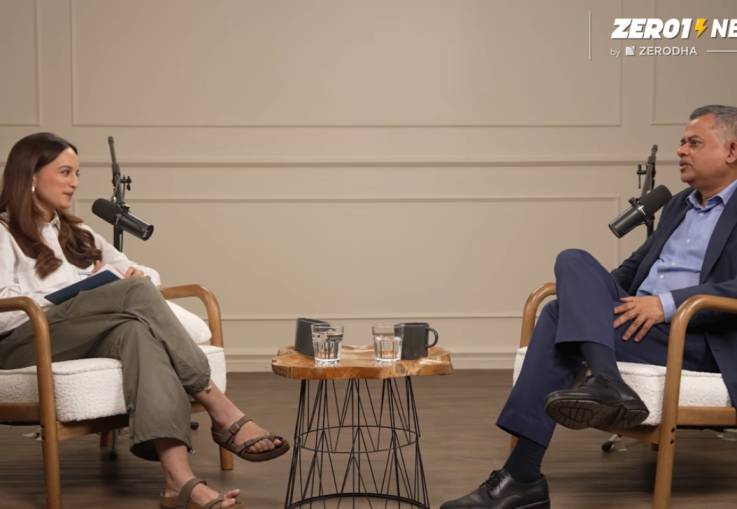
Editor’s Notes: In this insightful episode of “The Money Mindset,” host Sonia Shenoy sits down with Neelkanth Mishra, Chief Economist at Axis Bank, to navigate the turbulent waters of modern geopolitics and its profound impact on the global economy. The discussion delves into high-stakes topics such as the shifting rules-based order, the reality behind Trump’s tariffs, and the strategic maneuvers involving nations like Venezuela and Greenland. Mishra offers a sobering yet optimistic perspective, distinguishing between political posturing and long-term economic trends while providing a detailed outlook for Indian equities and precious metals. This interview is essential viewing for anyone looking to understand how domestic credit growth and structural reforms are positioning India amidst a changing world order. (Jan 23, 2026)
TRANSCRIPT:
SONIA SHENOY: Hey guys, I’m happy to be a part of Zerodha’s media network. Together, Zerodha and I plan to bring to you simple yet effective and impactful news and views from the best minds in the financial world.
Hey guys, welcome to The Money Mindset. Now there’s so much happening in the world of geopolitics that it’s sometimes hard to catch up. So we decided to invite our favorite economist, Neelkanth Mishra, Chief Economist at Axis Bank, here to do a quick catch up with him to understand what’s really happening with world politics and geopolitics. More importantly, Neelkanth, thank you so much.
NEELKANTH MISHRA: Thank you for having me again.
SONIA SHENOY: I think since the last time we spoke, the world has almost turned upside down. There is a lot that has happened. Have you made sense of it all?
The End of the Rules-Based Order
NEELKANTH MISHRA: Yeah, so it’s a continuation of the same old pattern. See, the rules-based order that was established in 1945 clearly is not in the interest of the US. And see, when you are 56% of world GDP, which is what they were in 1945, it makes sense to set up a system that everyone is aligned to and let the world grow, because that’s the only way for you to grow fast, given what had happened in the first and second world wars.
I think they also realized that if you corner some people too much, it ends up in war, which is much more damaging for everyone. So I think people were tired, the world got set up that way.
Now I think what they have realized, and perhaps Venezuela was a symptom of that, that following the rules of the game, it is impossible to corner China. So whether it is trade rules, whether it is rules of capital flows, and therefore even the charade that had to be put up. See, what Trump has done in Venezuela is not very different from what Obama did in Libya. It’s just that Obama and his administration at least tried to put lipstick on the pig that it should, you know, you at least try to make it sound logical.
I think the Trump administration has now realized even that charade is no longer necessary. So yeah, so I think now we are coming closer to the realization that there is a severe power conflict which is on and effectively people’s intentions, I mean, made very clear. So in a way it is a continuation of some of the major themes we discussed in the last podcast.
SONIA SHENOY: So you’re saying the rules-based order now doesn’t hold anymore?
NEELKANTH MISHRA: No.
Trump’s Tariff Strategy and NATO Allies
SONIA SHENOY: That’s interesting because what Trump is doing with the NATO allies, for example, you know, putting tariffs on all of the NATO allies doesn’t make sense to me. I mean, it will eventually result in all the allies going against the US and working out relationships with other countries. We’ve seen what’s happened with Canada and China, for example. Wouldn’t that be a self-goal in a way for the US?
NEELKANTH MISHRA: It is. I think the use of tariffs, I would say overuse of tariffs, and I’m frankly surprised that the Supreme Court in the US has not invalidated the IPA tariffs yet. They will, I think very high likelihood that they will declare that these reciprocal tariffs are unconstitutional, that you can’t have country-specific tariffs.
Now Trump, because that’s his instinct, it is very clear to anyone, and I’m sure there are people in the administration who believe the same, that tariffs actually end up damaging the US, but he’s going ahead and doing it because there are no checks and balances around him.
So see, some of these tensions and some of these readjustments are beyond individuals. The attack on Venezuela would not have happened without the Pentagon’s wish. See, a lot of what happened in Venezuela was about throwing the Russians and the Chinese out. There was no polite way to do it. And I’m sure the defense establishment in the US had been wanting to do it for a while. It is just that under President Trump, they found a regime which was happy to go along.
And so they, you know, the slightly jovial, but of course, there’s very serious stuff. Example parallel that I give is that suppose you’re a high schooler. You know, you’re very good at integral calculus and differential calculus, and some brawny bully comes and sort of troubles your girlfriend. Your calculus is not going to help you there.
So the fact that the Chinese can manufacture cheap electric vehicles and solar panels and are now beginning to catch up on semiconductors is one thing, but they can’t execute the kind of military maneuvers that the US can. And therefore, if you want to make sure that Chinese are out of your neighborhood, you can use muscle.
So the fact that the Pentagon would have wanted, because they would have been observing that these things are happening, that they’re building bases, they’re building business presence there, and there was no way to throw them out while pretending to follow the rules of United Nations and all that, and therefore this attack happened.
What’s happening in Iran?
I think the fact that they don’t know how to establish a new regime which will not destabilize Iran and thus disrupt the 3 million barrels a day of oil production, is perhaps the only reason why they haven’t done more in Iran. Because making sure that using muscle, you can somehow restrict the benefits that China is getting is what they’ve descended to.
The Risk of Global Trade War
SONIA SHENOY: Okay, so fair point, but you know, my question is that is this the start of a global trade war? Because if America is now cornering the Western hemisphere, as we’ve seen with what they’re doing with Venezuela, with Greenland, what stops, say, China from attacking Taiwan and then restricting chip supply to the US and the rest of the nations from doing the same? So are we looking at the start of a big global trade war?
NEELKANTH MISHRA: Well, that’s not a trade war, so that would be an actual physical open world war. Right. So I think that’s, well, look, history is not very comforting on that front. So whenever these major power resets happen, people don’t willingly cede power or cede space. And agreements happen only after people are tired of the bloodshed and the deaths and the destruction.
But at the same time, look, at least when it comes to the Chinese, they don’t have a lot of hot war experience. The last one they had was in Vietnam, which they lost late 1970s. And I think the next aircraft carrier is still a few years away, though, as some people say, the aircraft carrier has gone from being the queen to the king, meaning the queen was where, in the chessboard, on the chessboard you can move and kill anyone. Now the aircraft carrier is something that you have to protect like a king.
So I don’t know how useful it is, but there are many such things that perhaps are still not in place. There are some game theorists who say that the US is pretty much provoking the Chinese to get involved in Taiwan so that they can get caught up there and therefore deplete themselves.
So yeah, so it’s a complex thing, but I don’t think we are likely to see a hot war anytime soon. I mean a big conflagration anytime soon. But history says that any of these big power resets in the past have not happened without significant bloodshed.
Impact on Asset Classes and Indian Markets
SONIA SHENOY: And they’ve not gone down well in terms of even, there’s been a large contagion effect across the world. Right? I mean, sitting here in India you only get to read the headlines. But as an investor you are facing the brunt as well. I mean, our equity markets have done nothing. There’s a lot of volatility. Precious metals have picked up in a big way. So what do you see as the contagion effect of this geopolitical issues have on asset classes like say equities, precious metals, etc.?
NEELKANTH MISHRA: So okay, so the Indian market has not done that well, I think primarily because of the fact that our earnings have continued to get downgraded, I think, and that we are, most of that is behind us. But some of the early earnings reports in this quarter have not been very encouraging. December we had two big companies, airlines and autos, which had substantial earnings cut. So December was also not pretty good.
So you can keep saying, “Oh no, it’s only one company or two companies,” but the Nifty EPS, the downgrades continue to happen. So that’s clearly disappointing.
On the other hand, you have a significant shortage of semiconductors coming up. So memory is clear shortage. People are starting to ration memory chips. You see the renting rates on some of the cloud platforms for some of the most advanced GPUs. Apparently there’s some up 30, 35% year on year, which means that the demand for compute is rising faster than the supply of semiconductors, which means that there is a very strong cyclical uptick. So some of the semiconductor majors are seeing strong upgrades.
So for the world, or look at defense stocks in Europe now that finally it looks like the US has provoked the Europeans enough to get them to stand up and say no visa-free travel, and that we will also start exploring tariffs on the US, which suggests that finally some spine is being shown. But you look at European defense stocks, they’re absolutely flying because the administration there will now be forced to spend on defense.
So there are many such themes which are emerging out of this new environment. The story on India, which is of a pure macroeconomic recovery because we had over-tightened on the fiscal and monetary side, is not yet fully clear to others. I mean I can almost see it happening in the next 12 months, but clearly you need evidence if you’re looking at global markets of whether this will show up in earnings or not. Once it starts showing up, I think the Indian market should start recovering as well.
On precious metals, I think the challenge is slightly different. Of course war and uncertainty never helps because it means that there will be even more fiscal expansion. But for most long-term allocators, the challenge now is that a dollar decline, sometime the next three to five years, a sharp dollar decline is inevitable. There’s no other way that debt to GDP is sustainable or their economy can really survive and compete.
So if that is the case, then currency debasement, people start jumping into precious metals. Some of the stuff that is happening on silver and other base metals is a corollary of what’s happening to gold or is a, you know, the after-effects of, or let’s say side effects of gold going up. So that’s, even if the warlike scenario was not emerging, it would still be that, that would still be happening.
The Silver Question
SONIA SHENOY: So which side of the fence are you on when it comes to silver? Do you see more upsides and it’s still being a lucrative opportunity for investors or do you think that the best is over?
NEELKANTH MISHRA: So yeah, so I’m not precious metals expert, I just view things from a macroeconomic perspective. I think the market’s instincts on silver are somewhat vestigial. Meaning there was a time when gold and silver, I mean many countries had dual currency kind of system where silver was for day-to-day transactions and gold was for more higher value transactions. And at that time gold and silver used to be in a fixed ratio. That era is long gone, 135, 40 years. But still that vestigial instinct remains.
So people look at the gold-silver ratio and say, “Oh God, it’s going so high, so now silver has to catch up.” The difference between gold and silver is that gold is inelastic to demand. The prices, the supply and demand are inelastic to price, meaning that even if prices go up, it’s not that a lot of gold will suddenly appear out of somewhere and there is some period of digestion. But gold prices go up, after a while, people kind of adjust to the higher prices and so demand doesn’t get that badly affected.
Silver has a lot of industrial use. So if prices go up, demand goes down. And silver also is much more available than gold is. And therefore as prices go up, supply goes up. So therefore I think silver is less of a metal than gold when it comes to acting as a proxy for currencies.
But at the same time, when the crowds are rushing in, they can push up prices. So prices go up because everyone else thinks that prices, and to some extent gold is in a similar boat. But silver, therefore, for me, I mean the striking thing was that after a month back it had recovered its 1990s levels. So there’s a big lesson in that comment that you can have very speculative upturns. It is completely speculative. You have to be very sure of that. You will be able to exit at the right time. And so yeah, so I’m in this case.
SONIA SHENOY: Silver is not as speculative, right, because there is definitely higher demand than there was 10 years ago. Everything now needs silver, whether it’s EVs, whether it’s solar cells and all of this didn’t really exist in such large quantities, say 10 years ago. So it’s not speculative in that sense. It’s more demand-led, right?
Silver vs. Gold: Understanding the Speculative Trade
NEELKANTH MISHRA: Not really. So if you look at the… well, there is a lot of merit in what you say, that there are new uses of silver that have come up. But when you think about it as a comparison to gold, it’s mostly that: is silver a proxy to a currency? Because that’s the trade that people want to play.
See, the demand-supply argument on copper is much stronger because copper usage is actually going up, and by a substantial sum. In gold, maybe silver lies somewhere in the middle. In gold, say if Indians are buying 550 to 750 tons a year, or central banks are buying 800 to 900 tons a year, all of that is currency proxy.
In silver, I’ve forgotten the global volume of silver being sold, but I won’t be surprised if the actual industrial used demand is maybe less than 10% or 5% of the incremental demand for silver that is being seen. Almost all of it is speculative. The rest of it is that you’re buying it because it can go up, or that gold has gone up too much, so let me push up silver now. So I’m less of a fan of silver. This is not to say that silver prices start tanking tomorrow.
SONIA SHENOY: So if you’re an investor in 2026 and you want to take some allocation to precious metals because of what’s happening—not precious metals, metals in general—between silver, gold, copper and all the others, zinc, where do you see maximum potential now?
Gold and Copper: The Preferred Bets
NEELKANTH MISHRA: Look, I think gold and copper would be my preferred bets. Again, I must give a disclaimer that I used to be a metals analyst. I’m no longer one. So my instincts are not as finely tuned as they used to be.
Now, the reason why I say so is that the debasement trade is going to run for many years. So it’ll be many years before we can safely say that gold is done for this cycle. Whether $4,600, $4,700 is the peak for this year or not is a harder call to make. That’s not something that I’m very trained for or track regularly.
My colleagues think that it can touch $5,000 this year, which could happen. But when everyone around me is doing the same thing, my market instincts tell me that it’s the wrong thing to do.
SONIA SHENOY: Your contrarian hack.
NEELKANTH MISHRA: Yeah, exactly. So, but sometimes, you know, just because you and I think, or the 500 people that I meet maybe every month are all, you know, the financial elite, maybe they are not the big buyers. Maybe there is a much deeper penetration of that information before gold really peaks out.
But gold is a precious metal which I think in the next three to five years, there is significant further room for upside because currency debasement—there is no alternative.
Understanding Currency Debasement
SONIA SHENOY: So can you tell me a little more about currency debasement? Is it similar to what we spoke about earlier about de-dollarization?
NEELKANTH MISHRA: Yes, but it’s not de-dollarization. It is the fact that the US does not have a way out of its economic issues without significantly devaluing the dollar. And the challenge is that the real effective exchange rate is too high.
I mean, simple parallels: someone wrote that it’s cheaper now to fly to Disney World in Japan, spend a day there and fly back than to spend one day in Disney World, Florida. Four Seasons Hotel, apparently in New York is $1,120 a night. In China it is $250 a night. Most of East Asia, North Asia, it is at those levels.
SONIA SHENOY: But that was always the case, right?
NEELKANTH MISHRA: Not always the case. So there is a clear… I mean, this kind of differential even on things… you need to then really start doing really high-end stuff, which frankly is not something that the US is gearing up for by destroying its research and all of that.
The second aspect is the primary income, which is: as a country, what do you pay on your foreign liabilities and how much do you earn from your foreign assets? They used to have a positive primary income despite having more liabilities than assets. Now it has become negative.
The only way minus 90% of GDP worth of excess liabilities can be corrected is by devaluing the currency. So there are many arguments which warrant that decline. And the only challenge right now is that if you want to devalue your currency, against whom?
Because the Japanese are on a different tangent—clearly fiscal—and you know, Takaichi-san with the new election, she wants further support and you can see that in where the yen is headed. The Europeans need to get their act together. So who will they fall against?
And therefore there is effectively now competitive currency debasement. And will the Chinese allow their currency to appreciate a lot? One or 2% change is not going to solve the problem, which is what they do and everyone starts celebrating. But the USD-CNY is not the right proxy.
So if the Chinese currency does not appreciate strongly against the US dollar, then we are in a game where everyone is trying to devalue against everyone else. And then people try to find proxies like gold, which more than just the tech bros who want crypto, you know, it’s conventional and therefore because more people believe in it, the more it goes up.
So precious metals, there’s a strong story over the next three to five years. One year, I’m not so sure.
Base Metals and Industrial Demand
On non-gold precious metals, again, I think the fact that there is actual industrial usage is a negative because that usage, that demand will come off. If silver has gone up so much, imagine using silver for any actual product and there is adequate supply. Like you know, lead and silver are found together. So you have a lot of silver. So all of the lead miners are now ramping up the silver-lead output because they can get more silver out.
On the base metals which are financially traded like LME-traded copper, aluminum, zinc, lead, tin, nickel, there will be an impact where people try to hedge the debasement trade through purchasing large sums of these metals. So that will and has already started showing up in some of these prices.
The only challenge for some of these metals is that there are fundamental drivers of the change as well. So for example, aluminum is effectively like packaged energy. So the whole competition between the US and China is going to be: bring down energy prices so that the Americans can be more competitive.
As of now, of course because of the winter in Europe, gas prices have gone up. But one of the reasons possibly for the US to want to end the Russia-Ukraine war is to get Nord Stream 2 restarted so you can get… one of the reasons to not disrupt Iran more is so that oil prices don’t go up further.
So if energy prices are going to be contained, then there’s enough bauxite in the world. Frankly, I think aluminum at $3,200 doesn’t make a lot of sense to me.
Copper is different. Copper, the ore grade that you now need to mine, the cost curve, a lot of other things and the demand increase that is happening because of all that we see… similar stories on zinc, lead, nickel, tin. I think there are stories there.
On the ferrous metals, there is less of speculative interest because the volumes are much higher. At their peak, of course the Chinese have managed to speculate on that also because, you know, to keep one ton of iron ore you need a lot of space—meaning not one ton, $1 billion of iron ore, you need a lot of space, right, because it’s just $100 a ton. So it’s very hard to speculate in that.
We are currently going through an inventory restock cycle in India and the rest of the world. So steel prices are holding up. There is a trade there. But once the monsoons hit in China and India, the summers… so you have to trade around steel on seasonal and cyclical terms. There is no secular upturn that you can expect just because there is debasement of currency happening that steel prices will go higher.
The Pain in Indian Equities
SONIA SHENOY: Okay, so that’s on metals, right? And on commodities in general. But coming back to equities, this has been a very frustrating, painful period for Indian equities. If you take the last one, two, even three years, I was looking at some of the data. Most of these large caps, these bluest of blue chips, right? Reliance, ITC, HUL, Infosys, TCS, have done nothing—3%, 4%, 5% maybe in the last three years. I’m talking about stock performance.
Even if you look at earnings, single-digit earnings growth. Now we are seeing what’s happening with IT companies, et cetera. So for a normal average retail investor, it’s a period where they’re kind of losing trust in equities. And now with precious metals going up, a lot of people even talk about moving the equity portfolio to precious metals. I know there is a recency bias which is hitting a lot of people as well.
But what’s your take? Do you think that there could be a lot more pain before things get better in equities?
The Case for Equity Recovery
NEELKANTH MISHRA: Another couple of percentage point drop in the Nifty is possible in the near term. How the herd behaves is very hard to say. But as I was saying earlier, I think the economic recovery that is underway should be supportive of roll-forward gains in earnings.
And this is something which is worth reiterating. I often talk about it: look, in January 2026 we have three months of FY26 and nine months of FY27. The 12-month forward earnings is structured this way. In January 2027, if nothing else changes, we’ll have three months of FY27 and nine months of FY28.
So as of now, FY27 is supposed to be 15% higher than FY26 Nifty EPS, and FY28 is 14% higher than FY27. So give or take, you should be 14% higher if nothing else changes.
The problem has been that between October 2024 and October 2025, we saw a 13% downgrade in index EPS for any given year. So all the roll-forward gains were offset. Imagine that FY27 from current levels is brought down by 14% and FY28 also is brought down by 14%. So then you will be in January 2027 and your 12-month forward EPS is the same. There is no justification for the Nifty to go up from here, which is kind of what has happened.
So the period that you’re talking about, the ultimate painful period, is a period where your forward EPS just stopped growing. So you’ll see there’s a nice upward slope and then there’s a flat line.
Now the expectation I have is that with the economy now reviving and picking up momentum, the earnings cuts are not necessary going forward. And therefore what appears as 14% growth if things don’t change is deliverable.
So if you are, even if say the Nifty remains at 25,500 one year out, and you are currently at say, whatever, 21, 22 times forward, you will be at 18, 19 times forward even if the market has not done anything, which means that it is much cheaper and more attractive and some stocks will be much more attractive. So at least that time correction would have happened.
The painful part about the last 15 months…
SONIA SHENOY: Has been that nothing has happened.
NEELKANTH MISHRA: Nothing has happened.
SONIA SHENOY: But your base case is that the economy is reviving. But what makes you say that? Because it doesn’t feel like that on the ground. I mean, jobs is an issue. You know, growth has barely picked up. Look at this quarter’s earnings, corporate earnings, not great.
Signs of Economic Revival
NEELKANTH MISHRA: The December quarter cement volume growth was 8 to 9%. Now the thing about cement is that you can’t eat it, you can’t store it, you have to use it now. So if you are using it, you are using it with sand, with steel, with labor, with equipment. So if so much of cement is being consumed, all the other things are happening as well.
SONIA SHENOY: So it’s like a barometer of growth.
Credit Growth and Economic Indicators
NEELKANTH MISHRA: Yes. So it is a very strong parameter of construction, which is why GDP also uses cement volumes as a good proxy. We are seeing credit growth revive very strongly now. I think the second fortnight of December, the reported numbers of course jumped up atrociously. So I think 14.4% was the number. So from a 12 handle you went to a 14 handle in like one fortnight.
There were one-offs there, meaning the last three, four days of the quarter. Generally a lot of credit growth happens in every bank. It’s like the classic sales push that happens in any organization. So that happens in every bank as well. So the fact that this time the RBI shifted to a calendar month end, normally they would do fortnight as a weekend. This now they’ve said that no, we’ll do 15th and 30th or 31st. So that I think played a role.
There’s been some share gains versus the bond market, ECBs, external commercial borrowings. But by and large there is now good demand for credit coming up from the large corporates and the MSMEs. And you are seeing all of this excitement in foreign interest in NBFCs and banks. You’ve seen very large transactions.
So I think that there is significant scope for system credit growth to accelerate. So my team believes that system credit, so which I’m talking about not just banks, but also NBFCs, bonds, ECB, all put together can go from 13% this year to 15% next year. Now if something that significant happens it will show up in GDP growth because no one borrows money to keep it in their pockets. So they will end up spending it, investing it.
So I’m reasonably confident. Of course it’s a large and complex economy. You can always get surprised. One big fear that people have had that the US tariffs will affect the Indian economy significantly. Now we have evidence that we have been saying that for a while.
SONIA SHENOY: You know, it’s not going to affect.
India’s Export Resilience
NEELKANTH MISHRA: Yeah, because people are saying 50, 60 basis points. What happens if you 50%. So September, October number just to give you numbers, FY22 to FY25, export growth in goods in India was annualizing at I think 1.3%. So it had slowed substantially. So FY20 to 22, it’s. So of course there was Covid year and then the post-Covid recovery was very strong. But after that things kind of stagnated.
Despite the tariffs in the September to November period, the growth was 3% year on year. And even to the US the export growth is actually better than what used to be last year. So I mean I frankly. And once you start digging into the causality or at least sector by sector analysis, what you realize is that there are sectors where the Indian exports of the US are exempt, meaning electronics, pharmaceuticals, petrochemicals, like data center inputs and all that.
There are sectors where India does not have a specific disadvantage, which is what they call the section 232 tariffs where the US says that every country will be at 50% import tariff. Then India doesn’t have a specific disadvantage so long as the Americans can’t produce it. Indian companies can go and sell like steel. You would have seen how US farmers are the worst affected because farm equipment became more expensive and because steel has become more expensive. So on those sectors also India is not badly affected.
The stuff that was pure commodity like shrimps or ores and minerals or even commodity like inputs like say apparel. There is already evidence of significant diversification, meaning that what shrimps were being sold in the US are now going to Europe, going to China, to Japan. The shrimp exports were up 16% year on year.
So there are some segments which are somewhat affected, but even there, like look at auto components. If you’re selling to a global major, it’s unlikely that you are the only supplier sitting out of India. I mean that there are other suppliers from the rest of the world. So if your factory was used to target some US factories, they will target some Thai factories and the Thai component can then go up to the US.
So see, the businesses are much more robust and creative than states. So putting all this together, I think some of. And services exports continue to grow double digits. So putting all this together, I see no reason why we should be unduly worried about India’s economic growth.
SONIA SHENOY: So India’s domestic economy, okay, it’s still, growth is still quite stable. But coming back to where we started. Right, Putting your economist hat on and looking at it from your vantage point, if this entire growth, you know, this whole piece sort of comes apart through 2026 because of what’s happening with the tariffs and with the allies and you know, if growth suffers, do you think there could be a contagion effect across the world and will that drag India down with it as well?
Political Posturing vs Economic Reality
NEELKANTH MISHRA: Well, first, I don’t think those disruptive changes are likely, meaning that what we have seen over the past year is that the political establishment in both China and the US which are the principal protagonist, I mean, the rest of them are kind of collateral damage or roadkill as they say. Though of course, no one is dying here.
Both of them seem to have limited appetite for economic pain and therefore there will be a lot of posturing, a lot of shouting. But when it comes to actually things that hurt you, because the US has the midterm elections this year, I think their appetite for significant economic disruption is very low. So there’ll be a lot of posturing. See, if you’re a bully, you say, oh, I’ll do this, I’ll do that. But the moment someone.
SONIA SHENOY: The barking dog.
NEELKANTH MISHRA: Yeah, exactly. So, and therefore, that was my.
SONIA SHENOY: First question to you. If there are midterm elections, if they’re coming up, then why would the US, Why would Trump make all these statements? It’s almost seeming like a self goal, right? The US has more to lose.
NEELKANTH MISHRA: That’s logical. What you’re saying is absolutely logical. But what he’s playing to is his support base. So from what I gather, and maybe my information is not correct, but apparently Maduro wanted to just escape and said, you guys do what you want to, because they had put a whole armada in front of his small country and he knew what was coming.
So he said, you know, just give me a safe exit and things will be fine. You can do what you want. But the US administration wanted that drama because it makes them feel strong and it feeds into his approval ratings with the MAGA crowd. So almost all of it is about domestic politics.
And given that on Greenland there is some history of the Greenlanders not being happy with Denmark, that the US has tried in the past to acquire it. And again, 59,000 people are neither here nor there. So it becomes more like symbolic for him to make a move. I’m not saying it is doing the right thing. I think it’s completely immoral. But the fact that he is doing it, I think limited damage.
And, you know, if it comes down to say, spending a million dollars, telling all 59,000 Greenlanders, give you a million dollars each and make you US citizens, it costs $60 billion. They all vote in a referendum. So what I’m saying is this is just again, a lot of noise, which actually has very limited global economic impact.
So when we think about. In fact, that’s a very important message that I would like to leave your listeners that, you know, there will be. It is the role of a politician to stay in the limelight, to make a lot of noise, make a lot of song and dance so that. Just to show that it’s all about you. But in reality, the world doesn’t move like that.
So you look at global trade to GDP has risen this year. So we do a global trade aggregate. In the month of October, global trade in nominal terms is growing faster than nominal GDP. Now, whether it is China dumping somewhere or someone importing from somewhere, trade is happening. So you would think that with all of this disruption that somehow trade has come to a standstill. It is not.
SONIA SHENOY: So do you think all of this is just posturing at the end of the day?
Shifting Geopolitical Dynamics
NEELKANTH MISHRA: Well, there is some, you know, changing geopolitical dynamics and come back to the basic question of US and China sort of creating space for each other now, have they come to a G2 agreement where the Trump administration says, you know what? This is mine. It’ll never be declared as this is mine. It will be more signaling that, look, I do what I want in the western hemisphere and I can’t leave everything in the Eastern hemisphere to you.
But if you want to sort of go and acquire some parts of Siberia, if you want to sort of take over Taiwan, establish more points in the South China Sea, East China Sea, go ahead. I will not counter it. So there are people who fear that, or that maybe when they went and met in Korea, perhaps they discussed some of this, which I think is unlikely. I mean, there are people alleging that. So there is stuff which is moving, but it is moving way more slowly.
SONIA SHENOY: Than it’s out in the media.
NEELKANTH MISHRA: Yeah, exactly. So it feels like, oh my God, something is breaking apart. But you realize that therefore in our outlook note this year we had no discussion of global geopolitics, no discussion of global trade deliberately. It’s not that we don’t track it. It’s not important.
SONIA SHENOY: So what is important according to you, for investors who are tracking their portfolios and constantly worrying about what to do?
Key Focus Areas for Investors
NEELKANTH MISHRA: So how quickly can we get credit growth up? How quickly can we get this periodic liquidity disruption? See this sounds very nerdy, but these are very important issues. Like, you know, in the month of January we have the liquidity cost spiraling up. So last year there’s a measure of liquidity, we call it the CDY spread, but I’ll spare the nerdy jargon there.
But it’s like, you know, if markets have sufficient liquidity, then that cost should be 50 basis points. It was at 150 in March 25th and we all said, oh my God, so high. And March is the tightest liquidity month of the year. In January this year that is now 175 basis points. And a large part of that is because the government’s cash balances are bloated. The government’s issuance is so bad that long term costs are too inflated.
So there are many of these seemingly technical but extraordinarily important developments that we need to adjust for. The pace at which land is getting cleared, the pace at which national highway tendering is happening. Can you believe that in the first nine months of this year there’s been less than 2,000, maybe less than 2,500 km of national highways bid so that tendering can be accelerated. There is so much of urban infrastructure projects that need to get done. So there are many levers that can be pulled.
And what is remarkable and very positive is that the government, both center and state are out and out for reform. So there are remarkably positive shifts that are happening. Like you know, state governments, seven states last year allowed women to work the night shift. Now imagine that if you are expanding a modern trade outlet to sweat the real estate, you need to keep the shops open till 10, 11pm and you couldn’t hire women legally.
I mean, I’m sure many people were still hiring them and by bribing the labor inspector, but now you’re legally allowed to do it. You can expand beauty salons, restaurants and hire more women to run the shop. And the penalties, the decriminalization, a lot of momentum is there. So there are quality control orders being rescinded.
So these reforms are really structural basic stuff which perhaps should have been done 20 years back but it’s finally getting done and it’s unlocking a lot of potential in the economy. So I would be quite positive in terms of data points. We see one or two more months of this credit growth and I think there will be significant comfort that at least the momentum is there.
SONIA SHENOY: Okay, that’s important. But thank you so much for joining us. It was really wonderful to learn from you as always. And like you said, right a lot of the lot of times it’s just a smokescreen and it’s kind of a facade or maybe posturing. So don’t take it too seriously when it comes to your portfolio. I think looking inwards, looking to domestic growth that’s I think the better way to look at it from a retail investor standpoint. Okay. Thanks a lot for joining.
NEELKANTH MISHRA: Thank you. Thank you, Sonia.
Related Posts